Introduction
As early as the 1960s, archaeological investigations in western Iran—inspired by the work of Robert Braidwood from the Oriental Institute, University of Chicago—showed the importance of the Zagros region for understanding the Neolithic of the Near East (Braidwood Reference Braidwood1961; Figure 1). Recent archaeozoological and archaeobotanical research has further revealed that this part of the Iranian plateau played an active role in the domestication of animal and plant species and in the Neolithic transition in the eastern part of the Fertile Crescent (Zeder & Hesse Reference Zeder and Hesse2000; Matthews et al. Reference Matthews, Matthews and Mohammadifar2013; Riehl et al. Reference Riehl, Zeidi and Conard2013). By contrast, the eastern part of the plateau has so far experienced only sporadic archaeological investigation. In this region, the Neolithic period was first identified during the 1960s, in the Gorgan plain, at the multi-period sites of Turang Tappeh (Deshayes Reference Deshayes1967) and Yarim Tappeh (Crawford Reference Crawford1963), although these excavations mainly concerned later periods. Prior to the Iranian Revolution of 1979, the only excavation that focused specifically on the Neolithic of the region was conducted by a Japanese team, in the 1970s, at the twin mounds of Tappeh Sang-e Chakhmaq, near the town of Shahroud, on the southern flank of the Alborz Mountains (Masuda Reference Masuda and Bagherzadeh1973, Reference Masuda and Bagherzadeh1974, Reference Masuda and Bagherzadeh1976; Masuda et al. Reference Masuda, Goto, Iwazaki, Kamura, Furosato, Ikeda, Tagaya, Minami, Tsuneki, Matthews and Fazeli Nashli2013). Neither of these excavations was published in detail, and the nature and characteristics of the regional Neolithic were not recognised by the excavators; instead, the materials they recovered were ascribed to the well-known Jeitun culture of southern Turkmenistan (e.g. Deshayes Reference Deshayes1967; Kohl Reference Kohl1984). Archaeological fieldwork during recent decades has brought to light a wealth of new data that demonstrates both the nature of the Neolithic of north-eastern Iran and its interaction with the Jeitun culture (Roustaei Reference Roustaei2014, forthcoming).
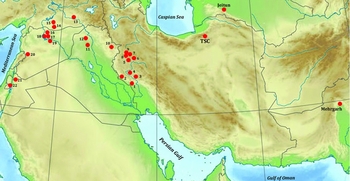
Distribution of the principal Neolithic sites in the Near East: 1) Ali Kosh; 2) Chogha Golan; 3) Chia Sabz; 4) Guran; 5) Ganj Darreh; 6) Tappeh Abdolhosein; 7) Sheikhi Abad; 8) Sarab; 9) Asiab; 10) Jarmo; 11) Nemrik; 12) M’lefaat; 13) Hallan Čemi; 14) Göbekli; 15) Nevali Čori; 16) Dja’de; 17) Jerf el Ahmar; 18) Mureybit; 19) Abu Hureyra; 20) Aswad; 21) Ain Ghazal; 22) Jericho; TSC = Tappeh Sang-e Chakhmaq.

The history of Neolithic studies in the Near East shows a continuous shift in the areas targeted by researchers seeking to locate the emergence of domestication. While in the 1960s and 1970s early Neolithic sites of Iranian Zagros, such as Tepe Guran (e.g. Meldgaard et al. Reference Meldgaard, Mortensen and Thrane1963), Ali Kosh (Hole et al. Reference Hole, Flannery and Neely1969) and Ganj Darreh (e.g. Smith Reference Smith and Bagherzadeh1976) were opening a promising window onto the initial stages of the Neolithic way of life, a growing body of research in the Levant was accumulating finer-grained data that put greater emphasis on the western flank of the Fertile Crescent (e.g. Bar-Yosef & Meadows Reference Bar-Yosef, Meadows, Price and Gebauer1995). In the last two decades, fascinating discoveries of very early Neolithic sites (tenth to ninth millennium BC) in south-east Turkey and Syria have focused attention on the importance of the upper reaches of the Euphrates and Tigris in early domestication (Zeder Reference Zeder2011). Still more recent discoveries of equally early Neolithic sites in the Iranian Zagros, such as Chogha Golan and Sheikhi Abad, dating to the tenth to eighth millennium BC (e.g. Matthews et al. Reference Matthews, Matthews and Mohammadifar2013; Riehl et al. Reference Riehl, Zeidi and Conard2013), are, however, once again raising the profile of the eastern flank of the Fertile Crescent (Zagros Mountains) in the search for the beginnings of Neolithic life. In short, the prevailing picture of the Neolithic transition in south-west Asia suggests that early domestication began in the Fertile Crescent and dispersed from there through other parts of south-west Asia and Europe (e.g. Zeder Reference Zeder2008, Reference Zeder2011). This implies that the Neolithic way of life was introduced into peripheral areas, such as eastern Iran, from a ‘core area’ situated elsewhere.
In sharp contrast to the Fertile Crescent, the eastern regions of the ancient Near East have to a large extent remained unexplored. East of the Zagros, the number of early Neolithic sites decreases substantially (Figure 1). In fact, in the vast area between Zagros and the Indus Valley only two early Neolithic sites have been identified, both dating to the seventh millennium BC: Sang-e Chakhmaq West Mound (Iran) and Mehrgarh (Pakistan) (Jarrige Reference Jarrige2008). They lie some 1500km apart. In the case of Mehrgarh, the Neolithic transition of the Indus Valley has been ascribed to both local developments and the introduction of certain animal and plant species from other regions; by contrast, there have been no serious attempts to situate the West Mound of Sang-e Chakhmaq in the broader context of the Neolithic of the Near East.
The Japanese excavations
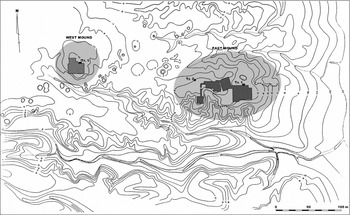
Tappeh Sang-e Chakhmaq lies on the plain of Bastam in the Alborz foothills, 8km north of the town of Shahroud and about 400km east of Tehran (Figure 1). The site comprises two adjacent mounds some 100m apart, the West Mound and the East Mound. Tappeh Sang-e Chakhmaq was discovered and extensively excavated during four seasons in the 1970s by a team led by the late Seiichi Masuda of Tokyo University (Masuda Reference Masuda and Bagherzadeh1973, Reference Masuda and Bagherzadeh1976). The West Mound is circular in shape, covers c. 0.4ha and rises c. 3m above the surrounding ground. Here the Japanese team excavated a 480m2 trench, reaching c. 3m below the surface at its deepest point (Figure 2). The excavated sequence was divided into five architectural layers (I–V from top to bottom). The plans of the buildings remain almost the same throughout the occupational sequence. Houses were constructed from sun-dried mud bricks and pisé (hard-packed earth or clay), some with finely plastered gypsum floors. The plaster-floored rooms were usually divided into three parts distinguished by different floor levels, and featured raised hearths and mud-brick platforms (Masuda Reference Masuda and Bagherzadeh1974: 23; Masuda et al. Reference Masuda, Goto, Iwazaki, Kamura, Furosato, Ikeda, Tagaya, Minami, Tsuneki, Matthews and Fazeli Nashli2013: 216).
Topographic map of Tappeh Sang-e Chakhmaq (adapted from Masuda Reference Masuda1984).

Only three small potsherds were found during the excavation of the West Mound: two pieces from layer I and one from layer III. The upper three layers were accordingly considered as pottery Neolithic, while the two lowest layers, IV and V, were ascribed to the pre-pottery Neolithic (Masuda Reference Masuda1984; Masuda et al. Reference Masuda, Goto, Iwazaki, Kamura, Furosato, Ikeda, Tagaya, Minami, Tsuneki, Matthews and Fazeli Nashli2013). The 23 newly available AMS (Accelerator Mass Spectrometry) dates, from the four lowermost of the five layers (II–V) place the occupation of the West Mound in the 7200–6600 BC time range (Nakamura Reference Nakamura and Tsuneki2014). The samples analysed, which lack details of their exact provenance, were charcoal collected during the excavations of the 1970s.
The East Mound, oval in shape, covers an area of c. 1.9ha and rises 5m above the plain. It was excavated much more extensively than the West Mound, with an excavated area of c. 1300m2 divided between four trenches (Figure 2). The excavations reached a depth of c. 6m and revealed six occupation layers, defined on the basis of architectural remains (I–VI, from top to bottom). The 14 newly available dates on charcoal samples from the 1970s excavation programme indicate that layers V--I of the East Mound span a period from c. 6200 to 5300 BC; no date is available for the earliest layer (VI) (Nakamura Reference Nakamura and Tsuneki2014). The architecture is characterised by mud-brick houses with irregular quadrangular plans and large circular or ovoid hearths. Hand-made, chaff-tempered, burnished painted pottery was common throughout the sequence, which shows close similarities with the pottery of the Jeitun culture of southern Turkmenistan (Masuda et al. Reference Masuda, Goto, Iwazaki, Kamura, Furosato, Ikeda, Tagaya, Minami, Tsuneki, Matthews and Fazeli Nashli2013; Roustaei Reference Roustaei2014).
The 2009 soundings
The Japanese excavations at Tappeh Sang-e Chakhmaq were not accompanied by absolute dating or by faunal and floral analyses. Faunal remains were extensively collected but remained unpublished until very recently, and, furthermore, the 2014 report is very brief (Mashkour et al. Reference Mashkour, Vigne, Mohaseb, Bréhard, Bémili, Reynolds, Daujat, Debue, Tsuneki and Tsuneki2014). No systematic flotation was practised except on a small sample of hand-retrieved grains (Fuller Reference Fuller and Tsuneki2014). Until very recently (Nakamura Reference Nakamura and Tsuneki2014) no reliable dating was available for the site. The absence of information so vital for the characterisation of the Neolithic transition east of Zagros led us to initiate a series of surveys (e.g. Roustaei Reference Roustaei2012a) and small-scale soundings at key sites in the Shahroud area. Tappeh Sang-e Chakhmaq was especially important as the only known Neolithic site in the whole of eastern Iran that had both pre-pottery and pottery Neolithic occupation; this represents the longest occupation sequence among the sites that have been identified in the north-east region (Roustaei Reference Roustaei2014). Our immediate goals were to establish a sequence supported by absolute dates from pre-pottery to pottery Neolithic in the region, and to obtain an overall impression of the subsistence practices of Neolithic communities through examination of remains of fauna and flora. It is with these objectives in mind that one of the authors undertook stratigraphic soundings at both mounds in 2009 (Roustaei Reference Roustaei2009).
The West Mound
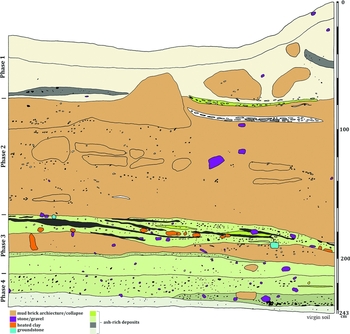
In April 2009 a 2.5 × 1m sounding was opened in the West Mound as an extension to the northern edge of the earlier Japanese trench (Figures 2 & 3). Virgin soil was reached at a depth of 2.43m below the present ground surface. In the excavated sequence 49 contexts (100–148 from top to bottom) were recognised and divided into four phases (Figure 3) according to the formation process of archaeological deposits rather than distinct changes in the material culture.
West Mound, Trench 1, profile of the north wall.

Architectural remains revealed in the West Mound sequence do not add greatly to our current understanding based on the Japanese excavations. The sequence included in situ eroded accumulations of mud-brick or pisé architecture interspersed with thick ash or charcoal layers from possible hearths. Two small pieces of pottery found in Phase 3 confirm its use at the site; it is not possible to correlate this pottery with that from the Japanese excavations (Masuda Reference Masuda and Bagherzadeh1974) because the stratigraphy was unpublished. The sherds are heavily chaff-tempered, red-slipped, burnished, low-fired and rather hard.
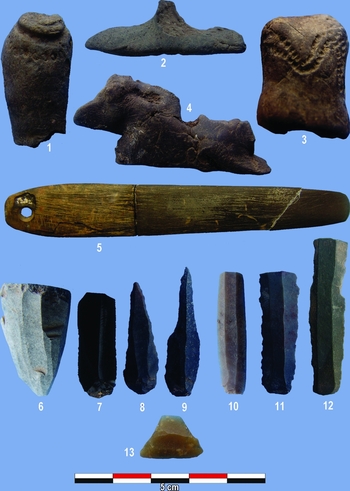
The lithic industry of the West Mound is largely dominated by unretouched bladelets and blades, with only a few backed bladelets, drills, geometrics, end scrapers and cores (Figure 4). Light brown chert, grey flint and chalcedony were the favoured materials, but a few items made of obsidian were also found. Obsidian, an exotic raw material, was used from the beginning of the occupation and is present throughout the sequence.
Selection of chipped-stone artefacts and small finds from the West Mound: 1) human clay figurine with small incised circles around the neck; 2) T-shaped clay figurine; 3) animal clay figurine; 4) clay figurine with incised decoration; 5) stone tool with abrasions; 6) bullet core; 7) obsidian blade; 8) perforator; 9) drill; 10) blade; 11 & 12) retouched blade; 13) trapeze.

Most of the recovered small finds were objects made of stone or baked and unbaked clay; few items were made from other materials such as bone or shell. After lithics, clay objects were the most numerous small find. A large number of the clay objects represented parts of clay figurines, both anthropomorphic and zoomorphic, and in rare cases, geometric ‘tokens’ (Figure 4).
A total of 18 archaeobotanical samples resulting from the bucket-flotation of 1986 litres of sediment were recovered from ashy layers throughout the sequence at the West Mound. Here, as at the East Mound, the carbonised plant remains, generally well preserved, probably represent the cleaning out of hearths and kilns. They should therefore reflect, to a large extent, daily and domestic activities such as the final stages of crop processing, food preparation and the use of different types of fuel.
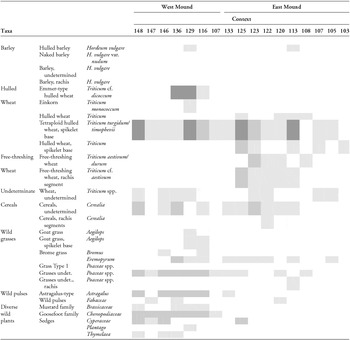
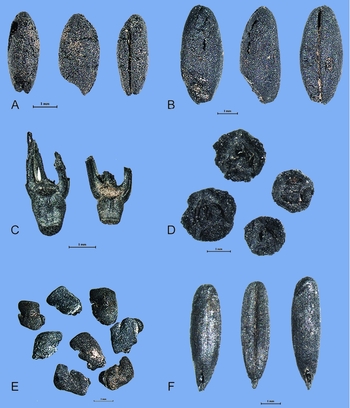
Domesticated cereals—wheat and barley—are present in samples from the earliest levels at the West Mound (Table 1). Most of the crop remains belong to at least two species of glume wheat: einkorn (Figure 5: A) and a second hulled wheat for which the morphology of the spikelet base (Figure 5: C) is close to that of a tetraploid species, from either emmer (T. turgidum) or Timopheev's wheat (T. timopheevii). Einkorn is so far identified from grain only, and the tetraploid wheat appears to be predominant among both grain and chaff remains. Free-threshing barley is attested from a single context.
Distribution of archaeobotanical remains in the West Mound and East Mound.

Key:
N<10
N = 10–100
N>100
Charred plant remains from the West Mound.

The samples are also rich in wild plants, both grasses and taxa belonging to other families (Figure 5: D–F). Small-seeded legumes, of the angular Astragalus-type, are recorded from most samples, as are the characteristic nutlets from the goosefoot family (Chenopodiaceae). Many species in this family grow in steppe environments and can also withstand saline conditions. The sedges (Cyperaceae, Figure 5: E) are common in wetter habitats, for example on periodically inundated soils.
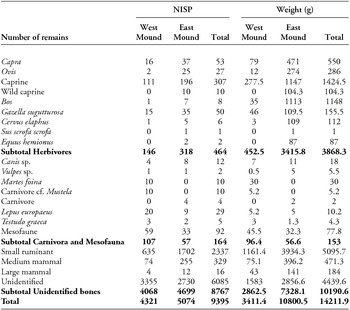
Approximately 4321 faunal remains were recovered from the West Mound trench (Table 2). The preservation of remains is very poor in both mounds due to heavy fragmentation, and more than 90 per cent could not be identified to the level of family or genus. Small ruminants, mostly caprini, followed by gazelle (Gazella cf. subgutturosa) constitute the bulk of the faunal assemblage (Figure 6). Horn cores, the most diagnostic element for distinguishing wild and domestic forms, suggest the presence of already domesticated forms of goat on the West Mound. According to metric analyses of the goat remains most of the specimens belong to a population of smaller-sized individuals than that of the earlier Neolithic sites, such as Ganj Darreh (Zeder & Hesse Reference Zeder and Hesse2000). It was not possible to determine whether the sheep (Ovis) were fully domesticated; that was also the case for cattle (Bos), which were represented by only a few specimens. Carnivore remains, especially those of canids (including domestic dog, wolf and jackal), were abundant.
The faunal spectra for the West Mound and East Mound.

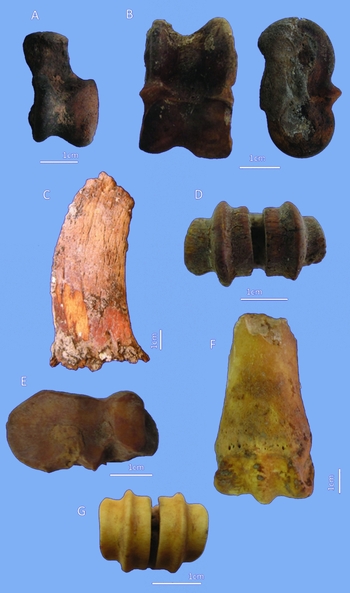
Animal bones from the West Mound and East Mound: A) West Mound L143, burnt talus, Canis familiaris; B) West Mound L 165, burnt talus, Capra; C) East Mound L116, horn core, Capra aegagrus; D) EW L136, metapodial Ovis; E) East Mound L122, radius, Ovis; F) East Mound L112, metapodial, Equus hemionus. G) East Mound L104, metapodial, Gazella.

The East Mound
Two small soundings were opened at the East Mound. The main trench, Trench 1 (2.5 × 1.5m), was opened at the northern edge of the largest of the four Japanese trenches. The second sounding, Trench 2 (1.5 × 1.5m) was located on the highest part of the site, c. 70m west of Trench 1 (Figure 2).
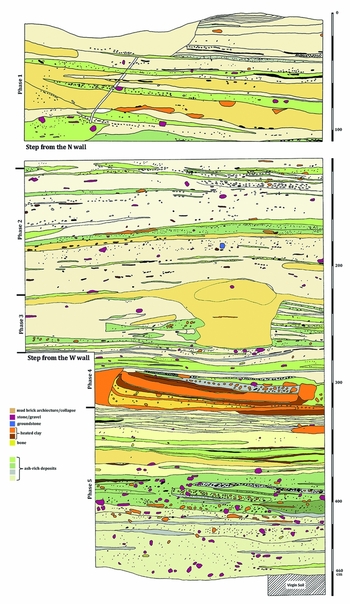
In Trench 1 (c. 4.7m in depth) 83 contexts (100–182 from top to bottom) were recognised and grouped into five different phases (Figure 7). The excavated sequence consisted of intermittent layers of mud-brick or pisé architecture and their related accumulations. The structures were constructed largely of mud bricks, which occurred in two forms: a long, circular or oval section, pillow-shaped mud brick that measured 40–60 × 20–30 × 10cm and were present throughout the sequence, and a rectangular mud brick with twin small impressions on the upper surface, this type was restricted to the uppermost layers.
East Mound, Trench 1, profile of the north wall.

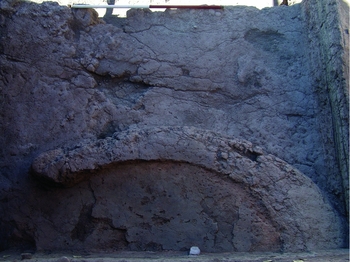
In Phase 4, a horseshoe-shaped hearth was revealed (Figure 8). The hearth, c. 2m in diameter, was constructed in pisé, and a sequence of at least six successive, delicately smoothed and burnished clay coatings were visible within it. Hearths of this type are well known from Jeitun culture sites in Turkmenistan (Masson & Sarianidi Reference Masson and Sarianidi1972, fig. 9).
Partly exposed horse-shoe hearth in Trench 1, East Mound.

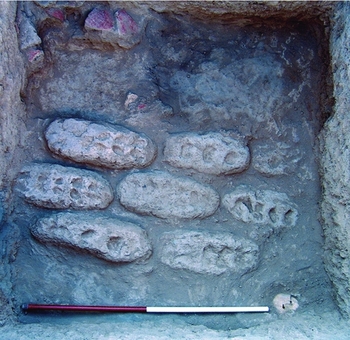
Trench 2 was excavated to a depth of about 1m. The excavated deposits were divided into six contexts (200–205 from top to bottom) representing a single phase. The main feature of the trench was a 0.5m-thick mud-brick wall running east–west across the trench (Figure 9). The mud bricks bear twin small depressions on their upper surfaces, different to those found in Trench 1. In the south-west corner of the trench, associated with the mud brick wall, the upper part of a human cranium was unearthed, belonging to an intra-site burial.
Mud-brick architecture associated with a possible intra-burial in Trench 2, East Mound.

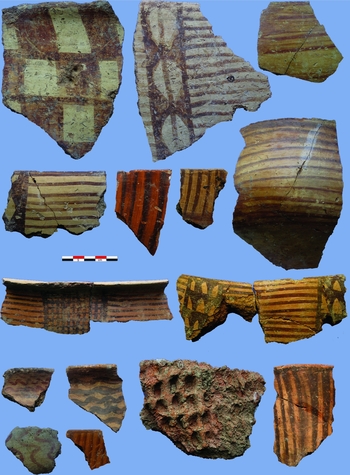
The pottery of the East Mound is handmade. Wares and decorative motifs change only slightly through time, and plant material alone was used as temper. The colour of the paste varies from cream to orange, with some minor variations (Figure 10). Almost all sherds bear a thick clay slip, usually light brownish-cream, cream, orange, or buff-cream. Nearly all sherds show various degrees of burnishing, usually in the form of thin horizontal parallel bands. The common shapes of vessels are deep bowls and jars, but other forms also occur, such as basins.
Selection of pottery from the East Mound.

Painted pottery was abundant at the East Mound. All of the recognised motifs are geometric with the most common consisting of parallel horizontal, vertical and obliquelines, especially in the upper layers. Wavy lines were predominant in the lower layers (Phases 5 and 4). Other common motifs include chequerboards, triangles and lozenges rendered in various combinations. The favoured colours for painting were brown, reddish-brown or red, with rare examples of black.
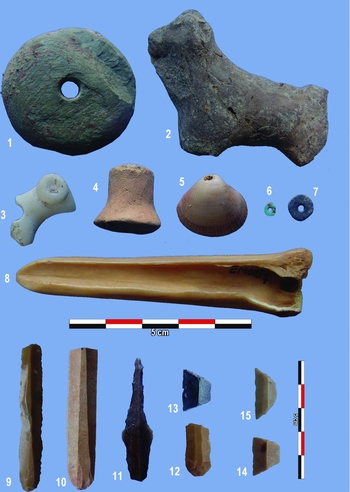
The lithic assemblage, akin to that of the West Mound, shows an overwhelming majority of bladelets and blades, followed, in much lower numbers, by flakes, drills, end scrapers, cores and geometrics (Figure 11). As at the West Mound, the materials used were a light-brown chert and, to a lesser degree, grey flint. No obsidian was found on the East Mound but new raw materials occurred for the first time: turquoise, alabaster and shale. In addition, more than 100 fragments of baked or unbaked clay objects were found and over 200 small stone beads. The latter were generally made of grey stone, probably shale, with outer diameters hardly exceeding 6mm. There are rare examples of marble, turquoise and wood; the latter was found in a charred state. A few beads were made of a bivalve shell, Didacna sp., (Figure 11), that originated in the Caspian Sea. More than 30 shell fragments were found in Trench 1, whereas they were rare at the West Mound. In the East Mound shell remains were concentrated in the lowermost contexts (182–173) of Phase 5; some were probably used as pendants. Needles and awls were common among the bone objects.
Selection of chipped stone artefacts and small finds of the East Mound: 1) stone spindle whorl; 2) clay animal figurine; 3) alabaster ram-shaped pendant; 4) clay cylinder; 5) shell pendant; 6) turquoise bead; 7) stone bead; 8) bone tool; 9) sickle blade with sheen; 10) broken blade; 11) drill; 12) end-scraper; 13 & 14) trapeze; 15) lunate.

Other artefacts included seven intact or broken spindle whorls made of pottery and a foliated stone, probably shale, bearing witness to the presence of local activities of spinning and weaving (Figure 11: 1). Squat cylinders of terracotta with no visible impurities in the clay were also recorded (Figure 11: 4). Surprisingly, no copper artefacts were found during the 2009 soundings, although some pieces were reported from the Japanese excavations (see Masuda Reference Masuda and Bagherzadeh1976, fig. 7: 11, 12).
At the East Mound, 41 flotation samples corresponding to 3232 litres of sediment were collected. Hulled tetraploid wheat continues to dominate the plant record, but a new wheat type appeared in the samples from this mound: free-threshing or naked wheat represented by both grain and chaff remains (Table 1). While the grain only allows a determination to the level of a broad category of free-threshing wheats (Triticum aestivum/durum), the morphology of the rachis segments is characteristic of hexaploid bread wheat (T. aestivum). Einkorn is no longer attested and, as at the West Mound, barley appears only sporadically. The proportion of wild plant remains is considerably lower than in earlier periods.
Approximately 5074 faunal remains were recovered from both trenches at the East Mound (Table 2). As at the West Mound, small ruminants are dominant with a majority of domestic forms, although wild caprines are still present in the assemblage. Here again, as at the West Mound, goats outnumber sheep. The kill-off pattern of goats, based on tooth wear, indicates the high consumption of meat from animals slaughtered between six months and two years old (Payne Reference Payne1973; Vigne & Helmer Reference Vigne and Helmer2007). Milk production could not be clearly evidenced from the East Mound faunal assemblage.
The increased frequency of cattle (Bos) remains on the East Mound is a clear indication of its incorporation into the domestic package by this stage, and its domesticated status is supported by morphological evidence; these animals are significantly smaller than the aurochs in earlier Near Eastern assemblages. Red deer (Cervus elaphus) and onager (Equus hemionus) are present among the large hunted species, besides the gazelle (Figure 6).
Dating
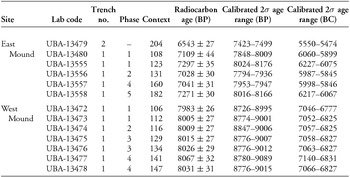
In order to contextualise the findings from Tappeh Sang-e Chakhmaq, a radiocarbon dating program was run on 13 samples of charred wood pieces from different contexts of both mounds. The identified charcoal fragments belonged to various tree species such as Salix/Poplus, Juniperus and Tamarix. The AMS 14C dating was carried out at the 14CHRONO Centre, Queen's University, Belfast (Table 3, Figure 12).
Radiocarbon dates for West and East Mounds at Tappeh Sang-e Chakhmaq.

Calibrated radiocarbon dates for Tappeh Sang-e Chakhmaq.

The dates from the West Mound trench are coherent and clearly indicate that that mound was formed during a relatively short period of time; a maximum of 300 years according to the seven radiocarbon dates. In Trench 1 in the East Mound, the 4.7m stratigraphic sequence seems to have formed within a similar time span. The single date from Trench 2 (East Mound) is much younger than the uppermost level of Trench 1; they are separated chronologically by an interval of at least 300 years, but this does not necessarily mean a real temporal gap in the cultural sequence as the two trenches are some 70m apart.
In general, the settlement at the West Mound was founded around c. 7000 BC and lasted for about 300 years, until around 6700 BC. After a chronological gap of possibly 500 years the settlement of the East Mound was established in c. 6200–6100 BC, which lasted for nearly 1000 years until around 5300 BC.
Concluding remarks
So far, Tappeh Sang-e Chakhmaq is the only known Neolithic site east of Zagros Mountains with both pre-pottery (at the West Mound) and pottery Neolithic (at the East Mound) components spanning an occupational sequence of 1500 years. As absolute dating shows (Table 3; see also Nakamura Reference Nakamura and Tsuneki2014), there is a c. 500 year gap between the final settlement of the West Mound and the earliest occupation of the East Mound. This gap can be considered responsible for differences between the two settlements in the architecture, in certain of the small finds and in the presence of pottery. Nevertheless, some aspects of the material culture, specifically the lithic assemblage, remain unchanged from the West Mound to the East Mound, as do the general spectra of plants and animals exploited (see below). In the absence of contradictory evidence, we may suppose that the established pottery Neolithic represented at the East Mound, which is the type-site for the Neolithic of north-east Iran, is the direct successor to a preceding culture that had already flourished at the West Mound.
The West Mound was established in the late eighth millennium BC, probably as a permanent agro-pastoral village with well-built mud-brick structures furnished mostly with gypsum floors, a technique frequently used in the pre-pottery Neolithic B phase (PPNB) in the Levant (cf. Kingery et al. Reference Kingery, Vandiver and Prickett1988). The inhabitants of the site practised wheat and barley cultivation and goat herding. Insufficient data prevents us being confident about whether domesticated sheep or cattle were part of their subsistence base. A few hundred years later, however, these livestock were firmly incorporated in the Neolithic subsistence pattern of the East Mound, as was free-threshing wheat. The agro-pastoral settlement of the West Mound has no apparent known predecessor in north-east Iran (Roustaei Reference Roustaei2014), and its appearance raises the question of how the Neolithic way of life was introduced into the region. Interpreting the West Mound in the wider geographic context of south-west Asia is a difficult task, as the nearest relevant sites are located some 700–800km to the west in the Central Zagros (Figure 1). Nevertheless, given that almost no part of the north east of Iran has been intensively surveyed, it is entirely possible that sites contemporary with or earlier than the West Mound are yet to be found.
Agriculture was practised at Tappeh Sang-e Chakhmaq from the earliest phases and it is likely that the crop species (wheat and barley) were introduced in an already domesticated form from elsewhere. As is the case at many other early Neolithic sites in the Near East, the crop assemblage is based on the cultivation of hulled wheat species, among which a tetraploid emmer-like type seems to dominate throughout the sequence. Einkorn is rarely attested so far and seems to be a minor crop here, in contrast to, for example, Jeitun in southern Turkmenistan where it is more common (Charles & Bogaard Reference Charles, Bogaard and Harris2010). In the Shahroud plain, einkorn seems to drop out of the crop assemblage in the pottery Neolithic---it is not recorded for this period at the East Mound or at later sites in the same area (see Roustaei Reference Roustaei2014). From the pottery Neolithic free-threshing wheat appears; this represents an early occurrence in a region where it might have originated. Indeed, the Sharoud plain, and north-east Iran in general, is situated within the range of distribution of Aegilops tauschii, which, by crossing with a cultivated tetraploid wheat, was the origin of the hexaploid wheat species (Zohary et al. Reference Zohary, Hopf and Weiss2012: 47–51). Barley is present throughout the chronological sequence considered here but never seems to constitute a major crop.
So far, no cultivated pulses, such as lentils, peas or vetches, have been recorded; and neither has flax. In this respect, the situation at Tappeh Sang-e Chakhmaq is different from many other Neolithic villages (in the Near East or Europe) where pulses and fibre crops were part of early agricultural economies. On the other hand, this situation is similar to that at Jeitun where cereals also seem to have constituted the only cultivated crops (Charles & Bogaard Reference Charles, Bogaard and Harris2010). It is thus possible that early subsistence economies in north-east Iran and southern Central Asia relied only on the cultivation of cereals, accompanied by animal husbandry.
The faunal analysis of the West Mound and East Mound reveals no major evolution in species composition or husbandry practices during the stratigraphic sequence of either site. Slight changes between the two mounds are visible and expressed by the increase of sheep (Ovis) and cattle (Bos) ratios, and by the decrease of carnivores and mesofauna in the East Mound. Despite the small size of the identified bones in the 2009 faunal assemblage, the presence of species from different ecological ecotones suggests the exploitation of a wide territory around the site. The arid steppe was the closest environment and is evidenced by the presence of gazelle and onager, while wooded areas were probably the source of red deer, and rocky and piedmont environments the source of wild sheep and goat.
One of the most important contributions of this study is the determination of the domesticated status of goat, sheep and cattle: the three pivotal species in the ‘Neolithic package’. The assemblage of Tappeh Sang-e Chakhmaq indicates that goat was already domesticated at the time of the West Mound occupation, but there is no clear indication for the presence of domestic sheep or cattle at that stage. By the time the East Mound was occupied, both are present in their domesticated state. How and when domesticated goat reached north-east Iran is obviously a key question to be explored, as is the origin of the complex architecture on the West Mound. Also worthy of note is the absence of evidence for domestic pig from both sites.
Some items excavated at Tappeh Sang-e Chakhmaq point to distant contacts. Obsidian, relatively frequent in the lower layers at the West Mound but absent from the East Mound, is of exogenous origin. Recent analyses on two pieces from our excavation show an origin in the eastern Anatolian Plateau (work in progress with B. Gratuze). In addition to obsidian, rare items of turquoise and copper were found at the site. The nearest potential source of copper is some 100km to the south, on the northern fringe of Dasht-e Kavir desert, and for turquoise some 300km to the east, near Neishabour (Roustaei Reference Roustaei2012b).
Having a secure and sequential series of 14C dates for both mounds of Tappeh Sang-e Chakhmaq now enables us to propose a solid framework for the earliest stages of the Neolithic way of life on the north-eastern Iranian Plateau, including Kopet Dagh. The detailed archaezoological and archaeobotanical studies now being undertaken will enhance our understanding of the exploitation of animals and plants by early settlers in this remote part of the ancient Near East (cf. Tosi Reference Tosi1973–1974). The massive amounts of charred remains of plants recovered and briefly reported here will be of utmost importance in studies of early agriculture on the Iranian Plateau.
Acknowledgements
Radiocarbon dating was supported by UMR 7209-CNRS/MNHN and the PPF Biodiversité actuelle et fossile. We would also like to thank the anonymous reviewers for their helpful comments.