Times of doubt
Sarajevo shooting. The viewfinder, the telephoto lens, the camera-eye slowly pans over the hill across the city. Tightly packed in the crosshair, white steles shimmer in the heat over young cemeteries: the sombre letters of a mnemonic language in which the world's cruelty culminates in a stony silence. A few years ago, in 2005, we found ourselves in this desolate place after travelling through half of Europe with a camera team to document the eccentric life of the Slovenian actress Maria Vera, who, a hundred years ago, illuminated stages with her unique pathos in a dynamic labyrinth of cultural transformation.Footnote 2 Now the memory of this great tragic actress has been superimposed onto the tragedy of a still lingering war.
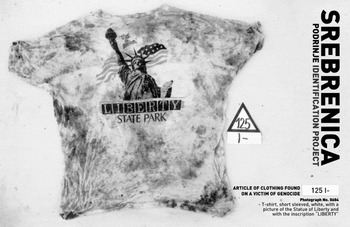
Jump cut. The flâneur point of view: a labyrinthine cityscape, marked through and through with the scars of warfare. Even the narrowest streets show the countless bullet holes that testify to close combat or even point-blank shootings. And everywhere shocking posters tout photographs of T-shirts, jackets, trousers by familiar brands like Diesel or Levi's – but the clothes are riddled, muddied, bloody. A close-up reveals that the photographed clothing belonged to the victims of the genocide in Srebrenica; the posters are commemorating the tenth anniversary of the biggest massacre in Europe since the Second World War (Fig. 1).Footnote 3 But today, even these haunting impressions start to pale against the ubiquitous flood of images that was let loose with a new ferociousness twenty years ago, after the fall of the Berlin Wall.Footnote 4
Anur Hadžiomerspahić and Aina Zlatan, poster commemorating the tenth anniversary of the Srebrenica genocide (2005). © Anur Hadžiomerspahić and Aina Zlatan.

‘The time is out of joint’ – in 1989, nothing on the stage seemed to respond to Hamlet's penetrating diagnosis as much as the violent collapse of established orders taking place outside the theatre. Indeed, events such as the fall of the Berlin Wall, together with its worldwide propagation and fetishization in small scraps of concrete, clearly show traits that are remarkably theatrical. New forms of the political and economic organization, administration, and utilization of time and space developed in close interaction with new aesthetic values. Such developments have not been inconsequential in the incremental growth of systematic research into the phenomena of theatricality, ritual and cultural performance, as well as visual culture, over the last two decades. Nevertheless, it has become clear that such forms of analysis often merely persist in chasing the illusions and mirror effects of shiny surfaces, which are then displayed in the elegant packaging of sterile metalanguages as ostensibly excellent commodities. Interestingly, engaged artists – the Belgian performer Eric Duyckaerts, for example – have recently started to respond to this situation with an inclination towards creative humour and subtle irony.Footnote 5
In times of drastic crisis or widespread upheaval, whenever art and theatre seem to be of particular interest and even occasionally of vital importance, they consistently draw on gestures of doubt, thus yielding a space for questions and questioning like windows suddenly being thrown open. In the shadow of all spoken words, impulses for a still-unnameable event converge in the eventful presence of a philosophy of the no. Looking back, such instances appear as living moments of almost unlimited possibilities of seeing, speaking, creating.
In 2009 Europe celebrates the twentieth anniversary of the fall of the Berlin Wall. This anniversary marks not only the fall of the physical wall that divided Berlin, but also the extensive avalanche of political, social and cultural change that came about as a result. According to Alain Badiou, disorientation became the new dominant ideology at the end of the Cold War. This can be clearly seen in the convergence of two very different perspectives: on the one hand, the mass chanting of ‘no violence’ in Berlin in 1989; on the other, a bloody war in Yugoslavia in the 1990s. After the ice age of the Cold War, we are now facing something that might be described as a liquefaction of inherited structures and values, bound up from the beginning with unsettling opportunities and risks. In contrast, the reaction of artists to this situation has frequently been extremely direct.
If today we are confronted with a financial and economic crisis of unimaginable proportions, we should remember that engaged art and theatre projects have been attempting since the early 1990s to investigate and discuss the influence of economic developments on what Georg Simmel terms a ‘style of life’.Footnote 6 Particularly worth mentioning in this respect are the Kapital (Capital) projects of the Slovenian groups Irwin (1991) and Laibach (1992), as well as the German group Rimini Protokoll (2006), not to forget Janez Janša's Kapital, performed in Prague in 2008.Footnote 7 The series of performance actions Sljedba štovatelja banaka (The Order of Bank and Money Worshipers) in Croatian banks by the group Shadow Casters (1994–5), as well as the performance Inkasso by the internationally established Slovenian group Via Negativa in 2005 have also attracted considerable attention.Footnote 8
Aside from economic questions, another point of focus for the emergence of these new arts of doubt and political theatre can be found in the profound link between physical and symbolic violence, which has marked European history from ancient times but has reached new proportions in the twentieth century. In philosophy and the arts, this question has been posed repeatedly as a central theme alongside the complicated societal events after the collapse of communism. This is particularly evident in Slavoj Žižek's book Violence (2008) or Emir Kusturica's film Underground (1995), for example. The new quality of interaction between physical and symbolic violence also received memorable expression in Tanja Miletic Oručević's Srebrenicki inferno (Inferno of Srebrenica), an oratory with eight actors performed at Srebrenica's Cultural Centre on 10 July 2005, the same day that, a decade after their tragic deaths, 610 victims exhumed from the mass graves of the Srebrenica genocide were buried at the Srebrenica-Potoćari Memorial.Footnote 9
In the wake of the Twin Towers catastrophe it has become clear that as far as the deployment of physical and symbolic violence is concerned – no matter where it happens – the ends do not always justify the means; certain forms of the war against terror, from a position of absolute military superiority, may well be accompanied by a fundamental undermining of Western values. In this respect, the provocative installation of an interactive sculpture by the Norwegian artist Lars Ø. Ramberg at the 52nd Venice Biennale (2007), consisting of self-cleaning public toilets bearing signs with the slogans ‘Liberté’, ‘Egalité’, ‘Fraternité’, requires no further comment.Footnote 10 Performances such as Democrazy by Francesco Vezzoli (2007) or Jan Fabre's Orgy of Tolerance (2009) operate along similar lines. Fundamental doubts concerning the West's distorted value system are also given forceful expression in works such as Rainer Ganahl's Homeland Security, Jenny Holzer's Detainee Summary Page, Tomer Ganihar's Hospital Party and Ignasi Aballi's Lists (The Dead), as well as Adel Abidin's Abidin Travels – Welcome to Bagdad. The images of violence, war and death in these works are not only critiques of current affairs and world crises; rather, they express existential uncertainty and doubt as to whether it is possible to build a future upon inherited concepts of democracy and tolerance.
The stylized articulation of such fundamental doubt is often linked with a certain kind of pathos. Even at the beginning of the 1990s, the performative style of the retro-avant-garde visual group Irwin was aptly described as a ‘collection of pathos formulas’.Footnote 11 Over the last two decades, dimensions of pathos have become an important research topic in the discourse of cultural studies.Footnote 12 The concept of Pathosformeln, developed by art historian and cultural theorist Aby Warburg, has also prompted new orientations in art theory and theatre studies.Footnote 13 The notion of Pathosformeln gains particular relevance in relation to the previously mentioned flood of images unleashed with new force around 1989, which has subsequently – as part of an accelerated dynamic of technical and media developments – covered the whole world in a secondary, shimmering surface.
Today, pathos often appears unexpectedly, in its full ambivalence, as the ‘divisive pathos of modernity’.Footnote 14 One cause of this constitutive division is the way in which pathos, in times of fundamental doubt, tends to be associated with a completely different aspect of cultural atmospheres; the ‘end of utopia and the return of melancholy’Footnote 15 has penetrated the whole arsenal of inherited and emerging pathos formulas in one way or another. On closer inspection, however, it can be seen that the constellation of pathos and melancholy becomes effective precisely where strong doubts concerning politics, state and society affect questions of individual existence – something that is currently occurring globally on a vast scale.
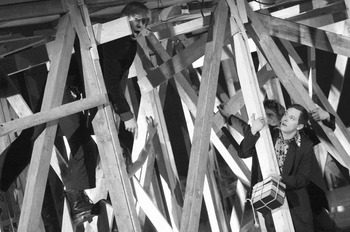
Therefore the rediscovery of existentially oriented works and philosophies is symptomatically associated with the theatre and art trends mentioned above. The performances of two works by Albert Camus – The Misunderstanding (directed by Gil Mehmert) and Caligula (directed by Jette Steckel) – which were enthusiastically received by audiences at the Deutsches Theater in Berlin in 2008 are closely related to this cultural atmosphere. Again in 2008, other remarkable attempts to bring radical existential situations of doubt and despair onto the stage culminated in an extremely strange coincidence: Bertolt Brecht's rarely performed didactic play The Measures Taken had independent and simultaneous performances in both Ljubljana (directed by Sebastijan Horvat; Fig. 2) and Berlin (directed by Frank Castorf; Fig. 3). Both performances stimulated a radical consideration of revolution, utopia and the tragic dimension of modern subjectivity, which would have been entirely unthinkable in the eventful period around 1989. From a present-day perspective, the sudden emergence of these two projects hints at the explosive energies that have been gathering over the last two decades beneath the polished surface of our brave new world.Footnote 16
The Measure Taken, directed by Sebastijan Horvat (Ljubljana, 2008). Photo: Nejc Saje. © Nejc Saje.

The Measure Taken, directed by Frank Castorf (Volksbühne Berlin, 2008). Photo: Thomas Aurin. © Thomas Aurin.

Therefore, in order to understand better the nature of this deep-seated doubt, one must literally go underground. In this context, Jacques Lacan's remark that Hamlet is ‘a tragedy of the underworld’ acquires a double meaning.Footnote 17 In the long introduction on Hamlet in his book Specters of Marx: The State of Debt, the Work of Mourning and the New International,Footnote 18 Jacques Derrida has shown how difficult this descent is and how we might benefit from a specific reference to Hamlet's time as Hamlet's grave.
Hamlet's grave
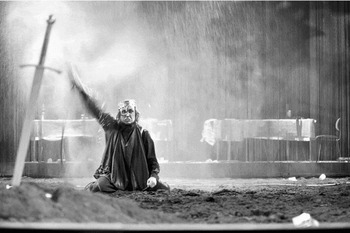
A grave-black grave. Floating above, sinking, then abruptly rising again, a coffin is grasped by white hands spread out in panic. The bulging eyes of silent films, wild expressionist gestures, a danse macabre in pouring rain over muddy ground summarize the compelling opening sequence of Thomas Ostermeier's Hamlet, which premiered in Athens in the summer of 2008 (Fig. 4). Hamlet's murdered father: the corpse in the drunken ship that refuses to depart. In its unruly force, however, the scene could also stand for something else: Hamlet, the undead, has been restlessly stalking the stages of Europe, a rootless stranger residing in both being and non-being.
Lars Eldinger as Hamlet in the performance directed by Thomas Ostermeier (Schaubühne Berlin in coproduction with Athens Festival and Festival d'Avignon, 2008). Photo: Arno Declair. © Arno Declair.

In 1974, in Le Jour des meurtres dans l'histoire d'Hamlet, Bernard-Marie Koltès placed Hamlet in the intimate setting of a chamber play as if it were a matter of scrutinizing the microstructures of tragedy. In 1995 and 1996 Robert Lepage demonstrated a command of the most modern technology by evoking an Elsinore pervaded with a nightmare that had become a space of total surveillance. In 2004 Polish director Jan Klata staged his production H after William Shakespeare in the Gdansk shipyard, whose rich history as a sought-after seaport from the Middle Ages to the Second World War and beyond to the birth of the Solidarity movement in 1980 created a particular historical resonance for the play.
Heiner Müller began work on the production of his highly unconventional Hamletmachine in the autumn of 1989; as if with an intuitive empathy for Hamlet's evocative statement that ‘the time is out of joint’, he had searched and found the most absurd possible contemporary framework. In the preparatory stages the director had already expressed considerable scepticism that he would succeed with the performance. He wrote that every director before him had failed with Hamlet because they had not been able to confront the dawning of the seventeenth century as ‘Hamlet-time’, a time of all-encompassing, irresolvable doubt.
This principle of a melancholic doubt is to a large extent personified in the figure of Hamlet, as Walter Benjamin strikingly puts it in his book The Origin of German Tragic Drama.Footnote 19 An all-encompassing doubt was developed and cultivated in the seventeenth century, which penetrated the foundations of Europe. Although this doubt appeared in different forms, it is, from a historical perspective almost entirely overshadowed by the powerful claim to validity of a single philosophical conception. René Descartes's Discourse on Method, first published in 1637, with the pathos of total conviction, promised a way to eliminate doubt, to correctly guide reason and to put science on the right path towards truth. The rhetorically founded authority of universal doubt becomes a means to remove all potential sources of deception from the inner ambivalence of a corporeal–spiritual existence. Doubt thus passes through the full range of proliferating error with the pathos of a Fury of purgation, leaving the structural ground plan of reason's game rules as a trace. Descartes identifies dreams, passions and the imagination as possible sources of deception – just as if he were providing a diagnosis for Hamlet. Through doubt, Descartes plays a rhetorical game, in which he never puts his own existence at risk; his doubt is an artful, artificial doubt. He attributes to doubt an extremely important role, he lends it power; and then, finally, in a skilful parry, he escapes it and sublimates it in the authority of pure thinking. The famous sentence ‘I think, therefore I am’ – Cogito ergo sum – creates, as a kind of pathos formula beyond all doubt, the desired geometric point in which Cartesian thought celebrates its own moment of truth.
However, in Blaise Pascal's Pensées there is another strategy of doubt that seems to be diametrically opposed to that of Descartes. Like Descartes, Pascal associates knowledge with the illuminating power of geometry, and, in as much as both are concerned with the clarity of understanding as a capacity for ordering, there seems at first glance to be little to distinguish them. However, if one pays careful attention to the role of doubt, the difference between them grows infinitely. Pascal's doubt is not a mere wager in a rhetorical game of thought. His doubt does not bring about any redemptive split between pure reason and ambivalent experience. Instead, it vouches for their inextricable relationship. If Descartes attempts to sublimate and ‘put in order’ the problem of being in the certainty of thought, Pascal accentuates the problematic nature of this being.
These different methods of cultivating doubt are necessarily linked to forms of a theatricality of communicative acts in public space; doubt requires the masquerade of consensual public behaviour. It calls into action the rhetoric of dazzlement as well as techniques of fortification and exclusion. Additionally, the principle of doubt probes dramatic conflicts and tragic errors within existing communities as well as the conflict between knowledge and power. Warburg's concept of Pathosformeln can be expanded into a culturally conditioned formula of doubt and melancholy. In this connection we can consider Robert Burton's Anatomy of Melancholy (1621),Footnote 20 in which the author deals with melancholy not only as an illness related to single, representative individuals (such as Hamlet or even Burton himself), but broadened to a fundamental cultural-critical symptomatology of the age. The investigation of melancholy later received a new aspect in the nineteenth and twentieth centuries, when the physiological, psycho-corporeal and medicinal bases for the cathartic effects of dramatic situations were discovered.Footnote 21 The figure of Hamlet reappears in such a context as an essential reference point, as a mask which embodies total internal conflict. On the one hand, he remains anchored in Shakespeare's time, yet on the other, he stands as a rootless stranger in the midst of the clamorous machinery of the early twentieth century. Hamlet, as described in Sigmund Freud's 1915 ‘Mourning and Melancholia’, becomes a striking precursor of Müller's Hamletmachine.
Hamlet's grave is empty. This we can state, at the end of our small excursion into the (historical) underground of pathos and melancholy. It is necessarily empty like the grave described in Kierkegaard's text The Unhappiest One (1843), or perhaps filled with water like the famous, large-format, elaborately staged photograph The Flooded Grave by Jeff Wall (1998–2000).
As personified doubt, Hamlet, the eternal undead, makes his way through the centuries in the area of tension between pathos and melancholy. We have already seen that, in the case of pathos and melancholy, it is not simply a matter of atmospheric moods or subjective affectivities, but literally of the total social mentality. What is more, the attempts to systematically cultivate and eliminate doubt through the establishment of new scientific methods have, since Hamlet's times, left deep traces in art and science, economics and politics. Thus, from today's perspective, and from the rereading of historical sources, one may gain a better understanding of ‘the tragic and ambiguous nature of our brave new world, the constitutive lack around which it is always structured’.Footnote 22
Death in Venice
Europe is strewn with secret and public sites of ubiquitous but rarely fully apprehended memento mori. A whole cartography of technological catastrophes organized mass murders and unimaginable strokes of fate form a political geography of tragedy. However, sites of extreme beauty, joy and well-being might also be included in such a map of wisdom – only the smallest anamorphic shift of perspective would be necessary.
In 1912 Thomas Mann published his famous novel, Death in Venice, which later also became widely known through Luchino Visconti's film version. In the novel and film Venice has played a unique, extremely theatrical role in the complex play of gazes, memories, atmospheres and attitudes; it has come to represent not only a site of beauty and love, but also of melancholy, decay and death. The novel and the film Death in Venice are important works that reflect the complex relations between pathos and melancholy. Indeed, the period in which the novel was written related directly to the tendencies of the historical avant-garde, while the premiere of the film in 1971 was linked with the neo-avant-garde and a new quality of political theatricality (‘Power to the imagination!’).Footnote 23
At the 52nd Venice Biennale in 2007, a number of the artworks revealed an alarming constellation of pathos and melancholy. The official title of the exhibition was Think with the Senses – Feel with the Mind, but it could have just as easily have been called Death in Venice, since, more than any previous Biennale, it dealt with existential questions of life and art in the border region of death. This broadly conceived ‘theatre of death’ – to use Tadeusz Kantor's well-known term – was charged with enormous experimental energy drawn from the tension between pathos and melancholy. Points of reference were found here that we believe will be important for the future development of the theatre: the future of its performative spaces, the future of its signs and strategies of perception. In the following, we would like to sketch some of our impressions from the exhibition.
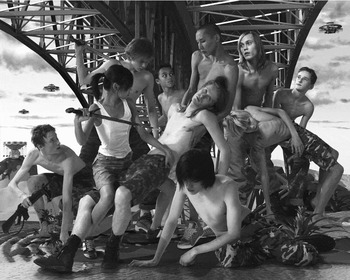
Last Riot, a video installation by the Russian group AES+F, has a very experimental, complex and provocative aesthetic that attracted large audiences and evoked lively public discussions (Fig. 5). The aesthetic energy of this sophisticated three-dimensional animation is derived from such a profound fusion of pathos and melancholy that the viewer is almost physically drawn into the rocky landscape that trembles with an infinite tension over three large screens, as if on the point of collapsing into the abyss. On the screens, various trains, trucks, aeroplanes, rockets and submarines are positioned among pointlessly revolving carousels and Ferris wheels, and surrounded by black birds of prey and engulfed in an emotionally charged cloud of sound whose menacing techno-rumble occasionally discharges sudden cascades of Wagner – the reified potential of a technological catastrophe. However, this grotesque–sublime mountain plateau is largely set aside as a stage for children and youngsters who, armed with baseball bats, swords, machine guns and golf clubs, display a whole spectrum of dramatic martial poses and expressions in sophisticated slow-motion editing. The series of battle scenes seems to be a hybrid of all the wars of the world, but they are instead reduced to a repertoire of pure gestures. Swords touch skin but do not penetrate it; baseball bats hit heads but do not crush them – the brand-name clothing never gets dirty.
AES+F, Last Riot 2. Bridge (2006, digital collage). © 2009 AES / Artists Rights Society (ARS), New York.

In its smoothness and functional perfection, this aesthetic consciously draws on the world of international fashion, design and architecture, as well as on the seductive and glossy world of department stores and shopping malls. Shopping malls, incidentally, are true sites of a memento mori, perhaps even more so than cemeteries. In the last few years many artists have become increasingly interested in participating in the global circulation of a new economy of signs and gestures, as well as in transforming these emotional energies into experimental art projects. This interest was exemplified in Czech artist Irena Juzová's Collection-Series, where dozens of flesh-coloured lycopene casts of hands and feet, as well as the whole body of the artist, are placed in vitrines like typical commercial displays. David Altmejd's contribution in the Canadian Pavilion grouped a variety of strange objects – elements from fashion, jewellery, everyday items and animal body parts – in the glittering light of a thousand mirror fragments around the hybrid figure of a giant. Christine Hill's Volksboutique also contributes to this theme with its ironic references to office culture and the postmodern consumer.
Again and again, the strong atmospheric quality of these works was imbued with an emphatic theatrical gesture that made the impression of entering a stage unavoidable. The Polish Pavilion, for instance, was filled with Monika Sosnowska's installation 1:1, a vast steel framework of a ruined architecture that invited the visitors to move as players through the hard graphic structures of a disturbing endgame. In a different way, Turkish artist Huseyin Bahri Alptekin's installation Don't Complain suggested a profound relation to the world of the theatre and the banal theatricality of everyday life. The visitors passed through five cheaply assembled cabins, in which simple, tasteless, empty living rooms figured as places of uprootedness. Curious videos, entitled ‘incidents’, consisting of a group of snapshots portraying a single place over long stretches of time, were shown on small screens like a touch of a ‘brave new world’ packed in melancholic scraps of music.
Finally, Isa Genzken's mixed-media installation Oil in the German Pavilion resembled a frozen ‘theatre of death’, which was nevertheless brought back to ‘life’ in a macabre way through the movement of the visitors. Wall-sized mirrors undermined the coherence of the space, disorienting the visitor by creating multiple perspectives. Suitcases and travelling bags were strewn everywhere, while motionless, helmeted figures lying on the floor resembled a catastrophically interrupted journey to nowhere, and nooses dangled over the heads of the visitors. Everywhere there were forlorn symbols and fetishes: signs of a lost communication, a lost connection, skulls with magnificent Venetian masks and grotesque miniature skeletons on metallic steles resembling the ones commonly found in department stores to display small expensive goods. And in the midst of all this, there was the golden glow of an Oscar award statue with a plaque reading ‘Best Film – Isa Genzken’, evoking an ironically inflected sense of pathos. The situation demanded something from the viewer: movement. Slowly, out of the dynamic constellation of bags, everyday objects, masks and skulls, stories began to emerge that were beyond narration. The visitor became both actor and a wandering camera in an exhibition event delicately orchestrated, even precisely directed, by the artist and the curator. The new balance between this activation of the spectator, the aspiration towards emotional attachment and instant response, and the emphasis on existential engagement are important features of an emerging aesthetic in the area of tension between pathos and melancholy.
This situation becomes even clearer when we examine the question of how dimensions of language and perception were localized in these theatrical spaces. Language, communication and understanding were often presented as a pathological symptom of ‘unsocial sociability’, as empty noise and madness. Instead of the commonplaces and platitudes of language, the spectator was suddenly confronted with sentences like ‘Nothing to say’, and everyday language that generally goes unnoticed was transformed into vast and intricate riddles that fully engaged the attention and creativity of the visitors.Footnote 24
In this context, the Spanish artists Los Torreznos presented unforgettable speech duels of a machine-like conflict on large video screens, constantly increasing in volume and rhythmic intensity and the stubborn repetition of single phrases and gestures suggestive of talking at cross-purposes. The result was feeling a pathos of deceptive certainty and a melancholy of unbearable isolation, but also the grotesque comedy of a reckless acoustic slapstick. The principle of repetition and the reduction of language to formula and cliché as the common symptom of our times were also evident in other projects. In The Voice as Performance Act and Body, Valie Export presented an anatomy of speaking by using a tiny camera to project her vocal chords onto large round monitors while giving a lecture performance. Her voice was constantly on the point of breaking, threatened by internal injury. The sounds, noises and voices coming from greater or lesser distances pervaded, occupied, troubled and opened up the entire exhibition space.
Particularly interesting in this context is the fact that for the first time at its venues the 2007 Venice Biennale became the site of a sophisticated media technology exhibition. The vast spaces of the Giardini and the Arsenale that had previously provided the setting for a theatre of paintings and sculptures looked like they had been covered with a second skin of digital images and sounds. Many projects – as if responding to contemporary computer games – invited the visitors to playful and creative participation. In Julia Millner's interactive high-tech video installation ClickIHope, for example, the visitor was able to click on a touch screen in any language, and the sentence ‘I Hope’ immediately appeared on the screen in the chosen language.
It is not quite enough to replace the notion of the spectator with that of the active performer/participant. A more accurate description would be that of the user. In the future this concept will no doubt become the focus of important changes in the aesthetics of art, music, design, architecture and theatre,Footnote 25 as well as in the field of economics and politics. It also seems that the search for new orientations in the arts will be connected to the expression of existential engagement – with an apparent search for an event which will mark a radical break with the existing, with an uncertain search of possibilities and visions. The foreseeable upheavals will be of such enormous dimensions that the dissonant constellation of pathos and melancholy will certainly also receive nourishment in relation to these huge innovations and departures.
Beyond theatricality
‘I will die’ – but what does this statement mean? Passing through a long, dark passage, a passage of memory. Pausing to look at larger-than-life faces. At point-blank range. In totally different parts of the world, they all made the same remark in front of rolling cameras, thus resembling, for a brief moment, living death masks of the future. Simultaneously or consecutively in an unsocial sociability. Appearing, disappearing on the white screens of a flickering wall of images. Voices and languages overlap in asynchronous simultaneity to become an inextricable confusion of tongues creating an acoustic cartography of a memento mori.
The installation of Chinese artist Yang Zhenzong transformed the nervous visitors into participants in an enigmatic endgame. It was precisely the abrupt appearance in the daily life of streets, offices, apartments and parks that gives ‘I will die’, ‘Ich werde sterben’, ‘Jaz bom umrla’ such an enormous intensity, one that still echoed as we encountered the works of the other artists: for instance, the sombre film Bouncing Skull by Italian artist Paolo Canevari projected in an endless loop onto a vast screen that shows a bored adolescent, playing football with a muddied skull among the burnt-out ruins of Belgrade. The spectrum of artworks dealing with the theme of death extended from such chilling videos to the bone-dry facticity of endless death lists in large, simple wooden frames, assembled from newspaper headlines. Particularly striking, however, was the restrained and provocative installation by Sophie Calle. The artist filmed the deathbed of her own mother, portraying her mother lying motionless in a white shroud, surrounded by flowers, in a setting for nervous hands that occasionally enter the frame to make the last ordering gestures, the last contact before the final leave-taking.
The potential significance of such artworks for our present situation suddenly flashes up when we attempt to clarify the paradoxical status of death in our everyday lives. On the one hand, we are invaded by its terrible forms and symbols from the flood of the daily news. This is linked with a whole economy of death, which extends from the trade in arms and information to the frivolous masquerades of contemporary fashion and the art market.Footnote 26 On the other, our daily lives are clearly marked by a suppression and separation of dying and death from life.Footnote 27 Nevertheless, death's concealment beneath a culture of rituals, gestures and masks, its suppression by a whole system of theatricality, has a long tradition.
This tradition goes back again to the time of Hamlet, a time whose central importance for the conflict-ridden restructuring of politics, culture and science cannot be overemphasized. Reflecting tirelessly on the theatricality of life in the late sixteenth century, Montaigne came to the conclusion that the deceptive masks of life would only fall away on one's deathbed. Examined carefully, however, Montaigne's version of the memento mori, handed down from antiquity, was not only or even primarily directed at questions of death: ‘The premeditation of death is the premeditation of liberty; he who has learned to die has unlearned to serve.’Footnote 28 Instead, his melancholic wisdom tended to focus on the philosophical problematization of human knowledge as well as on questions of the profound relatedness of knowledge to the conditions and limits of human existence.Footnote 29
Today, we may well be in a situation that has no reason to understand the memento mori as simply a relict of cultural history. This, at least, seems to be the conclusion to be drawn not only from the art projects presented in Venice but also from what we saw through the lens as we wandered through the streets of Sarajevo. Here, too, one senses an almost physical struggle with questions of bare existence beyond a globalized stylization of life. Here, too, the problem is one of finding perspectives of an other knowledge beyond the dazzling surfaces of an all-encompassing theatricality.Footnote 30 The latter's alternative character and its political dimension, however, grow out of a thoroughly risky relationship with doubt that is almost diametrically opposed to the Cartesian tradition. Here the deepest, unappeasable doubt appears not merely as a symptom of crisis and risk but also as the greatest chance.
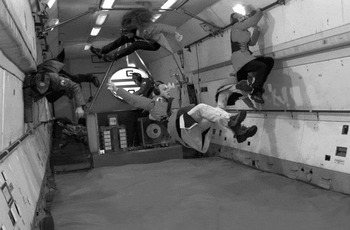
The innovative interaction of the sciences and the arts will soon bring into being new, previously barely conceivable projects and questions. The related temporal and spatial experimental dimension should finally be considered in relation to the long-term project Noordung by the Slovenian artist Dragan Živadinov, who in 1999 also realized, with the technical support of Russian space experts, the first ever theatre performance under the conditions of zero gravity (Fig. 6). Noordung began in 1995 as a long-term experiment and will be presented until 2045 following a jubilee rhythm of one performance every ten years. The place of the actors who subsequently die will be taken by a mechanical symbol while their spoken text will be represented by sounds. In 2045 these symbols will be sent into space in a capsule. This action is intended to abolish mimetic theatre and establish the rule of noncorporeal art. In an interview, the director spoke in a very inspiring and provocative way on the problem of death:
The human body will change. That's a fact. And that fact is what I'm most pleased about. We'll arrive at a miracle without a miracle, sacredness without a sacrifice. Going into space is to commit suicide. Living to the end of one's life is to commit suicide. Death isn't the relevant question. Knowledge, creation, and freedom, those are relevant.Footnote 31
Noordung, performance by the director Dragan Živadinov in zero gravity (Star City, Moscow, 1999). Photo: Miha Fras. © Dragan Živadinov.