‘what constitutes the public sector is not a matter of simple definition but is itself a contestable matter that must necessarily be contestable in modern societies… the major challenge confronting modern societies is increasing complexity; and this implies that the social sciences … need to develop both conceptions and methods for addressing problems of complex organizations in modern societies’
V. Ostrom, 2008 [1973], xxv.1. Introduction
Following Samuelson (Reference Samuelson1954, Reference Samuelson1955), economists have assumed – as a ‘self-evident truth’ – that whenever markets experience difficulties in the provision of certain goods and services (i.e. whenever markets failed), the State should take an active role toward their production and/or provision (Ostrom, Reference Ostrom1990). Because the dominant intellectual worldview presupposes two optimal organizational forms and two types of goods, intellectuals and policymakers become ‘conceptually trapped’ in the dichotomies: market versus state, or private versus public. Thus, claims of market failure and perceived inefficiencies are deemed sufficient grounds for government intervention in the economy and the social order (Ostrom, Reference Ostrom2010). The entire social order is conveniently reduced to a binary struggle between markets and the State. A wide variety of alternative institutional arrangements such as clubs and common-pool resource (CPR) communities that do not fit neatly into the binary taxonomy then become mere distortions, that are to be appropriately guided, controlled, and corrected, or simply disregarded (Ostrom, Reference Ostrom1990).
The Ostroms were critical of any ‘self-evident truths’ or the guiding assumptions that undergird many public policy reforms. Although they may appear neutral on the surface, such unvetted assumptions inevitably lead to non-neutral conclusions replete with biases about institutional structures meant to deliver them, thus resulting in counterintuitive and counter-intentional outcomes (Ostrom, Reference Ostrom2000). Instead, the Ostroms emphasized contestation. If an empirical investigation shows that ‘peculiar’ institutional arrangements regularly out-perform ‘optimal’ institutions, or if it appears that an ‘optimal’ institution regularly performs sub-optimally, then the very assumptions regarding ‘optimality’ and ‘peculiarity’ are to be contested. If public goods and services such as forests, irrigation systems, fisheries, and police services are under-preserved and/or under-provided by central authorities or the public sector – and are instead better preserved and provided by alternate mechanisms – then the ‘self-evident truth’ about the presumed publicness of such resources ought to be contested.
As the Vincent Ostrom quote which opens this article argues: ‘what constitutes the public sector is not a matter of simple definition but is itself a contestable matter that must necessarily be contestable in modern societies’ (Ostrom, Reference Ostrom2008). In other words, what is deemed the ‘public’ sector, and what could be considered a ‘public good’, are not necessarily exhausted in, or explained by, the state alone. It could encompass several other forms of cooperatives, local institutions, and civil society (Ostrom, Reference Ostrom1972, Reference Ostrom1990, Reference Ostrom2010). Put differently, ‘[t]he public economy need not be an exclusive government monopoly. It can be a mixed economy with substantial private participation in the delivery of public services’ (Ostrom and Ostrom, Reference Ostrom and Ostrom2002).
For the scholars of the Bloomington institutionalist tradition, the nature of the goods and services is the ‘analytical entry point’ – that is, the chief driver of institutional arrangements suited for their production and provision (Aligica and Boettke, Reference Aligica and Boettke2009: 40). In fact, without an adequate consideration of the typology and nature of goods and services, market-versus-state debates are of limited use and even unconstructive (Rayamajhee, Reference Rayamajhee2020). Therefore, the contestation of the ‘public’ sector starts with the contestation of the typology of the associated goods and services that justifies its publicness.
The two defining attributes of the goods' typology are ‘exclusion’ and ‘jointness of use or consumption (or subtractability)’ (Ostrom and Ostrom, Reference Ostrom and Ostrom2002). These attributes are typically viewed as static features, intrinsic to the good or service under consideration. However, the Ostroms contended that they are matters of degrees rather than ‘all-or-none’ categories (ibid.). Moreover, whether or not a good is excludable or subtractable ‘is not an ontological given’, but instead contingent upon existing technology and institutions (Aligica and Boettke, Reference Aligica and Boettke2009; Cowen, Reference Cowen1985). That is, if through technological innovations or policy reforms, excluding devices can be created and implemented, free-riding can be curtailed, and thus the good's publicness becomes contestable. In other cases, such as during post-disaster contexts, the degrees of subtractability and excludability of goods and services can change substantially following institutional changes, thereby shifting the good's nature and taxonomy (Rayamajhee, Reference Rayamajhee2020). In this paper, we extend the Ostroms' thesis regarding the contestability of the private–public dichotomy to its logical end.
We contend that most goods and services that are naively assumed to be static or fixed in their public nature (i.e. stationary in their non-excludability and non-subtractability) in one context can be private, club-good, or CPR in other contexts. Similarly, a typical private good, devoid of the institutional context characterized by private property rights, rule of law, and low exchange costs, is no longer excludable and subtractable (i.e. private). Thus, if the degrees of excludability and subtractability are contestable properties that are institutionally contingent, the taxonomy of goods itself is a dynamic feature that can change over time (Rayamajhee, Reference Rayamajhee2020). In other words, if the attributes that define publicness (or privateness) cannot withstand the tests posed by technological and institutional changes, the static classification of a good as public versus private has no empirical basis.
Hence, even though the Samuelsonian private–public dichotomy is a reasonable first step toward the analysis of the nature of goods, we contend that it falls short of being a reliable and practical guide for public policy design and implementation. Despite being a valid theoretical starting point, the static taxonomy fails to account for the dynamic and malleable nature of goods in the real economy. Instead, we suggest that the polycentric framework that the Ostroms advanced is a more consistent conceptual framework because it addresses both the institutional contingency of the goods' typology as well as the institutional diversity pervasive in the real world. We argue that it serves as a more constructive policy framework because it provides space for multiple private, public, and civic enterprises with overlapping jurisdictions to experiment with various approaches – competing in one aspect and/or cooperating in another – to adapt to changing degrees of excludability and subtractability of goods and services. This is our first contribution to the debates on public goods.
The second and core contribution of this article is that we provide a novel schematic to codify the contestable nature of goods and services. We then use the schematic to illustrate the fluid, heterogeneous, malleable, and institutionally contingent nature of goods and services. We describe four mechanisms through which the nature and typology of goods and services can be independently or jointly contested. Whereas prior contributions to this debate – such as Coase (Reference Coase1974), Cowen (Reference Cowen1985), Demsetz (Reference Demsetz1970), and Rayamajhee (Reference Rayamajhee2020) – have presented cases for the contestability of the nature of goods and services based on somewhat narrowly focused analyses of market-mechanisms or crisis instances, we attempt to synthesize and generalize many such scattered insights and situate them within the Bloomington institutionalist tradition. In doing so, we present a broader and unified way of thinking about the nature of goods and services that extends well beyond the narrow purviews of markets or states and the confines of specific disciplinary straightjackets.
Our final contribution concerns the specific mechanisms through which the typology of goods and/or services changes over time. In particular, we explore four mechanisms, all closely interlinked, that contribute to the malleability of the goods' classification – namely, (1) technological and geographical factors, (2) coproduction and entrepreneurial ingenuity, (3) bundling and unbundling of goods/services, and (4) ideologies, regime shifts, and systemic changes. These mechanisms separately or jointly create contexts wherein the nature of goods becomes contestable. Although these mechanisms are in no way exhaustive, they provide us with valuable conceptual tools to explain a vast majority of empirical cases of the dynamic nature of goods and services. Finally, our analysis serves two purposes. First, we generalize the notion that there is nothing ‘inherent’ in the nature of goods and services and that it is a fluid, heterogeneous, and malleable concept that is constantly evolving. Second, we highlight the limitations and perils of relying on the narrow Samuelsonian taxonomy to engage in public policy discourses.
The remainder of this paper is organized as follows. In section 2, we provide a brief overview of the debates surrounding the typology of goods. We describe the Ostroms' contributions to the evolution of the debate. In section 3, we discuss a simple typology framework borrowed from Rayamajhee (Reference Rayamajhee2020) to illustrate the dynamic nature of goods and services. Then, we delve into the mechanisms through which the typology of goods at any given time and context becomes contestable. Section 4 discusses the implications for policy and analysis. The final section concludes.
2. Good-typology: from Samuelson, Musgrave, Buchanan to the Ostroms
Samuelson's 1954 paper The Pure Theory of Public Expenditure started the debate about the classification of goods.Footnote 1 He explicitly assumed two classes of goods: private consumption goods which can be ‘parcelled out among different individuals’ and collective consumption goods which ‘all enjoy in common in the sense that each individual's consumption of such goods leads to no subtraction from any other individual's consumption of that good’ (ibid.: 387). The attribute ‘jointness in use or consumption’Footnote 2 was the defining feature of public goods. When opportunities to free ride on the efforts of others exist, self-interested individuals lack the incentives to reveal their true valuation of collective consumption goods. Such goods then, Samuelson contended, are under-supplied by competitive markets. The implication is that the ‘servant of the ethical observer’, the state, ought to interfere to ensure their optimal provision through non-market means (Hammond, Reference Hammond2015).
Musgrave (Reference Musgrave1959), however, argued that excludability, not rivalrousness or jointness in consumption, is a more important criterion to determine a good's publicness. He asserted that if non-contributors (or non-payers) can be excluded from enjoying the benefits of the good or service, market allocation is feasible. If not, government intervention is needed. He was also the first to use both excludability and subtractability/rivalrousness criteria to distinguish private and public goods (Pickhardt, Reference Pickhardt2006). Nevertheless, both Samuelson and Musgrave's contributions remain the theoretical basis for a majority of market failure arguments and for policy prescriptions that a centralized authority is necessary for the efficient provision of goods that are not fully excludable or subtractable (Ostrom, Reference Ostrom2003). It needs to be noted that the contemporary debates concerning the taxonomy of goods and services and the role of the state in the production and provision of specific goods are modern episodes within a larger history of economic thought that started with the works of Mill and Sidgwick (Medema, Reference Medema2009).
Buchanan's theory of clubs shrank the gap between Samuelson's idealized ‘purely private’ and ‘purely public’ goods (Buchanan, Reference Buchanan1965). A distinct class of goods in the real world are plausibly ‘private’ even by the rigid standards of rivalrousness and excludability. However, there are rarely any collective consumption goods that are universally (purely) public, other than perhaps gravity or the view of the moon. Instead, they all vary in their degrees of ‘publicness’. Instead of theorizing based on the attributes of the good itself, Buchanan uses individual utility as the starting point. He makes a case that the utility a person derives from consuming a good or service depends upon the ‘number of other persons with whom he must share its benefits’ (ibid.: 3). Thus, each good can have a unique optimal sharing threshold or the ‘membership margin’ where the ‘most desirable cost and consumption sharing arrangement’ is attained (ibid.: 2). Although club theory provides an escape route from the dichotomy trap, it relies heavily on the easily challengeable assumptions about flexible property arrangements and readily available excluding devices. That is, although the goods described are non-rivalrous (like public goods), their excludability is assumed. Nonetheless, Buchanan pushes forward the frontier of public goods theory by introducing a separate class of goods that defies the Samuelsonian dichotomy – namely, club goods.
Another class of goods distinct from both Samuelsonian–Musgravian public goods and Buchanan's club goods are CPRs. CPRs are characterized by subtractability and varying degrees of difficulty in exclusion. Examples include forests, fisheries, lakes, irrigation systems, etc. Not only are CPRs and public goods ‘theoretically different types of goods’ but experimental evidence points to substantially different participant behaviors in settings involving these goods (Ostrom, Reference Ostrom2003). In a CPR setting, non-cooperators can generate very high costs for others, so once corrective mechanisms through sanctioning are in place, cooperative behavior increases in subsequent iterations. On the other hand, participants in public goods experiments reveal a ‘pulsing decay pattern downward’ in subsequent repeated interactions (ibid.). Thus, the classes of collective action problems in these two types of goods are so vastly different that lumping them together as public goods, even if merely for analytical tractability, is not a prudent choice.
The Ostroms reconfigured the good-typology such that each of the aforementioned four classes of goods – namely, private, public, club goods, and CPRs – had a defined space within a 4 × 4 matrix based on its degrees of excludability (y-axis) and jointness of consumption or subtractability (x-axis), as shown in Figure 1. Instead of characterizing these attributes as all-or-none categories, they are classified based on degrees (Ostrom and Ostrom, Reference Ostrom and Ostrom2002). Each class of good belongs to a specific taxonomy or quadrant based on its degrees (low versus high) of excludability and subtractability. Public goods exhibit low levels of excludability and subtractability, so they occupy the top-left quadrant. Club/toll goods have low levels of subtractability but high levels of excludability, so they occupy the bottom-left quadrant; Similarly, CPRs and private goods occupy the top-right and bottom-right quadrants. Thus, each class of good has unique production and provision issues and pose different economic and policy challenges.
Conventional classification of goods and servicesFootnote 3
(Source: Ostrom et al., Reference Ostrom, Gardner and Walker1994).

However, simply extending the two-box taxonomy into one with four boxes does not resolve the issue entirely. Just as how missing markets or market inefficiencies have been deemed to be adequate grounds for public interference by the State, the four-box taxonomy can still be used to justify one or more forms of static institutional structures. If markets are weak or missing and the civil society or community ties are not as robust, then the conventional public good logic can still be extrapolated to mean that coercive external structures (domestic or foreign) are the only available recourses, even when we adhere to the four-box typology. This 4 × 4 reconstruction shifts the goal post just a tad bit further but does not fully address the underlying issue of the fluid boundaries separating the different classes of goods. A new reconfiguration of the typology consistent with the dynamic nature of goods is the next logical extension of the Ostromian thesis.
3. Contesting the static nature of goods
The presumed publicness of many goods based on situational non-excludability or non-subtractability or both criteria has been contested by many scholars (Boettke et al., Reference Boettke, Coyne and Leeson2011; Candela and Geloso, Reference Candela and Geloso2018b; Cowen, Reference Cowen1985). Notably, Cowen (Reference Cowen1985) presents a convincing case for the institutional contingency of publicness. He argues that publicness (or privateness), per se, is not an attribute of economic goods but is instead defined by other attributes that depend on institutional contexts.Footnote 4 The features used to define publicness – namely, excludability and subtractability – are not static concepts inherent to a specific good. Instead they are evolving matters subject to diverse interpretations and external constraints. Factors such as technology used, distribution mechanism, quantity produced, marginal unit under consideration, and intensity of demand can tinker with the degrees of exclusion and subtractability at any given moment (ibid.: 53). Thus, every good can be made more or less public or private by evaluating them in different contexts (ibid.: 62). Further, as Fritz (Reference Fritz, Boettke, Herzberg and Kogelmann2020) notes, even ideologies and beliefs concerning what ought to be publicly provided also influence what good is viewed as being private versus public.
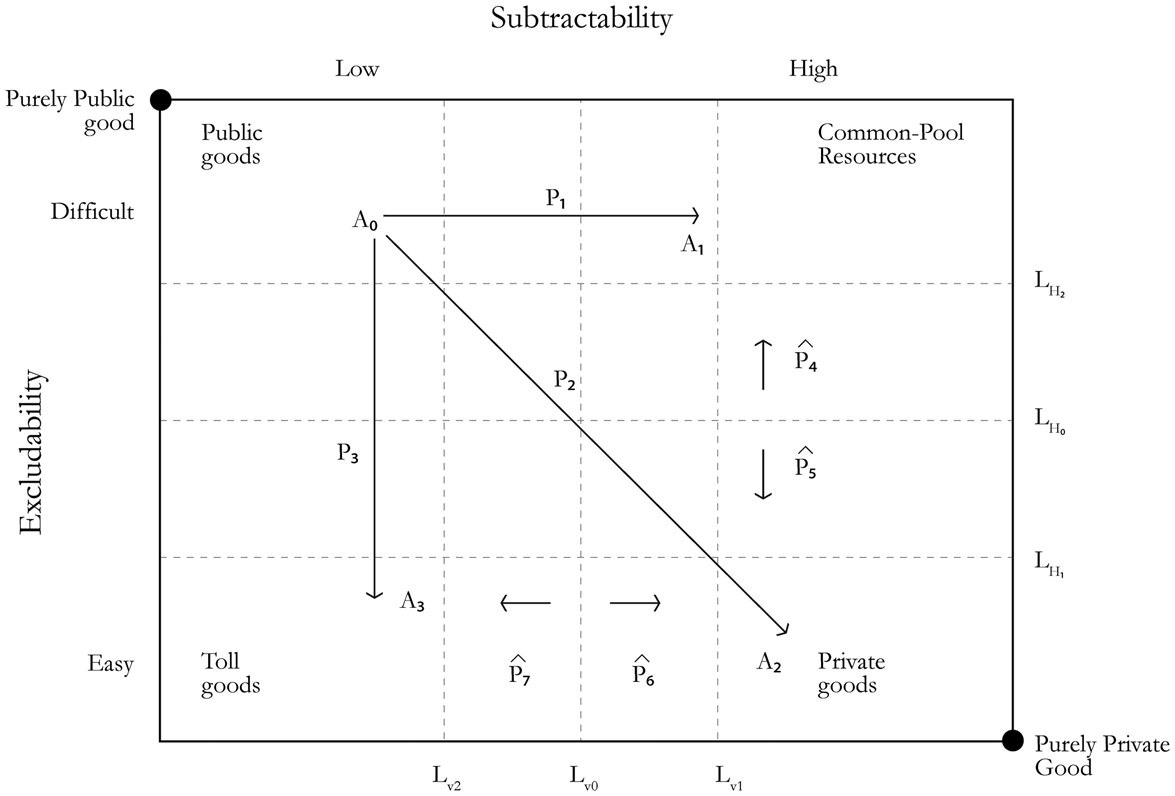
Building on the Ostromian framework, Rayamajhee (Reference Rayamajhee2020) contends that the institutional contingency of good-typology means that the nature of goods can shift from one classification to another if their degrees of excludability and/or subtractability change substantially. As shown in Figure 2, for a given good Ai, where i represents its position (in terms of x–y coordinates) at a given time, an institutional change that triggers changes in one or both of its attributes can change its type.Footnote 5 A club good at time t 1 can become public at t 2, a private good at time t 1 may become a CPR at time t 2, and so on.Footnote 6 Assuming N feasible configurations of i, the good can attain one of N possible positions with varying probabilities Pi such that $\sum\nolimits_{i = 1}^{N-1} {P_i = 1}$ for each Ai. He presents cases from post-disaster contexts where the degrees of excludability and subtractability of various goods and services change depending on the institutional responses, thus changing their classification. Viewed this way, the precise classification of a good is defined within its excludability–subtractability continuum rather than by boxing them in a specific quadrant. Moreover, the lines separating these categories (private–public–club–CPR) themselves can shift with different probabilities (represented by notation $\widehat{{P_t}}$
 in the diagram). That is, the domain of the private or the public sectors or the civil society can shrink or expand based on various institutional parameters.
Dynamic nature of goods (adapted from Rayamajhee, Reference Rayamajhee2020).

In the subsections that follow, we explore four mechanisms that create contexts under which the nature of goods becomes malleable resulting in its reclassification. Before we proceed, two important caveats must be noted. These mechanisms are not mutually exclusive. Instead, they can complement and even reinforce one another. Rules at various levels (constitutional, collective-choice, and operational levels) interact with these mechanisms, and these mechanisms themselves interact among one another leading to different challenges of excludability and subtractability (Ostrom and Ostrom, Reference Ostrom and Ostrom2004). Second, the specific direction of the change in a good's typology is an empirical matter. Institutional details matter greatly in any analyses pertaining to the directions.
3.1 Technological and geographical factors
There exists a complex interplay between technological and geographical factors resulting in different sets of challenges for the production, provision, or management of goods, services, or resources. Technology and geography often interact with the biophysical attributes of the specific good or the resource system, making it more or less excludable and/or subtractable (Schlager and Ostrom, Reference Schlager and Ostrom1992). Consequently, they constrain or expand the range of feasible institutional arrangements to handle its production, provision, and/or management.
Consider the well-cited CPR case of the Maine Lobster fishery described by Schlager and Ostrom (Reference Schlager and Ostrom1992). Prior to 1920, the state of Maine had ownership of the lobster grounds off its coast (Acheson, Reference Acheson1975). License-holders were the de facto proprietors and had appropriation rights to the resource system. They used sanctioning mechanisms such as gear destruction to exclude non-proprietors from illegal use. This was possible because the pre-1920 technology was such that large wooden traps had to be set on the ocean floor to catch lobsters. These traps are attached to buoys, which meant that cutting any traps set in the proprietors' territory by intruders was an effective exclusion strategy.
However, post-1920, the sanctioning mechanism no longer deterred intruders. The reason was the interplay between two factors – ‘new technology (advent of motorized boats) and the shape of the coastline’ (Acheson, Reference Acheson1975). Their interaction greatly diminished the excludability of the resource system (Schlager and Ostrom, Reference Schlager and Ostrom1992). The motors permanently extended how far and how long the lobstermen could fish. That made it near impossible to monitor and sanction intruders, particularly in Southern Maine where the coastline is ‘convoluted and forms deep bays’ (p. 258). Meanwhile, in northern Maine where the coastline is ‘generally not as convoluted’, proprietors were able to maintain excludability of their resource system with minor adaptations to their operational strategies (ibid.). Thus, the same resource system in Northern Maine was less ‘public’ than in Southern Maine because their geography permitted institutional adaptations to technological change.
In other cases, the degree of mobility of the flow units and the existence of storage capacity – both of which are functions of geography and available technology – influence the incentives and thus the types of institutional arrangements needed to manage a resource system (Schlager et al., Reference Schlager, Blomquist and Tang1994). For instance, in regard to non-stationary resources such as water and fisheries in marine settings, ‘the establishment of individual property rights is virtually out of the question’ (Clark, Reference Clark1980: 117). Hence, in regard to a ‘fugitive’ or a non-stationary resource, ‘the resource system is still likely to be owned in common rather than individually’ (Ostrom, Reference Ostrom1990: 13). On the other hand, the same fishery resources (e.g. a fish stock), but under entirely different geographical contexts such as small lakes, fish farms, and rivers, might be managed successfully and the ‘tragedy of the commons’ successfully tackled via fishkeeping or fish clubs, transferable rights for fishing or fish farming, and/or through consolidated private property. Access to storage technology can enhance the subsequent use of markets. Consequently, under certain technological and geographical contexts, privatization of fishery resources might be unfeasible; yet on other contexts, it might be the optimal solution to the ‘tragedy of the commons’ (Schlager and Ostrom, Reference Schlager and Ostrom1992).Footnote 7
Note that the above cases largely focused on the excludability criterion. Technology (and geography) can independently (or jointly) also tinker with the subtractability of a good or resource system. Let us reevaluate Cowen's (Reference Cowen1985) argument that television programs (movies, TV series, etc.) can be changed from a public good into a private good by technological innovations. The advent of Betamax movie cassettes made movies subtractable. That is, if one household purchases a cassette, it is no longer available for another household. Today, most of us are unfamiliar with Betamax. We now use online streaming services for media consumption. Once again, subtractability of movies (and music) has been challenged by the advent of online streaming services, hence increasing its ‘publicness’ from the subtractability point of view.Footnote 8 Moreover, non-subtractability and zero/low marginal cost reproducibility of digital products have led to newer challenges. Easy access to the Internet and alternative forms of peer-to-peer (P2P) file sharing platforms, such as Napster, enable ‘pirates’ to avoid large fixed costs associated with centralized hosting by dividing disk storage, computing, and bandwidth costs (Harris, Reference Harris2018).Footnote 9 As a result, a variety of digital or digitizable products such as music albums, art, movies, books, and even journal articles are freely available on the Internet as if they are public goods.Footnote 10
Subtractability of resource units varies greatly depending on geographical contexts. Farmers using a somewhat perennial run-off-the-river irrigation system in the mountainous region of Nepal face a different resource system than their counterparts in the Terai plains where the limited water from the reservoir is channeled through a canal to each farmland. The resource unit is substantially more subtractable in the latter than the former. In the latter case, the withdrawal of a specific quantity of water by one farmer means that there is that much less for the rest of the farmers (Ostrom and Ostrom, Reference Ostrom and Ostrom2004). In the former case, however, this is a non-issue because water is a relatively non-subtractable resource, continuously replenished from the melting Himalayas.
To illustrate the point further, we can think of geographical areas with easy transportation, large population, and higher development potential, such as river cities and flat cities, wherein the provision of services that exhibit high degrees of publicness can be opened up for competition. In such favorable conditions, the publicness of postal services, for instance, is easily contested by private courier services. Whereas, in other geographical contexts with costly and difficult transportation, small population, and lower development potential, such as desert towns and mountain cities, the provision of such services, given powerful economies of scale, would require a more active role of the state. Of course, technology largely determines the extent to which a geographical area becomes accessible and achieves higher development potential. Nonetheless, the take-away is that geographical and technological factors matter greatly in determining the nature of goods and services and in defining whether a good or service can be deemed private, communal, or public.
3.2 Co-production and entrepreneurial ingenuity
An additional challenge to the taxonomy of goods and services arises whenever the ‘clients’ of the goods and services are essential co-producers (Parks et al., Reference Parks, Baker, Kiser, Oakerson, Ostrom, Ostrom, Percy, Vandivort, Whitaker and Wilson1981). The notion of co-production – the situation in which consumer inputs are indispensable complements to the efforts of regular producer inputs– is foundational to understanding the Ostromian reconstruction of the good-typology that accounts for their subjective valuation (Aligica and Tarko, Reference Aligica and Tarko2013). The Ostroms identified that several public services (such as policing, educational services, fire protection services, health services, etc.) require high degrees of co-productiveness and local participation in order to retain their quality, and to protect them from deteriorating through time (Ostrom and Ostrom, Reference Ostrom and Ostrom2002). For such services, ‘[w]ithout the productive activities of consumers nothing of value will result’ (Parks et al., Reference Parks, Baker, Kiser, Oakerson, Ostrom, Ostrom, Percy, Vandivort, Whitaker and Wilson1981: 1001).Footnote 11 That is, ‘without the intelligent and motivated efforts of service users, the service may deteriorate into an indifferent product with insignificant value’ (Ostrom and Ostrom, Reference Ostrom and Ostrom2002: 93).
If a good or service exhibits high degrees of co-production, its ‘optimal’ provision requires two things – first, the intended consumers must value its production at a given time, and second, the conditions and incentives conducive for co-production must be in place (Aligica and Tarko, Reference Aligica and Tarko2013). Unlike inputs in regular production processes which can be predetermined in proportion to the intended output, co-production inputs are contingent upon preferences and external constraints that are intractable to outsiders (non-co-producers). Therefore, co-production requires active engagement of insiders who are endowed with the knowledge about non-static preferences and changing conditions. In other words, the degree to which an institution incentivizes civic engagement – and creates conditions suitable for reciprocity and exchange – determines its co-production capacity (Rayamajhee et al., Reference Rayamajhee, Storr and Bohara2020).
The centrality of co-production in any production or provision process means that agents that are able to minimize costs of co-production are likely to prevail over those that face high costs of co-production inputs. Existing agencies and institutions that have access to cheapest co-production inputs may have an upper hand. However, the challenge is not one of identifying the precise nature of goods and assigning ‘co-production contracts’ to the agency that faces the lowest co-production costs. In fact, a variety of competing or cooperating institutions can emerge to reduce co-production costs associated with the provision of a combination of goods and services. The final position of the specific good within the typology matrix depends on what entrepreneurs deem to be the most effective cost-minimizing approach. If co-production inputs comprise a significant proportion of the total production costs, then institutions that are able to acquire such inputs at the lowest costs are likely to determine whether a good or a bundle is suitable for private, public, club, or CPR-like provision.
Additionally, co-production provides a richer explanation as to why, in uncertain times such as those during post-disaster scenarios, informal, bottom-up institutions often outperform formal markets or government institutions in the provision of goods and services (Chamlee-Wright and Storr, Reference Chamlee-Wright and Storr2009; Rayamajhee, Reference Rayamajhee2020; Skarbek, Reference Skarbek2014). Because less formal, local associations and organizations are generally better equipped to mobilize local human capital, acquire the knowledge of time and place, and adapt to changing circumstances, they are better suited for high co-production activities than are formal institutions. Because the provision of goods and services in post-disaster settings is one such high co-production activity, there is a strong tendency for goods and services to move away from the classic private–public diagonal toward the club–CPR diagonal – that is, away from more formal and toward less formal (Rayamajhee, Reference Rayamajhee2020). Although we cannot yet make a general statement regarding the precise direction of the movement from these post-disaster cases, they allow us to derive one conclusion – that the typology of goods and services is influenced by the degree of co-production required for their delivery. That is, changes in co-production inputs can lead to changes in a good's nature, as defined by its typology.
The direction of the change, however, is context-specific. It also depends on the ingenuity of entrepreneurs that emerge from private, public, or civic sectors but often overlap all three sectors. Examples abound. In post-earthquake Nepal, for instance, artist-turned-social-entrepreneurs duo Dhurmus–Suntali created a platform for community members to come together and participate in voluntary activities toward rebuilding several earthquake-destroyed villages (Rayamajhee et al., Reference Rayamajhee, Storr and Bohara2020). Dhurmus–Suntali rightly identified the need (subjective value) for post-disaster reconstruction, determined the appropriate level of resource consolidation, and created conditions that fostered co-production across overlapping political jurisdictions. As a result, they faced significantly lower costs of co-production inputs relative to many well-established governmental and non-governmental organizations. Because active local participation through co-productive activities enabled them to better navigate the muddy legal landscape where formal rules and local rules-in-use did not match, they were successful in areas where many established organizations with more financial resources had failed.Footnote 12, Footnote 13
In this specific case, Dhurmus–Suntali's organization determined that a wide variety of goods and services that are conventionally private, public, or club goods would be best provided as CPR goods. The organization ‘pooled common resources [from the residents of Giranchaur and adjacent villages] to rebuild settlements and provide necessary amenities’ (ibid.). The specific model village comprises of 66 houses (for over a 100 families), three children parks, four parks, three vehicle-parking, nine community water taps, four public toilets, one community hall, one view tower, and one chautara. The entrepreneur-duo was able to (a) ‘reclassify’ a variety of private, public, and club goods as CPR goods, and (b) solve the collective action problem commonly associated with CPR goods. Houses are archetypal private goods, both excludable and subtractable; community hall can be thought of as a club good; view towers can be private or public; chautara is typically public; parks and vehicle-parking can be private, public, or club goods. However, in this post-disaster scenario, – thanks to Dhurmus–Suntali's entrepreneurial ingenuity – the optimal production and provision of these goods occurred by shifting them from the private–public–club quadrants to the CPR quadrant. In other scenarios, alternate shifting can occur. For instance, in post-Katrina New Orleans, the Mary Queen of Vietnam (MQVN) Church provided a wide variety of goods and services in the form of club goods (Chamlee-Wright and Storr, Reference Chamlee-Wright and Storr2009).
3.3 Re-bundling and re-packaging of related goods and services
In addition to the two mechanisms reviewed, any specific taxonomy of a good or service can also be contested through re-bundling and re-packaging of related goods and services. It is possible, for instance, to create incentives for the private provision of an otherwise ‘public’ good or service through markets or collective ‘club-like’ arrangements by bundling it with another complementary good or service for which excluding device exists (DemsetzFootnote 14, Reference Demsetz1970). In other cases, different types of goods and services can be bundled up and provided as CPR or club goods (Chamlee-Wright and Storr, Reference Chamlee-Wright and Storr2009; Skarbek, Reference Skarbek2014). Depending on the scope of complementarity, numerous configurations of goods and services are possible, with a wide range of possible positions in the typology matrix.
The lighthouse/lightship debate provides a particularly illuminative case wherein the typology can be contested through re-bundling of goods and services. Since Samuelson (Reference Samuelson1955), economists have treated lighthouse as an archetypal public good. Because ‘its beam helps everyone in sight’, (i.e. non-rivalrous) Samuelson contends, an individual or firm motivated by private interests ‘could not build it [lighthouse] for profit, since s/he cannot claim a price from each user’ (ibid.). Given their apparent non-excludability and non-rivalrous nature, when analyzed in isolation, lighthouses (and lightships) are conveniently classified as public goods.
Coase's (Reference Coase1974) The Lighthouse in Economics provides a persuasive rebuttal against the presumed publicness by showing historical evidence from England and Wales of private involvement in the supply of lighthouses.Footnote 15 Building on Coase, Candela and Geloso (Reference Candela and Geloso2018b) show that certain ‘bundling arrangements’ can reduce the extent of free-riding problems and thus make private provision of lightship possible.Footnote 16 They argue that too much attention has been concentrated on the analysis of lighthouse itself rather than focusing more broadly on coastal lighting services in general. Although the ‘light emitted from a lightship may be non-rivalrous to a certain extent’, commercial ships are able to ‘bundle the use of such light and tie it to the use of seaports’ thus creating an exclusionary mechanism and reducing the severity of free-rider problems (p. 487). Elsewhere, by analyzing lighthouse or lightship as one component of the broader market for maritime safety or management, the authors argue that bundling it with different complementary goods and services can convert it from public to a private good suitable for market provision (Candela and Geloso, Reference Candela and Geloso2018c).
If lighthouses are seen as complementary goods to navigation aids and maritime services such as docking, pilotage (directing the movement of a ship to guide it safely to a port), and ballastage (filling the bottom of a ship with sand to provide stability) services (Candela and Geloso, Reference Candela and Geloso2018b), then we can think of entrepreneurial possibilities of ‘bundling up’ or ‘repackaging’ them to create excluding devices. Thus, re-bundling presents profit opportunities for entrepreneurs to innovate cost-minimizing devices through competitive market processes (Candela and Geloso, Reference Candela and Geloso2018c). Moreover, once the joint production and bundling of public and private goods become possible, private provision of the entire bundle of heterogeneous goods becomes feasible, even when some of the goods are public in isolation (Cornes and Sandler, Reference Cornes and Sandler1996). Thus, the institutional choice – whether to allow private enterprises to experiment with various re-bundling configurations or to let the state influence or prohibit any bundling processes – ultimately determines the degree of publicness or privateness of lighthouses (Carnis, Reference Carnis2013).
Similarly, in post-disaster cases such as the great Chicago fire of 1871, we have a situation in which public goods and private goods get ‘bundled up’ and transformed into a new ‘disaster relief’ package. However, unlike in the case of the lighthouse, the transformed bundle is neither exclusively private nor strictly public, but instead exhibits features of CPRs (Rayamajhee, Reference Rayamajhee2020; Skarbek, Reference Skarbek2014). This specific transformation occurred because the Chicago Relief and Aid Society (CRAS), a local voluntary association which took leadership roles in post-disaster recovery, determined that to be the best approach from among a range of other institutional possibilities.
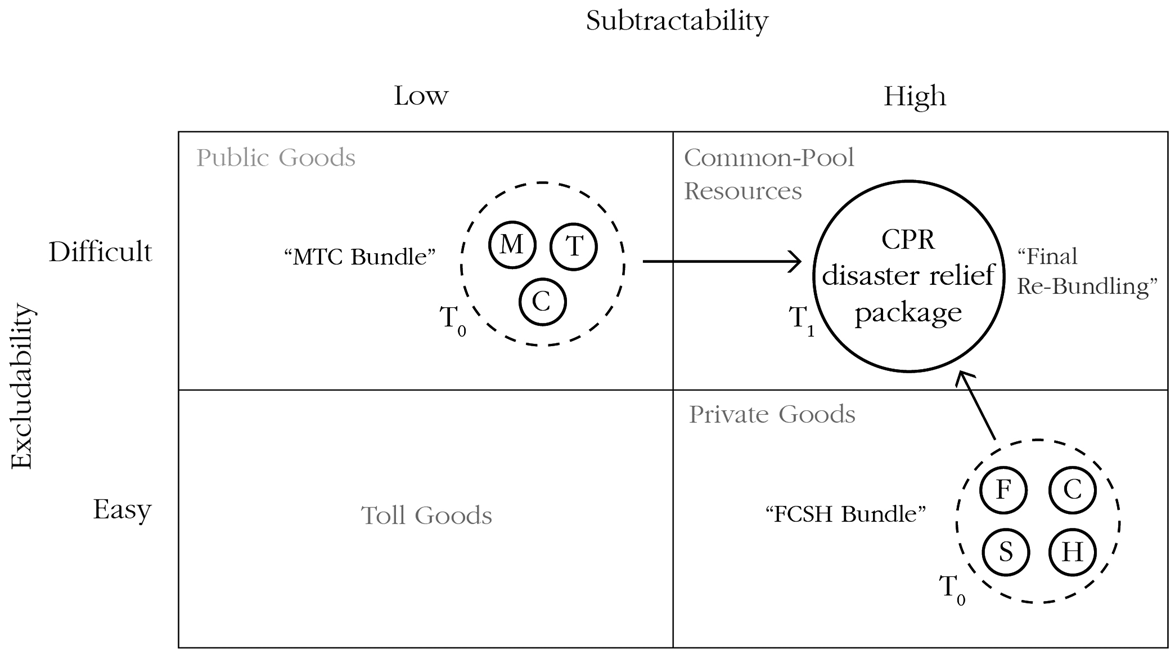
In the aftermath of the devastating fire, volunteers gathered in one of the few remaining buildings and identified three immediate tasks: to distribute food to the suffering, to organize a citizens patrol for duty, and to restore business (CRAS, 1874; Skarbek, Reference Skarbek2014). The list was extended to include temporary housing, clothing, household necessities, transportation, and medical services. As Rayamajhee (Reference Rayamajhee2020) describes, these represent a broad category of goods with varying degrees of subtractability and excludability. He classifies food, clothing, shelter, and household amenities (FCSH) as conventional private goods characterized by high degrees of subtractability and excludability. On the other hand, medical services, transportation services, and community safety (MTC) exhibit relatively lower degrees of subtractability and excludability. Moreover, the overall restoration of business and ensuring normal functioning of markets are highly non-excludable and non-rivalrous (a distinctly public feature), so are considered public goods and placed within the MTC set. To distinguish MTC from FCSH and to acknowledge MTC's relatively higher publicness, they are classified as public goods.Footnote 17 As shown in Figure 3 below, FCSH belongs in the lower-right quadrant and MTC in the top-left.
Contestability through re-bundling.
(Source: Authors' elaboration).

Formal political or bureaucratic organizations were not equipped to handle the crisis, so CRAS stepped in to provide relief aid and overcome many post-disaster challenges (Skarbek, Reference Skarbek2014). CRAS leveraged its organizational assets and existing ‘constitutional rules’, and mobilized local knowledge and resources to conduct ‘an appropriate bundling of these goods and services as disaster relief’, thus shifting them to a quadrant where free-riding problem could be most effectively minimized – the top-right CPR quadrant in Figure 3 (Rayamajhee, Reference Rayamajhee2020). Indeed, once donations and disaster aid contributions are gathered, they ‘exhibit features of a common pool resource’ (Skarbek, Reference Skarbek2014: 158). They are subtractable because if a specific amount of disaster relief is provided to a household, that amount gets subtracted from the total pool. They are, however, non-excludable to disaster victims because excluding someone would be determined vicious, inhumane, and reprehensible. As depicted graphically in Figure 3 below, CRAS was able to use its institutional strengths to re-bundle conventional private goods (the FCSH bundle) with public goods (the MTC bundle), and re-package them as ‘disaster relief package’ which had a distinctly CPR feature.
Thus, there exists a myriad of possibilities for re-bundling heterogeneous goods and services to leverage their symbiotic relationships, thereby changing their nature.
3.4 Ideologies, regime shifts, and systemic changes
So far, we have analyzed three mechanisms that engender typology changes through changes in the attributes of the specific good or service under consideration – that is, through changes in the degrees of subtractability and excludability of the good or service per se. The fourth mechanism that we shall delineate in this section pertains to systemic changes that affect not just any specific good or service but an entire class of goods and services, and in many cases, even the broader economy. For instance, regime-shifts and political-legal changes can drastically alter the size of the four quadrants in Figure 1; it can move the excludability and subtractability thresholds. Such changes often alter the economic incentives associated with the ownership, production, or provision of goods and services. For example, laxing legal enforcement of property rights, economy-wide restriction on the ownership of private property, or nationalization of a certain sector of the economy can partially or fully shrink the domain of the private sector (Rayamajhee, Reference Rayamajhee2020). In other cases, when laws (or lack thereof) or norms that dictate the excludability of an entire class of goods are exogenously modified, that can dramatically alter the size of different quadrants.
Consider Guthis, a form of traditional land pooling system in Nepal that can be traced back to the 5th century BC. Guthis have played special roles in maintaining temples, monuments, shrines, and traditional public spaces, organizing religious parades and festivals, and providing space for all rituals from birth to death (Shrestha, Reference Shrestha2019; Sunuwar, Reference Sunuwar2019). They serve as cultural and historical repositories and play central roles in transmitting traditions through generations. Over the centuries, different Guthis have evolved into diverse institutional forms. Thousands of Guthis of varying sizes, endowments, revenue-streams, and management approaches operate in Nepal to fulfill diverse cultural roles. Although primarily operated by pooling resources together at the community level, Guthis can also be ‘public’ (i.e. they receive government support) or private (run by members of the same lineage).
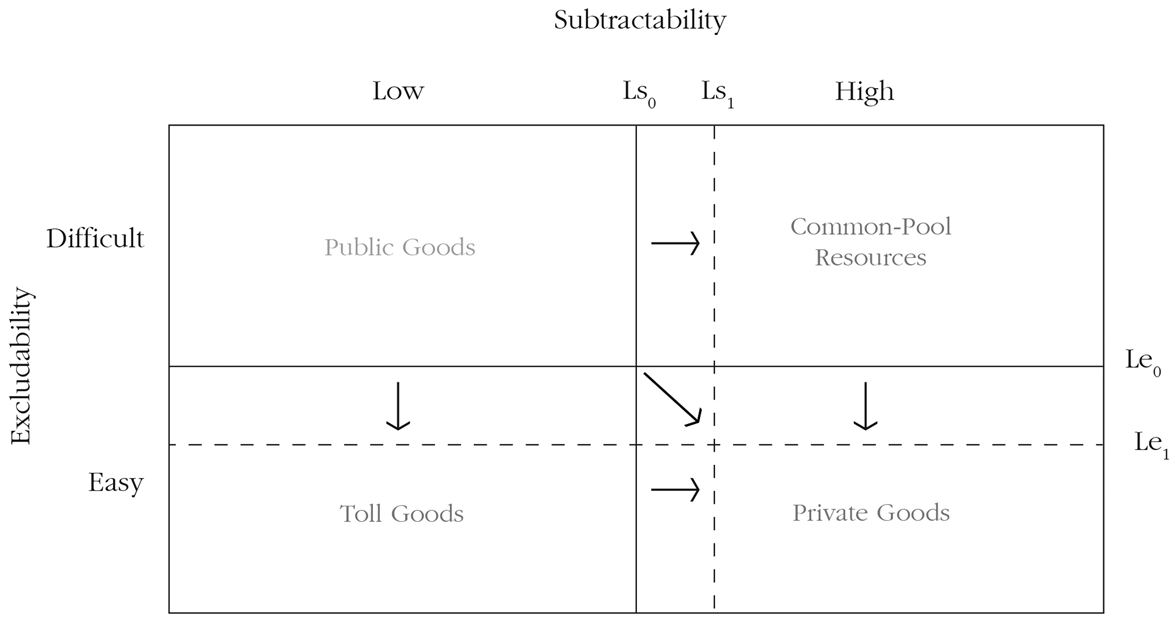
On 29 April 2020, Khadga Prasad Oli's communist government introduced the Guthi-bill that would ‘consolidate all acts and amendments related to guthis’ (Shrestha, Reference Shrestha2019). Among the primary provisions in the bill is the establishment of ‘a powerful commission to replace the Guthi Sansthan and to nationalize all Guthis’ (ibid). Once the bill is enacted into law, all different forms of Guthis and a wide variety of goods and services they provide (both tangible and non-tangible) will be deemed public goods characterized by absolute non-excludability. Unlike the movement of goods across quadrants as described in previous cases, changes of this kind are better modeled as the shrinking or expanding of the quadrants themselves.Footnote 18
As shown in Figure 4, the changes induced by the Guthi-bill can be represented as shifts in the excludability and subtractability thresholds (LEt shifts downward and LSt shifts right) of the entire Guthi system such that the public sector expands to engulf all CPR, club, and private arrangements.
Contestability through regime shifts.
(Source: Authors' elaboration).

Similar examples include the coercive takeover of private industry through nationalization schemes such as that of Carlos Andres Perez's economic plan La Gran Venezuela (Rayamajhee, Reference Rayamajhee2020). Alternatively, in the case of the Chinese ‘Great Leap Forward’, the entire economy was transformed to a collectivized (CPR-like) arrangement, thus ‘creating a tragedy of the commons where it didn't exist before’ (Tarko, Reference Tarko2017: 81). This externally coerced collectiveness (CPR arrangement) can be illustrated as an exogenous shift of the excludability threshold such that it becomes difficult to exclude non-members from expropriating benefits (e.g. previously private agricultural land and products). This fourth mechanism also provides an alternate framework to describe the thinning down of the civil society or the ‘third pillar’ as a result of the state and markets dominating many aspects of social lives (Rajan, Reference Rajan2019).
On the other hand, political decrees can make an entire class of goods or services less subtractable (hence more public) by scaling up its production, use, or the choice of marginal unit (Cowen, Reference Cowen1985). Hydroelectricity provides an illustrative case. Micro-hydropower is a practical and low-cost option for generating electricity at remote sites, particularly for small villages in hilly areas (Williams, Reference Williams1996). If a household or a group of households has a stream or river flowing through their property, a micro-hydropower system can be installed at reasonably low costs and the benefits can be mutually shared. Private micro-hydropower plants usually generate up to 100-kilowatts of electricity that is enough for a dozen large homes, or small businesses. On the other hand, larger hydropower plants can utilize community-based externality mitigation fund or benefit-sharing strategies to overcome collective action problems (Rayamajhee and Joshi, Reference Rayamajhee and Joshi2018). Contrast such approaches to those used in the operation of the Hoover Dam in the United States (operated by the US Bureau of Reclamation) or the Three Gorges Dam project in China (operated by government-owned China Yangtze Power). Through sheer political force, a sector can be made more public simply by amplifying the marginal unit. Thus, as public choice theory predicts, one of the reasons why many goods ‘appear to be public’ is because governments typically overproduce them (Cowen, Reference Cowen1985; Tullock, Reference Tullock1965). Hence, political maneuvering can exogenouslyFootnote 19 manipulate the subtractability threshold and artificially scale up the level of collective action problem.
Finally, whether a class of goods and services is private or public is not purely a function of the attributes discussed so far. Public perceptions about what goods and services ought to be part of ‘citizen rights’ and what are to be provided by the state matter a great deal in determining the size and scope of the public sector (Fritz, Reference Fritz, Boettke, Herzberg and Kogelmann2020). Regardless of good-specific attributes, the good or service can be made ‘public’ simply because the state decides so.Footnote 20 On the other hand, political ideologies can impose external restrictions on the extent of subtractability and excludability of a wide variety of goods and services. For instance, Mao Zedong's ‘Cultural Revolution’, aimed at ‘re-educating the youth’, effectively wiped out any notion of privateness of labor market or production. The Communist party and the nation vowed to ‘grasp revolution and promote production’ for public good (Stern, Reference Stern1979). The ‘re-educated youth’ were to view both labor inputs and outputs as both non-excludable and non-subtractable. The result is an involuntary omission of the private quadrant even though it defies the internal logic of the goods' typology.
Thus, the cases reviewed suggest that ideology and political changes influence what can be excluded, and can, therefore, exogenously define a good's typology.
4. Beyond stationary taxonomies and toward polycentricity
The four mechanisms reviewed tell us that any attempt to classify or taxonomize goods and services ex ante based on their alleged ‘inherent’ properties, as if they are immutable, ontological features, is futile. Even if we accurately identify the nature of goods and services at a specific time and place, that in no way ensures that the nature will remain static at a different time and place. We explored several ways in which goods and services can move across quadrants (i.e. their types) and scenarios when the quadrants themselves can shrink or expand. Collectively, they pose serious challenges to the task of calculating ‘optimal’ provision of ‘public’ goods and services, if we only follow the Samuelsonian logic. Hence, in recognizing the dynamic and contestable nature of goods and services, ‘we are confronted with the task of thinking through what patterns of organization might be used to accommodate these difficulties and yield reasonably satisfactory results’ (Ostrom and Ostrom, Reference Ostrom and Ostrom2002: 82).
Nonetheless, Samuelson's (Reference Samuelson1954) observation about the ‘impossibility of decentralized spontaneous solution’ through competitive market pricing alone has some truth to it for a certain class of goods (p. 388). But that in no way ascertains that the state is equipped with a more efficient mechanism to replace competitive market pricing. Add to that the fact that the nature of goods and services themselves shift over time and vary according to contexts. The challenge then becomes one of creating an omniscient bureaucratic apparatus that not only mimics analogous ‘prices’ in the public sector but also constantly examines the dynamic nature of goods and services and adapts its bureaucratic structure accordingly. Such role amounts to deciding its own scope and jurisdiction, which poses other difficulties that have been examined extensively by public choice scholars (e.g. Tullock, Reference Tullock1965).
The Samuelsonian dichotomy presents a false dilemma. If markets perform sub-optimally, then the state ought to intervene, and vice versa. But what if markets and the state both face insurmountable challenges in the provision of certain goods or services? Our analysis vis-à-vis the dynamic nature of goods and services suggests that the state cannot be the de facto final recourse in such cases because it is more likely to face ‘administrative rigidity’ problems that inevitably slow down adaptation processes (Tarko, Reference Tarko2017). In fact, as the administrative hierarchy gets steeper, inefficiencies are likely to increase at increasing rates because different administrative units operate at rigid scales whereas the nature of the goods and services (and their associated collective action problems) are in the states of constant flux (Ostrom, Reference Ostrom2008; Rayamajhee, Reference Rayamajhee2020). Does this mean then that we are stuck in a perpetual inefficiency trap?
The answer to the above question is no, at least not necessarily. The polycentric framework advanced by Polanyi (Reference Polanyi1951) and later articulated and further developed by Elinor and Vincent Ostrom offers a way out of this market versus state tug-of-war (Ostrom and Ostrom, Reference Ostrom and Ostrom2002; Ostrom et al., Reference Ostrom, Tiebout and Warren1961). Polycentric connotes numerous formally independent decision-making ‘centers’ that may enter into competitive relationships in some circumstances or may undertake contractual cooperative arrangements in other situations to fulfill specific objectives (Ostrom et al., Reference Ostrom, Tiebout and Warren1961).Footnote 21 The precise relationship chosen is an empirical matter and depends on many factors such as the nature of collective action problems or the type of goods and services to be produced or provided, legal-political landscape, cultural norms, and so on (ibid.). Moreover, even though polycentricity might resemble some form of cooperative federalism in the political sphere (Ostrom et al., Reference Ostrom, Tiebout and Warren1961), the specific ways in which polycentricity will manifest in different contexts depend on a host of factors: objectives and motivations of agents, background conditions, technological and political constraints, choice of rules at various decision centers across levels, and the resulting emergent processes (Aligica, Reference Aligica2014; Polanyi, Reference Polanyi1951).
The main argument presented for polycentricity, relevant to the Ostroms' analysis of metropolitan governance, is that the ‘optimum scale of production is not the same for all [urban] public goods and services’ (Aligica, Reference Aligica2014). Under a polycentric arrangement, the ‘existence of multiple agencies with some overlap may enable some aspects of services to be performed at a small scale while other aspects can be performed at a large scale’, thus ‘optimizing’ at appropriate levels (Ostrom, Reference Ostrom1972: 481). Our point concerning the dynamic nature of goods extends their argument a step further. Recognizing the constantly evolving nature of goods means that overlaps and duplications across institutions and agencies are ‘natural expression [s]’ of diversity and dynamism in the public sector (Ostrom and Ostrom, Reference Ostrom and Ostrom2002). Therefore, they cannot be prima facie deemed wasteful. After all, diversity and redundancy of products in the markets are strengths, not weaknesses. Thus, polycentricity provides a flexible and adaptive meta-institutional framework where diverse institutions with overlapping jurisdictions compete and/or cooperate to ‘track’ and ‘match’ those underlying changes in the nature of goods and services (Ostrom et al., Reference Ostrom, Tiebout and Warren1961).
Polycentric framework for policy analysis offers several key advantages. It leads to a better understanding of market processes and draws important lessons from them that may be transferred to non-market sectors. Where market mechanisms may not be employed for the provision of certain goods and services for a variety of reasons, it [polycentric framework] ensures that efficiency-enhancing processes are in place to mimic experimentation and maintain competitive pressures similar to markets in the public and quasi-public sectors. It also provides space for democratic processes in the discussion of public goods and services. Instead of asking whether a good is private or public ex ante, it allows civic discussions and institutional experimentation to discover the good's nature through dynamic processes. A variety of institutional arrangements with varying potentials can emerge to address various challenges. As Aligica (Reference Aligica2014: 31) puts it, ‘Each institutional arrangement has a certain potential: it could maximize or minimize some values, preferences, or options from a given heterogeneous set existing in a given society’.
Moreover, instead of ex-ante taxonomizing goods and services, the polycentric line of inquiry allows for more nuanced and productive analyses consistent with the everchanging nature of goods and services and the immense institutional diversity that characterizes our modern economy. Markets are remarkably complex institutions. The state too is an agglomeration of a wide range of institutions. And, we interact on a daily basis with a wide range of emergent institutions that cannot be neatly categorized as either markets or states. These institutions independently and simultaneously fulfill important functions. They do so with different efficiency levels and have different degrees of adaptability. Thus, inquiries directed toward identifying and encouraging flexible and adaptive institutional arrangements that are responsive to, and accommodate for, the dynamic nature of goods and services will yield better results. As Elinor Ostrom acknowledged, ‘[u]nless institutional arrangements are able to respond to everchanging environment, the sustainability of situations is likely to suffer…. If an institutional arrangement is too inflexible to cope with these unique conditions, it is unlikely to prosper’ (Ostrom, Reference Ostrom2011: 17).
5. Concluding remarks and areas of future research
This article provides a critique of the static private–public dichotomy of goods that continues to dominate academic and public discourses till date. Building on the Ostroms' body of work on public economies, we contend that the attributes that are used to define a good's type, namely excludability and subtractability, are not static, binary concepts. Instead, these are institutionally contingent, malleable, and dynamic features that change over time. Thus, if the degrees of excludability and subtractability are altered substantially, the nature of the good or service, defined by its position in the typology matrix, also changes (Rayamajhee, Reference Rayamajhee2020). The implication is that the theory of public goods based on the binary Samuelsonian dichotomy, which is often invoked to justify the public provision of certain goods and services, is inconsistent with the empirical reality of the dynamic modern economy.
We then present a topology schematic and use it to codify and analyze four (often) complementary mechanisms that create conditions by which the nature of goods and services changes over time: (1) technological and geographical factors; (2) co-production and entrepreneurial ingenuity; (3) re-bundling and re-packaging of related goods and services; (4) ideologies, regime shifts, and systemic changes. Thus, we provide a novel framework to show that the nature of goods is not an intrinsic feature of a good per se, but rather a dynamic, contextual feature that is contestable and constantly evolving.
Recognizing this leads us to conclude that there is no a priori or ontological basis in economic theory to posit that certain goods and services are, or must be, inherently permanent public goods.Footnote 22 And, even if they are considered as such at a given time – due to other political and/or ideological reasons – that does not necessarily mean that their ‘state-based’ publicness must or can always remain so. The conventional static classification of goods cannot provide a reliable framework for efficient and adaptive public policy because it does not account for such dynamic, contestable features of goods. Thus, we emphasize the need for a polycentric framework for public policy that allows for diverse and adaptive institutions to compete, cooperate, and innovate, putting forth a range of contestable solutions consistent with the heterogeneity and contestability of goods and services.
Hence, the logic of the dynamic nature of goods and its theoretical, empirical, and policy implications open up new avenues for policy research. It may be beneficial to extend the line of inquiry to uncover institutional details, constitutional rules, and specific governance structures within a polycentric framework that would allow for institutional malleability and adaptability such that ‘institutional matching’ may be possible that enables us to map out specific classes of institutions suited to the goods or services in question (Furton and Martin, Reference Furton and Martin2019).
In addition, there are several potential avenues of research that can be pursued by developing these insights. The varying probabilities of movement of goods across quadrants in the classification table open up related questions about institutional path dependence and transaction costs. For instance, it may be more difficult or easier for certain goods to transition toward a more ‘fitting’ quadrant than for other goods. Thus, the malleability that our analysis implies may not be feasible in situations characterized by prohibitive transaction costs and strong institutional path dependence that may induce transitional drags. Moreover, the shift may be neutral – i.e. consistent with the internal logic of goods – in some cases, and non-neutral (by fiat) in others. In many cases, critical tradeoffs may be involved when shifting a good toward its ‘right’Footnote 23 position (and hence appropriate provision). Thus, new insights may be generated by linking the dynamic nature of goods to the rich literature on transaction costs.Footnote 24
Finally, the notion of co-productiveness could take center stage in this analysis, by recognizing that it is a crucial feature in the production and maintenance of several goods and services. In addition to excludability and subtractability, one can think of the degree of co-productiveness as the crucial third attribute that influences the nature and typology of goods and services. This could add a new dimension and expand our analysis beyond its current 2 × 2 matrix form. Such an approach may equip us with appropriate tools to anatomize the ‘gray areas’ of ‘neither market nor state’ domains that have yet to receive adequate systematic treatment in economics and its adjacent disciplines. Incorporating the third attribute could help us improve upon, with more analytical details, the Ostromian attempt at building a typology of goods that justifiably accounts for institutional diversity and the essential role of civil society and local communities in the production of various goods and services. Thus, instead of characterizing a diverse set of institutions with lump-sum terms such as the ‘third sector’, ‘informal sector’, or ‘civil society’, we may be able to systematically study them based on their specific objectives (goods and services they provide), features such as adaptability, rules-in-use, and so on. This enables us to better tease out the sources of frictions and complementarity across markets, states, and the ‘third sector’, thus allowing us to identify and compare inefficiencies and potentials across different institutional arrangements.
Acknowledgments
This article grew out of a series of discussions that started during a colloquium on the Political Economy and Social Philosophy of Vincent and Elinor Ostrom organized by the Mercatus Center at George Mason University in 2019. We are grateful to the discussion leaders and participants at the colloquium, especially to Peter Boettke, Bobbi Herzberg, Brian Kogelmann, and Peter Lipsey for their insights and support. We also want to extend our gratitude to Professor Geoffrey Hodgson and five anonymous reviewers for their valuable feedback.