Kefir is a fermented milk, sour, slightly carbonated with a low alcohol content that is obtained by the fermentation of milk with kefir grains. These grains are composed of lactic and acetic-acid bacteria along with yeasts that are immobilised in a structural matrix of polysaccharides and proteins. The microorganisms present are responsible for the lactic, acetic, and alcoholic fermentation of milk that yields a product with characteristic organoleptic properties (Garrote et al. Reference Garrote, Abraham, De Antoni, Mozzi, Raya and Vignolo2010). Functional and probiotic properties of kefir and/or microorganisms isolated from kefir grains have been studied reporting as main effects prevention of tumours, stimulation of the immune system and inhibition of pathogenic microorganisms (Arslan, Reference Arslan2015; John & Deeseenthum, Reference John and Deeseenthum2015). Beneficial health properties of kefir have been attributed either to the presence of a complex microbiota, to generation of metabolic products or both. Within these latter products can be mentioned: organic acids, vitamins (mainly group B), ethanol, carbon dioxide, acetaldehyde, diacetyl, surface proteins of some microorganisms released into the medium (S-layer) and exopolysaccharides (Golowczyc et al. Reference Golowczyc, Mobili, Garrote, Abraham and De Antoni2007; Garrote et al. Reference Garrote, Abraham, De Antoni, Mozzi, Raya and Vignolo2010; Hamet et al. Reference Hamet, Medrano, Pérez and Abraham2016). In addition, peptides and other fermentation products may be implicated in the biological activity of the fermented product (LeBlanc et al. Reference LeBlanc, Fliss and Matar2004; Vinderola et al. Reference Vinderola, Perdigon, Duarte, Thangavel, Farnworth and Matar2006; Zagato et al. Reference Zagato, Mileti, Massimiliano, Fasano, Budelli, Penna and Rescigno2014). Tsilingiri et al. (Reference Tsilingiri, Barbosa, Penna, Caprioli, Sonzogni, Viale and Rescigno2012) found a differential effect on the inflammation process of a probiotic microorganism or the probiotic culture supernatants. In this way the authors defined the concept of ‘postbiotic’ referring to the fermentation products generated by probiotic microorganisms suggesting that they could be used with potential therapeutic application. Considering the possible relevance of the role of bacterial metabolites in the biological activity of fermented milk, the objective of the present study was to obtain and characterise the non-microbial fraction of kefir, and to evaluate their biological activity, focusing on the analysis of the antimicrobial activity against Escherichia coli, Salmonella spp. and Bacillus cereus, and the effect on Salmonella infection in vitro and in a murine model in vivo.
Materials and methods
Kefir grains, milk fermentation and preparation of the non-microbial fraction
Kefir grains CIDCA AGK1 and CIDCA AKG10 belonging to the CIDCA collection (UNLP-CIC- CONICET, Argentina) were used. They were inoculated in commercial skim milk UHT (La Serenisima, Argentina) in a ratio grains/milk 10% w/v and were maintained by successive cultures in milk at 20 °C for 24–48 h as described by Garrote et al. (Reference Garrote, Abraham and De Antoni2000). The non-microbial fraction of kefir (NMFK), was obtained by centrifugation at 10 000 g for 15 min at room temperature (Avanti J25, Beckman Coulter Inc., USA) and filtration of the supernatant obtained through a 0·45 µm of pore diameter (Millipore Corporation, USA). For certain experiments this fraction was neutralised by adding NaOH 5 N, and centrifuged again under the same conditions. For specific tests, this product was frozen at −80 °C, lyophilised and resuspended in phosphate-buffered saline solution (PBS) to give a 5-fold concentrated solution (in volume ratio).
Enumeration of viable microorganism
To determine the concentration of viable microorganisms in kefir grains and fermented products appropriate dilutions in tryptone 0·1% w/v were carried out, and plate counts were performed on MRS agar (Biokar Diagnostic) for lactic acid bacteria (LAB) and YGC agar (Biokar Diagnostic) for yeast. Kefir grains were previously scattered in a sterile mortar. The results were expressed as colony forming units (CFU)/g for kefir grains and CFU/ml for fermented products.
Organic acid and sugar determination in the non-microbial fraction of kefir
Qualitative and quantitative determination of organic acids was performed by high pressure liquid chromatography (HPLC) employing an ion exchange column (AMINEX HPX-87H, BioRad Labs, USA). The sample preparation as well as the running protocol was previously described by Garrote et al. (Reference Garrote, Abraham and De Antoni2000). Identifying acids was based on the comparison of retention times with standard solutions or standards acids with HPLC grade (Sigma Chemical Co.).
Sugar composition of fermented products was analysed by thin layer chromatography (TLC) employing Silica gel plates G (D-64271 Merk, Germany). The plates were activated 5 min at 100 °C. Seeding was carried out with a microsyringe placing 3 µl of each sample in 3 aliquots of 1 µl each. The mobile phase consisted of a mixture of n-propanol: acetic acid: water (70 : 20 : 10). The plates were developed with a solution of p-aminobenzoic acid (7 g/l) and o-phosphoric acid (30 g/l) in methanol, the solvent was evaporated and plates were placed 5 min at 100 °C to allow viewing of the corresponding carbohydrates (Piermaria et al. Reference Piermaria, Mariano and Abraham2008). Along with the samples, patterns of glucose, lactose and galactose were analysed. The total sugar determination was performed using anthrone sulphuric method (Southgate, Reference Southgate1976).
Pathogenic microorganisms
For antimicrobial activity assays pathogenic microorganisms isolated from clinical samples and collection were used as indicators. Salmonella enterica serovar Enteritidis CIDCA101 isolated in Hospital of Pediatrics Prof. Juan P. Garrahan, Buenos Aires, Argentina was provided by Dr H. Lopardo. Salmonella enterica subsp. enterica serovar Typhimurium ATCC 14028, Escherichia coli ATCC 11229 and Bacillus cereus ATCC 10876 belonging to the American Type Culture Collection (ATCC) were also used.
Antimicrobial activity of the non-microbial fraction of kefir
The antimicrobial activity of the non-microbial fraction of kefir obtained by milk fermentation with CIDCA AGK1 grains at 20 °C during 24 h was studied. Growth inhibition of S. Enteritidis, E. coli and B. cereus by non-microbial fraction of kefir was analysed by a microplate dilution test. 48-wells plates, were filled with 300 µl of nutrient broth (Biokar Diagnostic) added with the non-microbial fraction of kefir in concentrations 0, 25, 50, 75 and 100% (v/v) and seeded with a 5 µl suspension of the pathogen in saline buffer ≈1·5 × 108 CFU/ml. The plates were incubated at 37 °C and the optical density at 600 nm (OD600nm) was measured immediately after filling the plate, each hour during 8 and at 24 h. The OD600nm vs time was analysed.
Inhibitory activity of the non-microbial fraction of kefir was also studied by a turbidimetric assay. Non-microbial fraction of kefir in acid and neutralised condition was employed. 48-well plates were filled with 300 µl of non-microbial fraction of kefir in both conditions (acid or neutralised). Then plates were inoculated with 5 µl of each microorganism suspension as described above. Supernatant of unfermented milk artificially acidified with lactic acid to reach the pH 3·8 and the neutralised supernatant, both filtered were employed as control. The plate was incubated at 37 °C, OD600nm was measured immediately after filling the plate, each hour during 8 and 24 h. Then the OD600nm vs time was analysed.
The effect of concentrated non-microbial fraction of kefir on the growth of pathogens was studied by plate-count of viable microorganisms. Pathogen suspension 0·5 Mc. Farland were inoculated in non-microbial fraction kefir 5-folds concentrated in acid and neutralised condition. It was incubated at 37 °C. Every 2 h the concentration of microorganisms (CFU/ml) was determined by viable count in differential selective media. EMB agar was used for E. coli and Salmonella and Mossel agar for B. cereus. EMB agar plates were incubated at 37 °C and Mossel agar plates at 32 °C for 24 h.
Antagonistic activity against Salmonella of the non-microbial fraction of kefir
The ability of association and invasion of intestinal epithelial cells of Salmonella enterica serovar Enteritidis CIDCA 101 (S. Enteritidis) was determined employing Caco-2/TC7 cells as described Golowczyc et al. (Reference Golowczyc, Mobili, Garrote, Abraham and De Antoni2007). The non-microbial fraction of kefir, obtained by fermentation of milk with CIDCA AGK1 grains at 20 °C during 24 h, was analysed and two experimental designs which evaluate the effect of either the Salmonella- or cells-preincubation with non-microbial fraction of kefir were applied. Details are presented in online Supplementary Material Section.
In vivo survival assay
Conventional 3 week-old, male, Balb/C mice (Taconic, Germantown, NY, USA) were used in this study. The animals were housed in plastic mini-isolators in ventilated racks (Alesco, São Paulo, Brazil), maintained in the animal house under controlled lighting (12 : 12 h, light : dark), and handled according to the standards outlined in the Colegio Brasileiro de Experimentação Animal rules (COBEA, 2006). The animals were fed with a commercial diet for rodents (Nuvital, Curitiba, Brazil) ad libitum. The Institutional Ethics Committee on Animal Experimentation (CETEA/UFMG) approved the experiment under agreement number 96/2011.
To evaluate the effects of the oral treatment with kefir, non-microbial fraction of kefir and lactate 100 mM on the mortality during an experimental bacterial challenge, a total of 60 animals were divided into 4 groups: (C) Control group (n = 20) (mice receiving only sterile water), (K) mice receiving kefir diluted 1 : 100 in sterile water (n = 10) (NMFK) mice receiving the non-microbial fraction of kefir (n = 10) (L) mice receiving sodium lactate solution 100 mM (n = 20). Mice received treatments orally, ad libitum during 10 d before challenge by oral gavage with Salmonella Typhimurium (105 CFU) and all along the assay. Mice were analysed for weight changes and mortality induced by Salmonella Typhimurium infection. Cumulative mortality was assessed during 28 days post infection.
Statistical analysis
The results are expressed as mean ± standard deviation (sd). Data analysis was performed using Graph Pad Prism version 5.01 for Windows (GraphPad Software, California, USA). Analyses of variance followed by Tukey Test were applied. Log-rank (Mantel-Cox) Test was applied for comparison of survival curves. A P-value < 0·05 indicated a significant difference.
Results and discussion
The microbiological composition of the kefir grains CIDCA AGK1 and CIDCA AGK10 employed in the present study was not significantly different between them, reaching values of 108 CFU/g lactic acid bacteria and 107 CFU/g yeast as well as their fermented product. TLC analysis revealed that lactose was the main simple sugar present, also galactose was detected with lower intensity and no glucose was observed indicating that this sugar is being consumed by the bacteria and yeasts as a carbon source or can also be used in the formation of polysaccharides for the kefir grain biomass generation during the fermentation process (Rimada & Abraham, Reference Rimada and Abraham2001; Zajšek et al. Reference Zajšek, Kolar and Goršek2011). Total simple sugars present in the non-microbial fraction of kefir were quantified and expressed as lactose. Lactose consumption causes a pH decrease which is associated with the production of organic acids during fermentation. Analysis of fermented products obtained with both kefir grains reveals that lactic and acetic acids were the main organic acid produced followed by succinic acid, and that citric acid decreased compared with unfermented milk (Table 1). This represents an important feature, because organic acids are linked to the organoleptic and inhibitory properties of the products.
Microbiological composition, pH, concentration of lactose, lactic and acetic acid in fermented products obtained by milk fermentation during 24 h, at 20 °C with kefir grains inoculated at 10% w/v

CFU, colony forming units; LAB, lactic acid bacteria. Different letters within columns indicates significant differences with P < 0·05.
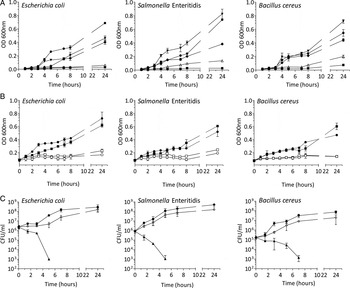
In order to study antimicrobial properties of the non-microbial fraction of kefir, CIDCA AGK1 grains were selected. The growth of Escherichia coli ATCC 11229, Salmonella enterica serovar Enteritidis CIDCA 101 and Bacillus cereus ATCC 10876 in nutrient broth added with different concentrations of non-microbial fraction of kefir was analysed (Fig. 1a). The non-microbial fraction had an inhibitory effect on the growth of Gram-positive and Gram-negative pathogenic microorganisms that was dose-dependent. Either the growth rate as well as the maximum harvest for the three pathogens analysed was reduced in presence of the non-microbial fraction of kefir. An increase in Lag phase of E. coli was observed with an addition of non-microbial fraction of kefir at concentration 50% v/v and completely inhibition of microbial growth was observed at concentration 75% v/v. Growth of Salmonella Enteritidis was affected in presence of the non-microbial fraction of kefir in concentrations higher than 50% v/v, whereas growth of B. cereus required concentration over 75% v/v to be completely inhibited. Subsequently, the development of pathogens was evaluated in the non-microbial fraction of kefir (pH 3·8) and in the same fraction neutralised (Fig. 1b). It was observed that the non-microbial fraction of kefir, completely inhibited the growth of pathogenic strains as well as milk supernatant artificially acidified with lactic acid (pH 3·8). In contrast, both samples upon neutralisation lost the inhibitory effect. These tests demonstrate that the lactic acid present in the non-microbial fraction of kefir might be responsible for the inhibition of pathogenic growth, and mainly due to non-dissociated content, since a loss of activity was observed when neutralised. These results are in accordance to previous reports by other authors where they analyse the antimicrobial activity of strains belonging to the genera Lactobacillus, Bifidobacterium, Lactococcus, Streptococcus and Bacillus against Gram-positive and Gram-negative pathogens, and describe that neutralisation of culture supernatants reduced the inhibitory effects. They sustain that one of the main mechanisms is the production of organic acids from the fermentation of the glucose and the consequent decrease of the pH (De Keersmaecker et al. Reference De Keersmaecker, Verhoeven, Desair, Marchal, Vanderleyden and Nagy2006; Tejero-Sariñena et al. Reference Tejero-Sariñena, Barlow, Costabile, Gibson and Rowland2012). It should be noted that equivalent results were obtained for the non-microbial fraction obtained with both kefir grains employed, which indicates that the fermentation of milk with kefir grains avoids the proliferation of pathogenic microorganisms that can act as contaminants, thus contributing to the quality and safety of the product obtained, as was also discussed previously by Garrote et al. (Reference Garrote, Abraham and De Antoni2000) and Londero et al. (Reference Londero, Iraporda, Garrote and Abraham2015). It was also observed that the effect of the non-microbial fraction of kefir at acidic pH was bactericidal since no development of colonies was observed in plates seeded after 24 h of incubation with the non-microbial fraction in concentration 75 or 100% v/v. In order to detect other antimicrobial components that could be present at low concentration, the acidic and neutralised non-microbial fraction of kefir was concentrated 5-fold by lyophilisation and the growth/survival of pathogens was analysed by counting viable microorganisms inoculated in the concentrated non-microbial fraction of kefir (Fig. 1c). It was observed that in concentrated and acidic conditions, the non-microbial fraction of kefir presented a bactericidal effect of the pathogens studied. The concentration of viable microorganisms was reduced to not detectable limits in 5 h for E. coli and Salmonella and in 7 h for B. cereus. When the concentrated non-microbial fraction was neutralised, the bactericidal effect was not observed. Therefore, 5-fold concentration of the non-microbial fraction of kefir did not exert antimicrobial contribution of other possible components, unless its activity also depends on the pH, but this fact could not be differentiated with these tests. Other antimicrobial metabolites in addition to organic acids have been described by other authors (Guzel-Seydim et al. Reference Guzel-Seydim, Seydim, Greene and Bodine2000; Beshkova et al. Reference Beshkova, Simova, Frengova, Simov and Dimitrov2003; Barbosa et al. Reference Barbosa, Santos, Lucho and Schneedorf2011). In addition, strains isolated from kefir are capable of producing bacteriocins (Powell et al. Reference Powell, Witthuhn, Todorov and Dicks2007); however, the contribution of these components to the antimicrobial effect of kefir has not been fully elucidated.
Non-microbial fraction of kefir affects E. coli, S. Enteritidis and B. cereus growth. (a) Effect of non-microbial fraction ok kefir (CIDCA AGK1, 10% w/v, 24 h, 20 °C) added to nutrient broth in different concentrations (% v/v): (●) 0 (▼) 25, (♦) 50, (∆) 75, and (■) 100. (b) Microorganism inoculated in (□) non-microbial fraction of kefir pH~3·8 (■), neutralised non-microbial fraction of kefir, (○) supernatant of milk artificially acidified with lactic acid at pH 3·8 and (●) supernatant of milk artificially acidified with lactic acid and neutralised. (c) Effect of the non-microbial fraction of kefir 5-fold concentrated at (▲) pH 3·8 or (◊) neutralised on the viability of pathogenic microorganisms. (●) pathogens in nutrient broth, control.

With the purpose of analysing the effect of the treatment of S. Enteritidis with the non-microbial fraction of kefir on their interaction with intestinal epithelial cells, the Caco-2/TC-7 cell line was employed. Although there were not significant differences on Salmonella association capacity, the ability of this pathogen to invade epithelial cells was significantly reduced (online Supplementary Fig. S1). To develop this test, the pH of the non-microbial fraction was adjusted to pH 4·5 in order to maintain the viability of S. Enteritidis during the assay time (1 h 37 °C). This result indicates that molecules present in the non-microbial fraction of kefir as organic acids, exopolysaccharides and/or proteins/peptides would alter the mechanisms of pathogenesis exerted by S. Enteritidis. Similar results regarding the decreased capacity of Salmonella invasion to intestinal epithelial cells were reported employing whey supernatants fermented with kefir grains (Londero et al. Reference Londero, Iraporda, Garrote and Abraham2015). Antagonic effects of lactic acid bacteria against Salmonella were also reported by other authors (Hudault et al. Reference Hudault, Lievin, Bernet-Camard and Servin1997; Coconnier et al. Reference Coconnier, Lievin, Lorrot and Servin2000). Golowczyc et al. (Reference Golowczyc, Mobili, Garrote, Abraham and De Antoni2007) demonstrates that the S-layer protein present in culture supernatants of L. kefiri strains is associated with S. Enteritidis surface structures and is responsible for the decreased ability of the pathogen to invade epithelial cells. This protein could also be found in the non-microbial fraction of kefir, as the presence of S-layer proteins has been evidenced in Lactobacilli isolated from kefir grains (Garrote et al. Reference Garrote, Delfederico, Bibiloni, Abraham, Pérez, Semorile and De Antoni2004), being able to contribute to the effect observed in the present work.
The interaction of a pathogen microorganism with a host cell usually triggers the activation of different signalling pathways of the host cell, either directly by bacterial components or by stimulation of host activating factors, such as inflammatory cytokines.
Treatment of intestinal epithelial cells with flagellin from Salmonella, exerts in vitro an inflammatory response that is down-regulated by the non-microbial fraction of kefir being this effect attributed to lactate (Iraporda et al. Reference Iraporda, Romanin, Rumbo, Garrote and Abraham2014). Considering this, the effect of the non-microbial fraction of kefir and lactate was analysed also in a Salmonella infection model in vitro and in vivo. Firstly, intestinal epithelial cells were pre-incubated with the non-microbial fraction of kefir or with lactic acid 100 mM, both neutralised (online Supplementary Table S1). As a result of this assay, no significant differences on the association/invasion capacity of S. Enteritidis were observed, indicating that the components present in the non-microbial fraction did not produce changes on the cells that might modify the interaction with the pathogen.
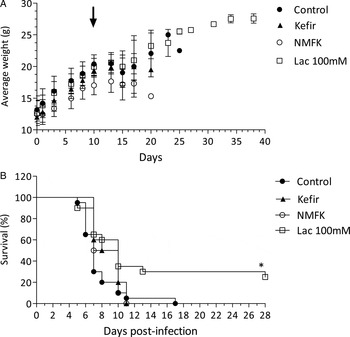
The in vivo effect of neutralised kefir and non-bacterial fraction of kefir were analysed in a murine model of Salmonella infection. A lactate solution 100 mM pH 6·8 was also included in the experiment. Mice consume these different treatments orally ad libitum, during 10 d previous Salmonella challenge and all along the assay, meanwhile, control group received water. Salmonella Typhimurium ATCC 14028 infection caused the death of 100% of the mice of control group after 17 d (Fig. 2). Either kefir or the non-microbial fraction of kefir did not exert a significant protection against Salmonella, and mice mortality was not significantly different from control group. As a relevant result, mice that received lactate 100 mM presented a lower mortality rate (P < 0·05).
Effect of oral treatment with (▲) kefir (○) non-microbial fraction of kefir (NMFK) (□) lactate 100 mM and (●) water (control) on: (a) Average weight (g) of mice. The arrow indicates Salmonella challenge. (b) Survival of mice challenged with S. Typhimurium. *indicates P < 0·05 in relation to control group, statistical test performed Log-rank (Mantel-Cox) Test.

Reports of beneficial effects of probiotics on Salmonella infection have been previously described and are associated with milk derived peptide released during fermentation, organic acids and other metabolic products (Altier, Reference Altier2005; Tellez et al. Reference Tellez, Corredig, Turner, Morales and Griffiths2011). Also, some authors attribute the effect of supernatants of lactic acid cultures on the reduction of Salmonella invasion to the presence of lactic acid (Makras et al. Reference Makras, Triantafyllou, Fayol-Messaoudi, Adriany, Zoumpopoulou, Tsakalidou, Servinc and De Vuysta2006). In the present study it was demonstrated that the consumption of lactate reduced the mortality induced by this pathogen. The use of lactic acid is one of the oldest methods used to inhibit the growth of Gram-negative and Gram-positive bacteria. In its non-dissociated form, this organic acid can cross the bacterial membranes and thus lower the intracellular pH causing adverse effects on numerous cellular functions (Presser et al. Reference Presser, Ratkowsky and Ross1997; Carpenter & Broadbent, Reference Carpenter and Broadbent2009). In addition, it also functions as a permeabiliser of the outer membrane of Gram-negative bacteria, and thus may enhance the effects of other antimicrobial substances (Alakomi et al. Reference Alakomi, Skytta, Saarela, Mattila-Sandholm, Latva-Kala and Helander2000). Although, it was demonstrated that short chain fatty acids and lactate modulate activity of relevant sentinel cell types activated by Toll-like receptors (TLR) signals and might down-regulate inflammatory response in a dose-dependent manner (Iraporda et al. Reference Iraporda, Errea, Romanin, Cayet, Pereyra, Pignataro, Sirard, Garrote, Abraham and Rumbo2015), more studies would be necessary to determine the mechanism by which lactate may interfere in the Salmonella infection or if this metabolite could modify the host resistance to infection. Lactic acid is one of the main metabolites of milk fermentation by lactic acid bacteria, and can also be found as a component of many other fermented products as well as it is also generated in situ by the intestinal microbiota, possibly contributing with the described effect.
Conclusion
This study highlights the relevant role of lactate on antimicrobial properties in vitro and in vivo. The non-microbial fraction of kefir inhibited the growth of pathogenic strains of E. coli, Salmonella and B. cereus in vitro and lactate consumption significantly reduced mortality produced by Salmonella infection in an in vivo assay. The pathogen growth inhibitory capacity observed was related to the concentration of non-dissociated lactic acid present in the non-microbial fraction of kefir. The non-microbial fraction of kefir also decreased significantly the ability of Salmonella to invade epithelial cells. The obtained results emphasise the importance of microbial metabolites in the biological activity of kefir.
Supplementary material
The supplementary material for this article can be found at https://doi.org/10.1017/S0022029917000358.
CI is a fellow of Argentina National Research Council (CONICET), AGA, and GLG are members of Scientific Career of CONICET (Argentine). The authors acknowledge CONICET, Agencia Nacional de Promoción Científica y Tecnológica (ANPCyT, Argentina), Universidad Nacional de La Plata (UNLP, Argentina) and CAPES (Brazil) for financial support.