Introduction
Ageing-in-place is favoured by a majority of older adults and is a policy priority across various countries among policy makers. It has been documented as the favourite way of ageing among older adults because it contributes to their wellbeing by maintaining a sense of attachment, connection to social support, security and familiarity (Callahan, Reference Callahan2015; Lum et al., Reference Lum, Lou, Chen, Wong, Luo and Tong2016). Recent studies conducted in China have shown that more than 70 per cent of older adults preferred staying in their communities and receiving home- and community-based care (Lum et al., Reference Lum, Lou, Chen, Wong, Luo and Tong2016; Fu et al., Reference Fu, Guo, Bai and Chui2017; Jiang et al., Reference Jiang, Lou and Lu2018).
Family care-givers play pivotal roles in providing care for community-dwelling and frail older adults. However, they have been found to experience intense and chronic care-giving stress, especially in low- and middle-income countries, where the formal system of long-term care is poorly developed (Silva et al., Reference Silva, Teixeira, Teixeira and Freitas2013; Alzheimer's Disease International, 2015; Stensletten et al., Reference Stensletten, Bruvik, Espehaug and Drageset2016). Therefore, in the guidelines for integrated care for older people, the World Health Organization (2017) has identified care-giver support as a crucial module and proposed that psychological and service support should be offered to family members and other informal care-givers of care-dependent older people. Respite services have been identified as one of the most effective resources for alleviating care-giver burden and promoting the wellbeing of both care-givers and older adults (Robinson et al., Reference Robinson, Lea, Hemmings, Vosper, McCann, Weeding and Rumble2012; Neville et al., Reference Neville, Beattie, Fielding and MacAndrew2015; McCabe et al., Reference McCabe, You and Tatangelo2016). However, in the Chinese context, respite care is often underused and does not match the reported demand for it among family care-givers (Lu and Ottervik, Reference Lu and Ottervik2017; Chen and Bian, Reference Chen and Bian2018).
Respite care services
Respite care services are a form of temporary or short-term accommodation care service for older adults with the aim of giving respite to primary care-givers from daily care-giving (O'Shea et al., Reference O'Shea, Timmons, O'Shea, Fox and Irving2017). It is recognised as a support strategy that is highly desired by care-givers and associated with increased caring longevity in many developed countries (Phillipson and Jones, Reference Phillipson and Jones2012). In China, respite services have been piloted by the Chinese government in a few big cities, including Beijing, Shanghai and Hangzhou. It is regarded as a promising method of sharing the responsibility of elder care between the government and family members (State Council of China, 2017). Older residents in these cities can attain this service for a few hours or up to several months through public community ageing-care centres or organisations specialising in care services (Shanghai Municipal People's Government, 2016; Beijing Committee on Ageing and China Philanthropy Research Institute, 2017).
In mainland China, Shanghai has offered respite services since 2012. In some communities of Shanghai, respite care services, which vary from several hours to two weeks in duration, are available to older adults and their family care-givers. According to the 13th Five-year Plan for the Development of Shanghai's Ageing Industry, it is expected that more than 500 elder-care homes and day-care centres will provide respite care services in 2020 (Shanghai Municipal People's Government, 2016). This plan shows the government's determination to support respite services. To achieve this goal, it is necessary to identify factors associated with informal care-givers’ respite service needs and dynamically monitor changes in care needs to inform community service planning and intervention.
Role of family care-givers in decision to use respite care
Intention to use respite services is not only associated with factors related to older adults’ situations but is also influenced by the characteristics of care-givers. However, only a limited number of studies have investigated factors that influence care-givers’ respite service utilisation. Researchers have identified factors that may influence the use of respite care by care-givers, including service accessibility (Brandão et al., Reference Brandão, Ribeiro and Martín2016), confidence in the services (Phillipson et al., Reference Phillipson, Jones and Magee2014), nature of the care-giving relationship (spousal care-givers are less likely to use respite care; Neville et al., Reference Neville, Beattie, Fielding and MacAndrew2015), care-giving duration (Shi et al., Reference Shi, Chan, Ferretti and McCallion2017) and care-givers’ characteristics (e.g. older age, education level and employment status; Moholt et al., Reference Moholt, Friborg, Blix and Henriksen2018). In sum, most available Western studies have been atheoretical because they have explored predictors by investigating associations between their hypothetical factors and use of respite services. The findings of these studies are fragmented, and the relationships among these predictors are ambiguous. Therefore, a suitable theoretical foundation should be established to allow systematic interpretation of factors affecting the utilisation of respite services.
Although no systematic study has focused on predictors of the intention to use respite services among family care-givers in China, a few articles exploring older adults’ (mostly those with dementia) long-term care service utilisation have stressed that family care-givers are important decision makers (Chang et al., Reference Chang, Schneider and Sessanna2011; Caldwell et al., Reference Caldwell, Low and Brodaty2014; Huang et al., Reference Huang, Griva, Bryant and Yap2017; Qiu et al., Reference Qiu, Sit and Koo2018). Previous studies have identified that traditional Chinese filial piety is one of the most important factors affecting adult children care-givers’ decisions to utilise formal caring resources (Chang et al., Reference Chang, Schneider and Sessanna2011; Huang et al., Reference Huang, Griva, Bryant and Yap2017). Compared to family care-givers in Canada, Chinese care-givers spoke more about their sense of duty regarding caring for older family members and were more likely to accept care-giving for a sick family member as an expected part of life (Caldwell et al., Reference Caldwell, Low and Brodaty2014). Therefore, they intended to exercise restraint in using or accessing formal elder-care services (Qiu et al., Reference Qiu, Sit and Koo2018).
Although these studies, together with those from Western societies (Neville et al., Reference Neville, Beattie, Fielding and MacAndrew2015; Brandão et al., Reference Brandão, Ribeiro and Martín2016; Shi et al., Reference Shi, Chan, Ferretti and McCallion2017; Moholt et al., Reference Moholt, Friborg, Blix and Henriksen2018), shed some light on predictors of informal care utilisation in the Chinese context, there is a lack of detailed information on the facilitators of respite care use in China. In particular, to understand how to address better care-givers’ unmet needs for respite services, there is a need to define multifactorial predictors affecting the intentions of family care-givers. This would help provide more appropriate evidence for context-sensitive policy and service design.
Understanding service utilisation by applying the Andersen model
The Andersen behavioural model of service use served as the theoretical foundation of this study. It has been widely used to explain or predict older people's long-term care needs and their utilisation of formal services together with family care-givers both in Western and in Chinese communities (Lou et al., Reference Lou, Chui, Leung, Tang, Chi, Leung Wong and Kwan2011; McKenzie et al., Reference McKenzie, Lucke, Hockey, Dobson and Tooth2014; Fu et al., Reference Fu, Guo, Bai and Chui2017; Li and Lu, Reference Li and Lu2017; Shi et al., Reference Shi, Chan, Ferretti and McCallion2017; Zeng et al., Reference Zeng, Xu, Zhang and Chen2019). It suggests that predictors may explain older peoples’ (or their care-givers’) utilisation of health and social services, including predisposing characteristics, presenting characteristics of the potential users of the path, enabling factors showing their interaction with the health and social system, and need factors suggesting their need for service (Andersen, Reference Andersen1995). Based on this theoretical framework, previous studies have identified predictors in these three categories of factors. Predisposing factors of age, gender, education level and marital status of both care recipients and care-givers have consistently been found to be strong predictors (Tian and Wang, Reference Tian and Wang2014; Shi et al., Reference Shi, Chan, Ferretti and McCallion2017). Enabling factors of financial satisfaction, number of children and living arrangements of older adults have usually been reported to be strong predictors (McKenzie et al., Reference McKenzie, Lucke, Hockey, Dobson and Tooth2014). Regarding need factors, activities of daily living (ADLs), instrumental activities of daily living (IADLs) and number of diseases among older adults have shown significant effects in available studies (Lou et al., Reference Lou, Chui, Leung, Tang, Chi, Leung Wong and Kwan2011; Diduk-Smith, Reference Diduk-Smith2017).
Given the high frequency of transitions in health conditions and daily activities of older adults who need long-term care, together with the complicated issues surrounding their care, researchers have called for an examination of the longitudinal patterns of predictors and their influence on service-use intention (Lou et al., Reference Lou, Chui, Leung, Tang, Chi, Leung Wong and Kwan2011; McKenzie et al., Reference McKenzie, Lucke, Hockey, Dobson and Tooth2014). However, from the available studies, although the Andersen model has been the prominent theoretical framework for predicting the long-term care needs of elderly people (Fu et al., Reference Fu, Guo, Bai and Chui2017; Zeng et al., Reference Zeng, Xu, Zhang and Chen2019) and their utilisation of formal services together with family care-givers (such as medical services and home-care services) in Chinese communities (Lou et al., Reference Lou, Chui, Leung, Tang, Chi, Leung Wong and Kwan2011; Tian and Wang, Reference Tian and Wang2014; Li and Lu, Reference Li and Lu2017), changes in characteristics of care recipients and care-givers have not been viewed together as a driving force behind the use of health-care services. Therefore, this study addresses research gaps by employing the Andersen model to explore factors affecting the utilisation of formal services in the Chinese context by taking the time-variant variables of the caring context into consideration.
Based on this overview, three research gaps were identified: (a) information on factors associated with care-givers’ intention to use respite services is limited and unclear, since most studies have not adopted a suitable theoretical framework; (b) no research has explored service-use intention among informal care-givers of older adults living at home in the Chinese context, with most studies considering the role of family care-givers in contributing to decisions regarding long-term care service utilisation; and (c) no research has included time-variant variables to examine predictors of respite service utilisation.
This study aimed to explore intention to use respite services from the perspective of informal care-givers of older adults in China by taking time-variant variables into consideration. In theory, this may contribute to the enrichment of the Andersen model and cumulative knowledge by highlighting that time-variant factors are also important in affecting the intention to use respite services among care-givers. In practice, the results could establish evidence for planning services and interventions to support family care-givers and bridge the gap between formal and informal care. Identification of these factors may be useful at a local practice level, where important factors could be incorporated and monitored as part of pathways designed to guide the community care of frail older adults and their care-givers.
Methods
Participants
Data were derived from the Longitudinal Study on Family Caregivers for Frail Older Adults Aged 75 or Above in Shanghai, which was jointly conducted by the University of Hong Kong and East China Normal University from 2010 to 2016.
In Shanghai, most frail older adults receive informal care from their family members; therefore, Shanghai is suitable for examining the caring experience and the needs of care-givers. The baseline study of this longitudinal research project was conducted in 2010, and follow-up surveys were completed in 2013 and 2016. The University of Hong Kong Human Investigation Committee approved the study protocol, and all participants provided verbal consent.
Quota sampling was adopted to recruit community-dwelling frail older adults and their primary care-givers. The sampling procedure consisted of two steps. First, one street office from each of the six urban districts in Shanghai was randomly selected. In China, the urban administrative system consists of five levels, which range from the provincial (highest), municipal and district levels, to the street office, and on down to the lowest level, the residents’ committee. The street office leads and organises the civil affairs of the local community and is responsible for providing various social services. Second, 120 frail older adult–care-giver dyads from each of the selected street offices were recruited. The inclusion criteria for the older adults were as follows: (a) have a Shanghai urban household registration status, (b) be 75 years old or older, (c) have no fewer than two limitations in ADLs or equivalent, and (d) have one primary care-giver aged 18 years or older. Cognitive capacity was assessed using the Short Portable Mental Status Questionnaire (SPMSQ). Proxies were used for older adults whose educational attainment was less than high school with an SPMSQ score higher than 4 and for those who received a college education or more with an SPMSQ score higher than 3.
An older adult and his or her primary care-giver in an eligible dyad were asked to complete different questionnaires (one for the older adult and one for the care-giver) through face-to-face interviews with our trained interviewers in one visit at their home. In the present study, a primary care-giver refers to the person who takes major caring responsibility for the older adult, except domestic helpers and nurses. The primary care-giver's caring work should also be unpaid. Furthermore, we asked older adults to point out who were their primary care-givers. The questionnaires for the elderly people were used to collect information on physical functions, psychological health, life satisfaction and social capital, while the questionnaires for the care-givers covered the topics of caring burden, intention of community service utilisation, social capital and psychological as well as physical health.
Eligible frail older adult–care-giver dyads (N = 720) participated in the survey at baseline. Due to mortality-caused sample attrition, 487 and 374 of the original respondents completed the interviews in the 2013 and 2016 waves, respectively. New eligible respondents joined in both the 2013 and 2016 waves of the survey, generating working samples of 823 in 2013 and 733 in 2016. Older adults and their care-givers who successfully completed the 2013 and 2016 follow-up surveys (N = 583) were included in the data analysis.
Measurement
Dependent variable
Care-givers’ intention to use respite care services served as the dependent variable in this study, as assessed by a single question: ‘Do you think the community should provide respite care services for older adults who are cared for by you?’ (0 = no, 1 = yes).
The Andersen model was employed as the theoretical framework for examining factors influencing the respite care utilisation intention of care-givers. To realise the purpose of this study, some time-variant variables of older adults and their care-givers were included as predictors besides predisposing factors, enabling factors and illness factors as proposed by the original Andersen model.
Predisposing factors
Variables included in predisposing factors were older adults’ age, marital status, gender and education level.
Enabling factors
Four enabling factors of older adults were examined: financial satisfaction (measured by a five-point Likert scale ranging from ‘very inadequate’ to ‘very adequate’), number of children, living arrangements (living alone or not) and employment of domestic helper (yes or no).
Illness factors
The older participants were asked to provide information on their health status, including number of illnesses and functional disabilities in ADLs, which were measured by the Barthel Index (Mahoney and Barthel, Reference Mahoney and Barthel1965). Higher ADL scores indicated more functional limitations in the respondents’ daily lives.
Time-variant factors
To ascertain the longitudinal patterns of the Andersen model, several time-variant factors were included to measure changes in characteristics of both the care-givers and older adults; specifically, changes in: (a) older adults’ IADLs; (b) older adults’ marital status from 2013 to 2016 (recoded as 0 = no, 1 = yes); (c) older adults’ living arrangements from 2013 to 2016 (recoded as 0 = no, 1 = living alone in 2013 but living with others in 2016, 2 = living with others in 2013 but living alone in 2016); (d) primary care-giver type (recoded as 0 = no change, 1 = son to spouse, 2 = son to daughter, 3 = spouse to daughter, 4 = daughter to spouse, 5 = spouse to son, 6 = daughter to son, 7 = son to others, 8 = daughter to others, 9 = others to spouse, 10 = others to son, 11 = spouse to others, 12 = others to daughter); (e) employment of domestic helper from 2013 to 2016 (0 = no, 1 = yes); (f) number of illnesses from 2013 to 2016; and (g) ADL limitations from 2013 to 2016.
Control variables
The control variables were age of primary care-giver, gender of primary care-giver, employment status of primary care-giver, care-giving burden, relationship between older adult and care-giver, and IADLs of the older adult (Lawton and Brody, Reference Lawton and Brody1969).
Care-giving burden was measured by the Chinese Caregiver Burden Inventory (Chou et al., Reference Chou, Jiann-Chyun and Chu2002), a 24-item scale with summed scores from 24 questions demonstrating the level of care-giver burden. Higher scores indicate higher levels of burden.
Data analysis
Logistic regression was adopted in this study. The intention of informal care-givers to use respite care was the dependent variable. Two models were run for the dependent variable separately to examine whether and how factors influence respite care needs from the perspective of informal care-givers. Initially, the predictor variables representing each of the Andersen framework factors (predisposing, enabling, illness) were entered. In the second model, the predictors representing predisposing, enabling and illness factors together with time-variant variables were entered. Listwise deletion was adopted to handle missing values, given that missingness in all variables was lower than 5 per cent. SPSS 19.0 software was employed for the data analysis.
Results
Demographic profiles and intention of family care-givers to use respite services
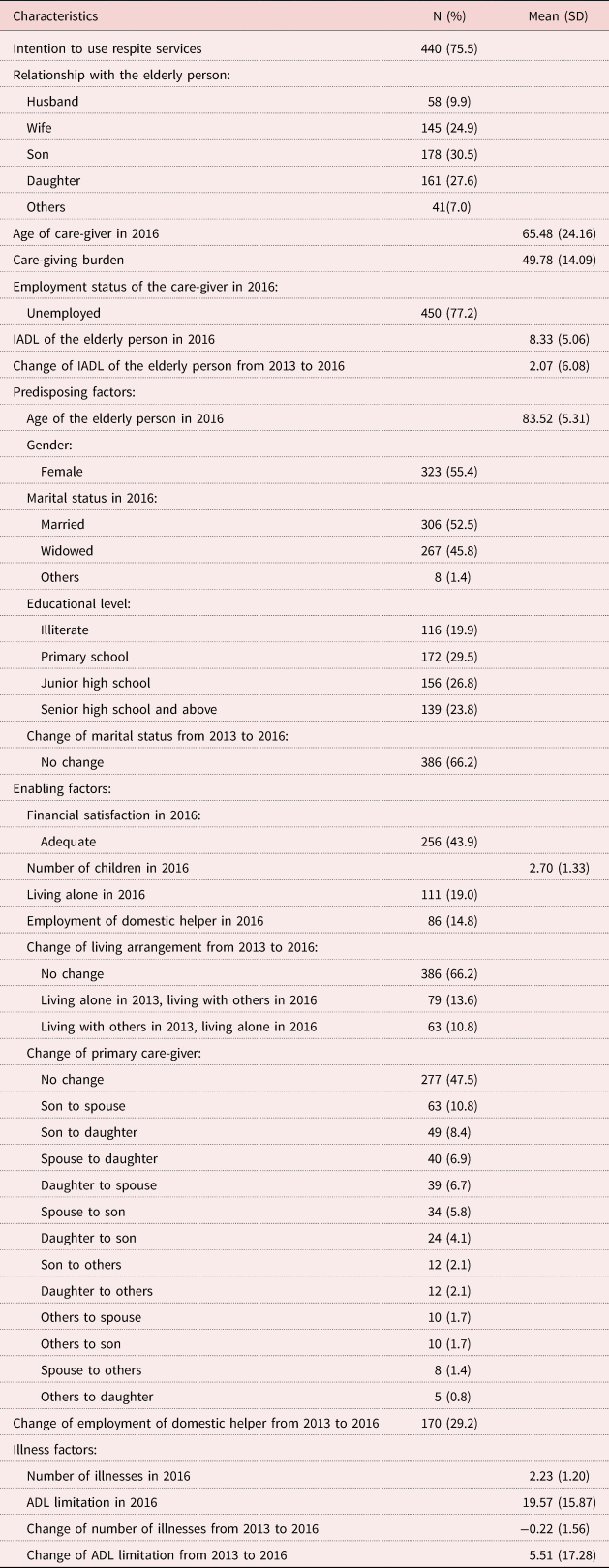
The demographics of frail older adults and their family care-givers and the descriptive results of predisposing, enabling, illness and change factors are presented in Table 1. More than three-quarters of the care-givers reported their intention to use respite services (75.5%, N = 583). Most care-givers (N = 583) were the children (30.5% were sons, 27.6% were daughters) or spouse (34.8%) of the older care recipient. The mean age of the care-givers was 65.48 in 2016. The mean score of care-giving burden was moderate (mean = 49.78, standard deviation = 14.09, N = 573).
Social demographics of frail elderly people and their family care-givers
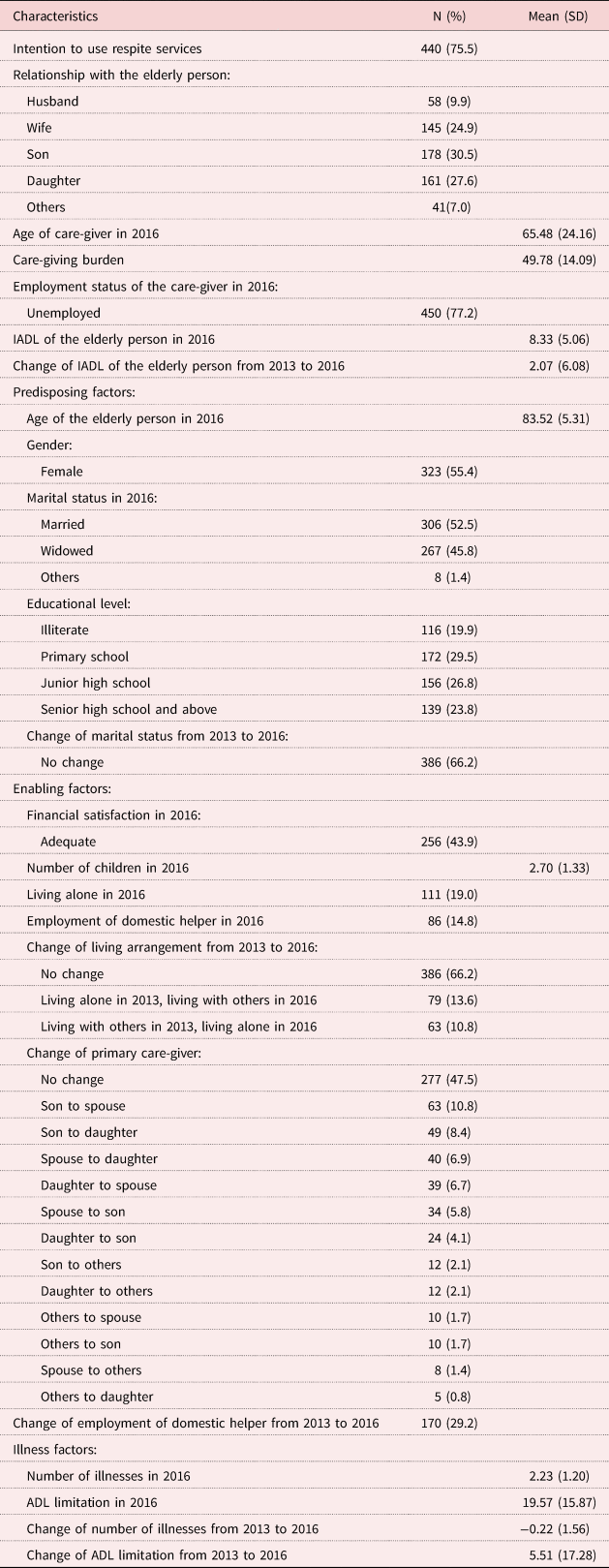
Notes: SD: standard deviation. IADL: instrumental activity of daily living. ADL: activity of daily living.
For older adults, the mean age was 83.52 in 2016. Gender was almost evenly split, with 55.4 per cent (N = 323) female and 44.6 per cent (N = 260) male. More than half (52.5%, N = 581) of the older adults were married, and most of them (80.1%, N = 583) had a primary or higher educational background. The average number of children was about two. Most of the older adults were living with others (81.0%, N = 583) and not employing a domestic helper (85.2%, N = 528). Nearly half of the older adults were satisfied with their financial situation (43.9%, N = 579). The mean ADL and IADL scores in 2016 were 19.57 (N = 581) and 8.33 (N = 575), respectively, and the mean number of diseases was about two.
In terms of change factors, most of the frail older adults reported no change in their marital status (66.2%, N = 583), living arrangements (66.2%, N = 583) and employment of domestic helpers (70.8%, N = 583) from 2013 to 2016. However, more than half of them had experienced a change in care-giver (52.5%, N = 583). The mean changes in ADL and IADL scores from 2013 to 2016 were 5.51 and 2.07, respectively, and the mean change in number of diseases from 2013 to 2016 was −0.22.
Associations between predictor variables and respite care needs of informal care-givers in the Andersen model with time-variant variables
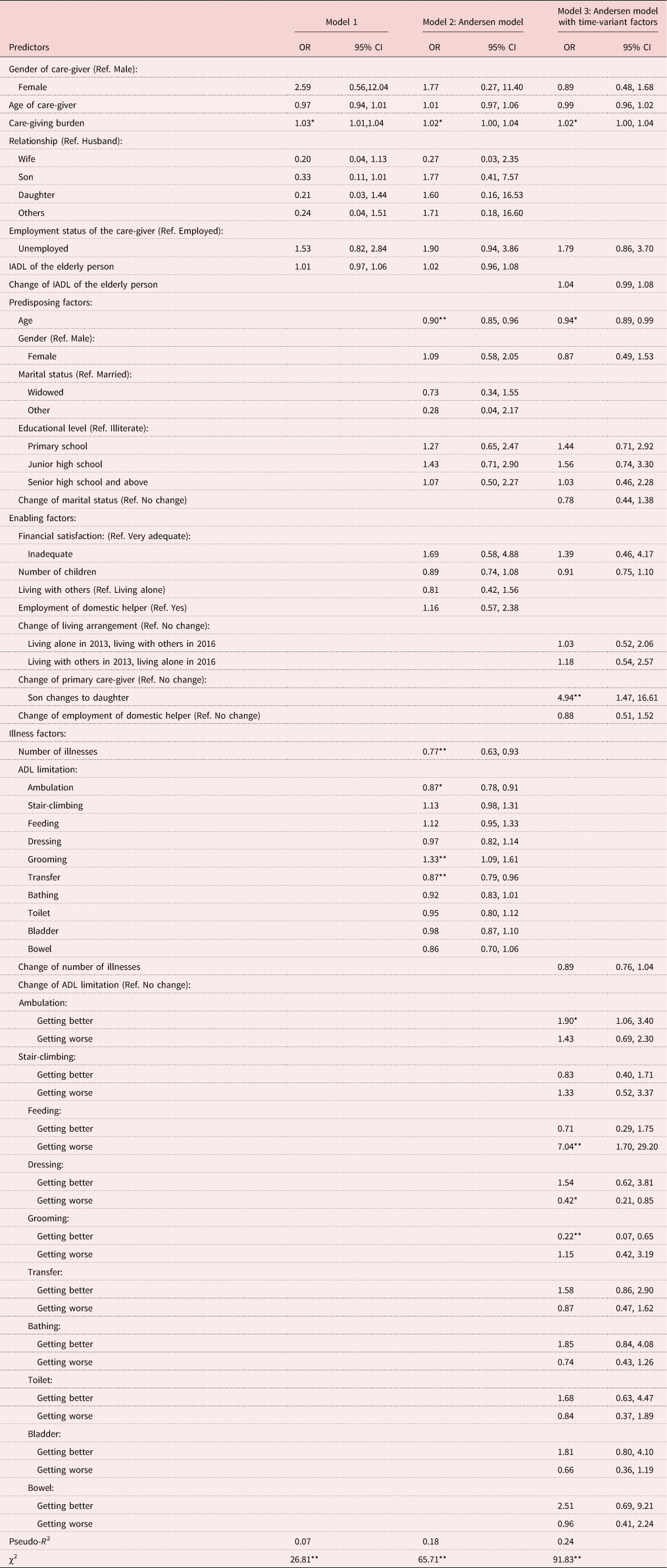
Estimates of the coefficients between predisposing, enabling, illness and change factors, and family care-givers’ intention to use respite services are demonstrated in Table 2. It is clear that the Andersen model with time-variant factors had greater explanatory power (pseudo-R 2 = 0.24, χ2 = 91.83, p < 0.01) regarding factors associated with the intention to use respite services among informal care-givers than the original model (pseudo-R 2 = 0.18, χ2 = 65.71, p < 0.01).
Logistic regression coefficients of informal care-givers’ respite care needs
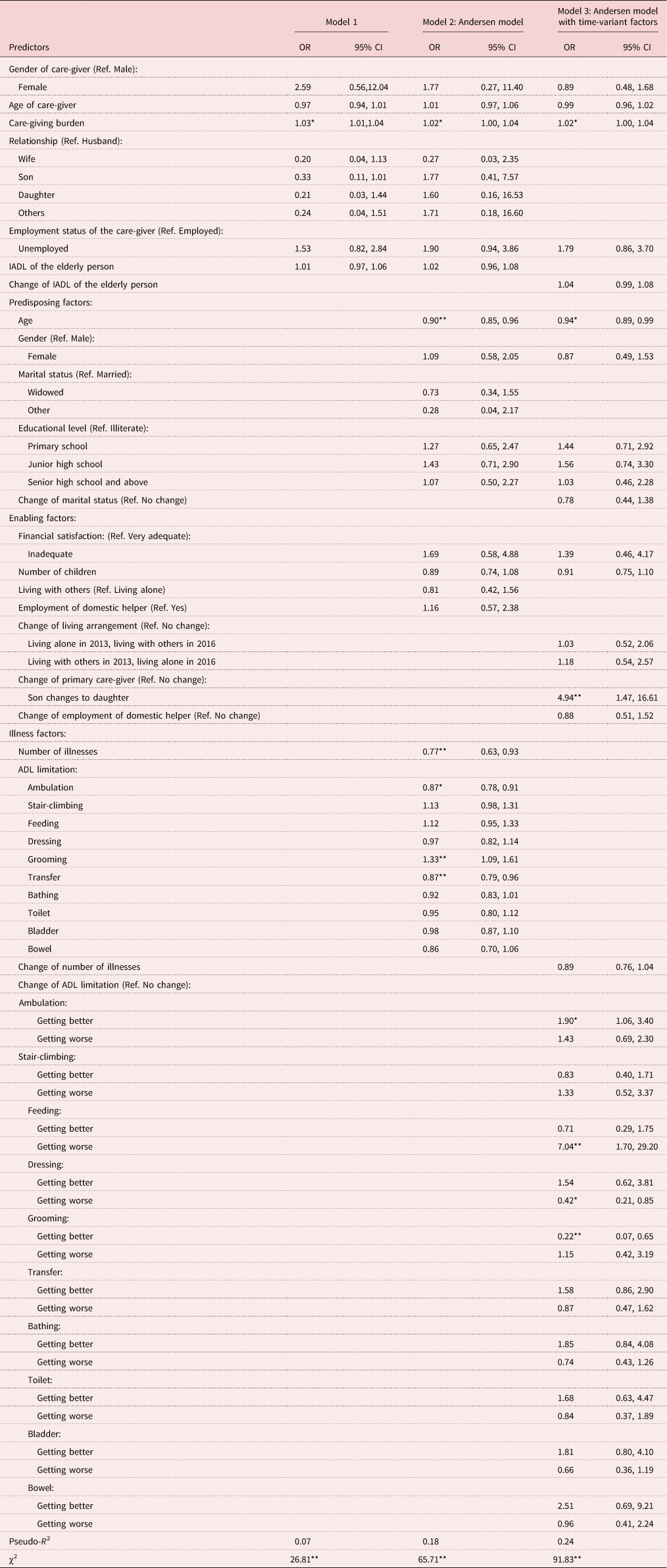
Notes: OR: odds ratio. CI: confidence interval. Ref.: reference category. IADL: instrumental activity of daily living. ADL: activity of daily living.
Significance levels: * p < 0.05, ** p < 0.01.
The original Andersen model demonstrated that care-givers with higher care-giving burden (odds ratio (OR) = 1.02, p < 0.05) and those who cared for older adults with a worse ADL function of grooming (OR = 1.33, p < 0.01) were more likely to report their intention to use respite services. The OR values showed significantly lower intention to use respite services if the care-givers cared for care recipients who were older (OR = 0.90, p < 0.01), had more illnesses (OR = 0.77, p < 0.01), or had worse ambulation (OR = 0.87, p < 0.05) or transfer (OR = 0.87, p < 0.01) function.
The Andersen model with time-variant factors also showed that care-givers had higher odds of intending to use respite services if they had higher care-giving burden (OR = 1.02, p < 0.05). Care-givers were more likely to report their intention to use respite services if they were caring for older adults who experienced care-giver change (from son to daughter: OR = 4.94, p < 0.01), had increased function of ambulation (OR = 1.90, p < 0.05) or had decreased function of feeding (OR = 7.04, p < 0.01). Similarly, care-givers of care recipients who were older (OR = 0.94, p < 0.05) were less likely to report their intention to use respite services. Care-givers of older adults with decreased function of dressing (OR = 0.42, p < 0.05) or increased function of grooming (OR = 0.22, p < 0.01) were less likely to report their intention to use respite services.
Discussion
This study not only echoed previous studies in Chinese communities by verifying that the predictors proposed by the Andersen model (predisposing, enabling and illness factors) can provide a relatively comprehensive theoretical framework to explain the long-term care needs of the elderly people (Fu et al., Reference Fu, Guo, Bai and Chui2017; Zeng et al., Reference Zeng, Xu, Zhang and Chen2019) and their utilisation of formal services together with family care-givers (such as medical services and home-care services) in Chinese communities (Lou et al., Reference Lou, Chui, Leung, Tang, Chi, Leung Wong and Kwan2011; Tian and Wang, Reference Tian and Wang2014; Li and Lu, Reference Li and Lu2017), but also improved on them by demonstrating that the Andersen model with time-variant variables is theoretically sound and can predict intention to use respite care among care-givers. In particular, adding time-variant factors into the Andersen model did not attenuate the relationship between predisposing, enabling and illness factors, and the intention to use respite services among care-givers. Instead, the proposed Andersen model with time-variant variables had greater variance explanation regarding intention to use respite care. Although this research was conducted in the Chinese context, it provided a theoretical model reference for other societies to understand and predict family care-givers’ intention to use respite services.
By examining the specific intention to use respite services among care-givers of community-dwelling older adults in Chinese communities, we obtained systematic and structured information on facilitators of the utilisation of respite care in China. This could provide more accurate clues for professionals to identify potential clients as well as more appropriate evidence for context-sensitive policy and service design.
Results from the Andersen model with time-variant variables revealed that: (a) for predisposing factors, only the age of the older adults was negatively associated with the care-givers’ intention to use respite services; (b) regarding enabling factors, for older adults experiencing care-giver change (from son to daughter) at some point from 2013 to 2016, their care-givers were more likely to express a need for respite care; (c) regarding illness factors, care-givers caring for older adults with increased function of ambulation had higher odds of intending to use respite care, whereas those caring for older adults with decreased function of dressing had lower odds of intending to use respite services; and (d) care-givers of older adults experiencing decreased function of feeding were more likely to report their intention to use respite care, whereas care-givers of older adults who experienced increased function of grooming were less likely to report respite needs.
For predisposing factors, care-givers were less likely to report respite service-use intentions if their care recipient was older. This is likely a reflection of the strong familistic and filial piety values of traditional Chinese culture (Chang et al., Reference Chang, Schneider and Sessanna2011). Core values such as filial piety and culturally based beliefs venerating older adults emphasise the obligation to take care of older family members, especially the oldest-old adults, who are expected to live at home as much as possible until the end of their lives (Qiu et al., Reference Qiu, Sit and Koo2018). This result echoed previous studies conducted in Chinese communities, which indicated that care-givers of older adults with dementia expressed the desire not to use formal services because they were trying to avoid feelings of abandonment among older adults and respect their family obligations (Caldwell et al., Reference Caldwell, Low and Brodaty2014; Huang et al., Reference Huang, Griva, Bryant and Yap2017).
Regarding enabling factors, care-giver change was found to be a significant predictor of intention to use respite care. Particularly, for older adults who experienced care-giver change (from son to daughter) at some point during the three-year study, their care-givers were more likely to express intention to use respite care. This result may reflect the gendered Chinese culture of xiao. According to traditional culture, sons were important for continuing the family lineage and providing physical and financial care for their parents, because married daughters have traditionally been given over to husbands’ families according to patrilocal tradition. The implication is that when sons act as primary care-givers, they may not seek respite due to the potential availability of support from their wives and their perception of seeking respite as a failure to fulfil their familial commitment (Neville et al., Reference Neville, Beattie, Fielding and MacAndrew2015). In contrast, when daughters become the primary care-giver, they are less likely to experience these barriers, which may increase the odds of intention to use respite care.
Regarding illness factors with changing characteristics, we found that care-givers of older adults with increased function of ambulation had higher odds of intending to use respite care, whereas those caring for older adults with decreased function of dressing had lower odds of intending to use respite services. Although policy makers have planned to establish a 15-minute service circle for older adults in all communities according to the 13th Five-year Plan for the Development of Shanghai's Ageing Industry (Shanghai Municipal People's Government, 2016), respite services were mostly provided in day-care centres or elder-care homes in the local community. Therefore, when their function of ambulation increased, it may have promoted the respite care-using intention of their care-givers. Decreasing the ADL function of dressing may also decrease the care-givers’ intention to use respite care. This may indicate that the care-givers and care recipients may be more willing to accept informal care due to a perceived ability to maintain basic dignity (Robinson et al., Reference Robinson, Elder, Emden, Lea, Turner and Vickers2009).
Furthermore, this research also indicated that care-givers of older adults experiencing decreased function of feeding were more likely to report their intention to use respite care, but those caring for older adults who experienced increased function of grooming were less likely to report respite needs. To understand better predictors based on changing characteristics, we may find some clues in the hierarchical profile of ADL loss, which reflects the continuum of personal ADLs. ADLs of older adults can be categorised into early (dressing and personal hygiene), middle (toilet use, transfer and ambulation) and late (bed mobility and feeding) loss components (Morris et al., Reference Morris, Fries and Morris1999). Dressing and personal hygiene abilities are generally the earliest functions to be lost, whereas feeding ability is the last function to be lost. Thus, older adults who are unable to feed themselves are more likely to be unable to perform any other tasks independently (Njegovan et al., Reference Njegovan, Man-Son-Hing, Mitchell and Molnar2001). In this study, older adults with improved function of grooming (one of the personal hygiene abilities) may have experienced positive changes in ADLs from 2013 to 2016, whereas older adults with decreased function of feeding may have become more dependent due to decreased physical function as a whole over the three years. Therefore, this could increase the odds of respite care-using intention among their care-givers, given the greater caring burden. Moreover, these results also reflected a division of labour between informal care and respite care. As suggested by the task specificity model (Litwak, Reference Litwak1985), the responsibilities for elder care were differently distributed between the informal and formal support sources. Regarding the illness factors, our findings indicated that the informal care-givers could fulfil the elder-care tasks until the older adults experienced decreased function of feeding, implying that family care-givers prefer to let respite care share their caring responsibilities when older adults have poor overall physical function. From the task-specific perspective, it also provides some implications on stimulating the use of respite care and bridging the gap between formal and informal care.
This study is among the first to examine factors associated with care-givers’ intention to use respite care using a longitudinal design. The findings of the present study have the following service promotion and intervention implications.
First, illness factors, particularly time-variant factors presenting changes in ADL function, were identified as important predictors of care-givers’ intention to use respite services in this study. Therefore, we suggest that instead of providing routine care, respite services should include ADL function training service strategies that consider the potential needs of the older adults and their care-givers. Moreover, the present research indicated that care-givers had higher odds of intending to use respite care if they perceived that older adults had the ability to walk safely and maintain basic dignity (with increased functions of ambulation and dressing). Therefore, we suggest that shuttle services be provided in order to promote respite service utilisation. Community programmes should also consider establishing and strengthening infrastructure to make respite care centres more accessible.
Second, we found that if the care-giver changed from son to daughter, they may have higher odds of needing respite care. Based on the discussion of the gendered culture of xiao in China, we suggest that service planners could establish case management and different service promotion strategies for respite services. Especially for sons, we propose couple-directed care approaches that consider the daughter-in-law's caring burden and need.
Last, the identified factors associated with care-givers’ respite service use intention in this study provide clues for describing the patterns of their service utilisation and division of caring tasks between informal care and respite care. These findings also show the importance of monitoring changes in the health status of older adults in community service planning and intervention.
Despite the merits of the present study, it has several limitations. First, data from this study were collected from six urban communities in Shanghai, China. This may constrain the generalisability of the proposed model and findings. Future studies may need to verify the model in another context. Second, this study did not include variables measuring respite service-use behaviours because its aim was to provide implications for service planning and promotion at the initial stage. Further studies may need to explore predictors of both intention and behaviour regarding service utilisation and identify different determinants. Last, the respondents of this study were care-givers of older adults. Future studies including both care-givers and older adults who receive care are needed to test differences in service-use intentions further and explore predictors to understand these differences in greater detail.
Acknowledgements
The authors would like to thank Professor Shixun Gui from East China University and Professor Vivian W. Q. Lou from Sau Po Centre on Ageing, The University of Hong Kong on their leadership in research design and data collection.
Financial support
This work was supported by the Longitudinal Study on Family Caregivers for Frail Older Adults Aged 75 or Above in Shanghai.