Introduction
The attention-deficit/hyperactivity disorder (ADHD) is one of the most frequently occurring mental disorders in children (Polanczyk et al. Reference Polanczyk, de Lima, Horta, Biederman and Rohde2007). ADHD is frequently accompanied by other mental disorders, and one of the most frequent comorbidities is the oppositional defiant disorder (ODD) (Spencer et al. Reference Spencer, Biederman and Mick2007; Ercan et al. Reference Ercan, Kandulu, Uslu, Ardic, Yazici, Basay, Aydin and Rohde2013).
Children diagnosed with ADHD experience selected negative outcomes during their adolescence and young adulthood, and those children are under the risk of developing delinquent behaviors, academic problems, and psychoactive substance dependence (Hazell, Reference Hazell2010). The ODD comorbidity negatively affects the course and prognosis of ADHD in children and adolescents and is associated with academic, social, family, and global impairment (Greene et al. Reference Greene, Biederman, Zerwas, Monuteaux, Goring and Faraone2002; Connor & Doefler, Reference Connor and Doefler2008; Hazell, Reference Hazell2010). Adults who had the ADHD-ODD comorbidity in their childhood are under a higher risk in terms of psychiatric comorbidity, psychoactive substance use disorder, and impaired psychosocial functioning compared with those diagnosed with ADHD alone (Harpold et al. Reference Harpold, Biederman, Gignac, Hammerness, Surman, Potter and Mick2007). Limited information exists regarding the effects of the ADHD-ODD comorbidity upon negative outcomes in childhood and adolescence. Relevant studies indicate that both symptoms and diagnosis of comorbid ODD and ADHD increased the risk of using illicit drugs, tobacco, and marijuana, as well as the occurrence of conduct disorders in children during adolescence (Molina & Pelham, Reference Molina and Pelham2003; August et al. Reference August, Winters, Realmuto, Fahnhorst, Botzet and Lee2006; Biederman et al. Reference Biederman, Petty, Monuteaux, Mick, Parcell, Westerberg and Faraone2008). Thus, the purpose of this study was to compare ADHD-diagnosed children with and without ODD comorbidity in terms of smoking, psychoactive substance use, disciplinary punishments at school, criminal behaviors, and unintentional injuries for a period of 4 years. We hypothesized that children with ADHD-ODD comorbidity would have a higher risk for smoking, psychoactive substance use, disciplinary punishments at school, criminal behaviors, and unintentional injuries than children with ADHD alone.
Methods
This study was conducted in the Child and Adolescent Psychiatry Clinic at the Sakarya University Training and Research Hospital in Sakarya, Turkey. The study protocol was approved by the Sakarya University Medical Faculty Ethics Committee (71522473.050.01.04/56).
Participants
In this study, the ADHD group consisted of 109 children who were diagnosed with ADHD for the first time and had no comorbidity. The ADHD-ODD group consisted of 79 children who had a diagnosis of ADHD and the ODD comorbidity only. The children who participated in the study were aged between 6 and 15 years.
Measures
Negative outcomes scale
A scale developed by the researchers was used to question the disciplinary punishments at school, smoking, psychoactive substance use, unintentional injuries, and criminal behaviors experienced by the children during a 4-year period. All disciplinary punishments at school and criminal behavior requiring forensic assessments were included in the study. Children and adolescents were coded as smokers if he or she smoked for longer than a 3-month period. Psychoactive substance use was defined as the use of alcohol and/or other substances more than once. Injuries that required hospital admission were defined as unintentional injuries. The scale was completed by researchers who obtained information from one of the parents of the child or the adolescent via the telephone.
Turgay DSM-IV-based Child and Adolescent Behavior Disorders Screening and Rating Scale-Parents Form (T-DSM-IV-S)
The T-DSM-IV-S form was developed by Turgay (Reference Turgay1994) based on the DSM-IV diagnostic criteria that includes 9 items regarding attention deficit, 6 items regarding hyperactivity, 3 items regarding impulsivity, 8 items regarding ODD, and 15 items regarding conduct disorder. The symptoms were scored by assigning a severity estimate for each symptom on a four-point Likert-type scale (specifically, 0=not at all; 1=just a little; 2=much; and 3=very much) (Turgay, Reference Turgay1994).
Procedures
In our clinic, during the first admission, a socio-demographic form was completed by parents of all children before the interview. The diagnoses of all children were made according to the DSM-IV-based clinical interview by a child and adolescent psychiatrist. The T-DSM-IV-S form was also completed by one of the parents after the first interview in our clinic in order to support the ADHD diagnosis. These scales and the diagnosis of children were retained in the files of our clinic.
After obtaining the permissions required for the study, there were 357 children and adolescents diagnosed with ADHD for the first time between September 2009 and March 2010. Of these 357 children, 121 children and adolescents were diagnosed with ADHD alone, and 87 children and adolescents were diagnosed with the ADHD-ODD comorbidity. Relevant evaluations of children and adolescents were performed 46–50 months after the first admission. Information concerning all the participating children and adolescents that was obtained from the hospital file was recorded on the socio-demographic information form by the researchers. Information regarding the diagnoses of children, follow-up visits, medications, and non-pharmacological interventions (such as psychoeducational programs or behavioral interventions) was obtained from their files in the institution. Parents of children and adolescents meeting the study criteria were called and informed about the study. Their verbal consents for the study were obtained on the telephone. Because the parents of 12 children from the ADHD group and of eight children from the ADHD-ODD group were unable to be reached via the telephone, these patients were excluded from the study. On the telephone, parents were questioned about all the negative outcomes from the time of first diagnosis up to the time of evaluation. Furthermore, information regarding the follow-up and treatment of 21 children, who were diagnosed in another clinic, was obtained from their parents.
Statistical analysis
Data were analyzed via SPSS v.17.0 for Windows (SPSS Inc., USA), by using the t-test, the χ 2 test, Fisher’s exact test, and binary logistic regression analysis. The odds ratios (OR) and confidence intervals (CI) were calculated. The level of statistical significance was set at p⩽0.05.
Results
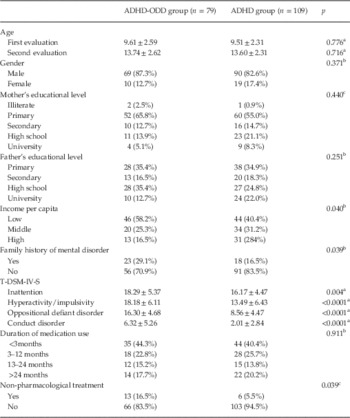
The mean age in the ADHD group was 9.51±2.31 versus 9.61±2.59 years in the ADHD-ODD group. In total, 82.6% of the ADHD group (n=90) and 87.3% of the ADHD-ODD group were male (n=69). The ADHD and ADHD-ODD groups were compared in terms of their socio-demographic characteristics, the T-DSM-IV-S subscale scores, and treatment characteristics (Table 1). No statistically significant difference was determined between the two groups in terms of the mean age in the first and second evaluation, the gender, the mother’s educational level, the father’s educational level, and the duration of medication. Study participants in the ADHD-ODD group had a lower level of income, a higher rate of family history of mental disorder, and received greater non-pharmacological interventions compared with the ADHD group. All initial T-DSM-IV-S subscale scores were found to be significantly higher in the ADHD-ODD group compared with the ADHD group.
Comparison of socio-demographic, clinical, and treatment-related factors of the groups

ADHD, attention-deficit/hyperactivity disorder; ODD, oppositional defiant disorder; T-DSM-IV-S, Turgay DSM-IV-based Child and Adolescent Behavior Disorders Screening and Rating Scale-Parents Form.
a t-test.
b χ 2 test.
c Fisher’s exact test.
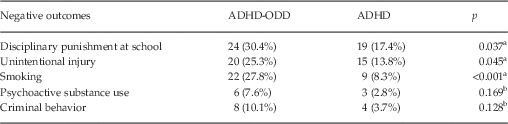
The ADHD and ADHD-ODD groups were compared in terms of negative outcomes (Table 2). The ADHD-ODD group exhibited a higher rate of disciplinary punishments at school, unintentional injuries, and smoking compared with the ADHD group. No statistically significant difference was determined between the groups in terms of psychoactive substance use and criminal behaviors.
Comparison of groups in terms of negative outcomes in the 4-year period
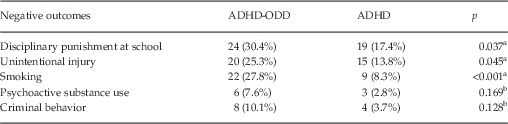
ADHD, attention-deficit/hyperactivity disorder; ODD, oppositional defiant disorder.
a χ 2 test.
b Fisher’s exact test.
Prediction of the T-DSM-IV-S subscale scores concerning disciplinary punishments at school, smoking, and unintentional injuries, which were determined to be at a high rate in the ADHD-ODD group, was evaluated with the binary logistic regression analysis. Higher T-DSM-IV-S conduct disorder scores (OR: 1.162; 95% CI: 1.038–1.301; p=0.009) were associated with disciplinary punishments at school. Higher T-DSM-IV-S ODD (OR: 1.291; 95% CI: 1.023–1.629; p=0.032) and conduct disorder scores (OR: 1.272; 95% CI: 1.107–1.462; p=0.001) were associated with smoking. Higher T-DSM-IV-S hyperactivity/impulsivity (OR: 1.394; 95% CI: 1.014–1.916; p=0.041) and conduct disorder scores (OR: 1.158; 95% CI: 1.006–1.332; p=0.041) were associated with unintentional injury.
Discussion
This study compared children diagnosed with ADHD and ADHD-ODD in terms of smoking and psychoactive substance use, as well as having disciplinary punishments at school, criminal behaviors, and unintentional injuries over a period of 4 years.
Children and adolescents with ADHD demonstrated increased use of remedial academic services, and were more likely to be expelled, suspended, and placed in special education classes compared with controls (LeFever et al. Reference Lefever, Villers, Morrow and Vaughn2002; Loe & Feldman, Reference Loe and Feldman2007). A limited number of studies are conducted on the relationship between the ADHD-ODD comorbidity and behavioral problems and violation of rules concerning education in children and adolescents diagnosed with ADHD. In a study conducted by Biederman et al. (Reference Biederman, Petty, Monuteaux, Mick, Parcell, Westerberg and Faraone2008), children with the ADHD-ODD comorbidity had a higher rate of suspension and were sent to special classes at a higher rate compared with children diagnosed with ADHD alone. Similarly, this research also demonstrated that children with the ADHD-ODD comorbidity had a higher rate of behavioral problems at school, and the symptoms of conduct disorder were associated with disciplinary punishments. The results of this research led to the conclusion that variation in assessment of the occurrence of the ODD comorbidity in different educational systems and across different cultures increases the behavioral problems and violation of rules concerning education in children with ADHD.
Various studies have demonstrated that the rate of unintentional injuries is higher in children with ADHD (Rowe et al. Reference Rowe, Maughan and Goodman2004; Marcus et al. Reference Marcus, Wan, Zhang and Olfson2008; Merrill et al. Reference Merrill, Lyon, Baker and Gren2009; Tai et al. Reference Tai, Gau and Gau2013; van den Ban et al. Reference Van Den Ban, Souverein, Meijer, Van Engeland, Swaab, Egberts and Heerdink2014). Furthermore, comorbid psychiatric disorders and behavioral problems such as aggressive behavior and risk-taking behavior also increased unintentional injury rates in children and adolescents with ADHD (Barkley, Reference Barkley2002; Rowe et al. Reference Rowe, Maughan and Goodman2004; Tai et al. Reference Tai, Gau and Gau2013; van den Ban et al. Reference Van Den Ban, Souverein, Meijer, Van Engeland, Swaab, Egberts and Heerdink2014). The fact that a greater incidence of unintentional injuries in the ADHD-ODD group was determined in this study contributes to the view that comorbidity and behavioral problems are associated with unintentional injuries in children with ADHD.
Children and adolescents diagnosed with ADHD are at risk for increased smoking and psychoactive substance use compared with those not diagnosed with ADHD (Lee et al. Reference Lee, Humphreys, Flory, Liu and Glass2011). In a study conducted by Molina & Pelham (Reference Molina and Pelham2003) on adolescents, childhood ODD/conduct disorder (CD) symptoms were determined to predict illicit drug use (Molina & Pelham, Reference Molina and Pelham2003). In a study conducted by August et al. (Reference August, Winters, Realmuto, Fahnhorst, Botzet and Lee2006), adolescents with ADHD who had externalizing disorder comorbidity, the majority of which was ODD, exhibited significantly worse drug use outcomes compared with those who did not (August et al. Reference August, Winters, Realmuto, Fahnhorst, Botzet and Lee2006). In a study conducted by Nogueira et al. (Reference Nogueira, Bosch, Valero, Gómez-Barros, Palomar, Richarte, Corrales, Nasillo, Vidal and Casas2014) on adults with ADHD, existence of the childhood ODD comorbidity increased the risk of psychoactive substance use disorder in individuals with ADHD (Nogueira et al. Reference Nogueira, Bosch, Valero, Gómez-Barros, Palomar, Richarte, Corrales, Nasillo, Vidal and Casas2014). Conversely, in this study, although the smoking rate was observed to be higher in children and adolescents with the ADHD-ODD comorbidity throughout the evaluation period, no statistically significant difference existed between the two groups in terms of psychoactive substance use. In a follow-up study conducted by Pingault et al. (2012), with children diagnosed with ADHD, the childhood oppositional behavior was determined to be an important determinant for nicotine addiction in young adulthood (Pingault et al. Reference Pingault, Côté, Galéra, Genolini, Falissard, Vitaro and Tremblay2012). In the study of Biederman et al. (Reference Biederman, Petty, Hammerness, Batchelder and Faraone2012), smoking behavior in adolescents diagnosed with ADHD was postulated to pose a risk of advancing to psychoactive substance use development (Biederman et al. Reference Biederman, Petty, Hammerness, Batchelder and Faraone2012). The fact that no difference was determined between the groups in this study in terms of substance use might have resulted from the lower average age of the participants in our study.
No difference was determined between the groups in our study in terms of criminal behavior. Upon examination of the literature, criminal behavior was determined to be associated with the CD comorbidity in children diagnosed with ADHD. Information concerning the relationship between the ADHD-ODD comorbidity and criminal behavior in childhood and adolescence is limited. Patients exhibiting the ODD comorbidity have a higher aggression severity compared with those without the ODD comorbidity, which is associated with the development of conduct disorders during adolescence in children with ADHD (Connor & Doefler, Reference Connor and Doefler2008; Whittinger et al. Reference Whittinger, Langley, Fowler, Thomas and Thapar2007). The fact that this study determined that violations of rules and punishments at school occurred at a higher rate in the ADHD-ODD group, yet no difference was found in terms of criminal behavior, led to the conclusion that the ODD comorbidity is associated with moderate violations of rules during childhood and adolescence and does not cause severe problems such as criminal behaviors. Furthermore, the association of conduct disorder symptoms with disciplinary punishments in school, smoking, and unintentional injury emphasizes the importance of conduct disorder symptoms in children with the ADHD-ODD comorbidity.
Certain limitations in the design of this study should be considered. Because children and adolescents who were included in this study were selected from a clinical sample, they do not necessarily represent a random sample of society. This study did not include a normal control group. Information about negative outcomes was collected by telephone surveys, and the information was only obtained from the parents. Failure to perform the mental assessment during the second evaluation also constitutes an important limitation.
This study determined that among children diagnosed with ADHD, those with the ODD comorbidity had greater rates of disciplinary punishments caused by violation of rules at school, in addition to unintentional injuries and smoking, compared with those without the ODD comorbidity. The ODD comorbidity did not increase the risk of psychoactive substance use and criminal behaviors in these children.
Acknowledgments
There are no sources of support for this study. The authors thank all the children and their families whose participation made this study possible.