Introduction
Evidence shows that dementia is one of the most common and complex diseases in older people (Mielke et al. Reference Mielke, Vemuri and Rocca2014; Misiak et al. Reference Misiak, Cialkowska-Kuzminska, Frydecka, Chladzinska-Kiejna and Kiejna2013; Prince et al. Reference Prince, Bryce, Albanese, Wimo, Ribeiro and Ferri2013) and one of the most challenging health problems for health-care systems and policy makers (Geldmacher and Kerwin 2014; Odenheimer et al. Reference Odenheimer, Borson, Sanders, Swain-Eng, Kyomen, Tierney, Gitlin, Forciea, Absher, Shega and Johnson2014; Wimo et al. 2013). Specific country differences can affect health-care decisions about relatives; for instance, when planning the admission of an older family member to a long-term care institution (Afram et al. Reference Afram, Stephan, Verbeek, Bleijlevens, Suhonen, Sutcliffe, Raamat, Cabrera, Soto, Hallberg, Meyer and Hamers2014 a; Beerens et al. Reference Beerens, Sutcliffe, Renom-Guiteras, Soto, Suhonen, Zabalegui, Bökberg, Saks and Hamers2014). Willingness to care for people with dementia at home is present in Spanish culture although, from a European perspective, Spanish informal care-givers of people with dementia suffer the highest levels of burden, depression and stress (Afram et al. Reference Afram, Stephan, Verbeek, Bleijlevens, Suhonen, Sutcliffe, Raamat, Cabrera, Soto, Hallberg, Meyer and Hamers2014 a). Furthermore, compared with care-givers from other countries, burden among care-givers in Spain remains high following admission of the person with dementia to a long-term care institution (Afram et al. 2014b). However, previous studies have suggested that this could be related to the informal care-givers' perception of the quality of care received by the patients at the long-term institution; perception of a high quality of care leads to better outcomes, for instance, in care-giver burden (Castro-Monteiro et al. Reference Castro-Monteiro, Forjaz, Ayala, Rodriguez-Blazquez, Fernandez-Mayoralas, Diaz-Redondo and Martinez-Martin2014). Mediterranean cultures tend to place similar emphasis on the importance of the family and older people are still helped and cared for by the youngest offspring at home. Consequently, admission of a family member to a long-term care institution can even cause feelings of failure and disappointment within the family (Risco et al. Reference Risco, Cabrera, Farré, Alvira, Miguel and Zabalegui2015). Many international studies have been conducted on the risk factors associated with admission to a long-term care institution (Rongve et al. Reference Rongve, Vossius, Nore, Testad and Aarsland2014; Tam-Tham et al. Reference Tam-Tham, Cepoiu-Martin, Ronksley, Maxwell and Hemmelgarn2013). It has been shown that these factors are related to the people with dementia or to their informal care-givers (Afram et al. 2014b), although more data on specific country-related characteristics are needed.
Literature review
In our study, the term professional care transition is used to refer to people being cared for at home by the home-care provision team but perceived to be at risk of institutionalisation due to their vulnerable situation or those recently admitted to a long-term care institution (Verbeek et al. Reference Verbeek, Meyer, Leino-Kilpi, Zabalegui, Hallberg, Saks, Soto, Challis, Sauerland and Hamers2012). This is considered to be a vulnerable situation since transition is always a difficult process that can provoke negative reactions in people with dementia (Meleis et al. Reference Meleis, Sawyer, Im, Hilfinger Messias and Schumacher2000) and also their informal care-giver (Arber and Ginn Reference Arber and Ginn1990). Thus, specific risk factors related to the final decision to admit a person to a long-term care institution need to be studied further to form the basis of better care plans from health-care professionals. Current health-care policies, from a medical and societal point of view, focus on enhancing resource use in the community to avoid medically unnecessary institutionalisation. This unnecessary institutionalisation follows recommendations in the literature which states that it is far preferable for older people with physical and psychological dependency to live in their own homes or in the homes of family members in their own communities rather than in more restrictive institutionalised settings removed from their friends and loved ones (Garcés et al. Reference Garcés, Carretero, Ródenas and Vivancos2010). Although difficult to measure, rates of long-term care institutionalisation in this population continue to rise, so significant challenges exist to the provision of long-term care services (Karlsson et al. Reference Karlsson, Bleijlevens, Roe, Saks, Martin, Stephan, Suhonen, Zabalegui and Hallberg2015). There are great variations between health systems and the availability of resources and their use in Europe. This variation has to do, above all, with the methods of financing the health-care system and the participation of members of the family in care provision, as well as access to services and reasonable costs for each individual (Hallberg et al. Reference Hallberg, Cabrera, Jolley, Raamat, Renom-Guiteras, Verbeek, Soto, Stolt and Karlsson2014; Knapp, Iemmi and Romeo Reference Knapp, Iemmi and Romeo2013). Although dementia is one of the emerging priorities of health programmes in the European Union, not many member states have adopted or are in process of adopting national plans. Furthermore, these policies may vary between countries. Belgium, Denmark, France, Norway, Sweden and the United Kingdom have specific plans for dementia patients focused on early diagnosis, treatment and specific dementia care. Others, like Estonia and Spain, only have policies focused on chronic conditions or the elderly, so dementia is included within this population group.
In Spain, there are also cultural differences regarding the degree of family participation in the system, even in the sense of duty to perform the activity of caring or the decision to take a family member into one's home (Rodriguez-Martin et al. Reference Rodriguez-Martin, Martinez-Andres, Cervera-Monteagudo, Notario-Pacheco and Martínez Vizcaino2014). The Spanish health system is composed of a set of health services under the administration of the State and health services of the Autonomous Communities, according to the provisions of the General Health Law, 1986. It was consolidated in 2002 and the system of quality and cohesion was implemented in 2003. Even so, the health system faces considerable challenges, common in most developed countries, such as co-ordination between different levels of care (Rogero-García and Rosenberg Reference Rogero-García and Rosenberg2011). We also need to understand how best to manage the organisation of the distinct care modalities to ensure optimal care in each specific situation and to work towards the goal of providing comprehensive, multidisciplinary care. Co-ordination and consensus among the various levels of care allow provision of better quality care and help to avoid problems of competence, such as admission to a long-stay institution when home care would be more appropriate (Brandt, Haberkern and Szydlik Reference Brandt, Haberkern and Szydlik2009). In addition, there are other factors that can affect the model used to predict avoidable institutionalisation; lack of integration between networks (health and social) within the region and the meagre health-care support provided to residential centres which hinders adaptation to the requirements of current social services (Daatland and Herlofson Reference Daatland and Herlofson2003).
Therefore, the purpose of this study is to explore the possible risk factors associated with admission to a long-term care institution of people with dementia in Spain. Up-to-date evidence could help policy makers and care-givers to improve home-care services and avoid unnecessary institutionalisation.
Methods
Design
An exploratory study, using quantitative and qualitative data collection methods, was performed as part of the RightTimePlaceCare project (grant agreement 242153), a study generating primary data for best practice development in the transition from home to long-term institutional care for people with dementia and their informal care-givers in Europe (Verbeek et al. Reference Verbeek, Meyer, Leino-Kilpi, Zabalegui, Hallberg, Saks, Soto, Challis, Sauerland and Hamers2012).
Sample size, eligibility and recruitment
The study was carried out in a metropolitan area of Barcelona, Spain. Our populations of interest were people with dementia during professional care transition. Inclusion criteria were related to the people with dementia. Participants were 65 years or older, with a diagnosis of dementia according to DSM–IV criteria and a Mini-Mental State Examination (Molloy and Clarnette Reference Molloy and Clarnette1999) score lower than 24, indicating dementia (Folstein, Folstein and McHug Reference Folstein, Folstein and McHug2001), having an informal care-giver living with the person with dementia or visiting him or her at least twice a month, and receiving formal home care from primary care services (physician, registered nurse or social worker). A health-care professional should consider that admission of the individual to a long-term care institution is probable within three to six months. For the institutionalised group, they had to have been recently institutionalised (less than three months). People suffering from psychiatric illness were excluded, as were those diagnosed with Korsakov's syndrome since this occurs mostly after alcohol abuse which causes an alteration in the status of the memory due to lack of thiamine and can be mistaken for dementia. In both cases, participants were directly selected from public and private institutions in Barcelona. People with dementia and informal care-givers were included through convenience sampling. Calculated sample size consisted of 175 home-care patient–care-giver dyads and 115 long-term care institution dyads, allowing for an expected dropout rate of 15 per cent in each group (Verbeek et al. Reference Verbeek, Meyer, Leino-Kilpi, Zabalegui, Hallberg, Saks, Soto, Challis, Sauerland and Hamers2012).
Patients were recruited based on previous assessments made by various health-care professionals, registered nurses, physicians or social workers involved in the daily health and social care of this population. Data were collected during face-to-face interviews with patients and informal care-givers between November 2010 and April 2012. Interviewers were professionals in health or social care, or medical/nursing/social worker students (Bachelor's degree) with clinical experience. They received additional training on all project procedures, including questionnaire completion and assessment of contents. Quantitative and qualitative data collection was chosen to understand better this specific care-transition process. The underlying logic of mixing methods is to test the efficiency of the actual measurements of potential risk factors associated with institutionalisation with the real actors' perceptions (Creswell and Miller, Reference Creswell and Miller2000). People-with-dementia and informal care-giver variables were selected based on previous studies predicting institutionalisation for people with dementia (Gaugler Reference Gaugler2009; Luppa et al. Reference Luppa, Luck, Brähler, König and Riedel-Heller2008).
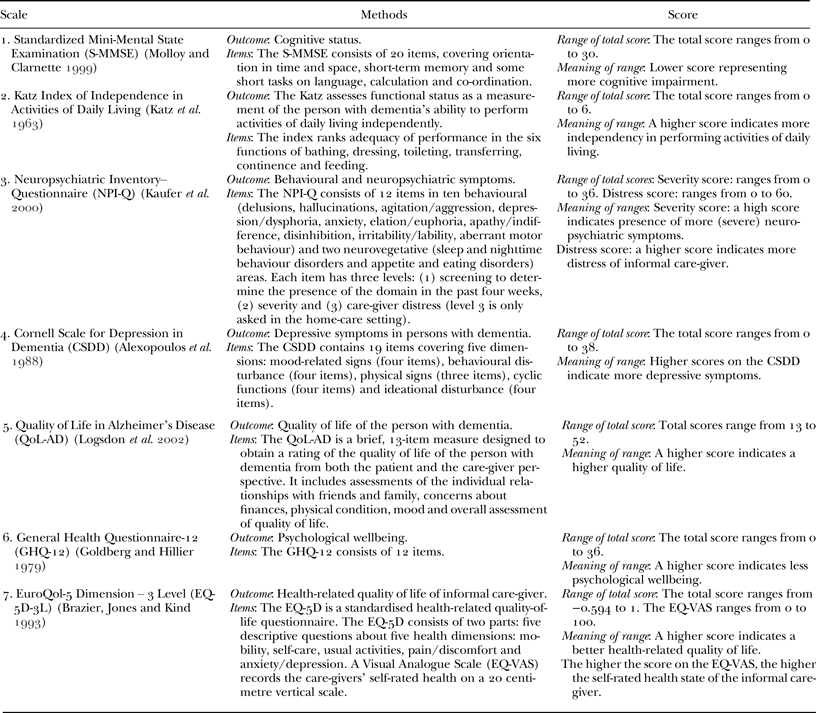
People-with-dementia variables were: gender; age; people with dementia–informal care-giver relationship; income; living alone; cognitive status assessed with the Standardized Mini-Mental State Examination (Molloy and Clarnette Reference Molloy and Clarnette1999); dependency in activities of daily living assessed through the Katz Index of Independence (Katz et al. Reference Katz, Ford, Jackson and Jaffe1963); behavioural and neuropsychiatric symptoms measured using The Neuropsychiatric Inventory (Kaufer et al. Reference Kaufer, Cummings, Ketche, Smith, MacMillan, Shelley, Lopez and DeKosky2000); depressive symptoms evaluated through the Cornell Scale for Depression in Dementia (Alexopoulos et al. Reference Alexopoulos, Abrams, Young and Shamoian1988); and quality of life assessed through the Quality of Life in Alzheimer's Disease scale (Logsdon et al. Reference Logsdon, Gibbons, McCurry and Teri2002). Informal care-giver variables were: age; gender; marital status; care-giver burden measured through the Zarit Burden Interview (Zarit, Reever and Bach-Peterson Reference Zarit, Reever and Bach-Peterson1980); psychological wellbeing evaluated through the General Health Questionnaire-12 (Goldberg and Hillier Reference Goldberg and Hillier1979); and health-related quality of life measured with the EuroQol-5 Dimension (Brazier, Jones and Kind Reference Brazier, Jones and Kind1993). Measurement instruments were selected according to their psychometric properties (validity and reliability), clinical utility, and suitability for the target settings and population (Table 1).
Scales utilised to measure the potential risk factors of institutionalisation following literature suggestions

Reasons for institutionalisation were inventoried by means of an open-ended question. Informal care-givers from the home-care group were asked about possible transition to a long-term care institution: ‘Why do you think it might be necessary for people with dementia to move to a long-term care institution?’; and the long-term care institution group was asked about the reason given: ‘What was the reason for the admission of the person with dementia to a long-term care institution?’
Statistical analysis
Categorical variables were described using frequencies and percentages. Continuous variables are reported as the mean and standard deviation (SD), median, and 25th and 75th percentiles. Statistical significance was set at p <0.05 with 95 per cent confidence intervals. Analyses were performed with the SPSS 18.0.
Each particular reason given was examined by two researchers using conventional content analysis (Hsieh and Shannon Reference Hsieh and Shannon2005) of text data to derive coding categories. Subsequently, a codebook with an overview of all categories was created: Overall deterioration, Neuropsychiatric symptoms, Care-giver burden, Inability to care by informal care-giver and Recommended by health-care professionals.
Subsequently, the percentage of informal care-givers stating a particular reason was calculated. This was done by summing the frequency of informal care-givers stating a particular reason and dividing it by the total number of informal care-givers in the sample. For the analysis, percentages were calculated of the proportion of informal care-givers stating a certain reason.
The analysis was performed by theme and category. This was done for the overall sample. Before coding the data-set, a data validation and inter-rater reliability assessment was carried out. Inter-rater reliability was evaluated by means of the Jaccard similarity coefficient (Popping Reference Popping1984), which ranged from 0.86 to 0.89, indicating high concordance between raters.
Methodological triangulation was performed through bivariate analysis to explore the relationship between scores on corresponding measurements and the most frequently stated reasons for admission to a long-term care institution.
Ethical issues and approval
Ethical approval was obtained from the Hospital Clínic Ethics Committee (2010/6031) for research on human beings to conduct the study in accordance with national standards and regulations. All participants, people with dementia and informal care-givers, were asked to provide informed consent prior to participating in the study, and in cases of severe cognitive impairment of the person with dementia, which was the case for most of these participants, consent was only requested from the informal care-givers.
Results
Sample description
A total of 287 people with dementia and their informal care-givers were studied; 174 were included from the home-care group and 113 from the long-term care institution group; three dyads were lost due to incorrect information collection.
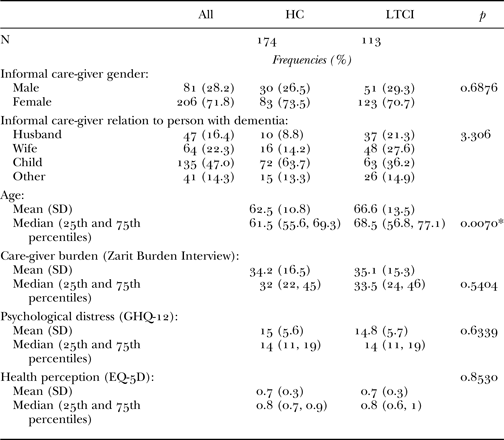
The socio-demographic characteristics of informal care-givers in both home care and long-term care institutions are shown in Table 2. No significant differences were seen between categorical variables such as gender or people with dementia–informal care-giver relationship. Informal care-givers were predominantly female in both groups (home-care group: 73.5 per cent; long-term care institution group: 70.7 per cent). Significant differences were seen in informal care-giver ages, with older informal care-givers in the home-care group compared with those in long-term care institutions (mean = 66.6, SD = 13.5; mean = 62.5, SD = 10.8; p < 0.05). Regarding instrument scores for informal care-givers, no significant differences were seen between the home-care group and long-term care institution group, with similar levels of burden, psychological wellbeing and health-related quality of life.
Informal care-giver sample characteristics
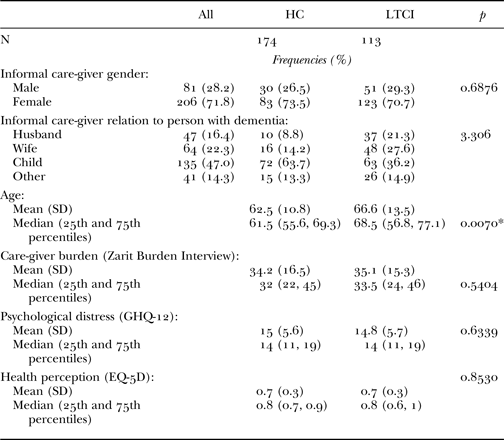
Notes: HC: home care. LTCI: long-term care institution. SD: standard deviation. GHQ-12: General Health Questionnaire-12. EQ-5D: EuroQol-5 Dimension.
Significance level: * p < 0.05.
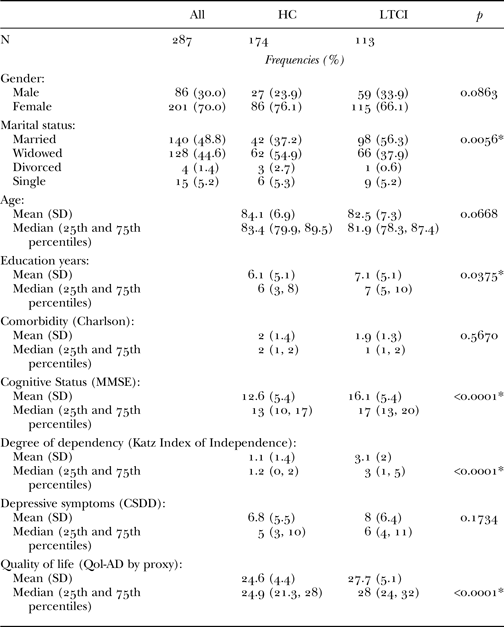
The socio-demographic characteristics of people with dementia in both settings are shown in Table 3. Although all participants had to have a Mini-Mental State Examination score lower than 24 to be included in this study, people with dementia at risk of institutionalisation showed less cognitive impairment than those in the long-term care institution group (home-care group: mean = 412.6, SD = 5.4; long-term care institution group: mean = 16.1, SD = 5.4; p < 0.05). Significant differences were seen in dependency in activities of daily living, with a greater degree of dependency (long-term care institution group: mean = 3.1, SD = 1.4; home-care group: mean = 1.1, SD = 1.4, p < 0.05) and lower people-with-dementia quality of life observed in the long-term care institution group (home-care group: mean = 24.9, SD = 4.4; long-term care institution group: mean = 27.6, SD = 5.1; p < 0.05).
Person with dementia sample characteristics

Notes: HC: home care. LTCI: long-term care institution. SD: standard deviation. MMSE: Mini-Mental State Examination. CSDD: Cornell Scale for Depression in Dementia. QoL-AD: Quality of Life in Alzheimer's Disease.
Significance levels: * p < 0.05.
Reasons for institutionalisation
Many reasons associated with admission of people with dementia to a long-term care institution were identified but, following completion of the coding procedures, six general categories emerged:
-
1. Care dependency which included all reasons related to activities of daily living, instrumental activities or other aspects related to the incapacity of the people with dementia to perform some activities independently such as toileting, bathing and eating.
-
2. People-with-dementia overall health status deterioration, people-with-dementia health-related problems such as frequent visits to the hospital, greater demands on the health-care professional and worsening of other associated diseases.
-
3. Neuropsychiatric symptoms, behavioural disturbances.
-
4. Care-giver burden, all the reasons given by the informal care-giver related to tiredness or overload derived from caring.
-
5. Inability to care by informal care-giver, informal care-giver health-related problems that hamper informal care-givers or prevent them from continuing to provide care.
-
6. Professional recommendation, advice about the admission of people with dementia to a long-term care institution given by a health-care professional to improve quality of care.
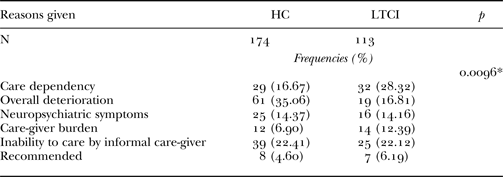
The overview of how these reasons were distributed across settings is provided in Table 4. Overall, home care care-givers' reasons had a slightly stronger association with people-with-dementia status than those gathered from long-term care institution care-givers. Significant statistical differences were seen globally (p < 0.05) but also in specific reasons given. For instance, 28.32 per cent of informal care-givers in long-term care institutions cited people-with-dementia care dependency while this figure was 16.67 per cent in home care. In contrast, in home care, more than 35 per cent gave a reason related to overall people-with-dementia deterioration, compared with only 16.81 per cent in long-term care institution.
Reasons given by informal care-giver in both settings: home care (HC) and long-term care institution (LTCI)

Significance level: * p < 0.05.
Reasons given by the informal care-giver most strongly associated with factors related to institutionalisation
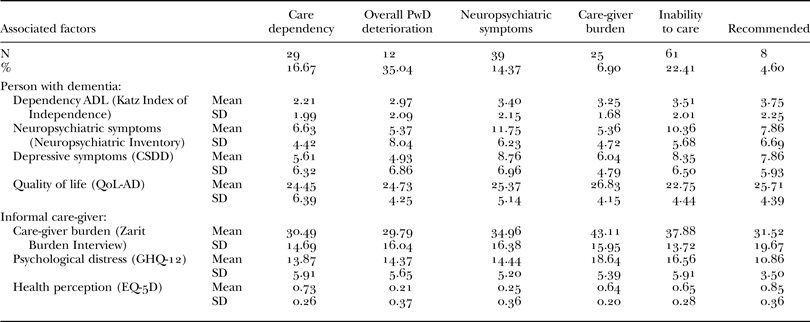
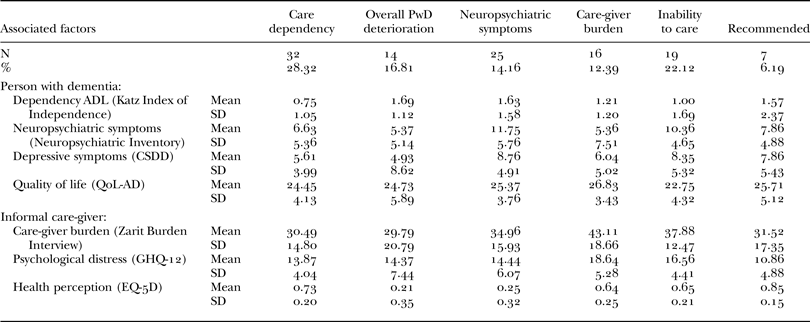
Six coded reasons associated with people-with-dementia institutionalisation were crossed with distinct scale measurements. The distribution of reasons given by informal care-givers in the home-care group (Table 5) differed from those in the long-term care institution group (Table 6).
Reasons given by informal care-giver in home care: factors associated with the institutionalisation of a person with dementia (PwD)

Notes: N = 174. SD: standard deviation. ADL: activities of daily living. CSDD: Cornell Scale for Depression in Dementia. QoL-AD: Quality of Life in Alzheimer's Disease. GHQ-12: General Health Questionnaire-12. EQ-5D: EuroQol-5 Dimension.
Reasons given by informal care-giver in a long-term care institution: factors associated with the institutionalisation of a person with dementia (PwD)

Notes: N = 114. SD: standard deviation. ADL: activities of daily living. CSDD: Cornell Scale for Depression in Dementia. QoL-AD: Quality of Life in Alzheimer's Disease. GHQ-12: General Health Questionnaire-12. EQ-5D: EuroQol-5 Dimension.
The reason care ‘dependency’ was not clearly associated with institutionalisation in either home care or long-term care institution. Only Katz scores in home care indicated a considerable degree of dependency within this group, supporting the opinion expressed by the informal care-givers. Slight associations between overall health status deterioration and the measurement scale scores were found with poor informal care-giver health perception in home care (mean = 0.21, SD = 0.37) and long-term care institutions (mean = 0.21, SD = 0.35). The reason ‘neuropsychiatric symptoms’ was clearly associated with The Neuropsychiatric Inventory score in both settings, indicating that there was a clear correlation with neuropsychiatric symptom scores in home care (mean = 11.75, SD = 6.23) and long-term care institutions (mean = 11.75, SD = 5.76). In addition, ‘neuropsychiatric symptoms', cited as a reason by informal care-givers, was associated with poor informal care-giver health perception in long-term care institutions (mean = 0.25, SD = 0.32) and in home care (mean = 43.11, SD = 0.36). Some association was also found with people-with-dementia depressive symptoms in the home-care group setting (mean = 8.76, SD = 6.96). ‘Care-giver burden’ given as a reason was related to high levels of care-giver burden assessed through the Zarit Burden Interview in both settings: home care (mean = 43.11, SD = 15.95) and long-term care institution (mean = 43.11, SD = 18.66); and also to greater informal care-giver psychological distress in both settings: home care (mean = 18.64, SD = 5.39) and long-term care institution (mean = 18.64, SD = 5.28). No extreme scores were seen related to the reason ‘inability to care’ by the informal care-giver. All measurements were low. When the reason given was ‘professional recommendation’, it was associated with the highest levels of quality of life for the informal care-giver in both settings: home care (mean = 0.85, SD = 0.36) and long-term care institution (mean = 0.85, SD = 0.15).
Discussion
Risk factors related to the admission of a person with dementia to a long-term care institution can also be related to the informal care-giver, so it is important to consider the profile of the informal care-giver taking care of the person with dementia when evaluating any possible immediate care transition. Young care-givers were more likely to place people with dementia in a long-term care institution sooner as they are probably working, have dependent children or more financial responsibilities (Brodaty and Donkin Reference Brodaty and Donkin2009). Furthermore, greater cognitive impairment, degree of dependency and poorer quality of life were closely associated with early admission of people with dementia to a long-term care institution. This has also been established from a European perspective (Afram et al. 2014a). As such, these outcomes need to be monitored by health-care professionals to identify early, unnecessary admission. It is possible to talk about inappropriate admission to a long-term care institution as the European study shows that when Spanish informal care-givers' quality of life was assessed following admission of people with dementia, the informal care-givers continued to have one of the highest levels of burden in Europe (Afram et al. 2014a). Furthermore, transition to a long-term care institution increases the total costs of dementia care from a societal perspective if the person with dementia does not suffer from very severe limitations (e.g. very severe ADL dependency). Public health efforts to prevent this unnecessary long-term care admission have the potential to be cost-effective for European health systems (Wübker et al. Reference Wübker, Zwakhalen, Challis, Karlsson, Zabalegui, Soto, Saks and Sauerland2014). Thus, increased coverage of informal care-givers' needs is essential, particularly psychological care needs, by including psycho-educational programmes to relieve informal care-givers' emotional distress and provide them with skills and coping strategies.
Significant differences between groups (home care and long-term care institution) regarding reasons expressed were noted although both were related to the need for health-care support in dependency care and incapacity to care by the informal care-giver, usually due to a lack of knowledge (Crellin et al. 2013; Zabalegui et al. Reference Zabalegui, Bover, Rodriquez, Cabrera, Diaz, Gallart, González, Gual, Izquierdo, López, Pulpón and Ramírez2008). Since Spain follows a family-care model, in common with other Southern European countries, there is limited provision of services by the state. Greater responsibilities are placed on the family as dementia health-care demands can increase, causing frequent, unnecessary interaction with emergency services, hospitals and other health-care providers (Mazzei, Gillan and Cloutier Reference Mazzei, Gillan and Cloutier2013). Some studies supporting these findings reveal that unnecessary resource utilisation could place indirect demands on the health-care system when few social services are available (Robinson, Buckwalter and Reed Reference Robinson, Buckwalter and Reed2013) and this can lead to an increase in current health-care costs (Wimo et al. Reference Wimo, Ballard, Brayne, Gauthier, Handels and Jones2014). Thus, interventions to improve or manage the degree of dependency in people with dementia and enhance their quality of life need to be implemented as these are the main difficulties our study population has to face. This may be a reflection of the scant involvement of other health-care professionals or the absence of other professional roles such as specialised liaison nurses, occupational therapists or physiotherapists, who have been shown to be valuable in other countries (Law et al. Reference Law, Barnett, Yau and Gray2014). Liaison nurses, as defined in another health-care context (Gerdner, Buckwalter and Reed Reference Gerdner, Buckwalter and Reed2002), with specific training and specific occupational status, provide benefits in terms of a multidisciplinary approach but with discipline-specific training to support patients with dementia. They also offer education and support in self-management and the development of coping strategies for patients to aid in improving long-term outcomes. Occupational therapists can be effective in improving care-giver wellbeing through specific environmental skill-building programmes (Gitlin et al. Reference Gitlin, Winter, Dennis, Hodgson and Hauck2010). Other effective multi-disciplinary, non-pharmacological interventions analysed in recent research (Zabalegui et al. Reference Zabalegui, Hamers, Karlsson, Leino-Kilpi, Renom-Guiteras, Saks, Soto, Sutcliffe and Cabrera2014) could be adapted to the characteristics of our study population.
The results of our research can help in the design of interventions aiming to avoid unnecessary long-term care admissions and potential family disappointments. Policy makers could find the results of studies such as ours useful when developing new health-care strategies.
Limitations
This study has some limitations. Our sample population is not representative of the overall Spanish population as only Barcelona citizens were selected, and some variables not considered, such as income or educational level, which can influence access to home-care services and long-term care institutions. Second, this study is part of a larger study and some methodological elements, such as a randomised sample, could not be adapted to the characteristics of our study population. Finally, it is possible that selection bias could represent a further study limitation since health-care professionals from distinct disciplines evaluated the probability of admission of people with dementia to a long-term care institution without using a standardised, valid instrument. As these professionals made the assessment using their own professional judgement, the criteria employed and evaluation of patients could differ among professionals.
Conclusions
The Spanish health-care system needs to provide more cost-effective resources and services to people with dementia and informal care-givers during the course of dementia to avoid unnecessary professional care transition. Special attention has to be paid to informal care-giver characteristics and to specific people-with-dementia risk factors such as degree of dependency, quality of life and neuropsychiatric symptoms, as these can be early predictors of long-term care institution admission. Reducing care-giver burden resulting from the overall deterioration of people with dementia could help to relieve the pressure on resources used in treating chronic and acute patients. Informal care-givers' perceptions are clearly related to measurable variables obtained with valid questionnaires, so special attention needs to be paid to informal care-giver demands. Listening and provision of emotional support are as important as psycho-educational interventions. It is also recommended that other health-care professionals, such as liaison nurses, occupational therapists or physiotherapists, should be involved in home care within the Spanish multi-disciplinary team.
Acknowledgements
This research was funded by a grant from the European Commission within the 7th Framework Programme (Project 242153). There are no conflicts of interest.