Introduction
This article shows, for the first time, that Captain Robert Falcon Scott rewrote his Terra Nova expedition sledging and base journals for the period 24 January 1911 to 18 June 1911 and made carbon copies from then until 31 October 1911. The combined manuscript is held by the Royal Geographical Society (with IBG) (hereafter RGS-IBG) with title Carbon copy of diary as leader of British Antarctic Expedition, Jan. to Oct. 1911, and reference number RFS/1 (hereafter Carbon Copy Diary or CCD).
Historian A.G.E. Jones explained, in his article “Scott’s Transport, 1911–1912”:
Scott made the entries in the B.M. Mss. [original handwritten journals held by the British Museum (hereafter BM)] at the time, day by day. They have also been reproduced in facsimile [Scott, Reference Scott1911a]. The R.G.S. Journal (top copy or carbon) [Scott, Reference Scott1911d] was written during the winter at Cape Evans. At some time, certain pages have been abstracted and ‘dummies’ inserted: as a rule, they contained Scott’s critical remarks about members of the expedition. A [three-way] comparison of the two mss. [BM journals and RGS-IBG manuscript] with the published narrative [Scott, Reference Scott2006] [compiled and edited by Leonard Huxley in 1913 as Scott’s Last Expedition] shows a large number of interesting differences and omissions. (Jones, 1977/Reference Jones1992, p. 290)
The CCD does not cover the full expedition; it covers the Autumn Depot Programme, the first winter and pre-departure preparations for the Southern Journey. It stops short of the Southern Journey and the Polar Party’s demise.
Producing The Voyage of the Discovery (the narrative of his first Antarctic expedition) had taught Scott how much time and effort can be required to produce an expedition narrative. On that occasion the book did not appearing until October 1905, 13 months after returning to England. There is no doubt Scott intended to produce a book about his second expedition (with Smith, Elder & Co. already engaged as publisher), in order to raise expedition funds, to meet sponsor expectations and to advance his naval career. Scott was a proficient writer with excellent command of the English language. At the time, it was common practice for explorers to maintain detailed (near-daily) journals as a source of raw material for their upcoming book(s). Such journals were often amended or rewritten in preparation for publication. The remarkable thing with the published narrative of Scott’s second expedition is that only his original raw journals were used in Scott’s Last Expedition (hereafter SLE), with the more recent (rewritten) CCD not being used at all. The consequence is that the published book of Scott’s Terra Nova expedition is based upon his second-latest journals, not his latest.
The main research question addressed in this article is “What was the significance of Scott rewriting his story?”
This article analyses the CCD as a historic artefact, to be thoroughly examined and documented. It compares two versions of Scott’s story, the published narrative (Scott, Reference Scott2006) and the CCD (Scott, Reference Scott1911d). It investigates the provenance of each version and then reviews differences that have been identified between them. Several areas of difference stand out.
This article touches upon editorial changes made to Scott’s original journal entries by Huxley for SLE and contrasts those changes with changes made by Scott himself when rewriting the same passages for the CCD. As the CCD was not used in compiling SLE, the question of what changes Huxley might have made to CCD entries does not arise.
It also investigates the provenance of a typescript version of the CCD held by Canterbury Museum.
To retain integrity with primary documents, this article uses imperial weights and measures. Nautical (geographic) miles are used throughout.
Previous works that mention the CCD
Despite the CCD being housed in the archives of a prestigious institution, only two published works refer to it (Jones, 1977/Reference Jones1992, p. 290 and Lyons, Reference Lyons1924, p. 10). There are no other references to the CCD in the wider literature of the Terra Nova expedition; no recent scholarship about the CCD has been located. The CCD appears to have been completely overlooked by modern writers, which is surprising, given its preeminent position within RGS-IBG’s Captain Robert Falcon Scott collection as RFS/1.
Part 1: Captain Scott’s multiple diaries
Original sledging and base journals
The history of Scott’s original Terra Nova expedition journals is well documented and is much more widely known than the history of the CCD. Max Jones’ Journals: Captain Scott’s Last Expedition (Scott, Reference Scott2006) is a widely respected source of information about SLE, which was based upon Scott’s original journals. For a straightforward explanation, refer to “Composition and Publication History” (Scott, Reference Scott2006, pp. xlii–xlviii). Jones’ The Last Great Quest contains additional information about the creation of SLE (Jones, Reference Jones2003).
Scott’s original journals from the death tent and from the Cape Evans base were taken to Lyttelton in the Terra Nova by Doctor Edward Atkinson. Joseph Kinsey, the expedition’s New Zealand agent, was Scott’s close personal friend and confidant as well as holding Scott’s power of attorney in New Zealand. Kinsey decided that Atkinson should present the journals to Kathleen Scott (hereafter Kathleen) in Wellington at the first opportunity (Kinsey, Reference Kinsey1913). She arrived in Wellington on 27 February 1913 in the Aorangi and Atkinson presented the journals the following day. She and her brother, Lieutenant Wilfrid Bruce, departed New Zealand at the first opportunity (on the Aorangi on the evening of 28 February 1913), returning to England via Australia (The Dominion (Wellington), 1 March 1913).
Scott’s original journals, comprising six small (five by eight inch) sketchbook sledging journals and six larger (eight by ten inch) base journals, were turned over to Huxley in May 1913 so he could assemble and produce the first book about Scott’s Terra Nova expedition. SLE was published on 6 November 1913.
The journals were then returned to Kathleen who lent them to the BM in January 1914, for an indefinite term:
She felt the BM offered a more prestigious site for the journals: a major national institution with a manuscripts saloon including texts from Nelson etc., open to the public (unlike the RGS), which would help secure the disaster as a sacrifice for the nation. (Max Jones, personal communication, 5 June 2021)
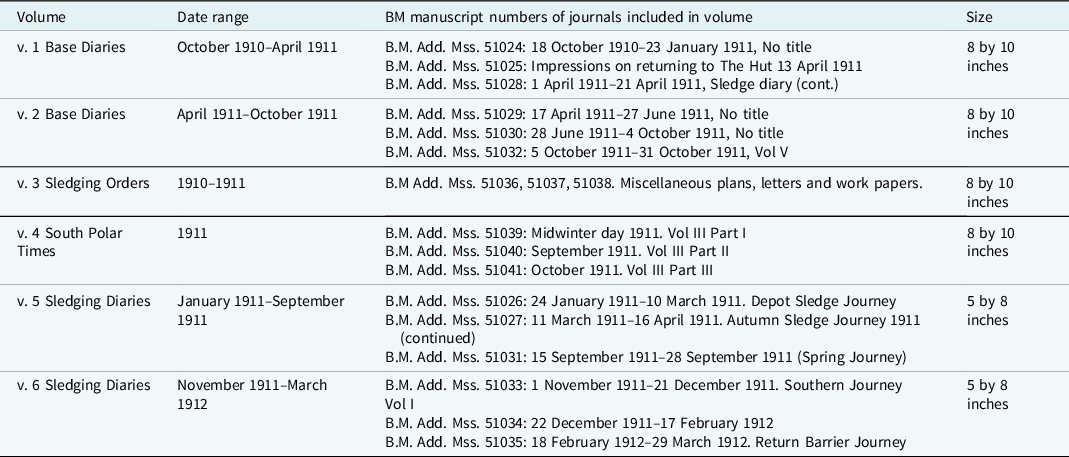
The museum assigned the manuscript numbers shown in Table 1. The numeric part of the BM manuscript number is used throughout this article when referring to specific original journals.
Composition of facsimile volumes: Scott’s original sledging and base journals (Scott, Reference Scott1911a).

Scott’s journals were transferred from the BM to the British Library on its establishment in 1973, where they remain to this day. Their contents are readily accessible via the published facsimile volumes.
Nine of Scott’s 12 original journals cover the entire period from 18 October 1910 to 29 March 1912, without gaps or overlapping dates: 51024, 51026, 51027, 51029, 51030 and 51032–51035. Of the three remaining journals:
-
○ 51025, “Impressions on returning …” describes the hut and men at Cape Evans in April 1911. It is not a diary of events; it stands apart from Scott’s daily entries, containing no dates. Huxley positioned it in SLE following the entry for 16 April 1911 (Scott’s first return to Cape Evans) while Scott positioned it in the CCD after his second return to Cape Evans, on 22 April 1911.
-
○ 51028 is a complete rewrite of events from 1 April 1911 to 21 April 1911 inclusive, its core being the relief of Hut Point. It is based on the last few pages of 51027 and first few pages of 51029. Key differences are:
-
51028 eliminates repetitive material about the weather, the freezing of the sea, the finding of frozen fish and various minor matters, reducing the net word count for the period from over 4300 to about 3100 words,
-
51028 is easier to read and
-
51028 ends with a buoyant overview of the challenges and achievements of the sledging season just completed, expressing optimism for the coming season.
-
-
○ When creating the CCD, Scott relied on 51028 in preference to the overlapped parts of 51027 and 51029, whereas Huxley made the opposite choice in SLE.
-
○ 51031 is Scott’s journal for the Spring Journey, which has little significance in the overall narrative. Huxley omitted this journal from SLE and Scott omitted it from the CCD.
Their son, Peter Scott, made the journals available for research purposes in the 1960s, initially to Reginald Pound and then in 1968 to University Microfilms, a Xerox company, who produced a magnificent set of facsimiles in six volumes (Scott, Reference Scott1911a), which still serve as the most accessible and reliable record of Scott’s original sledging and base journals.
Carbon Copy Diary
The CCD is a little-known version of Scott’s Terra Nova expedition journals held by the RGS-IBG (Scott, Reference Scott1911d). On 15 April 1915, the RGS wrote an unsigned letter (presumably from John Scott Keltie, their secretary at the time) to Kathleen. It acknowledged receipt of “the diary of Captain Scott from January to October, 1911” and further noting that “this may be reclaimed by your son Peter Scott, when he is 21, and that meanwhile, you are kindly willing to deposit it with us” (RGS, 1915).
The CCD is undated and contains entries from 24 January 1911 to 31 October 1911. The title unfortunately hints at it being an exact duplicate of original journals and casual readers might not realise it contains substantial revisions, by Scott, of his original journals.
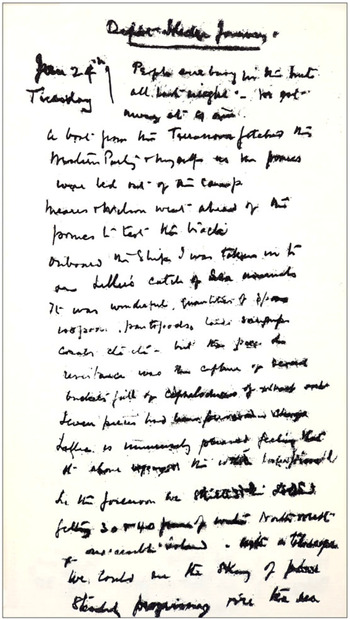
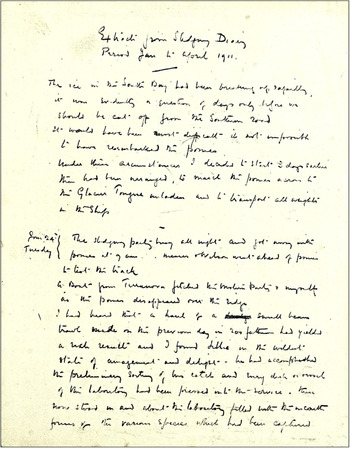
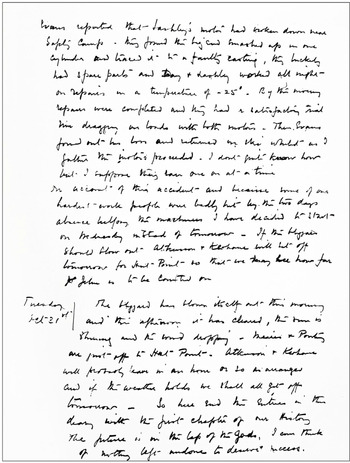
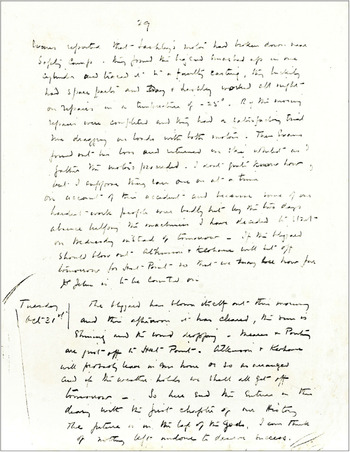
Figures 1 and 2 show corresponding pages dated 24 January 1911 from Scott’s original journal and the CCD. In this case, the so-called carbon copy is a completely rewritten page. Figures 3 and 4 show corresponding pages for 31 October 1911. In that case, the copied page (Figure 4) does indeed look like a carbon copy.
Page from Scott’s original 51026 sledging journal for 24 January 1911 (Scott, Reference Scott1911a) (pencil handwriting), partly overwritten by an unidentified person.

Corresponding page for 24 January 1911, from the CCD (Scott, Reference Scott1911d) (rewritten in ink), courtesy of RGS-IBG, RFS/1.

Page from Scott’s original 51032 base journal for 31 October 1911 (Scott, Reference Scott1911a) (pencil handwriting, top copy).

Corresponding page for 31 October 1911, from the CCD (Scott, Reference Scott1911d) (pencil handwriting, carbon copy), courtesy of RGS-IBG, RFS/1.

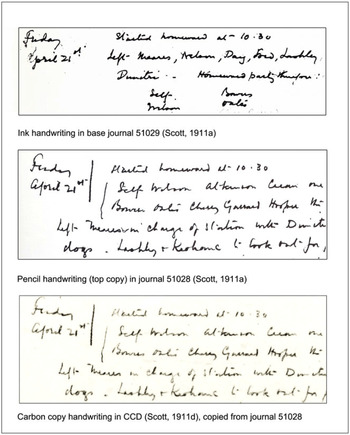
The CCD has long passages copied verbatim from Scott’s original sledging and base journals, plus many subtle changes, some new material and some deletions. Comparison of the CCD against the facsimile version of Scott’s journals (Scott, Reference Scott1911a) shows that from 24 January 1911 until 18 June 1911, the text has been rewritten and revised (extensively in places), but after 19 June 1911, the texts are identical. Closer examination of the CCD shows ink handwriting clear and crisp during the first period, while the CCD handwriting is somewhat faint and fuzzy during the second period, when Scott used pencil in his primary journal with carbon paper for a copy, destined for the CCD. Figure 5 shows Scott’s handwriting with ink, pencil and carbon paper.
Examples of Scott’s handwriting (magnified) illustrating different writing processes/media.

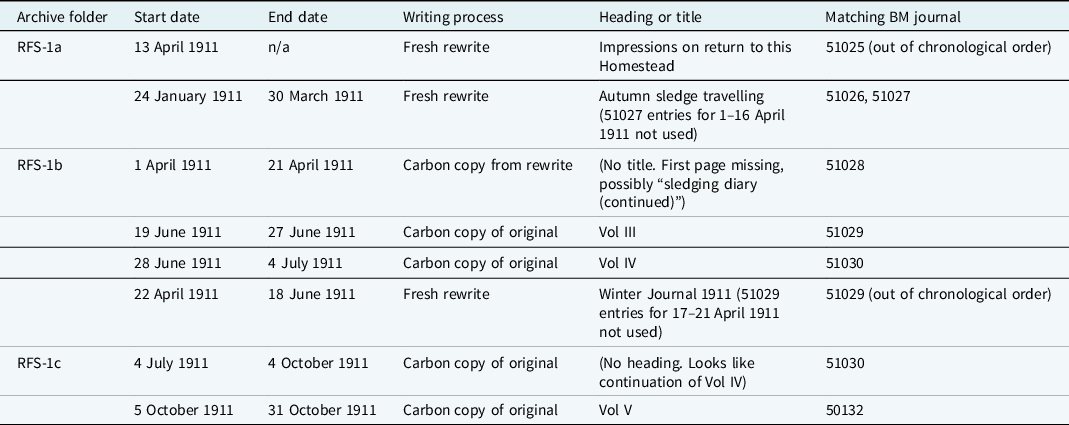
Scott apparently started the CCD by rewriting journal pages in full (in the Cape Evans hut, with pen and ink), but on 19 June 1911, he swapped to the carbon copy method. Base journal 51029, which was the working journal when Scott swapped to carbon copying, has three entries for 19 June 1911, two in ink and the third (much longer) entry in pencil. He rewrote pages in ink for 146 days’ worth of journal entries and used carbon copy for 135 days’ worth – slightly less than half the total. The RGS-IBG title Carbon copy of diary as leader of British Antarctic Expedition, Jan. to Oct. 1911 is therefore inaccurate. Table 2 shows the composition of the CCD.
Composition of Carbon Copy Diary (Scott, 1911d).

As noted previously, base journal 51028 is a complete rewrite of events from 1 April 1911 to 22 April 1911. It is entirely in pencil, suggesting it was written after 19 June 1911. It has been derived from sledging journal 51027 and base journal 51029.
Perusal of the CCD shows that it:
-
○ Consists of single-sided handwritten loose-leaf pages, approximately 8 by 10 inches,
-
○ Is currently stored in three A4 folders, labelled RFS-1a (108 pages), RFS-1b (102 pages) and RFS-1c (111 pages),
-
○ Can be related to Scott’s original journals, as shown in the rightmost column of Table 2,
-
○ Does not have unique page numbers. Scott restarted page numbering with most of his physical journals, meaning that CCD page numbers are not unique. This article therefore uses dates when referring to specific CCD entries.
-
○ Is missing nine pages (five explicitly redacted, with notes saying that pages were removed because of “personal information”, two with placeholder dummies and two missing without trace).
-
○ Contains two large sections of text that are out of chronological order, 51025 and the second section from 51029.
The CCD presents challenges to modern readers because two blocks of text are seemingly out of sequence, nine pages are missing, the handwriting is difficult to read and some pages have faded badly.
Scott’s book about the Terra Nova expedition was intended to be a significant source of expedition revenue. By preparing the leading chapters of his new book during the winter of 1911, he could hasten its eventual publication. The CCD therefore had a high commercial value to Scott; it must not be allowed to go astray or fall into the wrong hands. He decided to use trusted allies to get it to England as soon as possible; Drake and Kinsey would relay it to his wife Kathleen. Scott wrote to Kinsey on 28 October 1911:
I am sending a copy of my diary and have told Drake to deliver it into your hands. I am sure you will like to have a look through it, and be silent concerning any criticisms it may contain. But as it is the only copy I possess, will you please send it on to my wife as soon as you can. I have told her it will be sent by you after a short delay. (Scott, Reference Scott1911b)
Kinsey received the CCD after the Terra Nova docked in Lyttelton on 12 February 1912. He wrote to Kathleen on 10 April 1912:
He [Scott] has kindly sent me his journal for perusal. So far, I have not had a minute to spare since I received it, but you may rest assured I will not delay forwarding it one minute longer than I can possibly help. (Kinsey, Reference Kinsey1912a)
He wrote again on 2 May 1912, possibly because he needed more time to complete a personal copy:
I find I cannot send you the balance of your husband’s diary today. I have posted (registered) to you under separate cover to the end of Vol. IV. There is still Vol. V., 29 pages, which will be posted as soon as possible.
I find difficulty in deciphering the carbon copies, and the reading takes much time in consequence. (Kinsey, Reference Kinsey1912b)
Kathleen received the complete CCD in due course and her biographer-granddaughter recorded, “She edited [in mid-1912] those of Con’s journals that had been sent back” (Young, Reference Young1994, p. 152). As the CCD was based upon seven of Scott’s original journals, the term journals is consistent with this article’s terminology. We have no information about how Kathleen undertook the editing task or what documents were produced as a result. Her biographer responded to my questions:
Con [Scott] was a fine writer, and she would respect what he wrote. I can’t see that there’d be any reason for her to do much, as he would be dealing with it when he returned. She was not a professional editor. (Louisa Young, personal communication, 4 March 2021)
On 17 February 1913, while at sea en route to New Zealand, Kathleen learned of her husband’s death (The Dominion, 1 March 1913).
Kinsey wrote to Kathleen about expedition matters on 25 February 1913, reminding her:
Captain Scott sent up his private diary by the Terra Nova in March [sic] 1912, which, at his request, I read before posting on to you. This diary was written up to 31st October 1911 – the day prior to his departure for the Pole. (Kinsey, Reference Kinsey1913)
For reasons unknown, the CCD was not used in production of SLE. The obvious question “Why?” is addressed in “Circumstances under which Huxley produced the book” (below).
Kathleen wrote to Keltie on 31 March 1915, “I have at last got the duplicate manuscript ready for you of my husband’s diary” and suggested “coming to see you at the Geographical with these things at 4.20 tomorrow” (Scott, Reference Scott1915). The CCD remained with the RGS-IBG to this day.
In summary, the CCD incorporates changes Scott made to his story by rewriting all existing journal pages between 24 January 1911 and 18 June 1911, before swapping to carbon copying on 19 June 1911. In its current state, its integrity has been compromised by having two sections placed out of date order and by nine pages being removed. Readability is compromised by carbon copying and by fading.
Canterbury Museum Typescript
“Captain Scott’s Private Diary 1911” is the title on the spine of a little-known volume held in Canterbury Museum’s Robert Falcon Scott Collection with reference number MS142 (hereafter the Canterbury Museum Typescript or CMT) (Scott, Reference Scott1911e). It was deposited with the museum in 1941 by Mrs. May Moore, Kinsey’s daughter (Dr. Jill Haley, Curator of Human History, Canterbury Museum, personal communication, 18 March 2021). A digitised version can be downloaded without charge from https://collection.canterburymuseum.com/objects?query=ms142.
The CMT is a handsomely bound volume. It starts with seven silver-gelatine monochromatic photographs pasted directly onto pages, followed by an in memoriam certificate for the Polar Party and 319 pages typed from the CCD. It lacks any information about its author and publisher and it has no table of contents or index.
The first three photographs show the Polar Party at the South Pole, followed by one of them hauling a sledge and one of their snow tomb. The preface finishes with photographs of Scott’s final two-page letter to Kinsey, dated 24 March 1912 and the in memoriam certificate.
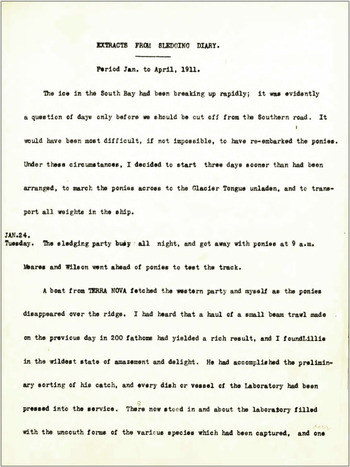
The CMT contains a full page-for-page typescript of the CCD. Comparison of Figure 6 (from the CMT) with Figure 2 (from the CCD) illustrates the relationship. It is typed with double-spacing and has minor proofreading corrections.
Page from the CMT for 24 January 1911 (Scott, Reference Scott1911e), courtesy of Canterbury Museum, MS142.

The CMT is a private copy of the CCD, apparently conceived by Kinsey and retained in his family until his wife’s death in 1941, when it was deposited with Canterbury Museum. Kinsey was an avid collector of books and fine art, leaving a library of over 15,000 books. Many of the books were first editions signed by authors and individuals who appear in the books. Kinsey specialised in books and artefacts related to Antarctic exploration. He was very proud of Scott’s last letter to him, in which Scott trustingly wrote, “My thoughts are for my wife and boy. Will you do what you can for them if the country won’t” (Scott, Reference Scott2006, p. 418).
Scott had trusted Kinsey to read the CCD, “I am sure you will like to have a look through it …” (Scott, Reference Scott1911b). Kinsey had ample time to have the CCD typed-up while it was in his custody from February to May 1912, before sending it on to Kathleen. The title on the CMT’s spine, Captain Scott’s Private Diary 1911 is consistent with Kinsey’s particular terminology private diary in his letter to Kathleen of 25 February 1913.
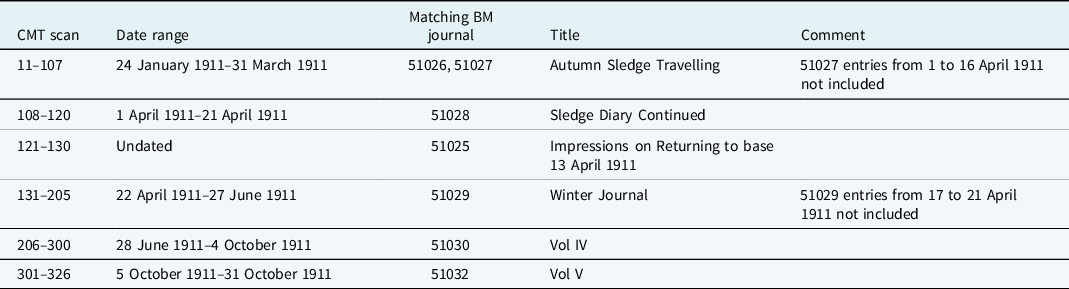
Unlike the CCD, the CMT is in date order, as shown in Table 3. The first column contains a scan numbers, effectively a unique consecutive page numbers within the volume.
Composition of Canterbury Museum Typescript (Scott, 1911e).

Comparison of Tables 2 and 3 shows that two large blocks of text in the CCD are out of date order, relative to the CMT. It seems unlikely that Scott, working from his day-by-day sledging and base journals, would have deliberately assembled the loose-leaf CCD out of date order and that Kinsey later rearranged his private copy into chronological order for binding. It seems more likely that Scott created the CCD in chronological order (the natural flow of his journals, apart from 51028 overlaps) and that the typescript simply follows the sequence of the CCD as it was on the day of typing, with somebody else spoiling the integrity of the loose-leaf CCD at a later date.
The nine missing CCD pages all appear in the CMT, indicating the CCD was pristine while in Kinsey’s custody. The CCD redaction notes were apparently inserted by an unknown person (not Scott or Kinsey) at an unknown date when pages were removed. Page removals after the CCD left the Antarctic are immaterial to this article; they do not indicate any change of story on Scott’s part.
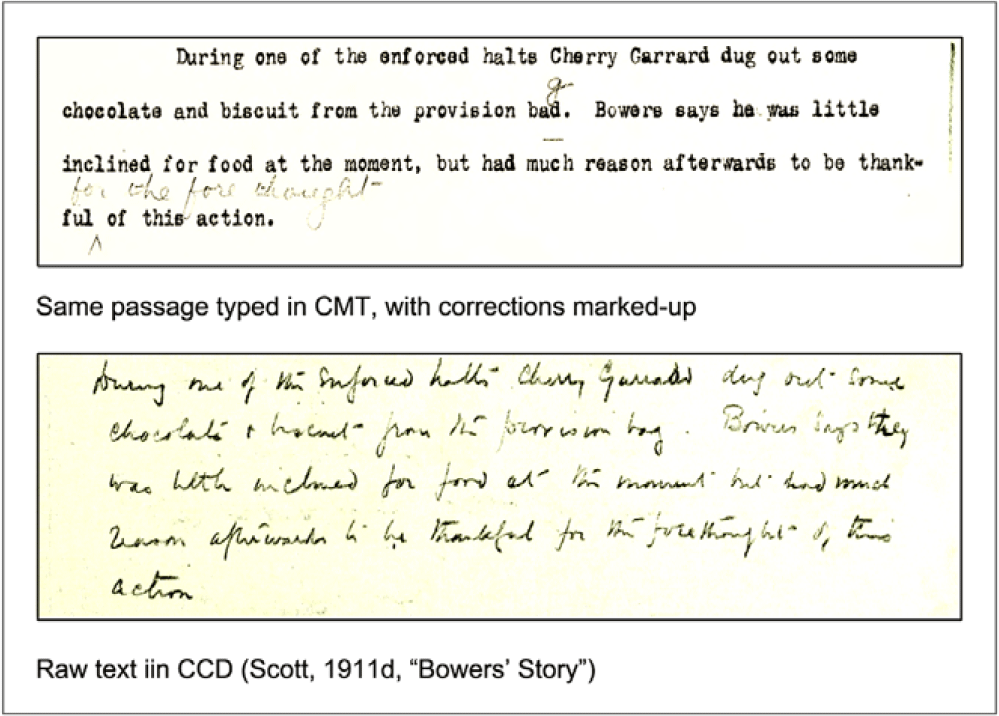
Proofreading corrections in the CMT do not indicate any change of story on Scott’s part either – they simply rectify straightforward typing errors, presumably detected by literal word-by-word comparison of the documents. Close examination shows some typing errors were missed by the proofreader. Figure 7 shows typical examples of CMT proofreading corrections. Unfortunately, the green ink used for corrections has faded and does not show particularly clearly in scanned images.
Sample proofreading corrections in the CMT (Scott, Reference Scott1911e).

In summary, the CMT is consistent with the CCD from which it was derived. It has greater integrity than the CCD and is far easier to read.
Sample pages from Scott’s multiple diaries
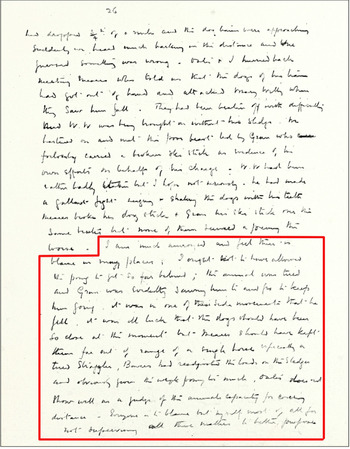
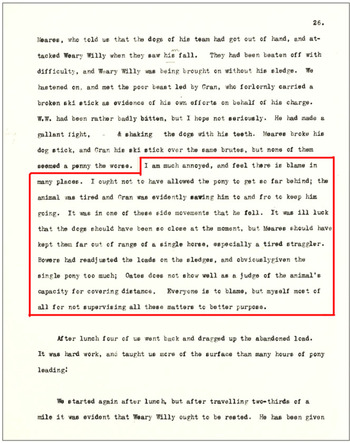
This article refers to several versions of Scott’s diary, which could be perplexing for some readers. This section includes sample pages recounting the same episode in each version, to illustrate the differences. The episode selected is Scott’s response to the incident where Cecil Meares’ dog team attacked the pony Weary Willy on 14 February 1911. The passages for comparison are bounded by red lines.
Sample 1: Original sledging journal
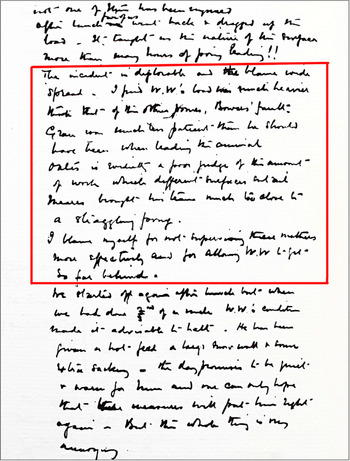
The wording from Scott’s sledging journal appears in Figure 8.
Scott’s reaction to the dog attack on Weary Willy – from his original sledging journal 51026 (Scott, Reference Scott1911a).

The highlighted passage in Figure 8 has been typed for easier reading:
The incident is deplorable and blame widespread. I find W.W.’s load was much heavier than that of the other ponies. [Lieutenant Henry] Bowers’ fault. [Tryggve] Gran was much less patient than he should have been when leading this animal. [Captain Lawrence] Oates is evidently a poor judge of the amount of work which different surfaces entail. Meares brought his team much too close to a struggling pony.
I blame myself for not supervising these matters more effectively and for allowing W.W. to get so far behind.
Sample 2: Published narrative
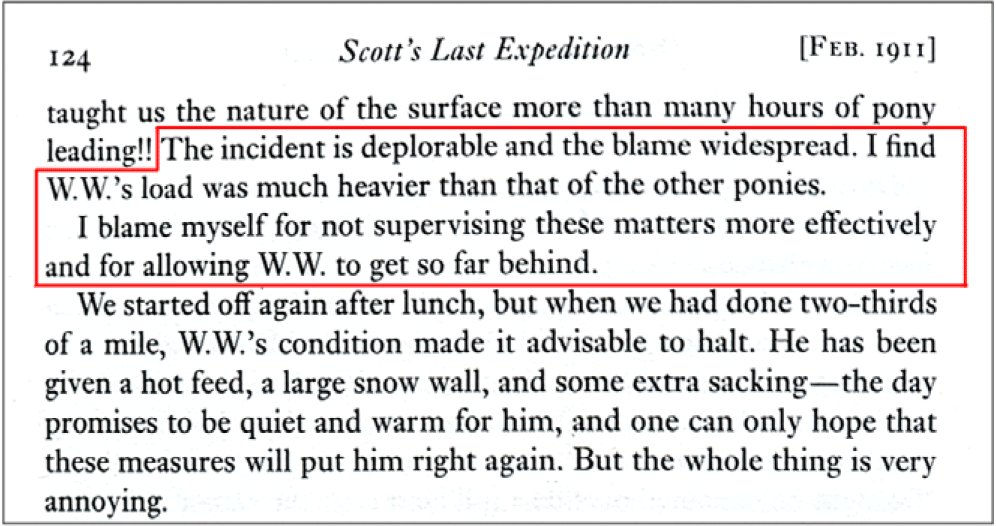
A substantial proportion of the text from Scott’s sledging entry was redacted. The editor, Huxley, presumably decided Scott would not wish to name those who he saw as being responsible for the incident. The corresponding passage in SLE (Scott, Reference Scott2006, p. 124) appears in Figure 9.
Scott’s reaction to the dog attack on Weary Willy – from the published narrative (Scott, Reference Scott2006).

Sample 3: Carbon Copy Diary
The corresponding passage in the CCD appears in Figure 10. It is evident that at the time of writing this page, Scott intended to name those who he saw as being responsible for the incident.
Scott’s reaction to the dog attack on Weary Willy – from the CCD (Scott, Reference Scott1911d), courtesy RGS-IBG, RFS/1.

It has been typed for easier reading:
I am much annoyed, and feel there is blame in many places. I ought not to have allowed the pony to get so far behind; the animal was tired and Gran was evidently sawing him to and fro to keep him going. It was in one of these side movements that he fell. It was ill luck that the dogs should have been so close at the moment, but Meares should have kept them far out of range of a single horse, especially a tired straggler. Bowers had readjusted the loads on the sledges, and obviously given the single pony too much; Oates does not show well as a judge of the animal’s capacity for covering distance. Everyone is to blame, but myself most of all for not supervising all these matters to better purpose.
Sample 4: The Canterbury Museum Typescript
The corresponding passage in the CMT appears in Figure 11. This text is identical to the CCD.
Scott’s reaction to the dog attack on Weary Willy – from the CMT (Scott, Reference Scott1911e), courtesy of Canterbury Museum, MS142.

Context in which Scott rewrote his story: winter 1911
Producing Voyage of the Discovery had taught Scott much about producing an expedition narrative. With nine months Admiralty leave, the book finally appearing in October 1905, 13 months after returning to England. Now, in the winter of 1911, he had a sound understanding of what would be involved in producing his second book. Winter was a good time to make an early start on the large job.
It was common practice in Scott’s day for explorers to maintain detailed journals as a source of raw material for their upcoming book(s). Such journals were often amended or rewritten as a matter of course, in preparation for publication. Scott’s changes would be driven by generic publishing conventions (a la his first book) plus specific pressures and issues, unique to his second expedition. He did not explicitly identify those pressures and issues, so we can only surmise; some or all of the following matters may have been significant.
Scott was still hoping to reach the South Pole early in 1912. The First Depot Journey had taught him that it would be more challenging than a simple dash to the Pole.
Scott was aware of the serious threat posed by Captain Roald Amundsen’s expedition. It was quite possible that Amundsen could beat him to the Pole. In that case the expedition’s broader reputation would depend on the perceived worth of its scientific results. The experience of having the Discovery expedition’s meteorological results challenged, and to some extent discredited, must not be repeated. After learning on 22 February 1911 of Amundsen’s presence in the Bay of Whales, he realised his book must portray an exceptionally successful scientific programme. Scott was already overseeing the scientific work, to ensure the results were beyond reproach; now the book must fit that bill.
Scott expected to return to England with the expedition in serious debt. He could not afford to lose the support of his main backers, the RGS and the Royal Navy (hereafter RN), because of any careless or thoughtless passages in the book. It would be important for the book to meet sponsors’ expectations.
He was relying on his naval career to support his mother, sister, wife and son. The RN had made substantial contributions of workers, equipment and supplies to the privately funded expedition, with the expectation that Scott would abide by long-standing naval traditions of polar exploration. Scott needed a successful expedition narrative in order to advance his naval career, a narrative that would show his leadership qualities as being fit for advancement.
The disastrous loss of six ponies on the First Depot Journey must be portrayed in the most positive light possible.
The decision to change the publicly announced transport strategy at a relatively late stage needed strong justification, as defence against possible challenges from sceptics and critics.
Several passages in Scott’s field journals lacked detail, for example the pony incident. In mid-winter he could ask questions and read the diaries of the men present, much more easily than after they had dispersed, post-expedition. Edward Wilson was rewriting his own field diaries in the Cape Evans hut at this time. SPRI MS 234/4 is Wilson’s rewritten diary covering exactly the same dates as Scott’s CCD.
Once the polar winter night set in, Scott would probably have reflected on the importance of quickly producing the first book about the Terra Nova expedition. He already had more than 200 pages of day-by-day journal entries to use as raw material, some pages requiring important revisions (aligning his story with RGS expectations, casting the loss of ponies in a positive light and justifying his change of transport strategy), many others requiring minor revisions or general polishing. He had ample raw material to tell the story of the expedition to-date. Apparently, he decided to rewrite all existing pages (many of which had been written under time pressure during lunch breaks or at the end of a hard day’s travelling) and to make carbon copies of future pages (in the comfort of the hut, without time pressure), covering the remaining period until the start of the Southern Journey. The resulting manuscript could be back in England by April 1912, a year ahead of his own expected return.
Part 2: changes Scott made to his story
Part 2 of this article reviews the post facto changes made by Scott when he rewrote his story. It comes from direct comparison of the CCD (Scott, Reference Scott1911d) against the published narrative (Scott, Reference Scott2006). This provides insight into how, in mid-1911, Scott intended to recast certain aspects of his story for publication. He would of course be making further changes prior to publication, meaning the CCD cannot be taken as the final text, had Scott lived. It is possible that inconsistencies noted in this article might be detected and corrected prior to publication.
Part 2 also touches upon editorial changes made in the published narrative by Huxley and his advisors. Jones’ Journals: Captain Scott’s Last Expedition (Scott, Reference Scott2006, pp. 457–471) has been used as the source of information about Huxley’s changes.
Did Scott change his criticisms of Amundsen and Shackleton?
Scott was upset about Ernest Shackleton’s misuse of his (Scott’s) hut at Hut Point in the 1908–1909 sledging season and about Amundsen’s secrecy and deception regarding his plans for the South Pole. He wrote strongly worded passages in his journals about both men, which Huxley withheld from SLE.
The question arises, “When Scott rewrote those strongly worded passages, months later, did he tone them down in any way?” The answer is that Scott did not resile from his critical stance towards either man. He improved the readability of his initial text and slightly intensified the criticisms.
Shackleton was already a popular hero when the Terra Nova left Britain, so Scott was taking a bold step with his assertive criticism. Scott’s CCD entry for 27 January 1911 was similar to the original (pre-redaction) text, except that “excrement” became “filth” and he summed-up with a damning biblical reference “the whole soiled with hideous marks of the beast”. Scott apparently believed Shackleton and his men had failed to exercise appropriate self-discipline with their personal hygiene, along with their failure to respect the property of others. At the time of writing the CCD, he apparently intended to make his opinion public.
Scott had received a telegram in Melbourne from Leon Amundsen, revealing his brother Roald’s intention to go south, rather than heading for the North Pole as publicly announced. Scott’s revised text for 22 February 1911, after learning of Amundsen’s presence in the Bay of Whales, was similar to the original (pre-redaction) text, except that the words “secret” and “feeling disgusted” were added. Scott apparently believed Amundsen was an unprincipled opportunist without honour. At the time of writing the CCD, he apparently intended to make his opinion public.
In summary, it appears that in mid-1911 Scott did not intend to soften his stance towards Shackleton or Amundsen. Had he lived, it is possible that senior figures in the RN and the RGS may have prevailed upon him to soften his stance – we can never know. We can however be certain that Scott did not rewrite his journals in mid-1911 in order to soften his initial criticisms of Shackleton and Amundsen.
Changes made to meet RGS expectations
The expedition was part-funded by its scientific backer, the RGS. Scott’s article “Plans of the British Antarctic Expedition, 1910” had been published in the RGS’s Geographical Journal. He was faithful to the RGS vision of exploration as “a tripartite process of measurement: explorers measured the world, taking scientific observations; measured manliness, testing their heroic character in the battle against nature; and measured empire, marking the limits of British imperial power” (Jones, Reference Jones2003, p. 10). Quite a few of Scott’ CCD changes can be seen as aligning his raw journal text with the tripartite process of measurement. Other changes emphasise the expedition’s scientific discoveries, experiments and scientific lectures.
A striking example of revision to align with RGS expectations occurs with the return of the Western Geological Party on 15 March 1911. The published narrative suggests the journey had largely been a waste of time:
They were very full of their adventures. The main part of their work seems to be rediscovery of many facts which were noted but perhaps passed over too lightly in the Discovery – but it is certain that the lessons taught by the physiographical and ice features will now be thoroughly explained. (Scott, Reference Scott2006, p. 146)
Scott seemed disappointed by shortfalls in the Discovery scientists’ documentation, as well as the wasted effort in repeating the previous expedition’s work. In the CCD, Scott recasts the same events into a more appealing narrative:
From a scientific point of view, this is undoubtedly one of the most important journeys that has ever been made in these regions. Already I gather the drift of the observations made, and I shall be much mistaken if [Frank] Debenham’s and [Charles] Wright’s work is not judged to be of a very high order, whereas that of Taylor himself is so entirely new and interesting that it cannot fail to throw a flood of new light on the physiographical history of the Continent. Wilson remarked that with these results the Expedition can claim to have done more work than any other in its opening season. (Scott, Reference Scott1911d, 15 March 1911)
Scott’s challenge was that with most fieldwork being carried out remotely from Wilson and himself, their preferred collaborative leadership methods were infeasible. Scott therefore lifted the standard of his written instructions for the second season:
-
○ The written briefing for the Western Geological Party’s work in the first season (1½ pages of double-spaced typing) appears on pp. 122–123 of With Scott: The Silver Lining. It is minimal.
-
○ Their written instructions for the second season are more extensive than the first season’s and refer to an additional verbal briefing “The objects of your journey have been discussed, and need not here be particularised” (Evans, Reference Evans1961, pp. 157–160).
Scott’s own actions demonstrate a determination to assure the quality of all scientific results, presumably to avoid criticisms like those levelled at the Discovery expedition’s scientific results. He took a personal interest in physical sciences such as geology, meteorology, physics, oceanography and earth sciences. He directed, guided and mentored the young scientists and made changes in the CCD to emphasise the quality of scientific work undertaken. For example, Wright gave a winter lecture on ice problems. The published narrative recorded:
In the evening Wright lectured on “Ice Problems.” He had a difficult subject and was nervous. He is young and has never done original work; is only beginning to see the importance of his task.
He started on the crystallisation of ice […].
The upshot of the discussion was a decision to devote another evening to the larger problems such as the Great Ice Barrier [Ross Ice Shelf] and the interior ice sheet. I think I will write the paper to be discussed on this occasion. (Scott, Reference Scott2006, p. 198)
The CCD recorded:
Evening – Wright lectured on “ice problems” – a difficult subject and a rather halting lecture. Wright is very clever, very sound and very hard working, but finds expression of his thoughts the greatest difficulty in life.
He started on crystallisation of ice […]
Wright has all the training in Physics necessary to cope with these ice problems, but as yet, they are new to him, and he has no grip of the larger issues. I feel particularly interested in his making a success of this business because it was my own idea to secure a specialist for the work, and because it came to me of the greatest scientific importance.
The upshot of the discussion was the decision to devote another evening to the larger problems, such as the Great Ice Barrier and Inland Ice Sheet. I think I will write a paper for discussion on that occasion. (Scott, Reference Scott1911d, 19 May 1911)
The published narrative touches on George Simpson using meteorological balloons for atmospheric temperature measurements during the time Scott was away on the Autumn Depot Programme (Scott, Reference Scott2006, pp. 176–177). It describes the physical details of the balloons and their threads, with in-depth explanation of the method for generating hydrogen gas. The CCD however talks of the scientific objectives of balloon-enabled measurements, the need for progressive correction and refinement of processes, an explanation (supported by a new diagram) of how temperatures were to be recorded and so on, effectively moving from a laboratory technician’s perspective to that of a scientist. The entry for 24 April 1911 was thereby changed from being an accurate but passive observation of Simpson’s handiwork to become a positive promotion of new methods for capturing meteorological information. This is consistent with the RGS value of “measuring the Earth”.
The CCD has two typed pages that were inserted in April 1969 by Mrs M. M. T. Hughes, RGS Archivist, explaining that the first two pages of Scott’s Winter Journal (51029) had been exhibited in a frame and had faded badly. The typed pages include Scott’s improved description of Simpson’s balloon activities and the new diagram. They appear in the CCD ahead of the Winter Journal, leaving the faded originals correctly sequenced. An intriguing observation is that Scott’s revised approach was sufficiently credible for the pages to be framed and displayed by the RGS. Evidently, Scott had the measure of RGS expectations at the time.
In summary, it appears that Scott rewrote several passages about the first season’s scientific work to align them with RGS expectations and their vision of exploration. His entry for 10 September 1911 “If the Southern Journey comes off, nothing, not even priority at the Pole, can prevent the Expedition ranking as one of the most important that ever entered the Polar regions” (Scott, Reference Scott2006, pp. 285–286) suggests Scott was now completely satisfied with the expedition’s scientific records to-date.
Changes made to frame the pony disaster in a positive light
The pony disaster (28 February 1911 to 2 March 1911) presented Scott with the challenge of how it should be framed in his book. The death of three of the best ponies was a major setback to his southern transport plans, so could not be lightly dismissed. Seven other men were involved in the disaster (Wilson, Meares, Oates, Gran, Apsley Cherry-Garrard, Crean and Bowers), several of whom kept detailed journals that would inevitably bring details of the disaster into the public domain.
Arguably, Scott himself should have been leading the Pony Party across the sea ice that was known at the time to be unsafe (Wilson, Reference Wilson1972, p. 108). Scott was aware of the danger, having written a week earlier, “Then I began to feel anxious, because I knew that the ice must now be very thin off the Cape [Armitage], and that it might be very risky for two people to attempt it alone” (Scott, Reference Scott1911d, 22 February 1911). He also knew that ponies would put greater pressure on the ice surface than men alone. He had more experience of sea ice than anybody else did, and it was his responsibility as expedition leader to take the lead in dangerous situations. In hindsight, it was a grave mistake for the inexperienced Bowers to lead the Pony Party, a mistake that cost three pony lives and placed three human lives at risk. If Scott’s performance as leader ever came under scrutiny, he could be accused of needlessly placing the lives of others in danger. His book would need to divert readers’ attention away from such thoughts.
The published narrative briefly covers the event-filled days of the pony disaster (Scott, Reference Scott2006, pp. 138–141), which at the time he pointedly called the “Bowers Incident”. Scott was under pressure, with little opportunity to write extensive journal entries, resulting in scanty coverage of the disaster. Huxley did not alter this part of Scott’s story, publishing just under 1200 words for the entire incident.
Scott achieved a great transformation with his rewritten coverage of the pony disaster. He added many details, creating a captivating, easy-reading adventure story. The rewritten account is presented in two parts – the first, describing Scott’s day-by-day personal involvement, appears in its chronological place. The second, from Bowers’ perspective, was now called “Bowers’ Story”. Scott gleaned valuable information from participants, “since all three participants are inclined to be too modestly reticent it has not been easy to gather the full significance of some of the facts” (Scott, Reference Scott1911d, “Bowers’ Story”, n.d.). The word count for the pony disaster in the CCD exceeds 6,000 words, a five-fold increase over the published narrative.
The CCD provides in-depth coverage of the challenges the men faced during the pony disaster and how they responded (perhaps with RGS expectations on measuring manliness in mind). It is more interesting and entertaining than the published narrative, with plenty of dramatic moments and human interest. From the misfortune of the pony disaster, the CCD draws a lesson of classic British courage under adversity, “Finally, adversity has its uses, apart from the consideration of the circumstances which caused it. In this case, it has produced a story of endurance, courage and resource which proves the quality of the men that met it” (Scott, Reference Scott1911d, “Bowers’ Story”, n.d.).
The published narrative does not identify any cause of the pony disaster, with its scanty and rather defensive coverage of the incident. Jones aptly commented, “Others [entries], such as the description of the ‘pony disaster’, are submissions to an imaginary board of inquiry” (Scott, Reference Scott2006, p. xxxiii).
The CCD puts the cause of the pony disaster down to astonishing bad luck, variously referred to as “the Great Storm” “the Great Gale” and “a phenomenal swell” causing the sea ice to break-up under the sleeping Pony Party. However, Simpson’s meteorological records for Cape Evans, just a few miles distant, show the hourly wind speed varied between 7 and 10 miles per hour on 1 March 1911, during the 2½ hour period the Pony Party slept on the ice (Simpson, Reference Simpson1923, Table 13). Bowers’ meteorological observations, taken on the sea ice at the time were (not surprisingly) incomplete, simply recording a wind of force 2 (4–7 miles per hour) before the men turned in (Simpson, Reference Simpson1923, Table 67). Bowers recorded on 1 March 1911, “The mist still hung to the West but you could see a good mile, and all was still. The sky was very dark, over the strait though, the unmistakable sign of open water” (Bowers, Reference Bowers1913, vol 2, p. 78). Apparently, Scott’s terms storm and gale were not accurate.
The concept of a phenomenal swell does not appear in the CCD until 17 March 1911:
A report that the Great Gale carried away a large part of the Glacier Tongue has been fully confirmed by clearer observation – at least a mile and a half has gone. […]
Its destruction shows conclusively that the swell which caused such confusion to our plans and ideas on the first [of March 1911] was quite phenomenal. Our strait [McMurdo Sound] could have experienced nothing so devastating for a great number of years. One cannot reflect on this fact without perceiving the extraordinary ill fortune which prompted us to choose the precise moment of its action to venture, and lose our ponies on the sea ice. It seems to me an instance of astonishing bad luck. (Scott, Reference Scott1911d, 17 March 1911)
There may be a problem with Scott’s recall here. Bowers had written on 5 March 1911, “Captain Scott walked over the shoulder under Castle Rock to see down the Strait and came back with the intelligence that he could hardly believe his eyes but half the Glacier Tongue had broken off and disappeared” (Bowers, Reference Bowers1913, vol 3, p. 17). Wilson had seen the broken tongue the previous day (Wilson, Reference Wilson1972, p. 115). The CCD is silent about both reported sightings. Scott reasoned that the break-up of sea ice under the sleeping Pony Party was caused by the phenomenal swell that broke 1½ miles off Glacier Tongue and which he feared at the time may have swept away the hut at Cape Evans. He contends that without the phenomenal swell (a once in many years event) the Pony Party had no risk of ice breaking up beneath them as they slept. Scott clearly wished his readers to perceive the Pony Party as victims of astonishing bad luck. Actually, much of the sea ice and parts of the Barrier in McMurdo Sound break out in late summer every year.
The CCD candidly addresses the matter of Scott’s absence at the critical time:
It was at this point in the proceedings, and at this point only, that my own experience might have saved the situation. I am sure that I should have been alarmed at the first sight of these cracks, and should have turned back at once. But it is by no means certain that I should have saved this party. (Scott, Reference Scott1911d, n.d.)
Surprisingly, Scott did not address the alternative of the ponies following the Dog Party, as he had instructed Bowers.
In short, Scott rewrote the narrative of the pony disaster, expanding and enriching the parts he wished to emphasise while diminishing the risk of future personal criticism by stressing things that were beyond human control.
Changes made to justify Scott’s revised polar transport strategy
The article “Captain Scott changed his mind: the dogs shall not go to the South Pole” (Alp, Reference Alp2021) shows that Scott’s publicly announced southern transport strategy was based upon dog transport being used to reach the Pole. To view a read-only version of that article without cost, click here. A full version may be obtained via the doi in the “References” section.
With expert dog handlers in the Terra Nova team, Scott had put the mismanagement of Discovery dogs behind him (Alp, Reference Alp2021, “Scott’s attitude towards working dogs and animal cruelty”). Dog management was very different on Scott’s second expedition. Relevant material from my earlier article is reproduced in Supplementary Material, Appendix A, “Scott’s reputed biases”.
However, between 22 February 1911 and 8 May 1911, Scott developed a new scheme of advance that relied solely on pony power and manpower. His strategy changed from dog transport to the Pole to no dogs beyond the Barrier. Having made his decision about Southern Journey transport, Scott needed the men to understand and whole-heartedly support the new scheme of advance. He therefore needed to build the men’s trust in ponies, despite abundant evidence that they were not as well suited to Antarctic conditions as dogs. In such situations, a leader will often seek to create a clear, shared purpose for the entire enterprise. With that objective, it seems Scott embarked upon a circuitous performance in his Cape Evans lecture of 8 May 1911. He did not admit that too many ponies had been lost for the Southern Journey to follow his initial scheme of advance. He led the men to believe dogs were inherently disappointing and unreliable, even though recent problems actually came from the inadequate dog ration set by Meares and himself. Eleven pages of Scott’s lecture notes have survived (Scott, Reference Scott1911c). The article (Alp, Reference Alp2021, “The rationale behind Scott’s delivery technique”) provides additional coverage of Scott’s May 1911 lecture.
Recasting the relative merits of ponies and dogs is the most intricate revision in the CCD. Apparently, Scott wished readers to accept that “dogs will not work willingly or well on the Barrier for any length of time” (emphasised below).
Scott’s CCD entry for 18 February 1911 introduces a new story element, “I am anxious to see the dogs working, and find out at first-hand what we can expect from them”. There is no corresponding text in the published narrative. The next day’s CCD entry follows-on with “… but they jib at a heavy weight behind, and obviously suffer from the monotony of long hours without sight of anything diverting”, as though he had recently observed such behaviour. There is no corresponding text in the published narrative. The journals of no other expedition members report dogs losing interest at the time.
Three days later, Scott returned to his new story element and added another theme, dog motivation:
I suggested this hurried journey home to test them [the dogs], and I am satisfied that we shall only place a limited reliance on these animals. At present, they are ravenously hungry […] but this trip confirms my former opinion in showing that, apart from the food question, dogs will not work willingly or well on the Barrier for any length of time [emphasis added]. I think the reason is to be found in the unending monotony of the business. […]
[T]o travel day after day over a snow plain seems to gradually take the heart out of them, and in this condition, I do not think the best driver could force them to face a cutting wind with drift. To get these animals to the summit of Victoria Land [Polar Plateau] would mean an immense sacrifice of other transport, and when there it is quite possible, if not probable, that they would refuse to work. Such is the problem that faces us next year. (Scott, Reference Scott1911d, 22 February 1911)
The emphasised phrase does not appear to have any factual basis – the dogs had just travelled over 81 miles across the Barrier in three days, much better than the best pony achievement. They were returning along the well-marked southern trail, with campsites, cairns, pony walls, human waste and pony dung – it was not “monotony of long hours without sight of anything diverting”. They did not “face a cutting wind with drift” during their three-day northward journey to Corner Camp - the tail wind was a mix of south-south-west, southwest-by-south, south, south-by-east and calm. The wind strength was force 5 (fresh breeze 19–24 miles per hour) and less, according to Bowers’ records for 18–21 February 1911 (Simpson, Reference Simpson1923, Table 67). Apparently, Scott was hypothesising, rather than reporting the facts of how the returning Dog Party actually performed.
The phrase “I suggested this hurried journey home to test them” is also open to challenge. Four days earlier, Scott had recorded, “We have four days’ food for the dogs” (Scott, Reference Scott1911d, 18 February 1911). There was no option but to make a dash for home before dog rations were exhausted. After more than three weeks of underfeeding while dragging heavy sledges (Alp, Reference Alp2021, “The dogs are as thin as rakes”), they risked starvation if they spent ten or so days returning with the ponies.
Lieutenant Edward Evans noted a conversation with Scott that occurred on the same day (22 February 1911), suggesting a problem with Scott’s recall:
Scott was most enthusiastic about the capabilities of Meares’ dogs, and he then expressed an opinion that he would probably run the dogs light on the Polar journey and do the final plateau march to the Pole itself with them. What a pity he didn’t! (Evans, Reference Evans1961, p. 76)
A significant original (pre-redaction) entry for 17 March 1911 recorded Scott’s despondent personal thoughts about soon needing to alter his scheme of advance:
It is ill to sit still and contemplate the ruin which has assailed our transport. The scheme of advance must be very different from that which I first contemplated. The Pole is a very long way off, alas!
Bit by bit I am losing all faith in the dogs and much in Meares—I’m afraid neither he nor they will ever go the pace we look for. Meares is a real nice fellow but he hates exercise and doesn’t inspire any confidence to see the thing through. (Scott, Reference Scott2006, p. 147, 462)
This text was withheld from the CCD, which instead suggests the pivotal decision to change transport strategy was made around 22 February 1911, three weeks earlier. The CCD contradicts Scott’s sledging journal on the matter of dates, and his discussion with Evans about the merits of dogs. Scott’s observation that the dogs lost interest and motivation on the return leg of the First Depot Journey is not supported by the journals of other men (notably Wilson and Cherry-Garrard, who travelled back to Corner Camp with Scott, Meares and the dogs), or by the daily mileages achieved.
In general, Scott’s journals are remarkably free of inconsistencies and contradictions. A possible (uncorroborated) explanation for Scott’s inconsistencies noted in this section is that he may have uncritically adopted an entry from Wilson’s journal, dated 22 February 1911, the day they learned of Amundsen’s presence in the Bay of Whales:
As for Amundsen’s prospects of reaching the Pole, I don’t think they are very good, for I don’t think his dogs –though he has a large number, 116, and good drivers with lots of experience – I don’t think he knows how bad an effect the monotony and the hard travelling surface of the Barrier is to animals. (Wilson, Reference Wilson1972, p. 107)
Several months later when writing the CCD, Scott may have conflated Wilson’s judgement of Amundsen’s dogs with his own decision to change the role of the Terra Nova dogs. If so, that could strengthen the justification for change of transport strategy, defusing possible challenges from sceptics and critics.
Scott inserted the concern about dog motivation in the CCD on Wilson’s 22 February 1911 diary date. Perhaps Scott’s reasoning was flawed as Wilson did not have any evidence for judging Amundsen’s dogs and Scott appears to have had no factual basis for retrospectively applying Wilson’s judgement to the Terra Nova dogs.
In summary, the CCD introduces new post facto story elements and drops an important original journal passage. The net result is that the CCD is more supportive of the new transport strategy announced on 8 May 1911 than his original journal. However, the evidence presented in this section suggests the CCD changes in this matter lack credibility.
Minor changes made in preparation for publication
Scott, like other writers who produced books based upon field diaries, chose to revise many daily entries, presumably to reach a standard for mass-market publication. He made a large number of minor CCD changes to clarify and/or simplify the text, to remove irrelevant material, to remove repetitions and to rearrange passages for ease of reading. Most were unremarkable localised changes that did not affect the storyline to a significant extent. Such minor changes are of course normal with any published memoire. This section provides typical examples of Scott’s minor changes.
He wanted his book to appeal to a wide readership and therefore expanded many passages to make them more interesting. For example, the published narrative entry for 21 February 1911 was relatively brief:
Meares was lowered down a foot or two to secure the Alpine rope to the leading end of the trace; this done, the work of rescue proceeded in better order. Two by two, we hauled the animals up to the sledge and one by one cut them out of their harness. (Scott, Reference Scott2006, p. 131)
The CCD fleshed this out:
A bowline was made in the Alpine rope and Meares lowered two or three feet under the sledge. In this position, he was able to get at the nearest dogs, and to cut their traces when we had firm hold of them. In this manner, one by one the poor things were landed on firm ground, where they immediately coiled themselves down to sleep. Meares had to be hauled up from his uncomfortable position very soon, but by this time, we could handle the weight, and I was able to lean over and free those that remained. (Scott, Reference Scott1911d, 21 February 1911)
Scott was aware of social norms for communicating vulgar and unwholesome matters. In writing the CCD, he applied those norms to his raw sledging notes. For example, the original entry for 19 February 1911 is rather unpleasant:
During this journey both ponies and dogs have had what under ordinary circumstances would have been a good allowance of food, yet both are desperately hungry. Both eat their own excrement,
[…] but with the dogs it is a very sickening sight—they are all very loose & appear ravenously hungry—and in this state not a moment is lost after the passage of excrement before it is redevoured providing the animals can get at it. (Scott, Reference Scott2006, p. 129, 460)
Huxley redacted part of this passage. Scott went further in the CCD, “The dogs are ravenously hungry and therefore not pleasant to watch …” (Scott, Reference Scott1911d, 19 February 1911).
Another example of toning down an unpleasant passage occurs with the crevasse incident of 21 February 1911, “… three of them [dogs] are passing blood and have more or less serious internal injuries. Many were held up by a thin thong round their stomach, writhing madly to get free” (Scott, Reference Scott2006, p. 132). Huxley made no change to this passage but in the CCD it became “The dogs must have been dangling for more than an hour and yet with one or two exceptions, they do not seem any the worse” (Scott, Reference Scott1911d, 21 February 1911). Scott’s revision understates to dogs’ injuries, perhaps because he saw such unpleasant details as inappropriate for his book.
Several of Scott’s original passages about animals and animal management have a judgemental twist, often after something had gone wrong. Scott perhaps found that the experienced animal handlers, Oates and Meares, did not always share his approach to animal management problems. In several instances, the CCD presents the event in a more balanced and factual manner, using less judgemental language. For example, the 27 January 1911 entry in the published narrative “but certainly also the dogs will not pull heavy loads—500 pounds proved a back-breaking load for 11 dogs today – they brought it at a snail’s pace” (Scott, Reference Scott2006, p. 107) became “It is unfair to judge them when out of condition, but the fact that 500 lbs proved a heavy load for 11 dogs today gives one to think” (Scott, Reference Scott1911d, 27 January 1911).
Some published passages were withheld from the CCD. For example, the entry for 4 February 1911 (in one of Scott’s drifting “Impressions” passages, written while tent-bound at Corner Camp) claims “A dog must be either eating, asleep, or interested. His eagerness to snatch at interest, to chain his attention to something, is almost pathetic. The monotony of marching kills him” (Scott, Reference Scott2006, p. 117).
Scott made a large number of minor changes such as those identified in this section, as well as the broader multi-element changes noted separately in previous sections (meeting RGS expectations, framing the pony disaster in a positive light and strengthening the justification for his change of transport strategy).
Criticism of expedition members, Huxley’s redactions
From his RN training, Scott understood the importance of demonstrating professional accountability for all outcomes of the expedition, even where he was not the person responsible for something that had gone wrong. Several changes were made in the CCD to align with that principle. Scott accepted accountability for whatever happened during the expedition and recorded the names of those responsible and those who had contributed to specific incidents. For example, the CCD (but not the published narrative) acknowledges an inappropriate instruction during the pony disaster, “At breakfast I unfortunately said, ‘It is now neck or nothing,’ and when we arrived at the ice foot Bowers and Oates went out over the floes with this in mind” (Scott, Reference Scott1911d, 2 March 1911), leading to the death of the pony Punch.
Scott’s personal values at the time were similar to today’s RN core values – courage, commitment, discipline, respect for others, integrity and loyalty. Scott had selected expedition members with similar values to his own, wherever possible. He recorded personal assessments of expedition members throughout his journals, particularly when he had time on his hands to reflect and summarise. Scott’s most critical comments cited Atkinson, Lieut. Evans, Gran, Griffith Taylor, Meares, Nelson and Oates.
For Huxley and his advisors, the matter of personal criticism evidently demanded more editorial changes, by far, than any other aspect of Scott’s journals. They removed or moderated all but the mildest of Scott’s comments that assessed or criticised his men.
The question naturally arises, “When Scott rewrote the passages in his journals that assessed or criticised his men, did he modify those passages in any way?” The answer is that Scott did not resile from what he saw as fair criticism, but he did tone down the harshness of language in places and improved the readability of some passages. For example, Scott’s original (pre-redaction) journal blamed Bowers, Gran, Oates and Meares (as well as himself) for the dog attack on the pony Weary Willy on 14 February 1911. Huxley removed the personal criticisms from SLE. However, the CCD repeats the criticisms and blames the same four men, by name, as well as himself. The section “Sample pages from Scott’s multiple diaries” (above) reproduces the relevant texts.
Scott toned-down some criticisms to be more objective as he rewrote his story. For example, his original sledging journal of 9 March 1911 (pre-redaction) notes “Gran proves to be no use at all. He feels the cold more than anyone and is desperately lazy and slow. I don’t think he could ever be made into a sledge traveller” (Scott, Reference Scott2006, p. 460), while the CCD for the same date notes “Gran is an exception; he seems to be bewildered, and lacking in initiative. Perhaps he is too young; certainly he feels the cold more than anyone else, and is least able to take care of himself” (Scott, Reference Scott1911d, 9 March 1911).
In summary, Scott did not rewrite his story in order to remove criticisms of expedition members. He recorded what he believed to be their flaws of character and shortfalls in action, taking the opportunity to make the criticisms more objective.
Part 3: inference and conclusions
Circumstances under which Huxley produced the book
Scott wrote the CCD in mid-1911 in preparation for his new book. He was aware that Amundsen was likely to beat him to the Pole, in which case his book must depict an outstandingly successful scientific programme, in order to promote the expedition’s broader reputation. His rationale is discussed in “Context in which Scott rewrote his story: winter 1911” (above).
Circumstances were very different for Huxley. The Polar Party had perished on their return journey, so the book would now be about a noble, British and well-documented death; a story of heroic endeavour, suffering and tragedy.
Work commenced in May 1913:
Kathleen Scott discussed the form of a book about the expedition with, among others, three of Scott’s old friends from the Royal Geographical Society, Lord [George] Curzon, Admiral Sir Lewis Beaumont, and Sir Clements Markham, who read the proofs. But the final text was arranged again by Leonard Huxley, in consultation with Kathleen Scott and Reginald Smith. (Scott, Reference Scott2006, p. xliii)
Kathleen’s priorities were clear: she wanted to commemorate what she saw as the wonderful last few weeks of her husband’s life:
The end of Con’s diary is the most wonderful thing I ever read – so invigorating and self-forgetting. Things written after they had been at any rate days without food and after two were dead are most magnificent and inspiring. The splendour of it obliterates for me the hurt one might have had for his great mental suffering … (Scott, Reference Scott1913)
Curzon’s priorities were clear too, he wanted to promote RGS values (see “Changes made to meet RGS expectations” above). For him, the most valuable parts of the narrative would be about long periods of strenuous sledge hauling and other tests of manliness. He advised Kathleen:
[Y]ou would not do well to give to the Strand Magazine the full verbatim account of your husband’s journey as told by him in his diary from the [Beardmore] Glacier to the Pole and back again to the scene of his death. (Curzon, Reference Curzon1913)
Thus, the two most influential people guiding Huxley prized a part of Scott’s story that occurred well after the CCD’s October 1911 end date. The Southern Journey narrative that was so important to them lay in just three of Scott’s twelve journals: 51033, 51034 and 51035.
The question naturally arises, “Why wasn’t the CCD used in creating the published narrative?” Not enough direct evidence has been found to answer that question with confidence, so it becomes a matter of inference, a matter of evidence plus reasoning.
Perhaps Kathleen and Curzon individually advocated what they saw as the lessons of greatest value. The CCD, missing Scott’s Southern Journey, would thereafter be considered less useful than the original journals. Without a wearisome paragraph-by-paragraph comparison of the handwritten CCD against Scott’s original handwritten journals, they could not know which passages (if any) were apropos of the new circumstances, where heroic endeavours were to be highlighted. Possibly, they decided a detailed assessment of the CCD was not worth the effort.
Modern readers are often hungry for precise detail of all aspects of Scott’s second expedition, unlike editors of the time who prized tales of heroic endeavour. For example, the abridged Captain Scott’s Own Story edition of SLE (published by John Murray in 1923, with Kathleen’s and J.M. Barrie’s endorsement) has only 166 pages, while the full single volume edition has 470 pages. The shortened version omits the whole of the Autumn Depot Programme (including the crevasse incident and the pony disaster) but includes the main features of the Southern Journey. The abridged version sold well for over 40 years.
New evidence about the CCD not being used may emerge when Kathleen’s unpublished diaries are digitised. However, my enquiries revealed that the diaries have not been digitised and at present, there is no plan to do so (Frank Bowles, Archivist, Cambridge University Library, personal communication, 10 May 2021).
Conclusions
The CCD (Scott, Reference Scott1911d) and the CMT (Scott, Reference Scott1911e) are both little-known manuscripts. This article affirms both to be an authentic revision, by Scott, of his original journals.
Only two publications have ever referred to the CCD (Jones, 1977/Reference Jones1992, p. 290; Lyons, Reference Lyons1924, p. 10) while no references have been found to the CMT. Perhaps shortcomings in institutional cataloguing may be the cause. It is hoped that this article may bring both manuscripts into the mainstream of Terra Nova expedition research resources.
The main research question addressed in this article is “What was the significance of Scott rewriting his story?” Several matters stand out, suggesting the underlying pressures that drove Scott to rewrite his story in mid-1911:
-
○ He needed to align his story with the expectations of the expedition’s principal scientific backer, the RGS.
-
○ He needed to frame the pony disaster in a positive light in order to deflect possible criticism of his leadership.
-
○ He seemingly wanted to provide additional justification for his relatively late change of mind about the publicly announced polar transport strategy.
-
○ He wanted to hasten publication of his book about the Terra Nova expedition.
No direct evidence has (yet) been found to explain the CCD not being used in production of the published narrative. This must remain a matter of inference until new evidence emerges.
Huxley’s redactions when editing SLE are quite different to the changes Scott himself made to the same passages when writing the CCD. Huxley removed many of the personal criticisms levelled by Scott in his original journals, whereas Scott recorded what he believed to be flaws of character and shortfalls in action, but did take the opportunity to make the criticisms more objective.
This short article is necessarily limited in its analysis of the CCD and the CMT. Both manuscripts present great opportunities for further research into Scott’s story. To that end, I made a donation towards Canterbury Museum’s costs of having the CMT digitised.
Supplementary material
To view supplementary material for this article, please visit https://doi.org/10.1017/S0032247421000723
Acknowledgements
I would like to acknowledge the generous and knowledgeable assistance of Dr. Max Jones, who has provided insight, encouragement and practical suggestions. I would like to thank staff of the Alexander Turnbull Library, Canterbury Museum (particularly Dr. Jill Haley), Wiley Digital Archive and the Royal Geographical Society (with IBG) (particularly Jan Turner) for assistance in locating and providing historic documents.
Conflicts of interest
None.