Introduction
Over the past few decades there has been an exponential rise in the aging population. One of the major outcomes of this worldwide phenomenon is the increased need for a health care workforce with skills to work with older adults, both at a professional and technical level, for the performance of field tasks, and – at the political and research level – to work towards the development of new strategies and policies. Notwithstanding the widespread need for health care workers, which spans different occupational settings, students from a variety of disciplines often display an explicit lack of interest in working with older adults. This lack of interest has been documented in students studying psychology (Snyder, Reference Snyder2005; Fonseca et al., Reference Fonseca, Gonçalves and Martin2009), medicine (Alford et al., Reference Alford, Miles, Palmer and Espino2001), nursing (McLafferty, Reference McLafferty2005), and social work (Cummings et al., Reference Cummings, Adler and DeCoster2005). Since students appear to avoid age-related courses and degrees, the professions associated with aging may receive poorly trained applicants or no applicants at all (Scharlach et al., Reference Scharlach, Simon and Dal Santo2002; Lee et al., Reference Lee, Volans and Gregory2003).
Interest in work with older adults seems to be explained by four interrelated factors: attitudes towards aging; previous contact with older adults; technical knowledge about aging; and gender and age. Attitudes are usually formed through social learning, and processes such as peer observations regarding caring for older adults and opinions held by others, both of which help to explain how some attitudes are formed even without direct interaction (Baron and Byrne, Reference Baron and Byrne1994). Knowledge is intrinsically related to attitudes, and the acquisition of new knowledge regarding a certain object or population has been considered one of the most effective methods in changing attitudes (Alford et al., Reference Alford, Miles, Palmer and Espino2001). It is often the lack of knowledge regarding aging and older adults that leads to ageism and to the lack of interest in working with this population. Several successful strategies have been used to promote knowledge acquisition and subsequently support positive attitudes towards aging (see Gonçalves, Reference Gonçalves2009, for a review). Direct contact with older adults, both through an informal network such as neighbors and relatives, and through formal settings, such as paid work, seems to be a highly significant way of promoting interest in older adults (Kimuna et al., Reference Kimuna, Knox and Zusman2005; Waites and Lee, Reference Waites and Lee2006). Notwithstanding the relevance of direct contact, it is important to bear in mind that direct contact will not always promote interest in working in the field of aging (Koder and Helmes, Reference Koder and Helmes2008), as sometimes students are placed in age-related work settings without being properly prepared to deal with the challenges that may ensue (Aday and Campbell, Reference Aday and Campbell1995; Schwartz and Simmons, Reference Schwartz and Simmons2001). Age and gender have been less explored and although older women predominantly manifest more positive attitudes when compared with other age and gender groups, recent results indicate a complex interaction between both factors (Bodner and Lazar, Reference Bodner and Lazar2010). There is a trend for younger men to display more ageism, whereas older individuals, both men and women, tend to have more positive attitudes towards older adults (Kite et al., Reference Kite, Stockdale and Whitley2005).
Several explanations have been put forward to explain the reluctance of university students to work within aging contexts, such as the lack of challenge and the absence of social status (Cohen et al., Reference Cohen, Sandel, Thomas and Barton2004). Additionally, it is also true that most university students seeking to join the health and welfare professions are female and aged under 30 years. Thus, from a developmental perspective, it might be argued that they are likely to be naturally predisposed towards an interest in children, hence the great popularity of pediatrics and child psychology. To fully understand students' standpoints, it is highly relevant to study current social structures and attitudes, where references to older adults in the media vacillate between images of condescension and those of impairment (Donlon et al., Reference Donlon, Ashman and Levy2005; Ellis and Morrison, Reference Ellis and Morrison2005). Aging stereotypes include the “accepting and helpful grandmother”, the “conservative and authoritarian elder statesman”, and the “lonely and old-fashioned senior citizen” (Brewer et al., Reference Brewer, Dull and Lui1981). In a recent review about the origins of ageism, Bodner (Reference Bodner2009) framed younger adults' attitudes towards older adults within the broader context of Terror Management Theory. In this way, because older adults constantly reminded younger adults about the inevitability of deterioration and eventual death, they needed to be seen as distant and even inferior (Bodner, Reference Bodner2009).
In this way, notwithstanding the aging global population and the introduction of positive concepts such as “successful aging”, ageism in the twenty-first century is still “widespread, generally accepted, and largely ignored” (Angus and Reeve, Reference Angus and Reeve2006). This study was undertaken to analyze the attitudes towards aging among Portuguese university students pursuing different degrees. As attitudes towards aging have seldom been studied in Portugal, we intend to add to the body of knowledge concerning this timely and relevant topic.
Methods
Goals
The underlying goals of the present study were (i) to assess knowledge of and attitudes towards aging in a sample of Portuguese undergraduate students representing different bachelor degrees, and (ii) to analyze the extent to which knowledge, attitudes and other factors were associated with interest in working with older adults. These variables included previous geriatric and/or gerontology training and either formal or informal contact with older adults. This study was approved by the Heads of the School where data collection was conducted. All students provided informed consent before participating. For the current study, “older adult” was defined as a person aged 65 years and older.
Sample
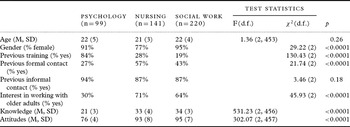
The student sample (Table 1) was composed of 460 students from private higher degree institutions in the north of Portugal, selected from three different bachelor degree programs: nursing (n = 141), psychology (n = 99) and social work (n = 220). Approximately 90% were full-time students. The mean age was 22 years (SD = 4, range 18–46), and the majority of the students were female (approximately 89%). As for contact with older adults, half of the sample had regular contact with older adults in formal settings, whereas almost 90% had frequent contact with older relatives and neighbors in an informal setting.
Group comparison regarding main variables of interest

d.f. = degrees of freedom.
Measures
Standardized questionnaires were constructed to assess sociodemographic data (such as age and gender), frequency and quality of formal and informal contact (formal contact was defined as either paid work or volunteer tasks, whereas informal contact was defined as contact with family, friends and/or neighbors), and number of hours of previous training either in gerontology or geriatrics. Interest in working with older adults was ascertained using the question: “How would you rate your interest in working with older adults?”, with the possible answers ranging from 1 (no interest) to 5 (a lot of interest). Interest in working with other age cohorts (children, teenagers, and adults) was also sampled.
Knowledge about aging was assessed using a Portuguese version of Palmore's “Facts on aging quiz” (1988). The original quiz comprises 25 items with dichotomous answers and for this study we used an adapted version of quizzes one and three, with a total of 50 items (Palmore, Reference Palmore1988). Attitudes towards aging were ascertained through an adapted version of the “Attitudes towards hospitalized older people” (McLafferty, Reference McLafferty2005), a 20-items scale with a 5-point Likert scale response, where higher scores reflect more positive attitudes. Examples of responses included: “It is interesting to talk with older adults” or “Older adults tend to use their age as a means of taking advantage of younger people”.
Procedure
The study design was cross-sectional. Data were collected during class time in the semester. There were no established inclusion criteria, other than to be an enrolled student for that class. Students were invited to participate in the study, and were told that participation was completely voluntary and confidential, and that no benefit or negative consequence would result from their acceptance or refusal. The questionnaires were completed in the classroom and returned to one of the researchers. Because the researcher was in the room and available to answer questions, the percentage of missing data was quite low.
Data analyses
Analyses were conducted using STATA 11 (StataCorp, 2009). The category of students' age was presented as the mean age and associated standard deviation (SD) for each group and for the entire sample. Contingency tables and one way analysis of variance were both applied for inter-group comparison. Bonferroni's post hoc analyses were applied when significant main effects were detected. A multivariate logistic regression analysis was performed. The variable “interest in working with older adults” was dichotomized using a cut-off point of 3 and used as the outcome variable, whereas degree, attitudes towards aging, knowledge, previous training received in gerontology and geriatrics, and previous contact with older adults were introduced as the predictive factors. The regression models were adjusted for age and gender.
Results
Cronbach's α was acceptable for both the “Facts on aging quiz” and the Attitudes towards hospitalized older people”, ranging from 0.78 to 0.84. As can be seen in Table 1, there was no significant difference in student responses among the three courses regarding age (F(2,453 = 1.36, p = 0.26), but there was in gender (χ2(4) = 26.65, p < 0.0001). There were also statistically significant differences regarding knowledge (F(2, 456) = 531.23, p < 0.0001), attitudes (F(2, 457) = 302.07, p < 0.0001) and interest (χ2(2) = 45.93, p < 0.0001). Students enrolled in nursing and social work displayed higher knowledge and more positive attitudes as well as a greater interest in working with older adults than students in psychology. Post-hoc Bonferroni tests indicated that the differences between psychology students and students both from nursing and social work were always statistically significant, whereas differences between the latter courses were highly significant for attitudes (p < 0.01) and marginally significant for knowledge (p = 0.04). In both cases, social work students scored higher than nursing students. The magnitude of the differences between groups were analyzed through the eta2 values, obtained after the analysis of variance. The values ranged from small (knowledge: 0.05) to medium (attitudes: 0.07).
The interest in working with other age groups was also analyzed, and results indicated that students on the three courses were more interested in working with children than any other age group, with nursing students scoring an average of 4.2 and both social work and psychology students rating 3.8 on average. Both nursing and social work students were slightly less interested in working with adolescents (3.6 and 3.7, respectively) and adults (3.7 and 3.6) than with older adults (3.9 and 3.8), whereas psychology students considered working with older adults as the less appealing option (adolescents: 3.7; adults: 3.6; older adults: 2.8). In this way, the only marked difference between students was regarding work with older adults, where psychology students displayed a clear low interest, being the only value below the neutral point.
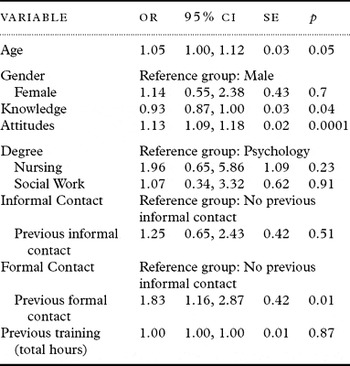
The next step was to analyze which variables were more strongly associated with interest in working with older adults, through a multivariate logistic regression model. Once it was determined that psychology students displayed the lowest interest in working with older adults, they were then used as the reference group (Table 2). Full model tests contrasting with a constant-only model indicated that the model was statistically significant (χ2(9) = 110.38, p < 0.0001). It was clear that the only significant variables, after adjusting for each other, were attitudes (OR = 1.13, 95% CI: 1.09, 1.18, p < 0.0001, per each additional point), knowledge (OR = 0.93, 95% CI: 0.87, 1.00, p = 0.04, per each additional point), and previous formal contact (OR = 1.83, 95% CI: 1.16, 2.87, p = 0.01) which, as previously mentioned, was defined as frequency of contact with older adults in paid or volunteer work. Values for both attitudes and knowledge refer to the odds ratio associated with each additional point on the scoring system for the respective scale. Age was marginally associated with interest in working with older adults (OR = 1.05, 95% CI: 1.00, 1.12, p = 0.05, per each additional year). The remaining factors (gender, type of degree, informal contact, and previous training in gerontology and geriatrics) were not significantly associated with the level of interest in working with older adults (p>0.05).
Multivariate logistic regression using interest in working with older adults as the outcome variable

OR = odds ratio; CI = confidence interval; SE = standard error.
Taken together, these results indicate that attitudes towards aging, previous formal contact with aging cohorts, knowledge about aging processes and the student's age are significant factors for developing interest in working with older adults. Attitudes towards aging were the most significant factor, and more positive attitudes increased the likelihood of being interested in working within the field of aging. Formal contact followed the same pattern, and those students who reported formal contact with older adults in the past were almost twice as likely to have an interest in working with older adults than those students who did not report formal contact. Knowledge followed an opposite pattern, in the sense that as knowledge about aging increased, the interest in working with older adults decreased. Finally, age displayed a marginally significant positive relation with interest in working with older adults.
Discussion
These results suggest that in a sample of Portuguese undergraduate students, attitudes regarding aging and previous formal contact with older adults were significantly associated with interest in working with older adults in the future. Furthermore, knowledge about aging displayed an inverse relation, in the sense that increased knowledge was associated with a decreased likelihood of having interest in working with older adults, although not attaining a large effect. These results partially corroborated previous findings, as positive attitudes were correlated with interest in working within the field of aging (e.g. Aday and Campbell, Reference Aday and Campbell1995), whereas contact in formal settings was found to be an essential element to change attitudes and promote interest in developing a career with older adults (Cummings et al., Reference Cummings, Adler and DeCoster2005). As for knowledge, it was found to increase awareness about the aging processes but not necessarily interest in working with this age cohort (Alford et al., Reference Alford, Miles, Palmer and Espino2001). Moreover, previous results suggest that the acquisition of knowledge does not ensure a decrease of ageist beliefs (Cottle and Glover, Reference Cottle and Glover2007). One hypothesis to explain this is that acquiring knowledge about the mechanisms of aging without having contact with older adults, either healthy or frail, might promote positive attitudes by demystifying stereotypes and prejudices, but at the same time serve to increase lack of interest in this population. Additionally, perceived status and financial reward might also be concomitant factors. It might also be that lack of interest in working with older adults is better explained by a complex mechanism where the nature and pace of the required tasks and the absence of financial and social reinforcements interact (Alford et al., Reference Alford, Miles, Palmer and Espino2001). Finally, age was found to be a positive factor when considering working with older adults. These results corroborate previous findings that indicated that mature students tended to have more realistic views about aging, which is partially explained by the higher likelihood of having older parents, for whom they might be caring (Kimuna et al., Reference Kimuna, Knox and Zusman2005).
As mentioned previously, these results should be framed within a broader societal and interactional context. In this way, both tacit and explicit ageism are often caused by the fear of one's own aging, especially in a society where productivity and independence are constantly reinforced and rewarded (Angus and Reeve, Reference Angus and Reeve2006). When interacting with older adults, students are constantly reminded of their own aging processes, of how at some point they will lose their vitality, strength, and efficiency, no matter how healthy, active, and careful they try to be, and ultimately ageism can be perceived as a defense mechanism against death anxiety (Bodner, Reference Bodner2009). Finally, it is also worth noting how the factors underlying the choice of studies (nursing, psychology or social work) might have contributed to these results. Career choices and decisions are a complex and dynamic process, constrained by proximal (e.g. personality, vocational interests) and distal (presence/absence of obstacles, relationships with others) factors (Fouad, Reference Fouad2007). For instance, students doing science majors (e.g. physical and biological science) were found to be more realistic and investigative than students doing social science majors (e.g. psychology and sociology), whereas an inverted pattern was found for social and conventional dimensions of personality (Larson et al., Reference Larson2010). In this way, it may be that nursing students, who reported the highest interest in working with older adults, had already expected that they might work within the field of aging. Additionally, social work professionals have been traditionally performing aging-related tasks in Portugal, whereas the history of the practice of psychology in relation to older adults is considerably more recent. As such, psychology students might be less likely to perceive themselves in that role.
Notwithstanding the lack of interest displayed by a substantial part of our sample, it is highly likely that some of the students who manifested low interest will end up working within aging contexts, due to workplace and market demands. This scenario might possibly lead to what Kane (Reference Kane2004) describes as “therapeutic nihilism”, where ageist conceptions decrease the investment in services provided to older adults. Furthermore, it might also lead to anger and resentment, and an unconscious desire to take revenge or retaliate. Reversing such ageist conceptions is a complex and resource-consuming task, one which demands a hierarchical approach at different levels. A first step would be to ensure that experts from different settings, such as academia, policy units, and health practices, possess relevant up-to-date knowledge regarding aging processes (Angus and Reeve, Reference Angus and Reeve2006). Faculty members have an advantageous position in influencing developments here since they might not only spread knowledge but also serve as positive role models (Ferrario et al., Reference Ferrario, Freeman, Nellett and Scheel2008). A second relevant step would be to increase the aging content within undergraduate curricula (Hinrichsen and McMeniman, Reference Hinrichsen and McMeniman2002; Heyman et al., Reference Heyman, Gutheil, White-Ryan, Phipps and Guishard2008), as knowledge of the normative changes with age increases the likelihood of positive attitudes, especially when it is concomitant with direct contact both with aging adults and knowledgeable faculty members (Ferrario et al., Reference Ferrario, Freeman, Nellett and Scheel2008). Finally, direct contact with diverse older adults should be promoted as a strategy to increase positive attitudes and demystify stereotypes (Aday et al., Reference Aday, Sims and Evans1991; Jarrott and Bruno, Reference Jarrott and Bruno2007).
The limitations of this study should be mentioned to allow a clear assessment of its validity. Some of these limitations are related to the sample. First, the number of participants was limited, restricting the possibility of additional analysis such as the inclusion of interaction terms between variables. Another limitation related to the sample is the high percentage of female participants, which might constrain generalizability. Finally, this was a convenience sample, with data collected from a student sample. This last limitation concerns the psychometric properties of the measures, as they are yet to be adapted and validated for the Portuguese population; nevertheless, initial analyses were favorable, as indicated by the Cronbach's α. Future research will need to include a longitudinal analysis of variables that are associated with change in interest over time. Preliminary data, obtained for the psychology sample, indicated that after attending a course on “Aging and human development” there was an increase in both knowledge and positive attitudes, and also a marginal increase in the interest in working with older adults (Fonseca et al., Reference Fonseca, Gonçalves and Martin2009).
Conflict of interest
None.
Description of authors' roles
DCG and IM conceived and designed the experiments. JG, AMF and FCP collected the data. DCG analyzed the data and wrote the paper. GJB and NAP reviewed the paper.
Acknowledgments
This work was partially funded by a scholarship from the Fundação para a Ciência e Tecnologia, Portugal (ref. SFRH/BD/30226/2006), awarded to the first author.
The authors would like to acknowledge the reviewers for their perceptive comments, which helped to improve the final version of the paper.