Implications
There has been little evidence suggesting a redistribution of vitamin A during immunological stress. Lack of sufficient evidence showing how broilers would respond immunologically under heat stress (HS) if their diets were supplemented with varying levels of vitamin A has necessitated further study. The objective of this experiment was to evaluate the effects of dietary vitamin A levels on growth performance and immunocompetence of broilers raised under HS.
Introduction
Heat stress (HS) is causing increasing concern in poultry due to the rapid development of all types of poultry industry in countries having hot climates. Feed efficiency, growth rate, mortality and other important traits governing the prosperity of poultry industry are adversely affected by severe HS (Austic, Reference Austic1985). Broilers exposed to 32°C showed a 24% decrease in feed intake by 6 weeks of age (Geraert et al., Reference Geraert, Padilha and Guillaumin1996). It has been established that high environmental temperatures affect the development of a specific immune response in chickens (Thaxton et al., Reference Thaxton, Sadler and Glick1968; Subba Rao and Glick, Reference Subba Rao and Glick1970; Thaxton and Siegel, Reference Thaxton and Siegel1972). When chicks were exposed to temperatures ranging from 32.2°C to 43°C for short intermittent periods of constant high temperatures or cycling high temperature conditions, the resulting antibody response to sheep red blood cells (SRBC) was reduced significantly. Although limited information is available on the effect of HS on cell-mediated immune response, Miller and Qureshi (Reference Miller and Qureshi1991) reported a depression of immunocompetence of chicken macrophages under HS. Lymphoid organ weights, primary and secondary antibody responses, incidences of macrophages in abdominal exudate cells (AEC) and phagocytic ability of macrophages were all reduced by HS (Bartlett and Smith, Reference Bartlett and Smith2003).
Vitamin A has long been known for its role in immunity. Clear evidence exists that vitamin A deficiency is associated with impaired immune functions and reduced resistance to infection (Nauss and Newberne, Reference Nauss and Newberne1985; Friedman and Sklan, Reference Friedman and Sklan1989a; Bowman et al., Reference Bowman, Goonewardene, Pasatiempo, Ross and Taylor1990; Friedman et al., Reference Friedman, Meidovsky, Leitner and Sklan1991). On the other hand, very high intake of vitamin A in chickens has been shown in some studies, but not all, to severely depress antigen-specific immune responses as measured by antibody response and lymphocyte proliferation (Friedman and Sklan, Reference Friedman and Sklan1989b; Friedman et al., Reference Friedman, Meidovsky, Leitner and Sklan1991). However, there is evidence from other studies in animals and humans that administration of vitamin A affects both specific and nonspecific arms of the immune system (Ross, Reference Ross1992).
The concentration of nutrients required to maintain health and productivity of the poultry is challenged due to the reduction in feed intake under HS conditions. Studies have shown a redirection of nutrient flow to meet the metabolic requirements of an immune or inflammatory response (Bauman and Currie, Reference Bauman and Currie1980). There has been little evidence suggesting a redistribution of vitamin A during immunological stress. Lack of sufficient evidence showing how broilers would respond immunologically under HS if their diets were supplemented with varying levels of vitamin A has necessitated further study. The objective of this experiment was to evaluate the effects of dietary vitamin A levels on growth performance and immunocompetence of broilers raised under HS.
Material and methods
Experimental design and birds
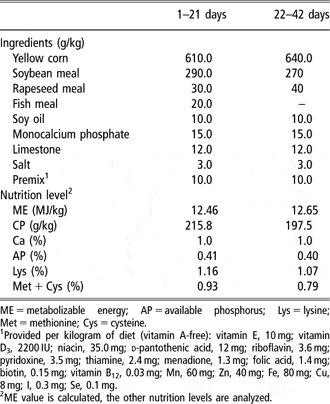
This experiment was conducted according to protocols approved by the Northwest A&F University Animal Care and Use Committee. The design used was a 3 × 2 factor randomized block design. A total of 180 1-day-old Arbor Acress male broiler chicks were randomly assigned to six groups, each group had six replicates, and each replicate contained five birds. Before 3 weeks of age, the birds of each two groups were fed a corn–soybean meal basal diet (Table 1; vitamin A = 60.4 IU/kg, analysis from ingredients of basal diets) supplemented with vitamin A (retinol) at a concentration of 750 (low), 1500 (standard; National Research Council, 1994) and 15 000 (high) IU/kg, respectively. Vitamin A was provided by Lunpu Biochem. Tech. Co., Ltd, Beijing, China. Water and feed were provided ad libitum, and feed intake and body weight (BW) were recorded by replicate, weekly. Birds were kept in four-layer cages. After 3 weeks of age, the birds of each two groups fed the same dietary treatment, were randomly divided into the two environmental chambers. In one chamber, the ambient temperature was adjusted so that daily fluctuations were between 24°C and 38°C, simulating diurnal temperature during HS. The birds were exposed to 12 h of 24°C, 3 h of 24°C to 38°C, 5 h of 38°C, and 4 h of 38°C to 24°C. In the other chamber, environmental temperature was kept at a constant 24°C (thermoneutral, TN). For the next 3 weeks, birds were provided the same dietary treatments as they received in the initial 3 weeks of the experiment, and feed intake and BW were monitored by replicate, weekly. The light regime was set at 22L : 2D throughout the whole experimental period.
Ingredients and nutrient level of basal diets

ME = metabolizable energy; AP = available phosphorus; Lys = lysine; Met = methionine; Cys = cysteine.
1Provided per kilogram of diet (vitamin A-free): vitamin E, 10 mg; vitamin D3, 2200 IU; niacin, 35.0 mg; d-pantothenic acid, 12 mg; riboflavin, 3.6 mg; pyridoxine, 3.5 mg; thiamine, 2.4 mg; menadione, 1.3 mg; folic acid, 1.4 mg; biotin, 0.15 mg; vitamin B12, 0.03 mg; Mn, 60 mg; Zn, 40 mg; Fe, 80 mg; Cu, 8 mg; I, 0.3 mg; Se, 0.1 mg.
2ME value is calculated, the other nutrition levels are analyzed.
Immunocompetence evaluations
Cell-mediated immunity
Avians lack a resident population of harvestable cells (macrophages and other inflammatory cells) in the abdominal cavity (Sabet et al., Reference Sabet, Hsia, Stanisz, El-Domeiri and van Altten1977; Trembicki et al., Reference Trembicki, Qureshi and Dietert1984). Therefore, the cell-mediated response of the birds was evaluated using a Sephadex stimulation method described previously (Qureshi et al., Reference Qureshi, Dietert and Bacon1986). Briefly, on day 32 (12 days after transfer) six birds per treatment, from each environmental chamber, were randomly selected and weighed. The abdominal area was cleaned with alcohol and a 3% suspension of preswollen Sephadex G-50 (Sunpu Biochem. Tech. Co., Ltd, Beijing, China) prepared in 0.85% sterile saline, was injected into the abdominal cavity at 1 ml/100 g BW.
Harvesting abdominal exudate cells
Approximately 42 h after injection, birds were slaughtered by cervical dislocation. A small incision (approximately 1 cm) was made in an area of the abdomen that contained a minimal number of blood vessels. The cavity was then flushed with sterile heparinized saline solution (0.5 U/ml), and approximately 30 ml of exudate was collected from each bird into conical siliconized glass tubes on ice, using a fabricated harvester. Tubes were allowed to sit for about 20 min to allow debris to settle. The exudate was pipetted into clean tubes and centrifuged at 500 × g at 8°C for 15 min. Cell pellets were resuspended in 5 ml of RPMI-1640 growth medium (Sunpu Biochem. Tech. Co., Ltd) supplemented with 5% fetal bovine serum and 1% antibiotics (penicillin–streptomycin).
Preparation of quail anti-SRBC serum
Five Japanese quails were injected, via the jugular vein, with 1 ml of 7% SRBC. After 7 days, 3 ml of blood was collected from each quail by jugular venipuncture, and serum was generated and evaluated for antibody production. After 3 days, the quails were given a booster injection of the 7% SRBC for secondary antibody production. This procedure was followed because the level of antibody produced during a secondary response is higher than during the primary response. The serum was evaluated for immunoglobulin (Ig) G and IgM titers. Serum from the quail with the highest titer was then used for opsonizing SRBC.
Preparation of unopsonized and opsonized SRBC
A 1% concentration of unopsonized SRBC was prepared by adding 250 μl/ml of cells in 25 ml of RPMI-1640 growth medium. For opsonized SRBC, cells were prepared as before except that 2 μl/ml of quail anti-SRBC serum was added. This mixture was incubated in a 37°C water bath for 30 min. Tubes were removed, gently shaken to coat cells, and then centrifuged at 300 × g at 10°C for 10 min. Cells were washed and resuspended in 25 ml of RPMI-1640 medium.
In vitro phagocytosis assay
The phagocytic ability of the macrophages was determined using an in vitro SRBC phagocytic assay, as described previously (Qureshi et al., Reference Qureshi, Dietert and Bacon1986).
Humoral immunity
Sheep red blood cells were used as a test antigen to quantify specific antibody responses. On day 32, six birds per treatment per environmental chamber were bled by cervical venipuncture, and 3 ml of blood was collected from each bird for prechallenge antibody titer analysis. This procedure was followed to check for the presence of antibodies prior to challenge with SRBC. The same birds were then immunized intravenously via the wing with 1 ml of 7% SRBC suspension. Seven days post-injection, all birds were bled by brachial venipuncture, and 3 ml of blood was collected for primary antibody response. The blood was left at room temperature for 2 h to clot, then wrung with a wooden applicator stick, and placed overnight in a refrigerator, at 4°C, for maximum sera yield. The antigenic challenge was repeated 14 days after the first challenge, and blood samples were collected 3 days after injection to determine secondary antibody response.
Antibody assay
Serum samples were tested for total antibody response, then specifically for IgM and IgG using the 2-mercaptoethanol (ME) technique as described previously (Lepage et al., Reference Lepage, Bloom and Taylor1996).
Organ collection
Six birds from each treatment were slaughtered at 42 days of age, and thymus, spleen and bursa of Fabricius were collected and weighed.
Statistical analysis
All the data were analyzed statistically using the mixed models procedure of SAS software (SAS Institute, 1995). Differences among treatments means were determined using least significance difference test (P = 0.05). Log2 transformations were done on antibody titers prior to statistical analysis.
Results
Growth performance
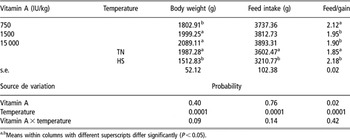
The effect of different levels of vitamin A on growth performance of 42-day-old broilers under HS is shown in Table 2. Dietary vitamin A levels did not influence feed intake (P > 0.05), while BW and feed conversion was affected significantly (P < 0.05). However, BW and feed conversion did not linearly increase with increasing dietary vitamin A; BW and feed conversion of broilers fed 750 IU of vitamin A/kg was significantly lower than that of the other diets (P < 0.05), whereas no significant difference was observed in BW and feed conversion of broilers supplemented with 1500 IU of vitamin A/kg compared with that of broilers supplemented with 15 000 IU of vitamin A/kg (P > 0.05). There was a significant reduction in BW, feed intake and feed conversion when the birds were exposed to HS (P < 0.05). There was not significant interaction in broiler growth performance between dietary vitamin A and environmental temperature (P > 0.05).
Body weight, feed conversion and intake of 42-day-old broilers fed different levels of vitamin A under thermoneutral (TN) and heat stress (HS) conditions

a,bMeans within columns with different superscripts differ significantly (P < 0.05).
Lymphoid organ weights
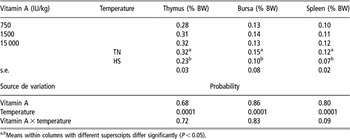
Lymphoid organ weights were measure as a percentage of BW (Table 3). None of these organs (thymus, bursa or spleen) were significantly affected by the level of vitamin A in the diet (P > 0.05). However, all organ weights were significantly reduced when birds were exposed to HS (P < 0.05).
Lymphoid organ weights of 42-day-old broilers fed different levels of vitamin A under thermoneutral (TN) and heat stress (HS) conditions

a,bMeans within columns with different superscripts differ significantly (P < 0.05).
Antibody responses
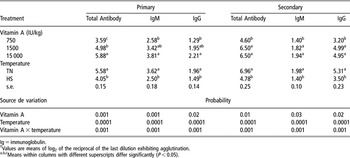
Prior to antigenic challenge, sera from birds were analyzed for prechallenge antibody titers that could influence the experiment, and were found to be negative. Table 4 shows the main effect means of diets and temperature and their effects on primary and secondary antibody responses. The data represent the means of log2 of the reciprocal of last dilution exhibiting agglutination. Titer of total antibody for primary response significantly increased with increasing dietary vitamin A (P < 0.05). Birds receiving the diet with 15 000 IU of vitamin A/kg had significantly higher titers of IgM and IgG antibodies than that of those receiving the other diets for primary response (P < 0.05). Those receiving the diets with 1500 and 15 000 IU of vitamin A/kg were similar with a higher response for total, IgM and IgG antibodies during the secondary challenge when compared with control treatment (P < 0.05). Birds reared under HS conditions showed a significant reduction in all three parameters during primary and secondary responses (P < 0.05). There were significant interactions in anti-SRBC antibody response during both primary and secondary challenge between dietary vitamin A and environmental temperature (P < 0.05).
Main effect means of anti-SRBC antibody response of broilers fed different levels of vitamin A under thermoneutral (TN) and heat stress (HS) conditionsFootnote 1

Ig = immunoglobulin.
1 Values are means of log2 of the reciprocal of the last dilution exhibiting agglutination.
a,b,c Means within columns with different superscripts differ significantly (P < 0.05).
Cellular immune response
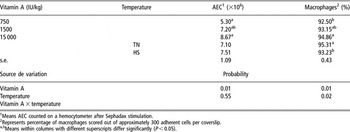
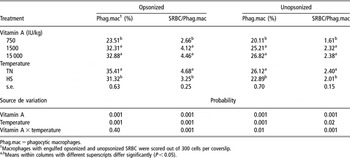
Total mean AEC and percentage of macrophages (Table 5) were increased significantly (P < 0.05) with an increase in dietary vitamin A . Although HS did not significantly affect the total number of AEC, there was a significant reduction in the percentage of macrophages (P < 0.05). There was a significant interaction in the percentage of macrophages between environmental temperature and dietary vitamin A (P < 0.05). The result indicated that dietary vitamin A significantly increased the percentage of macrophages under HS conditions (P < 0.05). Table 6 showed the phagocytic ability of macrophages for opsonized and unopsonized SRBC. Birds fed the diets with 1500 and 15 000 IU of vitamin A/kg had more activated macrophages for opsonized and unopsonized SRBC than those of control treatment (P < 0.05). In both cases, HS significantly reduced the number of activated macrophages (P < 0.05).
Incidence of macrophages in abdominal exudates cells (AEC) of broilers fed different levels of vitamin A under thermoneutral (TN) and heat stress (HS) conditions

1Means AEC counted on a hemocytometer after Sephadax stimulation.
2Represents percentage of macrophages scored out of approximately 300 adherent cells per coverslip.
a,bMeans within columns with different superscripts differ significantly (P < 0.05).
Phagcytosis of opsonized and unopsonized sheep red blood cells (SRBC) by abdominal macrophages of broilers fed different levels of vitamin A under thermoneutral (TN) and heat stress (HS) conditions

Phag.mac = phagocytic macrophages.
1Macrophages with engulfed opsonized and unopsonized SRBC were scored out of 300 cells per coverslip.
a,bMeans within columns with different superscripts differ significantly (P < 0.05).
Discussion
The results of the present study indicated that BW and feed conversion were significantly influenced by dietary vitamin A. These results were in agreement with previous reports (Sklan et al., Reference Sklan, Melamed and Friedman1994; Lessard et al., Reference Lessard, Hutchings and Cave1997; Kucuk et al., Reference Kucuk, Sahin and Sahin2003). The growth performance of 42-day-old broilers was significantly reduced when the birds were raised under HS conditions. This result was in accordance with the general trend observed in broilers raised under HS conditions (Austic, Reference Austic1985; Geraert et al., Reference Geraert, Padilha and Guillaumin1996). It is believed that for every 10°C increase in ambient temperature above 20°C, there is a 17% reduction in feed intake (Austic, Reference Austic1985). Geraert et al. (Reference Geraert, Padilha and Guillaumin1996) observed a 14% reduction in BW from 2 to 4 weeks of age, and a 24% reduction from 4 to 6 weeks of age when birds were exposed to 32°C, and suggested that the reduced efficiency could be due to changes in metabolic utilization of nutrients.
The results of the present study showed that none of the lymphoid organ weights (thymus, bursa and spleen) were significantly influenced by dietary vitamin A. This finding was inconsistent with a previous report (Davis and Sell, Reference Davis and Sell1983). However, all organ weights were significantly reduced by HS. This result was in agreement with the result of Bartlett and Smith (Reference Bartlett and Smith2003), and suggested the decrease in lymphoid organ weights could have been a result of the reduction in feed intake, thereby providing less nutrients for proper development of these organs under HS conditions.
Dietary vitamin A significantly increased antibody response to SRBC. This finding was in disagreement with the result reported by Sklan et al. (Reference Sklan, Melamed and Friedman1994). Both primary and secondary antibody responses were significantly decreased when birds were reared under HS conditions. This response was similar to previous observations (Thaxton and Siegel, Reference Thaxton and Siegel1970; Donker et al., Reference Donker, Nieuwland and van der Zijpp1990; Bartlett and Smith, Reference Bartlett and Smith2003). However, this is not always the case. Along with the immune suppression observed in these studies, there has been evidence of immunostimulation (Kelley, Reference Kelley1985; Siegel, Reference Siegel1987), as well as no response (Regnier et al., Reference Regnier, Kelley and Gaskins1980). Due to the considerable variation found in the above-mentioned responses, these researchers believe there are apparent differences in susceptibility to HS, based on genetic lines. These differences may have implications during the application of selection programs for immune responsiveness. Another explanation could be the decrease in feed intake and feed efficiency by HS during this study, leading to a reduction in the nutrients available to mount an effective immune response. In this study, supplementing vitamin A in the diet could improve antibody responses when birds were under HS conditions. Also, Lin et al. (Reference Lin, Wang, Song, Xie and Yang2002) reported that dietary vitamin A had a beneficial effect on immune function of layer chickens under HS.
The present study demonstrated that dietary vitamin A could increase the number of macrophages and the phagocytic ability of macrophages for opsonized and unopsonized SRBC, and HS significantly reduced the number of macrophages and the phagocytic ability of macrophages. These results were in accordance with Miller and Qureshi (Reference Miller and Qureshi1991) and Bartlett and Smith (Reference Bartlett and Smith2003).
In conclusion, the results of the present study suggested that supplementation of vitamin A in the diet can improve immunocompetence of broilers, when reared under HS conditions.
Acknowledgement
Financial support provided by the National Basic Research Program of China (Project 2006BAD12B02-07) is gratefully acknowledged.