Trypanosomatid-caused diseases and treatments
Trypanosomatids are unicellular flagellate organisms, belonging to the clade Trypanosomatida, most of them pathogenic for other organisms including mammals, insects and plants (Adl et al., Reference Adl, Bass, Lane, Lukes, Schoch, Smirnov, Agatha, Berney, Brown, Burki, Cardenas, Cepicka, Chistyakova, Del Campo, Dunthorn, Edvardsen, Eglit, Guillou, Hampl, Heiss, Hoppenrath, James, Karnkowska, Karpov, Kim, Kolisko, Kudryavtsev, Lahr, Lara, Le Gall, Lynn, Mann, Massana, Mitchell, Morrow, Park, Pawlowski, Powell, Richter, Rueckert, Shadwick, Shimano, Spiegel, Torruella, Youssef, Zlatogursky and Zhang2019; Marchese et al., Reference Marchese, Nascimento, Damasceno, Bringaud, Michels and Silber2018; Menna-Barreto, Reference Menna-Barreto2019). Among trypanosomatids, two genera comprise known species pathogenic to humans: Trypanosoma and Leishmania. The first one includes two human-infecting species: Trypanosoma cruzi, causing the American trypanosomiasis or Chagas disease (Chagas, Reference Chagas1909) [https://www.who.int/news-room/fact-sheets/detail/chagas-disease-(american-trypanosomiasis)], and Trypanosoma brucei, the etiological agent of the human African trypanosomiasis (HAT) or sleeping sickness (Steverding, Reference Steverding2008) [https://www.who.int/news-room/fact-sheets/detail/trypanosomiasis-human-african-(sleeping-sickness)]. The genus Leishmania includes more than 20 species causing a variety of human diseases generically known as leishmaniasis (Maxfield and Crane, Reference Maxfield and Crane2019) (https://www.who.int/news-room/fact-sheets/detail/leishmaniasis).
Trypanosomatids have a series of peculiarities concerning their cellular organization, control of gene expression and metabolism (Marchese et al., Reference Marchese, Nascimento, Damasceno, Bringaud, Michels and Silber2018). But, despite these unique characteristics offering a myriad of potential targets for drugs, most of the treatments for trypanosomatid-caused diseases remain unsatisfactory, and even in those cases in which new alternatives have been developed, the emergence of resistant strains is foreseeable (Menna-Barreto, Reference Menna-Barreto2019).
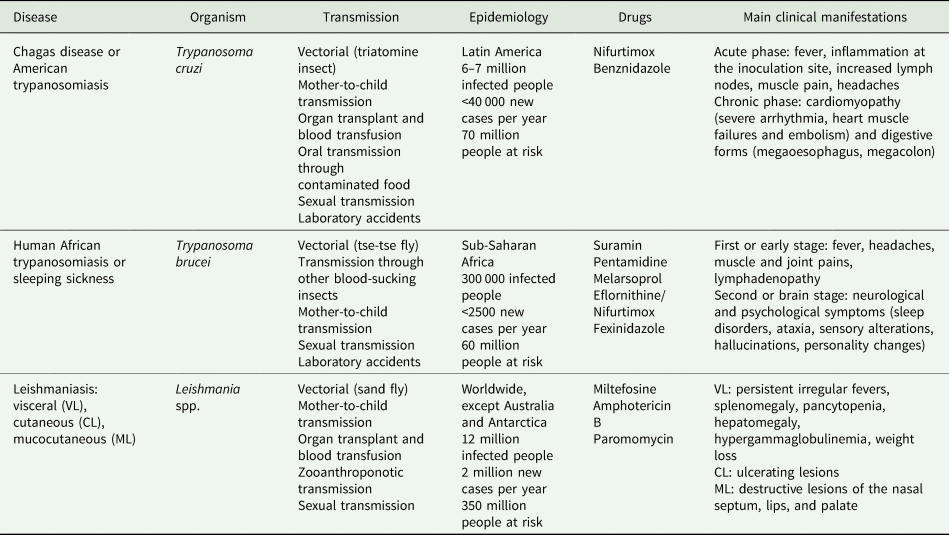
Chagas disease affects approximately 8 million people, and an estimated 70 million at risk of contracting the infection (Perez-Molina and Molina, Reference Perez-Molina and Molina2018). The disease presents two major phases: acute and chronic. The acute phase happens immediately after infection and is usually asymptomatic. In cases in which clinical symptoms manifest, they are mild and unspecific as presented in Table 1. The acute phase is characterized by a high parasitaemia and the absence of humoral immune response (Bern, Reference Bern2015; Perez-Molina and Molina, Reference Perez-Molina and Molina2018). After the acute phase, which can last for up to 2 months, follows the chronic phase that lasts for the rest of their life. The chronic phase is characterized by the absence of evident parasitaemia and a robust immune humoral response, and presents several clinical forms that can be divided in the indeterminate form, which is asymptomatic and accounts for approximately 70% of the patients; and the symptomatic forms, affecting the remaining 30% of the infected population (Perez-Molina and Molina, Reference Perez-Molina and Molina2018; Rassi et al., Reference Rassi, Rassi and Marin-Neto2010). The chronic clinical features are mentioned in Table 1. The treatment for Chagas disease consists of only two drugs approved for human use half a century ago: benznidazole (1) and nifurtimox (2). Both drugs are efficient in the acute phase, but frequently fail in the chronic phase when most of the patients are diagnosed (Boscardin et al., Reference Boscardin, Torrecilhas, Manarin, Revelli, Rey, Tonelli and Silber2010; Hall et al., Reference Hall, Bot and Wilkinson2011).
Principal features of trypanosomatid-caused diseases

For more information about these diseases see: Chagas disease https://www.who.int/news-room/fact-sheets/detail/chagas-disease-(american-trypanosomiasis); human African trypanosomiasis https://www.who.int/news-room/fact-sheets/detail/trypanosomiasis-human-african-(sleeping-sickness); leishmaniasis https://www.who.int/news-room/fact-sheets/detail/leishmaniasis.
HAT is considered mostly under control (Bottieau and Clerinx, Reference Bottieau and Clerinx2019); in the last two decades, it has been observed a dramatic drop of nearly 85% in the number of reported new cases. However, it still threatens 65 million people living in endemic areas. HAT presents two stages: during the first (or early) stage, the parasites proliferate in the blood and lymphatic system, causing mild and unspecific symptoms, as shown in Table 1. After a variable time, the parasites can cross the brain–blood barrier, reaching the central nervous system, initiating the second (or brain) stage. While the central nervous system infection progresses, neurological and psychological symptoms can be observed (Table 1) (Mogk et al., Reference Mogk, Bosselmann, Mudogo, Stein, Wolburg and Duszenko2017). If left untreated, sleeping sickness can cause death within several months or several years, depending on which T. brucei subspecies caused the infection (Buscher et al., Reference Buscher, Cecchi, Jamonneau and Priotto2017). The treatment of stage one is mostly based on the administration of suramin (3), the first-line drug, and upon failure pentamidine (4), the second-line treatment. Both are ineffective for stage two since they do not cross the blood–brain barrier. Thus, for the second stage of the disease, melarsoprol (5) has been used since the 1940s. It has the advantage of being useful for both T. brucei sub-species causing HAT; however, it is extremely toxic, and in some cases, it could be fatal. Eflornithine (6; difluoromethylornithine) is less toxic than melarsoprol (5), but is ineffective against T. brucei rhodesiense. More recently, eflornithine (6) was indicated to be used in combination with nifurtimox (2), which made the therapy more efficient (Babokhov et al., Reference Babokhov, Sanyaolu, Oyibo, Fagbenro-Beyioku and Iriemenam2013). Finally, fexinidazole (7) was approved for being distributed via the World Health Organization (WHO) since 2019 in T. brucei endemic countries to treat HAT first and second stages when caused by the subspecies T. brucei gambiense (which is responsible for 98% of the human reported cases) (Deeks, Reference Deeks2019; Mesu et al., Reference Mesu, Kalonji, Bardonneau, Mordt, Blesson, Simon, Delhomme, Bernhard, Kuziena, Lubaki, Vuvu, Ngima, Mbembo, Ilunga, Bonama, Heradi, Solomo, Mandula, Badibabi, Dama, Lukula, Tete, Lumbala, Scherrer, Strub-Wourgaft and Tarral2018).
Leishmaniasis constitutes a broad spectrum of diseases with different severity, ranging from self-cure skin lesions to visceral damage that can lead to death (Aronson et al., Reference Aronson, Herwaldt, Libman, Pearson, Lopez-Velez, Weina, Carvalho, Ephros, Jeronimo and Magill2017). The disease is endemic of at least 100 countries mostly located in the tropical and sub-tropical belt of the planet and it is estimated that 12 million people are affected. Three main forms of leishmaniasis can be recognized, depending on the Leishmania species involved in the infection: visceral (VL), cutaneous (CL) and mucocutaneous (ML) (Burza et al., Reference Burza, Croft and Boelaert2018). VL can be asymptomatic, however, when symptoms appear they can develop within 2 weeks and several years after the infection. If left untreated, VL can be fatal. CL is the most common form of leishmaniasis, consisting of exposed lesions of the skin or, in a small number of cases, sub-dermal diffuse papules. ML is much more aggressive than CL, usually causing the partial or complete destruction of mucous tissues. CL and ML have serious consequences due to severe disabilities, opportunistic infections and social stigma, producing negative psychological effects. Table 1 shows the main clinical features of the three forms of leishmaniasis. The strategies to treat and manage leishmaniasis must take into account several factors such as parasite species, geographic location and co-infections. Classically, the treatment of VL consists of two pentavalent antimonials: sodium stibogluconate (8; Sb(V)) or meglumine antimoniate (9). Their toxicity and the increasing emergence of resistance led to the search for alternatives. For example in North Bihar, India, where VL caused by L. donovani is endemic, a widespread primary failure to Sb(V) has been reported and its use is not recommended anymore (Croft et al., Reference Croft, Sundar and Fairlamb2006; Ponte-Sucre et al., Reference Ponte-Sucre, Gamarro, Dujardin, Barrett, Lopez-Velez, Garcia-Hernandez, Pountain, Mwenechanya and Papadopoulou2017). In the last two decades, some drugs were launched to be used as single-treatment or in combination: an oral formulation of miltefosine (10), which constitutes now the first-line treatment in most of the Asian endemic countries (Pinto-Martinez et al., Reference Pinto-Martinez, Rodriguez-Duran, Serrano-Martin, Hernandez-Rodriguez and Benaim2018), and later an injectable formulation of paromomycin (11), followed by a liposomal formulation of amphotericin B (12) (Alves et al., Reference Alves, Bilbe, Blesson, Goyal, Monnerat, Mowbray, Muthoni Ouattara, Pecoul, Rijal, Rode, Solomos, Strub-Wourgaft, Wasunna, Wells, Zijlstra, Arana and Alvar2018; Burza et al., Reference Burza, Croft and Boelaert2018; van Griensven and Diro, Reference van Griensven and Diro2019). Most of the CL lesions are self-cured in a period between 2 and 18 months in immunocompetent patients. However, accelerating the cure is desirable to reduce the risk of dissemination or progression to ML. The treatments used can be local, such as intralesional injections of sodium stibogluconate (8), physical therapies like cryotherapy or thermotherapy, or topical application of agents such as paromomycin (11). Currently, a combination of locally applied antimonials and cryotherapy are considered the first-line treatment in Asia and African endemic countries (Aronson and Joya, Reference Aronson and Joya2019; Burza et al., Reference Burza, Croft and Boelaert2018).
The precise mode of action of the drugs mentioned in this section is not determined, except for eflornithine (6), which functions as an irreversible inhibitor of ornithine decarboxylase (ODC), an enzyme involved in the polyamine biosynthesis (Wilkinson and Kelly, Reference Wilkinson and Kelly2009).
Table 1 summarizes the clinical and epidemiological characteristics and the available drugs for the treatment of these trypanosomatid diseases.
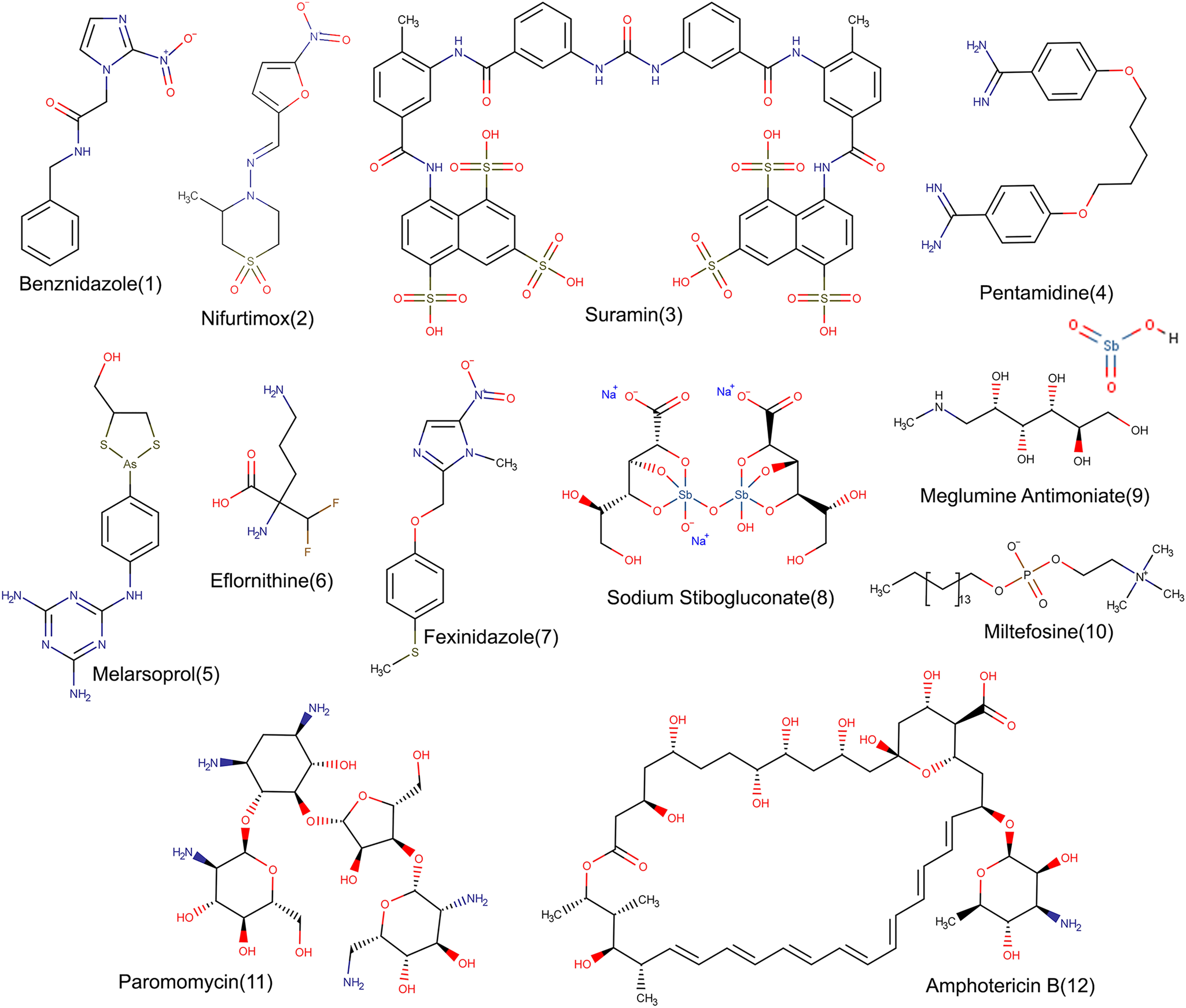
The molecular structures of all the mentioned drugs are presented in Fig. 1.
Chemical structures. Detailed structures of approved drugs to treat Chagas disease (1 and 2), human African trypanosomiasis (3–7) and leishmaniasis (8–12).

Molecular targets for trypanosomiasis and leishmaniasis drug development
Traditionally, the way to identify the drug targets relied exclusively on comparative biochemistry and genetics. The completion of the genome projects for human-infecting trypanosomatids is a breakthrough that allows the identification of an increasing number of possible molecular targets, usually enzymes, proteins or biochemical pathways. Strictly, there are three features an ideal target must satisfy: it has to be absent or strikingly different from its homologue in the mammalian hosts, being druggable and essential for the parasite survival (Hughes et al., Reference Hughes, Rees, Kalindjian and Philpott2011; Wyatt et al., Reference Wyatt, Gilbert, Read and Fairlamb2011). The first criterion denotes target selectivity in order to differentially direct to the parasite a given drug. With the availability of trypanosomatid genomes (Berna et al., Reference Berna, Rodriguez, Chiribao, Parodi-Talice, Pita, Rijo, Alvarez-Valin and Robello2018; Berriman et al., Reference Berriman, Ghedin, Hertz-Fowler, Blandin, Renauld, Bartholomeu, Lennard, Caler, Hamlin, Haas, Bohme, Hannick, Aslett, Shallom, Marcello, Hou, Wickstead, Alsmark, Arrowsmith, Atkin, Barron, Bringaud, Brooks, Carrington, Cherevach, Chillingworth, Churcher, Clark, Corton, Cronin, Davies, Doggett, Djikeng, Feldblyum, Field, Fraser, Goodhead, Hance, Harper, Harris, Hauser, Hostetler, Ivens, Jagels, Johnson, Johnson, Jones, Kerhornou, Koo, Larke, Landfear, Larkin, Leech, Line, Lord, Macleod, Mooney, Moule, Martin, Morgan, Mungall, Norbertczak, Ormond, Pai, Peacock, Peterson, Quail, Rabbinowitsch, Rajandream, Reitter, Salzberg, Sanders, Schobel, Sharp, Simmonds, Simpson, Tallon, Turner, Tait, Tivey, Van Aken, Walker, Wanless, Wang, White, White, Whitehead, Woodward, Wortman, Adams, Embley, Gull, Ullu, Barry, Fairlamb, Opperdoes, Barrell, Donelson, Hall, Fraser, Melville and El-Sayed2005; El-Sayed et al., Reference El-Sayed, Myler, Bartholomeu, Nilsson, Aggarwal, Tran, Ghedin, Worthey, Delcher, Blandin, Westenberger, Caler, Cerqueira, Branche, Haas, Anupama, Arner, Aslund, Attipoe, Bontempi, Bringaud, Burton, Cadag, Campbell, Carrington, Crabtree, Darban, da Silveira, de Jong, Edwards, Englund, Fazelina, Feldblyum, Ferella, Frasch, Gull, Horn, Hou, Huang, Kindlund, Klingbeil, Kluge, Koo, Lacerda, Levin, Lorenzi, Louie, Machado, McCulloch, McKenna, Mizuno, Mottram, Nelson, Ochaya, Osoegawa, Pai, Parsons, Pentony, Pettersson, Pop, Ramirez, Rinta, Robertson, Salzberg, Sanchez, Seyler, Sharma, Shetty, Simpson, Sisk, Tammi, Tarleton, Teixeira, Van Aken, Vogt, Ward, Wickstead, Wortman, White, Fraser, Stuart and Andersson2005a,Reference El-Sayed, Myler, Blandin, Berriman, Crabtree, Aggarwal, Caler, Renauld, Worthey, Hertz-Fowler, Ghedin, Peacock, Bartholomeu, Haas, Tran, Wortman, Alsmark, Angiuoli, Anupama, Badger, Bringaud, Cadag, Carlton, Cerqueira, Creasy, Delcher, Djikeng, Embley, Hauser, Ivens, Kummerfeld, Pereira-Leal, Nilsson, Peterson, Salzberg, Shallom, Silva, Sundaram, Westenberger, White, Melville, Donelson, Andersson, Stuart and Hallb) and more accurate databases (https://tritrypdb.org/tritrypdb/; https://www.genedb.org/) supporting the computational background with biochemical data, it should be straightforward to verify if a given gene product is absent from the mammalian counterpart, or the degree of divergence they present. But, in practice, a real target does not always meet selectivity, for example, the ODC which is a valid target against African trypanosomiasis. In these cases, selectivity should be provided by improving the affinity of the drug towards the parasite target (Kawasaki and Freire, Reference Kawasaki and Freire2011). The term druggability refers to the capacity of a given target to be affected by a drug; in essence, the target must bind a molecule that modulates its activity (Abi Hussein et al., Reference Abi Hussein, Geneix, Petitjean, Borrel, Flatters and Camproux2017). This information can be obtained during the preliminary stage of a drug discovery project by accessing accurate computational druggability prediction methods. The Special Programme for Research and Training in Tropical Diseases (TDR) has developed the TDR targets database, which is a very useful tool that facilitates the identification and prioritization of candidate drug targets for the ‘Tritryp’ genomes among other pathogens (Magarinos et al., Reference Magarinos, Carmona, Crowther, Ralph, Roos, Shanmugam, Van Voorhis and Aguero2012) (http://tdrtargets.org/). Likewise, more recently, the Target-Pathogen database (Sosa et al., Reference Sosa, Burguener, Lanzarotti, Defelipe, Radusky, Pardo, Marti, Turjanski and Fernandez Do Porto2018) (http://target.sbg.qb.fcen.uba.ar/patho) was designed and developed as an online resource. This platform has integrated and weighed protein information, such as structural properties including druggability and essentiality, one of the most important steps in the validation of a given target. Nowadays many drug discovery programmes consider the genetic validation a critical point because it reflects the loss of function attributable to therapeutic intervention. This implies that genes are made inoperative by knockout or knock-down procedures which are particularly effective in T. brucei. However, when working with T. cruzi and Leishmania, the situation is more critical because T. cruzi and most species of Leishmania do not possess the RNA interference and the traditional genetic knockouts in many cases are not successful (Burle-Caldas Gde et al., Reference Burle-Caldas Gde, Grazielle-Silva, Laibida, DaRocha and Teixeira2015). Also, gene disruption experiments are mainly carried out in the insect stage of the parasite because their easy culture and manipulation (Barrett et al., Reference Barrett, Mottram and Coombs1999) and the results not always reflect the biological effect observed in other stages. To avoid target misestimation, the mutants should be also tested for their ability to progress through the life cycle and survive in vivo and in vitro. It is possible that the gene is lethal for the other life cycle stages or generates a conditional lethal phenotype (Barrett et al., Reference Barrett, Mottram and Coombs1999). The mentioned limitations have been recently evidenced by Jones et al., who published an overview of the genetic assessments of suitable targets in Leishmania and T. cruzi (Jones et al., Reference Jones, Catta-Preta, Lima and Mottram2018). Noteworthy, to date, 65 out of 200 knocked out genes in Leishmania are essential and only 16 out of 36 in T. cruzi (Jones et al., Reference Jones, Catta-Preta, Lima and Mottram2018; Osorio-Mendez and Cevallos, Reference Osorio-Mendez and Cevallos2018); whereas T. brucei has been widely subjected to high-throughput genetic screens covering the whole genome. CRISPR-Cas9 has become one of the most promising methodologies for the genetic validation of trypanosomatid targets (Lander et al., Reference Lander, Chiurillo and Docampo2016; Soares Medeiros et al., Reference Soares Medeiros, South, Peng, Bustamante, Wang, Bunkofske, Perumal, Sanchez-Valdez and Tarleton2017), and it is expected to make further valuable contributions to this field.
An alternative strategy to the genetic validation is the pharmacological validation, but evidence of essentiality is preferred to be supported by both criteria (Field et al., Reference Field, Horn, Fairlamb, Ferguson, Gray, Read, De Rycker, Torrie, Wyatt, Wyllie and Gilbert2017; Gilbert, Reference Gilbert2013).
In the evaluation of which targets are better, the fundamentals of metabolic control analysis and metabolic modelling offer new insights into target prioritization. This methodology allows studying the control of cellular metabolic pathways regardless of whether it is a two-step or multiple-step pathway, showing that enzymes with the highest pathway control are the most convenient targets for therapeutic intervention. This idea is supported based on the fact that in any essential pathway, removing an enzyme by genetic manipulations would lead to the same essential phenotype, providing a number of potential drug targets equal or similar to that of the total components (Bakker et al., Reference Bakker, Westerhoff, Opperdoes and Michels2000; Gonzalez-Chavez et al., Reference Gonzalez-Chavez, Olin-Sandoval, Rodiguez-Zavala, Moreno-Sanchez and Saavedra2015; Hornberg et al., Reference Hornberg, Bruggeman, Bakker and Westerhoff2007; Olin-Sandoval et al., Reference Olin-Sandoval, Gonzalez-Chavez, Berzunza-Cruz, Martinez, Jasso-Chavez, Becker, Espinoza, Moreno-Sanchez and Saavedra2012). Therefore, this approach emphasizes the point that proving a gene is essential, specific and druggable is no guarantee that it encodes a valid drug target.
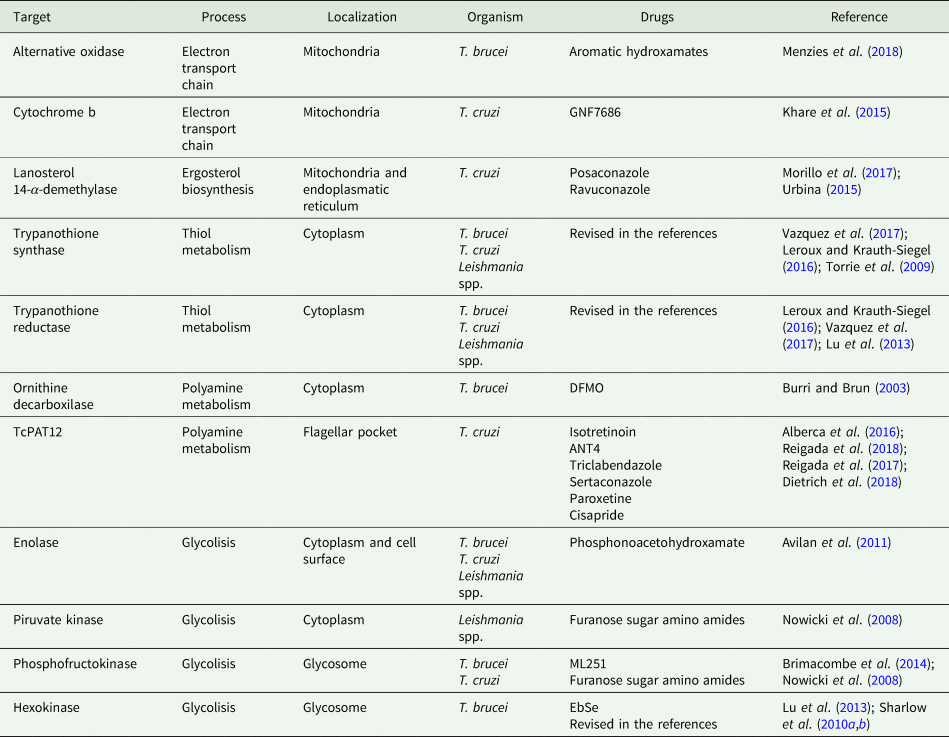
Several biochemical pathways that are common to pathogenic trypanosomes and exclusive to them are supposed to be the most promising for drug discovery, for example, mitochondrial metabolic pathways, sterol biosynthesis, the thiol–polyamine metabolism and glycolysis, among others (Alberca et al., Reference Alberca, Sbaraglini, Balcazar, Fraccaroli, Carrillo, Medeiros, Benitez, Comini and Talevi2016; Avilan et al., Reference Avilan, Gualdron-Lopez, Quinones, Gonzalez-Gonzalez, Hannaert, Michels and Concepcion2011; Burri and Brun, Reference Burri and Brun2003; Dietrich et al., Reference Dietrich, Alberca, Ruiz, Palestro, Carrillo, Talevi and Gavernet2018; Khare et al., Reference Khare, Roach, Barnes, Hoepfner, Walker, Chatterjee, Neitz, Arkin, McNamara, Ballard, Lai, Fu, Molteni, Yeh, McKerrow, Glynne and Supek2015; Leroux and Krauth-Siegel, Reference Leroux and Krauth-Siegel2016; Lu et al., Reference Lu, Vodnala, Gustavsson, Gustafsson, Sjoberg, Johansson, Kumar, Tjernberg, Engman, Rottenberg and Holmgren2013; Menzies et al., Reference Menzies, Tulloch, Florence and Smith2018; Morillo et al., Reference Morillo, Waskin, Sosa-Estani, Del Carmen Bangher, Cuneo, Milesi, Mallagray, Apt, Beloscar, Gascon, Molina, Echeverria, Colombo, Perez-Molina, Wyss, Meeks, Bonilla, Gao, Wei, McCarthy and Yusuf2017; Nowicki et al., Reference Nowicki, Tulloch, Worralll, McNae, Hannaert, Michels, Fothergill-Gilmore, Walkinshaw and Turner2008; Reigada et al., Reference Reigada, Phanstiel, Miranda and Pereira2018, Reference Reigada, Valera-Vera, Saye, Errasti, Avila, Miranda and Pereira2017; Sharlow et al., Reference Sharlow, Golden, Dodson, Morris, Hesser, Lyda, Leimgruber, Schroeder, Flaherty, Weiner, Simpson, Lazo, Aube and Morris2010a,Reference Sharlow, Lyda, Dodson, Mustata, Morris, Leimgruber, Lee, Kashiwada, Close, Lazo and Morrisb; Torrie et al., Reference Torrie, Wyllie, Spinks, Oza, Thompson, Harrison, Gilbert, Wyatt, Fairlamb and Frearson2009; Urbina, Reference Urbina2015; Vazquez et al., Reference Vazquez, Mejia-Tlachi, Gonzalez-Chavez, Silva, Rodriguez-Zavala, Moreno-Sanchez and Saavedra2017). In Table 2, some targets are summarized regarding these pathways; some of them are introduced in ‘VS applied to trypanosomatid-caused diseases’ section of this manuscript.
Drug targets in Trypanosoma and Leishmania parasites

Finally, in addition to finding a good target, when thinking in a possible therapy, the biological differences between parasite intracellular and extracellular stages inside the host should be considered. Contrary to T. brucei, which is only extracellular, T. cruzi and Leishmania spp. possess intracellular forms, so the in vivo accessibility of a drug is different for each of them. Drugs need to overcome additional barriers to meet its target such as host plasmatic membranes, parasitophorous vacuoles, host metabolism, among others. Drugs must be active in these different environment conditions.
Drug development for trypanosomatid-caused diseases
Along with the history of drug development for trypanosomatid-related diseases, many strategies have been implemented. Through different programmes, an initial chemotherapy arsenal to treat leishmaniasis and trypanosomiasis was introduced and remained unaltered for decades.
Different approaches have been implemented to identify new drug candidates. Classical methods to find and optimize new chemical entities (NCE) have been based mainly on new compounds synthesis (de novo drug discovery) and bio-guided fractionation and isolation of natural products.
The first one has been included in many classical drug discovery pipelines, being a high-cost and usually very long and time-consuming approximation. The second provided NCE with either a known or a new scaffold, which can be structurally complex. To be able to use those compounds as a starting point in a drug discovery programme, it is necessary to develop a complete synthetic route to perform a structure–activity relationship and preclinical studies. Alternatively, the complete biosynthetic pathway has to be elucidated to produce adequate amounts of a natural product, and the heterologous expression of the biosynthetic genes should be optimized (Luo et al., Reference Luo, Li, Liu, Zhang, Chen, Jia, Zeng, Zhao and Yuan2015).
On the other hand, short-term approaches have been introduced to speed up the process of candidates' identification. One of those strategies involved drug combinations (Sun et al., Reference Sun, Sanderson and Zheng2016) that have been explored for leishmaniasis and trypanosomiasis treatment. Those approaches were implemented looking to increase drug efficacy, shorten the treatments and decrease the administered doses (Alcântara et al., Reference Alcântara, Ferreira, Gadelha and Miguel2018; Nwaka et al., Reference Nwaka, Ramirez, Brun, Maes, Douglas and Ridley2009). Additionally, drug combination therapy is a well-established approximation to avoid resistance in pathogenic organisms, being a valuable approach that optimizes the resources and know-how to produce improved therapies with better properties (Walvekar et al., Reference Walvekar, Gannimani and Govender2019). Tolerability can be also increased, because if the combined drugs can be administered below their individually prescribed dose limits, their side-effects would be significantly reduced. One leading case example of that approach is the nifurtimox (2)–eflornithine (6) combination therapy, which can be safely used as first-line treatment for the second stage of HAT caused by T. brucei gambiense (Kansiime et al., Reference Kansiime, Adibaku, Wamboga, Idi, Kato, Yamuah, Vaillant, Kioy, Olliaro and Matovu2018; Priotto et al., Reference Priotto, Kasparian, Mutombo, Ngouama, Ghorashian, Arnold, Ghabri, Baudin, Buard, Kazadi-Kyanza, Ilunga, Mutangala, Pohlig, Schmid, Karunakara, Torreele and Kande2009).
Pharmaceutical companies have recently recovered their historical role in drug development against neglected tropical diseases (NTDs) (Aerts et al., Reference Aerts, Sunyoto, Tediosi and Sicuri2017). Over the last decades, GlaxoSmithKline (GSK), Johnson & Johnson, Merck KGaA, MedPharm, Merck & Co, and Pfizer reassumed the leadership as drugs provision for NTDs. Those companies have donated billions of tablets to treat some NTDs in addition to direct procurement. Beyond those efforts, it is clear that there are not enough investments for NTDs yet from the pharmaceutical industries or participation of non-governmental organizations (NGOs). The WHO is critical to make the medication available for the patients on the endemic regions (Hollingsworth, Reference Hollingsworth2018), working with the public and private sectors, international agencies and NGOs in order to guarantee adequate free of charge medication for millions of people.
Recently, one new approach has been consolidated, the partnership of large pharmaceutical companies with non-profit organizations like the Drugs for Neglected Diseases initiative (DNDi), Wellcome Trust or the Academia. Those partnerships have been actively working on campaigns to characterize new NCE with leishmanicidal and trypanocidal activity. Such efforts included the screening of millions of compounds against TriTryps parasites, in particular, partnerships with GSK and Novartis (Khare et al., Reference Khare, Nagle, Biggart, Lai, Liang, Davis, Barnes, Mathison, Myburgh, Gao, Gillespie, Liu, Tan, Stinson, Rivera, Ballard, Yeh, Groessl, Federe, Koh, Venable, Bursulaya, Shapiro, Mishra, Spraggon, Brock, Mottram and Buckner2016). GSK Tres Cantos has also integrated a collaborative research network for more than a decade with the Drug Discovery Unit (DDU, University of Dundee) and Wellcome Trust to discover new candidate drugs for VL and Chagas disease (Wyllie et al., Reference Wyllie, Brand, Thomas, Rycker, Chung, Pena, Shishikura, Spinks, Stojanovski, Thomas, Thompson, Viayna, Martin, Gray, Miles, Gilbert, Read, Marco and Wyatt2019). Thanks to that endeavours, many hit compounds have been identified. In general, the approach involves the screening of drug-like libraries against the etiological agents of these diseases to identify compounds that kill the parasites. This approach provides compounds able to cross the cell membranes and kill the parasite within the parasitophorous vacuole. One logical and important disadvantage is that usually this approach is set to be very stringent, providing few bioactive compounds per campaign. Another obvious disadvantage is that the molecular targets have to be elucidated, having to specifically design strategies to identify them.
There are some successful examples of new structures that have been identified from the phenotypic screening of big libraries on Leishmania parasites. One of them is the identification of GNF6702 by Novartis (Khare et al., Reference Khare, Nagle, Biggart, Lai, Liang, Davis, Barnes, Mathison, Myburgh, Gao, Gillespie, Liu, Tan, Stinson, Rivera, Ballard, Yeh, Groessl, Federe, Koh, Venable, Bursulaya, Shapiro, Mishra, Spraggon, Brock, Mottram and Buckner2016) and another is the ‘Leish-Box’ of inhibitors by GSK (Lamotte et al., Reference Lamotte, Aulner, Spath and Prina2019), just to mention a few.
It is also important to understand an experimental compound's mode of action as this can enable an assessment of the likelihood of resistance mechanisms evolving in the parasite. Strategies of target deconvolution are therefore required to identify the molecular target of a hit compound obtained by phenotypic screening. The usual approach involves a combination of genetic and/or metabolomic approaches or pull-down experiments that afterward must be genetically validated. That is a long and laborious process, even with today's advances such as CRISPR/Cas9 (Beneke et al., Reference Beneke, Madden, Makin, Valli, Sunter and Gluenz2017; Duncan et al., Reference Duncan, Jones and Mottram2017).
An alternative strategy to the very costly, time-consuming and usually very inefficient phenotypic screening campaigns is the target-based drug discovery approach, which is the most commonly used in the pharmaceutical industry. This strategy has also been applied to drug discovery against trypanosomatid-caused diseases in Academia. In this approach, a validated protein target is selected, requiring a well-developed biochemical or biophysical assay that can be used to identify the inhibitors. Big pharmaceutical companies and some well-equipped academic institutions have performed high-throughput screening (HTS) campaigns looking for new hits. Those hits should eventually go through a hit-to-lead process where they are chemically optimized to improve their properties in terms of potency, selectivity and bioavailability.
Over the last decades, the knowledge on the trypanosomatids biochemistry has allowed the identification of many putative drug targets that can potentially provide the validated hits for drug development. Nevertheless, only a few of them have been extensively explored.
Thiol–polyamine metabolism of trypanosomatids was one of the first examples of enzymes used as target-based drug discovery. The most studied enzyme on that matter is trypanothione reductase. Since the early reports of the activity, substrate specificity and kinetics of T. cruzi trypanothione reductase in the late 80s (Krauth-Siegel et al., Reference Krauth-Siegel, Enders, Henderson, Fairlamb and Schirmer1987), the activity of hundreds of compounds has been reported on the enzyme (Tiwari et al., Reference Tiwari, Tanwar and Munde2018).
Recently, an HTS campaign to find new inhibitors of T. brucei tryparedoxin peroxidase has been reported (Fueller et al., Reference Fueller, Jehle, Putzker, Lewis and Krauth-Siegel2012). On that work, nearly 80 000 compounds were analysed, with only 32 displaying activity. Further studies revealed that the compounds not only targeted the enzyme in vitro but also in the intact parasite, validating the target. Trypanothione synthetase is another enzyme of thiol–polyamine metabolism that has been explored. Benitez et al. have studied the potential of that target by assaying 144 compounds, mostly obtained by chemical synthesis and some natural products (Benitez et al., Reference Benitez, Medeiros, Fiestas, Panozzo-Zenere, Maiwald, Prousis, Roussaki, Calogeropoulou, Detsi, Jaeger, Sarlauskas, Peterlin Masic, Kunick, Labadie, Flohe and Comini2016). Different inhibitors have been found, being paulone derivatives the most promising scaffold, nevertheless, some 5-substituted 3-chlorokenpaullone derivatives were off-target (Orban et al., Reference Orban, Korn, Benitez, Medeiros, Preu, Loaec, Meijer, Koch, Comini and Kunick2016).
An article reported by Professor Gelb in 2003 highlighted the potential of protein farnesyl and N-myristoyl transferases (NMTs) as piggy-back medicinal chemistry targets for the development of anti-trypanosomatids (Gelb et al., Reference Gelb, Van Voorhis, Buckner, Yokoyama, Eastman, Carpenter, Panethymitaki, Brown and Smith2003). Those enzymes that produce the co- and post-translational protein modification were studied for drug development in other eukaryotic systems, in particular mainly looking for new anticancer agents. The studies on protein farnesyltransferase as a target of screening libraries against the parasitic enzyme did not produce any interesting compounds to develop new medications.
CYP51 (sterol 14α-demethylase cytochrome P450) has been proposed as a possible target for antikinetoplastids drug discovery. That enzyme is the target of azole drugs in clinical practice. In general, the activity of antifungal drugs is often different on the parasitic orthologues, requiring the optimization of existing structures or introducing NCE to achieve the required selectivity. Many different structures have been prepared and assayed in vitro against parasitic CYP51. Those differences require the optimization of existing structures or the introduction of NCE that were more potent and selective. Between those structures, there are substrate analogues, mostly sterol derivatives, indomethacin amides (Konkle et al., Reference Konkle, Hargrove, Kleshchenko, von Kries, Ridenour, Uddin, Caprioli, Marnett, Nes, Villalta, Waterman and Lepesheva2009) and imidazoles modified from a collection of vitamin D hydroxylase inhibitors. Interesting examples are imidazolyl benzamides (called VNI) that have been through a hit-to-lead optimization process (Friggeri et al., Reference Friggeri, Hargrove, Rachakonda, Blobaum, Fisher, de Oliveira, da Silva, Soeiro, Nes, Lindsley, Villalta, Guengerich and Lepesheva2018; Lepesheva et al., Reference Lepesheva, Ott, Hargrove, Kleshchenko, Schuster, Nes, Hill, Villalta and Waterman2007) that have been able to cure acute and chronic forms of Chagas disease in mice models (Villalta et al., Reference Villalta, Dobish, Nde, Kleshchenko, Hargrove, Johnson, Waterman, Johnston and Lepesheva2013). Other examples are 4-aminopyridyl derivatives (Calvet et al., Reference Calvet, Choi, Thomas, Suzuki, Hirata, Lostracco-Johnson, de Mesquita, Nogueira, Meuser-Batista, Silva, Siqueira-Neto, Roush, de Souza Pereira, McKerrow and Podust2017; Choi et al., Reference Choi, Calvet, Gunatilleke, Ruiz, Cameron, McKerrow, Podust and Roush2013) and the tipifarnib-modified structures (Kraus et al., Reference Kraus, Tatipaka, McGuffin, Chennamaneni, Karimi, Arif, Verlinde, Buckner and Gelb2010).
Another enzyme that has been usefully used on target-directed antikinetoplastids drug discovery is the NMT. This enzyme has been genetically and experimentally validated in Leishmania spp. Once its essentiality on the parasite biology was established, in vitro HTS of a diverse subset of the Pfizer corporate collection against LdNMT, Plasmodium falciparum NMT and the two human isoforms (HsNMT) led to the discovery of new and potent inhibitors (Bell et al., Reference Bell, Mills, Williams, Brannigan, Wilkinson, Parkinson, Leatherbarrow, Tate, Holder and Smith2012). The compounds were subsequently resynthesized and validated leading to a compound 43 that is a potent and neutral NMT inhibitor and a promising candidate for antileishmanial drug development (Hutton et al., Reference Hutton, Goncalves, Brannigan, Paape, Wright, Waugh, Roberts, Bell, Wilkinson, Smith, Leatherbarrow and Tate2014).
An initiative led by the Novartis Institute for Tropical Diseases screened 3 million compounds in proliferation assays on L. donovani, T. cruzi and T. brucei. That campaign provided GNF5343, which was later optimized preparing nearly 3000 new analogues that led to GNF6702, a compound 400-fold more active in intra-macrophage L. donovani. Later, the parasite proteasome was identified by different strategies as the target of the lead compound. GNF6702 is shown to be able to eradicate parasites in mouse disease models (Khare et al., Reference Khare, Nagle, Biggart, Lai, Liang, Davis, Barnes, Mathison, Myburgh, Gao, Gillespie, Liu, Tan, Stinson, Rivera, Ballard, Yeh, Groessl, Federe, Koh, Venable, Bursulaya, Shapiro, Mishra, Spraggon, Brock, Mottram and Buckner2016). Besides the tremendous work behind that report, there is a remarkable example of wide-spectrum antikinetoplastid drug development.
Despite the extensive work and the profound improvement on the drug discovery and development process over the last decades, there are many gaps in the process and only a few targets have been progressed to preclinical development. The involvement of pharmaceutical companies has improved the process and the budget, but there are still financial and material resources limitations. Consequently, the approaches of drug repurposing and the inclusion of computational resources in the analysis of the ever-growing amount of biochemical and genetic data appear as a logical and convenient approach to optimize the process.
An overview of the computational/virtual screening techniques
Similarly to HTS, a virtual screening (VS) employs computer-generated models to search in libraries of small molecules those with chances of binding a molecular target, commonly, but not restricted to, an enzyme or receptor (Rester, Reference Rester2008).
Computer-aided drug discovery is hugely advantageous; allowing to test bigger compound libraries at negligible costs. Molecules that are not yet synthesized to expand the chemical space can be also added (Rodriguez et al., Reference Rodriguez, Chakraborty, Warnick, Crane, Gao, O'Connor, Jacobson and Carlsson2016) without preparing compounds that most likely will not have the desired biological activity (Gasteiger, Reference Gasteiger2015; Schneider, Reference Schneider2010).
When using digital means in the search of bioactive molecules, the options and strategies are plentiful (Haga et al., Reference Haga, Ichikawa and Date2016), and the factors to take into account when deciding which ones to employ and how to combine them are addressed below.
The starting point
The first step before planning a VS workflow should always be performing an extensive bibliographical research about the target that one is trying to find drugs for (Gimeno et al., Reference Gimeno, Ojeda-Montes, Tomas-Hernandez, Cereto-Massague, Beltran-Debon, Mulero, Pujadas and Garcia-Vallve2019); aspects as, for example, its biological function, availability of techniques to measure its activity, natural ligands, known inhibitors, catalytic mechanism, structure, known homologues and their ligands.
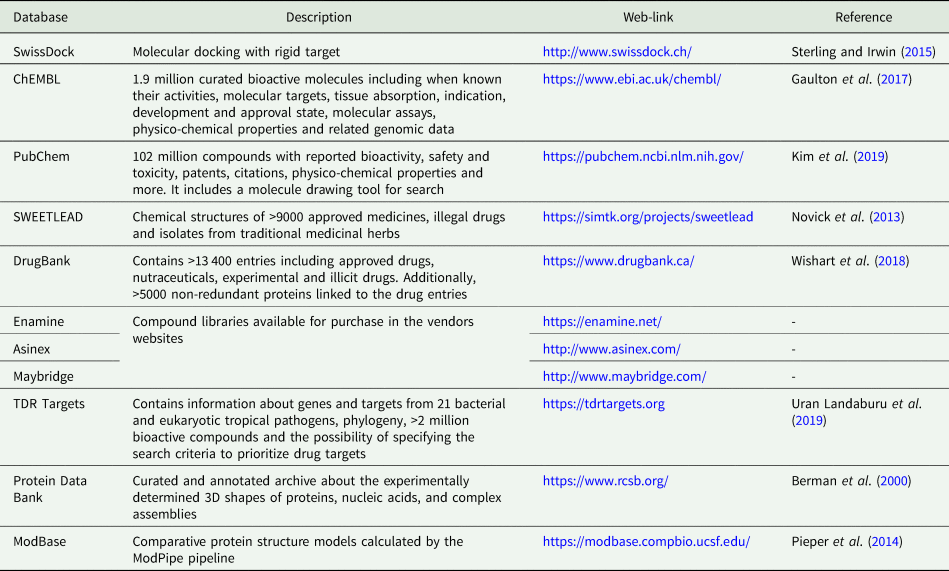
While the results of the literature review will determine what kind of computational tools can be used, every strategy shares the need for a compound library to screen. The confection of the screening library will greatly depend on the specific goals of the VS. There are different small molecule databases available for VS. The ChEMBL (https://www.ebi.ac.uk/chembl/) (Gaulton et al., Reference Gaulton, Hersey, Nowotka, Bento, Chambers, Mendez, Mutowo, Atkinson, Bellis, Cibrian-Uhalte, Davies, Dedman, Karlsson, Magarinos, Overington, Papadatos, Smit and Leach2017), PubChem (https://pubchem.ncbi.nlm.nih.gov/) (Kim et al., Reference Kim, Chen, Cheng, Gindulyte, He, He, Li, Shoemaker, Thiessen, Yu, Zaslavsky, Zhang and Bolton2019) and ZINC (https://zinc.docking.org/) (Sterling and Irwin, Reference Sterling and Irwin2015) are databases with hundreds of millions of compounds and useful search tools. The SWEETLEAD (https://simtk.org/projects/sweetlead) (Novick et al., Reference Novick, Ortiz, Poelman, Abdulhay and Pande2013) and the DrugBank (https://www.drugbank.ca/) (Wishart et al., Reference Wishart, Feunang, Guo, Lo, Marcu, Grant, Sajed, Johnson, Li, Sayeeda, Assempour, Iynkkaran, Liu, Maciejewski, Gale, Wilson, Chin, Cummings, Le, Pon, Knox and Wilson2018) databases contain drugs approved for human administration. Also, some compound vendors, such as Enamine (https://enamine.net/) and Asinex (http://www.asinex.com/), offer screening libraries of their products.
As the goal of a VS strategy is finding molecules to test against a molecular target, it is wise to filter out compounds that could give false positives in the binding assays. These compounds, known as Pan-Assay Interference Compounds (PAINs) (Dahlin et al., Reference Dahlin, Nissink, Strasser, Francis, Higgins, Zhou, Zhang and Walters2015), can give false results by reacting non-specifically with the target, with several other targets, or interfering with the measurement assays (Baell and Walters, Reference Baell and Walters2014). Some chemical groups are shared by many known PAINs, which make it possible to previously remove any molecule containing the said groups (Baell and Holloway, Reference Baell and Holloway2010).
An estimated 50% of the tested drug candidates fail because of inefficiencies in Absorption, Distribution, Metabolism, Excretion and/or Toxicity (ADME/Tox) (Li, Reference Li2001). Based on the physical chemical characteristics of known drugs, Lipinski et al. developed the ‘rule of five’ for orally available drugs (H-bond donors ⩽5, H-bond acceptors ⩽10, molecular weight ⩽500 Da, logP ⩽5) (Lipinski et al., Reference Lipinski, Lombardo, Dominy and Feeney2001). There are computational tools that predict ADME/Tox characteristics, but many of them rely on the Lipinski's rules, excluding administration routes other than oral (Scior et al., Reference Scior, Bender, Tresadern, Medina-Franco, Martinez-Mayorga, Langer, Cuanalo-Contreras and Agrafiotis2012); they also have a low predictive performance on more complex properties, e.g. carcinogenesis (Stouch et al., Reference Stouch, Kenyon, Johnson, Chen, Doweyko and Li2003).
In this sense, at the stage of filtering the screening library, one could take into account the pharmacokinetic characteristics of the compounds to be screened, and three scenarios are possible (Oprea, Reference Oprea2002). Some strategies focus on first obtaining high-affinity lead compounds that later would be optimized for good pharmacokinetic properties, modifications to achieve better ADME/Tox could be detrimental to the target binding, leading to a trial–error optimization that consumes time and resources. Another scenario is filtering compounds before the screening, in an attempt to obtain lead compounds with good ADME/Tox properties and later optimize the potency, which can reduce ADME characteristics, but would be a less consuming process towards optimal structures. A third and highly recommended strategy is to simultaneously follow changes that increase affinity and ADME/Tox characteristics (Drews, Reference Drews1998).
Known ligands of a target can be the starting point in a VS campaign. Also, using experimental data of the molecular structure of the target or a homologue, a receptor-based approximation can be performed (Ghemtio et al., Reference Ghemtio, Perez-Nueno, Leroux, Asses, Souchet, Mavridis, Maigret and Ritchie2012; Table 3).
List of databases of interest for drug virtual screening

Ligand-based virtual screening
Johnson et al. (Reference Johnson, Maggiora and Meeting1990) introduced the concept that similar molecules exhibit similar behaviours, an assumption extended to their biological activity. Based on this principle, if there is knowledge of compounds with the desired effect, finding molecules similar to them is a reasonable starting point in the search of new drugs. However, ‘similarity’ is a tricky concept, to determine if two or more compounds are similar, different characteristics, methods of comparison and metrics that allow such contrasts can be used.
To compare molecules for ligand-based VS, the first step is representing them in numerical terms. To this end, there are different mathematical models to denote different measurable properties of compounds in ways that are usable, these models are called molecular descriptors (Todeschini et al., Reference Todeschini, Consonni, Gramatica, Brown, Walczak and Tauler2009). Descriptors used in VS can be classified as one-dimensional (1D), two-dimensional (2D) and three-dimensional (3D), depending on the molecules information about what they represent. As not all descriptors correlate with the biological activity of the molecule, the selection of the descriptors and the methods used to compare them is crucial.
Because the ligand binding to its receptor will depend in great extent on the spatial interactions that can occur between them, 3D descriptors are considered a more reliable choice (Danishuddin and Khan, Reference Danishuddin and Khan2016; Mavridis et al., Reference Mavridis, Hudson and Ritchie2007) that, when thoroughly used, enhances the chances of finding structurally diverse candidates (Brown and Jacoby, Reference Brown and Jacoby2006). However, a molecule can have many 3D configurations, and comparing spatial data is more complex than comparing 2D descriptors, which translates in greater computational costs (Mavridis et al., Reference Mavridis, Hudson and Ritchie2007).
On the other hand, 2D descriptors consume less computational resources, maintaining good performance, but missing key characteristics involved in the interaction (Fradera and Babaoglu, Reference Fradera and Babaoglu2017).
Fingerprint similarity methods rely on the abstraction of molecular properties into bit sequences, where the bit value (0 or 1) at each position of the sequence represents the absence or presence of a particular descriptor in a molecule (Banegas-Luna et al., Reference Banegas-Luna, Ceron-Carrasco and Perez-Sanchez2018). The sequences can be compared at each position to obtain a metric on how similar are the compounds, given the compared descriptors.
Many comparison algorithms exist, being the Tanimoto coefficient one of the most popular (Bajusz et al., Reference Bajusz, Racz and Heberger2015). Regardless of the comparison metric selected, the results can be sorted from more to less similar to the known ligands. At this point comes the thorny choice of where to apply the cut-off after which compounds will be discarded, as there is no universal value for it, so the selectivity/sensitivity trade-off needs to be carefully determined from the retrieval of known actives and inactives (Fradera and Babaoglu, Reference Fradera and Babaoglu2017). In addition, because similarity coefficients assign to all the compared bits an equal relevance, compounds similar in the bits important for the biological activity can end down in the list for not sharing enough of the non-important characteristics, and vice versa (Scior et al., Reference Scior, Bender, Tresadern, Medina-Franco, Martinez-Mayorga, Langer, Cuanalo-Contreras and Agrafiotis2012).
Machine learning algorithms permit computer-aided drug discovery take a step further, by stop relying on explicit physical representations of what is needed for an expected biological activity, and allow the use of complex pattern recognition algorithms to construct mathematical models that take into account many molecular descriptors at the same time, as well as exploring bigger datasets with low computational costs (Lo et al., Reference Lo, Rensi, Torng and Altman2018). These methods rely on databases of known active and inactive compounds, so the algorithms try to find a set of molecular descriptors that correlate with the desired activity, assigning a level of importance to each of them, and producing a model able to predict the activity of new compounds (Gimeno et al., Reference Gimeno, Ojeda-Montes, Tomas-Hernandez, Cereto-Massague, Beltran-Debon, Mulero, Pujadas and Garcia-Vallve2019).
As the algorithm will try and find any patterns, the initial or ‘training’ dataset of active and inactive compounds is extremely important. When the training library is too small or with poor structural diversity, the produced model might be based in chance correlation or be biased towards similar characteristics not determining the biological activity (Ma et al., Reference Ma, Jia, Zhu, Xue, Li and Chen2009; Scior et al., Reference Scior, Bender, Tresadern, Medina-Franco, Martinez-Mayorga, Langer, Cuanalo-Contreras and Agrafiotis2012), so it is preferred to count with a large and structurally diverse input set. As the amount of inactive compounds will always be greater than the actives (Schierz, Reference Schierz2009), it is important to balance both sets to avoid the production of a model biased towards the correct identification of inactive compounds, but being sub-optimal in the discrimination of true actives. Whenever possible, it is advisable to choose those inactive compounds that are structurally similar to the actives, so the model will have more chances of discriminate between them (Tropsha, Reference Tropsha2010).
Ligand-based pharmacophores are ensembles of spatial and electrostatic features shared between a set of known active molecules. These models are used later to search for other candidates containing such features, assuming they are responsible for the interaction with the receptor (Gimeno et al., Reference Gimeno, Ojeda-Montes, Tomas-Hernandez, Cereto-Massague, Beltran-Debon, Mulero, Pujadas and Garcia-Vallve2019). In this way, the compounds retrieved can be structurally richer, as the matched features can be contained by a wider range of structures.
Though pharmacophore models can be constructed from one or a few ligands, it is always better to use large sets of known actives (Scior et al., Reference Scior, Bender, Tresadern, Medina-Franco, Martinez-Mayorga, Langer, Cuanalo-Contreras and Agrafiotis2012) in order to identify which features seem to be critical to the binding, as well as finding as many important features as possible that may not be shared by every ligand.
Receptor-based virtual screening
Using known ligands of the target macromolecule to find hit compounds is very fast and computationally inexpensive. Nevertheless, for NTDs such as those caused by trypanosomatids, the amount of information available regarding experimentally demonstrated ligands of interesting targets can be scarce or even non-existing. Additionally, ligand-based methods tend to narrow the chemical space by retrieving only molecules similar to the known ligands, leaving out potentially good and structurally diverse hits. Although similar molecules tend to have similar activities, this is not necessarily true, as some of the chemical groups that make the hit different from the known ligands might be detrimental to the ligand–receptor interaction in what is known as activity cliff (Stumpfe and Bajorath, Reference Stumpfe and Bajorath2012).
Analysing the molecular target allows to discard hits that would be incompatible with the binding site, and allows finding structurally novel hits capable of fitting in and interacting with a given pocket in the receptor. Structural information of some targets can be found in the Protein Data Bank (PDB, https://www.rcsb.org/) (Berman et al., Reference Berman, Westbrook, Feng, Gilliland, Bhat, Weissig, Shindyalov and Bourne2000), a database containing experimentally determined protein structures, or in the ModBase (https://modbase.compbio.ucsf.edu/) (Pieper et al., Reference Pieper, Webb, Dong, Schneidman-Duhovny, Fan, Kim, Khuri, Spill, Weinkam, Hammel, Tainer, Nilges and Sali2014), a database of comparative protein structure models.
A strong drawback of receptor-based techniques is that in many cases the target 3D structure has not been experimentally determined, especially in the case of trypanosomatids. This problem can be circumvented if there are structural data of molecules similar enough to the target to build a homology model.
A general rule of thumb is selecting the protein template with the highest sequence identity with the receptor of interest, particularly on the target pocket, and sequence identities lower than 30% will produce significantly less reliable models (Fiser, Reference Fiser2010). The quality of homology models must be assessed before using them in a receptor-based VS, and while there are many ways of evaluating the quality of a homology model (Bhattacharya et al., Reference Bhattacharya, Wunderlich, Monleon, Tejero and Montelione2008; DasGupta et al., Reference DasGupta, Kaushik and Jayaram2015; di Luccio and Koehl, Reference di Luccio and Koehl2012; Eramian et al., Reference Eramian, Shen, Devos, Melo, Sali and Marti-Renom2006; Shen and Sali, Reference Shen and Sali2006), and most of the modelling tools include scores for quality assessment, it is important to know their capabilities and limits. Many assessment tools are biased towards the more known structures and may fail with proteins less represented in the databases, as is the case for membrane proteins (Benkert et al., Reference Benkert, Biasini and Schwede2011; di Luccio and Koehl, Reference di Luccio and Koehl2012).
Molecular docking is the receptor-based technique most extensively used in VS (Forli et al., Reference Forli, Huey, Pique, Sanner, Goodsell and Olson2016; Sousa et al., Reference Sousa, Ribeiro, Coimbra, Neves, Martins, Moorthy, Fernandes and Ramos2013) to predict if and how a library of ligands would interact with a receptor. It relies on randomly changing the spatial conformation of the ligand and calculating how well the generated poses would interact with the receptor, assigning an interaction score to each. This results in a set of conformations that are scored as the most likely to represent the real binding mode. When a compound library is used, it is possible to rank those molecules according to their biding scores, and obtaining their possible modes of interaction with the receptor.
While molecular docking algorithms give potential ways of a receptor–ligand interaction, it is not definitive proof of the mode of binding, or that there is binding at all. Thus the docked poses should be treated more as hypotheses to test experimentally. In fact, for some receptors and docking algorithm, mode of interaction with known ligands might not be reproduced (Chaput et al., Reference Chaput, Martinez-Sanz, Saettel and Mouawad2016), for that reason it is extremely important, when possible, to validate whether the docking algorithm is capable of reproducing experimental results before using it to predict interactions with new compounds. The two most used methods of validation are re-docking, when the co-crystalized ligand is removed from the protein and docked to test whether the produced pose is the same as in the crystal, and cross-docking, when different co-crystalized ligands are docked with the receptor (Jain, Reference Jain2009).
One of the most important drawbacks of molecular docking is the treatment of the receptor as a rigid molecule, so compounds that would otherwise bind to a pocket that is different – or not present – in the rigid receptor will be wrongly targeted as non-binders. To manage the flexibility of the receptor (B-Rao et al., Reference B-Rao, Subramanian and Sharma2009), an option would be using all known conformations of the receptor. Some algorithms make it possible to allow some degree of overlapping between the ligand and the receptor, treating some key residues of the target as flexible, and even perform induced fit models (Xu and Lill, Reference Xu and Lill2013); all of them requiring additional computational costs.
Structure-based pharmacophore can also be obtained from the receptor as a set of spatial features capable of interacting with the residues on the binding site. This can be done directly by analysing the electrostatic distribution on the pocket, or by doing molecular docking of small fragments with varying molecular nature to probe the pocket and finding which features are more probable to interact with different parts of the binding site.
A very interesting strategy, although computationally expensive, is to perform molecular dynamic (MD) simulations of the receptor embedded in organic/aqueous mixed solvents containing different molecular features to find which areas of the receptor had more interactions with such solvents (Defelipe et al., Reference Defelipe, Arcon, Modenutti, Marti, Turjanski and Barril2018). This approach results in a spatial distribution of preferential interactions in the protein surface while taking into account the flexibility of the protein in a span of time.
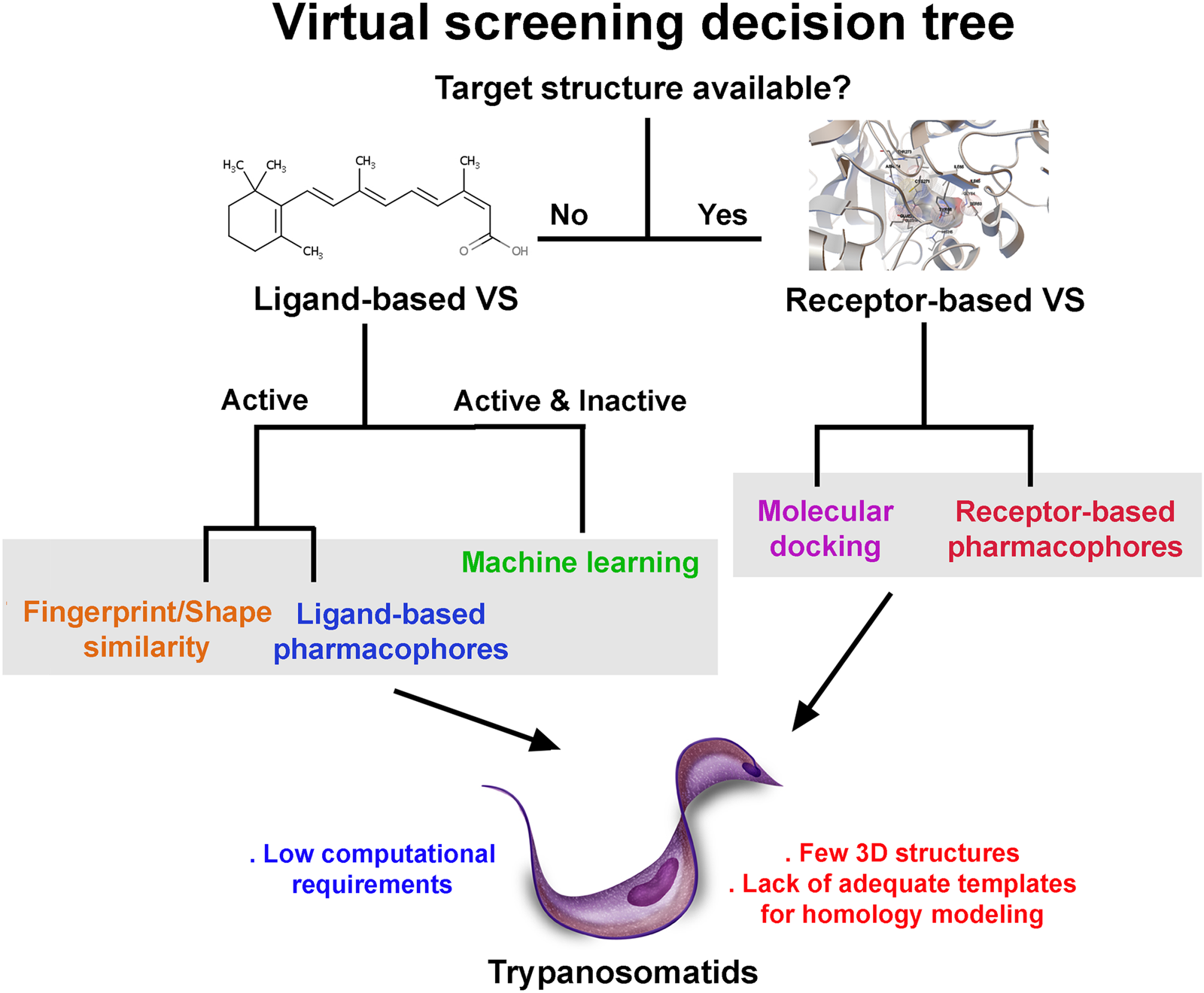
Figure 2 shows a graph on how to choose among the different VS strategies, as well as their advantages and disadvantages.
Common virtual screening techniques. Different VS approaches based on the available information about the protein targets and/or ligands. Receptor-based VS requires experimentally determined 3D structures or good-quality homology models that, in the case of trypanosomatid, are scarce. In the case of ligand-based VS, only small molecules (substrates, inhibitors, etc.) that interact with the target protein are needed.

Combined virtual screening strategies
Combinations of different techniques in a single VS workflow are strongly advised, taking advantage of their different strengths while minimizing the downsides they would have when used separately (Talevi et al., Reference Talevi, Gavernet and Bruno-Blanch2009). The size of the compound library being used is another factor to take into account at the moment of designing a VS pipeline; as for bigger libraries, it is preferable to start using methods computationally less expensive that allow discarding a huge volume of compounds and data. For smaller libraries or later steps in the workflow, it is plausible to use techniques that employ more computing power but also give more information about the possible mode of interaction that then can be used to bias the VS into finding compounds with such characteristics. As an example, receptor- and ligand-based pharmacophores can be used to adjust docking protocols to prefer the kind of interactions found in the model in what is known as ‘biased’ or ‘guided’ docking (Hu and Lill, Reference Hu and Lill2014), which increases the performance of the docking algorithms.
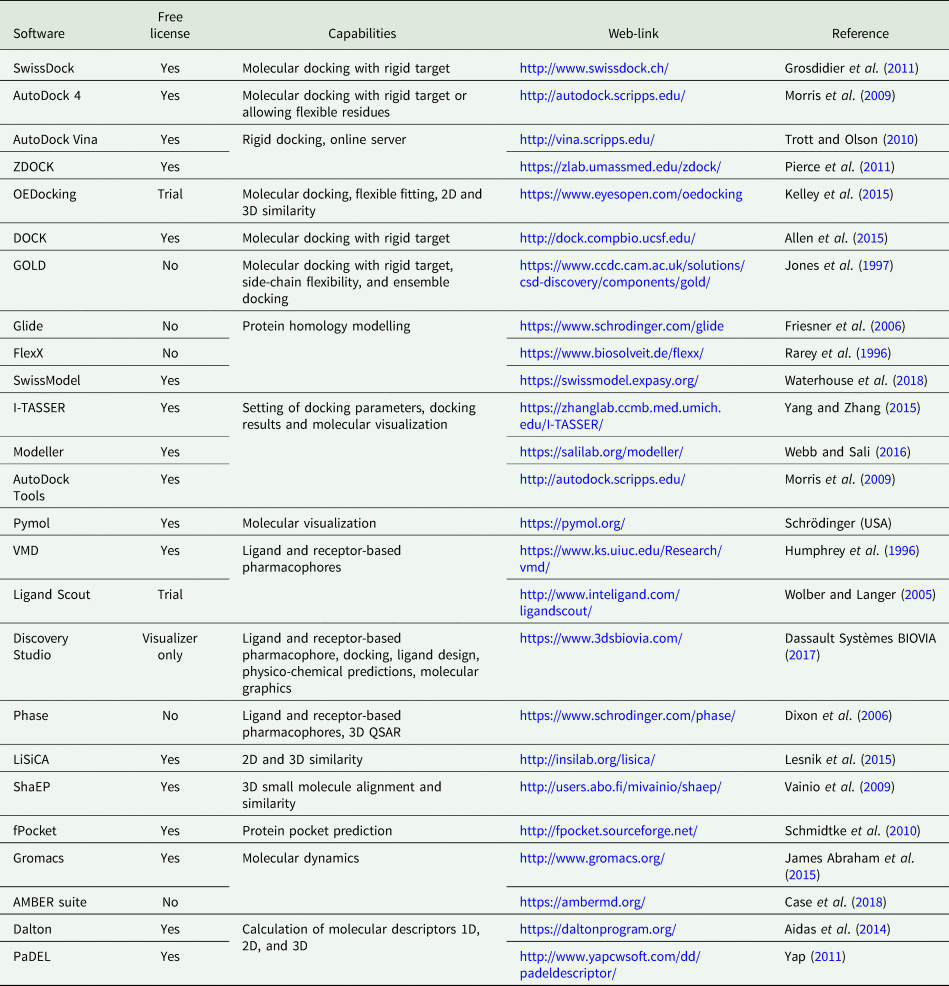
Computational approaches are of great value in the drug discovery for trypanosomatid-caused diseases, by reducing the testable chemical space to a handful of promising compounds with high chances of having the desired biological activity, and by allowing to better exploit the growing information about the biology of these parasites. The available informatic tools are plentiful, whether the molecular target and its structure are known, or if there is a set of compounds interacting with a specific target in ways that might or might not be known; and combination of diverse tools is always the best choice to draw on their advantages while reducing their short-comes. The use of these approaches is not restricted to the search of active compounds, as the produced models can be harnessed to better understand the chemical characteristics of the ligand–target interaction. Finally, we must always keep in mind that these models have no value until they are experimentally tested, and feedback from the bench is critical for their betterment (Table 4).
Software of interest for computer-aided drug discovery

VS applied to trypanosomatid-caused diseases
During the last decade, there was a significant increase in the number of scientific publications about different VS techniques applied to the identification of drug candidates for the treatment of NTDs. Probably one of the reasons for this emergent trend is the power of VS techniques to select active compounds rapidly and with an accessible cost for any laboratory (Bellera et al., Reference Belllera, Sbaraglini, Alberca, Alice, Talevi and Roy2019).
Many international organizations, such as DNDi (Chatelain and Ioset, Reference Chatelain and Ioset2011), recommend repurposing drugs for the treatment of NTDs in order to reduce the economic cost and the time of implementation of new therapeutic alternatives. In this sense, one of the main approaches for drug repositioning is through the application of computer simulations or VS. These techniques can use libraries of approved drugs to find a molecule with the desired biological activity. Most common approaches usually include a first in silico step based on individual or combined VS campaign followed by in vitro enzymatic or cell viability assays (Kontoyianni, Reference Kontoyianni2017).
To illustrate the capabilities of VS, a few examples applied to drug discovery in NTDs will be detailed below.
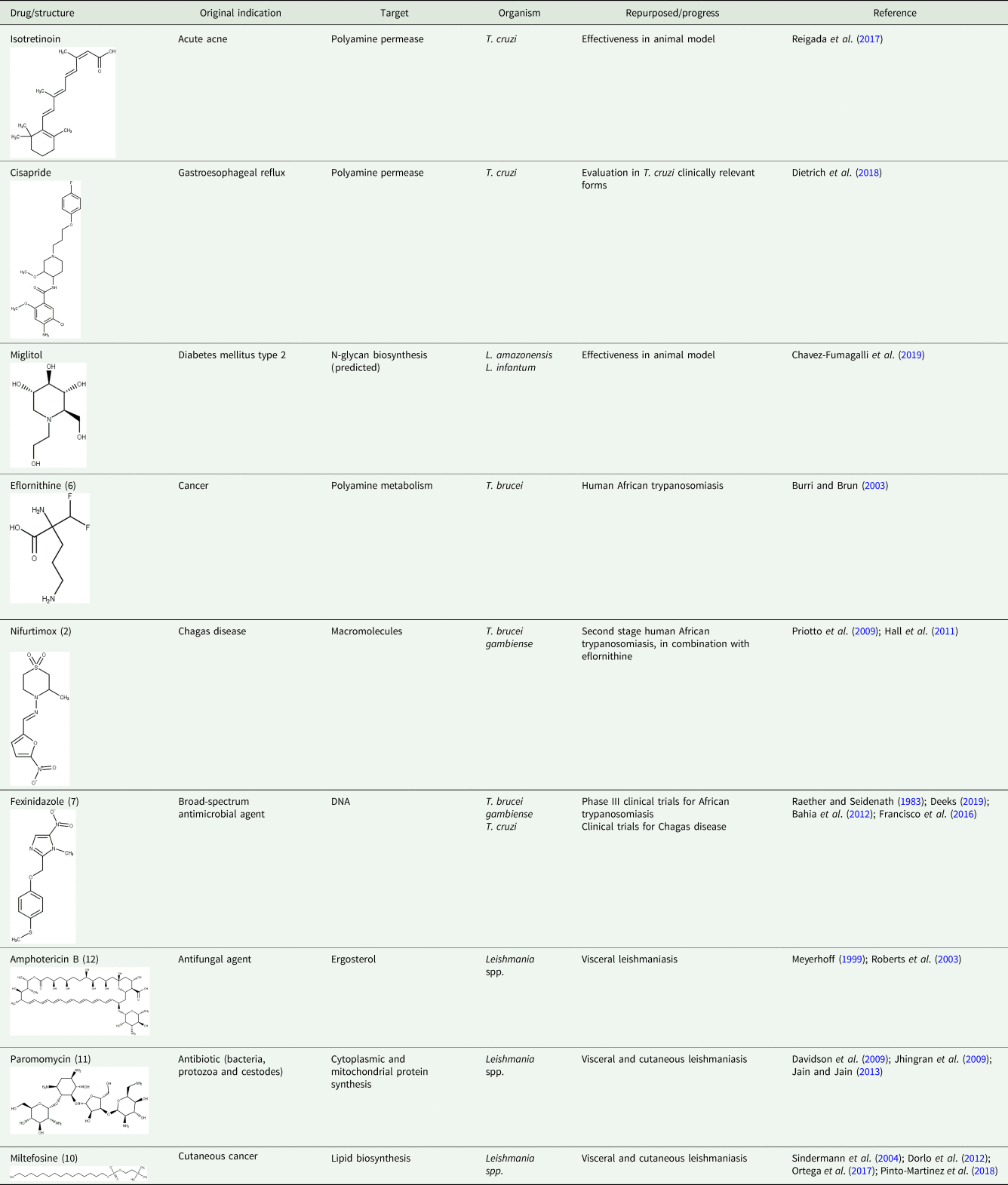
Reigada et al. performed a VS strategy to repurpose drugs to inhibit the T. cruzi polyamine transporter TcPAT12. The authors used the Tanimoto coefficient in LiSiCA v1.0 to search by 2D molecular similarity among 2924 compounds approved by the Food and Drug Administration (FDA) for its use in humans, employing retinol acetate as the reference since this molecule has been reported to decrease the intracellular polyamine concentration in Leishmania. A set of seven retinoids of dermatological use was identified and subsequently used in molecular docking. Among these compounds, isotretinoin, a drug used to treat severe acne, obtained the lowest docking score (−10.78 kcal/mol), which was in the range of the reference molecule (10.02 kcal/mol) and three times higher than the scores obtained for its natural ligands, spermidine and putrescine. Because of this, isotretinoin was tested in vitro, inhibiting the polyamine transport in the parasite and showing a strong trypanocidal effect at nanomolar concentrations (Reigada et al., Reference Reigada, Valera-Vera, Saye, Errasti, Avila, Miranda and Pereira2017) (Fig. 3A).
Membrane transporters as drug targets. Ligand- and receptor-based VS was applied in this example to identify inhibitors of the T. cruzi polyamine permease (Reigada et al., Reference Reigada, Valera-Vera, Saye, Errasti, Avila, Miranda and Pereira2017). Retinol acetate was first reported as a leishmanicidal compound that reduces the intracellular concentration of polyamines (Mukhopadhyay and Madhubala, Reference Mukhopadhyay and Madhubala1994). Through a similarity VS using a database of FDA-approved drugs and retinol acetate as a reference molecule, a group of candidate drugs was identified. After the second step of receptor-based VS (molecular docking) followed by in vitro assays, it was demonstrated that the retinoid isotretinoin is a polyamine transport inhibitor with a strong anti-T. cruzi activity (A). Some advantages of membrane transporters as drug targets are schematized (B). For example, in many cases transport processes are the only way to obtain essential metabolites (i.e. polyamines in T. cruzi); the presence of extracellular spans in the transporter facilitates the accessibility of the drugs; some inhibitors are incorporated to the cell presenting additional intracellular targets such as enzymes or nucleic acids.

Another approach to identify inhibitors of the same T. cruzi polyamine transporter involved an anthracene–putrescine conjugate (Ant4) that blocks polyamine uptake in cancer cells. Ant4 was also found to inhibit the polyamine transport system in T. cruzi and produced a strong trypanocidal effect. Considering that Ant4 is not currently approved by the FDA, a similarity ligand-based VS using this compound as a reference molecule was applied. Three tricyclic antipsychotic drugs, promazine, chlorpromazine and clomipramine, showed to be effective inhibitors of putrescine uptake, and also revealed a high trypanocidal activity against T. cruzi amastigotes and trypomastigotes with calculated IC50s between 1.3 and 3.8 μ m (Reigada et al., Reference Reigada, Saye, Phanstiel, Valera-Vera, Miranda and Pereira2019)
These are interesting examples of trypanosomatid-caused diseases when little information about the target and its binding molecules is available. In the ligand-based approach, it shows the capabilities of similarity search to find active molecules with high potency starting from a single compound, even when the antecedents are in another organism, a significant advantage in the case of these insufficiently studied organisms, but since similarity search highly depends on the input set, it is worthy to note the small quantity of retrieved compounds. It also highlights a potential problem that should be taken into account; if the molecular target is too similar to a human homologue, it could bind to it as well, the reason why the differences between the parasites and the host are a key aspect to observe in the drug search.
Regarding the receptor-based methods, membrane proteins are more readily accessible for drugs but less structural information about them is available. At the time of publication, there was no crystal structure for a polyamine transporter in Tritryps, and the most related protein deposited in the PDB was an E. coli amino acid transporter (AdiC), with an identity of 30% with TcPAT12 considered the lower limit in the production of a reasonable homology model. Having in mind the previously mentioned bias of the quality assessment towards soluble proteins, the authors had to rely only on a Ramachandran plot to check the produced model was worthy of using in docking assays. Nevertheless, the molecular docking worked on predicting the binding of isotretinoin that was later determined experimentally in the same work. An important thing to have in mind is that docking scores by themselves are not a good indicator of whether a ligand will be a good binder or not, as they do not represent actual binding energies, working only to rank the complementarity of a ligand inside a pocket and hinting to which molecules might be better ligands than the others, the reason why the authors use retinoic acetate, spermidine and putrescine as a reference for what a good score might be for this particular case.
Using the same protein target, Dietrich et al. identified other anti-T. cruzi polyamine transport inhibitor, cisapride, a drug withdrawn for human treatments currently used in veterinary medicine to stimulate the upper gastrointestinal tract. The authors screened the ZINC and DrugBank databases employing similarity search, quantitative structure–activity relationship (QSAR) models and molecular docking-based screening (Dietrich et al., Reference Dietrich, Alberca, Ruiz, Palestro, Carrillo, Talevi and Gavernet2018).
For the similarity search, they used six compounds that disrupted the putrescine uptake in T. cruzi. Two different cut-off values were employed, for the DrugBank database, comprising 8261 molecules, those with a Tanimoto coefficient <0.5 were filtered out, while for the ZINC database, due to its greater size (17 900 742 compounds) they set a more stringent cut-off of 0.7, showing how its selection depends entirely on the researchers criteria about the desired quantity and structural diversity of the retrieved molecules. Because of the limitation of this strategy to find few compounds because of the quantity of input molecules, they complement the strategy with a QSAR model designed to find polyamine analogues with trypanocidal activity in micromolar concentrations, whether or not their molecular target was known. Employing both strategies, they find 594 candidates for further filtering by molecular docking.
The authors used the natural ligands and reported inhibitors of the transporter as reference molecules, and as negative controls a set of amino acids that do not bind to it. They compared Autodock 4.2 and Autodock Vina docking software and evaluated the performance of different scoring functions. Additionally, they performed a set of evaluations with rigid receptors, and other sets allowing flexibility on different residues determined by docking or mutagenesis to be involved in the binding of the natural ligands. Although Autodock Vina is reported to have better predictive power than Autodock 4.2 (Gaillard, Reference Gaillard2018), in this case, the former ranked the inactive compounds higher than the natural ligands. From all the tested docking conditions, the rigid model with Autodock 4.2 performed the best on discriminating non-binders. The example shows the importance of testing various scoring functions and docking parameters, as their performance is specific to each receptor–ligand system.
By using a set of active and inactive compounds, the researchers could build a Receiving Operating Characteristic (ROC) curve to determine the score cut-off with the better trade-off between specificity and sensibility for the receptor-based filtering. Applying the mentioned model, 203 molecules were classified as possible binders; the top 10% were thoroughly analysed for their physicochemical properties, structural diversity and purchasability, leading to four compounds of which only cisapride inhibited the putrescine uptake in vitro. This illustrates how a richer input dataset can lead to better predictive models capable of processing larger libraries and retrieving active compounds.
Recently, it was demonstrated that crystal violet, a colourant used as an additive in blood banks to prevent transfusion-transmitted Chagas disease, inhibits the T. cruzi proline permease TcAAAP069. Using crystal violet as a query for a drug repurposing ligand-based VS, loratadine, cyproheptadine, olanzapine and clofazimine were identified as structurally related compounds. All these already-approved drugs for clinical use inhibited TcAAAP069 activity with different efficacies, presented trypanocidal action in epimastigotes, trypomastigotes and amastigotes of different T. cruzi strains and also presented a synergistic effect in combination with benznidazole (Saye et al., Reference Saye, Gauna, Valera-Vera, Reigada, Miranda and Pereira2020)
Regarding the above-mentioned examples, some properties of membrane transporters as targets for drug development are outlined in Fig. 3B.
Other approaches using molecular descriptors and QSAR models were applied to find natural products that inhibit the de novo pyrimidine biosynthetic pathway, specifically the enzyme dihydroorotate dehydrogenase (DHODH) from L. major (Chibli et al., Reference Chibli, Schmidt, Nonato, Calil and Da Costa2018). Similarly, inhibitors of the enzyme that reduce trypanothione were identified by linear discriminant analysis using molecular descriptors (Prieto et al., Reference Prieto, Talevi and Bruno-Blanch2006).
For T. brucei, the only fully validated molecular target is the protein ODC (i.e. its disruption is the known target of current clinic treatment for the disease) (Gilbert, Reference Gilbert2014), in this sense, great efforts have been made in order to identify other compounds capable of inhibiting its enzymatic activity. In a compelling example (Smithson et al., Reference Smithson, Lee, Shelat, Phillips and Guy2010), the authors started from a commercially available library of compounds and used chemoinformatic tools to filter out potential PAINs, select molecules with good ADME properties and generate clusters containing up to 20 compounds with maximum structural diversity. The generated clusters (with a total of 316 000 compounds) were used for HTS against T. brucei and human ODC. They found a novel chemotype comprising eight tested compounds that were a potent and selective inhibitor of the parasite ODC. Because both active sites have a high identity, the authors found unlikely that these compounds would be binding to the active site considering the high observed selectivity. Therefore, they used informatics tools to identify three other possible binding pockets for these inhibitors, followed by rigid docking simulations with the found active compounds and inactive chemical analogues in the identified pockets as well as the active site. The models predicted that only one of the pockets would bind better to the actives compared with the enzyme active site; also, the dockings in the same pocket yielded better discrimination between actives and inactives. To evaluate the role of the predicted binding residues, the authors analysed the differences in the predicted pocket between the human and parasite, and performed mutagenesis experiments, both analysis further supported their hypothesis. This is a fascinating example of how the feedback loop between computational models and the experimental results lead to a better understanding of the studied molecular systems.
Two promising drug targets for the treatment of HAT are the enzymes pteridine reductase and the N-acetyl-glucosaminyl-phosphatidylinositol deacetylase (GlcNAc-PI de-N-acetylase), involved in the essential pterin metabolism and GPI anchor biosynthesis of membrane proteins, respectively. Different chemical determinants of the T. brucei pteridine reductase activity were identified by pharmacophore mapping and subsequently used to database screening to find potential nanomolar range inhibitors (Dube et al., Reference Dube, Sharma, Singh and Kaur2014). A very similar approach was applied to discover GlcNAc-PI de-N-acetylase inhibitors and two approved drugs were repositioned; the antibiotic ethambutol and the vasoconstrictor metaraminol (Rashmi and Swati, Reference Rashmi and Swati2015).
A combined VS campaign was designed to find specific inhibitors of the L. donovani γ-glutamylcysteine synthetase (Gcs), an enzyme of the trypanothione-based redox system. The receptor-based steps include the homology modelling of the enzyme structure and active site prediction. Using a database of 55 000 commercially available compounds obeying the Lipinski's rules (http://www.maybridge.com/), the authors used molecular docking with three different scoring functions and retrieved five compounds ranked by the three functions better than L-buthionine-S, R-sulfoximine (BSO), a Gcs inhibitor that prolongs the survival in T. brucei mice infections but induces toxicity in the host. The predicted poses were evaluated by MD using GROMACS (James Abraham et al., Reference James Abraham, Schulz, Pall, Smith, Hess and Lindahl2015). These simulations confirmed the stability of the predicted binding modes, allowing the authors better assess the residues important for the binding of these compounds, and to identify other residues in the active site that could be exploited in lead optimization to increase the binding affinity. However, including the docking pose of BSO would be a great addition to the work, as it would work as a positive control of the model and throw some light on what molecular determinants should be retained if an optimization of its toxicity would be carried in the future. The five ligands were successfully validated in vitro, four compounds had better enzymatic inhibition than BSO, dissociation constants comparable to it, and leishmanicidal activity, three of them having negligible toxicity in human cell lines (Agnihotri et al., Reference Agnihotri, Mishra, Mishra, Sirohi, Sahasrabuddhe and Pratap2017). These results are a clear example of following in parallel the binding affinity and the ADME/Tox properties, and how information obtained from the predicted models could be of use for further lead optimization.
Another example of combined ligand- and structure-based VS strategy employing similarity VS, molecular docking and MD was applied to find putative T. cruzi enolase (TcENO) inhibitors. The enzyme substrates and two known enolase inhibitors were used as queries for the similarity VS using five different algorithms, resulting in six compounds of medical use (etidronate, pamidronate, fosfomycin, acetohydroxamate, triclofos and aminohydroxybutyrate). Molecular docking simulations and pose re-scoring predicted that etidronate and pamidronate were the best candidates. Finally, using MD calculations, it was proposed that etidronate is the best potential TcENO inhibitor and described the molecular motifs to be taken into account in the repurposing or design of drugs targeting this enzyme active site (Valera-Vera et al., Reference Valera-Vera, Saye, Reigada, Miranda and Pereira2020).
A novel approach based on the combination of proteomics and VS was used to identify potential drug targets to treat leishmaniasis. First, by proteome mining, new drug targets essential for the parasite and with low identity to human homologues were detected. One of these proteins related to the N-glycan biosynthesis pathway and a putative inhibitor, miglitol, were predicted in silico and validated in vitro (Chavez-Fumagalli et al., Reference Chavez-Fumagalli, Lage, Tavares, Mendonca, Dias, Ribeiro, Ludolf, Costa, Coelho and Coelho2019).
An important point that can be remarked from the previous examples of VS strategies is the need of sources of structural variability in the databases screened to increase the chances of finding a compound with the appropriate biological properties. In this sense, the databases of approved drugs used for the drug repositioning have only about 3000 drugs. A widely used alternative are databases of small molecules either of natural or synthetic compounds that have >100 000 structures to find lead compounds for further optimization, always reminding that compounds obtained by VS must be tested in vitro and in vivo, and that following the evolution of potency and ADME/Tox through the drug development is highly recommended. Although the different VS tools can be combined in diverse ways to increase the efficiency in retrieved active compounds, the probability of success with this approach is completely uncertain until biological assays are performed on the protein, the target organism and infection models, results that can in turn be used to the improve the predictive models. For the specific case of trypanosomatid-caused diseases, there are, as yet, no treatments obtained from a VS strategy. Nevertheless, the enrichment in active molecules obtained from computational tools and the growing amount of information about potential targets and compounds binding to them make the discovery and development of chemotherapies against these parasites a more approachable task.
Additional examples of VS techniques applied to trypanosomiasis and leishmaniasis are listed in Supplementary Table S1.
Drug repurposing, an advantageous alternative to new drugs in NTDs
During the period 2016–2018, 130 NCE and 78 drug line extensions, which are products based on a previously approved molecule, were approved and launched to global markets. That is almost 40% of the new treatments in the last years corresponds to new indications, new combinations or new formulations for already marketed drugs (Graul et al., Reference Graul, Pina, Cruces and Stringer2017, Reference Graul, Pina, Cruces and Stringer2019, Reference Graul, Pina and Stringer2018). As previously mentioned, finding new indications for approved, withdrawn, abandoned or investigational drugs is called drug repurposing or drug repositioning, and in this section, we will present some advantages of this drug discovery strategy and also will provide examples of repositioned drugs to treat human pathologies, including trypanosomatid-caused diseases.
The classic drug development approach usually takes between 10 and 17 years from target identification to be available in the market. All these years also imply a rough investment of 0.8–2.3 billion dollars (DiMasi et al., Reference DiMasi, Grabowski and Hansen2016), and even then, drugs can fail and never get to the pharmacy. The main reasons for this failure are that the drugs are not as effective in humans as predicted by the preclinical assays, and/or that they are not safe for human administration. Drug repurposing can accelerate the time needed for a drug to reach the market and reduced the financial costs mainly because the preclinical and clinical assays can take advantage of the available safety, toxicity and pharmacokinetics and pharmacodynamics data. This approach can take between 3 and 12 years and diminish the cost around 40% of the traditional development (Ashburn and Thor, Reference Ashburn and Thor2004; Chong and Sullivan, Reference Chong and Sullivan2007) (Drug Repurposing and Repositioning: Workshop Summary; https://www.nap.edu/read/18731/chapter/1). The potential repositioned compound can be identified through serendipity or rational approaches, including computational strategies, biological experimental strategies or a combination of both (Xue et al., Reference Xue, Li, Xie and Wang2018). One of the most recognized examples of a successful repurposing story involves sildenafil which was first developed as an antihypertensive drug and then repurposed for the treatment of erectile dysfunction and pulmonary arterial hypertension (Ghofrani et al., Reference Ghofrani, Osterloh and Grimminger2006). Another example is the drug thalidomide that was originally developed for treating morning sickness and was withdrawn from the market because of its teratogenic effects. However, this compound is now used to treat erythema nodosum leprosum and it is also employed in combination with dexamethasone for the treatment of newly diagnosed multiple myeloma (Gupta et al., Reference Gupta, Sung, Prasad, Webb and Aggarwal2013; Singhal et al., Reference Singhal, Mehta, Desikan, Ayers, Roberson, Eddlemon, Munshi, Anaissie, Wilson, Dhodapkar, Zeddis and Barlogie1999; Zhou et al., Reference Zhou, Wang, Hsieh, Wu and Wu2013). Inspired by these cases and many other success stories of repositioned drugs, several studies are underway to identifying new biological activities for existing drugs (Czech et al., Reference Czech, Lalani and Oyewumi2019; Ferreira and Andricopulo, Reference Ferreira and Andricopulo2016; Novac, Reference Novac2013).
NTDs, like Chagas disease, HAT and leishmaniasis, are usually associated with underdeveloped countries and poverty. Thus, big pharmaceutical companies are not generally interested in the development and production of treatments for these diseases because it is unlikely for them to recover the investment and even less probable to make a profit. In this regard, the drug repurposing approach turns out very appealing since the costs of the drug discovery process are greatly reduced.
Eflornithine (6), a polyamine synthesis inhibitor, constitutes a remarkable case of drug repositioning in trypanosomatid-caused diseases since it was initially evaluated as an antitumor agent, but the clinical studies were discontinued due to adverse effects (Abeloff et al., Reference Abeloff, Rosen, Luk, Baylin, Zeltzman and Sjoerdsma1986; Meyskens et al., Reference Meyskens, Kingsley, Glattke, Loescher and Booth1986). However, in the late 1980s, eflornithine (6) was licensed as an orphan drug for treating HAT (Burri and Brun, Reference Burri and Brun2003). Another example involves nifurtimox (2), used for Chagas diseases, which has been combined with eflornithine (6) for first-line treatment of second-stage T. brucei gambiense HAT (Priotto et al., Reference Priotto, Kasparian, Mutombo, Ngouama, Ghorashian, Arnold, Ghabri, Baudin, Buard, Kazadi-Kyanza, Ilunga, Mutangala, Pohlig, Schmid, Karunakara, Torreele and Kande2009). Another drug tested was fexinidazole (7), which had been in preclinical development in the 1970s–1980s as a broad-spectrum antimicrobial agent (Raether and Seidenath, Reference Raether and Seidenath1983). The molecule is a DNA synthesis inhibitor rediscovered by the DNDi in 2005 as having an activity against African trypanosomes (Deeks, Reference Deeks2019). The DNDi, in collaboration with Sanofi, have demonstrated that fexinidazole (7) represents the first well-tolerated single-compound oral therapy against first and second stage of HAT due to T. brucei gambiense (Deeks, Reference Deeks2019). The drug is currently undergoing Phase III clinical trials for treating this disease (https://www.dndi.org/diseases-projects/portfolio/fexinidazole/).
Despite no drugs have been successfully repurposed for its use against Chagas disease yet, fexinidazole (7) also represents an important advance for drug discovery in this parasitic disease. Its activity was investigated in vivo on several T. cruzi strains [susceptible, resistant or partially resistant to the current treatment benznidazole (1)] and its efficacy in suppressing parasitaemia and preventing death in infected mice has been demonstrated (Bahia et al., Reference Bahia, de Andrade, Martins, do Nascimento, Diniz Lde, Caldas, Talvani, Trunz, Torreele and Ribeiro2012). Another study revealed that fexinidazole (7) is more effective at curing chronic than acute T. cruzi infections in a similar mouse model (Francisco et al., Reference Francisco, Jayawardhana, Lewis, White, Shackleford, Chen, Saunders, Osuna-Cabello, Read, Charman, Chatelain and Kelly2016). This drug is currently being evaluated in clinical trials as a treatment for Chagas disease (https://www.dndi.org/diseases-projects/portfolio/fexinidazole-chagas/).
Most of the drugs that are active against leishmaniasis were repurposed from other indications. For instance, amphotericin B (12) was introduced as an antifungal agent obtained from Streptomyces nodosus. In 1997, liposomal amphotericin B (AmBisome) was the first drug approved for the treatment of visceral leishmaniasis (Meyerhoff, Reference Meyerhoff1999). It binds to ergosterol, the predominant sterol in Leishmania (Roberts et al., Reference Roberts, McLeod, Rice, Ginger, Chance and Goad2003). Paromomycin (11), an aminoglycoside antibiotic, was isolated in the 1950s from Streptomyces krestomuceticus and it is active against bacteria as well as some protozoa and cestodes (Davidson et al., Reference Davidson, den Boer and Ritmeijer2009). The antileishmanial activities of paromomycin (11) were recognized in the 1960s and it is used as an alternative treatment of both visceral and cutaneous leishmaniasis (Jain and Jain, Reference Jain and Jain2013). One mechanism of action of paromomycin (11) involves inhibition of cytoplasmic and mitochondrial protein synthesis (Jhingran et al., Reference Jhingran, Chawla, Saxena, Barrett and Madhubala2009). The antileishmanial drug miltefosine (10), an alkylphosphocholine, was originally developed for the treatment of cutaneous cancers but was discontinued for this indication due to its adverse effects (Dorlo et al., Reference Dorlo, Balasegaram, Beijnen and de Vries2012). Miltefosine (10) has re-emerged as the only effective oral drug available to treat all of the clinical forms of leishmaniasis; however, it is limited by its relatively high cost and side-effects (Ortega et al., Reference Ortega, Giorgio and de Paula2017; Sindermann et al., Reference Sindermann, Croft, Engel, Bommer, Eibl, Unger and Engel2004). On the other hand, fexinidazole (7) was also effective in L. donovani-infected mice; however, clinical trials in patients with visceral leishmaniasis have been discontinued due to lack of efficacy (Wyllie et al., Reference Wyllie, Patterson, Stojanovski, Simeons, Norval, Kime, Read and Fairlamb2012) (https://clinicaltrials.gov/ct2/show/NCT01980199).
Many more cases are emerging for developing treatments for neglected diseases through drug repurposing. The computational strategies mentioned previously are becoming an important part of this process. They can be used for identifying potential repositioning candidates systematically and are an excellent complement to experimental techniques (Delavan et al., Reference Delavan, Roberts, Huang, Bao, Tong and Liu2018). These in silico approaches contribute to speed up the process of drug discovery at little extra cost (Ekins et al., Reference Ekins, Williams, Krasowski and Freundlich2011). For example, VS methods offer a quick assessment of huge libraries compiling known drugs and reduce the number of compounds that need testing to discover novel treatments (Kontoyianni, Reference Kontoyianni2017). This computer-aided strategy has been signalled as a relevant strategy to aid find new medications for neglected diseases (Ekins et al., Reference Ekins, Williams, Krasowski and Freundlich2011; Pollastri and Campbell, Reference Pollastri and Campbell2011; Sardana et al., Reference Sardana, Zhu, Zhang, Gudivada, Yang and Jegga2011). Examples of drugs repositioned against trypanosomatid-caused diseases are listed in Table 5.
Repurposed drugs

Examples of repositioned drugs against trypanosomatid-caused diseases including the actual treatment, protein target and the new drug indication.
Concluding remarks
Since the development of new drugs for neglected diseases is a hard task due to the low investment of resources and the lack of economic interest from most pharmaceutical companies, the use of VS techniques for drug repurposing is a good option. The advantages of this experimental approach are the low time-consuming first stage generating a group of candidate compounds for further testing in vitro and in vivo. In addition, working with drugs already approved for other diseases shortens the subsequent trials and the funds needed for implementing a new therapy against NTDs.
These applications are accessible to any laboratory since a large number of free open source software are available and in most cases can be used with standard personal computers. In addition, drugs used for other pathologies have available information about, for example, their toxicity, pharmacokinetics, pharmacodynamics, bioavailability and half-life.
In addition, in drug repurposing approaches, side-effects are not necessary exclusion factors since the main goal is the development of new therapeutics against deadly diseases and most of the current treatments for NTDs are not safe for the patients.
There are numerous successful examples of drug development, involving VS techniques, for the treatment of different diseases. Some examples are isoniazid (DrugBank ID: DB00951) approved as tuberculostatic, amprenavir (DrugBank ID: DB00701) approved for the treatment of HIV or flurbiprofen (DrugBank ID: DB00712) approved as non-steroidal anti-inflammatory agent with antipyretic and analgesic activity (Batool et al., Reference Batool, Ahmad and Choi2019). However, in the case of trypanosomiasis, these strategies were recently applied to the identification of new drugs and it will still be necessary to wait a few years to evaluate the first results in clinical trials.
Finally, we encourage research groups that work with drug targets to try the VS techniques described in this review. As a very important initial tip, we consider that the most suitable and reliable approach is the use of a combined strategy. However, there are no predetermined schemes to establish the order or the techniques to use, they exclusively depend on each particular case.
Supplementary material
The supplementary material for this article can be found at https://doi.org/10.1017/S0031182020000207
Financial support
This work was supported by Consejo Nacional de Investigaciones Científicas y Técnicas, Agencia Nacional de Promoción Científica y Tecnológica (FONCyT PICT 2015–0539, 2017-2096 and 2018-1801). The research leading to these results has, in part, received funding from the UK Research and Innovation via the Global Challenges Research Fund under grant agreement ‘A Global Network for Neglected Tropical Diseases’ grant number MR/P027989/1. CAP, GRL and MRM are members of the career of the scientific investigator; CR and EVV are research fellows from CONICET; and MS is PDRA from the A Global Network for Neglected Tropical Diseases.
Conflict of interest
None.
Ethical standards
Not applicable.