Lactoferrin (Lf) is an iron-binding glycoprotein present in milk, in other external secretions of epithelial cells and in granules of polymorphonuclear leucocytes (PMN), and has a multifunctional role in non-specific host defence on mucosal surfaces (Brock, Reference Brock2002). Bacteria require iron for growth, and Lf can inhibit bacterial growth by chelating iron (Weinberg, Reference Weinberg1978). Lf can modulate immunological response by down-regulating lipopolysaccharide (LPS)-induced cytokines (Legrand et al. Reference Legrand, Pierce, Elass, Carpentier, Briand, Mariller and Mazurier2008). The ability of Lf to bind LPS on the outer cell membrane of Gram-negative bacteria inhibits the activity of endotoxin (Appelmelk et al. Reference Appelmelk, An, Geerts, Thijs, de Boer, MacLaren, de Graaff and Nuijens1994; Elass-Rochard et al. Reference Elass-Rochard, Roseanu, Legrand, Trif, Salmon, Motas, Montreuil and Spik1995). Concentration of bovine Lf (bLf) in the milk is associated with stage of lactation, daily milk production and udder health status, reflected by somatic cell count (SCC) (Cheng et al. Reference Cheng, Wang, Bu, Liu, Zhang, Wei, Zhou and Wang2008). Concentration of bLf in normal milk during lactation is low, approximately 0·01–0·35 mg/ml (Harmon & Newbould, Reference Harmon and Newbould1980; Schanbacher et al. Reference Schanbacher, Goodman and Talhouk1993; Hyvönen et al. Reference Hyvönen, Suojala, Orro, Haaranen, Simola, Rontved and Pyörälä2006; Chaneton et al. Reference Chaneton, Tirante, Maito, Chaves and Bussmann2008) but increases during involution, reaching concentrations as high as 20 mg/ml (Welty et al. Reference Welty, Smith and Schanbacher1976). During mastitis, concentrations of bLf in the milk can increase up to 2 mg/ml, depending on the causal agent and the severity of the disease (Kawai et al. Reference Kawai, Hagiwara, Anri and Nagahata1999; Hyvönen et al. Reference Hyvönen, Suojala, Orro, Haaranen, Simola, Rontved and Pyörälä2006; Chaneton et al. Reference Chaneton, Tirante, Maito, Chaves and Bussmann2008). Studies on the dynamics of concentrations of bLf in endotoxin mastitis models are scant, but in those available, increased concentrations in milk have been found within 2 d post challenge (Harmon & Newbould, Reference Harmon and Newbould1980; Shuster et al. Reference Shuster, Harmon, Jackson and Hemken1991).
Citrate is a normal constituent of milk, and forms one of the main buffer systems regulating the equilibrium between calcium and hydrogen ions (Faulkner & Peaker, Reference Faulkner and Peaker1982; Walstra, Reference Walstra, Walstra, Wouters and Geurts2006). Citrate is secreted into milk by the mammary epithelial cells and its concentration reflects mammary activity. Concentration of citrate varies greatly according to the stage of lactation and is at the highest during the early lactation period (Garnsworthy et al. Reference Garnsworthy, Masson, Lock and Mottram2006). Concentrations of citrate in milk have been shown to decrease in acute and subclinical bovine mastitis (Oshima & Fuse, Reference Oshima and Fuse1981; Guidry et al. Reference Guidry, Ost, Mather, Shainline and Weinland1983; Majewski, Reference Majewski1986) because of diffusion down the concentration gradient from milk into blood via paracellular routes (Faulkner & Peaker, Reference Faulkner and Peaker1982). In experimentally induced endotoxin mastitis, Guidry et al. (Reference Guidry, Ost, Mather, Shainline and Weinland1983) reported that concentration of citrate decreased significantly both in experimental and in control quarters. In contrast, Sloth et al. (Reference Sloth, Friggens, Lovendahl, Andersen, Jensen and Ingvartsen2003) did not establish any correlation between citrate concentrations and health status of the udder but, in cluster analysis, a clear relationship between responses in the milk constituents, such as citrate, and udder health within the herd was noted.
The bacteriostatic effect of Lf is mainly based on its ability to sequester iron (Baker & Baker, Reference Baker and Baker2004). Citrate, which competes with Lf for iron, forms a citrate-iron complex that is available to bacteria. The molar ratio of citrate to iron-free bLf (apo-bLf) in mammary gland secretions varies with the stage of lactation, decreasing in the involuting udder and increasing during lactogenesis (Peaker & Linzell, Reference Peaker and Linzell1975; Kutila et al. Reference Kutila, Pyörälä, Kaartinen, Isomäki, Vahtola, Myllykoski and Saloniemi2003). The lower the molar ratio, the more effective the inhibition of bacterial growth in the milk (Bishop et al. Reference Bishop, Schanbacher, Ferguson and Smith1976).
The aim of this study was to investigate concentrations of bLf and citrate in the milk of quarters with experimentally induced endotoxin mastitis in the same cows during the early v. late lactation period.
Materials and Methods
Animals, endotoxin (LPS) challenge and sampling
Nine clinically healthy Finnish Ayrshire cows were used in this experiment. Two of the cows were primiparous and seven multiparous (two to four lactations). Cows had free access to good quality silage and hay, and concentrate was given twice daily. The cows were milked twice a day at 6·00 and 17·00, and their milk yield was 17–38 kg/d in early lactation (EL), and 5–19 kg/d in late lactation (LL). The cows were free from udder pathogens and their milk had a low SCC (<150 000 cells/ml). A crossover design was used: each cow was challenged twice, in the EL period 6 to 15 d of lactation, and in the LL period 137 to 77 d before the next parturition. Cows were randomly allocated to two groups; one group was challenged for the first time in the EL period, and the other group in the LL period.
Cows were infused after the morning milking in one hind quarter with 100 μg Escherichia coli 0111:B4 lipopolysaccharide (Bacto, Difco Laboratories, Inc., Detroit MI, USA) diluted in 5 ml of sterile isotonic NaCl. The same quarter was used at both challenges. The contralateral quarter was used as a control quarter. The Ethics Committee of the Faculty of Veterinary Medicine of the University of Helsinki approved the study protocol.
Systemic and local signs were recorded throughout the experiment. Aseptic milk samples for determination of SCC, N-acetyl-β-D-glucosamidase (NAGase) activity and concentrations of tumor necrosis factor alpha (TNF-α) and serum amyloid A (SAA) in milk were collected from the challenged and control quarters, and blood samples for haematological, blood chemistry and other analyses from the jugular vein, as described by Lehtolainen et al. (Reference Lehtolainen, Suominen, Kutila and Pyörälä2003, Reference Lehtolainen, Røntved and Pyörälä2004). For analyses of concentrations of Lf and citrate, aseptic milk samples, 25 ml milk each time, were collected from the challenged and control quarters of each cow before each milking at the time points 0 h (just before the endotoxin infusion) and 2, 4, 8, 12, 24, 28, 32, 48, 56 and 72 h post challenge (PC). Milk samples were frozen and Lf and citrate concentrations were measured later during the next 2 months at the universities of Oulu and Helsinki.
Determination of the concentrations of lactoferrin and citrate
Lf concentrations were determined using DELFIA (dissociation-enhanced lanthanide fluoroimmunoassay) (Isomäki, Reference Isomäki1999). Milk was made to curd by centrifuging, and whey separated by precipitating caseins with thermolase enzyme. DELFIA was carried out as a competitive reaction, in which the labelled antigen competes with the unlabelled antigen in binding to limited amounts of the antibody. This assay does not discriminate between the saturated and non-saturated forms of bLf, because the iron-binding sites are not on the surface of the protein and thus the degree of saturation does not interfere with antigen-antibody interaction. In this method, an europium label is bound to the antigen in an essentially non-fluorescent form. In the final step of the assay, a special enhancement solution is added that causes chelate dissociation and the europium ion forms a new chelate with components of the enhancement solution inside a protective micelle. The new chelate is highly fluorescent, because inside the micelle it is protected from the quenching effect of the water molecules. The europium concentration in the solution is measured with high sensitivity using time-resolved fluorometry (Soini & Lövgren, Reference Soini and Lövgren1987). The inter-assay and intra-assay coefficients of variation (CV) for DELFIA were <4·1% and <5·8%, respectively.
Citrate concentrations in the milk samples were determined using a commercial kit (Boehringer Mannheim GmbH, Mannheim, Germany). First, fat was removed from milk by centrifugation and then milk deproteinized by adding trichloroacetic acid. After membrane filtration the samples were neutralized. In the two-phase method, citric acid (citrate) is converted first to oxaloacetate and acetate and, in the second phase, oxaloacetate is reduced to l-malate by reduced nicotinamide-adenine dinucleotide (NADH). Concentration of citrate is determined measuring NADH absorbance by photometry (Mutzelburg, Reference Mutzelburg1979). The inter-assay and intra-assay CV for citrate was <5·5% and 4%, respectively.
The molar ratio of citrate to bLf were calculated using the following formula:

Statistical analysis
Differences in the concentrations of citrate and lactoferrin and citrate/lactoferrin molar ratios were analysed using mixed linear model analysis. The mixed model consisted of fixed effects of lactation (early or late), sequence of the challenge period (early first or late first), milking time point and udder quarter (experimental or control). Cow was considered as random effect. Interactions between lactation, milking time point and udder quarter were tested. All statistical analyses were performed with SPSS 17 for Windows. Results were considered to be statistically significant when P<0·05.
Results
Results concerning the clinical and inflammatory responses of the cows have been described in detail in the previously published papers by Lehtolainen et al. (Reference Lehtolainen, Suominen, Kutila and Pyörälä2003, Reference Lehtolainen, Røntved and Pyörälä2004). In brief, intramammary infusion of endotoxin (LPS) resulted in mild to moderate clinical mastitis in both groups, but in the EL group clinical signs were more severe, and concentrations of indicators of inflammation in the milk were greater. After endotoxin challenge, both milk SCC and number of PMN in blood increased in EL cows significantly more than in LL cows. Blood neutrophil function measured using chemiluminesence (CL) decreased in EL cows but increased in LL cows; function of milk PMNs increased in both EL and LL cows. Indicators of inflammation, milk NAGase activity and concentration of SAA, and concentration of the inflammatory cytokine TNF-α in milk were higher in EL cows than in LL cows, reflecting the stronger inflammatory response during EL, although the differences were not statistically significant (Lehtolainen et al. Reference Lehtolainen, Suominen, Kutila and Pyörälä2003; Lehtolainen et al. Reference Lehtolainen, Røntved and Pyörälä2004).
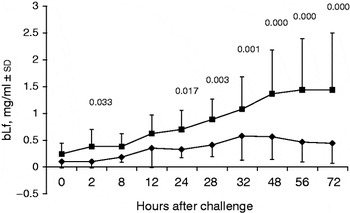
Before the intramammary endotoxin challenge, the average bLf concentration of the milk was 0·1 (sd 0·12) mg/ml (EL) and 0·24 (sd 0·19) mg/ml (LL). The concentration of bLf in the milk of the experimental quarters started to increase at 8 h PC and was still significantly higher than the pre-challenge level on the third day. Concentrations of bLf in the milk varied greatly among cows, and were higher in LL cows than in EL cows during the whole experimental period (Fig. 1). Peak concentrations of bLf in the milk were 0·58 (sd 0·45) mg/ml (EL) and 1·44 (sd 0·94) mg/ml (LL). Significant differences were found between concentrations of bLf in the milk of EL v. LL cows at 2 h (P=0·033), 24 h (P=0·017), 28 h (P=0·003), 32 h (P=0·001) and from 48 h to 72 h PC (P=0·000). Concentrations of bLf in the milk of the control quarters remained unchanged over the whole experimental period.
Concentration of bovine lactoferrin (bLf, mg/ml) in the milk of udder quarters infused with 100 μg endotoxin (LPS) in early-lactating (◆) and late-lactating (▪) dairy cows (n=9). The significances of the pair-wise comparisons are shown in the figure. Dispersion bars represent sd.

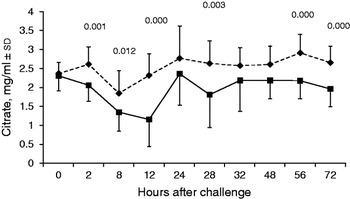
Before challenge, the average citrate concentration was 2·3 (sd 0·43) mg/ml in the milk of both EL and LL cows. After infusion of endotoxin, concentrations of citrate were higher in the EL cows than in the LL cows (Fig. 2) but variation among the cows was high. Citrate concentrations in the milk of the challenged quarters differed significantly between EL and LL groups at 2 h (P=0·001), 8 h (P=0·012), 28 h (P=0·003), 56 and 72 h PC (P=0·000). Citrate concentrations in the milk of control quarters were higher in EL cows than in LL cows (data not shown). During the first 8–12 h PC, citrate concentrations in the milk of the experimental quarters decreased, but from 24 h PC the differences remained stable.
Concentrations of citrate (mg/ml) in the milk of udder quarters infused with endotoxin (LPS) in early-lactating (◆) and late-lactating (▪) dairy cows (n=9). The significances of the pair-wise comparisons are shown in the figure. Dispersion bars represent sd.

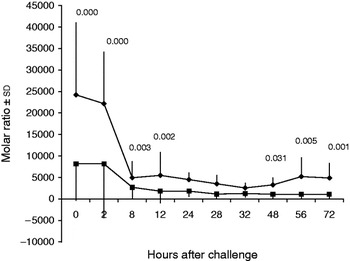
Before the endotoxin challenge, the molar ratio of citrate to bLf was higher in the milk of the EL cows: molar ratio was 24 213 (sd 16 773) in the EL group and 8180 (sd 8342) in the LL group, respectively. Molar ratios of citrate to bLf in EL and LL cows after endotoxin challenge are shown in Fig. 3. The difference at 2 h PC was statistically highly significant, reflecting the difference prior to challenge. Thereafter, significant differences between groups were recorded at 8 h (P=0·003), 12 h (P=0·002), 48 h (P=0·031), 56 h (P=0·005) and 72 h PC (P=0·001).
Molar ratios of citrate to bLf in the milk of udder quarters infused with endotoxin (LPS) in early-lactating (◆) and late-lactating (▪) dairy cows (n=9). The significances of the pair-wise comparisons are marked in the figure. Dispersion bars represent sd.

The crossover model used was valid because no significant differences were found (P=0·242) in allocating the cows first to the EL group and then to the LL group and vice versa.
Discussion
The aim of this study was to investigate changes of bLf and citrate concentrations in milk during mastitis, and the effect of the lactation period on the concentrations. The same cows in early v. late-lactation were used in a crossover trial to reduce variation among cows.
All cows developed clinical signs of mastitis at both endotoxin challenges. The clinical response was more severe in EL cows than in LL cows. EL cows also had significantly higher milk SCC than LL cows (Lehtolainen et al. Reference Lehtolainen, Suominen, Kutila and Pyörälä2003). Cows in the puerperial period or early lactation are known to be most susceptible to coliform mastitis and tend to have more severe clinical signs than cows in later lactation (Vandeputte-Van Messom et al. Reference Vandeputte-Van Messom, Burvenich, Roets, Massrat-Leen, Heyneman, Kremer and Brand1993; Shuster et al. Reference Shuster, Lee and Kehrli1996; Mehrzad et al. Reference Mehrzad, Duchateau, Pyörälä and Burvenich2002). Susceptibility of cows to coliform mastitis during the periparturient period has been suggested to be due to slow leucocyte recruitment to the mammary gland, dysfunction of PMNs, and a negative energy balance and stress during that time (Suriyasathaporn et al. Reference Suriyasathaporn, Heuer, Noordhuizen-Stassen and Schukken2000; Burvenich et al. Reference Burvenich, Bannerman, Lippolis, Peelman, Nonnecke, Kehrli and Paape2007). SCC mainly comprises PMNs, which are the predominant cells in the mammary tissues and milk during mastitis.
bLf is abundantly present in the secondary granules of PMNs but is also released from the secretory epithelium of the mammary gland (Harmon & Newbould, Reference Harmon and Newbould1980; Schmitz et al. Reference Schmitz, Pfaffl, Meyer and Bruckmaier2004; Bruckmaier, Reference Bruckmaier2005). Paradoxically, in this study, bLf concentrations in milk were significantly lower in EL cows than in LL cows, despite the more severe clinical signs and the higher milk SCC in the former group. Concentration of bLf in the milk has been reported to increase with increasing severity of mastitis (Kawai et al. Reference Kawai, Hagiwara, Anri and Nagahata1999; Hagiwara et al. Reference Hagiwara, Kawai, Anri and Nagahata2003). One possible explanation for the present results could be the depressed PMN function in EL cows and consequently a smaller release of bLf (Burvenich et al. Reference Burvenich, Paape, Hill, Guidry, Miller, Heyneman, Kremer and Brand1994). However, milk PMN activity measured as CL was similar during EL and LL (Lehtolainen et al. Reference Lehtolainen, Suominen, Kutila and Pyörälä2003). The higher concentrations of bLf seen in the LL group may simply be due to the higher bLf concentration in the udder related to the approaching dry period. In an endotoxin model, inflammation in the quarter is of short duration and epithelial damage transient, if present at all. If damaged, epithelial cells would also release bLf and contribute to its increased concentration in the milk (Boulanger et al. Reference Boulanger, Zhao and Lacasse2002; Zhao & Lacasse, Reference Zhao and Lacasse2008). In our previous study using an experimental Esch. coli mastitis model in early lactating cows (Hyvönen et al. Reference Hyvönen, Suojala, Orro, Haaranen, Simola, Rontved and Pyörälä2006), concentrations of bLf in milk were considerably higher than found in this endotoxin model, indicating the more severe inflammation in the mammary gland due to the infection by Esch. coli.
Schmitz et al. (Reference Schmitz, Pfaffl, Meyer and Bruckmaier2004) investigated mRNA expression of various soluble immune components during the acute phase of endotoxin-induced mastitis. In that study, mRNA expression for bLf was already seen 3 h after infusion of endotoxin, with a peak value at 6 h. According to our knowledge, only two previous studies exist (Harmon & Newbould, Reference Harmon and Newbould1980; Shuster et al. Reference Shuster, Lee and Kehrli1996) where bLf concentrations in the milk were studied in an endotoxin mastitis model. Harmon & Newbould (Reference Harmon and Newbould1980) used cows in mid-to-late lactation and found that bLf concentrations remained unchanged for the first 24 h, peaked on day 2 (up to 2 mg/ml) and decreased thereafter. The same pattern was seen also in our study, but bLf concentrations were here lower both in EL and LL cows, even though the endotoxin dose was higher. In the study of Shuster et al. (Reference Shuster, Harmon, Jackson and Hemken1991) average peak bLf concentrations in milk of late lactating cows were low (0·26 mg/ml), which is considerably lower than our average peak concentration in LL cows (1·44 mg/ml). The endotoxin dose used by Schuster (10 μg) was only one-tenth of that used by us (100 μg). Harmon & Newbould (Reference Harmon and Newbould1980) used an even lower dose of endotoxin (5 μg). Despite that, the concentrations of bLf in their study were higher than here, which is difficult to explain. In those studies, dairy cows of the Holstein-Friesian breed were used (Harmon & Newbould, Reference Harmon and Newbould1980; Shuster et al. Reference Shuster, Harmon, Jackson and Hemken1991) whereas our cows were of the Finnish Ayrshire breed. In dairy cows, concentration of bLf in milk varies among breeds and individuals (Gaunt et al. Reference Gaunt, Raffio, Kingsburry, Damon, Johnson and Mitchell1980; Tsuji et al. Reference Tsuji, Hirata, Mukai and Ohitaki1990) because of genetic polymorphisms in the regulatory region of the bLf gene. The significance of this variation and possible functional differences associated with the polymorphism has yet to be established (O'Halloran et al. Reference O'Halloran, Bahar, Buckley, O'Sullivan, Sweeney and Giblin2009).
Citrate is a normal constituent of milk, forming one of the main buffer systems, and has a central role in cellular energy metabolism, such as fatty acid synthesis (Faulkner & Peaker, Reference Faulkner and Peaker1982). During lactation, milk citrate induces the ferric citrate transport system in the bovine mammary gland, and competes with bLf for iron (Lin et al. Reference Lin, Hogan and Smith1999). Bicarbonate is another ion which facilitates binding of iron by bLf (Cheng et al. Reference Cheng, Wang, Bu, Liu, Zhang, Wei, Zhou and Wang2008). Concentration of bicarbonate in the milk varies according to stage of lactation and health status of the udder (Bishop et al. Reference Bishop, Schanbacher, Ferguson and Smith1976; Rainard, Reference Rainard1983). In the involuted gland, reduced citrate and increased bicarbonate concentrations are more favourable to the iron-chelating properties of bLf. During mastitis, bicarbonate transudates from blood into milk and changes the citrate:bicarbonate molar ratio, which also increases the iron-binding capacity of milk bLf. In mastitis, concentration of citrate in the milk has been reported to be slightly lower in the infected quarters than in the healthy control quarters (Majewski, Reference Majewski1986). Guidry et al. (Reference Guidry, Ost, Mather, Shainline and Weinland1983) studied citrate concentrations in the milk using an endotoxin mastitis model, and reported significant decrease in concentration of citrate in the milk in experimental as well as in control quarters. In our study, the difference in milk citrate concentrations in experimental and control quarters was not as clear as seen in infectious clinical mastitis (Majewski, Reference Majewski1986). In a study where quarters with different degrees of subclinical mastitis were compared, concentration of citrate in the milk decreased proportionally with Na and Cl concentrations, reflecting the increased severity of subclinical mastitis (Oshima & Fuse, Reference Oshima and Fuse1981). Sloth et al. studied composition of milk from healthy or mastitic cows and reported decreasing citrate concentrations, similarly to the previous study (Oshima & Fuse, Reference Oshima and Fuse1981; Sloth et al. Reference Sloth, Friggens, Lovendahl, Andersen, Jensen and Ingvartsen2003). Garnsworthy et al. (Reference Garnsworthy, Masson, Lock and Mottram2006), however, reported that variations in milk citrate concentrations were not related to mastitis and did not depend on stage of lactation: concentration of citrate was 2·17 mg/ml in early lactation, 1·86 mg/ml in mid lactation and 1·94 mg/ml in late lactation. In our study, the concentration of citrate decreased more clearly in LL cows than in EL cows after infusion of endotoxin. Basic concentrations of citrate in the milk of experimental and control quarters in EL and LL cows before challenge ranged from 2·3 mg/ml to 2·5 mg/ml.
The molar ratio of citrate to bLf has been found to be more important for the growth inhibition of bacteria than the absolute concentration of either component: a molar ratio of 75 was resulted in 50% inhibition of growth of coliform bacteria, and a ratio of 300 or greater resulted in less than 10% inhibition (Bishop et al. Reference Bishop, Schanbacher, Ferguson and Smith1976). Consequently, the lower the ratio, the more resistant is the udder against coliform infections, and the faster are bacteria eliminated from the udder. The molar ratio of citrate to Lf decreases with involution, reaching a value of 10 in the secretion of a fully involuted mammary gland (Schanbacher & Smith, Reference Schanbacher and Smith1975; Kutila et al. Reference Kutila, Pyörälä, Kaartinen, Isomäki, Vahtola, Myllykoski and Saloniemi2003). An involuted udder has been found to be very resistant to coliform infections (Oliver & Sordillo, Reference Oliver and Sordillo1989; Todhunter et al. Reference Todhunter, Smith and Hogan1990). Here, before endotoxin challenge, the molar ratio in milk was significantly higher in the EL group than in the LL group because of the higher concentration of bLf in milk of LL cows. The difference remained significant, but decreased during the first 24 h PC. The higher molar ratio in EL cows may expose early-lactating cows to intramammary infections, and may be one explanation for the well-known high proportion of mastitis post partum and in early lactation (Pyörälä, Reference Pyörälä2008). A tendency towards higher concentrations of bLf in the milk in late-lactating cows compared with early- or mid-lactating cows was also reported by other authors (Hagiwara et al. Reference Hagiwara, Kawai, Anri and Nagahata2003). In our study, molar ratios among cows varied greatly during the first hours PC, but the concentration of citrate in the milk was always higher in EL cows than in LL cows. Concentration of bLf and molar ratios could affect the susceptibility to intramammary infection during different lactation periods. Dhillon & Singh (Reference Dhillon and Singh2009) recently reported that the citrate content of quarters with chronic mastitis was much lower than in healthy quarters.
The present study confirmed results from earlier studies that stage of lactation affects the potential susceptibility to mastitis and the intensity of the inflammatory reaction. The low concentration of bLf and the consequent high molar ratio of citrate to bLf may be indigenous factors contributing to the greater susceptibility of the udder to mastitis during early lactation, especially with regard to coliform bacteria. Concentration of bLf and the molar ratio also correlate with the severity of mastitis and probably affect the speed of elimination of infection from the udder. Practical applications based on the present findings remain to be seen, but could be related to selection of more resistant dairy cows by breeding or possibly to Lf-based medicinal products to protect dairy cows from mastitis around calving.
We thank the staff in the laboratory at the Department of Production Animal Medicine, Helsinki University, for measurement of citrate concentrations.