In their efforts to gain the “long view” on Brexit, a number of commentators in recent years have attempted to argue that the origins of the contemporary debate about the United Kingdom's departure from the European Union go back at least to the time of Henry VIII, when English national sovereignty was asserted over the transnational Catholic Church in the Reformation.Footnote 1 To the extent that Brexit has its origins in the specific issue of immigration, however, Brexiteers could look more accurately to the precedents set under Henry's great-uncle, Richard III. In his parliament of 1484, the last Yorkist monarch presided over an extraordinary legislative program. Those born outside England were forbidden from entering the kingdom to act as independent skilled tradespeople or to sell wares wholesale or retail; alien craftspeople already in the land were prevented from employing any new apprentices or servants except their own children. The clear intent of this statute was to starve out skilled foreign workers. The defense of such a radical position was that honest English people were at risk of losing employment and becoming “thieves, beggars, vagabonds and people of vicious living, to the great disturbance of your highness and of your whole realm.”Footnote 2
The rhetoric of social breakdown in the wake of an unregulated flood of immigrants should remind us that there is little new about modern debates on immigration. The arguments of 1484 found ready reiteration in the controversy surrounding the free movement of labor that informed the opinions of so many voters in the 2016 referendum on the United Kingdom's membership of the European Union.Footnote 3 By the same token, although it represents the first comprehensive legislation restricting immigration at a national level, the statute of 1484 was itself the product of a century of public debate in England over whether or not the remarkable range of rights accumulated by resident aliens during the thirteenth and fourteenth centuries ought to be revised in such a way as to give preference to the interests of the king's native-born subjects and thus (so it was argued) to promote the common good of the realm at large. In what follows, I chart the development of these arguments and policies and evaluate their place within the wider cultural framework of attitudes to foreigners in later medieval and early Tudor England. Is it reasonable to refer to a consistent anti-alien “movement” in fifteenth- and early sixteenth-century England? If so, did this “movement” contribute in any larger sense to the development of English people's sense of their place within the wider world? Or was anti-alien sentiment simply a pragmatic resort that lacked intellectual coherence and fed off latent popular xenophobia to create convenient scapegoats at moments of wider economic or political crisis? To answer such questions requires us to move beyond the rhetoric of parliamentary bills and statutes and to understand the ways and the extent to which that rhetoric actually impinged on the experiences of the thousands of aliens who, in each generation, continued to make England their home.
England's Immigrants
First, though, we need to look at what data exist for the presence of immigrants in England during this period and what such information tells us about their visibility and influence. In fact, we know about the presence of foreigners in fifteenth-century England with a level of detail impossible either earlier or indeed at any point thereafter before the age of the census. The reason for this is that in 1440 the English Parliament decided to impose a tax to which only those born outside the kingdom would be liable: the so-called alien subsidy. This tax continued, albeit intermittently and in increasingly attenuated form, until 1487; some elements of it were also revived to create a distinct class of “alien” in the various tax categories established under the new forms of mainstream taxation, the so-called Tudor subsidies, in the early sixteenth century. In the online database England's Immigrants, 1330–1550: Resident Aliens in the Later Middle Ages (EIDB), my research team has gathered all the available nominal data from the alien subsidy rolls, along with that for selected counties in the records of the Tudor subsidy of 1523–24. In addition, the database includes details from a range of documents issued by the royal Chancery to aliens present within England, including protections, denizations, and confirmations of fealty, dating from between the beginning of the Hundred Years in the 1330s and the middle of the sixteenth century. (This wider chronological frame explains the date-range in the title of the database.) Altogether, the EIDB provides information on the names, genders, places of residence, and, where possible, the occupations, place of origin, and relationships to other foreign and English persons, for nearly sixty-five thousand instances of individuals who lived some or most of their lives in England in the two centuries before the coming of the Huguenots.
I should stress that the EIDB far from exhausts the wider range of information available for this period, especially in urban records. But my particular justification for focusing on the larger of the two data sets in the EIDB, derived from the records of the alien subsidy, is that this tax was both national in its reach and (potentially) comprehensive in its social range. In the early stages at least, it was applicable not only to those who had been born under the dominion of foreign powers but also to those from most of the wider dependencies of the English crown in the British Isles and France. Because it was a tax on both householders (who paid 1s. 4d.) and non-householders (who paid 6d.), it was interested in not just high-profile, established alien residents in the realm but also people of lesser estate, including laborers, servants, and even the indigent poor. Some significant groups were exempt, including the Welsh, alien monks and nuns, the foreign-born wives of aliens and of Englishmen, and children under the age of twelve. We also need to be aware that formal and informal exemptions increased considerably during the later years of the tax's existence: this is especially important in terms of people from the crown's overseas dominions in Ireland, the Channel Islands, and parts of France, who were originally made liable but in the course of the 1440s secured release from the levy. Despite the shifting tax base and various lacunae in the records, however, the alien subsidy material represents an extraordinarily detailed survey of the foreign presence in England during the late Lancastrian, Yorkist, and early Tudor periods and repays sustained quantitative and qualitative analysis.
How many foreigners were there in England at any one moment in this period? The raw data for the first alien subsidy in 1440 represent by far the most complete single snapshot available and give us a headcount of just over 18,500 people.Footnote 4 This figure can be adjusted for lacunae and exemptions through a detailed methodology developed by Jonathan Mackman to generate a total of roughly thirty thousand.Footnote 5 One's immediate response is that this is perhaps rather a paltry number. But it is vital to remember just how small a place England was in 1440. The best guesses of demographers are that the total population of England in the mid-fifteenth century was no more than 2 million to 2.5 million people. Consequently, aliens represented between 1.2 and 1.5 percent of the country's population—a proportion very similar, we may note in passing, to that recorded in the UK censuses of the end of the nineteenth century.
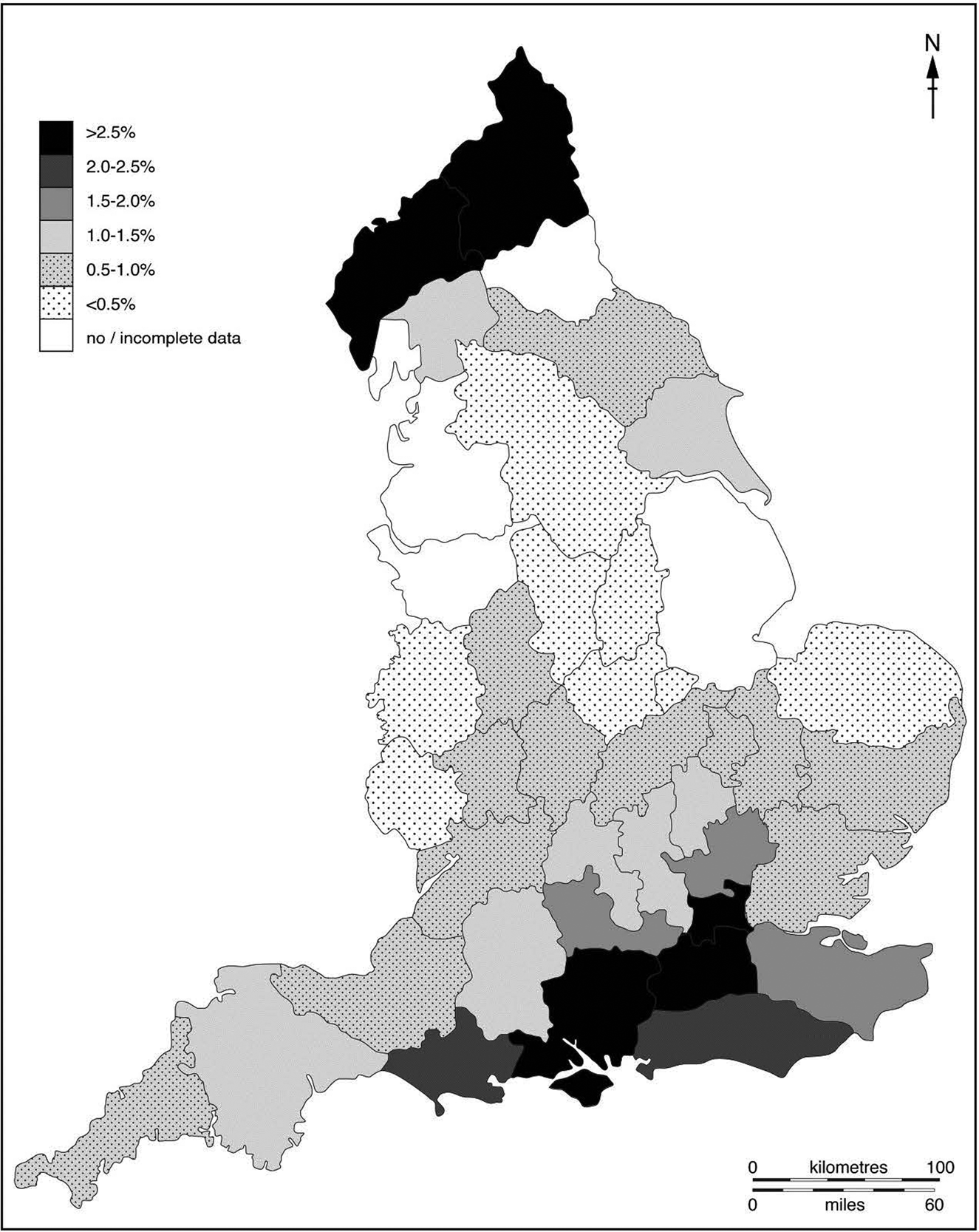
Such numbers were not, of course, distributed equally. Figure 1 expresses the number of alien taxpayers in 1440 as a percentage of the total taxpaying population represented in the poll tax of 1377 across the historic counties of England. (Note that Cheshire and County Durham were exempt from both levies, while there are no satisfactory surviving data from the 1440 alien subsidy for Lancashire and Lincolnshire.) Broadly speaking, the map shows us what we would probably expect to see: namely, a high or relatively high population density of aliens in the south (as a result of proximity to the continent) and the far north (as a result of heavy immigration from Scotland), with a generally considerably lower density in the Midlands—though just as the data for Lincolnshire in 1440 are missing, so too are those for Norfolk notoriously incomplete; these east-coast counties would otherwise undoubtedly deliver “hotter” shadings on the map.
Alien taxpayers in 1440 as a proportion of total taxpayers in England in 1377, by county. EIDB; The Poll Taxes of 1377, 1379 and 1381, ed. Carolyn C. Fenwick, Records of Economic and Social History, n.s. 27, 29, 37 (Oxford, 1998–2005)

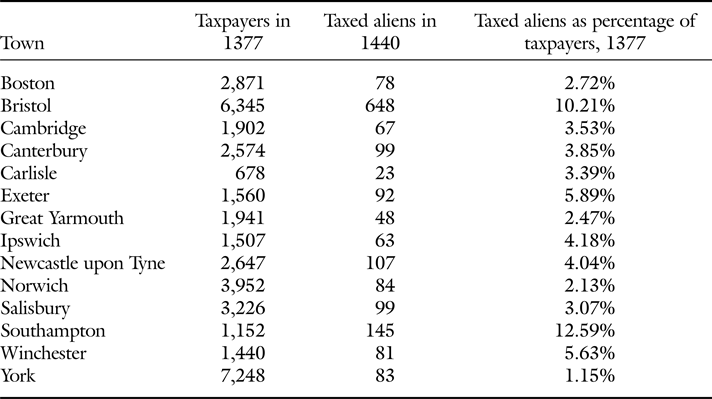
We can also use the alien subsidy records to quantify the general assumption that aliens tended to gravitate toward urban areas. J. L. Bolton and Derek Keene have suggested that first-generation immigrants in the fifteenth century represented between 6 and 10 percent of the population of London.Footnote 6 I can now go considerably further and present my team's calculations for other towns. Table 1 again expresses the 1440 data as a proportion of the total taxable population of the relevant towns in the poll taxes of 1377. The two standout places here are Bristol and Southampton, where the index suggests remarkable figures, with first-generation immigrants from outside England making up over 10 percent of the urban populace. This figure is all the more remarkable given that the 1440 data are not adjusted here for exemptions and lacunae. The deficiencies of registration and record-keeping may mean that the proportions expressed here for Norwich and York are probably too low. Still, all the other towns in this list, and a number of others not included, deliver alien populations in excess of 3 percent—which means that such urban centers had populations of alien immigrants that were at least twice the national average.
Aliens in selected English towns, 1440, Ormrod, Lambert, and Mackman, Immigrant England, 62

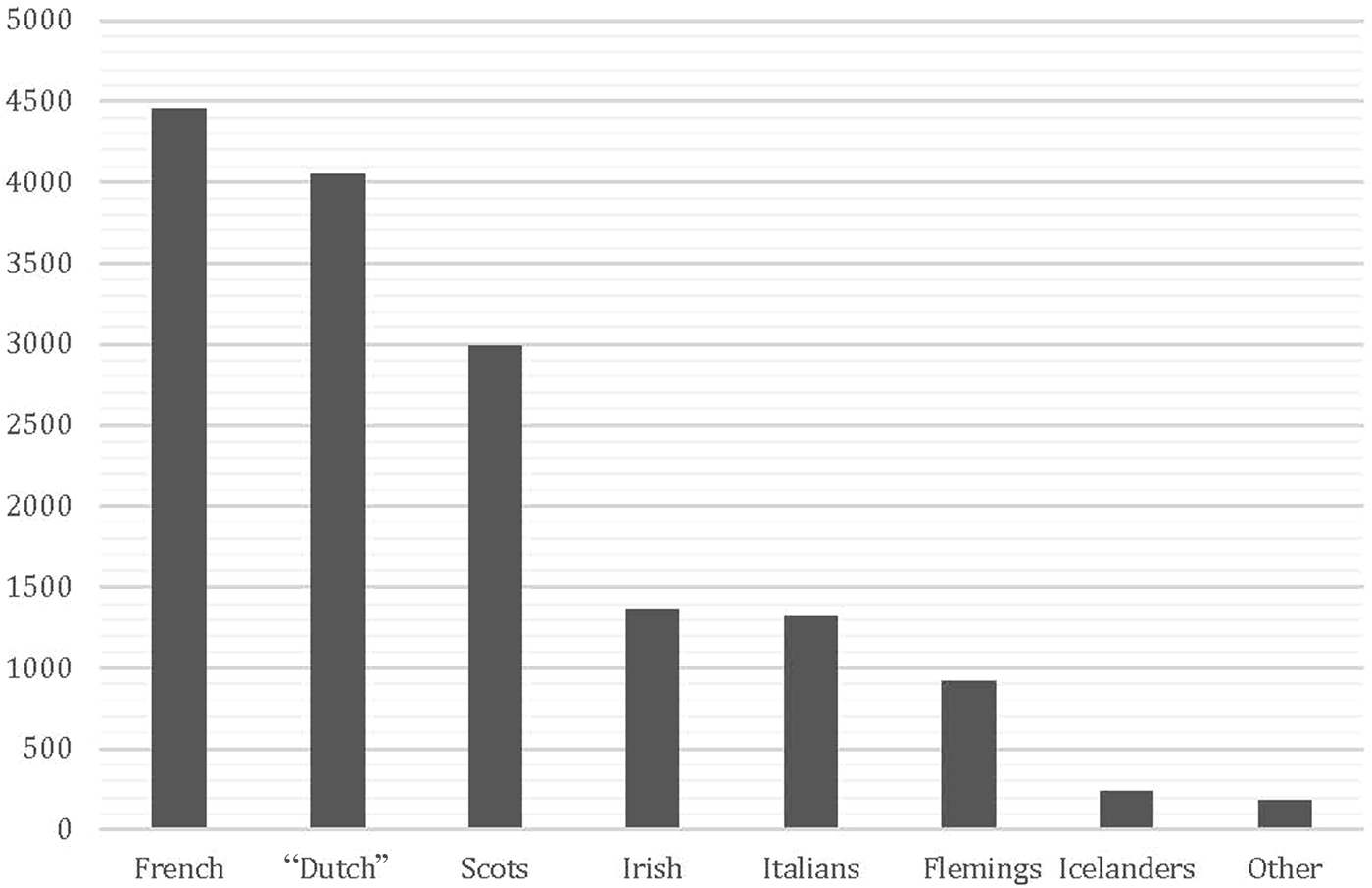
The alien subsidy records are also rich in detail about the ethnic profile of England's late medieval immigrants. In just under a third of the total number of cases across the lifespan of the alien subsidies, nationality or ethnicity was declared or can be inferred. Figure 2 takes the entire sample across the whole range of the alien subsidies from 1440 to 1487 and may tend to overrepresent those categories, such as the Scots, who were liable throughout, while underrating groups such as the Irish, who secured exemption relatively early in the history of the tax. In effect, then, the graph quantifies “national” numbers in the alien subsidy returns accumulatively rather than at any one moment in time.Footnote 7 For what it is worth, however, the largest categories identified over time in this way were (in order): the French (including those from specified regions within the late medieval kingdom of France and other francophone areas,Footnote 8 the “Dutch” (a catch-all linguistic term, which also here includes those specified as coming from a wide variety of principalities in the Holy Roman Empire and the German-speaking regions of northwest Europe),Footnote 9 and the Scots.Footnote 10 These groups are followed at some distance by the Irish, the Italians (who were usually identified in the records in terms of their allegiance to a specific city state),Footnote 11 and the Flemings (probably underrated because the non-French speaking people of Flanders were often otherwise lumped in with the “Dutch”). Among the smaller groupings were the Icelanders; the category of “Other” in the graph brings together small numbers from the Channel Islands, Scandinavia, and Iberia, as well as a group of Greeks, who included refugees from the westward advance of the Ottoman Turks.Footnote 12
Nationalities in the alien subsidy returns, 1440–1487, EIDB

The alien subsidies provide by far the largest coherent sample for the presence of foreigners in the fifteenth century. Fortunately, however, they can be supplemented with other materials also captured in the EIDB. A series of more than eighteen hundred oaths of fealty offered by subjects of the Duke of Burgundy living within England in 1436–37 is especially rich in specifying the city or rural township of origin for this significant immigrant community. The visualizations of places of origin that can be generated by searches in the EIDB are particularly interesting in this case, since a number of the locations specified were already lost at this date or subsequently as a result of the devastating coastal floods in the region over the course of the fifteenth century.
The alien subsidies also provide some occupational data, though it often has to be inferred from surnames. In the alien subsidies, it was much more common to give occupations in the case of non-householders, largely because the individuals in question were servants defined in relation to their alien and English masters and mistresses. Letters of denization, however, are more consistent in this respect, and not always just in terms of identifying skilled professions and trades. Between 1540 and 1544, Henry VIII's government pushed for a process of what might be called the “mass denization” of French residents in England, which resulted in a rush of new documentation. A Chancery roll now in the Westminster Abbey Muniments provides occupational data in over 50 percent of its twenty-five hundred individual entries; these includes significant number of servants and laborers whose masters seem to have paid the reduced fee of 6s. 8d. in order to avoid the risk of having their employees deported.Footnote 13
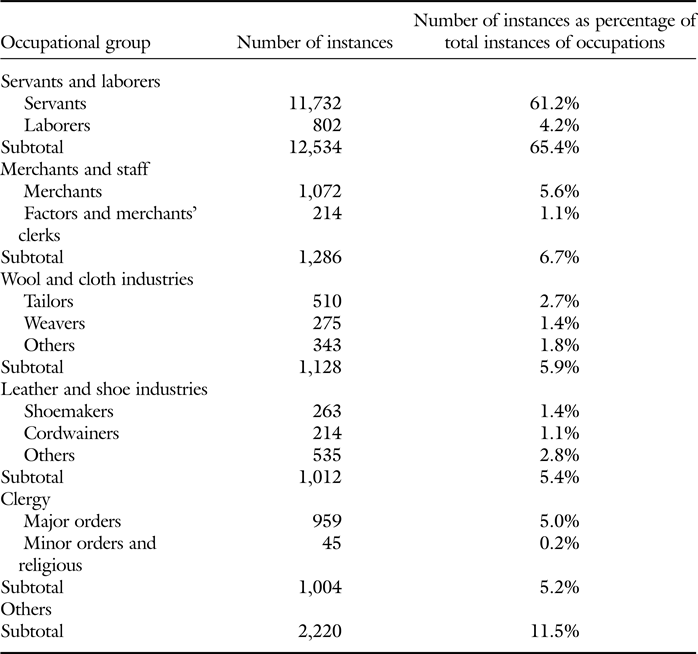
Taking all the material in the EIDB together, we have occupational data in some 30 percent of cases. The very large number of occupations specified are rationalized in Table 2 into a series of broader categories that help to give a sense of the overall evidence. By far the most frequently designated occupation was that of “servant”—though, for the reason outlined in the previous paragraph, this group appears to be overrepresented in the sample. Here, we should also remember that “servant” has a wide potential application, including journeymen and apprentices as well as agricultural laborers and household staff. Among the skilled occupations, the largest numbers are for merchants, their factors, and brokers; the producers of (and traders in) cloth and clothing; those involved in the processing of leather and the making of leather goods and footwear; and the clergy, in major and minor orders, including a few officially exempt religious. I later refer to some of the smaller professional and occupational groupings represented in this sample, which help us to understand the extraordinary diversity of the immigrant profile in this period.
Occupations of immigrants, EIDB

Finally in this section, I briefly explore some of the ways in which the information in the EIDB can be analyzed using the database's faceting facilities in order to build up more detailed impressions of the various national groupings I defined just above. The Italians in England, for example, were almost exclusively high-status males, focused in London, Southampton, and Sandwich and all involved in some way in international trade. The Icelanders, males and females, also clustered in a small number of towns, especially Hull, Nottingham, Coventry, and Bristol; they were of very diverse social status, and Peter Fleming has argued that the unnamed Icelandic youths registered for the alien subsidies in Bristol may have been trafficked as part of a North Atlantic trade in slaves.Footnote 14 A relatively high proportion of the “Dutch,” who settled in many towns across England, tended to arrive in the country already skilled and established in their trades, bringing wives and children with them. A much higher proportion of the French and the Scots, by contrast, were unskilled laborers, whose presence in England may have been merely seasonal, or part of a life-cycle process. The largest group of unmarried women in the national samples, recently analyzed by Judith M. Bennett, was made up of Scots in the north of England who worked as casual labor and were often necessarily highly mobile—“vagabonds,” as a few of the alien subsidy returns classify them.Footnote 15 The French were also, perhaps less predictably, a common feature in the countryside of southern and Midland England: indeed, the name “John the Frenchman” appears with sufficient frequency in rural communities in these areas to suggest that, rather like Piers Plowman, he was something of a recognized universal type in the agricultural workforce of late medieval England.
Rules and Regulations
With these data about England's late medieval immigrants, I now consider the issues that their presence evoked and the ways in which public authorities responded to demands for the regulation of the alien population. My first point is about legal definitions and rights. The law of alienage as it developed in the later thirteenth and fourteenth centuries was remarkably permissive. It gave immigrants access to English courts on a wide range of personal and criminal actions, including the right to have half the jury made up of people of their own nationality. From the thirteenth century, self-governing cities and towns also allowed aliens to enter the urban franchise and thus to ply their trade, hold property, and participate in civic government. Finally, as Bart Lambert and I have shown, it was in the later 1370s that the crown developed the process known as denization, by which foreign nationals could renounce their allegiance of birth, take an oath of fealty, and enjoy virtual parity of rights with their English neighbors.Footnote 16 Prior to 1400, the law seems to have drawn little distinction between what it would later call the alien enemy and the alien friend: while sanctions were certainly put in place against immigrants understood to have been born under the jurisdiction of the king's enemies, especially the French and the Scots, a range of protections was still available, and the common law did not automatically exclude alien enemies from access to justice. The major message of all these measures was that trustworthy immigrants could expect to be recognized as rightful inhabitants of the realm and active participants in its affairs.
Until the end of the fourteenth century, both the economic climate and economic policy also seemed distinctly to favor the alien. The shift in the social distribution of wealth over the late fourteenth and fifteenth centuries, with the middling and lower orders gaining significant expendable income, is well known. Perhaps less well understood is that this “golden age of the English laborer” was also something of a golden age for the immigrant—at least for the skilled immigrant.Footnote 17 The purchasing power especially of bourgeois society created important new markets in England for just those high-quality, luxury goods and services that consumers traditionally associated with the continent: fine woolen cloth and many other quality fabrics, plate and jewelry, decorative furniture, paintings and hangings, and so on. The alien subsidy returns show just how much further this distinctive element of economic life extended, with male and female immigrants being prominent providers of a whole range of specialist services: from apothecaries to attorneys, bakers to brickmakers, carpenters to cooks, glaziers to goldsmiths, schoolmasters to sex workers.Footnote 18 It was, for example, immigrant “Dutch” brewers who helped make the new strong beer of the Low Countries not only fashionable in England but even exportable back home—a late medieval example of “coals to Newcastle” if ever there was one!
Riding especially high on this wave of rights and prosperity were the foreign merchants who chose to make England their permanent home. There was little or nothing, it seemed, to prevent such men from ascending to the very heights of civic and political life. In York, the process is exemplified by the Hanseatic merchant Henry Wyman, who possibly originated from Gdansk but established himself as a permanent presence in the city during the 1380s, when he took out both the civic freedom and denization. In the early fifteenth century, he served as lord mayor of the city not once but three times. His social network is glimpsed in the fact that his daughter Joan married the son of no less a figure than the chief justice of England, Sir William Gascoigne of Gawthorpe. Wyman's story is not typical, of course, but it is, importantly, replicated elsewhere: for example, by his contemporary, the Gascon Edmund Arnold, who served both as mayor and as MP for Dartmouth in Devon; and later by Cristoforo Ambrogi, from Florence, who was twice elected mayor of Southampton.
From the late fourteenth century, however, this general model of an integrated immigrant population began to come under strain, and a more visible anti-alien sentiment appeared in local and national politics. From the 1370s onward, England's balance of trade went into the negative, as the volume of wool exports declined and that of the increasingly diverse range of imports rapidly increased. The advent of a prolonged economic recession—the so-called great slump—during the middle years of the fifteenth century intensified the economic difficulties of the kingdom and provoked a particular crisis of confidence in urban communities of the Midlands and the north.Footnote 19 The answer to the problem was found in an elaborate series of protectionist measures that attempted, quite deliberately, to set aliens at a disadvantage to denizens. Parliament's decision to impose the alien subsidies in and after 1440 was part of a much wider policy of “making aliens pay:” this also involved increasingly punitive tariffs on foreigners trading goods out of England, and strict limits on the amount of English bullion that could be taken out of the country. From the early fifteenth century, moreover, the ruling elites in London and in provincial centers such as Bristol, Ipswich, Norwich, and Coventry began to focus on alien craftspeople, subjecting their products to special scrutiny, banning them (in some cases) from participating in skilled manufacture, and/or excluding them from the urban franchise.
Political and diplomatic changes also affected aliens’ rights. The gradual loss by the 1450s of all England's previous possession in France, with the exception of Calais, seems also to have bred a harder line in terms of the legal rights accorded to foreigners. By the middle of the fifteenth century, common lawyers were claiming that aliens, like women, monks, villeins, outlaws, and excommunicates, had no rights at law other than those that the crown allowed by exception. Consequently, those who were the subjects of foreign powers in enmity with the crown of England could be denied the forms of access to the courts that “aliens in amity” still generally enjoyed.Footnote 20
We thus return full circle to the place where we began: Richard III's anti-immigrant legislation of 1484 and the significant restrictions that this placed, in theory, on the ability of skilled aliens to work in England. Before we completely buy into the anti-alien rhetoric of the civic and national legislation, however, we need to admit the fundamental inconsistency, not to say hypocrisy, of this campaign. By no means all English towns, for example, succumbed to the easy resort of scapegoating the alien. In Southampton, the former mayor John Payne whipped up anti-alien fervor in the late 1450s and early 1460s in pursuit of factional political interests, but his movement rapidly lost force, and friendly relations were subsequently reestablished with the significant alien community of the town.Footnote 21 Meanwhile in Exeter, as Maryanne Kowaleski has revealed, no impediments existed to prevent the formal admission of aliens into economic and political life, and there is every sign that foreign nationals were extremely well integrated into civic society.Footnote 22 In smaller towns and in the countryside, the comparative rarity of skilled aliens made the whole issue of foreigners largely irrelevant, and we need to remember that the 1484 legislation specifically declared that immigrant agricultural laborers were exempt from restrictions on their freedom of movement. All of this, combined with continued demand for foreign goods and services, meant that the national legislation simply lost a good deal of its force. Although early Tudor parliaments chose on several occasions to reissue the statute of 1484, they made telling concessions: skilled immigrants could now run their own businesses, under certain conditions, and important exceptions were applied for people with skills considered to be in short supply within the realm, ranging from bakers and brewers to scriveners and surgeons.
Attitudes to Aliens
The general picture I am painting here—of a conditional but continued permissiveness around the involvement of aliens in the economy—inevitably raises significant questions about more general, cultural approaches to immigrants in later medieval England. Here we face many conceptual and methodological challenges. An intermittent debate over the past couple of decades over whether sixteenth-century England can rightly be regarded as xenophobic has reached little consensus; this is not altogether surprising, given the ambiguity of the term and the subjective nature of the evidence on which we have to work.Footnote 23 Below, I describe as plainly as possible the situation in England as I see it during the two centuries prior to the Reformation.
That English culture in this period exhibited wide and deep suspicion of the peoples of other lands and cultures is inevitably most keenly manifest in relation to members of religious and racial minorities. In 1290, the English state took the most radical line possible with regard to the Jews and expelled them from the kingdom under a prohibition that remained formally in place until the seventeenth century. The only Jews tolerated in England during this period were therefore converts; late medieval English Christian culture played constantly on a popular anti-Semitism that stereotyped the imagined Jew as a usurer and child-stealer.
While Muslims from North Africa and the Near and Middle East were never formally banned in the same way, they too were only really accepted if they converted. John Blanke (Black), the well-attested trumpeter at the court of Henry VII and Henry VIII, is the first identifiable black person to leave both a documentary trail and an artistic likeness; for this reason he is still often, though quite erroneously, claimed to be the first person of color in England.Footnote 24 Blanke's apparently rather exalted career needs also to be set properly in context: the reason why there are not more black people in the archives before and during his generation is simply that most were considered the chattels of their masters and were therefore generally invisible to the eyes of public authorities. A few emerge momentarily from such oblivion. The married couple Benedict and Antonia Calaman, who paid the alien subsidy in London in 1483 at the non-householder rate, were described by the assessors as “of Inde”—that is, originating from somewhere in the great landmass eastward of the Holy Land.Footnote 25 The same description is applied to James Black, a servant at Dartmouth in Devon in 1484 who, like John Blanke, carries a direct marker of ethnicity in his name.Footnote 26 And Cordelia Beattie has recently explored the case, found in the Chancery petitions, of Maria Moriana, whose name denotes Moorish origins, and who seems to have started her life in England as a slave of Filippo Cini, a well-known Southampton-based Venetian merchant. Maria is remarkable in a number of ways; she refused to be sold to one of her master's Italian business associates, and she evidently claimed manumitted status in order to present her case before the chancellor. But the odds remained firmly stacked against her, and her case in all probability failed.Footnote 27 In sum, while the English theoretically accepted a degree of racial diversity, the institutional and cultural opposition to Jews, Muslims, and people of color marks late medieval England as a place of deliberate and systematic prejudice.
English attitudes toward white Christians from other parts of Europe could at times be scarcely less hostile. A powerful tradition stretching back to the time of King John had it that alien-born people were a negative influence at the royal court. Sometimes this was only by way of general prejudice: in the fourteenth century, for example, moralists complained that the new male fashions of high-waisted jerkins and pointed shoes were the result of the invidious influence of the followers of two foreign queens, Philippa of Hainault and Anne of Bohemia. Not surprisingly, a more serious and sustained suspicion attached to the king's enemies, especially the French and the Scots, with whom England was in a state of real or potential hostility for virtually the whole of this period. Urged on by royal propaganda, popular culture inevitably cast such peoples in profoundly negative terms: the Scots were uncouth barbarians, the French were effeminate roués, and both, of course, were inherently treacherous. On a number of occasions in the fourteenth and early fifteenth centuries, the English government indulged in a populist campaign of repatriation, either stripping out the aliens in the royal household or announcing that all French and Scots should depart the realm. Interestingly, the sense of public animosity was still stronger toward the Flemish, possibly because their political leaders shifted sides so frequently during the course of the Hundred Years War. According to the author of the Libelle of Englyshe Polycye, a polemic written in 1436 at the time of one such defection from the English cause, the Flemings were such uncouth sots that two of them would consume a whole barrel of beer at a sitting, simply pissing under the table as they drank.Footnote 28
Not surprisingly, there were also occasional outbursts of violence against aliens, infamous “flashpoints” when toleration seemed momentarily to break down and an aggressive form of xenophobia briefly prevailed. By far and away the most devastating such incident so far as the targeted victims were concerned was the Peasants’ Revolt of 1381, when some thirty-five to forty Flemings were massacred in the capital; Italians and other aliens also had their houses looted—though, as far as is known, their lives were spared. Nor was the anti-foreigner violence of 1381 completely confined to London: there were also outbreaks of hostility against people from Flanders in a number of towns in East Anglia. Again in 1435–36, the decision of the Duke of Burgundy to betray the English cause and side with the French whipped up a frenzy in the metropolis in which the Flemish and other subjects of the duke were attacked on the streets of London and Southwark, with some loss of life. In the 1450s, 1460s, and 1490s, further outbreaks of violence in the capital targeted specific alien groups—Flemings, Italians, and Hanseatics. Finally, in 1517, came the xenophobic London riots known as the Evil May Day.Footnote 29
Looking back over the entirety of the evidence for organized anti-alien violence in England during the fourteenth and fifteenth centuries, I think it is appropriate to make three basic points. First, such attacks were very rarely purely spontaneous. In most cases, indeed, it is possible to argue that they were orchestrated by craft masters and traders eager to exploit moments of disorder to express their frustration at alien groups whom they regarded as overly privileged or doing too well: Flemish weavers in 1381, “Dutch” brewers and brothel keepers in 1435–36, Italians with special rights to export wool in 1457, and so on. Secondly, public authorities were generally quick to act, recognizing that violence against aliens had the effect of damaging the king's reputation abroad and inciting lawlessness at home: the use of charges of treason against the ringleaders of Evil May Day in 1517 is particularly instructive in this case. Thirdly, and most obviously, significant mob violence against foreigners was almost entirely confined to the capital, where aliens were not only conspicuous but there was a particularly enduring tension between their rights and those of native merchants and craftspeople.
For all these reasons, it seems to me unwise to suggest on the basis of such decidedly limited evidence of organized attacks on foreigners that English society as a whole was any more, or any less, innately xenophobic in the early sixteenth century than it had been in the middle of the fourteenth. What did change was the official position of civic, and then central, governments. Bart Lambert and Milan Pajic have recently demonstrated that the attack on the Flemings in London during the Peasants’ Revolt was the direct consequence of the frustration of the native cloth workers over the crown's policy, evident since the 1330s, of attracting people skilled in cloth production to settle in England and help kick-start the nascent woolen cloth industry. In this instance, political factions within the city mobilized the mob to vent frustration against a royal policy that was famously (or infamously) pro-immigrant.Footnote 30
By the time of the Evil May Day, by contrast, various towns—and after 1484, the crown itself—had nailed their protectionist colors to the mast by developing policies that explicitly prevented aliens from participating in regulated trade: creating, in other words, what the Tory government of the 2010s has openly referred to as a “hostile environment” for immigrants. In an important forthcoming study, Sarah Rees Jones has pointed to the coincidence between the anti-alien legislation of 1484 and the shift in language forms around that time, whereby elites (including the bourgeoisie) who had previously practiced a functional multilingualism across French, Middle Dutch, and Low German came to assert a much more insular “English” language.Footnote 31 While governments might shy away from the unintended consequences of their actions, it is difficult to resist the idea that the combined effects of anti-alien legislation and a more strident isolationism were to give unofficial license to hate crimes against foreigners. Writing at the turn of the sixteenth century, the Italian visitor Andreas Franciscus claimed that the Londoners habitually attacked his compatriots on the streets at night.Footnote 32 And half a century later in the time of Mary I, Annibale Litolfi wrote to Guglielmo Gonzaga, Duke of Mantua: “The English are naturally the enemies of all aliens.”Footnote 33 How many ethnic groups, in many parts of the kingdom, lived under the simmering threat of verbal and physical abuse from their English neighbors in the sixteenth century?
An Inclusive Society
For all these and other examples of xenophobic “direct action,” however, what is chiefly remarkable about the period 1330–1550 is the paucity of such evidence, even in that most active hub of anti-alien sentiment, the city of London. Insofar as it can be quantified, the accumulated evidence suggests that host communities in almost all English towns and villages found pragmatic ways to live in relatively peaceful coexistence with immigrants from continental Europe. In seeking evidence and explanations for this, we can first usefully address the spatial dimension. In those urban centers that had significant immigrant populations, it would appear that aliens very rarely segregated themselves, or were forced to segregate, from the English. The alien subsidy material is especially helpful here because in Bristol, York, and London it was administered at the level of the ward or parish and thus allows us to detail the distribution of aliens across these cities. Settlement in York clearly followed economic rather than ethnic lines, with the more prosperous, skilled aliens inhabiting the central commercial area and those dubbed “servants” tending to reside in the suburban parishes. In Bristol, aliens lived in every part of the city: relatively high numbers were recorded in some of the suburban areas, reflecting the low status of many of the Irish and Icelanders in the town, but there was never a sense of a discreet “alien zone.” Finally, in London, immigrants were mostly concentrated in the outer ring of the city's wards, most of all on the Thames waterfront, where Italians were especially conspicuous, though there were no areas where one “national” grouping dominated to the exclusion of others. The very high mobility of many alien residents in London and York, evidenced by tracking individuals across different parts of the two cities in successive payments of the alien subsidy, is again a sign of the absence of ghettoization. The most important point is that foreigners were encountered everywhere across the English townscape.
In the countryside, the story is inevitably rather different but equally telling. In Cumberland in 1440, for example, some 296 aliens (all of them probably Scots) lived outside the county town of Carlisle, distributed across no fewer than eighty-eight different settlements. Even in a county such as Essex, which had a much higher level of urbanization and commercialization, this model of rural diaspora apparently holds good: in fact, well over 50 percent of aliens here were accounted for in small towns and villages where they numbered six or fewer residents; a remarkable ninety-six villages returned only one or two names of alien settlers in 1440. There are a number of contrasting implications. On the one hand, the pattern of rural distribution speaks to the relative weakness of purposeful chain migration: the agricultural economy simply did not allow people to cluster and stay in alien “nodes” outside major towns. On the other hand, the distribution data speak to the ubiquity of the foreigner: the vast majority of people in later medieval England must, on the basis of the alien subsidy material, have encountered “real-live” foreigners at some stage in their lives.
Scattered settlement coupled with the obvious difficulties of maintaining contact with the old country also meant that very few ethnic groupings coming into England had the opportunity to recreate and perpetuate their native cultures. A litmus test here is the survival of natal languages. In certain cases we can imagine how larger family units and small ethnic groupings self-consciously preserved their natal tongues. In 1483, the “Dutch” armorer Vincent Toteler was living in London's Tower ward with his “Dutch” wife, Antonia, their “Dutch” daughter, Margaret, and twelve alien servants, nine of them also “Dutch” and one having his “Dutch” wife with him. There is surely little doubt what linguistic tradition was observed in that household.Footnote 34 Similarly, in rural Devon, as Maryanne Kowaleski has shown from the 1440 alien subsidy returns in the EIDB, there were sufficient places that were homes to small clusters of French-born immigrants to allow us to imagine francophone micro-communities flourishing in the late medieval West Country.Footnote 35 Other incomers, however, found ways of responding positively to their increasingly monolingual English neighbors. In 1347, during one of the periodic security emergencies on the south coast, a Frenchman named John Gournay persuaded the citizens of Salisbury to support his exemption from a general repatriation on the grounds that he was only in the city “to improve his English.”Footnote 36 In the vast majority of cases, aliens had no choice but to follow Gournay's example and acquire new linguistic skills. And in the process, they also acquired new identities: the alien subsidy material bears especially striking testimony to the way in which a proportion of almost all national groupings except the Italians took on anglicized surnames (many of them occupational) that made them, at least in the written record, no different from their English neighbors, acquaintances, in-laws, and friends.
The most important area where we may glimpse the forces of social integration is inevitably in religious observance. The formal prohibition on Jews, the effective ban on the practice of Islam, and the official persecution of Lollards and Protestants meant that all immigrants to England before the Henrician and Edwardian reformations were assumed to conform to a universal, Catholic Christianity. Very occasionally, we find characteristic and ostensibly exclusive forms of religious observance among particular national groupings. In London, as Justin Coulson has shown, aliens founded their own fraternities, such as the Holy Blood of Wilsnack, supported by people from Saxony, which met at the Augustinian friary (later, interestingly, the Protestant Dutch church).Footnote 37 The Italians in London were especially well organized in terms of religion; the merchants of Lucca had their own chapel dedicated to the cult of the Holy Face in the hospital of St. Thomas of Acon in London. Outside the capital, however, evidence of such devotional “importations” is extremely limited before the arrival of Lutheran converts at the beginning of the sixteenth century. By far the most striking case is Norwich, where at least two houses of pious women were recorded in the fifteenth century in apparently direct emulation of the beguine movement in the Low Countries. One of them, possibly established in the building that is now the Britons Arms, was founded by the English merchant John Asger, whose wife, Catherine, was from Flanders.Footnote 38
These examples indicate the potential variety of opportunity for religious observance by aliens in urban areas that had sizable and stable communities of immigrants from particular parts of Europe. Even so, they can hardly compare with the explicitly separatist “stranger churches” that developed after the advent of the highly visible Protestant refugees into England from the 1540s. As Emily Vine has recently elucidated, it was the presence of these religious minorities, together with the arrival of new groups of converts from Judaism and Islam, that really created sensitivities around the spatial distribution and social exclusion of foreigners in later Tudor London.Footnote 39 In the vast majority of provincial towns and villages in pre-Reformation England, by contrast, immigrants were necessarily socialized into the mainstream public rituals and routines of the parish church and the parish guilds.
It is also worth pointing out that such new parishioners encountered much that was familiar. The letters of denization and alien subsidy returns indicate that significant numbers of parish clergy, along with a smaller number of church workers in minor orders, came from other parts of the British Isles and the continent, especially from France, to minister and work in England. In 1440, for example, the Irishman John Reynald was vicar of Frilsham in Berkshire; John Idill, a Scot, was a chaplain at Langley in Northumberland; Gilam Frensshman, of obvious origin, was employed as a “holy water clerk” at Feltham in Middlesex. John Miles, a foreigner of unstated nationality, was parish clerk to the church of St. Lawrence, Bristol, in 1441.Footnote 40 The fabric of English parish churches, many of which were remodeled or rebuilt in this period, also owed much to the contribution of foreign craftsmen, especially from the Low Countries and northern France, working as sculptors, woodcarvers, glaziers, and painters. At Long Melford in Suffolk, for example, the assessors of the alien subsidies in the 1480s enumerated a Flemish sculptor, Henry Phelypp, and a Flemish painter, Anthony Lammoson, both lodging with John Clopton, Esquire, and probably at work on decorating the newly completed parish church.Footnote 41 It is very easy to romanticize these images of inclusivity. But in terms of its overall engagement with immigrants, it might indeed be argued that the ecclesia Anglicana was a significantly more accommodating church before the Reformation than it came to be after it.
Conclusions
How, then, to draw some conclusions about then—and now? It was in the period between the late thirteenth and the early sixteenth centuries that the formal entity of the alien was first invented in England, and when many of the modern debates about immigration had their first iterations. My material on the immigrant experience in late medieval England, because overwhelmingly about white Europeans, may not appear at first glance to speak particularly strikingly to the diversity agenda as it is often articulated today. In Britain at least, however, it chimes very closely with the current heated debate about the supposed consequences of freedom of movement within the European Union. As the fifteenth-century material vividly attests, there is absolutely nothing new about our current reliance on other parts of Europe to fill shortages of highly skilled workers and to do the kinds of low-status jobs that British people will not generally accept. This is where I think the late medievalists in particular have missed a crucial element of our history, by assuming far too readily that there was no significant immigration between the Norman Conquest of 1066 and the coming of the French and Dutch protestant refugees after 1540. The “social turn” in our discipline has produced enormous advances in the past two generations as a result of our willingness to acknowledge the voices of previously underrated or ignored groups in society: women; peasants; heretics; those who were lesbian, gay, bisexual, transgender, or queer; those who were disabled; and others. It is now time to reflect on the fact that an important feature of diversity in Britain throughout its documented past has been the presence of immigrants.