Implications
The benefits of polyunsaturated fatty acids (PUFA) supplementation on reproductive performance of lactating dairy cows have been extensively researched, particularly the effects of these fatty acids (FAs) on pregnancy establishment and embryo loss. Lactating beef cows are physiologically different from dairy cows, and little is known about the use of these feeding strategies on beef cows. This study provides further evidence that different profile of FAs in the diet can alter the profile of FAs in bovine tissues, however, failed to show any benefits on the evaluated parameters associated with pregnancy establishment and reproductive performance in cattle.
Introduction
The use of supplemental fat to enhance cattle reproduction has been extensively investigated (Hess et al., Reference Hess, Lake, Scholljegerdes, Weston, Nayigihugu, Molle and Moss2005). Although energy status is known to dictate reproductive performance (Schillo, Reference Schillo1992; Staples et al., Reference Staples, Burke and Thatcher1998; Hess et al., Reference Hess, Lake, Scholljegerdes, Weston, Nayigihugu, Molle and Moss2005), research indicates that reproductive outcomes are positively impacted by fat supplementation regardless of an increase in energy intake (Mattos et al., Reference Mattos, Staples and Thatcher2000; Santos et al., Reference Santos, Bilby, Thatcher, Staples and Silvestre2008a; Thatcher et al., Reference Thatcher, Santos and Staples2011), suggesting that specific FAs may play a role on controlling reproductive biology in cattle.
Supplementation of PUFA has been reported to alter follicular growth in both beef (Hightshoe et al., Reference Hightshoe, Cochran, Corah, Kiracofe, Harmon and Perry1991) and dairy cows (Lucy et al, Reference Lucy, Michel, Thatcher and Staples1991; Lucy et al., Reference Lucy, De La Sota, Staples and Thatcher1993) postpartum. In addition, supplementing PUFA may also improve reproductive performance through different mechanisms, such as increasing progesterone production, and altering oocyte and embryo quality (Mattos et al., Reference Mattos, Staples and Thatcher2000; Santos et al., Reference Santos, Bilby, Thatcher, Staples and Silvestre2008a). Moreover, the inclusion of n-3 (Mattos et al., Reference Mattos, Staples, Williams, Amorocho, McGuire and Thatcher2002; Mattos et al., Reference Mattos, Staples, Arteche, Wiltbank, Diaz, Jenkins and Thatcher2004) and n-6 (Cipriano et al., Reference Cipriano, Cooke, Rodrigues, Silva, Bohnert, Marques, Vasconcelos, Pires and Cerri2016) PUFA during maternal recognition of pregnancy potentially improves reproductive performance by optimizing the interaction between uterus and conceptus (Santos et al., Reference Santos, Cerri and Sartori2008b; Thatcher et al., Reference Thatcher, Santos and Staples2011; Cooke et al., Reference Cooke, Cappellozza, Guarnieri Filho, Depner, Lytle, Jump, Bohnert, Cerri and Vasconcelos2014).
Overall, these findings indicate that PUFA supplementation can potentially optimize uterine environment during the establishment of pregnancy. Furthermore, evidence of altered follicular dynamics in cows supplemented with greater concentrations of PUFA indicates a possible effect on postpartum resumption of estrous cycles. Hence, we hypothesized that PUFA supplementation of beef cows would alter parameters associated with establishment of pregnancy and cow reproductive performance. To test this hypothesis, two separated experiments evaluated the effects of PUFA supplementation on primiparous (Experiment (Exp.) 1) and multiparous (Exp. 2) suckled beef cows.
Material and methods
Experimental design, animals and treatments
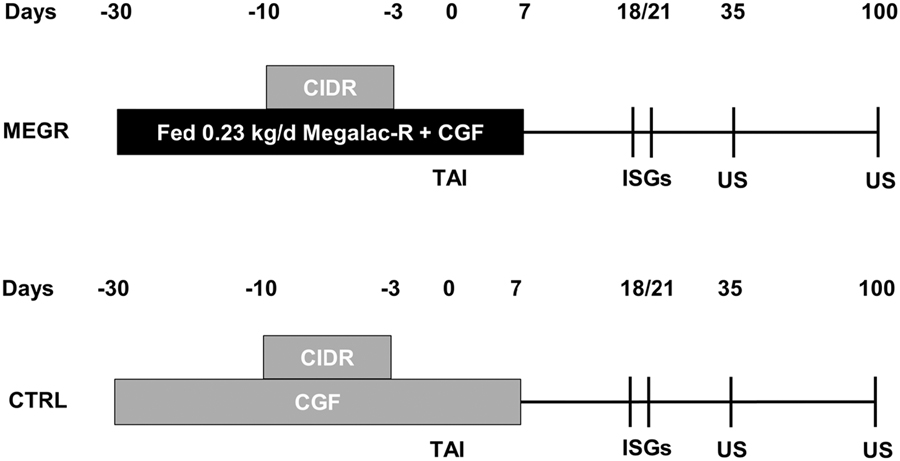
Exp. 1 was performed at the University of Florida North Florida Research and Education Center in Marianna, FL. In total, 60 Angus and Brangus crossbred primiparous cows (428±42 kg BW) were stratified by breed, body condition score (BCS), and days postpartum, and were randomly assigned to one of two dietary treatments: (1) cows individually received a supplement of 1.36 kg/day of corn gluten feed (CGF; CTRL; n=30); and (2) treated cows individually received a supplement of 1.36 kg/day of CGF and 0.23 kg/day of Megalac-R (Church & Dwight, Princeton, NJ, USA; MEGR; n=30). Cows were grazing on a mixed winter forage pasture of rye (Secale cereale) and ryegrass (Lolium multiforum; CP=23% and total digestible nutrients (TDN)=62% dry matter (DM)) and had ad libitum access to water and mineral. Cows were individually penned daily and supplemented with their respective treatments. The supplementation period occurred from 30 days before the initiation of the breeding season until 7 days after fixed-time artificial insemination (TAI; Figure 1). Cows were fed at 0700 h and treatments were readily and completely consumed. After treatments were consumed, all cows were placed together in the same pasture. Cows that became pregnant to TAI were monitored until calving to determine gestation length and calving distribution.
Experiment 1 outline and schematic of treatments. Cows were assigned to one of two treatments: control (CTRL; 1.36 kg/day of corn gluten feed) and treatment (MEGR; 1.36 kg/day of corn gluten feed and 0.23 kg/day of Megalac-R (Church & Dwight, Princeton, NJ). Supplementation occurred from 30 days prior to fixed-time aritificial insemination (TAI) until 7 d post-TAI. At initiation of the breeding season cows were exposed to the 7-days CO-Synch+CIDR estrous synchronization protocol and submitted to TAI. On days 18 and 21 blood samples were collected in order to isolate peripheral blood leukocytes and measure interferon stimulated genes (ISG) expression. Pregnancy was diagnosed using transrectal ultrasonography (US) on days 35 and 100 after TAI

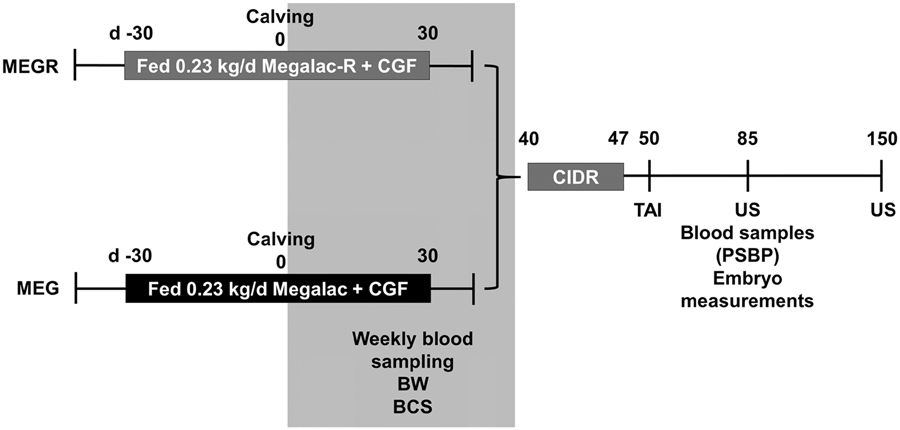
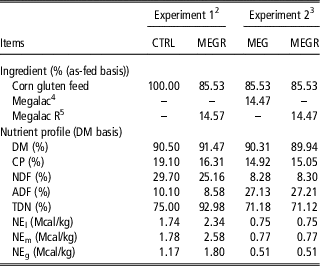
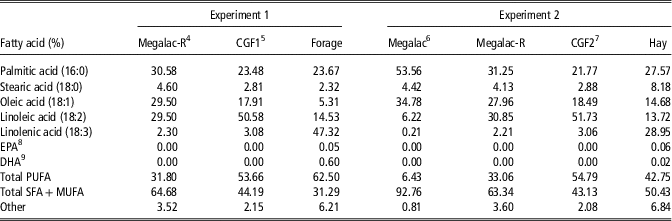
In Exp. 2, 66 Angus and Brangus crossbred multiparous cows (621±70 kg BW) were stratified by breed, parity, and the previous year’s calving date, and were randomly assigned to one of two treatments: (1) cows received a supplement containing 0.65 kg/day CGF and 0.23 kg/day of Megalac (Church & Dwight; MEG; n=32); and (2) cows received a supplement of 0.65 kg/day of CGF and 0.23 kg/day of MEGR (n=34). As opposed to Exp. 1, the MEG treatment was designed to ensure that supplements had the same level of energy (Table 1); therefore, the MEG treatment was an isocaloric control and the only difference between the two supplements was the greater concentrations of PUFA (Table 2) in MEGR. The supplementation period was calculated to start 30 days before the expected calving date and to last until 30 days after parturition (Figure 2). The mean day in which cows received supplement before calving was 29.7±11.6 days, whereas mean postpartum days receiving supplement was 29.3±11.6. Cows were individually penned and provided with treatments 5 days per week at 0700 h. All cows had ad libitum access to bermudagrass hay (Cynodon dactylon; CP=14% DM and TDN=53% DM), water and mineral supplement during the supplementation period. Treatments were completely consumed. After completion of the supplementation period, all cows were grazing on a mixed winter forage pasture of rye and ryegrass for the remainder of the study. After parturition, cow and calf BW and cow BCS were assessed weekly until the beginning of the breeding season. After calving, blood samples were collected weekly to evaluate the postpartum resumption of estrous cycles. Pregnant cows were monitored until calving, and calf birth weight and calving distribution were determined.
Experiment 2 outline and schematic of treatments. Cows were assigned to one of two treatments: control (MEG: 0.65 kg/day of corn gluten feed [CGF] + 0.23 kg/day of Megalac [Church & Dwight, Princeton, NJ]) and treatment (MEGR: 0.65 kg/day of CGF + 0.23 kg/day of Megalac-R [Church & Dwight, Princeton, NJ]). Supplementation occurred from 30 days prior to parturition until 30 days after calving. Blood samples were collected weekly from parturition until the beginning of the breeding season. At initiation of the breeding season cows were exposed to the 7 days CO-Synch+CIDR estrous synchronization protocol and submitted to TAI (day 50). Pregnancy was diagnosed using transrectal ultrasonography (US) 35 and 100 days after TAI. Concentration of PSPB and embryo size (CRL) were evaluated on day 85.

Composition and nutrient analysisFootnote 1 of treatments to beef cows supplemented in Experiments 1 and 2

TDN=total digestible nutrients; NE=net energy requirement.
1 Analyzed by a commercial laboratory using a wet chemistry package.
2 Control (CTRL; 1.36 kg/day of corn gluten feed) and treatment (MEGR; 1.36 kg/day of corn gluten feed and 0.23 kg/day of Megalac-R).
3 Low polyunsatured fatty acid (PUFA) supplement (MEG; 0.65 kg/day of corn gluten feed+0.23 kg/day of Megalac) and high PUFA fat supplement (MEGR; 0.65 kg/day of corn gluten feed+0.23 kg/day of Megalac-R).
4 Ruminally partially inert saturated fatty acid supplement (Megalac).
5 Ruminally partially inert PUFA supplement (Megalac-R).
Fatty acid profileFootnote 1 of feedstuffs provided to beef cows in Experiments 1Footnote 2 and 2Footnote 3

MUFA=monounsaturated fatty acids.
1 As a percentage of fatty acids. All feedstuff were anlayzed for fatty acid content according to procedures described by Tripathy et al. (Reference Tripathy, Torres-Gonzalez and Jump2010). Samples were collected biweekly during the experimental period for both Experiments 1 and 2. A composite of the different samples collected was analyzed.
2 Control (CTRL; 1.36 kg/day of corn gluten feed) and treatment (MEGR; 1.36 kg/day of corn gluten feed and 0.23 kg/day of Megalac-R).
3 Low polyunsatured fatty acid (PUFA) fat supplement (MEG; 0.65 kg/day of corn gluten feed+0.23 kg/day of Megalac) and high PUFA supplement (MEGR; 0.65 kg/day of corn gluten feed+0.23 kg/day of Megalac-R).
4 Ruminally partially inert PUFA supplement (Megalac-R).
5 Corn gluten feed for Experiment 1.
6 Ruminally partially inert saturated fatty acid (SFA) supplement (Megalac).
7 Corn gluten feed for Experiment 2.
8 EPA (20:5).
9 DHA (22:6).
For both experiments, feed samples were collected biweekly throughout the experimental period and analyzed for nutrient composition (Table 1) by a commercial laboratory (Dairy One Forage Laboratory, Ithaca, NY, USA). Feed samples were also analyzed for FA contend (Table 2) according to Tripathy et al. (Reference Tripathy, Torres-Gonzalez and Jump2010).
Breeding season management
For both experiments, all cows were submitted to the 7 days CO-Synch+controlled intravaginal drug release (CIDR) estrus synchronization protocol (Larson et al., Reference Larson, Lamb, Stevenson, Johnson, Day, Geary, Kesler, DeJarnette, Schrick, DiCostanzo and Arseneau2006) at the beginning of the breeding season, which consisted of an injection of 100 µg of gonadorelin (2 ml of Factrel; Zoetis Animal Health, Parsippany, NJ, USA) concurrent with the insertion of a new CIDR insert (Zoetis Animal Health) containing 1.38 g of progesterone. Seven days after CIDR insertion, the device was removed and cows received a 25 mg injection of dinoprost tromethamine (5 ml of Lutalyse; Zoetis Animal Health). Cows were exposed to TAI 60 to 66 h after CIDR removal and were administered 100 µg of gonadorelin. Five days after TAI, all females were exposed to fertile clean-up bulls to complete a 70-day breeding season. Average days postpartum at TAI was 96±12 and 49±12 for Exp. one and Exp. two, respectively.
Diagnosis of pregnancy and embryo morphometry
In both experiments, diagnosis of pregnancy was assessed by transrectal ultrasonography on days 35 and 100 of gestation with an Ibex portable ultrasound equipped with a linear 5 MHz multifrequency transducer (E. I. Medical Imaging, Loveland, CO, USA). In Exp. 2 a video was recorded at the first pregnancy diagnosis and a frame-by-frame procedure was used to choose an ideal position and orientation of the conceptus to measure embryo crown-to-rump length (CRL), which was measured using an image capturing software (ImageJ; National Institutes of Health, Bethesda, MD, USA). Two separate individuals measured images twice independently and final CRL were calculated as the mean of both measurements.
Blood collection and analysis
All blood samples were collected from the jugular vein into 10-ml evacuated vials containing 143 IU of sodium heparin (Vacutainer; Becton, Dickinson and Company, Franklin Lakes, NJ, USA). Blood samples were immediately placed on ice and later centrifuged at 1500×g at 4°C for 15 min. The plasma was transferred into polypropylene vials and stored at −20°C. Plasma samples from Exp. 1 and Exp. 2 were analyzed for FA concentrations using gas chromatography (Agilent 7890; Agilent Technologies Inc., Wilmington, DE, USA) as described by Tripathy et al. (Reference Tripathy, Torres-Gonzalez and Jump2010). Blood samples were collected from a subsample of cows for each treatment within each experiment (n=24; 12 per treatment) at two different time points: samples were collected during the supplementation period (at TAI for Exp. 1 and at calving for Exp. 2) and again when cows were not being supplemented (at the beginning of Exp. 1 and at pregnancy diagnosis for Exp. 2). Plasma FA values obtained during the non-supplemental period served as a covariate; therefore, the values reported in this study are covariately adjusted.
In Exp. 2, blood samples were collected weekly to evaluate the resumption of postpartum estrous cycles via plasma progesterone concentrations, and 35 days after TAI assess pregnancy-specific protein-B (PSPB). Plasma concentrations of progesterone were determined by an immunoassay system (Immulite 1000; Siemens, Munich, Germany) as previously described (Mercadante et al., Reference Mercadante, Fontes, Ciriaco, Henry, Moriel, Ealy, Johnson, DiLorezenzo and Lamb2015). Cows with plasma concentrations of progesterone above 0.5 ng/ml were considered to be cycling, as previously reported (Mallory et al., Reference Mallory, Busch, Ellersieck, Smith and Patterson2014; Nash et al., Reference Nash, Mallory, Ellersieck, Poock, Smith and Patterson2014). Plasma concentrations of PSPB were analyzed using a quantitative ELISA assay (BioPRYN, BioTracking LLC, Moscow, ID). Two control samples of known hormone concentrations were included in all assays. The intra-assay CV was 1.44% for progesterone, and 8.37% for PSPB.
In addition, blood samples were collected on days 18 and 21 after TAI in Exp. 1 for the isolation of peripheral blood leukocytes according to Gifford et al. (Reference Gifford, Racicot, Clark, Austin, Hansen, Lucy, Davies and Ott2007). Briefly, after centrifugation and collection of plasma, buffy coat fractions were harvested by pipetting and transferring into 15 ml conical tubes. Red cell lysis buffer (150 mM NH4Cl, 10 mM NaHCO3, 1 mM EDTA, pH 7) was added to the buffy coat for a total volume of 15 ml. Tubes were inverted several times and incubated at room temperature for 5 min. Samples were then centrifuged at 300×g for 10 min at 4°C and the supernatant discarded. The peripheral blood leukocytes pellet was mixed with 5 ml of red blood cells lysis buffer, incubated at room temperature for 5 min, centrifuged at 300×g for 10 min at 4°C and the supernatant discarded. The peripheral blood leukocytes pellet was washed with ice-cold phosphate-buffered saline, centrifuged at 300×g for 10 min at 4°C and the supernatant discarded. The peripheral blood leukocytes pellet was resuspended with 0.8 ml of Trizol (Molecular Research Center Inc., Cincinnati, OH, USA), transferred into 1.5 ml microtubes, and stored at −80°C until further analysis.
RNA extraction and quantitative real-time reverse transcription PCR
Total RNA was further purified and concentrated (PureLink RNA Mini Kit; Invitrogen, Carlsbad, CA, USA) according to the manufacturer’s recommendations. Total RNA concentration and quality was determined by measuring absorbance at 260 and 280 nm (using a NanoDrop spectrophotometer; Thermo Fisher Scientific Inc., Waltham, MA, USA). All RNA samples contained a 260 : 280 nm ratio >1.8; 1 μg of total cellular RNA was treated with deoxyribonuclease (DNase I RNase-free; Invitrogen) before synthesis of complementary DNA (cDNA) using the High-Capacity cDNA Reverse Transcription kit (Applied Biosystems Inc., Foster City, CA, USA). Complementary DNA (50 ng) was amplified using gene-specific primers (Table 3) and SYBR Green chemistry in a 20-μl reaction (Mastercycler EP Realplex System; Eppendorf AG, Hamburg, Germany) in duplicate. Amplification parameters were 40 cycles of a two-step amplification protocol (15 s at 95°C followed by 60 s at optimized annealing temperature of 57°C and by 15 s at 95°C followed by 15 s at 60°C). Primer efficiencies ranged from 90% to 105%. Reactions were run in duplicate and were comprised by melting curve analysis to ensure amplification of a single product. Samples lacking reverse transcriptase also were included to verify that no genomic contaminants were amplified. Threshold cycle (Ct) values for reference genes, Peptidylprolyl Isomerase A (PPIA; Green et al., Reference Green, Okamura, Poock and Lucy2010), were used for computation of ΔCt values. These internal controls were chosen because their transcript abundance was not altered by breed, parity, time period or treatment for the particular tissue of interest. Relative fold change in gene expression was calculated with the formula 2−ΔΔCt. Intra- and interassay CV were, respectively, 0.35 and 0.34% for PPIA, 1.5 and 1.67% for MX2, 0.37, and 0.37% for OAS1.
Nucleotide sequence of bovine-specific primers used in the quantitative real-time reverse transcription PCR to determine expression of target genes in Experiment 1

Statistical analysis
Experiment 1 was a completely randomized design. Animals received treatments individually and individual supplement intake was measured; therefore, animal was considered the experimental unit. All data were analyzed using the SAS statistical package (SAS Institute Inc., Cary, NC, USA; Version 9.4). Pregnancy rates to TAI and overall pregnancy rates were analyzed by ANOVA using the GLIMMIX procedure of SAS, with the fixed effect of treatment. Gestation length and calf birth weight were analyzed using the MIXED procedures, with treatment as a fixed effect. Cow BW and BCS were analyzed as repeated measures using the MIXED procedure of SAS. The covariance structure used was unstructured and was selected based on the smallest Akaike information criterion. The model included the fixed effects of day, treatment and treatment×day interaction. Subject was considered cow within day. Relative messenger RNA (mRNA) expression of interferon-stimulated genes (ISG) was analyzed within day by ANOVA using the MIXED procedure of SAS, with the final model including the fixed effect of treatment.
Experiment 2 was a completely randomized design. Animals received treatments individually and individual supplement intake was measured; therefore, animal was considered the experimental unit. Data were analyzed using SAS. Cyclicity, pregnancy rates at TAI and overall pregnancy rates were analyzed by ANOVA using the GLIMMIX procedure of SAS. The model included the fixed effects of treatment, cyclicity and the random effect of breed. Embryo measurements and concentrations of plasma PSPB were analyzed using the MIXED procedure of SAS. The model included the fixed effect of treatment and the random effect of breed. When analyzing calf birth weight in 2015 and 2016 and calf adjusted weaning weight in 2015, the MIXED procedure of SAS was used and the models included the cow BW at the beginning of the study as a covariate and cow breed as a random effect. Gestation length was analyzed using the same procedure; however, cow BW was not included as a covariate. To analyze the effects of treatment on subsequent calving distribution, the LIFETEST procedure was used to perform a survival analysis. Cow BW and BCS were analyzed by ANOVA with repeated measures using the MIXED procedure of SAS. The covariance structures was unstructured and was selected based on the smallest Akaike information criterion. The model included the fixed effects of week, treatment and treatment×week interaction. Subject was considered cow within day. Treatment differences with P⩽0.05 were considered significant.
Results
Experiment 1
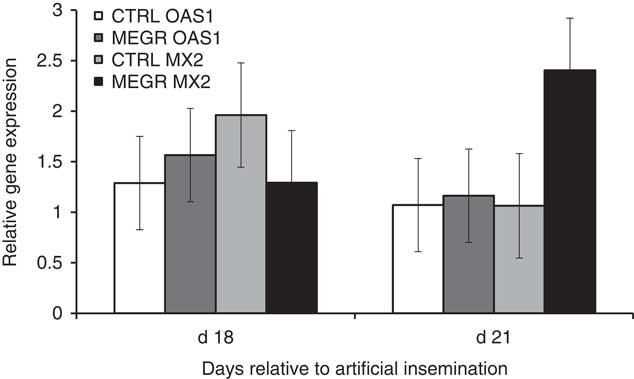
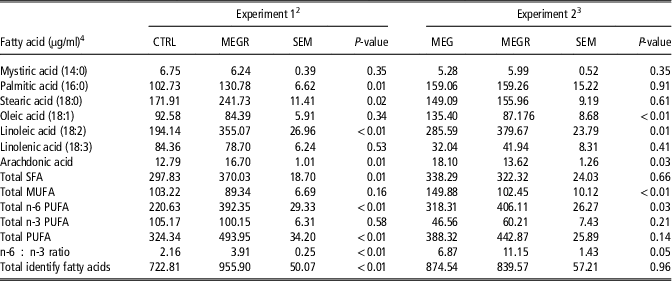
Plasma samples were analyzed for FA content and plasma FA profile is summarized in Table 4. Cows in the MEGR treatment had greater (P<0.01) total FA concentrations when compared with CTRL cows, as well as greater (P<0.01) concentrations of total PUFA and FAs from the n-6 family. Consequently, MEGR cows had a greater n-6 : n-3 ratio than CTRL cows (P<0.01). Cow BW and BCS were not altered (P=0.52 and P=0.52, respectively) by the supplementation of PUFA from 30 days before TAI until 7 days post-AI (values not reported). There was no difference between treatments on pregnancy rates to TAI (MEGR=43.3% v. MEG=63.3%; P=0.12). In addition, final pregnancy rates were not altered by dietary supplements (MEGR=93.3% v. MEG=96.7%; P=0.56). There was no effect of treatment on mRNA expression of OAS1 on either day 18 (P=0.67) or day 21 (P=0.72), nor did treatments alter the mRNA expression of MX2 (Figure 3) on day 18 (P=0.96) or day 21 (P 0.17; Figure 3). All pregnant cows were monitored until parturition during the subsequent calving season and gestation length was assessed. Cows that were supplemented with MEGR had greater gestation length than the cows in the CTRL treatment (MEGR=281.1 days, CNTRL=285.3 days; P=0.02). Even though MEGR supplement increased gestation length, calf birth weight (P=0.20) was not altered by treatments.
Expression of 2′-5′-oligoadenylate synthetase 1 (OAS1) and Myxovirus resistance 2 (MX2) messenger RNA on days 18 and 21 after artificial insemination in suckled beef cows treated with polyunsaturated fatty acids in Experiment 1. Treatments: CTRL: 1.36 kg/day of corn gluten feed and MEGR: 1.36 kg/day of corn gluten feed+0.23 kg/day of Megalac-R. There was no effect of treatment on days 18 or 21 for both MX2 and OAS1.

Plasma fatty acid profileFootnote 1 of cows enrolled in Experiments 1 and 2

SFA=saturated fatty acids; MUFA=monounsaturated fatty acids.
1 Blood samples were analyzed for fatty acid content according to procedures described by Tripathy et al. (Reference Tripathy, Torres-Gonzalez and Jump2010).
2 Control (CTRL; 1.36 kg/day of corn gluten feed) and treatment (MEGR; 1.36 kg/day of corn gluten feed and 0.23 kg/day of Megalac-R).
3 Low polyunsaturated fatty acid (PUFA) fat supplement (MEG; 0.65 kg/day of corn gluten feed+0.23 kg/day of Megalac) and high PUFA fat supplement (MEGR; 0.65 kg/day of corn gluten feed+0.23 kg/day of Megalac-R).
4 Blood samples were collected from a subsample of cows for each treatment within each experiment (n=24; 12/treatment) at two different time points (samples were collected during the supplementation period and again when cows were not supplemented). Plasma fatty acid values obtained during the non-supplemental period served as a covariate; therefore, the reported values are covariately adjusted.
Experiment 2
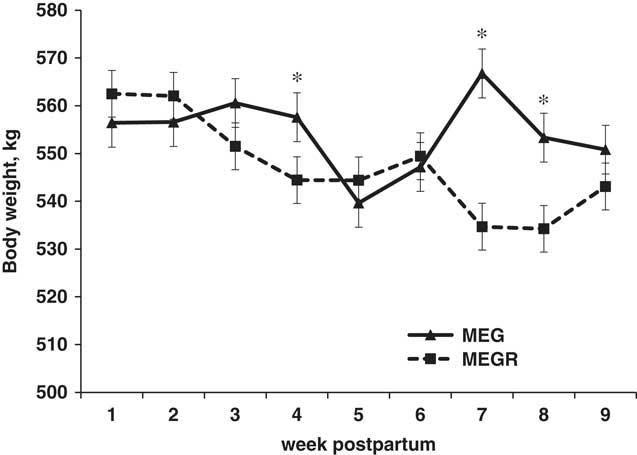
Plasma samples were analyzed for FAs content (Table 4). As opposed to Exp. 1, there was no difference between treatments in plasma total identified FAs in Exp. 2 (P=0.96). However, MEGR successfully increased (P=0.03) plasma concentrations of total n-6 family PUFA; therefore altering circulating n-6 : n-3 ratio (P=0.05). In Exp. 2, a treatment×week interaction (P<0.01) was observed for cow BW, where cows receiving MEGR had a lesser BW compared with MEG cows at weeks 4, 7 and 8 postpartum (Figure 4). Supplementation with PUFA also had a negative effect on cow BCS (P<0.01). Although BW and BCS were negatively influenced by MEGR, treatments did not alter the percentage of cows cycling before the initiation of the breeding season (MEGR=26.5% v. MEG=15.6%; P=0.29). Supplementation of greater levels of PUFA did not alter conception rates when cows were exposed to TAI (MEGR=35.4% v. MEG=33.3%; P=0.87). Final pregnancy rates were also not altered by the dietary treatments (MEGR=84.4% v. MEG=91.2%; P=0.29). Similarly, there was no effect of supplement on circulating concentrations of PSPB (4.87 ng/ml; P=0.46) and treatments did not alter embryo size (12.3 mm; P=0.24).
Effects of prepartum and postpartum polyunsaturated fatty acid supplementation of suckled beef cows on postpartum BW for Experiment 2. MEG: 0.65 kg/day of corn gluten feed+0.23 kg/day of Megalac and MEGR: 0.65 kg/day of corn gluten feed+0.23 kg/day of Megalac-R. Treatment×week interaction (P=0.048). *P<0.05.

The performance of calves born during Exp. 2 was affected by treatment. Although calf birth weight was similar (P=0.89), a treatment effect was observed on calf adjusted weaning weight to 205 days (P=0.03), with calves nursed by cows receiving MEGR having reduced weaning weights compared with calves nursed by MEG cows (218.2±5.13 v. 235.4±5.51 kg, respectively). All cows diagnosed as pregnant during the experimental period were maintained as a single herd until calving. Calf birth weight was recorded and there was no effect of treatment on calf birth weight (72.3 kg; P=0.11) and gestation length (279.9 days; P=0.58). As opposed to Exp. 1, treatment did not influence gestation length in Exp. 2. Subsequent calving distribution also was not influenced by supplementation of PUFA (P=0.52).
Discussion
We hypothesized that supplementation strategies using a lipid supplement with high concentrations of essential PUFA could be a potential alternative to increase reproductive performance of beef cows. However, the main challenges when evaluating the effects of dietary strategies on reproductive performance are to design studies that have enough statistical power to detect differences in binomial response variables, and at the same time control individual intake of treatments. Therefore, we decided to evaluate if PUFA supplementation alters the profile of FAs in cow plasma, and consequently changes parameters known to be associated with cow fertility and performance, focusing on continuous variables such as mRNA expression of ISG, plasma PSPB concentration, fetal CRL and calving distribution.
It has been previously reported (Santos et al., Reference Santos, Cerri and Sartori2008; Cooke et al., Reference Cooke, Cappellozza, Guarnieri Filho, Depner, Lytle, Jump, Bohnert, Cerri and Vasconcelos2014; Cipriano et al., Reference Cipriano, Cooke, Rodrigues, Silva, Bohnert, Marques, Vasconcelos, Pires and Cerri2016) that altering the profile of FAs that are absorbed by the small intestine, results in changes in the profile of FAs in blood plasma as well as in the reproductive tissues of bovines. It is through changes in the FA profile of reproductive tissues that PUFA supplementation is thought to alter the physiology and potentially improve reproductive performance in cattle (Santos et al., Reference Santos, Cerri and Sartori2008). In the present study, supplementation of MEGR to suckled beef cows altered the plasma FA profile. Increasing the percentage of n-6 FAs in the diet increased plasma total n-6 PUFA and n-6 : n-3 FAs ratio. Furthermore, changes in the profile of plasma FAs occurred not only when MEGR was added to a CGF supplement (Exp. 1) but also when isocaloric fat supplements with different FA profile were offered (Exp. 2).
Although supplementation of long-chain FAs during the postpartum period increased dominant follicle size in both beef (Hightshoe et al., Reference Hightshoe, Cochran, Corah, Kiracofe, Harmon and Perry1991) and dairy females (Lucy et al., Reference Lucy, De La Sota, Staples and Thatcher1993), PUFA supplementation did not alter the resumption of the postpartum estrous cycles in the present study. However, the percentage of cows initiating postpartum estrous cycles is a variable that follows a binomial distribution, and the number of cows enrolled in Exp. 2 may have been insufficient to identify an effect of treatment. Nevertheless, all pregnant cows were monitored until parturition and calving distribution was analyzed with a survival analysis that provided greater statistical power to detect a difference between treatments. There was still no effect of treatment on subsequent calving distribution. Similar results were reported when supplementation of linoleic acid (C18:2, n-6) did not alter cyclicity in lactating dairy cows (Silvestre et al., Reference Silvestre, Carvalho, Crawford, Santos, Staples, Jenkins and Thatcher2011). It is important to recognize that there was an overall small number of cyclic cows in Exp. 2, which was probably associated with the short interval between calving and the beginning of the breeding season.
Uterine prostaglandin F2α concentration increases during the first weeks postpartum (Guilbault et al., Reference Guilbault, Thatcher, Drost and Hopkins1984), and arachidonic acid (C20:4, n-6) present in the phospholipids of endometrial cellular membranes is the main precursor for prostaglandin F2α synthesis in the uterus. Arachidonic acid can be synthesized from linoleic acid that is derived from the diet. Supplementation of linoleic acid to dairy cows from 30 days prepartum until 30 days postpartum increased the n-6 : n-3 FAs ratio in caruncular tissue, and increased plasma prostaglandin F2α metabolite concentrations during the first week postpartum. However, transition diets with high levels of n-6 FAs failed to improve conception rates to artificial insemination (Silvestre et al., Reference Silvestre, Carvalho, Crawford, Santos, Staples, Jenkins and Thatcher2011). In the present study, MEGR cows had greater concentrations of plasma n-6 FAs in both Exp. 1 and Exp. 2. In addition, although there was a numerical difference in conception rates to TAI in Exp. 1 (MEGR=43.3% v. MEG=63.3%), treatments did not significantly alter conceptions rates to TAI or final pregnancy rates in either experiment. Yet again, it is important to emphasize that these experiments were not design to determine whether PUFA supplementation alters pregnancy rates or cyclicity. Rather, we were interested on the effects of the proposed PUFA supplementation strategies on biological parameters associated with fertility.
Supplementation of long-chain FAs in the diet may decrease prostaglandin F2α secretion and have an anti-luteolytic effect that could influence the interaction between the conceptus and uterus (Thatcher et al., Reference Thatcher, Santos and Staples2011). In Exp. 1, the supplementation period was completed 7 days after TAI and cows could potentially have experienced an effect of PUFA supplementation on the uterus–conceptus interactions. Therefore, peripheral blood leukocytes were isolated from plasma to evaluate mRNA expression of ISG (OAS1 and MX2) on days 18 and 21 after TAI. The expression of these genes increase in peripheral blood leukocytes when an elongating conceptus that can actively secrete interferon-τ (IFNτ) is present (Hansen et al., Reference Hansen, Sinedino and Spencer2017). There were no effects of PUFA on OAS1 and MX2 mRNA expression. In addition, evaluation of PSPB may also serve as a marker for embryonic/fetal viability and placental function (Wallace et al., Reference Wallace, Pohler, Smith and Green2015). Similarly, no differences between treatments were noticed. Embryo CRL length was also not altered by treatment, indicating that although supplementation of PUFA can alter FAs composition of fetal tissues (Cooke et al., Reference Cooke, Cappellozza, Guarnieri Filho, Depner, Lytle, Jump, Bohnert, Cerri and Vasconcelos2014), it did not change embryonic growth in the present study.
Pregnancy rates to TAI were improved in Bos indicus beef cows by feeding a similar source of PUFA as the present study (Lopes et al., Reference Lopes, Cooke, Reis, Peres and Vasconcelos2011). Furthermore, feeding the same PUFA during maternal recognition of pregnancy, increased concentrations of linoleic acid in the blood plasma, endometrium, corpus luteum and conceptus. Treated cows also had greater circulating concentrations of progesterone, greater corpus luteum volume and greater concentrations of IFNτ in uterine luminal flushing (Cooke et al., Reference Cooke, Cappellozza, Guarnieri Filho, Depner, Lytle, Jump, Bohnert, Cerri and Vasconcelos2014). In addition, PUFA supplementation altered mRNA expression of target genes related to pregnancy establishment (Cipriano et al., Reference Cipriano, Cooke, Rodrigues, Silva, Bohnert, Marques, Vasconcelos, Pires and Cerri2016). These benefits reported in beef cows (Lopes et al., Reference Lopes, Scarpa, Cappellozza, Cooke and Vasconcelos2009 and Reference Lopes, Cooke, Reis, Peres and Vasconcelos2011; Cooke et al., Reference Cooke, Cappellozza, Guarnieri Filho, Depner, Lytle, Jump, Bohnert, Cerri and Vasconcelos2014) seem to be associated with a different mechanism to that proposed by researchers conducting studies in dairy cows (Mattos et al., Reference Mattos, Staples and Thatcher2000; Santos et al., Reference Santos, Bilby, Thatcher, Staples and Silvestre2008a; Thatcher et al., Reference Thatcher, Santos and Staples2011), since levels of n-6, but not n-3 FAs were not altered in the studies performed in beef cows (Cooke et al., Reference Cooke, Cappellozza, Guarnieri Filho, Depner, Lytle, Jump, Bohnert, Cerri and Vasconcelos2014; Cipriano et al., Reference Cipriano, Cooke, Rodrigues, Silva, Bohnert, Marques, Vasconcelos, Pires and Cerri2016). Supplementation of n-3 FAs to dairy cows decreased prostaglandin F2α production (Mattos et al., Reference Mattos, Staples, Williams, Amorocho, McGuire and Thatcher2002), which may be beneficial during the maternal recognition of pregnancy. Further studies indicate that feeding n-3 FA, decrease pregnancy loss to TAI, and increase overall pregnancy rates in dairy cows (Silvestre et al., Reference Silvestre, Carvalho, Crawford, Santos, Staples, Jenkins and Thatcher2011). In addition, inclusion of n-3 FAs to bovine endometrial cell cultures attenuate prostaglandin F2α secretion (Mattos et al., Reference Mattos, Guzeloglu, Badinga, Staples and Thatcher2003). When the effects of n-3 FAs and IFNτ in endometrial cells were evaluated, both reduced prostaglandin F2α secretion. Furthermore, n-3 FAs did not alter mRNA concentrations of prostaglandin-endoperoxidase synthase 2, whereas IFNτ reduced it significantly, indicating that n-3 FAs reduces endometrial prostaglandin F2α secretion through a different pathway to IFNτ (Mattos et al., Reference Mattos, Guzeloglu, Badinga, Staples and Thatcher2003).
An effect of treatment was observed on cow BW and BCS during the postpartum period in Exp. 2. Even though both treatments received isocaloric supplements, cows receiving greater concentrations of PUFA had significantly lower BW and BCS compared to MEG cows. Feeding excessive unsaturated FAs may decrease digestibility of non-lipid energy sources by disrupting fermentation in the rumen (Jenkins and Palmquist, Reference Jenkins and Palmquist1984; Jenkins, Reference Jenkins1993) negatively impact DM intake in cattle (Allen, Reference Allen2000). In Exp. 1, there were no differences in BW and BCS between treatments. In this case, cows were supplemented with PUFA only from 30 days before until 7 days after TAI. Although DM intake of hay was not measured in the present study, DM intake increases in beef cows during the early postpartum period as a consequence of increased milk production and energy requirements (Wiltbank et al., Reference Wiltbank, Rowden, Ingalls, Gregory and Koch1962). Therefore, the resulting concentration of the PUFA in the total DM intake in Exp. 1 was likely less when compared with Exp. 2, where cows received PUFA during the prepartum and likely had less total DM intake at that point compared to postpartum cows (Campling, Reference Campling1966). Even though manufacturing calcium salts of long-chain FAs can partially decrease the negative effects of unsaturated FAs in rumen digestion (Jenkins, Reference Jenkins1993), the amount of unsaturated FAs offered during this period of reduced DM intake may have caused detrimental effects to the rumen microbiome and altered animal performance. In addition, the inclusion of fat in cattle rations was shown to increase plasma concentrations of cholecystokinin and pancreatic polypeptide, which are satiety hormones associated with reduction in DM intake (Choi and Palmquist, Reference Choi and Palmquist1996). Cows in the MEGR also weaned lighter calves compared with MEG. These results are also substantiated by the lesser BW and BCS observed in the MEGR group, and support the idea that unsaturated FAs may have impacted nutrient digestibility and/or the secretion of satiety hormones that control intake.
Therefore, supplementation of PUFA to suckled multiparous beef cows during the pre and postpartum periods, and primiparous beef cows from 30 days before until 7 days after TAI, did not alter the mRNA expression of ISG, plasma concentrations of PSPB, fetal CRL, and subsequent calving distribution. In addition, feeding 0.23 kg/day of MEGR during the prepartum and postpartum periods may have negatively affected nutrient digestibility and consequently decreased cow production performance. Further research is required to better understand the mechanisms by which different FAs alter reproductive biology in cattle, as well as how PUFA supplementation strategies can be implemented to beef production system in order to improve cow reproductive performance.
Acknowledgements
Sincere appreciation is expressed to P. Folsom, M. Foran, O. Helms, D. Jones, C. Nowell, T. Schulmeister, and D. Thomas for their assistance with data collection and laboratory analysis. The authors also acknowledge Elliot Block, Neil Michael, and Arm & Hammer (Church & Dwight, Princeton, NJ) for their donation of MEG and MEGR.
Declaration of interest
The authors declare no conflict of interest.
Ethics Statement
All procedures involving animals were approved by the University of Florida Institutional Animal Care and Use Committee number 201408406.
Software and data repository resources
Data and models have not been deposited in an official repository.