1 Introduction
1.1 What is a ‘clause’?
A number of studies have argued that speech is organised into a finite set of hierarchically organised phonological domains which more or less reflect syntactic constituency (Selkirk Reference Selkirk and Fretheim1981, Reference Selkirk1986, Nespor & Vogel Reference Nespor, Vogel, van der Hulst and Smith1982, Reference Nespor and Vogel1986, among others). Above the word level, at least two prosodic levels are usually assumed: the phonological phrase (φ) and the intonational phrase (ι). It is widely accepted that the φ is formed in relation to syntactic domains, specifically lexical XPs (Truckenbrodt Reference Truckenbrodt1999, Selkirk Reference Selkirk, Goldsmith, Riggle and Yu2011) or spell-out domains (Dobashi Reference Dobashi2003, Ishihara Reference Ishihara2003, Kratzer & Selkirk Reference Kratzer and Selkirk2007). Identifying the basis for the ι has been a more problematic enterprise. As well as syntactic factors, semantic and pragmatic factors have also been argued to play a role. For instance, Selkirk (Reference Selkirk1984) proposes the ‘Sense Unit Condition’, which makes reference to the semantic interpretation of the material involved. In more recent work, ι's are said to match constituents that form speech acts (Selkirk Reference Selkirk, Frota, Vigário and Freitas2005, Truckenbrodt Reference Truckenbrodt, Kluck, Ott and de Vries2014). Finally, it has been argued that specific information-structure roles influence phrasing: for instance, dislocated topics are said to constitute their own ι (Frascarelli Reference Frascarelli2000, Feldhausen Reference Feldhausen2010). Another line of thinking identifies the basis of ι's in purely syntactic terms, as the prosodic reflex of the ‘syntactic clause’ (Downing Reference Downing1970, Emonds Reference Emonds1970, Reference Emonds1976). Various realisations of this idea have been offered, including optimality-theoretic constraints (McCarthy & Prince Reference McCarthy and Prince1993) requiring alignment or wrapping of vP/TP/CP with ι (Zerbian Reference Zerbian2006, Truckenbrodt Reference Truckenbrodt and de Lacy2007, Cheng & Downing Reference Cheng and Downing2009). The notion of a clause is also central in Match theory (Selkirk Reference Selkirk, Goldsmith, Riggle and Yu2011), where MatchC lause is defined as in (1).
-
(1)


Selkirk proposes that at least two notions of clause are relevant: the ‘standard clause’ and the ‘illocutionary clause’. The standard clause is ‘the constituent that is the complement of the functional head Comp. In modern syntactic theory, Comp°, or simply C, is commonly assumed to introduce the canonical sentence, which consists of an explicit or an implied subject, a predicate, and a locus for Tense: CP[Comp° [standard clause]]CP’. The illocutionary clause ‘is the highest syntactic projection of the sentence and carries its illocutionary force, which determines its appropriateness in a discourse context … the syntactic structure for this clause type [is] assumed to be ForceP[Force° [illocutionary clause]]ForceP’. A slightly different formulation is given in Selkirk (Reference Selkirk2009), where it is proposed that MatchClause could apply to ‘the complement of any functional head of the ‘complementizer layer’’ (i.e. TopicP or FocusP).
Our central question is how best to characterise the notion of ‘clause’ in constraints related to the syntax–prosody mapping of the ι. We propose that the notion of ‘clause’ should be determined in each language and each construction by reference to the highest projection in the root clause (see Downing Reference Downing1970), to which the verbal material (i.e. the verb itself, the inflection, an auxiliary or a question particle) is overtly moved or inserted, together with the material in its specifier. So we argue that there is no particular functional head which plays a role in the theory of intonational phrasing (contra most recent approaches). We discuss data from Hungarian and Bàsàá which support this flexibility in syntax–prosody mapping. In particular, we show that certain phrases are in a high A-bar position, while being prosodically integrated (Hungarian; §2) and, conversely, that phrases can be syntactically low, while not being prosodically integrated into the core ι (Bàsàá; §3). What determines the prosodic phrasing is not the syntactic position itself, but rather the relative position of the constituent with respect to the verb.
1.2 Flexible mapping constraints
Szendrői (Reference Szendrői2001) proposes that the constraints in (2) are operative in the syntax–prosody mapping of clauses.
-
(2)
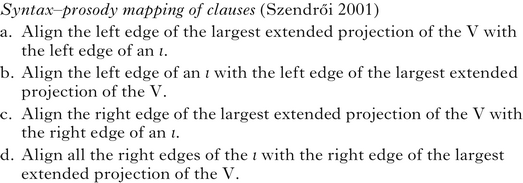
In this paper, we want to preserve the insight that ‘clausehood’ should be understood as the highest projection to which the verbal material is overtly moved or inserted, together with the material in its specifier. We will abbreviate this projection as HVP (highest overt verbal projection). We will consider evidence for our proposal from Bàsàá and Hungarian.
Szendrői (Reference Szendrői2001) does not consider complex clauses, and we cannot deal with them here. However, Downing (Reference Downing1970) (see also Truckenbrodt Reference Truckenbrodt, Kluck, Ott and de Vries2014) proposes that root clauses seem to have a special role in the syntax–prosody mapping.
-
(3)

In current approaches, the immediate effect of Obligatory Boundary Insertion would be that clauses that are not dominated by predicative material form their own ι. This would apply to main clauses, but not to complement or adjunct clauses. This seems to be the correct prediction for both Hungarian and Bàsàá (see Szendrői & Hamlaoui in preparation). Although none of the data discussed in this paper hinges on the difference between ‘root’ and ‘non-root’ clauses, as we only discuss simplex clauses, for consistency's sake we propose the four constraints in (4a) to determine correspondences between syntactic and prosodic units on the clause level. Note that nothing in the present paper hinges on the distinction between Alignment theory and Match theory and that the label Align is simply used to maintain consistency with the original proposal in Szendrői (Reference Szendrői2001).
-
(4)
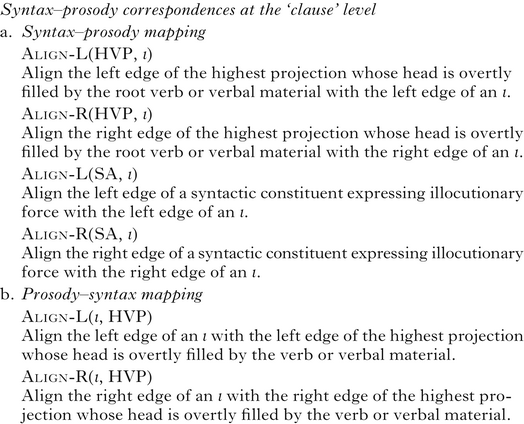
In addition, the two constraints in (4b) capture our proposal that, while root clauses have a privileged status from the perspective of syntax-to-prosody mapping, all clauses are equal in prosody-to-syntax mapping.Footnote 1 By distinguishing syntax-to-prosody from prosody-to-syntax mapping constraints, we are not proposing that they apply at different places in the grammar. What distinguishes them is simply their underlying motivation (see Szendrői & Hamlaoui in preparation for more discussion). All six mapping constraints apply at the same time to determine syntax–prosody correspondences at the level of the ‘clause’.
1.3 Predictions of the flexible mapping constraints
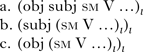
Let us concentrate on our main claim, i.e. that mapping often specifically refers to the overt syntactic position of the verb in the structure. This allows us to formulate generalisations about the syntax–prosody interface that are hard to formulate in frameworks that make rigid reference to specific syntactic projections (e.g. TP or CP). In particular, we predict that elements targeting specifier positions with accompanying verb movement will normally be internal to the core ι, as in (5a). In contrast, elements occurring in a left-peripheral position in the absence of accompanying verb movement (or insertion) will prosodically be outside the core ι, as in (5b).
-
(5)
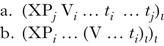
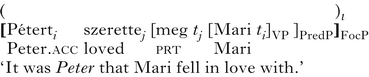
Specifically, we will show in §2 that the configuration in (5a) is found in the Hungarian left-peripheral focus construction in (6), where the V moves to a functional position within the C domain, FocusP (Rizzi Reference Rizzi and Haegeman1997), and the focused element moves to its Specifier. In this and following examples, syntactic brackets corresponding to the HVP are in bold.
-
(6)
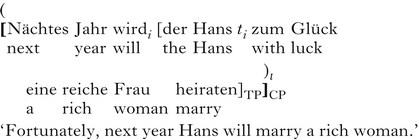
The same prosodic phrasing applies both in English wh-questions involving I-to-C movement and in German V2 clauses; see (7) for an example (adapted from Frey Reference Frey2005). In accordance with our proposed mapping constraints, when I-to-C or V-to-C movement occurs, ι encompasses the whole CP. Crucially there is no evidence for the presence of the left edge of an ι following the finite verb (C°), as would be predicted by approaches that rigidly map TP to ι, such as Zerbian (Reference Zerbian2007a) and Selkirk (Reference Selkirk2009, Reference Selkirk, Goldsmith, Riggle and Yu2011).
-
(7)
In contrast, as we will demonstrate in §3, Bàsàá has a construction, termed here zero-coded passive left-dislocation, which is an example of (5b); see (8). This construction effectively topicalises the object, but in a relatively low position within the inflectional domain (Woolford Reference Woolford1991, Hamlaoui & Makasso Reference Hamlaoui and Makasso2013, Hamlaoui Reference Hamlaoui2014). Tonal processes show that the fronted topical object is outside the core ι.
-
(8)

The proposed phrasing is unexpected in those proposals that associate CP with the ι (e.g. Truckenbrodt Reference Truckenbrodt and de Lacy2007, Pak Reference Pak2008, Cheng & Downing Reference Cheng and Downing2009, Henderson Reference Henderson2012).
In sum, we predict that it is the highest overt position that the verb occupies within the clause rather than some rigid syntactic category (CP, TP or vP) that is relevant for the mapping of ι. When the fronting of an XP is accompanied by verb movement/insertion, the fronted XP and the verbal material are integrated into the core ι. This is so even if the targeted position is relatively high within the clausal hierarchy, as in Hungarian focus or German V2. This is unexpected in theories that use TP-to-ι mapping. Conversely, an XP can fall outside the core ι even if it is relatively low in the tree, as exemplified by passive left-dislocated phrases in Bàsàá, so long as the fronting operation is not accompanied by verb movement to the head position of the targeted specifier. This is unexpected in theories that rigidly use CP-to-ι mapping.
Finally, our proposal does not a priori distinguish sentences with broad focus from sentences with a different information-structural organisation (and thus with a non-neutral word order). It is not the topical or focal nature of a peripheral element that primarily determines whether it is phrased inside or outside the core ι (contra Selkirk Reference Selkirk, Frota, Vigário and Freitas2005, Downing Reference Downing2011, for example); rather, phrasing is dependent on the highest overt position of the verb.
We now turn to empirical evidence in favour of the proposed approach.
2 Evidence from Hungarian simple clauses
2.1 Hungarian non-neutral and neutral declaratives
Both traditional and more recent syntactic accounts of Hungarian classify simple clauses into neutral and non-neutral, involving a left-peripheral exhaustive focus (É. Kiss Reference É. Kiss2002). We consider these in turn. As (9) shows, a particle verb (Prt-V) forms a right-headed morphological unit in Hungarian, corresponding to a single phonological word (ω). In out-of-the blue utterances without a topic, the Prt-V complex is situated at the left edge of the clause, with any arguments following it, as in (9a). In utterances with topics, the topics precede the Prt-V complex. It is often the subject that is in this position, as in (9b), but various factors, including referentiality, animacy and relative salience, influence whether an argument ends up in the preverbal topic position. In (9c), for instance, the utterance sounds natural because the object is human, while the subject is not.Footnote 2
-
(9)
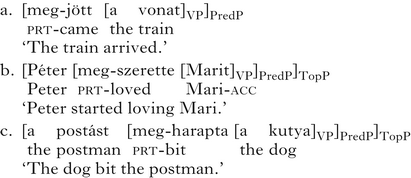
Standard analyses of the Hungarian neutral clauses assume that the Prt-V complex moves out of the VP, targeting a v-like functional head (Pred) position (É. Kiss Reference É. Kiss2008). Left-peripheral topics target designated left-peripheral positions, i.e. Spec,TopP (Rizzi Reference Rizzi and Haegeman1997), and TopP is recursive, as shown in (10) (from Kálmán Reference Kálmán2001: 22).
-
(10)

As argued in Szendrői (Reference Szendrői2001), Hungarian simple clauses with topics involve the type of recursive phrasing shown in (11) (cf. (9c)). The left-peripheral topic constitutes a φ that is both outside the core ι and dependent on it, by virtue of being inside the outermost layer of ι. (See also the discussion of Bàsàá zero-coded passive left-dislocation in §3 below.)
-
(11)

The proposed mapping constraints in (4) give rise to recursive ι's, as in (11), as long as Align-L(SA, ι) is ranked above Align-L(ι, HVP). This is because in (11) the boundaries of the outermost ι satisfy Align-L/R(SA, ι), while Align-L/R(HVP, ι) ensure that the left and right edges of the core PredP (here the HVP) are marked by the edges of an ι. These boundaries satisfy Align-L/R(HVP, ι), but the outermost left ι edge violates Align-L(HVP, ι).
In utterances with multiple topics, there does not seem to be any evidence for the presence of ι boundaries between the topics, so, contra Szendrői (Reference Szendrői2001), we propose that the correct prosodic phrasing of such sentences is as in (12), which follows from the proposed mapping constraints.Footnote 3
-
(12)

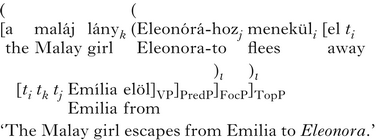
Non-neutral sentences involve a left-peripheral focus constituent, as in (13). Semantically, the Hungarian left-peripheral focus has an exhaustive interpretation (Szabolcsi Reference Szabolcsi1994). Syntactically, it moves to the specifier of a designated functional position in the left-periphery, FocusP (Bródy Reference Bródy and Kenesei1995). The verb itself moves to the head position of the projection, leaving its particle behind.
-
(13)

Given the structure in (13), the mapping constraints in (4) give the phrasing in (14), where the leftmost element in the core ι is now the focused phrase, and the relation of the topic to the rest of the sentence is the same as in (11).
-
(14)

As before, high-ranked Align-L/R(SA, ι) ensure that ι boundaries are matched with the edges of the whole utterance, which constitutes a speech act. Additionally, Align-L/R(HVP, ι) align the edges of the core ι with the projection headed by the verb. Importantly, Hungarian focus movement is accompanied by verb movement, resulting in FocP now being the projection that hosts the moved verb and accounting for the fact that the focused phrase is included in the core ι. Again, the core ι boundaries satisfy Align-L/R(ι, HVP), while the outermost left boundary violates Align-L(ι, HVP).
In comparison, on the view that every projection of a supra-inflectional functional head is mapped onto an ι, or if it is assumed that a ‘standard’ clause is the complement of C, a sentence like (13) would be expected to display an additional ι break between the verb and the material following it. However, just as in the German example in (7), no ι break is normally observed between the verb and the remainder of the sentence.
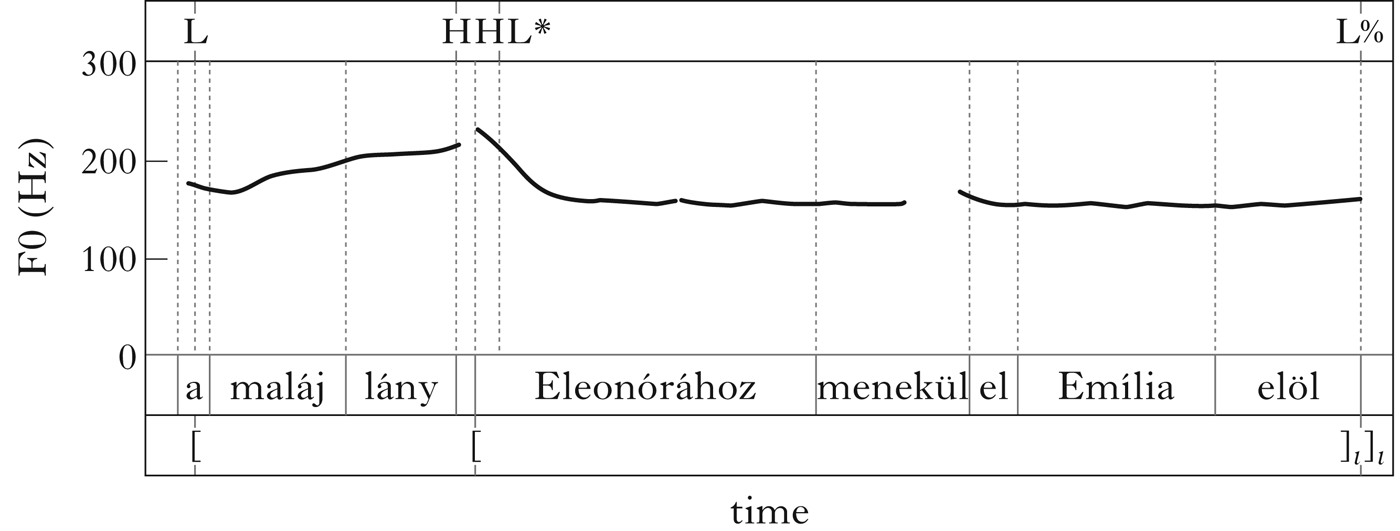
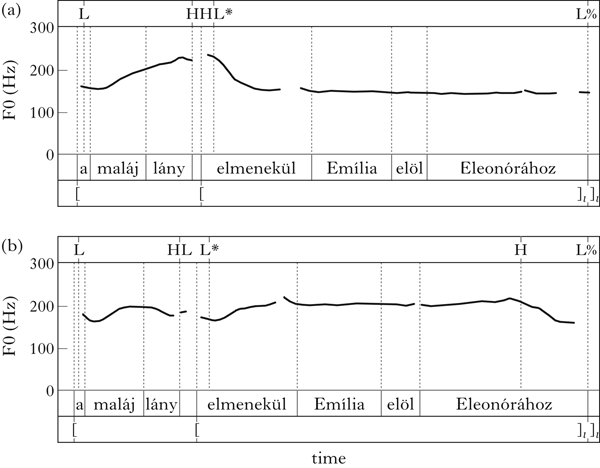
We now turn to the issue of prosodic prominence in the Hungarian clause. For non-neutral sentences such as (15) (cf. Fig. 1), there is consensus in the literature (see e.g. Varga Reference Varga2002: 143) that the main stress falls on the focal constituent and any postverbal phrases undergo postfocal accent reduction (possibly due to their given status). Prefocal phrases may be accented, but need not be.
-
(15)
F0 contour for the non-neutral declarative sentence in (15): A maláj lány Eleonórához menekül el Emília elöl. ‘The Malay girl escapes from Emilia to Eleonora.’.

We propose that this can be derived if we adopt the stress-alignment constraints in (16), with the ranking Stress-ιέEndRule-LέEndRule-R.Footnote 4
-
(16)
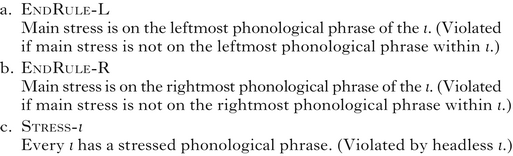
This will ensure that main stress falls on the leftmost φ of the core ι in Hungarian in sentences with recursive phrasing. This is because EndRule-L will ensure that it is left-aligned with one of the left ι boundaries, while Stress-ι will make sure it is the innermost boundary, otherwise the innermost ι would violate the constraint. This gives rise to metrical prominence on the focal element in non-neutral sentences, as, given our proposed phrasing, these end up as the leftmost elements of the core ι. As argued by Szendrői (Reference Szendrői2001), by being aligned with the left edge of the core ι, the focused phrase optimally satisfies the interface requirement in (17).
-
(17)

As we can see from (15), the position of the verb is crucial for phrasing, and consequently for accentuation. Verb movement enlarges the ι, allowing the focal phrase to target a position that ends up leftmost within the core ι, and thus receives main stress. The fact that left-peripheral topics are ‘skipped’ by the stress constraints in (16) shows that such elements end up phrased outside the core ι. In §3, we will turn to Bàsàá for an example of a construction that provides further evidence for the proposed syntax–phonology mapping constraints, not based on accentuation, but rather established on evidence from domain-sensitive tonal processes.
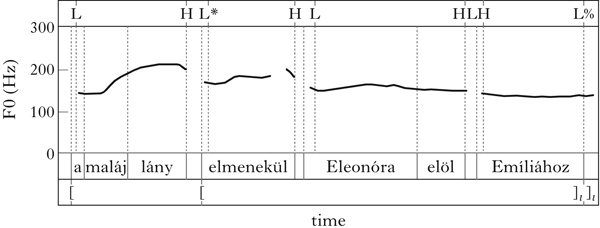
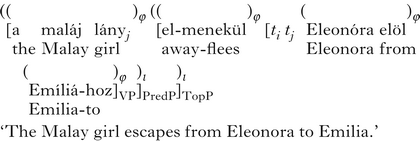
In neutral sentences, all φ's are stressed and carry pitch accents. This is illustrated for (18) in Fig. 2.
-
(18)
F0 contour for the neutral declarative sentence in (18): A maláj lány elmenekül Eleonóra elöl Emíliához. ‘The Malay girl escapes from Eleonora to Emilia.’.

Szendrői (Reference Szendrői2001) argues for an analysis that treats the φ containing the Prt-V complex as carrying main stress (see Ladd Reference Ladd1996 and Kálmán Reference Kálmán2001 for similar proposals). But the distribution of pitch accents illustrated in Fig. 2 leads Kálmán (Reference Kálmán and Kenesei1985), for example, to declare that Hungarian declarative sentences do not have nuclear stress. As will be apparent below, we still think it is plausible to assume that the Prt-V complex bears ι-level prominence in Hungarian neutral declarative sentences; this would fall out from the application of the stress rules proposed above in (16) for non-neutral sentences. But we will not defend this stronger claim here. We will argue only that (i) the Prt-V complex forms its own φ, and bears φ-level accent, and (ii) this φ is located at the left edge of ι (contra Surányi et al. Reference Surányi, Ishihara, Schubö, Elordieta and Prieto2012 and Genzel et al. in press). (Whether or not this φ also bears ι-level prominence is therefore an issue that we leave open here.)
Our first claim, that the Prt-V complex forms its own φ in neutral clauses in Hungarian, is consistent with existing prosodic descriptions (Kálmán Reference Kálmán and Kenesei1985, Varga Reference Varga2002). In Hungarian, unlike English, the verb does not form a φ together with the right-adjacent object NP. As proposed by Szendrői (Reference Szendrői2001), Hungarian marks the left edge of syntactic constituents in prosodic structure, as is characteristic of OV languages. Note that Hungarian has dependent–head order in other syntactic domains, and that Proto-Hungarian was an OV language (É. Kiss Reference É. Kiss2013).
We assume that an extra φ right edge is inserted following the Prt-V complex, ruling out an alternative phrasing in which Prt-V is only a ω at the left edge of a recursive φ encompassing the Prt-V and the VP-internal PP. This could be the result of a prosodic constraint such as StrongStart (Selkirk Reference Selkirk, Goldsmith, Riggle and Yu2011: 522), as the Prt-V is at the left edge of ι (see (18)) (Lisa Selkirk, personal communication).
Let us now turn to the more contentious part of our proposal, namely that the φ comprising the Prt-V complex is situated at the left edge of ι. This claim goes against a recent analysis of the prosodic phrasing of Hungarian declaratives by Surányi et al. (Reference Surányi, Ishihara, Schubö, Elordieta and Prieto2012) and Genzel et al. (in press). In a production study with simple declarative sentences, they showed that sentence-initial topics in Hungarian can always have a rising accent, but in some cases a falling accent is also possible (a flat pitch is also found in about 10% of the cases, but no relevant systematic variation was found). Crucially, they found that the falling accent is restricted to certain information-structural configurations (Genzel et al. in press: Table 2). In particular, it does not arise unless the utterance contains a discourse-new topic or a focus that is contrastive. However, in about 40% of the cases where the topic is new and the focus is not contrastive, a falling pitch accent occurs on the left-peripheral topic. Genzel et al. observe that the initial peak in these cases is significantly higher than the peak on the verbal modifier (in press: Table 1). They conclude from the lack of pitch reset after the topic that the clause is mapped on to a single ι, as in (19a), rather than a set of nested ι's, as in (19b), with the main prominence falling accent on the Prt-V complex, as proposed by Szendrői (Reference Szendrői2001).
-
(19)
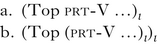
What is unexplained in Genzel et al.'s analysis is why the Prt-V complex has an obligatory falling accent even in broad-focus cases. In their analysis, it does not occur in the leftmost position of the ι (at least not if the preceding topic is new information). One might say that the Prt-V complex receives a phrasal accent simply by virtue of not being old information, but, as Genzel et al.'s investigations show, there is a crucial difference between the prosodic characteristics of the Prt-V complex and that of postverbal material: the latter is often deaccented or, if accented, hardly ever has falling pitch (24 cases out of 320; see their Table 9), while a falling contour is found on the Prt-V complex in over 90% of the cases in all declaratives (298 out of 320; see their Table 1). So it cannot simply be the case that the φ containing the Prt-V is just like any other postverbal φ inside the ι.
We believe that the problematic assumption underlying Genzel et al.'s proposal is that a falling accent necessarily indicates that the element bearing it is inside the core ι. They assume this on the basis of previous work reported by Surányi et al. (Reference Surányi, Ishihara, Schubö, Elordieta and Prieto2012), who carried out a production study with sentences involving a frame-setting topical PP and multiple peripheral quantifiers, as in (20).
-
(20)

Surányi et al. found that the quantifiers (and also the Prt-V complex, as we will discuss below) were often pronounced with a falling contour, while the PP a vizsgán ‘at the exam’ never was. They conclude from this that the frame-setting topic, but not the quantifiers, falls outside the core ι, whose left edge, they assume, is determined by the first falling accent. However, in their study there was simply no opportunity for the topic to bear a falling contour, as such a contour is restricted to cases involving new information topics (and non-contrastive foci), as shown by Genzel et al. (in press). Since (20) and similar sentences were embedded in an appropriate discourse context, we can assume that the frame-setters were at least inferable, and thus the falling accent would have been unwarranted. Moreover, preverbal quantifiers have a tendency to be interpreted as contrastive foci, which would again preclude the possibility of a falling accent on the sentence-initial topic, even if it were new information.
We propose that the correct analysis of sentences involving new topics is that these topics, just like any others in Hungarian, fall outside the core ι. The leftmost element of the core ι is the Prt-V complex, which bears the falling pitch accent obligatorily found in all declaratives. The topic, by virtue of being new, and thus stressed, may optionally bear phrasal accent and a falling contour. In our view, the absence of pitch reset between the φ constituted by the topic and the φ containing the Prt-V complex is consistent with the phrasing in (11), and indicative of the fact that in Hungarian the relevant domain for the process of downstep is the outermost ι.Footnote 5 In §2.2 we show that the behaviour of yes-no questions provides further support for our analysis.
2.2 Hungarian yes-no questions
Ladd (Reference Ladd1996) proposes a useful diagnostic for the ι in Hungarian. In yes-no questions, which are syntactically unmarked in Hungarian, the intonational contour is responsible for the interrogative meaning. It starts with an optional H tone on preverbal elements in neutral clauses and prefocal elements in non-neutral clauses. The nuclear pitch, which starts with a L*, is anchored on the Prt (or if there is no particle, then on the verb itself) in neutral clauses, and on the focal element in non-neutral clauses. The right edge of the contour is marked by a H- phrasal tone and a L% boundary tone, which are aligned with the penultimate and final syllables of the ι respectively (word-level stress is always on the initial syllable in Hungarian). If the utterance is long enough, then the L accent may be repeated on any postverbal phrases in neutral sentences, but no postverbal accents occur in non-neutral ones.
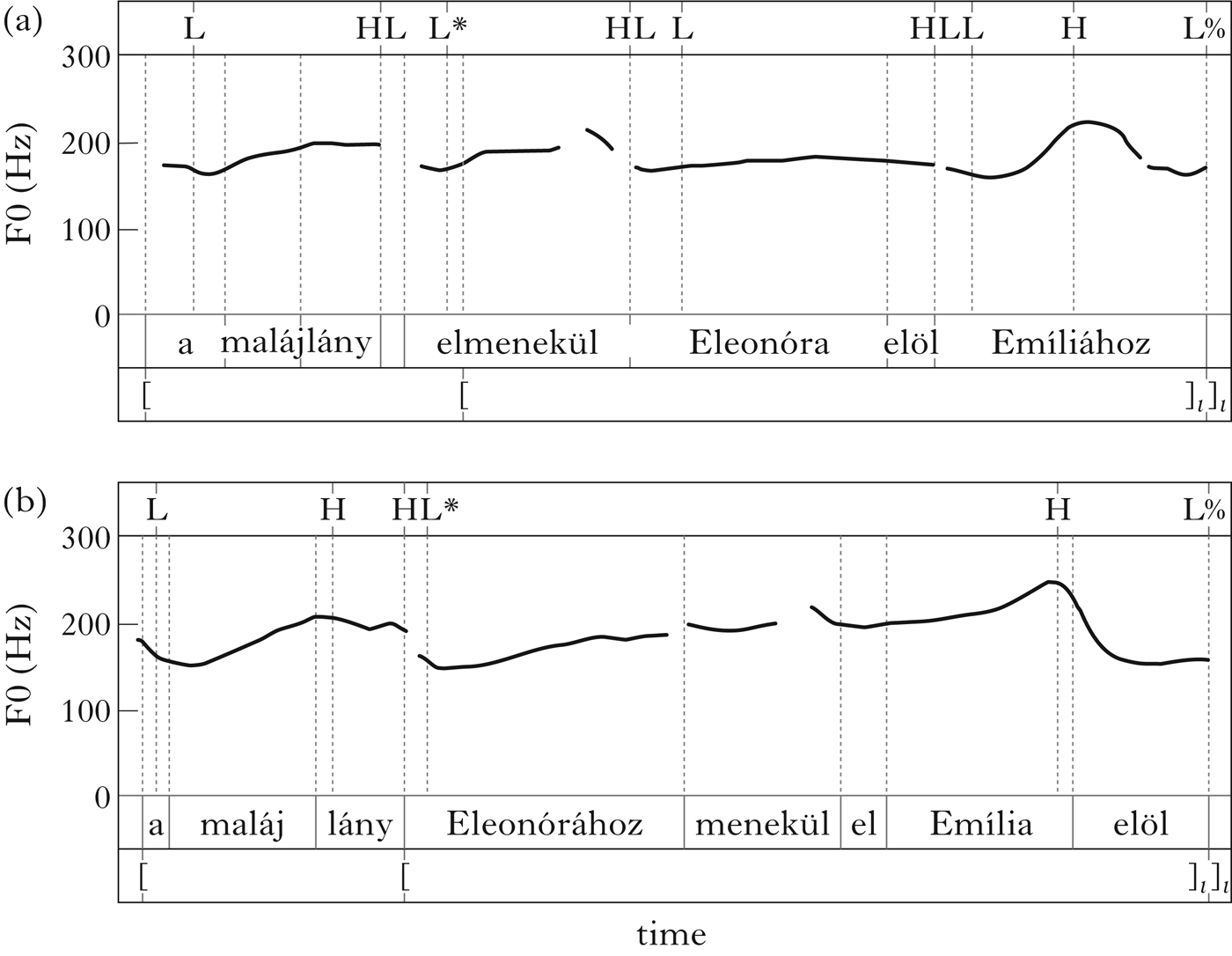
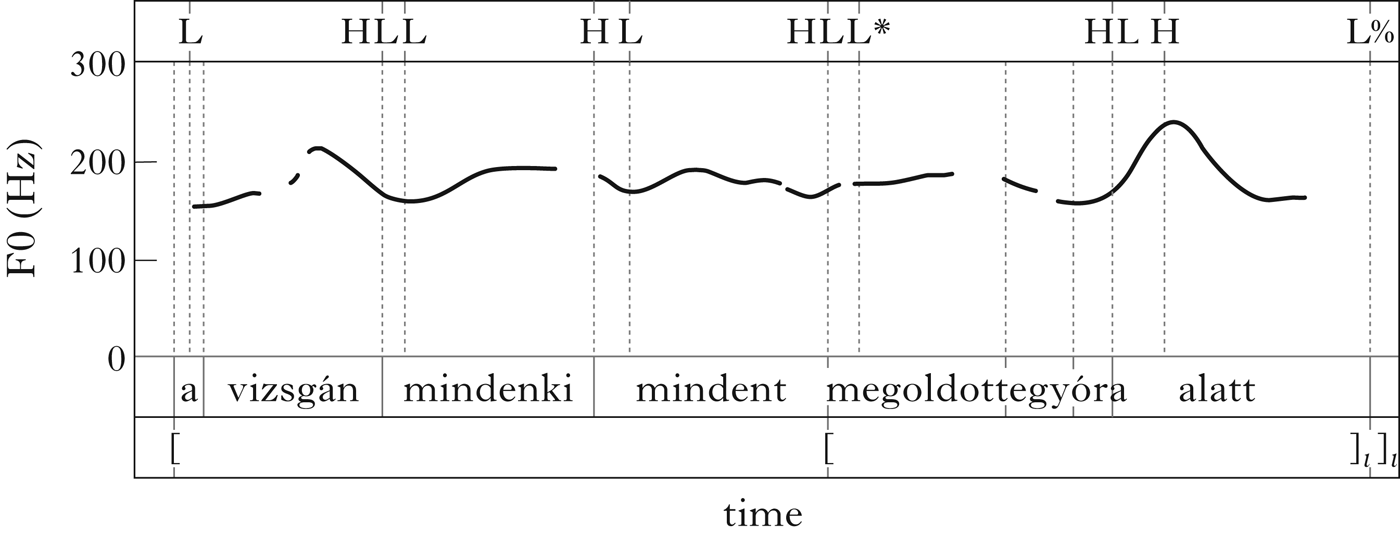
The prosodic characteristics of the sentences in Figs 3a and b are fully consistent with our proposed phrasings in (11) and (14) respectively. The proposed rankings of the mapping constraints in (4) and the stress constraints in (16) correctly derive the prosodic structure for yes-no questions, as in (21). If we assume that the initial L* accent falls on the first φ following the left edge of the core ι, then we correctly derive that it will fall on the focus in non-neutral sentences, and on the prefix (or if there is no prefix, on the verb) in neutral sentences. The H-L% tones are aligned with the penultimate and final syllables of the utterance respectively.
-
(21)

F0 contours for (a) the neutral yes-no question A maláj lány elmenekül Eleonóra elöl Emíliához? ‘Does the Malay girl escape from Eleonora to Emilia?’; (b) the non-neutral yes-no question A maláj lány Eleonórához menekül el Emília elöl? ‘Does the Malay girl escape from Emilia to Eleonora?’.

As we can see from (21), the position of the verb is crucial with respect to phrasing and consequently accentuation. Verb movement enlarges the ι, allowing the focal phrase to target a position that ends up leftmost in the core ι, and thus receive the initial L* accent stress. The fact that left-peripheral topics are ‘skipped’ and the initial L* accent of the yes-no question contour targets the focus shows that the left edge of the core ι follows such topics.
Note that, contrary to our claim, one might argue that what we call the yes-no question contour is in fact a marked contour, for instance reflecting polarity or verum focus (Lisa Selkirk, personal communication), as in (22).
-
(22)

This would have the consequence that the fact that such a contour cannot start on a left-peripheral topic, even if that topic is new, would have no bearing on the analysis of simple declaratives sentences, as declaratives would be neutral sentences with neutral prosody, while yes-no questions would be non-neutral sentences with non-neutral prosody. Fortunately, we can establish that this is not the case. Recall that the one aspect of Hungarian prosody that is generally agreed on is that in non-neutral prosody main prominence falls on the left-peripheral focal element and postverbal phrasal accents are eradicated; see Fig. 4a. As the minimal pair in Figs 3a and 4b illustrates, such postverbal accent reduction is not the norm in yes-no questions in general, but rather arises if there is contrast on the Prt-V complex or the veracity of the proposition. Thus one cannot assume that yes-no question intonation contour is a non-neutral contour per se, because it does not bear the characteristic postfocal reduction of such contours.
F0 contours for (a) the non-neutral declarative sentence with verb focus in (22a): A maláj lány elmenekül Emília elöl Eleonórához. ‘The Malay girl escapes from Emilia to Eleonora.’; (b) the non-neutral question with verb focus in (22b): A maláj lány elmenekül Emília elöl Eleonórához? ‘Does the Malay girl escape from Emilia to Eleonora?’.

2.3 Quantifiers and syntax–prosody mismatch
Before closing this section, we need to tackle one remaining issue that arises with respect to our analysis of Hungarian prosody: the prosody of sentences with a focused quantifier, such as (20) above, which are examined by Surányi et al. (Reference Surányi, Ishihara, Schubö, Elordieta and Prieto2012).
Recall that Surányi et al. found that such quantifiers often bear a falling pitch contour, at least in broad-focus contexts. In addition, just as in the case of the left-peripheral new topics considered by Genzel et al. (in press), the Prt-V complex is also marked by a falling contour (Surányi et al. Reference Surányi, Ishihara, Schubö, Elordieta and Prieto2012: 49). As noted above, Surányi et al. assume that the leftmost falling accent marks the left edge of the core ι: they conclude that the left edge of the core ι in such sentences precedes the quantifiers bearing a falling pitch. They therefore assume the phrasing in (23a). In contrast, the phrasing we assign is given in (23b).
-
(23)
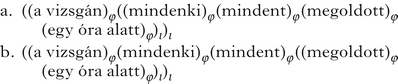
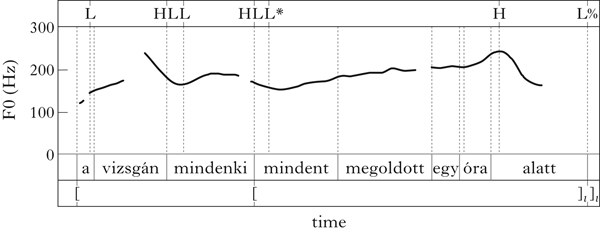
To determine which is the correct phrasing, we must impose a question intonation contour on such sentences. As Fig. 5 shows, the L* accent is anchored to the Prt-V complex, while the preverbal quantifiers bear marked LH contours indicating contrast, as in (24a).Footnote 6 It is not possible to extend the question contour to include the quantifiers, as in (24b), showing that the correct phrasing is that in (23b).
-
(24)

F0 contour for the neutral question with a topic and two quantifiers A vizsgán mindenki mindent megoldott egy óra alatt? ‘At the exam, did everyone solve everything in less than an hour?’.

Finally, let us consider the same sentence in a context that requires a contrastive narrow-focus interpretation on the second quantifier. As Surányi et al. (Reference Surányi, Ishihara, Schubö, Elordieta and Prieto2012: 54) observe, in such a situation at least some speakers alter the normal phrasing, assigning a falling pitch on the second quantifier and a rising contour on the first quantifier; on the Prt-V complex the ‘pitch contour was so compressed that it was impossible to detect the actual accent type’ (see also their Fig. 5).We interpret this state of affairs as indicating that the second quantifier indeed occupies the leftmost position in the core ι, with postfocal reduction of the Prt-V complex. The phrasing in such cases of narrow focus is as in (25), which violates our syntax–prosody mapping constraints.
-
(25)

We agree with Surányi et al.'s idea (but not the specifics of their analysis) that such cases constitute a misaligned syntax–prosody mapping. The misaligned phrasing is motivated by the fact that, on the one hand, the quantifier, being contrastively focused, must bear main prominence (see (15)), and that, on the other hand, universal quantifiers are banned from the Hungarian focus position (e.g. *A vizsgán mindenki mindent oldott meg egy óra alatt) (see Szabolcsi Reference Szabolcsi1994 for a semantic explanation). Indeed, as Fig. 6 shows, the L* accent of the yes-no contour can extend to the quantifier just in cases where it is contrastively focused.
-
(26)
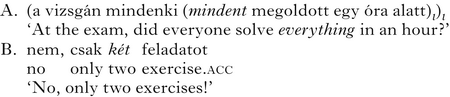
F0 contour for the non-neutral question with focus on the second quantifier in (26): A vizsgán mindenki mindent megoldott egy óra alatt? ‘At the exam, did everyone solve everything in less than an hour?’.

To summarise, we have provided an account of the prosodic phrasing patterns of Hungarian simple declaratives and yes-no questions, including both neutral and non-neutral utterances, which assumes the mapping constraints in (4) and the stress constraints in (16). Our analysis is superior to alternative analyses, as it provides a unified account of all these cases. On our account, the left edge of the core ι corresponds to the left edge of the syntactic phrase that hosts the overt verb: the focus in non-neutral sentences, and the Prt-V complex in neutral ones. There is one exception to this, the case of focused quantifiers, which constitutes a misalignment which is easily explained by independent principles.
3 Evidence from Bàsàá simple clauses
In this section, we examine a special type of left-dislocation in Bàsàá, which is associated with a broad focus reading and is functionally equivalent to a sentence in the passive voice.Footnote 7 This type of left-dislocation, a ‘zero-coded passive’, is used to express a change in grammatical voice in languages that lack passive morphology, such as Lango (Nilotic) (Noonan Reference Noonan1977, Reference Noonan1992, Noonan & Bavin Woock Reference Noonan and Bavin Woock1978) and Mbuun (Bantu; B87) (Bostoen & Mundeke Reference Bostoen and Mundeke2011), and in languages in which passive voice markers reduce the valency of a verb, like Bàsàá (see Cobbinah & Lüpke Reference Cobbinah, Lüpke, Brenzinger and Fehn2012 for an overview of zero-coded passives). We argue first that the zero-coded passive left-dislocated XP is located below C, and that, as shown by a process of Falling Tone Simplification, it is outside the syntactic constituent corresponding to the core ι. This provides further evidence for our claim that prosodic integration in the core ι is dependent on the HVP, rather than on a specific syntactic category. If our approach is on the right track, the general lack of prosodic integration of dislocated topics is related to the fact that they are situated outside the HVP, no matter how high they are in the structure.
3.1 The syntax of zero-coded passive left-dislocation
In terms of basic word order, Bàsàá displays the typical SVO word order found in the Bantu family. Basic sentences are analysed as in (27) (Hamlaoui & Makasso Reference Hamlaoui and Makasso2015). In line with standard assumptions (e.g. Krifka Reference Krifka1995, Zerbian Reference Zerbian2006, Hyman & Polinsky Reference Hyman, Polinsky, Zimmermann and Féry2010), vP hosts the internal arguments of the verb, and its highest XP raises to the specifier of a functional projection in the inflectional domain (Spec,TP). In addition, the fact that adverbials systematically follow the verb provides evidence for v/V-to-T movement (Pollock Reference Pollock1989). The HVP in the sentences considered in this section is thus TP.Footnote 8
-
(27)

Although Bàsàá is in many aspects a typical Bantu language, it lacks the freedom in constituent ordering often associated with its eastern and southern relatives (Nurse & Philippson Reference Nurse and Philipson2003, Hamlaoui & Makasso Reference Hamlaoui and Makasso2015). Instead, it belongs to the type of languages identified by Noonan (Reference Noonan1992) as having ‘indirect role marking’, i.e. surface positions in Bàsàá strongly encode thematic relations.
When it comes to changes in diathesis, only short passives can be expressed through the use of passive morphology, as in (28). These structures are agentless, hence the impossibility of attaching adverbials like /nì n∫ὲŋ/ ‘voluntarily’. As the patient is the highest thematic role selected by the verb, it can be raised to the preverbal subject position, Spec,TP.
-
(28)
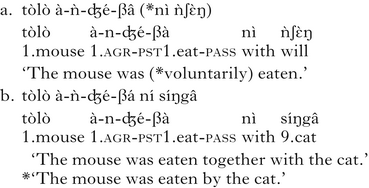
To express passive sentences displaying both agent and patient arguments, Bàsàá resorts to object left-dislocation. This strategy, in (29) (cf. (8) above), allows the promotion of the (more topical) patient argument, without deviating from the default linking between argument structure and syntax which requires raising the agent to Spec,TP.
-
(29)
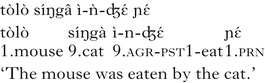
A number of properties distinguish zero-coded passive left-dislocation from both hanging-topic left-dislocation and clitic left-dislocation, found for instance in Romance and Germanic languages (see references below). These properties generally indicate greater syntactic integration of the XP undergoing zero-coded passive left-dislocation. We will illustrate the crucial ones here (the interested reader is referred to Noonan & Bavin Woock Reference Noonan and Bavin Woock1978, Woolford Reference Woolford1991 and Bostoen & Mundeke Reference Bostoen and Mundeke2011).
First, whereas hanging-topic left-dislocation and clitic left-dislocation are free, recursive operations (e.g. Rizzi Reference Rizzi and Haegeman1997, Frey Reference Frey2005, De Cat Reference De Cat2007b), zero-coded passive left-dislocation only targets one argument of the verb at a time. This is illustrated in (30), with the arguments of the ditransitive verb /tí/ ‘to give’. Whenever both objects are full XPs, the only word order available in Bàsàá is recipient preceding patient, as is typical in Bantu languages (Hyman Reference Hyman2003). Either object can be fronted to derive a zero-coded passive, as in (a) and (b), but not both (irrespective of order), as in (c).
-
(30)
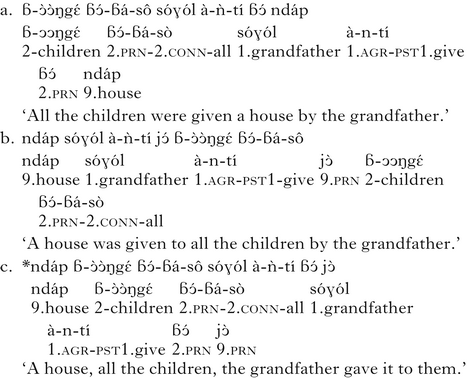
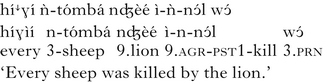
Second, singular quantified expressions and non-specific indefinites, which typically resist hanging-topic left-dislocation and clitic left-dislocation (De Cat Reference De Cat2007b: 504), can participate in Bàsàá zero-coded passive left-dislocation, as in (31).
-
(31)
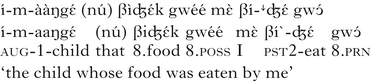
Third, zero-coded passive left-dislocation can take place in clauses with non-root properties, as in the restrictive relative clause in (32) (Jenks et al. Reference Jenks, Makasso and Hyman2012).
-
(32)
In contrast, French does not allow clitic left-dislocation in restrictive relative clauses, as in (33).
-
(33)

Finally, in contrast to Romance and Germanic hanging-topic left-dislocation and clitic left-dislocation, where object left-dislocation is generally inappropriate in all-new contexts, zero-coded passive left-dislocation is possible in utterances with a wide-focus reading, as in (34).
-
(34)
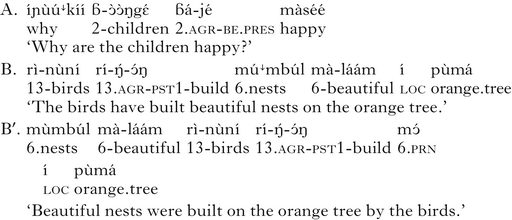
Taken together, these properties show that the dislocated XP in zero-coded passive left-dislocation is syntactically comparable with the subject of a morphological passive, rather than with a dislocated peripheral topic. Syntactic proposals differ with respect to the exact location of the latter type of left-dislocated XP. It has been treated as being adjoined to a ‘discourse projection’ (TP; De Cat Reference De Cat2007a) or a ‘clause’ (CP; Cheng & Downing Reference Cheng and Downing2009), as the specifier of a functional projection in the supra-inflectional domain (TopicP; Cinque Reference Cinque, Ehlich and van Riemsdijk1983, Rizzi Reference Rizzi and Haegeman1997) or most recently as belonging to an entirely separate clause (Ott to appear). The last approach explicitly captures the long-acknowledged syntactically non-integrated nature of these peripheral topics. This lack of syntactic integration has in turn been associated with their observed lack of prosodic integration (Selkirk Reference Selkirk, Frota, Vigário and Freitas2005, Cheng & Downing Reference Cheng and Downing2009, among others), as these left-dislocated phrases are not phrased together with the core clause (Downing Reference Downing1970, Frascarelli Reference Frascarelli2000, De Cat Reference De Cat2007a, Downing Reference Downing2011, among others).
In contrast, Woolford (Reference Woolford1991) proposes the syntactic analysis in (35) for zero-coded passive left-dislocation in Lango, with the left-dislocated XP (‘a second subject’) occupying Spec,IP and the agent (the actual grammatical subject) staying in Spec,VP. But, the assumption that in such structures the OSV order is derived by object movement to Spec,IP across the in situ subject is problematic on Relativised Minimality grounds (Rizzi Reference Rizzi1990). What would make the object move over the subject in a language that otherwise moves the argument with the highest thematic role to Spec,IP?
-
(35)

Our alternative representation in (36) captures Woolford's insight, while respecting the fact that subject agreement in Bàsàá takes place above vP (in T). There is no Relativised Minimality violation, as the subject moves to Spec,TP and a [+topic] feature attracts the object to Spec,TopP.
-
(36)

Syntactically, the left-dislocated XP in (36) belongs to the core clause. Crucially, it is located within the inflectional domain. Additional evidence for the position of the left-dislocated XP within the inflectional domain comes from Bantu languages like Kinyarwanda in (37a) and Kanyok in (37b), in which the fronted object of OVS zero-coded passives controls subject agreement on the verb.
-
(37)
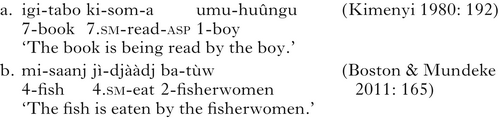
The relationship between the OSV and OVS zero-coded passives is noted by Bostoen & Mundeke (Reference Bostoen and Mundeke2011), who investigate zero-coded passive left-dislocation in Mbuun, and discussed further in Hamlaoui & Makasso (Reference Hamlaoui and Makasso2013) and Hamlaoui (Reference Hamlaoui2014). The best-studied case of OVS zero-coded passive is probably from Kinyarwanda (Kimenyi Reference Kimenyi1980, Reference Kimenyi and Shibatani1988, Morimoto Reference Morimoto, Butt and Holloway King1999, Reference Morimoto2006). As these authors show, in so-called ‘subject-object reversal’ structures like (37a), preverbal object and postverbal subject retain their respective object and subject properties: ‘NPs advanced to subject by the [Object-Subject] reversal rule do not acquire the properties of basic subjects, such as raising, deletion under identity, and ha- insertion’ (Kimenyi Reference Kimenyi1980: 145). The only subject-like properties of the object are its linearly preverbal location and its control over subject agreement. So, in contrast to (non-passive-related) OVS structures, observed for instance in V2 languages like German in which O and V are located in the CP domain and do not agree, what is observed in Kinyarwanda suggests that O and V are within the inflectional domain.Footnote 9 What distinguishes Kinyarwanda from Bàsàá, then, is how high the verb can move within its extended projections, with the Kinyarwanda verb moving over the subject to Topic, as in (38).Footnote 10
-
(38)

In summary, zero-coded passive left-dislocation provides valuable evidence as to the syntactic edges with which ι boundaries align within root clauses. It can help us to test empirically whether ι boundaries universally align with a specific syntactic category like CP, TopicP or CommaP (Selkirk Reference Selkirk, Frota, Vigário and Freitas2005), or whether the notion of ‘clause’ that serves as a basis for ι formation should be characterised in purely structural (and thus cross-categorial) terms (just like ω and φ). In Bàsàá, the mapping constraints given in (4) predict the presence of an ι boundary between the left-dislocated object and the subject, as this position corresponds to the left edge of the HVP. We will show that this prediction is borne out.
3.2 The prosody of left-dislocation in Bàsàá
From a prosodic perspective, Bàsàá is a tonal language which underlyingly contrasts two level tones, H and L. Additionally, a number of grammatical morphemes (noun class prefixes, some tense markers and verbal extensions) are underlyingly toneless (Hamlaoui et al. Reference Hamlaoui, Gjersøe, Makasso, Gussenhoven, Chen and Dediu2014). In the existing literature on Bàsàá, there are two tone rules which have been extensively discussed (see Dimmendaal Reference Dimmendaal and Bouquiaux1988, Bitjaa Kody Reference Bitjaa Kody1993, Hyman Reference Hyman2003, Makasso Reference Makasso2008). The first, High Tone Spreading, turns H–L and H–Ø sequences into H–HL and H–H sequences respectively. The domain of application of High Tone Spreading is the φ.Footnote 11 When the appropriate tonal configuration is met, High Tone Spreading applies within words, as well as at the following word junctures: (i) between a verb and the phrase that immediately follows it within the same clause, as in (39a), and (ii) between the agreement marker and the (underlyingly toneless) tense marker, as in (39b). High Tone Spreading provides evidence for the following phrasing in simple canonical sentences: (S)φ (V XP)φ (XP)φ.Footnote 12
-
(39)
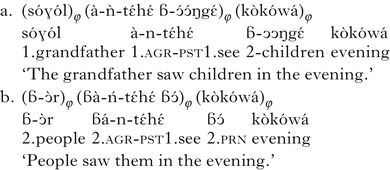
The H on the last mora of the subject phrase in (39a) does not spread onto the first mora of the verbal complex (*/sóɣól à-ǹ-tέhέ/→[sóɣól á-ń-tέhέ]), due to the fact that these words belong to separate φ's. High Tone Spreading also generally fails to apply between the phrase that immediately follows the verb (an object in (39)), and the phrase that follows it, here a temporal adjuncts (*/ɓ-ↄ́ↄ́ŋgέ kòkówá/→[ɓ-ↄ́ↄ́ŋgέ kókówá]). The lack of High Tone Spreading in this position is further illustrated in (40) (from Bitjaa Kody Reference Bitjaa Kody1993).
-
(40)

Let us now turn to the second major tone rule, Falling Tone Simplification. This rule turns a HL–H sequence into H–↓H.Footnote 13 It applies in a phonological domain larger than the φ. This domain encompasses an entire simple sentence and thus corresponds to the ι. For instance, the falling tone on [ɓ-ↄ́ↄ́ŋgέ ɓↄ́-ɓá-sô] in (41a), itself derived through High Tone Spreading, is simplified whenever the phrase is in medial position within the ι and followed by a H, as in (41b) (see also (41c) and (42a)).
-
(41)
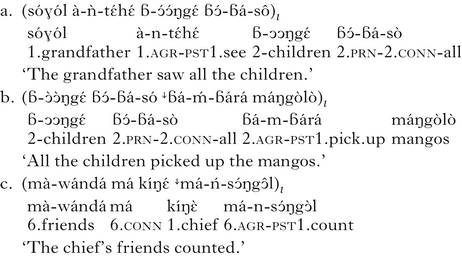
Falling Tone Simplification also applies between a verb and the phrase that immediately follows it within the same clause, as in (42a), and between the arguments or adjuncts of a verb, as in (b) and (c).
-
(42)
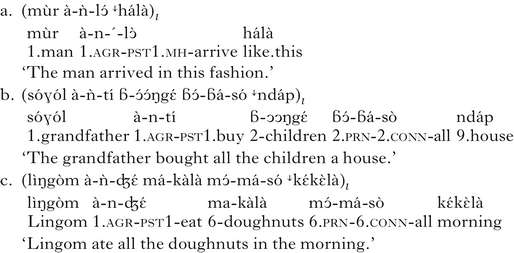
Importantly, whenever the left-dislocated XP resulting from zero-coded passive left-dislocation and the subject create the proper tonal configuration, as in (43), Falling Tone Simplification fails to apply.
-
(43)

As predicted by the constraints in (4), the HVP, which in Bàsàá is TP, forms a core ι which exclude the left-dislocated XP in Spec,TopP. The prosodic structure of the sentence in (43) is thus (44).
-
(44)

Alternative approaches, both those which tie the notion of clause to CP (Cheng & Downing Reference Cheng and Downing2007, Reference Cheng and Downing2009, Truckenbrodt Reference Truckenbrodt and de Lacy2007, Downing Reference Downing2011, Henderson Reference Henderson2012) and those in which the crucial syntactic boundary for mapping an ι is the edge of the maximal projection corresponding to the complement of C (Dobashi Reference Dobashi2003, Ishihara Reference Ishihara2007, Selkirk Reference Selkirk, Goldsmith, Riggle and Yu2011), predict the phrasing in (45). Approaches that associate the TP with clausehood would derive the Bàsàá phrasing correctly, but would fail to account for V2 sentences in German (§1) and left-peripheral focus sentences in Hungarian (§2).
-
(45)

In sum, our HVP-based theory seems to be the only one that can capture the intonational phrasing of V2 structures in German (§1) and focus-fronting structures in Hungarian (§2), and make the correct prediction for the intonational phrasing of low topicalisation in Bàsàá.
3.3 Variation in the phrasing of left-dislocated XPs
The prosodic phrasing of zero-coded passive left-dislocation in Bàsàá is comparable to the phrasing of left-dislocation reported by Zerbian (Reference Zerbian2007a) for Northern Sotho, in which there is evidence that a left-dislocated XP does not constitute a separate ι. In Northern Sotho, penultimate lengthening and a rule of finality restriction characterise the right edge of an ι. These phonological processes apply at the end of declarative sentences, as well as at the end of right-dislocated phrases.Footnote 14
As shown by Zerbian, the penultimate syllable of the left-dislocated XP in (46) fails to display the lengthening typical of words located at the right edge of an ι, and its final syllable is not extratonal, i.e. exempt from receiving an H through the process of High Tone Spreading.Footnote 15 Thus left-dislocated XPs do not align with the right edge of an ι.
-
(46)
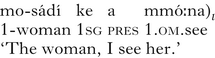
In Bàsàá, contour tones are not generally restricted to ι edges. For instance, as they are not followed by an H, the falling tones in (47) do not simplify, showing that these contour tones are licit in ι-medial position.
-
(47)
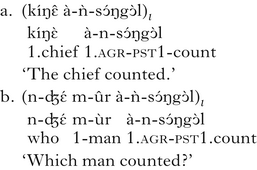
The presence of a contour tone on the left-dislocated object in (43) is thus not indicative of this constituent forming its own ι, as in the prosodic structure in (48).
-
(48)

The phrasing of left-dislocation observed in Sotho and Bàsàá is consistent with our syntax–prosody mapping constraints, in which the ι break that separates a left-dislocated XP from the remainder of the clause is not introduced by the left-dislocated XP itself, but rather by the HVP. However, this phrasing contrasts with a different one, which has been reported for a number of languages. For instance, Selkirk (Reference Selkirk, Goldsmith, Riggle and Yu2011) observes that in Xitsonga left-dislocated XPs right-align with an ι break. Penultimate lengthening is also an indicator of the presence of the right edge of an ι in Xitsonga (Kisseberth Reference Kisseberth, Cole and Kisseberth1994, Selkirk Reference Selkirk, Goldsmith, Riggle and Yu2011). It is found at the edge of simple declarative sentences and at the right edge of right-dislocated phrases. Interestingly, penultimate lengthening is also found at the edge of left-dislocated XPs in Xitsonga. In that language, the phrasing of left-dislocation is of the type in (48), in which the left-dislocated XP constitutes an ι of its own, as in (49) (from Kisseberth Reference Kisseberth, Cole and Kisseberth1994: 154).
-
(49)

In Xitsonga, left-dislocated XPs thus seem to have greater prosodic prominence and autonomy than in Northern Sotho or Bàsàá. As proposed by Selkirk (Reference Selkirk, Goldsmith, Riggle and Yu2011: 444), if Xitsonga left-dislocated XPs belong syntactically to the same clause as the material that follows them (instead of belonging to a separate clause, as in Ott to appear), the high ranking of a prosodic constraint such as StrongStart (Selkirk Reference Selkirk, Goldsmith, Riggle and Yu2011: 472) could promote the dislocated phrase into a separate ι. Equal Sis ters, proposed by Myrberg (Reference Myrberg2013: 75), would yield a similar result.
As noted by Zerbian (Reference Zerbian, Schwabe and Winkler2007b), Downing (Reference Downing2011) and Selkirk (Reference Selkirk, Goldsmith, Riggle and Yu2011), among others, forming a separate ι is not a necessary trait of topics. Thus we have an argument against the proposals of Frascarelli (Reference Frascarelli2000) and Feldhausen (Reference Feldhausen2010), which establish a direct link between topicality and alignment with ι, as in (50) (adapted from Feldhausen Reference Feldhausen2010).
-
(50)

The problem with a constraint like (50) is that it only captures the phrasing of left-dislocation in languages that pattern like Xitsonga (and a number of Romance languages), but says nothing about languages like Northern Sotho, Bàsàá or Hungarian, in which topics do not form a separate ι but are nonetheless set off from the remainder of the clause.Footnote 16
We started this section with a series of syntactic arguments showing that zero-coded passive left-dislocation should not be analysed in the same way as clitic left-dislocation and hanging-topic left-dislocation in Romance and Germanic languages. We would like to finish it by pointing out that, in spite of their distinct underlying syntactic structures, hanging-topic left-dislocation, clitic left-dislocation, Bàsàá zero-coded passive left-dislocation and even Hungarian topics display similar prosodic behaviour, in that the dislocated element is set off from the rest of the clause by an ι break. Among the various approaches to the syntax–phonology mapping of ι's, only the flexible approach captures the prosodic similarity of this variety of syntactic structures.Footnote 17 What all these cases share is that the left-dislocated element is syntactically outside the projection hosting the overt verb. In our approach, this is why they are prosodically outside the core ι.
4 Conclusion
In this paper, we have argued that the syntax–prosody and prosody–syntax mapping constraints that relate syntactic clauses to ι's do not rigidly refer to specific syntactic categories such as CP or TP, but rather that they are flexible in nature. In particular, we have proposed that what constitutes a clause is the highest projection to which the root verbal material (i.e. the verb itself, the inflection, an auxiliary or a question particle) is overtly moved or inserted, together with the material in its specifier. The size of the ι can thus vary from language to language and construction to construction, depending on the position of the verb (or verb-related material) in the syntactic tree. This explicitly cross-categorial approach allows for an analysis of Hungarian left-peripheral topics and foci, as well as of Bàsàá zero-coded passive left-dislocated objects in simplex clauses. An additional benefit is that our account encompasses non-canonical word orders involving topics and foci without making reference to the discourse status of the elements.