Introduction
Schistosomiasis is a parasitic disease afflicting 200 million people worldwide in tropical and subtropical countries (Takougang et al., Reference Takougang, Meli, Fotso, Angwafo, Kamajeu and Ndumbe2004). It is an occupational disease acquired by humans through water-related activities such as washing, fishing, bathing and recreation. It has been recognized as a disease of significant socio-economic and public health importance, second only to malaria (WHO, 1993). It is responsible for 754 million disability-adjusted life years (DALYs) among children in Africa (WHO, 2002).
Both urinary and intestinal schistosomiasis are endemic in Nigeria, particularly in rural areas (Ozumba et al., Reference Ozumba, Christensen, Nwosu and Nwaorgu1989; Adewunmi et al., 1991; Okoli & Odaibo, Reference Okoli and Odaibo1999; Opara et al., Reference Opara, Mbagwu and Ekpo2001; Mafiana et al., Reference Mafiana, Ekpo and Ojo2003; Ekpo & Mafiana, Reference Ekpo and Mafiana2004). However, Schistosoma haematobium, the causative agent of urinary schistosomiasis, is more prevalent in Nigeria than S. mansoni, which causes intestinal schistosomiasis (Ejezie et al., Reference Ejezie, Gemade and Utsalo1989). The control of schistosomiasis has received considerable attention, partly because of the increasing evidence that treatment can improve the physical and cognitive development of school-aged children and that prevalence in school-aged children can also be used as an index for assessing community prevalence (Guyatt et al., Reference Guyatt, Brooker and Donnelly1999; Mafiana et al., Reference Mafiana, Ekpo and Ojo2003). Therefore, many prevalence studies and control interventions have been directed towards school-aged children. There is paucity of information on the prevalence of schistosomiasis in pre-primary schoolchildren in Nigeria and other parts of the world where the disease is endemic, partly because school-based schistosomiasis control is informed by the fact that school-aged children (5–14 years) are usually the most heavily infected and are also likely to contribute most to transmission (Useh & Ejezie, Reference Useh and Ejezie1999b). Recently, attention has been focused on screening of pre-school children ( < 5 years) for schistosomiasis in endemic communities. Interestingly, these studies have confirmed the presence of this disease in infants (Mafiana et al., Reference Mafiana, Ekpo and Ojo2003; Bosompem et al., Reference Bosompem, Bentum, Otchere, Anyan, Brown, Osada, Takeo, Kogima and Ohta2004; Odogwu et al., Reference Odogwu, Ramamurthy, Kabatereine, Kazibwe, Tukahebwa, Webster, Fenwick and Stothard2006). As the risk of complication of schistosomiasis is related to the degree of exposure and intensity of infection, it would be worthwhile documenting the prevalence and intensity of infection in pre-primary schoolchildren in schistosomiasis-endemic communities for design of control programmes.
Urinary schistosomiasis is endemic in Adim Community in Cross River State, Nigeria (Ejezie et al., Reference Ejezie, Uko and Braide1991; Useh & Ejezie, Reference Useh and Ejezie1999a, Reference Useh and Ejezieb). The disease is a public-health and socio-economic problem in this community. Community members still depend on freshwater streams for their domestic, economic and recreational water contact activities due to the absence of pipe-borne water. Despite the enormous studies on schistosomiasis in Adim, no study has been carried out in pre-primary and/or pre-school children in the community. This investigation was therefore conducted to determine the prevalence, intensity and morbidity indicators of schistosomiasis in pre-primary schoolchildren in Adim, with a view to taking them into account during control interventions.
Methods
Cross River State, Nigeria, is situated in Cross River Basin, between latitude 5°32′ and 4°27′ north and longitude 7°20′ and 2°20′ east. It occupies an area of 23,074.425 km2. Adim is a rural agrarian community within the Cross River Basin. This study site has been adequately described elsewhere (Useh & Ejezie, Reference Useh and Ejezie1996, Reference Useh and Ejezie1999a). The community head (Onum) of Adim was briefed about the aims and objectives of the study. Following his consent a representative of the village council was mandated to brief the head teacher of Homeland Nursery School, Adim, in the presence of the investigators, on the benefits of the study. The consent of parents was sought and obtained. The community was thereafter mobilized to participate in the study. The Cross River State Ministry of Health approved the study. The study was conducted in Adim, between March and July 2005. Pupils of Homeland Nursery School (privately owned), Adim formed the core of the study. Children below 5 years of age, not attending the nursery school were also enlisted for the study. They were accompanied to the Chief's place with their mothers. Children were registered using an epidemiological field form, which documented their age, sex, name of head of household and community. We enlisted 126 children: 81 boys and 55 girls.
A single terminal urine sample was collected from each child between 10.00 and 14.00 hours, when maximum egg excretion occurs (Chen & Mott, Reference Chen and Mott1989). For children less than 3 years old the method of Mafiana et al. (Reference Mafiana, Ekpo and Ojo2003) was employed: briefly, mothers were given dark plastic bowls with the instruction to collect any voided urine between the hours specified. Within 2 h of collection of the urine sample, haematuria and proteinuria were detected in the field using dipsticks (medi-test combi-9, manufactured by Machery-Hagel, Duren, Germany). The reagent end of the test strip was dipped into fresh, well-mixed, uncentrifuged urine for 40 s. Upon removal, the test area was compared with a standard colour chart. Haematuria was calibrated as 5–10 erythrocytes/μl (+), 50 erythrocytes/μl (++) and 250 erythrocytes/μl (+++). Proteinuria was calibrated as 30 mg/μl (+), 100 mg/μl (++) and 500 mg/μl (+++). A report on the appearance of the urine and the presence or absence of blood was also recorded. All the urine samples collected were fixed in 2 drops of 40% formaldehyde after haematuria and proteinuria determination, thereafter transported to the laboratory for detection of ova of S. haematobium. Ten millilitres of each of the well-mixed urine samples was taken and centrifuged at 2000 rpm for 3 min. The supernatant was discarded and the sediment examined under the microscope for eggs. The number of eggs was counted and expressed as eggs/per 10 ml urine (Cheesbrough, Reference Cheesbrough1998).
Four major water contact sites (Culvert, Oduba, Akaralla, Wybera) in the study area were searched for molluscs using a scoop net, as described previously (Oliver & Schneidermann, Reference Oliver and Schneidermann1956). Potential snail vectors were not tested through cercariae shedding. Differences in proportions were tested by chi-squared tests. Intensity between gender was tested using Student's t-test.
Results
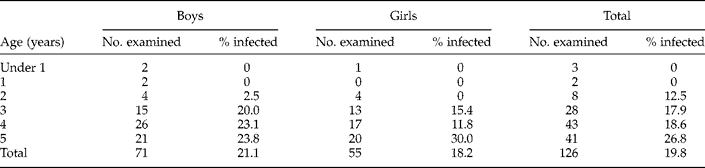
Out of the 126 urine samples examined, 25 (19.8%) were infected with S. haematobium. Sex-specific prevalence in the community showed that boys (21.1%) had a higher prevalence than girls (18.2%), but this was not significant (χ2 = 0.22, P > 0.05) (table 1). The age-specific prevalence in the study area showed that infection occurs exclusively among the 2- to 5-year-old pupils. The rate of infection increased with age, with the highest infection rate of 26.8% in the 5-year-old pupils. The lowest infection rate was observed in 2-year-old pupils (12.5%). There was no infection in children less than 1 year old. The relationship between egg count (intensity), haematuria and proteinuria among the 126 children screened is presented in table 2. The overall haematuria rate was 32.5%. Boys (33.8%) had a higher insignificant haematuria rate than girls (30.9%) (χ2 = 0.1, P > 0.05). The overall proteinuria rate was 27.8%: girls (29.1%) had a higher proteinuria rate than boys (26.8%) (χ2 = 0.1, P > 0.05). There was considerable variation in the number of S. haematobium eggs in urine samples. The absolute egg count ranged from 1 to 25 eggs/10 ml urine. The intensity of S. haematobium in the study population relative to host age and gender is shown in table 2: boys (6.2 eggs/10 ml urine) had a higher intensity of infection than females (5.6 eggs/10 ml urine) (t-test = 0.46, P > 0.05). The overall intensity was 5.9 eggs/10 ml urine.
Prevalence (%) of urinary schistosomiasis in pre-primary schoolchildren in Adim relative to host age and gender.
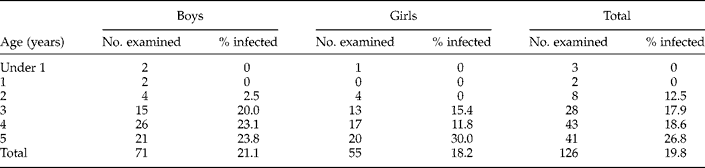
Prevalence (%) of haematuria, proteinuria and intensity relative to host age and gender.

The result of the snail survey revealed six species of snails in the study area, namely: Bulinus globosus, B. truncatus, B. forskali, Biomphalaria pfeifferi, Lymnea natalensis, Lanister libycus and Melanoides tuberculata. Bulinus globosus was the most abundant.
Discussion
The apparent increase in prevalence among the schoolchildren of Adim from the 44% recorded by Ejezie et al. (Reference Ejezie, Uko and Braide1991) to 55–72% revealed by Useh & Ejezie (Reference Useh and Ejezie1999a), and the 19.8% in pre-primary schoolchildren in this survey, indicates that there is active transmission of urinary schistosomiasis and that the intensity of transmission may have increased over the years in this community. The prevalence of urinary schistosomiasis observed among pre-primary schoolchildren calls for concern in view of the fact that they are excluded from most school-based treatment.
The prevalence may be attributed to the people's dependence on the surrounding water for domestic, recreational and occupational uses. Infection and transmission in pre-primary schoolchildren might occur when children accompany their mothers to undertake water-related activities. Other factors that may account for the high prevalence of infection observed include the absence of a community-based control programme and the absence of mass or targeted health education (Useh & Ejezie, Reference Useh and Ejezie1999a). The prevalence of 19.8% obtained in this study is similar to 14.5% reported by Nour et al. (Reference Nour, Fayed, Hussien, Shaheen and Abdel-Rahean1990) among pre-school children in Egypt and 11.2% reported by Bosompem et al. (Reference Bosompem, Bentum, Otchere, Anyan, Brown, Osada, Takeo, Kogima and Ohta2004) among infants in Ghana. It is possible that the prevalence observed in this study might have been higher if this investigation had taken more than one urine sample, given the variability of daily egg output, and if we had employed a monoclonal antibody (MoAb)-based dipstick assay for urine analysis. This assay has been reported to be sensitive, specific and suited for field use (Bosompem et al., Reference Bosompem, Asigbee, Otchere, Haruna, Kpo, Chen and Kogima1998, Reference Bosompem, Bentum, Otchere, Anyan, Brown, Osada, Takeo, Kogima and Ohta2004; Odogwu et al., Reference Odogwu, Ramamurthy, Kabatereine, Kazibwe, Tukahebwa, Webster, Fenwick and Stothard2006).
There was no difference between infection and gender, this might be due to an equal degree of exposure to cercariae-infested water bodies. The age-related prevalence may be attributed to the frequency and duration of contact with the water and the nature of the water-contact activities at the index site (Udonsi, Reference Udonsi1990). It has been observed that in children about 3 years and above, exposure to infection is unaided as most children had acquired the ability to swim, bathe and wash on their own (Mafiana et al., Reference Mafiana, Ekpo and Ojo2003). This observation might be responsible for the increase in prevalence with age recorded in this study. Older children (4–5 years) were observed to spend more time swimming than younger ones, hence a higher degree of exposure. Mafiana et al. (Reference Mafiana, Ekpo and Ojo2003) obtained a prevalence of 43% in children less than 1 year old; the present investigation did not encounter any infection at this age, the small sample size examined (due to difficulty in getting urine samples from these children) might have accounted for this variability.
Haematuria and proteinuria are recognized clinical features of S. haematobium infection (Wilkins, 1979). With a prevalence of 32.5% and 27.8% for haematuria and proteinuria, respectively, the occurrence of these morbidity indicators in Adim is quite significant and the potential risk of severe pathological damage in later years of life is correspondingly high, especially if these cases remain untreated. The egg output of the infected children in this study increased with age, reaching a peak in the 5-year-old age group. The factors that determine infection prevalence may also influence the infection intensity within the population. One of the most widely distributed freshwater snails in Adim is B. globosus, which appears to be well adapted to various habitats in the community. Shiff (Reference Shiff1964) has shown that B. globosus will survive and reproduce in both stable and unstable water bodies. The community urinary egg output will also determine the infection rates of snail and the dynamics of the intramolluscan larval population of the transmission sites (Udonsi, Reference Udonsi1990).
Although urinary schistosomiasis was perceived by the residents of Adim as a serious public health problem in the area, knowledge about the parasite causing the disease and the vector is poor. That most of the residents of Adim recognized the disease as a serious problem may indicate that it occurs all around them, hence the local name Moniyen (blood in urine) and they are willing to support any community-based control programme. Good baseline epidemiological data on schistosomiasis is of paramount importance prior to launching or initiating any control programme. No endemic area can be considered a typical area, because of the disparity in the ecology, transmission pattern and socio-economic characteristics peculiar to the locality (Jordan, Reference Jordan1985). In the national control programme, age 5–19 years has been defined as the target population for nationwide control through the school systems, while rapid screening is based on the use of a questionnaire. Since the morbidity of schistosomiasis is a function of intensity and duration (WHO, 1993), the exclusion of under-fives from treatment might portend a great danger to control intervention, since this age group might be acting as a veritable source of transmission.
This study and other previous investigations have shown that in schistosomiasis-endemic communities everybody may be at risk of infection. It is hoped that this status report will be useful in planning an integrated schistosomiasis control programme in the community. It is recommended that in endemic communities everybody should be dosed with praziquantel, irrespective of age. This makes it imperative that the national schistosomiasis control programme should consider the possibility of introducing praziquantel syrup into their control intervention. This is important in view of the fact that praziquantel is only available as tablets in the Nigerian market and the manufacturer's prescription excludes infants ( < 4 years) from taking the tablets.
Acknowledgements
We are grateful to the Village Head (Onum) of Adim, Chief Igriga, for mobilizing his people for this study. The cooperation of the head teacher and teachers of Homeland Nursery School, Adim is highly appreciated. Finally, we wish to express our gratitude to Professor E.I. Braide for logistic support and encouragement.