INTRODUCTION
Sociologists have long explored how place or location (which I define as cities and towns using U.S. Census Bureau designations)Footnote 1 influences and explains ethno-racial variation in life chances. Furthermore, research on the influence of place for life chances illustrates that individuals’ and groups’ ethno-racial status within a particular geographic location has consequences for their educational, labor market, wealth, homeownership, and healthcare outcomes (Flippen Reference Flippen2010; Massey and Denton, Reference Massey and Denton1993; Massey and Eggers, Reference Massey and Eggers1993; Squires and Kubrin, Reference Squires and Kubrin2006; Wilson Reference Wilson1996). Assortative mating also impacts these outcomes as couples who share higher incomes, educational attainment, wealthy backgrounds, and occupational status are an important part of the relationship and marital landscape (Greenwood et al., Reference Greenwood, Guner, Korcharkov and Santos2014; Kalmijn Reference Kalmijn1994; Schwartz Reference Schwartz2013; Sweeney and Cancian, Reference Sweeney and Cancian2004). Given the significance of socioeconomic outcomes and assortative mating, this paper examines how race and place intersect to constrain opportunities for forming heterosexual romantic relationships.
This examination is important for a few reasons. First, a wide body of research examines how location shapes marriage patterns among women who have none or some college education (Edin and Kefalas, Reference Edin and Kefalas2005; Furstenberg Reference Furstenberg, Carlson and England2011; Stack Reference Stack1974; Wilson Reference Wilson1987) but there is little research on the college-educated population. College-educated women also increasingly desire romantic partners who share the same educational background as themselves (Fisman et al., Reference Fisman, Iyengar, Kamenica and Simonson2008; Schwartz Reference Schwartz2013) and, like their non-college educated counterparts, also desire partners of the same racial/ethnic group (Kalmijn Reference Kalmijn1998; McPherson et al., Reference McPherson, Smith-Lovin and Cook2001). While marriage rates are much higher among the college-educated than other groups, racial differentials among them remain pronounced. Black women are increasingly becoming college-educated, but they are the least likely to be married compared to non-Black college-educated women (NCES 2017; Raley et al., Reference Raley, Sweeney and Wondra2015; Reeves and Guyot, Reference Reeves and Guyot2017; Ruggles et al., Reference Ruggles, Genadek, Goeken, Grover and Sobek2015).
Second, an important segment of college-educated women of color follow jobs and educational opportunities to areas outside of traditional areas of minority settlement (Frey Reference Frey2018), making location a central limitation on their dating lives in a way that is not the case for non-Black women. Yet, how do race and place influence experiences and variation in intimate romantic relationship formation patterns among Black and non-Black college-educated women? Third, romantic relationships also play a vital and significant role in individuals’ physical and mental wellbeing and outcomes (Braithwaithe et al., Reference Braithwaite, Delevi and Fincham2010; Finkel et al., Reference Finkel, Eastwick, Karney, Reis and Sprecher2012; Horn et al., Reference Horn, Xu, Beam, Turkheimer and Emery2013; Liu and Umberson, Reference Liu and Umberson2008; Musick and Bumpass, Reference Musick and Bumpass2012). Thus, ethno-racial variation in romantic relationship formation may be an important site for understanding differences in mental and physical wellbeing. Fourth, men and women differ in their selection of romantic partners. Research shows that women are much more selective than men about their partner preferences in general (Schwartz and Hassebruck, Reference Schwarz and Hassebrauck2012). For example, women are more selective about their partner’s race/ethnicity and educational level than men (Bratter and King, Reference Bratter and King2008; Fisman et al., Reference Fisman, Iyengar, Kamenica and Simonson2008; Hitsch et al., Reference Hitsch, Hortascu and Ariely2010a, Reference Hitsch, Hortascu and Ariely2010b; Hwang Reference Hwang2013; Regan Reference Regan1998). How does the intersection of race and place influence women’s opportunities for mate selection in terms of race/ethnicity and educational attainment?
Furthermore, both academic and popular scholarship suggests that men’s and women’s attitudes toward gender roles in heterosexual relationships are changing as women increasingly attain economic independence (Gerson Reference Gerson2011; Lamont Reference Lamont2014; Sassler and Miller, Reference Sassler and Miller2011). Differences in desires for marriage are also in flux, even though women still desire marriage more than men (Kabiri Reference Kabiri2016). Additionally, men’s and women’s attitudes toward marriage and desire for marriage or other types of romantic relationships differ by location, and cities and towns also often embody beliefs, rituals, attitudes, and norms of the people in them (Gieryn Reference Gieryn2000; Kefalas et al., Reference Kefalas, Furstenberg, Carr and Napolitano2011). What then are women’s romantic search experiences at locations where gender differences in attitudes toward and about relationship formation and expectations are salient?
Finally, dating websites and applications, also known as dating technology (Weigel, Reference Weigel2016), have increasingly become the primary mode of finding and forming romantic relationships. This is the case especially among college-educated individuals (Smith Reference Smith2016; Smith and Duggan, Reference Smith and Duggan2013; Tottham, Reference Tottham2018). Dating technology also widens the pool of potential romantic partners as site and app users can search for romantic connections beyond their neighborhood, city, state, or country.
Therefore, dating technology not only has the potential to decrease geographical boundaries as an obstacle in the romantic partner search, but also to potentially decrease the relevance of location in the relationship formation process. Dating technology may also alleviate the challenge of finding romantic partners that besets college-educated women. However, it may also make disparities in partner availability even more visible to women, heightening feelings of frustration, disappointment, and exhaustion as women search for both short- and long-term romantic partners. What is the significance of place for relationship formation and romantic search experiences for college-educated women given the rise of dating technology? This paper examines how place and race intersect to influence the romantic partner search experiences among college-educated women of varying ethno-racial backgrounds in the digital age. This examination also contributes to our understanding of assortative mating and racial/ethnic differences in relationship and marriage formation trends among college-educated women.
THEORETICAL BACKGROUND
Explaining the Race Gap in Marriage
Marriage Market Explanations
Location is an important theme in the literature on the race gap in marriage among poor and working-class women as place and race are central to marriage market explanations. Marriage markets are explored using the ratio of same-race men to women within a certain geographic location in terms of several demographic categories: employment/income, age, and sometimes education (Lichter et al., Reference Lichter, McLauglin, Kephart and Landry1992; Lichter et al., Reference Lichter, Anderson and Hayward1995; Wilson Reference Wilson1996). These ratios are examined at the neighborhood level as measured by census tracts (South and Crowder, Reference South and Crowder1999) or metropolitan areas (Choi and Tienda, Reference Choi and Tienda2016; Cohen and Pepin, Reference Cohen and Pepin2018). These ratios produce a marriageable-men index which is used to determine the quality of the marriage market. Because the marriageable-men index is often higher for White women than it is for Black women, White women’s marriage markets are considered more favorable.
Researchers explain that due to having more favorable marriage markets, White women have higher rates of marriage than Black women.
The marriage market literature is limited in two ways. First, because the studies are often quantitative, they provide little insight into how these women experience relationship formation within these places that may have favorable or unfavorable marriage markets. Qualitative research is necessary in order to demonstrate this experience. Kathryn Edin and Maria Kefalas’ (Reference Edin and Kefalas2005) Promises I Can Keep, for example, investigates how the problems associated with the neighborhoods in which low-income mothers reside can facilitate or create obstacles to forming and maintaining romantic relationships. This study similarly focuses on the romantic partner search experiences college-educated women have in particular cities and towns. Second, the marriageable-male index is calculated to show that most individuals in the market desire and/or marry partners of the same race (Fisman et al., Reference Fisman, Iyengar, Kamenica and Simonson2008; Kalmijn Reference Kalmijn1998; Wang Reference Wang2012).Footnote 2 While ethno-racial homogamy is something many Americans desire and choose, this calculation ignores desires for interracial marriage. These desires are also increasing (Wang Reference Wang2012). Without more consideration of the desire for interracial romantic relationships, marriage market explanations cannot fully explore how opportunities for marriage are constrained.
Marital Attitudes Explanations
The importance of location is also underemphasized in scholarship that examines racial/ethnic differences in desires for marriage to explain ethno-racial variation in marriage trends. These studies have not found significant ethno-racial differences in marital attitudes among women (Edin and Kefalas, Reference Edin and Kefalas2005; South Reference South, South and E. Tolnay1992). This may be the case because these studies often overlook how location may influence desires about type of relationships (short- or long-term) or aspirations for marriage. Data suggest, for instance, that individuals who reside in large, urban metropolises such as New York or San Francisco or in the Northwest and West regions of the United States are more likely to be open to casual and/or short-term relationships. Individuals who reside in the South, Midwest, or in more rural towns are less open to these types of relationships (Kabiri Reference Kabiri2016; Kefalas et al., Reference Kefalas, Furstenberg, Carr and Napolitano2011). Therefore, location may shape how women experience their romantic partner search because of “locational norms” that undergird desires for certain kinds of relationships. Furthermore, these locational norms may also influence ethno-racial differences in desires for short- or long-term relationships.
Gendered Racial Exclusion Explanations
Lastly, consideration of how location may impact the inclusion or exclusion of individuals in particular ethno-racial groups as potential partners is also missing from explanations that focus on gendered racial exclusion to understand ethno-racial differences in marital trends. Proponents of gendered racial exclusion maintain that searchers’ racial status is valued differently in American marriage markets. Gender additionally intersects with race to mediate the value of one’s racial status. This literature demonstrates how the exclusion of individuals in particular racial/ethnic groups as potential partners may lead to ethno-racial variation in romantic relationship formation trends. However, it leaves out how place influences this exclusion. This omission is problematic as college-educated people are highly mobile and follow career opportunities. These forces are (slowly) transforming patterns of racial/ethnic settlement across the country, with “new destinations” emerging for Blacks, Asians, and Latinos alike (Flippen and Kim, Reference Flippen and Kim2015; Frey Reference Frey2018; Lichter Reference Lichter2012; Lichter et al., Reference Lichter, Parsey, Tanquino and Grice2010).
Furthermore, studies also show that Black women are the least likely to be desired as potential romantic partners for interracial dating compared to White, Asian, and Latina women, even when they have a college degree (Lin and Lundquist, Reference Lin and Lundquist2013). However, it is unclear if this is the case for Black women who reside in cities such as Washington DC, San Francisco, and Boston. These cities are the top three destinations for college-educated Black men and women (Frey Reference Frey2018).
Marriage Still Matters
The gaps in scholarship that explore ethno-racial variation in romantic relationship formation are significant, first, because marriage still matters in the United States. Although the proportion of people ever married is declining, marriage remains a culturally significant, status granting institution. The proliferation of popular reality television shows such as Marriage at First Sight, The Bachelor, The Bachelorette, and even shows that document relationship formation among Blacks like To Rome for Love and Black Love, demonstrate that forming and having romantic relationships remains significant to Americans. Even as people postpone their nuptials, many Americans still express a desire to be married someday (Cherlin Reference Cherlin2009; Edin and Nelson, Reference Kathryn and Nelson2013; Edin and Kefalas, Reference Edin and Kefalas2005). The fight for and lingering debate over marriage equality between LGBTQ+ groups and conservatives also demonstrate the relevance of marriage in American culture. Marriage also remains central in debates about poverty. Although numerous studies illustrate that increasing marriage among the poor is a not a solution for poverty (Edin and Kefalas, Reference Edin and Kefalas2005; Edin and Nelson, Reference Kathryn and Nelson2013; Lichter et al., Reference Lichter, McLauglin, Kephart and Landry1992; Lichter et al., Reference Lichter, Anderson and Hayward1995), conservatives still support policies that promote marriage among welfare recipients (Gunn, Reference Gunn2017). Lastly, Andrew J. Cherlin (Reference Cherlin2009) argues that marriage persists in American culture as an accomplishment and a sign of prestige.
Educational Attainment and Marriage
Second, educational attainment among Black women has risen in recent decades (NCES 2017; Reeves and Guyot, Reference Reeves and Guyot2017). Unlike White, Asian, and Latina college-educated women, however, Black women’s odds of getting married are not rising with their educational attainment. In fact, Black women between the ages thirty-five and forty-five with a college degree are less likely to be married than White women without a college degree (Reeves and Guyot, Reference Reeves and Guyot2017).
Similar to their non-Black college-educated counterparts, Black women also desire partners with the same racial and educational background as themselves (Feliciano et al., Reference Feliciano, Lee and Robnett2011; Fisman et al., Reference Fisman, Iyengar, Kamenica and Simonson2008; Hwang Reference Hwang2013; Lin and Lundquist, Reference Lin and Lundquist2013; Lundquist and Lin, Reference Lundquist and Lin2015; Muro and Martinez, Reference Muro and Martinez2016; Robnett and Rosenfeld, Reference Rosenfeld2008; Schwartz Reference Schwartz2013). However, they have a more difficult time achieving this desire (Lundquist and Lin, Reference Lundquist and Lin2015; Robnett and Feliciano, Reference Robnett and Feliciano2011). For an increasing number of Black college-educated women then, romantic relationship formation is a site for racial inequality that requires sociological examination.
Dating Technology and Relationship Formation
Lastly, the rise of computer-based dating technology, beginning in the late 1990s and early 2000s, further widened the opportunities for romantic connections beyond neighborhoods, work, school, and friends and family (Ansari and Klinenberg, Reference Ansari and Klinenberg2015; Schwartz and Velotta, Reference Schwartz, Velotta, Van Hook, McHale and King2018). Prior to dating technology, place, particularly the local neighborhood, mattered for relationship formation. One third of couples who got married in Philadelphia in the 1930s, for instance, lived within a five-block radius of each other (Ansari and Klinenberg, Reference Ansari and Klinenberg2015; Brossard Reference Brossard1932). These patterns held steady for small rural towns as well (Ellsworth Reference Ellsworth1948). Due to large macro forces like immigration and discriminatory housing laws, neighborhoods were also segregated. This facilitated racially and religiously homogamous marital relationships as individuals found partners close to home and racial norms discouraged interracial marriages (Adeyinka-Skold and Roberts, Reference Adeyinka-Skold and Roberts2019).
Shifts that started in the late 1960s, such as greater participation of women in the labor force and higher education, the lengthening of the transition to adulthood, independence in choosing romantic partners, increasing time investment in education, later ages at marriage, and the shift to the individualized marriage (Cherlin Reference Cherlin2009; Oppenheimer Reference Oppenheimer1994; Rosenfeld and Kim, Reference Rosenfeld and Kim2005), also contributed to widening the pool of potential matches beyond the neighborhood. Young people today often leave their childhood homes and neighborhoods for college and then reside in different cities in their twenties and thirties as they explore different jobs and career paths (Ansari and Klinenberg, Reference Ansari and Klinenberg2015). They are more likely to find romantic partners at college, work, and in their friend networks from these institutions rather than in their childhood neighborhood.
With the rise of dating technology, individuals can search for romantic partners outside the confines of their neighborhood, city, county, state, and even country. Michael J. Rosenfeld and Reuben J. Thomas (Reference Rosenfeld and Thomas2012) found that between 1995 and 2005, there was an “exponential growth in the proportion of respondents who met their partners online” (p. 531). Between 2005 and 2012, one third of all the couples who got married in the United States met on the internet (Ansari and Klinenberg, Reference Ansari and Klinenberg2015). In the last ten years, dating technology once again evolved from computer-based to mobile phone or application dating (Schwartz and Velotta, Reference Schwartz, Velotta, Van Hook, McHale and King2018; Woo Reference Woo2013).
Despite this latest evolution in modern dating, location remains central to how dating apps and online websites bring individuals together for romantic encounters and relationships. Both apps and websites ask users for their location and give them the option of searching for romantic partners within a specific mile radius of their choice (from one mile to 100 miles, and more) (Orenstein Reference Oreinstein2017). Some apps, like happn, use location as the primary way to meet romantic partners. This app shows users how many times they have overlapped with other happn users at a particular location. It also displays profiles in the user’s app with how many times they have “crossed paths” (Dillet Reference Dillet2014; Ma et al., Reference Ma, Sun and Naaman2017). If a user taps on a profile in the app, happn will also show users a map that details the time and place of the most recent overlap (Ma et al., Reference Ma, Sun and Naaman2017). Dating applications, better known in the media and digital literature as “location-based media and reality dating” applications (LBRTDs) (Blackwell et al., Reference Blackwell, Birnholtz and Abbott2015; Handel and Schklovski, Reference Handel and Shlovski2012; Woo Reference Woo2013), depend on GPS capabilities in smartphones to connect potential partners to each other. Because dating technology relies on users’ locations, patterns of migration, residential segregation, or even attitudes toward gender roles in a particular place, it may also influence what kind of romantic partners users may come across on dating websites and/or apps.
Consequently, it remains important to explore how location influences relationship formation experiences and how those experiences differ by race/ethnicity in the digital age.
DATA AND METHODS
This paper is part of a larger project that explores intimate romantic relationship formation among heterosexual, college-educated women of varying ethno-racial backgrounds to further understand dating in the digital age and its consequences for ethno-racial differences in patterns of romantic relationship formation. Given the continued significance of marriage in the United States, the limited research on ethno-racial variation in relationship formation among the college-educated, and how place continues to matter for making romantic connections in the digital age, this article asks: how does the intersection of race and place influence college-educated women’s search for romantic partners?
Using interviews with 111 college-educated women, conducted over fifteen months, I find that women experience the locations where they live, work, and socialize, as barriers for forming romantic relationships. Both White and non-White women feel that some places have limited opportunities to meet new men and/or that the majority of men in their city or town have dating norms, beliefs, and relationship expectations that run counter to how the women approach dating. Women of color, however, also feel that not all locations provide ample opportunities for same-race partnering and not all places provide good opportunities for interracial dating. Consequently, women of color employ various strategies more often than their White counterparts to address or alleviate locational barriers they encounter while searching for romantic partners.
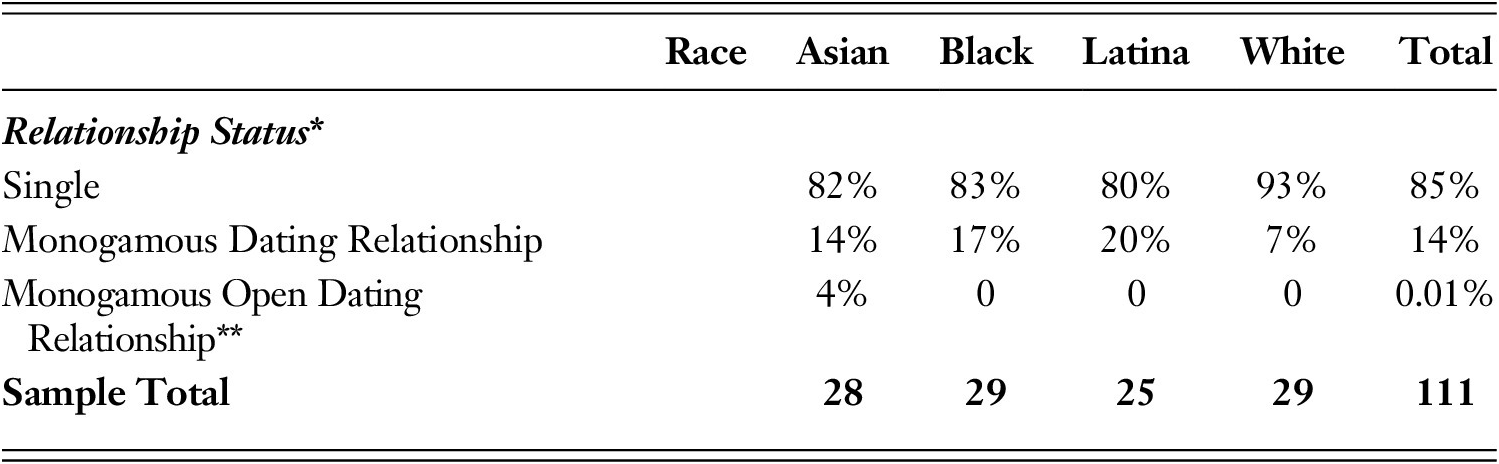
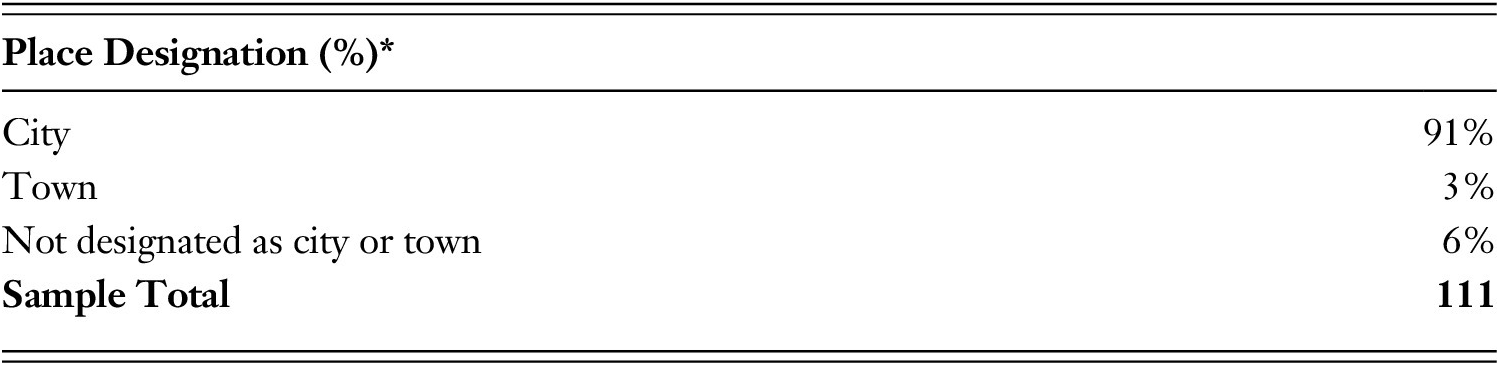
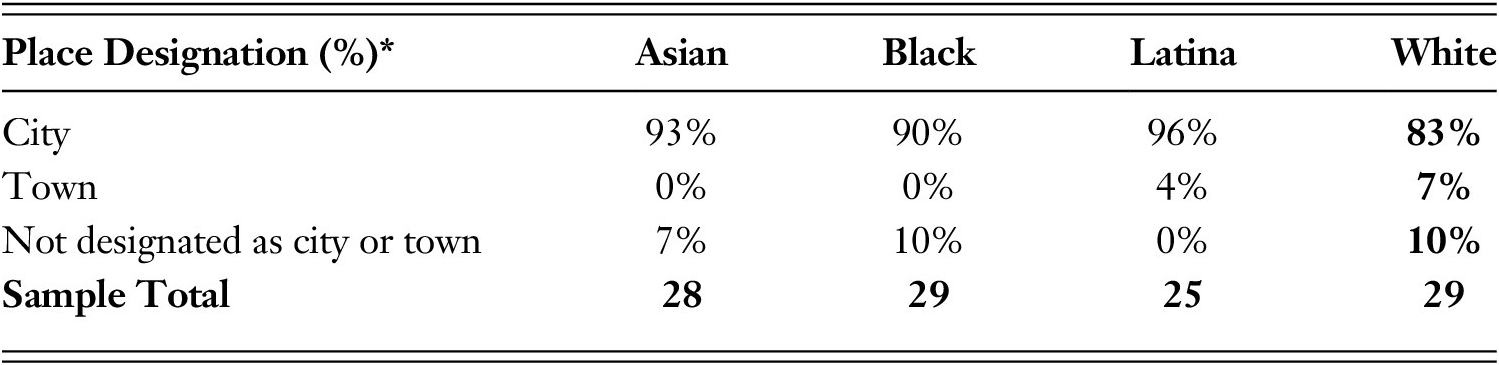
For this study, interview subjects self-identified as Asian, Black, Latina, or White (Table 1). The women were between the ages of twenty-five and thirty-three, identified as heterosexual, had no children, and were currently single or had been in an exclusive dating relationship for a year or less at the time of interview. I noted no significant differences in search experiences between women who were currently single and those who had been in an monogamous, dating relationship for a year or less. Additionally, the majority of my sample was singleFootnote 3 and open to finding a romantic partner at the time of the interview (Table 2). The average age for women in the sample was twenty-eight years old, ranging from twenty-seven among Latinas and twenty-nine for White women. The majority of my sample resided in a city, while a smaller fraction resided in either a town or a location not designated as a city or town by the U.S. Census Bureau (e.g. Princeton, New Jersey; Racine, Missouri; and Silver Spring, Maryland) (Tables 3 and 4).
Sample Size of Respondents by Race/Ethnicity

Relationship Status of Respondents at Time of Interview by Race/Ethnicity

* Column percentages
** Romantic relationship where partners agree to date and/or have sex with other partners outside of the relationship.This is different from polyamorous relationships where individuals have more than one main or primary relationship (Ritschel Reference Ritschel2019; Schippers Reference Schippers2016).
Location of Respondents Using U.S. Census Designation

Location of Respondents by Race/Ethnicity

Why Women?
This study is concerned particularly with women’s romantic partner search for three reasons. First, research shows that women are much more selective than men about whom they choose to date and their partner preferences (Bratter and King, Reference Bratter and King2008; Fisman et al., Reference Fisman, Iyengar, Kamenica and Simonson2008; Hitsch et al., 2010; Hwang Reference Hwang2013; Regan Reference Regan1998). Because of this, they represent an ideal sample group to study how location poses a constraint for those preferences in their romantic partner search. Second, research also demonstrates that despite the social advances due to the Civil Rights and feminist movements and the increase in dating technology, women still face norms, expectations, and stigma that influence how they manage their search for a romantic partner (Eig Reference Eig2014; Hamilton and Armstrong, Reference Hamilton and Armstrong2009; Henry-Waring and Barracket, Reference Henry-Waring and Barraket2008). Black women are especially prone to some of these societal expectations. For example, both mainstream and scholarly authors chide Black women about desiring Black men as partners when Black women lament that there is a shortage of marriageable Black men (Banks Reference Banks2011; Judice Reference Judice2018). Some of these authors also suggest that Black women expand their pool to include non-Black men. This suggestion that assumes non-Black men are equally open to dating Black women as other non-Black women and that all geographic locations provide this opportunity. In popular and social media, college-educated Black and Latina women are also scolded for desiring educational homogamy or having standards that are too high (Hurt et al., Reference Hurt, McCleroy, Sheats, Landor and Bryant2014; Muro and Martinez, Reference Muro and Martinez2016). Men are allowed much more autonomy in their partner choice. Lastly, sexual relationships remain riskier for women than for men. Despite the myriad of contraceptive options available, should any of these methods fail and a woman becomes pregnant, her partner can walk away from the experience while she cannot. Thus, constraints on the romantic partner search may have implications for how often and with whom women can express their sexuality.
Recruitment
I recruited respondents using snowball sampling, Facebook, Meet Up groups, affinity groups on a university campus, and college alumni Facebook groups. The recruitment blurb (Appendix) included a link to an online survey that asked interested participants about their college education, sexual orientation, race, current relationship status, and children to determine eligibility. For those who were eligible, I followed up with an email where I assigned them an identification (ID) number to use for the remainder of the study. Twenty-four hours prior to each scheduled interview, I emailed respondents a link to a survey that inquired about partner preferences including ethno-racial, educational, religious, and occupational characteristics. This email also contained the consent form for the interview. Completing these surveys on their own and anonymously gave the women the ability to answer the survey truthfully. I also used the surveys to provide me with some context when I asked respondents about their dating experiences given their stated preferences. It is important to note that my sample of 111 women is not a nationally representative sample.
Interviews
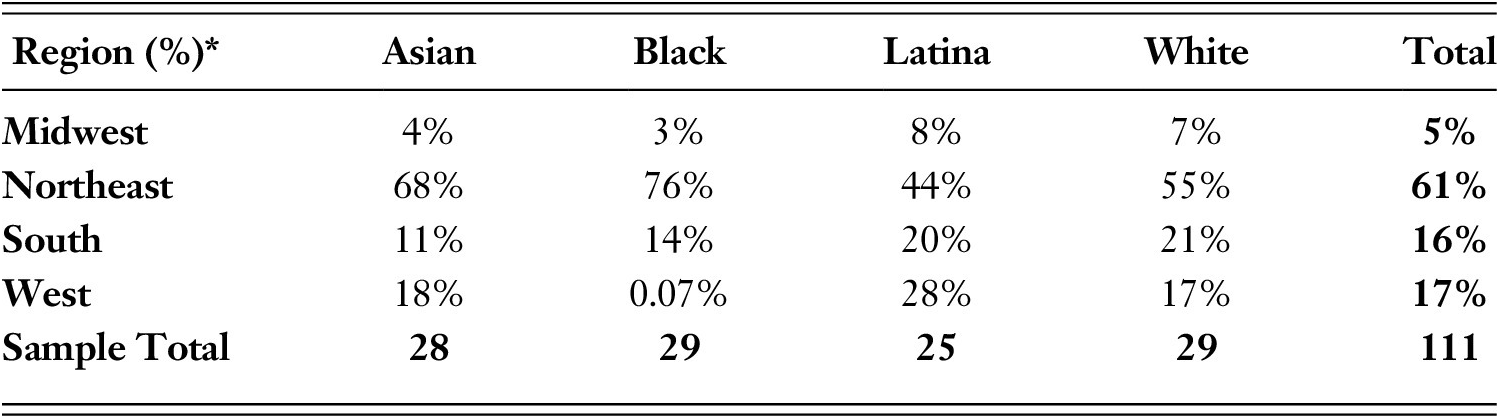
The interviews were semi-structured and ranged from sixty to 120 minutes. I inquired about respondents’ modes of searching for a partner, frustrations of the search, experiences with online dating, and marital expectations. I performed face-to-face interviews at cafes, offices, conference rooms, and in respondents’ home with women who were in my geographic area (Philadelphia and central and southern New Jersey). The majority of my sample resided in the northeast (Table 5). I conducted all other interviews using Skype, Google Hangout, and telephone.
Sample Respondents by Race/Ethnicity and Region

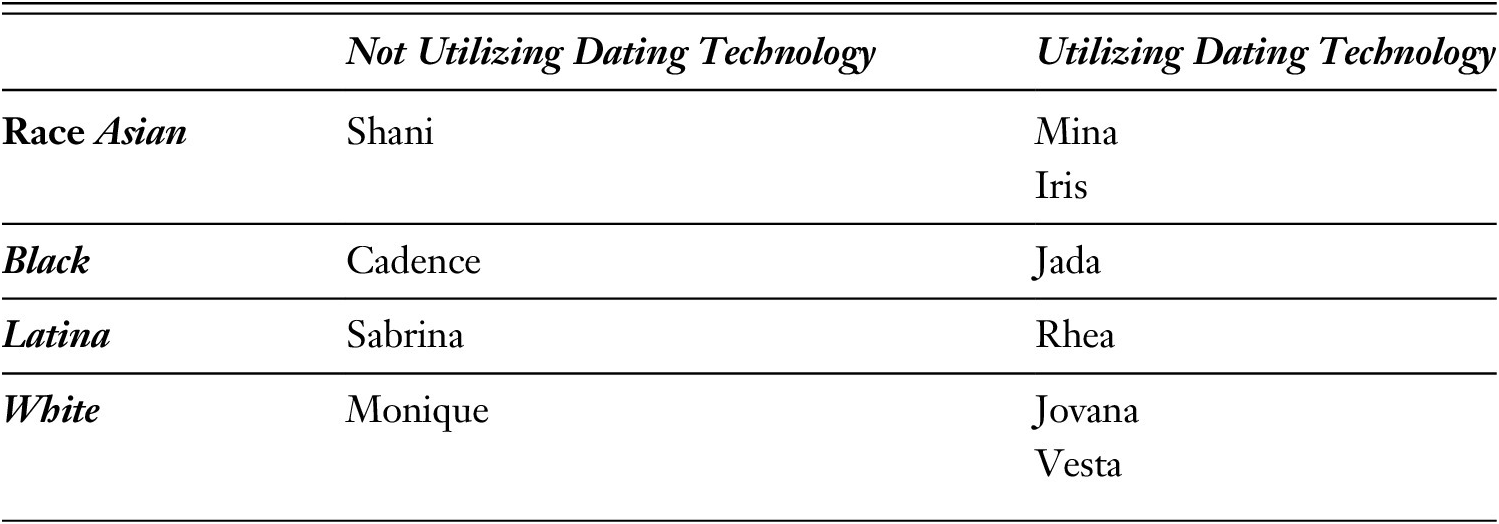
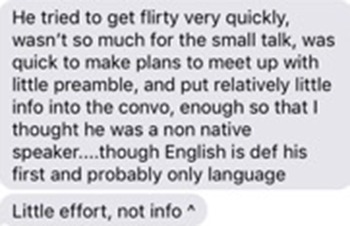
The last phase of this project included monthly follow-up interviews with ten women from my original sample (Table 6).Footnote 4 These year-long follow-up interviews concluded in April 2019. These follow-up interviews were intended to gather more detailed data about the larger patterns I noticed from the original data set, to provide continuity from and greater context for my original interviews, to further compare women who did and did not utilize dating technology, and to address issues of recall bias. In the follow-up interviews, I asked about potential dates, on- and offline interactions, and frustrations and joys of the romantic partner search. Respondents who used dating technology in their search also sent me screenshots of their online and/or app profiles, profiles of men with whom they have matched and/or were communicating, text or app conversations with potential dates, and any other interactions and updates they chose to share. This information provided me with real-time, detailed data about my respondents’ search process. I performed content analysis on this data to bolster my arguments about the barriers women encountered in their romantic partner search.
Follow-up Respondents by Race/Ethnicity and Utilization of Dating Technology

My positionality as a woman, close in age to my respondents, who had embarked on a romantic partner search, was significant as I built rapport with my respondents. I too utilized many of the same dating apps and shared similar stories and experiences as my respondents.
Being a Black woman allowed greater empathy with the women of color in my study because I could understand how race might shape their dating experiences. These commonalities I shared with my respondents were helpful in abating social desirability bias and encouraging them to be open and honest. At the same time, my race could have influenced women of color respondents to be more truthful than the White women and could be a limitation of the study. This bias however was somewhat, if not completely, abated by asking White and non-White respondents to complete their surveys in private and by posing questions about race/ethnicity in the same manner to all respondents.
Coding and Analysis
All recorded interviews were transcribed and coded with Atlas.ti. I utilized an emergent method as I searched for themes, refined themes and codes, wrote memos, and sought disconfirming evidence. This coding schema also helped me to observe alternative explanations for the patterns I noticed. Specifically, the theme of location as a barrier initially emerged after I finished conducting interviews and began coding the transcribed interviews. I noticed it while re-coding these three broad themes: frustrations of the search, current and future barriers, availability of men with respondents’ preferences, and race and dating. There were no questions in the original interview guide about locational barriers. Nevertheless, almost one third of the women in my sample had something to say about it. For women of color, the discussion of location as a barrier for assortative mating along educational and racial/ethnic lines was salient. All the women of color who discussed location as a barrier also mentioned that it influenced their ability to find men of the same or different ethno-racial background and/or educational level as themselves to date. On the other hand, no White women who mentioned location as a barrier observed it as such for finding and dating White men. They did, however, notice it if they were interested in dating interracially. Additionally, given that location as a barrier emerged without prompting during the first phase of data collection, I asked my follow-up respondents about it.
Again, it was a relevant topic for my Asian, Black, and Latina follow-up respondents. I imagine that more women in my original sample would have said much more if I had asked specifically about their thoughts on how their residential location impacted their romantic search experiences.
In my analysis of the codes and quotes, I paid careful attention to how women in each ethno-racial group talked about location as a barrier. From that emerged the differences between White and non-White women in terms of how place was a barrier for them. During content analysis of text messages, I also thoroughly examined words and images that illustrated women’s feelings, attitudes, and concerns about their romantic partner search due to location. The independent variable was the location where a woman resided. The dependent variable was the barrier to relationship formation that the respondent encountered.
FINDINGS
Respondents, regardless of race or whether or not they utilized dating technology, feel that some cities or towns are barriers as they engaged in their romantic partner search. First, I discuss locational barriers that were common to all women, but which White women discussed more than women of color. Next, I examine the locational barriers that only women of color encountered. Lastly, I explore the strategies that primarily women of color employed to address these locational barriers. I show throughout that location remains relevant for relationship formation as the intersection of race and place creates locational barriers for relationship formation among women of color. This intersection further demonstrates that opportunities for relationship formation are racially stratified.
Race and Place Among White Women
Regardless of whether or not they utilized dating technology, women I interviewed observed that where they resided did not always provide opportunities to meet men for romantic connections or that men in these places practiced dating norms and/or had expectations of long-term relationships that ran counter to respondents’ norms and beliefs. White women, however, discussed these locational barriers more often than women of color. Unlike women of color, White women rarely actively addressed these barriers.
Limited Opportunities to Meet Men
Rosalia, a twenty-five year-old White woman who lived in Tulsa, Oklahoma discussed her frustration with living in a city where everyone knew each other and the challenge it posed for her romantic partner search:
Tulsa’s a big place, but Tulsa’s also a very small place. I went to one of the largest high schools in Tulsa. I graduated with 1,500 kids, so that’ s people that are in my past that I see all the time, and that I don’t necessarily want to be in my future. That’s actually happened to me too. I was talking to this guy [on an app] and he ended up knowing someone that I went to high school with. They opened their mouth and said some not true and not nice things about me. Then the guy ghosted me. So, it’s hard when you live in a city where everyone knows everyone.
Rosalia also utilized dating technology; however, it did not assuage the problem of familiarity that she felt hindered her search in Tulsa. Rosalia considered moving from Tulsa, though mostly in jest. She explained:
I feel we have a really small pool of men to choose from. I joke with my parents all the time that I’m going to have to move to Boulder; that I’m going to have to move to Austin or Dallas where there are so many more people to choose from. A lot of people move away from Tulsa once they graduate and go to school. And then they don’t come back. So, there’s not a lot of people that are near my age range that are not already married or that are looking for what I’m looking for.
Living in a small town also posed challenges for meeting new people. Thirty year-old Monique, a White woman, lived in Lubbock, Texas where she worked as a general manager at a big box store. Monique typically never spent more than a month on any website or app and was off the apps when I first interviewed her. She explained that she felt she could “literally go through every guy that was on the dating site within a few days or a week.” She continued, “There was just the same people over and over again because I live so far out in the middle of nowhere.”
Callie, a twenty-seven year-old White woman living in Stamford, Connecticut felt as though her opportunities to meet men were limited by the small population of young adults in the area:
I feel I don’t know where to meet people and feel like I just see the same group of people every week. And there’s just not a lot of young people in this area. There are even less that are Christian. In a lot of senses, I feel like I know all the young Christians in this area, and I’m not really interested in any of them.
Callie also used dating technology on and off but grew frustrated, and eventually went offline. She relied on church services, church social events, and her friendship network to make romantic connections with men. Her locational barriers were further compounded by her desire to date Christian men who not only attended church, but whose beliefs centered on their faith in Jesus Christ. Therefore, location could be a barrier not only in terms of the number of men available, but also men who fit certain preferences on which women did not want to comprise or give up.
Vesta, a twenty-eight year-old White woman living in Alexandria, Virginia framed the opportunity to meet single college-educated men, her partner preference, as a matter of imbalanced sex ratios in Washington, DC and its surrounding suburbs. Vesta explained there were more single female than male college grads which constrained her opportunities for making romantic connections. She described dating in Alexandria as “frustrating”:
I live in the city of Alexandria, and that is immediately outside of Washington, DC…It’s definitely imbalanced in terms of there are more women than men. They are also pretty extremely higher numbers of educated women (compared to) men, women who have higher socioeconomic status than men, all of those things are high.
Sex ratio imbalance remains a widely accepted explanation for the marriage gap between college-educated Black and non-Black women (Cohen and Pepin, Reference Cohen and Pepin2018). However, as Vesta experienced in her romantic partner search, it is also a nationwide phenomenon that varies by location (Birger Reference Birger2015) and is regularly written about in popular media (e.g., Codik Reference Codik2015; Swanson Reference Swanson2015). New York City, for example, has a higher ratio of college-educated women to men than DC (Birger Reference Birger2015). Jeanine, a thirty-one year-old White woman, lived in New York City prior to moving to Philadelphia, and also noted that the sex ratio imbalance in New York City was a barrier in her romantic search there. She explained, “I don’t know what the sex ratio is in Philly, if there are more girls than guys, which would be to my disadvantage. I lived in New York for a little bit and that was definitely the case there.” Like Vesta, Jeanine found dating in New York to be disappointing and frustrating.
Mismatch with Dating Norms and/or Relationship Expectations
White women, like women of color, also felt that dating norms that governed a particular location constrained their opportunities to find romantic partners. They discussed men’s gendered expectations of long-term relationships and/or their approach to dating. Monique not only felt that Lubbock, TX was too small of a town to meet men. She also felt that Lubbock was a “very conservative” town in which to search for long-term romantic partners. She described it as a place where men in long-term dating relationships expected their partners to have children and stay home after they were married:
I feel that my purpose isn’t necessarily to be a mom, but to impact other people with my time and energy. That’s where I see myself being more of a value to people is in that aspect, rather than being a mom. I don’t want to give someone the wrong impression that I’m ready to pop out three kids and be a stay-at-home mom, because that’s not the case. Particularly in Lubbock where I am, it’s a very conservative town, and there is quite literally a church on every corner. That’s traditionally what everybody does. They meet their significant other, either in high school or college, and as soon as they graduate college, they get engaged, get married, and start a family. That’s typically the order of things. So, most guys that I meet are looking for that. They’re looking for that person, that woman where she might have a career, but is she willing to give it up to raise a family? Or does she at least want to have kids and have a good job and be able to afford daycare, because that’s what you’d have to do…I’m not the only one down south that doesn’t want to be a stay-at-home mom; but I would definitely say the mass population of women, that’s their goal. It is to find a husband with a good job, to make the babies, and stay at home to raise them.
Monique described her romantic partner search as “extremely difficult” because her desires to remain childless after marriage and to continue in her career was a mismatch with what most men (and in her opinion, most women) in Lubbock were interested in when looking for in long- term romantic partners.
In contrast, women who live in cities felt that men there approached dating casually and were not interested in exclusive, long-term relationships. This was a significant issue for women in my study who had or currently lived in New York City. Angela, a thirty-one year-old White woman, lived and dated in New York before she left the city for another job on the West coast. She described New York City as a “terrible place to try to meet men.” Angela felt this way because:
I feel like maybe everyone is just looking. There are so many people that there’s always the sense that there’s probably someone better right around the corner…It didn’t seem like there were a lot of people who were really committed to the idea of looking for a relationship. Even if they liked the idea of a relationship, they were more into their job or—I don’t know. That seemed to be an experience that a lot of my friends were having too.
Jeanine described New York City as a place where “there are just more guys who were not willing to grow up than girls.” She felt that women approached dating and relationships more seriously than men. This mismatch between how respondents versus the men where they resided approached dating was a source of frustration for women searching for romantic partners.
Place and Race Among Women of Color
Most White women and women of color in my study wanted to date men of the same educational and ethno-racial backgrounds as themselves. For educational homogamy, women felt that they had more in common with or it was sometimes easier to discuss their professional or educational aspirations with men who were college-educated (even though that was not always the case). In terms of ethno-racial homophily, women of color often cited a desire for romantic partners who are familiar with negotiating race and racism in their daily lives as a reason they preferred men of the same ethno-racial background or men of color in general. They also preferred that their partners already be knowledgeable about elements of their culture such as food, language, traditions, or cultural values.
Jazmin A. Muro and Lisa M. Martinez (Reference Muro and Martinez2016) noted similar preferences in their study of partnering among college-educated Latinas. Women of color, particularly Black and Latina women, experienced location as a barrier in two ways that White women did not: some locations had limited opportunities to date men of color and some places had limited opportunities to date interracially. Towns and places not designated as a town or city with limited opportunities to meet men further constrained chances to achieve educational and ethno-racial homogamy because few educated men of color lived in there. White men in these locations were also sometimes reluctant to date women of color. These issues, however, were not always abated by living in a city. College-educated Black women often outnumber college-educated Black men in metropolitan locations (Cohen and Pepin, Reference Cohen and Pepin2018). Therefore, the opportunities to date men of their same racial and educational background, especially for Black women, could also be limited in these cities, even if interracial dating was slightly easier to do.
Limited Opportunities to Achieve Racial/Ethnic Homophily
Women of color sometimes found it difficult to meet and make romantic connections with men of their same racial/ethnic and/or educational background because there were simply not enough men with these characteristics in a particular city or town. Women who used dating technology experienced these constraints more immediately than non-tech users because the apps and websites instantly showed them who was available at a particular location. Although the apps could not capture the entire population of single men of color in a particular location, they could serve as a window into a city’s ethno-racial diversity. To illustrate, Jane, a twenty-five year-old Latina, described the change in ethno-racial diversity she noticed on OkCupid when she moved from Central Texas back to Houston, her hometown:
I was living in the central Texas area suburbs, and I felt like it was limited in Hispanic/Latino men. It felt like there weren’t that many to choose from. There were mostly White men my age. It was about White men my age and half other races, Arabic, Middle Eastern, some Hispanic, some Asian, other ethnicities. When I moved back to Houston, it was a totally different demographic. Once, I logged back into OkCupid just out of curiosity when I moved back, it was a lot. It was almost seventy-five percent Latino men showing up near me. I felt like there was more to choose from.
Cadence, a 27-year-old Black woman residing in west Los Angeles (LA), expressed similar opinions about the difficulty of finding college-educated Black men to date in LA because of her location. She described her options for Black men on Tinder as “horrible” and “super limited, because I live in a very White, affluent area.” Cadence directly names location as the reason for her inability to meet men of color, despite the assistance of dating technology. In one of our follow-up interviews, Cadence also recalls a trip she took to Atlanta, GA earlier in the month, to illustrate how location was a barrier to making romantic connections with college-educated Black men. She used OkCupid and Bumble in Atlanta and noted that the “number and quality” of college-educated Black men is “much higher in Atlanta than it was in LA.” This is not surprising given that Atlanta is one of the top destinations for college-educated Blacks (Frey Reference Frey2018). Ultimately, Cadence’s experience of the differences between Atlanta and LA reveals that locations where women reside and search for romantic connections do not all provide the same opportunities. Location can constrain chances for forming romantic relationships depending on the woman’s race/ethnicity and her partner preferences.
“Culture” of Place
Despite the primary desire to date men of the same racial/ethnic backgrounds as themselves, women in my study were also open to dating men outside of their race. Overall, White and Asian women were more open to dating interracially than Latinas and Black women. While half of the Asian and White women in the sample were interested in dating interracially, only a third of Latinas and Black women were open to doing so. The women of color who expressed a desire to date interracially discussed their attempts to do so in the cities where they resided. I found that regardless of whether or not they utilized dating technology, women of color felt that some cities did not provide ample opportunities for interracial dating, particularly with White men, which posed a barrier in their romantic partner search. One way in which women of color experienced limited opportunities to date interracially was in how White men embodied the “locational culture,” a concept I explore below. Other limiting factors included perceptions of a general reluctance to date interracially because they did not see many interracial couples and/or that men, including White men, were explicitly not interested in doing so.
Regions, cities, and towns embody the distinct rituals, beliefs, history, and other characteristics of the individuals who live there and make up the particular “culture” of a location (Gieryn Reference Gieryn2000). Among women who use dating technology, a location could be a barrier for a woman’s relationship formation if she feels the men’s profiles on the apps depict an embodiment of aspects of the locational culture that she finds unattractive. For example, Rhea, a twenty-nine year-old Latina woman living in Columbia, SC, sent me picture after picture of profiles with men holding both live and dead animals (see images 1–3) in one of our follow-up text exchanges. Rhea used Bumble and Tinder, mainstream apps that attracted a diverse group of users, not a niche app that catered to hunters.Footnote 5 Hunting, nevertheless, was a significant part of White male culture in the South (Klinenberg Reference Klinenberg2018). It was also a major turn-off for Rhea. Thus, she did not initiate a match with men who expressed these cultural behaviors in their dating profiles.
Image 1

Image 2

Image 3

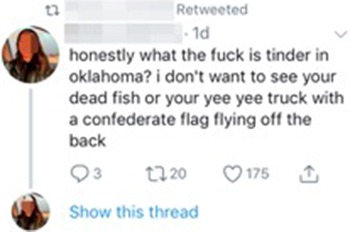
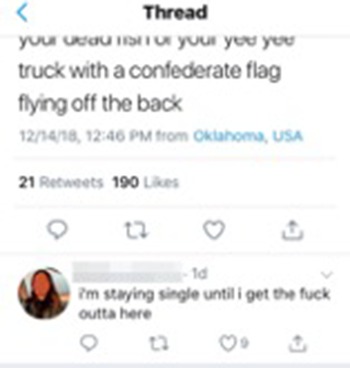
Rhea’s experience was not unique. A quick scroll on Twitter showed women with similar experiences. Images 4 and 5 below show a woman who complained about men’s profiles with pictures of dead animals and “yee yee trucks” with confederate flags on her Tinder app in Oklahoma. She also lamented that she would remain single until she left the state, presumably because these images characterized many of the profiles she saw on the apps and she had no interest in dating these men.
Image 4

Image 5

Although racism was not always as explicit in the profiles that Rhea browsed, there were undertones of it which made Rhea less likely to pursue a match. Within the locational context of the South, specifically in American Evangelical churches, there is an underlying narrative of Whites saving the lost souls of Black and Brown heathens (Schneider Reference Schneider2018). Thus, men with profiles that featured pictures of them with Black or Brown children with references to God, Jesus, or missionary work were a turn-off to Rhea. Images 6 and 7 are examples of such profiles Rhea sent me in another text conversation. Because she felt these profiles implied a belief in the narrative of the “White savior” (Cammorota Reference Cammorata2011; Schneider Reference Schneider2018), she refused to show interest in these men.
Image 6

Image 7

Image 8

Rhea also prepared to face racism offline as a Latina searching for romantic partners in Columbia, SC. She explained:
I know that I’m going to encounter things that aren’t nice. I know I’m going to be segregated; I know that I’m going to have to prove I’m a smart person; I know I’m going to get asked about my immigration status; and all of these things that aren’t pleasant or things I don’t want to think about when I’m thinking of whether I want to date someone or not.
In Columbia, Rhea anticipated negative attitudes and stereotypes about Latinos that could stymie her in the search for a romantic partner. However, like some of the other Latinas in my study, she could not ignore this reality as she engaged in her romantic partner search, not only in a location with few Latino men, but White men whom she did not want to date.
At other geographical locations, women of color experienced limited opportunities to date interracially because men, mainly White men, were not interested. Luna, a twenty-five year-old Asian-American woman who resided in Harrogate, TN, a predominantly White town, was interested in dating White men. Luna, however, found it difficult to meet men who were interested in dating interracially in Harrogate. She explained:
Back where I’m from, in California, interracial dating is really common. Here, it’s not so much. I’ve looked around and it’s not super common. I do think that it’s a deterrent sometimes. I mean I do find Caucasian men attractive. But it seems the people from around here, I feel like they may not be as comfortable with the idea of having an interracial relationship. There’s a lot of Caucasian people in this area where I live.
White-Asian interracial couplings are one of the most common types of interracial couplings (Wang Reference Wang2012). California, particularly in cities like Los Angeles, San Francisco, and San Diego, boast the lion’s share of these interracial marriages (Livingston Reference Livingston2017). But in the South, a region where thirteen percent of adults state that interracial marriage is not good for society (Livingston Reference Livingston2017), Luna found herself excluded as a romantic partner. Luna also explained how living in a predominantly White area in Tennessee made her romantic partner search harder than she expected. She stated, “I didn’t expect to end up in Tennessee for school. I do think that if I had gone to a school in like a larger area, I’d probably to be able to meet more people. I do think, I expected things [finding a romantic partner] to be a little easier, but then now, the way things have taken a turn, it’s a little harder.”
Sandy’s experience in Meriden, CT, was similar to Luna’s. Sandy, a thirty-one year-old Black woman, was also open to dating men outside of her race. She used dating apps in the past but was not using them at the time of the interview. Like Luna, she felt there was a general reluctance towards interracial dating relationships with Black women in Meriden. She noted that in “certain areas of Connecticut I do see interracial couples, like in maybe Meriden, Hartford, and New Haven areas.” However, she also stated that, “I feel that maybe some people are not open to it [dating interracially] …I don’t get hit on much out here.” Sandy’s feelings were based on her experiences in Newport Beach, CA. She explained, “I went to California last summer, and I felt like I got more flirting from guys out there in person and on the apps. It was mixed too, like different races. So, it felt like people were more open and saw me as a human and not a Black female.” Her search experiences in Meriden, on the other hand, made her feel as though being a Black woman was undesirable.
Sandy’s thoughts about her experience of searching for romantic partners in Meriden and Newport Beach also powerfully illuminate the importance of location for relationship formation for Black women, even in an age when digital technology seemingly erases its significance.
Numerous findings show that Black women are the least likely to be seen as potential romantic partners because of gendered racial stereotypes (Feliciano et al., Reference Feliciano, Robnett and Komaie2009; Lin and Lundquist, Reference Lin and Lundquist2013; Robnett and Feliciano, Reference Robnett and Feliciano2011). However, Sandy’s experience demonstrates that the degree to which they feel and experience this exclusion on- and offline may vary from place to place.
Addressing Locational Barriers
Women of color utilized various strategies to address or alleviate the locational barriers to forming romantic relationship sthey encountered where they lived. These strategies included aligning their career plans with moves to another city that could offer them more opportunities to meet college-educated men of color, altering their self-presentation on- and offline, and including White males in their partner preferences. Factors that determined what, when, and how the respondents employed these strategies depended on their use of dating technology and/or what strategy best fit at that particular moment in their lives.
Aligning Career Plans
Nacine, a twenty-seven year-old Black woman living in New Orleans, LA, did not use or desire to use dating technology in her romantic partner search. She felt New Orleans was not a city where she could easily find Black men who were also college-educated, even though there were a few Black men at her medical school. She had also recently ended a casual relationship with one of them. Nacine mentioned that staying in New Orleans for residency would likely continue to limit her potential for relationship formation. She recently decided that it would be necessary to move to another city for residency if she wanted to find a long-term romantic partner. She explained that, in five years, “I think it could potentially be difficult to find this person if I was still in New Orleans.” Instead, Nacine considered residency programs in Chicago, Pittsburg, Atlanta, and Houston—places with large populations of Black college-educated men (Frey Reference Frey2018). Luna, mentioned above, also planned to return to California or another state where there was greater openness to interracial dating for her medical residency.
Monique was one of the very few White women in my study who employed a locational strategy to address limited opportunities to meet men and the mismatch in relationship expectations. In one of our follow-up interviews, she stated firmly that she planned to leave Lubbock:
I’ve made it clear to my boss that I don’t want to stay here. [By] approximately 2020 he should be getting me back to the DFW (Dallas-Fort Worth) metroplex. I actually bought some property outside of Dallas. And while I live out here, I’m paying on that property and eventually, I hope to live out there. It’s actually still pretty country. It’s an hour outside of Dallas, but I’ll be working in the city. And that should happen in the next year and a half.
Including White Males in Partner Preferences
Yolanda, a twenty-five year-old Black woman also living in Harrogate, TN, stated she wanted to date a college-educated Black man. She had used dating apps in the past, but stopped using them after she started medical school, as she found them time-consuming and distracting. Yolanda described her experience in Harrogate as, “You know, I’m the minority in everything.” She not only experienced being Black in a majority White space, but also the lack of exposure to men of color because she saw so few of them in her daily life. Yolanda decided to expand her racial partner preferences to include White men. She explained, “I feel like I may be more open to dating out of my race because I just see more White people—I see more non-minorities, obviously, in my daily life and stuff.” Because she recognized that her current racial preferences would likely hinder her relationship formation in Harrogate, Yolanda compromised on her partner preferences to alleviate the barriers that living in the town posed. It is important to note that White women in my study never mentioned changing their racial preferences to include men of color as a locational barrier strategy. Asian women also often already included White men in their ethno-racial partner preferences. Thus, this particular strategy was one that only Black and Latina women in my study performed.
Yolanda’s strategy to include White men in her romantic partner preferences also defied both popular and scholarly opinion that Black women do not adjust their racial/ethnic partner preferences in the face of a shortage of marriageable Black men (Banks Reference Banks2011). Proponents argue this is why they were more likely to be single than women of other ethno-racial groups (Banks Reference Banks2011; Judice Reference Judice2018). This claim is not supported by the evidence in this study. Another study also found that college-educated Black women sometimes changed their sexual preferences and dated Black college-educated women as an alternative to finding and dating educated Black men (Massey et al., Reference Massey, Charles, Lundy and Fischer2003).
Altering Self-Presentation
Women of color also sometimes altered their online or app dating profiles or their offline appearances as a locational barrier strategy. Although Rhea was open to dating White men in Columbia, SC, due to the racist undertones she encountered on the apps, she curated her self- presentation in her dating profiles. She explained, “No, I never put any information about my political beliefs on my profile. It was on purpose. I think that putting that out there has the potential of drawing attention from trolls.” Rhea curated her profile to avoid being harassed or “trolled” on the apps because of her views on immigration, women’s rights, and Black Lives Matter. Being trolled could happen on any dating or non-dating online platform in the United States, given the current political climate (Desmond-Harris Reference Desmond-Harris2016). Yet, it was especially important for Rhea to avoid becoming a target because she was a Latina living in a southern city.
Amariah, a thirty-two year-old Latina living in Grand Rapids, MI, had stopped using dating apps for about a year when I interviewed her. Consequently, she was doing more activities such as going out to clubs and bars with friends to meet potential romantic partners. She also tried going out alone to cafes and coffee shops to meet men, but was deterred by the lack of Latino men she saw in public. Additionally, she felt she could not fully engage with the White men she encountered in public because of her ethno-racial status as a Latina and the negative rhetoric surrounding this group. She explained:
I think I have trust issues lately especially because of political stuff and how people feel about immigrants. It’s huge and you can’t really gauge that from just bumping into someone at a coffee shop or whatever. So, I distrust a lot of people or mistrust… And that’s hard because I don’t want to randomly bring up the topic. I’ve done that before, just randomly say something like, ‘Immigrants are amazing’ or whatever and then they just look at me like, ‘What are you saying?’ And then they are offended because of something I said. I don’t want to bring up topics that are going to offend people and deter them from getting to know me as opposed to just getting to know me first and then figuring out what their stand is on things.
Amariah adjusted the ways in which she presented her beliefs and opinions to make herself more approachable to men who may be interested in her. She also, however, did not want to lose the opportunity for someone to get to know her, have more context for her beliefs, and understand who she was as a Latina. For Amariah and other women of color in my study, these weighty considerations that concerned political issues, but that were also deeply personal, forcefully came into play in their romantic search, especially in places where they encountered locational barriers.
Utilizing Niche Apps
Among women of color who used dating technology, another way they dealt with the limited exposure to college-educated men of color was to utilize dating platforms that catered to Black and Brown searchers (e.g. Badoo, Black People Meet, or Soul Swipe) or individuals interested in dating interracially (e.g. AfroRomance, Beyond Black and White, and Interracial Cupid). These niche apps could potentially facilitate the search for users who have racial/ethnic preferences with which they did not want to part. For example, Shiloh, a twenty-six year-old Black woman living in Newark, DE, met her current boyfriend on Badoo because she wanted to date men of color. However, there were few of them on Tinder in Newark. She noticed that “the White people here [Newark] are using Tinder, and then there are more Black and Latino men on Badoo.”
Niche apps, nevertheless, were not a complete solution to locational barriers for three reasons. First, many of the men that were on the niche apps were also on mainstream apps like Tinder, OkCupid, Coffee Meets Bagel, and Hinge. Respondents explained that they rarely used niche apps exclusively in their romantic partner search because male searchers, like their female counterparts, also utilized both mainstream and niche dating apps and websites. In fact, Shiloh learned about Badoo from a man she met on Tinder because he also had a profile on Badoo. Second, mainstream dating apps and websites also tend to have a greater number of users than niche apps (Priceonomics Reference Pricenomics2016). Thus, users could potentially limit themselves if they only utilized niche apps. Lastly, recent data shows that the use of apps, including niche apps, varies by region. In the South for instance, individuals use Black People Meet more often than mainstream apps like Tinder or Coffee Meets Bagel (Priceonomics Reference Pricenomics2016).
This finding is not surprising given that there is a large population of Blacks in the South, including Black millennials (Frey Reference Frey2018; Hunt et al., Reference Hunt, Hunt and Falk2008). Therefore, in some locations, niche apps may be better for meeting people of color than in other places, as Shiloh discovered. Coffee Meets Bagel, on the other hand, is much more popular in the West and Midwest (Priceonomics Reference Pricenomics2016). Using a niche app in cities in these regions may not facilitate making romantic connections because most of the users are on mainstream platforms.
Changing Distance Preferences
Women who use dating technology could also increase their distance preferences in order to include locations that have larger populations of men, men of color, or men willing to date interracially. However, similar to findings in other studies, neither White women nor women of color wanted to travel too far from home to find love, whether it be for a casual or long-term relationship (Rosenfeld and Thomas, Reference Rosenfeld and Thomas2012). On average, women set their distance preference to twenty miles. Some women set it as low as one mile. One woman set hers at 250 miles, but this was because she lived in a small city with two cities to the south and north of her which were easily accessible by train. In general, however, respondents preferred to search for partners within a distance that encouraged meeting potential romantic partners in person. This evidence, along with data that shows that the use of niche and mainstream apps varies by region, further demonstrates that location remains important for relationship formation in the digital age.
No Locational Barriers: Alternative Experiences of Race and Place Among Women of Color
Regardless of whether or not they used dating technology, women of color who lived in cities with a large demographic of educated men of color often found it was easier to meet and date these men. Rhonda and Shani’s experiences illustrate this point. Rhonda, a thirty-two year-old Black woman, had a career that took her from New York to San Francisco and then to Philadelphia. She searched for Black college-educated men using dating technology in all three cities. Therefore, she could speak confidently about similarities and differences in the opportunities to meet college-educated single men of color in each city. She explained:
I think Philly just doesn’t have enough large industries to attract enough educated, eligible bachelors. So, I just feel like cities like San Francisco and New York just have higher numbers, and that’s really what it boils down to. Especially Black men.
Rhonda noted that she had little trouble finding Black college-educated men in both San Francisco and New York because there was a large population of them there. She felt, however, that it was more difficult to do so in Philadelphia. Rhonda’s experiences also align with data that shows that New York and San Francisco are in the top ten cities with the largest numbers of college-educated millennials. San Francisco, additionally, had the second highest number of college-educated Black millennials (Frey Reference Frey2018). Rhonda’s experiences demonstrate that the potential of a particular online dating platform may not be fully reached if the city in which one uses it does not have a large demographic of the partners that fit specific criteria. They also illustrate that favorable and unfavorable marriage markets for Black women vary by location. Some cities may be better than others for college-educated Black women who desire racial and educational homophily in their romantic relationships.
Shani, one of my follow-up respondents and a twenty-seven year-old Asian American woman, had also lived in and searched for romantic partners in multiple cities: Boston, New York, and currently San Francisco. Shani did not use online dating platforms or apps to search for romantic partners. She relied heavily on her friend networks and her church to meet men. Shani also preferred that her romantic partner be college-educated, Asian, and a Christian who not only attended church regularly, but whose values and beliefs were informed by their faith. While it helped that Shani had a friendship network primarily made up of college-educated Asian Americans, San Francisco also has a large, diverse Asian population. Shani’s description of Asian television programming in San Francisco also depicted this reality:
The Bay Area, as a whole, tends to have more Asians. It’s really telling that in the Bay Area, you have a lot of just regular [TV] network channels that are Chinese or that are other Asian language channels and you don’t require a separate cable system to access those channels, which I don’t think is the case in a lot of other places. It speaks to the fact that there is such a large Asian population here that regular network TV will also cater towards those groups and have …Asian programming.
Shani also attended church regularly, was involved in a small group where other church members met weekly to study the Bible, and attended church activities that facilitate meeting other young adults at her church. Shani stated that while she purposefully found and went to multi-ethnic churches in San Francisco, she still found that “even at multi-ethnic churches, there are so many young adults that are Asian… I think it’s super interesting because even if they are not a majority, they are still a very sizeable population.” This exposure to Asian men who fit her partner criteria helped Shani to meet three men within the first six months of moving to San Francisco. Shani stated that while she felt pressure from her friends to join an online dating platform, she did not feel that she needed it at this time. If she lived in a city with fewer college- educated Asian young adults like Fresno, CA or San Antonio, TX (Frey Reference Frey2018), it may have been much harder to meet men who fit her preferences, even if she were going to church or meeting men through friends.
Alternative Explanations for Locational Barriers
This study examines location as a barrier to relationship formation. Among my respondents, location influenced mismatch between dating norms and/or expectations of relationships and limited opportunities for inter- and intraracial dating. However, there are other variables not examined that could also constrain women’s chances for meeting men and forming romantic relationships. These constitute alternative explanations and are limitations of this study. I noticed no differences among ethno-racial groups in terms of who mentioned these alternative explanations.
Personal Issues
One alternative explanation is that respondents had personal issues that contributed to limited opportunities for making romantic connections. Personal issues included spending time doing activities that respondents felt were more fulfilling to them such as buying a house, or pursuing career and/or educational opportunities, being too selective in their partner preferences, recovering from a recent break up, or being unsure about whether or not they desired a short- or long-term romantic relationship at the moment. Natasha, a twenty-eight year-old Latina living in Philadelphia, explained that although she has been searching for romantic partners, she did not feel it had been a robust search due to her recovery from a toxic relationship:
I got in a really bad relationship and it lasted…on and off for four years. For me the healing process has been really important. I’m not the type to jump into relationships to cope from a destructive one. I don’t feel like I’m fully healed from that relationship yet.
Natasha felt she needed more time to cope with the trauma of that relationship before devoting time to finding a partner or using another relationship to cope with her failed one. Janica, a twenty-seven year-old White woman residing in New York City, struggled with prioritizing a romantic partner search and “putting herself out there.” This meant spending time on dating technology or going to events or places where she could meet men. Instead, she wanted to invest that time on her health, education, and friendships. Janica explained:
Am I actually putting myself out there enough? Right now, no. I haven’t gone on one of these app dates in over a month. Before that, it was not since April. So, there’s part of me that’s like, am I not trying hard enough? At the same time, …I also want to make sure all the parts of my life are developed and happy, and that means friendships and school and working out and all the other things.
These two quotes are characteristic of the personal issues a third of my sample gave as factors that could contribute to being unable to form relationships or romantic connections. These reasons also support research that shows that young people often want to feel personally fulfilled before entering a romantic relationship (Cherlin Reference Cherlin2009; Kefalas et al., Reference Kefalas, Furstenberg, Carr and Napolitano2011).
Lack of Time
Another third of my original sample also explained that they were simply too busy and did not have the time to search for partners. Part of the busyness included having demanding jobs, pursuing post-college professional or academic degrees, or transitioning from one city to another—an increasingly important part of young adulthood for college-educated individuals (Ansari and Klinenberg, Reference Ansari and Klinenberg2015; Kefalas et al., Reference Kefalas, Furstenberg, Carr and Napolitano2011). Jada, a twenty-six year-old Black woman and one of my follow-up respondents, was finishing her last year in a social work program in Chicago when I initially interviewed her. She wondered whether or not she would remain there after graduating in June:
My transition after June is up in the air. I don’t know where I’m going to be, so there is definitely some instability with my future goals. I know I want to end up working in the FBI and that can call for a lot of traveling, so that could be a barrier. I’m also looking at the Army Social Work Internship Program, which is four years long, and that could call for traveling as well as me getting deployed.
Jada put her search for a romantic partner on hold because she wanted to finalize her transition. After graduation, she accepted a job in Washington, DC and resumed her partner search there.
Additionally, respondents felt that prioritizing career, education, or other personal goals left them too busy and exhausted to do activities that facilitated making romantic connections such as going to bars or clubs, social gatherings and parties, volunteer activities, or browsing for potential dates on dating apps and sites. The quotes below from Victoria and Lacey capture the sentiment about busyness and exhaustion among my respondents. Victoria, a twenty-five year-old living in Brooklyn, NY, explained “I have a very busy schedule. Like I said previously, I could imagine that there might be people who would put off by the fact that I can’t see them, or I can’t talk to them as often.” Lacey, a thirty-one year-old Asian woman living in Racine, MO stated:
Everybody’s so busy, myself included. We just have become—we just go from one thing to the next and don’t take a lot of time to slow down. It’s hard to slow down to meet people to date or make time to go out on a date and make that sacrifice of time and energy to go attempt something that might turn out to (be) nothing.
As Lacey’s comment suggests, more often than not, respondents felt they had to spend a significant amount of time and energy exploring potential connections that did not result in a short- or long-term romantic relationship.
Physical Attraction
Another personal variable that was not explored, but which studies demonstrate are somewhat important for women and their mate selection, was physical attraction (Buss Reference Buss1989; Meltzer et al., Reference Meltzer, McNulty, Jackson and Karney2014; Schwarzt and Hassebruck, Reference Schwarz and Hassebrauck2012). No women in my study noted that a lack or abundance of physically attractive men influenced their opportunities for relationship formation. However only two women, who were also White, mentioned that men may not find them attractive enough to date. These women described themselves as “bigger” or “overweight” and explained that this perhaps contributed to their barriers for making romantic connections. Thirty-three year-old Ada living in Baltimore, MD explained sadly, “My weight, cuz I’m on the bigger side, so that plays a big part in things.” Laney, a thirty-two year-old residing in Tulsa, OK, stated something similar. She noted that because men value physical attractiveness in women, they may be uninterested in her because, “I think that I’m overweight. In my mind that seems like a barrier. Men are so visual. It feels like a barrier, how I physically look.”
Studies on sex differences in mate selection have consistently demonstrated that men prioritize physical attractiveness when choosing romantic partners more often than women (Buss Reference Buss1989; Meltzer et al., Reference Meltzer, McNulty, Jackson and Karney2014; Schwarzt and Hassebruck, Reference Schwarz and Hassebrauck2012). These findings were especially important as photos are one of the very first profile items searchers use to make a judgement about their romantic interest when using dating technology (Elderfield Reference Elderfield2018; Graff Reference Graff2018; Murray Reference Murray2017). Consequently, it is possible that how physically attractive men find women could influence women’s opportunities for romantic connection.
Gender
A third of my respondents also mentioned structural reasons for being unable to make romantic connections. These included gender, age, and religion. In terms of gender, women mentioned that their social networks and where they spent most of the most hours in a day (jobs and/or graduate program) were female dominated. This also meant there were fewer hours available to be in spaces where men primarily and regularly congregated. Twenty-five year-old Maia, an Asian woman, explained with disgust that there were not enough men in her social work program while she was searching for a partner as a student. Despite graduating, her friendship network remained primarily female:
We talked about how a lot of this is app bullshit because I don’t have guy friends anymore. I think that is really just kind of the biggest factor. Yes. I feel like if I had been in a different program at [Ivy League] things might have happened more organically.
Laney also mentioned that although she used online dating, she felt that she needed to spend more time where there were men. She explained:
I’ve been noting places where boys are. I went to a basketball game with a friend the other night. I was like, ‘This is where all the boys are!’ The other day I stood in line at a BBQ restaurant and it was all men. I was like ‘This is where the men are!’ I’m noticing places where men are. I was like, ‘I could start noticing that more and trying to frequent those places, being in the spaces they are.’
These quotes support findings that show that individuals often operate in social networks with people who share the same gender as themselves (McPherson et al., Reference McPherson, Smith-Lovin and Cook2001; Thelwall Reference Thelwall2008). These same-gender networks may also impact their opportunities to make heterosexual romantic connections.
Age
Respondents also explained that their age could limit opportunities for relationship formation. This is a viable explanation given that heterosexual men tend to prefer and date heterosexual women that are younger than themselves (Buss Reference Buss1989; Bech-Søreson and Pollet, Reference Bech-Sørensen and Pollet2016;). Thus, it is possible that respondents were also searching for partners at locations where they have “aged” out of the preferred age category for heterosexual men seeking romantic partners. It was also possible that respondents resided in a place where there were more married than single men their age.
Ada felt this was also a potential barrier to finding a romantic partner. She stated frankly, “I mean, age is kind of a factor because I am thirty-three, so the pool [of single men] starts to shrink a bit.” Twenty-five year-old Victoria anticipated that in five years when she turned thirty, it would be much harder to find men to date. She explained, “I think it’s like a numbers game.
It’s the ability for you to even find someone in a smaller and smaller pool.”
Religious Beliefs
Lastly, another barrier to forming romantic relationships that women mentioned was finding a partner who shared the same religious beliefs. In the survey portion of this study, I asked my respondents to rank what characteristics they would like to have in common with a future long-term partner. The most important characteristics for homophily in a romantic relationship in order were religion, political views, quality of sexual relationship, race/ethnicity, occupation, and income. This is not surprising given that the majority of my sample, both as a whole and within ethno-racial groups, identify with the Christian tradition. Regardless of race/ethnicity, Christian and Muslim women who saw their religion as central to their identity struggled most with this constraint. One major reason these respondents noted for this barrier was that they did not practice pre-marital sex. Niara, a twenty-nine year-old Latina who lived in White Plains, NY stated plainly, “I am waiting until marriage to enter a sexual relationship.” This characterized the stance of Christian and Muslim women who planned to abstain from sex until marriage. They expressed difficulty in finding men who were willing to wait for sex, even if they shared the same religious background as the respondents.
Navigating both on- and offline dating was additionally challenging because these women were often conflicted about whether or not they should put their views about abstinence on their profiles or at what point in their search to tell potential dates about their views. Vesta, a White twenty-eight year-old woman, mentioned earlier, living in Alexandria, VA and one of my follow-up respondents, was firm in her belief against premarital sex. Similar to the deeply religious women in my study, Vesta vacillated between putting this information in her profile and risk reducing her chances of meeting a potential date or meeting a man who later rejects her because he is not practicing abstinence. Vesta ultimately decided to not put on her profile that she is waiting until marriage to have sex. Similar to women who practice abstinence, she talked about her faith in her profile, chose Christian as her religious preference, and stayed vigilant about weeding out men who seem eager about sex. Below is an image of a text (see image 8) she sent to me on July 22, 2019 about a man she matched with on Coffee Meets Bagel, but whom she declined to meet in person using the clues she describes in the text.
These strategies, however, were not barrier free as they posed other challenges that could constrain opportunities for romantic connections. Vesta also often met men who were upset that she had not notified them ahead of time about her stance and found she had to explain herself:
I had this conversation [with a date] where I felt like I needed to be more explicitly clear that I do not have sex outside of marriage and that I’m not sexually active with partners and that can’t be an expectation for moving forward.
Although religious homophily was important to my respondents, location trumped the inability to find a partner who shared similar religious beliefs as a salient barrier to making romantic connections and forming relationships. Religion is nevertheless an important constraint to consider as an alternative explanation given individuals’ preferences for religious homophily.
CONCLUSION
Regardless of race and use of dating technology, college-educated women searching for romantic partners find that location could pose a barrier to making romantic connections. Respondents note that some places do not provide ample opportunities to meet men regularly or the dating norms and/or expectations of relationships in some places are a mismatch. This finding is similar to research that shows how geography contributes to young adults’ perceptions of and desires for marriage. Maria Kefalas and colleagues (Reference Kefalas, Furstenberg, Carr and Napolitano2011) find that young adults who live in more rural locations (e.g. rural Iowa) are more oriented and motivated toward marriage than those who live in large cities like New York, San Diego, and Minneapolis/St. Paul. Additionally, respondents feel that these barriers made their search for a romantic partner more difficult. This finding further expands to research on geography and relationship formation as it demonstrates that dating and marital norms/expectations that govern a particular location also influence searchers’ perceptions of the ease or difficulty of finding a romantic partner.
There were, however, also ethno-racial differences in how women experienced locational constraints on their romantic partner search. Women of color experienced location as a barrier in two ways: some locations did not provide ample opportunities to form romantic connections with men of color or some locations constrained opportunities for interracial dating. In general, however, Asian women’s experiences of race and place were more similar to White women than to Black and Latina women. If they resided in a place with few Asian men, White men were usually open to dating them. These findings support other research that shows that college-educated Black and Latina women have difficulty meeting and forming romantic connections with men of color, specifically college-educated men of color (Crowder and Tolnay, Reference Crowder and Tolnay2004; Muro and Martinez, Reference Muro and Martinez2016; Reeves and Guyot, Reference Reeves and Guyot2017; Sawhill and Venator, Reference Sawhill and Venator2015). These findings are similar to studies that show that some ethno-racial groups, particularly Blacks, have limited opportunities for interracial dating compared to other ethno-racial groups (Bany et al., Reference Bany, Robnett and Feliciano2014; Feliciano et al., Reference Feliciano, Robnett and Komaie2009; Lin and Lundquist, Reference Lin and Lundquist2013; Robnett and Feliciano, Reference Robnett and Feliciano2011). This study further contributes to research on assortative mating because it considers how a woman’s ethno-racial status in a particular location may facilitate or hinder her opportunities to date intraracially, interracially, or meet men with the same educational level as herself.
Women of color in my study were also more likely to employ locational barrier strategies to address the locational strategies unique to them. They actively considered career moves to places that would decrease the constraints they experienced in their romantic partner search, used niche apps, adjusted their self-presentation on- and offline, and broadened their racial preferences to include White men. This last finding supports other scholarship that shows that individuals can change or exchange their assortative partner preferences to “balance out pluses and minuses” (Schoen and Wooldredge, Reference Schoen and Wooldredge1989, p. 466; Kalmijn Reference Kalmijn2010; Torche and Rich Reference Torche and Rich2017). White women were less likely to utilize these strategies to alleviate their locational barriers because it was not usually necessary. The locational barriers that women of color faced were exclusive to them because of their status as ethno-racial minorities. On the other hand, if White women were interested in dating men of color but lived where there were few of them, they could simply date White men.
While the romantic partner search was difficult for White women, it was more difficult for women of color. This finding supports scholarship which maintains that due to a racial system that rewards and privileges Whiteness, ethno-racial minorities must often do more than their White counterparts to address the adverse impacts of racial inequality (Bonilla-Silva Reference Bonilla-Silva2014; Feagin and Sikes, Reference Feagin and Sikes1994; Steinbugler Reference Steinbugler2012). The burden of adaptation often falls on these marginalized groups as the system does not change (easily) to accommodate them (Romano Reference Romano2018). This study also supports research that treats race as a hierarchical variable in explorations of ethno-racial variation in relationship formation trends (Han and Choi, Reference Han and Choi2018; Kalmijn Reference Kalmijn2010; Lin and Lundquist, Reference Lin and Lundquist2013; Orne Reference Orne2017; Torche and Riche, Reference Torche and Rich2017).
Most significant, my findings suggest that location remains relevant for romantic relationship formation in the digital age. This conclusion is also supported by emerging literature on modern dating. Courtney Blackwell et al. (Reference Blackwell, Birnholtz and Abbott2015) compared the experiences of Grindr users who lived in Chicago, IL and Ithaca, NY. Grindr was the first location-aware dating app; and it was primarily for men who have sex with men. The researchers found that not only did men in Chicago make new romantic connections more easily because it was a larger, denser city, but they were also more likely to see and connect with men of varying racial/ethnic backgrounds on the app than users in Ithaca. Additionally, the study reported that men varied in how open or guarded they were about their sexuality on Grindr depending on the neighborhood in Chicago. Users in Ithaca, on the other hand, were more likely to see the same users on the app no matter where they were in the city.
There are four additional limitations of this current study. First, the sample is limited to only heterosexuals and cannot account for barriers that LGBTQ+ women may face in their relationship formation. Future research should examine the intersection of race, place, and sexuality among LGBTQ+ men and women in the digital era. While varying expressions of sexuality are increasingly accepted, LGBTQ+ individuals of color still encounter sexual racism, discrimination, and pressure to conform to heterosexual norms (Han and Choi, Reference Han and Choi2018; Orne Reference Orne2017) in their partner search and relationship formation. Future studies about location, similar to the Blackwell et al. (Reference Blackwell, Birnholtz and Abbott2015) study, can also illuminate how location is a barrier for these groups and expand our understanding of how the difficulties of LGBTQ+ individuals reflect and reify inequalities of race and sexual orientation. Future research should also explore if these groups employ locational barrier strategies and how much they alleviate the burden of these barriers.
Second, this study demonstrates that women of color utilized strategies to address the locational barriers they faced; this was not something their White counterparts did as much. Future research should examine how well the strategies discussed in this paper address the barriers that women of color encounter or if they create additional constraints.
Third, this study also focuses exclusively on women, much like the literature on relationship and family formation. The ethno-racial variation marriage rates among college- educated Black and non-Black men, however, are similar to that college-educated women (Reeves and Guyot, Reference Reeves and Guyot2017). Furthermore, gender norms and expressions of masculinity are also in flux and may influence how men experience their romantic partner search. At the same time, due to the #MeToo movement and increased discourse about consent and harassment, how men show romantic interest both on- and offline, and how that interest is interpreted, may impact their search for a romantic partner. Future research should explore heterosexual men’s relationship formation to examine the barriers men may face in their romantic search, how these barriers reflect inequality, and their implications for ethno-racial differences in relationship formation and marriage patterns for both men and women.
Fourth, this study subsumes the different Latino and Asian ethnic groups under one “Latina” and “Asian” monolith. Studies show Latinos and Asians from different countries of origin have different experiences, some of which are due to phenotype and colorism (Portes and Rumbaut, Reference Portes and Rumbaut2006; Portes and Zhou, Reference Portes and Zhou1993; Telles and Ortiz, Reference Telles and Ortiz2008). Future research should examine relationship formation within Latino and Asian ethnic groups and how men and women in these groups may experience constraints in their romantic partner search.
In conclusion, an implication of this research is that ethno-racial differences in barriers that women face in their romantic partner search may contribute to differences in intimate romantic relationship formation. While barriers and their resulting impact may dissipate or become less influential for college-educated White, Asian, and Latina women, they may have greater staying power for college-educated Black women. This lingering impact may then contribute to lower rates of marriage among college-educated Black women compared to their non-Black counterparts. This is a possibility given that research shows although the color line has faded for other ethno-racial groups, it remains a bright line for Blacks (Bean et al., Reference Bean, Lee and Bachmeier2013; Bonilla-Silva Reference Bonilla-Silva2014; Lee and Bean, Reference Lee and Bean2004). Consequently, theories that explain, and future research that explores, racialized relationship formation outcomes should examine how individuals’ ethno-racial background contributes to other barriers that they face in their romantic partner search and how these constraints influence ethno-racial variation in relationship formation.
ACKNOWLEDGMENTS
The author is incredibly grateful to the women that participated in this project because without them this article would not exist. Thank you for your time and vulnerability. She also thanks her dissertation committee members Dorothy Roberts, Chenoa Flippen, and Robin Leidner for their feedback and affirmation. Special thanks to Amanda Cox-Barrett, Blair Sackett, Lindsay Glassman Wood, and Natalie Young for their invaluable feedback and support. Thank you to the reviewers for their insightful, encouraging, and helpful feedback. Lastly, this article is dedicated to Sarah’s wonderful husband, Wesley Adeyinka-Skold, whose pride in her motivates her to give her best.
Appendix
Recruitment Blurb
Dear Single Women Ages 25 to 33,
My name is Sarah Adeyinka-Skold and I’m a graduate student at the University of Pennsylvania. I’m doing a research project about the experiences of college-educated, single, never-married women. I’d love to hear about your dating and romantic search experiences. If you are interested, please complete this survey (https://www.surveymonkey.com/r/HZD8VJ5) to determine eligibility. You can also email Sarah Adeyinka-Skold (adeyinka@sas.upenn.edu) or text or call me at 484-469-8788. Thank you!