1. Introduction
Plants from the Silurian to Early Devonian period are crucial to our understanding of the primary diversification of tracheophytes and their phytogeographical distribution patterns (Edwards & Wellman, Reference Edwards, Wellman, Gensel and Edwards2001). The earliest uncontroversial records of embryophytes are the Dapingian (early Middle Ordovician) cryptospores from the Zanjón Formation and the Labrado Formation of Argentina (Rubinstein et al. Reference Rubinstein, Gerrienne, de la Puente, Astini and Steemans2010). Some workers have suggested that the enigmatic plant Pinnatiramosus qianensis Geng, from Llandovery sediments (lowermost Lower Silurian) of Fenggang, Guizhou Province, China is the earliest known vascular plant (Geng, Reference Geng1986; Cai et al. Reference Cai, Shu, Wang, Fang, Rong, Geng and Li1996; Wang & Xu, Reference Wang and Xu2009), while others claimed that this plant may be rooting structures of younger (i.e. Permian) vegetation (Edwards et al. Reference Edwards, Wang, Bassett and Li2007). Wenlock sediments (late Early Silurian) are presently the lowermost horizons with uncontroversial fertile axial land plants (Edwards, Feehan & Smith, Reference Edwards, Feehan and Smith1983). Nevertheless, the Silurian Baragwanathia flora in Victoria, Australia is of Ludlow age based on graptolite records (Tims & Chambers, Reference Tims and Chambers1984; Rickards, Reference Rickards2000), which indicates an early appearance of lycophytes. Recently, some morphologically complex plants of mainly zosterophyll affinities were described from the Ludlow sediments of Bathurst Island, Canada (Basinger, Kotyk & Gensel, Reference Basinger, Kotyk and Gensel1996; Kotyk et al. Reference Kotyk, Basinger, Gensel and de Freitas2002). The remains of megafossil plants are progressively more common in Pridoli (uppermost Silurian) and Lochkovian (lowermost Lower Devonian) strata, as reported from England, Wales, Brazil, Xinjiang (North China), Yunnan (South China), Argentina and other areas (Cai, Dou & Edwards, Reference Cai, Dou and Edwards1993; Wellman et al. Reference Wellman, Habgood, Jenkins and Richardson2000; Edwards & Wellman, Reference Edwards, Wellman, Gensel and Edwards2001 and references therein; Edwards et al. Reference Edwards, Morel, Paredes, Ganuza and Zuniga2001a, Reference Edwards, Morel, Poire and Cingolanib; Gerrienne et al. Reference Gerrienne, Bergamaschi, Pereira, Rodrigues and Steemans2001, Reference Gerrienne, Dilcher, Bergamaschi, Milagres, Pereira and Rodrigues2006; Hao et al. Reference Hao, Xue, Liu and Wang2007, Reference Hao, Xue, Guo and Wang2010; Xue, Reference Xue2009; Wang & Xu, Reference Wang and Xu2009).
In previous reports, four species of Zosterophyllum Penhallow (Z. qujingense Hao et al., Z. xishanense Hao et al., Z. minorstachyum Xue and Z. shengfengense Hao et al.) and one plant with distinct sporangial features, Xitunia spinitheca Xue, have been described from Pridoli–Lochkovian sediments in Qujing, Yunnan, South China (Hao et al. Reference Hao, Xue, Liu and Wang2007, Reference Hao, Xue, Guo and Wang2010; Xue, Reference Xue2009). The present paper adds new data on the primary diversity of plants in this area and presents a new zosterophyll-dominated plant assemblage from the Xitun Formation (Lochkovian) of Qujing.
2. Stratigraphy
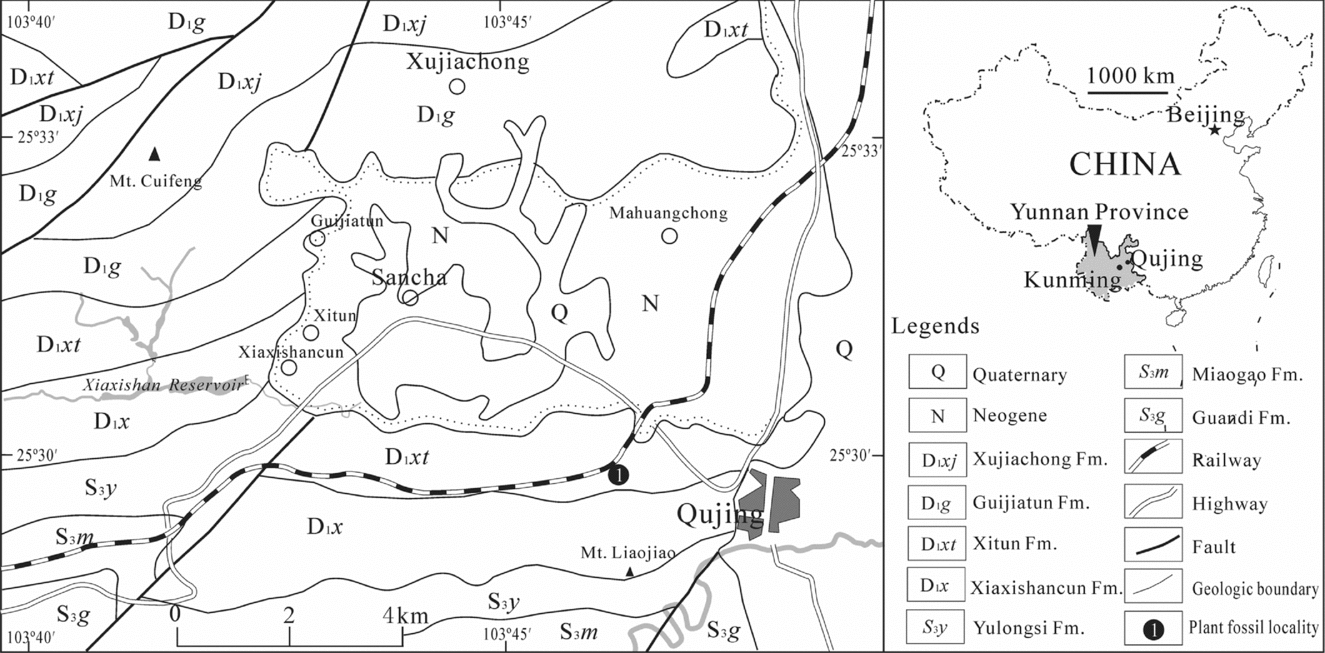
The Lower Devonian deposits in the Qujing area of Yunnan Province, China, include, in ascending order, the Xiaxishancun Formation, Xitun Formation, Guijiatun Formation and Xujiachong Formation, and overlie the Silurian Yulongsi Formation (Fig. 1, also see figs 1 & 2 in Dupret & Zhu, Reference Dupret and Zhu2008) (Li & Cai, Reference Li and Cai1978; Cai et al. Reference Cai, Fang, Li, Wang, Geng, Gao, Wang, Li and Liu1994; Fang et al. Reference Fang, Cai, Wang, Li, Wang, Geng, Wang, Gao, Wang and Li1994; Ma, Liao & Wang, Reference Ma, Liao and Wang2009). The Xitun Formation is well exposed near Qujing city (Fig. 1). Previous reports of plants from this formation include only plant fragments preserved as isolated sporangia and K-type sterile branches (possibly of Zosterophyllum), and fragments of algae such as Uncatoella verticillata Li & Cai (Li & Cai, Reference Li and Cai1978; Kenrick & Li, Reference Kenrick and Li1998; Cai & Wang, Reference Cai, Wang and Li1995). Two more plants, Xitunia spinitheca and Z. minorstachyum, were added to this list recently (Xue, Reference Xue2009).
Generalized map showing geologic features of the Qujing area and plant fossil locality (modified from fig. 1 of Hao et al. Reference Hao, Xue, Liu and Wang2007).

The Xitun Formation consists mainly of greyish blue and purple calciferous mudstones, which yield abundant bivalves, fish and rare fragmentary megafossil plants. Fish remains have been assigned to the Diabolepis–Nanpanaspis macrovertebrate assemblage II sensu Zhu, Wang & Wang (Reference Zhu, Wang, Wang, Blieck and Turner2000) and the Cuifengshan assemblage sensu Zhao & Zhu (Reference Zhao and Zhu2010), indicating a mid–late Lochkovian age. On the basis of spore assemblages, a mid–late Lochkovian age (Early Devonian) was proposed for the Xitun Formation by Cai et al. (Reference Cai, Fang, Li, Wang, Geng, Gao, Wang, Li and Liu1994). The spores they obtained from this formation include Apiculiretusispora plicata, Stenozonotriletes pusillus, Breconisporites breconensis, Streelispora newportensis, Apiculatisporites microcanonus and Emphanisporites neglectus, comparable to assemblages of the Streelispora newportensis–Emphanisporites micrornatus (NM) and Breconisporites breconensis–Emphanisporites zavallatus (BZ) zones of the Old Red Sandstone of Europe (Richardson & McGregor, Reference Richardson and McGregor1986; Streel et al. Reference Streel, Higgs, Loboziak, Riegel and Steemans1987; Cai et al. Reference Cai, Fang, Li, Wang, Geng, Gao, Wang, Li and Liu1994). However, Tian & Zhu (Reference Tian and Zhu2009) suggested that the Siluro-Devonian boundary should be located at the middle of the Xitun Formation, based on their recovery of spore assemblages of the Synorisporites verrucatus–Apiculiretusispora plicata (VP) and Apiculiretusispora minuta–Leiotriletes ornatus (MO) types. While the Early Devonian megafossil plants of South China show many endemic forms (see discussion), the reported spore assemblages of the Xitun Formation share many elements with those of Europe (Laurussia). Further investigation of dispersed spores and in situ spores of endemic plants is badly needed considering the controversy over spore biostratigraphy of this formation and the apparent contradiction between evidence from megafossils and spores.
Some beds of the Xitun Formation are dominated by the bivalve Dysodonta Mansuy, an Early Devonian genus found in Northern Vietnam and the Yunnan and Guangxi provinces of China, and the associated brachiopod genus Lingula (Fang et al. Reference Fang, Cai, Wang, Li, Wang, Geng, Wang, Gao, Wang and Li1994). Ostracods collected from the mid–upper part of the Xitun Formation include Cytherellina suboviformis Wang et al., Sulcella convaviuscula Wang et al., Paracoelonella fabiformis Wang et al. and Leperditia delicates Jiang, indicating an age of early Early Devonian (but not younger than Pragian) (Wang, Liu & Li, Reference Wang, Liu and Li1992). Conodont records give little additional insight into the age of the Xitun Formation; some taxa of Ludlow–Pridoli age, Ozarkodina crispa, O. excavate and Dentacodina sp., were found in the upper part of the underlying Yulongsi Formation (Fang et al. Reference Fang, Cai, Wang, Li, Wang, Geng, Wang, Gao, Wang and Li1994), but conodonts were not recovered from the mainly clastic Xiaxishancun and Xitun formations.
A mid–late Lochkovian age for the Xitun Formation has been questioned by some authors. Based on faunal records (fish, chitinozoans and others) of the Yulongsi Formation, Rong et al. (Reference Rong, Chen, Wang, Geng, Wu, Deng, Chen and Xu1990) suspected that at least the lower part of the Xiaxishancun Formation might be of Pridoli age, which indicates that the overlying Xitun Formation could be slightly older than mid–late Lochkovian, perhaps early–mid Lochkovian. Wang (Reference Wang1997) established a vertebrate assemblage, Parathelodus–Polybranchiaspis assemblage, in the Xiaxiashancun and Xitun formations and suggested on this basis that both of these formations are of Pridoli age.
3. Materials and methods
The plant fossils studied here were collected from the middle–upper part of the Xitun Formation, cropping out in a quarry in Huaguo Hill, Shengfeng district of Qujing city, Yunnan, China (Fig. 1); the GPS location is at 25°29.853′N and 103°46.309′E (WGS84). The fossils described in this report were derived from a c. 10 cm thick bed of grey mudstone, which also contains fossils of the previously described Xitunia spinitheca. Zosterophyllum shengfengense was collected from a bed of grey mudstone overlying this unit (Hao et al. Reference Hao and Xue2010). Specimens have been prepared by disaggregation with steel needles, and photographed with a Nikon digital camera system (Nikon SMZ1500, DXM1200F and Software NIS-Elements). All specimens are housed at the School of Earth and Space Sciences, Peking University, P. R. China.
4. Palaeobotanical descriptions
4.a. Gen. nov. A (Figs 2a–k, 3a–e, 4a–f, 5a–b)
4.a.1. Description
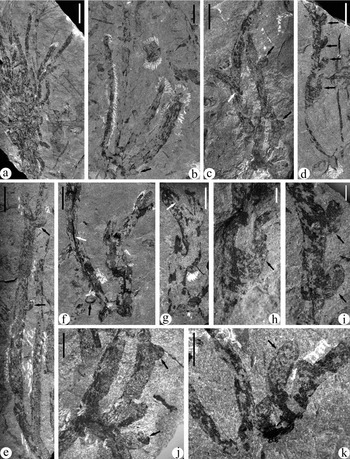
More than 15 specimens with sterile axes have been collected. Axes are naked and range from 1.2 to 3.1 mm in width (Fig. 2 a–g). The longest axis preserved is 41 mm long and incomplete at both ends. A vestige of a central xylem strand occurs along the axes (Fig. 2c, f, g, white arrows). In some examples the axes are compressed together (Fig. 2a), which may be a reflection of the living status, with many crowded upright axes arising from a common rhizome. Figure 2b shows a rhizomatous axis with more than five upright axes; these upright axes may arise from successive K- or H-type branching patterns at very close intervals (Figs 2b, 3a). The axis shown in Figure 2c divides twice at the base to form a K-type branching configuration (Figs 2c, j, 3b). Some axes are wider in diameter and branch at close intervals, with a clear vestige of a xylem strand (Figs 2f, g, 3e). The upright axes may branch dichotomously (Figs 2c–e, 3b–d) or not (Figs 2b, 3a).
Gen. nov. A from the Xitun Formation of Yunnan, China. (a) Multiple overlapping axes, probably reflecting the crowded state of a living plant, whereby a rhizome bears numerous upright branches. PKU-XH204a. Scale bar = 10 mm. (b) Five upright axes arising from a central rhizome. Black arrow (bottom) indicates a small lateral branch. PKU-XH203. Scale bar = 5 mm. (c) Axes. Black arrows indicate two small lateral branches. White arrow indicates xylem strand vestige. The lower part is enlarged in (j). PKU-XH202a. Scale bar = 4 mm. (d) Axis showing a proximal dichotomy and four small lateral branches distally. PKU-XH206. Scale bar = 4 mm. (e) Upright axes with small lateral branches (arrows). PKU-XH205. Scale bar = 4 mm. (f) Axis showing K-type branching, small lateral branch (black arrow) and vestige of central xylem strand (white arrow). PKU-XH218. Scale bar = 5 mm. (g) Axis showing branching and vestige of central xylem strand (white arrow). PKU-XH220. Scale bar = 3 mm. (h) Enlargement of the lower small lateral branch in (d). Scale bar = 1 mm. (i) Enlargement of the upper part of (d). Scale bar = 1 mm. (j) Enlargement of the lower part of (c), showing K-type branching. Arrows refer to two small lateral branches. Scale bar = 2 mm. (k) Axis with a small lateral branch (arrow). PKU-XH202a. Scale bar = 2 mm.


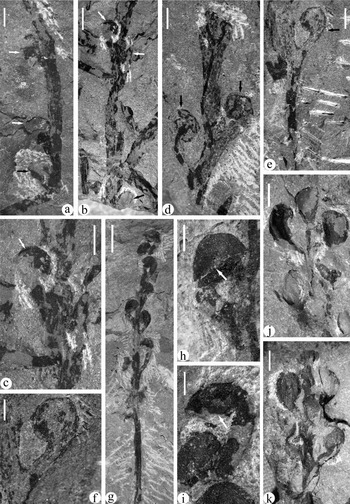
Gen. nov. A (a–f), aff. Huia sp. (g–i) and an unnamed spike (j, k) from the Xitun Formation of Yunnan, China. (a, b) Two fertile axes with lateral sporangia attached (arrows). (a) PKU-XH216. Scale bar = 2 mm. (b) PKU-XH217b. Scale bar = 3 mm. (c) Enlarged view of the upper two sporangia of the axis in (b). Arrow indicates a narrow thickened border. Scale bar = 2 mm. (d) Fertile axis with two lateral stalked sporangia (arrows). PKU-XH213. Scale bar = 3 mm. (e) Fertile axis with a lateral sporangium (arrow). PKU-XH209. Scale bar = 2 mm. (f) Enlarged view of the sporangium in (e). Scale bar = 1 mm. (g) Spike with helically arranged sporangia. PKU-XH214. Scale bar = 4 mm. (h, i) Enlarged view of sporangia, showing their recurvation and dehiscence (arrows). Scale bars = 1 mm. (j, k) Unnamed spike, part and counterpart, showing helically arranged sporangia. PKU-XH215a, 215b. Scale bars = 2 mm.

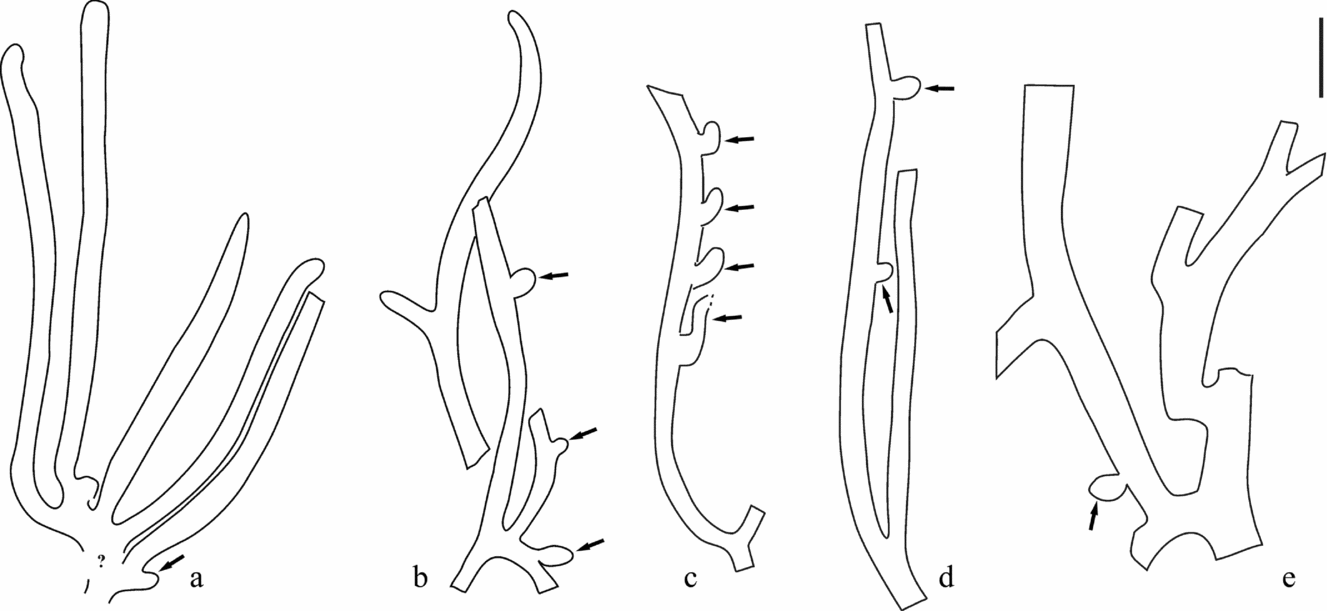
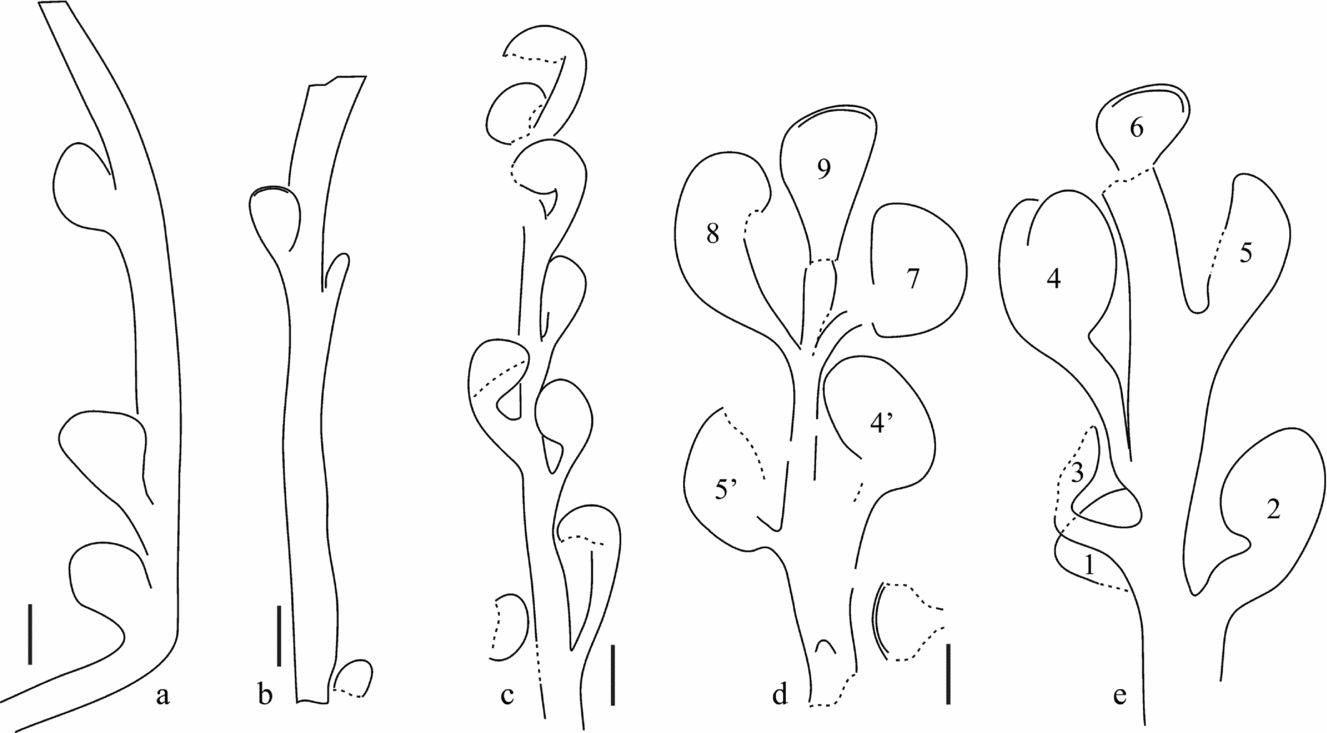
Line drawings of Gen. nov. A, aff. Huia sp. and the unnamed spike. (a) Fertile axis shown in Figure 4a. Scale bar = 2 mm. (b) Fertile axis shown in Figure 4b. Scale bar = 3 mm. (c) aff. Huia sp., spike shown in Figure 4g. Scale bar = 2 mm. (d, e) Unnamed spike shown in Figures 4j, 4k. Scale bar = 1.5 mm.

Small lateral branches with round or tapering apices are irregularly distributed along the axes (Figs 2b–f, 3a–e, black arrows). They are of various dimensions, 1.0–1.5 mm in width and 0.8–4.3 mm in length. Their distribution and morphology are different from those of the normal dichotomous and K-type branching patterns. Some are borne on the axes at a position close to the branching point of K-type branching (Figs 2b, f, j, k, 3a, b, e). Others are attached to one of the daughter branches of a dichotomous axis (Figs 2d, e, 3c, d), with an interval ranging from 3.8 to 13.4 mm. Some of these kinds of branches are very small and appear as elliptical ‘protuberances’ on the axes (Fig. 2d, i), while others are much larger (Fig. 2d, h, k). The specimen shown in Figure 2d shows the size variation of these branches. The axis shown in Figure 2d firstly divides once at the proximal portion to form a dichotomy and one of the daughter axes bears four small lateral branches (Figs 2d, 3c, black arrows), the first one of which, although broken at the tip, is larger than the others (Fig. 2h, i).
Although not organically connected to the sterile axes, four fertile axes (Fig. 4a, b, d, e) are considered parts of this plant because of their general morphology, axis size, surface pattern and similar appearance of vestiges of a central xylem strand. Specimens PKU-XH216 and 217b contain two incompletely preserved axes, each bearing three lateral sporangia (Fig. 4a, b, arrows; Fig. 5a, b). The axes are naked, ranging from 1.1 to 1.6 mm in width, and up to 33 mm in length. Sporangia are stalked and have a loose and irregular arrangement (Figs 4c, 5a, b), with an irregular distance between successive sporangia, from 3.1 mm proximally to 9.4 mm distally in specimen PKU-XH216 (Fig. 4a). The third fertile axis is 1.2–1.4 mm in width and 13.4 mm in length, broken at the proximal end (Fig. 4d); it bears two lateral stalked sporangia. Two dichotomies can be observed at the very distal part of this axis. The fourth axis similarly bears one lateral sporangium (Fig. 4e, f). The sporangia are circular to elliptical in shape, 1.8–2.4 mm wide and 1.8–2.3 mm high. Each sporangium is stalked, departing from the axis at a narrow angle. The stalk is 2.4–2.8 mm long and 0.7–1.2 mm wide, and the distal part of the stalk is wider than the basal part, merging with the margin of the sporangia. A very narrow thickened border is visible on the sporangia (Fig. 4c, arrow), indicating the position of dehiscence.
4.a.2. Comparisons and affinity
Although fragmentarily preserved, Gen. nov. A shows a unique character combination that includes K-type branching, lateral stalked sporangia and diagnostic small lateral branches scattered along the axes. The first two characters suggest that Gen. nov. A is clearly a zosterophyll plant. The K-type branching, resulting from two successive dichotomies at closely spaced intervals, resembles that of most zosterophylls, such as Zosterophyllum, Kaulangiophyton Gensel et al., Discalis Hao and Gumuia Hao (Walton, Reference Walton1964; Gensel, Kasper & Andrews, Reference Gensel, Kasper and Andrews1969; Edwards, Reference Edwards1975; Gensel, Reference Gensel1982a; Gerrienne, Reference Gerrienne1988; Hao, Reference Hao1989a, Reference Haob; Hao et al. Reference Hao, Xue, Liu and Wang2007). The sporangia of Gen. nov. A, with a distal dehiscence, are more or less elliptical in shape and loosely arranged, similar to the sporangia of Wenshania zhichangensis Zhu & Kenrick, Zosterophyllum deciduum Gerrienne and Z. shengfengense, and to some specimens of Z. myretonianum Penhallow where some sporangia are also more loosely arranged in fertile regions (Edwards, Reference Edwards1975; Gerrienne, Reference Gerrienne1988; Zhu & Kenrick, Reference Zhu and Kenrick1999; Hao et al. Reference Hao and Xue2010). Nevertheless, unlike the sporangia of Gen. nov. A, the sporangia of Z. myretonianum and Z. deciduum have a clear junction between sporangium and stalk (Edwards, Reference Edwards1975; Gerrienne, Reference Gerrienne1988). Many other species of the genus Zosterophyllum, however, including Z. myretonianum, Z. rhenanum Krausel & Weyland, Z. australianum Lang & Cookson, Z. yunnanicum Hsü, Z. qujingense, Z. sinense Li & Cai, Z. minorstachyum and others (Walton, Reference Walton1964; Edwards, Reference Edwards1975; Li & Cai, Reference Li and Cai1977; Hao, Reference Hao1992; Hao et al. Reference Hao, Xue, Liu and Wang2007; Wang, Reference Wang2007; Xue, Reference Xue2009), bear radial spikes with a compact arrangement of sporangia, and therefore differ from the specimens of Gen. nov. A.
The small lateral branches of Gen. nov. A, occurring at different levels of the plant, vary in size from small ‘protuberances’ to larger ones. These branches are obviously different from the normal K-type or dichotomous branching patterns of the same plant. Some short, non-circinate branches can be observed in the axes of Zosterophyllum myretonianum, Z. deciduum and Z. xishanense and they generally show as small protuberances (Lele & Walton, Reference Lele and Walton1961; Gerrienne, Reference Gerrienne1988; Hao et al. Reference Hao, Xue, Liu and Wang2007), similar to the smaller lateral branches of Gen. nov. A. The subordinate branches (also called axillary tubercles) of many zosterophylls (e.g. Gosslingia Heard, Deheubarthia Edwards et al.) are commonly positioned below the dichotomy of the main axial system (Kenrick & Crane, Reference Kenrick and Crane1997, p. 152), different in position and distribution to the small lateral branches of Gen. nov. A. However, in Tarella Edwards & Kenrick, subordinate branches of variable length and morphology are scattered over the main axes (Edwards & Kenrick, Reference Edwards and Kenrick1986), showing similarities to the condition of Gen. nov. A. In compression fossils, the subordinate branches are indicated by a conical projection or depression on the axes (Rayner, Reference Rayner1983; Remy, Schultka & Hass, Reference Remy, Schultka and Hass1986). In Gosslingia, Deheubarthia, Tarella, Crenaticaulis Banks & Davis, Thrinkophyton Kenrick & Edwards, Anisophyton Remy et al. and Sawdonia Hueber, the subordinate branches usually show as single, usually small, undeveloped, circinate axes (Remy, Schultka & Hass, Reference Remy, Schultka and Hass1986; Kenrick & Crane, Reference Kenrick and Crane1997, p. 152), but the small lateral branches of Gen. nov. A do not show any circinate tips.
Apparently similar to the small lateral branches of Gen. nov. A, in the Rhynie Chert plant Rhynia gwynne-vaughanii Kidston & Lang, Edwards (Reference Edwards1980) was able to describe the hemispherical projections and numerous short adventitious branches along the stem of R. gwynne-vaughanii, interpreting the latter as underdeveloped lateral branches or asexual reproduction structures. However, the similarity between small branches of Gen. nov. A and adventitious branches of R. gwynne-vaughanii must be considered as superficial in the absence of anatomical information for Gen. nov. A.
Based on the above comparisons, the present specimens probably represent a zosterophyll plant, with naked axes, a diagnostic branching pattern (i.e. K-type branching as well as small lateral branches scattered along the axes) and lateral stalked sporangia. Here they are treated as Gen. nov. A because the fragmentary preservation recommends against formal nomenclatural treatment at this time, and conditionally are assigned to the Zosterophyllopsida. Further assessment of the taxonomy and phylogenetic position of this plant requires more and better material.
4.b. aff. Huia sp. (Figs 4g–i, 5c)
Specimen PKU-XH214 bears a terminal spike (Figs 4g, 5c) 2.2–3.8 mm wide and about 23 mm in length, with the axis of the spike 0.8–1.1 mm wide. At least eight lateral sporangia are observed, which have a loosely helical arrangement (Fig. 5c). The sporangia are ovate in side view (Fig. 4h, i), 1.5–1.9 mm wide and 1.6–2.4 mm high. The distance between two successive sporangia is 1.2–5.4 mm. The sporangia have long stalks and are reflexed adaxially. A dehiscence line is visible on some sporangia, arching from one side of the sporangium over the adaxial face to the opposite side, dividing the sporangium into two unequal valves (Fig. 4h, arrow; Fig. 5c, dotted line). Some sporangia have been broken along the dehiscence line, leaving only one half attached on the stalk (Fig. 4i, arrow; Fig. 5c). The stalk is 0.6–1.0 mm wide and 2.0–3.9 mm long, broadening distally and merging with the margin of the sporangia, lacking a clear junction between stalk and sporangium.
The distinguishing feature of the plant is the ovate and stalked sporangia arranged in loose helices and reflexed adaxially (as in specimen PKU-XH214). These sporangia resemble those of Huia recurvata Geng and H. gracilis Wang & Hao described from the Pragian deposits of Yunnan, China (Geng, Reference Geng1985; Wang & Hao, Reference Wang and Hao2001). Huia bears terminal spikes comprised of helically arranged lateral sporangia and a probable centrarch protostele; it remains controversial in affinity, being considered variously a rhyniophyte (Geng, Reference Geng1985; Gensel, Reference Gensel1992), a Cooksonia derivative (Wang & Hao, Reference Wang and Hao2001) or a basal lycophyte (Kenrick & Crane, Reference Kenrick and Crane1997, p. 176). The dimensions of spike, sporangia and stalks of the present specimen are in the minimum extreme of those of H. gracilis and are much smaller than those of H. recurvata. Sporangial stalks of specimen PKU-XH214, H. gracilis and H. recurvata are 2.0–3.9 mm, 4.0–13.0 mm (Wang & Hao, Reference Wang and Hao2001) and 10–20 mm long (Geng, Reference Geng1985), respectively.
It should be noted that the observed sporangial dehiscence in specimen PKU-XH214 is transverse, i.e. transversely dividing the sporangia on the adaxial face, which is different from dehiscence in Huia gracilis, which is reported to be longitudinal, along the radial plane of the fertile axis (Wang & Hao, Reference Wang and Hao2001). Not considering the recurvation of sporangia, the transverse sporangial dehiscence is similar to that of most zosterophylls, such as Zosterophyllum, Crenaticaulis Banks & Davis, Sawdonia Hueber, Discalis, Guangnania Wang & Hao and others (Banks & Davis, Reference Banks and Davis1969; Hao, Reference Hao1989a; see fig. 4 in Gensel, Reference Gensel1992 and reference therein; Wang & Hao, Reference Wang and Hao2002). In general, the characters of specimen PKU-XH214 indicate that the plant is most similar to the genus Huia, but it cannot be readily put into this genus, and thus is tentatively treated as aff. Huia sp.
4.c. Unnamed spike (Figs 4j, k, 5d, e)
A poorly preserved terminal spike was collected (PKU-XH215a, 215b, part and counterpart, shown in Figs 4j, k, 5d, e). The spike is 17 mm long and 5.2–7.2 mm wide, with an axis 0.8–1.4 mm wide, and bears at least nine helically arranged sporangia. The sporangia are ovate in side view, 1.6–2.4 mm wide and 2.5–3.7 mm high. The sporangial stalk is 0.6–0.9 mm wide and 1.6–1.9 mm long, with an acute insertion to the axis. Because of the fragmentary nature, an accurate taxonomic assignment of this specimen remains to be determined. The helically arranged stalked sporangia, however, indicate a probable zosterophyll affinity.
5. Composition of the Xitun flora
To date, plants reported from the Xitun Formation (the Xitun flora) include Xitunia spinitheca, Zosterophyllum minorstachyum, Z. shengfengense, Gen. nov. A, aff. Huia sp. and some unnamed spikes (Xue, Reference Xue2009; Hao et al. Reference Hao and Xue2010; and this work), showing diverse morphologies of vegetative (e.g. branching pattern, roots) and fertile structures (e.g. sporangial shape and distribution). There are also some additional unnamed ribbon-like axes (not illustrated) which can be assigned to the morphogenus Taeniocrada White. Xitunia has lateral stalked sporangia, indicating a probable zosterophyll affinity, although there are some spiny appendages attached on the sporangia. Zosterophyllum shengfengense was established on the basis of a completely preserved specimen (Hao et al. Reference Hao and Xue2010), with numerous root-like axes forming one of the earliest known rooting systems. Gen. nov. A is clearly a zosterophyll. Aff. Huia sp. has adaxially recurved sporangia comparable to those of the genus Huia from Pragian sediments of Yunnan. Other than these tracheophytes, several presumed algal species were recognized on the basis of fragmentary specimens (Cai & Wang, Reference Cai, Wang and Li1995). The axes of Uncatoella verticillata, being considered a dasycladalean alga, are very common in this flora (Li & Cai, Reference Li and Cai1978; Kenrick & Li, Reference Kenrick and Li1998).
6. Early Devonian plants from other localities of South China
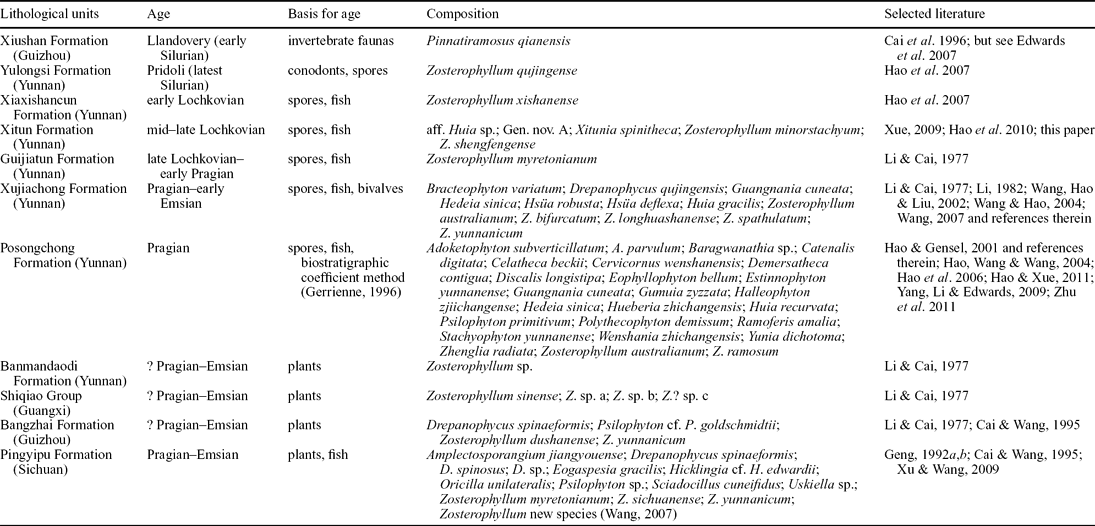
The earliest record of Zosterophyllum in South China is from the Yulongsi Formation (Hao et al. Reference Hao, Xue, Liu and Wang2007), which is considered Pridoli in age (Cai et al. Reference Cai, Fang, Li, Wang, Geng, Gao, Wang, Li and Liu1994). Zosterophyllum xishanense was described from the lower part of the Xiaxishancun Formation (Hao et al. Reference Hao, Xue, Liu and Wang2007); Li & Cai (Reference Li and Cai1977) described Z. sp. 2 from this formation, consisting of only two isolated sporangia. Possible spikes of Z. myretonianum were reported from the Guijiatun Formation (Li & Cai, Reference Li and Cai1977). The Xujiachong Formation has yielded a rich assemblage (Table 1), including Z. longhuashanense Li & Cai, Z. spathulatum Li & Cai, Z. bifurcatum Li & Cai, Z. yunnanicum, Z. australianum, Huia gracilis, Hedeia sinica Hao & Gensel, Guangnania cuneata Wang & Hao, Drepanophycus qujingensis Li & Edwards, Bracteophyton variatum Wang & Hao, Hsüa robusta and Hsüa deflexa (Li & Cai, Reference Li and Cai1977; Wang, Hao & Liu, Reference Wang, Hao and Liu2002; Wang, Reference Wang2007 and reference therein).
List of vascular plants reported from the Silurian–Lower Devonian deposits of South China

Many plants, most of which are endemic, have been reported from the Posongchong Formation of Wenshan (c. 240 km south of Qujing), southeastern Yunnan, interpreted as Pragian in age based on fish, spores, the biostratigraphic coefficient method and regional stratigraphic correlation (Hao & Gensel, Reference Hao, Gensel, Gensel and Edwards2001). The Posongchong flora includes 23 genera and 25 species (Table 1), representing one of the best documented floras of the Early Devonian.
Other localities within the Early Devonian are poorly constrained to a Pragian–Emsian age (Table 1). Li & Cai (Reference Li and Cai1977) described Zosterophyllum sp. from the Banmandaodi Formation of Naxi, Yunnan, Z. sinese Li & Cai, Z. sp. a, Z. sp. b and Z.? sp. c from the Shiqiao Group of Cangwu, Guangxi, and Z. dushanense Li & Cai from the Bangzhai Formation of Dushan, Guizhou. Drepanophycus spinaeformis Goeppert, Z. yunnanicum and Psilophyton cf. P. goldschmidtii Halle were later added to the plant assemblages of the Bangzhai Formation (Cai & Wang, Reference Cai, Wang and Li1995).
The Pingyipu Formation at Yanmenba, Jiangyou, Sichuan, of probable Pragian to early Emsian age, yields abundant plant fossils, including nine genera and 14 species (Table 1): four Zosterophyllum species, Hicklingia cf. H. edwardii Kidston & Lang, Oricilla unilateralis Geng, Eogaspesica gracilis Daber, Uskiella Shute & Edwards sp., Psilophyton sp., Drepanophycus spinaeformis, D. spinosus Kräusel & Weyland, D. sp., Sciadocillus cuneifidus Geng and Ampectosporangium jiangyouense Geng (Geng, Reference Geng1992a, Reference Gengb; Cai & Wang, Reference Cai, Wang and Li1995; Wang, Reference Wang2007). The composition of this flora needs reinvestigation, because plants such as Hicklingia Kidston & Lang and Oricilla Gensel were originally found in Lower Devonian deposits of Europe and North America (Laurussian palaeocontinents) (Edwards, Reference Edwards1976; Gensel, Reference Gensel1982b), and their occurrence in South China requires confirmation. As an example, Xu & Wang (Reference Xu and Wang2009) reinvestigated the specimen assigned to Leclercqia complexa Banks et al. by Geng (Reference Geng1992a), and believe that it does not belong to Leclercqia.
7. Lochkovian floras of South China and palaeophytogeographical considerations
The Lochkovian floras of South China reported here and in previous studies (e.g. Hao et al. Reference Hao, Xue, Liu and Wang2007, Reference Hao, Xue, Guo and Wang2010; Xue, Reference Xue2009) shed some light on the origin of Early Devonian plant diversity in Asia. The Lochkovian floras from the Xiaxishancun and Xitun formations share one genus, Zosterophyllum, with the Pragian Xujiachong and Posongchong floras. Aff. Huia sp. from the Xitun Formation is similar to Huia, a genus found in both the Xujiachong and Posongchong floras (Geng, Reference Geng1985; Wang & Hao, Reference Wang and Hao2001). Thus, the Lochkovian floras share some elements with younger floras, showing a continuation of floristics in this area. Nevertheless, a large gap, both taxonomically and morphologically, still exists between the Lochkovian and the Pragian floras in Yunnan (and South China), with the emergence of new characters (i.e. evolutionary innovations) and plant types (probably at class or order levels), such as megaphylls (Eophyllophyton Hao; Hao, Beck & Wang, Reference Hao, Beck and Wang2003), and microphylls and sporophylls (Zhenglia Hao et al.; Hao et al. Reference Hao, Wang, Wang and Xue2006), which are not yet clearly attributed to known Lochkovian antecedents.
An update to the Lochkovian megafossil database has been provided by Edwards & Wellman (Reference Edwards, Wellman, Gensel and Edwards2001, their table 2.2) and Edwards et al. (Reference Edwards, Morel, Poire and Cingolani2001b, their table 2). The genus Zosterophyllum had a very wide distribution, from Lochkovian deposits in Wales, England, Scotland, Germany, Siberia, Australia, Spitsbergen and South China (Wellman et al. Reference Wellman, Habgood, Jenkins and Richardson2000; Edwards & Wellman, Reference Edwards, Wellman, Gensel and Edwards2001 and reference therein; Hao et al. Reference Hao, Xue, Liu and Wang2007, Reference Hao, Xue, Guo and Wang2010; Xue, Reference Xue2009), but not from contemporaneous sediments of western Gondwana (e.g. Paraná Basin, Brazil, and Precordillera, Argentina; Edwards et al. Reference Edwards, Morel, Poire and Cingolani2001b; Gerrienne et al. Reference Gerrienne, Bergamaschi, Pereira, Rodrigues and Steemans2001). The Lochkovian flora of South China includes Zosterophyllum xishanense, Z. minorstachyum, Z. shengfengense (Hao et al. Reference Hao, Xue, Liu and Wang2007, Reference Hao, Xue, Guo and Wang2010; Xue, Reference Xue2009), all having radially (or irregularly) arranged sporangia. Lochkovian species of Zosterophyllum found from the Lower Old Red Sandstones include Z. myretonianum, Z. fertile and cf. Z. fertile (Edwards, Reference Edwards1975; Wellman et al. Reference Wellman, Habgood, Jenkins and Richardson2000; Edwards & Wellman, Reference Edwards, Wellman, Gensel and Edwards2001). Zosterophyllum myretonianum has both radially and bilaterally arranged sporangia, while Z. fertile bears sporangia in two rows. At this time, no species have been confirmed to be shared by South China and Europe, although Li & Cai (Reference Li and Cai1977) reported two fragmentary spikes possibly assignable to Z. myretonianum from South China. Combining the evidence from Lochkovian and Pragian–Emsian floras, Hao et al. (Reference Hao, Xue, Liu and Wang2007) suggested that the zosterophylls with radially arranged sporangia were probably dominant in the early land floras of South China, while those with sporangia in rows were common in the Laurussian palaeocontinent. This suggestion is supported by the plants reported from the Xitun Formation.
The Lochkovian floras of Laurussia and western Gondwana, such as England (Edwards, Fanning & Richardson, Reference Edwards, Fanning and Richardson1994; Wellman, Edwards & Axe, Reference Wellman, Edwards and Axe1998; Edwards & Wellman, Reference Edwards, Wellman, Gensel and Edwards2001), Paraná Basin, Brazil (Gerrienne et al. Reference Gerrienne, Bergamaschi, Pereira, Rodrigues and Steemans2001, Reference Gerrienne, Dilcher, Bergamaschi, Milagres, Pereira and Rodrigues2006) and Precordillera, Argentina (Edwards et al. Reference Edwards, Morel, Poire and Cingolani2001b) are dominated by plants with isotomous branching and terminal sporangia, such as species of Cooksonia Lang, Pertonella Fanning et al., Isidrophyton Edwards et al. and others. These plants share the same grade of organization (i.e. small size, isotomous branching and terminal sporangia; Gerrienne et al. Reference Gerrienne, Bergamaschi, Pereira, Rodrigues and Steemans2001; Edwards et al. Reference Edwards, Morel, Poire and Cingolani2001b); however, their phylogenetic position, although difficult to determine owing to the morphological simplicity and the lack of anatomy, probably would be different. Some of them may be basal eutracheophytes, while others are assigned to polysporangiophytes (Gerrienne et al. Reference Gerrienne, Bergamaschi, Pereira, Rodrigues and Steemans2001), or only to Plantae insertae sedis in taxonomy (Edwards et al. Reference Edwards, Morel, Poire and Cingolani2001b). On the contrary, no similar plants have been discovered so far from the Silurian–Lower Devonian deposits of South China. It seems that such kinds of plants were not dominant elements in South China. Furthermore, compared to the zosterophyll-dominated Lochkovian floras of South China, zosterophylls are significantly absent in the reported assemblages of Argentina and Brazil (Edwards et al. Reference Edwards, Morel, Poire and Cingolani2001b; Gerrienne et al. Reference Gerrienne, Bergamaschi, Pereira, Rodrigues and Steemans2001, Reference Gerrienne, Dilcher, Bergamaschi, Milagres, Pereira and Rodrigues2006). The global phytogeographic patterns of the Late Silurian recognized by Raymond, Gensel & Stein (Reference Raymond, Gensel and Stein2006), i.e. the North Laurussian unit (with Bathurst Island, near the palaeoequator), South Laurussian–Northwest Gondwanan unit, Kazakhstanian unit and Northeast Gondwanan (Australian) unit, might extend into the Early Devonian. It is apparent that South China, geographically near the palaeoequator and phytogeographically part of the Northeast Gondwanan unit (see Hao & Gensel, Reference Hao and Gensel1998), supported floras different from those of the Laurussian and Gondwanan palaeocontinent, and that these differences can be traced to as early as the Lochkovian from the evidence of megafossil plants.
Acknowledgements
The author especially thanks Prof. Hao Shougang (Peking University) for his constant support, encouragement and insightful inspiration in understanding Early Devonian plants, and thanks Prof. James F. Basinger (University of Saskatchewan) for his helpful comments and patient English corrections on the manuscript. I also thank Dr Wang Deming (Peking University) for his helpful discussions. I am grateful to the reviewers for their critical and helpful comments, which greatly improved this paper. This work was supported by the National Natural Science Foundation of China (Nos. 40802003, 40830211). At a later stage of this work, the author was also supported by the State Key Laboratory of Palaeobiology and Stratigraphy (Nanjing Institute of Geology and Palaeontology, CAS) (No. 123113).