

I. Introduction
The wine sector has experienced dramatic changes in the last 20 years. Wine has become a globalized product, consumed and produced throughout the world. Today, wine is one of the main sources of net trade surplus in several wine-producing countries of both “old” world (France, Italy, Spain) and “new” world (United States, Argentina, New Zealand, South Africa, Chile, Australia). The sector represents real economic stakes at the international level.
The global wine trade has, however, received limited attention from academics—notable exceptions include the seminal works of Kym Anderson and coauthors (Anderson, Norman, and Wittwer, Reference Anderson, Norman and Wittwer2003; Anderson and Wittwer, Reference Anderson and Wittwer2013, Reference Anderson and Wittwer2017, Reference Anderson, Wittwer, Anderson and Pinilla2018). In particular, few studies examine the nature of countries’ comparative advantages in wine trading, and their evolution over time. Few authors comment on the future of international wine trade, at least beyond the prediction of macro models based on specific assumptions regarding future growth and consumption patterns.
This article discusses key comparative advantages of wine-producing nations in a more qualitative way, taking both backward- and forward-looking perspectives. As demonstrated in the trade literature, comparative advantages are dynamic and evolve over time (Grossman and Helpman, Reference Grossman and Helpman1991). The implementation of learning systems allows countries to move from one specialization to another, as it enables efficient technological absorption and rapid adaptation to changing technological and competitive conditions (Lall, Reference Lall2000; Uchida and Cook, Reference Uchida and Cook2005). In this context, we employ a methodology based on two stages.
In the first stage, we study comparative advantages in 16 significant wine-producing countries—France, Italy, Spain, United States, Argentina, New Zealand, South Africa, Chile, Australia, Germany, Portugal, United Kingdom, Georgia, China, India, Brazil—using Porter's diamond. This well-known approach provides a holistic and convenient framework to investigate the evolution of key determinants of successful trade strategies. Our study reveals a major shift in factors determining countries’ comparative advantage: from “factor endowments” (old world) to “Ricardian technology” (new world). In brief, technology and innovative management today are more critical than land and traditional knowledge in determining a successful trade strategy. Latecomers are catching up, building their comparative advantage on significant investments. Some of them benefit from the growing domestic demand and a potentially large customer base (United States, China). In these countries, comparative advantage is largely driven by rising demand and income, as described in Linder's theory of international trade (Linder, Reference Linder1961).
In the second stage of our analysis, we report results from a survey in which we ask wine economists to assess the future trade performance of the same 16 countries. Results are broadly consistent across methods: China, New Zealand, and Chile have the greatest potential to succeed in future world trade. It is also expected that Georgia, the United Kingdom, and Australia play an important role, although to a lesser extent. Significant differences emerge for two major producing-countries: France and Argentina. These discrepancies with Porter's criteria reveal that experts put an overwhelming emphasis on demand and market structures—and basically ignore factor conditions—as key trade determinants for future wine trade. The focus on demand is clearly consistent with the first-stage conclusions. The article concludes with a discussion of these results and suggests different scenarios of future developments in the international wine trade.
II. Porter's Diamond Applied to the International Wine Trade
A. Past Trends
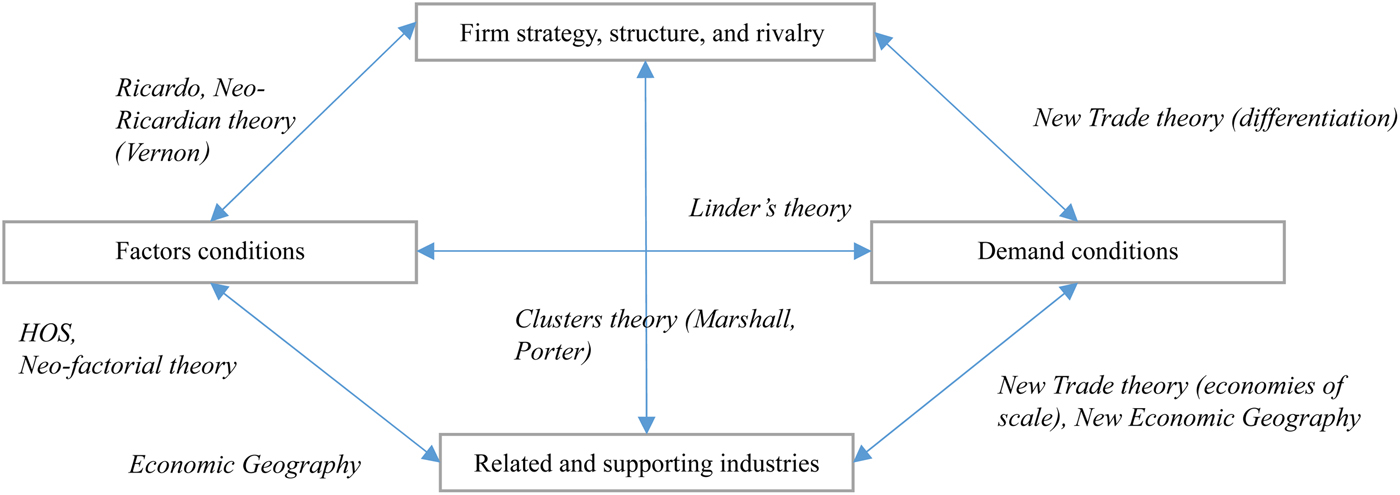
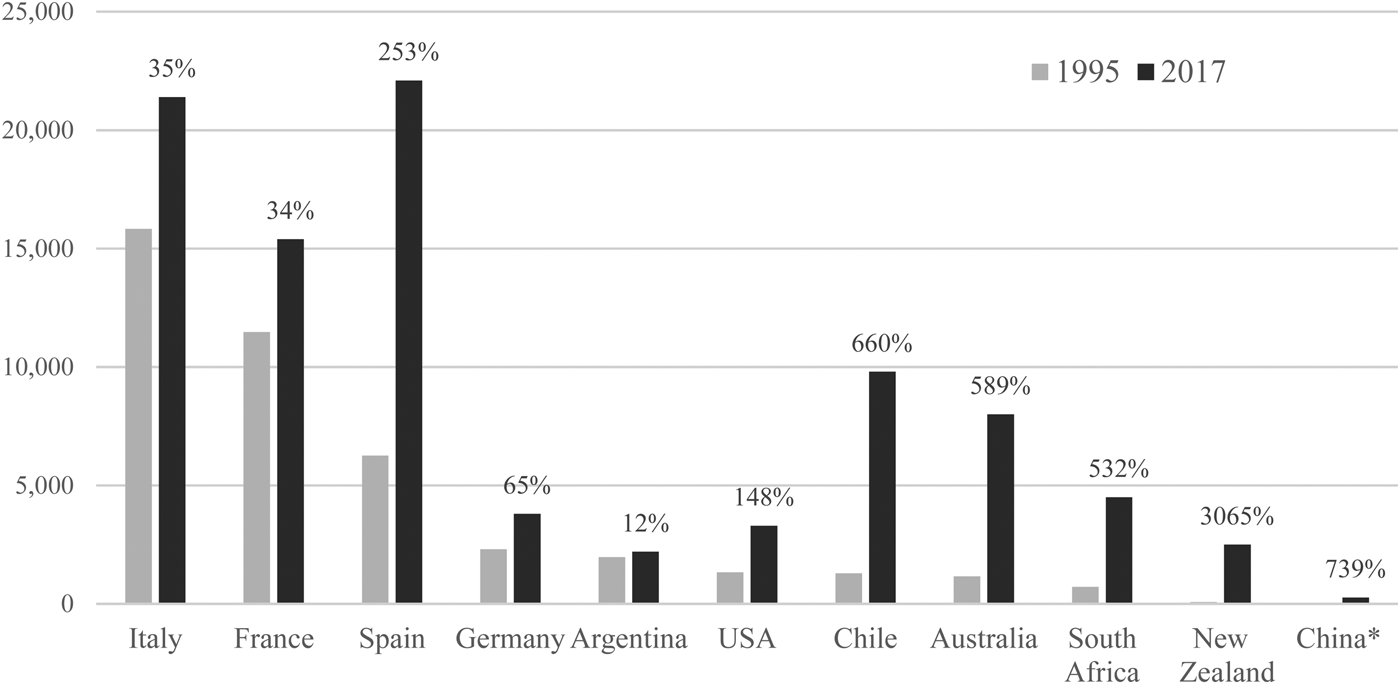
Porter's diamond (Porter, Reference Porter1990), represented in Figure 1, is a scheme nesting different international trade theories (e.g., Ricardo, HOS and their developments, New Trade theory, Economic Geography, etc.). In the last 20 years, the key comparative advantages in wine exports moved from the bottom-left to the top-right of Porter's diamond: factor conditions and support industries have been replaced by demand conditions and firms and market structure as the key determinants of a successful trade strategy. These trends underlie the catching-up of the new world (see Figure 2), as described by Morrison and Rabellotti (Reference Morrison and Rabellotti2017). The global expansion of basic technologies and the growing importance of innovation, combined with a demand shift from traditional wine-producing countries in the rest of the world, may explain this evolution.
International Trade Theory in Porter's Diamond

Exported Volumes of the Main Wine-Exporting Countries, 1995–2017 (in 1,000hl)

B. Anticipating Future Trends
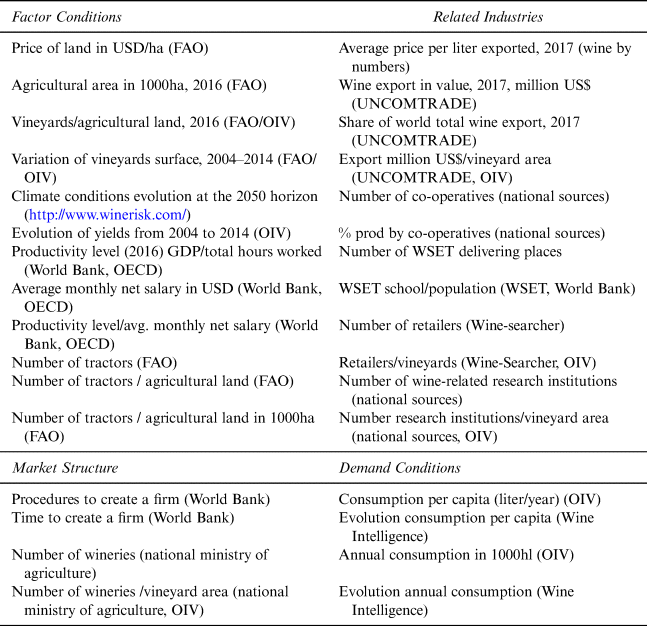
In this section, we use Porter's diamond to propose a long-term perspective on international wine trade. Each vertex of Porter's diamond refers to a competitive advantage category (e.g., factor conditions), which can be broken down into a list of specific metrics consistent with trade theory (Porter, Reference Porter1990, Reference Porter2010). Regarding data availability and following Esterhuizen, Stroebel, and Van Rooyen (Reference Esterhuizen, Stroebel and Van Rooyen2011), we select measures relevant to the wine trade.Footnote 1 Table 1 lists the selected metrics and sources; factor conditions refer to production capacity and competitiveness. Demand condition metrics relate to past and future demand conditions, and account for social and economic factors, as well as expected preferences. For market structure, we look at the ease of doing business and the number and size of companies (countries with large companies are more likely to be competitive in a globalized market). Finally, for related industries, we use proxy variables that approximate the weight of the wine sector in the country. That is, if the wine sector is large (i.e., a large number of distributors, a high level of exports, an important premium segment, research, etc.), its support industry should also be significant.
Items Selected to Assess Country Competitive Advantage in the Context of Porter's Diamond

Source: Authors (derived from Porter, Reference Porter1990; Esterhuizen, Stroebel, and Van Rooyen, Reference Esterhuizen, Stroebel and Van Rooyen2011).
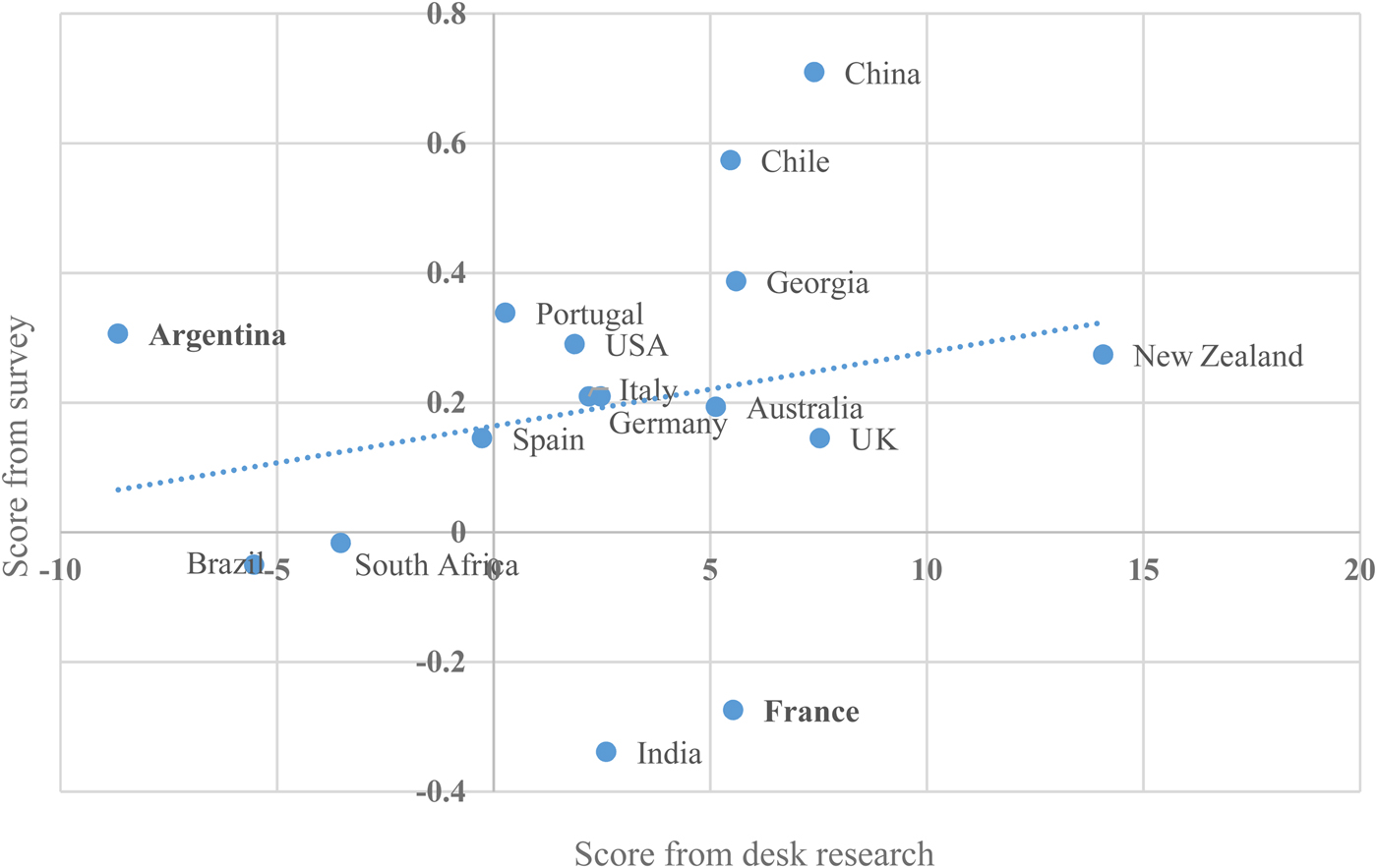
We try to describe the current situation of each country regarding each of these metrics and to anticipate future evolutions using past and current trends, as well as existing prospective studies (e.g., climate studies).Footnote 2 It leads to scores for each item that are based on a harmonized scale and, hence, can be aggregated into an overall country score. To ensure robustness, we have also conducted various sensitivity analyses, varying the definitions of the items whose interpretation was not straightforward (for instance, the role of exports as a proxy for support industries, the role of research, and the number of wineries as a metric under market structure). Our results are relatively stable to alternative definitions/scorings and the final scores presented in Figure 3 (x-axis) are an average of those obtained in six different sensitivity analyses.
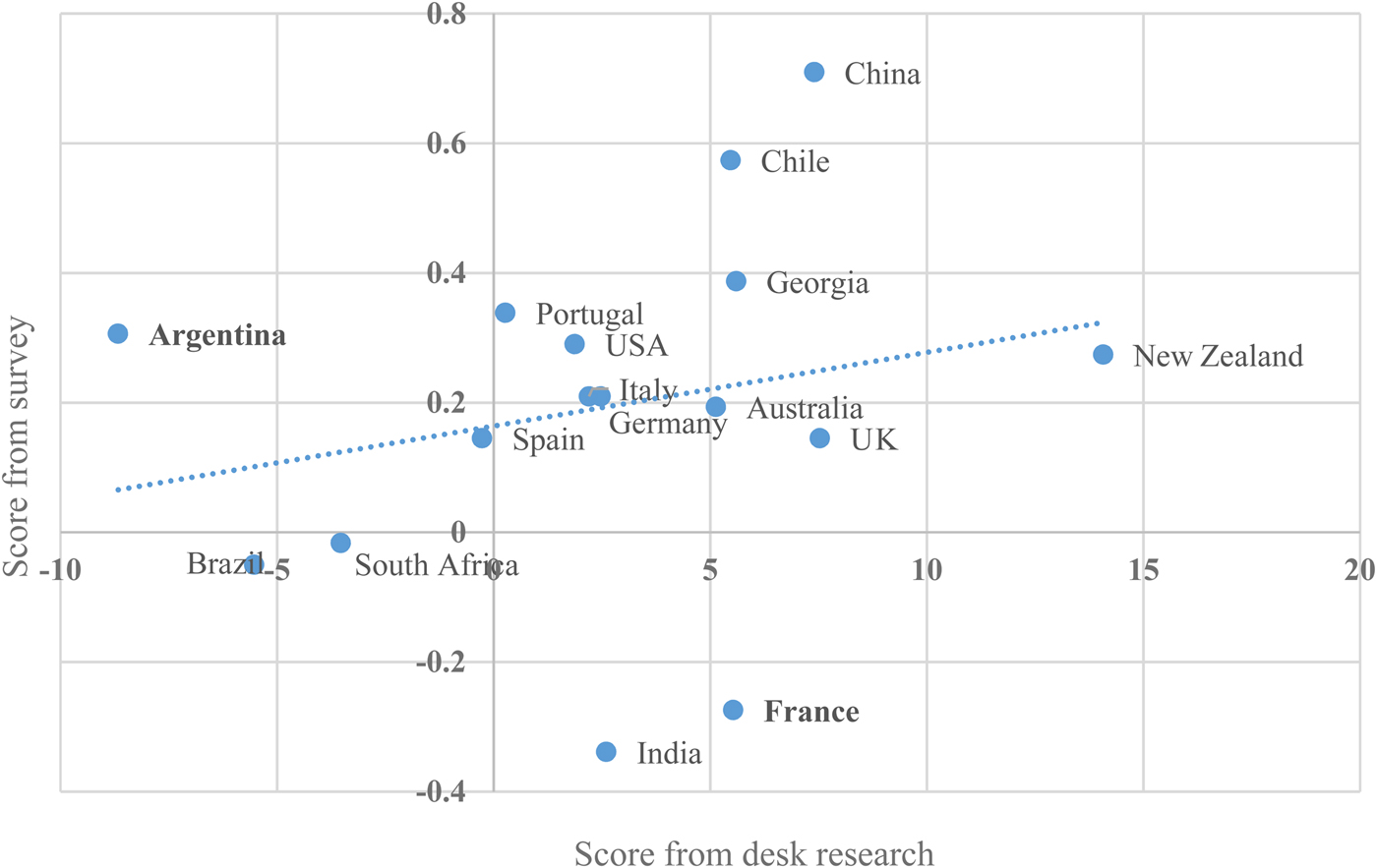
Cross-Scores Obtained from Porter's Diamond and from Survey
III. Survey of Wine Economists and Comparison
We aim to compare the “objective” scores derived from Porter's approach to those obtained from a survey of wine experts. The survey was administered via Google forms to the participants of the 2018 conference of the American Association of Wine Economists (June 10–14, 2018). In the survey, respondents were first presented with the main elements of Porter's diamond. We then asked them to evaluate the future trade performance of each of the 16 countries on a Likert scale (e.g., a rating scale where future performances range from 1 (poor) to 5 (excellent)). We collected 62 anonymous responses. Respondents were also asked to report their nationality. Overall, 14 nationalities were represented; 32% of the respondents were U.S. citizens.
The scores with both approaches are reported in Figure 3. There is a certain congruence in the results. As we can see, 75% of the countries (12 out of 16) are either in the upper-right quarter—trade performance is expected to improve in both approaches—or in the bottom-left quarter—trade performance is expected to deteriorate in both approaches. The two main outliers are France and Argentina. If both countries are included, the overall correlation between survey scores and diamond scores is .33 and the Spearman rank correlation is .32. Without them, the correlation is .52, the Spearman rank correlation is .56 and we cannot reject the independence of both scores.
Under both approaches, new-world countries, and notably Chile and New Zealand, are expected to emerge as future leaders in world wine trade. In objective terms, China is likely to have the strongest growth in terms of commercial performance. In contrast, traditional European wine producers may stagnate or experience weak trade growth. Surprisingly, the new players are the United Kingdom and Georgia. Both are likely to significantly improve trade performances, notably as a result of climate change and of a growing domestic market as in the case of the United Kingdom. It is expected that South Africa and Brazil, on the other hand, will see their trade position deteriorate. South Africa, in particular, should suffer from climate changes along with Spain. In the case of Brazil, the deterioration of the economic and social situations drive the negative outlook. For all these countries except France, Argentina, and India, experts' scores seem to align, even if Chile and China exhibit above-proportional survey scores.
Let us now focus on the three countries for which we observe a clear discrepancy between approaches. One of them, India, is not a major producer. The survey responses go against the Porter diamond analysis, since respondents do not expect India to gain market share in the future and become a major player. The other two countries, France and Argentina, are currently major-producer countries. France is the world's leading exporter by value and ranks second in volume (OIV, 2017). While survey respondents expect this position to significantly deteriorate, the Porter diamond analysis predicts that France will continue to play a leading role because of France's support industries and technologies, its premium positioning, the great diversity of its regions, and the limited impact of climate change at the national level. In the case of Argentina, the negative prediction from the Porter diamond analysis reflects the adverse impact of global warming and a deteriorating economic situation. The survey responses, however, reflect optimism for this country.
Finally, we took a closer look at the specific scores for the four main Porter criteria (average grades for the different items under factor conditions, related industries, market structure, and demand conditions, respectively). We find a weak correlation between the former two criteria and expert grades, while demand seems to be what drives experts' opinions. A simple regression of expert grades on these four (standardized) scores confirms that the implicit weight of factor conditions and related industries in expert judgement is basically zero while demand and, to a lesser extent, market structure appear to be more relevant. Further research is needed to analyze why objective factors such as climatic conditions only play a minor role in experts' opinions.
IV. Discussion and Future Scenarios
From our analysis, China, New Zealand, and Chile appear to have the greatest potential to succeed in world trade. However, their comparative advantages are very different—they are essentially based on domestic demand in China and on supply factors in New Zealand and Chile. It is also expected that Georgia, the United Kingdom, and Australia play an important role in future trade, although to a lesser extent.
These results show that comparative advantages in wine trade are neither uniform nor static. Terroir, which used to be the driving force of the old world, is no longer sufficient. Traditional producers of Europe should also be penalized by high labor costs and the cost of land particularly in densely populated regions. At the same time, investments and innovations create a dynamic of comparative advantages. Incentives to invest may come from an increase in domestic demand (China, United States, United Kingdom) or an increase in foreign demand to be captured by new world producers (Chile, Georgia, Australia). In the case of France, Argentina, and India, the discrepancy between the two approaches does not allow for clear conclusions, but the overwhelming role of demand transpires from the experts’ ranking.
Of course, this analysis is based on what we know today. Many shocks may affect individual trends in the future, which are difficult or impossible to anticipate. Nonetheless, three types of shocks can be commented on and may affect our analysis.
The first is an environmental shock. It is very difficult to accurately predict the intensity of climate change and its impact on vines. Climate change encompasses not only global warming, but also extreme events that affect the health of vines (e.g., late frost, hail, torrential rain, etc.). Environmental shocks may also produce new vine diseases.
A second shock in preferences and demand may enhance the use of synthetic phytosanitary products, which endanger the long-term wellbeing of vines and soils. On the one hand, continued demand growth in new-consumer countries could accelerate the trends already identified and lead to the emergence, in a Linder-style scenario, of a China–United States tandem as future leaders in international wine trade. On the other hand, preferences could evolve towards an increased preference for local consumption and craft, local, organic, and/or natural wines. Such a scenario, as it happened in the beer sector, could penalize major brands of new-world wines, and in particular countries such as Chile and Australia.
A shift towards local consumption could also emerge exogenously through a third shock in international trade, if the possibility of a trade war and generalization of protectionism in coming years is to be taken seriously. Wine is traditionally a highly taxed product and is often targeted in trade wars since it is symbolic of its country of origin. This de-globalization scenario can be interpreted as the political factor mentioned by Porter in his reflection on competitive advantages.
Politics and regulation can also play a role through public-health laws. Wine is an alcoholic beverage. As such, it causes a number of negative social externalities (e.g., diseases, accidents, violence, etc.). The law may become more repressive towards wine, as happened with tobacco. Increased prohibition would affect demand and would significantly impact wine trade.
The combination of these different types of shocks may lead to an unpredictable future, but the framework outlined earlier may still be useful and updated over time to analyze forthcoming changes. Our findings can also be seen as complementing wine market predictions based on macroeconomic models (as in Anderson, Norman, and Wittwer, Reference Anderson, Norman and Wittwer2003; Anderson and Wittwer, Reference Anderson and Wittwer2013, Reference Anderson and Wittwer2017, Reference Anderson, Wittwer, Anderson and Pinilla2018; OECD-FAO model in European Commission, 2017). These models attempt to quantify future trade flows in the wine market by extrapolating on the basis of macro model estimates and trend forecasts of standard macro variables (e.g., GDP, GDP/capita, etc.). Exogenous shocks may also invalidate these predictions. The present article offers different types of anticipations based on a rather qualitative approach, grounded on existing trade theories and decomposing key comparative advantages into specific items. Future research should attempt to complete this analysis with a broader survey, covering a larger number of experts and administering a more detailed questionnaire to wine industry professionals. This approach may shed more light on the relevant factors for the future global trade of wine.