Congress, despite its constitutional mandate, does little to constrain presidents when it comes to foreign policy. It allowed open-ended US engagement in Syria on the strength of authority granted after the September 11 terrorist attacks. Despite reservations among many members, it deferred to Barack Obama in Libya. Most prominently, Congress acquiesced to George W. Bush's invasion of Iraq, with even most Democrats reluctantly providing support.
The observation that presidents dominate US foreign policy is hardly novel. Around the world, executives generally have informational advantages in international affairs that translate into foreign policy autonomy (Baum and Potter Reference Baum and Potter2015). Political institutions and practices make this doubly true in the United States (Howell Reference Howell2003). Indeed, presidential dominance in foreign policy is so widely accepted that there is shorthand for it—“two presidencies”—a weaker one for domestic policy and a stronger one for foreign affairs (Wildavsky Reference Wildavsky1966; Canes-Wrone et al. Reference Canes-Wrone, Howell and Lewis2008).
Most scholarship, however, glosses over how we got to these two presidencies, gauzily attributing it to presidential entrepreneurialism and the emergence of the United States as a superpower (e.g., Moe Reference Moe1985; Neustadt Reference Neustadt1991). In this telling, presidential foreign-policy power is the combined product of geopolitical change that thrust the United States into the role of a global superpower and the savvy of presidents who availed themselves of that opportunity.
We make a different argument: the emergence of the modern presidency was partially the consequence of institutional change.Footnote 1 Specifically, the shift to the direct election of senators realigned the division of foreign policy power between the branches. By shifting senators' electoral principals from state legislators to the median state voter, direct election disincentivized attentiveness to foreign policy—a domain that the average voter knows and cares little about (Holsti Reference Holsti1996; Delli Karpini and Keeter Reference Delli Karpini and Keeter1997). With senators no longer rewarded for muscularly engaging in foreign policy, presidents inserted themselves into the vacated political space.
We leverage the piecemeal phase-in of senatorial direct election to identify the impact on votes to either expand or limit presidential authority over tariffs or treaties between the 45th (1877–79) and 63rd (1913–15) Congresses.Footnote 2 Our results indicate that senators subject to direct election were more inclined to delegate foreign policy autonomy to presidents. We confirm these results with a placebo test on similar votes in the House of Representatives, where no equivalent institutional change occurred. We also show that senators subject to direct election shied away from foreign policy committee assignments.
1. Direct election and presidential power
The shift to direct election of senators was driven by Progressive-era ambition to bring government closer to the people it ostensibly represented. There were less lofty, more practical, considerations at play as well—that direct election would limit corruption by making influence costlier and avoid the Senate vacancies produced by deadlocked state legislatures (Schiller and Stewart Reference Schiller and Stewart2015).
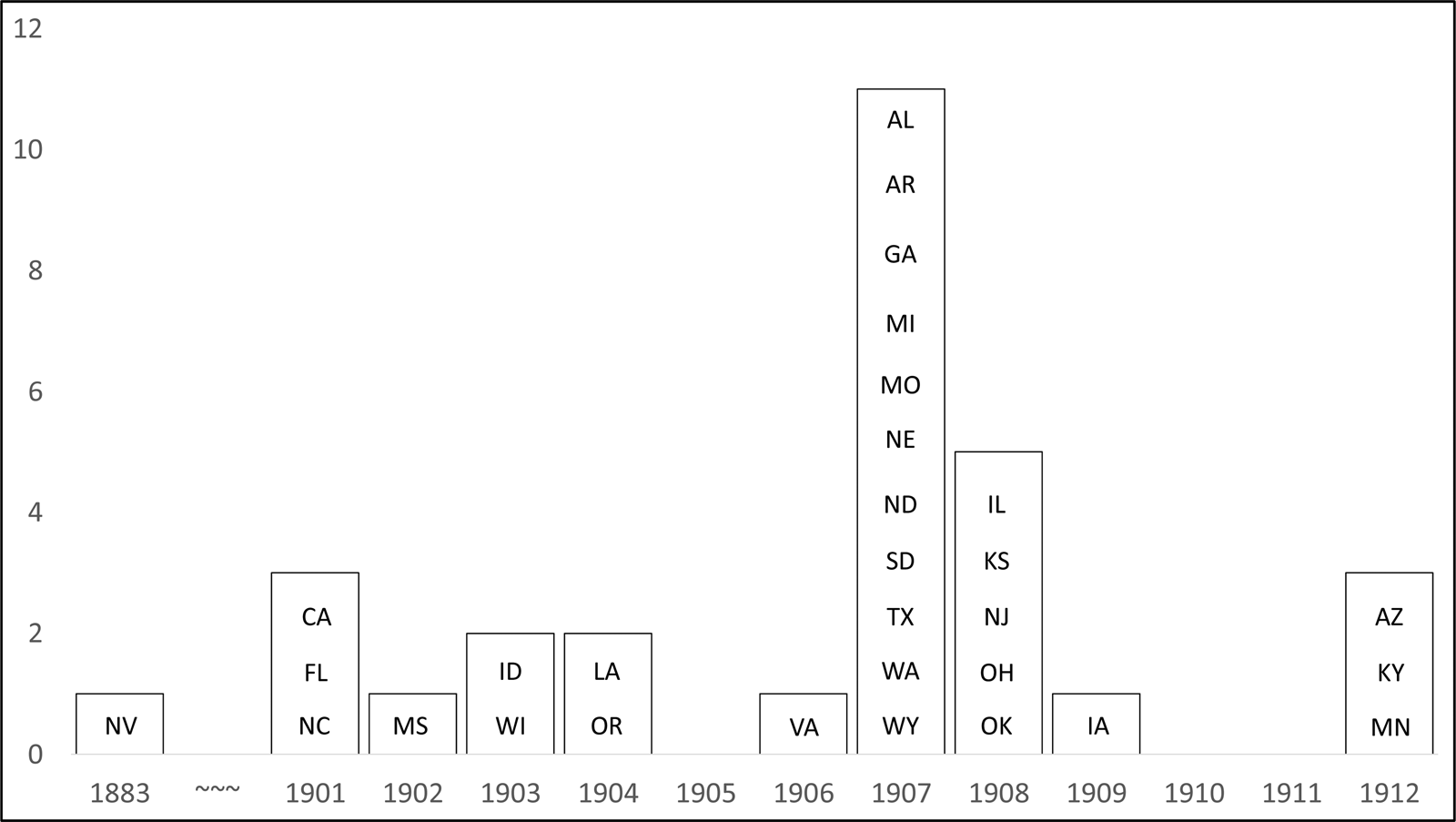
As with any major institutional change, there were controversies that delayed adoption. Southern leaders, for example, resisted for fear that it would threaten the Jim Crow system (Lapinski Reference Lapinski2000). That said, in comparison with the fights over other constitutional amendments, the debate was muted. By the time the 17th Amendment was ratified in 1913, a majority of states, led by those in the West, had already moved toward direct election through the adoption of direct primaries (Figure 1).
Adoption of direct election via state primaries.

We argue that direct election had an additional, unintended consequence. While it may have moved the Senate closer to the ideals of plebiscitary democracy, direct election also shifted the incentives of senators in ways that directly empowered the executive in the area of foreign policy and contributed to the emergence of the modern presidency.
Why did this seemingly innocuous change have such a profound impact? The answer lies in the ultimate source of accountability. As elected agents, senators are held responsible for their actions by principals who must be both attentive and knowledgeable about their foreign policy performance. The shift to direct election increased information and attentiveness asymmetries by shifting the principal from state legislators to citizens.
Information is required to ensure this accountability, but it is hard for the average citizen to acquire this information and the individual rewards for doing so are minimal.Footnote 3 Holmstrom (Reference Holmstrom1979) notes that monitoring foreign policy is especially difficult due to the natural information asymmetries between leaders and citizens, which is compounded by low popular attentiveness to (and knowledge about) foreign policy (Holsti Reference Holsti1996; Baum and Potter Reference Baum and Potter2015).
The shift to direct election exacerbated these information and attentiveness gaps by shifting the principal from state legislators to citizens. Absent major conflict, foreign policy operates well beneath the public's radar (Miller and Stokes Reference Miller and Stokes1963; Ostrom and Simon Reference Ostrom and Simon1985). This is because typical voters do not know much about or engage with foreign policy (Holsti Reference Holsti1996; Delli Carpini and Keeter Reference Delli Karpini and Keeter1997). Most significantly, they tend to vote based on their immediate concerns rather than foreign policy considerations or other public goods, particularly those at the national level.
Once citizens were given the responsibility to elect senators directly, their voting reflected this prioritization. Directly elected senators had little choice but to change their behavior accordingly, with increased attention to local concerns at the expense of foreign policy. The takeaway is that the insulation that came with indirect election led to a Senate that was better positioned to constrain executive preferences over foreign policy. As that insulation evaporated as a consequence of direct election, the incentives to meaningfully constrain presidential foreign policy preferences went with it.
In comparison with the mass public, state legislators were (and are) more informed about and concerned with matters of national significance including foreign policy. Around the turn of the 20th century, as they remain today, state legislators were, on average, wealthier and better educated than their constituents, attributes that are consistently associated with better political information and foreign policy attentiveness. According to Campbell (Reference Campbell1980: 39), “Both Democrats and Republicans recruited their delegations mainly from the more eminent citizens of small town and rural America….”
Even when not particularly versed in or concerned with foreign affairs in their own right, state legislators were pushed in ways that led to the election of senators better positioned to constrain presidential foreign policy preferences. State legislators in this period were highly reliant on “power brokers”—party bosses, party machines, and wealthy patrons—for political survival (Rothman Reference Rothman1966; MacNeil and Baker Reference MacNeil and Baker2013: 20; Schiller and Stewart Reference Schiller and Stewart2015: 38–40).Footnote 4 These power brokers, who had wide-ranging business and financial interests, pushed state legislators to select senators who were attentive to defending the institutional prerogatives of the chamber, including in the realm of foreign policy (Gailmard and Jenkins Reference Gailmard and Jenkins2009).
Finally, states in this period more directly bore the cost of assertive foreign policy and conflict than they do now. This meant that state legislatures and powerbrokers had substantial incentives to constrain presidential foreign policy initiatives that might impact their budget priorities. Peacetime defense outlays and deficit spending were minimal, so there was a tighter link between foreign adventures, state budgets, and taxation. Trade and treaties were also more immediately salient in this period because they dictated the bulk of the federal budget prior to the imposition of the income tax.Footnote 5
In short, prior to the implementation of direct election, comparatively more sophisticated and informed state legislators were the principals selecting and overseeing senators. Afterward, amateurs (regular citizens who were less sophisticated and informed) took on this role. As a consequence, the procedural change to direct election broke the careful equilibrium required for the system of checks and balances to function as the Framers intended. The shift fundamentally altered both the demographics and policy preferences of the relevant median voter, with predictable consequences (Gailmard and Jenkins Reference Gailmard and Jenkins2009). With their political futures now determined by direct election, senators no longer had sufficient incentives to engage with foreign policy.
This leads us to the simple expectation that a shift from indirect to direct election of senators will be associated with an increased probability of voting to delegate foreign policy autonomy to presidents.
2. Research design
To assess this expectation, we leverage the phased adoption of direct primaries prior to the ratification of the 17th Amendment. This approach allows for better identification of the causal process by providing variation within Senate roll calls and within senators, with some senators facing popular election and others still answering to state legislatures. The approach also differentiates between our argument and the rival possibility that the federal income tax empowered the modern presidency by increasing financial autonomy. While the 16th and 17th Amendments were ratified in close succession, the income tax was not adopted piecemeal by the states.
To establish a valid set of votes for comparison, we rely on all roll calls on tariffs and treaties in the Senate from the 45th (1877–79) through 63rd (1913–15) Congresses—the period after Reconstruction until the ratification of the 17th Amendment. Among this set, we identify those votes that explicitly sought to expand or limit presidential discretion. Examples include authority to staff commissions and authorization to choose the details of policy implementation. These roll calls are mostly on amendments, motions, and resolutions that narrowly address presidential power, rather than final-passage votes on full multi-faceted bills.Footnote 6 As required, we recoded such that a positive observation indicates a position in favor of presidential autonomy. The result is a dataset of 1,916 individual votes from 32 roll calls, 15 of which were on tariff issues and 17 on treaty-implementation issues. Our unit of analysis is the senator-vote.
We define the “treatment,” which we call Direct Election, as whether the senator's state had, by that Congress, introduced some form of direct primary for the election of senators.Footnote 7 We also include a dichotomous measure of co-partisanship (President Co-partisan) on the expectation that this could lead to more willingness to support an expansion of presidential authority.
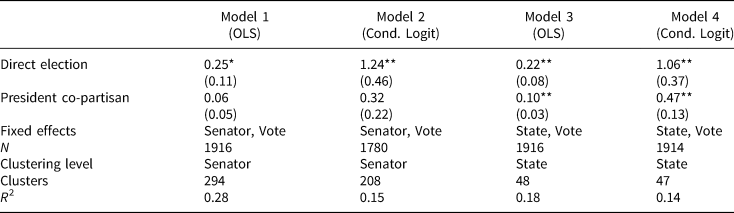
In Table 1, we present results from simple linear probability models as well as conditional logistic regressions that better fit the dichotomous dependent variable. Within each model type, we estimate models with (1) senator and roll-call fixed effects and (2) state and roll-call fixed effects. We also include a specific time trend for each state in all models and cluster our standard errors at the senator or state level, depending on the fixed effects. State-specific time trends address the possibility that states' preferences on these issues changed over the period, and that this change could vary by state. One potential threat to our design is if important features of states' preferences for foreign-policy oversight were also important for switching to popular election. Our state-specific time trends help partially mitigate this by allowing states to change in different directions and at different rates.
Direct election and support for presidential autonomy

Note: Each model contains state-specific time trends. Models 2 and 4 suffer minor data loss due to within-unit invariance in outcome (senators only voting in one direction throughout their careers). *p < 0.05, **p < 0.01; one-tailed tests.
The two fixed-effects approaches allow us to test slightly different things. The senator-fixed-effects models assess changes to the individual senator's behavior rather than change brought about by the election of new senators. This measures the impact of the change-in-principal on individual senators. In total, we observe 26 senators with 396 total votes cast before and after a change to direct primaries. In the state-fixed-effects models, information is drawn from changes within states' voting, which combines the effects of individual change with replacement, the changes brought about by new senators with different tendencies getting elected under a different electoral system.
The models indicate that senators subject to direct election were more likely to vote in favor of presidential autonomy. Senators subject to a popular vote were about 25 percentage points more likely to support presidential discretion than earlier in their careers under legislative electoral systems (Model 1). We recover a similar relationship (22 percentage points) in the state-fixed-effects model (Model 3).
Our theoretical arguments do not predict whether this transition is driven by changing the behavior of existing senators or replacing senators with new ones. However, a comparison of the models allows us to speak fairly conclusively to that question, and the evidence weighs in favor of the conversion of existing senators. Specifically, the similarity of these two effect sizes between Model 1 and Model 3 indicates that the impact of direct election arises primarily from the changes in the behavior of sitting senators rather than changes in who was in the Senate. This does not, however, foreclose the possibility that, had existing senators been less responsive, replacement could also have been a powerful mechanism.
Co-partisanship is only significant in models with state fixed effects, most likely due to the limited variation in presidential partisanship in these phase-in years (Democrats only held the presidency during the split administration of Grover Cleveland) meaning that many senators had little or no variation in presidential party during their time in office.Footnote 8 As a consequence, the state-fixed-effects models are better equipped to reveal the role of co-partisanship—senators sought foreign policy autonomy for their own party's presidents more than rival-party presidents by about 10 percentage points.
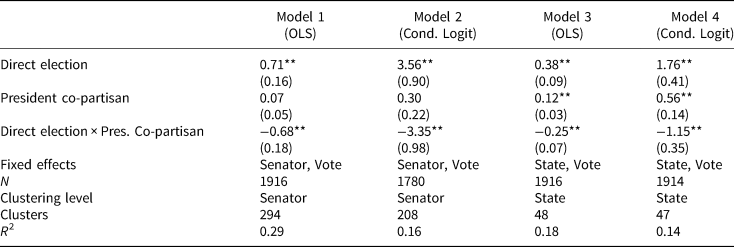
Elsewhere in the literature, scholars have shown that congressional behavior that appears to be chamber-wide has in fact been concentrated on one side of the partisan divide (e.g., Rohde Reference Rohde1991; Cox and McCubbins Reference Cox and McCubbins2005; Wawro and Schickler Reference Wawro and Schickler2006). To better understand the source of the shift to deference on foreign policy matters and the extent to which it might be concentrated among the president's co-partisans or rivals, we interact Direct Election and President Co-partisan. Again, we present four models (Table 2): two ordinary least squares (OLS) models (1 and 3) and two conditional logistic regressions (Models 2 and 4), varying whether we specify senator or state fixed effects.
Direct election (conditional on co-partisanship) and support for presidential autonomy

Note: Each model contains state-specific time trends. *p < 0.05, **p < 0.01; two-tailed tests.
The interactive model clarifies that the shift to direct election is associated with a particularly strong change in delegation behavior among rivals (resulting in a negative and significant coefficient for the interaction term between Direct Election and President Co-partisan).
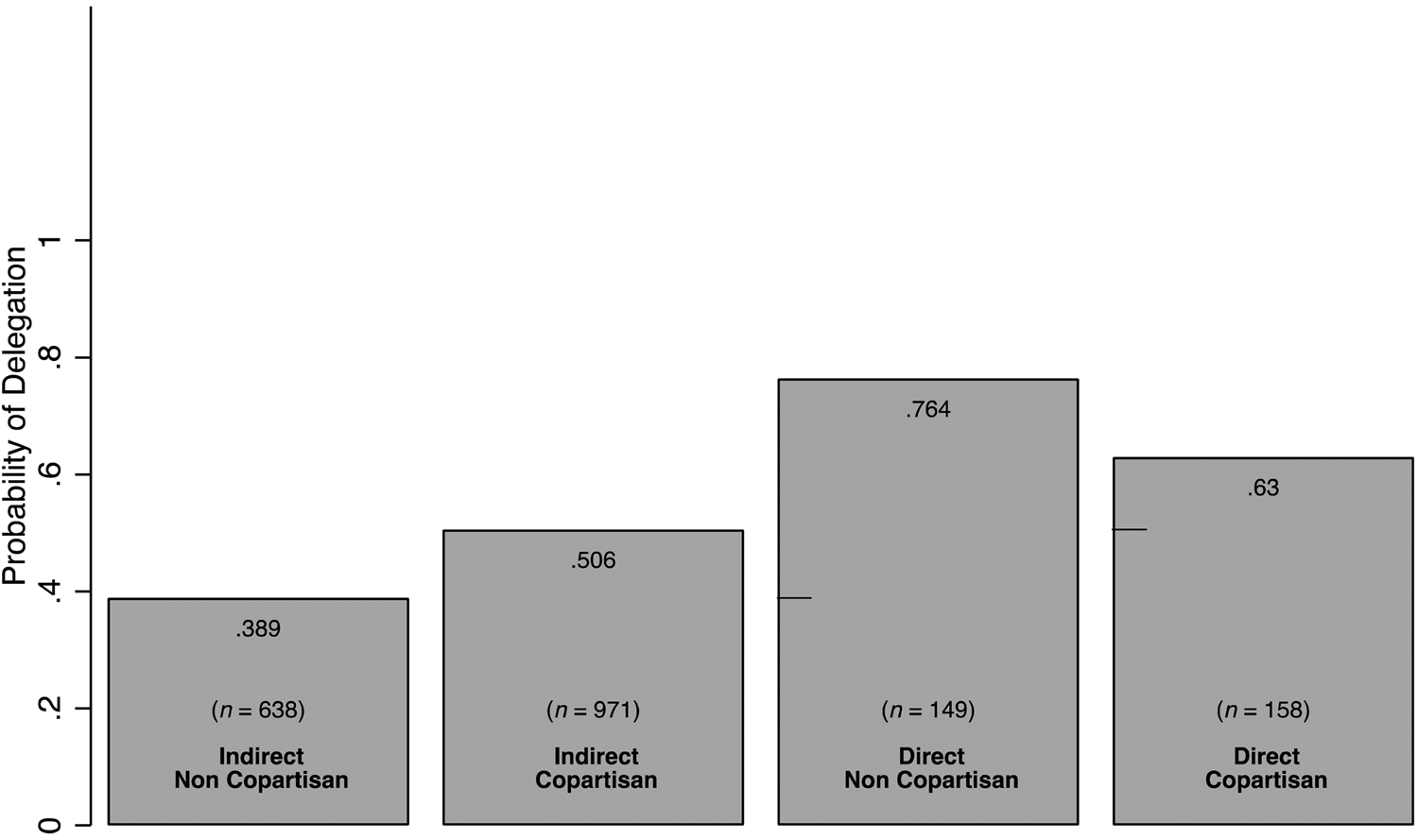
Figure 2 presents the predicted probability of supporting the president for all four possible combinations of presidential co-partisanship and direct-election status. Among senators selected by state legislatures, co-partisanship with the president is associated with an approximately 12-percentage-point increase in the likelihood of voting to delegate foreign policy authority. Among those elected via direct primaries, the difference is not significant.
Impact of direct election, conditional on partisanship. Note: Each bar shows the probability of delegation among senators subject to indirect and direct election from Model 3 in Table 2.

The increase in deference among partisan rivals as we move from indirect to direct election likely owes to the low partisan salience of foreign policy at the turn of the 20th century. In this context, the president's partisan opponents in the Senate were more available to shift once overseen by less watchful eyes, in large part because co-partisans were naturally more likely to delegate even before the institutional shift to direct election. As we have noted, it was primarily party power brokers who enforced state legislative oversight of senators when it came to constraining presidential foreign policy. As a consequence, co-partisans were under less pressure than rivals to constrain under indirect election, allowing for the greater swing to occur among the rival partisans with the transition to direct election. For example, during the McKinley, Roosevelt, and Taft administrations, attempts to provide the president with authority to negotiate trade agreements (to promote trade reciprocity) and to create a Tariff Commission found some Democratic support (Goldstein Reference Goldstein1993: 113; Wolman Reference Wolman1992). This pattern is borne out in Figure 2.
Additionally, we consider the possibility that we are capturing larger Congressional trends that happened to coincide with the transition to direct elections. This would undermine our thesis as the shift to direct election only occurred in the Senate. To address this, we conduct placebo tests on the US House, following identical specifications to those found in Tables 1 and 2. We find no comparable relationship with switching senatorial election type on House votes. This implies that the changes in senatorial allowance of presidential discretion are Senate-specific and timed to the piecemeal adoption of popular election.Footnote 9
3. Committee assignments
Our argument assumes that popular disinterest in foreign policy translates into senatorial disinterest once senators are subject to direct election. We can empirically establish the existence of this senatorial disinterest by looking at committee assignments. That is, if direct election leads senators to disengage from foreign policy because it has been devalued, this should show up in their committee assignments. Specifically, directly elected senators should hold fewer foreign policy committee assignments as a function of their total committee assignments than indirectly elected senators. This could occur because directly elected senators push back against foreign policy committee assignments, party leadership recognizes that it would be electorally advantageous to assign committees in a way that minimized the foreign policy engagement of directly elected senators, or some combination thereof.
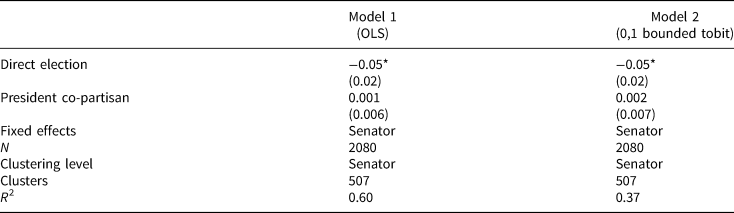
To assess this, we explore two regressions of foreign-policy committee assignments (as a percentage of total committee assignments) on direct election and co-partisanship with the president.Footnote 10 Table 3 presents these two models: a simple OLS model with senator fixed effects (Model 1) and a bounded tobit model with senator fixed effects to account for the structure of our 0–100 (percentage) dependent variable (Model 2). As anticipated, in both cases, direct election is associated with a significant decrease in the relative foreign-policy committee burden. For indirectly elected senators, approximately 23 percent of their total assignments are on foreign-policy committees. This drops to 18 percent for those who are directly elected (based on Model 1 in Table 3). This 22-percent (five-percentage-point) drop reflects a significant reduction in commitment to foreign policy oversight, which is itself a symptom of a reduced emphasis on foreign policy, but it also likely had knock-on effects in the future due to declining specialization and expertise as these committees receive less talent, attention, and effort.
Direct election and committee assignments

*p < 0.05; one-tailed tests.
Senators take committee assignments seriously and leverage them assiduously for electoral gain (Groseclose and Stewart Reference Groseclose and Stewart1999; Canon and Stewart Reference Canon, Stewart and Oppenheimer2002). The existence of a significant difference in foreign-policy-committee service between the directly and indirectly elected is difficult to account for without resorting to the conclusion that direct election shifted senators' perception of their political interests. These new interests put less emphasis on foreign policy.
4. Conclusion
Our findings suggest that the shift to the direct election of senators played an underappreciated role in the emergence of the modern presidency. However, this is not the end of the story, as this finding generates as many questions as it resolves and creates and opens the door to a number of avenues for additional research.
First, while we have plumbed the depths of available data on votes and committee assignments, it is plausible that qualitative evidence for the mechanism might be found by American political development scholars working on presidents, Congress, or state legislatures. Such work would also do well to explore whether the Senate was more diligent in protecting other institutional prerogatives prior to the advent of direct election.
Second, there are additional implications of the theory that could be exploited. For example, our theory implies a different selection process with observable impacts on the demographics and attributes of the individuals who become senators in terms of income, education, experience, urban/rural, and so on.
Third, while we have explored the impact of direct election on presidential foreign policy power, our theory points to a more general argument. We have argued that the shift to direct elections led senators to favor the particularistic interests of individual voters over foreign policy because that latter domain is a national-level concern far from voters' daily experience and knowledge. By that logic, there are other domains that may have also become less politically salient for senators once they were subject to direct election and therefore also candidates for delegation to presidents. Examples would include public lands policy, the credit of the federal government, the public debt of the nation, decisions involving cabinet-level departments, and potentially advice and consent with regard to the Senate confirmation process. In the current context, such arguments might inform discussion on why the Senate fails to assert itself on pressing national matters such as climate change.
Finally, consideration must be given to the ultimate impacts augured in by the direct election of senators. We have demonstrated an impact on a relatively small set of votes to delegate foreign policy authority and drawn a theoretical linkage to the broader issue of presidential foreign policy empowerment as identified by the “two presidencies” literature. However, much more can be done to clarify the many other ways in which presidents have been empowered by an indifferent Congress with little incentive to fulfill their constitutional role as a check on executive foreign policy powers.
Supplementary material
The supplementary material for this article can be found at https://doi.org/10.1017/psrm.2020.9.
Acknowledgements
We thank Anthony Fowler, Jeff Grynaviski, Kris Kanthak, John Matsusaka, Rachel Potter, Saikrishna Prakash, and workshop participants at UC-Riverside for very useful comments.