Introduction
According to the Canada Health Act, all Canadians are entitled to equitable access to health services, regardless of where in Canada they live. Although the organization and delivery of hospital and medical services are the responsibility of the individual provinces and territories, access to these services must be universal, comprehensive, accessible, portable, and publicly administered in order for provinces and territories to receive federal funding to cover a portion of the associated costs of providing health services (Jennissen, Reference Jennissen1992). Nevertheless, differences both in the provision of health services and in health outcomes are well documented across provinces and regions of Canada, and in particular between rural and urban areas. The Romanow (Reference Romanow2001) report entitled Building our Values: The Future of Health Care in Canada identified access to health care in rural areas and remote communities as a major problem due to both distance and retention of health workers. Similar conclusions were drawn in the Kirby report that noted access issues were the most serious problems for residents of rural and remote areas, and also that the health of rural residents was worse than that of their urban counterparts.Footnote 1 While the percentage of the population living in rural areas fell from 29.2 per cent in 1991 to 22.2 per cent in 1996, the percentage of physicians practicing in rural areas fell from 14.9 per cent to 9.8 per cent over the same period. Further, the ratio of physicians per 1,000 residents in rural areas has been forecast to fall from 0.79 in 1999 to 0.53 in 2021 (Laurent, Reference Laurent2002).
Ongoing rationalization of health care provision by provincial governments, including the closure of hospital beds, emergency wards, and the replacement of hospitals with community care centres in less populated areas, has been well documented in the media, giving at least the impression that people in rural areas are experiencing longer waiting or travel times, lower levels of technology, and more uneven resource distribution than in other areas. As Cloutier-Fisher and Joseph (Reference Cloutier-Fisher and Joseph2000) noted, government funding reductions and downsizing may have contributed to the devolution of responsibility for health care to local communities and individuals, making the provision of health care to vulnerable populations such as those in rural areas more challenging.Footnote 2
In this context, there has been continued interest in the health outcomes and health services use of older individuals since as a group they are the most frequent users of health services (Martin-Matthews, Reference Martin-Matthews2002; Rosenberg & James, Reference Rosenberg and James2000). As Canada’s population ages, there will be increasing pressure on the public health care system because of the rate at which older individuals use publicly funded health services (Lassey, Lassey, & Jinks, Reference Lassey, Lassey and Jinks1997, quoted in Martin-Matthews). The health service use of older individuals is particularly important for rural areas, because demographic and socio-economic changes have meant that older individuals are increasingly over-represented in rural and small town areas (Jennissen, Reference Jennissen1992). However, most of the recent research on the use of health services by older Canadians in rural and urban areas has been limited to specific provinces (Fakhoury & Roos, Reference Fakhoury and Roos1996, and Peterson, Shapiro, & Roos, Reference Peterson, Shapiro and Roos2005, for Manitoba; Cloutier-Fisher & Joseph, Reference Cloutier-Fisher and Joseph2000, for Ontario; Liu, Hader, Broussart, White, & Lewis, Reference Liu, Hader, Broussart, White and Lewis2001, for Saskatchewan; Allan & Cloutier-Fisher, Reference Allan and Cloutier-Fisher2006, for British Columbia). The research that has been of national scope has not focused specifically on the health care use or unmet health care needs of older individuals in rural areas.Footnote 3
This article examines whether the use of basic health services and the incidence of unmet health care needs experienced by Canadians aged 55 years or older vary across urban and rural areas of Canada, and analyzes possible reasons for any observed differences. The underlying motivation for the article is to provide additional evidence on whether residents of rural areas are relatively more likely to face barriers in obtaining health care than residents of more urban areas. In the work we report on here, we controlled for a range of demographic, socio-economic and health status characteristics that may differ between rural and urban residents and thus might account for observed disparities in health service use.Footnote 4 Since disparities in health service use among otherwise comparable residents of rural and urban areas may still not necessarily indicate access barriers, we found it useful to analyze a range of different health services that vary in terms of who makes the decision to obtain care. Thus, we considered the determinants both of health services that are typically obtained at the discretion of the patient and those that are typically obtained following a joint decision of doctor and patient. We also analyzed the prevalence of unmet health care needs. Such unmet needs, particularly those arising from services not being available in the time required, provide arguably a more direct measure of barriers in access to appropriate health care (Chen, Hou, Sanmartin, Houle, Tremblay, & Berthelot, Reference Chen, Hou, Sanmartin, Houle, Tremblay and Berthelot2002; Nelson & Park, Reference Nelson and Park2006).
Conceptual Framework
The Andersen framework (Andersen, Reference Andersen1968; Andersen & Newman, Reference Andersen and Newman1973) is commonly used in studies of health service use and has been both refined and criticized by various authors in later research (e.g., Andersen, Reference Andersen1995; Wolinsky, Reference Wolinsky1994; Wolinsky & Johnson, Reference Wolinsky and Johnson1991). The basic model identifies three types of factors likely to be important determinants of an individual’s demand for health services: (1) predisposing factors such as age and gender; (2) needs factors such as health status; and (3) enabling factors such as income. Wolinsky extended the notion of enabling factors to how medical care is organized and included, in the basic model, variables reflecting community resources generally and specific measures such as physician density. In the same vein, health insurance should also be included as an enabling factor. Similarly, Andersen (Reference Andersen1995) argued that the main focus of the model for policy should be on enabling factors, which are most mutable. He expanded the model to include measures of health behaviours as enabling factors affecting health service use, but also recognized the dynamic interaction of health behaviours, health service use, and health outcomes. Geography can be considered an enabling factor since living in a rural area would imply access issues arising from longer distances that must be travelled to obtain certain health services and possibly longer waiting times.
Dependent Variables – Measuring Health Service Use
Certain measures of health services are basic services that the average Canadian should have regardless of the state of his/her physical health. For example, it is recommended that all Canadians, particularly those individuals over 20 years of age, see a doctor once a year for a health check-up, and most dentists recommend at least an annual check-up for good oral health (Peckins, Reference Peckins2006). Other types of health service use reflect particular medical needs in which the state of one’s physical health is likely to be an important determinant. For example, a visit to a specialist or a night’s stay in the hospital is likely to arise in response to a particular medical condition. By considering how a range of health services differs in use between rural and urban areas, insights into the nature of possible barriers to access can be gained. Additional insights can also be gained by considering use of health services that are not typically covered by provincial or territorial health insurance systems, such as dental care or visits to alternative health care providers.
We considered a range of measures of basic health service use as our dependent variables. These included binary indicators for whether an individual had a family doctor, whether the individual had visited a general practitioner (GP), a medical specialist (such as a surgeon, allergist, gynaecologist, or psychiatrist) or a dentist in the previous 12 months, whether the individual had spent at least one night in hospital, had received home care, or had received alternative health care. Our set of dependent variables also included measures of the frequency during the previous 12 months of GP visits, specialist visits, dental visits, and nights in hospital conditional on at least some use of that service during the year. As well, we analyzed an indicator of whether the individual experienced unmet health care needs in the previous 12 months.
Independent Variables
Predisposing Factors
Following the expanded Andersen model, we included variables for age, gender, marital status, and immigrant status as predisposing factors. We controlled for age using a set of indicator variables for five-year intervals (age 55–59, age 60–64, etc.) as well as indicator variables for immigrant status and for the different categories of marital status (married, widowed, separated/divorced, never married). Unfortunately, small sample sizes precluded our use of controls for ethnicity for many measures of health service use since our focus is on older individuals in rural areas.
Need Factors
Need factors (e.g., health status) are likely to be the most important and immediate determinants of health service use, and self-perceived health is widely used in the literature as a proxy for health status (Newbold, Eyles, & Birch, Reference Newbold, Eyles and Birch1995). We included indicator variables for the different categories of self-reported general health specified by the respondent (excellent, very good, good, fair, or poor) and indicator variables for each of nine different (self-reported) chronic conditions: (1) cancer, (2) Alzheimer’s disease, (3) high blood pressure, (4) asthma, (5) stroke, (6) heart disease, (7) diabetes, (8) arthritis, and (9) glaucoma.
Enabling Factors
We included controls for the highest level of education attained (less than secondary school graduation, secondary school graduation, some post-secondary, or university degree or more), and indicator variables for five levels of household income adequacy.Footnote 5 It is noteworthy that causality between health (and also health service use) and income can work in both directions (Buckley, Denton, Robb, & Spencer, Reference Buckley, Denton, Robb and Spencer2004; Fuchs, Reference Fuchs2004). As pointed out by Case, Fertig, and Paxson (Reference Case, Fertig and Paxson2005), being in poor health, even at an early age, can determine one’s level of socio-economic status in the future.
We expanded the set of enabling factors to include four sets of variables identified in the literature as potentially important. The first set of variables reflected types of private health insurance coverage that are available in Canada to cover the cost of those services that are not insured under Medicare, such as dentist visits, pharmaceuticals, eye exams and glasses, and private hospital rooms. We included in the statistical analysis indicators for health insurance covering each of these aspects of health service use.Footnote 6 The second set of variables was for health behaviours related to smoking, including whether the person was currently a daily smoker or was ever a daily smoker. The third set of variables measured differences in the potential availability of physicians across health regions, and included both the number of general practitioners (GPs) and the number of specialists per 1000 residents.
The fourth set of variables reflected region of residence, the main focus of the analysis. Region of residence is also an enabling factor since it can reflect ease of access to health services among other factors. We included a set of indicators for the degree of urbanization of the individual’s community. Using Statistics Canada (2006) definitions, we identified four types of areas based on population and proximity to a Census metropolitan area (CMA) or Census agglomeration (CA). For ease of expression, we hereafter refer to the group of CMAs and CAs simply as CMAs. The four categories follow: (1) urban CMA: areas with a population of at least 10,000 and delineated within a Census metropolitan area or Census agglomeration; (2) rural fringe of CMA: areas within a CMA but with a population of less than 10,000; (3) urban not CMA: areas with a population of at least 1,000 but less than 10,000 and with no fewer than 400 people per square kilometre; and (4) rural not CMA: areas outside of CMAs but not otherwise classified as urban. (See Allan & Cloutier-Fisher, Reference Allan and Cloutier-Fisher2006, for further discussion of these categories.)Footnote 7 We also included a set of indicator variables for province of residence that will capture provincial-wide differences in the provision of health care for older Canadians since provinces differ markedly in their management of health care systems and in terms of the extent of publicly provided health insurance for various health services, prescriptions, and other services.
Data and Methods of Analysis
Data Sources
The data used in our study are from the Statistics Canada Master file of Cycle 2.1 of the Canadian Community Health Survey (CCHS) from 2002–2003. The CCHS focuses on Canadians aged 12 and older who live in private dwellings in all of the provinces and territories and does not sample those living on Indian Reserves, Crown Land or private institutions, or members of the Armed Forces. We restricted our attention only to residents of Canada’s provinces who are aged 55 or older. Given the possible influence of outliers in the data arising from the very old, in results not reported here we repeated the analysis after restricting the sample of Canadians to those aged 55–79. There was very little impact on the results that we report here. Our final sample for estimation consisted of 39,974 observations across the 10 Canadian provinces. Note that all data in the CCHS, including data on both health service use and on health outcomes such as chronic conditions, are based on self-reports by the respondents. We also obtained data by health region on the number of active registered GPs and number of active registered specialists per 1,000 residents (both full-time and part-time) for the year 2002 from the Canadian Institute of Health Information. We included these data as rough measures of the average supply of physicians in an individual’s particular health region of residence.Footnote 8
Empirical Approach
For the statistical analysis, estimation of the determinants of binary dependent variables was by multivariate Logistic regression. For measures of health service use where we are also interested in the frequency of use, we employed the “two-part” approach in which frequency is divided into whether there was use at all and the frequency of use conditional on some use. Ordinary Least Squares (OLS) estimation on the number of visits or days conditional on positive use constituted the second part. This method is commonly used in the literature (see, for example, Van Houtven & Norton, Reference Van Houtven and Norton2004; Escarce, Shea & Chen, Reference Escarce, Shea and Chen1997; Hurd & McGarry, Reference Hurd and McGarry1997). Results of the Logistic estimation are reported as odds ratios relative to the specified base case. We transformed the frequency measures with a log transformation in order to reduce the possible influence of large numbers of visits or nights in hospital. For frequency measures conditional on use, OLS coefficient estimates were reported and since the dependent variables are in log form, these OLS estimates can be interpreted approximately as the proportional change in the frequency of use of the service relative to the specified base case. In all regressions, results were obtained using population weights, and standard errors were calculated after allowing for clustering of observations by health region.
Results
Descriptive Statistics
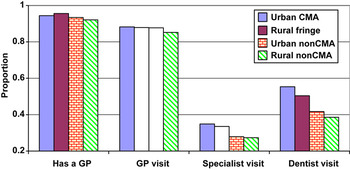
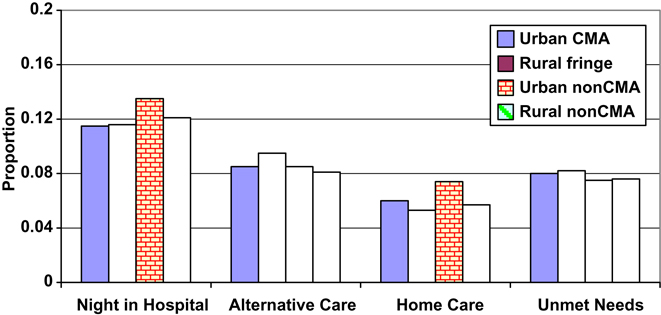
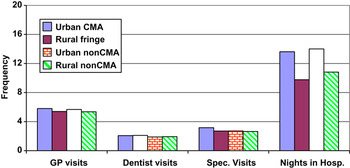
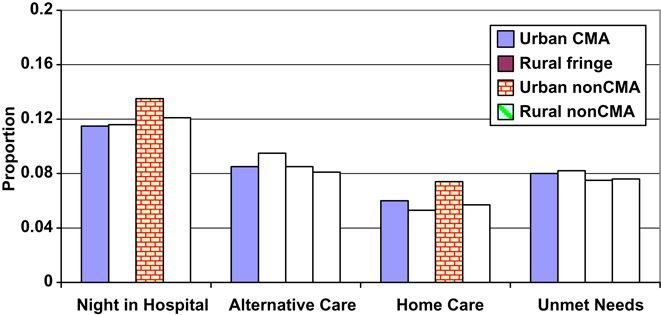
We first illustrate overall differences in health service by residents of different types of rural and urban areas. Figures 1 and 2 show the proportion of older Canadians who used particular health services in the year prior to the survey date, as well as the proportion of older Canadians reporting unmet health care needs. Figure 3 shows the average frequency of use of particular health services, conditional on at least some use. Although the proportion of older Canadians reporting unmet health care needs was not statistically different across rural and urban areas, residents of rural non-CMA areas were less likely to have a GP, to have visited a GP, a specialist, or a dentist, have had fewer visits with a GP, a dentist, or a specialist, and have spent fewer nights in hospital.
Proportion of older Canadians using health services in the past 12 months. A clear bar indicates not significantly different from Urban CMA at the 5 per cent level of significance. Results are for the adult non-institutional population aged 55 or older.

Proportion of older Canadians using health services in the past 12 months. A clear bar indicates not significantly different from Urban CMA at the 5 per cent level of significance. Results are for the adult non-institutional population aged 55 or older.
Frequency of use of health services by older Canadians in the past 12 months (conditional on some use). A clear bar indicates not significantly different from Urban CMA at the 5 per cent level of significance. Results are for the adult non-institutional population aged 55 or older.

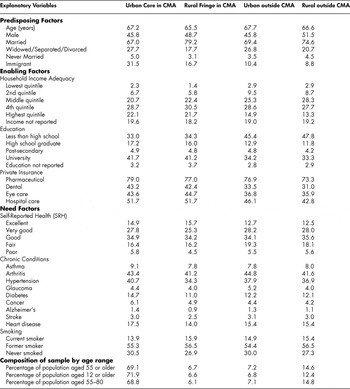
Table 1 shows a comparison of measures of predisposing, enabling, and need factors from the (weighted) sample of people aged 55 or older across the rural/urban categories. Residents of rural fringe areas of CMAs and rural areas outside of CMAs were actually a little younger on average than urban residents, and were also more likely to be married. CMA urban core areas had the highest proportion of residents born outside of Canada while rural non-CMA areas had the lowest. Perhaps not surprisingly, the biggest difference in socio-economic status across regions was between CMA areas (including urban core and rural fringe) and non-CMA areas (including urban non-CMA and rural non-CMA), rather than between urban and rural areas. More than 20 per cent of CMA residents (both urban core and rural fringe) were in the highest income adequacy quintile for Canadian households, and more than 40 per cent of these residents also had university degrees. Comparable figures for regions outside of CMAs were less than 15 and 35 per cent respectively. Related to this, a greater percentage of CMA residents had health insurance to cover drugs, dental care, eye care, and hospital care than non-CMA residents although the gap is smaller for drug coverage than for the other forms of insurance.
Descriptive statistics on predisposing, enabling, and need factors associated with the health service use of Canadians aged 55 or older by urban/rural classification of residence (percentages)

Notes
Data are drawn from the CCHS 2.1. The CCHS data exclude individuals who are resident in institutions, and on reserve. This table also excludes residents of Canada’s territories.
For the percentage of the smoking population aged 55 or older, 12 or older, and between the ages of 55 and 80, the CCHS data differentiate further between urban core CMA and urban fringe CMA. Individuals classified as living in the urban fringe of a CMA are not included in Table 1 owing to small sample sizes, so that the percentages in the last three rows add to less than 1. Percentages for people resident in “urban fringe” are 2.5, 2.4, and 2.5 respectively.
Self-reported health appeared to be marginally better in the urban core and rural fringe of CMAs than in areas outside of CMAs. In contrast, the prevalence of certain chronic conditions (asthma, hypertension, diabetes, cancer, and heart disease) was somewhat higher in the urban core areas of CMAs than in other areas, and for none of the nine chronic conditions we considered was the prevalence in rural areas outside of CMAs higher than in the more populous urban areas. The prevalence of current daily smoking was lower in urban CMA areas than in other areas.
Regression Results
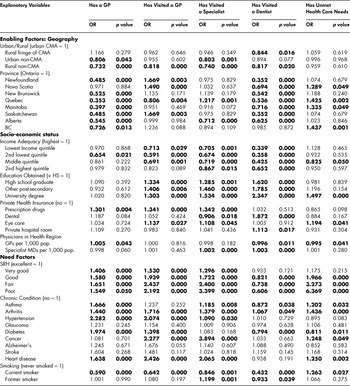
Table 2 presents selected results from a multivariate Logistic regression of each of the binary indicators of health service use expressed as a function of our full list of enabling, need, and predisposing factors. The first part of Table 2 reports results for the measures of rural/urban status, our main variables of interest. In column 1 of Table 2, it can be seen that other things being equal, residents of rural areas outside of CMAs were significantly less likely to have a GP (OR: 0.732; p value: 0.000). This was also true of urban residents outside of CMAs (OR: 0.806; p value: 0.043), but it was not true of residents in the rural fringe of a CMA (OR: 1.166; p value: 0.279). In columns 2 to 4, comparable results show that rural non-CMA residents were significantly less likely than urban CMA residents to have visited a GP (OR: 0.818; p value: 0.000), to have visited a specialist (OR: 0.740; p value: 0.000), and to have visited a dentist (OR: 0.817; p value: 0.020). Thus, differences in demographic, socio-economic, and health status characteristics between rural and urban residents did not account for the differences in the likelihood of contact with doctors, specialists, and dentists. In contrast, column 5, shows that despite lower levels of health service use, there were no significant differences in the occurrence of unmet health care needs between rural and urban residents. The estimated odds ratios for the urban and rural categories were all very close to 1.0, with large p values. There were also no significant differences across rural and urban areas in the prevalence of having spent at least one night in hospital, in receiving home care, or in utilizing alternative methods of health care, and so these results were not reported.
Multivariate Logistic regression results of the determinants of health service use and unmet health care needs in the past 12 months by Canadians aged 55 years or older (odds-ratios relative to urban core of a CMA)

Notes
Regression equations also include controls for predisposing conditions (age, gender, marital status, immigrant status). These results are not reported but are available on request from the authors.
Residents of the Territories and PEI are omitted from the estimating sample for data confidentiality reasons.
Bold font denotes statistical significance at the five per cent level.
The Wald Chi-squared test of the overall significance of the regression has a p value of 0.000 in each case.
Source of Data: Canadian Community Health Survey 2.1. Data on numbers of GPs and Specialists per 1,000 residents are from the Canadian Institute of Health Information and are included at the level of the health region.
It is also clear from Table 2 that all other things being equal, health service use varied significantly across provinces but not uniformly. Residents of all other provinces were less likely to have a family GP than residents of Ontario. Relative to Ontario, residents of Quebec were less likely to have visited a GP while residents of Newfoundland, Nova Scotia, and Saskatchewan were more likely. In contrast, Quebec residents were actually more likely to have visited a specialist, as were Alberta residents. Ontario residents were also more likely to have visited a dentist than residents of the other provinces. In terms of unmet health care needs, residents of Nova Scotia, Quebec, Manitoba, and BC were more likely to have such needs than Ontario residents.
Among the other enabling explanatory variables included in the regressions, we found that a higher number of GPs per 1,000 residents was associated with a greater likelihood of a person having a GP, and a higher number of specialists per 1,000 residents was associated with a greater likelihood of visiting a specialist in the past year. As well, a higher number of GPs per 1,000 residents was found to be associated with a lower prevalence of having unmet health care needs. Controls for both income adequacy and education level were highly significant and indicated clearly that the prevalence of having visited a GP, a specialist, or a dentist at least once during the previous year was higher for people with more education and people in households with a higher income adequacy. Odds ratios for education levels of high school graduate or higher were all significantly greater than 1.0, while odds ratios for income adequacy levels below the top category were almost all significantly less than 1.0. The patterns were particularly pronounced for having visited a dentist, and it should be noted that these results were based on regressions that also controlled for various forms of medical insurance, including dental insurance.
Not unexpectedly, variables reflecting need factors were also significant determinants of health service use. Individuals with lower levels of self-reported health were more likely to have visited a GP and a specialist, and were more likely to have unmet health care needs. They were also less likely to have visited with a dentist. Similarly, many of the nine chronic conditions we considered were positively correlated with a person’s visit to a GP or a specialist as well as to that person’s having unmet health care needs, in particular heart disease, cancer, and arthritis. Controls for smoking had no significant effect on health service use after controlling for chronic conditions and the other factors.
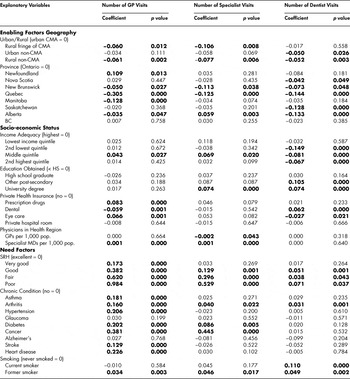
In Table 3, we present unstandardized OLS regression results for the frequency of health service use, as measured by the number of GP visits, specialist visits, and dentist visits in the past year, conditional on at least one visit to each. Consistent with the results from Table 2, the frequency of visits to each medical professional was significantly lower for residents of rural non-CMA regions than for urban CMA residents: all other things being equal, rural residents had 6.3 per cent fewer visits to a GPFootnote 9 (coefficient: –0.061; p value: 0.002), 8.0 per cent fewer visits to a specialist (coefficient: –0.077; p value: 0.006), and 5.3 per cent fewer visits to a dentist (coefficient: –0.052; p value: 0.003). Frequency of visits was also lower for residents of rural fringe CMA areas and for urban areas outside of CMAs, but the difference was not always significant at the five per cent level. Though not reported in Table 3, the results for the frequency of nights in hospital showed no significant variation across rural or urban regions.
Multivariate OLS regression results of the determinants of the number of health service visits in the past 12 months, conditional on at least one visit, by Canadians aged 55 years or older

Notes
Regression equations also include controls for predisposing conditions (age, gender, marital status, immigrant status). These results are not reported but are available on request from the authors.
Residents of the Territories and PEI are omitted from the estimating sample for data confidentiality reasons.
Bold font denotes statistical significance at the five per cent level.
The F-test of the overall significance of each OLS regression has a p value of 0.000
Source of Data: Canadian Community Health Survey 2.1. Data on numbers of GPs and Specialists per 1,000 residents are from the Canadian Institute of Health Information and are included at the level of the health region.
Results for the province variables again gave a somewhat mixed picture, although generally it appeared that the frequency of visits to health care professionals was lower in other provinces than in Ontario. Further, older residents of Quebec had fewer visits to a GP, fewer visits to a specialist, and fewer visits to a dentist than residents of any other province, other factors being equal. The concentration of GPs per 1,000 residents in the health region was positively associated with the number of GP visits by individuals, while the concentration of specialists per 1,000 residents was positively associated with the number of specialist visits (though GPs per 1,000 was negatively associated with this measure).
The relationship between the frequency of medical visits and socio-economic status was less clear, although there was some indication that higher socio-economic status as measured by higher income and more education was associated with more visits. Need factors reflecting self-reported health status and chronic conditions were found to be strongly associated with the frequency of physician consultations, and in fact the number of GP visits and number of specialist visits both increased monotonically with decreasing levels of self-reported health.
It was not surprising that health services use was found to vary significantly across provinces since the provision of health services and the timing of health care rationalization can vary widely. For example, the provision of basic health care in Quebec is much more likely to be through community health centres than in other provinces (see Richard, Gauvin, Ducharme, Gosselin, Sapinski & Trudel, Reference Richard, Gauvin, Ducharme, Gosselin, Sapinski and Trudel2005). It is therefore quite possible that rural–urban differences may also vary by province of residence. To investigate this possibility, we next split the sample by province and estimated the same specification as before only run separately for each sub-sample of individuals. For this analysis, we defined five Canadian provincial groups because of confidentiality restrictions: the Atlantic Provinces, Quebec, Ontario, the Prairies (including Alberta), and British Columbia. For brevity, we only present results for the indicators of rural or urban residence although the regressions included all of the same explanatory variables we described earlier except for the province indicators. For regions that include multiple provinces, we included indicator variables for each province that is part of that provincial group.
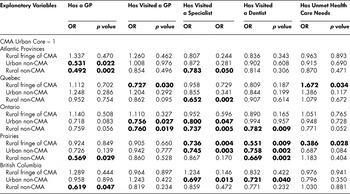
Table 4 reports results for the same binary measures of health care use as in Table 2. From column one of Table 4, we see that older residents of rural areas outside of CMAs were significantly less likely to have a GP than comparable residents of urban CMAs for each provincial group except Quebec (though the odds ratio for rural Ontario was only significant at the 10% level [OR: 0.759; p value: 0.056]). Residents of smaller urban centers outside of CMAs in Atlantic Canada were also significantly less likely to have a GP (OR: 0.531; p value: 0.022). Results for whether a rural non-CMA resident had visited a GP in the past year show odds ratios less than 1.0 for all provincial groups, but it was only for Ontario that the difference was significant (OR: 0.760; p value: 0.019). Consulting with a specialist was significantly less likely for older residents of rural non-CMA areas in Atlantic Canada, Quebec, and Ontario, and it was also less likely for residents of urban areas outside of CMAs in Ontario, the Prairies, and British Columbia. The likelihood of visiting a dentist was lower for rural non-CMA residents in Ontario and the Prairies, and for urban non-CMA residents in the Prairies and British Columbia. Overall, Table 4 shows that after controlling for other factors, health service use in rural areas was almost always lower than in urban CMA areas, and was never significantly higher than in urban CMA areas. In Table 4 as in Table 2, rural residents outside of CMAs, however, were no less likely than residents of urban CMAs to have unmet health care needs in any provincial group, despite differences in the prevalence of a visit to a GP or specialist. The odds ratio for rural residents of Ontario was significantly lower than 1.0 only at the 10 per cent level (OR: 0.771; p value: 0.052). There was also no significant difference between rural and urban areas in any provincial group for a night in hospital, for alternative care, and for home care, and so again these results were not reported.
Selected multivariate Logistic regression results of the effect of rural/urban status on health service use in the past 12 months by Canadians aged 55 years or older; separate regressions by province of residence (odds-ratios relative to urban core of a CMA)

Notes
Equations are estimated separately for each of the provinces or group of provinces identified in the table. Each province-specific regression also includes controls for predisposing conditions (age, gender, marital status, immigrant status), predisposing factors (education level, household income quintile, type of private insurance, if any, concentration of GPs and specialist MDs per 1,000 residents), and need factors (self-assessed health, chronic conditions, smoking status, age started smoking). These results are not reported but are available on request from the authors.
The reference individual is a married male aged 60–64 with less than high school education, a household income in the highest quintile of income adequacy, no private health insurance, and living in the urban core of a Census metropolitan area in Ontario.
Residents of the Territories and PEI are omitted from the estimating sample for data confidentiality reasons.
Bold font denotes statistical significance at the five percent level.
The Wald Chi-squared test of the overall significance of the regression has a p value of 0.000 in each case.
Source of Data: Canadian Community Health Survey 2.1. Data on numbers of GPs and Specialists per 1,000 residents are from the Canadian Institute of Health Information and are included at the level of the health region.
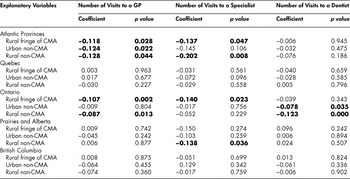
Table 5 gives selected results for the same frequency measures as in Table 3, although again we report only those regression results for the rural and urban indicators. Table 5 shows that differences in GP visits between rural non-CMA regions and urban CMA regions were inconsistent across provincial groups, with significant differences only for rural residents of Atlantic Canada (13.7% fewer GP visits: coefficient: –0.128; p value: 0.044) and Ontario (9.1% fewer GP visits: coefficient: –0.087; p value: 0.013). Rural residents of Atlantic Canada also had 22.4 per cent fewer visits with a specialist than urban CMA residents (coefficient: –0.202; p value: 0.008), while rural residents of the Prairies had 14.8 per cent fewer visits with a specialist than urban CMA residents (coefficient: –0.138; p value: 0.036). There was no significant difference in the frequency of specialist visits between rural non-CMA and urban non-CMA regions for Quebec, Ontario, and British Columbia. Finally, although rural non-CMA residents overall had a lower frequency of dentist visits based on Table 2, it was only rural non-CMA residents of Ontario for whom this discrepancy was significant.
Selected multivariate OLS regression results of the effect of rural/urban status on of the number of health service visits in the past 12 months by Canadians aged 55 years or older; separate regressions by province of residence (OLS estimates relative to urban core of a CMA)

Notes
Equations are estimated separately for each of the provinces or group of provinces identified in the table. Each province-specific regression also includes controls for predisposing conditions (age, gender, marital status, immigrant status), predisposing factors (education level, household income quintile, type of private insurance, if any, concentration of GPs and specialist MDs per 1,000 residents), and need factors (self-assessed health, chronic conditions, smoking status, age started smoking). These results are not reported but are available on request from the authors.
The reference individual is a married male aged 60–64 with less than high school education, a household income in the highest quintile of income adequacy, no private health insurance, and living in the urban core of a Census metropolitan area in Ontario.
Residents of the Territories and PEI are omitted from the estimating sample for data confidentiality reasons.
Bold font denotes statistical significance at the five percent level.
The Wald Chi-squared test of the overall significance of each regression has a p value of 0.000 in each case.
Source of Data: Canadian Community Health Survey 2.1. Data on numbers of GPs and Specialists per 1,000 residents are from the Canadian Institute of Health Information and are included at the level of the health region.
Discussion
The results clearly indicate that a number of important measures of health service use are lower among older Canadians living in rural areas outside of CMAs than among those living in the urban core of CMAs: rural residents are less likely to have a GP; to have visited a GP, a specialist or a dentist in the past year; and have significantly fewer visits with a GP, a specialist, or a dentist for those people who have had at least one visit during the year. These discrepancies between rural and urban residents are significant after controlling for a wide range of predisposing, need, and enabling factors, including the concentration of physicians and specialists at the level of the health region and the health of the individual. When the sample is disaggregated by province and the same equations estimated separately for each provincial group, health services use in rural areas is almost always estimated to be less than in urban CMA areas (though not always significantly so) and is certainly not significantly greater than in urban CMA areas for any measure of health services in any provincial group. In contrast, there do not appear to be any differences between older residents of rural and urban areas in terms of unmet health care needs after controlling for other factors (a result consistent with the research of Wilson & Rosenberg, Reference Wilson and Rosenberg2004). As well, the prevalence and frequency of nights in hospital are not any lower for older residents of rural areas compared to those in urban areas. (Allan & Cloutier-Fisher [Reference Allan and Cloutier-Fisher2006] actually found higher rates of hospital stays for older residents of rural BC based on BC administrative data.)
That there are no discrepancies between rural and urban areas in terms of hospital nights or self-reported unmet health care needs is an encouraging result and suggests that barriers to access of health services may not be any more pronounced in rural areas, all other things being equal. However, possible reasons for having unmet health care needs are varied, and it may well be that unmet needs specifically related to access barriers do differ between rural and urban areas. For example, waiting times might be longer in rural areas or travel to visit specialists in urban areas might be more difficult. To investigate this possibility, we recast this variable to include only unmet health care needs arising from waiting times that were too long, services that were not available in the locality, the required distance to be traveled was too far, or services that could not be obtained in the time required.Footnote 10 Notably, results were qualitatively the same as what we have reported. Specifically, there was no significant difference between rural and urban areas overall or for each provincial group with the sole exception of British Columbia where unmet needs were significantly more likely in rural non-CMA areas than urban CMA areas at the 5 per cent level.
Given that there are no widespread differences in the prevalence of unmet health care needs, it is of course possible that differences in health service use are not indicative of under-utilization relative to what is medically appropriate and may instead simply reflect differences in the interaction between patients and physicians in rural and urban areas. For example, if doctor visits in rural areas are longer, more thorough, or address multiple medical complaints, then fewer visits might be required in rural areas for the same effective level of health care. However, the lower likelihood that a rural resident will visit a GP or a dentist at all during the year is of serious concern. Good health practices should involve annual check-ups with a GP and a dentist even if there are no apparent health problems, and this is particularly the case for older individuals where regular blood pressure and cholesterol and cancer screening tests, as well as other measures that take place in a doctor’s office or require a doctor’s referral, are strongly recommended. The true prevalence of unmet health care needs may be understated if individuals do not obtain basic health care and so may not be aware of conditions requiring treatment, such as high blood pressure or diabetes. Similarly, the lower likelihood of visiting a specialist among rural residents after controlling for health status might also suggest access barriers since specialist visits are at the instigation of the family physician in the Canadian health system. These results for access to specialists are consistent with anecdotal evidence of the under-supply of specialist physicians in rural areas. Additional research on how health service use patterns react to specific health sector restructuring (such as Cloutier-Fisher & Joseph, Reference Cloutier-Fisher and Joseph2000, and Liu et al., Reference Liu, Hader, Broussart, White and Lewis2001) would be informative in this regard.
A number of caveats should be emphasized when considering these results. First, the use of health services among older Canadians at one point in time may give only a partial look at the extent of barriers in access even after controlling for physical health status. One reason is that barriers in access to health services at earlier ages can contribute to worse health later in life, leading to greater need for and reliance on health services by older individuals. Although some of our measures of health service use – such as visiting a doctor and a dentist at least once during the year – are recommended for all adults, more specific measures of preventive health service use among younger people – such as cancer screening – would provide a useful complement to the results we have reported here.
A more general caveat is that all information on health service use and health outcomes is self-reported in the CCHS. Allan and Cloutier-Fisher (Reference Allan and Cloutier-Fisher2006) instead used administrative data on health care based on provincial Medicare records that do not suffer from recall bias or reporting errors. However, they were constrained by a relatively limited set of control variables so that the rural/urban indicators in their analysis may in fact reflect differences in predisposing, enabling, or need factors between rural and urban residents.
A third caveat is that despite the large sample size available in the CCHS, the sampling frame specifically excludes individuals living in institutions such as nursing homes. It is thus the case that the extent of health service use among older individuals will be under-stated, and if there are differences in the proportion of older individuals residing in institutions between rural and urban areas, this will affect our results. Related to this, if older individuals living in rural areas move to more urban areas to take advantage of what they believe will be more accessible health care, then again the discrepancies in health service use between rural and urban areas will be under-stated.
In this regard, we can get a preliminary sense of the potential problem by examining data of the migration decisions of older Canadians from the 2001 Census. Overall, 95 per cent of all people aged 65 or older and 92.1 per cent of all people aged 45 to 64 have the same address as one year ago. Figures for remaining at the same address in the past five years are 81 and 71 per cent respectively. While migration is therefore not a common occurrence for older Canadians, it may still be the individuals in relatively poorer health who are more likely to move. Analysis of a longitudinal data set such as the National Population Health Survey could focus on the timing of a move vis-à-vis health status and would provide a useful complement to the work reported on in this article.
A final caveat is that, although more detailed than much previous work on the topic, our definition of rural areas outside of CMA/CAs, even differentiated by province, is still relatively broad. In this regard, Propper, Damiani, Leckie, and Dixon (Reference Propper, Damiani, Leckie and Dixon2007) examined the links between distance traveled for in-patient treatment and socio-economic status using data from the UK, while McLean, Guthrie, and Sutton (Reference McLean, Guthrie and Sutton2007) studied differences in the quality of primary medical care by remoteness from urban settlements.
Notwithstanding these caveats, if part of what underpins differences in basic health service use such as a visit to a GP relates to differences in perceptions of the need for health services, then policy makers may need to stress the importance of access to timely and preventive health care for people in rural areas through, for example, information campaigns about the importance of regular check-ups. One direction for future research that might inform this issue is the role of distance and remoteness in affecting basic preventive and diagnostic health service use. Finally, it should be noted that since the concentration of physicians in a health region is found to be a significant determinant of both health service use and unmet health care needs, the extent to which rural areas have lower concentrations of physicians than urban areas will only exacerbate the important differences in health service use that we have documented.