Soil organic matter (SOM) represents the largest reservoir of terrestrial carbon (C) worldwide and is an important component of the C source in all terrestrial ecosystems. SOM is a complex mixture of polyelectrolytes produced by the biotic and abiotic alteration/degradation of organic compounds of plant and animal origin (Paul, Reference Paul2016). Thus, SOM consists of organic compounds with different chemical structures, and it forms via distinct pathways depending on whether the inputs that are water soluble and/or are easily solubilized enter the soil, such as dissolved OM, mineral-associated OM and particulate OM (Cotrufo et al., Reference Cotrufo and Lavallee2022). Therefore, SOM persistence could be a function of biotic and abiotic processes in the soil, such as climate and soil geochemical characteristics (i.e. microbial activity and association of minerals).
Minerals are among the primary soil parameters that determine SOM persistence (Kleber et al., Reference Kleber, Eusterhues, Keiluweit, Mikutta, Mikutta and Nico2015). In soils and sediments, a variety of minerals are present. These soil minerals are dominated by the clay fraction (<2 μm), which is a mixture of phyllosilicate clay minerals, aluminium (Al) and iron (Fe) oxides, oxyhydroxides and hydroxides (together known as oxides). Phyllosilicate clay minerals are the primary components in most soils (Cotrufo et al., Reference Cotrufo and Lavallee2022). These soil components could preserve SOM through the formation of mineral–OM associations (MOAs; Mikutta et al., Reference Mikutta, Kleber, Torn and Jahn2006; Chen et al., Reference Chen, Dynes, Wang, Karunakaran and Sparks2014; Kleber et al., Reference Kleber, Eusterhues, Keiluweit, Mikutta, Mikutta and Nico2015), which are an essential form of stable OM (Parfitt et al., Reference Parfitt, Theng, Whitton and Shepherd1997; Barré et al., Reference Barré, Fernandez-Ugalde, Virto, Velde and Chenu2014; Kopittke et al., Reference Kopittke, Dalal, Hoeschen, Li, Menzies and Mueller2020). As a result, several research studies have focused on the role of soil minerals in the persistence of SOM.
Soil clay minerals influence the stabilization of soil humus through accumulating humic monomers, catalysing the abiotic polymerization of the adsorbed humic monomers and physically sequestering some OM and hence making OM unavailable to soil microorganisms (Bosetto et al., Reference Bosetto, Arfaioli, Pantani and Ristori1997; Ahmat et al., Reference Ahmat, Thiebault and Guégan2019; Bu et al., Reference Bu, Yuan, Liu, Liu, Qin and Zhong2019). The adsorption sites of clay minerals, such as montmorillonite (Mnt) and kaolinite, are mainly silicon hydroxyl (Si-OH) and aluminium hydroxyl (Al-OH) sites, which can interact with OM with deprotonated functional groups (e.g. carboxyl and phenolic hydroxyl) through a cation bridge and/or hydrogen bonding (Lützow et al., Reference Lützow, Kögel-Knabner, Ekschmitt, Matzner, Guggenberger, Marschner and Flessa2006). Research has shown that clay minerals with more swelling layers might contribute to the retention of OM and improve carbon stabilization in soil (Barré et al., Reference Barré, Fernandez-Ugalde, Virto, Velde and Chenu2014). In addition, metal oxides could accumulate OM via a surface complexation reaction at an iron hydroxyl (Fe-OH) site and have greater sorption potential than phyllosilicates (Tombácz et al., Reference Tombácz, Libor, Illés, Majzik and Klumpp2004; Chen et al., Reference Chen, Dynes, Wang, Karunakaran and Sparks2014). Some studies have concluded that the abundance and stocks of organic carbon (OC) typically increase as both clay and Fe/Al oxide contents increase in tropical ecosystems and beyond (Bruun et al., Reference Bruun, Elberling and Christensen2010).
In addition to these inorganic minerals, multivalent cations (i.e. Fe3+ and Al3+) are frequently present in soils with concentrations up to hundreds of micromolar (Yang et al., Reference Yang, Liu, Hu, Rumpel, Bolan and Sparks2017). By binding minerals and OM, these cations might enhance the retention of OC on mineral surfaces and decrease the desorption of soluble OM from soils (Muneer & Oades, Reference Muneer and Oades1989; Hobbie et al., Reference Hobbie, Ogdahl, Chorover, Chadwick, Oleksyn, Zytkowiak and Reich2007). Moreover, they might contribute to improving OM retention via Fe(III)–OM precipitation (Chen et al., Reference Chen, Dynes, Wang, Karunakaran and Sparks2014) or Fe (hydr)oxide-induced adsorption and co-precipitation in OM-containing solution systems (Chen et al., Reference Chen, Dynes, Wang, Karunakaran and Sparks2014). Furthermore, previous studies have demonstrated that MOAs are held together by these cations (Muneer & Oades, Reference Muneer and Oades1989), especially in smectitic soils (Wattel-Koekkoek et al., Reference Wattel-Koekkoek, Van Genuchten, Buurman and Van Lagen2001). These findings suggest that the presence of Ca2+, especially in Mnt soils, could favour the formation of larger C soil reservoirs (Sutton & Sposito, Reference Sutton and Sposito2006). However, in addition to Ca2+, ternary systems that include Fe3+, minerals and OM are widespread in the soil. Previous studies have suggested that the hydrolysis of Fe3+ in solution could form Fe (hydr)oxide, while the presence of OM or inorganic minerals might be suppressed (Karlsson & Persson, Reference Karlsson and Persson2012; Meng et al., Reference Meng, Bu, Fei, Chen, Lei and Liu2022). Consequently, the presence of Fe3+ could affect the persistence of SOM because hydrolysis, Fe3+precipitation and subsequent ageing would restrict Fe(III)–mineral–OM interactions.
Humic substances (HSs) are organic compounds that naturally occur during long-term decomposition of biomass residue, constituting some of the greatest components of SOM and some of the most common OM present in soil solutions. Notably, the organic components might be dissolved as discrete particles in the soil or coatings on the surface of minerals (Schnitzer & Monreal, Reference Schnitzer and Monreal2011). Mnt, as a member of the smectite group, is a 2:1 clay mineral with a central octahedral sheet of alumina sandwiched between two tetrahedral sheets of silica, and it is commonly found in a variety of soils in the temperate zone (Kleber et al., Reference Kleber, Eusterhues, Keiluweit, Mikutta, Mikutta and Nico2015). The swelling of Mnt in aqueous solutions enables the intercalation of OM and greatly retards the microbial mineralization of SOM. However, the stabilization of HSs during the reaction between co-precipitated Fe(III) and Mnt remains unclear. Hence, it is necessary to acquire basic knowledge regarding the persistence and functioning of HSs in Fe(III)–clay-based temperate-zone soils in order to comprehend the significance of mineral matrices for HSs.
In this study, we investigated the effects of co-precipitated HSs on the Fe(III)–Mnt–HS system and discussed the persistence of HSs. Specifically, the stability of OM was evaluated by testing its susceptibility to decomposition during pyrolysis under an N2 atmosphere. Thermal analysis (i.e. thermal gravimetric analysis (TGA) and differential scanning calorimetry (DSC)) is vital tool for investigating the thermal evolution of SOM (Lopez-Capel et al., Reference Lopez-Capel, Bol and Manning2005; Plante et al., Reference Plante, Pernes and Chenu2005; Tokarski et al., Reference Tokarski, Wiesmeier, Weissmannová, Kalbitz, Demyan, Kučerík and Siewert2020). Thermal analysis provides information on the energy input required to break down organic molecules during combustion and the energy yield associated with this breakdown, whether consumed or released (Peltre et al., Reference Peltre, Fernández, Craine and Plante2013). These parameters of HS stability are then compared across mineral types to assess how clay-sized Al phases and Fe oxides influence OM stability. The results of this study provide insights into the influence of cation–mineral–OM systems on OC stabilization.
Experimental
Materials
The Mnt SAz-2 was obtained from the Clay Minerals Society. The as-received chunky sample was ground to a powder before being used in this study. After purification and Ca saturation, the Mnt product was obtained. The HSs were purchased from Aladdin Industrial Corporation (CAS No. 1415-93-6). The composition was >90% fulvic acid and was used directly without further purification. Solution HSs were prepared via the dissolution of HSs in 0.1 mol L–1 NaOH. The Fe (hydr)oxide was prepared as described in Schwertmann & Cornell (Reference Schwertmann and Cornell2008). For Fe(III)–mineral–OM systems, Fe (hydr)oxide solutions were co-precipitated with Mnt–HS solutions. Specifically, 2.7 g of FeCl3⋅6H2O was added to 50 mL Milli-Q water (18.2 MΩ) in the presence of HS or Mnt–HS solutions. The weight ratio of Fe/Mnt was 2:1 and the HS concentration was 10%. NaOH solution at a concentration of 1 mol L–1 was slowly added until the pH reached 7.0. Then, the turbid solution was aged at room temperature for 4 h. At that point, the pH decreased slightly, and the pH was reset to 7.0. The turbid liquid was centrifuged at 10 000 rpm for 15 min. The supernatant was discarded and the products were washed with Milli-Q water four times to remove excess Cl–. Subsequently, the solids were freeze-dried, ground with a pestle and mortar and placed in anoxic gloveboxes. The products were denoted as Fe(III)–Mnt–HS, Fe(III)–HS and Mnt–HS, respectively. For the control treatment, Fe (hydr)oxide and Mnt solutions were co-precipitated with HS solutions to prepare Fe(III)–OM and Mnt–OM MOAs, respectively.
Characterization
A Thermo FLASH2000 element analysis instrument was utilized to measure the total OC content in the samples. X-ray photoelectron spectroscopy (XPS) was applied to study the surface elemental composition of the samples. The XPS spectra were collected with a Thermo Scientific K-Alpha XPS device with an Al-K X-ray source. The charge effect was corrected by adjusting the binding energy of C 1s to 284.8 eV. The C and O spectra were fitted using the Avantage software with the peaks of the Gaussian–Lorentzian mixed function.
The mineralogy of the samples was confirmed on freeze-dried subsamples via X-ray diffraction (XRD). Powder XRD analysis was performed using a Bruker D2 PHASER diffractometer with a copper source (λ = 0.154 nm, 30 kV and 30 mA). The samples were collected from 8° to 80° at a scanning rate of 1°2θ min–1, and the Mnt-based samples were scanned from 3 to 80°2θ to verify possible intercalations. The data were collected using a 12 mm divergence slit, a 12 mm filament length, a 15 mm sample length and 2.5° Soller slits. A Thermo Scientific Nicolet iS20 infrared spectrometer was used to perform Fourier-transform infrared (FTIR) spectroscopy characterization. The spectral collection range was 400–4000 cm–1. The spectra represent the average of 32 scans at a resolution of 4 cm–1.
The thermal stability of the samples was studied using TGA and DSC with a Netzsch STA-2500 thermal analyser under an inert N2 atmosphere. Before the experiment, the samples were sieved through a 100 mesh sieve before being tested and then weighed (~10 mg) and placed in an open alumina crucible. A heating rate of 5°C min–1 was used to heat the samples from 30°C to 800°C.
After preparation and characterization of the MOAs, heat ageing tests of the MOAs in an anaerobic environment were conducted. The solids were weighed into porcelain boats and heated at 200°C, 300°C and 400°C under a steady flow of N2 at a heating rate of 10°C min–1. The heating rate was maintained constant for 3 h. At each sampling, the solids were collected after cooling to room temperature and analysed at pre-designated times to monitor the changes in the physicochemical characteristics of the MOAs. The temperatures used in the ageing experiments were specifically chosen as they revealed the greatest variation in mass during thermal degradation compared to those observed during TGA.
Results
Properties of MOAs
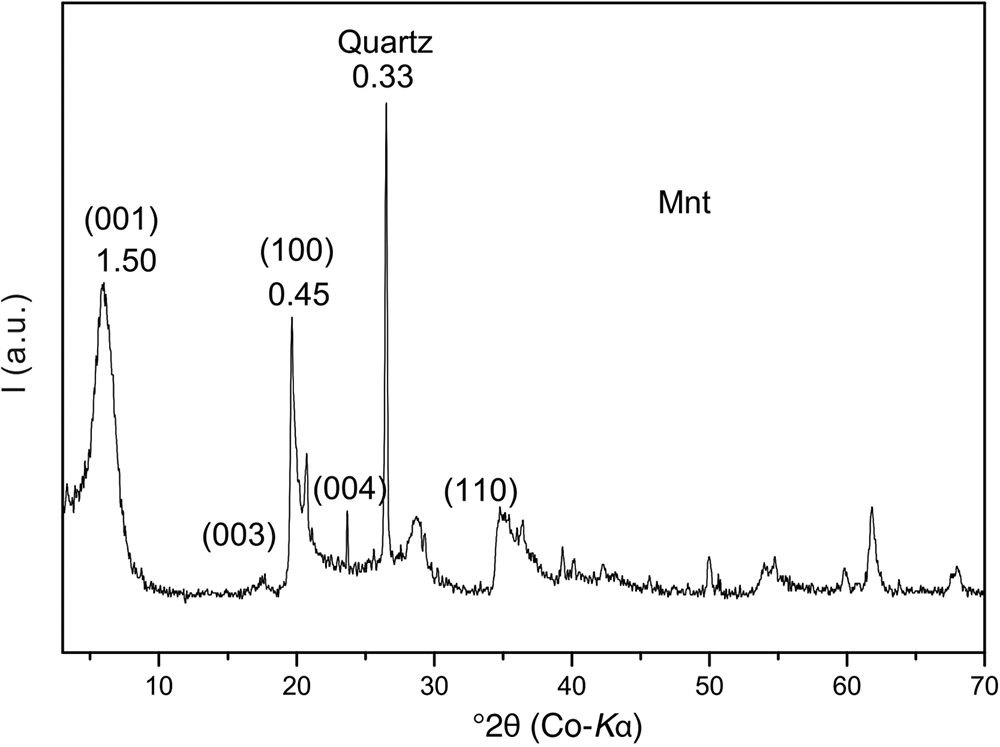
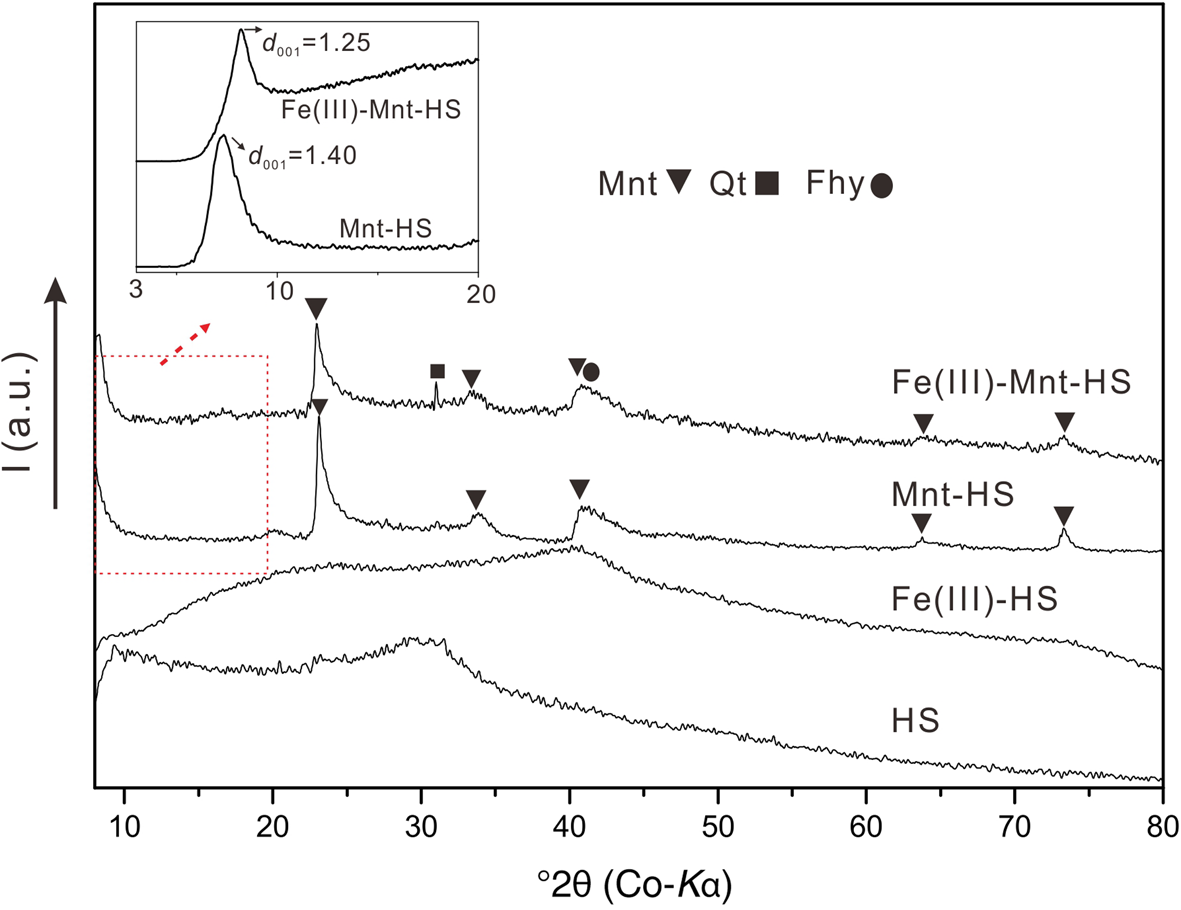
The XRD trace of Mnt is illustrated in Fig. 1. The basal spacing of Mnt was 1.50 nm. The XRD traces of the MOAs show a 2.58 Å ferrihydrite (Fhy) peak (Fig. 2), suggesting that amorphous two-line Fhy is the main Fe phase. Other broad peaks in the XRD trace of Fe(III)–HS were also identified, corresponding to the OM or other inorganic minerals from the co-precipitated HSs. For Mnt–HS, a d 001 spacing of 1.40 nm was observed, which indicates intercalation of organic molecules in the interlayer space of Mnt. This observation is consistent with the previous finding that some humic acid molecules can be partially incorporated into the interlayer space of Mnt (Ye et al., Reference Ye, Deng, Zhou, Gao and Yan2022). However, for Fe(III)–Mnt–HS, the introduction of Fe shifted the (001) peak to a lower d-spacing (1.25 nm for Fe(III)–Mnt–HS and 1.50 nm for Mnt), suggesting that some Fe ions or some organic molecules entered the interlayer via exchange with Ca2+ (Fig. 1 & inset of Fig. 2).
XRD trace of Mnt. Labels represent d-spacing values in nanometres.

XRD traces of HS and the synthesized Fe(III)–HS, Mnt–HS and Fe(III)–Mnt–HS systems. Labels represent d-spacing values in nanometres. Qt = quartz.

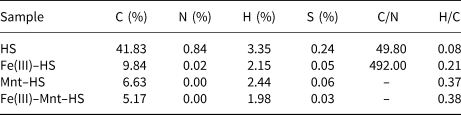
The elemental compositions of the HSs and MOAs are shown in Table 1. The C content ranges from 5.17% to 41.83%, while the N and H contents vary from 0% to 0.84% and from 1.98% to 3.35%, respectively. The high C/N ratio and low H/C ratio for the HSs indicated high stability and condensation degree as well as an extended degree of humification (Rosell et al., Reference Rosell, Andriulo, Schnitzer, Crespo and Miglierina1989). Hence, the HSs seem to be affected by the co-precipitation process, which influences their stability and degree of condensation. The low N content of the MOAs indicates that Fhy formed during co-precipitation and Mnt had separated some nitrogen-containing functional groups, whereas the high H/C ratio could be due to the addition of these minerals.
Elemental compositions of HSs and MOAs.

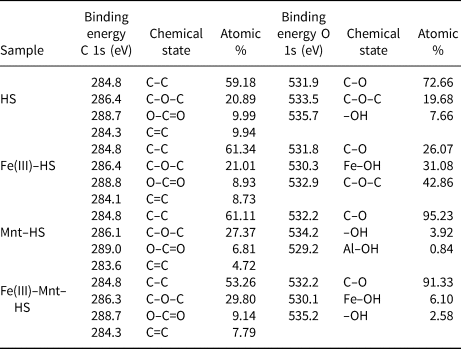
The surface elemental components were determined using XPS analysis (Figs 3 & 4 & Tables 2 & S1). Figures 3 & 4 show the high-resolution XPS spectra of C 1s and O 1s, respectively. The three main peaks at ~284.8, ~286.4 and ~288.7 eV were assigned to C–C, C–O–C and O–C=O, respectively (Zeng et al., Reference Zeng, Huang, Ma, Zhu, He and Shi2020). The presence of C highlights the adsorption of certain organic compounds by the samples during the co-precipitation process. Compared with the HSs alone, the proportion of C–C groups in Fe(III)–HS and Mnt–HS increased, whereas the proportion of O–C=O groups decreased. In the case of Fe(III)–Mnt–HS, the proportion of C–C groups decreased, whereas the proportion of C–O–C groups increased. The surface C changes observed after the involvement of Fhy demonstrated that these might occur either if the OM combined with Fe included the inclusion, occlusion and entrance of Fe (hydr)oxide crystals (Kleber et al., Reference Kleber, Eusterhues, Keiluweit, Mikutta, Mikutta and Nico2015; Sodano et al., Reference Sodano, Lerda, Nisticò, Martin, Magnacca, Celi and Said-Pullicino2017; Bao et al., Reference Bao, Bolan, Lai, Wang, Jin and Kirkham2022) or if some small, fractionated OM molecules entered the interlayer space of Mnt during the co-precipitation process (Bu et al., Reference Bu, Yuan, Liu, Liu, Liu and He2017).
The C 1s XPS spectra of (a) HS, (b) Fe(III)–HS, (c) Mnt–HS and (d) Fe(III)–Mnt–HS. The grey dotted lines denote the measured XPS spectra. The black lines denote the smoothed XPS spectra.

The O 1s XPS spectra of (a) HS, (b) Fe(III)–HS, (c) Mnt–HS and (d) Fe(III)–Mnt–HS. The grey dotted lines denote the measured XPS spectra. The black lines denote the smoothed XPS spectra.

Analysis of C 1s and O 1s XPS spectra.

Regarding the O 1s spectrum (Fig. 4), the fitted XPS spectrum of the HSs featured three distinct peaks at ~531.9, ~533.5 and 535.7 eV, corresponding to organic C–O, C–O–C and O–H groups, respectively. The new peak at ~530 eV for Fe(III)–HS, Mnt–HS and Fe(III)–Mnt–HS suggests the presence of metal–oxygen bonds, which is in agreement with the presence of minerals such as Fhy (Ye et al., Reference Ye, Padilla, Xuriguera, Brillas and Sirés2020). The content of C–O groups decreased significantly for the Fe(III)–HS system (the atomic contents decreased significantly from 72.66% to ~26.07%) and increased for the Mnt–HS and Fe(III)–Mnt–HS systems (Table 2). Due to the Fhy and Mnt involved, the content of hydroxyl groups was significantly reduced for all the samples. The absence of C–O–C groups in the Mnt–HS and Fe(III)–Mnt–HS systems implies that the ether functional groups were diminished. This suggests that the reaction was mediated by hydroxyl-containing functional groups and/or ether linkages during the co-precipitation process. In addition, strong Fe signals were detected in both the Fe(III)–HS and Fe(III)–Mnt–HS systems. In Fe(III)–HS, total P and Fe were enriched, whereas total O, Si and Al were enriched in the Fe(III)–Mnt–HS system. In the case of Mnt–HS, the total C and N contents were lower than those of Fe(III)–HS and Fe(III)–Mnt–HS (Table S1). Accordingly, the surface fixation ability of Mnt to OC seems weaker than that of Fe(III) during the co-precipitation process. This suggests that the Fhy and Mnt act as a chromatographic system during the co-precipitation of Fe(III), and the co-precipitation of OM results in the fractionation of the compounds according to their sorption selectivity.
TGA and DSC analysis of the MOAs
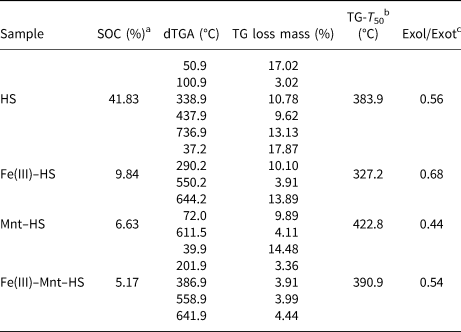
The TGA data showed that the breakdown of HSs begins at >200°C (Fig. 5a). The major thermal event of pure HSs occurred between 200°C and 550°C, resulting in a sharp deriative TGA (dTGA) peak at 339°C (Fig. 5b & Table 3). The decomposition of OM with a low degree of humification was responsible for this decarboxylation. Higher temperatures of >400°C induced structural changes in HS macromolecules, mainly dearomatization of the ring (Barros et al., Reference Barros, Cole, Tranvik, Prairie, Bastviken and Huszar2011). The two contrasting peaks reflected by the dTGA curves were examined to divide the thermal oxidation/combustion resistance levels into two distinct categories (Demyan et al., Reference Demyan, Rasche, Schütt, Smirnova, Schulz and Cadisch2013; Merino & Nevado, Reference Merino and Nevado2014; Kurganova et al., Reference Kurganova, Merino, de Gerenyu, Barros, Kalinina, Giani and Kuzyakov2019; Barreto et al., Reference Barreto, Elzinga, Ramlogan, Rouff and Alleoni2021): (1) 200–400°C (labile OM) and (2) 400–550°C (recalcitrant OM). The labile OM might represent carbohydrates (e.g. sugars) and lipids with a low humification degree, whereas the recalcitrant OM might represent aromatic compounds with a high humification degree (Barros et al., Reference Barros, Cole, Tranvik, Prairie, Bastviken and Huszar2011). The Fe(III)–HS system exhibited a first thermal event at temperatures >200°C, with a sharp dTGA peak at ~290°C (Table 3). The mass loss (~10.10%) was related to the decomposition of labile OM because previous studies indicated the difficulty of Fhy undergoing structural changes in this temperature range (Eggleton & Fitzpatrick, Reference Eggleton and Fitzpatrick1988). The temperature of the event at 550°C is compatible with the decomposition of recalcitrant OM. However, for Mnt–HS, there was virtually no mass loss in the temperature range of ~200–400°C, and the greatest mass loss mainly occurred at <200°C (Fig. 5b & Table 3). The thermal event at 612°C corresponds to the release of structural water (He et al., Reference He, Ding, Zhu, Yuan, Xi, Yang and Frost2005). Similarly, a peak at 387°C (i.e. <400°C) was recorded in the Fe(III)–Mnt–HS sample (Fig. 5b). This sample displayed a second step at 559°C. Compared to the HSs, the proportion of labile OM in the MOAs decreased by 6.3% for Fe(III)–HS and by 63.7% for Fe(III)–Mnt–HS (Table 3). The proportion of recalcitrant OM in the MOAs decreased by 59.4% for Fe(III)–HS and by 58.0% for Fe(III)–Mnt–HS. These results indicate that Fhy exhibited a tendency to combine with liable OM more frequently in the HS solutions. The hydroxyl (–OH) groups on mineral surfaces alongside the carboxyl and phenolic OH groups of the OM are critical for this combination reaction. Interestingly, the thermal analysis showed a peak at ~202°C with a mass loss of 3.36%. This mass loss may be due to the decomposition of some OM, which was catalysed by clay minerals (Bu et al., Reference Bu, Yuan, Liu, Liu, Liu and He2017; Liu et al., Reference Liu, Yuan, Liu, Bu, Song, Qin and He2018).
(a) TGA data of mass loss of HS and MOAs. (b) Derivative ‘mass loss’ of HS and MOAs. (c) DSC of HS and MOAs.

HS and thermal MOA attributes as functions of the clay.

a Total soil organic matter (SOC) is measured by C element analysis after acidification with hydrochloric acid.
b The temperature at which OM is half-decomposed.
c The proportion of thermally decomposed labile OM in the total OM.
Dehydroxylation is an endothermic process that is highlighted by negative peaks in the DSC data (Fig. 5c) at the same temperatures (i.e. ~280°C and ~480°C) with substantial mass loss. For the three samples (HS, Fe(III)–HS and Fe(III)–Mnt–HS), the endothermic peak temperatures were 347.9°C, 234.2°C and 384.9°C, respectively, and the energies were 2.36, 1.03 and 2.88 mW mg–1, respectively. Accordingly, the temperature and energy required for the heat absorption decreased upon Fe(III) addition. However, the addition of Fe(III) and Mnt at same time resulted in increasing the temperature and energy required for heat absorption.
OM thermal stability assessment
The thermal indices of OM stability were calculated based on the following data: (1) the temperature at which half of OM is decomposed (TG-T 50; Peltre et al., Reference Peltre, Fernández, Craine and Plante2013) and (2) the proportion of thermally decomposed labile OM in the total OM (Exol/Exot). A lower TG-T 50 temperature promotes easier oxidation degradation for these organic compounds (Fernández et al., Reference Fernández, Cabaneiro and Carballas1997; Plante et al., Reference Plante, Pernes and Chenu2005; Rovira et al., Reference Rovira, Kurz-Besson, Coûteaux and Vallejo2008). The HS, Fe(III)–Mnt–HS and Mnt–HS samples showed higher index TG-T 50 values (384°C, 391°C and 423°C, respectively), whereas Fe(III)–HS showed a lower TG-T 50 value (327.2°C; Table 3). The Exol/Exot ratios in the HS, Fe(III)–Mnt–HS, Mnt–HS and Fe(III)–HS samples were 0.56, 0.68, 0.44 and 0.54, respectively (Table 3). A higher Exol/Exot ratio was correlated with reduced OM stability. It is worth noting that Fhy can negatively influence the stability of HSs, whereas Mnt can improve the stability of HSs. Compared with Fe(III)–Mnt–HS, the degradation efficiencies of HSs alone and Fe(III)–HS were greater. Previous studies have shown that the oxidation-resistant fraction of mineral-associated OC was positively correlated with the Fe content and slightly negatively correlated with the clay content (Kirsten et al., Reference Kirsten, Mikutta, Vogel, Thompson, Mueller and Kimaro2021).
Discussion
According to the findings in this study, the stability of the SOM is related to the interaction of Fe minerals and clay minerals. The fraction of C bonded with Mnt was effectively preserved, but the OM bonded with Fhy decomposed rapidly. This might be attributed to the differences in the soil mineral properties during SOM development. First, we considered the selectivity of minerals in SOM. The precipitation of HSs during Fhy co-precipitation in the MOAs induced the fractionation of organic compounds. The labile OM was preferentially adsorbed on the surface of Fhy. Parts of OM on the mineral surfaces may have initiated the catalytic process at lower temperatures, thus reducing the amount of energy required for OM breakdown and combustion. Similar phenomena have been observed in real soil systems worldwide (Faure et al., Reference Faure, Jeanneau and Lannuzel2006). Previous research on the pyrolysis behaviour of beech leaf litter in the presence of various soil minerals (i.e. Mnt and Fhy) showed that Fhy could promote the degradation of SOM (Miltner & Zech, Reference Miltner and Zech1997). CO2 was released during the thermal decomposition of SOM in the presence of soil minerals under an N2 atmosphere, and Fhy produced more CO2 than Mnt (Miltner & Zech, Reference Miltner and Zech1997).
Second, the attachment of OM on mineral surfaces is typically dynamic and dependent on several factors, such as surface charge, surface topography and crystal structures (Kirsten et al., Reference Kirsten, Mikutta, Vogel, Thompson, Mueller and Kimaro2021). In this work, temperature-dependent alteration in the Fe mineral phase was observed. During the pyrolysis of the MOAs under anaerobic conditions, the original amorphous Fhy was transformed into crystalline magnetite (Mgt; Fig. 6a). Mgt was generated at 300°C in the Fe(III)–Mnt–HS system, whereas in the Fe(III)–HS system it was produced at 200°C (Fig. 6c). The newly formed Fe mineral may lead to the creation of pores or defects, which might trigger the decomposition of OM. The Fe mineral phase changed, as was indicated by the FTIR spectrum of Fe(III)–HS, which showed the disappearance of the OH stretching vibration (~3352 cm–1) for the heated samples (Fig. 6d & Table S2). The interlayer structure of Mnt had a considerable impact on the stability of Fe–OM complexes, as was evidenced by the higher d 001 values of Fe(III)–Mnt–HS and the lower d 001 values of Mnt–HS (Fig. 6b,c). These findings suggest that the interlayer OM is resistant to degradation at high temperatures because of Fe speciation.
XRD traces of (a) Fe(III)–HS, (b) Mnt–HS and (c) Fe(III)–Mnt–HS before and after ageing. FTIR spectra of (d) Fe(III)–HS, (e) Mnt–HS and (f) Fe(III)–Mnt–HS before and after ageing. Mgt = magnetite; Qt = quartz.

In addition, new organic functional groups such as the amide II band (1554 cm–1), symmetric of R–COO– stretching (1381 cm–1) and the amide III band (1267 cm–1) emerged after a high-temperature anaerobic process was conducted (Fig. 6f & Table S2; Calderón et al., Reference Calderón, Haddix, Conant, Magrini-Bair and Paul2013; Bu et al., Reference Bu, Yuan, Liu, Liu, Qin and Zhong2019; Meng et al., Reference Meng, Bu, Fei, Chen, Lei and Liu2022). At 200°C, 300°C and 400°C, these surface functional groups were almost invariant with ageing duration. Figure 6d shows a broad band at 3382 cm–1 that was attributed to the N–H stretching vibration and may indicate the presence of an amide A band (Ji et al., Reference Ji, Yang, Ji, Zhu, Ma and Chen2020). For the Fe(III)–Mnt–HS system, the amide II band at 1547 cm–1 appeared at 200°C and 300°C and disappeared at 400°C (Fig. 6d). The amide II band most probably resulted from a C chain bond stretching vibration associated with the carbonyl group (C=O). The main source of the amide III band was methyl-related C–H or C–C stretching vibrations. The main source of the amide A band was the H–N stretching/bending vibration or the hydroxyl H–O stretching/bending vibration (Ji et al., Reference Ji, Yang, Ji, Zhu, Ma and Chen2020).
Our data support the notion that soil mineralogical properties play a key role in determining the OC content of the soil. Particularly in systems where Fe(III) is present, the clay minerals contribute to the thermal stability of the SOM. This finding suggests that the soils comprising Fe(III)–aluminous clays exhibit greater OM persistency and are thus more resistant to disruptions induced by a high-temperature anaerobic process. The potential mechanism that could account for our experimental findings is as follows:
(1) In solution, co-precipitation of Mnt inhibited the formation of Fhy (the Fe fraction is reduced) and reduced the adsorption of labile OM. The interfacial reaction between Fe species and OM could have been altered by the presence of Mnt, which accounts for these observations. The co-precipitated HS might form a complex with Fe(III) mainly via carboxyl groups. Although Mnt would positively influence some OM adsorption and fractionation, it might also cause some OM to intercalate into the interlayer space of Mnt. In kaolinite–Fe(III)–malic acid systems, previous research proposed that Fe species might contribute to the complexation with OM via tetrahedral Fe bridges at smaller Fe/OM molar ratios, whereas the produced Fhy might induce adsorption and/or co-precipitation of OM molecules at greater Fe/OM molar ratios (Yang et al., Reference Yang, Liu, Hu, Rumpel, Bolan and Sparks2017). This suggests that Mnt will selectively preserve OM in the soil solution in Fe(III)–Mnt–OM systems and emphasizes the role of Mnt in the Fhy-induced adsorption/co-precipitation of OM.
(2) Labile OM on Fhy decomposes when the soil undergoes a high-temperature anaerobic heating process in a dry state. The transformation of Fhy occurs gradually. The dehydration, dehydroxylation and recrystallization of Fe (hydr)oxides could affect their surface physical chemical properties, which may cause some OM combined with Fe(III) to become unprotected and lead to inclusion, occlusion and entrance into the Fe (hydr)oxide crystal. Recalcitrant OM is a dominant component of Fe(III)–Mnt–HS. The Mnt disperses the Fhy particles and combines with some of them, thereby preventing a phase transition, further inhibiting the OM occlusion in Fhy. Previous studies demonstrated that Mnt influenced the mobility and fate of associated OM (Zhao et al., Reference Zhao, Moore, Xiao, Curti, Fariña, Banwart and Peacock2022) and inhibited the transformation of Fhy (Zhang et al., Reference Zhang, Tang and Fu2023). In addition, OM influenced the physiochemical properties of Fe oxide minerals, leading to more defects and porosity than in those formed from pure Fhy (Lu et al., Reference Lu, Hu, Wang, Ding, Lu and Lin2019), which may create a greater area for the sequestration of OM. Accordingly, the clay minerals control the thermal behaviour of SOM via Fe (oxyhydr)oxides in terms of the aluminosilicate-induced reactions and their associations with Fe (oxyhydr)oxides in the soil.
The function of clay minerals in the actual soil system goes beyond this description. The interlayer space of expandable clay minerals might accommodate positively charged organics via cation exchange (Yuan et al., Reference Yuan, Lin, Zheng, He and Huang2013), which could affect the accommodation performance of these minerals for OM (Liu et al., Reference Liu, Yuan, Liu, Bu, Song, Qin and He2018). This finding is consistent with the widely acknowledged phenomenon that the amount of available inorganic surface area determines how long OM is preserved (Kögel-Knabner et al., Reference Kögel-Knabner, Guggenberger, Kleber, Kandeler, Kalbitz and Scheu2008; Kleber et al., Reference Kleber, Eusterhues, Keiluweit, Mikutta, Mikutta and Nico2015). Numerous studies have indicated that the interlayer space of clay minerals hosts OM in soil and sediment samples (Schulten et al., Reference Schulten, Leinweber and Theng1996; Lagaly et al., Reference Lagaly, Ogawa and Dékány2006). The interlayer can stabilize OM against biological attacks as well as decomposition and mineralization processes. The results of this study indicate that expandable clay minerals in the soil should be studied further and could contribute more than other minerals to the stability of C in temperate-zone soils.
Conclusions
In this study, we used thermal analysis techniques to demonstrate the major impacts of Fe speciation on the stability of HSs in a ternary Fe(III)–Mnt–HS system. Given that Mnt particles were negatively charged and frequently combined with Fe (hydr)oxides in soils (Regelink et al., Reference Regelink, Voegelin, Weng, Koopmans and Comans2014), ternary complexes of Fe between HSs, clays and Fhy should exist, which probably contributes to HS stability through Fhy-induced adsorption, co-precipitation or ternary complexation of HSs via Fe bridges on Mnt. During the co-precipitation of HSs, Mnt impacts the fractionation of HSs. Labile OM prefers to combine with Fe species. As Fhy cannot convert (i.e. it is suppressed) in the presence of Mnt, some labile OM has been retained and stabilized by the Fe species. Therefore, it is concluded that the speciation of Fe in the Fe(III)–clay–HS system controls the amount of C connected to minerals, particularly in the dry state. To fully understand how clay–OM interactions affect OM stability and C sequestration, further experiments involving a wider variety of relevant SOM, clay mineral species and environmental factors are required.
Acknowledgements
The authors thank LetPub (www.letpub.com) for linguistic assistance during the preparation of this manuscript.
Financial support
This work was financially supported by the Guangdong Academy of Sciences's Project of Science and Technology Development (no. 2020|GDASYL-20200102019, 2019GDASYL-0102002-5), Guangdong Basic and Applied Basic Research Foundation (2021A1515011540) and the National Natural Science Foundation of China (42107046).
Supplementary material
To view supplementary material for this article, please visit https://doi.org/10.1180/clm.2023.30.