Implications
The study aimed to test effects of: (1) dark brooders (secluded warm, dark areas in the home pen) early in broilers’ life on fearfulness and free-range use later in life, and (2) overhangs outside the pop holes on free-range use. Neither treatment resulted in marked effects on fearfulness and/or free-range use. One possible explanation is inadequate brooder or overhang designs. Alternatively, because free-range use was already high in all treatment groups, it may have been difficult to effect further improvements. High free-range use could be attributed to access to suitable shelter and use of small mobile houses facilitating outdoor access.
Introduction
Limited use of the free-range area is common in broiler chickens with outdoor access; on average only a small part of the flock is found outside at any given moment, and the majority of the birds remain close to the chicken house (Dawkins et al., Reference Dawkins, Cook, Whittingham, Mansell and Harper2003; Jones et al., Reference Jones, Feber, Hemery, Cook, James, Lamberth and Dawkins2007). Improved use of the range could benefit broiler welfare as a result of factors including increased space per animal, better air quality outside compared with inside, and access to more substrates for natural behaviours such as sand for dust bathing and natural vegetation for foraging. A better distribution of the flock over the range would also benefit the environment; a lower bird density close to the chicken house would lead to a reduction in point pollution of nitrogen and phosphorus (Dekker et al., Reference Dekker, Aarnink, De Boer and Koerkamp2012).
Limited use of the free range has multifactorial causes. A prior study has shown that shelter plays an important role: if birds had access to both short rotation coppice (SRC) with willow and grassland with artificial shelter (AS; wooden A-frames), they showed a clear preference for SRC (Stadig et al., Reference Stadig, Rodenburg, Ampe, Reubens and Tuyttens2017b). Another factor that may increase free-range use is a more gradual transition from inside the house to the range, for example by providing some kind of shelter just outside the house. A study with 33 flocks of laying hens showed that a higher light intensity in the house was associated with a higher percentage of hens using the range (Gilani et al., Reference Gilani, Knowles and Nicol2014). Dekker et al. (Reference Dekker, Aarnink, De Boer and Koerkamp2012) suggested that the higher free-range use in laying hens with transparent curtains between the house, winter garden and outdoor run was due to the smaller differences in light intensity between these areas in comparison to farms with opaque curtains. An alternative for these transparent curtains may be overhangs in front of the pop holes. These give the birds the opportunity to go outside without immediately being exposed to factors such as bright light, precipitation and aerial predators. After this transition they may feel more confident to proceed into the range.
Free-range use may be influenced by fearfulness. In laying hens, there are indications that increased fearfulness is related to lower free-range use (Grigor et al., Reference Grigor, Hughes and Appleby1995; Hartcher et al., Reference Hartcher, Hickey, Hemsworth, Cronin, Wilkinson and Singh2015; Campbell et al., Reference Campbell, Hinch, Downing and Lee2016). Stadig et al. (Reference Stadig, Rodenburg, Ampe, Reubens and Tuyttens2017a) found some relationships between fearfulness and free-range use in broiler chickens, although these were tested on group level and not on individual level. If a relation between fearfulness and free-range use in broiler chickens does exist, decreasing fearfulness could lead to increased free-range use.
Use of dark brooders during the rearing phase (before free-range access is provided) may reduce fearfulness. Dark brooders in this study were elevated, heated wooden panels curtained off by black rubber curtains with fringed bottoms. Dark brooders give chicks access to a warm, secluded, dark area and give chicks the choice between being in an active or inactive group (Jensen et al., Reference Jensen, Palme and Forkman2006). In laying hens, provision of dark brooders is related to a reduction in feather pecking and cannibalism (Jensen et al., Reference Jensen, Palme and Forkman2006; Gilani et al., Reference Gilani, Knowles and Nicol2012), which are known to be associated with fearfulness (Jones et al., Reference Jones, Blokhuis and Beuving1995; Keeling and Jensen, Reference Keeling and Jensen1995; Bolhuis et al., Reference Bolhuis, Ellen, Van Reenen, De Groot, Ten Napel, Koopmanschap, De Vries Reilingh, Uitdehaag, Kemp and Rodenburg2009; Rodenburg et al., Reference Rodenburg, Van Krimpen, De Jong, De Haas, Kops, Riedstra, Nordquist, Wagenaar, Bestman and Nicol2013). Indications for reduced fearfulness in laying hens with access to dark brooders have been found by Gilani et al. (Reference Gilani, Knowles and Nicol2012) and Riber and Guzman (Reference Riber and Guzman2016). One study showed that dark-brooded laying hen pullets engaged less often in locomotion and fleeing and foraged more than control hens at day 42 (Riber and Guzman, Reference Riber and Guzman2016). Laying hen pullets reared with either a mother hen or a dark brooder showed longer bouts of activity at young age, whereas the total time budget did not differ between brooded and non-brooded chicks (Wauters et al., Reference Wauters, Perré, Bizeray, Leterrier and Richard-Yris2002; Riber et al., Reference Riber, Nielsen, Ritz and Forkman2007). Dark brooders could partially mimic a broody hen, providing a safe place from where the chicks can explore their surroundings (Nicol, Reference Nicol2015). Maternal care by a foster mother was shown to reduce fearfulness in an open field test in layer chicks (Rodenburg et al., Reference Rodenburg, Uitdehaag, Ellen and Komen2009).
A mother hen provides more than a warm, dark place to rest; she also guides the chicks’ feeding behaviour, among others (Nicol, Reference Nicol2015). However, fearful mother hens may also cause their chicks to be more fearful (Houdelier et al., Reference Houdelier, Lumineau, Bertin, Guibert, De Margerie, Augery and Richard-Yris2011). Dark brooders may therefore be a good substitute, and are more feasible under commercial circumstances. The studies in laying hens show dark brooders can have a long-lasting effect on chickens’ feather pecking behaviour, possibly because they are applied in early life, when the brain is still developing and the chick is still maturing (Nicol, Reference Nicol2015), conditions under which stimulation may have a long-lasting impact. Until now studies regarding the effect of dark brooders have only been performed with laying hens, and have not included persistence of the differences after the period with access to the brooders.
Dark brooders may have other effects on chicks’ development and free-range use. For example, chicks with brooders become habituated to going from a dark to a light environment, which may mimic the transition between the house and the range later in life. They also have more freedom to choose between different environments, perhaps leading to more controllability. This is beneficial for their welfare because it reduces stress levels (Wiepkema and Koolhaas, Reference Wiepkema and Koolhaas1993). In addition, they may learn that exploration is rewarding, because it allows them to discover the dark brooders for resting, and areas outside the dark brooders for activities such as feeding, drinking, foraging and interacting with conspecifics. These factors, together with reduced fearfulness, may all contribute to increased free-range use later in life.
The aims of this study were: (1) to test how access to dark brooders early in life affected fearfulness, free-range use and behaviour later in life, (2) to test how overhangs adjacent to the pop holes affected free-range use and behaviour and (3) to test whether presence of dark brooders and overhangs interacted with chickens’ preference for shelter type (SRC or AS). We hypothesised that dark brooders and overhangs would increase free-range use, that dark brooders would increase the number of birds outside and far from the house as a result of reduced fearfulness, and that the effects of brooders and overhangs would be largest in AS because fearfulness would play a bigger role in a less sheltered environment.
Material and methods
Animals and housing
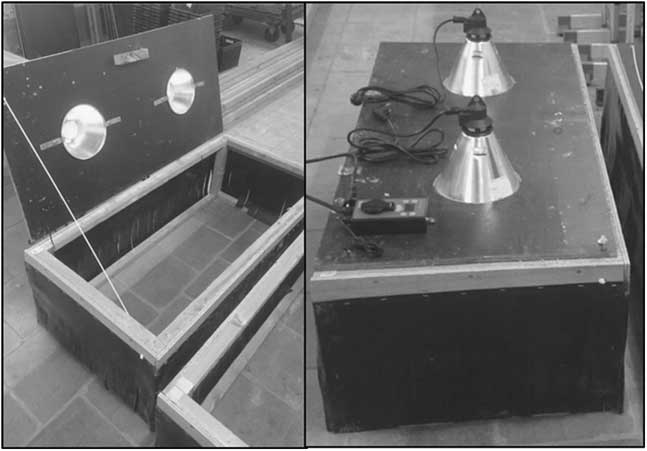
All animal procedures were approved by the Ethics Committee of Flanders Research Institute for Agriculture, Fisheries and Food (ILVO, Merelbeke, Belgium). In order to have replications of the treatments over time, three production rounds with 440 birds (Sasso, Sabres, France) XL451 the most common breed in organic broiler production in Belgium) per round were completed. Round 1 lasted from 7 March until 16 May, round 2 from 23 May until 1 August, and round 3 from 8 August until 17 October 2016. No experiments were done in the winter because the mobile houses could not be heated, which could impair chicken welfare and cause problems with the water supply. During days 0 to 25 chicks were housed indoors in four pens of 3×4.4 m (110 birds/pen). The male:female ratio was 50:50 in each group. Each pen contained one bell drinker (circumference 100 cm) and one feeder (circumference 130 cm). Two of the pens contained three 150 W IR lamps; the other two were fitted with a dark brooder. The dark brooder was a wooden frame (l ×w×h: 120×60×40 cm) with rubber fringes on the sides, and a wooden panel equipped with two 150 W ceramic heat panels (that only produced heat, no light) on top (Figure 1). Temperature inside the brooder was regulated by a thermostat (Thermo 2; Bio Green, Bischoffen-Oberweidbach, Germany) and was reduced gradually over time, from 29.2±5.2°C in week 1 to 25.8±4.1°C in week 4 under the brooders, and from 27.6±2.6°C in week 1 to 23.8±3.3°C in week 4 in the rest of the pen. The room temperature was controlled manually.
Dark brooder (l×w×h: 120×60×40 cm; left: opened, right: closed) with two ceramic heat lamps (150 W each) in the wooden panel on top, and rubber fringes around the sides to create a dark, secluded area.

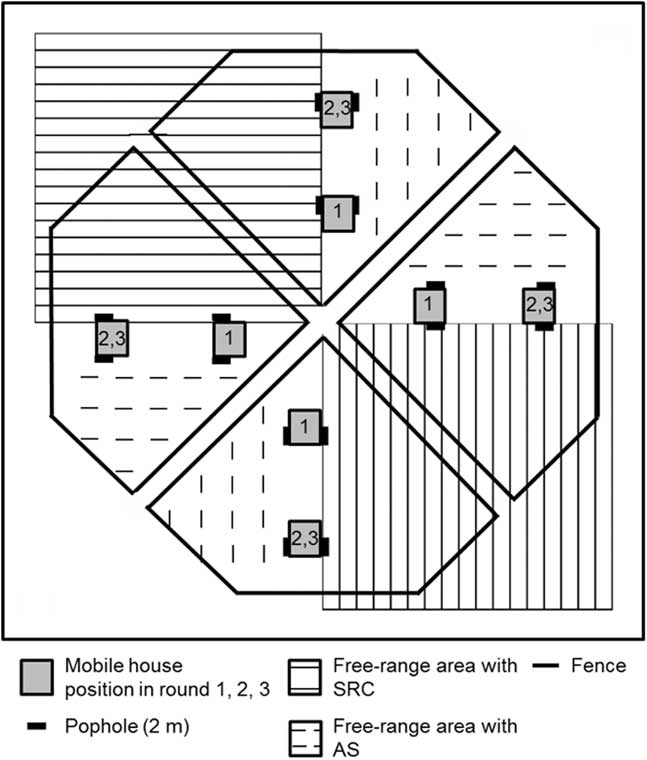
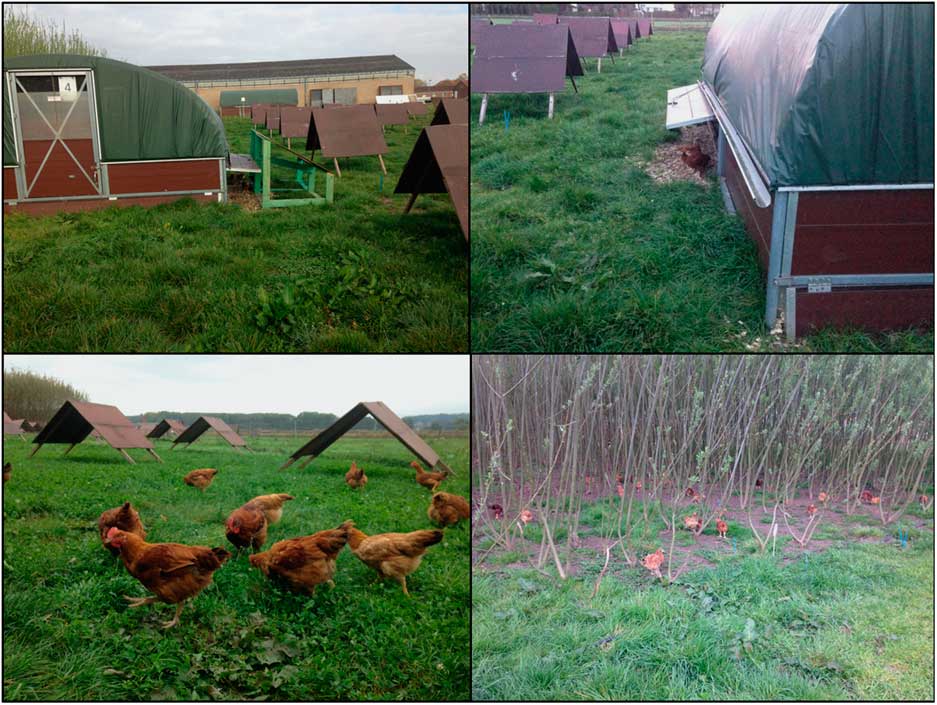
On day 25, the birds were moved in the same groups to four mobile houses on a 100×100 m field (Figure 2). To move them, the birds were caught manually and placed in transport crates (25 to 30 birds/crate), after which they were transported by tractor over a distance of 400 m, and released into the mobile houses. Outdoor access was provided from day 28 onwards. Pop holes were opened at 0800 h and closed around sunset (between 1844 and 2200 h depending on the season). All groups had access to both grassland with AS and SRC (Figure 2). Short rotation coppice was planted in double rows at high density; distance between two double rows was 1.5 m, distance between two single rows within a double row was 0.75 m, and distance between trees within a single row was 0.6 m. Average height of the SRC in the year of the experiment was 5.8 m. The distance between the houses and the SRC or AS was 1 to 2 m. Houses were 4.1×4.25 m, contained two bell drinkers and two feeders each (both will a circumference of 110 cm), with solid floors covered with wood shavings (Plospan, Waardenburg, Nederland). Two of the four houses had overhangs; these were wooden constructions (l×w×h: 100×100×50 to 100 cm; Figure 3). Two overhangs were placed per house, in front of the pop hole on either side of the house. The overhangs were switched between houses every week to increase the statistical power of the experiment: house I (dark-brooded birds) and house II (non-brooded birds) had overhangs in weeks 6, 8 and 10; house III (dark-brooded birds) and house IV (non-brooded birds) in weeks 5, 7 and 9. This switch was always done on Friday evening, so that the birds could acclimatise to the new situation before observations of free-range use started on the following Monday.
Schematic top view of the experimental field (outer edges 100×100 m) with four mobile stables, short rotation coppice (SRC) and grassland with artificial shelter (AS).

(colour online) Upper left and right: mobile house with open pop hole, with and without adjacent overhangs. Lower left: grassland with artificial shelters. Lower right: short rotation coppice.

Behavioural tests
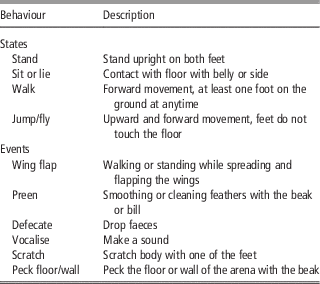
On day 18, 100 birds (25/group) per round were given a neck tag with a unique number. The number of birds was chosen based on the number of birds that could be tested in this time frame. On days 22 and 23, these birds were subjected to an open field test. Before the test a small group of birds (10 to 15) were fenced off from the rest of the group, to facilitate catching of the birds in a calm manner. The birds were caught individually and transported by hand to the novel arena, which was just outside their home pen, in the same room. After catching five birds from the fenced-off group, the rest of the birds were released and a new group was placed in the fenced-off area. During the open field test the bird was placed in a novel arena (1.5×1.5 m) for 5 min. Their behaviour was video recorded and scored in Observer XT (Noldus, Wageningen, the Netherlands) using the ethogram in Table 1, from which ‘latency to first movement’ (walking or jumping), ‘latency to vocalise’, and ‘number of transitions between behaviours’ were derived as extra variables. Using Ethovision (Noldus, Wageningen, the Netherlands) the open field arena was virtually divided into 16 squares measuring 37.5 by 37.5 cm, and the following variables were analysed: total distance moved, latency to move from the initial square to another square, percentage of time spent in squares alongside the edge and in the centre of the arena, and number of transitions between squares.
Ethogram of behaviours scored during the open field test (performed on days 22 or 23, n=100 chicks/round, 50/dark brooder treatment group)

States were expressed in duration (s), events in counts (number of times they occurred).
On day 23 (birds that had been subjected to an open field test on day 22) and 24 (birds that had been subjected to an open field test on day 23) the same 100 chickens used in the open field test were subjected to a tonic immobility (TI) test. The same manner of catching as for the open field test was used, and the TI cradle was just outside the birds’ home pen. The birds were placed on their back in a U-shaped cradle, were fixated for 15 s and then released (Jones, Reference Jones1986). The number of inductions needed to successfully induce TI (bird remained on its back for at least 10 s) was recorded, with a maximum of three, and the TI duration was recorded (time to righting of the bird), with a maximum of 300 s.
Free-range use
Free-range use visual observations were performed every week day by an observer standing ~10 m from the house after an acclimation period of 2 min. The number of birds outside was counted using scan sampling around 0900, 1300 and 1700 h (exact time depended on the group of the bird, as the order in which the groups were observed was rotated), and for each bird observed outside the area, it was noted which area it was in (AS or SRC), the distance from the house (0 to 2, 2 to 5 m or >5 m), and its behaviour was noted using scan sampling (Altmann, Reference Altmann1974). Observations were always conducted starting with the birds closest to the house in one of the shelter types, alternating between starting in AS or SRC. Behaviours that were scored were walking, running, sitting or lying, standing, foraging, preening, dust bathing and aggressive behaviour. The same descriptions for the behaviours were used as during the open field test (Table 1). In addition, foraging was defined as scratching the ground with feet, pecking in the soil, or eating plant material. Dust bathing was defined as a bird sitting or lying down while fluffing dust through the plumage, accompanied by wing-shaking, head rubbing, bill-raking and scratching with one leg (Van Liere, Reference Van Liere1991). Aggression was defined as a negative interaction with other birds, which included aggressive pecks, leaps, chases, stand-offs, threats and fights (Estevez et al., Reference Estevez, Newberry and Keeling2002).
Data analysis
Statistical analyses were performed in SAS 9.4 (SAS Institute, Cary, NC, USA). Data are presented as least squares means ± 95% confidence intervals unless stated otherwise. Continuous variables were considered sufficiently normally distributed based on the graphical evaluation (histogram and Q-Q plot) of the residuals. Statistical significance was evaluated at P<0.05, whereas P<0.1 was considered a tendency. Factors with P-values >0.1 were removed from the final models (one at the time, starting with the factor with the highest P value), except for ‘dark brooders’ and ‘overhangs’ and factors that were part of significant interactions. In case of post hoc pairwise comparisons, the Tukey–Kramer adjustment for multiple comparisons was used at a total significance level of 0.05. The results of the analyses are displayed with their corresponding F values and degrees of freedom (numerator and denominator).
Data from the behavioural tests were analysed using generalised linear mixed models with dark brooder (yes/no) as fixed effect and production round and pen within production round as random effects. In the open field test, scratching and wing flapping never occurred, and were therefore not included in the statistical analyses. In order to obtain normally distributed residuals, latencies to first activity, to first vocalisation and to leave their initial square during the open field test, and TI duration were all log-transformed. Of the open field test data, sitting, jumping, preening, pecking at the ground or wall occurred rarely so were dichotomised (yes=occurred, no=did not occur). The number of inductions for the TI test was also dichotomised (0=one induction needed, 1=more than one induction needed).
For the data on free-range use, the percentage of chickens observed outside per shelter type and distance from the house were grouped per week, and this average of all observations per week was used for statistical analysis. The data were analysed using a logistic mixed regression model with a first-order autoregressive covariance-structure to correct for multiple observations over time within the same house. Dark brooder (yes/no), overhangs (yes/no), shelter (AS/SRC), distance from the house (<2 m, 2 to 5 m, >5 m) and weeks (5 to 10) and their interactions were included as fixed effects, as well as a three-way interaction between shelter, distance and week, and house within production round as random effect. Dark brooder and overhangs were never removed from the models as they were the primary focus of this study. After removal of other non-significant factors, the fixed factors that remained in the model were dark brooder, overhangs, shelter, distance from the house, week, week×shelter, week×distance and shelter×distance.
The behaviours of the outside chickens (percentage of the chickens observed outside that performed the behaviour) were also analysed using a generalised linear mixed model with dark brooder, overhangs, shelter, distance from the house, week and their interactions as fixed effects, and house within production round as random effect. Because ‘running’ occurred rarely, it was grouped with ‘walking’ to form a new variable ‘locomotion’. Again, non-significant factors were removed from the models, but dark brooder and overhangs were always retained.
Results
Behavioural tests
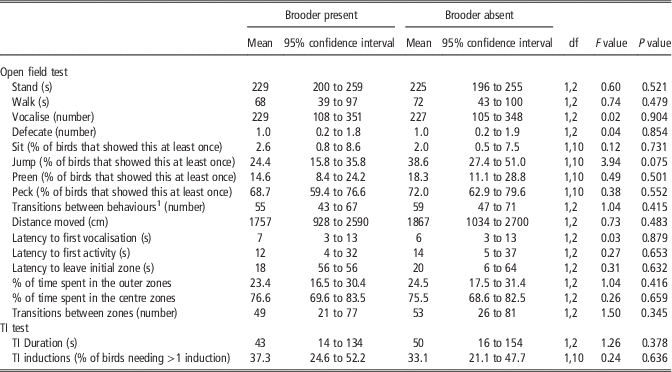
The presence of a dark brooder had no significant effect on the variables scored in the open field and TI tests (Table 2). Only the percentage of birds that jumped in the open field test tended to be higher in the groups without a dark brooder (P=0.075).
Least-square means and 95% confidence intervals of variables scored during the open field (on days 22 or 23) and tonic immobility (TI) (on days 23 or 24) tests for chicks reared with and without a dark brooder present (n=100 chicks/round, 50/treatment group)

1 Transitions between behaviours are defined as the number of transitions between different states (standing, sitting or lying, walking and jumping).
Free-range use
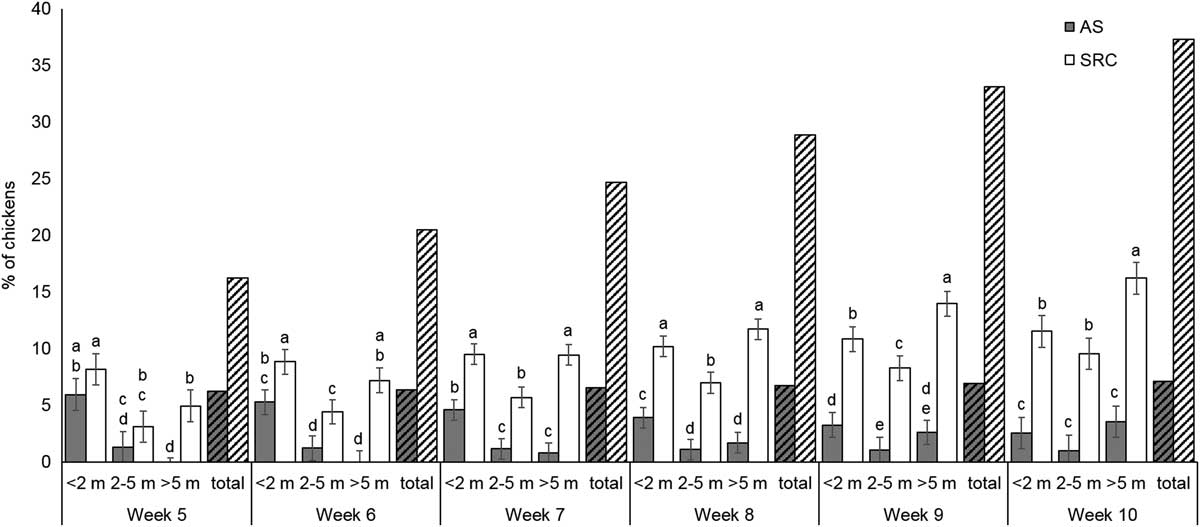
The percentage of chickens outside was not influenced by presence of dark brooders in their early life (no brooder: 34.9% (95% CI: 27.7–42.1) v. with brooder: 31.7% (95% CI: 24.4–38.9), F 1,10=1.62; P=0.232) or by the presence of overhangs during the period with free-range access (no overhangs: 32.5% (95% CI: 25.8–39.2) v. with overhangs: 34.1 (95% CI: 27.4–40.8), F 1,7=0.52; P=0.496). An interaction existed between week, distance from the house and shelter (F 2,408=8.83; P<0.001; Figure 4). Birds preferred SRC over AS at all ages and at all distances from the house except in week 5, which was the 1st week with outdoor access. The mean percentage of chickens outside increased with age of the birds in SRC, but not in AS. In SRC, the birds showed an increasing preference for areas farther from the house over time; this was not the case in AS.
Percentage (least-square means ± 95% confidence interval) of chickens outside per distance from the house, shelter type (AS=grassland with artificial shelter; SRC=short rotation coppice) and week of age. a,b,c,dBars with different superscripts differ significantly within week of age. The striped bars represent the sum of the four previous bars (per distance from the house) for that shelter type and week of age.

Behaviour of birds outside
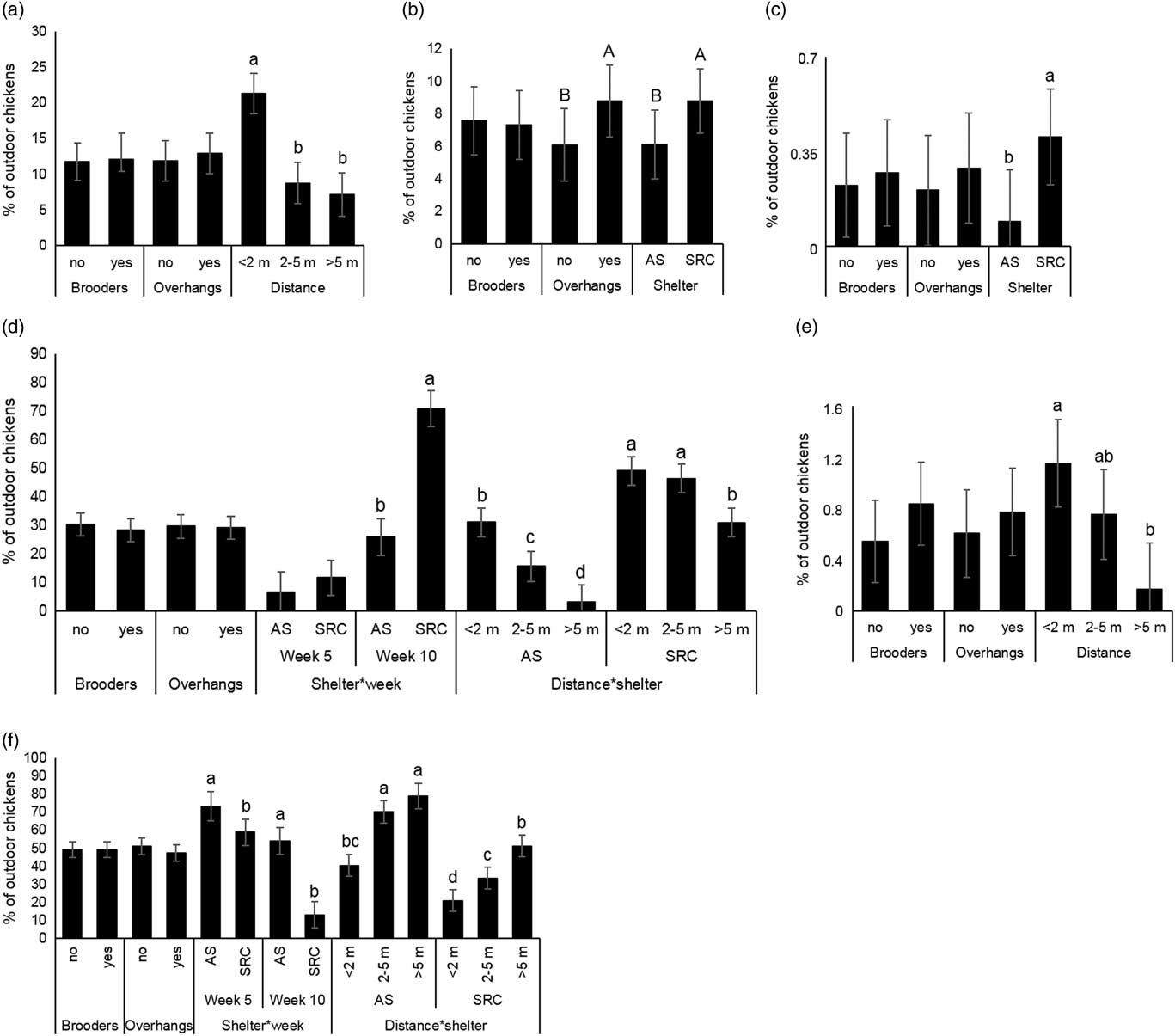
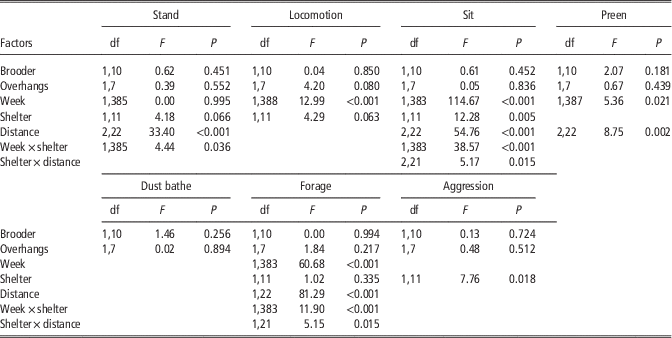
Behaviour of the chickens observed outside the house was influenced by several factors. The presence of dark brooders in their early life or overhangs during the period with free-range access were either not or rarely associated with behaviour, respectively (Table 3). Standing tended to be affected by an interaction between week of age and shelter type, but no significant pairwise differences were found. Standing occurred most at <2 m from the house (P<0.001; Figure 5). Locomotion tended to occur more in the presence of overhangs, and more in SRC than in AS (Figure 5). Sitting increased over time and occurred more in SRC than in AS in all weeks except week 5 (all P<0.001; Figure 5; for comprehensions only weeks 5 and 10 are shown). Sitting occurred more often in birds close to the house, although in SRC no difference between <2 m and 2 to 5 m was observed (all other P<0.031; Figure 5). Preening increased with age (+0.1%/week; Table 3). Foraging occurred more often in AS than in SRC, and this difference increased with age (all P<0.011; Figure 5). In AS, it occurred most at >2 m from the house, whereas in SRC it was also higher at >5 m than at 2 to 5 m (Figure 5).
Behaviours expressed as the percentage (least-square means SEM) of birds outside performing them, divided into groups with and without brooders and overhangs and where significant, week, shelter type and distance from the house and their interactions. a,b,c,d,A,BBars without common lower or upper case superscripts within a main effect or interaction indicate a significant difference (P<0.05), or a tendency (P<0.1), respectively, except for interactions including ‘week’ because ‘week’ was included in the model as a continuous variable, so no post hoc pairwise comparisons could be made. (a)Standing, (b)locomotion, (c)aggression, (d)sitting, (e)preening, (f)foraging. AS=grassland with artificial shelter; SRC=short rotation coppice.

Overview of the effects of brooders (yes/no), overhangs (present/not present), weeks (5 to 10), shelter (artificial shelter/short rotation coppice), distance (<2 m/2 to 5 m/>5 m) and their interactions on outside chicken behaviours

df=degrees of freedom (numerator, denominator); F=F-test statistic.
Discussion
The presence of dark brooders during the first 4 weeks of life did not reduce chickens’ fearfulness or explorative behaviours (walking, pecking at the arena walls or ground) as measured in the open field and TI tests. Only the percentage of birds jumping at least once in the open field test tended to be higher in the groups without dark brooders. Further, use of dark brooders did not affect the number of chickens outside or their distribution on the range during the free-range period. Also, the scored behaviours of outside birds were not affected by dark brooder rearing, including explorative behaviours such as walking and foraging, although differences in short duration behaviours such as aggression or behaviours that occur infrequently such as dust bathing may not have been recorded due to the instantaneous sampling method. This may be expected to be higher in brooded chickens because they learned the advantages of exploration, as the brooders provide them with different environments to discover.
The jumps in the open field test were often against the wall of the open field test; they probably do not arise from a higher general activity level in non-brooder birds because other active behaviours such as walking did not differ between treatment groups. These jumps may have been escape attempts, which are less often observed under fear-eliciting conditions (Gallup and Suarez, 1980; Suarez and Gallup, 1983), so this may indicate higher levels of fearfulness in the dark-brooded birds. Alternatively, they may have been an indication of a higher motivation for social reinstatement (Forkman et al., Reference Forkman, Boissy, Meunier-Salaun, Canali and Jones2007). Gilani et al. (Reference Gilani, Knowles and Nicol2012) suggested that dark-brooded hens have a calmer nature; they found that hens reared with a brooder more often ignored humans during an approach test, although a novel object test gave no conclusive results. In a study by Riber and Guzman (Reference Riber and Guzman2016), layer chicks were provided with dark brooders from days 0 to 41, and birds with brooders had shorter TI durations at weeks 4, 14 and 26 and were generally less often engaged in locomotion in the home pen. The brooders are thought to simulate certain aspects of a broody hen, which has been shown to reduce fearfulness in laying hens (Perré et al., Reference Perré, Wauters and Richard-Yris2002; Rodenburg et al., Reference Rodenburg, Uitdehaag, Ellen and Komen2009; Shimmura et al., Reference Shimmura, Kamimura, Azuma, Kansaku, Uetake and Tanaka2010; Campo et al., Reference Campo, Dávila and Gil2014). However, research on the effect of maternal care and dark brooders on broiler chickens is lacking. There are indications that broiler chickens are generally less fearful than laying hens (Keer-Keer et al., Reference Keer-Keer, Hughes, Hocking and Jones1996; Saito et al., Reference Saito, Tachibana, Choi, Denbow and Furuse2005), so a fear-attenuating treatment may affect them less, but these studies used fast-growing broilers which differ from the slower-growing hybrids such as the one used in this study.
Another difference between the results presented by Riber and Guzman (Reference Riber and Guzman2016) and those of the present study was the temperature difference under the brooders compared with the ambient temperature in the room. In the study by Riber and Guzman (Reference Riber and Guzman2016), the temperature under the brooder was considerably higher than the ambient temperature until day 28 (10°C to 12°C higher in the first 3 days, then lowered gradually), whereas in the present study, these temperatures were much more similar. In the current study the pens with and without brooders were located in the same room, so the ambient temperature had to stay within the thermal comfort zone for the chicks without brooders (Meltzer et al., Reference Meltzer, Goodman and Fistool1982; Sasso, 2014). This may have caused the brooders to be less attractive as compared with the rest of the pen. It is possible that the chickens did not make enough use of the brooders, although informal observations indicated that they did use them frequently.
Overhangs did not affect the number of chickens located outside or the distribution of the flock on the range. Overall, free-range use in this study was high in both treatment groups, making it more difficult for either overhangs or dark brooders to have a positive effect. One explanation for this may have been that the transition between the house and range may have been gradual enough in the houses without the overhangs, with small differences between light intensity inside and outside. The pop holes already had a small overhang in front of them (i.e. the hinged door of the pop hole). Also, the mobile houses were quite small, so the probability of a bird coming in proximity of a pop hole was high. Small flocks of laying hens have been shown to range more than large ones (Bestman and Wagenaar, Reference Bestman and Wagenaar2003; Hegelund et al., Reference Hegelund, Sørensen, Kjær and Kristensen2005; Whay et al., Reference Whay, Main, Green, Heaven, Howel, Morgan, Pearson and Webster2007). The exact reasons for this remain unclear, although it has been suggested to be due to having to cross a smaller distance to reach the range (Chielo et al., Reference Chielo, Pike and Cooper2016). Alternatively, the lack of effect of the overhangs could be due to the fact they were provided only every other week, which was done to increase the statistical power of the experiment. If they would have been provided during the entire period with free-range access, this may have yielded different results. This should be tested in future research. Future studies could also be aimed at clarifying the relationship between group size and free-range use, for example by testing differences between light intensity inside and outside.
It was clear that chickens had a preference for SRC over AS, in agreement with previous studies (Stadig et al., Reference Stadig, Rodenburg, Ampe, Reubens and Tuyttens2017a and 2017Reference Stadig, Rodenburg, Ampe, Reubens and Tuyttensb). The observation that free-range use increased with age, especially in areas farther from the house in SRC, also corresponds with earlier findings (Stadig et al., Reference Stadig, Rodenburg, Ampe, Reubens and Tuyttens2017b). This can be attributed to either decreasing fearfulness and more habituation to the range over time or to a depletion of vegetation or other resources close to the house. Nevertheless, the finding that a higher percentage of foraging was observed in AS, but the birds did not range farther over time in this shelter type, seems to contradict the depletion-option. However, it is important to note that all behavioural data are expressed as a percentage of birds in that particular area (shelter type and distance from the house), and that the absolute number of birds in AS was always lower than in SRC. This means that even if a higher proportion of the chickens in AS were foraging, a higher absolute number of chickens will have foraged in SRC, perhaps leading to faster depletion of the vegetation. In addition, there was less ground cover in SRC due to the dense foliage of the willows blocking the sunlight, so depletion could have occurred faster. Nevertheless, foraging motivation was probably not the only motivation to range far from the house in SRC, as a higher percentage and number of birds was also observed to be sitting farther from the house in SRC than in AS. This corresponds with findings of Stadig et al. (Reference Stadig, Rodenburg, Ampe, Reubens and Tuyttens2017b). These findings may be because the birds felt safer in SRC, or the SRC had a more comfortable microclimate such as less solar radiation (as slow-growing broiler chickens avoid direct sunlight; Stadig et al., Reference Stadig, Rodenburg, Ampe, Reubens and Tuyttens2017b).
In conclusion, the present study found no clear effect of dark brooders on slow-growing broiler chickens’ fearfulness, free-range use and behaviour, and little effect of overhangs on free-range use and behaviour. The relatively high free-range use across all four treatment groups (perhaps due to small mobile houses and suitable shelter) may have made it more difficult to show effects of additional measures to improve range use. The chickens showed a clear preference for dense vegetation over AS, and ranged farther from the house in SRC.
Acknowledgements
The authors thank T. Decroos, K. Govaert, W. Kraan and I. J. Wise for their help with practical work, the animal caretakers of ILVO for their care for the animals, and A. De Vliegher and the technical team of G. De Smet for installation and maintenance of the SRC plots. They also thank M. Levenson for proofreading and English language correction. This research was funded by a PhD grant of Flanders Innovation & Entrepreneurship (VLAIO).