Introduction
Tonsillectomy is one of the most commonly performed surgical procedures.Reference Ramsden, Brown, Ryan, Yung, Browne and Copley1 There is good evidence that tonsillectomy results in a significant improvement in quality of life for both adultsReference Witsell, Orvidas, Stewart, Hannley, Weaver and Yueh2 and children.Reference Schwentner, Schmutzhard, Schwentner, Abraham, Hofer and Sprinzl3 However, the procedure is not without risk, with post-operative pain and bleeding being the two most significant causes of morbidity. Post-operative pain can result in prolonged hospital stay, and bleeding usually requires readmission to hospital and possibly a return to theatre.Reference Ramsden, Brown, Ryan, Yung, Browne and Copley1
There are many publications addressing post-tonsillectomy outcomes with respect to bleeding and pain.Reference Ramsden, Brown, Ryan, Yung, Browne and Copley1, Reference Carney, Harris, MacFarlane, Nasser and Esterman4–Reference Shapiro and Bhattacharyya8 There is some evidence that newer tonsillectomy techniques may have significant advantages with respect to pain control;Reference Timms and Temple9 however, some authors claim that this is at the expense of an increased risk of bleeding.Reference Burton and Doree10 It is now well established that patients and doctors are prepared to ‘trade-off’ risk if extra benefits are gained as a direct result.Reference McNeil, Weichselbaum and Pauker11 However, we believed that adult patients, paediatric patients' parents, general practitioners and ENT surgeons would be likely to differ in their opinions on the trade-off between post-tonsillectomy pain and bleeding.
We believed a priori that ENT surgeons would favour techniques with the lowest secondary bleeding rate, whilst parents of paediatric patients would favour optimal post-operative pain control, with adult patients and general practitioners falling somewhere in between. However, since this was the first study of this type undertaken for tonsillectomy, we considered it to be primarily descriptive, and no power calculations were therefore performed.
Materials and methods
Questionnaires were distributed to four groups of individuals: ENT surgeons, general practitioners, adult patients and parents of children about to undergo tonsillectomy. General practitioners were randomly identified from the hospital database, and ENT surgeons were identified from the South Australia commercial telephone directory. Consecutive tonsillectomy patients were identified at pre-operative ENT assessment clinics at the Flinders Medical Centre, South Australia. Ethics approval was obtained; however, the human research ethics committee at our institution requested that different questionnaires be given to patients and doctors, as it was felt that adult patients and paediatric patients' parents would not be able to give detailed responses to more than six scenarios.
Questionnaires
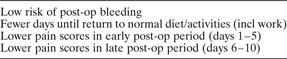
All groups were asked to rank the following four tonsillectomy outcomes in order of importance, from one to four (where one = most important and four = least important): low bleeding risk, quick return to normal activity, minimal pain immediately post-operatively, and minimal pain later in recovery (see Appendix I). For each group and all groups combined, mean ranks were compared using the exact Friedman test.
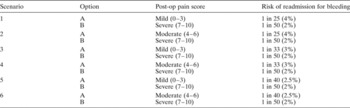
As a separate task, six hypothetical scenarios were put to adult patients and paediatric patients' parents. In each scenario, respondents were given two hypothetical options and asked to state their preference (see Appendix II). Results were analysed by chi-square test.
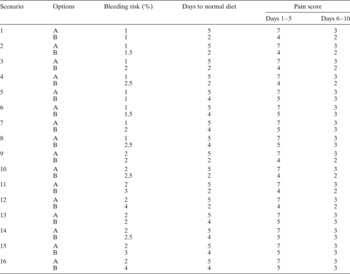
Sixteen hypothetical scenarios were put to ENT surgeons and general practitioners. As in the above questionnaire, each scenario had two hypothetical outcomes and respondents' preferences were requested (see Appendix III). Multiple correspondence analysis was utilised to assess respondents' scenario preferences, after first dichotomising all variables. For example, if a given scenario was preferred, the variable ‘preference’ was coded as one and given the label ‘yes’. If the scenario was not preferred, it was coded as zero and given the label ‘no’. For bleeding risk, if the risk was 1 per cent or 1.5 per cent then the variable ‘bleed’ was coded as one, otherwise it was coded as zero. A similar procedure was used for days to normal diet, and early and late pain scores.
All the questions assumed the procedures to be equal in terms of cost and operative time. Respondents were advised that patients with bleeding would require admission to hospital for observation. One in four bleeding patients would need to return to theatre for surgical haemostasis, one in 10 would require blood transfusion, and a one in 200 mortality rate was quoted.
The Statistical Package for the Social Sciences version 16 software (SPSS, Chicago, Illinois, USA) was used for all statistical analyses.
Results and analysis
A total of 72/112 (64.3 per cent) questionnaires was returned. With respect to the four respondent groups, 16/16 (100 per cent) adult patients, 16/16 (100 per cent) paediatric patients' parents, 15/40 (37.5 per cent) general practitioners and 25/40 (62.5 per cent) ENT surgeons responded.
Respondents' mean ranking of the importance of post-tonsillectomy pain, bleeding and return to normal activity is shown in Table I. In all groups, there was a statistically significant difference in mean ranks between attributes (p < 0.001). A low risk of post-operative bleeding was found to be the most important attribute, followed by lower pain scores in the early post-operative period and a quick return to normal activity. Lower pain scores later in the recovery period were perceived as the least important attribute.
Respondents' mean ranking of importance of post-tonsillectomy pain, bleeding and return to normal activity

* n = 72; †n = 16; ‡n = 16; **n = 15; §n = 25. Post-op = post-operative; pts = patients; GP = general practitioner
Subgroup analysis revealed that early return to normal activity was deemed more important than lower pain score in the early post-operative period amongst adult patients and general practitioners, compared with ENT surgeons and paediatric patients' parents.
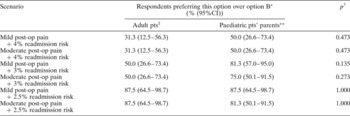
Results for the six scenarios offered to patients and parents are shown in Table II. Whereas 50 per cent of parents indicated that they would accept a doubling of bleeding risk (2 per cent increasing to 4 per cent) in order to enable less pain for their child, adult patients indicated that they would only accept a smaller bleeding risk (2 per cent increasing to 3 per cent) at the 50 per cent ‘cross-over’ point.
Adult patients' and paediatric patients' parents' preferences for option A over option B in presented scenario

* Option B = severe post-operative (post-op) pain with a 2% readmission rate. †Chi-square test, adult patients vs paediatric patients' parents. ‡n = 16; **n = 16. 95%CI = 95% confidence intervals; pts = patients
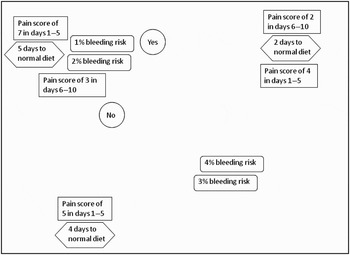
The results of the multiple correspondence analysis for each of the responses from general practitioners and ENT surgeons are shown in Figure 1. Multiple correspondence analysis is an exploratory technique used to analyse data in multi-way contingency tables, where correspondence is positioned between rows and columns. It was developed by BenzecriReference Benzecri12 and can be thought of as a way of partitioning the overall chi-square value for the tables. Data are represented in a two-dimensional chart, where the two dimensions have little interpretative value in their own right. In the software-generated chart, attributes which appear closer to each other are more highly associated than those further apart.
Multiple correspondence analysis of each of the responses from general practitioners and ENT surgeons.

In multiple correspondence analysis, the responses more closely related to the ‘yes’ option are those deemed to be more acceptable post-operative risks. These responses include lower bleeding risk (at 1–2 per cent), followed by high early post-operative pain score.
Note that the higher early post-operative pain score is chosen in the context of low bleeding risk (1 per cent). Other responses which are closely related to the ‘yes’ option are low pain scores in the late post-operative period and an early return to a normal diet.
Discussion
This study was motivated by the ongoing, heated debate amongst ENT surgeons as to the best method of performing tonsillectomy. What method produces the lowest rate of haemorrhage and causes less pain? Does it matter if a method achieves one and not the other?
Tonsillectomy carries risk. Although fatalities are fortunately rare,Reference Randall and Hoffer13 all ENT surgeons and probably most general practitioners have encountered frightening secondary post-tonsillectomy haemorrhages. However, patients and parents are unlikely to have had a close friend or relative suffer a severe bleed, although they may anecdotally have heard of someone so unfortunate. The risk of bleeding causes fear – but pain also scares patients, and doctors are often accused of not acknowledging that fear.Reference Idvall, Bergqvist, Silverhjelm and Unosson14 As such, it is therefore unsurprising that, in the current study, both adult tonsillectomy patients and parents of children about to undergo surgery were prepared to accept some risk of increased bleeding in exchange for better post-operative analgesia. Despite the lure of possible better analgesia, we found that bleeding remained by far the most important risk perceived by all four respondent groups, both patients and doctors.
On initial assessment of our results, there was a suggestion that patients might be more willing to accept a higher bleeding risk, compared with treating ENT surgeons (1.69 vs 1.23). However, subsequent statistical analysis failed to show any significant difference between these two groups in this respect (p = 0.087). We found that adult patients and ENT surgeons were willing to accept higher pain levels in exchange for lower bleeding risks, while parents were more willing than adult patients to trade off a slightly higher bleeding risk in exchange for better pain control. Although we chose the spectra of bleeding risks and pain scenarios offered to patients somewhat arbitrarily, these outcomes were meant to approximate what might be expected following diathermy vs cold-steel vs coblation tonsillectomy. We are aware that many surgeons might disagree with the actual figures proposed; however, the accuracy of the figures used was entirely irrelevant to the aims of this paper.
The National Prospective Tonsillectomy Audit in England has demonstrated that the overall risk of post-tonsillectomy bleeding is 3.5 per cent, with 1 per cent of patients requiring operative intervention for haemostasis.Reference Ramsden, Brown, Ryan, Yung, Browne and Copley1 Post-tonsillectomy haemorrhage is described as primary when it occurs within the first 24 hours of surgery, and secondary if it occurs more than 24 hours after surgery.Reference McClelland and Jones15 A large meta-analysis has also shown that the risk of primary bleeding is 1.4 per cent, occurring in the first eight hours post-tonsillectomy.Reference Bennett, Clark, Bath and Montgomery16 Secondary bleeding is commoner in adults and peaks between days five to seven, but it can occur at any time up to 28 days post-operatively, albeit rarely.Reference Ramsden, Brown, Ryan, Yung, Browne and Copley1
The aetiology of post-tonsillectomy haemorrhage is controversial. Historically, it was often attributed to infection, but this has since been disputed.Reference Ahsan, Rashid, Eng, Bennett and Ah-See17–Reference Dhiwakar, Eng, Selvaraj and McKerrow20 Tonsillectomy is associated with transient bacteraemia;Reference Yildirim, Okur, Ciragil, Aral, Kilic and Gul19 however, patients with post-operative bleeding do not usually demonstrate clinical signs of infection,Reference Ahsan, Rashid, Eng, Bennett and Ah-See17 and bleeding rates are not reduced by prophylactic antibiotics.Reference O'Reilly, Black, Fernandes and Panesar18, Reference Dhiwakar, Eng, Selvaraj and McKerrow20 Various retrospective, prospective and randomised, controlled trials have investigated the effect of tonsillectomy technique on secondary bleeding rates.Reference McClelland and Jones15 Data from the National Prospective Tonsillectomy Audit have clearly demonstrated that the traditional tonsillectomy method of ‘cold-steel and ties’ is associated with the lowest incidence of post-operative haemorrhage (1.7 per cent).Reference Ramsden, Brown, Ryan, Yung, Browne and Copley1 The haemorrhage rate is significantly higher for ‘hot’ techniques such as electrocautery and radiofrequency coblation. The Audit results also suggested that the risk of bleeding is closely related to increasing power settings on the diathermy machine.Reference Ramsden, Brown, Ryan, Yung, Browne and Copley1 A subsequent, prospective study has confirmed the positive association between increased bleeding rates and increased energy levels delivered to the tonsillar fossae.Reference Cardozo, Hallikeri, Lawrence, Sankar and Hargreaves7
Post-tonsillectomy pain generally peaks by days two to three and resolves by days six to nine.Reference Lavy21 In most cases, such pain can be easily managed with oral analgesia. The pain levels associated with various tonsillectomy techniques have been compared in recent reviews; however, conflicting conclusions have been drawn, due largely to the small numbers in all published studies.Reference Burton and Doree10, Reference Kelley22, Reference Pinder and Hilton23
The search for a less painful, less bleeding prone tonsillectomy method led to the introduction of coblation in 2001.Reference Temple and Timms24 Coblation technology utilises a system of radiofrequency, bipolar electrical current passed through a medium of normal saline, resulting in the production of a plasma field of sodium ions. These energised ions break down intercellular bonds and effectively vaporise tissue at a temperature of only 60°C.Reference Burton and Doree10 The introduction of coblation tonsillectomy has been extremely controversial, welcomed by someReference Polites, Joniau, Wabnitz, Fassina, Smythe and Varley5, Reference Timms and Temple9 and criticised by others.Reference Burton and Doree10 It does result in faster surgery and better intra-operative haemostasis,Reference Shapiro and Bhattacharyya8 leading to a reduced risk of primary haemorrhage.Reference Carney, Harris, MacFarlane, Nasser and Esterman4 However, coblation also results in additional expense, and the National Prospective Tonsillectomy Audit clearly demonstrated a higher secondary bleeding rate. On the positive side, several studies have now demonstrated that coblation tonsillectomy causes less post-operative pain, although opinions differ as to how great an analgesic advantage it offers.Reference Polites, Joniau, Wabnitz, Fassina, Smythe and Varley5, Reference Timms and Temple9, Reference Stoker, Don, Kang, Haupert, Magit and Madgy25 The higher secondary bleeding rate noted in the National Prospective Tonsillectomy Audit was claimed by many to be due to a significant learning curve with the technique.Reference Ramsden, Brown, Ryan, Yung, Browne and Copley1, Reference Carney, Harris, MacFarlane, Nasser and Esterman4 A more recent, Australian audit has revealed that, in experienced hands, the bleeding rate for coblation tonsillectomy is now comparable to that for ‘gold standard’, cold steel tonsillectomy.Reference Carney, Harris, MacFarlane, Nasser and Esterman4 Nevertheless, despite the fact that coblation haemorrhage results apparently now match those for cold steel tonsillectomy, an updated audit of the same size as the National Prospective Tonsillectomy Audit will be required before firm conclusions on this matter can be drawn.
• Bleeding was the most important factor chosen by adult patients, paediatric patients' parents and doctors when ranking post-tonsillectomy outcomes
• Adult tonsillectomy patients were prepared to ‘trade-off’ a slightly increased bleeding risk (2–4 per cent) in exchange for more optimal analgesia
• Parents of children about to undergo tonsillectomy were slightly more willing to trade-off a higher bleeding risk in exchange for better pain control, compared with adult patients
We believe that, whatever the analgesic benefits offered by coblation tonsillectomy, surgeons should continue to audit their own results, and should abandon the technique or receive further training if their haemorrhage rates become unacceptable (i.e. over 3 per cent). Our current findings support this statement; it is likely that patients would not consent to a tonsillectomy that put them at significantly increased risk of bleeding, although they might consent to a slightly increased risk (i.e. between 2 and 3 per cent) in exchange for significant analgesic benefits in the post-operative period.
Conclusion
Adult patients, paediatric patients' parents and their treating doctors ranked the risk of bleeding as the most important factor when considering post-operative outcomes following tonsillectomy. In certain circumstances, all groups are prepared to trade-off a slightly increased bleeding risk (2–4 per cent) in exchange for more optimal analgesia. However, once post-tonsillectomy bleeding risk increased to over 4 per cent, few adult patients or paediatric patients' parents would consider such an analgesic trade-off. Parents of children about to undergo surgery were slightly more willing to chance a higher bleeding risk in exchange for better pain control, compared with adult patients.
Outcomes ranked by respondents

Post-op = post-operative; incl = including
Post-op scenarios presented to adult patients and paediatric patients' parents

Post-op = post-operative
Post-operative scenarios presented to ENT surgeons and GPs

GPs = general practitioners