Introduction
Crop production and weed management tactics change over time. Glyphosate-resistant (Roundup Ready® [RR], Monsanto, St. Louis, MO) soybean was readily adopted due to the ease of use of the technology. Today, RR soybean is still the primary soybean cultivar planted in the United States (USDA National Agricultural Statistics Service [USDA-NASS] 2016). However, the overuse of glyphosate has led to an increase in glyphosate-resistant (GR) weeds. In 2013, glyphosate and glufosinate were reported to be sprayed alone to 9% and 13% of the reported RR and glufosinate-resistant (LibertyLink® [LL], Bayer CropScience, Monheim am Rhein, Germany) soybean hectares, respectively, in several midsouthern states (Riar et al. Reference Riar, Norsworthy, Steckel, Stephenson, Eubank and Scott2013b).
The overuse of glyphosate in RR soybean allowed for weeds to evolve resistance to this mode of action (MOA) and caused a shift toward weeds that escape glyphosate control due to late or continual germination (Reddy and Norsworthy Reference Reddy and Norsworthy2010). Emergence of annual grasses and pigweeds (Amaranthus spp.) in several flushes throughout the season allow these weeds to escape early-season glyphosate applications in the absence of residual herbicides (Tharp and Kells Reference Tharp and Kells2002). The prevalence of and concern surrounding GR species like Palmer amaranth has led to an increase in soil-applied residual herbicides, primarily protoporphyrinogen oxidase (PPO)-inhibiting herbicides (Owen and Zelaya Reference Owen and Zelaya2005).
Adoption of best management practices (BMPs) for mitigating the risk of herbicide-resistant weeds evolving is imperative for the sustainability of cropping systems (Green Reference Green2007). As a result, Norsworthy et al. (Reference Norsworthy, Ward, Shaw, Llewellyn, Nichols, Webster, Bradley, Frisvold, Powles, Burgos, Witt and Barrett2012) recommended 12 BMPs that can help reduce herbicide-resistant weeds. The adoption of these BMPs can overcome real and perceived obstacles that growers face, including costs associated with managing herbicide-resistant weeds, which does not seem to deter growers. Although no new herbicide MOAs are foreseen in the near future, growers believe that a new herbicide will eventually be developed to mitigate herbicide resistance (Foresman and Glasgow Reference Foresman and Glasgow2008).
In the midsouthern United States, growers rely on crop consultants to scout their fields and provide appropriate recommendations for both crop and weed management. Thus, they have information about problematic weed species in their fields and what management approach is needed. Therefore, a soybean weed management survey was constructed for soybean consultants in the midsouthern United States to determine the consultants’ perspective on the area under specific herbicide-resistant traits, general soybean production practices, general weed management practices, the importance and adoption of various herbicide-resistant BMPs, problematic weed species, and the perceived area infested with PPO-resistant Palmer amaranth.
Materials and Methods
In fall 2016, a survey questionnaire was made available online (https://www.surveymonkey.com/r/surveysoybean) to crop consultants from Arkansas, Louisiana, Mississippi, southeast Missouri, and Tennessee. It is unknown how many soybean consultants received the website link, since the survey was available online and broadcast on statewide or regional consultant list servers. The survey questionnaire was divided into four main sections: (1) general weed management, (2) herbicide-resistance management, (3) problematic weed species, and (4) PPO-resistant Palmer amaranth.
The first section focused on general weed management. The survey questions are listed in Appendix 1. In the second section, consultants were provided with a list of obstacles that growers face with adopting resistance management strategies and were asked to rate the importance of each on a scale of 1 to 5, with 1=not important, 2=rarely important, 3=occasionally important, 4=important, and 5=very important (this scale was similar to that in Riar et al. Reference Riar, Norsworthy, Steckel, Stephenson, Eubank and Scott2013b). Additionally, consultants were asked which of those obstacles they believe would increase or decrease over the next couple of years and to describe why. In the third section, consultants were provided with a list of 38 potential weeds in their area and were asked to rate the importance of each on a scale of 1 to 5. They were further asked to list their three most problematic weeds. The fourth section was related to the control and spread of PPO-resistant Palmer amaranth. In addition, consultants were asked to provide recommendations being given to growers who have PPO-resistant Palmer amaranth in their fields. Finally, consultants were asked to identify two areas of research that would help improve weed management in soybean.
Results and Discussion
Soybean Area Scouted
A total of 25, 24, 9, 11, and 7 registered consultants responded to the survey (n=76) from Arkansas, Louisiana, Mississippi, southeast Missouri (four counties), and Tennessee, respectively. These consultants represent 13% (170,587 ha), 28% (142,105 ha), 8% (39,798 ha), 16% (38,680 ha), and 5% (33,502 ha) of the total soybean hectares planted in Arkansas (1,275,304 ha), Louisiana (506,073 ha), Mississippi (829,996 ha), southeast Missouri (497,479 ha), and Tennessee (708,502 ha), respectively, in 2016 (USDA-NASS 2016).
General Weed Management
Out of the total area scouted by the consultants surveyed, 74%, 92%, 42%, 76%, and 69% of Arkansas, Louisiana, Mississippi, Missouri, and Tennessee, respectively, was planted to RR soybean in 2016. The collective area planted under this technology was 78% across all states, while the remaining acreage was planted with 18% LL, 3% RR Xtend® (Monsanto) glyphosate- and dicamba-tolerant, and 1% conventional soybean varieties. Of the total area surveyed across this geography, 86% was treated with a PRE herbicide and 98% with a POST herbicide. The three most commonly used active ingredients applied PRE were flumioxazin, metribuzin, and metolachlor, and POST applications were glyphosate, glufosinate, and fomesafen. Overall 51% and 47% of the area reported was sprayed with more than three and two sites of action (SOAs), respectively, in crop. However, it is unclear whether growers fully understand SOAs or can properly identify active ingredients in various SOAs (Norsworthy et al. Reference Norsworthy, Owen, Gunsolus, Everman, Ervin, Frisvold, Hurley, Jussaume and Welcher2017b).
As herbicide resistance is a continual problem in soybean, new traits are expected to become available to help combat resistance issues. The traits expected to be planted in 2017 include RR, LL, Xtend®, and conventional. In addition, Enlist™, glyphosate, glufosinate, and 2,4-D choline tolerant (Dow AgroSciences, Indianapolis, IN), was included in case the trait was approved for global import before planting; however, import approvals were not obtained before the 2017 growing season. The addition of Xtend® and Enlist™ technologies allow for additional SOAs to be used without damaging the crop. In 2017, consultants expected their total soybean acreage to increase by 7%, 7%, 5%, 2%, and 10% in Arkansas, Louisiana, Mississippi, southeast Missouri, and Tennessee, respectively, from 2016. Consultants anticipated that, in 2017, the majority of their scouted fields would be planted with RR, LL, or Xtend® soybean, averaging 52%, 20%, and 35%, respectively.
Limited herbicide options remain for control of some weed species (e.g., Palmer amaranth) in soybean. Glufosinate-resistant soybean has been heavily relied upon in recent years in geographies where glyphosate and PPO resistance are most prevalent (JKN, personal observation). With what herbicides remain, studies in Arkansas have shown that on PPO-resistant populations, glufosinate has shown to provide a high level of control (99%), whereas a single application of dicamba (80%) or glyphosate (10%) provided marginal or little mortality (Norsworthy et al. Reference Norsworthy, Barber and Scott2017a; Schwartz-Lazaro et al. Reference Schwartz-Lazaro, Norsworthy, Scott and Barber2017).
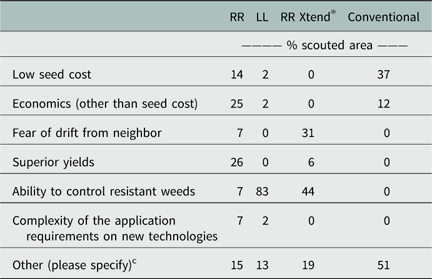
The survey further asked consultants why they believe their growers would choose a specific trait in 2017 (Table 1). RR soybean was primarily chosen based on two factors: superior yields and economics (other than seed cost). The choice to plant LL soybean was often because glufosinate enables resistant weeds to be controlled. RR Xtend® was perceived by the respondents to be chosen because of the ability to control herbicide-resistant weed species and out of fear of drift from neighbors. Reasons given for why conventional soybeans were planted included low seed cost (most common response) and premium received for non-GMO grain. A large percentage of consultants provided “other” as a reasoning for choosing to plant a soybean variety (Table 1). The answers varied by technology. Consultants believed that some growers were not willing to switch from RR due to their current comfort with this system and the lower seed costs associated with this technology. Others reported that growers are reluctant to shift from RR soybean technology to non-GR alternatives, because they perceive these alternatives as more costly and less time efficient (Green and Owen Reference Green and Owen2011). Consultants believed some growers would plant RR and LL soybean because of the unavailability of Xtend® soybean seed.
Consultants’ perspectives on the likely reason why a specific soybean herbicide-resistant trait will be grown in 2017.Footnote a , Footnote b

a Abbreviations: LL, LibertyLink®; RR, Roundup Ready®.
b Data pooled across states surveyed.
c “Other” explanations provided within the text.
Herbicide-Resistance Management
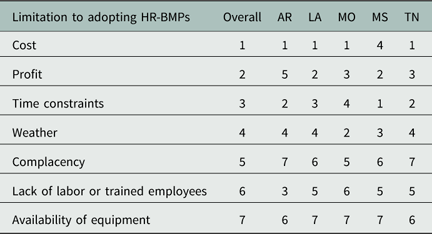
Consultants were asked to rank seven important perceived obstacles in adopting herbicide resistance BMPs. Overall, they ranked cost as the largest obstacle and availability of equipment, such as sprayers, as the least important obstacle (Table 2). At the state level, cost was still the largest obstacle, except for Mississippi. Mississippi’s largest obstacle was considered to be time constraints, which was ranked as the third largest obstacle overall. Louisiana, Missouri, and Mississippi all ranked the availability of equipment as the smallest obstacle, whereas Arkansas and Tennessee ranked complacency as the least important obstacle in adopting herbicide-resistance BMPs (Table 2).
Ranking of limitations to adoption of herbicide resistance best management practices (HR-BMPs).Footnote a
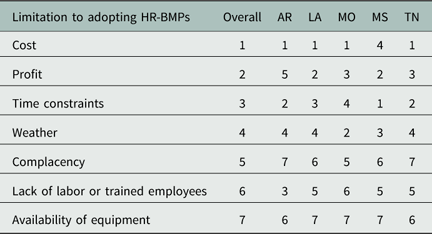
a Importance ranking was based on the number of importance points. The rating scale was 1=greatest importance to 7=least important.
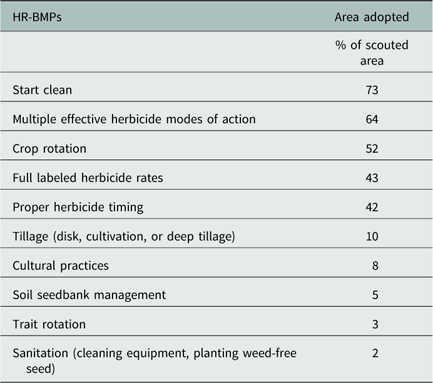
Previous surveys have documented appropriate timing of herbicide applications as the most important herbicide-resistance BMP (Prince et al. Reference Prince, Shaw, Givens, Owen, Weller, Young, Wilson and Jordan2012; Riar et al. Reference Riar, Norsworthy, Steckel, Stephenson, Eubank, Bond and Scott2013a). However, in this survey, appropriate herbicide application timings were only adopted on 42% of the total areas scouted (Table 3). Starting with weed-free fields (73%) and using multiple effective SOAs (64%) were the two most important BMPs adopted by growers in the midsouthern United States. Starting clean has been a widely recommended herbicide-resistance BMP (Norsworthy et al. Reference Norsworthy, Ward, Shaw, Llewellyn, Nichols, Webster, Bradley, Frisvold, Powles, Burgos, Witt and Barrett2012) and was ranked among the top five weed management practices by U.S. cotton (Gossypium hirsutum L.), soybean, and corn (Zea mays L.) growers averaged across 22 states (Prince et al. Reference Prince, Shaw, Givens, Owen, Weller, Young, Wilson and Jordan2012). Planting into weed-free fields has not changed since a similar survey was conducted in 2011 of scouted midsouthern soybean hectares (Riar et al. Reference Riar, Norsworthy, Steckel, Stephenson, Eubank and Scott2013b). The lack of an increase in use of multiple effective SOAs compared with the earlier survey of consultants in this region is concerning. Overlay of residual herbicides of multiple SOAs every 2 to 3 wk until crop canopy formation is highly recommended to delay the evolution of and reduce selection pressure on herbicide-resistant weeds (Norsworthy et al. Reference Norsworthy, Ward, Shaw, Llewellyn, Nichols, Webster, Bradley, Frisvold, Powles, Burgos, Witt and Barrett2012).
Farmer adoption of herbicide-resistance best management practices (HR-BMPs) as perceived by midsouthern U.S. soybean consultants.
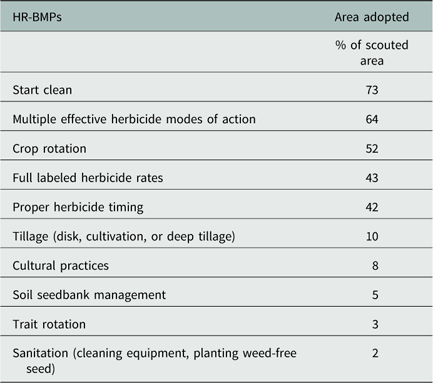
Consultants were asked which of the 10 adopted herbicide-resistance BMPs (Table 3) would increase or decrease in adoption over the next 5 yr. The top three BMPs that consultants believed would increase were using multiple effective SOAs (42%), proper herbicide application timing (13%), and the use of cultural practices (12%). Conversely, consultants believed that equipment sanitation (18%), tillage (17%), and trait rotation (17%) would decrease over the next 5 yr. Previous research has shown that the cleaning and sanitation of tillage and harvest equipment is a primary means of minimizing the likelihood of weed introductions and spread throughout a farm and neighboring farms (Norsworthy et al. Reference Norsworthy, Ward, Shaw, Llewellyn, Nichols, Webster, Bradley, Frisvold, Powles, Burgos, Witt and Barrett2012). Although tillage has the potential to suppress the evolution of herbicide-resistant weeds, growers often fail to acknowledge the importance of tillage and adopt this practice (Frisvold et al. Reference Frisvold, Hurley and Mitchell2009). Finally, rotation of crops with herbicide-resistant traits, such as glyphosate- or glufosinate-resistant soybean, is important, but rotation of crops with the same herbicide-resistant trait, for example, GR cotton, soybean, and corn, has minimal advantage because of similar levels of selection pressure on evolution of herbicide-resistant weeds. Consultants believe that these three herbicide resistance BMPs will decline over the next 5 yr due to cost and unwillingness of the growers to alter their current effective practices. Furthermore, this assumes that effective chemical control options will remain available.
Problematic Weed Species
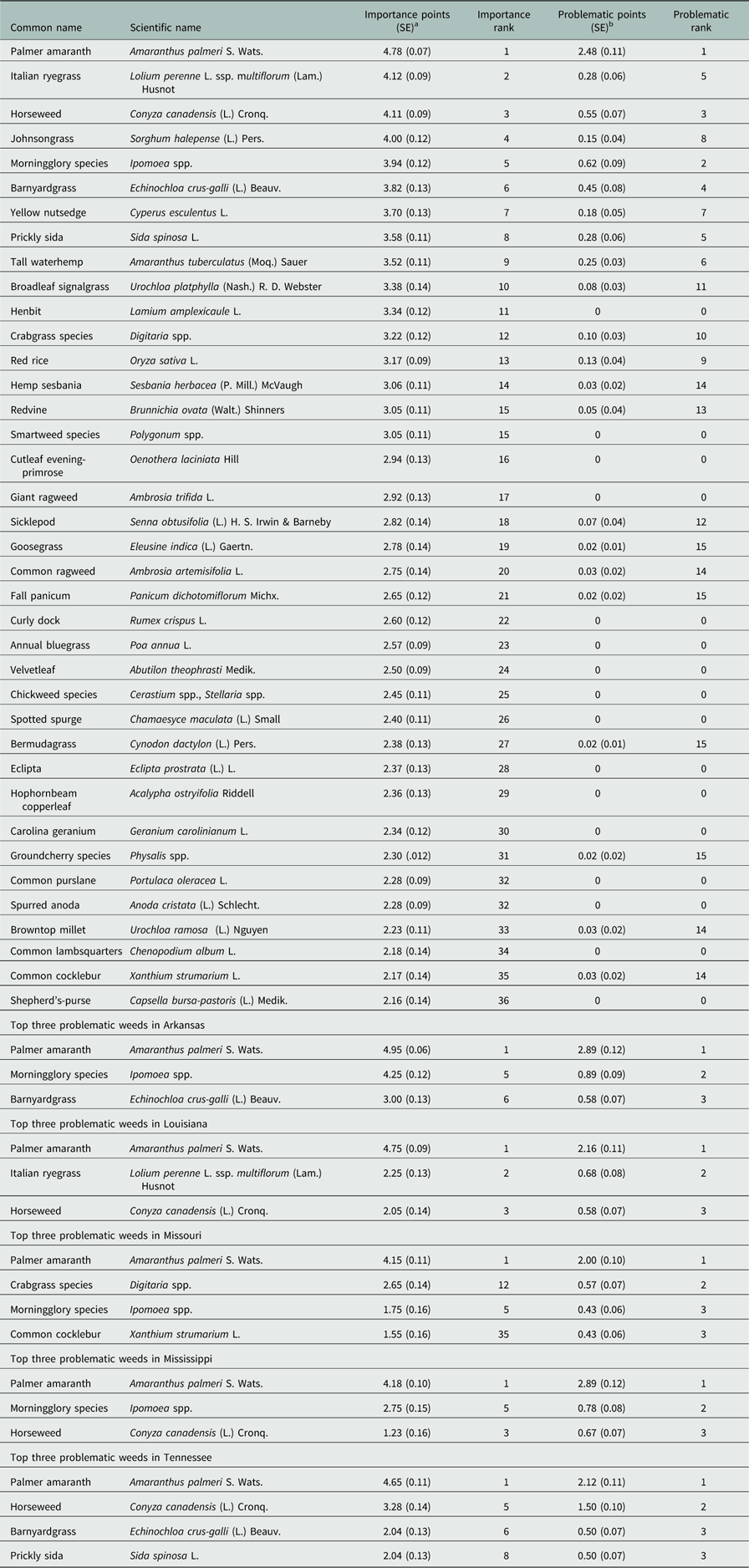
The overreliance on a single SOA, such as glyphosate, has led to shifts in the weed spectrum both below- and aboveground. The weed species shift has been shown to be due to geography, agronomic practices, environmental conditions, soil moisture, and effectively controlling the soil seedbank (Cardina et al. Reference Cardina, Herms and Doohan2002; Schwartz et al. Reference Schwartz, Gibson, Gage, Matthews, Jordan, Owen, Shaw, Weller, Wilson and Young2015). While annual management practices will readily alter the aboveground weed flora, the soil seedbank is typically slower to respond because of the inherent buffering capacity caused by seeds present from multiple seasons of seed rains (Schwartz et al. Reference Schwartz, Gibson, Gage, Matthews, Jordan, Owen, Shaw, Weller, Wilson and Young2015). In this survey, Palmer amaranth, morningglory species, horseweed, barnyardgrass, and Italian ryegrass were the five most problematic weeds in soybean across the five states (Table 4).
Consultants ranking of weeds in midsouthern United States soybean (data from all states were pooled), with the top three most problematic weeds from each state.
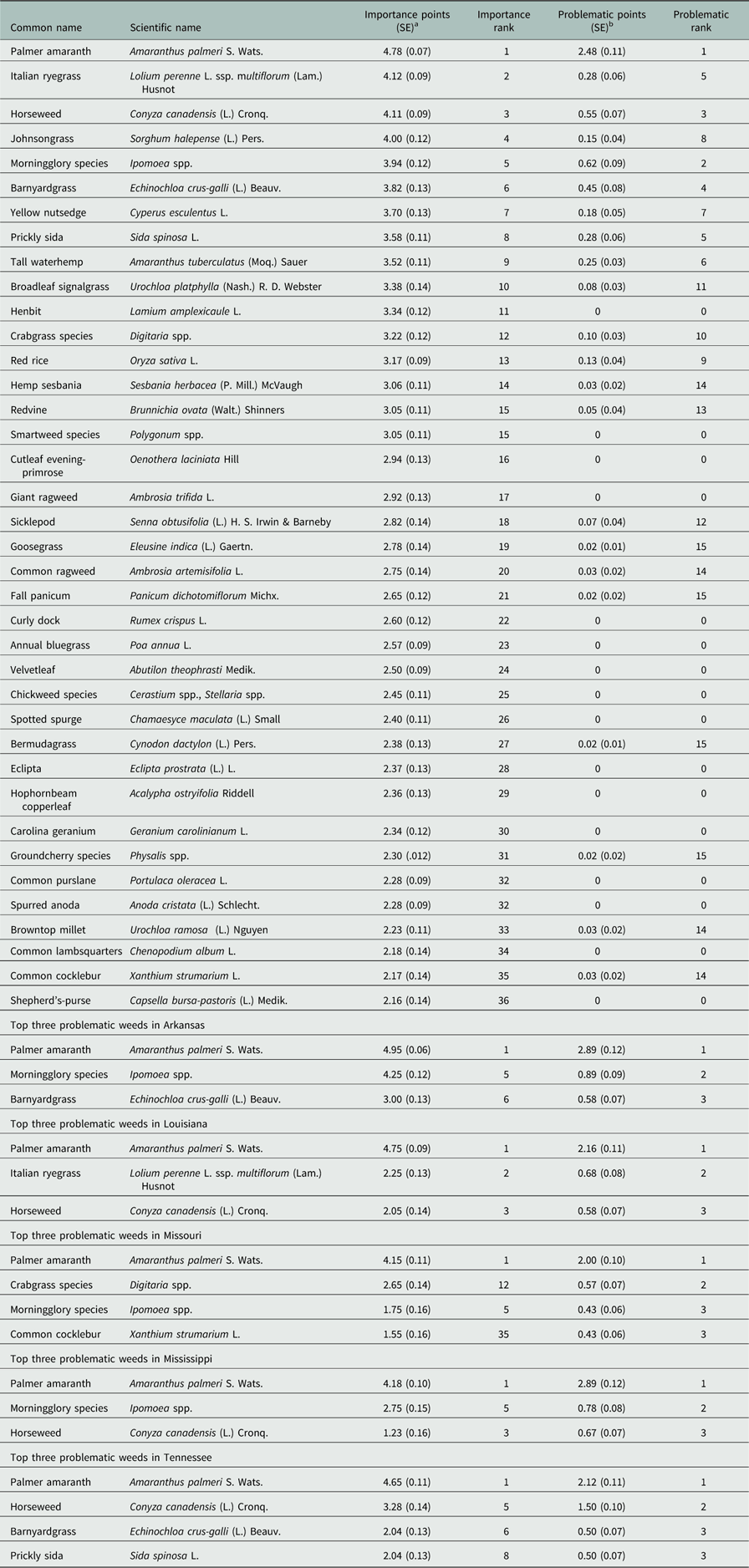
a Importance points were calculated based on the point value assigned to each weed by consultants. The rating scale was 1=not important, 2=rarely important, 3=occasionally important, 4=important, and 5=very important. Standard errors for each weed species provided in parentheses.
b Problematic points were calculated by assigning 3, 2, and 1 points to the first, second, and third most problematic weeds, respectively, from each survey. Each species that was not ranked among three most problematic weeds by a consultant was assigned a value of 0. Standard errors for each weed species provided in parentheses.
Problematic weed species were further divided by individual state. Palmer amaranth was the most problematic weed in the Midsouth, regardless of state, mainly due to widespread herbicide resistance and the large number of plants that need to be controlled each year (Table 4). Palmer amaranth is considered the most prominent weed in soybean production in the midsouthern United States today and is currently resistant to six herbicide SOAs (Heap Reference Heap2017; Norsworthy et al. Reference Norsworthy, Griffith, Griffin, Bagavathiannan and Gbur2014). This species has shown the ability to significantly reduce crop yield if not controlled. For example, a density of only 8 Palmer amaranth plants m−2 present at soybean emergence reduced grain yield by 78% (Bensch et al. Reference Bensch, Horak and Peterson2003). Morningglory species were the second most problematic in Arkansas and Mississippi and the third most problematic in Missouri. Although these species are not currently resistant to any SOA, plants can be difficult to control with the currently available soybean herbicides (Webster Reference Webster2013). In addition, seed from this annual vine can persist in soil for at least 39 yr, causing continual problems for farmers if not controlled early in the growing season (Toole and Brown Reference Toole and Brown1946). The third most problematic weed across states was horseweed, which was the second most problematic weed in Tennessee and the third most problematic weed in Louisiana and Mississippi. Barnyardgrass, the fourth most problematic weed in the Midsouth, was the third most problematic weed in Arkansas and Tennessee. This species is currently resistant to seven SOAs, and in soybean, Vail and Oliver (Reference Vail and Oliver1993) found a 10%, 25%, and 50% reduction of yield with respective barnyardgrass densities of 42, 110, and 250 plants m-1 of row. The fifth most problematic weed, Italian ryegrass, was considered the second most problematic weed in Louisiana, likely because of the increase of glyphosate resistance.
A similar weed survey conducted in the fall of 2011 (Riar et al. Reference Riar, Norsworthy, Steckel, Stephenson, Eubank and Scott2013b) included a comparable problematic weed survey. The top three weed species from Arkansas were the same in 2011. In Louisiana, the weed species remained the same, but the order changed, with the most problematic weeds in 2011 being morningglory, Palmer amaranth, and Italian ryegrass. The first two weed species in Mississippi remained the same; the third species in 2011 was Italian ryegrass. The top three weed species in Tennessee in 2011 were Palmer amaranth, morningglory, and horseweed. Barnyardgrass was not in the top five weed species previously.
Most weed species in the top five most problematic weeds are resistant or tolerant to at least one commonly used herbicide SOA. The evolution and spread of GR Palmer amaranth (Norsworthy et al. Reference Norsworthy, Griffith, Scott, Smith and Oliver2008), horseweed (Koger et al. Reference Koger, Poston, Hayes and Montgomery2004), and Italian ryegrass (Nandula et al. Reference Nandula, Reddy, Koger, Poston, Rimando, Duke, Bond and Ribeiro2012), and the tolerance of morningglory, prickly sida (Sida spinosa L.), and hemp sesbania [Sesbania herbacea (P. Mill.) McVaugh] (Riar et al. Reference Riar, Norsworthy and Griffith2011) to glyphosate are most likely the reasons for the dominance of these weed species. Barnyardgrass is the only weed in the five top-ranking species that is inherently susceptible to both glyphosate and glufosinate applications (Scott et al. Reference Scott, Boyd, Selden, Norsworthy and Burgos2017). Ecological traits of barnyardgrass such as prolonged emergence and high seed production allow the soil seedbank to be replenished each year. Most soybean fields in the Midsouth, especially in Arkansas, Louisiana, Missouri, and Mississippi, are rotated with rice, and barnyardgrass has evolved resistance to many herbicides used in rice production. These herbicides include propanil, quinclorac, clomazone, cyhalofop, and several acetolactate synthase–inhibiting herbicides (Heap Reference Heap2017).
PPO-Resistant Palmer Amaranth
PPO-resistant Palmer amaranth was reported in Arkansas in 2011, in Tennessee in 2015, and in Illinois in 2016 (Heap Reference Heap2017). The overreliance on one SOA can lead to a high selection rate for resistance, which has affected weed management strategies and effectiveness over the past decade (Hager et al. Reference Hager, Wax, Bollero and Stoller2003; Riggins and Tranel Reference Riggins and Tranel2012). The continual evolution of resistance to widely used and effective SOAs has led to increasing use of PPO-inhibiting herbicides for Palmer amaranth control (Schwartz-Lazaro et al. Reference Schwartz-Lazaro, Norsworthy, Scott and Barber2017). Overall, 79% of the scouted area has had a PPO inhibitor applied to it multiple times over the past 3 yr. Of the consultants surveyed, 77% perceived PPO-resistant Palmer amaranth to be of high concern, and 69% suspected that they have PPO-resistant Palmer amaranth on the fields they scout. This represents 39% (67,211 ha), 24% (34,674 ha), 45% (17,483 ha), 33% (17,702 ha), and 65% (13,750 ha) of the surveyed areas in Arkansas, Louisiana, Mississippi, southeast Missouri, and Tennessee, respectively. Interestingly, PPO-resistant Palmer amaranth has not been documented in Louisiana.
These results align with previous research that tested five PRE and four POST PPO-inhibiting herbicides in Arkansas. Complete control was not achieved at the 8X rate with any herbicide at the PRE application; for the POST application, complete control was not achieved until the 32X rate for all herbicides (Schwartz-Lazaro et al. Reference Schwartz-Lazaro, Norsworthy, Scott and Barber2017). Furthermore, Wuerffel et al. (Reference Wuerffel, Young, Matthews and Young2015) found that an Illinois PPO-resistant population had 38X, 3.2X, and 29X R/S ratios for fomesafen, sulfentrazone, and flumioxazin, respectively.
Due to this high concern with PPO-resistant Palmer amaranth, consultants are primarily advising their growers to switch to either LL or RR Xtend® soybean traits, to have no emerged weeds present at planting, and to use multiple effective SOAs. Additional suggestions include the use of cover crops, narrow rows, crop rotation, and timely herbicide applications. Although the majority of farms scouted have suspected PPO-resistant Palmer amaranth, consultants are split (55%: increase; 45%: decrease) on whether more tillage will be used to help combat this problem. This is interesting, because consultants previously (see earlier discussion of BMPs) thought that tillage would decrease in the coming years. In the Midsouth, PPO inhibitors have been extensively used over the past 8 to 10 yr to combat GR Palmer amaranth in various cropping systems, especially soybean (Owen and Zelaya Reference Owen and Zelaya2005). Additional herbicide SOAs that are effective on a wide range of problem weed species are needed to enhance SOA diversity, which would lessen the risks of herbicide-resistance evolution (Norsworthy et al. Reference Norsworthy, Ward, Shaw, Llewellyn, Nichols, Webster, Bradley, Frisvold, Powles, Burgos, Witt and Barrett2012) and could improve Palmer amaranth control. Furthermore, despite the emergence of technologies that will increase the number of chemical weed control options in various crops, weed management programs that rely solely on a single herbicide are not sustainable (Meyer et al. Reference Meyer, Norsworthy, Young, Steckel, Bradley, Johnson, Loux, Davis, Kruger, Bararpour, Ikley, Spaunhorst and Butts2015; Norsworthy et al. Reference Norsworthy, Ward, Shaw, Llewellyn, Nichols, Webster, Bradley, Frisvold, Powles, Burgos, Witt and Barrett2012).
Suggested Research Priorities
An effort was made to try and summarize areas of research deemed to be of greatest importance by the consultants responding to the survey. Not all consultants suggested research; hence, there were 85 responses (only 2 responses were allowed per consultant). The two areas that were most frequently listed were cover crops (13 responses) and the new traited technologies available in soybean (9 responses). In regard to cover crops, consultants wanted to see research defining the necessary seeding rate to optimize weed control for an assortment of cover crops, comparison of the efficacy and length of residual weed control with herbicides used in combination with cover crops, the economics of cover crops in soybean weed control systems, herbicide options for terminating cover crops, and integration of cover crops into new herbicide-resistance traits. Consultants asked for: research on comparison of new herbicide-resistance technologies in regard to identifying strengths and weaknesses of each system; a side-by-side comparison of traits with emphasis on ease of implementation, weed control expectations, and returns to the soil seedbank; and identification of strategies for preservation of the new traits (i.e., lower risk for resistance), such as practical ways to integrate tillage and other nonchemical options into these systems. There were five responses requesting research on off-target movement of herbicides through comparison of the new auxin traits back to current standards like glufosinate and glyphosate. In addition, responses included evaluating efficacy as a function of nozzle selection for various herbicides and weed species, the use of hooded sprayers to reduce drift, and herbicide options in buffers and along turnrows where weed control is most challenging. Four responses called for greater emphasis on herbicide discovery, specifically finding a new MOA. While we acknowledge the need for a new MOA, especially in light of increasing resistance to the MOAs that are currently available, university weed scientists do not have the needed resources for herbicide discovery. Two consultants noted the need for improved application techniques that maximize herbicide performance, while two others suggested research comparing fall versus spring burndown options in order to determine which would be a better fit on the current weed spectrum.
In addition, many of the consultants actually named a specific weed for which they wanted to see as a research focus. Weeds named two or more times by consultants in some part of their written research area included Palmer amaranth (8), barnyardgrass (2), and Italian ryegrass (2).
This survey represented 13%, 28%, 8%, 16%, and 5% of the total soybean area planted in Arkansas, Louisiana, southeast Missouri, Mississippi, and Tennessee, respectively. Of the total scouted area, 78% of the consultants said their growers planted RR soybean in 2016, with 18% planting LL, primarily due to familiarity with and cost of the technology. Glufosinate was determined to be the most effective herbicide in controlling Palmer amaranth by 94% of the consultants. However, they were primarily concerned with controlling herbicide-resistant weeds and the associated cost followed by return profit and time constraints. Palmer amaranth, morningglory species, horseweed, barnyardgrass, and Italian ryegrass were the five most problematic weeds in soybean across the five states. Palmer amaranth was the most problematic and important weed in each state individually. The increased concern with this species was attributed to the rising concern with and occurrence of PPO-resistant Palmer amaranth. Consultants indicated that that more research was needed on cover crops and the new herbicide-resistant soybean traits in order to improve weed management in soybean. The information derived from this survey will allow for the current weed issues in soybean production and for future research needs to be more closely aligned based on grower concerns.
Acknowledgments
The authors would like to thank the University of Arkansas Systems Division of Agriculture for all of its support. The authors are also grateful to each consultant who took the time to complete the online survey.
Appendix 1. Soybean Weed Management Survey
Section 1. General information
-
1. Provide the state and counties where you scout_____________________
-
2. How many soybean acres did you scout this year? ________________ acres
-
3. How many soybean acres do you anticipate scouting in 2017? ___________ acres
-
4. What percent of your 2016 scouted soybean acres were planted to the following traits?
Roundup Ready® __________________%
LibertyLink® __________________%
Roundup Ready® Xtend® _______________%
Conventional _____________%
-
5. What percent of your soybean acres were treated at least once during each of the last 3 years with a PPO herbicide? __________%
-
6. What percent of your acres was treated with a preemergence herbicide? _______________%
-
7. What was the most commonly applied preemergence herbicide? _________
-
8. What percent of your acres was treated with a postemergence herbicide? _______________%
-
9. What was the most commonly applied postemergence herbicide? ________
-
10. What percent of your acres were treated solely with a single postemergence herbicide such as glyphosate (Roundup®) or glufosinate (Liberty®)? ______________%
-
11. Excluding a burndown application, what percent of your acres were treated either preemergence or postemergence with one of the following modes of action in 2016?
Group 2 (ALS herbicides: Classic®, Envive®, Canopy®, Trivence®, Valor® XLT, others) _______________%
Group 5 (Tricor®, metribuzin, Authority® MTZ, Boundary®) _________%
Group 9 (Roundup®, glyphosate) ________________%
Group 10 (Liberty®, Cheetah®, Interline™, glufosinate) ______________%
Group 14 (PPO herbicides: Flexstar®, Prefix®, Warrant® Ultra, Valor® XLT, Fierce®, Valor®, Verdict®, all Authority® products) __________%
Group 15 (Dual, Warrant®, Warrant® Ultra, Zidua®, Prefix®) _________%
-
12. What percent of your acres were treated in-crop (preemergence and postemergence) with
1 mode of action ________________%
2 modes of action _______________%
3 or more modes of action _______________%
-
13. On average, how much did your growers spend on herbicides in the following systems?
-
a. Roundup Ready® ________________$/acre
-
b. LibertyLink® _________________ $/acre
-
c. Conventional _________________$/acre
-
14. Please provide the percentage of your 2017 acres that you anticipate to be planted to each of the following soybean traits.
-
a. Roundup Ready® ____________%
-
b. LibertyLink® ________________%
-
c. Roundup Ready® Xtend® _____________%
-
d. Enlist™ _____________________%
-
e. No trait (conventional) _____________%
-
15. For your growers that will plant Roundup Ready® soybean in 2017, what is the most likely reason (choose only one)? Circle answer.
-
a. Low seed cost
-
b. Economics (other than seed costs)
-
c. Fear of drift from neighbor
-
d. Superior yields
-
e. Ability to control resistant weeds
-
f. Complexity of the application requirements on new technologies
-
g. Other (please specify): _____________________________________
-
-
16. For your growers that will plant LibertyLink® soybean in 2017, what is the most likely reason (choose only one)? Circle answer.
-
a. Low seed cost
-
b. Economics (other than seed costs)
-
c. Fear of drift from neighbor
-
d. Superior yields
-
e. Ability to control resistant weeds
-
f. Complexity of the application requirements on new technologies
-
g. Other (please specify): _____________________________________
-
-
17. For your growers that will plant Roundup Ready® Xtend® soybean in 2017, what is the most likely reason (choose only one)? Circle answer.
-
a. Low seed cost
-
b. Economics (other than seed costs)
-
c. Fear of drift from neighbor
-
d. Superior yields
-
e. Ability to control resistant weeds
-
f. Complexity of the application requirements on new technologies
-
g. Other (please specify): ____________________________________
-
-
18. For your growers that will plant Enlist™ soybean in 2017, what is the most likely reason (choose only one)? Circle answer.
-
a. Low seed cost
-
b. Economics (other than seed costs)
-
c. Fear of drift from neighbor
-
d. Superior yields
-
e. Ability to control resistant weeds
-
f. Complexity of the application requirements on new technologies
-
g. Other (please specify): _____________________________________
-
-
19. For your growers that will plant conventional soybean in 2017, what is the most likely reason? Choose one answer.
-
a. Low seed cost
-
b. Economics (other than seed costs)
-
c. Fear of drift from neighbor
-
d. Superior yields
-
e. Ability to control resistant weeds
-
f. Complexity of the application requirements on new technologies
-
g. Other (please specify): _____________________________________
-
-
20. Please rate the average effectiveness (or anticipated effectiveness) of the following postemergence herbicides alone on 4-inch tall Palmer amaranth today using the following categories (Excellent, Good, Fair, Poor, No Control).
-
a. Roundup® _________________________
-
b. Classic® (ALS herbicide)___________________________
-
c. Flexstar® or Reflex (PPO herbicide) _______________________
-
d. Liberty® ___________________________
-
e. Dicamba __________________________
-
f. Enlist Duo® (Roundup® + 2,4-D choline) __________________
-
-
21. If an extremely effective herbicide were to be made available, which scenario do you think would most likely occur? Choose one answer.
-
a. Most farmers would blend its use with other weed management practices, including cultural practices.
-
b. Most farmers would use it exclusively until its effectiveness diminished.
-
c. Most farmers would use it in combination with other herbicides.
-
Section 2. Herbicide resistance
-
1. Rank in order (1=greatest to 7=least) the obstacles your growers face in adequately adopting herbicide-resistance management strategies.
___________ Weather
___________ Cost
___________ Time constraints
___________ Lack of labor/trained employees
___________ Profit
___________ Complacency
___________ Availability of equipment
-
2. Choose the three management practices for herbicide resistance that are most widely adopted by your growers
-
a. Start clean
-
b. Proper herbicide timing
-
c. Multiple effective herbicide modes of action
-
d. Full labeled herbicide rates
-
e. Soil seedbank management
-
f. Crop rotation
-
g. Trait rotation
-
h. Tillage (disk, cultivation, or deep tillage)
-
i. Cultural practices (narrow rows, cover crops, hand weeding, narrow-windrow burning)
-
j. Sanitation (cleaning equipment, planting weed-free seed)
-
-
3. Which one of the following practices do you expect to see the greatest increase in adoption over the next 5 years? Choose one answer.
-
a. Start clean
-
b. Proper herbicide timing
-
c. Multiple effective herbicide modes of action
-
d. Full labeled herbicide rates
-
e. Soil seedbank management
-
f. Crop rotation
-
g. Trait rotation
-
h. Tillage (disk, cultivation, or deep tillage)
-
i. Cultural practices (narrow rows, cover crops, hand-weeding, narrow-windrow burning)
-
j. Sanitation (cleaning equipment, planting weed-free seed)
-
-
4. Which of the following resistance management practices do you believe may decrease over the next 3 years? Check all that apply.
-
a. Start clean
-
b. Proper herbicide timing
-
c. Multiple effective herbicide modes of action
-
d. Full labeled herbicide rates
-
e. Soil seedbank management
-
f. Crop rotation
-
g. Trait rotation
-
h. Tillage (disk, cultivation, or deep tillage)
-
i. Cultural practices (narrow rows, cover crops, hand-weeding, narrow-windrow burning)
-
j. Sanitation (cleaning equipment, planting weed-free seed)
-
-
5. Please explain why you perceive that the above practices will decrease.
____________________________________________________________________________________________________________________________________________________
-
6. Of these cultural practices, which one do you perceive as having the greatest impact on reducing herbicide resistance?
-
a. Drill-seeded soybean
-
b. Cover crops
-
c. Hand weeding
-
d. Narrow-windrow burning
-
-
7. How will grower adoption of Roundup Ready® Xtend® soybean impact use of best management practices for resistance? ____________________________________________________________________________________________________________________________________________________
Section 3. Most problematic/troublesome weeds
-
1. Give the following weeds a number associated with management importance. 1=not important, 2=rarely important, 3=occasionally important, 4=important, and 5=very important.
Annual bluegrass
Barnyardgrass
Bermudagrass
Broadleaf signalgrass
Browntop millet
Carolina geranium
Chickweed
Common cocklebur
Common lambsquarters
Common purslane
Common ragweed
Crabgrass
Curly dock
Cutleaf evening-primrose
Eclipta
Fall panicum
Giant ragweed
Goosegrass
Groundcherries
Hemp sesbania
Henbit
Hophornbeam copperleaf
Horseweed
Italian ryegrass
Johnsongrass
Morningglories
Palmer amaranth
Prickly sida
Red rice
Redvine
Shepherd’s-purse
Sicklepod
Smartweeds
Spotted spurge
Spurred anoda
Velvetleaf
Waterhemp
Yellow nutsedge
-
2. What are your three most problematic weeds in soybean?
Section 4. PPO-resistant Palmer amaranth
-
1. Rate your concern with PPO-resistant Palmer amaranth. Circle most appropriate answer.
-
a. None b. Slight c. Moderate d. High
-
2. Do you suspect PPO-resistant Palmer amaranth on the farms that you scout? _____yes _____no
-
3. If you answered yes to the previous question, on what percent of your scouted acres have you observed PPO-resistant Palmer amaranth?
-
4. Do you expect tillage to increase on your farms as a result of PPO-resistant Palmer amaranth? _____yes _____no
-
5. What are you recommending to growers who have PPO-resistant Palmer amaranth?
____________________________________________________________________________________________________________________________________________________
Section 5. Describe two areas where you would like to see weed scientists in your state increase their research focus.
-
a. ____________________________________________________________________________________________________________________________________________________
-
b. ____________________________________________________________________________________________________________________________________________________
-