On 2 February 2010, Greece’s socialist Prime Minister George Papandreou addressed his nation on television to plead for a ‘national consensus’ to pull the country out of its deepening economic crisis: ‘We all have a debt and duty towards our homeland to work together at this difficult time to protect our economy.’ Before the speech, he had met with his main political rival, the conservative leader Antonis Samaras, who issued a statement in support of the prime minister. But this unity at the elite level was not reflected in the population. In the very same article detailing the speech, The Guardian observes that ‘after weeks of being bombarded by bad news, a backlash is already brewing among leftwingers and trade unions’ and reports about tractor blockades set up by farmers, who vowed to intensify their protests.Footnote 1
Representing the interests of different societal groups in the political arena is one of politicians’ most important functions. The anecdote above suggests that mainstream parties in Greece failed to do so during the economic crisis in 2008 and after. And while the situation in Greece was extreme, it was by no means unique, as the crisis greatly affected other member states of the eurozone as well. There is a long literature in political science showing that external threats disrupt political representation, as they provide an incentive for politicians to ‘put politics aside’ and form coalitions across cleavages.Footnote 2 So far, research on this topic has focused on the effect of wars or terrorist attacks. But a global or regional economic crisis, such as the one that hit the eurozone at the end of the last decade, can also severely jeopardize a country’s way of life. At the height of the Great Recession, politicians in Greece, Spain, Portugal, Italy and Ireland faced the prospect of defaulting on their sovereign debt, arguably with ruinous consequences. Politicians in other European countries also had to deal with the fallout of an economic downturn that threatened standards of living built up over decades. Put succinctly, the economic problems that hit the eurozone at the end of the last decade posed a fundamental threat to the countries most affected by them. In the face of such danger, did the focus of political actors shift towards coming together in cooperation, at the expense of representing conflicts among different constituents?
It is difficult to answer this question using existing data and methods. The dominant approach to studying political representation has been in terms of issue congruence.Footnote 3 However, data on the policy positions of parties and citizens are typically only collected every few years through election studies, expert surveys or the coding of election manifestos.Footnote 4 For example, Comparative Manifesto Project data for France are available from 2007 and 2012, which does not allow us to study how well French parties represented voters during the crisis in 2008 and 2009. A number of recent projects address this problem by analyzing press releases or parliamentary speeches using automated text analysis methods.Footnote 5 While this produces data on an almost continuous basis, the focus is on communication from politicians to their constituents. However, studying political representation requires information on both those who represent as well as the represented.
In this article, I introduce a new approach that quantifies how political parties represent important societal actors in their public interactions. I use an extensive trove of news reports from eleven eurozone countries between 2001 and 2011. The reports are machine coded to provide more than 140,000 dyadic public interactions among almost 2,500 political and societal actors (for example, citizens, representatives of corporations, unions, religious groups or other civil society organizations). The data document cooperative and conflictual public interactions among politicians, between politicians and members of society, and among societal actors. I use the event data to create a spatial representation of the public interactions by estimating latent network models.Footnote 6 They infer the structure of the network of interactions among the hundreds of political and societal actors by placing them in a common ‘social space’. If two actors have mostly cooperative interactions with each other or – because the network approach models third-order dependencies – they are connected through mutual cooperation with third actors, they are located in the same direction in the space.Footnote 7 This means that the relationship between two actors can be inferred even if no direct interaction between them is reported: their relations are friendly if they interacted cooperatively with the same set of actors, and not friendly if one has conflictual interactions with actors that the other is cooperative with.
Using the estimated positions in the social space, I create a new measure of political representation by calculating the cooperation score of each political party with each societal actor that shows up in the media reports. I find clear evidence that economic growth, and in particular the dramatic drop during the eurozone crisis, affected the way parties represented conflicts within society. Using quantile regressions with and without country and year fixed effects, I show that as economic growth decreases, parties’ relationships with the societal groups they are most cooperative with become less cooperative, while their relationships with the groups they are most conflictual with become less conflictual. In other words, we see a ‘compression’ of political representation: in normal times, a party has some constituencies with which it cooperates a lot, and is in conflict with others that in turn are represented by other parties. During an economic crisis, both extremes become less pronounced.
The article makes three main contributions. First, it introduces a novel way to think about and measure political representation. While it has long been realized that communication is central to representation,Footnote 8 its empirical study has taken a back seat.Footnote 9 Advances in automated text analysis techniques have led to more studies examining political communication as a facet of representation. The focus so far has been on how politicians communicate to constituents through press releases or parliamentary speeches. Instead of analyzing what politicians tell others about themselves, I examine how politicians communicate with each other and with other members of society. And because of the focus on unidirectional communication by politicians, existing studies have only examined one side of political representation. The combination of machine coded news reports and latent network modeling allows me to locate political parties as well as publicly visible societal actors in the same space. This makes it possible to quantify, for the first time, how well the former represent the latter in their public interactions.
Secondly, the article adds to the broader debate about political representation in times of crisis. A number of classic contributions cite an external threat as an incentive for parties to at least temporarily put aside traditional cleavage divisions.Footnote 10 So far, this has been shown to occur in response to terrorist attacks or the outbreak of wars. Using the example of the eurozone, I show that a severe economic shock can also lead to a suspension of the regular pattern of political representation. This finding also supports arguments that mainstream parties in advanced industrial democracies increasingly function as ‘responsible’ instead of as ‘responsive’ actors, especially in times of economic upheaval.Footnote 11
Finally, the article contributes to the literature on the consequences of the eurozone crisis. Most existing studies examine the effects of the Great Recession on citizens,Footnote 12 governments’ policy responsesFootnote 13 and their fate in elections.Footnote 14 I add to this an examination of how political parties reacted to the conflicts that came with the economic downturn.
CRISES, PUBLIC COMMUNICATION AND REPRESENTATION
It is a long-standing finding in the literature that an external threat is a powerful force that can diminish partisan disagreements. For example, Lijphart calls it an important condition that facilitates power-sharing agreements across societal cleavages: ‘External dangers promote internal unity.’Footnote 15 The most prominent threat discussed in the literature is war. Riker shows that the desire for protection from an external threat or the opportunity for a joint military aggression is a necessary condition for the creation of a federal union.Footnote 16 Bueno de Mesquita argues that during wartime, democracies tend to coalesce around a strong leader.Footnote 17 This is backed up by studies stressing the absence of elite conflict at least at the beginning of many wars.Footnote 18 More recently, the effect of terrorism as an external threat has received increased attention. Again, there is evidence that it diminishes partisan conflict, as it leads to less criticism by opposition parties and coalitions with less ideological polarization.Footnote 19
While war and terrorism are the most obvious candidates for an external threat, they may not be the only ones. A severe economic downturn might have a similar effect. In particular, the recent Great Recession brought significant economic hardships to many countries around the world. In the eurozone, several countries came close to defaulting on their sovereign debt. While the worst fears did not materialize, the toll that the crisis took on the population was grave nonetheless, as GDP per capita contracted by up to 9 per cent per year.Footnote 20 Given such a threat, which these countries had not faced in many decades, it is natural to wonder whether politicians reacted to it in a similar way as to other external threats.Footnote 21 Did the dangers of the Great Recession lead politicians to temporarily ‘put politics aside’ and cooperate in the face of a fundamental threat? This question is especially relevant in the context of the eurozone. The processes of market integration, it is argued, has made it difficult for political parties to respond to the short-term demands of voters and interest groups. Instead, they are increasingly constrained by non-national actors such as the European Union and have to act as ‘responsible’ instead of ‘responsive’ parties.Footnote 22 This dynamic is exacerbated in times of crisis.Footnote 23
If politicians suspend their usual pattern of interaction and act ‘responsible’ during a severe economic crisis, they necessarily have less room to represent different conflicts that may be present in society. This is particularly important given that there is a difference between an economic recession and war or terrorism as a threat. In the latter cases, the temporary unity among political actors is usually accompanied by a similar sentiment among the population.Footnote 24 The example at the beginning of the article suggests that politicians did try to evoke such a reaction during the crisis, but by all accounts it did not occur. In the American context, there is evidence that the Great Recession induced heterogeneous preferences about stimulus spending,Footnote 25 welfare spendingFootnote 26 and social policy.Footnote 27 In Europe, it led to differences in support for financial bailoutsFootnote 28 or immigration.Footnote 29 Finally, there was a marked increase in protest movements and demonstrations.Footnote 30 This suggests that conflicts within society increased, or at the very least did not decrease. Did political parties during the Great Recession take up these conflicts, or did they temporarily suspend representing them?
Traditionally, the literature on political representation has focused on the congruence between the policy positions of voters and parties.Footnote 31 Partly in reaction to findings that citizens’ perceptions of political parties are not always in agreement with the latters’ stated policies,Footnote 32 the study of political communication as a facet of representation has started to grow in recent years. Scholars have analyzed how parties communicate to citizens in parliamentary debatesFootnote 33 and through press releases.Footnote 34 The focus is therefore on one-sided communication from politicians to their constituents.
But to answer the question whether politicians represent societal conflicts, it is necessary to jointly analyze politicians and non-partisan societal actors. We want to know how politicians publicly communicate with each other, how they communicate with other members of society and how these other members communicate with them. In the following section, I introduce the large-scale event data that allow me to study the public interactions of political and non-political actors, and how they changed during a time of economic crisis.
DATA ON PUBLIC INTERACTIONS
How well do political parties represent societal actors in their public communication? And how was this affected by the Great Recession? In this section, I introduce the trove of news reports from eleven eurozone countries that allows me to answer these questions.
Machine Coded Event Data
The usage of machine coded news reports has increased rapidly in recent years. Several projects leverage the large amounts of information produced by media outlets every day to get event data on phenomena of interest to political scientists. So far, they have been employed most widely in conflict studies.Footnote 35 For this article, I use the publicly available event data from the Integrated Crisis Early Warning System (ICEWS) project.Footnote 36 ICEWS is an early warning system designed to help US policy analysts predict violent as well as non-violent political crises.Footnote 37 To aid these efforts, the centerpiece of the project was the development of an event collection that reflects the activities of countries’ main socio-political actors as accurately as possible.
To ensure the breadth of the event data, their source material is the universe of news reports in the extensive media repositories of the Open Source Center and Factiva. They incorporate all news stories from a large number of sources at the international and national levels. For the eleven eurozone countries studied here, more than 200 sources are used, including newspapers, magazines and newswires. The first six sentences of each news report are coded by the BBN ACCENT automatic information extraction system.Footnote 38 It uses general linguistic models trained on pre-existing corpora in conjunction with domain-specific components developed for the particular task of coding daily political events.
The result is an event data point consisting of three relevant variables: the initiator of the event (source), the recipient (target) and the event type. To determine the latter, the categorical coding scheme developed by the Conflict and Mediation Event Observation (CAMEO) project is used.Footnote 39 CAMEO consists of twenty top-level verb categories (with a total of around 350 subcategories) that classify the nature of the reported events, such as ‘make optimistic comment’, ‘express intent to settle dispute’ or ‘accuse of aggression’.
For example, on 5 March 2008, the news agency Reuters released a report about a proposed new law in Germany.Footnote 40 The fourth sentence of the report reads: ‘Economics Minister Michael Glos, of the government’s conservative CDU/CSU coalition partner, attacked a draft proposal from Justice Minister Brigitte Zypries.’ This produces the following triplet of information: the event source is Michael Glos, Brigitte Zypries is the event target and the CAMEO event type is ‘criticize or denounce’.
Because the goal of the ICEWS project was to have an event collection that chronicles the activities of countries’ main actors, the coded reports are extensively screened and filtered. In particular, great care is taken to avoid duplicate events that show up in multiple sources, and to weed out historical events as well as those unrelated to socio-political activities (for example, sports or entertainment). As a consequence, the number of events in ICEWS is remarkably stable over time. This is not the case in other media-based datasets, the volume of which grows sharply each year as more sources become digitally available.Footnote 41 A detailed description of the steps taken by BBN ACCENT, further information on CAMEO and descriptive statistics of the event data are available in the Online Appendix.
Breadth is not the only important characteristic of the ICEWS data. Language is complex and difficult to quantify, especially since context is often crucial for understanding. How accurate is the machine coding of the news reports? The first piece of evidence addressing this question comes from studies of BBN ACCENT. The algorithm’s developers report that in a validation study, the machine coding was judged to be correct in 68–75 per cent of cases, using a sample of 500 event codings for each of three top-level CAMEO event codes.Footnote 42 This compares well with the available alternative, which is human coding. Even well-trained coders are prone to errors.Footnote 43 For example, King and Lowe evaluate event type coding done by trained undergraduates and find them to be correct in only 25–50 per cent of cases.Footnote 44 This is about as accurate as their machine coding, which was performed using a comparatively simple algorithm. Given advances in this area over the last decade, the machine coding of the news reports in this article is likely to be at least as accurate as human coding would be, and quite possibly better. Most importantly, I further process the event data for analysis by dividing them into cooperative and conflictual events (see below). This will further decrease coding errors. Finally, to the extent that there is still measurement error that adds noise to the codings, it should weaken the relationship between the event data and the independent variables, making it harder to uncover systematic relationships.
As with any source, there are of course some limitations to the event data. For one, media reports tend to focus on high-level political and social actors. Ministers, party leaders and party spokespersons are well represented, while the activities of, for example, backbencher members of parliament are less likely to be reported. Similarly, unions or nationwide protest movements are more likely to be covered than societal actors at the local level. The findings in this article thus focus on the way that publicly visible elites represent societal conflict as expressed by widely visible groups.
A second characteristic of the data is that, just like other commonly used sources in the study of political communication (press releases, parliamentary speeches), it only represents public events. However, one advantage of media-based data compared to existing approaches is that it captures interactions in multiple venues: press releases, parliamentary speeches, interviews, campaign events and so on. Of course, how (and in which venues) actors communicate with each other publicly may differ between countries depending on their laws, culture and institutions. I address this challenge to the comparability of the event data below by making sure that the findings are robust to accounting for potential unobserved cross-national differences.
Processing the Event Data
For this study, I use all reported events in the ICEWS database for eleven original eurozone countries with a domestic source and target that occurred between 1 January 2001 and 31 December 2011.Footnote 45 This time frame includes sufficient data on interactions before the crisis and covers the recession years as well. I further process the event data in a number of ways.
First, I differentiate between three types of actors: partisan political, non-partisan political and societal. For events involving partisan political actors, I aggregate all politicians who are members of the same party. Politicians’ partisan affiliations are hand coded and take party switches into account. I also assign partisan affiliations to institutional actors (for example, head of state, Ministry of Defense, ruling party) when they can be clearly inferred. In the example above, Michael Glos is a member of the Christian Democratic/Christian Social Union (CDU/CSU), and Brigitte Zypries is a member of the Social Democrats (SPD). Political parties are thus treated as unitary actors, so the analysis does not address intraparty dynamics.Footnote 46 Non-partisan political actors are those who belong to the state apparatus, but are not explicitly partisan (for example, police, judges, military). Societal actors consist of, for example, citizens, representatives of corporations or unions, religious groups or other civil society organizations. Non-partisan political and societal actors are not aggregated.
Secondly, I divide the CAMEO codes into two categories: cooperative and conflictual.Footnote 47 In the example sentence above, ‘criticize or denounce’ is conflictual. The event is thus coded as a conflictual interaction between the CDU/CSU and the SPD. Not only is this dichotomization in accordance with the theoretical framework of the article, it also increases the accuracy of the event coding. Sticking with the above example, even if Glos’ ‘attack’ on Zypries had been misclassified as ‘use unconventional mass violence’ rather than as ‘criticize or denounce’, it would still correctly be considered a conflictual interaction. The data contain a total of 141,234 events that involve 2,474 different actors. Detailed information on the news sources, actors, cooperative and conflictual event codes, frequency tables and summaries by country are provided in the Online Appendix.
QUANTIFYING PUBLIC REPRESENTATION
The next step is to turn the cooperative and conflictual events among hundreds of actors into a measure of political representation. To do so, I exploit the fact that the event data arise from a network of relations among political and societal actors. I use a latent network model to infer this structure. It locates actors in a low-dimensional ‘social space’: two actors will be oriented in the same direction in the space if they have mostly cooperative interactions with each other or if they are connected through mutual cooperation with third actors. They are located in different directions if they interact conflictually or have opposite relations with third actors. In other words, the latent network model creates a spatial representation of public interactions among political parties and societal actors. Analyzing the positions of the former in relation to the latter gives us a measure of political representation. In fact, because the latent network approach incorporates information about relations through third actors, it is possible to infer how close a party is to a societal actor even if there was no reported direct interaction between the two.
As a first step, I create a matrix for each country-year that aggregates the cooperative and conflictual dyadic interactions reported in the event data. If there are N domestic actors in a given country-year, I construct an N×N connectivity matrix Y with cells
 $$y_{{ij}} \,{\equals}\,{\rm ln}\left( {{{m_{{ij}} ^{\plus} {\plus}1} \over {m_{{ij}}^{{\minus}} {\plus}1}}} \right)$$
where
 $m_{{ij}}^{{\plus}} $
denotes the number of cooperative dyadic interactions between actors i and j and
 $m_{{ij}}^{{\minus}} $
the number of conflictual events. Larger values of y
ij
indicate greater net cooperation.Footnote
48
The central idea of a latent network model is to reduce the complexity of the large number of interactions among many actors in Y by placing them in a low-dimensional space. This is similar to the idea underlying commonly used techniques that summarize roll-call votes, patterns of campaign donations or Twitter followers in unidimensional scalings.Footnote 49 The main difference is that the latent network model is explicitly designed for dyadic data and accommodates indirect network ties through third actors. Furthermore, unlike in the proximity-based spatial models, actors in the latent space that are friendly with each other are located in the same direction, but not necessarily in close proximity. For example, in a one-dimensional space they are both placed to the left or the right of the zero point. Those who are in conflict with each other are located in different directions, so to the left and right of zero. The approach was introduced to a broad audience by Hoff and colleagues.Footnote 50 In political science, it has been used to study international tradeFootnote 51 as well as political conflict.Footnote 52
We are interested in modeling an N×N undirected sociomatrix Y with elements y ij =y ji . This is done as follows:
 $$\eqalignno{ & y_{{ij}} \,{\equals}\,\alpha {\plus}a_{i} {\plus}a_{j} {\plus}\gamma _{{ij}} {\plus}z_{i}^{\prime} z_{j} \cr & a_{1} ,\,\ldots\,,a_{N} \,\sim\,{\rm i}{\rm .i}{\rm .d}.\,\,{\cal N}\left( {0,\sigma _{a}^{2} } \right) \cr & \left\{ {\gamma _{{ij}} } \right\}\,\sim\,{\rm i}{\rm .i}{\rm .d}.\,\,{\cal N}( {0,\sigma _{g}^{2} } ) $$
where α is the overall intercept, a
i
, a
j
and γ
ij
are mean−0 random effects, and
 $$z_{i}^{\prime} z_{j} $$
is the multiplicative effects term that captures the latent space.Footnote
53
The basic idea of Equation 2 is to break down the variance in the dependent variable into several components. The first two terms, a i and a j , are node-specific random effects. They capture the fact that some actors in general have a lot of cooperative interactions, while others have mostly conflictual relations. Put another way, the terms account for differences in the row and column sums of Y. The term γ ij is a dyad-specific random effect that captures second-order dependence. This refers to reciprocity, which is the correlation of actions between a dyadic pair of actors.
Finally,
 $z_{i}^{\prime} z_{j} $
models the remaining variance and consists of the K-dimensional latent position zi
, which describes i’s behavior in interactions net of its overall propensity to interact cooperatively or conflictually, while zj
does the same for j. This multiplicative term captures the central feature of a network: third-order dependencies. They consists of three aspects: transitivity, balance and clusterability.Footnote
54
Transitivity captures the ‘a friend of a friend is a friend’ logic. For directed binary relations, if actors i and j as well as j and k are connected, then the triad ijk is transitive when i and k are also connected. Balance is achieved if each pair of actors relates identically to one another. For example, if i and j are positively connected, then ik and jk are either both negative or both positive. Finally, a triad is clusterable if it is balanced or if the relations are all negative. These characteristics are incorporated through the latent vectors.Footnote
55
The position of each node i in the latent space is represented by zi
.
More intuitively,
 $z_{i}^{\prime} z_{j} $
will model two actors that tend to have cooperative interactions with each other (relative to how cooperative their overall interactions are) in a similar direction. Actors that have mostly conflictual interactions with each other are placed in different directions. To see why this is the case, recall that the dependent variable y
ij
in Equation 1 is positive for a more cooperative relationship and negative for a more conflictual one. Suppose we chose a unidimensional latent space (K=1). If actors i and j are placed in the same direction, zi
and zj
will either both be positive or both be negative, resulting in
 $z_{i}^{\prime} z_{j} $
> 0. If they are placed in different directions far away from each other, one of them will be positive and one will be negative, so
 $z_{i}^{\prime} z_{j} $
<0. Since this is not only done for i and j, but also for i and k, j and k, and so on, two actors will be located in the same direction if they have mostly cooperative interactions with each other (conditional on their overall level of cooperation) or if they are connected through mutual cooperation with third actors.
The latent space thus condenses a complex network of relations among hundreds of actors into a low-dimensional spatial representation that can easily be interpreted and used for further quantitative analysis. In particular, the multiplicative effect
 $z_{i}^{\prime} z_{j} $
provides an estimated cooperation score between actors i and j, regardless of whether we actually observe interactions between them. The higher the score, the better a societal actor j is represented by party i. And the collection of multiplicative effects of all parties with all societal actors quantifies the state of political representation.
I aggregate the events at the country-year level and estimate a total of 121 latent spaces (eleven years for eleven countries).Footnote 56 I have estimated the models using both a unidimensional and a two-dimensional latent space. However, the latter do not show variation on the second dimension, so I focus on the latent spaces with K=1.
ANALYSIS
This section systematically analyzes the effect of economic conditions on the degree to which political parties represent societal actors in their public interactions.
Example: Greece
Before moving to a regression analysis, it is useful to build a better understanding of the latent network space and how it helps us quantify the degree to which political parties represent conflicts within society. In this section, I present the case of Greece in detail. Of the eurozone countries, Greece was most affected by the crisis. Having enjoyed growth rates between 2 and 5 per cent from 2001 to 2007, its economy started contracting in 2008. In 2010, growth of GDP per capita was around −5 per cent, which fell to −7 per cent in 2011. If economic crises affect how parties represent societal conflicts, Greece should be a good case to observe it.
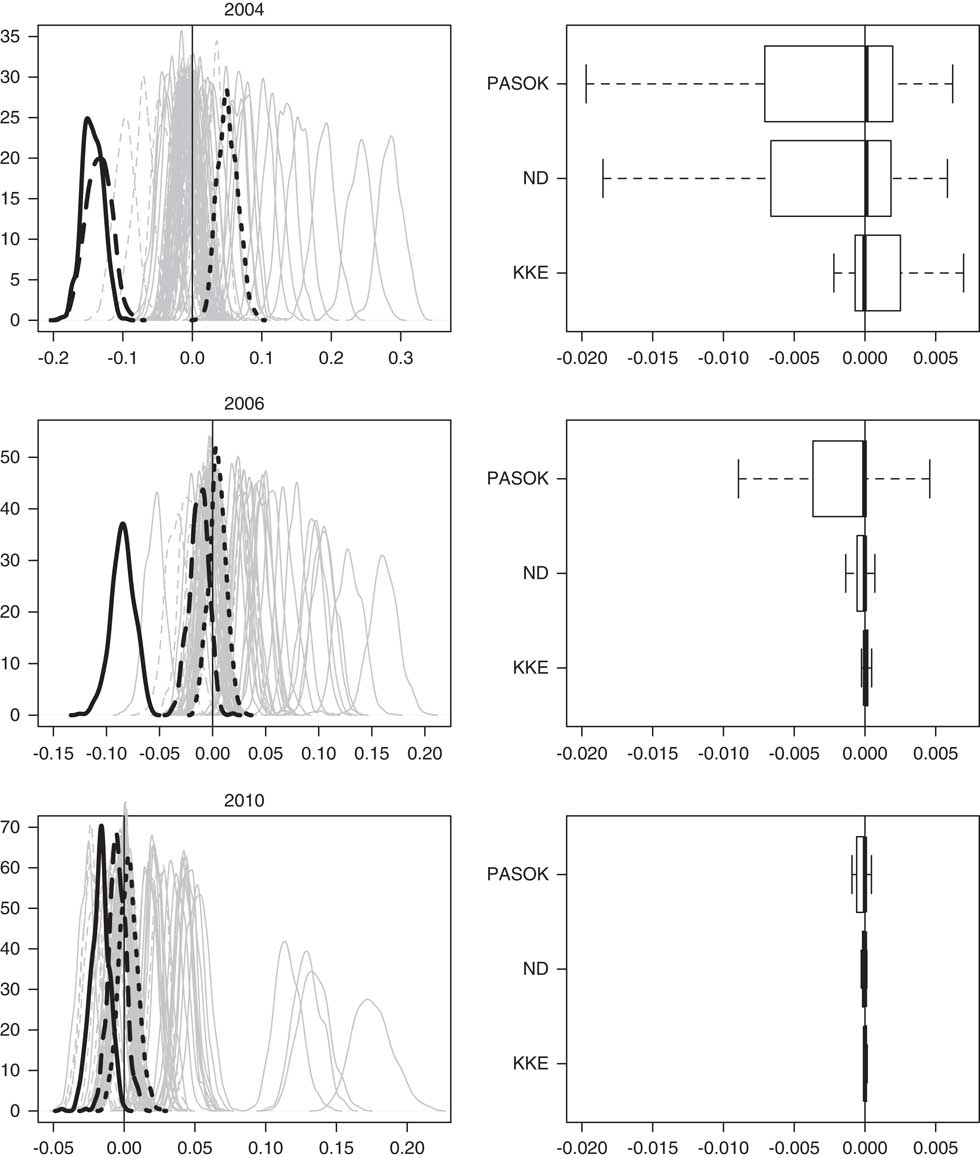
The left side of Figure 1 plots the distributions of posterior positions in the one-dimensional latent space for 2004, 2006 and 2010. There were three main parties in that period: the left-of-center Panhellenic Socialist Movement (PASOK, solid line), the right-of-center New Democracy (ND, dashed line) and the Communist Party (KKE, dotted line).Footnote 57 Non-partisan political actors (for example, police, judges, military) are plotted in dashed gray lines, and societal actors (for example, citizens, unions or protest movements) are plotted in solid gray.
Left side: Posterior latent space estimates for Greece in 2004, 2006 and 2010. Right side: Box-and-whisker plots of each party’s cooperation scores with the societal actors. Note: parties: PASOK (solid line), ND (dashed line), KKE (dotted line). Societal actors in solid gray, non-partisan political actors in dashed gray.

Remember that we can get an expected cooperation score between two actors i and j by computing
 $z_{i}^{\prime} z_{j} $
, the product of their latent positions. This means that actors oriented in a similar direction are cooperative with each other, whereas those that are conflictual with each other will be on different sides of the zero point. Because the term is invariant to rotation, the numerical values of actors’ latent positions should not be interpreted by themselves: the product of the latent positions of two actors conveys the relevant information. Note that this is different from dimensionality reduction methods based on the spatial proximity model.Footnote
58
It is not important whether an actor has a positive or negative latent position; what matters is that they tend to have cooperative relations with actors on the same side, but conflictual ones with those on the other side of the origin. The right side of Figure 1 shows box-and-whisker plots of each party’s cooperation scores with the societal actors.
In 2004, PASOK (solid line) has high cooperation scores with the societal actors that also have a negative latent position, in particular those that have large negative values. The cooperation score is low between PASOK and the societal actors with positive latent positions. The box-and-whisker plot demonstrates that PASOK has highly cooperative relations with some societal actors, but highly conflictual ones with others. The same is true of the ND, and to a lesser extent the KKE. A similar, although somewhat muted, structure is repeated in 2006.
By contrast, the pattern of political representation is very different during the financial crisis in 2010. The latent positions show all three parties clustered together around the neutral point, while many societal actors have large positive or negative latent positions. If parties were representing these actors, some of them would be located more to the left, and others more to the right. Instead, parties are not particularly cooperative with any societal actor, so the polarizing conflict within society is unrepresented in the political system. On the flip side, because they are clustered in the center of the social space, the parties were not in conflict with many societal actors. This can be clearly seen in the box-and-whisker plot, which is compressed around the origin for all three parties. At least in Greece, the societal polarization that came with the Great Recession was not reflected by the existing political parties, much in the way the anecdote at the beginning of this article suggests. Instead, there was a ‘compression’ of political representation in public communication.
Regression Results
Does the effect found in the previous section systematically hold for the entire eurozone, and when controlling for potential confounders? We are interested in how well a party i represents a societal actor j, both from country c in year t.Footnote
59
I therefore create a dependent variable
 $$y_{{ijct}} \,{\equals}\,z_{{ict}}^{\prime} z_{{jct}} $$
, which is the multiplicative effects term for all possible combinations of parties and societal actors using the latent space for a given country-year. The term will be positive when both are oriented in the same direction (on the same side of the origin), indicating that i represents j well. The term is negative if they are on different sides of the origin, meaning that i does not represent j well in the political arena.
The standard approach would be to regress this dependent variable on an indicator of the state of the economy and a set of controls. This would give us the average effect of the economy on how well parties represent societal actors. But representation is not about averages. A political party has groups it is closer to and whose interests it represents, and a party has societal groups it is in conflict with, and whose interests it does not represent. The question therefore is: did the eurozone crisis change how parties represent the groups they are close to? And did it change parties’ relationships to groups they stand in opposition to? To analyze these questions, I use a quantile regression of the following form:
 $$Q_{\tau } \left( {y_{{ijct}} } \right)\,{\equals}\,\alpha _{\tau } {\plus}\beta _{\tau } g_{{ct}} {\plus}\mu _{\tau } X_{{ct}} {\plus}{\epsilon}_{{ijct}} $$
where Q τ is the quantile function of the dependent variable at quantile τ. The main independent variable is annual GDP per capita growth g ct , the most commonly used measure for economic conditions in the literature. X ct is a vector of controls that vary across time and space: population size, trade openness (imports plus exports as a percentage of GDP), whether a national election was held in that year, the number of parties for which the latent positions were estimated and the number of events in the data.Footnote 60 Finally, I include the mean cooperation score in the latent network for country c in year t. This addresses potential concerns about the comparability of the separately estimated latent spaces.
I estimate Equation 3 for τ∈{0.01, 0.05, 0.25, 0.50, 0.75, 0.95, 0.99}. A low τ indicates a low quantile in the distribution of y ijct , so it will capture relations of a party with a societal group it is not very close to. A high τ captures the relations of parties with groups it represents well. In the previous section, there was evidence that in Greece, the Great Recession compressed representation: parties were less close to the groups they represent most, and closer to the ones they are most conflictual with. If this pattern holds in general, we expect β τ to be negative when τ is small, and positive when τ is large. To take into account that the cooperation scores are based on estimated latent positions, I derive the dependent variable separately for all 500 posterior draws of a latent space. Each is regressed on GDP per capita growth and the control variables, and I then combine the results from these estimations.Footnote 61
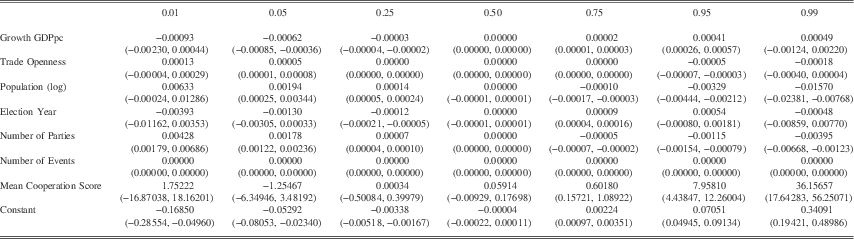
Table 1 shows the results of the quantile regression. The first column shows how economic conditions affect the degree to which political parties represent the societal actors for which they have very low representation scores (1st percentile). That is, these are the societal actors they are most likely to have conflictual relations with. As hypothesized, the point estimate of GDP per capita growth is negative. However, the 95 per cent confidence interval includes zero. This is an important first finding, suggesting that an economic crisis does not necessarily change how a party represents the societal groups it is most opposed to.
Effect of Economic Conditions on the Expected Cooperation Score between Political Parties and Societal Groups

Note: quantile regression based on 24,579 observations. 95 per cent confidence intervals in parentheses.
When looking at the 5th and 25th percentiles, however, the point estimates of GDP per capita growth are negative and the confidence intervals do not include zero. This is consistent with the expectation laid out above: the better the economy, the less parties represent those groups. In other words, during bad economic times, parties are more representative of groups they are generally in conflict with, and the substantive effect is quite large. The 5th percentile of the dependent variable is about −0.00635, and the point estimate is −0.00062. This means that a one-percentage-point decrease in economic growth increases the expected representation score by more than 9 per cent.
The fourth column shows the results for the 50th percentile. The point estimate is close to zero, so economic conditions have no effect on how parties represent societal groups they are neither particularly close to nor especially in conflict with. Finally, the last three columns show how growth affects the way political parties represent societal actors for which they have higher representation scores. Here, the effect is positive. The better the economy, the more parties represent the groups to which they are closest. This means that during a recession, they are less representative of core constituents. The substantive effect is somewhat smaller than the one at the other end of the distribution. The 95th percentile of the dependent variable is 0.00783 and the point estimate is 0.00041, so a one-percentage-point decrease in economic growth decreases the expected representation score by roughly 5 per cent. Finally, the point estimate for the 99th percentile is negative, but the confidence interval includes zero.
These findings highlight the importance of using a regression that estimates different effects for different parts of the distribution of the dependent variable. In a regular model that estimates the average impact, the positive and negative effects cancel each other out. This would lead us to wrongly conclude that economic growth has no impact on the representation score. However, the quantile regression confirms that it did, and that the ‘compression’ found for Greece in the descriptive analysis holds for the eurozone as a whole.
Note that I show the effect of GDP per capita growth on political representation and interpret this as the consequence of the Great Recession. In the Online Appendix, I justify this by showing that much of the variance in the growth data is a consequence of the crisis. Furthermore, I show descriptively that the variation in the cooperation scores drops sharply (is compressed) for almost all countries, particularly for those most affected by the recession (Greece, Portugal, Ireland, Spain). Thus during the Great Recession, parties’ relationships with the societal groups they are most cooperative with became less cooperative, while their relationships with the groups they are most conflictual with became less conflictual.
Fixed Effects Regression Results
One worry with estimating Equation 3 is that there might be unobserved or unmeasured characteristics that affect the way political parties represent societal actors through their public interactions. To account for many of them, I re-estimate the quantile regressions using fixed effects. First, I add a set of country fixed effects. They remove all observed and unobserved time-invariant heterogeneity between countries, so no variance across units remains. The effect of economic growth thus only captures changes within countries over time. Secondly, I add country and year fixed effects. The coefficients then capture differences in how the countries were affected by the economy, relative to the country’s baseline level of growth and relative to everyone else in the eurozone at the same time.
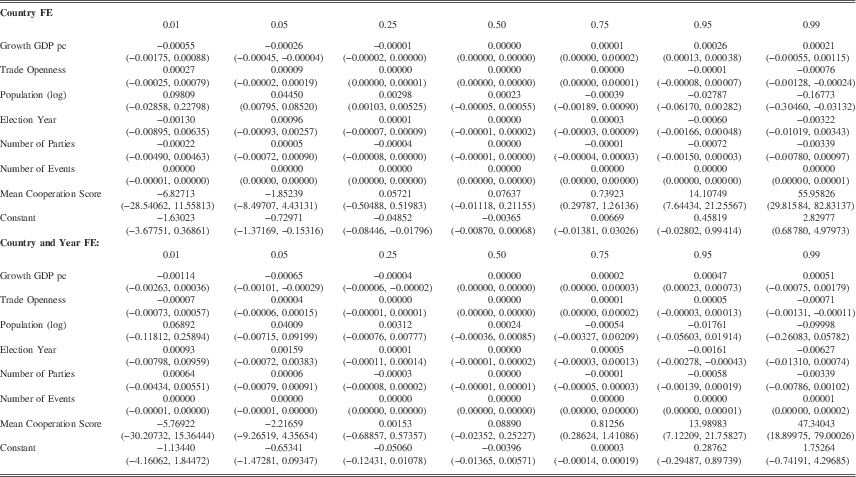
The upper panel of Table 2 shows the results of estimating the quantile regression with country fixed effects. The substantive findings are very similar to the ones above. For the 5th and 25th percentiles, the coefficients are negative and significantly different from zero. For the 75th and 95th percentiles, the effect is again positive. Note that the coefficients are smaller in absolute size than in Table 1, by roughly a factor of one-half. Nevertheless, even when controlling for any time-invariant heterogeneity between countries, it holds that the worse the economic conditions, the more parties represent societal groups they are relatively distant from, and the less they represent groups they are close to.
Effect of Economic Conditions on the Expected Cooperation Score between Political Parties and Societal Groups, with Fixed Effects

Note: quantile regression based on 24,579 observations. 95 per cent confidence intervals in parentheses. First table: with country fixed effects. Second table: with country and year fixed effects.
Finally, the lower panel shows the quantile regression using country and year fixed effects. The coefficients for GDP per capita growth again follow the same pattern as before, going from negative for lower quantiles to positive for higher ones. Their magnitudes are comparable to those in the model with no fixed effects. Taken together, the two regressions in Table 2 show that the core finding of this article is robust to controlling for unobserved or unmeasured characteristics between countries and over time.
CONCLUSION
While it has been well established that a national crisis such as a war or terrorist attack tends to disrupt ‘politics as usual’, this article explores how a severe economic recession, such as the one hitting the eurozone in 2008 and after, affects political representation. It is difficult to answer this question using current approaches, since they either rely on data that can only be measured every few years, or are unable to locate politicians and constituents in the same space. I have proposed a method of measuring representation by looking at tens of thousands of public interactions among politicians, between politicians and members of society, and among societal actors. By estimating the network that gives rise to these interactions, the relationship between any two actors can be inferred even if no direct interaction between them is reported. Using this approach, I show that among eurozone countries, the Great Recession led to a ‘compression’ of representation: political parties were less close to the groups they represent most, and closer to the ones they are most conflictual with.
Of course, this approach comes with some caveats. An obvious worry when using data that rely on media stories is reporting bias. For example, larger and economically more powerful countries tend to receive more coverage than small nations. However, because I rely on the ratio of cooperative and conflictual interactions instead of event counts, this should not be of great concern here. In addition, any cross-national differences are absorbed in the fixed effects regressions.
There is also a risk that the findings are driven by a change in the way societal interactions are reported. While I cannot exclude the possibility that the media selectively suppressed conflictual interactions among political actors and instead reported more cooperation at the height of the Great Recession, such a pattern is inconsistent with the truism that ‘bad news sells best’. If the crisis had led partisan politicians to represent societal conflicts in a more amplified manner than usual, one would expect media outlets to happily focus on this. Potential changes in the way the media covered events should thus bias against the results found here.
The article suggests a number of avenues for future research, related to both the substantive results and the methodological approach. The data used here end in the aftermath of the crisis in 2011. In the following years, traditional political parties recorded significant losses in elections, and new parties such as Syriza and Golden Dawn in Greece or Podemos and Ciudadanos in Spain have emerged and achieved electoral success. This loss of trust in the established parties among voters is consistent with the results of this study and raises an important question for future research: does the way established parties represent (or rather do not represent) societal groups in their public interactions predict the success of new parties?
While consistent with other research about the impact of crises on political interactions, the findings presented here may appear counterintuitive. In times of scarce resources, we might expect politicians to increase their efforts to advocate the interests of their constituents. This is particularly true since we know that voters punish politicians for poor economic performance if they can identify who is responsible.Footnote 62 This gives political actors incentives to blame each other in times of crisis. Why did this apparently not happen here? One possible answer is that the eurozone is a union in which a common economic space overlaps with several political jurisdictions. Mair has argued that mainstream European parties have moved away from being ‘responsive’ to their domestic constituents and are instead ‘responsible’ in that they follow the demands of international actors such as the European Union, especially in times of crisis.Footnote 63 One possibility is that political cooperation and conflict in the union has two dimensions: within and between countries. In future research, I will use the approach presented in this article to examine whether political conflict within countries was replaced by conflict between the eurozone members during the recession.
This raises a related question about the scope of the findings. The eurozone is special in a number of ways, and one should not conclude that politicians always react to poor economic growth in the way documented in this study. In recessions that are less severe, or that can be more clearly traced to domestic causes, the motivation to assign blame for economic mismanagement and to represent one’s own constituents may dominate the compression effect. Thus in order to define the scope conditions of the present findings, future research should investigate patterns of cooperation and conflict in economic downturns that were less severe or less global in nature.
Finally, the article has introduced a novel way to study public communication as an important aspect of political representation. It has several advantages over existing empirical approaches, in particular that it uses continuously produced source data and that it locates ‘representers’ and the ‘represented’ in a common space. This opens many avenues for future research. The data may provide novel insights for long-standing research programs, for example on elite polarizationFootnote 64 and its effects on mass polarization,Footnote 65 citizens’ information environment about politicsFootnote 66 or democratic satisfaction. Extending the latent space analysis of public interactions to a larger number of countries will provide a wealth of new information to explain and be explained.