The prevalence of different types of child maltreatment across the globe was recently estimated at 13%–36% (the lower estimate for sexual abuse, the higher estimate for emotional neglect) in a meta-analytic survey of 244 publications and 551 prevalence rates (Stoltenborgh, Bakermans-Kranenburg, Alink, & van IJzendoorn, Reference Stoltenborgh, Bakermans-Kranenburg, Alink and van IJzendoorn2015). For the most recent American data available (2016), the Centers for Disease Control and Prevention estimated the total lifetime cost of child abuse and neglect, arising from the annual evidence, as $124 billion. Wide-ranging public health and social-welfare consequences of child maltreatment were first documented in the landmark report on adverse childhood experiences (ACEs) that is still reverberating through the social and medical sciences as well as public policy domains (Felitti et al., Reference Felitti, Anda, Nordenberg, Williamson, Spitz, Edwards and Marks1998), with many follow-on publications from this group more finely specifying the devastating health consequences of exposure to four or more ACEs in the first 18 years of life (e.g., Dube et al., Reference Dube, Felitti, Dong, Chapman, Giles and Anda2003). Cicchetti (Reference Cicchetti2013) reviewed the substantial risks to the psychological and physical health of children and families, as well as the economic costs to society, that follow from failing to intervene, or failing to intervene successfully. In brief, the consequences of parent–child maltreatment extend far into the future, with well-known hard-to-break cycles of risk across generations that predict poverty, crime, psychological distress, and physical illness in adults who as children were maltreated (Caspi, Moffat, Newman, & Silva, Reference Caspi, Moffitt, Newman and Silva1996; Dube et al., Reference Dube, Felitti, Dong, Chapman, Giles and Anda2003). Correspondingly, maltreatment prevention interventions have been developed and applied, yet a focus on the factors that moderate the effectiveness of these interventions has not been a consistent focus of investigation. The current report aims to provide evidence of a recently developed maltreatment prevention attachment-based intervention for vulnerable mothers and their children under 3 years of age, while also attending to the possibly moderating factor of mothers’ prior exposure to ACEs in the first 18 years of life.
The maltreating environment is likely to include parental behavior that is unsupportive and hostile, with consequent parent–child interactions characterized by a lack of emotional expressiveness or constriction and a lack of reciprocity. Reciprocity is the focus of a recent report on parent–child relationships over the first 10 years of life where optimal patterns of behavioral and physiological regulation are shown to be linked to parent–child relationship patterns rated high for reciprocity, give-and-take, with shared positive affect (Feldman, Reference Feldman2015). The developmental sequelae of maltreatment impacts children at multiple levels of functioning in terms of biological, cognitive, and social- emotional functioning, with not only long-lasting severe adversity but also identifiable patterns of resilient functioning (Cicchetti, Reference Cicchetti2013). An attachment perspective highlights the role the caregiver may have in promoting resilience in children by providing caregiving that is low on hostility, high on supportive presence, while having dyadic or relational parent–child characteristics that are seen to be low in tension or constriction, and high in reciprocity. This paper reports on a randomized control trial (RCT) that aimed to show how a relational multifamily maltreatment prevention intervention could promote these very signs of resilience in vulnerable parents and their children at risk of maltreatment.
The surest antidote to child maltreatment is the development of healthy caregiving contexts. There are numerous interventions focused on these dual interrelated goals, decreasing maltreatment and improving the parent–child relationship. There is an urgency for establishing evidence-based support for the treatment of child maltreatment as underlined by a recent meta-analytic report that has suggested a lack of efficacy for intervention programs (Euser, Alink, Stoltenborgh, Bakermans-Kranenburg, & van IJzendoorn, Reference Euser, Alink, Stoltenborgh, Bakermans-Kranenburg and van IJzendoorn2015). The current study reported here focuses on a fresh approach to addressing the risk of child maltreatment, the Group Attachment-Based Intervention (GABI), an intensive multifamily program. We have previously reported promising results from a single-group open-enrollment trial (Steele, Murphy, & Steele, Reference Steele, Murphy and Steele2010) pointing to a diminishment in attachment disorganization and promotion of family preservation. The baseline characteristics of the first 60 families enrolled in this RCT have been reported, detailing the rationale and structure of the GABI treatment model (Murphy et al., Reference Murphy, Steele, Bate, Nikitiades, Allman, Bonuck and Steele2015). Given the high prevalence of trauma in the background of parents thought to be at risk of maltreating their children, there is a need to consider the possible moderating role that past trauma exposure may have on the efficacy of child maltreatment prevention efforts. In other words, parents’ past experiences of the very problem the intervention is aiming to prevent (child maltreatment) may complicate efforts to intervene effectively (Agnew-Blais & Danese, Reference Agnew-Blais and Danese2016). Reports of therapy with vulnerable mothers and their children, in both attachment-based interventions (Moran, Pederson, & Krupka, Reference Moran, Pederson and Krupka2005) and therapy based on social learning principles (Routh, Hill, Steele, Elliott, & Dewey, Reference Routh, Hill, Steele, Elliott and Dewey1995), have found therapeutic effectiveness impeded or attenuated by participating mothers’ unresolved loss or trauma. For these reasons, the present report measures and tests the moderating effect, on treatment outcome, of the parent's exposure to abuse and household dysfunction (ACEs) in the first 18 years of the parent's life.
A characteristic feature of attachment-based interventions aimed at preventing child maltreatment is the explicit use of the theory and research underpinning an attachment perspective. Initiated by Bowlby and Ainsworth, parent–infant attachment is seen as a part of the biological, emotional, and cognitive properties of the infant who seeks proximity to an attachment figure especially in times of distress (Ainsworth, Blehar, Waters, & Wall, Reference Ainsworth, Blehar, Waters and Wall1978; Bowlby, Reference Bowlby1982/1969). Efficacy studies of attachment-based interventions typically rely on observational measures of the parent–child relationship, including maternal sensitivity and relationship characteristics, as primary outcome measures. These interventions with a strong evidence base vary across several important clinical dimensions ranging from a focus on the parent or both parent and child, home visiting or clinic context, the use of video as a clinical tool, and whether delivered to individual dyads or in a group format.
One of the most widely disseminated and well-validated interventions to prevent child maltreatment and enhance parent–child relationships is child–parent psychotherapy (CPP; Lieberman, Ghosh Ippen, & Van Horn, Reference Lieberman, Ghosh Ippen and Van Horn2006; Toth, Maughan, Manly, Spagnola, & Cicchetti, Reference Toth, Maughan, Manly, Spagnola and Cicchetti2002), which is typically delivered to a parent and child in a clinical setting. Working directly with the unfolding interactions between parent and child in real time, CPP has been shown to be efficacious in five RCTs including positive outcome findings from independent research teams (e.g., Toth, Michel-Petzing, Guild, & Lieberman, Reference Toth, Michl-Petzing, Guild, Lieberman, Steele and Steele2018.) The widely disseminated Nurse–Family Partnership is a home visiting program (Donnelan-McCall & Olds, Reference Donnelan-McCall, Olds, Steele and Steele2018; Olds, Reference Olds2006; Olds, Henderson, Tatelbaum, & Chamberlain, Reference Olds, Henderson, Tatelbaum and Chamberlin1986) applied widely over several decades with empirical support, with regard to improved health outcomes, from three RCTs and from a 19-year follow-up study postintervention (Eckenrode et al., Reference Eckenrode, Campa, Luckey, Henderson, Cole, Kitzman and Olds2010). Other attachment-based interventions delivered in the home that have shown positive outcomes in terms of improved levels of maternal sensitivity and more secure parent–child relationships include the Attachment and Biobehavioral Catch-Up model (Dozier, Bernard, & Roben, Reference Dozier, Bernard, Roben, Steele and Steele2018; Dozier, Lindhiem, & Ackerman, Reference Dozier, Lindhiem, Ackerman, Berlin, Ziv, Amaya-Jackson and Greenberg2005), the Minding the Baby intervention, which addresses parents’ complex trauma (Slade et al., Reference Slade, Simpson, Webb, Albertson, Sadler, Close, Steele and Steele2018), as well as the Attachment Video-Feedback Intervention of Moss et al. (Reference Moss, Dubois-Comtois, Cyr, Tarabulsy, St.-Laurent and Bernier2011) showing robust findings.
An increasing number of interventions include the use of video, relying on examples of stock parent–child interactions to illustrate central features of what the intervention aims to teach, or video footage is captured of participating parents and children as a means to promote observational skills in parents and activate the capacity for positive change. Prominent examples include Steps Toward Effective, Enjoyable Parenting (Erikson & Egeland, Reference Erickson and Egeland2004; Suess et al., Reference Suess, Erickson, Egeland, Scheuerer-Englisch, Hartmann, Steele and Steele2018), Circle of Security (Hoffman, Marvin, Cooper & Powell, Reference Hoffman, Marvin, Cooper and Powell2006; Woodhouse, Powell, Cooper, Hoffman & Cassidy, Reference Woodhouse, Powell, Cooper, Hoffman, Cassidy, Steele and Steele2018), and Attachment Video-Feedback Intervention (Moss et al., Reference Moss, Tarabulsy, St.-Georges, Dubois-Comtois, Cyr, Bernier and Lecompte2014, Reference Moss, Taraabulsy, Dubois-Comtois, Cyr, Bernier, St.-Laurent, Steele and Steele2018). The most extensively tested early intervention, with positive significant results (combined effect size d = 0.47, from studies of 1,116 families from 12 RCTs) is the Video-Feedback Intervention to Promote Positive Parenting and Sensitive Discipline (Juffer, Bakermans-Kranenburg, & van IJzendoorn, Reference Juffer, Bakermans-Kranenburg and van IJzendoorn2008). This approach (summarized by Juffer, Bakermans-Kranenburg, & van IJzendoorn, Reference Juffer, Bakermans-Kranenburg, van IJzendoorn, Steele and Steele2018) relies centrally on video feedback. There is a unique power of video feedback when deployed in conjunction with a therapeutic goal, as seeing is believing (Steele et al., Reference Moss, Tarabulsy, St.-Georges, Dubois-Comtois, Cyr, Bernier and Lecompte2014). In addition, this power may be magnified when a parent is provided video feedback in the context of a group with other (peer) parents.
Delivering treatment interventions in groups in general has been found to be of therapeutic value in a range of treatments (McDermut, Miller, & Brown, Reference McDermut, Miller and Brown2006). Not only are group interventions deemed to be cost-effective (Niccols, Reference Niccols2008), but bringing parents with similar challenges together offers unique opportunities for therapeutic action. Participants and their peers, through observing and interacting with one another, can experience mutual support particularly via noticing and commenting on others’ parenting skills, which can create nurturing peer relationships and instill hope that was not previously there (Yalom, Reference Yalom1998). Group formats have also been shown to be especially effective in engaging participants from diverse backgrounds who perceive group treatments as less stigmatizing, which may impact attendance (Cunningham, Bremner, & Boyle, Reference Cunningham, Bremner and Boyle1995). Several of the attachment-based interventions aimed at ameliorating child maltreatment are provided to a group of parents. These include components of Steps Toward Effective, Enjoyable Parenting (Erickson & Egeland, Reference Erickson and Egeland2004; Suess et al., Reference Suess, Erickson, Egeland, Scheuerer-Englisch, Hartmann, Steele and Steele2018), Circle of Security (Hoffman et al., Reference Hoffman, Marvin, Cooper and Powell2006; Woodhouse et al., Reference Woodhouse, Powell, Cooper, Hoffman, Cassidy, Steele and Steele2018), the New Beginnings program (Baradon et al., Reference Baradon, Sleed, Atkins, Campbell, Fagin, van Schaik, Fonagy, Steele and Steele2018; Sleed, Baradon, & Fonagy, Reference Sleed, Baradon and Fonagy.2013), and Right from the Start (Niccols, Reference Niccols2008).
Group Attachment-Based Intervention (GABI)
The Group Attachment-Based Intervention delivers GABI in a multifamily group-based maltreatment prevention intervention utilizing several of the strategies evident in other attachment-based interventions. The hallmark of the GABI approach is a distinct set of attachment-relevant features delivered in a group context. There is (a) a specified time for parents and children under 3 years of age to interact with one another, (b) a time for parents to interact with other parents while their children experience individual time with their age-mates in the presence of trained clinicians who help them to engage with peers, and finally, and (c) a “reunion” where children and parents are together again for a period of time that signals the end of a 120-min GABI session. These tripartite sessions are offered three times weekly over 26 weeks. Like CPP (typically delivered over 52 weeks), GABI is delivered in a clinic context rather than in a home visit. This is by force of necessity, as many of the families live in uncertain or fragile housing circumstances (e.g., shelters) making home visits difficult to implement with the intensity, flexibility, and frequency of sessions (multiple times per week) that GABI affords. For many parents, the clinic-based multifamily setting for GABI is a welcome refuge.
Video filming and video feedback is an important component to the GABI model. Filming of parent–child sessions is accomplished with two goals: (a) a training goal so that the videos can be reviewed by the clinicians in the room independently before review with a supervisor; and (b) a therapeutic goal of showing back to parents in the parent-only sessions fragments of a given parent interacting with her child, so that some possible meanings of the interaction can be explored. Beyond the integration of video into the training and therapeutic delivery of the model, there are core attachment-based principles informing the model. Parents with their infants and toddlers (birth to 3 years old) attend GABI up to three times weekly for 2 hr, over a 6-month period (at least). The schedule's frequency and consistency provides a secure base for families who may have unpredictable schedules, allowing families more time options to attend due to conflicting appointments. The flexible schedule reflects an understanding of the context in which parents and children live. In general, a trauma-informed approach, vital to the delivery of GABI, favors predictability and structure over rigid rules in order to create a culture of understanding, and thus avoid inducing shame about minor and ordinary events such as missed sessions. Therapeutic attention is thus given to the parent, the child, and the parent–child relationship.
As indicated above in reference to the work of Moran et al. (Reference Moran, Pederson and Krupka2005), one important perspective that interventionists working with trauma-burdened parents ought to take is that of considering the relevant, possibly differing, impact on treatment efficacy that is carried by parents’ differing levels of exposure to past trauma. That is, does the parent with a higher burden of ACEs stand to benefit more or less from a trauma-informed intervention? With respect to the current study, examining the effectiveness of GABI on maternal and child behaviors in a free-play context, we give attention to this question, in addition to the general RCT-related question, that is, does GABI lead to improvements in the mother–child relationship not seen in the control treatment as usual (TAU) group treatment, that is, Systematic Training for Effective Parenting (STEP)?
STEP
STEP was developed in the 1970s, and by 1989 a third edition of the model came into print and has been widely applied (Dinkmeyer, McKay, & Dinkmeyer, Reference Dinkmeyer, McKay and Dinkmeyer1997) across the United States. The STEP intervention model was the most common form of treatment available in the New York City, Bronx neighborhood, at the time where the RCT reported on in this paper was undertaken. Therefore, it was deemed appropriate to consider STEP as the TAU comparison with the novel GABI treatment model. Support for STEP has been provided through largely single-group and quasi-experimental studies, largely undertaken before RCT-standards in psychological research became commonplace (Robinson, Michael, & Dunn, Reference Robinson, Michael and Dunn2003). Typical benefits of STEP include parents perceiving their children more favorably, an increase in parenting skills, and improvements in parents’ perceptions of children's behavior in the home. STEP comprises a 10- to 12-week, once weekly treatment model, with each week building successively on the previous one, and with early topics including anger management, the distinction between discipline and punishment, and role-playing adaptive parenting strategies. Of note, the STEP manual is deemed appropriate for children aged 2–18, and the STEP therapist meets only with the parents, not the children.
The central question informing the RCT concerns the expectation that participation in GABI will lead to significant improvements in the mother–child relationship, not expected in the TAU, STEP control group. To explore this question, we have considered different dimensions of observed mother–child interactions video-recorded at intake and end of treatment. Specifically, we filmed 10 min of free play between parent and child, and this paper concerns reliable scoring of the first 5 min of these free-play sequences using the Coding Interactive Behavior (CIB) system developed by Ruth Feldman (Reference Feldman1998). Four CIB dimensions are included in this report: two dimensions of the CIB that reflect a possible history and risk of maltreatment, (a) maternal hostility and (b) dyadic constriction; and two dimensions that reflect a probable history of sensitive care and probable health and security in the parent–child relationship: (a) supportive maternal presence especially if the child is in need and (b) dyadic reciprocity or turn taking. The results consider this question of possible CIB-related change. At the same time, the results consider whether the burden of mothers’ exposure to ACEs moderates any observed CIB changes.
Method
Sample
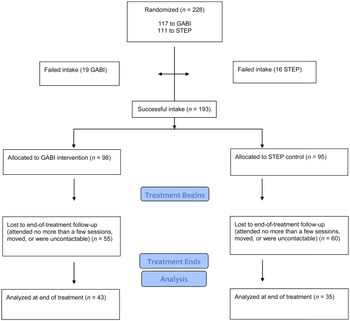
Sample size was determined from prior work demonstrating the effectiveness of an attachment-based maltreatment prevention intervention that diminished attachment disorganization (Cicchetti, Rogosch, & Toth, Reference Cicchetti, Rogosch and Toth2006). A power analysis was conducted with the assumption that attachment disorganization in STEP controls would remain at >80% (typical proportion for maltreated infants) and that GABI's rate would decline to <60% by end of treatment; 35 subjects/group were required to detect this effect with 80% power. Given an expected attrition rate of 30%, we aimed to recruit 50/group. The flow of recruitment and retention/attrition is shown in the consort diagram (Figure 1).
(Colour online) Consort flow diagram for randomized control trial.

Figure 1 reveals that the number of families retained from initial randomization (n = 228), through clinical intake, research baseline observations, and to end of treatment was 78 (n = 43 in GABI and 35 in STEP). Families were randomized in two blocks of 8, stratified by child age less than versus greater than 18 months of age, with 57% of children being under 18 months of age, and the remainder (43%) over 18 months but under 3 years of age. As shown in the consort diagram, n = 117 were randomized to GABI and n = 111 to STEP. Figure 1 reveals that retention from allocation to end of treatment was 37% for families assigned to GABI and 32% for families assigned to STEP. In other words, attrition rates were high (63% for GABI and 68% for STEP), more than twice the level expected. Failed intakes and attrition was due mainly to housing instability with families moving and becoming uncontactable.
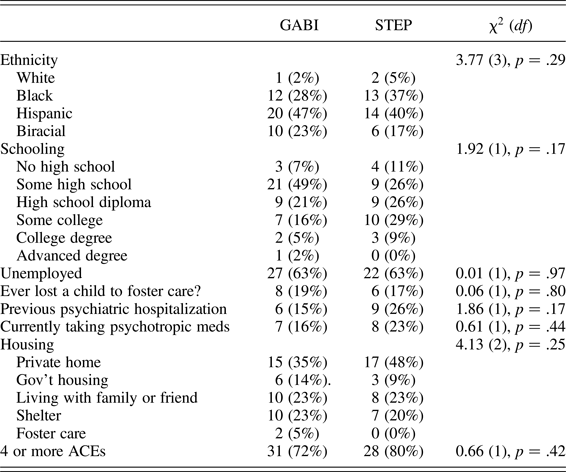
Table 1 summarizes the sociodemographic characteristics of the mothers who were in the GABI or STEP arm who were followed from intake to end of treatment. Table 1 reveals an ethnically diverse sample, with >90% identifying as Black, Hispanic, or biracial; two-thirds of the parents were unemployed; and nearly 20% had previously lost a child to foster care. About half lack stable housing, and are living in a shelter or have temporary housing arrangements with a family or friend. Table 1 also shows that the majority of parents have a high school diploma or less schooling. In terms of the demographic characteristics shown in Table 1, no significant differences were observed when comparing mothers from one arm with the other arm of the RCT. This is clear from the column with the chi square results from cross-tabulations of group membership (GABI vs. STEP) with the shown demographic groupings. As Table 1 shows, all comparisons were nonsignificant. This nonsignificance of comparison across treatment groups holds as well for the reported incidence of ACEs (72% of mothers in GABI and 80% of mothers in STEP reported four or more ACEs). It may be concluded that randomization worked. Of note, this high ACE (four or more) threshold was observed in less than 10% of the original ACE sample recruited from a large middle-class sample of more than 17,000 individuals by Felitti et al. (Reference Felitti, Anda, Nordenberg, Williamson, Spitz, Edwards and Marks1998), revealing the remarkably high burden of past trauma carried by the vast majority of mothers in both arms of the RCT.
Maternal demographics at baseline, by treatment group

Note: Schooling groups were collapsed for the χ2 analysis into those with high school diploma or less versus those with some college through an advanced degree.
Design
The study was undertaken in the Bronx, the nation's poorest urban county; its poverty rate among families and children is twice the state and national averages. Bronx residents are also young; the Bronx is the youngest county in New York, and 1 of only 5 in the United States with >30% single-family households. The main criterion for inclusion in the RCT was concern about parenting capacity (vs. evidence of symptomology in the child) due to the parent's own history of maltreatment, social isolation, or having lost custody of a child in the past. Referrals came from Pediatrics, Child Welfare, and Court Systems throughout the Bronx. Criteria for inclusion were (a) biological parents of (b) birth–36-month-old children with custody of their child. Exclusion criteria were (a) parent inability to provide informed consent due to mental illness or cognitive impairment and (b) parent lacks fluency in English.
The RCT was conducted at the Rose F. Kennedy Children's Evaluation and Rehabilitation Center (RFK CERC) in the Bronx, New York, from 2012 to 2017. Families who declined study participation were still eligible for RFK CERC services. This study was approved by the Einstein Committee on Clinical Investigations, and by the Human Research Protection Program at the New School for Social Research.
Interested parents were screened and, if eligible, scheduled for a study visit to be consented, complete baseline questionnaires, and be randomized. For randomization, research staff opened sealed envelopes that allocated participants in a 1:1 ratio to treatment (GABI or STEP control) groups, stratified by child age (less than vs. greater than 18 months). Parents and children were then scheduled for a visit to the New School's Center for Attachment Research, a university laboratory (in Manhattan) for baseline behavioral observations and recording. Assessors (and coders) of parent, child, and dyadic outcomes (CIB scoring) were masked to treatment group and time (baseline vs. end of treatment). Participants received a $50 incentive after each visit.
Measures
CIB (Feldman, Reference Feldman1998, Reference Feldman2010)
This instrument assesses maternal behavior, child behavior, and the quality of mother–child interaction based on an observation of 5 min of free play, typically the first 5 min of a 10-min observation. While 43 discrete 5-point scales were applied to maternal, child, and dyadic behaviors, this report focuses on four scales that relate most directly to the risk of child maltreatment, on the one hand, and to a healthy secure and well-functioning parent–child relationship, on the other hand. These are the Feldman (Reference Feldman1998) scales measuring (a) maternal hostility (refusal to play, avoidance, or snide comments) and (b) dyadic constriction (a paucity of emotional expressiveness, and poor coordination between partners), as well as (c) maternal supportive presence (parent provides to child a secure base) and (d) dyadic reciprocity (a feeling of synchrony and mutual dance is evident). CIB coding groups were led by a senior PhD student (A.N.) and a postdoctoral researcher (V.B.), each trained by Ruth Feldman, and each having passed a posttraining reliability test. The coding groups comprised 5–8 MA and PhD students working with A.N. and/or V.B. Internal consistency estimates, equivalent to average intraclass correlation estimates, arrived at by the individual contributions made to the coding groups were consistently high both for intake videos (median α = 0.88, range = 0.84–0.94) and for end-of-treatment videos (median α = 0.85, range 0.81–0.90).
ACEs
Maternal reports of their own exposure to ACEs was collected at baseline, relying on a 25-item clinician-administered version of the Clinical Adverse Childhood Experiences Questionnaire, a widely used and previously validated questionnaire (Felitti et al., Reference Felitti, Anda, Nordenberg, Williamson, Spitz, Edwards and Marks1998), assessing the adult's recollection of exposure to traumatic events and circumstances over the first 18 years of life (Murphy et al., Reference Murphy, Steele, Steele, Allman, Kastner, Dube and Briggs2016). ACE questionnaire scores range from 0 to 10, depending on levels of agreement to five forms of abuse (physical, psychological, sexual abuse, physical neglect, and emotional neglect) and five forms of household dysfunction (parent mentally ill, incarcerated, drug addicted, domestic violence, and separation/divorce). Exposure to four or more of these ACEs has been shown to have associations to all range of adult psychological and physical health problems. We have demonstrated the validity of our clinician-administered version of the ACE questionnaire in association to the parenting domain, for example, in showing a significant association between parents with four or more ACEs and parents with unresolved loss or trauma or cannot classify responses to the Adult Attachment Interview (Murphy et al., Reference Murphy, Steele, Dube, Bate, Bonuck, Meissner and Steele2014). We have also shown a significant link between parents with exposure to four or more ACEs in the first 18 years of their life and clinical levels of parenting stress, in both low socioeconomic status and high socioeconomic status contexts (Steele et al., Reference Steele, Bate, Steele, Dube, Danskin, Knafo and Murphy2016). For the present study, we rely on the binary distinction between self-reported exposure to low (fewer than four) or high (four or more) ACEs in one's first 18 years of life to consider whether high exposure moderates responsiveness to the maltreatment prevention interventions tested in the RCT.
RCT treatment arms
GABI©, a 26-week manualized maltreatment prevention intervention described elsewhere in detail (Murphy et al., Reference Murphy, Steele, Bate, Nikitiades, Allman, Bonuck and Steele2015; Steele, Steele, Bonuck, Meissner, & Murphy, Reference Steele, Steele, Bonuck, Meissner, Murphy, Steele and Steele2018) and summarized below, aims to strengthen parent–child attachment in biological parents and their birth to 3-year-old children. Each 2-hr session begins with a 45-min dyadic parent–child psychotherapy session delivered in a group context. Next, parents and children separate into concurrently run 60-min group sessions. Each session ends with a final group 15-min parent–child reunion. GABI was offered three times weekly for 2 hr in the morning or afternoon (6 sessions/week). GABI offers families 24/7 text access to on-call clinicians to consolidate family engagement by helping to address the contextual sources of stress the families face.
The parent group component of GABI (when children have their own separate group) is the place where weekly video feedback sessions take place (Steele et al., Reference Moss, Tarabulsy, St.-Georges, Dubois-Comtois, Cyr, Bernier and Lecompte2014). For the current trial, each mother received between one and three occasions of viewing 45 s to 60 s of video showing herself interacting with her toddler in a benign sequence chosen by the clinical and research team. Discussion of what is seen on the video proceeds in the context of privileging the parent who was filmed, and honoring the potential of the parent–child relationship to thrive. For the current report, variation in mothers’ receipt of the video-feedback experience in parent group sessions was unrelated to their ACE scores or to treatment outcome measures.
The GABI clinical approach derives much of its heuristic power from its grounding in carefully observed clinical processes. Clinical evidence of therapeutic action and elaboration of the GABI model as a vehicle to promoting change in parent–child relationships was established through filmed observation of clinical practice. We reviewed over 5 years of video footage collected during the single-group open-enrollment stage of the study (Steele, Murphy, & Steele, Reference Steele, Murphy and Steele2010), including over 500 hr of film, in order to identify moments of therapeutic action and conceptualize a treatment manual to guide the training and implementation of GABI (Murphy, Steele, & Steele, Reference Murphy, Steele and Steele2012).
Just as GABI clinicians were trained to follow the GABI manual, clinicians delivering STEP were trained to reliably follow the STEP manual. GABI training begins with a 2-day didactic, followed by 6 months of co-leadership and supervision. Competence was monitored monthly via fidelity checklists developed and applied in both the STEP and GABI treatment groups: 80% or better fidelity ratings were consistently achieved.
Participants in the control group were assigned to attend STEP (Dinkmeyer, McKay, & Dinkmeyer, Reference Dinkmeyer, McKay and Dinkmeyer1997) once weekly (over 10–12 weeks) parenting class. At the time, STEP was the prevailing maltreatment education program in the study locale, with a set series of parenting lessons, including anger management, social learning approaches to parenting, and guidance on how to deflect and prevent domestic violence. Early Childhood STEP programs produced clinical evidence of reductions in parenting stress and improvements in parent reports of child behavior in vulnerable families of 1- to 36-month-olds (Huebner, Reference Huebner2002; Robinson et al., Reference Robinson, Michael and Dunn2003).
Results
A series of one-way analyses of covariance (ANCOVA) results were computed in order to determine statistically significant differences in maternal or interactive behavior qualities that may exist between the two treatment groups (GABI vs. STEP) at end of treatment, controlling for baseline observed maternal or interactive behaviors. In addition, the ANCOVA models considered as a second independent variable the mothers’ reported levels of ACEs to which they were exposed in the first 18 years of their lives, dichotomized into ACE scores less than 4 versus 4 or greater. Maternal behavior results are presented first, followed by dyadic or interactive behavior results. Tables include not only results of main effects and interactions (F values and degrees of freedom) but also partial η2 values that indicate effect sizes (Cohen, Reference Cohen1988; Open Science Collaboration, 2015: small = .02; medium = .13; and large = .26). For the four one-way ANCOVA results reported below, Levene's tests were first computed to be confident that assumptions of normality were met. Tables also include for the treatment groups (GABI or STEP) the observed and adjusted means, and standard deviations. Where an interaction of treatment group by ACE group is found to be significant, the relevant adjusted means difference for the ACE subgroups at end of treatment, standard error of difference, and 95% confidence intervals are also provided in the tables. Each table also includes the overall estimate of the covariate (i.e., intake CIB mean) to which the end-of-treatment means, for the two treatment groups, are being compared.
Maternal behavior results
Maternal supportive presence
First, a one-way ANCOVA was conducted to determine if mothers participating in GABI would show a significantly greater increase in “maternal supportive presence,” as compared to mothers participating in the TAU comparison group STEP, controlling for baseline levels of “maternal supportive presence.” The ANCOVA model also considered the possible main and interaction effects of maternal reports of exposure to ACEs (low vs. high) during the first 18 years of their lives. Results are presented in Tables 2.1, 2.2, and 2.3.
Descriptive statistics for T2 maternal supportive presence

Note: Overall adjusted mean at T1 = 2.72.
ANCOVA summary for maternal supportive presence T2 by treatment group, adverse childhood experiences (ACEs), and group by ACEs with T1 maternal supportive presence as a covariate

Note: R 2 = .21 (Adjusted R 2 = .16). **p < .01. ***p < .001.
Mean differences in maternal supportive presence by treatment group

Results (see Table 2.2) revealed a significant main effect of treatment group, after controlling for baseline “maternal supportive presence” levels, F (1, 73) = 9.50, p < .05; partial η2 = .12. As Table 2.3 shows, mothers in GABI scored 0.68 higher than mothers in STEP (GABI = 3.35, STEP = 2.68, with the covariate in the model for maternal supportive presence at baseline being 2.72). In other words, for mothers in GABI, their scores for supportive presence increased, compared to intake, and to mothers in the STEP treatment, who showed on average a decrease in supportive presence. Table 2.2 also reveals that there was no significant main effect of ACEs (F = 0.17, ns; partial η2 = .00), nor was there any significant Group × ACEs interaction (F = 1.62, ns).
Maternal hostility
Second, a one-way ANCOVA was conducted to determine if mothers participating in GABI would show a significant decrease in the proxy for maltreatment, that is, maternal hostility, as compared to mothers in the control STEP group, while controlling for baseline maternal hostility levels. The ANCOVA also considered the possible main and interaction effects of low versus high maternal experiences of ACES during their own childhood. These results are shown in Tables 3.1, 3.2, and 3.3.
Table 3.2 shows a main effect of group, after controlling for baseline levels of hostility at intake, F (1, 73) = 3.82, p < .05. Inspection of the adjusted mean scores shown in Table 3.1 and 3.3 reveals that mothers who participated in GABI showed, at end of treatment, 0.48 lower levels of hostility than mothers who participated in STEP (GABI = 1.52, STEP = 2.00, and the covariate in the model for maternal hostility at baseline was evaluated at 1.71). In other words, mothers in GABI displayed less hostility, as compared to prior to treatment while mothers in STEP showed more hostility at end of treatment. Table 3.2 also reveals no significant main effect of ACES (F = 0.94, ns), and no significant interaction effect of Group × ACEs (F = 0.01, ns).
Descriptive statistics for T2 maternal hostility

Note: Overall adjusted mean at T1 = 1.71.
ANCOVA summary for maternal hostility T2 by treatment group, adverse childhood experiences (ACEs), and group by ACEs with T1 maternal hostility as a covariate

Note: R 2 = .13 (Adjusted R 2 = .08). *p < .05.
Mean differences in maternal hostility by treatment group

Mother–child interactive behavior results
Dyadic constriction
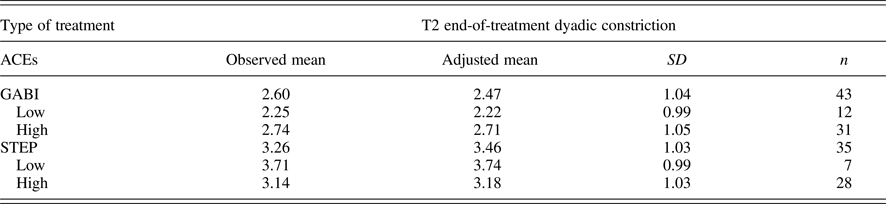
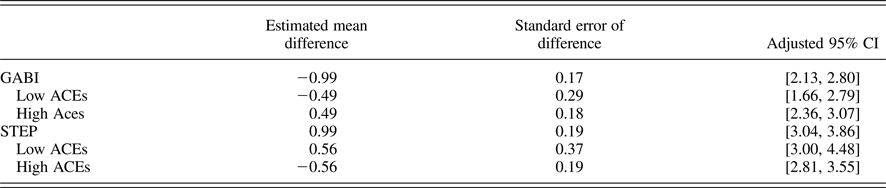
A one-way ANCOVA was conducted to determine if mothers participating in GABI would show a significant decrease in the relationship variable thought to be a proxy for maltreatment tendencies, that is, dyadic constriction, as compared to mothers in the TAU STEP group, while controlling for baseline levels of dyadic constriction. The ANCOVA also considered the possible main and interaction effects of low versus high maternal experiences of ACEs during their own childhood. These results are shown in Tables 4.1, 4.2, and 4.3.
Descriptive statistics for T2 dyadic constriction

Note: Overall adjusted mean at T1 = 3.15.
ANCOVA summary for dyadic constriction T2 by treatment group, adverse childhood experiences (ACEs), and group by ACEs with T1 dyadic constriction as a covariate

Note: R 2 = .21 (Adjusted R 2 = .17). *p < .05. **p < .01. ***p < .001.
Mean differences in dyadic constriction by treatment group and low versus high ACE exposure in first 18 years of life for mother

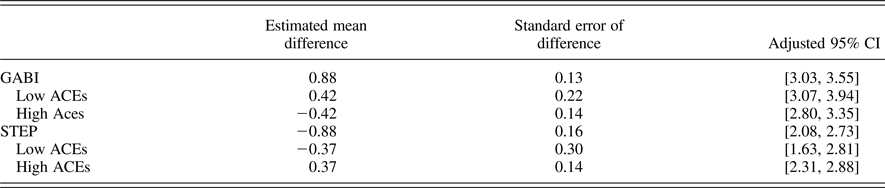
Table 4.2 shows a main effect of group, after controlling for baseline levels of dyadic constriction at intake, F (1, 73) = 13.69, p < .001. Inspection of the adjusted end-of-treatment means shown in Tables 4.1 and 4.3 reveals that GABI showed at end of treatment, 0.99 lower levels of constriction than mothers who participated in STEP (GABI = 2.47, STEP = 3.46, with the covariate in the model for dyadic constriction at baseline being evaluated at 3.15). In other words, children and mothers in GABI showed significantly less dyadic constriction, as compared to prior to treatment and to children and their mothers in STEP who showed significantly higher levels of dyadic constriction. The partial η2 value of .16, shown next to group in Table 4.2, suggests this to be a moderate effect.
Table 4.2 also reveals no significant main effect of ACEs (F = 0.02, ns, partial η2 = .00), but indicates a significant interaction of Group × ACEs, F (1, 73) = 3.83, p < .05; partial η2 = .05, underling the small nature of this effect. Descriptive statistics (Table 4.1) revealed that within the group of mothers who received GABI, dyadic constriction adjusted means were lowest (mean = 2.22) if mothers had reported low levels of ACES compared to higher dyadic constriction scores (mean = 2.71) if mothers reported high levels of exposure to ACEs. In contrast, for mothers who received the STEP intervention, the group who reported low levels of ACEs had the higher dyadic constriction scores (mean = 3.74), while those mothers in STEP who reported high levels of ACEs scored lower (mean = 3.18). Given the covariate estimate appearing in the model for intake levels of dyadic constriction was 3.15, it is clear that mothers in GABI declined somewhat (0.44) if they had high ACE exposure and declined greatly (0.93) if they had low ACE exposure, both GABI subgroups still being lower than the ACE subgroups among mothers in the control group STEP. For mothers in STEP, if they reported high ACE exposure, their average levels of dyadic constriction were largely unchanged from intake (0.03 higher than intake), while for those mothers who reported low levels of ACE exposure, their levels of dyadic constriction increased notably (0.49) compared to intake. The note beneath Table 4.2 indicates that the model with dyadic constriction as the dependent variable yielded a R 2 value of .21, suggesting the medium effect of group (GABI < STEP) responsible for circa 16% of the variance, and a small effect of the interaction between ACEs and group (circa 5%).
Dyadic reciprocity
Finally, a one-way ANCOVA was conducted to determine if mothers and children participating in GABI would show a significant increase in dyadic reciprocity as compared to children and their mothers in the TAU STEP group, while controlling for baseline levels of dyadic reciprocity. The ANCOVA also considered the possible main and interaction effects of low versus high maternal experiences of ACES during their own childhood. These results are shown in Tables 5.1, 5.2, and 5.3.
Descriptive statistics for T2 dyadic reciprocity

Note: Overall adjusted mean at T1 = 2.51.
ANCOVA summary for dyadic reciprocity T2 by treatment group, adverse childhood experiences (ACEs), and group by ACEs with T1 dyadic reciprocity as a covariate

Note: R 2 = .25 (Adjusted R 2 = .21). †p < .10. **p < .01. ***p < .001.
Mean differences in dyadic reciprocity by treatment group and low versus high ACE exposure in first 18 years of life for mother

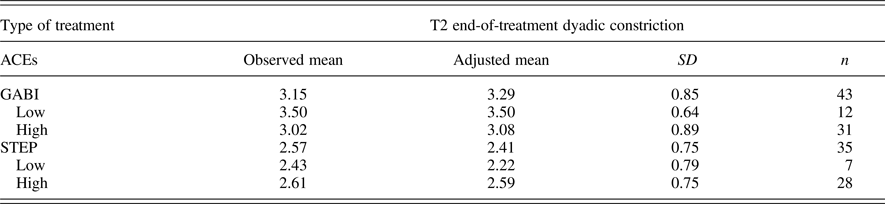
Table 5.2 shows a main effect of group, after controlling for baseline levels of dyadic reciprocity at intake, F (1, 73) = 17.56, p < .0001, partial η2 = .19, pointing to a moderate effect size. The adjusted end-of-treatment means in Table 5.1 and 5.3 reveal that children and mothers who participated in GABI showed 0.88 higher levels of dyadic reciprocity than children and mothers who participated in STEP (GABI = 3.29, STEP = 2.41, with the covariate in the model dyadic reciprocity at baseline being evaluated at 2.51). In other words, children and mothers in GABI showed significantly more dyadic reciprocity, as compared to intake in contrast to children and their mothers in STEP, who showed slightly lower levels of dyadic reciprocity than shown at intake.
Table 5.2 reveals no significant main effect of ACEs (F = 0.02, ns, partial η2 = .00). Table 5.2 does indicate a trend-level interaction of Group × ACEs, F (1, 73) = 3.72, p < .10, with partial η2 = .05, suggesting a small effect. Descriptive statistics shown in Table 5.1 revealed that within the group of mothers who received GABI, dyadic reciprocity adjusted means were lower (mean = 3.08) if mothers had reported high levels of ACEs compared to higher dyadic reciprocity scores (mean = 3.50) if GABI-participating mothers reported low levels of exposure to ACEs. As with dyadic constriction, for the mothers who received the STEP intervention, the higher scores for dyadic reciprocity were for the group who reported high levels of ACEs (mean = 2.59), while those mothers who reported low levels of ACEs scored lower (mean = 2.22). Given the covariate estimate appearing in the model for intake levels of dyadic constriction was 2.51, it is clear that mothers in GABI all on average increased, by a half point if they had high ACE exposure, and by a full point (on the 5-point scale) if they had low ACE exposure. While for mothers in STEP, if they reported high ACE exposure, their average level of dyadic reciprocity was largely unchanged from intake, while for those STEP-participating mothers who reported low levels of ACE exposure, their levels of dyadic reciprocity, on average, declined slightly. The note at the bottom of Table 5.2 indicates that the ANCOVA model with dyadic reciprocity as the dependent variable yielded a R 2 value of .25, suggesting 25% of the variance in end-of-treatment dyadic reciprocity scores could be attributed to a medium size main effect of GABI (circa 20%), and a small effect of the interaction between ACEs and group (circa 5%).
Discussion
This paper reported on an RCT results comparing STEP, a parenting group intervention (weekly over 10–12 weeks), to a more intensive parent–child, dyadic, multifamily Group Attachment-Based Intervention (GABI; up to 3 times weekly over 26 weeks). STEP was chosen as the comparison treatment to GABI because in the Bronx, New York, where the RCT was carried out, STEP was the standard of care most commonly offered to the types of families, with high risk of child maltreatment. The results in this paper considered changes from intake to end of treatment, based on video-filmed observations of the parent–toddler interaction in a room with toys over 10 min. The first 5 min of the interactions were scored on four 5-point rating scales from the CIB manual (Feldman, Reference Feldman1998). This discussion focuses on possible reasons for the observed significant changes and small to moderate effects that include main effects of treatment group, and interactions (or moderating/enhancing effects) of the treatment Group × ACEs (maternal exposure to low vs. high ACEs). This discussion first addresses main effects of changes in maternal behavior, in terms of supportive presence and hostility, and then turns to main effects of changes in the mother–child relationship (i.e., in terms of dyadic constriction and dyadic reciprocity). The discussion then considers the moderating role of ACEs in mothers’ capacity to benefit from the treatment. Finally, limitations of the work are considered, before a focus on the wider relevance of the work for the maltreatment prevention field is discussed.
Main effects involving changes in maternal behavior
Significant improvements in maternal supportive presence and significant reductions in maternal hostility were observed in mothers who participated in the GABI treatment group. In contrast, mothers who participated in the STEP control and TAU group did not show any significant changes in these proxy measures of maltreatment risk. This is most easily explained in terms of GABI's provision to mothers’ repeated practice at being with their infants/toddlers where their caregiving role was privileged by the trained GABI therapists. In contrast, for those mothers receiving the STEP intervention, no supervised in vivo practice with their children was provided for. All guidance in how to provide a more supportive presence to the child, or how to be less hostile was hypothetical, with no hands-on, observed practice and correspondingly no immediate therapeutic guidance or feedback.
Further, there is a synchrony between the attachment-based model of preventive intervention that is GABI and the CIB guidelines detailed by Feldman (Reference Feldman1998), especially the construct of “maternal supportive presence.” In describing this scale in her manual, Feldman (Reference Feldman1998) cites and relied on the secure base concept, a contribution of Mary Ainsworth's to attachment theory (Bowlby, Reference Bowlby1988); in addition, Feldman cites the work on hidden regulators of emotion, behavior and physiology in animal models (Hoffer, Reference Hoffer, Goldberg, Muir and Kerr1995). Furthermore, raters of parental “supportive presence” are encouraged to have in mind Winnicott's (Reference Winnicott and Mariotti2012/1956) account of the holding environment and the concept of “refueling” articulated by Mahler, Pine, and Bergman (Reference Mahler, Pine and Bergman1975). At the lowest end (1) of the 5-point “supportive presence” scale the child appears anxious, uninvolved, and disorganized. At the scale midpoint (3), there are some indications that the parent's presence may serve a secure base, while at the high end (5), the parent is seen to provide for the child a regulating influence in terms of emotion, attention, interest, learning, and emerging social skills (Feldman, Reference Feldman1998). This puts in context why an attachment-based maltreatment prevention intervention like GABI would lead to significant gains in observed ratings of maternal supportive presence, not seen in the parenting group control treatment, STEP.
Main effects of treatment group on dyadic mother–child interaction patterns
The strongest results reported concern the support for GABI leading to significant changes in mother–child interaction patterns. Specifically, compared to intake observations, by end of treatment there was significantly less “constriction” and significantly more “reciprocity” in the observed mother–child interaction in the mothers and children who participated in GABI, with no change, or a change for the worse, in the children and mothers who participated in the STEP arm (as a group) of the RCT. The reciprocity result was a medium effect with GABI participation accounting for 20% of the variation in reciprocity scores. This makes sense in terms of the repeated practice GABI mothers and children received in being together, separating (for parents-only groups and children-only groups) and reuniting. Beyond the experience of therapist-supported and peer-supported interactions, GABI provided the experience of reviewing on film (video feedback) one's own parenting behavior and one's child's reactions. The therapist would never claim to understand fully what was shown on the video, at least not before repeated gentle efforts to elicit from the mother a reaction, “but what do you see?” In addition, fellow parents would learn from the typically emotive response provided by the mother reacting to what she had seen, and what she had thought about what she had seen. Above all else, perhaps, parents would express relief at not being judged, as they were encouraged to listen more fully to what their toddlers were trying to say to them, or show to them (Steele et al., Reference Moss, Tarabulsy, St.-Georges, Dubois-Comtois, Cyr, Bernier and Lecompte2014).
As to why the mothers in STEP did not show any improvements in dyadic reciprocity or declines in dyadic constriction, it is perhaps not surprising given that mothers in the STEP groups, where parenting skills were being taught, were not given the opportunity to engage in supervised interactions with their children and so act, with therapeutic support, on what they had learned. Nor did the parents attending STEP have the benefit of seeing themselves interacting with their children in the context of video feedback with the rich potential benefits such experiences may have brought (Steele et al., Reference Steele, Steele, Bates, Knafo, Kinsey, Bonuck and Murphy2014).
The small moderating effect of mothers’ exposure to ACEs on treatment outcome
Results with respect to dyadic behavior (parent–child interactions) revealed small but notable interaction effects that somewhat lessened the effectiveness of GABI when the maternal ACE burden was high (four or more). This was evident in respect of the CIB ratings at end of treatment (T2) for two of the four measures obtained, that is, dyadic constriction and dyadic reciprocity (marginal interaction effect). For these two dyadic scales, results of the interaction effects were different for those mothers who participated in the STEP control group. For these mothers, when the ACE burden was high, there was no change from intake (T1), and when the ACE burden was low, there was a slight decline in dyadic reciprocity at T2, and a slight increase in dyadic constriction. The increase in dyadic constriction is particularly worrisome as dyadic constriction may be seen as a proxy for risk of child maltreatment. These results point to the challenge for the vulnerable mothers studied, who carried a high trauma burden, to break the intergenerational cycle of abuse so deeply familiar to them. As compared to the control group STEP results, GABI clearly offers more hope than STEP.
The only other clinical study utilizing the CIB as the outcome measure, in an independent single-group test–retest design with vulnerable mothers and their toddlers, where significant improvements in maternal sensitivity and child engagement were observed (Dollberg, Feldman, Tyano, & Keren, Reference Dollberg, Feldman, Tyano and Keren2013), found that maternal intrusiveness did not lessen over time. Maternal intrusiveness was a composite variable, in this earlier work by Dollberg et al. (Reference Dinkmeyer, McKay and Dinkmeyer2013), including the discrete scale “maternal hostility” that was a focus of the current research. Dollberg et al. reported that high levels of maternal intrusiveness were associated with higher levels of maternal stress. Though the Dohlberg et al. study was not a RCT, the findings echo the results of Moran et al. (Reference Moran, Pederson and Krupka2005), who found that unresolved loss or trauma impeded the effectiveness of their attachment-based intervention. Moran et al. discuss the difference between “working through” as opposed to “working around” trauma. Insofar as GABI welcomes mothers (in the parent groups) to work through their past trauma, it may be that some mothers with a high trauma burden are not as ready as those with lower levels of trauma to explore their past histories, and so the effectiveness of the intervention is attenuated for them. This is of particular concern for an intervention like GABI that is trauma-informed: it may be that the offer of 26 weeks (as often as three times weekly) of GABI is an insufficient dose for the most trauma-laden parents.
In contrast to GABI, the control treatment STEP would seem to work around trauma, relying on a didactic set of parenting lessons. It would appear also that mothers with high levels of ACEs in the STEP arm of treatment, meeting weekly over 10–12 weeks, earned the certificate of “completing STEP” but changed very little. Mothers in STEP with low levels of ACEs actually fared worse over the course of treatment, appearing notably less reciprocal and more constricted with their children in the filmed observations. The STEP intervention training, it is fair to conclude, did not influence, or adversely influenced, mother–child interactions for the participating mothers.
It is notable that there was no moderating effect of ACEs on treatment outcome, in terms of maternal behavior, that is, supportive presence (where GABI mothers increased and control STEP group mothers decreased or stayed the same) and hostility (where GABI mothers decreased but control STEP group mothers stayed the same or increased). This suggests that in the therapeutic work with vulnerable mothers of young children, including the parent and child in the treatment is required to achieve maximum therapeutic benefit.
Limitations
This report on a RCT comparing two approaches to maltreatment prevention, while controlling for mothers’ ACEs, has a number of limitations. Three broad limitations can be identified concerning the outcome measure, the moderator measured, and the differing length (and characteristics) of treatment in the two arms of the RCT.
First, the free-play outcome measure that was filmed and rated on four discrete 5-point scales calls into a question whether this can actually serve as a proxy for maltreatment risk, on the one hand, and a healthy secure parent–child relationship, on the other hand. Certainly, there is substantial validity for the construct of dyadic reciprocity being linked to healthy adaptation and well-regulated emotional and physiological functioning in the work of Feldman (Reference Feldman2010, Reference Feldman2015) who developed the CIB scales (Feldman, Reference Feldman1998). However, confirmatory findings from independent labs are called for. Reciprocity may well serve as a marker of healthy secure parent–child relationships, but there is no study yet comparing this construct with the Strange Situation (Ainsworth et al., Reference Ainsworth, Blehar, Waters and Wall1978). The current study may, in the fullness of time, provide such convergent validity findings, but we are not there yet. Of more concern, perhaps, is the claim made in this paper that CIB measures of “hostility” and “dyadic constriction” may serve as proxies for maltreatment risk. While the suggestion has face validity, much more additional longitudinal work is called for to validate this claim.
Second, with respect to the attempt to control of mothers’ exposure to ACEs, it may be that the self-report measure of exposure to abuse and household dysfunction over the first 18 years of life is vulnerable to social desirability influences, especially among mothers who stand to lose their child to protective custody if they are seen to be repeating a history of maltreatment. With over 70% of mothers reporting exposure to four or more ACEs in the current report, social desirability seems unlikely to have played a large role. All the same, we do not know how many of these mothers with high (or low) ACEs were unresolved regarding past loss and trauma (the moderating variable in the work of Moran et al., Reference Moran, Pederson and Krupka2005), despite our own prior evidence, with a pilot sample of mothers receiving GABI (Steele et al., Reference Steele, Murphy and Steele2010), high ACE exposure was linked to unresolved loss or trauma (Murphy et al., Reference Murphy, Steele, Dube, Bate, Bonuck, Meissner and Steele2014).
Third and finally, the differing length of treatment in the two arms of the RCT makes the two treatment programs difficult to compare. A GABI-attending mother and child with full 100% attendance would have been seen 26 × 3 times, that is, on 78 occasions, 2 hr each, so 156 hr of contact. By comparison, a fully compliant STEP-attending mother (without her child) would have been seen for 12 weeks, 1 hr each. Therefore, in simple quantitative terms of therapeutic attention, the GABI-attending mother would have received more than 12 times more contact with a therapeutic team than a STEP-attending mother. This is setting aside the fact that in GABI, mothers and children were seen as opposed to just mothers in STEP. STEP was nonetheless treatment as usual (i.e., parenting class) in the Bronx where the work was conducted, and in many other locations across the United States. In brief, multiproblem trauma-burdened parents deserve more, not less, well-informed, evidence-based, maltreatment prevention services.
Conclusion
This initial empirical report on the effectiveness of GABI calls for elaboration and replication. In particular, we await the completion of reliable masked scoring of the Strange Situation assessments (Ainsworth et al., Reference Ainsworth, Blehar, Waters and Wall1978), including 6-month follow-up data that will yield a more definitive account of the extent to which GABI improves the quality of the child–mother relationship, and in particular, if attachment disorganization can be diminished by GABI, and so greatly lessen the probability of maltreatment being extended into another generation. Perhaps we can claim, based on the reported results, and others in this Special Issue, that the ominous task of preventing child maltreatment though challenging is possible (Euser et al., Reference Euser, Alink, Stoltenborgh, Bakermans-Kranenburg and van IJzendoorn2015).