Introduction
Otoliths are metabolically inert structures composed of calcium carbonate, primarily precipitated in the form of aragonite, along with numerous trace elements. They are located in the inner ear of bony fish and are an important component of the sensory system and hearing of fish (Popper and Fay, Reference Popper and Fay2011; Schulz-Mirbach et al., Reference Schulz-Mirbach, Ladich, Plath and Heb2019). Bony fish have three pairs of otoliths: sagitta, asteriscus, and lappillus, which are structures with intraspecific morphology (Asiss, Reference Asiss2003; Volpedo and Vaz-Dos-Santos, Reference Volpedo and Vaz-Dos-Santos2015). Because otoliths are inert, they aid in several studies in ichthyology, such as: trophic ecology of ichthyophages (Baimukanov et al., Reference Baimukanov, Shagilbayev and Iskakov2024); age and growth (Vieira, Reference Vieira2023); identification of fish stocks (Avigliano et al., Reference Avigliano, Miller, Carvalho, Gironde, Tombari and Volpedo2020); connectivity (Carvalho et al., Reference Carvalho, Pérez, Aguilar-Perera, Noh-Quiñones, Vitule and Volpedo2022), and anthropogenic impact on fish populations (Cerna et al., Reference Cerna, Guido Plaza, Avigliano and Vaz-dos-Santos2025).
As technology evolves, new tools have enabled deeper analysis of otolith morphology, moving from simple direct optical observations to techniques such as computed tomography (Mapp et al., Reference Mapp, Fisher, Atwood, Bell, Greco, Songer and Hunter2016) and crystallography (Carvalho et al., Reference Carvalho, Barbieri, Spach and Volpedo2023). These techniques allow us to comprehend the internal organization and the forms of CaCO3 crystallization in otoliths. This technique allows detecting the presence of carbonate polymorphs such as vaterite, which is the most unstable calcium carbonate. Vaterite deposition in otoliths typically occurs due to changes in endolymph pH. These changes in endolymph pH can result from environmental changes, such as extreme variations in temperature and pH (Murase et al., Reference Murase, Kawamoto, Akizawa and Irie2023; Gaffney et al., Reference Gaffney, Polard, Walton, Kraemer, Molder, Covernton, Atkinson, Elmer, James, Negrin, Quindazzi, Duguid and Juanes2025). Given that, we have also begun to detect anomalies in otolith formation and study them more thoroughly. Recent studies have reported a growing number of cases involving morphologically deformed otoliths. The presence of anomalous otoliths has been reported in some fish species caught in marine and estuarine environments for example: Odontesthes bonariensis (Avigliano et al., Reference Avigliano, Tombari and Volpedo2012), Platichthyes flesus (Neves et al., Reference Neves, Guedes, Valentim, Campos and Freitas2017), Atherinella brasiliensis (Carvalho Lapuch et al., Reference Carvalho Lapuch, Carvalho and Baptista Metri2022), and Sarpa salpa (Yedier et al., Reference Yedier, Daban, Şen and Bostancı2024). According to several studies, anomalous otoliths of fish collected in marine and estuarine environments may result from stress, genetic predisposition, pollution, and other environmental conditions (Gauldie, Reference Gauldie1986; Tomás et al., Reference Tomás, Geffen, Allen and Berges2004; Yedier and Bostancı, Reference Yedier and Bostancı2020; Yedier et al., Reference Yedier, Bostancı and Türker2023).
The occurrence of anomalous otoliths has also been demonstrated in cultivated species, such as: Sciaenops ocellatus (Gauldie, Reference Gauldie1986), Oncorhynchus kisutch (Sweeting et al., Reference Sweeting, Beamish, Noakes and Neville2003), and Oncorhynchus mykiss (Brown et al., Reference Brown, Sisneros, Jurasin, Nguyen and Coffin2013). However, no such abnormalities have been reported in Epinephelus marginatus, either in natural or captive environments. These authors suggest that the cause of morphological anomalies in otoliths of farmed fish may be related to high population density in the culture tanks, mechanical trauma, and nutritional deficiency. Taken together, water flow in the cultivation tanks appears to be a determining factor in the occurrence of otolith anomalies (Gaffney et al., Reference Gaffney, Polard, Walton, Kraemer, Molder, Covernton, Atkinson, Elmer, James, Negrin, Quindazzi, Duguid and Juanes2025). Globally, there is a growing trend toward increasing the production of marine and estuarine fish in closed production systems (FAO, 2024). An excellent example is the Serranidae family, which reached production of 155,000 tons in 2015. Many species of the Serranidae family are economically important for mariculture in China, Taiwan, and Indonesia (Ybanez and Gonzales, Reference Ybanez and Gonzales2023).
Species of the Serranidae family, popularly known as groupers, are widely distributed in tropical and subtropical waters. This family is composed of 102 species (Froese and Pauly, Reference Froese and Pauly2025). Many genera belonging to the Serranidae family are important for aquaculture, for example: Plectropomus, Aethaloperca, Cromileptes, Cephalopholis, Hyporthodus, and Epinephelus (Rimmer and Glamuzina, Reference Rimmer and Glamuzina2019). Among these genera, technological packages for cultivating species of the Epinephelus genera have been the subject of several studies (Kumar Das et al., Reference Kumar Das, Xiang, Noor, De, Mazumder and Goutham-Bharathi2021). For example, E. marginatus has great economic importance and there are already initiatives to produce this species through aquaculture (Condini et al., Reference Condini, García-Charton and Garcia2018; Lisboa et al., Reference Lisboa, Torres, Albuquerque Filho, Souza, Silva, Lopes and Matias2024). In this study, we analysed otoliths of E. marginatus obtained from an aquaculture system to test the hypothesis that the cristallographic structure of anomalous otoliths differs from that of normal ones. More specifically, we assessed the occurrence of otolith deformities and examined them using Raman Spectroscopy to identify the predominant carbonate polymorphs.
Materials and methods
The cultivation and transport of all specimens complied with animal welfare laws, guidelines and policies, approved by the national licensing authority the Instituto Brasileiro do Meio Ambiente e dos Recursos Naturais Renováveis (IBAMA).
The larviculture of E. marginatus was carried out on the coast of São Paulo at a temperature of 26°C. The larvae were fed with harpacticoid copepods (Tisbe sp.) and calanoid copepods (Acartia tonsa) until approximately 60 days of age. After that, to avoid cannibalism, the juveniles were sorted by size and separated and fed with pelleted feed (Begossi and Kerber, Reference Begossi and Kerber2020).
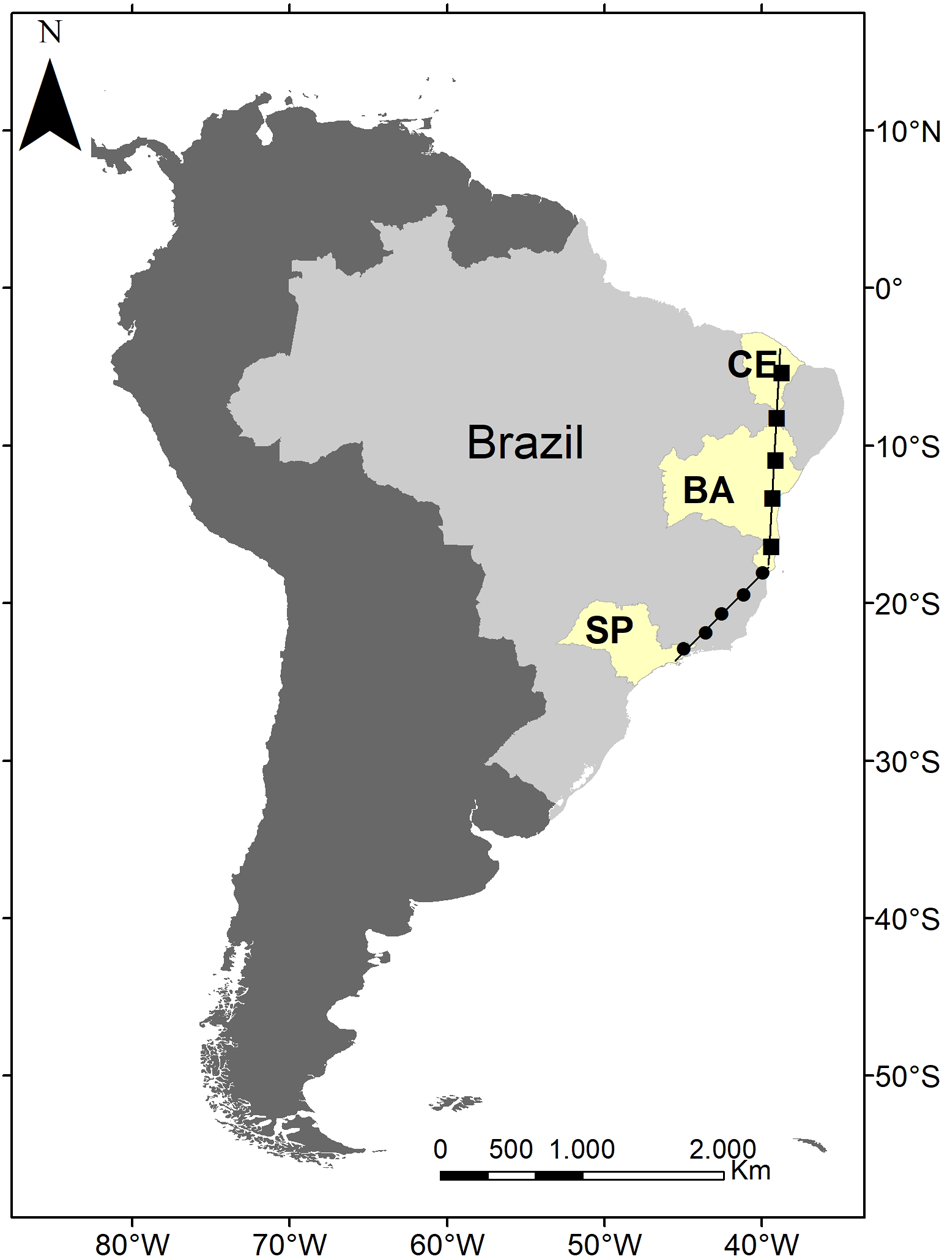
Fattening of species E. marginatus was carried in the farm Prime Seafood Marine Farm, Alcobaça – BA – Brazil, and specimens were transported to Mirante Pescados, Cascavel – CE – Brazil. The fish arrived at the farm Mirante Pescados with an average weight of 150 (±3 g), where they were stocked in floating net cages (1.5 m × 1.5 m × 1 m with a 4 mm mesh size) enclosed in a frame tank padded with a plastic liner (7 m × 7 m × 1.40 m), filled with marine water (35 g/L) with a land-based Recirculating Aquaculture System – RAS (biological and suspended solids filter) and temperature between 28.2°C and 30.1°C (Lisboa et al., Reference Lisboa, Torres, Albuquerque Filho, Souza, Silva, Lopes and Matias2024) (Figure 1).
South American map presenting the regions where Epinephelus marginatus larvae were produced and raised (SP); the first transport of about 1000 km to Bahia (circles) and the second transport of about 1000 km from Bahia to Ceará (square).

The specimens of E. marginatus were measured for total length (TL, in cm) and total weight (TW, in grams). The sagittae otoliths were removed from the palate region through an incision made in the optical capsule, cleaned, stored dry, weighed (OW) and classified morphologically according to Siliprandi et al. (Reference Siliprandi, Cldb, Brenha-Nunes, Gonsales, Santificetur and Vaz-dos-Santos2014). The morphology of the right and left otoliths was examined to detect potential asymmetries or anomalies between paired structures. The crystallographic characterization of otoliths was performed using a Confocal Raman Witec alpha 300 R spectrometer, the spectra were excited by the 532 nm, using a 50× microscope objective, laser penetration was 200 μm and the results were collected 10 times with an exposure time of 3 s. The aragonite and vaterite in otoliths are characterized by vibrations at different wavelengths, in which aragonite is characterized by a more intense vibration between 1075 and 1090 cm−1 and two small vibrations between 100 and 400 cm−1. Vaterite differs from aragonite because it presents two more intense vibrations between 1075, 1081 and 1090 cm−1 and three small vibrations between 100 and 400 cm−1 (Melancon et al., Reference Melancon, Fryer, Ludsin, Gagnon and Yang2005). In otoliths exhibiting morphological anomalies, Raman spectroscopy was conducted in the deformed region, whereas in otoliths with normal morphology, analyses were performed in the dorsal region above the acoustic sulcus.
To verify the difference between the total length and weight of otoliths with normal and anomalous morphology, a paired t-test was performed (a = 0.05) in the R software.
Results
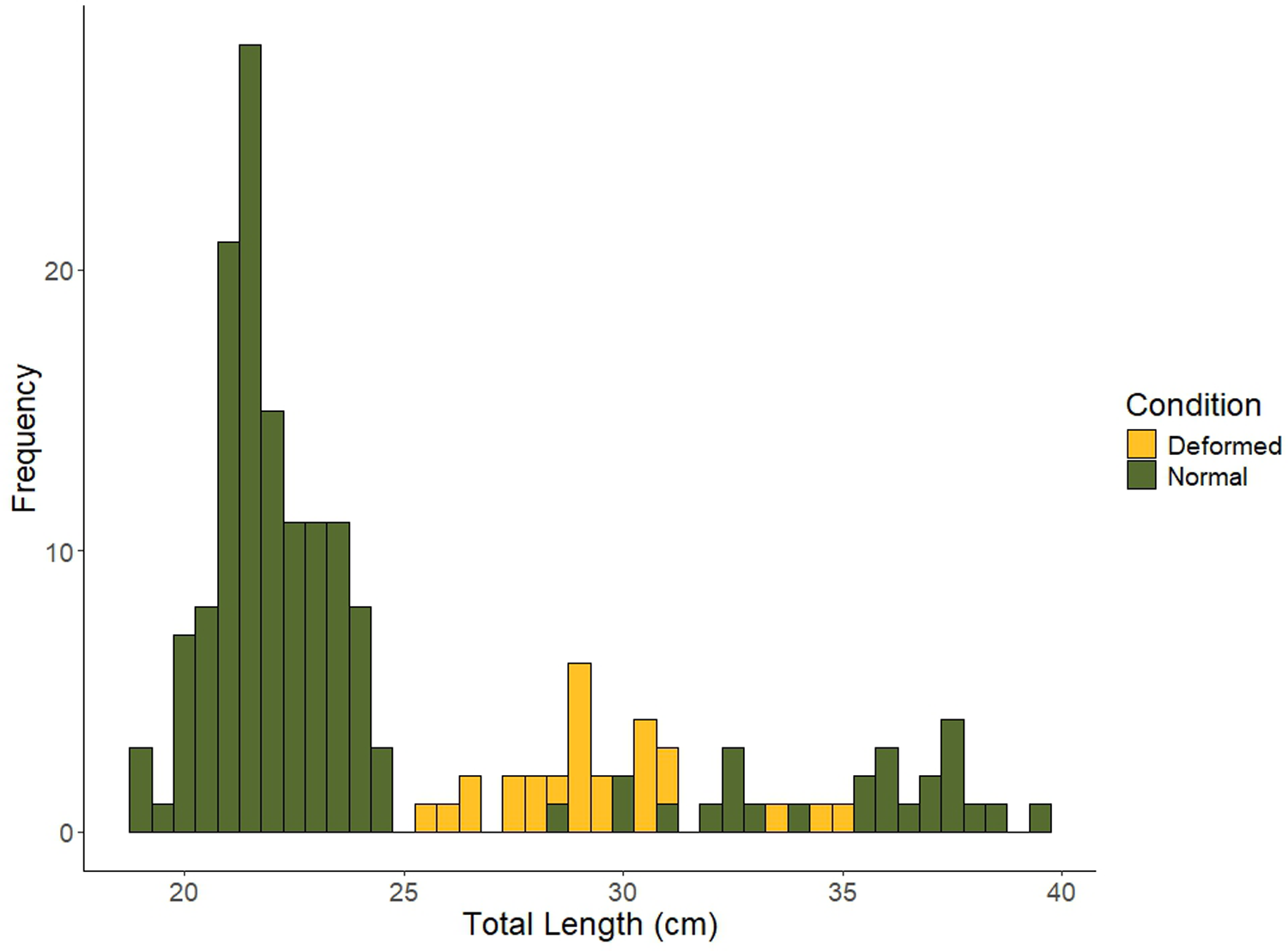
We examined sagittal otoliths of 184 E. marginatus (TL ranged from 18.8 cm to 39.7 cm) reared in a commercial culture. Most otoliths presented normal morphology (n = 152; TL = 24.0 ± 3.59 cm; OW = 0.034 ± 0.014 g) while about 17% were deformed (n = 32; TL = 29.7 ± 1.87 cm; OW mean = 0.040 ± 0.011 g) (Figure 2). In Figure 3, it is possible to observe the morphology of deformed and normal otoliths. Deformed otoliths show irregular anterior and posterior regions (Fig. 3A and 3B). Otoliths classified as normal present smooth anterior and posterior regions (Fig. 3C).
Frequency distribution of the total length of Epinephelus marginatus according to otolith condition.

Deformed pair sagitta otoliths of Epinephelus marginatus (A) 26.5 cm; (B) 28.4 cm, and (C) 33.5 cm without alterations (normal). Scale bar 500 µm and A, anterior; D, dorsal; P, posterior; V, ventral region of the otoliths.

Among the deformed otoliths, 37.5% (n = 12) presented both sagittal otoliths deformed. The paired t-test showed no significant difference (t = −0.99896, df = 1, P-value = 0.5003) between the total length and weight of the otoliths between specimens with normal and anomalous otoliths (Figure 3).
All otoliths with normal morphology presented aragonite as the predominant polymorphic carbonate and no vaterite was observed in any otolith with normal morphology (Fig. 4A). Raman spectroscopy detected the deposition of aragonite in all anomalous otoliths (Fig. 4B).
Raman spectra of sagitta otoliths with morphological alterations of Epinephelus marginatus. (A) Aragonite of the otoliths normal 36.0 cm and (b) aragonite anomalous sagitta otoliths 31.0 cm.

Discussion
In this study, we found that 17% presented sagittal otoliths deformed E. marginatus presented morphological alterations in their sagittae otoliths. Among the deformed otoliths, 37.5% presented both sagittal otoliths deformed (right and left) with morphological alterations. Both normal and deformed otoliths were predominantly composed of aragonite, thereby refuting our primary hypothesis. Additionally, otolith deformities were observed only in fish larger than 25 cm, suggesting that the sampled individuals may have experienced specific conditions early in life that contributed to the elevated incidence of otolith deformities. According to the study by Andrade et al. (Reference Andrade, Machado, Hostim-Silva and Barreios2003), the size at first maturity for the species is 47 cm, which corresponds to an age of 3–5 years, according to the study by Condini et al. (Reference Condini, García-Charton and Garcia2018). Therefore, all individuals analysed in this study are considered immature.
The formation of otolith abnormalities is not well understood, but has been suggested to result from factors such as genetics, nutritional deficiency, and mechanical trauma (David and Grimes, Reference David and Grimes1994; Sweeting et al., Reference Sweeting, Beamish, Noakes and Neville2003; Tosta et al., Reference Tosta, Muramoto, Duarte-costa-de-medeiros, Branco-Albinati, Silva-Olier and Gomes-Sanches2022). Although rare in nature, deformed otoliths have been reported more frequently in cultured specimens, as demonstrated by several studies, for example, in Clupea harengus (Tomás and Geffen, Reference Tomás and Geffen2003); species of the genus Oncorhynchus (Reimer et al., Reference Reimer, Dempster, Warren-Myers, Jensen and Swearer2016) and Hypomesus transpacificus (Lewis et al., Reference Lewis, Huang, Willmes, Fichman, Hung, Ellison, Stevenson, Teh, Hammock, Schultz, Grimsich, Huyskens, Yin, Cavole, Botto and Hobbs2022). The crystal structure of otoliths may also induce otolith deformities. While normal otoliths primarily consist of aragonite, anomalous otoliths sometimes contain inclusions of calcite and vaterite (Yedier et al., Reference Yedier, Bostancı and Türker2023). However, the absence of calcite and vaterite in the otoliths examined in this study led us to rule out carbonate crystallography as a potential cause of the otolith deformities in E. marginatus.
The large-scale cultivation of species of the genera Epinephelus has been a challenge for aquaculture. Several studies report fish anatomical deformities and high mortality rates. For example, Nagano et al. (Reference Nagano, Hozawa, Fujiki, Yamada, Miyaki, Sakakura and Hagiwara2007) assessed the jaw deformities and skeletal deformities of the species E. septemfasciatus. These changes were influenced by the temperature of the culture tanks. According to Lv et al. (Reference Lv, Wang, Xiao, Liu, Xu, Zhai and Li2019), the species E. lanceolatus undergoes morphological changes in the skull and skeleton caused by handling in the initial stages of post-flexion development. The E. marginatus in experimental cultivation showed a high percentage of spinal deformities, possibly caused by nutritional deficiency (Tosta et al., Reference Tosta, Muramoto, Duarte-costa-de-medeiros, Branco-Albinati, Silva-Olier and Gomes-Sanches2022). The studies mentioned above indicate that deformities in species of the genera Epinephelus may result from various issues arising during larval rearing. Among them, mechanical trauma during fish development (Tosta et al., Reference Tosta, Muramoto, Duarte-costa-de-medeiros, Branco-Albinati, Silva-Olier and Gomes-Sanches2022; Gaffney et al., Reference Gaffney, Polard, Walton, Kraemer, Molder, Covernton, Atkinson, Elmer, James, Negrin, Quindazzi, Duguid and Juanes2025).
The farm where our samples were raised used to purchase 2-g juveniles (60-day-old fish), which were transported from São Paulo to Bahia State – approximately 1000 km – by land (Begossi and Kerber, Reference Begossi and Kerber2020). After approximately 3 months in Bahia, 150-g juveniles were transported by land for another 1000 km to Ceará state, where the final fattening farm is located (Lisboa et al., Reference Lisboa, Torres, Albuquerque Filho, Souza, Silva, Lopes and Matias2024). Throughout the prolonged transport process, juveniles were continuously exposed to forced water movement caused by truck acceleration and road irregularities. Previous studies have shown that water flow may influence the occurrence of otolith deformities (Gaffney et al., Reference Gaffney, Polard, Walton, Kraemer, Molder, Covernton, Atkinson, Elmer, James, Negrin, Quindazzi, Duguid and Juanes2025), prompting consideration of another possible factor affecting E. marginatus otoliths. Thus, this system involves several critical factors, including handling and road transportation, that may cause mechanical trauma, ultimately leading to the otolith deformations observed in this study.
Based on the results of this study, it is plausible to suggest that the species E. marginatus may be sensitive to handling and transporting, which could lead to morphological changes in its otoliths. We recommend future studies comparing fish fattening at varying distances from the larval production facility to better understand the impact of road transportation on the occurrence of otolith deformities. These findings may contribute to improved animal welfare, leading to a better and more productive culture system.
Acknowledgements
B.M.C. acknowledges the National Council for Scientific and Technological Development (CNPQ 168196/2022-0). Centro de Microscopia Eletrônica (CME-UFPR) by Raman Spectra.
Author contributions
B.M.C. – article design, analysis, writing and revision; C.Q.A. – article design, analysis, writing and revision; B.B.V. – sampling and writing; V.L. – article design, analysis, writing and revision; J.F.N.M. – sampling and writing; G.B.S. – article design, analysis, writing and revision.
Financial support
National Council for Scientific and Technological Development.
Conflict of interest
The authors declare no conflict of interest.
Data availability statement
Data available on request from the authors.