1. Introduction
In domain theory and non-Hausdorff topology, we encounter numerous links between topology and order theory (cf. Abramsky and Jung (Reference Abramsky and Jung1994), Gierz et al. (Reference Gierz, Hofmann, Keimel, Lawson, Mislove and Scott2003), Goubault-Larrecq (Reference Goubault-Larrecq2013)). The upper topology and Scott topology are probably two of the most important order-compatible topologies on posets, and sobriety is probably the most important and useful property of
 $T_0$
-spaces (see Abramsky and Jung (Reference Abramsky and Jung1994), Gierz et al. (Reference Gierz, Hofmann, Keimel, Lawson, Mislove and Scott2003), Goubault-Larrecq (Reference Goubault-Larrecq2013), Jia (Reference Jia2018), Xu and Zhao (Reference Xu and Zhao2021)). The Hofmann-Mislove Theorem reveals a very distinct characterization for the sober spaces via open filters and illustrates the close relationship between domain theory and topology. With the development of domain theory and non-Hausdorff topology, two other properties also emerged as very useful and important properties for
 $T_0$
-spaces: the property of being a
 $d$
-space and well-filteredness (see Wyler (Reference Wyler1981), Abramsky and Jung (Reference Abramsky and Jung1994), Gierz et al. (Reference Gierz, Hofmann, Keimel, Lawson, Mislove and Scott2003), Keimel and Lawson (Reference Keimel and Lawson2009), Goubault-Larrecq (Reference Goubault-Larrecq2013), Jia (Reference Jia2018), Xu et al. (Reference Xu, Shen, Xi and Zhao2020), Xu and Zhao (Reference Xu and Zhao2021)).
In order to uncover more finer links between
 $d$
-spaces and well-filtered spaces, Xu and Zhao (Reference Xu and Zhao2020) introduced and investigated strong
 $d$
-spaces, and Xu (Reference Xu2026) introduced and studied strongly well-filtered spaces. The strong
 $d$
-spaces and strongly well-filtered spaces possess many important properties (see Li et al. (Reference Li, Jin, Miao and Chen2023), Lawson and Xu (Reference Lawson and Xu2024a, Reference Lawson and Xu2024b), Xu (Reference Xu2026), and Xu and Zhao (Reference Xu and Zhao2020, Reference Xu and Zhao2021)), two of the key ones being that the Scott space
 $\Sigma \,\!\!P$
of a poset
 $P$
is a strong
 $d$
-space iff it is strongly well-filtered, and if
 $P$
is a dcpo such that
 $\Sigma P$
is strongly well-filtered and
 $\Sigma (P\times P)=\Sigma P\times \Sigma P$
, then
 $\Sigma P$
is sober (see (Xu Reference Xu2026, Theorems 4.10 and 4.14)).
Power constructions are very important structures in domain theory, which play a fundamental role in modeling the semantics of non-deterministic programming languages. The Hoare power construction and Smyth power construction are two main power constructions (see Heckmann (Reference Heckmann1990, Reference Heckmann1992), Smyth (Reference Smyth1978)). These power constructions were traditionally given in the category of dcpos but are easily and profitably extended to general topological spaces (see, e.g.,, (Abramsky and Jung Reference Abramsky and Jung1994, Sections 6.2.3 and 6.2.4) and Schalk (Reference Schalk1993)).
In Xu (Reference Xu2026), posed the following two questions (see (Xu Reference Xu2026, Questions 7.1 and 7.2)):
Question 1.
For a sup-complete poset
 $P$
, is
 $(P, \upsilon (P))$
strongly well-filtered?
Question 2.
Is the Hoare power space
 $P_H(X)$
of a
 $T_0$
-space
 $X$
strongly well-filtered?
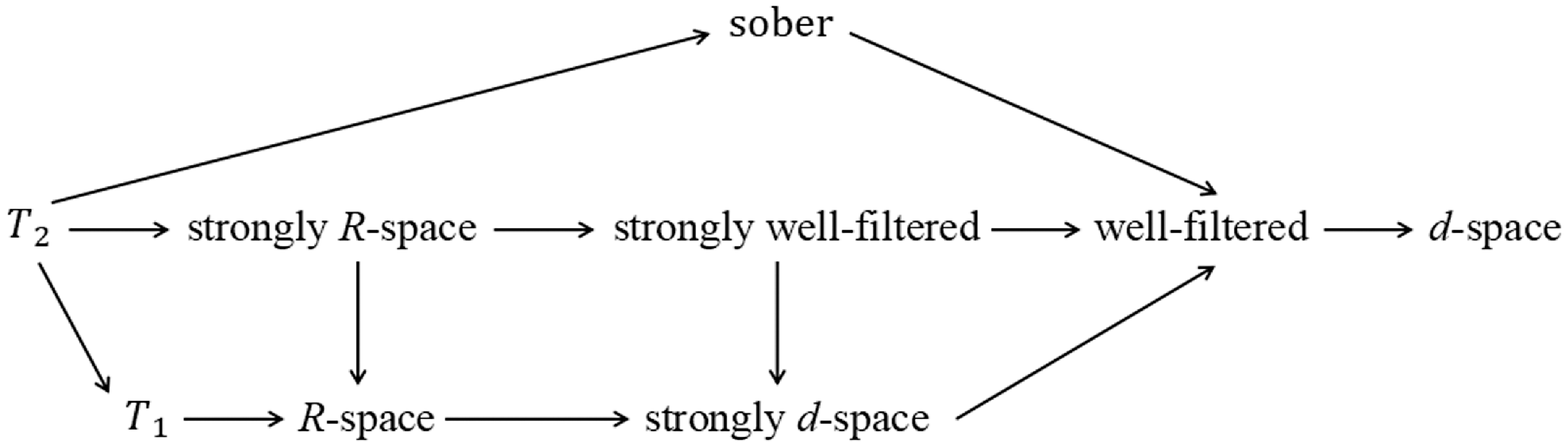
In this paper, we first introduce a new class of
 $T_0$
-spaces – strong
 $R$
-spaces, which are stronger than both
 $R$
-spaces and strongly well-filtered spaces. Some relations among
 $T_2$
-spaces,
 $T_1$
-spaces, strong
 $R$
-spaces,
 $R$
-spaces, strongly well-filtered spaces, well-filtered spaces, and sober spaces are investigated. It is proved that any sup-complete poset equipped with the upper topology is a strong
 $R$
-space, and the Hoare power space of a
 $T_0$
-space is a strong
 $R$
-space. Hence, the upper topology on a sup-complete poset is strongly well-filtered, and the Hoare power space of a
 $T_0$
-space is strongly well-filtered, which answers the two aforementioned questions.
2. Preliminaries
In this section, we briefly recall some basic concepts and results about ordered structures and domain theory that will be used in the paper. For further details, we refer the reader to Abramsky and Jung (Reference Abramsky and Jung1994), Gierz et al. (Reference Gierz, Hofmann, Keimel, Lawson, Mislove and Scott2003), and Goubault-Larrecq (Reference Goubault-Larrecq2013).
For a poset
 $P$
and
 $A \subseteq P$
, define
 $\mathord {\uparrow } A=\{x\in P: a\leq x \mbox{ for some }a\in A \}$
and
 $\mathord {\downarrow } A=\{x \in P: x \leq a \mbox{ for some }a\in A\}$
. For
 $x\in X$
, let
 $\mathord {\uparrow } x=\mathord {\uparrow }\{x\}$
and
 $\mathord {\downarrow } x=\mathord {\downarrow }\{x\}$
. A subset
 $A$
is called a lower set (resp., an upper set) if
 $A=\mathord {\downarrow } A$
(resp.,
 $A=\mathord {\uparrow } A$
). Define
 $A^{\mathord {\uparrow }}=\{u\in P: A\subseteq \mathord {\downarrow } u\}$
(the set of all upper bounds of
 $A$
in
 $P$
) and
 $A^{\mathord {\downarrow }}=\{v\in P: A\subseteq \mathord {\uparrow } v\}$
(the set of all lower bounds of
 $A$
in
 $P$
). The set of all nonempty upper subsets of
 $P$
is denoted by
 $\mathbf{up}(P)$
. If the set of upper bounds of
 $A$
has a unique smallest element, we call this element the least upper bound of
 $A$
or the supremum of
 $A$
and write it as
 $\vee A$
or sup
 $A$
. Dually, the greatest lower bound is written as
 $\wedge A$
or inf
 $A$
. We use
 $P^{op}$
to denote the dual poset of
 $P$
. The set of all natural numbers is denoted by
 $\mathbb N$
. Let
 $\mathbb N^{+}=\mathbb N\setminus \{0\}$
. When
 $\mathbb N$
is regarded as a poset (in fact, a chain), the order on
 $\mathbb N$
is the usual order of natural numbers. For a set
 $X$
, let
 $|X|$
be the cardinality of
 $X$
and let
 $\omega =|\mathbb{N}|$
. The set of all subsets of
 $X$
is denoted by
 $2^X$
.
A nonempty subset
 $D$
of a poset
 $P$
is called directed if every finite subset of
 $D$
has an upper bound in
 $D$
. Dually, a nonempty subset
 $F$
of
 $P$
is said to be filtered if every finite subset of
 $F$
has a lower bound in
 $P$
. The set of all directed sets of
 $P$
is denoted by
 $\mathcal{D}(P)$
. The poset
 $P$
is called a directed complete poset, or dcpo for short, provided that the least upper bound
 $\vee D$
of
 $D$
exists in
 $P$
for any
 $D\in \mathcal D(P)$
. The poset
 $P$
is called a sup semilattice if for any two elements
 $a$
,
 $b\in P$
, the supremum
 $\mathrm{sup}\{a, b\} = a\vee b$
exists in
 $P$
. The poset
 $P$
is said to be sup-complete if every nonempty subset
 $A$
has a supremum
 $\vee A$
in
 $P$
. Clearly, a poset
 $P$
is sup-complete iff
 $P$
is both a sup semilattice and a dcpo.
Lemma 2.1.
Let
 $P$
be a sup-complete poset and
 $A$
be a nonempty subset of
 $P$
. If
 $A^{\downarrow }$
is nonempty, then the infimum of
 $A$
exists and
 $\wedge A=\vee A^{\downarrow }$
.
Proof. Since
 $A^{\downarrow }\neq \emptyset$
and
 $P$
is sup-complete,
 $\vee A^{\downarrow }$
exists in
 $P$
. For any
 $a\in A$
, we have
 $A^{\downarrow }=\bigcap _{c\in A}{\downarrow } c\subseteq {\downarrow } a$
, and hence,
 $\vee A^{\downarrow }\leq a$
. Thus,
 $\vee A^{{\downarrow }}$
is a lower bound of
 $A$
. Suppose
 $y$
is another lower bound of
 $A$
. Then
 $y\in A^{\downarrow }$
, whence
 $y\leq \vee A^{\downarrow }$
. Therefore,
 $\vee A^{\downarrow }$
is the greatest lower bound of
 $A$
, namely,
 $\wedge A=\vee A^{\downarrow }$
.
The notions in the following definition are well-known (cf. Gierz et al. (Reference Gierz, Hofmann, Keimel, Lawson, Mislove and Scott2003)).
Definition 2.2.
Let
 $P$
be a dcpo and
 $s, t\in P$
. We say
 $s$
is way below
 $t$
, written
 $s\ll t$
, if for each
 $D\in \mathcal D(P)$
for which
 $\vee D$
exists in
 $P$
,
 $t\leq \vee D$
implies
 $s\leq d$
for some
 $d\in D$
. For
 $x\in P$
, let
 ${\Downarrow } x = \{u\in P : u\ll x\}$
and
 $K(P)=\{k\in P : k\ll k\}$
. Points in
 $K(P)$
are called compact elements of
 $P$
.
-
(1)
 $P$
is called a continuous domain if for each
$x\in P$
,
${\Downarrow } x$
is directed and
$x=\vee {\Downarrow } x$
.
-
(2)
$P$
is called an algebraic domain if for each
$x\in P$
,
$\mathord {\downarrow } x\cap K(P)$
is directed and
$x=\vee (\mathord {\downarrow } x\cap K(P))$
.


As in Gierz et al. (Reference Gierz, Hofmann, Keimel, Lawson, Mislove and Scott2003), the upper topology on a poset
 $P$
, generated by the complements of the principal ideals of
 $P$
, is denoted by
 $\upsilon (P)$
. A subset
 $U$
of a poset
 $P$
is Scott open if (i)
 $U={\uparrow }U$
, and (ii) for any directed subset
 $D$
for which
 $\vee D$
exists,
 $\vee D\in U$
implies
 $D\cap U\neq \emptyset$
. All Scott open subsets of
 $P$
form a topology, and we call this topology the Scott topology on
 $P$
and denote it by
 $\sigma (P)$
. The space
 $\Sigma P=(P, \sigma (P))$
is called the Scott space of
 $P$
. The upper sets of
 $P$
form the (upper) Alexandroff topology
 $\alpha (P)$
.
The following is a key feature of the Scott topology (see (Gierz et al. Reference Gierz, Hofmann, Keimel, Lawson, Mislove and Scott2003, Proposition II-2.1)).
Lemma 2.3.
Let
 $P, Q$
be posets and
 $f : P \longrightarrow Q$
. Then the following two conditions are equivalent:
-
(1)
$f$
is Scott-continuous, that is,
$f : \Sigma \,\!\! P \longrightarrow \Sigma \,\!\! Q$
is continuous.
-
(2) For any
$D\in \mathcal D(P)$
for which
$\vee D$
exists,
$f(\vee D)=\vee f(D)$
.


For a
 $T_0$
-space
 $X$
, we use
 $\leq _X$
to represent the specialization order of
 $X$
, that is,
 $x\leq _X y$
iff
 $x\in \overline {\{y\}}$
. In the following, when a
 $T_0$
-space
 $X$
is considered as a poset, the order always refers to the specialization order if no other explanation is given. Let
 $\mathcal O(X)$
(resp.,
 $\Gamma (X)$
) be the set of all open subsets (resp., closed subsets) of
 $X$
. Let
 $X^{(\lt \omega )}$
be the set of all nonempty finite subsets of
 $X$
,
 $\mathbf{Fin}X=\{\mathord {\uparrow } F : F\in X^{(\lt \omega )}\}$
and
 $\mathbf{Fin}^{op}\,\!\!X=\{{\downarrow } F : F\in X^{(\lt \omega )}\}$
. The closure of a subset
 $A$
in
 $X$
will be denoted by
 $\textrm {cl}_X A$
(or simply by
 $\textrm {cl} A$
if there is no ambiguity) or
 $\overline {A}$
, and the interior of
 $A$
will be denoted by
 $\textrm {int}_X A$
or simply by
 $\textrm {int} A$
. The space
 $X$
is called a
 $d$
-space (or monotone convergence space) if
 $X$
(endowed with the specialization order) is a dcpo and
 $\mathcal O(X) \subseteq \sigma (X)$
(cf. Wyler (Reference Wyler1981), Gierz et al. (Reference Gierz, Hofmann, Keimel, Lawson, Mislove and Scott2003)).
A topology
 $\tau$
on a poset
 $P$
is called order-compatible if its specialization order agrees with the original order on
 $P$
, or equivalently,
 $\upsilon (P)\subseteq \tau \subseteq \alpha (P)$
.
A nonempty subset
 $A$
of a
 $T_0$
-space
 $X$
is said to be irreducible if for any
 $F_1$
,
 $F_2\in \Gamma (X)$
,
 $A\subseteq F_1\cup F_2$
implies
 $A\subseteq F_1$
or
 $A\subseteq F_2$
. We denote by
 ${\mathsf{Irr}}(X)$
(resp.,
 $\Gamma (X)$
) the set of all irreducible (resp., irreducible closed) subsets of
 $X$
. Clearly, every directed subset of
 $X$
(with the specialization order) is irreducible, and the nonempty irreducible subsets of a poset equipped with the Alexandroff topology are exactly the directed sets of
 $P$
(cf. (Heckmann and Keimel Reference Heckmann and Keimel2013, Fact 2.6) or (Hoffmann Reference Hoffmann1979, Lemma 1.2)). The space
 $X$
is called sober, if for any
 $A\in \Gamma (X)$
, there is a unique point
 $x\in X$
such that
 $A=\overline {\{x\}}$
. We say that
 $X$
is irreducible complete if for any
 $A\in {\mathsf{Irr}}(X)$
,
 $\vee A$
exists in
 $X$
. For a subset
 $B$
of
 $X$
, it is easy to verify that
 $\vee B$
exists in
 $X$
iff
 $\vee \overline {B}$
exists in
 $X$
, and
 $\vee B=\vee \overline {B}$
if they exist in
 $X$
. So
 $X$
is irreducible complete iff
 $\vee A$
exists in
 $X$
for all
 $A\in \Gamma (X)$
.
Proposition 2.4 ((Xu et al. Reference Xu, Shen, Xi and Zhao2020, Proposition 2.9)). For any poset
 $P$
, the space
 $(P,\upsilon (P))$
is sober iff it is irreducible complete.
Corollary 2.5.
For a sup-complete poset (especially, a complete lattice)
 $P$
,
 $(P,\upsilon (P))$
is sober.
For a topological space
 $X$
,
 $\mathcal{G}\subseteq 2^{X}$
and
 $A\subseteq X$
, let
 $\Diamond _{\mathcal{G}}A=\{G\in \mathcal{G}: G\cap A\neq \emptyset \}$
and
 $\Box _{\mathcal{G}}A=\{G\in \mathcal{G}: G\subseteq A\}$
. The sets
 $\Diamond _{\mathcal{G}}A$
and
 $\Box _{\mathcal{G}}A$
will be simply written as
 $\Diamond A$
and
 $\Box A$
, respectively, if there is no confusion. The lower Vietoris topology on
 $\mathcal{G}$
is the topology that has
 $\{\Diamond U: U\in \mathcal{O}(X)\}$
as a subbase, and the resulting space is denoted by
 $P_{H}(\mathcal{G})$
. If
 $\mathcal{G}\subseteq {\mathsf{Irr}} (X)$
, then
 $\{\Diamond _{\mathcal{G}}U: U\in \mathcal{O}(X)\}$
is a topology on
 $\mathcal{G}$
. The space
 $P_H(\Gamma (X)\setminus \{\emptyset \})$
is called the Hoare power space or lower space of
 $X$
and is denoted by
 $P_H(X)$
for short (cf. Schalk (Reference Schalk1993)). The canonical mapping
 $\eta _X : X\rightarrow P_H(X)$
,
 $x\mapsto \overline {\{x\}}$
, is a topological embedding.
Clearly,
 $P_H(X)=(\Gamma (X) \setminus \{\emptyset \}, \upsilon (\Gamma (X)\setminus \{\emptyset \}))$
. So by Corollary 2.5, we get the following.
Corollary 2.6.
For a
 $T_0$
-space
 $X$
, its Hoare power space
 $P_H((P,\upsilon (P)))$
is sober.
Rudin’s Lemma, due to Rudin (Reference Rudin1980), is an important tool in domain theory and non-Hausdorff topology (see Gierz et al. (Reference Gierz, Lawson and Stralka1983), Abramsky and Jung (Reference Abramsky and Jung1994), Gierz et al. (Reference Gierz, Hofmann, Keimel, Lawson, Mislove and Scott2003), and Goubault-Larrecq (Reference Goubault-Larrecq2013)). In this paper, we use the following version, which was given by Jung (see (Jung Reference Jung1989, Theorem 4.11) or (Heckmann and Keimel Reference Heckmann and Keimel2013, Corollary 3.5)).
Lemma 2.7 (Rudin’s Lemma). Let
 $P$
be a poset and
 $\mathcal{F}\subseteq P^{(\lt \omega )}$
such that
 $\{{\mathord {\uparrow }} F : F\in \mathcal F\}$
is a filtered family. Then there exists a directed set
 $D\subseteq \mathop {\bigcup }\limits _{F \in \mathcal{F}} F$
such that
 $D\cap F\neq \emptyset$
for all
 $F\in \mathcal{F}$
.
Lemma 2.8.
Suppose that
 $\{{\mathord {\uparrow }} F_d : d\in D\}$
is a filtered family of nonempty upper sets of a poset
 $P$
, and
 $A, U\subseteq P$
. Then we have the following two conclusions:
-
(1) If
$F_d\cap {\mathord {\downarrow }} A\neq \emptyset$
for any
$d\in D$
, then
$\{{\mathord {\uparrow }} (F_d\cap {\mathord {\downarrow }} A) : d\in D\}$
is filtered.
-
(2) If
$F_d\not \subseteq {\mathord {\uparrow }} U$
for any
$d\in D$
, then
$\{{\mathord {\uparrow }} (F_d\setminus {\mathord {\uparrow }} U) : d\in D\}$
is filtered.


Proof. (1): First, we show that
 ${\mathord {\uparrow }} (F\cap {\mathord {\downarrow }} C)={\mathord {\uparrow }} ({\mathord {\uparrow }} F\cap {\mathord {\downarrow }} C)$
for any
 $F, C\subseteq P$
. Obviously,
 ${\mathord {\uparrow }} (F\cap {\mathord {\downarrow }} C)\subseteq {\mathord {\uparrow }} ({\mathord {\uparrow }} F\cap {\mathord {\downarrow }} C)$
. Conversely, if
 $t\in {\mathord {\uparrow }} ({\mathord {\uparrow }} F\cap {\mathord {\downarrow }} C)$
, then there is
 $s\in {\mathord {\uparrow }} F\cap {\mathord {\downarrow }} C$
such that
 $s\leq t$
, whence there exists
 $f\in F$
with
 $f\leq s$
. So
 $f\in F\cap {\mathord {\downarrow }} C$
and
 $f\leq t$
. Thus,
 $t\in {\mathord {\uparrow }} (F\cap {\mathord {\downarrow }} C)$
. Therefore,
 ${\mathord {\uparrow }} ({\mathord {\uparrow }} F\cap {\mathord {\downarrow }} C)\subseteq {\mathord {\uparrow }} (F\cap {\mathord {\downarrow }} C)$
, and hence,
 ${\mathord {\uparrow }} (F\cap {\mathord {\downarrow }} C)={\mathord {\uparrow }} ({\mathord {\uparrow }} F\cap {\mathord {\downarrow }} C)$
. As
 $\{{\mathord {\uparrow }} F_d : d\in D\}$
is filtered,
 $\{{\mathord {\uparrow }} (F_d\cap {\mathord {\downarrow }} A) : d\in D\}=\{{\mathord {\uparrow }} ({\mathord {\uparrow }} F_d\cap {\mathord {\downarrow }} A) : d\in D\}$
is also filtered.
(2): Let
 $B=X\setminus {\mathord {\uparrow }} U$
. Then
 $B={\mathord {\downarrow }} B$
and
 $F_d\cap {\mathord {\downarrow }} B=F_d\setminus B=F_d\cap (X\setminus {\mathord {\uparrow }} U)=F_d\setminus {\mathord {\uparrow }} U\neq \emptyset$
for any
 $d\in D$
. Hence by (1) we get that
 $\{{\mathord {\uparrow }} (F_d\setminus {\mathord {\uparrow }} U) : d\in D\}=\{{\mathord {\uparrow }} (F_d\cap B) : d\in D\}$
is filtered.
3. Strong
$d$
-Spaces and Strongly Well-Filtered Spaces

A subset
 $A$
of a
 $T_0$
-space
 $X$
is called saturated if
 $A$
equals the intersection of all open sets containing it (equivalently,
 $A$
is an upper set in the specialization order). We use
 $\mathsf{K}(X)$
to denote the set of all nonempty compact saturated subsets of
 $X$
and endow it with the Smyth order
 $\sqsubseteq :\,K_1\sqsubseteq K_2$
iff
 $K_{2}\subseteq K_{1}$
. The space
 $X$
is called well-filtered if for any filtered family
 $\mathcal{K}\subseteq \mathord {\mathsf{K}}(X)$
and any open set
 $U$
,
 $\bigcap \mathcal{K}{\subseteq } U$
implies
 $K{\subseteq } U$
for some
 $K{\in }\mathcal{K}$
. The space
 $X$
is said to be coherent if the intersection of any two compact saturated sets is compact.
The following implications are well-known (see, e.g., (Gierz et al. Reference Gierz, Hofmann, Keimel, Lawson, Mislove and Scott2003, Theorem II-1.21) or (Xu et al. Reference Xu, Shen, Xi and Zhao2020, Theorem 6.6 and Corollary 7.12)):

A poset
 $P$
is said to be Noetherian if it satisfies the ascending chain condition (
 $\mathrm{ACC}$
for short): every ascending chain has a greatest member.
Proposition 3.1 ((Lawson and Xu Reference Lawson and Xu2024b, Proposition 11)). For any poset
 $P$
, the following conditions are equivalent:
-
(1)
$P$
is Noetherian.
-
(2)
$P$
is a dcpo such that every element of
$P$
is compact (i.e.,
$x\ll x$
for all
$x\in P$
).
-
(3)
$P$
is a dcpo and
$\alpha (P)=\sigma (P)$
. -
(4)
$(P,\alpha (P))$
is sober.
-
(5)
$(P,\alpha (P))$
is well-filtered.
-
(6)
$(P,\alpha (P))$
is a
$d$
-space.


As a strengthened version of well-filtered spaces (resp.,
 $d$
-spaces), the following two notions were introduced in Xu and Zhao (Reference Xu and Zhao2020) and Xu (Reference Xu2026).
Definition 3.2 ((Xu Reference Xu2026, Definition4.1)). A
 $T_0$
-space
 $X$
is called strongly well-filtered if for any filtered family
 $\{K_d : d\in D\}\subseteq \mathsf{K}(X)$
,
 $K\in \mathsf{K}(X)$
, and
 $U\in \mathcal O(X)$
,
 $\bigcap _{d\in D}K_d\cap K\subseteq U$
implies
 $K_d\cap K\subseteq U$
for some
 $d\in D$
.
Definition 3.3 ((Xu and Zhao Reference Xu and Zhao2020, Definition 3.18)). A
 $T_0$
-space
 $X$
is called a strong
 $d$
-space if for any
 $D\in \mathcal D(X)$
,
 $x\in X$
, and
 $U\in \mathcal O(X)$
,
 $\bigcap _{d\in D}{\mathord {\uparrow }} d\cap {\mathord {\uparrow }} x\subseteq U$
implies
 ${\mathord {\uparrow }} d\cap {\mathord {\uparrow }} x\subseteq U$
for some
 $d\in D$
.
Proposition 3.4 ((Xu Reference Xu2026, Proposition4.3)).
-
(1) Every strongly well-filtered space is well-filtered.
-
(2) Every strongly well-filtered space is a strong
$d$
-space.
-
(3) Every coherent well-filtered space is strongly well-filtered.
-
(4) Every
$T_2$
-space is coherent and sober and hence strongly well-filtered.


Theorem 3.5 ((Xu Reference Xu2026, Theorem 4.8)). Let
 $X$
be a
 $d$
-space such that
 $\downarrow (A\cap K)$
is closed for any nonempty closed set
 $A$
and
 $K\in \mathsf K(X)$
. Then
 $X$
is strongly well-filtered.
Proposition 3.6 ((Xu Reference Xu2026, Proposition4.3)). For a complete lattice
 $L$
,
 $(L, \upsilon (L))$
is strongly well-filtered.
4. Main Results
Definition 4.1 ((Lawson and Xu Reference Lawson and Xu2024b, Definition 30 and Remark 38)). A
 $T_0$
-space
 $X$
is called an R-space if for any nonempty family
 $\{{\uparrow }F_{i}:i\in I\}\subseteq \mathbf{Fin}X$
and any
 $U\in \mathcal O(X)$
,
 $\bigcap _{i\in I}{\uparrow }F_{i}\subseteq U$
implies
 $\bigcap _{i\in I_{0}}{\uparrow }F_{i}\subseteq U$
for some
 $I_{0}\in I^{(\lt \omega )}$
.
The
 $R$
-spaces were first introduced in (Xu Reference Xu2016, Definition 10.2.11) (see also Wen and Xu (Reference Wen and Xu2018)), and they have been systematically studied in Lawson and Xu (Reference Lawson and Xu2024b), Xu (Reference Xu2016).
As a strengthened version of
 $R$
-spaces, we introduce the following notion.
Definition 4.2.
A
 $T_0$
-space
 $X$
is called a strong R-space if for any nonempty family
 $\{K_{i} : i\in I\}\subseteq \mathsf{K}(X)$
and any
 $U\in \mathcal O(X)$
,
 $\bigcap _{i\in I}K_i\subseteq U$
implies
 $\bigcap _{i\in I_{0}}K_i\subseteq U$
for some
 $I_{0}\in I^{(\lt \omega )}$
.
The essential distinction between
 $R$
-spaces and strong R-spaces is that the definition of an
 $R$
-space uses the system of upper sets generated by nonempty finite sets, while that of a strong
 $R$
-space uses the system of nonempty compact saturated subsets. Clearly, every strong
 $R$
-space is an
 $R$
-space, and the Sierpiński space
 $\Sigma 2$
is a strong
 $R$
-space but not
 $T_1$
.
Proposition 4.3.
-
(1) Every strong
$R$
-space is strongly well-filtered.
-
(2) Every coherent well-filtered space is a strong
$R$
-space.
-
(3) Every
$T_2$
-space is a coherent sober space and hence a strong
$R$
-space.


Proof. (1): Suppose that
 $\{K_d : d\in D\}\subseteq \mathsf{K}(X)$
is a filtered family,
 $K\in \mathsf{K}(X)$
and
 $U\in \mathcal O(X)$
satisfying
 $\bigcap _{d\in D}K_d\cap K\subseteq U$
. Select
 $i\not \in D$
and let
 $K_i=K$
. Setting
 $I=D\cup \{i\}$
, we conclude there exists a finite subset
 $I_0$
of
 $I$
such that
 $\bigcap \limits _{j\in I_0}K_j\subseteq U$
. As
 $\{K_d : d\in D\}$
is filtered, there is
 $d_0\in D$
such that
 $K_{d_0}\subseteq \bigcap \limits _{d\in I_0\setminus \{i\}}K_d$
. Then
 $K_{d_0}\cap K\subseteq \bigcap \limits _{j\in I_0}K_j\subseteq U$
. Hence,
 $X$
is strong and well-filtered.
(2): Assume that
 $X$
is a coherent well-filtered space. Let
 $\{K_i : i\in I\}\subseteq \mathsf{K}(X)$
be a nonempty family and
 $U\in \mathcal O(X)$
satisfying
 $\bigcap _{i\in I} K_i\subseteq U$
. If there is
 $I_0\in I^{(\lt \omega )}$
with
 $\bigcap \limits _{i\in I_0}K_i=\emptyset$
, then
 $\bigcap \limits _{i\in I_0}K_i\subseteq U$
. Now we assume that
 $K_J=\bigcap \limits _{i\in J}K_i\neq \emptyset$
for all
 $J\in I^{(\lt \omega )}$
. Then by the coherence of
 $X$
,
 $\{K_J : J\in I^{(\lt \omega )}\}\subseteq \mathsf{K}(X)$
is filtered and
 $\bigcap \limits _{J\in I^{(\lt \omega )}}K_J=\bigcap _{i\in I} K_i\subseteq U$
. By the well-filteredness of
 $X$
, there is
 $J_0\in I^{(\lt \omega )}$
such that
 $K_{J_0}\subseteq U$
(i.e.,
 $\bigcap \limits _{i\in J_0}K_i\subseteq U$
). Thus,
 $X$
is strong
 $R$
-space.
(3): Let
 $X$
be a
 $T_2$
-space. Then it is easy to verify that
 $X$
is sober (see, e.g., (Goubault-Larrecq Reference Goubault-Larrecq2013, Proposition 8.2.12)) and hence well-filtered. As
 $X$
is
 $T_2$
,
 $\mathsf{K}(X)\subseteq \Gamma (X)$
(see (Engelking Reference Engelking1989, Theorem 3.1.8)). For any
 $K_1, K_2\in \mathsf{K}(X)$
,
 $K_1\cap K_2$
, as the intersection of a compact subset
 $K_1$
and a closed subset
 $K_2$
, is a compact set of
 $X$
. So
 $X$
is coherent. Therefore, by (2)
 $X$
is a strong
 $R$
-space.
The following example shows that a coherent well-filtered space may not be sober, and hence, a strong
 $R$
-space may not be sober.
Example 4.4.
Let
 $X$
be an uncountably infinite set and
 $X_{coc}$
the space equipped with the co-countable topology (the empty set and the complements of countable subsets of
 $X$
are open). Then
-
(a)
$\mathcal C(X_{coc})=\{\emptyset , X\}\cup X^{(\leqslant \omega )}$
and
$X_{coc}$
is
$T_1$
. -
(b)
${\mathsf{Irr}}_c(X_{coc})=\{X\}\cup \{\{x\} : x\in X\}$
, and hence,
$X_{coc}$
is non-sober.
-
(c)
$\mathord {\mathsf{K}} (X_{coc})=X^{(\lt \omega )}\setminus \{\emptyset \}$
.Clearly, every finite subset is compact. Conversely, if
$C\subseteq X$
is infinite, then
$C$
has an infinite countable subset
$\{c_n : n\in \mathbb N\}$
. Let
$C_0=\{c_n : n\in \mathbb N\}$
and
$U_m=(X\setminus C_0)\cup \{c_m\}$
for each
$m\in \mathbb N$
. Then
$\{U_n : n\in \mathbb N\}$
is an open cover of
$C$
, but has no finite subcover. Hence,
$C$
is not compact. Thus,
$\mathord {\mathsf{K}} (X_{coc})=X^{(\lt \omega )}\setminus \{\emptyset \}$
. -
(d)
$X_{coc}$
is well-filtered and coherent.
By (c),
$X_{coc}$
is coherent. Suppose that
$\{F_d : d\in D\}\subseteq \mathord {\mathsf{K}} (X_{coc})$
is a filtered family and
$U\in \mathcal O(X_{coc})$
with
$\bigcap _{d\in D}F_d\subseteq U$
. As
$\{F_d : d\in D\}$
is filtered and all
$F_d$
are finite,
$\{F_d : d\in D\}$
has a least element
$F_{d_0}$
, and hence,
$F_{d_0}=\bigcap _{d\in D}F_d\subseteq U$
. Thus,
$X_{coc}$
is well-filtered.
-
(e)
$X_{coc}$
is a strong
$R$
-space and hence a strong well-filtered space by (d) and Proposition 4.3
.


Figure 1 shows certain relations of some spaces lying between
 $d$
-spaces and
 $T_2$
-spaces (cf. (Lawson and Xu Reference Lawson and Xu2024b, Figure 1)).
Theorem 4.5.
For a sup-complete poset
 $P$
,
 $(P, \upsilon (P))$
is a strong
 $R$
-space and hence a strongly well-filtered space.
Proof. Suppose that
 $\{K_i:\,i\in I\}\subseteq \mathsf{K}((P,\,\upsilon (P)))\setminus \{\emptyset \}$
and
 $U\in \upsilon (P)$
satisfying
 $\bigcap \limits _{i\in I}K_i\subseteq U$
. We will show that there exists
 $I_0\in I^{(\lt \omega )}$
such that
 $\bigcap \limits _{i\in I_0}K_i\subseteq U$
.
Case 1:
 $U=P$
.
Then for any
 $i\in I$
, we have
 $K_i\subseteq U$
.
Relations of some spaces lying between
 $d$
-spaces and
 $T_2$
-spaces.

Case 2:
 $U\neq P$
.
As
 $P$
is sup-complete, it has a greatest element
 $\top =\vee P$
. For any
 $i\in I$
, as
 $\emptyset \neq K_i=\uparrow K_i$
, we have
 $\top \in K_i$
. Then
 $\top \in \bigcap \limits _{i\in I}K_i\subseteq U$
, whence
 $U\neq \emptyset$
. Therefore, there exists a nonempty family
 $\{F_j:\,j\in J\}\subseteq P^{(\lt \omega )}$
such that
 $U=\bigcup \limits _{j\in J}(P\setminus {\downarrow } F_j)=P\setminus \bigcap \limits _{j\in J}{\downarrow } F_j$
. As
 $P\neq U$
, we have
 $\bigcap \limits _{j\in J}{\downarrow } F_j\neq \emptyset$
. Hence for any
 $S\in P^{(\lt \omega )}$
,
 $\emptyset \neq \bigcap \limits _{j\in S}{\downarrow } F_j=\bigcup \limits _{\varphi \in \prod \limits _{j\in S}F_j}\bigcap \limits _{j\in S}{\downarrow } \varphi (j)$
. Let
 $\Phi _S=\{\varphi \in \prod \limits _{j\in S}F_j : \bigcap \limits _{j\in S}{\downarrow } \varphi (j)\neq \emptyset \}$
. Then
 $\Phi _S\neq \emptyset$
, and for any
 $\varphi \in \Phi _S$
, by Lemma 2.1, we get that
 $\bigwedge \limits _{j\in S}\varphi (j)$
exists in
 $P$
, whence
 $\bigcap \limits _{j\in S}{\downarrow } \varphi (j)={\downarrow } \bigwedge \limits _{j\in S}\varphi (j)={\downarrow } \wedge \varphi (S)$
. For
 $S\in P^{(\lt \omega )}$
, let
 $F_S=\{\wedge \varphi (S) : \varphi \in \Phi _S\}$
. Then
 $\emptyset \neq F_S\in P^{(\lt \omega )}$
and
 $\bigcap _{j\in S}{\downarrow } F_j={\downarrow } F_S$
. So
 $\{{\downarrow } F_S : \varphi \in J^{(\lt \omega )}\}\subseteq \mathbf{Fin}^{op}\,\!P$
is a filtered family, and
 $\bigcap \limits _{S\in J^{(\lt \omega )}}{\downarrow } F_S=\bigcap \limits _{j\in J} {\downarrow } F_j= P\setminus U \subseteq P\setminus \bigcap \limits _{i\in I}K_i=\bigcup \limits _{i\in I} (P\setminus K_i)$
. Let
 $W=\bigcup \limits _{i\in I} (P\setminus K_i)$
. Then
 $W$
is a nonempty lower subset of
 $P$
.
Now we claim that there is
 $S_0\in J^{(\lt \omega )}$
such that
 ${\downarrow } F_{S_0}\subseteq W$
. Assume, on the contrary, that
 ${\downarrow } F_S\not \subseteq W$
for any
 $S\in J^{(\lt \omega )}$
. Then by Lemma 2.8 (applying it to the dual poset
 $P^{op}$
),
 $\{{\downarrow } (F_S\setminus W) : S\in J^{(\lt \omega )}\}\subseteq \mathbf{Fin}^{op}\,\!P$
is filtered. By Lemma 2.7 (also applying it to the dual poset
 $P^{op}$
), there is a filtered subset
 $E\subseteq \bigcup \limits _{S\in J^{(\lt \omega )}}(F_S\setminus W)$
such that
 $E\cap (F_S\setminus W)\neq \emptyset$
for all
 $S\in J^{(\lt \omega )}$
. If
 $\bigcap \limits _{e\in E}{\downarrow } e=\emptyset$
, then
 $K_i\subseteq P\setminus \bigcap \limits _{e\in E}{\downarrow } e=\bigcup \limits _{e\in E}(P\setminus {\downarrow } e)$
for any
 $i\in I$
. Hence,
 $\{P\setminus {\downarrow } e : e\in E\}\subseteq \upsilon (P)$
is a directed open cover of
 $K_i$
. Therefore, there is
 $e_0\in E$
such that
 $K_i\subseteq P\setminus {\downarrow } e_0$
, and hence,
 $e_0\in P\setminus K_i\subseteq W$
, which is a contradiction with
 $E\subseteq \bigcup \limits _{S\in J^{(\lt \omega )}}(F_S\setminus W)\subseteq P\setminus W$
. Thus,
 $\bigcap \limits _{e\in E}{\downarrow } e\neq \emptyset$
. By Lemma 2.1,
 $\wedge E$
exists in
 $P$
. So
 ${\downarrow } \wedge E=\bigcap \limits _{e\in E}{\downarrow } e\subseteq \bigcap \limits _{S\in J^{(\lt \omega )}}{\downarrow } F_S\subseteq W=\bigcup \limits _{i\in I}(P\setminus K_i)$
. Then there is
 $i_0\in I$
such that
 ${\downarrow } \wedge E\subseteq P\setminus K_{i_0}$
, and hence,
 $K_{i_0}\subseteq \bigcup \limits _{e\in E}$
. As
 $K_{i_0}\in \mathsf{K}((P, \upsilon (P)))$
and
 $E$
is filtered, there is
 $e\in E$
such that
 $K_{i_0}\subseteq P\setminus {\downarrow } e$
, whence
 $e\in P\setminus K_{i_0}\subseteq W$
, which is in contradiction with
 $E\subseteq P\setminus W$
. Thus, there is
 $S_0\in J^{(\lt \omega )}$
such that
 $\bigcap \limits _{j\in S_0}{\downarrow } F_j={\downarrow } F_{S_0}\subseteq W=\bigcup \limits _{i\in I}(P\setminus K_i)$
. As
 $F_{S_0}$
is finite, there is
 $I_0\in I^{(\lt \omega )}$
such that
 ${\downarrow } F_{S_0}\subseteq \bigcup \limits _{i\in I_0}(P\setminus K_i)=P\setminus \bigcap \limits _{i\in I_0} K_i$
, and hence,
 $\bigcap \limits _{i\in I_0} K_i\subseteq P\setminus {\downarrow } F_{S_0}=P\setminus \bigcap \limits _{j\in S_0}{\downarrow } F_j=\bigcup \limits _{j\in S_0}(P\setminus {\downarrow } F_j)\subseteq U$
. This completes the proof that
 $(P, \upsilon (P))$
is a strong
 $R$
-space.
For a
 $T_0$
-space
 $X$
,
 $\Gamma (X)\setminus \{\emptyset \}$
is clearly a sup-complete poset and
 $P_H(X)=(\Gamma (X) \setminus \{\emptyset \},$
 $ \upsilon (\Gamma (X)\setminus \{\emptyset \}))$
. So by Theorem4.5, we get the following.
Theorem 4.6.
For a
 $T_0$
-space
 $X$
, its Hoare power space
 $P_H(X)$
is a strong
 $R$
-space and hence a strongly well-filtered space.
Proposition 4.7.
For a sup-complete poset
 $P$
,
 $(P, \upsilon (P))$
is coherent.
Proof. Suppose
 $K_1, K_2\in \mathsf{K}((P, \upsilon (P)))$
. We will show that
 $K_1\cap K_2\in \mathsf{K}((P, \upsilon (P)))$
. As
 $P$
is sup-complete, it has a greatest element
 $\top =\vee P$
. Clearly,
 $\top \in K_1\cap K_2$
. Hence,
 $K_1\cap K_2$
is a nonempty saturated subset of
 $P$
.
 $\mathbf{Case\,1:}$
 $K_1=P$
or
 $K_2=P$
.
Then
 $K_1\cap K_2=K_2\in \mathsf{K}((P, \upsilon (P)))$
or
 $K_1\cap K_2=K_1\in \mathsf{K}((P, \upsilon (P)))$
.
 $\mathbf{Case\,2:}$
 $K_1\neq P\neq K_2$
.
We use the Alexander Subbase Theorem (cf. (Engelking Reference Engelking1989, Problem 3.12.2)) to prove that
 $K_1\cap K_2$
is compact in
 $(P, \upsilon (P))$
. Let
 $\{P\setminus {\downarrow } x_i: i\in I\}$
be an open cover of
 $K_1\cap K_2$
in
 $(P, \upsilon (P))$
, that is,
 $K_1\cap K_2\subseteq \bigcup \limits _{i\in I}(P\setminus {\downarrow } x_i)=$
 $P\setminus \bigcap \limits _{i\in I}{\downarrow } x_i$
. Then we need to show that there exists
 $I_0\in I^{(\lt \omega )}$
such that
 $K_1\cap K_2\subseteq \bigcup \limits _{i\in I_0}(P\setminus {\downarrow } x_i)$
.
(C1)
 $\bigcap _{i\in I}{\downarrow } x_i=\emptyset$
.
Then
 $K_1\subseteq P=P\setminus \bigcap \limits _{i\in I}{\downarrow } x_i=\bigcup \limits _{i\in I}(P\setminus {\downarrow } x_i)$
. By
 $K_1\in \mathsf{K} ((P, \upsilon (P)))$
, there is
 $I_0\in I^{(\lt \omega )}$
such that
 $K_1\subseteq \bigcup \limits _{i\in I_0}(P\setminus {\downarrow } x_i)$
, whence
 $K_1\cap K_2\subseteq \bigcup \limits _{i\in I_0}P\setminus {\downarrow } x_i$
.
(C2)
 $\bigcap _{i\in I}{\downarrow } x_i\neq \emptyset$
.
Then by Lemma 2.1,
 $\bigwedge \limits _{i\in I}x_i$
exists in
 $P$
, whence
 ${\downarrow }\wedge _{i\in I} x_i=\bigcap _{i\in I}{\downarrow } x_i$
. So
 $K_1\cap K_2\subseteq P\setminus \bigcap \limits _{i\in I}{\downarrow } x_i=P\setminus {\downarrow }\bigwedge \limits _{i\in I} x_i$
or, equivalently,
 ${\downarrow }\bigwedge \limits _{i\in I} x_i\subseteq P\setminus (K_1\cap K_2)=(P\setminus K_1)\cup (P\setminus K_2)$
. Without loss of generality, we can assume
 ${\downarrow }\bigwedge \limits _{i\in I} x_i\subseteq P\setminus K_1$
. Then
 $K_1\subseteq P\setminus \subseteq \bigcup \limits _{i\in I}(P\setminus {\downarrow } x_i)$
. By the compactness of
 $K_1$
, there exists an
 $I_0\in I^{(\lt \omega )}$
such that
 $K_1\subseteq \bigcup \limits _{i\in I_0}(P\setminus {\downarrow } x_i)$
, whence
 $K_1\cap K_2\subseteq \bigcup \limits _{i\in I_0}(P\setminus {\downarrow } x_i)$
. By Alexander Subbase Theorem, we have
 $K_1\cap K_2\in \mathsf{K}((P, \upsilon (P)))$
. Thus,
 $(P, \upsilon (P))$
is coherent.
Finally, we give three examples to illustrate that when
 $P$
is a dcpo but not sup-complete,
 $(P, \upsilon (P))$
may not be well-filtered (and hence not strongly well-filtered) or may not be coherent.
Example 4.9.
Let
 $X$
be a countably infinite set and
 $X_{cof}$
the space equipped with the co-finite topology (the empty set and the complements of finite subsets of
 $X$
are open). Then
-
(a)
$X$
(with the discrete order) is a dcpo (in fact, it is a countable Noetherian dcpo).
-
(b)
$(X, \upsilon (X))=X_{cof}$
. -
(c)
$\mathcal C(X_{cof})=\{\emptyset , X\}\cup X^{(\lt \omega )}$
,
$X_{cof}$
is
$T_1$
and hence a strong
$d$
-space.
-
(d)
$\mathord {\mathsf{K}} (X_{cof})=2^X\setminus \{\emptyset \}$
. -
(e)
$\mathcal O(X_{cof})$
is countable, whence
$X_{cof}$
is second-countable.
-
(f)
$\mathord {\mathsf{K}} (X_{cof})=2^X\setminus \{\emptyset \}$
. So
$X_{cof}$
is locally compact.
-
(g)
$X_{cof}$
is not well-filtered. Let
$\mathcal K=\{X\setminus F: F\in X^{(\lt \omega )}\}$
. Then
$\mathcal K$
is a filtered family of saturated compact subsets of
$X_{cof}$
and
$\bigcap \mathcal K=\emptyset$
, but
$X\setminus F\neq \emptyset$
for every
$ F\in X^{(\lt \omega )}$
. Thus,
$X_{cof}$
is not well-filtered.


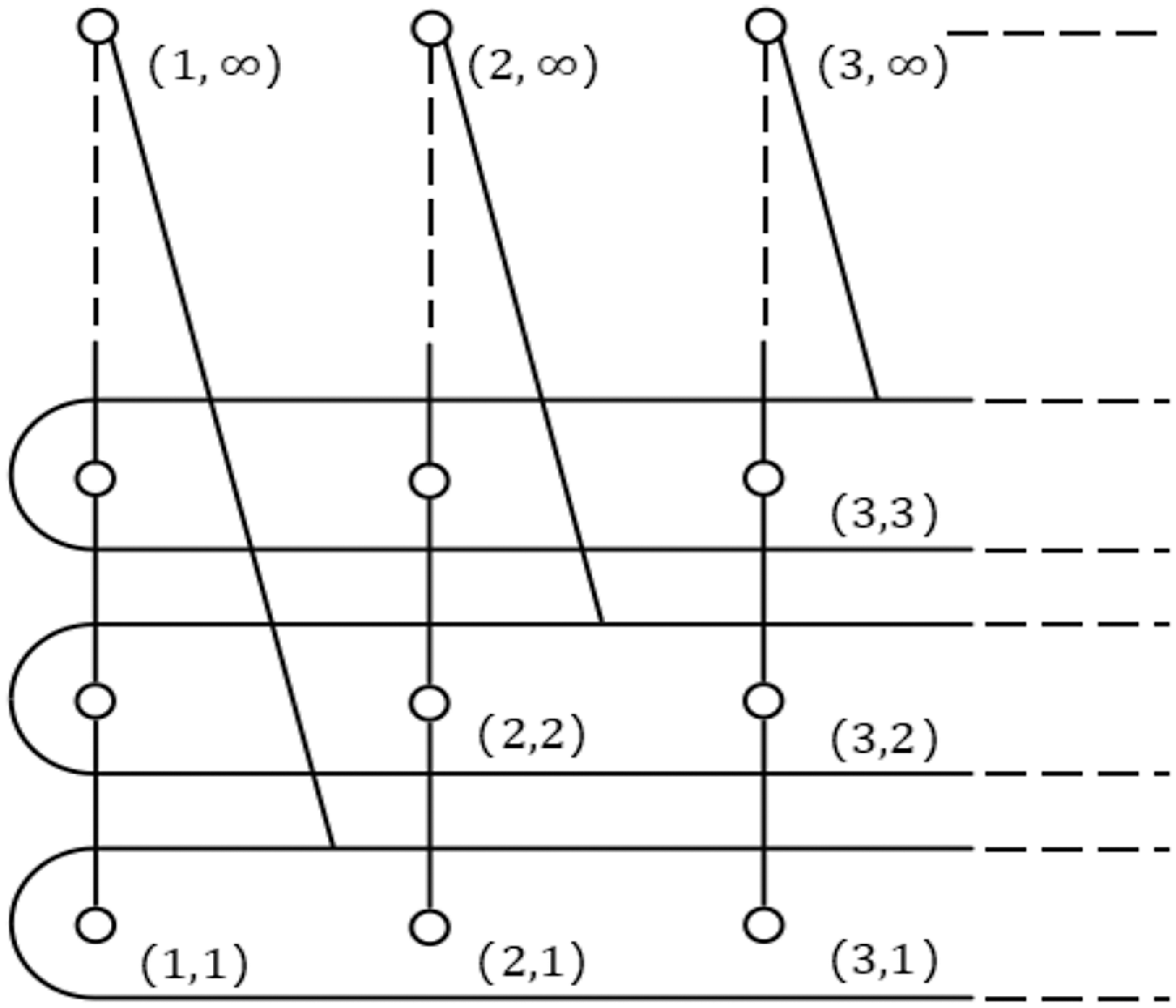
Example 4.10 (Johnstone’s dcpo). Let
 $\mathbb{J}=\mathbb{N}^{+}\times (\mathbb{N}^{+}\cup \{\infty \})$
with ordering defined by
 $(j, k)\leq (n, m)$
iff
 $j = n$
and
 $k \leq m$
, or
 $m =\infty$
and
 $k\leq n$
(see Figure
2
).
 $\mathbb{J}$
is a well-known dcpo constructed by Johnstone in Johnstone (Reference Johnstone1981), which is the first given dcpo whose Scott space is non-sober. Clearly,
 $\mathbb{J}_{max}=\{(n, \infty ) : n\in \mathbb{N}^{+} \}$
is the set of all maximal elements of
 $\mathbb{J}$
.
The following four conclusions about
 $\Sigma \,\!\mathbb{J}$
are known (see, e.g., (Lu and Li Reference Lu and Li2017, Example 3.1) and (Miao et al. Reference Miao, Li and Zhao2021, Lemma 3.1)):
-
(i)
$\mathcal{D}(\mathbb{J})=\{D\subseteq \mathbb{J} : D \mbox{has a largest element or there is}\, n\in \mathbb{N}^{+} \,\mbox{such that}\, |D|=\omega \,\mbox{and}\,D\subseteq \{n\}\times \mathbb{N}^{+}\}$
. So
$\mathbb{J}$
is a dcpo.
-
(ii)
${\mathsf{Irr}}_c (\Sigma \,\!\mathbb{J})=\{\overline {\{x\}}={\mathord {\downarrow }} x : x\in \mathbb{J}\}\cup \{\mathbb{J}\}$
. -
(iii)
$\mathsf{K}(\Sigma \,\!\mathbb{J})=(2^{\mathbb{J}_{max}} \setminus \{\emptyset \})\bigcup \mathbf{Fin}\,\!\mathbb{J}$
. -
(iv)
$\Sigma \,\!\mathbb{J}$
is not well-filtered and hence non-sober (cf. (Goubault-Larrecq Reference Goubault-Larrecq2013, Exercise 8.3.9)).


Considering the space
 $(\mathbb{J}, \upsilon (\mathbb{J}))$
, we have the following conclusions.
-
(a)
$(\mathbb{J}, \upsilon (\mathbb{J}))$
is not irreducible complete, and hence,
$\mathbb J$
is not sup-complete.
Figure 2.Johnstone’s dcpo
$\mathbb{J}$
.By (ii) we have
$\mathbb{J}\in {\mathsf{Irr}}_c(\Sigma \,\!\mathbb{J})\subseteq {\mathsf{Irr}} ((\mathbb{J}, \upsilon (\mathbb{J}))$
. As
$\mathbb{J}$
has no greatest element,
$\vee \mathbb{J}$
does not exist in
$\mathbb{J}$
. Thus,
$(\mathbb{J}, \upsilon (\mathbb{J}))$
is not irreducible complete, and hence,
$\mathbb J$
is not sup-complete.
-
(b)
$\mathsf{K}(\Sigma \,\!\mathbb{J})=(2^{\mathbb{J}_{max}} \setminus \{\emptyset \})\bigcup \mathbf{Fin}\,\!\mathbb{J}\subseteq \mathsf{K}((\mathbb{J}, \upsilon (\mathbb{J})))$
by (iii) and
$\upsilon (\mathbb{J})\subseteq \sigma (\mathbb{J})$
-
(c)
$(\mathbb{J}, \upsilon (\mathbb{J}))$
is not well-filtered and hence not strongly well-filtered. Let
$\mathcal K=\{\mathbb{J}_{max}\setminus F : F\in$
$(\mathbb{J}_{max})^{(\lt \omega )}\}$
. Then by (b),
$\mathcal K\subseteq \mathsf{K}((\mathbb{J}, \upsilon (\mathbb{J}))$
is a filtered family and
$\bigcap \mathcal{K}=\bigcap _{F\in (\mathbb{J}_{max})^{(\lt \omega )}}$
$(\mathbb{J}_{max}\setminus F)=\mathbb{J}_{max}\setminus \bigcup (\mathbb{J}_{max})^{(\lt \omega )})=\emptyset$
, but
$\mathbb{J}_{max}\setminus F\neq \emptyset$
for all
$F\in (\mathbb{J}_{max})^{(\lt \omega )}$
. Therefore,
$(\mathbb{J}, \upsilon (\mathbb{J}))$
is not well-filtered, and hence, it is not strong well-filtered.


Example 4.11.
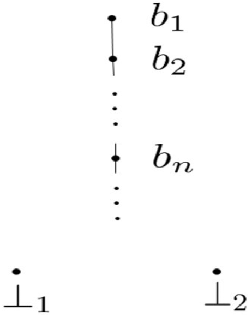
Let
 $P=\{b_n: n\in \mathbb N^{+}\}\cup \{\bot _1, \bot _2\}$
and define a partial order
 $\leq$
on
 $P$
as follows (see Figure
3
):
-
(1)
$b_{n+1}\lt b_n$
for any
$n\in \mathbb N^{+}$
, -
(2)
$\bot _1\lt b_n, \bot _2\lt b_n$
for all
$n\in \mathbb N^{+}$
, and
-
(3)
$\bot _1$
and
$\bot _2$
are incomparable.


The poset
 $P$
in Example 4.11.

Consider the upper topology space
 $(P, \upsilon (P))$
. Then
-
(a)
$P$
is Noetherian, and hence,
$P$
is an algebraic domain and
$\sigma (P)=\alpha (P)$
by Proposition 3.1
. -
(b)
$\upsilon (P)=\alpha (P)=\{{\uparrow } b_n : n\in \mathbb{N}^+\}\cup \{{\uparrow } \top _1, {\uparrow }\top _2 \}\cup \{\{b_n: n\in \mathbb{N}^+\}\}\cup \{P, \emptyset \}$
.Suppose that
$\emptyset \neq A={\downarrow } A$
. We show that
$A$
is closed in
$(P, \upsilon (P))$
. If
$A\subseteq \{\bot _1, \bot _2\}\}$
, then clearly
$A\in \Gamma ((P, \upsilon (P))$
. Now we assume that
$A\cap \{b_n : n\in \mathbb{N}^+\}\neq \emptyset$
. Let
$m=\mathrm{min}\{n\in n\in \mathbb{N}^+ : b_n\in A\}$
. Then
$A={\downarrow } A={\downarrow } b_m\in \Gamma ((P, \upsilon (P))$
. Hence
$\upsilon (P)=\alpha (P)=\mathbf{up}(P)=\{{\uparrow } b_n : n\in \mathbb{N}^+\}\cup \{{\uparrow } \top _1, {\uparrow }\top _2 \}\cup \{\{b_n: n\in \mathbb{N}^+\}\}\cup \{P, \emptyset \}$
. -
(c)
${\mathsf{Irr}}((P, \upsilon (P)))={\mathsf{Irr}}((P, \alpha (P)))=\mathcal D(P)=2^{P}\setminus \{\emptyset , \{\bot _1, \bot _2\}\}$
by (a) and (b).
-
(d)
$(P, \upsilon (P))$
is irreducible complete by (a) and (c).
-
(e)
$(P, \upsilon (P))$
is sober by (d) and Proposition 2.4
. -
(f)
$P$
is not a sup-semilattice (
$\bot _1\vee \bot _2$
does not exist in
$P$
), and hence, it is not a sup-complete poset.
-
(g)
$\mathsf{K}((P, \upsilon (P)))=\mathsf{K}((P, \alpha (P)))=\mathbf{Fin}\,\!P=\mathbf{up}(P)\setminus \{\{b_n:\,n\in \mathbb N^{+}\}\}=\{P, {\uparrow }\top _1, {\uparrow }\top _2\}\cup \{{\uparrow } b_n:\,n\in \mathbb N^{+}\}$
.We only need to show that
$\{b_n:\,n\in \mathbb N^{+}\}\notin \mathsf{K}((P, \upsilon (P)))$
. In fact,
$\{b_n:\,n\in \mathbb N^{+}\}\subseteq \bigcup \limits _{m\in \mathbb N^{+}}$
$(P\setminus {\downarrow } b_m)=\bigcup \limits _{l\in \mathbb N^{+}, l\geq 2 }\{b_1,\,b_2,\,\cdots ,\,b_{l-1}\}$
. But
$\{b_n:\,n\in \mathbb N^{+}\}\subseteq P\setminus {\downarrow } b_m$
for no
$m\in \mathbb N^{+}$
. Hence
$\{b_n:\,n\in \mathbb N^{+}\}\notin \mathsf{K}((P, \upsilon (P)))$
. -
(h)
$(P, \upsilon (P))$
is not coherent.
${\uparrow }\bot _1, {\uparrow } \bot _2\in \mathsf{K}((P, \upsilon (P)))$
, but
${\uparrow }\bot _1\cap {\uparrow }\bot _2=\{b_n:\,n\in \mathbb N^{+}\}\notin \mathsf{K}((P, \upsilon (P)))$
by (g). So
$(P, \upsilon (P))$
is not coherent.


5. Conclusion
In this paper, we have introduced a new kind of
 $T_0$
-spaces – strong
 $R$
-spaces, lying between strongly well-filtered spaces and
 $T_2$
-spaces. The strong
 $R$
-spaces are closely related to
 $R$
-spaces, strongly well-filtered spaces, and well-filtered spaces. By introducing and studying strong
 $R$
-spaces, we have provided some finer links between
 $d$
-spaces and
 $T_2$
-spaces and given answers to two questions recently posed by Xu.
The
 $R$
-spaces and strongly well-filtered spaces have been proven to be two important classes of
 $T_0$
-spaces (cf. Lawson and Xu (Reference Lawson and Xu2024b), Wen and Xu (Reference Wen and Xu2018), and Xu (Reference Xu2016, Reference Xu2026)). Our study in this paper indicates that strong
 $R$
-spaces may deserve further investigation.
Acknowledgements
The authors sincerely thank the anonymous referee for his valuable comments and suggestions that have greatly improved this paper.
Competing interests
The authors declare that they have no conflicts of interest with this work. We declare that we do not have any commercial or associative interest that represents a conflict of interest in connection with the work entitled “Strong well-filteredness of upper topology on sup-complete posets” (Manuscript ID: MSCS-2025-0097).