Introduction
The expressive content of the various domains of recorded song is an issue that surfaces fairly frequently in analytical writing. The effect of the groove; the differences between open, closed, and non-discursive harmonic patterns; the connotations of timbre; the expressive meaning of melody and lyric; the import of levels of repetition – though contested, these are all now becoming established topics of musicological (and other) analysis and interpretation. One domain, however, remains a poor relation in this debate, and that is the spatialization of sounds and its effects. Indeed, the expressive role of spatialization within the stereo field alone is so poorly understood that it frequently does not surface within analytical discussion, and when it does, its appearance is only cursory. This article, and the larger project from which it emanates, endeavours to provide a foundation for understanding the ways in which spatialization and references to spatial location create meaning within the context of the recorded song or track.Footnote 1
The foundation proposed here represents the confluence of a number of theoretical positions. The first two of these help us to formulate the spatial conditions of the stereo field itself and the presence within it of a persona or personae, who may or may not be coterminous with an equivalent number of actual singers or performers. First, the sound-box: a heuristic model of the way in which the positioning of sound sources is perceived in recordings.Footnote 2 The sound-box acts as a virtual spatial enclosure within which the location of sound sources can be specified with some precision. Location within the sound-box is metaphorically described at any single moment in three-dimensional space: laterality of the stereo image; perceived proximity to a listener (also referred to as prominence); and the perceived pitch height of sound sources (register, in other words). The changes in that positioning over time create a fourth dimension, that of temporality.Footnote 3 Second, the personic environment, which distinguishes between the persona or personae evidenced in a recording and the musically coded environment in which that persona is virtually located.Footnote 4 This environment is normally articulated through three factors: the location of sound sources within the sound-box, harmonic vocabulary, and form (or narrative). The persona is normally activated through lyrics and their articulation, a topic that involves aspects of melodic contour.
In order to name and analyse the spatial aspects of interpersonal and environmental relationships in recorded song, we pair two further theoretical positions. Through a reformulation of proxemics,Footnote 5 which we use to refer to recorded presences, we theorize relations among the listener, the persona, and the personic environment. Proxemics describes the distances (social, public, personal, intimate) between individuals-in-interaction, a factor not only of audible distance but also (on recordings) of the degree of congruence between a persona and the personic environment.Footnote 6 We pair with proxemics a formulation in cognitive theory known as the image schema,Footnote 7 a patterned way-of-knowing developed in our bodily experience of our world and translatable from one sense-domain to another.Footnote 8 We use these image schemata, in conjunction with the proxemic vocabulary developed here, to theorize the organization and experience of spatial relationships in the stereo field. Throughout this examination points will be exemplified with reference to a pragmatically limited range of recordings. While the genre scope of these examples might seem narrow, this should not be taken to indicate any limitation in the genre scope of the theory.Footnote 9
Image schemata and metaphorical extension
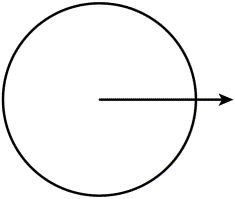
Drawing on established conceptualizations of schemata by Kant and by the cognitive psychologist Ulric Neisser, Mark Johnson argues that our most basic, embodied ways of knowing and of being in the world act as the experiential (he uses the word ‘pre-conceptual’) basis upon which the propositional realm (i.e. all abstract thought and language) builds.Footnote 10 According to Johnson, we process our embodied experience cognitively in terms of schemata, and these schemata have inherent, specific qualities. For Daniel Levitin, schemata ‘frame our understanding; they’re the system into which we place the elements and interpretation of an aesthetic object.'Footnote 11 Johnson's image schemata exist at a high level of generalization and abstraction, which permits them to serve as the basis of more abstract ways of knowing.Footnote 12 They are identified by their simplicity and generality, and are distinct from concrete, rich images, such as ‘mental pictures’, which have a higher degree of particularity and specificity.Footnote 13 In their generality, image schemata may serve as the foundation for understanding concepts in relation to a number of domains, such as objects, actions, and abstract thought, in ways that rich images cannot. For instance, Johnson discusses the specific image schema in-out, observing that its latter aspect ‘can represent an enormous number of orientational possibilities, as in: Mary got out of the car; Spot jumped out of his pen; He squeezed out some toothpaste; Tear out that cartoon and save it; Get out of bed!’.Footnote 14
out schema (Johnson, The Body in the Mind, 33).
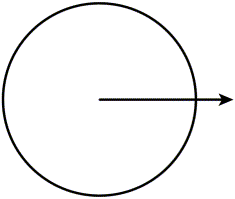
Johnson explains that schemata usually contain a small number of parts and their relations: ‘their most important feature is that they have a few basic elements or components that are related by definite structures, and yet they have a certain flexibility. As a result of this simple structure, they are a chief means for achieving order in our experience so that we can comprehend and reason about it’.Footnote 15 It is the very structure of the image schemata, manifested in the relations among parts, that will determine the way in which an individual schema may be used.Footnote 16 These relations operate in a variety of registers, such as temporal, locational, causal, and instrumental.Footnote 17
Image schemata function as the basis for rational thought by way of metaphorical extension,Footnote 18 serving as the pre-conceptual ground for cross-domain mapping.Footnote 19 Indeed, any initial extension of a schema can serve as the primary point of cross-domain mapping,Footnote 20 which is a process enacted by metaphor. In the words of Lawrence Zbikowski, the only musicologist as yet to have made a full-length study of the application of cognitive science to music, ‘Cross-domain mapping is a process through which we structure our understanding of one domain (which is typically unfamiliar or abstract) in terms of another (which is most often familiar and concrete).’ Zbikowski illustrates the concept by pointing out that we understand electrical conduction by means of a hydraulic model: we speak of electricity flowing, for example, an apprehension facilitated by a mapping from the domain of the movement of water to that of the ‘movement’ of electricity.Footnote 21 Of chief significance to Johnson's aims is the way in which physical schemata may make both physical and non-physical extensions available. The issue becomes more complex – and of particular relevance for our purposes – in the case of song, when we consider the intersections of lyrics and non-lexical sonic properties (such as spatial indicators) that may at once call upon both physical and non-physical extensions of schemata. We return to this point below. But image schemata are not universally, nor arbitrarily, available to metaphorical extension.Footnote 22 Whether a schema is appropriate for certain kinds of extension depends above all on its structure, and this structure thereby constrains rational thought (as do the cultural conditions in which schemata operate, another point to which we shall return).
By connecting propositional thought to pre-conceptual schemata, Johnson extends what is commonly meant by ‘reasoning’ to include activities of the body, a bodily knowing that is intimately and inherently linked with rational processes, rather than separate from them:
Logical inferences, I am claiming, are not just inexplicable structures of rationality (of pure reason). On the contrary, they can be seen to emerge from our embodied, concrete experience and our problem solving in our most mundane affairs. The patterns of our rationality are tied, in part, to the preconceptual schemata that give comprehensible order and connectedness to our experience.Footnote 23
In the way that it brings the body into a theory of meaning, Johnson's position becomes particularly attractive to our study, concerned as we are with the spatialization of sound in recorded song and our bodily experience of it. Johnson includes the body in his arguments in two other notable ways, both of which we treat in more detail in the following sections. The first has to do with the way in which the body is seen as structural to many, if not most, image schemata, both as a foundational point of experience upon which schemata are built and as providing a viewpoint inherent to the structural relations of many image schemata.Footnote 24 The second relates to the way in which Johnson argues for the culturally determined and maintained nature of most schemata.Footnote 25
Image schemata and sound
Johnson's theory offers a number of rich possibilities for the analytical study of spatialization in recorded sound. Just as he writes about the metaphorical extensions of schemata in thought and language, so it is possible to consider sonic extensions of schemata in music (or, rather, it is possible to consider sonic iterations of schemata as one further metaphorical extension, along with thought and language).Footnote 26 As already noted, his embrace of bodily experience as the foundation for all meaning helps us to think analytically about the ways in which our somatic experiences of music may contribute to the overall (but perhaps diffuse) sense of meaning that listeners derive from a particular song, and also about the pleasurable aspects of song, which remain difficult to discuss, despite the efforts of, for example, gestural analysis.Footnote 27 William Echard, analysing Neil Young's ‘Powderfinger’,Footnote 28 has already adopted an image-schemata-based analytical approach in order to discuss the cyclical accumulation of tension and release in the first verse of the track, and while other music theorists have also embraced his work,Footnote 29 none has yet applied his theories towards the analysis of spatialization, to which specific question we now turn.
Our sense of sonic space in recorded tracks is encountered and experienced first in interaction with our own bodies. In listening we confront our full bodily experience of sound – it is outside us, abutting us, exciting our molecules. This initial bodily experience of recorded sound activates Johnson's containment schema. Consider three different hearings of the t.A.T.u. track ‘All the Things She Said’.Footnote 30 Imagine listening to it softly on your mobile phone (so as not to annoy fellow travellers, for example). We'll call this listeningA. The sound does not travel very far and, for you, barely extends beyond the equipment itself; it is contained within a very localized space, a space which encompasses both the equipment and the listener but which has imprecise boundaries. Any overspill is irrelevant to your listening, though it may act as a badge of identity. Your phone might be in your hand (most likely) or a top pocket – its direction from your ears is immaterial, because you perceive the signal as mono. Next, imagine listening to it on your home stereo, listeningB. Aspects of the track are localized in one speaker or the other, if you choose to listen closely. At 1′40″, for instance, an acoustic guitar is audible in the right speaker, ‘answered’ subsequently by synthesized, arpeggiated strings in the left speaker. The overall sound, however, expands to fill the room as you move towards the sweet spot. Finally, imagine listening to it on headphones, listeningC. The sound is now enclosed (in that, unless at excessive volume, it does not extend beyond your body from the perspective of any external listener). It is by far the most prominent feature of your entire aural landscape, and it becomes superimposed on regions of your body. Thus, these ‘voices’ are centralized within your head. Are they facing you, or facing out from you? Actual voices are likely to be perceived as facing (i.e. addressing) you unless you identify yourself as listener with the voice. With instrumental resources the issue is less clear-cut. The guitar that was in the right speaker, for instance, is now in your right ear and its orientation (forwards? backwards? inwards?) seems uncertain. The synthesized bass, which had been up front and close, is now in line with your forehead (or further down your body if you have the volume up).
containment schema (Johnson, The Body in the Mind, 23).

The containment schema proposed by Johnson has five distinct operative functions: protection from external forces, restriction of forces within the container, relative fixity of location, accessibility to an observer, and transitivity. Each of these is activated in a different way to organize these three different listening spaces. In the case of listeningA the container is porous, in that its precise limits cannot be fixed, but the relationship between its elements (the mobile phone and you as a listener) is fixed. The container is only minimally protected from external forces, but the porosity of sound prevents its destruction by them. Its transitivity is trivial, for if we move from the platform to the train, the container moves also. In the case of listeningB, as the container is coextensive with the room (despite some probable overspill), it is more protected, unless someone comes into the room and chooses to turn off the stereo. The relationship is less fixed, as you are free to move your position within the container relative to that of the speakers, but the force of the sound is equally constrained, and you will have different motivations for placing yourself in different positions. The container is accessible to an observer but in most cases becomes visually accessible only once it is entered. Now consider the case of listeningC. The container is no longer something external to the listening body, but internal. The container is barely porous, though a little sound will usually escape, and a listener can choose to be aware of external sounds. Paradoxically, sounds positioned at the extremities of the stereo spectrum can appear to originate from outside the head, whereas this is not the case for the room of listeningB (though it can certainly be the case that sounds positioned at the extremes appear to originate to the right of the right speaker and/or to the left of the left speaker). Thus, while not all Johnson's operative functions are equally in play for each mode of listening, the overall practice of listening to a recording activates this schema. Insofar as we have experience of these different modes of listening, we are aware of the sense of the listening experience being contained, unlike a viewing experience – a position compounded by the ability to buy such music to keep it contained on a CD rack, an iPod, or a computer.
Moving forward from this bodily experience of recorded sound, primary as it is, we can examine the sonic (metaphorical) extensions of image schemata within the soundbox.Footnote 31 Sonic extensions, thus conceived, may be manifest in any number of domains, including lyrics, harmonic content, persona/environment relationships, production techniques, and so forth. Significantly, each of these activated schemata contains within its structure a perspective,Footnote 32 the effect of which is to afford the listener a single point, or multiple points, of view from which to experience (spatially) the musical material.Footnote 33 In addition to the containment schema, four or five others identified by Johnson may underpin spatial elements in music. The path and centre-periphery schemata seem particularly related to the somatic experience of spatialization in some songs, while the cycle and force schemataFootnote 34 are relevant both to our sense of trajectory through space (its impediment or momentary staticity, etc.) and also perhaps to the movement of sound sources within the stereo field.Footnote 35 We turn now to some examples.
path schema (Johnson, The Body in the Mind, 28).

Image schemata exemplified
The title and hook of Missy Elliott's ‘Pass that Dutch’Footnote 36 pose an imperative – one that triggers a particular point of view and sense of responsibility through the activation of the path schema. The hook is overtly spatialized by the panning on each iteration (it appears first on the right, then on the left, and then back on the right again, etc.), and this treatment of the imperative demand reinforces the perspective activated by the lyrics. Importantly, both these elements (the lyric itself and the spatialization) place the listener centrally as just one, albeit a focal, point on the path along which the ‘dutch’ (or joint) travels. The perspective relates specifically to the experience of passing joints and, more generally, of being between people, of being situated within a sharing group, and of passing something between members of that group with yourself as a point along that path. It allows for a physical experience of ‘response’ and ‘responsible’ (a derivation that Johnson relates to the moral dimensionFootnote 37). Even at this level the image-schemata-based analysis of the positioning of the listener through lyrical and spatialized elements is meaningful, in that it helps to describe a pleasure to be gained from the track, as well as a possible impetus towards certain movements rather than others. It may also help to explain a particular kind of listener identification with the illicit act, because it places the listener along a path and asks for a responsibility of action along it. It is also noteworthy that the centralized positioning of the listener, which occurs during the choruses, places him or her in a similar position to Elliott herself when she delivers her rapped verses. The bass is sited centrally and spans the entire stereo field, helping to create the boundaries of the sonic horizon by way of the centre-periphery schema. Elliott is placed centrally (or just to the right of centre) throughout and is forward from the bass. She is continually juxtaposed with additional voices panned wide left and right, and crowd voices panned mid-left and right. The central positioning of her voice in the verses suggests, when the hook re-enters, a central positioning for the listener – an implication of the track's subject position over and above whatever physical positioning the listener may adopt (for instance in the room space of listeningB). This central location, matching that of the singer, allows for the listener's identification with Elliott's dominance and stardom, a factor that is perhaps part of the pleasurable experience of this song.Footnote 38
centre-periphery schema (Johnson, The Body in the Mind, 124).

Note that in ‘Pass that Dutch’ (as in other examples that follow) we argue that the musical material activates more than one schema (in this case, path and centre-periphery). As Susan Fast's earlier use of image schemata implies, a feature of this theoretical position is that multiple schemata can be – indeed, would normatively be – activated by the same experience: Johnson offers the possibility of superimposed, but not competing, schemata operating at a given time.Footnote 39 This is a position that Lakoff and Johnson argue is endemic to a cognitive metaphorical perspective.Footnote 40 They insist that an approach that demands singular understandings of concepts is both unreal and suspect. Moore and Dockwray, in their investigation of the development of a normative diagonal mix, argue for a centred listener perspective, with the two sides of the stereo field equally balanced.Footnote 41 That model is suggestive of Johnson's balance schema and applies to a large number of tracks, but this is not to exclude other schemata that might be invoked by particular tracks. Johnson's work offers us a theoretical position through which we can meaningfully speak of a multiply positioned listener, one who holds a particular viewpoint or perspective based on the structural properties of one or many underlying image schemata and whose position, therefore, is fluid and subject to shifting.
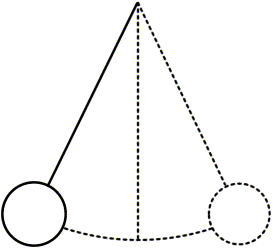
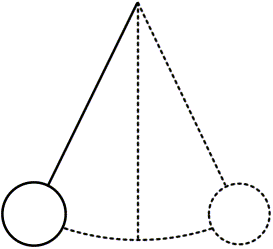
The lyrics to Bob Dylan's song ‘All along the Watchtower’Footnote 42 have troubled many in their interpretation. The first two verses record a highly allusive conversation between two figures, ‘the joker’ and ‘the thief’, while the third narrates an observation from ‘the watchtower’ of what might be encroaching menace. The key line is the very first, ‘There must be some kind of way out of here’, in which ‘here’ refers, at least metaphorically, to a space or situation from which escape is necessary. The final verse's ‘two riders’ could be seen as offering just such an escape for the joker and the thief, with the added sense of menace contained in the word ‘approaching’ (with its senses of both deliberation and resistance to deflection) and in the image of the wind starting to howl. In Dylan's original recording, it is left simply as that – no further information on (or interpretation of) the dramatic situation is provided. His voice is central in the mix, generally smothering the guitar. Harmonica to the left and drums to the right balance the bass, which is also in the centre. Jimi Hendrix's cover version disposes the sound-box differently.Footnote 43 The kit is now to the left, with a second guitar to the right, but Hendrix's voice and lead guitar, along with Noel Redding's bass, are central. The harmonic pattern is identical, but Hendrix chooses an alternative articulation. The upbeat is peculiar to Hendrix; this means that, at the very opening of the track, grouping and phrase boundaries do not coincide. On each iteration the harmonic pattern, rather than dropping from the tonic and then returning as in Dylan's version (aeolian: i–(VII–)VI–VII–), embodies both a rise and a fall from VII (aeolian: VII–i–VII–VI–). The pivot, the centre of the pattern, has now become VII, as a result of the regularly empty (third) beat, which demarcates each iteration. The harmony moves to both sides of this VII, but is unable to escape throughout the entire track. We suggest that the force of this harmonic reformulation can best be understood as an instance of the pendulum schema.Footnote 44
No precise analysis of this schema is present in the literature, but it seems that pendulum combines characteristics of two of Johnson's other schemata – balance, in its twin-pan version, and containment.Footnote 45 The pattern is at least doubly embodied: it appears in both the walking gait and the swung arms so necessary to walking at speed. The sense is of the harmonic motion swinging one way (to i) and then the other (to VI), but without being able to break free (of the boundary set by i and VI as extremes) and instead constantly returning to VII. This is an important point: William Echard, in the article cited above, finds the tonic to be the ‘fulcrum’ of balance in Neil Young's ‘Powderfinger’,Footnote 46 but we would be wary of accepting any unqualified assumption that the tonic function and the fulcrum will always be coextensive – particular articulations need to be observed. The harmonic motion in Hendrix's recording, then, implies that the joker is wrong, that there is indeed no ‘way out of here’. Neither of the later cover versions of the song – by Richie Havens and U2Footnote 47 – incorporates Hendrix's upbeat. This omission implies a different reading of the song, one that fails to use Hendrix's rhythmic rethinking to energize the metaphor that enables us to feel that, for the joker and the thief, escape is impossible.Footnote 48
pendulum schema.
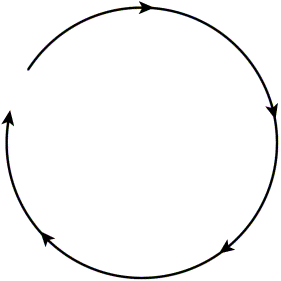
cycle schema (Johnson, The Body in the Mind, 120).
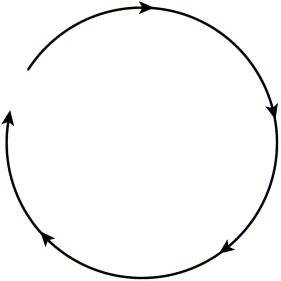
Recall next our earlier example, ‘All the Things She Said’. This particular track activates the cycle schema,Footnote 49 a schema marked by a temporally recurring internal structure and a pattern of tension and release. In this track (as in so many others), the recurring harmonic pattern of the chorus (VI–v–i–i6) constitutes the cycle, while the rising melodic tessitura (as  –
 – becomes
 –
 –) provides the highpoint to which the cycle leads. The Gossip's ‘Standing in the Way of Control’ offers a similar invocation of the cycle schema, with an eight-bar
harmonic cycle that is repeated throughout virtually the entire song (aeolian: i–VII–IIIsus4–IVsus4)Footnote 50 and an ostinato in the bass line that corresponds to that harmonic cycle. Also active here is the force schema. This metaphor of force is frequently employed in the interpretation of music, but for Johnson it has particular components as an image schema: (potential) interaction, directionality, a single path of motion, origin, intensity, and a sequence of causality.Footnote 51
compulsion schema (Johnson, The Body in the Mind, 45) – one of the force schema structures.

In ‘Standing’, the bass line traces a cyclic descent from the upper tonic through scale degrees  –––
 ; this descent is accompanied by a syncopated slide from ♯
 to before the drop to , which reinforces its trajectory. The descent itself provides a forward directionality, or compulsion, to the cycle, as do the regular off-beat accents that appear on every time the cycle occurs.Footnote 52 Johnson argues that force is experienced in a variety of ways (as compulsion, blockage, counterforce, diversion, removal of restraint, enablement, attraction, etc.) and that these play a large part in the experience of music.Footnote 53 ‘Standing in the Way of Control’ affords a sense of force through the compulsion or directionality of the instrumental material, but the way in which this compulsion is thwarted each time the refrain of the title enters further develops this sense of force. The syncopated rhythmic impulse stops as the refrain comes in, and for at least the first four bars of the refrain the straight delivery of the individual semiquavers blocks the momentum of the cycle and force impulses, providing a sonic iteration of the title, which, like the underlying schemata, metaphorically extends the concept government is a physical force.Footnote 54
The Real Thing's ‘Can You Feel the Force?’ uses lyrics to make its subject matter clear, while the musical environment presents various ‘forces’ for our consideration. Most notable in this regard are the series of sound effects that occupy the first minute of the disco track, over which the band members ask three times, in a loud whisper, ‘Can you feel the force?’, identifying ‘the force’, on the surface, with those sound effects. Of what do they consist? Directionality is most clearly evident in the opening seconds, as a ‘whoosh’ reminiscent of a fast-moving firework moves position in two dimensions, both left to right and, in terms of pitch, from ‘low’ to ‘high’. The increase of speed is consistent with the notion of the sound having been ejected from a clear point of origin in a single path of motion. Directionality, however, is also apparent in subtler moments, such as the upward and then downward pitch bend far to the left over the opening ten seconds, as if a counterforce were acting upon it. A low synthesized B♭ enters in the meantime, becoming of indeterminate pitch over the first twenty-five seconds. This motion does not seem directed – the movement towards indistinctness of pitch is perhaps better understood as a path-related process. Indeed, it is the sense of intention associated with force that is absent from most of these sound effects. When the lyric ‘Can you feel the force?’ is used later in the track, it is provided with multiple echoes, but these echoes do not change position. At these points (35″, for example) it is as if the urgency with which the question is delivered increases, with the hint of additional voices reinforcing it. A ‘force’ is also illustrated (as at 1′15″, for example) by a synthesized sound, which combines the ‘whoosh’ of the opening effect with the echoing of fast individual splinters of sound, erupting far to the right at 16″ and moving swiftly to the left over the course of the next two seconds. At this point, since the stylistic context has changed (the conventional sound of a disco outfit now dominates), it sounds out of place. While the lyrics suggest that we should equate the ‘force’ with love or peace, or some such positive quality, the character of the sound seems to have nothing to do with such a quality (indeed, a realist reading would identify this opening as chaotic, uncoordinated, and accidental). An alternative understanding of the force of this track, of course, can be developed with attention to the gradual process from undifferentiated durations at the very opening, by way of the beat marker, towards a regularized metre, introduced progressively by means of rhythmicized chordal passages (first heard at 28″). Though this is a clichéd move, it does not mean that such a reading is necessarily unhelpful.
The Gossip track ‘Standing in the Way of Control’ leads us to a final aspect of Johnson's theory that proves attractive for the study of spatialization, namely the kinaesthetic qualities of image schemata, a point related to their generality. Johnson argues: ‘“[I]mage schemata” have a certain kinesthetic character – they are not tied to any single perceptual modality, though our visual schemata seem to predominate. […] It would seem that image schemata transcend any specific sense modality, though they involve operations that are analogous to spatial manipulation, orientation, and movement’.Footnote 55 This aspect of Johnson's argument allows for the possibility that a particular schema may operate within a song by means of a number of abstract extensions (e.g. lyrical content, harmonic motion, textural change, or a combination of the above) and might therefore carry wider meanings than other single elements of the song.Footnote 56 This would certainly seem a possibility for the force schema in ‘Standing’, the unity of which may account for the track's pleasure and impact. Johnson argues, ‘The central problem in each case is always to identify the structure of the source-domain that constrains the metaphorical mapping onto a target-domain. In this way one is able to show that metaphorical projections are not arbitrary (i.e., that not just anything can be mapped onto anything else), and that they do influence our reasoning.’Footnote 57 To consider this more fully, which is beyond the scope of this paper, we would need to analyse all of the metaphorical extensions in Western culture and language that utilize the concept government is a physical force.
Further possibilities arise in terms of unified extensions. ‘Pass that Dutch’ exemplifies this idea rather simply, as lyrics and spatiality reinforce each other directly.Footnote 58 In ‘All the Things She Said’ the container schema is extended both by the lyrics (‘running through my head’) and by the overlapping of voices in the stereo field. ‘Running through my head’ metaphorically extends the concept of our bodies as vessels, and the saturation of the stereo field with the repeated vocal iterations provides a sense of depth, laterality, and boundedness to the sound-box that reinforces the container schema.
More oblique is the case of Steeleye Span's ‘The Elf Knight’.Footnote 59 This track too can be understood as a manifestation of the balance schema, in that two protagonists exchange places in terms both of their position as actors within the narrative and of the harmonic detail that underlies their respective portions of the song. The characters in the story are named as the Elf Knight and Lady Isobel. The knight is intent on enticing, seducing, and murdering the Lady Isobel, as in many similar ballads, but in this one she turns the tables on him. Two stretches of music are used in Steeleye Span's version, one for her, which is based on G (and makes prominent use of the chords of C and D), and a second for him, which is based on E minor (but again prominently features C and D chords). D acts cadentially in both instances.Footnote 60 After a lengthy fiddle solo, Lady Isobel assumes the Elf Knight's stretch of music, while he assumes hers, reinforcing the exchange that has taken place in their relative positions as actors, which have undergone a rotation of 180 degrees. Textures match this exchange: a predominance of acoustic guitar and cymbals articulate the G material, and a prominent bass guitar articulates the E minor material. Marked spatially throughout is the refrain (‘Fine flowers in the valley’), which is doubled by a backing voice at the octave (rather than the third as elsewhere in the track) and recedes progressively further into the background.
Image schemata, sound, and difference
Clearly Johnson's image schemata provide a rich framework within which to discuss issues of sonic space and embodied meaning in music. As others have noted, however, the body Johnson resuscitates for theorists is a Western, white, male body.Footnote 61 In his formulation of image schemata, he theorizes a degree of universality to physical experience and does not elaborate on the related subjects of bodily, sexual, and experiential differences. More recent commentators on embodied cognitionFootnote 62 tend to be more sensitive to such differences. Gibbs follows DamasioFootnote 63 in delineating three levels of embodiment: the neural (common to the species), the cognitive unconscious (common to the culture), and the phenomenological (common to the individual).Footnote 64 Whether image schemata appear at the first or second level is unclear.
Johnson's universality is perhaps most evident in his explanation of the schema containment. He writes:
Our encounter with containment and boundedness is one of the most pervasive features of our bodily experience. We are intimately aware of our bodies as three-dimensional containers into which we put certain things (food, water, air) and out of which other things emerge (food and water wastes, air, blood, etc.). From the beginning, we experience constant physical containment in our surroundings.Footnote 65
Johnson's formulation of containment through the contained and containing body entertains little, if any, sexual difference, and it remains plausible that for Others – for women or for queer subjectivities, for example – either the component parts of image schemata or the schemata themselves will differ from those put forward in Johnson's work.Footnote 66 Such a difference would, of course, have real implications for the theorization of spatial experience in recorded music. Still, only a partial reading of Johnson's work would suggest that he argues strictly for an essential, human bodily experience, which is necessarily and always male, white, and heterosexual. Rather, he argues that our ways of knowing our world, and the metaphorical extensions we use in what is commonly understood as rational thought, rely on both our bodily being in the world and the cultural interaction with and codification of such experience – what he calls ‘publicly shared meaning structures’.Footnote 67 An exploration of alternative image schemata born of our distinct bodily experiences remains well beyond the scope of this paper. However, we would like to offer a brief reading that utilizes Johnson's containment schema as the product of ‘shared cultural modes of experience’, at the same time within the confines of a sonic space in which difference and resistance are articulated.Footnote 68
Like Johnson, we begin with the body and return to The Gossip's ‘Standing in the Way of Control’. Ubiquitous in the public reception of the music of The Gossip is a discourse about Beth Ditto's body and weight. Ditto identifies herself as ‘fat’ or as a ‘bigger girl’, and her body weight exceeds that put forward as ideal by mainstream popular culture. Moreover, her performative body, typically perceived as either disordered or liberated, shouts a knowing and hostile refusal of Western cultural strictures on the size, shape, and demeanour of women. Ditto's ‘fat’ over-coats the beauty construct of a skeletal, pliant waif; her ‘fat’ overfills her bra and underwear, which are often all she wears on stage; her ‘fat’ overspills the clothing she wears, a shirt designed as a dress, biker shorts many sizes ‘too small’. She throws herself around, sweating, panting, and jiggling – violating the frame in which her body is meant to operate. The performance strategy as a whole leads us to experience her weight as the undeniable occupation of a space normally denied to white Western women as part of that regulation of femininity that Susan Bordo identifies as an ‘other-oriented economy’. In this economy, Bordo explains, ‘the control of female appetite for food is merely the most concrete expression of the general rule governing the construction of femininity: that female hunger – for public power, for independence, for sexual gratification – be contained, and the public space that women be allowed to take up be circumscribed’.Footnote 69 Publicly articulate in her identity as a feminist and a lesbian, Ditto is equally content to allow her body to speak, to create and inhabit a space in which her voice can be heard. Her embodied performance speaks an embrace of femininity, a rejection of hetero-normativity, a one-ness with oneself (one's hunger, one's sexuality).Footnote 70 By both representing and transgressing the margins of social control, she makes manifest the schema containment.Footnote 71
The invocation of containment set up by Ditto's performative body is then rearticulated in the materia musica of the three-piece band. The music of The Gossip is characterized in large measure by repetitive harmonic and rhythmic riffs. What harmonic motion is present is usually minimal and straightforward; guitar solos are few and usually function as sparse moments of textural reduction rather than as technical displays; the use of distortion in both bass and guitar is limited. The percussion background is sparse, with few fills and no solos. In this musical context Ditto's voice nearly always sits at a level somewhat removed from the band. To use the terms introduced earlier in this article, her persona sits at a certain distance from her environment, a feature common enough in the band's work to be considered idiolectal. Unlike her band-mates, Ditto is constantly straining at the bounds of her physical capabilities, her voice almost always overdriven. The melodic line is embellished and florid; in live shows the vocal material of the recorded track dissolves into exhausted panting and screaming. Neither these musical techniques nor this kind of persona/environment relationship is unique to The Gossip. But their music affords a particular experience of the containment schema, exemplified first by Ditto's body and second by the conditions of confinement – created by the guitar, bass, and drums – against whose boundaries her voice pushes.
We have already argued that ‘Standing in the Way of Control’ extends both the cycle and force schemata, thus creating a powerful anthem in support of same-sex marriage rights. Our analysis of the temporary alignment of musical materials in the refrain becomes richer with a consideration of the containment schema articulated in Ditto's performance style and the band's normative persona/environment relationship; in each refrain the musical elements that normally articulate containment through their separation come together to block the trajectory of social control. In the track ‘Dark Lines’ Ditto and her band-mates are similarly separated, inhabiting acoustic spaces of different sizes, and her voice is removed again from the environment created by the instrumental components of the track. In ‘Yr Mangled Heart’ the voice is again set some distance away from the other instrumental parts through multi-tracking and its degree of prominence within the sound-box. And their cover tracks, such as ‘Careless Whisper’ or ‘9 to 5’, provide additional examples of this persona/environment relationship, the overriding impression of which is Ditto's voice straining against the confines of the band's delimited space. With Ditto's body as its first iteration, then, we read containment as an over-arching schema in the music of The Gossip, which the band further articulates through an insistent and multi-layered onslaught on pre-defined musical boundaries, thus reinforcing their identity as an anti-establishment, post-punk trio.
Proxemics
The term proxemics originates in the work of anthropologist Edward Hall, who used it to refer to human beings' communicative use of space. According to Hall's groundbreaking theorization, such space is separated into four zones: intimate, personal, social, and public. Each of these zones is delimited by types of interpersonal behaviour, characterised by key bodily ‘dimensions’, such as the postural, the kinaesthetic, the tactile, the thermal, the olfactory, and the auditory.Footnote 72 Hall's formulation of proxemics as a theory of interpersonal relationships within a given environment complements the image-schemata-based theory of spatialization in recorded song proposed above. While the image-schemata-based theory affords us a language of movement in space (and conceptions of space), Hall's proxemics provides a language for the relations between and among people in, around, and in relation to such spaces. Specifically, Hall's work is most useful to us as a means of theorizing the relationship between the listener's perceptual position, which we can locate either within or outside the created spaces of recorded song, and the position of the song's persona (and the relationship it holds with its environment). As noted earlier in this article, our use and modification of both image-schemata-based analysis and proxemics resonates with Eric Clarke's development of the theory of ecological perception. Indeed, Clarke argues that ‘cultural’ aspects of the environment (including those that manifest speech) are no less open to ecological perception than ‘natural’ aspects, insofar as one can maintain a distinction between them;Footnote 73 clearly our theoretical positions address both aspects of Clarke's environment.Footnote 74
For an initial characterization of proxemic zones in recorded song (i.e., the spatial relationships among listener, persona, and personic environment), the adoption of elements basic to Hall's theory is fairly straightforward.Footnote 75 We adopt Hall's four zones as descriptors of interpersonal relationships established in recorded space, while also maintaining his distinction between a close and a far phase within the interpersonal zones, though in practice we apply this distinction only to the intimate zone (see below). Two basic determining elements of his characterizations of each zone, and their component qualities, remain fundamental in our adaptation: the concept of personal space, which is individualized and surrounds a person; and the concept of interpersonal distance, which refers to the related distance between two persons.Footnote 76 In the context of recorded song, we refer to the personal space of the listener, though a sense of the persona's personal space is also integral to any characterization of its relationship to the environment, while our understanding of interpersonal distance theorizes a distance between the listener's perceptual position and the position of the song's persona, as modified by its (personic) environment. We note above that one of the significant analytical tools yielded by image-schemata-based analysis is the ability to consider a subject position for both listener and persona, inasmuch as the structure of each schema called into play by the various elements of the song embodies a point of view. Equally, the classification of different qualities of personal space and interpersonal distance allows for further analysis of the subject position(s) encouraged or utilized by a given song. Of course, environment informs our understanding of interpersonal relationships (listener–performer) by providing more information about personal space. We return to the question of the musical environment shortly.Footnote 77
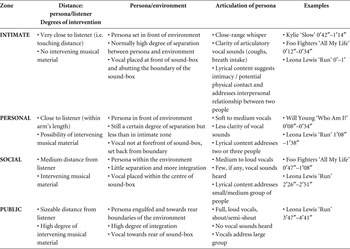
Although Hall utilizes a large number of particular factors to analyse and notate proxemic behaviour,Footnote 78 we focus on three core elements in recorded song: the distance between the persona and the listener (characterized, in part, by the degree of intervention between these two points by other musical material), the persona/environment relationship,Footnote 79 and the mode and character of articulation of the persona. Certain of Hall's bodily dimensions, such as the olfactory, remain at best implied in recorded song, whereas others take on a multiplicity of further qualities. Loudness of voice (relative to the environment) is important, together with the observation that sonic objects can appear to be in or out of focus and surrounded by space or enclosed by matter. However, none of these is a straightforward indicator of a particular interpersonal relationship or spatial quality. Given the important role that the musical environment plays in determining personal space and interpersonal distance in recorded song (based on the fact that aural cues are relied upon as non-verbal forms of communication), our ‘dimensions’ are both more interconnected and more interdependent than Hall's. The level of volume projected by the persona, for example, is not a clear identifier of the relevant proxemic zone, since it is subject to the overall dynamic integration of the persona in the environment. Additionally, certain listening experiences require the consideration of other environmental factors, such as those of peri-personal space, the space immediately around the body (and thus closer than Hall's ‘personal space’), and extra-personal spaces, which Biocca et al. divide into focal space, sphere of action, scene, and ambient space.Footnote 80 Recalling our earlier example of listening to t.A.T.u.'s ‘All the Things She Said’, peri-personal space is relevant to listeningC, where the whole body is involved, but is less important in listeningA and listeningB, since the music is unidirectional. Our understanding of the issues relevant to the determination of proxemic zones in recordings appears as Table 1, to which much of the following discussion refers.
Of some use for the analysis of proxemic behaviour in recorded song, and particularly the distance between listener and persona, is Joshua Meyrowitz's concept of para-proxemics, which he developed for visual media following Hall's work. Exploring the relationship between the perception of interpersonal distance and what he calls the ‘framing variable’, Meyrowitz's notion of para-proxemics focuses on the perceived or, rather, relative size of an object in order to judge its distance from the perceiver.Footnote 81 Visual techniques such as close shots bring the main object into focus and thus lessen the sense of interpersonal distance. Analogies can be drawn with audible contexts. Musically, a sense of focus can refer to the increased definition of a sound source and of sound source width, and the relative ‘size’ of the persona (as manifested aurally) suggests which of the four zones is operative. Thus we can argue that in the opening to the Foo Fighters' ‘All My Life’Footnote 82 Dave Grohl's vocals appear ‘in focus’, forming as they do a larger block of sound than the more elongated latitude of the accompanying guitar. We can extrapolate about the distance created between the listener and his persona based on such a sense of focus (see Table 1, row 1).
The listener gauges the distance between her- or himself and the persona by engaging in the overall scene of the track, which offers additional aural clues to spatial placement and perceived proxemic distance (we refer to this above as the environment). Albert Bregman theorized this activity as auditory scene analysis: the ‘process whereby all the auditory evidence that comes, over time, from a single perceptual environmental source is put together as a perceptual unit’.Footnote 83 While Bregman's work concentrates on isolated sounds, as opposed to the combinations of organized sounds that comprise music, other scholars have developed his theory with specific application to musical syntax. Among them, Francis Rumsey has used auditory scene analysis as a means of classifying auditory processes in a way that accounts for the complexity of recorded song.Footnote 84 Rumsey's aim is the clarification of semantic language. Whereas BregmanFootnote 85 concentrates on three main processes of auditory scene analysis (segmentation, segregation, and integration), Rumsey is concerned with the objective and environmental attributes of sound sources used in the description and assessment of spatial quality, an approach he calls scene-based. By focusing on the attributes of the sound sources and the environment of a particular space, Rumsey argues that the perception of spatial placement becomes clearer, enabling a scene-based understanding both of where sounds are placed in relation to each other and of the type of space in which they appear.
Rumsey theorizes three main categories of spatial attribute: width, depth/distance, and envelopment. Each of these he relates to four levels: individual sound source, ensemble, environment, and scene (which in the case of envelopment becomes the attribute he calls ‘presence’). Of these, the difference between environment and scene can be open to question, and we shall disregard it here, while the phenomenon of ‘ensemble’ (where a group of sound sources is discretely positioned within the scene) is rare in popular song, but might sometimes identify an orchestra or an orchestral grouping (such as ‘horns’). However, the width and depth of individual sound sources, the width and depth of the spatial environment, and a sense of envelopment remain valuable for our purposes. The difference between depth and distance is subtle: distance is the space between the ‘front’ of a sound source and a listener, while depth acknowledges that there can be a ‘back’ to that sound source and that the difference between front and back can create a sense of depth.
Proxemic zones.

Proxemics exemplified
Through an acknowledgment of these attributes of sounds, the proxemic positioning of the persona can be more clearly discussed. Returning to the Foo Fighters' track ‘All My Life’, we can observe how Grohl's persona begins the song in the intimate zone, a positioning immediately evidenced by the vocal quality (a semi-whisper) and the audible vocal breaths caught by the close miking of the sound source (again, see Table 1, row 1). In these early seconds of the track, as mentioned earlier, the laterality of his voice, spanning almost the entire scene width, and the high definition of his vocals bring his persona into focus and perceptually closer to the listener. Additionally, the guitar that was featured in the introduction also plays a key role in the proxemic positioning of Grohl's persona, as it provides a stable point from which the listener can perceive the voice's relative (and, ultimately, shifting) distance from her/himself and its distance from the guitar. The ensemble width (that is, the perceived width of the main group of sound sources) allows for differentiation between other sound sources that are spatially detached from the rest of the ensemble (particularly a guitar at the extreme right at around 50″). Moreover, source separation and increased source definition can also provide the listener with an increased perception of the degree of distance between the persona and the rest of the ensemble. The sonic attributes of each sound source provide aural clues to spatial positioning; thus the lower dynamic and narrower source width of the guitar immediately places it behind Grohl's vocal persona. By 0′35″ (a point marked by the entry of the remaining sound sources) the group width is increased and seems to encompass almost the entire scene width. Grohl's persona is now no longer focused and detached from the environment, but has become enveloped by the individual sound sources of the ensemble, reducing its definition. What is markedly different at this point is that guitars panned to each side (but particularly on the right) appear to have encroached on the persona's personal space, becoming closer to the listener. Grohl's persona has accordingly changed in terms of vocal delivery (he is now shouting), becoming dynamically louder in an attempt to be heard over the rest of the ensemble, which here acts as his personic environment.Footnote 86
As noted earlier, Hall's original work makes a useful distinction between a near and a far phase within each dimension (though this aspect has tended to find less favour in developments of his work by others). For our purposes, such a distinction is relevant for the analysis of differing qualities of intimacy created in recorded tracks. In Kylie Minogue's track ‘Slow’,Footnote 87 for example, her persona is presented in an intimate zone; the closeness to the listener is clearly evident through the audibility and extensive source width of her whispered voice, as well as the clarity of her breath intakes. Her lyrics make reference to the body and suggest potential physical, possibly sexual, contact.Footnote 88 Grouped together, these qualities create a comfortable and almost secretive experience of her persona. As Hall notes, the close-intimate phase ‘is the distance of love-making and wrestling, comforting and protecting’, in which ‘[p]hysical contact or the high possibility of physical involvement is uppermost in the awareness of both persons’.Footnote 89 By contrast, the intimate zone inhabited by Grohl's voice at the beginning of ‘All My Life’, which we consider as the ‘far’ phase of the intimate zone, is neither secretive nor comfortable; indeed, using scene-based analysis we can argue for a degree of discomfort in his proximity to the listener (and, perhaps, discomfort at his separation from his environment). Hall notes the high level of discomfort among white Americans, in particular, when faced with strangers in such close proximity.Footnote 90 Neither do Grohl's lyrics suggest intimacy, but rather are centred on himself and his search for something, indicating a near-threatening sense of insatiability in his approach: ‘nothing satisfies but I’m getting close, closer to the prize at the end of the rope'. The speed with which Grohl's persona moves from one zone to another reinforces a sense of discomfort with this moment of intimacy. His need to come quickly out of that zone into a more public, social zone suggests that there has been an invasion of personal space, too great a disclosure of personal details (see Table 1, row 3). It is here that Johnson's work is again fruitful in helping us negotiate the different speeds involved in moves between zones. The out schema is both complex and rich. In each version of this schema Johnson distinguishes between the landmark and the trajectory: ‘the “landmark” is that in relation to which the “trajector” moves, as in a figure-ground relation.’Footnote 91 At 3′37″ we read Grohl as moving permanently into a public space, where his voice is stretched to the limit in order to overcome the power of the band. Earlier, however, at the end of each verse, it is as if he reminisces, moving swiftly back to an intimate space (at 1′09″ and 2′01″) before leaping back into social space. The landmark here is provided most noticeably by the guitar, whose location is stable. While the changes of zone serve a structural role, the move back into an intimate space at 2′40″, as the opening texture is recaptured, leads gradually but inevitably towards that final move into public space. That it is achieved with a repeat of the chorus (which is always sung within this space) emphasizes the final abandonment of the intimate zone.
Changes of proxemic zone such as the one made by Grohl are perhaps among the most interesting uses of personal space in recorded song. Leona Lewis's ‘Run’Footnote 92 provides a more stereotypical example of such a change and is representative of the gradual movement from one zone through the others. The track begins with Lewis in an intimate zone, backed by a resonant piano very much in the background. The piano is joined at 45″ by mid-range sustained strings, providing a carpet of sound. At 1′08″ both strings and Lewis achieve an upper range in terms of register: while the degree of reverb has not altered, it is as if she has stepped back, as the greater range opens her words up to a wider audience. This excerpt shows Lewis's persona in the personal zone. By 1′38″ she is no longer foregrounded by her environment, but the whole texture has receded into a social space, or rather the environment has moved towards us. Two minutes into the song (in the second verse) the drumkit – its activity hitherto restricted to onbeat ride cymbals, which had been crucial in bringing the environment to the fore – falls into a conventional pattern, and any remaining illusion of intimacy is lost (Lewis now seems proud of her profession of constancy). By 3′20″ both she and the strings appear with full force and are subsequently joined by a full gospel choir. Any sense of restraint is now lost, as if she no longer cares who hears. Lewis's persona is now fully enveloped by the environment and is situated in the public zone (see Table 1, column 5).
Lewis's track is a cover of the original song by Snow Patrol.Footnote 93 This too begins in an intimate space, but with the full band present behind lead singer Gary Lightbody. The chorus retraces the step of growth, but then returns to intimacy for the second verse. Two possibilities present themselves here: either Lewis's production has realized a potential inherent in the original song or it has imposed an aesthetic foreign to the original. The Simian track ‘Drop and Roll’Footnote 94 has a more striking use of different spaces, as befits the opening track to their first album. The opening employs simple instrumentation (a cheap keyboard, a tambourine, and a melodica, with unpolished voice) and lacks reverberation, the recording picking up the sounds of people sitting on dining chairs to play. After one verse (at 1′34″) the setting changes entirely to a social space full of reverb and texture.
At a first hearing, Guy Garvey's voice on Elbow's ‘Scattered Black and Whites’Footnote 95 seems equally intimate, but the environment is less uniform. Of all the sound sources Garvey's voice has greatest individual width, while the snare's prominence seems to increase its own sense of width. Kit and acoustic guitar share the groove with the piano, but occasionally the piano breaks from the rhythmic pattern and broadens what is otherwise a series of (overlapping) individual narrow widths. More importantly, other background sounds drift through (as if recalled from childhood), while a general sense of padding of environmental width takes place, as reverb appears to increase. Then from 4′06″ Garvey's wordless voice acquires both processing and increased reverb, lessening the sense of intimacy. Particularly because the voice is sharing childhood memories, which are not for broadcast everywhere, this would seem to be occurring in a personal space – a space nonetheless with some distance between persona and addressee(s), but in which (nothing more than) a small group of people is present.
These first examples have suggested that the identification of proxemic zones is generally straightforward. This is by no means always the case, however, as Nerina Pallot's ‘Rainbow’Footnote 96 demonstrates. To begin with, she appears to occupy an intimate space – her intakes of breath are audible. However, her voice is treated with some light reverb and is placed in an environment which itself is scarcely any further away from the listener. The personic environment forms a constant presence, with no temporal gaps. Everything therefore appears enclosed, compounded by the reverb. Pallot also sings of being transparent, of being able to take on any colour desired ‘for you’, and thus the immediacy of her own presence is not clear, a sense reinforced by the production setting. To take a different example, Skin's persona in Skunk Anansie's ‘Tracy's Flaw’Footnote 97 initially appears to convey a high degree of intimacy, although the pun that inhabits the title points to the abusive relationship in the track's back story. Clear reference to subtleties of Tina Turner's delivery (‘that I’ at 37″, ‘know’ at 50″) may resonate for some listeners, though there is no evidence that such a reference was intentional on Skin's part. Skin's intimacy lies in our being able to hear such things as intakes of breath, but the increasing richness of tone and power of attack from 2′15″, as she sings ‘I’ll come running right back to you', traces a sustained path towards the climactic release at 3′20″. The degree of anger in evidence here is surely transgressive in such an intimate environment, placing her in its far phase, which is what gives the track its extreme expressive power.
Seth Lakeman's ‘The Charmer’Footnote 98 is perhaps more perplexing. Over the opening strummed guitar, with extreme width, we hear a compressed, and narrower, vocal vowel approaching at speed and stopping abruptly, but with no reverb. The verse continues with the same intimate presence, and an underplayed guitar and bass. The accompaniment grows in power for the chorus, and Lakeman's voice is double-tracked with a little more reverb. His persona recounts a narrative of the past, giving a sense that the details are private, while the message of the chorus (‘Tell it to the charmer’) is for wider circulation. We are therefore in a privileged position. But then, in the final verse (at 1′56″), the line ‘she has two hearts, I have none’ is doubled at the third by an overdubbed Lakeman. This simple word-painting ruins the illusion of intimacy, and we realize that the tale is not being vouchsafed to us personally. This use of doubling is now commonplace, and it is a moot point whether this destroys an ecologically valid response or not. Does it perhaps increase his sense of authority as teller of the tale, achieving a mode of delivery that we cannot?
While the identification of both individual sound sources and ensemble soundworld are important in the location of the persona in a particular proxemic zone, it is the combination of both sonic and environmental attributes that further enhances the listener's cognitive understanding of the auditory experience. The auditory clues that may lead the listener to perceive the sounds as being performed in an enclosed ‘room’ (as opposed to a large open space) result from ‘an understanding that emerges when auditory experience matches a pattern we can describe as the auditory spatial schemata [sic] for room’.Footnote 99 Scene attributes such as environmental width seem ‘to be related to a perception of a reverberant sound within the reproduced space’,Footnote 100 and it is precisely the type of reverberation that can determine whether a space is perceived as being analogous to a small room or to a larger space. The instantiation of a particular container schema can have consequences for the perception of the proxemic placement, and location, of the performer. In the track ‘Wide Open Space’ by Mansun,Footnote 101 vocalist Paul Draper emphasizes his location (‘I’m in a wide open space') repeatedly in the opening verse and throughout the rest of the track. While his persona may be convinced of his location, the listener may not share this conviction, as the space or container in which he is situated does not entirely fit the spatial schema for an open space. Right from the opening guitar phrase the perception derived from the ensemble and the environmental attributes seems to be that of a container akin to a medium-sized room, since wide open (outside) spaces have no reverberation. The vocals, however, can be perceived as situated in a different space from the rest of the ensemble, owing to the use of delay (or, more precisely, to a combination of differing delay times and varying sound source widths), which results in the perception of a slight reverberation and thus creates a sense of separation that detaches Draper's persona very slightly from the main ensemble. As a result, the delay narrows the perception of the voice's source depth, which creates a sense of the persona operating in a smaller space. Although the lack of scene depth, the thick texture, and the increased ensemble width hints that perhaps the sound produced is overpowering and unsuitable for the size of the room, particularly in the chorus, the result for the listener is a sense of claustrophobia, while that for the persona is a sense of aspiration to be in the wide open space he so clearly desires. Although this particular track makes its effect by emphasizing the containment schema, it is the combination of sound source and environmental attributes that determines the type of container that is implicated, and this, in turn, can affect the listener's experience of the track.
Proxemics issues
While we would argue that these examples demonstrate the value not only of proxemics as a methodological focus, but of the general thrust of our entire apparatus, there are some remaining issues. The range of sound sources in Melanie Safka's anthem ‘Lay Down’,Footnote 102 which recalls her experience performing at Woodstock in 1969, enables an interpretation of the relationship between Melanie's persona and the apparent content of the track. The first three minutes of the track alternate two verses and two bridges with three double-length choruses thus: choruses 1 and 2; verse 1; choruses 3 and 4; bridge; choruses 5 and 6; verse 2 extended; bridge. The remainder of the seven-minute track consists of more than twenty-five further varied repetitions of the chorus. The sound sources are relatively simple: Melanie's voice, the backing voices of the Edwin Hawkins singers, and a small gospel backing band of bass, kit, congas, piano, and (barely audible) organ. Although the resources are clearly limited, their use of space is intriguing. There is little stereo separation (this is, after all, a recording from 1970), though the drum kit is towards the right and the congas towards the left; the ensemble tends to act as a unity. And while the instruments of the band are timbrally segregated, since none of them is employed in any sort of solo capacity, they recede into a generally undifferentiated personic environment: the spatial environmental width is broad, more so than that of the choir. Timbral difference alone distinguishes Melanie's voice from the band, although it is less clearly distinguished from that of the backing choir. The level of reverb is constant throughout much of the track, but its application on Melanie's voice is reduced from the six-minute point onwards (the twenty-third hearing of the chorus), bringing her forward into an intimate space. Particularly when we note that this voice remains the only constant factor of the track while everything else fades at the very end, it is as if her persona is musing, from outside the action, on the content of the rest of the track and even on her own part in it, since the rich ostinato figure which she uses (and which first appeared at 4′35″, in chorus 15) remains in evidence. And this marks a continuation of an earlier process, since earlier in the track (c4′–5′, from chorus 12 onwards) she had led the choir's changes of delivery (from ‘ooo’ to ‘aaa’ to spoken lyrics); at this final point they simply fail to keep up with her. While this articulation of events sits oddly with words that so strongly express the communality of the Woodstock experience, it serves to emphasize that what we are sharing is her own vision of that communality. (The singer suggested that the song's first verse came to her while driving away from the Woodstock festival after performing,Footnote 103 influenced by the crowd's lighting of candles during her performance.)
Melanie's performance brings to the fore an important difference between the roles of participant and observer: it is quite possible for a song's persona to adopt either one or the other, as in this case, or to switch between the two. The same alternatives can also be present for a listener,Footnote 104 depending on whether the listener accepts the persona's implicit invitation to act as addressee, or refuses it, in which case the listener acts as observer.Footnote 105 The conventionalized understanding of an intimate performance is well realised by Tori Amos's ‘Hey Jupiter’.Footnote 106 Nothing intervenes between Amos and the listener; we can clearly hear her intakes of breath. She has substantial width in the sound environment, though she does not cover the entire space. The piano, on the other hand, is far in the distance and has little width, even though the listener might well assume (despite her incongruously greater width) that she is playing it while singing. This intimacy is particularly clear in an affecting moment of unselfconsciousness at one point in her vocalise (at 2′20″) – a seeming response to the introduction of an electric piano, which increases the sense of environmental width. This intimacy is reinforced by the constant addressing of ‘Jupiter’ as ‘you’, which invites the listener to take on Jupiter's persona. However, the repeated line ‘no-one's picking up the phone’ makes better sense if the song is understood as an interior monologue to which the listener is made party. Recognition of this (and other similar lines) keeps us uncertain of our position and, by doing so, holds our interest. Pulp's ‘Common People’Footnote 107 is a similar example of presence in the intimate zone: no textural strands intervene between singer Jarvis Cocker and the listener; his intakes of breath can be heard; and the subject matter is private, as if a confidence is being shared in something close to a whisper. The vocals in the opening verse are treated with pre-delay and a reverberation redolent of a large room, giving the impression that the vocals are located close to the listener. We are invited to assume the role of addressee, listening in to a story about a third person. The environment, however, is noisier than in the Tori Amos example – it is as if it is necessary to lean close to hear all the details. The verse of the same band's ‘Mis-Shapes’ is a less immediately obvious example, but here the personic environment (formed by the ensemble) is clearly integrated and segregated from the persona (for example from 34″, where the entire band plays on every beat, and only on the beat, with a higher degree of reverberation than that applied to Cocker's voice). During the chorus, however, the band comes almost to overwhelm the singer, who shifts towards occupying what seems to be a social space, marked by the loss of any pre-delay treatment of the vocals, as he makes the appeal ‘brothers, sisters, can't you see?’.
One further issue to be addressed is whether a voice is necessary in order to define the proxemic space. Slade's ‘Hey Ho Wish You Well’Footnote 108 is a good example. The track opens with an electric guitar riff. The power of the sound is normally associated with a large space, and it would certainly not suggest an intimate space. However, we hear not only the guitar's sonic power but the sound of the fingers damping the strings during the riff, and also the sound of the plectrum on the strings – a proximity that, in contrast, would indeed identify an intimate space. While the guitar exudes power, it is fairly focused in terms of width. By the time the full band, and then Noddy Holder's lead voice, have entered, the guitar has receded and we seem to inhabit a social space. Perhaps the best approach here is to suggest that the environment promises intimacy at the opening, a promise which is not fulfilled.
Consideration of the proxemic zones we have been concerned with in this part of the article may suggest a reinterpretation of the Missy Elliott track ‘Pass that Dutch’, discussed at length as part of the exploration of image schemata. Although the scene set by the track places us in close proximity to Elliott's persona, the forcefulness of the bass makes it difficult to place her in an intimate space. Perhaps this is right, as other (unidentified) persons are present in the path. The lack of resonance evident on her voice, which we have not previously noted, helps the listener to perceive it as occupying a personal space. We believe, as a result, that although it may at times seem necessary to bring to an interpretation the full range of perspectives explored here (and that each perspective may suggest a modified understanding of that achieved by way of others), they do not function as an indivisible method; precisely which hermeneutic approaches are to be brought into play should be determined by what a particular track offers.
Our final example here, the Zutons' ‘Valerie’,Footnote 109 differs from all the others in three important respects. First, the indistinctness of some of singer Dave McCabe's consonants removes him from close proximity to us. Second, backing voices intrude such that we are no longer being addressed by an individual. Finally, Abi Harding's rather raw saxophone line intervenes, coming to the fore of the personic environment and rather intruding on McCabe's space. We might be tempted to define the persona here as occupying a social space when, quite possibly, we are simply overhearing. The Rolling Stones' ‘Tumbling Dice’Footnote 110 (originally 1972) is emblematic of public space, in that Jagger's voice is fully integrated with the personic environment: even the kit is further to the fore. Their ‘Gimme Shelter’Footnote 111 (originally 1969) takes things to extremes, as Jagger's voice is so far back in the mix that, through most of the track, it registers as little more than an aura. The guitars (if nothing else) are far more prominent. But they do not act as a surrogate for the persona, which is still audible, although it is split between Jagger and his backing singer – at least until the repeated line ‘just a kiss away’ (at 3′52″), at which point his voice achieves a certain clarity. The embeddedness of the voice in the texture implies that we should hear this in a public space, addressed to all and sundry.
Conclusion: back to cognitive modelling
This discussion of a range of individual tracks has raised two particular problems for an ecological approach. (That the reader may not recognize them as problems simply serves to underline their ubiquity.) We refer specifically to the spatial divorce between Tori Amos's voice and her piano, and the double-voicedness of the climax to Seth Lakeman's performance. What are we to make of these aural events, which it is impossible to encounter outside the virtual world of the recording? While much of this article has focused on image schemata, there are other theoretical aspects of cognitive science that can be used to shed light on certain features of recordings, in particular that of conceptual blending. According to Fauconnier and Turner, conceptual blending is a ‘basic mental operation’ which forms ‘an invisible, unconscious activity involved in every aspect of human life’.Footnote 112 They argue that conceptual blends occur through ‘integrating partial structures from two separate domains [mental spaces] into a single structure with emergent properties within a third domain’.Footnote 113 Mental spaces are defined as ‘small conceptual packets constructed as we think and talk, for purposes of local understanding and action’. Two or more ‘input’ mental spaces are compressed into a single output ‘blended’ space; those elements shared by input spaces are ‘captured in a generic space’.Footnote 114 A subordinate category – of particular use in respect of the Amos and Lakeman examples referred to above – is that of the mirror network, which Fauconnier and Turner define as an ‘integration network in which all spaces – inputs, generic, and blend – share an organizing frame’.Footnote 115 Among the examples they use to clarify the mirror network is an article from the New York Times in July 1999 that reported the breaking of the world mile record by the Egyptian runner Hicham el-Guerrouj. The article included an illustration that portrayed el-Guerrouj together with mile record holders from each of the five previous decades, illustrating the distance behind el-Guerrouj that each would have been trailing had they all raced together. Such an illustration, or even just a description, they claim, prompts a reader unconsciously to construct a blended space. The input spaces in this instance consist of aspects of each of the six individual races concerned; in the blended space we will find some elements of those races (the individual winners and their relative times, the presence of a finishing line in each race) but not others (the actual location of the individual tracks, the identities of the losing runners in each race, etc.). While Fauconnier and Turner describe such a blend as ‘immediately intelligible and persuasive’, its construction is ‘remarkably complicated’.Footnote 116 A similar explanation may lie behind the ‘problems’ identified in Amos's and Lakeman's recordings. In the case of Tori Amos, her vocal performance takes place in one input space and her piano accompaniment in another (after all, anecdotally, most listeners are aware that different elements of a recording are recorded at different times, and even perhaps in different locations, whatever may have been the actual case here). Our hearing of the track prompts us to create a blended space in which her voice (and hence her persona) is in an intimate zone relative to us, but her fingers (and thus, again, her body) are far distant. The same explanation lies behind Lakeman's self-accompaniment. Here there is no doubt that his voice was recorded twice at separate times, since there are two separate, simultaneous vocal lines identifiable with the same singer. Each of these lines therefore takes place in its own input space, and we understand the resultant recording within a blended space. Explanations of such phenomena have, of course, been offered, particularly in relation to Bakhtinian double-voicing (deconstructing the idea that an individual's subjectivity is embedded in her/his physical voice), but despite such explanations their presence often passes without comment. This may seem like a laborious explanation for what amounts to rather common features of recordings. However, their commonality should not deafen us to their impossibility outside the virtual space created in the recording, and it is because we create such blended spaces all the time, from the various aspects of the world we encounter, that these devices appear inevitable, ‘natural’.
This article, then, has focused particularly on two theoretical positions, those of cognitive modelling – as represented by the concepts of image schemata and, latterly, conceptual blending – and of proxemic zones, as modified by concepts associated with auditory scene analysis. Both are translatable into a musical hermeneutics, and both have something particular to offer to a consideration of the spatialization of musical events even if, as we hope to have demonstrated, their value extends beyond this domain alone. The article has also briefly situated these theoretical positions in relation to two others, those of the persona/environment relation and of ecological perception, and has argued that these latter positions are complementary in developing a hermeneutic programme. Methods of analysing melodies and harmonies, narratives and personae have now developed to such a point that each has much to contribute to our understanding of meaning in recorded song. Such work, however, can only ever be partial if we fail to take into account that aspect which most clearly distinguishes the recorded performance from the live performance, that of the soundworld's spatialization. With the theoretical positions developed in this essay and the examples of them provided, it is hoped that consideration of the spatial domain and its full import can now take its rightful place in such discussions.
 and
 . The only time these octave leaps on