

In examining selection to legislative committees, a large body of research has studied whether legislators seek selection to committees that offer the potential to distribute particularistic benefits to constituents. According to one prominent theory of legislative organization, distributive theory, legislators seek membership on committees that allow them to provide distributive goods to constituents (e.g., through targeted spending), to claim credit for sponsoring or supporting legislation that would help particular groups of constituents, and to give voice to constituents’ interests (Mayhew Reference Mayhew1974; Shepsle Reference Shepsle1978; Weingast and Marshall Reference Weingast and Marshall1988; Shepsle and Weingast Reference Shepsle, Weingast, Shepsle and Weingast1995). Doing so, according to distributive theory, increases the name recognition of members engaging in these activities, which, in turn, enhances the potential of winning personal votes from constituents (i.e., votes for the candidate beyond those that the party label alone would have garnered), and thus augmenting the likelihood of re-election (Fenno Reference Fenno1978; Mann and Wolfinger Reference Mann and Wolfinger1980; Stein and Bickers Reference Stein and Bickers1994; Evans Reference Evans2004).
While some research concludes that members with outlying preferences for particular committee assignments are not significantly more likely to be selected to committees (Groseclose Reference Groseclose1994; Overby and Kazee Reference Overby and Kazee2000; Overby et al. Reference Overby, Kazee and Prince2004; Prince and Overby Reference Prince and Marvin Overby2005; Battista Reference Battista2006), a sizable body of research on committee selection in the United States has found evidence supporting the predictions of distributive theory (Rohde and Shepsle Reference Rohde and Shepsle1973; Weingast and Marshall Reference Weingast and Marshall1988; Londregan and Snyder Reference Londregan and Snyder1994; Rundquist et al. Reference Rundquist, Rhee, Lee and Fox1997; Adler and Lapinski Reference Adler and Lapinski1997; Adler Reference Adler2000; Frisch and Kelly Reference Frisch and Kelly2004; Sprague Reference Sprague2008; Lewis Reference Lewis2014). Despite the peculiarities of U.S. legislatures (including, among other things, two-party dominance), research examining committee selection outside the United States has found evidence that constituency preferences influence committee selection patterns (Stratmann and Baur Reference Stratmann and Baur2002; Ciftci et al. Reference Ciftci, Forrest and Tekin2008; Fujimura Reference Fujimura2012; Raymond and Holt Reference Raymond and Holt2014, Reference Raymond and Holt2017; Mickler Reference Mickler2018a, Reference Micklerb).
Most of these studies assume, as distributive theory does, that the relationship between constituency preferences and committee appointments results from individual legislators’ pursuing their personal re-election goals. To what extent, however, does the alignment of constituency preferences and committee selection respond to the interests of political parties? Do the relationships between constituency preferences and committee assignments arise solely from the interests and actions of legislators, or do parties also work to promote the representation of constituency interests by their members?
This study examines these questions using the case of the Mexican Cámara de Diputados (the lower house of the Mexican Congress). Until the elections of 2018, taking effect for the elections of 2021, diputados (members of the Cámara) were barred from seeking re-election. Thus, the principal assumption required for constituency preferences to influence committee selection (according to distributive theory) was not met, as committee work did not help members’ career prospects in the legislature. However, parties may also have interests in representing constituents by providing distributive goods (real or symbolic) to constituents to enhance the party’s chances of re-election (see Raymond and Holt Reference Raymond and Holt2014, 179–80; Mickler Reference Mickler2018a, 117, b, 521). If constituency preferences influence committee selection in the Cámara de Diputados despite the absence of individual election-seeking motivations, this would provide evidence in favor of a revised perspective on committee selection; namely, if parties face incentives that lead them to compel their members to represent constituency interests on committees, then observing that constituency preferences influence selection to committees would suggest that parties also care about and use distributive politics to their electoral advantage, in the same way as assumed of individual politicians by distributive theory.
This article proceeds to outline the case of the Mexican Cámara de Diputados in greater detail. It then examines the reasons that parties may promote the party’s re-election chances by appointing members to committees representing constituencies concerned with the business of those committees. It presents the research design and an empirical analysis. The final discussion puts the findings into the larger context of the literature.
Committees, Careers, and Distributive Politics in Mexico
The Mexican Cámara de Diputados provides a theoretically interesting case for studying the impact of constituency preferences on committee selection for two principal reasons. For one, committees in the Cámara de Diputados are quite powerful (especially in relation to other Latin American legislatures; Palanza et al. Reference Palanza, Scartascini and Tommasi2016), and thus are attractive venues in which particularistic constituent interests could be pursued. Similar to other legislatures like the U.S. Congress or the German Bundestag, in which committees operate as potential legislative gatekeepers, Mexican committees hold considerable powers to amend and even block legislation, and possess their own staff and other resources to support detailed scrutiny of legislation (Béjar Reference Béjar2006, 13; Rivera Reference Sánchez and Abel2004).
To be sure, committees in the Cámara de Diputados lack other powers characteristic of strong committee systems. For instance, although they possess formal authority to compel members of the executive to appear and provide evidence (Fish and Kroenig Reference Fish and Kroenig2009, 448), in practice, committees in the past have lacked recourse when executive officials refused to attend (Rivera Reference Sánchez and Abel2004, 297–98). Additionally, committee members find that party discipline often prevents them from securing pork barrel spending. That said, the powers possessed by committees in the Cámara de Diputados do offer members considerable potential to engage in the sort of actions predicted by distributive theory—even if they are not as able to actually distribute particularistic goods to constituents through legislation, as is often the case in many U.S. legislatures.
Specifically, committees in the Cámara de Diputados offer numerous opportunities for “credit claiming” and “position taking.” Diputados can claim credit among voters for supporting or contributing to legislation favorable to their constituencies—and also can take credit for undermining legislation with negative consequences for their constituents. Because committee membership garners media attention over and above that available to nonmembers, diputados can also use their committee positions to take public stances on issues relevant to constituents—even if these issues are not addressed with legislation during a particular legislative term. This provides diputados with an additional means of demonstrating their representation of (or at least desire to represent) constituents’ interests. Through both credit claiming and position taking, diputados are able to signal to their constituents that they are actively representing their interests.
On the basis of the potential to engage in credit claiming and position taking on committees in the Cámara de Diputados, one might expect that diputados representing districts with more constituents affected by a committee’s business would be more likely to seek selection to that committee than legislators representing fewer such constituents (e.g., Adler and Lapinski Reference Adler and Lapinski1997; Adler Reference Adler2000).
The second major reason the Cámara de Diputados provides a theoretically interesting case to study is that the individual motivations that are assumed to be necessary for constituency preferences to impact committee assignments are not present. Distributive theory is predicated on the assumption that if left free to their own devices, legislators needing to attract personal votes to secure re-election will seek committee assignments aligning with their constituents’ interests (e.g., Mayhew Reference Mayhew1974). Absent these re-election motives, however, legislators would seemingly not have a reason to seek such committee assignments. Because diputados were barred from immediate re-election, term limits would seemingly prevent constituency preferences from influencing selection to committees. And yet, despite the lack of individual re-election incentives, previous research shows that diputados still engage in behaviors associated with a distributive model of legislative activities, such as sponsoring constituency-targeted spending through budget amendment proposals (Kerevel Reference Kerevel2015a).Footnote 1
If diputados pursue distributive spending despite the absence of individual re-election incentives, this raises the possibility that diputados engage in other behaviors associated with distributive theory, including sitting on committees aligning with their constituents’ preferences. In the absence of re-election incentives, however, observing that selection to committees in the Cámara de Diputados is associated with constituency characteristics would suggest that other actors—and not individual diputados themselves—are concerned with the electoral benefits gained from constituency representation on committees.
The Role of Parties: Promoting Constituency Representation?
While distributive theory developed in a context in which parties exerted relatively little control over committee assignments—which, proponents argue, allows members to essentially self-select onto their preferred committees—parties in most legislatures around the world play a commanding role in determining the composition of legislative committees. The role played by parties in selecting members to committees (even in U.S. legislatures) led many scholars to question the degree to which constituency preferences determine committee appointments in legislatures where party leaders control committee assignments.
One account of the roles parties play in organizing legislative business is cartel theory (Cox and McCubbins Reference Cox and McCubbins1993). According to cartel theory, party leaders exercise control over all legislative business to ensure that their members’ behavior does not damage the party’s brand (i.e., its collective record in the electorate’s view). Leaders exert such control because the party brand is a collective good that affects the re-election chances of all members. In their quest to provide distributive benefits to constituents, members might use their committee appointments to enhance their own goals instead of working for the benefit of the party as a whole.
Anticipating the deleterious effects of such behavior on the party brand (and in turn, affecting the re-election probability of all members), parties often act as gatekeepers to committee selection. Party leaders achieve this by appointing loyal members to committees, avoiding other members who would seek committee assignments to further their personal goals in ways which hurt the party brand (or removing members acting in such a way after they have been appointed). The high level of control exerted over members’ committee assignments thus may prevent members from self-selecting onto committees aligning with their constituents’ preferences.
Perhaps due to the level of party control, committee appointments in Latin American legislatures have received little attention in previous research (Alemán Reference Alemán2013). Like many legislatures in Latin America, party discipline is rigidly enforced in the Mexican Cámara de Diputados. Political parties in Mexico are highly centralized and possess several tools to ensure that members conform to the party’s interests (Nacif Reference Nacif, Morgenstern and Nacif2002; Díaz Reference Gómez and Rodrigo2006; González Reference Tule and Antonio2010). This concern extends to committees. In the Cámara de Diputados, parties receive a share of seats on each committee in roughly equal proportion to their total seat share. Parties distribute committee presidencies (the equivalent of committee chairs in the U.S. Congress) and determine their seat totals on each committee through negotiation, with the proportionality rule (relative to parties’ seat shares) serving as a rough benchmark for these negotiations.
Once they receive their allotments of committee seats, party leaders carefully select their representatives on each committee on the basis of party loyalty before sending their lists for formal installment by the Junta de Coordinación Política, which is the primary “control committee” organizing business in the Cámara de Diputados. Through such partisan selection, and through the use of committee secretaries (diputados who assist committee presidents and often serve as informal whips on committees), parties exert strict control over their members’ behavior in order to advance the party’s agenda. As evidence of their control, party leaders have often withheld favorable committee assignments and removed disloyal members from committees (Béjar Reference Béjar2014).Footnote 2
Although concerns with the party brand suggest that party leaders will engage in significant gatekeeping that prevents the representation of constituency preferences on committees, cartel theory also acknowledges that parties may be willing to allow for constituency representation on committees. Why might political parties be willing to allow, or perhaps even encourage, constituency representation and the pursuit of constituents’ particularistic interests on committees? One reason is that parties will allow for committees to be composed of members with particular interests in sitting on the committee if any negative consequences of their actions do not negatively affect the party brand in the electorate at large (Cox and McCubbins Reference Cox and McCubbins1993, 191–99). In the case of representing parochial constituency preferences, parties may be willing to select members of committees aligning with their constituents’ interests if those issues are sufficiently localized that they do not negatively impact the party brand among voters nationwide. Another reason is that parties must concern themselves first and foremost with vote seeking before they can consider their office- or policy-seeking goals (Cox and McCubbins Reference Cox and McCubbins1993, 189–90).Footnote 3
Given such concerns with re-election, and because the representation of constituents’ particularistic interests on committees may increase committee members’ re-election prospects (see, e.g., Mayhew Reference Mayhew1974; Cain et al. Reference Cain, Ferejohn and Fiorina1987), party leaders may compel members to represent their constituents’ interests on committees in the hope that such representation will improve the party’s standing among constituents—and thereby increase the party’s prospects of re-election.
Instead of being seen as a nuisance to avoid, constituency representation is often an important part of parties’ electoral strategies (e.g., Latner and McGann Reference Latner and McGann2005; Celis et al. Reference Celis, Schouteden and Wauters2015). Even highly centralized and disciplined parties competing in multiparty contexts have incentives to promote the representation of constituency preferences by their members (Taylor Reference Taylor1992; Carey Reference Carey1996). For parties to maintain good relationships with voters concerned partly with constituency-specific issues, previous research has noted, parties may promote the sort of constituency representation on committees predicted by distributive theory to promote the party and attract votes from constituents satisfied with the party’s efforts to represent constituents and their concerns (Mickler Reference Mickler2018a, 117, b, 521).
This is particularly important for parties in contemporary Mexico, which, until recently, could not depend on individual members’ re-election ambitions to provide a secure number of seats for the party. Moreover, considering the increasingly competitive nature of federal elections in Mexico (Kerevel and Bárcena Reference Kerevel and Bárcena2017), such efforts to represent constituents’ interests may be essential to winning closely fought elections featuring an increasing number of parties competing for votes. While some parties may be more popular among some groups of voters or expend more effort to attract those voters’ support as part of their national electoral strategy, we expect that all parties will seek to ensure representation of constituency issues on committees aligning with their constituents’ preferences. If one party uses its allocation of committee seats to represent constituents’ interests in an effort to increase its support among voters affected by the committee’s work, we would expect other parties to follow suit, as failing to do so would give advantage to those other parties.
While this discussion suggests that parties have an incentive to select diputados for committees to represent their constituents’ particularistic interests, one question remains: why would individual diputados represent constituents’ interests on committees if they lack the re-election incentives that motivate legislators in most other legislatures to seek committee assignments that help them win personal votes? One reason is that Mexican politicians concerned with their careers after their time in office—those pursuing both political and nonpolitical careers—depend to a significant degree on different members of the party. Although a majority of diputados seek another elected office after their term in the Cámara de Diputados expires (Kerevel 2015b), they will be nominated to run only if they have demonstrated sufficient party loyalty. Because constituency representation is an important part of demonstrating diputados’ service and loyalty to the party, diputados may act on behalf of the party while in office by representing their constituents on relevant committees as a means to enhance their career prospects after their term is over.
This need to engage in constituency representation to please party leaders also applies to diputados seeking opportunities at the state level, as state governors control access to the ballot in state-level elections (Langston and Aparicio Reference Langston and Aparicio2008; Kerevel 2015b).Footnote 4 Even those intending to leave elected office altogether must engage in constituency representation on behalf of the party, because administrative jobs controlled by the party are also awarded on the basis of loyalty (as are many high-level jobs in the private sector, which often require good party contacts). While some research notes how concern for future employment and the need to remain in the good graces of governors may undermine party cohesion in the Cámara de Diputados (Langston Reference Langston2010; Rosas and Langston Reference Rosas and Langston2011; Cantú and Desposato Reference Cantú and Desposato2012), the activities needed to appease governors involve the same sorts of constituency representation promoted by party leaders at the federal level. Indeed, previous research shows that diputados finding future employment at the national or the state level (those seeking both elected and unelected office) engage in efforts to secure particularistic funding for their constituents while in office. This demonstrates that most diputados are expected by federal and state party leaders to represent constituency interests as a condition for furthering their careers. In other words, diputados thinking about most career options following their time in office have incentives to represent the interests of their constituents by accepting or even seeking committee assignments addressing their constituents’ interests.
Before concluding that any correlation between constituency preferences and appointment to committees reflects the vote-seeking efforts of parties, however, one must account for the possibility that diputados are selected not to represent particular constituencies’ interests but for their personal expertise. According to the informational theory of legislative organization (Gilligan and Krehbiel Reference Gilligan and Krehbiel1990; Krehbiel Reference Krehbiel1991), legislators are selected for committees on the basis of the information they can provide the legislature; because legislatures are ultimately concerned with the production of good policies, they will appoint members who have expertise and specialized knowledge in the issue areas addressed by the committees to ensure that committees have the best information possible with which to formulate policy. Even in legislatures where parties exert strong control over the agenda, previous research notes that parties have the same incentives to promote expertise (Mickler Reference Mickler2018a, 117, b, 521).
Term limits, moreover, have meant constant membership turnover, which prevents the development of expertise and specialist knowledge that otherwise would accumulate over multiple successive terms serving on committees. This suggests that parties in the Cámara de Diputados have been particularly reliant on the expertise and specialized knowledge of their members for completing committee business.
In keeping with an informational perspective, previous research suggests that diputados are more likely to be appointed to committees if they possess specialized knowledge (Aparicio and Langston Reference Aparicio and Langston2009). Because what appears to be an effect of constituency preferences on committee appointments may instead reflect parties’ appointing diputados with expert knowledge of the issues addressed by committees—diputados who are more likely to reside in areas with many constituents affected by the committees’ work—we need to account for the expertise diputados potentially bring to committees before concluding that constituency preferences impact committee appointments.
Thus, the Mexican Cámara de Diputados offers an interesting opportunity to test the argument that constituency preferences influence the selection of legislators to committees because parties have an interest in the benefits of committee service for the re-election of the party. If parties are concerned with the distributive politics of committee representation, we would expect that diputados are selected to committees aligning with their constituents’ interests. Because diputados in previous terms have not faced re-election incentives, any evidence that constituency preferences influence appointment to committees would suggest that party leaders use the representation of constituents’ interests on committees to further the party’s electoral interests—instead of merely tolerating such representation pursued by individual members, as such behavior does not advance members’ own career interests in the legislature.
Testing for Constituency Effects on Committee Appointments in the Mexican Congress
To determine whether constituency preferences influence parties’ appointments to committees in the Mexican Cámara de Diputados, we examine a dataset containing all members elected to the Cámara de Diputados in the 60th to 63rd Legislatures (corresponding with the period from 2006 to 2018). We focus on this period because the district boundaries were consistent and the data to measure constituency preferences were available. Biographical, institutional, and political data for each diputado were drawn from the Cámara de Diputados’ official webpages and the Mexican System of Legislative Information (Sistema de Información Legislativa).
We examine the appointment of diputados to 11 committees: Migration (Asuntos Migratorios), Northern Border Affairs (Asuntos Frontera Norte, in operation in the 62nd and 63rd Legislatures), Southern Border Affairs (Asuntos Frontera Sur-Sureste, also in operation in the 62nd and 63rd Legislatures), Mexico City (Distrito Federal, a committee dealing with issues specific to the capital city, in operation in the 60th to 62nd Legislatures), Agriculture, Agrarian Reform (Reforma Agraria), Citrus (Citricultura, in operation in the 60th and 61st Legislatures), Ranching (Ganadería), Fishing (Pesca), Tourism (Turismo), and Indigenous Affairs (Asuntos Indígenas).Footnote 5 Diputados were coded 1 if they were selected to sit on the committee at the start of the term, and 0 otherwise. We focus only on initial appointments because these committee assignments are less likely to be affected by additional strategic considerations (e.g., as with any legislature, the membership of the Cámara de Diputados changes during the term) that may influence committee appointments at later points during the term. This avoids potential omitted variable bias that would affect committee assignment decisions later in the term.
We focus on these 11 committees for two reasons. First, due to the nature of their remits, these committees have an identifiable constituency with targeted, particularistic interests in the legislation they address. This, in turn, creates incentives for parties to select diputados representing areas with more constituents who might be concerned with the issues these committees examine, since their service on these committees and representation of constituents’ interests may help the party to curry favor with voters and thereby increase the party’s prospects of re-election. The second reason for examining these committees is that data were available to measure constituency characteristics that would create incentives for diputados to sit on certain committees.
Following the practice of previous research (Adler and Lapinski Reference Adler and Lapinski1997; Adler Reference Adler2000; Stratmann and Baur Reference Stratmann and Baur2002; Raymond and Holt Reference Raymond and Holt2014, Reference Raymond and Holt2017), we measure constituency preferences using a combination of census data—in this case, collected from the Instituto Nacional de Estadística y Geografía (Mexico’s national statistics agency)—and other variables measuring identifiable structural and geographical incentives potentially motivating selection decisions. We then examine the relationship between these constituency profile measures and whether or not diputados representing districts or states with identifiable constituency preferences are more likely to be selected for the relevant committee than those not representing areas with identifiable constituency preferences. While there may be other committees with constituents who are concerned with the business conducted on those committees, we prefer to be conservative in our coverage, focusing only on those committees for which we can reliably measure constituency profiles.
Constituency preferences on the Northern and Southern Border Committees are measured using dummy variables coded 1 for diputados representing districts or states located on the northern or southern border of the country, and 0 otherwise. Because the Migration Affairs Committee deals with issues of migration to the United States and the Mexico-U.S. border, we also use the variable measuring diputados representing districts or states on the northern border. In the case of the Mexico City Committee, we measure constituency preferences using a dummy variable coded 1 for diputados representing the federal capital. In each case, we expect that diputados from the affected districts or states will be more likely to seek and be appointed to each committee addressing the interests of the affected geography.Footnote 6
To measure constituency preferences related to the five agriculture and food industry–related committees, we measure the (logged) percentage of constituents employed in agriculture-related occupations (agriculture, ranching, and fishing). Because these committees are tasked with studying legislation about agricultural production and the labor required for such production, distributive theory would expect that areas with more constituents employed in agriculture would be the most affected by the business of the committee, and thus parties would be more likely to select diputados representing these areas to each committee. Because data for this variable were not available at the district level, we use the percentage of constituents employed in agricultural work for the state in which diputados were elected. While this is less precise than would be preferable, the imprecision in this case works against finding that constituency preferences impact committee selection because the greater heterogeneity of the estimated effects (resulting from both overestimated and underestimated constituency preferences) reduces the chances of finding statistically significant constituency preference effects for diputados elected in the single-member districts.
Constituency preferences on the Tourism Committee were measured using a dummy variable measuring districts and states with Mexico’s major tourism centers. Specifically, we code all districts (states, in the case of diputados elected in the PR tier) with a “beach center” identified by the Secretaría de Turismo (Reference de Turismo2016, 6) as 1, and 0 otherwise. We expect that diputados representing beach center districts and states will be more likely to be appointed to the Tourism Committee than other diputados.
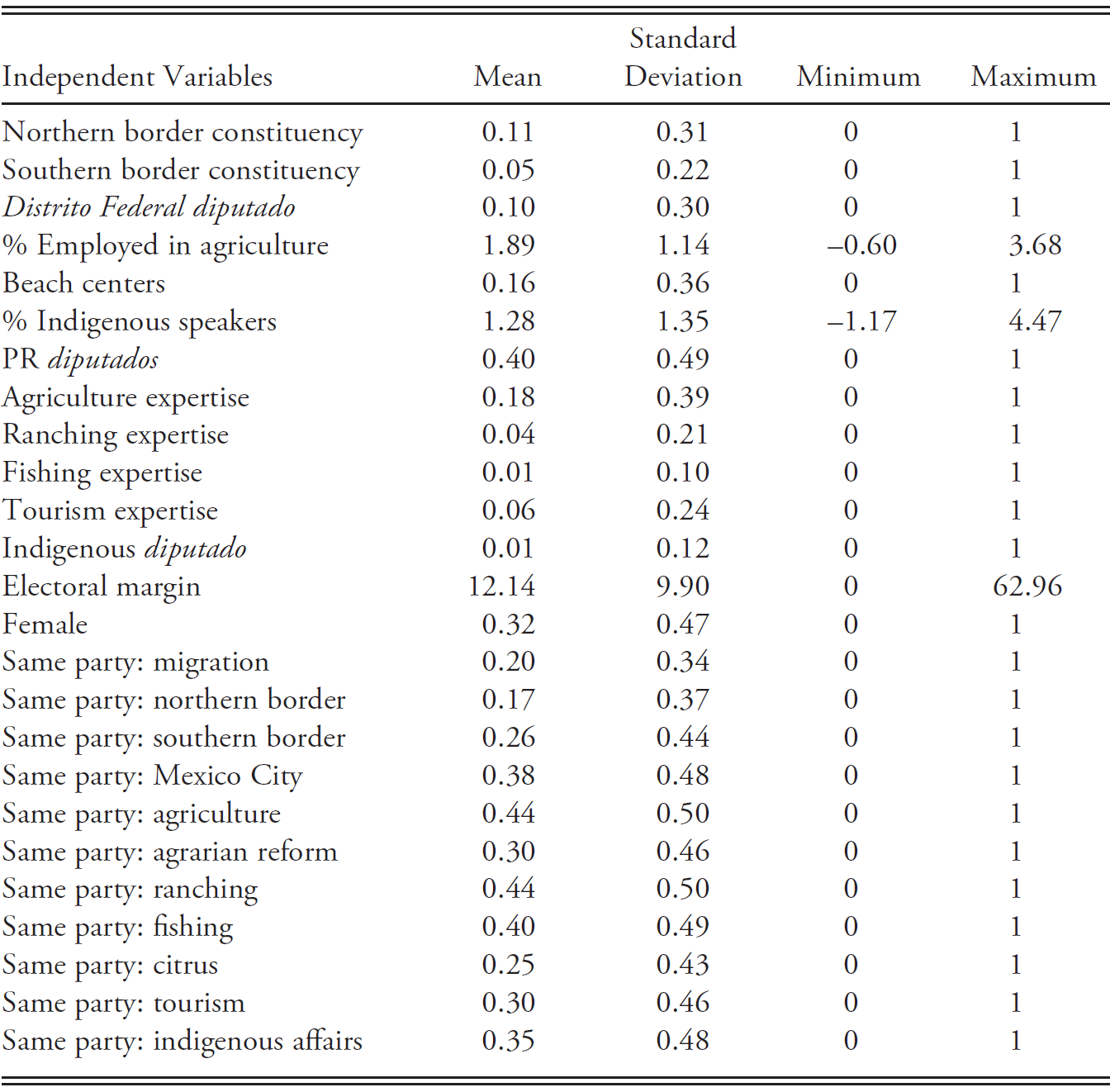
To measure constituency preferences relevant to the Indigenous Affairs committee, we use a variable measuring the (logged) percentage of the district or state speaking indigenous languages. Because the Indigenous Affairs Committee deals with issues affecting indigenous constituents, distributive theory would predict that diputados from districts and states with more indigenous language–speaking constituents would be more likely to be selected to the Indigenous Affairs Committee than diputados from districts and states with fewer indigenous language–speaking constituents. Parties looking to win re-election in seats with more indigenous voters would therefore look to use the Indigenous Affairs Committee to represent indigenous constituents’ preferences to attract more support among these voters. Data for these and the other independent variables discussed below are presented in table 1.
Descriptive Statistics for the Independent Variables

Note: “Same party” refers to whether diputados belonged to the same party as that of the committee chair.
We analyze committee selection for both diputados elected in single-member districts (or mayoría relativa) and those elected in the proportional representation (PR, or representación proporcional) tier of the electoral system.Footnote 7 We include members elected in both tiers because both types of diputados have an identifiable constituency to represent in the legislature. While diputados elected in the single-member districts represent their particular districts, diputados elected in the PR tier are associated with (and therefore can be expected to represent) a particular state— even if they are elected in one nationwide constituency.
Previous research suggests that members elected in the PR tier may be less focused on representing the particularistic concerns of constituents on committees than those elected in single-member districts (e.g., Stratmann and Baur Reference Stratmann and Baur2002; Langston and Aparicio Reference Langston and Aparicio2008). However, because the discussion above suggests that diputados elected in both tiers of the electoral system may be equally interested in using their positions to advance their political careers following the end of their terms, it is possible that committee selection in the Cámara de Diputados does not differ significantly between the two types of diputados. To test the argument that diputados elected in the PR tier may be significantly less likely to seek and be appointed to committees on which they could represent constituents’ preferences, we include a variable coded 0 for diputados elected in single-member districts and 1 for those elected in the PR tier. To test the possibility that constituency preferences have less impact on the appointment of diputados elected in the PR tier, we also estimate models including interactions between each measure of constituency preferences and the variable measuring diputados elected in the PR tier.
We also include several additional control variables potentially explaining committee selection. Because informational theory predicts that diputados possessing specialized knowledge of the issues falling under committees’ remits may be more likely to be selected to these committees, we examined diputados’ profiles in the System of Legislative Information and included dummy variables coded 1 for diputados with work experience (whether in the private sector or in public administration) in the areas of agriculture, ranching, fishing, and tourism for the respective committees, and 0 otherwise.
In the case of the Indigenous Affairs Committee, we include a variable measuring whether diputados themselves identify as indigenous (coded 1, and 0 otherwise), using data from Acosta (Reference Acosta Díaz2016). Although we lack measures of diputados’ expertise associated with the four geography-specific committees, the measures of expertise in the models estimating appointments to the other seven committees provide strict tests of the impact of constituency preferences on selection to those committees. If constituency preferences remain important predictors of appointment to committees after accounting for diputados’ expertise, then we would have robust evidence suggesting that constituency preferences impact the committee appointment process.
To control for the possibility that parties might select diputados to committees from less electorally secure districts to enhance their electoral prospects in those districts, we include a variable measuring the percentage difference between the top two parties in the district or state in which diputados were elected.Footnote 8 To account for the possibility that the probability of being selected to a committee may differ between male and female diputados, with female MPs either more likely to be excluded from committees or relegated to committees dealing with so-called women’s issues, we include a variable coded 1 for female diputados (relative to males, who are coded 0).
We also include a variable measuring whether diputados were from the same party as the committee president, to control for possible partisan stacking by the party chairing the committee. To account for party-specific variation in the probabilities of being appointed to each committee that are independent of the other covariates examined, we include dummy variables for diputados belonging to the two largest parties, Partido Revolucionario Institucional (PRI) and Partido Acción Nacional (PAN).Footnote 9 Finally, because members of the Mesa Directiva (which sets the legislative agenda and ensures that parliamentary practices and standards are followed) and the Junta de Coordinación Política (tasked with, among other things, proposing the memberships of committees) usually do not have other committee roles, we omit diputados serving on either body from the analysis.Footnote 10
To analyze the selection of diputados to committees, we estimate separate logistic regressions for each committee. Each regression model examines committee selection for the entire period covered by our dataset. To account for any differences in the underlying probability of being selected to each committee from one legislative term to the next, we treat the 60th Legislature as the baseline and include dummy variables for each subsequent term.
Analysis
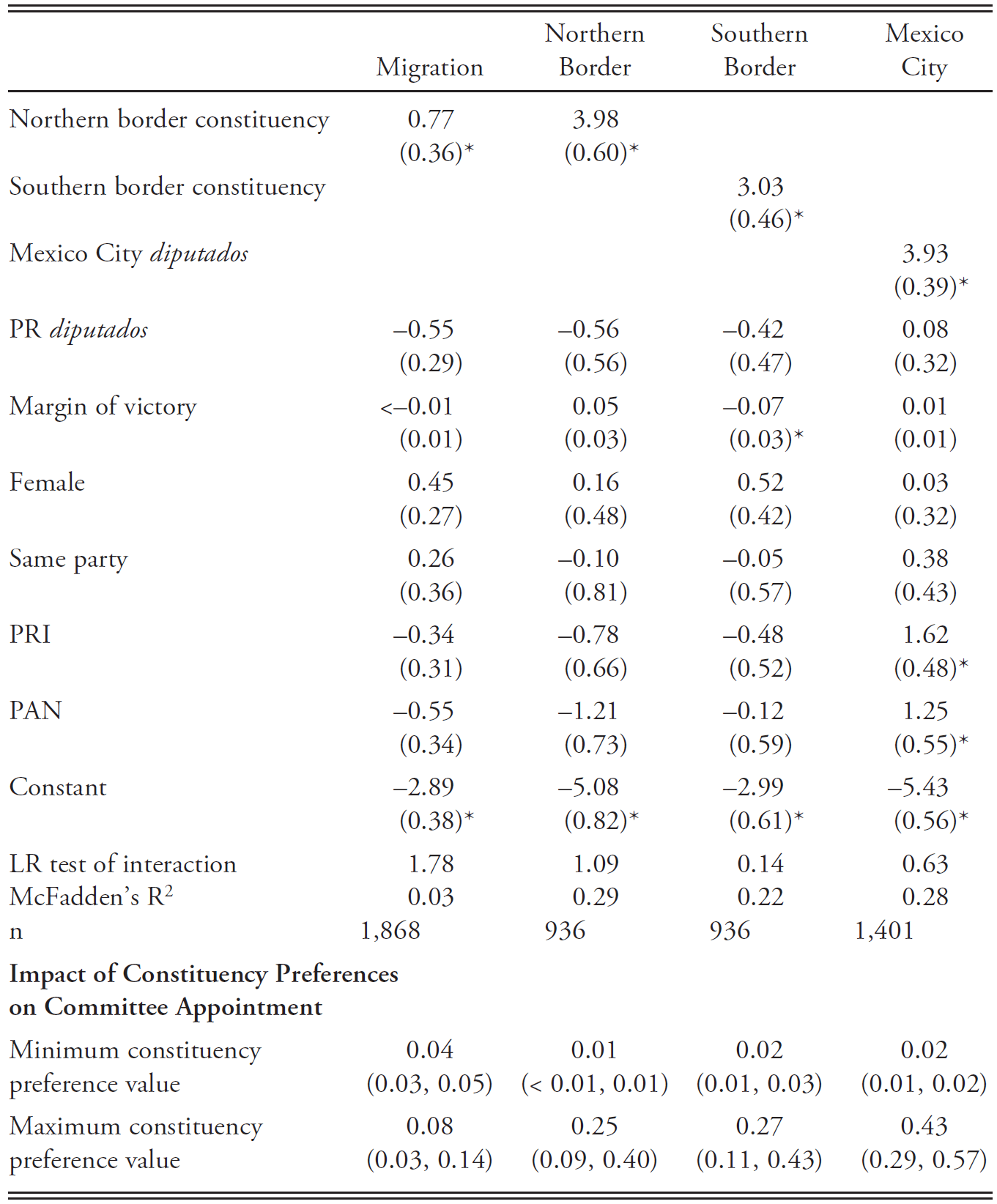
Table 2 presents the results of the logistic regression models predicting appointment to the Migration, Northern Border, Southern Border, and Mexico City Committees. On all four committees, the results suggest that constituency preferences are associated with higher probabilities of being appointed to relevant committees. As previous research testing the predictions associated with the distributive theory of committee selection would predict, diputados representing districts and states along the Mexico-U.S. border are significantly more likely to be appointed to the Migration and Northern Border Committees; diputados representing districts and states along Mexico’s southern borders with Guatemala and Belize are significantly more likely to be appointed to the Southern Border Committee; and diputados elected in the federal capital are significantly more likely to be appointed to the Mexico City Committee.
Estimated Effects of Constituency Preferences on Selection to Distributive Committees

* p < 0.05
Notes: Entries in the top part of the table are logistic regression coefficients (standard errors). Term fixed effects excluded. Entries in the bottom two rows are the predicted probabilities of being appointed to committee (95% confidence intervals). “LR test of interaction” is the χ2 value from model comparison tests of models with and without interactions between the constituency preference variables and the variable measuring diputados elected in the PR tier. Insignificant values suggest that the interaction effect does not significantly improve model fit.
It is interesting to note that the estimated effects of these constituency preference variables do not differ significantly between those elected in the single-member districts and those elected in the PR tier: not only is the variable measuring PR diputados statistically insignificant, but models including interactions between each constituency preference measure and the PR tier variable do not provide evidence of interaction effects (as seen in the statistically insignificant likelihood ratio model comparison tests).Footnote 11
The predicted probabilities reported at the bottom of table 2 illustrate the substantive impact of the estimated constituency preference effects. Holding all other variables at their median values, diputados from districts and states located on the Mexico-U.S. border have an 8 percent probability of being appointed to the Migration Committee compared with diputados from districts and states not located on the Mexico-U.S. border, who have a 4 percent probability of being appointed. The probabilities of diputados from northern and southern border districts and states being appointed to the Northern and Southern Border Committees are 25 and 27 percent, respectively (compared to 1 and 2 percent for those not representing border districts and states). Diputados from the federal capital have a 43 percent probability of being appointed to the Mexico City Committee (compared to the 2 percent probability among diputados representing districts and states outside the federal capital).
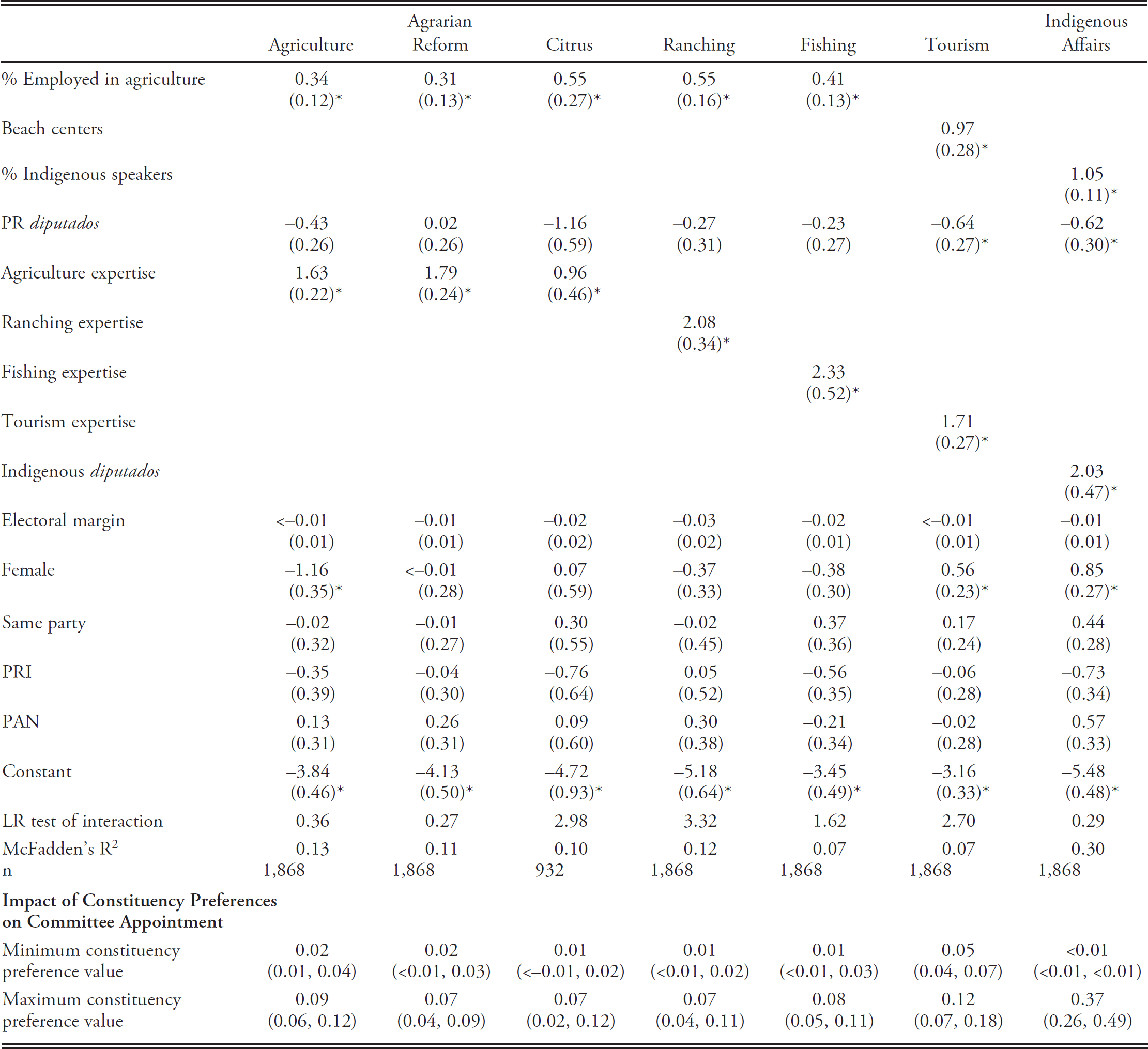
Table 3 presents the results of the logistic regression models predicting appointment to the remaining seven committees. For each committee, the measure of constituency preferences is associated with significantly higher probabilities of appointment to the associated committee: diputados representing states with more people employed in agriculture-related occupations are significantly more likely to be appointed to each agriculture-related committee; diputados representing districts and states with beach centers recognized by the Secretaría de Turismo are significantly more likely to be appointed to the Tourism Committee; and diputados representing districts and states with more indigenous language speakers are more likely to be appointed to the Indigenous Affairs Committee.
Estimated Effects of Constituency Preferences on Selection to Distributive Committees, Controlling for Diputados’ Backgrounds

*p < 0.05
Notes: Entries in the top part of the table are logistic regression coefficients (standard errors). Term fixed effects excluded. Entries in the bottom two rows are the predicted probabilities of being appointed to committee (95% confidence intervals). “LR test of interaction” is the χ2 value from model comparison tests of models with and without interactions between the constituency preference variables and the variable measuring diputados elected in the PR tier. Insignificant values suggest that the interaction effect does not significantly improve model fit.
These findings are even more impressive than those seen in table 2 because these results emerge even after controlling for diputados’ expertise associated with each committee. While expertise resulting from employment in agricultural occupations is associated with significantly higher probabilities of being appointed to agriculture-related committees, and while expertise accumulated through employment in the tourism sector is associated with higher probabilities of being appointed to the Tourism Committee, constituency preferences are associated with significantly higher probabilities of being appointed to each committee. In the case of the Indigenous Affairs Committee, the percentage of indigenous language speakers is associated with higher probabilities of being appointed to the Indigenous Affairs Committee, even after controlling for the fact that indigenous diputados are more likely to be appointed to the Indigenous Affairs Committee.
The magnitude of the estimated effects of each measure of constituency preferences can be seen by comparing the predicted probabilities at the bottom of table 3. Holding all other variables at their median values (with the expertise variables held to zero), diputados from states with the highest observed levels of agriculture-related employment have predicted probabilities of being selected to the agriculture-related committees ranging from 7 to 9 percent—compared to predicted probabilities of only 1 to 2 percent among diputados from states with the lowest observed levels of agricultural employment. The predicted probability of diputados representing districts and states with beach centers being selected to the Tourism Committee is 12 percent, compared to 5 percent among diputados not representing districts and states with a beach center. Diputados representing districts and states with the highest observed percentages of indigenous language speakers have a 37 percent probability of being appointed to the Indigenous Affairs Committee, compared to a probability less than 1 percent among those with the minimum observed percentages of indigenous language speakers in their districts and states.
Taken together, the results presented here suggest that constituency preferences impact the selection of diputados to committees. In line with the predictions associated with the arguments holding that parties engage in distributive politics when selecting members to committees, these findings suggest that diputados representing districts and states with more constituents concerned with a particular set of issues are more likely to be selected to that committee, in order to distribute particular benefits to that constituency. Because diputados during this period were not personally concerned with re-election, the finding that constituency preferences remain associated with selection to committees is consistent with the argument that party leaders promote the representation of constituency interests on committees to improve their party’s electoral prospects in the next election. While Mexican party leaders may still be concerned with the consequences of such representation for the party brand, these results suggest that party leaders calculate that any damage done to the party brand by representing constituency preferences may be outweighed by the benefits of representing constituency concerns for the party’s chances of re-election.
Although the impact of constituency preferences on the probabilities of being appointed to some committees is far from overwhelming (particularly with regard to the agriculture-related committees), the results nonetheless provide support for the argument that constituency preferences significantly impact committee selection in the Mexican Cámara de Diputados. In line with the argument that parties care about and use distributive politics as an end to improving the party’s electoral fortunes, diputados representing constituents with particular interests in the work of a committee are several times more likely to be selected to that committee than diputados representing districts where constituents are far less concerned with the committee’s activities.
It is important to note that these changes in probability occur despite the measurement of agriculture-related constituency preferences, which works against finding evidence of constituency preferences on committee appointments. Even more impressively, the constituency preference effects on assignments to the committees included in table 3 emerge even after controlling for diputados’ personal backgrounds and expertise—thereby accounting for potential overlap with the predictions associated with the informational theory of committee selection.
Discussion and Conclusions
Reflecting the need to extend research on committee selection to legislatures in Latin America (Alemán Reference Alemán2013), this study has examined the impact of constituency preferences on appointments to several committees in the Mexican Cámara de Diputados. Applying theories of legislative organization developed in the study of U.S. legislatures to the case of Mexico presents an interesting problem. Given that diputados were barred from running for re-election until only recently, and with the strong control over diputados exerted by party leaders, the Mexican Cámara de Diputados is an unlikely case in which constituency preferences would be expected to impact selection to committees. On the 11 committees observed here, however, the results suggest that constituency preferences are associated with higher probabilities of selection to relevant committees.
The case of Mexico highlights that instead of resulting from diputados’ pursuing committee assignments enhancing their personal prospects of re-election, distributive politics and the representation of constituency interests on committees are important to parties’ electoral concerns. Because parties often control diputados’ career prospects outside the legislature, the results suggest that parties have compelled their diputados to serve on committees addressing issues of concern to their constituents with the intention of improving the party’s standing in future elections—which has resulted in correlations between constituency preferences and committee assignments in the Cámara de Diputados despite the presence of term limits.
These results have several important implications for the comparative literature on committee selection. For one, the results suggest that it is not only individual legislators concerned with their personal chances of re-election who seek to exercise the sort of constituent representation on committees expected by distributive theory, but also political parties. Given the absence of re-election incentives in the period examined here, individual diputados selected to committees addressing their constituents’ concerns were not engaging in constituency representation for their own re-election benefits; instead, the finding that measures of constituency preferences predict selection to committees suggests that diputados are selected to represent their constituents’ interests for the benefit of the party. Therefore, the findings presented here suggest that revisions to our understanding of distributive theory are needed: while the pursuit of distributive goods for constituents certainly is an important feature of individuals’ own re-election goals, the example of Mexico shows that parties are similarly concerned with such constituent representation for the re-election interests of the party as a whole.
Additionally, the results presented here have important implications for the application of cartel theory to legislatures outside the United States. Although distributive theory is often viewed as being at odds with cartel theory, these findings suggest that there is much greater overlap between the two. Consistent with previous research that has noted how parties may pursue electoral strategies in keeping with many of the predictions associated with distributive theory (Raymond and Holt Reference Raymond and Holt2014, 179–80; Mickler Reference Mickler2018a, 117, b, 521), these findings suggest that parties have an interest in promoting the representation of constituency preferences on committees as a means of enhancing the party’s electoral fortunes in the following election.
Previous research applying cartel theory acknowledges that parties may not prevent self-interested members with outlying preferences from being selected to committees where they represent their constituents’ interests, as such behavior increases the chances that the party and its members will be re-elected (Cox and McCubbins Reference Cox and McCubbins1993, 191–99). However, the finding that parties in Mexico continued to select members to committees aligning with their constituents’ interests, despite the absence of individual re-election interests, suggests that more attention to the incentives for parties to ensure that constituency interests are represented on committees (independently of individual members’ own interests) is needed in future research.
The results also have important implications for the literature on committees in Latin American legislatures. The findings presented here suggest that theories of committee selection developed in the study of U.S. legislatures and applied increasingly to other legislatures also travel to committees in Latin American legislatures. Accordingly, we would expect that future research on committee selection in other legislatures would yield similar findings. Additionally, as this study has found evidence that distributive politics impact committee selection in the Mexican Cámara de Diputados, future research on committees in Latin American legislatures will need to account for the importance of distributive concerns—both those of parties and of their members—when trying to understand the behavior of committee members and those seeking selection to committees. More broadly, these findings reinforce the importance of distributive politics already acknowledged in previous studies (e.g., Taylor Reference Taylor1992; Fujimura Reference Fujimura2012; Kerevel Reference Kerevel2015a) for understanding the politics and products of Latin American legislatures.
One interesting avenue for future research would be to extend the analysis to examine the impact of differences in individuals’ career plans on the probabilities of selection to committees. We noted that based on previous studies of diputados’ careers post-office and their behavior while still in office (e.g., Kerevel Reference Kerevel2015a), we could safely assume that most diputados faced incentives to sit on committees and represent constituency preferences as a means to enhancing future career prospects. Future research seeking to extend this analysis might want to examine the effects of differences in career plans on individuals’ desire to seek committee assignments aligning with constituency preferences. This may be even more important to understanding committee selection in legislatures without term limits, as those seeking to remain in office may be more enthusiastic in pursuing committee assignments that allow them to represent their constituents’ interests than those seeking other offices (and even more so than those looking to quit politics altogether).