Introduction
Lack of social support after exposure to traumatic events is one of the strongest predictors of post-traumatic stress disorder (PTSD) (Brewin et al. Reference Brewin, Andrews and Valentine2000; Ozer et al. Reference Ozer, Best, Lipsey and Weiss2003). There is a growing recognition, however, that different types of post-trauma social support are associated with varied psychological outcomes. Research has indicated, for example, that perceived social support is more strongly related to psychological outcomes than objective social support (Solomon et al. Reference Solomon, Mikulincer and Hobfoll1987). In addition, perceived social support can be conceptualized as being both positive and negative in nature, with positive support representing interactions in which friends and family members take an interest in the individual and make him/her feel cared about, while negative support is characterized by friends and family making demands, criticizing and/or creating arguments (Schuster et al. Reference Schuster, Kessler and Aseltine1990). Cross-sectional studies have consistently linked perceived negative social support with poor post-traumatic mental health outcomes (Ullman, Reference Ullman1996; Tarrier et al. Reference Tarrier, Sommerfield and Pilgrim1999; Zoellner et al. Reference Zoellner, Foa and Brigidi1999; Andrews et al. Reference Andrews, Brewin and Rose2003; Borja et al. Reference Borja, Callahan and Long2006). In contrast, findings regarding the relationship between perceived positive social support, and PTSD symptoms have been mixed (Engdahl et al. Reference Engdahl, Dikel, Eberly and Blank1997; Campbell et al. Reference Campbell, Ahrens, Sefl, Wasco and Barnes2001; Holeva et al. Reference Holeva, Tarrier and Wells2001; Regehr et al. Reference Regehr, Hemsworth and Hill2001; Andrews et al. Reference Andrews, Brewin and Rose2003; Pietrzak et al. Reference Pietrzak, Johnson, Goldstein, Malley, Rivers, Morgan and Southwick2009; Evans et al. Reference Evans, Steel and DiLillo2013).
Longitudinal research has further demonstrated the complexity of the relationship between perceived social support and subsequent PTSD symptoms. Studies that have investigated perceived positive and negative social support separately, for example, have found that perceived positive social support post-trauma is associated with better subsequent mental health outcomes, while perceived negative social support is linked to greater psychological distress (Holeva et al. Reference Holeva, Tarrier and Wells2001; Grills-Taquechel et al. Reference Grills-Taquechel, Littleton and Axsom2011). Other studies that have simultaneously investigated the impact of perceived positive and negative social support on subsequent symptoms have linked perceived negative (but not positive) social support to post-traumatic distress (Zoellner et al. Reference Zoellner, Foa and Brigidi1999; Andrews et al. Reference Andrews, Brewin and Rose2003). Still other studies have found that that extent to which perceived positive or negative social support predicts subsequent PTSD symptoms changes over time (Cook & Bickman, Reference Cook and Bickman1990; Robinaugh et al. Reference Robinaugh, Marques, Traeger, Marks, Sung, Gayle Beck, Pollack and Simon2011).
Overall, studies to date have failed to show a consistent temporal pattern of association between perceived social support and subsequent PTSD symptoms when assessed at multiple time-points. Further, there has been limited research investigating the effect of PTSD symptoms on perceived social support using prospective longitudinal designs. The social support deterioration model posits that stressful events may lead to reductions in social support over time, via changes in individuals' expectations of social support, and weakening of interpersonal relationships (Barrera, Reference Barrera and Cohen1988; Wheaton, Reference Wheaton1985). Two prospective studies have been conducted that examined the association between perceived social support and subsequent PTSD symptoms as well as the relationship between PTSD symptoms and subsequent perceived social support. King et al. (Reference King, King, Taft, Hammond and Stone2006a ) found that more severe PTSD symptoms two years after combat exposure were associated with lower perceived positive social support five years later amongst male veterans. In contrast, social support did not predict subsequent changes in PTSD symptoms. Kaniasty & Norris (Reference Kaniasty and Norris1993) found that perceived positive familial social support at 6 months post-trauma predicted lower levels of PTSD 12 months following a natural disaster. Between 12 and 18 months, the relationship was reciprocal, such that high levels of perceived positive social support predicted decreases in PTSD and high levels of PTSD symptoms predicted decreases in social support. Between 18 and 24 months, PTSD was associated with lower perceived social support, but not vice versa. These two studies provide preliminary evidence that PTSD symptoms are associated with subsequent decreases in perceived positive social support. Nevertheless, neither study examined the relationship between perceived negative social support and PTSD, nor investigated these associations from the acute post-trauma period to several years after the trauma. Accordingly, it remains unclear whether this pattern is consistent across perceived positive and negative social support, or across an extended time-frame.
The objective of this study was to examine the bi-directional relationships between PTSD symptom severity and both perceived positive and negative social support following traumatic injury. This study is novel as it investigates this relationship over an extended time-period that encompasses both the acute post-trauma phase and the years following the traumatic event. Elucidation of the dynamic relationship between perceived social support and PTSD symptom severity across this time-frame provides a unique opportunity to investigate how these variables maintain and/or exacerbate one another over an extended period, which has the potential to inform the development of effective interventions to manage this inter-relationship from a longitudinal perspective. We implemented latent difference score (LDS) structural equation modeling, a statistical technique that allows for investigation of multiple types of change concurrently, to examine the direction of influence between PTSD symptom severity and perceived positive social support, and PTSD symptom severity and perceived negative social support over a 6-year period following exposure to a traumatic injury.
We hypothesized a unidirectional relationship between PTSD symptom severity and perceived social support over time. Specifically, we predicted that increased PTSD symptom severity would be associated with decreases in both perceived positive and negative social support over time. These hypotheses are drawn from the studies conducted by King et al. (Reference King, King, Taft, Hammond and Stone2006a ) and Kaniasty & Norris (Reference Kaniasty and Norris1993) which broadly suggested that increases in PTSD severity preceded decreases in positive social support. While these studies did not investigate negative social support, it may be expected that, as PTSD symptoms increase, individuals withdraw from their social networks and experience decreases in both positive and negative social support. As longitudinal studies have failed to demonstrate a consistent relationship between perceived social support and subsequent PTSD symptom severity (Kaniasty & Norris, Reference Kaniasty and Norris1993; King et al. Reference King, King, Taft, Hammond and Stone2006a ), we did not hypothesize a relationship between social support and changes in PTSD symptom severity. Further, we did not expect specific differences in the pattern of association at different time-points.
Method
Participants and procedure
Participants in this study were injury survivors recruited from four Level 1 trauma centers across Australia. Inclusion criteria included (a) aged 18–70 years, (b) proficient communication in English, and (c) hospital admission for >24 h following traumatic injury. Exclusion criteria encompassed (a) moderate to severe head injury, (b) current psychotic symptoms, (c) active suicidality, (d) temporary visitor to Australia, (e) cognitive impairment, or (f) under police guard. Eligible participants were selected using an automated assignment procedure, and were stratified by length of stay. Participants were interviewed just prior to discharge from hospital by research assistants (which represented the baseline time-point in this study). At 3, 12, 24, and 72 months after the trauma, the interview measure [i.e. Clinician Administered PTSD Scale (CAPS); Blake et al. Reference Blake, Weathers, Nagy, Kaloupek, Gusman, Charney and Keane1995] was administered by telephone, and the self-report measure was returned by post [i.e. Schuster Social Support Questions (SSSQ); Schuster et al. Reference Schuster, Kessler and Aseltine1990]. Participants were not paid for taking part in the study.
Initially, 1590 individuals met inclusion criteria; of these, 1150 (71.6%) agreed to participate and completed the initial assessment. Of these, 18 individuals did not complete the measures reported in this study (i.e. had missing data on all PTSD symptom and perceived social support measures, or had missing data on the covariates included in the study), and so were excluded from the analyses. Those who declined to participate did not differ from those who did take part on gender, length of hospital admission, injury severity score, or age. At the 3-month follow-up assessment, 989 individuals were interviewed by telephone, representing 86.8% of the initial sample. At the 12-month follow-up assessment, 865 participants of the initial 1139 (76.0%) were interviewed, at the 24 month follow-up assessment, 830 participants were interviewed (72.9%), and at 72 months, 613 were interviewed (53.9%). Duration of response at each time-point from baseline was as follows: 3 months (mean = 3.38 months after baseline, s.d. = 1.55), 12 months (mean = 12.25 after baseline, s.d. = 1.14), 24 months (mean = 24.30 after baseline, s.d. = 1.40), 72 months (mean = 74.60 after baseline, s.d. = 6.01). The final sample size of participants who were included in the analyses at each time-point was: baseline (N = 1132), 3 months (N = 974), 12 months (N = 849), 24 months (N = 813), and 72 months (N = 543).
Individuals who did not complete the assessment at 72 months did not differ from those who did complete the assessment on gender, mechanism of injury, length of stay, or injury severity. Those who did not complete the 72-month follow-up assessment were younger (mean = 36.33 years, s.d. = 13.56 v. mean = 39.53 years, s.d. =13.48; t 1126 = 3.97, p < 0.001) and had higher baseline CAPS scores (mean = 20.21, s.d. = 17.89 v. mean= 16.13, s.d. = 15.06; t 1113.9 = 4.17, p < 0.001) than completers.
Measures
PTSD symptom severity was assessed in relation to the injury for which the patient was hospitalized [based on the DSM-IV definition (APA, 1994)], using the CAPS (Blake et al. Reference Blake, Weathers, Nagy, Kaloupek, Gusman, Charney and Keane1995). This measure indexes the 17 DSM-IV PTSD symptoms on both frequency and intensity, yielding a total sum score of PTSD symptom severity. At the first time-point, PTSD symptoms were assessed since the injury; at subsequent time-points, PTSD symptoms were assessed over the previous month. The CAPS is considered the gold-standard measure of PTSD symptoms, and has strong psychometric properties (Weathers et al. Reference Weathers, Keane and Davidson2001). Internal consistency of the CAPS was strong at all time-points: baseline (α = 0.89), 3 months (α = 0.94), 12 months (α = 0.94), 24 months (α = 0.94), 72 months (α = 0.94). Interviews were audiotaped so that 5% could be re-scored by an independent assessor.
Perceived social support was assessed using the SSSQ (Schuster et al. Reference Schuster, Kessler and Aseltine1990). This scale measure comprises two subscales, indexing perceived positive and negative support provided by friends and family. Perceived positive social support is indexed by four items, with two relating to family members and two relating to friends (e.g. How often do family/friends express interest in how you are doing?; How often do friends/family make you feel cared for?). Perceived negative social support is indexed by six items, with three relating to family members and three relating to friends (e.g. How often do family/friends make too many demands on you? How often do family/friends criticize you? How often do family/friends create tensions or arguments with you?). Items are scored on a four-point scale ranging from 1 (never) to 4 (extremely), and were summed to form scales representing perceived positive social support from family members and friends (with higher scores representing greater perceived positive support), and perceived negative social support from family members and friends (with higher score representing greater perceived negative support). These scales evidenced excellent internal consistency at each time-point: baseline [perceived positive social support (PSS) α = 0.78, perceived negative social support (NSS) α = 0.82], 3 months (PSS α = 0.83, NSS α = 0.83), 12 months (PSS α = 0.82, NSS α = 0.83), 12 months (PSS α = 0.82, NSS α = 0.83), 24 months (PSS = 0.84, NSS α = 0.83), 6 years (PSS α = 0.82, NSS α = 0.82).
We assessed previous exposure to traumatic events using the trauma history inventory of the PTSD module of the Composite International Diagnostic Interview (WHO, 1997). This scale screens for 11 traumatic life events, including combat, life-threatening injury, natural disaster, witnessing injury or death, rape, sexual molestation, physical assault, childhood neglect or abuse, threatened with weapon, great shock because of events occurring to other, and ‘other’. We also added a question on exposure to ‘torture or terrorism’. Participants were asked to report if they had been exposed to these events before the trauma in which they were injured.
Data analysis
We first calculated Pearson's correlations between PTSD symptoms, perceived positive social support and perceived negative social support. We used LDS structural equation modeling to investigate the relationship between PTSD symptom severity and perceived positive and negative social support over the course of the study (King et al. Reference King, King, McArdle, Shalev and doron-LaMarca2009; Ferrer & McArdle, Reference Ferrer and McArdle2010). LDS allows for the modeling of three sources of change, including (1) cross-lagged bivariate change, or the impact of scores on one variable on subsequent changes in scores on a second variable, (2) autoproportional change, or the impact of the immediately preceding latent score on the difference in the score of the same variable, and (3) constant change, or the natural course of change in variable scores across time. Analyses were conducted using Mplus version 7 (Muthen & Muthen, Reference Muthén and Muthén1998–Reference Muthén and Muthén2013). Mplus implements a robust full information maximum-likelihood estimation procedure to account for missing data. Accordingly, participants were included in the analyses if they responded to one or more of the time-points for PTSD symptoms or perceived social support. Participants with missing data on all PTSD symptom and perceived social support measures or the study covariates (N = 18) were excluded from the analyses. Consistent with recommendations in the field, we used the following indices to evaluate model fit: Root Mean Square Error of Approximation < 0.06; and Comparative Fit Index values approaching 1.00 or greater (Hu & Bentler, Reference Hu and Bentler1999).
Our analyses involved a two-step process. First, we estimated univariate change score models for PTSD symptom severity, perceived positive social support scores and perceived negative social support scores to (1) evaluate whether single (autoproportional or constant change only) or dual (autoproportional and constant change) change model best fit the data, and (2) describe the pattern of univariate change in these variables. We compared the fit of these models using the scaled Satorra–Bentler χ² difference test (Satorra & Bentler, Reference Satorra and Bentler2001). We also evaluated whether the constraint to equality of autoproportional paths significantly degraded model fit in the PTSD and perceived social support models. This allowed us to determine whether (e.g.) PTSD symptoms influenced subsequent PTSD symptoms equally at each time-point, or whether this varied across measurement occasions.
Second, we conducted multivariate latent difference score analyses using the best-fitting models derived from the univariate model testing phase, examining the sequence of PTSD symptom severity, perceived positive social support, and perceived negative social support. In LDS, each observed variable at each time-point is partitioned into a latent variable and a measurement error component. The latent variables are used to calculate highly reliable change or difference scores (four difference scores, corresponding to the five time-points examined in this study). In addition to modeling the change parameters represented in the univariate models (i.e. autoproportional change and constant change), bivariate change is modeled using cross-lagged paths from the latent variable of one construct at time t − 1 to the latent difference score of the other construct at time t. This allowed us to determine the extent to which scores on one variable influenced subsequent changes in scores on another variable. We modeled cross-lagged paths between PTSD symptom severity and perceived positive social support and PTSD and perceived negative social support. We allowed perceived positive and negative social support to covary at each time-point to account for the moderate negative relationship between these variables. These models also controlled for important covariates including age, gender and past trauma exposure. Non-significant paths between covariates and baseline PTSD symptoms, perceived positive social support and perceived negative social support were removed and the model re-fitted.
Ethical statement
The authors assert that all procedures contributing to this work comply with the ethical standards of the relevant national and institutional committees on human experimentation and with the Helsinki Declaration of 1975, as revised in 2008.
Results
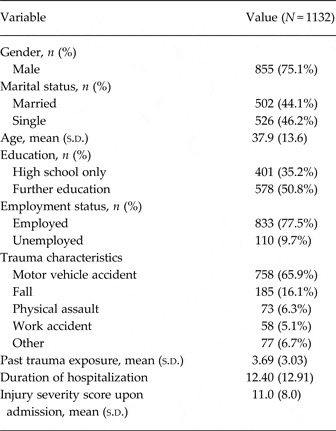
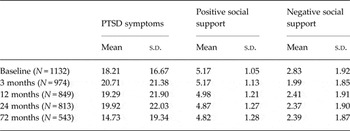
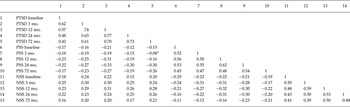
Demographic information and trauma characteristics are presented in Table 1. Means and standard deviations for PTSD, perceived positive social support and perceived negative social support are presented in Table 2. Correlations between variables are presented in Table 3. There were significant negative correlations between PTSD and perceived positive social support at each time-point, and significiant positive correlations between PTSD and perceived negative social support at each time-point, with the exception of between PTSD symptoms at 72 months and perceived positive social support at baseline (p = 0.062). There were significant negative correlations between perceived positive and negative social support at each time-point.
Sample descriptive statistics at baseline and trauma characteristics

Means and standard deviations for perceived positive social support, perceived negative social support and PTSD symptoms at baseline, 3 months, 12 months, 24 months and 72 months
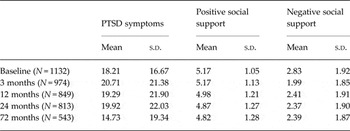
PTSD, Post-traumatic stress disorder.
Correlations between PTSD symptoms, perceived positive social support and perceived negative social support at baseline, 3 months, 12 months, 24 months and 72 months
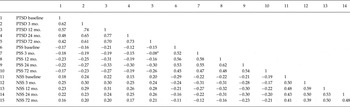
PTSD, Post-traumatic stress disorder; PSS, perceived positive social support; NSS, perceived negative social support; mo., months.
All correlations significant at p < 0.01, except for correlation denoted by a where p = 0.062.
Univariate latent difference score models
Univariate latent difference score models were fitted for PTSD symptom severity, perceived negative social support and perceived positive social support. When residual errors were allowed to vary freely in the negative social support model, the model did not coverge, thus residual errors were set to equality for this model only. Additional parameters that were set to 0 to aid convergence included the covariance of PTSD symptoms constant slope and positive perceived social support constant slope, the covariance of positive perceived social support initial status and constant slope, and the covariance of negative perceived social support initial status and constant slope [see Supplementary material for fit statistics (Supplementary Table S1) and model parameters (Supplementary Table S2)]. The dual change model best fit the data for PTSD symptoms (see Supplementary Table S1). PTSD symptom severity evidenced significant negative autoproportional change at each time-point, indicating that high levels of PTSD symptoms were associated with subsequent decreases in PTSD symptom severity over time. The mean slope of PTSD symptom severity was positive and significant, suggesting that, overall, PTSD symptom severity increased over time. This suggests that, overall, PTSD symptoms showed a general trend to increase over time, but participants with high levels of these symptoms evidenced greater subsequent decreases in these symptoms over time. This is consistent with other trauma-affected samples (King et al. Reference King, King, McArdle, Saxe, Doron-Lamarca and Orazem2006b ; Nickerson et al. Reference Nickerson, Barnes, Creamer, Forbes, McFarlane, O'Donnell, Silove, Steel and Bryant2014).
For the positive social support model, the dual change model evidenced the best fit to the data (see Supplementary Table S1). Despite this, autoproportional and constant change parameters were not significant in this model, suggesting that positive social support did not demonstrate systematic patterns of change over time. For the negative social support model, the dual change model evidenced the best model fit (see Supplementary Table S1). Perceived negative social support demonstrated significant negative autoproportional change at each timepoint, indicating that high negative social support scores were associated with greater subsequent decreases in negative social support scores over time. The mean slope of perceived negative social support was positive and significant, suggesting that, overall, negative social support increased over time.
Multivariate latent difference score model
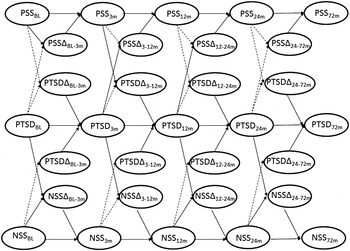
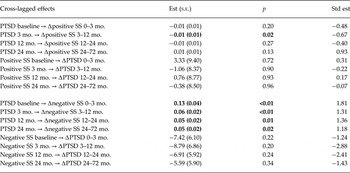
Multivariate latent difference score analyses revealed that a model with freely-varying cross-lagged paths between variables fit the data well (see Table 4 for model comparisons). This model controlled for significant paths from gender to baseline PTSD symptoms (B = 6.13, s.e. = 0.76, β = 0.16, p < 0.001) and perceived positive social support (B = 0.14, s.e. = 0.06, β = 0.06, p = 0.009), and trauma exposure to PTSD symptoms (B = 0.59, s.e. = 0.15, β = 0.11, p < 0.001), and perceived positive (B = −0.04, s.e. = 0.01, β = −0.11, p < 0.001) and negative (B = 0.09, s.e. = 0.02, β = 0.15, p < 0.001) social support. As the focus of these analyses was on the inter-variable relationships, results from the cross-lagged paths are discussed here and displayed in Table 5 and Fig. 1 (see Supplementary Table S3 for full model parameters). Greater PTSD symptom severity was associated with subsequent increases in perceived negative social support scores (i.e. increased negative social support) at all time-points. Greater PTSD symptom severity was associated with subsequent decreases in perceived positive social support (i.e. reductions in positive social support) between 3 and 12 months. Levels of perceived positive and negative social support were not related to changes in PTSD symptom severity at any time-point.
Conceptual representation of bivariate latent difference score analyses, controlling for age, gender and trauma. PSS, Perceived positive social support; NSS, perceived negative social support; PTSD, PTSD symptoms; BL, baseline; m, months. Note that PSS and NSS are allowed to covary. Significant paths represented by unbroken lines.

Fit statistics for bivariate latent difference score models for PTSD symptoms, perceived positive and perceived negative social support

PTSD, Post-traumatic stress disorder; CFI, Comparative Fit Index; RMSEA, Root Mean Square Error Approximation.
Cross-lagged parameters in latent difference score model of relationship between PTSD, perceived positive social support and perceived negative social support

PTSD, Post-traumatic stress disorder; SS, social support; Est, estimate; s.e., standard error; Std est, standardized estimate; mo., months.
Significant parameters are represented in bold.
Discussion
This study represents the first longitudinal investigation of the temporal association between PTSD sympotm severity and both perceived positive and negative social support. Consistent with our hypothesis, high levels of PTSD symptoms were associated with decreases in perceived positive social support between 3 and 12 months after the trauma. Contrary to our hypothesis, high levels of PTSD symptoms were associated with increases in perceived negative social support at all time-points. To our knowledge, this is the first study to investigate the impact of PTSD symptom severity on subsequent levels of perceived negative social support. The finding relating to perceived positive social support is broadly consistent with previous longitudinal research. Kaniasty & Norris (Reference Kaniasty and Norris2008) found that, between 12 and 24 months, PTSD symptoms were associated with subsequent decreases in perceived positive social support. King et al. (Reference King, King, Taft, Hammond and Stone2006a ) found that PTSD symptoms at 2 years post combat-exposure were associated with decreases in positive social support over the next 3 years. In contrast, while we found that PTSD symptom severity was associated with decreases in perceived positive social support between 3 and 12 months following the trauma, we found no association between PTSD symptom severity and perceived positive social support between baseline and 3 months post-trauma nor 12 months and 6 years post-trauma. One possible explanation for this discrepancy is that the studies conducted by King et al. (Reference King, King, Taft, Hammond and Stone2006a ), and Kaniasty & Norris (Reference Kaniasty and Norris2008) examined the relationship between positive social support and PTSD symptoms, without simultaneously considering the impact of PTSD symptoms on negative social support. In our study, PTSD symptom severity had a strong and consistent negative effect on subsequent negative social support at all time-points. It may be the case that failure to consider the impact of PTSD symptom severity on perceived negative social support has inflated the relationship between PTSD symptoms and positive support in previous studies.
Results from this study indicated that perceived social support had no subsequent impact on PTSD symptom severity. This is consistent with the findings of King et al. (Reference King, King, Taft, Hammond and Stone2006a ), and extends this pattern of results to perceived negative social support. In contrast, our results are not consistent with the findings of Kaniasty & Norris (Reference Kaniasty and Norris2008) that, between six and 12 months, and 12 and 18 months, high levels of positive social support predicted decreases in PTSD symptom severity. It may be that the differences in social contexts of our sample of traumatic injury survivors and the natural disaster survivors in the study by Kaniasty and Norris account for these discrepancies in findings. For example, Kaniasty & Norris (Reference Kaniasty and Norris2008) noted the pervasive social impact that mass trauma may have on affected communities, and that this can lead to a complex inter-relationship between expectations of support held by survivors and availability of support (Kaniasty, Reference Kaniasty2012). Accordingly, Kaniasty & Norris (Reference Kaniasty and Norris1993) found that decreases in perceived positive support and social embededdness following exposure to a disater contributed to both the acute and delayed symptoms of psychological distress. In the context of social upheaval in the aftermath of mass trauma, it is possible that availablility of social support provides a greater protective function against PTSD relative to settings, such as in the present study, in which discrete traumatic events occur in the context of an otherwise stable social fabric.
Our finding that perceived social support was not associated with subsequent changes in PTSD symptom severity is consistent with research that has failed to find a link between social support and PTSD (Zoellner et al. Reference Zoellner, Foa and Brigidi1999; Campbell et al. Reference Campbell, Ahrens, Sefl, Wasco and Barnes2001; Holeva et al. Reference Holeva, Tarrier and Wells2001; Regehr et al. Reference Regehr, Hemsworth and Hill2001; Andrews et al. Reference Andrews, Brewin and Rose2003; Galea et al. Reference Galea, Tracy, Norris and Coffey2008; Evans et al. Reference Evans, Steel and DiLillo2013), but contrary to other studies that have found that positive social support is associated with better posttraumatic adjustment (Brewin et al. Reference Brewin, Andrews and Valentine2000; Dougall et al. Reference Dougall, Ursano, Posluszny, Fullerton and Baum2001; Holeva & Tarrier, Reference Holeva and Tarrier2001; Regehr et al. Reference Regehr, Hemsworth and Hill2001; Ozer et al. Reference Ozer, Best, Lipsey and Weiss2003; Galea et al. Reference Galea, Tracy, Norris and Coffey2008; Grills-Taquechel et al. Reference Grills-Taquechel, Littleton and Axsom2011; Evans et al. Reference Evans, Steel and DiLillo2013). Researchers have attested to the complexity of the relationship between social support and PTSD symptoms. For example, offered v. experienced social support may differ dramatically (Hofmann et al. Reference Hofmann, Litz and Weathers2003; Hyman et al. Reference Hyman, Gold and Cott2003), and an individual may experience receiving either too much or too little positive social support (Declercq & Palmans, Reference Declercq and Palmans2006). Further, numerous factors moderate the impact of social support, including symptom severity, personality traits (Borja et al. Reference Borja, Callahan and Rambo2009), attachment style (Mikulincer et al. Reference Mikulincer, Shaver, Gillath and Nitzberg2005; Declercq & Palmans, Reference Declercq and Palmans2006), trauma type, history, and dosage (Punamaki et al. Reference Punamaki, Komproe, Qouta, El-Masri and de Jong2005; Gabert-Quillen et al. Reference Gabert-Quillen, Irish, Sledjeski, Fallon, Spoonster and Delahanty2012; Littleton et al. Reference Littleton, Grills-Taquechel, Axsom, Bye and Buck2012), and source of social support (Grills-Taquechel et al. Reference Grills-Taquechel, Littleton and Axsom2011; Evans et al. Reference Evans, Steel and DiLillo2013). It may be that while the specific type of social support examined in the current study (namely, perceived positive and negative social support) and with this sample of traumatic injury survivors, did not impact on subsequent changes in PTSD symptoms, other types of support, or investigation with other trauma samples, may yield different results. There is a need for further research to examine the generalizability of these findings to other groups and other types of social support.
There are multiple potential mechanisms by which PTSD symptom severity may lead to changes in positive and negative social support. In terms of PTSD symptoms leading to reductions in positive social support, one possibility is that PTSD symptoms themselves involve withdrawal from positive interpersonal relationships (Hofmann et al. Reference Hofmann, Litz and Weathers2003; Gutner et al. Reference Gutner, Rizvi, Monson and Resick2006; Shallcross et al. Reference Shallcross, Frazier and Anders2014). Conversely, the distress experienced and expressed by trauma survivors (including behavioral manifestations such as aggression, impulsiveness and irritability) may lead others to withdraw from relationships with the individual, reducing potential sources of support (Guay et al. Reference Guay, Billette and Marchand2006). In contrast, PTSD symptoms may lead to increased negative social support due to interpersonal conflict that may be engendered by PTSD symptoms (MacDonald et al. Reference MacDonald, Chamberlain, Long and Flett1999; McFarlane & Bookless, Reference McFarlane and Bookless2001). For example, if a trauma survivor demonstrates symptoms such as irritability or detachment, this may lead to criticism from and conflict with potential sources of social suport, increasing the trauma survivor's perception of negative social support. In addition, PTSD is associated with excessively negative attributions (APA, 2013), including those regarding social relationships (Warda & Bryant, Reference Warda and Bryant1998), and this tendency may lead individuals with more severe PTSD to perceive lower positive and higher negative social support from those around them (Evans et al. Reference Evans, Steel and DiLillo2013). Overall, further research should be conducted to elucidate the mechanisms underlying the association between PTSD symptoms and social support. This would inform the development of psychological interventions that directly target the nexus between PTSD symptoms and social support. It may be the case, for example, that integrating strategies that address interpersonal difficulties into evidence-based interventions for PTSD may buffer the negative association between PTSD symptoms and social support. In support of this, Cloitre and colleagues found that skills training in interpersonal regulation prior to implementing exposure therapy for PTSD led to greater decreases in interpersonal problems than exposure therapy with supportive counseling, as well as greater treatment adherence (Cloitre et al. Reference Cloitre, Stovall-McClough, Nooner, Zorbas, Cherry, Jackson, Gan and Petkova2010).
The current study had several limitations. First, all participants were survivors of traumatic injury and thus results may not be generalizable to individuals exposed to other types of trauma. Second, a proportion of participants in this study were lost to follow-up (13.2% at 3 months, 24% at 12 months, 27.1% at 24 months and 46.1% at 72 months). While the response rate in this study was strong compared to other longitudinal studies, this may have influenced the results, especially as those who were lost to follow-up at 72 months had higher PTSD symptoms at baseline than those who were retained. Third, we did not examine the impact of depression symptoms on the association between PTSD symptoms and perceived social support in this study as this would have resulted in a high level of model complexity. This would represent an interesting avenue for future investigation. Relatedly, the lack of prospective data on social support immediately prior to and at the time of the trauma limits inferences about the influence of perceived social support on PTSD symptoms during this time period. We also did not investigate the relationship between other types of social support (e.g. instrumental support) and PTSD symptoms in this study. In addition, PTSD symptoms in this study were measured only in relation to the traumatic injury for which the individual was hospitalized. While this has the advantage of enhancing conclusions that can be drawn about the inter-relatd course of PTSD symptoms and social support following a specific traumatic event, it may have resulted in an underestimate of participants' psychopathology if they continued to experience PTSD symptoms from previous trauamtic events. Finally, we did not examine the impact of relevant potential moderator variables, such as attachment style, which has been shown to impact how people utilize social supports in the aftermath of stress (Mikulincer et al. Reference Mikulincer, Shaver, Gillath and Nitzberg2005).
Findings from this longitudinal study conducted with traumatic injury survivors suggested that high levels of PTSD symptoms were associated with decreases in perceived positive social support in the first year after trauma exposure, and greater increases in negative social support over the 6 years following a traumatic event. In contrast, high levels of perceived social support did not have a buffering or exacerbating effect on subsequent PTSD symptoms. Understanding the social consequences of PTSD symptoms may enhance the development of interventions that promote adaptation after trauma.
Supplementary material
The supplementary material for this article can be found at http://dx.doi.org/10.1017/S0033291716002361.
Acknowledgements
This research was supported by a National Health and Medical Research Council Program Grant (300304).
Declaration of Interest
None.