


Introduction
Lesbian, gay and bisexual (LGB) individuals have significantly increased risk for mental health problems such as anxiety and depression, compared with heterosexual people (Chakraborty et al., Reference Chakraborty, McManus, Bhugra, Bebbington and King2011; King et al., Reference King, Semlyen, Tai, Killaspy, Osborn, Popelyuk and Nazareth2008; Semlyen et al., Reference Semlyen, King, Varney and Hagger-Johnson2016). Discrimination relating to sexual orientation (both experienced and anticipated) and trauma appear to contribute to this elevated risk (Chakraborty et al., Reference Chakraborty, McManus, Bhugra, Bebbington and King2011; Woodhead et al., Reference Woodhead, Gazard, Hotopf, Rahman, Rimes and Hatch2016).
Many studies report that bisexual individuals have an even greater risk of mental illness than lesbian women and gay men (Ploderl and Tremblay, Reference Ploderl and Tremblay2015). The reasons are unclear but suggested contributory factors include others’ misconceptions or prejudices about bisexuality (e.g. that it is a phase, does not really exist, or is a sign of being promiscuous or confused), bisexual individuals experiencing prejudice from both heterosexual and lesbian/gay individuals, bisexual individuals being less likely to be ‘out’ and bisexual people having fewer social resources than others (Barker, Reference Barker2015; Dodge et al., Reference Dodge, Herbenick, Friedman, Schick, Fu, Bostwick, Bartelt, Munoz-Laboy, Pletta, Reece and Sandfort2016; Hsieh, Reference Hsieh2014).
The increased trauma, stigma and discrimination experienced by LGB individuals may adversely impact on not only their risk for developing psychological problems but also their ability to benefit from treatment. Elliott et al. (Reference Elliott, Kanouse, Burkhart, Abel, Lyratzopoulos, Beckett, Schuster and Roland2015) found that LGB primary care patients in England reported poorer communication with doctors and nurses, less trust and confidence in their doctor and less overall satisfaction, relative to heterosexuals. This study did not investigate patients’ experiences with other health professionals such as counsellors or therapists. Surveys of mental health service provision have highlighted problems experienced by sexual minorities including being assumed to be heterosexual, lack of opportunity to discuss sexual orientation, sexual orientation being ignored after disclosure, and ignorance or hostility to LGB issues (Guasp and Taylor, Reference Guasp and Taylor2012; King et al., Reference King, Semlyen, Killaspy, Nazareth and Osborn2007). Notably, it was not until 2015 that a consensus document was published by all the major UK therapy bodies stating that they consider efforts to change or alter sexual orientation through psychological therapies to be unethical and potentially harmful (Memorandum of Understanding of Conversion Therapy in the UK, 2015). Therefore, feared or experienced difficulties with health service professionals may result in poorer treatment outcomes for LGB patients. However, the authors could not locate any previous research publications comparing the mental health treatment outcomes of sexual minority individuals with those for heterosexual patients. A recent systematic review of randomized controlled trials for anxiety and depression (Heck et al., Reference Heck, Mirabito, LeMaire, Livingston and Flentje2016) could only locate one study that reported sexual orientation and this did not compare outcomes across different sexual orientation groups.
There has also been little research into the presenting sociodemographic and clinical characteristics of LGB patients compared with those of heterosexual patients. Although LGB individuals are at greater risk of experiencing distress, it is possible that all groups will access Improving Access to Psychological Therapies (IAPT) services when a particular threshold of distress is reached, so there will not necessarily be differences in levels of presenting symptomatology. However, sexual minority individuals may avoid or delay accessing help, for example due to feared discrimination and may present with higher levels of distress. Therefore research into the characteristics of LGB patients referred to mental health services is needed.
The aim of the present study was to compare the presenting sociodemographic and clinical characteristics and treatment outcomes for lesbian, gay, bisexual and heterosexual patients with common mental health problems receiving a primary care psychological intervention. It was hypothesized that sexual minority patients would show poorer treatment outcomes than heterosexual individuals, due to above-mentioned factors such as feared or actual discrimination from health service professionals, inadequate therapist knowledge about how to address LGB issues, as well as greater previous trauma and ongoing stigma and discrimination experiences. Planned adjustments were made for the possible confounders of age, ethnicity, employment status, intervention (‘high’ or ‘low’ intensity), number of therapy sessions and baseline scores on outcome measures. Male and female participants were examined separately, in line with recommendations for sexual minority research as there can be important sex differences in the mental health of sexual minorities (Hatzenbuehler, Reference Hatzenbuehler2009).
Method
Design
This study used routine clinical outcome data to compare baseline psychosocial characteristics and changes between first and last sessions for different sexual orientation groups. Results were analysed separately for men and women.
Procedure
Routine clinical data from the IAPTUS electronic patient record system (http://www.iaptus.co.uk) was exported to the Clinical Record Interactive Search (CRIS) system at South London and Maudsley NHS Trust (Stewart et al., Reference Stewart, Soremekun, Perera, Broadbent, Callard, Denis, Hotopf, Thornicroft and Lovestone2009); CRIS provides pseudo-anonymized data for analysis purposes, under the support of the National Institute of Health Research (NIHR). This study received approval as an audit from South London and Maudsley NHS Foundation Trust and was approved by the CRIS Oversight Committee.
Participants
Participants were adults attending Improving Access to Psychological Therapies (IAPT) services in four boroughs of South London (Southwark, Lambeth, Lewisham and Croydon), which are all provided by South London and Maudsley National Health Service Foundation Trust. They received treatment between 1 April 2012 and 31 March 2015.
Patients were included if they had received at least two sessions of psychological intervention and had completed the routine outcome measures of depression and anxiety symptoms at both of those sessions. Cases were only included if the case had been closed, i.e. they were no longer receiving treatment. If there was more than one treatment episode, only the first episode was included. (An ANOVA indicated that that the different sexual orientation groups did not differ in the number of treatment episodes within the data collection period.)
Patients were included in this study if sexual orientation data was available and recorded as either heterosexual, bisexual or gay/lesbian. Participants who met the other inclusion criteria but who declined to provide their sexual orientation data (248 women and 95 men) or whom it was recorded as ‘not known’ (285 women and 139 men) could not be included. The characteristics of these participants were compared with those with sexual orientation data. For both men and women, people for whom sexual orientation data was not available were more likely to be from a minority ethnic background, unemployed and they showed significantly smaller reductions in depression, anxiety or impairment after treatment. Women with no sexual orientation information (n = 533) were older and had higher pre- and post-treatment depression, anxiety or impairment than women with a reported sexual orientation (n = 7047) (all p values <0.05); men (n = 234 versus n = 3744) showed similar patterns but these failed to reach significance.
Measures
Demographic data were collected via a registration form or during an assessment session. For sexual orientation, patients were asked how they would describe their sexual orientation from response options ‘heterosexual’, ‘gay/lesbian’, ‘bisexual’ or they could indicate that they would prefer not to disclose, were unsure or could report their sexual orientation as ‘other’. The therapist could also record sexual orientation data after the patient's assessment or record it as unknown/not stated. Ethnicity was assessed according to IAPT specifications using five groups (17 subgroups); for the present analyses, patients in the White group were compared with four combined Black and Minority Ethnic (BME) groups (Black or Black British, Asian or Asian British, Mixed and Other Ethnic groups). Treatment details (e.g. number of sessions) were recorded by the therapist.
Patients completed the three questionnaires listed below at every clinical contact.
Patient Health Questionnaire Depression Scale
Depressive symptom severity over the previous two weeks was measured using the 9-item self-report Patient Health Questionnaire Depression Scale (PHQ-9; Kroenke et al., Reference Kroenke, Spitzer and Williams2001). Items are rated on a 4-point Likert scale from 0 to 3. Scores range from 0 to 27 with a score of more than 9 likely to correspond to ‘caseness’ for a diagnosis of depression (Lowe et al., Reference Lowe, Kroenke, Herzog and Grafe2004). The PHQ-9 has been found to have a good sensitivity and specificity for major depressive disorder (Kroenke et al., Reference Kroenke, Spitzer and Williams2001). Kroenke et al. (Reference Kroenke, Spitzer and Williams2001) reported good internal consistency with Cronbach's α = 0.89.
Generalised Anxiety Disorder Scale
Anxiety symptom severity was measured using the 7-item self-report Generalised Anxiety Disorder Scale (GAD-7; Spitzer et al., Reference Spitzer, Kroenke, Williams and Lowe2006). Items are rated on a 4-point Likert scale from 0 to 3. Scores on this scale range from 0 to 21, with a score of greater than 7 likely to correspond to ‘caseness’ for a diagnosis of generalizded anxiety disorder. It has been shown to have moderate to good sensitivity and specificity for generalized anxiety disorder, panic disorder, social anxiety disorder and post-traumatic stress disorder (Kroenke et al., Reference Kroenke, Spitzer, Williams, Monahan and Lowe2007). Kroenke et al. (Reference Kroenke, Spitzer, Williams, Monahan and Lowe2007) reported good internal consistency with Cronbach's α = 0.92.
Work and Social Adjustment Scale
The Work and Social Adjustment Scale (WSAS; Mundt et al., Reference Mundt, Marks, Shear and Greist2002) is a reliable and valid 5-item scale assessing functional impairment in work, home management, social and private activities and relationships. Responses range from ‘not at all impaired’ (0) to ‘very severely impaired’ (8). Scores of 10 or above are associated with significant functional impairment at a clinical level (Mundt et al., Reference Mundt, Marks, Shear and Greist2002). The numbers of patients for whom WSAS data was available was lower than for the PHQ-9 and GAD-7.
Service and treatment characteristics
Psychological intervention was provided by IAPT services in South London and Maudsley NHS Foundation Trust, covering the boroughs of Croydon, Lambeth, Lewisham and Southwark. IAPT is a national programme providing evidence-based treatments (e.g. cognitive behaviour therapy, interpersonal therapy) for common mental health problems such as anxiety and depression. After triage, ‘low intensity’ treatments are usually offered as the first step, including workshops, groups and guided self-help using workbooks or online packages. ‘High intensity’ interventions typically involve weekly one-to-one sessions. Adults may be referred by their general practitioner or other health professional, or may self-refer. Low intensity interventions are offered by psychological wellbeing practitioners, and high intensity interventions by psychological therapists. Data regarding intervention type received within the treatment episode were taken from the final treatment session and refer to whether the patient had a high intensity intervention (either alone after low intensity) versus low intensity only.
Data preparation
Changes in self-reported symptom scores (last session minus first session) were calculated for the three outcome measures. In addition, a variable was derived to indicate whether each individual case met ‘recovery’ criteria. In IAPT services, a patient is considered to have ‘recovered’ overall if either their GAD-7 or PHQ-9 score at assessment was above the clinical cut-off (>7 and >9, respectively), and at their final session both their GAD-7 and PHQ-9 scores were below the clinical cut-off (<8 and <10, respectively). ‘Reliable recovery’ was calculated using methods described by Gyani et al. (Reference Gyani, Shafran, Layard and Clark2013). Reliable recovery is considered to have occurred if the patient met the recovery criteria and their scores on at least one measure demonstrated a reliable reduction, with the other not showing a reliable deterioration. Reliable reduction is considered to have occurred when improvements in scores exceed the measurement error of the questionnaire, and are therefore statistically reliable. Reliable reduction was assessed using criteria described by Jacobson and Truax (Reference Jacobson and Truax1991). Using standard deviations from the sample, this meant that PHQ-9 reduction must exceed 5.2, and GAD-7 change must exceed 3.5. Failure to recover was defined as having exceeded PHQ-9 or GAD-7 cut-off at baseline but not meeting the recovery criteria at post-treatment; similarly for failure to meet reliable recovery.
Data analysis
Analyses were conducted using SPSS. Baseline characteristics of the different groups were compared using chi-square or one-way ANOVAs. Significant group effects were investigated using Bonferroni-adjusted pair-wise comparisons.
Linear regression analyses were used to investigate whether bisexual or gay/lesbian patients showed significantly smaller reductions in outcome measures relative to heterosexual patients, adjusting for age, gender, ethnicity, employment status, number of therapy sessions and intervention (‘high’ or ‘low’ intensity). Changes in each of the three outcomes were the dependent measures (post-treatment minus pre-treatment scores). Dummy variables were used with heterosexual patients as the reference category.
Binary logistic regression was used to investigate whether bisexual or lesbian/gay patients were more likely to fail to recover than heterosexual patients, adjusting for age, gender, ethnicity, employment status, intervention (‘high’ or ‘low’ intensity), number of therapy sessions and baseline scores on the PHQ-9, GAD-7 and WSAS. All variables were entered into the model simultaneously.
Results
Patient characteristics and treatment received
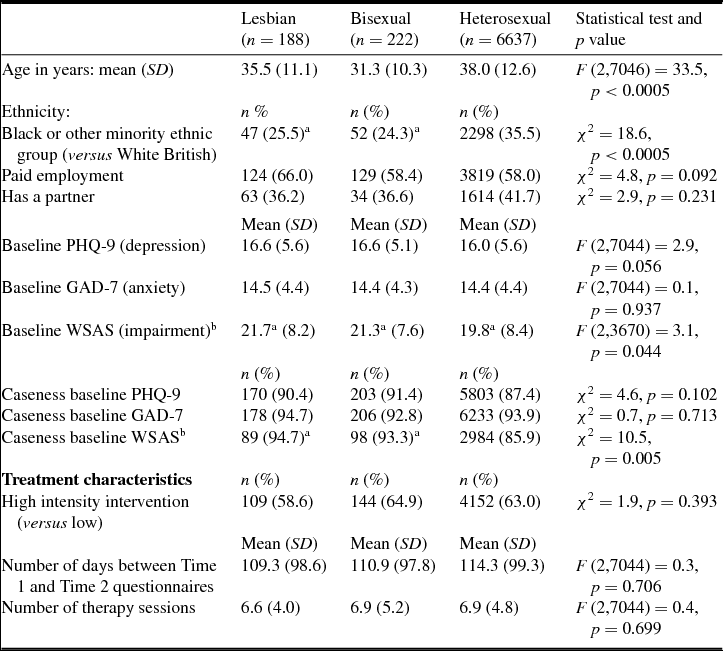
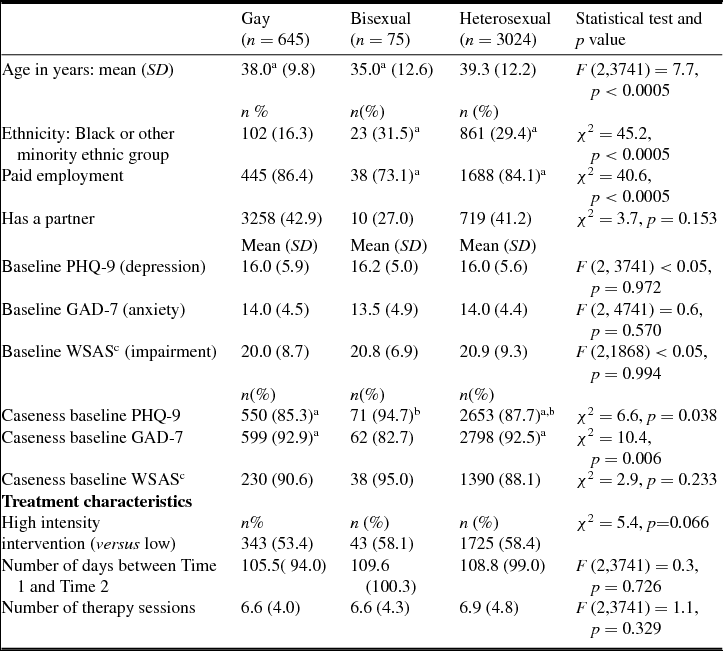
The characteristics of the patients by sexual orientation are shown in Tables 1 and 2.
Sociodemographic, psychological and treatment characteristics of female participants (n = 7047) by sexual orientation

a For analyses where there is a significant group effect, values in the same row that share a superscript are not significantly different from each other, after Bonferroni correction. bSample size for analyses involving WSAS: 94 lesbian, 105 bisexual and 3473 heterosexual women
Sociodemographic, psychological and treatment characteristics of male participants (n = 3744) by sexual orientation

a,b For analyses where there is a significant group effect, values in the same row that share a superscript are not significantly different from each other. cSample sizes for analyses involving the WSAS: 254 gay men, 40 bisexual men, 1577 heterosexual men.
Female patients
Heterosexual female women were significantly older than lesbian women, who in turn were significantly older than bisexual women. A significantly smaller proportion of the sexual minority women reported black or other minority ethnicity compared with the heterosexual women. There were no significant differences regarding employment or partnership status.
There was a significant group difference in the proportion of women who exceeded the cut-off for clinical impairment on the WSAS. Both lesbian and bisexual women were more likely to exceed WSAS cut-off than heterosexual women but did not differ significantly from each other. There was a significant overall group difference in baseline mean WSAS scores although post-hoc chi-square analyses comparing pairs of groups in turn did not indicate significant differences (even for comparisons that were not Bonferroni-adjusted). There were no significant differences in the proportion meeting caseness for anxiety or depression or in mean scores for those measures, although there was a non-significant trend for lower baseline PHQ-9 scores in the heterosexual women.
There were no significant group differences in the proportion who received a high intensity intervention, the number of therapy sessions or in the number of days between first and last session recorded.
Male patients
The heterosexual men were significantly older than the gay and bisexual men. A significantly lower proportion of gay men reported black or other minority ethnicity than heterosexual or bisexual men. Gay men were significantly more likely to be employed than heterosexual or bisexual men. There was no significant group difference in the proportion who had a partner.
There were no significant group differences in baseline scores on the PHQ-9, GAD-7 or WSAS. Bisexual men were more likely to meet PHQ-9 caseness than gay men but not heterosexual men, and the latter two groups did not differ significantly from each other. In contrast, significantly fewer bisexual men met GAD-7 cut-off than heterosexual men, whereas the difference relative to gay men was significant after adjustment for multiple comparisons. There was no significant group difference for the proportion meeting clinical cut-off on the WSAS.
There was no group difference in the proportion who had a high intensity intervention or in the number of days between first and last session or in the number of therapy sessions received.
Changes in depression, anxiety and impairment after treatment
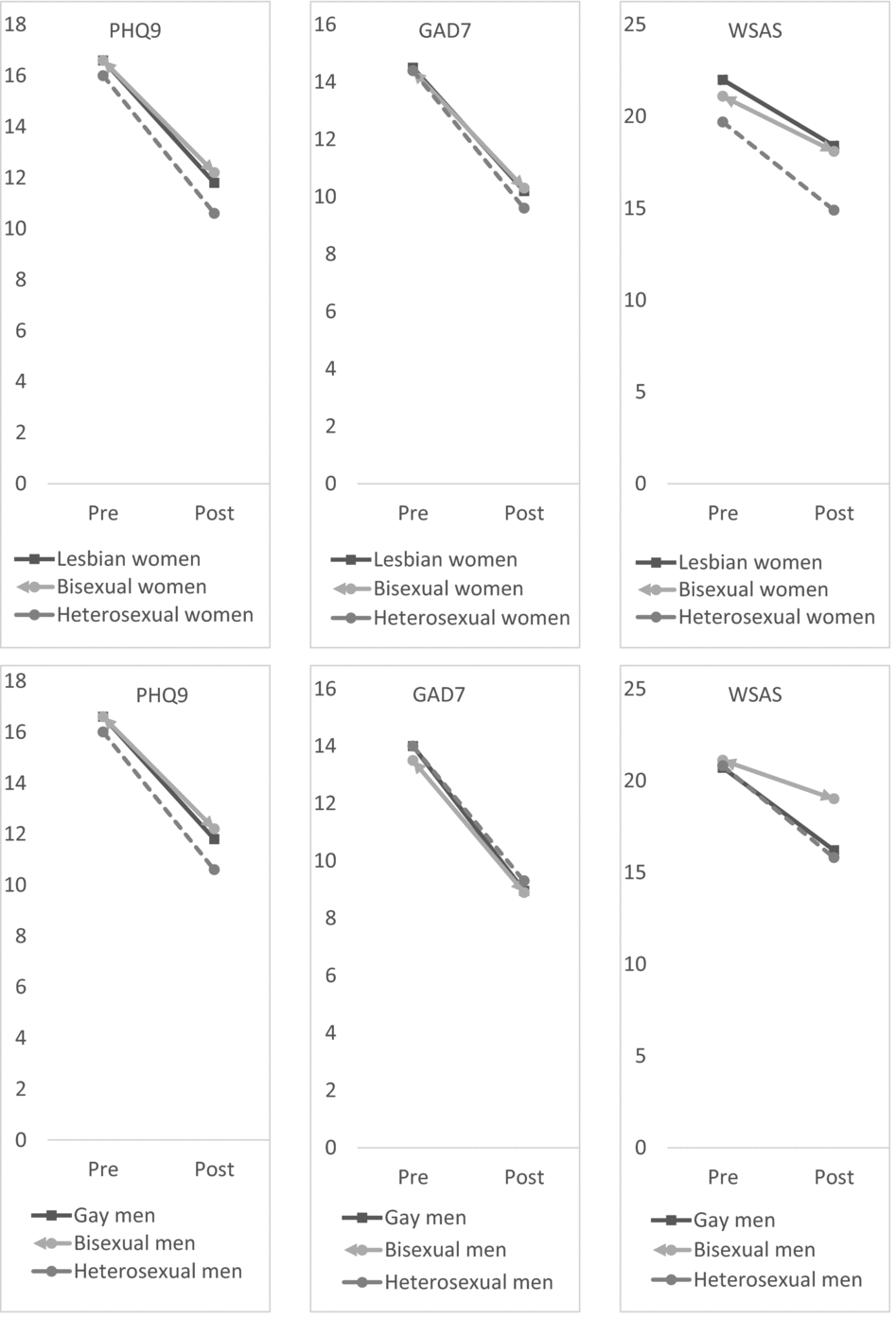
Unadjusted means on the PHQ-9, GAD-7 and WSAS before and after treatment are shown in Fig. 1.
Graphs of unadjusted pre- and post-treatment scores on the PHQ-9 (depression), GAD-7 (anxiety) and WSAS (impairment) for female and male participants, by sexual orientation.
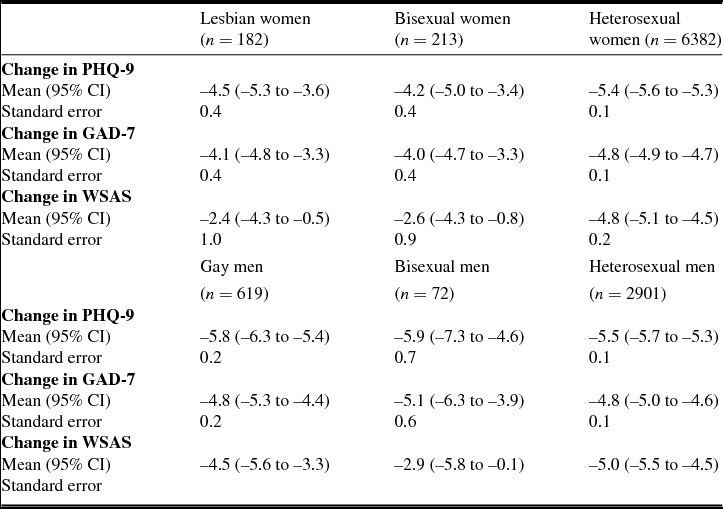
Linear regression analyses were used to investigate whether bisexual or lesbian women's changes in depression, anxiety and impairment outcomes differed significantly from those of heterosexual women. An a priori decision had been taken to control for age, ethnicity, employment status, the intensity of the intervention (high or low), number of therapy sessions and baseline score on the outcome measure. Marginal means for changes in scores on the outcome measures are shown in Table 3, adjusted for the aforementioned variables.
Estimated marginal mean changes in depression, anxiety and functional impairment, adjusted for age, ethnicity, employment status, intervention intensity, number of therapy sessions and baseline outcome measurea

Negative values indicate a reduction from Time 1 to Time 2. aSample sizes for WSAS: 78 lesbian, 93 bisexual, 3013 heterosexual women, 228 gay men, 35 bisexual men, 1366 heterosexual men. PHQ-9 is a measure of depression, GAD-7 is a measure of anxiety and WSAS is a measure of impairment.
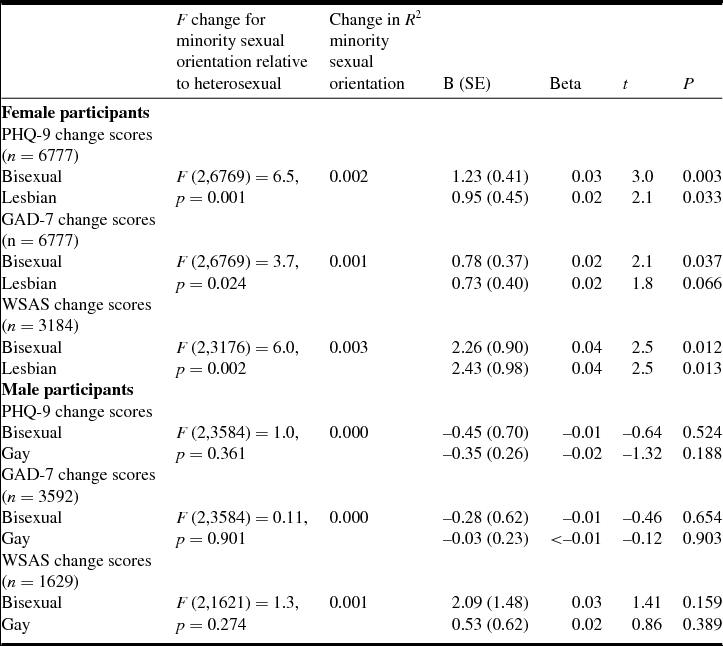
Results of the linear regression analyses indicated that both lesbian and bisexual women showed significantly smaller reductions in PHQ-9 and WSAS scores between Times 1 and 2 than heterosexual women. Bisexual women also showed significantly smaller reductions in GAD-7 scores than heterosexual women; for lesbians there was a non-significant trend in the same direction; see Table 4.
Results of linear regression analysesFootnote a : changes in depression, anxiety and impairment by sexual orientation

a Analyses were adjusted for age, ethnicity, employment status, intensity of intervention (high or low), number of therapy sessions and baseline score on the outcome measure. PHQ-9 is a measure of depression, GAD-7 is a measure of anxiety and WSAS is a measure of impairment
For men, similar linear regression analyses indicated no significant differences between gay men and heterosexual men or between bisexual men and heterosexual men; see Table 4.
Does minority sexual orientation predict failure to recover?
All patients scored above caseness cut-off on the PHQ-9 or GAD-7 at baseline, and were therefore used in the recovery analyses. Failure to recover was found for 122 (64.9%) lesbian women, 167 (75.2%) bisexual women, 4068 (61.3%) heterosexual women, 375 (58.1%) gay men, 48 (64.0%) bisexual men and 1799 (59.5%) heterosexual men. Failure to meet reliable recovery was found for 125 (66.5%) lesbian women, 170 (76.6%) bisexual women and 4209 (63.4%) heterosexual women. For male participants, 396 (61.4%) gay men, 49 (65.3%) bisexual men and 1898 (62.8%) heterosexual men failed to meet reliable recovery.
Logistic regression analyses indicated that after adjustment for confounders, women (n = 6777), bisexual patients were significantly more likely to fail to recover than heterosexual women (beta = 0.63, odds ratio (OR) = 1.88 (95% confidence interval (CI) 1.35–2.60) p < 0.0005); lesbian women were not significantly different from heterosexual women (beta = 0.15, OR = 1.16 (95% CI 0.84–1.61), p = 0.365). Bisexual women were also significantly more likely to fail to meet reliable recovery than heterosexual women (beta = 0.60, OR 1.83 (95% CI 1.32–2.54), p < 0.0005); lesbian women were not significantly different from heterosexual women (beta = 0.14, OR = 1.15 (95% CI 0.83–1.59), p = 0.395).
For men (n = 3592), relative to heterosexuals there was no significant difference in the likelihood of recovery for gay men (beta = –0.11, OR = 0.99 (95% CI 0.82–1.20), p = 0.912) or for bisexual patients (beta = 0.12, OR = 1.13 (95% CI 0.82–1.20), p = 0.912). Similarly, relative to heterosexual men there was no significant difference in the likelihood of reliable recovery for gay men (beta < –0.05, OR = 1.00 (95% CI 0.83–1.20), p = 0.969) or for bisexual men (beta=0.01, OR = 1.00 (95% CI 0.61–1.67), p = 0.957).
Discussion
Lesbian and bisexual women – particularly the latter – showed less benefit from a primary psychological intervention compared with heterosexual women. As far as the authors are aware, this is the first study to compare psychological treatment outcomes across different sexual orientation groups for men and women, adjusting for possible confounders such as age, ethnicity, employment status, intervention type and baseline scores on the outcome measures used.
The impact of previous adverse life experiences and ongoing social disadvantages may both increase risk of psychological illness and reduce the extent to which sexual minority women can benefit from psychological intervention. Sexual minority women experience the compounded burden of greater discrimination, stigma-related experiences and lower social status and power relating to their gender and sexual orientation. These stressors will also interact with psychosocial factors relating to their mental illness, including additional stigma processes. Intersectionality theory and research has highlighted how different social inequalities should be considered together as they interrelate and reinforce each other in complex ways (Robinson and Ross, Reference Robinson and Ross2013). Unfortunately, data were not available for such factors to be examined in this study. However, the finding that lesbian and bisexual women had higher pre-treatment impairment scores than heterosexual women despite no significant differences on depression or anxiety measures would be consistent with additional stressors making it more difficult for sexual minority women to cope. In this study, all the female groups had much higher levels of unemployment than the male groups. Moreover, previous research has established that women are more likely to have experienced child abuse than men (Walker et al., Reference Walker, Carey, Mohr, Stein and Seedat2004) and even higher frequency, severity and persistence of physical and sexual abuse in childhood/adolescence is reported by lesbian and bisexual women relative to heterosexual women (Austin et al., Reference Austin, Jun, Jackson, Spiegelman, Rich-Edwards, Corliss and Wright2008). Previous research in an IAPT service included in the current study found that 67% of patients reported childhood trauma and 55% reported at least one stressful life event in the past year (Hepgul et al., Reference Hepgul, King, Amarasinghe, Breen, Grant, Grey, Hotopf, Moran, Pariante, Tylee, Wingrove, Young and Cleare2016), but these figures were not broken down by gender or sexual orientation. There is evidence that experience of childhood maltreatment is associated with poorer outcomes after treatment for depression in general clinical samples (Nanni et al., Reference Nanni, Uher and Danese2012).
Another possible factor contributing to the poorer therapy outcomes for lesbian and bisexual women in this study is that these women might anticipate or experience discrimination from their therapists. Many previous studies have documented reports of discrimination or negative attitudes towards sexual minorities from health professionals (e.g. King, Reference King2015). Even if discrimination is not experienced, the anticipation could lead to less disclosure about factors relating to one's sexual orientation that might be relevant for the intervention or for feeling understood and safe with their therapist. This may particularly be the case for bisexual women as there is evidence of even more negative societal attitudes towards bisexuality than towards homosexuality (Dodge et al., Reference Dodge, Herbenick, Friedman, Schick, Fu, Bostwick, Bartelt, Munoz-Laboy, Pletta, Reece and Sandfort2016). It is not known whether the sexual minority women in this sample anticipated or experienced more discrimination than the sexual minority men, who did not show significant differences in treatment outcomes to heterosexual men. Future research should examine if sexual minority women experience different treatment from mental health professionals and whether this mediates treatment outcomes. Both quantitative and qualitative research methods are likely to be useful in improving our understanding of reasons for poorer treatment outcomes for sexual minority women.
Gay and bisexual men showed a different pattern of results relative to heterosexuals than the lesbian and bisexual women. At pre-treatment, unlike the women, the sexual minority men showed no difference in daily functional impairment. However, this may have been due to a lower statistical power because of reduced data availability for the WSAS and a smaller number of bisexual men; a similar proportion of bisexual men met WSAS clinical cut-off to the bisexual and lesbian women. As mentioned above, bisexual men were more likely to meet caseness criteria for depression than heterosexual men. However, they were less likely to meet caseness for anxiety than both other groups. Previous research has reported greater psychological problems in bisexual men than gay or heterosexual men in the general population but the authors are not aware of studies comparing psychological characteristics prior to therapy. It is possible that anxiety is more associated with non-access to IAPT therapy services for bisexual men than for gay or heterosexual men, rather than this finding reflecting lower levels of anxiety within bisexual men in the community. This requires further research.
Unlike sexual minority women, there were no significant group differences in reductions in symptoms after therapy for the male patients. The only caveat is that for bisexual men, their mean reduction on the WSAS was closer to that for the lesbian and bisexual women than for the gay or heterosexual men. It is possible that with a larger sample size, bisexual men would have shown a statistically smaller reduction on this scale than the gay and heterosexual men. However, apart from this possible issue, the treatment outcomes are very encouraging for the sexual minority men. Given the robust evidence of elevated rates of psychological problems in gay and bisexual men compared with heterosexual men, it is reassuring to gain this preliminary indication that the treatments provided in primary care psychological therapy services may be as beneficial for sexual minority men as for heterosexual men.
Clinical implications
A greater number of treatment sessions, or modified forms of treatment, may be required to enable sexual minority women to achieve the same symptom reductions as heterosexual women. Of course, social inequities for sexual minorities should be addressed in multiple ways, including at structural levels (Mustanski et al., Reference Mustanski, Birkett, Greene, Hatzenbuehler and Newcomb2014). Yet there will always be minority group processes at work which will put sexual minorities at increased risk of psychological problems, such as feeling different or socially isolated, anticipating rejection, concealment of sexual orientation status and having more difficulty finding partners or having children. Therefore, it is important that psychological interventions address the specific issues faced by sexual minorities to enable them to cope as effectively as possible (British Psychological Society, 2012).
One of the services involved in this study is now evaluating whether a CBT group for lesbian, gay and bisexual individuals can help to address their specific needs. There is preliminary evidence for positive effects of gay affirmative CBT (Pachankis et al., Reference Pachankis, Hatzenbuehler, Rendina, Safren and Parsons2015), but this package was specifically developed for sexual minority young men, not women or adults in general. The possibility of developing interventions specifically for sexual minority women in general, and/or bisexual women in particular, should be considered. Another option would be to provide additional therapist training about working with sexual minorities rather than providing a different form of treatment. Although IAPT therapists would typically receive training in working with sexual minority individuals as part of their core professional training, this is usually quite minimal and there is no requirement for post-qualification training in this area.
The older age and greater proportion of minority ethnicity in the heterosexual patients may reflect more concealment of minority sexual orientation in patients who are older or who are from BME groups, which would be consistent with the finding that patients who did not provide sexual orientation data were also significantly more likely to be BME and were older. It is also possible that older and BME sexual minority individuals are less likely to access help from IAPT services. IAPT access for LGB individuals requires a fine-grained analysis due to the wide variation in proportions of sexual minorities living across different London boroughs and other areas of the country. Specific outreach may be required to facilitate access by sub-groups of the LGB population.
Limitations of the study
It cannot be assumed that these results would generalize to patients who experience same-sex attractions but do not identify as lesbian, gay or bisexual, and/or for whom sexual orientation data is not available. Patients for whom sexual orientation data was recorded as ‘declined’ or ‘not stated’ were different from those included in the present study. They were older, more likely to have a minority ethnicity or be unemployed, more clinically impaired at baseline and showed significantly smaller reductions in anxiety, depression and impairment after treatment. If people who decline to provide sexual orientation data are more likely to be from a minority sexual group then the current findings may underestimate the extent to which sexual minorities experience reduced benefit from therapy compared with heterosexual patients. This is especially concerning because those who conceal their sexual orientation may be those most adversely affected by stigma or discrimination relating to the sexual minority status (Hatzenbuehler, Reference Hatzenbuehler2009).
Furthermore, the differences in treatment outcomes reported here may reflect differences in group characteristics that were not measured or taken account in this study. For example, if there are barriers affecting access to IAPT services for LGB individuals, this might mean that lesbian and bisexual women who do access IAPT are different or have more complex problems, in an unmeasured way, than heterosexual women who do not face the same access issues.
It is not known whether these results would generalize to other IAPT or non-IAPT psychological intervention services. The annual report for IAPT services 2015–2016 (Community and Mental Health Team, Health and Social Care Information Centre, 2017) reported that heterosexual patients had higher recovery rates than gay/lesbian patients who in turn had better recovery rates than bisexual patients, but did not break this down by gender or adjust for potential confounders, so it is not possible to make direct comparisons. A study from two of the London boroughs involved in this study found elevated rates of mental illness compared with a national sample and an even greater discrepancy between non-heterosexual individuals compared with heterosexuals (Woodhead et al., Reference Woodhead, Gazard, Hotopf, Rahman, Rimes and Hatch2016). This is despite the higher proportion of LGB individuals in these boroughs than other parts of the UK, which evidence had suggested might be protective for LGB mental health (Hatzenbuehler et al., Reference Hatzenbuehler, Keyes and McLaughlin2011). One possible reason is that these boroughs have higher proportions of black and other minority ethnic individuals and recent migrants, for whom discrimination contributes to elevated rates of common mental health problems (Hatch et al., Reference Hatch, Gazard, Williams, Frissa, Goodwin and Hotopf2016). The impact of intersecting multiple disadvantaged statuses requires further investigation. Previous research from one of the services in this study also reported a high degree of co-morbidity for the patients in general: 72% of participants had two or more psychiatric diagnoses (Hepgul et al., Reference Hepgul, King, Amarasinghe, Breen, Grant, Grey, Hotopf, Moran, Pariante, Tylee, Wingrove, Young and Cleare2016). In parts of the country with lower rates of mental illness and sexual orientation mental health disparities, better outcomes may be found for the sexual minority women. However, in such areas the therapists are likely to be less experienced in working with these groups, which could affect treatment outcomes.
Conclusions
Lesbian and bisexual women had poorer treatment outcomes than heterosexual women in IAPT services in a large South London NHS mental health trust, after adjustment for possible confounders such as age, ethnicity, employment status, intensity of intervention or pre-treatment levels of symptomatology. Possible reasons for this should be investigated, such as the experiences of the women outside of therapy (e.g. lifetime trauma or stigma and discrimination related to gender or sexual orientation) or anticipated and experienced stigma and discrimination within the therapy service. The specific needs of bisexual women, who had the poorest outcomes, requires further research. Although gay and bisexual men did not show significantly worse treatment outcomes than heterosexual men, for the measure of impairment this may have been due to low statistical power; further research is required with a larger sample to investigate outcomes for bisexual men in particular. Methods for reducing these disparities in treatment outcomes require urgent investigation.
Acknowledgements
We would like to thank Megan Pritchard for CRIS advice, Sheila Ali for research assistance and Oliver Hawthorne for his work on a previous audit.
Financial support: This paper represents independent research part-funded by the National Institute for Health Research (NIHR) Biomedical Research Centre at South London and Maudsley NHS Foundation Trust and King's College London. (That funding supports the Clinical Record Interactive Search; there was so specific grant funding for this project.) The views expressed are those of the authors and not necessarily those of the NHS, the NIHR or the Department of Health.
Conflicts of interest: Katharine Rimes, Matthew Broadbent, Rachel Holden, Qazi Rahman, David Hambrook, Stephani Hatch and Janet Wingrove have no conflicts of interest with respect to this publication.
Ethical statement: All authors have abided by the Ethical Principles of Psychologists and Code of Conduct as set out by the APA. The study received approval as an audit from South London and Maudsley NHS Foundation Trust and was approved by the CRIS Oversight Committee.




Comments
No Comments have been published for this article.