

Introduction
Organic dairies have to meet specific requirements for their certification, and the use of conventional treatments (i.e. antimicrobial) is very limited and discouraged. Additionally, food- producing animal industries in many countries, including conventional dairy production, are aiming at reducing the use of antimicrobials for preventing diseases. Consequently, both organic and conventional dairy producers are looking for alternatives to antimicrobial therapy. At drying-off, for instance, in many conventional dairies, all quarters of all cows are infused with an antimicrobial (Aghamohammadi et al., Reference Aghamohammadi, Haine, Kelton, Barkema, Hogeveen, Keefe and Dufour2018). This practice is used for treating existing intramammary infections (IMIs) and for preventing acquisition of new IMIs, which have been shown to be very frequent at beginning and end of the dry period and can result in clinical mastitis (CM) during the subsequent lactation (Bradley and Green, Reference Bradley and Green2000; Bradley and Green, Reference Bradley and Green2004). The increase in IMI incidence at beginning of the dry period is partly due to cessation of milking, physiological changes related to mammary gland involution, and the delay before formation of a keratin plug. On the other hand, increased in IMI incidence in the last few weeks prior to calving may be caused by a certain level of immunosuppression, perhaps exacerbated by the hormonal changes occurring during that period. Antimicrobial treatment of all quarters at drying-off is, therefore, still considered a cornerstone of mastitis control plans in conventional dairies in many countries (Dufour et al., Reference Dufour, Frechette, Barkema, Mussell and Scholl2011). Treating at drying-off presents many advantages: better curative effectiveness of antibiotics, and, because cows are not milked anymore, no immediate milk withdrawal and a lower risk of antimicrobial residues in milk. Consequently, a large proportion of the antimicrobials used in dairies are used for dry cow treatment (Saini et al., Reference Saini, Mcclure, Leger, Dufour, Sheldon, Scholl and Barkema2012). The median costs for these dry cow treatments have recently been evaluated at 18 CAD per cow per year in Canadian dairies (Aghamohammadi et al., Reference Aghamohammadi, Haine, Kelton, Barkema, Hogeveen, Keefe and Dufour2018).
Another approach that may be of interest for conventional dairies is selective dry-off treatment. In such cases, a diagnostic test (e.g. historical somatic cell count and CM cases, milk bacteriological culture) is used to differentiate cows (or quarters) that need to be treated (i.e. infected cows) from healthy cows, and only infected cows get treated with antibiotics, while solely an internal teat sealant (ITS) is used for healthy cows. Such an approach can reduce significantly the amount of antibiotics used at drying-off in dairies (Cameron et al., Reference Cameron, Mckenna, Macdonald, Dohoo, Roy and Keefe2014; Scherpenzeel et al., Reference Scherpenzeel, Den Uijl, Van Schaik, Riekerink, Hogeveen and Lam2016). This strategy would, however, be inaccessible for organic dairies where prophylactic use of antibiotics is prohibited.
Another option that would be allowed for both organic and conventional producers is the use of a strictly non-antimicrobial approach at dry-off. For instance, many homeopathic and botanical products, as well as some immunomodulators, have been studied and some are already used in commercial dairies for mastitis treatment and prevention. However, the recommendations frequently conveyed in the dairy organic sector on the efficacy of some of these alternative approaches remain questionable and do not appear to be supported by rigorous studies (Francoz et al., Reference Francoz, Wellemans, Dupre, Roy, Labelle, Lacasse and Dufour2017).
Another non-antimicrobial approach that could be considered for dry-off treatment is the use of an ITS alone, without concurrent administration of an antimicrobial. Such an approach would be acceptable both for organic and conventional dairy producers. An ITS creates a physical barrier blocking the teat canal and would, therefore, help prevent acquisition of new IMIs during the dry period. We would not expect, however, that an ITS would have any impact on IMI already present at drying-off. The efficacy of ITS to prevent new IMI and CM in the subsequent lactation has been reviewed by Halasa et al. (Reference Halasa, Osteras, Hogeveen, Van Werven and Nielen2009) and, more recently by Rabiee and Lean (Reference Rabiee and Lean2013). In these two studies, meta-analyses were conducted to summarize the effect of administering and ITS on prevention of new IMI (both studies) and, in the Rabiee and Lean (Reference Rabiee and Lean2013) study only, on CM incidence in the subsequent lactation. These meta-analyses reported a lower risk of IMI acquisition and of CM in quarters receiving an ITS. In both studies, however, both ITS-treated and ITS + antimicrobial-treated quarters were collapsed together into the ITS-treated quarter category. Thus, these results cannot be used to summarize the efficacy of using an ITS alone without any antimicrobial for preventing IMI during the dry period.
The objective of the current study was to use a systematic review methodology to describe and appraise efficacy of the various non-antimicrobial strategies that can be used at dry-off to treat existing IMIs, prevent IMI acquisition during the dry period, and prevent CM in the subsequent lactation. The protocol for this review was previously published (Francoz et al., Reference Francoz, Wellemans, Dupre, Roy, Labelle, Lacasse and Dufour2016). This first result article focuses on non-antimicrobial ITS-based approaches at drying-off for treating and preventing IMI.
The PICO (population, intervention, comparator, outcome) question answered by the current article can be formulated as: When compared with intramammary infusion of antimicrobial and/or with no treatment (i.e. the comparators), are non-antimicrobial ITS-based approaches (i.e. the interventions) efficient for preventing IMI acquisition during the dry period, reducing IMI prevalence at calving, and reducing CM incidence early in the subsequent lactation (i.e. the outcomes) in dairy cows (i.e. the population)?
Materials and methods
The protocol for this review was accepted for publication prior to initiating the review and is fully described in Francoz et al. (Reference Francoz, Wellemans, Roy, Lacasse, Ordonez-Iturriaga, Labelle and Dufour2016). The search strategies described in the previously published protocol were all conducted on the same day (18th May 2016) for the two databases (CAB Abstract and PubMed), and the search platform (Web of Science). Modifications performed with justifications and further detailing of the protocol are described in the following sections.
Amendments
A modification to the protocol was performed regarding the reporting of the review. When appraising the literature included in the systematic review, it became obvious that non-antimicrobial approaches at drying-off could be divided into two large groups, ITS-based approaches and other non-antimicrobial approaches. Moreover, the literature on ITS-based approaches was substantial and reported in a manner that was sufficient for conducting a number of meta-analyses on these approaches, while the other non-antimicrobial approaches could only be discussed qualitatively. It was, therefore, decided to separate the reporting of the review in two parts: part (1) non-antimicrobial ITS-based approaches at drying-off for treating and preventing IMI, a systematic review and meta-analysis (the current paper); and part (2) non-antimicrobial approaches, other than ITSs, used at drying-off for treating and preventing IMI, a systematic review and qualitative analysis.
Information sources
Selection process
An important step regarding assessment of full texts for inclusion was not described in the previously published protocol. In some cases, some critical information for deciding on inclusion of a manuscript was not provided in the manuscript. For instance, whether cows or quarters were simultaneously treated with an antimicrobial in the ITS treatment group versus treated with an ITS alone, was not always mentioned. In such cases, the authors were contacted (twice at a 15-day interval) to gather the missing information. If an answer could not be obtained within 1 month of the last attempt, the manuscript was excluded.
Data collection process
Compared with the published protocol, rather than using Excel sheets and RevMan 5.3 for extracting data and for assessment of risk of bias, a single Access (Microsoft) database was created with data entry and risk of bias forms. Members of the research team were trained to use these forms. Moreover, as reporting of IMI varied from one manuscript to another (e.g. by species, major versus minor, all bacterial species grouped together), results obtained for all pathogens combined were retained for analyses. If these data could not be extracted, then results for major pathogens were considered. Finally, all included studies were controlled trials (randomized or not), therefore, only the Cochrane Collaboration's tool for assessing risk of bias was used for assessing risk of bias in selected studies (Cochrane Handbook for Systematic Reviews of Interventions, version 5.1.0).
Data synthesis and meta-bias
In the original published protocol, we suggested that meta-analyses would be conducted if a ‘substantial’ number of trials were available for a given comparison. More specifically, we actually computed summary measures using meta-analyses whenever three or more trials were available for a given comparison. Moreover, the original protocol mentioned using either a fixed or random effect model for the meta-analyses. Given the high heterogeneity between studies, random effect models were used. For a fixed effect model, we make the assumption that there is one true risk ratio (RR) that is shared by all included studies. Using a random effect model, on the other hand, we allow that the true RR could vary from study to study (e.g. due to regional, chronological, or methodological study's characteristics). Random effect models are, therefore, more appropriate when an important heterogeneity is noted between studies (highlighted by a high value of the I 2 statistic) and will usually give more conservative confidence intervals (CIs).
Confidence in cumulative estimates
In the published protocol, we proposed to appraise the quality of evidence for each comparison made using the Grading of Recommendations Assessment, Development, and Evaluation (GRADE) working group methodology (Guyatt et al., Reference Guyatt, Oxman, Akl, Kunz, Vist, Brozek, Norris, Falck-Ytter, Glasziou, Debeer, Jaeschke, Rind, Meerpohl, Dahm and J2011a). The GRADE approach involves rating, for each comparison made, the confidence in effect estimate based on an assessment of eight domains: number of trials, risk of bias (Guyatt et al., Reference Guyatt, Oxman, Vist, Kunz, Brozek, Alonso-Coello, Montori, Akl, Djulbegovic, Falck-Ytter, Norris, Williams, Atkins, Meerpohl and Schunemann2011f), inconsistency (Guyatt et al., Reference Guyatt, Oxman, Kunz, Woodcock, Brozek, Helfand, Alonso-Coello, Glasziou, Jaeschke, Akl, Norris, Vist, Dahm, Shukla, Higgins, Falck-Ytter, Schunemann and Group2011d), indirectness (Guyatt et al., Reference Guyatt, Oxman, Kunz, Woodcock, Brozek, Helfand, Alonso-Coello, Falck-Ytter, Jaeschke, Vist, Akl, Post, Norris, Meerpohl, Shukla, Nasser, Schunemann and Group2011c), imprecision (Guyatt et al., Reference Guyatt, Oxman, Kunz, Brozek, Alonso-Coello, Rind, Devereaux, Montori, Freyschuss, Vist, Jaeschke, Williams, Murad, Sinclair, Falck-Ytter, Meerpohl, Whittington, Thorlund, Andrews and Schunemann2011b), publication bias (Guyatt et al., Reference Guyatt, Oxman, Montori, Vist, Kunz, Brozek, Alonso-Coello, Djulbegovic, Atkins, Falck-Ytter, Williams, Meerpohl, Norris, Akl and Schunemann2011e), number of individuals (in our case quarters or cows) followed, and a summary measure of association with 95% CI. Then, a general decision is made regarding the level of confidence in the summary effect estimate observed. However, for most domains investigated, the GRADE statement does not suggest specific guidelines for rating these different domains. In the current review, three co-authors (S.D., V.W., and D.F.) rated each domain independently. For the risk of bias domain, we rated comparisons according to Guyatt et al. (Reference Guyatt, Oxman, Vist, Kunz, Brozek, Alonso-Coello, Montori, Akl, Djulbegovic, Falck-Ytter, Norris, Williams, Atkins, Meerpohl and Schunemann2011f) as: no serious limitations (most information is from trials at low risk of bias); serious limitations (most information is from trials at moderate risk of bias); or very serious limitations (most information is from trials at high risk of bias). For the inconsistency domain, we visually appraised, using forest plot, whether a uni-, bi-, or multi-modal distribution of point estimates was observed across trials and rated these, respectively, as no serious, serious, and very serious limitations. Regarding the indirectness domain, we computed independently the proportion of trials for which the investigated population, intervention, and outcome matched those of interest, and an equal weight was given to these three sub-domains. Comparisons with a score ⩾66%, between 65 and 33%, and of ⩽33% for that domain were then rated as no serious, serious, and very serious limitations, respectively. For instance, with nine trials reporting on a given comparison, if four trials (4/9) investigated the effect of administering an ITS to healthy cows only (versus all cows irrespective of their udder health status), but all investigated a typical ITS intervention (9/9), and all reported on an outcome defined with a very acceptable case definition (9/9), a score of 23/27 (85.2%) would be computed, and this comparison would be rated as no serious limitation for the indirectness domain. The imprecision and publication bias domains were rated only for comparisons for which a summary measure was computed (i.e. for comparisons with at least three trials). Briefly, the difference between the natural logarithm of the higher and lower bounds of the summary RR was computed. Comparisons with CI bounds differences ⩽1.1 on the logarithmic scale (equivalent to an RR interval of 1.0–3.0 points), between 1.1 and 1.6 (equivalent to an RR interval of 3.0–5.0 points), and ⩾1.6 (equivalent to an RR interval of ⩾5.0 points) were rated, respectively, as no serious, serious, and very serious limitations. Finally, for the publication bias domains, we considered and gave equal weight to the generated funnel plots and to proportion of trials that were industry sponsored. For funnel plots, we considered whether a publication bias was likely to be present, the direction of that bias, and whether statistical significance would be modified by the bias (e.g. a 95% CI containing the null value after adjustment for publication bias versus not containing the null value before adjustment). For instance, a funnel plot indicating a small bias toward the null value with no change in statistical significance, and with a minority of information coming from industry sponsored trials would still be rated as no serious limitations, even though a publication bias could not be excluded. When appraising overall quality of the evidence for a given comparison, comparisons for which less than three trials were available were automatically downgraded by two points. Then, the scores obtained for the other domains were appraised globally to further rate our confidence in the cumulative estimate.
Results
Search results
Results of steps involved in identifying relevant literature are presented in Fig. 1. Briefly, after removing duplicates, 2062 records were identified from the search conducted on Cab Abstracts, Web of Science, and Medline. After reviewing the content of the abstracts, 409 records were selected for further evaluation. Of these, 104 had to be excluded due to language restriction (n = 95) or because the abstract was not associated with any full text article (n = 9). Of the remaining 305 full texts evaluated, 25 met the inclusion criteria. Two additional full texts were included after screening of references of included articles, leading to a total of 27 full texts included in the systematic review. Of these, 16 full texts investigated 18 ITS-based approaches at drying-off and were included in the analyses conducted for the current manuscript. Eleven full texts investigated non-ITS-based approaches and these will be discussed in a separate article. Within the ITS manuscripts, one author (Mullen et al., Reference Mullen, Anderson and Washburn2014) was contacted and provided precisions on the ITS treatment investigated (formulation, dosage, and frequency of administration). The list of all the abstracts evaluated (database and reference search) can be found in Appendix (Suppplementary Materials).
Result of the different steps for identifying the relevant literature in a systematic review and meta-analysis of the literature on the effect of ITSs for controlling IMI and CM in dairy cows.

Included studies
Characteristics of included studies are described in Table 1. The selection criteria used in each study for recruiting herds, cows, and quarters, along with the description of the ITS and control group treatment regimens used are provided as Supplementary materials (Table S1). The comparators and outcomes studied are described in Table 2. Briefly, all trials included were controlled trials although only half of them clearly reported a randomization process and could, therefore, be considered randomized controlled trials. In most studies, a minimal level of udder health was specified to recruit cows and/or quarters. Only four studies (Elecko et al., Reference Elecko, Federic and Vrtiak1985; Schaeren and Maurer, Reference Schaeren and Maurer2005; Bhutto et al., Reference Bhutto, Murray and Woldehiwet2011; Mullen et al., Reference Mullen, Anderson and Washburn2014) had not reported specific herd, cow, or quarter udder health-based selection criteria and, thus, appeared to have conducted their trial on infected and uninfected cows or quarters altogether.
Principal characteristics of 18 trials from 16 manuscripts included in a systematic review of ITS-based approaches without use of antimicrobials for drying-off dairy cows
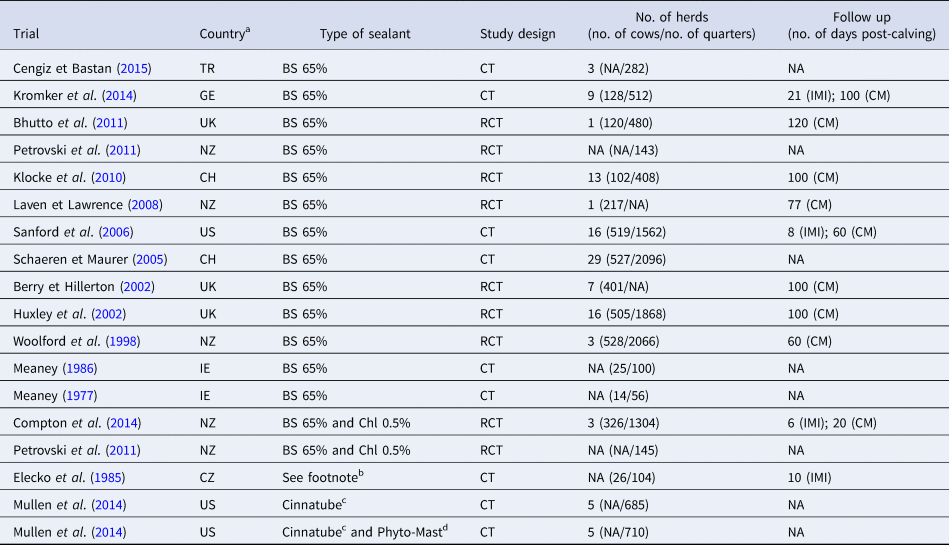
BS, bismuth subnitrate; CT, controlled trial; NA, not available; IMI, follow-up period for intramammary infections; CM, follow-up period for clinical mastitis; RCT, randomized controlled trial, Chl, chlorhexidine.
a Two-letter country codes from the International Organization for Standardization.
b A synthetic internal test sealant made of methylcellulose cetyl alcohol liquid paraffin glycerine, methylparabenum, and methylrosanilinium chloratum (exact ratio unrevealed).
c Cinnatube is composed of beeswax and oils from olive, tea tree, calendula, cinnamon, and eucalyptus (exact ratio unrevealed).
d Phyto-Mast is composed of essential oils from Thymus vulgaris (thyme), Gaultheria procumbens (wintergreen), Glycyrrhiza uralensis (Chinese licorice), A. sinensis, and A. dahurica (exact ratio unrevealed).
Type of teat sealant, outcomes studied, and comparison groups (−: untreated; +: conventional dry cow antimicrobial) of 18 trials from 16 manuscripts included in a systematic review of ITS-based approaches without use of antimicrobials for drying-off dairy cows

IMI, intramammary infections; CM, clinical mastitis; DIM, days in milk; plac, placebo; antb, antimicrobial; BS, bismuth subnitrate; Chl, chlorhexidine.
a In Huxley et al. (Reference Huxley, Green, Green and Bradley2002), IMI incidence was reported separately for major and minor IMI. Only the results for major IMI were included in the meta-analysis.
b A synthetic internal test sealant made of methylcellulose cetyl alcohol liquid paraffin glycerine, methylparabenum, and methylrosanilinium chloratum (exact ratio unrevealed).
c Cinnatube is composed of beeswax and oils from olive, tea tree, calendula, cinnamon, and eucalyptus (exact ratio unrevealed).
d In the Mullen et al. (Reference Mullen, Anderson and Washburn2014) study, the positive control group consisted of quarters receiving an antibiotic and a bismuth subnitrate ITS.
e Phyto-Mast is composed of essential oils from T. vulgaris (thyme), G. procumbens (wintergreen), G. uralensis (Chinese licorice), Angelica sinensis, and Angelica dahurica (exact ratio unrevealed).
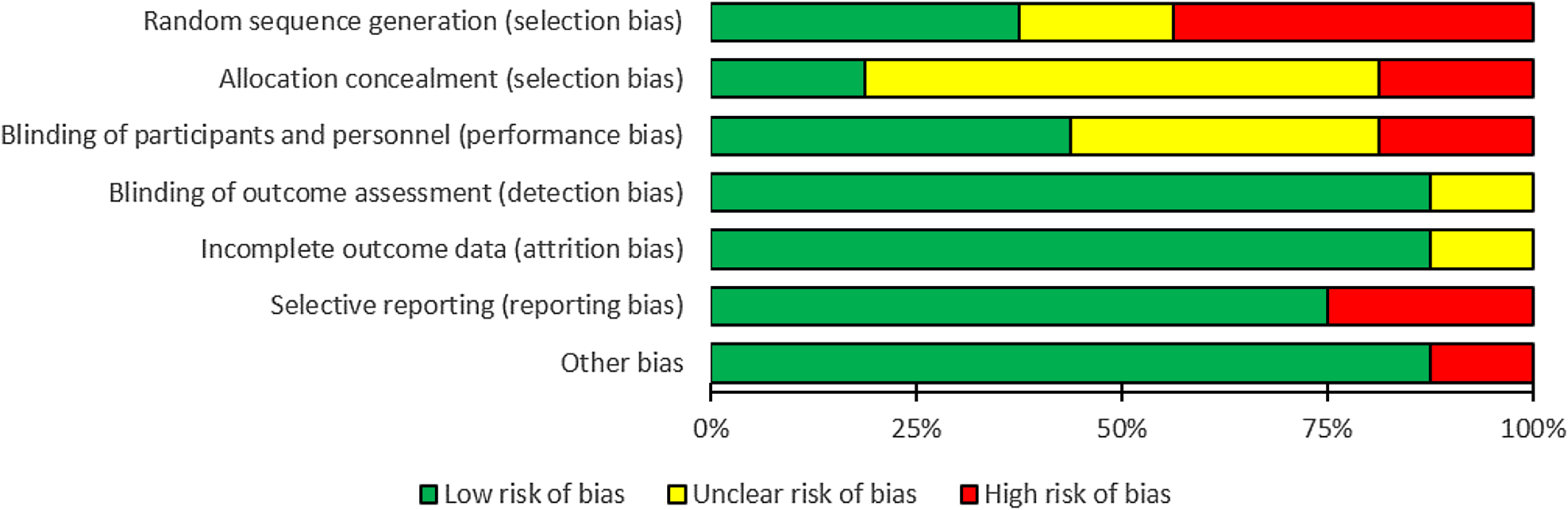
Risk of biases in included studies
The risk of bias for each individual study is reported as Supplementary materials (Fig. S1). Figure 2 summarizes the proportion of studies with a given risk of bias. Briefly, the most problematic items were random sequence generation, allocation concealment, and blinding of participants and personnel. Six studies used a systematic or non-randomized allocation process (Meaney, Reference Meaney1977; Meaney, Reference Meaney and O'Shea1986; Schaeren and Maurer, Reference Schaeren and Maurer2005; Sanford et al., Reference Sanford, Keefe, Dohoo, Leslie, Dingwell, Descoteaux and Barkema2006; Kromker et al., Reference Kromker, Grabowski and Friedrich2014; Mullen et al., Reference Mullen, Anderson and Washburn2014), and three other studies did not report on the randomization process in sufficient details for assessing potential bias (Elecko et al., Reference Elecko, Federic and Vrtiak1985; Woolford et al., Reference Woolford, Williamson, Day and Copeman1998; Bhutto et al., Reference Bhutto, Murray and Woldehiwet2011). In most studies, risk of bias due to the lack of allocation concealment could not be appraised because the method of concealment was not described at all. Similarly, blinding of participants and personnel was not mentioned in many studies.
Proportion of studies with a given risk of bias among 16 manuscripts included in a systematic review of ITS-based approaches without use of antimicrobials for drying-off dairy cows.
Meta-analyses on the effect of internal teat sealants without antimicrobials on udder health
A total of 18 trials investigated the use of an ITS without any antimicrobials at drying-off. Briefly, 13 trials evaluated a bismuth subnitrate (65%) ITS preparation, two trials evaluated a bismuth subnitrate (65%) and chlorhexidine (0.5%) ITS, two trials evaluated a beeswax and essential oil combination ITS (Cinnatube) with (n = 1) or without (n = 1) an additional essential oil treatment (Phyto-Mast), and one trial evaluated a methylcellulose cetyl alcohol liquid paraffin glycerine-based ITS (Table 2).
The I 2 statistic describes the variation across studies that is due to heterogeneity rather than sampling error. A rough guide for the interpretation of I 2 statistic is: 0–40%, might not be important; 30–60%, may represent moderate heterogeneity; 50–90%: may represent substantial heterogeneity; 75–100%: considerable heterogeneity (Cochrane Handbook for Systematic Reviews of Interventions, version 5.1.0). In all the meta-analyses conducted, and before conducting any meta-regression, moderate to substantial heterogeneity was observed with I 2 ranging from 51 (for studies reporting CM incidence between ITS-treated and untreated cows) to 89% (for studies reporting on IMI prevalence at calving between ITS- and antimicrobial-treated quarters), thus supporting our choice of using a random effect model (Francoz et al., Reference Francoz, Wellemans, Dupre, Roy, Labelle, Lacasse and Dufour2017). The most important study characteristics hypothesized to act as source of heterogeneity and tested in meta-regression were: (1) the type of ITS under investigation; (2) whether quarters or cows were naturally infected or challenged; (3) whether a random treatment allocation was used; and (4) whether cows or quarters included in the study had to meet a minimal udder health status at drying-off (e.g. SCC lower than a given threshold, negative on milk bacteriological culture) or not.
Effects of an internal teat sealant on IMI incidence over the dry period
In 12 studies, IMI incidence during the dry period (i.e. new IMI acquisition determined using one or many pre-dry milk samples and one or many post-calving milk samples) was investigated and compared with untreated quarters (n = 9) and/or to quarters treated with a conventional dry cow treatment antimicrobial (n = 7; Table 2). Incidence over the dry period was always reported at the quarter level. One study (Huxley et al., Reference Huxley, Green, Green and Bradley2002) reported major and minor IMI incidences separately and without sufficient details to compute an overall IMI incidence. For that latter study, only the major IMI incidence data were kept for the meta-analysis.
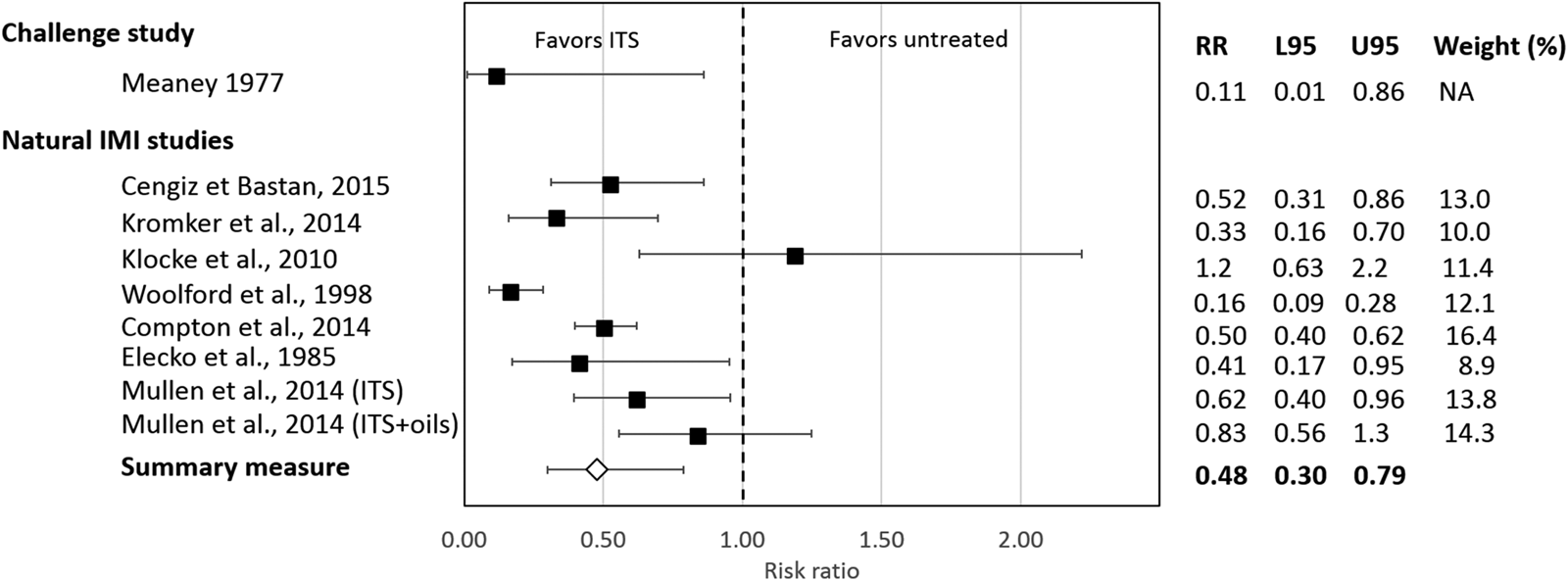
When comparing IMI incidence over the dry period in ITS-treated and untreated quarters, the only study characteristic significantly associated with the treatment effect was whether the study used a bacterial challenge to increase risk of IMI (one trial; Meaney, Reference Meaney1977) or just considered naturally acquired IMI (n = 8 trials). Figure 3 presents the RR comparing risk of acquiring a new IMI over the dry period between ITS-treated and untreated quarters for each trial, as well as a summary RR for studies monitoring natural IMI. Overall, in studies monitoring naturally occurring IMI, we observed that ITS-treated quarters had 0.48 times (95% CI: 0.30, 0.79) the risk of acquiring a new IMI over the dry period compared with untreated quarters.
RR comparing risk of acquiring a new IMI over the dry period between ITS-treated and untreated quarters for one study using a challenge to increase new IMI risk and eight studies monitoring naturally acquired IMI. A summary RR is presented for studies monitoring natural IMI.
When comparing IMI incidence over the dry period in ITS-treated quarters to quarters treated with a conventional dry cow treatment antimicrobial, the type of ITS used (beeswax- versus bismuth subnitrate-based) was associated with the treatment effect. The two trials using beeswax-based ITSs, however, were also the only two trials recruiting cows and quarters without regards to their prior udder health status (compared with selecting only cows or quarters with a minimal pre-defined udder health status). Thus, we could not disentangle the ‘type of ITS effect’ from the ‘selection of studied animals effect’. Furthermore, in the two trials using beeswax-based ITSs, the positive control group was composed of quarters receiving an antibiotic and a bismuth subnitrate-based ITS. Thus, in these trials, both treated and positive control groups were infused with ITS, although the type of ITS did differ. Figure 4 presents the RR comparing the risk of acquiring a new IMI over the dry period between ITS-treated and antimicrobial-treated quarters for each trial, as well as a summary RR for trials using bismuth subnitrate-based ITS and selecting cows with a minimal udder health status. In these latter studies, we observed that ITS-treated quarters had 0.77 times (95% CI: 0.66, 0.90) the risk of acquiring a new IMI over the dry period compared with quarters treated strictly with a conventional antimicrobial.
RR comparing risk of acquiring a new IMI over the dry period between ITS-treated quarters and quarters treated with a conventional dry cow antimicrobial for: (1) two studies evaluating a beeswax-based ITS and not using an udder health status selection criterion for recruiting quarters; and (2) five studies evaluating a bismuth subnitrate-based ITS and conducted on quarters selected for their good udder health status. A summary measure (RR) is reported for that latter category of studies. Note that the positive control groups in the Mullen et al. (Reference Mullen, Anderson and Washburn2014) trials received an antibiotic and a bismuth subnitrate-based ITS (versus an antibiotic only).

Effects of an internal teat sealant on IMI prevalence at calving
In 10 studies, IMI prevalence at calving (determined using only post-calving milk samples) was investigated and compared with untreated quarters (n = 9) and/or to quarters treated with a conventional dry cow treatment antimicrobial (n = 4; Table 2). Prevalence of IMI at calving was always reported at the quarter level.
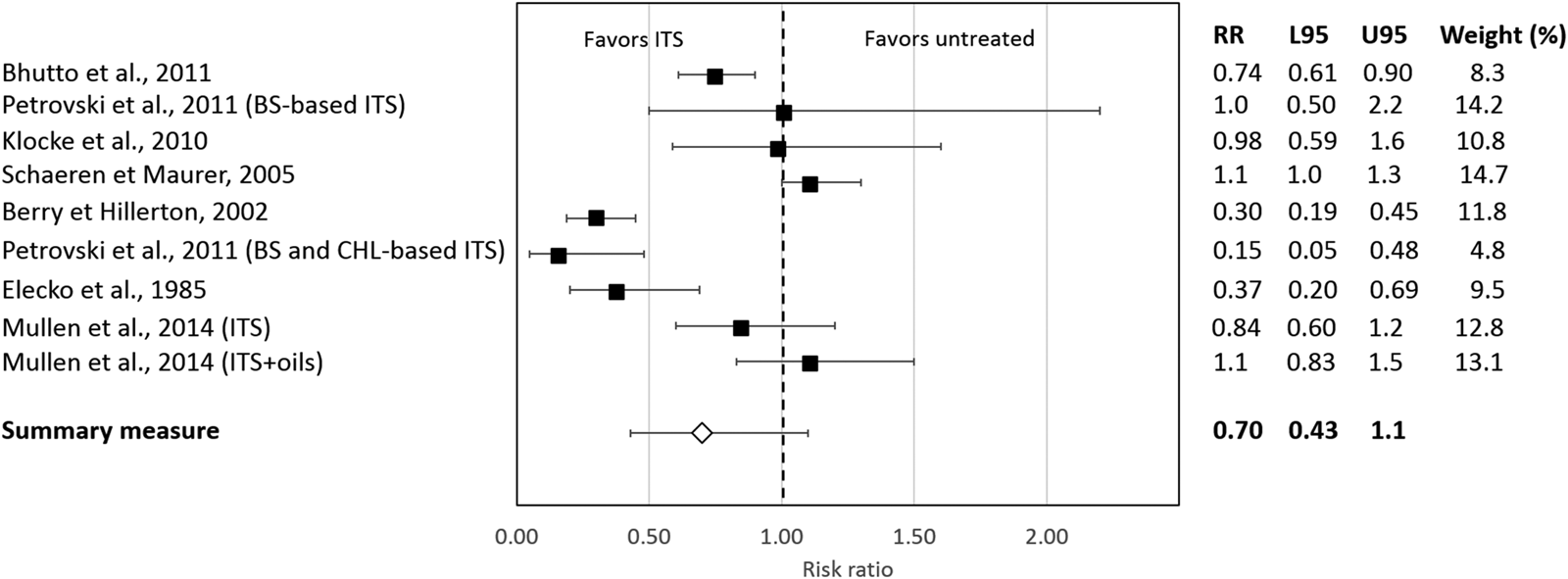
When comparing IMI prevalence at calving in ITS-treated and untreated quarters, none of the study characteristics investigated were associated with the treatment effect. Figure 5 presents the RR comparing risk of IMI at calving between ITS-treated and untreated quarters for each study, as well as a summary RR. Overall, we observed that ITS-treated quarters had 0.70 times (95% CI: 0.43, 1.1) the risk of harboring an IMI at calving compared with untreated quarters.
RR comparing risk of harboring an IMI at calving between ITS-treated and untreated quarters for nine studies along with summary RR.
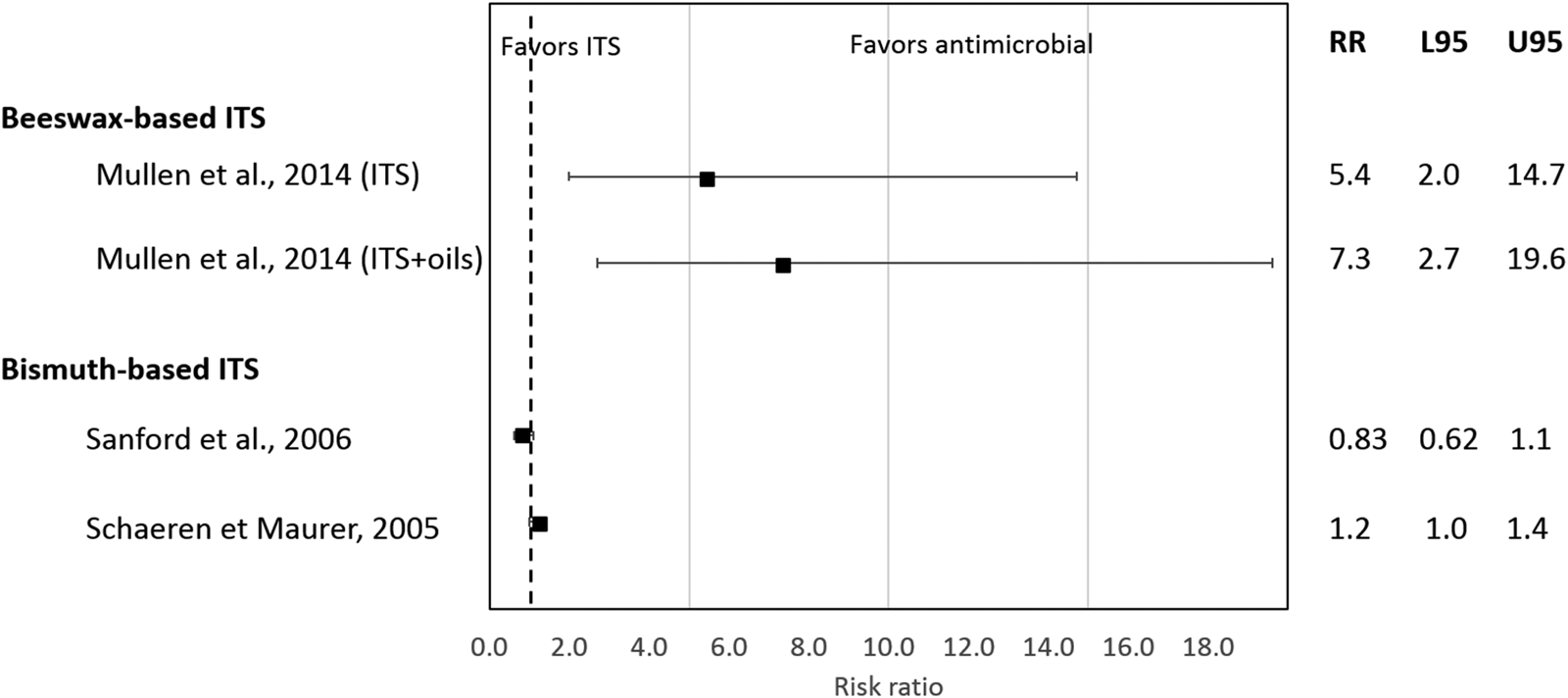
When comparing IMI prevalence at calving in ITS-treated to quarters treated with a conventional dry cow treatment antimicrobial, the type of ITS used (beeswax- versus bismuth subnitrate-based) was associated with the treatment effect. Figure 6 presents the RR comparing risk of IMI at calving between ITS-treated and antimicrobial-treated quarters for each trial. Given the low number of trials in each group, summary RR measures were not computed.
RR comparing risk of harboring an IMI at calving between ITS-treated and quarters treated with a conventional dry cow treatment antimicrobial. Note that the positive control groups in the Mullen et al. (Reference Mullen, Anderson and Washburn2014) trials received an antibiotic and a bismuth subnitrate-based ITS (versus an antibiotic only).
Effects of an internal teat sealant on clinical mastitis incidence in the early lactation
Incidence of CM early in the following lactation was investigated in eight trials (Table 2). Seven of them compared CM incidence in ITS-treated cows with untreated cows. In two studies, CM incidence was compared between ITS-treated cows and cows treated with a conventional dry cow treatment antimicrobial (Table 2). In one trial, using a split-udder experimental design (Compton et al., Reference Compton, Emslie and Mcdougall2014), CM incidence was reported by quarters, in all other trials investigating CM incidence, cow-level data were reported and the cow was, therefore, used as statistical unit. Results from the Compton et al. (Reference Compton, Emslie and Mcdougall2014) study were, therefore, not directly compared with those presenting cow-level data or used to compute a summary RR estimate.
When comparing CM incidence post-calving in ITS-treated and untreated cows, none of the study characteristics investigated were associated with the treatment effect. Figure 7 presents the RR comparing risk of CM post-calving between ITS-treated and untreated cows for each trial, as well as a summary RR. Overall, we observed that ITS-treated cows had 0.49 times (95% CI: 0.24, 1.0) the risk of experiencing CM in the early lactation compared with untreated cows. In the Compton et al. (Reference Compton, Emslie and Mcdougall2014) study presenting quarter-level CM risk, an RR of 0.61 (95% CI: 0.35, 1.1) was observed between ITS-treated and untreated quarters.
RR comparing risk of CM in the first 90 days in milk between ITS-treated and untreated quarters for seven studies along with summary RR.

Only two studies compared the risk of CM in ITS-treated cows and cows treated with a conventional antimicrobial treatment. In Huxley et al. (Reference Huxley, Green, Green and Bradley2002) an RR of 0.82 (95% CI: 0.50, 1.4) was observed between ITS-treated cows and cows treated with a conventional antimicrobial treatment. In Woolford et al. (Reference Woolford, Williamson, Day and Copeman1998) the RR was 0.60 (95% CI: 0.22, 1.6). Given the low number of studies comparing risk of CM in ITS-treated cows and cows treated with a conventional antimicrobial treatment, a summary RR was not computed.
Publication bias
Funnel plots for each comparison for which a summary RR could be computed are presented in Fig. S2. The limited number of trials available for each comparison limited our ability to clearly exclude any publication bias. In general, however, the potential publication bias always appeared to be of small magnitude and had no effect on statistical significance.
Summary of evidence
Table 3 presents a GRADE evidence profile for the different comparisons investigated. We concluded on a high level of evidence regarding the higher efficacy of ITS (any type) when compared with no treatment for preventing IMI acquisition during the dry period. We also concluded on the moderate level of evidence regarding the higher efficacy of bismuth subnitrate-based ITS compared with antimicrobial treatment for preventing IMI acquisition during the dry period. Finally, we concluded on the moderate level evidence regarding efficacy of ITS (any type) compared with no treatment for reducing prevalence of IMI at calving.
GRADE evidence profile: use of ITS without antimicrobial at dry-off to control IMI

IMI, intramammary infections; CM, clinical mastitis; CI, confidence interval; ITS, internal teat sealant; NT, no treatment; RCT, randomized control trial; CT, control trial (not necessarily randomized); AB, conventional intramammary antimicrobial dry-off treatment; BS, bismuth subnitrate; NA: not applicable.
a For these parameters, only data from trials used for computing summary relative risk are presented.
b For this comparison, one study (Compton et al., Reference Compton, Emslie and Mcdougall2014) reporting CM incidence using quarter-level data (versus cow-level) is not included when computing the summary relative risk.
Discussion
The current review shed new light on the effect of using ITS alone without concomitant antimicrobial treatment at drying-off on udder health parameters. As mentioned before, two previously published meta-analyses have investigated the effect of ITS on IMI incidence and/or CM early in the subsequent lactation, but combining together the results for ITS alone and ITS + antimicrobial approaches. In the current paper, only studies evaluating at least one non-antimicrobial ITS approach were retained. Thus, the articles used in our review differ substantially from those used in the Halasa et al. (Reference Halasa, Osteras, Hogeveen, Van Werven and Nielen2009) and Rabiee and Lean (Reference Rabiee and Lean2013) reviews. Actually, of the 16 manuscripts included in our study, only two and five were retrieved and used in the Halasa et al. (Reference Halasa, Osteras, Hogeveen, Van Werven and Nielen2009) and Rabiee and Lean (Reference Rabiee and Lean2013) studies, respectively.
Summary of evidence
Use of internal teat sealants for preventing acquisition of new intramammary infections
Regarding prevention of IMI acquisition over the dry period, we conclude with a high level of confidence that all ITS (bismuth subnitrate- and beeswax-based) are efficient at preventing IMI and would reduce risk of IMI incidence by roughly 52% compared with untreated quarters (Table 3). This general conclusion would be comparable with that of Rabiee and Lean (Reference Rabiee and Lean2013), who reported a 73% reduction in risk of IMI incidence in quarters treated with an ITS alone or ITS + antimicrobials compared with negative controls. The conclusions of Rabiee and Lean (Reference Rabiee and Lean2013), however, were based solely on the results from four trials.
We also conclude, with a moderate level of confidence, that using a bismuth subnitrate-based ITS is better than conventional antimicrobial treatment at preventing new IMI and would further reduce IMI incidence by 23% compared with conventional antimicrobial treatments. The only drawback for that latter comparison was that the study population was cows (or quarters) with a pre-determined minimal udder health level in five out of nine trials. Whether a bismuth subnitrate-based ITS approach would give the same results when apply to all cows (or quarters) irrespective of their health status is not fully demonstrated. In a previous study, we observed that herd-level dry period IMI incidence and elimination rates are related for many mastitis pathogens, with usually higher elimination rate in herds with lower IMI incidence (Dufour and Dohoo, Reference Dufour and Dohoo2013). It was then hypothesized that cow resistance or pathogen host-adaptation may have a role to play. In such case, it is not clear whether a bismuth subnitrate-based ITS would still outperform an antimicrobial for preventing new IMI when applied to all cows, irrespective of their udder health status, for instance in herds where cows are more susceptible to IMI. Nevertheless, in most well-managed herds (i.e. in herds with mean bulk milk SCC <250 000 cells per ml), most cows will reach drying-off with four healthy quarters. For instance, in a recent study conducted on 16 Canadian herds, 86% of quarters were considered free of IMI on the day prior to drying-off, based on a quarter-milk bacteriological culture (Cameron et al., Reference Cameron, Mckenna, Macdonald, Dohoo, Roy and Keefe2014). Thus our results regarding comparison of bismuth subnitrate-based ITS and conventional antimicrobial treatment for preventing new IMI would probably apply to most modern cows.
When comparing beeswax-based ITS with conventional antimicrobials, level of evidence was very low. Two trials each highlighted the inferiority of beeswax-based ITS and of beeswax-based ITS with essential oils compared with a conventional antimicrobial and bismuth subnitrate-based ITS. Our current evaluation provides a lack of support of evidence of benefits; more trials are needed prior to promotion of its use.
Use of internal teat sealants for reducing intramammary infection prevalence at calving
Regarding IMI prevalence at calving we conclude with a moderate level of confidence regarding the efficacy of ITS (all types) for reducing prevalence of IMI at calving. In that case, the risk of IMI at calving would be reduced by 30% compared with untreated quarters. However, this reduction was not statistically significant as the null effect (an RR of 1.0) was also included in the 95% CI. For that comparison, our level of confidence was mainly affected by the bimodal distribution observed for RR point estimates, with three trials reporting RR estimates in the 0.15–0.40 range, and six trials reporting RR point estimates in the 0.74–1.1 range.
The level of confidence regarding the effect of an ITS for reducing prevalence of IMI at calving compared with conventional antimicrobials was very low. In that case, only two trials for bismuth subnitrate-based ITS and two trials for beeswax-based ITS were available with three of them considered at high risk, and one at moderate risk of bias. Further studies are, therefore, warranted to better appraise the efficacy, or the lack of efficacy, of ITS for reducing prevalence of IMI at calving.
Having a low prevalence of IMI at calving is the ultimate goal of a dry period udder health management program. Prevalence of IMI at calving, however, results from a combination of new IMI prevention and existing IMI elimination. Dry-off antimicrobial treatment can both prevent new IMI (especially at beginning of the dry period) and help eliminate existing IMI. For ITS, only IMI prevention can be expected, though it would be hypothesized to be as efficient at beginning and end of the dry period, given that a good retention rate is usually achieved (Meaney, Reference Meaney1977; Woolford et al., Reference Woolford, Williamson, Day and Copeman1998; Kabera et al., Reference Kabera, Dufour, Keefe and Roy2018). Thus, when comparing ITS-based approach with antimicrobial-based approaches, the ITS-based approach will always be penalized by the fact that it will not help eliminate existing IMI. It might be comparable with antimicrobial-based approaches, however, in herds where prevalence of infected quarters at drying-off is low, in herds where infected quarters are infected with pathogens that can easily be eliminated by the cow's immune system, or, finally, in herds where the rate of new IMI at the end of the dry period is high (i.e. at a time where the ITS would be expected to perform better than the antimicrobial for preventing new IMI).
Use of internal teat sealants for reducing clinical mastitis incidence early in the subsequent lactation
We have a low level of confidence regarding the efficacy of bismuth subnitrate-based ITS at preventing CM in the following lactation compared with no treatment. In this case, we would expect the risk of CM to be reduced by 50% when using bismuth subnitrate-based ITS compared with no treatment. The fact that most of the trials (6/7) were conducted solely on cows having a minimal predefined udder health status (versus all cows irrespective of their health status) does not support making inference to all types of cows (healthy and infected). Moreover, a larger imprecision was noted for that latter comparison, with a summary effect CI width of 1.4 on the log-scale.
Regarding comparison between bismuth subnitrate-based ITS and a conventional antimicrobial treatment for preventing CM in the following lactation, despite promising results from two trials showing RR estimates comparable between ITS and antimicrobial treatments, because of the low number of trials available, we conclude toward a low level of confidence for that specific comparison.
In the Rabiee and Lean (Reference Rabiee and Lean2013) review, they concluded that an ITS (with or without an antimicrobial) would reduce CM incidence in the subsequent lactation compared with using an antimicrobial alone (14 trials; RR = 0.72 and 95% CI: 0.65, 0.80) or with no treatment (7 trials; RR = 0.52 and 95% CI: 0.37, 0.75). However, the effect of an ITS alone versus ITS + antimicrobial could not be disentangled with the presented results.
Limitations
Some of the important limitations were already mentioned: selection of only healthy cows (or quarters) in many studies, and, in one case, comparisons with a control group also receiving an ITS, but of another composition (Mullen et al., Reference Mullen, Anderson and Washburn2014). In addition to these, we must mention the language restriction (only English, French, and Spanish articles were evaluated) that led to exclusion of 95 potential articles. Given the observed retention rate from article evaluation to inclusion (16/305; 5%), we could hypothesize that five additional articles would possibly have been included if it was not from the language restriction.
Moreover, as usual, various risks of bias were identified in the articles selected for inclusion. However, overall the quality of the included studies was relatively good compared with a previously conducted review focusing on non-antimicrobial approaches for CM treatment (Francoz et al., Reference Francoz, Wellemans, Dupre, Roy, Labelle, Lacasse and Dufour2017) and where many ‘alternative’ approaches were investigated.
Conclusions
With the available results, we can conclude with a high level of confidence that non-antimicrobial ITS-based dry-off approaches are efficient for preventing new IMI during the dry period when compared with no treatment, and would reduce risk of new IMI by 52%. Moreover, we are relatively confident that a bismuth subnitrate-based ITS would perform better than an antimicrobial for preventing new IMI during the dry period. Similarly, we are relatively confident that an ITS-based approach would only slightly, or not at all reduce the prevalence of IMI at calving compared with untreated quarters. Finally, there was not enough literature available to conclude regarding the effect of ITS-based compared with antimicrobial-based dry-off approaches on IMI prevalence at calving, nor on the effect of ITS-based approaches on CM incidence in the subsequent lactation.
Supplementary material
The supplementary material for this article can be found at https://doi.org/10.1017/S1466252319000070
Acknowledgments
The authors acknowledge Raphaël Braga, librarian, Faculté de médecine vétérinaire, Université de Montréal, Canada, for his help. This research was funded by the AgriInnovation Program of Agriculture and Agri-Food Canada's Growing Forward 2 Policy Framework (a federal-provincial-territorial initiative), Dairy Farmers of Canada, and Valacta Inc. through the Organic Science Cluster II, an industry supported research and development endeavor initiated by the Organic Agriculture Centre of Canada at Dalhousie University in collaboration with the Organic Federation of Canada. DF is the guarantor of the current review.
Author contributions
DF, VW, AOI, and SD contributed to establishing the protocol for the systematic review. DF, VW, AOI, and SD were responsible for selecting articles, extracting data, and analyzing them. JPR and PL provided their expertise on IMI and organic dairy farming. All authors reviewed and provided feedback on the manuscript.



