The US Constitution assigns significant policy-making authority to each branch of government. The lion’s share of attention in the document goes to Congress, especially with regard to the breadth of its power and the processes by which it can create new laws. The Constitution also clearly provides the president with the tools to influence and set policy, both through the legislative process and through alternative methods, such as executive orders.Footnote 1
Yet, the Constitution barely mentions the most active policymakers at the national level. Here we refer, of course, to the bureaucracy. For example, in 1999, Congress and the president passed 170 laws, while the president issued 35 executive orders. At the same time, national-level agencies issued 1,636 final rules, and considered thousands more. These rules have the potential to dramatically shift the course of public policy. To take one example, in the spring of 2011 the Department of Education (ED) issued final rules that placed restrictions on the recruitment practices of for-profit colleges and universities. The intent of these rules was to curb predatory practices by these organisations, which were suspected of targeting vulnerable populations and misrepresenting the value of their product. The rules, which were controversial in that they were a first step towards government oversight of the rapidly growing $40 billion for-profit college industry, were promulgated over the industry’s protests and in the absence of a congressional mandate.
ED’s use of rulemaking to precipitate a major policy shift was not unusual. During the Obama administration, for example, the Environmental Protection Agency (EPA) employed rulemaking as a vehicle to tackle climate change in the absence of decisive action from Congress. Similarly, at the tail end of the George W. Bush administration in late 2008, the Department of Interior (DOI) issued a controversial rule – over the vehement objections of environmental groups – that relaxed restrictions on the disposal of rock and dirt debris from mountaintop coal mining.
As these examples illustrate, rulemaking is a major (and often controversial) avenue for policy change in the American system. Yet in spite of the prominence, effect, and durability of rules, little is known about the conditions under which agencies pursue policy change using rules or are constrained from doing so. In this article, we investigate these conditions and in so doing make several contributions. To begin, we add our analysis to the small but significant set of empirical studies of rulemaking (e.g., O’Connell Reference O’Connell2008, Reference O’Connell2011; Yackee and Yackee Reference Yackee and Yackee2009; Boushey and McGrath Reference Boushey and McGrath2015, Reference Boushey and McGrath2017; MacDonald and McGrath Reference MacDonald and McGrath2016; Potter Reference Potter2017). More specifically, we analyse the volume of rulemaking activity, with the goal of explaining the variation in volume across agencies and across time.
In addition, we contend that in order to understand when and why agencies engage in rulemaking, scholars need to consider not only the nature of the agency, but also the political forces – in particular, those emanating from elected officials in political institutions that provide oversight – that can influence the frequency with which an agency engages in rulemaking. A focus on rulemaking thus allows us to contribute to the much larger literatures on policymaking in a separation of powers system and political influence over agencies. Rulemaking, we argue, uniquely allows us to investigate how agencies respond to separation of powers oversight generally – that is, by focusing not just on one agency (e.g., Olson Reference Olson1996; Shipan Reference Shipan2004) or a small set of agencies (e.g., Wood and Waterman Reference Wood and Waterman1993), but looking instead at similar actions across a broad range of agencies (e.g., MacDonald Reference MacDonald2010). In our investigation, we consider how the president and Congress affect agency policymaking, and do so while accounting for differences across agencies. The growth of the regulatory state is a frequent and heated subject of debate among politicians, and unravelling how political forces affect this type of policymaking has important public policy implications.
The politics of rulemaking
Until fairly recently, the study of rulemaking had, by and large, been the province of legal scholars who often focused on the normative implications of the notice-and-comment rulemaking process. Such studies, however, provided few insights about why some agencies engage in rulemaking with greater frequency than others, or why an agency finalises many rules at some times but few at others.
Recently, however, notable exceptions to this pattern have emerged. Newer work has explored the role of interest groups in affecting regulatory outcomes (Balla Reference Balla1998; Haeder and Yackee Reference Haeder and Yackee2015) and the influence of the political environment – and in particular, the institutions of our separation of powers system – on agency rulemaking. O’Connell (Reference O’Connell2008), for example, analyses the effect of political transitions in Congress and the White House on the volume of agency regulatory activity, while Boushey and McGrath (Reference Boushey and McGrath2015) and Yackee and Yackee (Reference Yackee and Yackee2009) explore the effect of divided government on the promulgation of agency rules.
By identifying noteworthy empirical patterns in rulemaking cycles, these studies contribute to our understanding of rulemaking as a political phenomenon. At the same time, they leave several important questions unanswered. Do other political institutions influence the incidence of rulemaking? If the president favours some agencies over others, do those favoured agencies engage in more rulemaking? Do agencies fear being overturned by Congress and, if so, how does this affect their level of policy activity? Although existing empirical analyses highlight important patterns, in order to fully understand the implications for agency policymaking, it is necessary to have a firm understanding of when and why agencies engage in rulemaking.
Theory and hypotheses
In order to understand why agencies either increase or decrease their production of rules, we begin by asking why agencies issue rules in the first place. After all, although at times statutes require agencies to engage in rulemaking, at other times the decision to utilise the rulemaking process is a conscious choice by the bureaucrats who work at agencies. In addition to rulemaking, there are a range of other tools that bureaucrats can employ to affect policy, including individual case adjudication, the issuance of guidance documents, direct interaction with citizens and groups, and adjustments to enforcement and implementation approaches. This means that the decision to pursue rulemaking must have some appeal to agencies. In other words, rulemaking can provide potential benefits to agencies and, more specifically, the bureaucrats that work within them.Footnote 2
These potential benefits come in multiple forms. Perhaps most prominently, bureaucrats of course have policy preferences (e.g., Knott and Miller Reference Knott and Miller1987), and the rulemaking process provides these bureaucrats with an avenue to realise these preferences. Some rules are legislative, or substantive, in nature, in which case the agency creates new policy; other rules are interpretive, where Congress has issued general guidelines and the agency explains what the law means and how it will be carried out (Kerwin and Furlong Reference Kerwin and Furlong2011). In the former case, the agency’s ability to create new policies – and the ability of bureaucrats to act on their policy preferences – is clear and direct. However, even in the latter case, agency actions can have a dramatic effect on policy. During the Obama administration, for example, the EPA issued a new rule, known as the “Waters of the United States” (WOTUS) rule, that clarified which streams and wetlands fell under federal clean water protections. In this case, the agency did not create a new law; rather, it interpreted an existing law from 1972, but in a way that clearly moved policy in a liberal direction.Footnote 3
The ability to pursue policy preferences – and to lock in policy gains through a relatively durable policy instrument – suggests that bureaucrats can derive policy benefits from rulemaking. Another type of benefit comes from the possibility for individual advancement either within the organisation or outside of it. As Downs (Reference Downs1967) observed long ago, although some bureaucrats are motivated strictly by policy concerns, others – whom he labelled “climbers” – are motivated by the possibility of career advancement (see also Dewatripont et al. Reference Dewatripont, Jewitt and Tirole1999a, Reference Dewatripont, Jewitt and Tirole1999b).Footnote 4 Sometimes this advancement occurs within an agency. Successful contributions to the creation and finalisation of rules can provide bureaucrats with a strong reputation within an agency. For instance, the successful promulgation of a proposed or final rule is something that both an agency leader and a programme manager can list as an “accomplishment” in an annual evaluation report. Such concrete actions can increase the likelihood of internal promotion. However, bureaucrats also can achieve career advancement externally through the revolving door. Professionalism provides one such avenue, with bureaucrats using their management of (and participation in) the rulemaking process as a means to burnish professional credentials and standing. In other words, rulemaking can help bureaucrats to demonstrate field-specific prowess; this kind of commodity can then be leveraged for career gains at other agencies or in private sector firms that specialise in the bureaucrat’s field (see, e.g., Adolph Reference Adolph2013).
Although not all bureaucrats strictly pursue career goals (Teodoro Reference Teodoro2011), rulemaking may even benefit those who are less ambitious. Another of Downs’s bureaucratic types – “conservers” – may profit from rulemaking due to the stability and regularisation it provides. That is, rulemaking is associated with organisational momentum, suggesting an agency that is healthy and able to function – key attributes to those who value security above all else.
Rulemaking thus offers a set of potential benefits to bureaucrats, giving them an incentive to engage in this activity. At the same time, however, bureaucrats must be wary of the potential costs of rulemaking. Moreover, while the benefits outlined above give them an incentive to produce rules, the potential costs may give them pause.
Some costs are internal. Foremost among these are the opportunity costs of engaging in rulemaking. Setting aside (for the moment) the potential reactions of external political actors, agencies will find rulemaking to be a burdensome process because engaging in rulemaking – developing texts, responding to comments, and so on – means foregoing the opportunity to engage in the other sorts of activities, identified earlier, that agencies either want or are expected to carry out. In addition, some agencies might not be as inclined as others to develop rules, due to structural or ideological factors. For example, because independent agencies are more likely than executive branch agencies to be created to balance opposing interests, they confront a regulatory process that is often long and controversial – in other words, a process with higher costs. These higher costs, combined with a natural lack of political support, predispose them to prefer adjudication to rulemaking (Meier Reference Meier2000). In such cases, the rulemaking process is both less beneficial and more costly than it is for other agencies.
Although many costs are internal, others are external (Mashaw Reference Mashaw1994). After all, rulemaking is situated within agencies; but agencies are situated within the broader separation of powers framework. And these externally imposed costs are arguably even more important. Agencies that propose rules that run counter to the wishes of elected politicians can quickly find themselves the target of unwanted scrutiny and pressure. Such pressure can cause agencies to pursue policies different from ones they otherwise might prefer, resulting in a loss of policy utility. It could damage the careers of the bureaucrats who are involved in the process, diminishing their chances at promotions within the government or the possibility of attractive jobs outside government. It could also derail the rulemaking process entirely, with similar negative repercussions for the bureaucrats associated with what would be seen as a failed project. Finally, other political actors can overturn a new rule, either by striking it down or by enacting a new law that results in a less than ideal (from the bureaucrat’s perspective) policy outcome. Moreover, once again, the bureaucrats involved would suffer policy and career consequences. More generally, agencies that are subjected to close scrutiny, political pressure and the prospect of having their actions overturned can suffer reputational losses, which in turn affect the overall trajectory of the agency and the career prospects of individual bureaucrats (Carpenter Reference Carpenter2001).
We argue that bureaucrats continually evaluate the relative costs and benefits of producing rules, and that this calculation affects the volume of rules that an agency produces. To explore external costs in more detail, we turn now to a discussion of the roles that the president and Congress can play in influencing agencies’ views towards rulemaking. Before doing so, however, it should be noted that not only are these other institutions sources of potential costs; they are also sources of potential benefits.
Presidents and rulemaking
As the Chief Executive, the president occupies a privileged position with respect to agencies. For executive branch agencies, the chain of command leads directly to him, giving these agencies a strong incentive to take actions that meet with the president’s approval.Footnote 5 With respect to rulemaking, presidents have centralised review power over executive branch agencies through the Office of Information and Regulatory Affairs (OIRA), which reviews and approves executive branch rules and can, with some effort, coerce agencies into taking action (Sunstein Reference Sunstein2012; Heinzerling Reference Heinzerling2014). More generally, presidents have a variety of tools that they can use to punish wayward agencies, including diverting funds from pet programmes, firing key agency leaders, packing the agency with friendly appointees or commanding expertise within agencies (LaRocca Reference LaRocca2006). Many of these tools of influence also extend to independent agencies. For example, for some independent agencies, presidents retain the ability to limit an agency’s budget, rewarding those agencies they like and constraining those they do not. Presidents also have the ability to nominate the heads of these agencies, and to create a partisan balance of commissioners that favours their point of view (Devins and Lewis Reference Devins and Lewis2008).
From the vantage point of agencies, then, these powers mean that presidents are a force to be reckoned with, as they can affect an agency’s rule-making benefit-cost calculus. In particular, when the president favours an agency, bureaucrats will see that rulemaking is worth the time and effort that the process entails. To begin with, the president can state his unequivocal support for the agency’s approach, which can help to insulate it from criticisms. For example, groups that otherwise might attempt to slow down or even derail an agency’s rule might be less likely to do so if they know that the agency has the weight of the White House behind it. In addition, bureaucrats at a favoured agency who successfully propose and finalise rules will see their career prospects improved – civil servants may see promotions, and political appointees may be elevated to higher positions. Finally, bureaucrats can rest assured that the president will not agree to any laws that, in reaction to the rulemaking process, undercut the agency by limiting the agency’s jurisdiction or overturning its rule.
Just as presidents can increase the benefits of engaging in rulemaking for agencies that they favour, they can raise the costs of rulemaking to agencies that they view with disfavour. One primary way this occurs is through OIRA review. OIRA has the power to review agency rules and to require agencies to change, or even abandon, those rules; this power also might have a deterrent effect on rule production, as agencies might either revise or drop their rules in anticipation of running into difficulties with OIRA.Footnote 6 Furthermore, the converse also holds true: when the president views agency rulemaking favourably, OIRA review can actually facilitate the issuance of rules (Potter Reference Potter2017), meaning the centralisation of review can benefit agencies (Sunstein Reference Sunstein2012). Overall, then, the centralisation of regulatory review in OIRA raises the costs of rulemaking to any agencies that the president views with disfavour.
We identify two categories of agencies that presidents will view favourably. First, different presidents come into office with different policy priorities. If an agency’s jurisdiction matches the president’s priorities, then that agency will find the environment a beneficial one in which to carry out rulemaking. A president who comes into office emphasising the importance of, say, environmental regulation will produce an environment in which the EPA sees benefits to creating new rules. The agency knows that if it does so, it will receive support from the president, that bureaucrats involved in writing the rule will see the possibility of career advancement within the agency or the executive branch more broadly, and that OIRA will stand ready to help the agency create a workable and well-received rule. In other words, the agency will benefit from being one of the president’s priorities. Conversely, if the agency does not work in an area that the president prioritises, it might suffer costs in the form of less support, less protection, and fewer rewards for doing its job.
Second, agencies are more likely to see the benefits of rulemaking when they share the president’s ideology. When presidents come into office, they can enlist agencies to act on their behalf, especially agencies with which they share a general ideological predisposition. As with shared priorities, agencies that share the president’s ideology see that they are likely to benefit from engaging in rulemaking, while those that do not share the president’s ideology are more likely to anticipate increased costs. Thus, we expect agencies that share the president’s preferences to be more active and those with different ideological leanings to be less active. We summarise these views in the following two hypotheses:
(H1) Presidential Priority: Agencies are more likely to engage in rulemaking when the president places priority on the policy areas they address.
(H2) Aligned President: Agencies are more likely to engage in rulemaking when they are in ideological agreement with the president.
There is an additional way in which presidents can influence an agency’s production of rules: he can coax them into action on short notice. In particular, there are two conditions under which a president might push agencies to quickly increase their production of rules (O’Connell Reference O’Connell2008). First, an outgoing Democratic president who is about to be succeeded by a Republican president, or vice versa, will have an incentive to implement “midnight rules” in an attempt to lock in certain policies before leaving office. Second, if an election produces a transition from unified to divided government, the outgoing president will have a similar incentive. In both cases, the president can encourage agencies to create new rules while they can, thereby increasing the benefits to agencies. Also in both cases bureaucrats at these agencies will see one final opportunity to get their policy preferences enacted. This combination of presidential support and a last chance to influence policy provides clear benefits to bureaucrats and agencies, giving them an incentive to engage in more rulemaking.Footnote 7 We capture these two end-of-term effects in the following hypothesis:
(H3) Midnight and Transition Rules: Rulemaking will increase after a presidential election if the current president will be succeeded by a new president from the other party or if government will switch from unified to divided control.
Congressional influence on rulemaking
Just as the president can raise either the costs or benefits that will accrue to an agency as a result of rulemaking, so too can Congress. Indeed, as two close observers of the rulemaking process have noted, “when delegating the power to interpret and prescribe law, Congress does it in the secure knowledge that it retains sufficient power and opportunity to redirect rulemakings that go astray” (Kerwin and Furlong Reference Kerwin and Furlong2011, 30). Congress can thus draw on its powers to increase or decrease the likelihood of agency rulemaking by making such action either more beneficial or more costly to an agency.
Broadly speaking, Congress’s abilities to increase the costs of rulemaking for agencies come in two forms: statutory powers and nonstatutory powers. Within the category of statutory powers, Congress has several approaches it can take. First, it can simply pass a new law that overturns a rule by creating a new policy. Second, a slightly easier variant of this first approach is that Congress can utilise the Congressional Review Act, which allows it to overturn rules in a way that avoids being stymied by a filibuster. Third, Congress can pass laws that do not directly attack a specific rule, but that affect the ability of an agency to engage in rulemaking in the future. For example, Congress can remove certain policy areas from an agency’s jurisdiction or can place limits on the agency’s rulemaking authority. Finally, members of Congress can pass appropriations riders, which are attachments to appropriations bills that can be used to prevent funds from being directed towards the proposal or towards implementation of specific rules (MacDonald Reference MacDonald2010).Footnote 8
These statutory actions have the potential of increasing the costs of engaging in rulemaking. They can increase policy costs by putting a new policy in place or by simply striking down the policy and moving policy back to whatever reversion point exists. In either case, the agency, after expending much effort, ends up with a less-preferred policy. Or they can increase policy costs by preventing agencies from creating new policies via rulemaking in the future. In addition, there are the opportunity costs of having worked on a rule that is either changed or eliminated, or that leads to other adverse consequences. Finally, agencies – and the bureaucrats within them who worked on the rules – suffer reputational costs if the policies they produced are overturned, or if those policies redound to the future detriment of the agency.
Of course, many of these actions are rare. Still, overturns do occur (e.g., Kaiser Reference Kaiser1980). In the 114th Congress, for example, the seemingly dormant Congressional Review Act morphed into the tactical tool that its supporters originally envisioned. Furthermore, Congress regularly passes laws that affect the jurisdiction and powers of agencies. Appropriations riders also have been used at surprisingly high rates (MacDonald Reference MacDonald2010). Although the odds that some of these statutory approaches will impose costs may be low, the odds that others will do so are not; and when taken in combination, the potential costs are high enough that agencies will pay attention and try to avoid antagonising Congress.
Nonstatutory approaches represent a second way that Congress can impose costs on agencies. Even if Congress does not pass new laws, it can make life difficult for an agency that is intent on taking actions that it dislikes. For example, agency leaders can be called to appear before a hostile committee, which both increases the costs to the agency of doing business and potentially imposes a reputational cost on the political appointees or civil servants who have to testify. Congress also can threaten to slash an agency’s budget, can conduct additional monitoring (e.g., requesting investigative reports by the Government Accountability Office), can spur inspectors general to conduct time-consuming investigations of agency actions, can pressure agencies through informal means (e.g., via staff-to-staff interactions), or can institute onerous reporting requirements. When Congress opposes an agency, it has no shortage of tactics it can use to make life difficult for that agency (Shipan Reference Shipan2005).Footnote 9
Agencies are aware that Congress always has these statutory and nonstatutory tools at hand. However, they also know that Congress is more likely to utilise these tools, and to increase the costs of rulemaking to an agency, when it opposes the agency’s actions. More specifically, when congressional opposition to an agency is both strong (i.e. in terms of size) and unified (meaning that Congress is more capable of overcoming its collective action problems), it will be more likely to utilise one or more of these tools and, in so doing, raise the costs of rulemaking to an agency. Therefore, we expect the agency to be less likely to engage in rulemaking when those conditions are met; and more likely to do so when those conditions are not met. This leads to our final hypothesis:
(H4) Congressional Opposition: Rulemaking will decrease when the agency’s congressional opponents are relatively strong and in a position to impose costs on the agency.
Data
The creation of a rule via the notice-and-comment process is a technical and lengthy process requiring substantial agency resources.Footnote 10 The process is not speedy; the average duration between the issuance of a proposed rule and the publication of the final rule is just under two years (O’Connell Reference O’Connell2008; Potter Reference Potter2017). However, despite the numerous requirements and potential obstacles associated with the production of rules, agencies engage in a substantial amount of rulemaking. During the period under study, there is significant variation in the number of final rules produced each year. For instance, while the mean number of final rules issued per quarter for the agencies in our data set is 1.08 (SD=1.92), the EPA issued far more rules on average (mean=4.98, SD=3.22) and the Department of State issued far fewer (mean=0.25, SD=0.71).Footnote 11
Our data on federal rulemaking come from the Unified Agenda of Federal Regulatory and Deregulatory Actions (“Unified Agenda”),Footnote 12 a semiannual report on agency rulemaking activity that is published in the Federal Register. It includes a list of completed rules for the previous period, including the dates of publication as well as a number of other attributes. Since 1995, agencies have reported on which of their rules in the Unified Agenda are “significant.” As we are interested in rules that move the substantive policy needle rather than those rules that deal with mundane administrative activities, we rely on indications of a rule’s significance to create two dependent variables. Proposed Rules is a count of all significant proposed rules issued by agency i in quarter t, for each quarter from 1995 to 2007,Footnote 13 while Final Rules represents the same counts for significant final rules.Footnote 14 Since we are interested in how agencies strategically adjust the volume of proposed and final rules produced in light of separation of powers oversight, as a first cut we exclude any rule with an associated statutory or judicial deadline from our counts. Agencies have considerably less discretion over these two types of rules and therefore will be more constrained in their choice about the timing of the rule or whether to issue it at all.
Explanatory variables
To test our hypotheses, we include a number of explanatory variables, starting with those that allow us to assess our hypotheses.Footnote 15 We begin with our Presidential Priority hypothesis (Hypothesis 1), which focuses on the extent to which the president has made a particular agency or its policy a key part of his policy agenda. To do this, we follow Bolton et al. (Reference Bolton, Potter and Thrower2016) by focusing on presidential rhetoric and, in particular, presidential priorities as expressed in State of the Union (SOTU) speeches. We start by matching each agency with its primary policy area according to the Policy Agendas Project and then identify how often that policy area was mentioned in a given year’s SOTU. From there, Priority is a dichotomous variable that takes on a value of “1” if the agency’s policy area exceeds the mean number of mentions across all agencies in that year, and “0” otherwise.
Next, the variable Aligned President allows us to test our hypothesis that an agency is more likely to engage in rulemaking when its ideology is similar to the president’s, and less likely when it differs (Hypothesis 2). To operationalise this concept, we use Clinton and Lewis’s (Reference Clinton and Lewis2007) measures of agency ideology based on expert surveys. More specifically, we first classify each agency as liberal or conservative.Footnote 16 Next, we create a dichotomous variable that takes a value of 1 either if the president is a Democrat and the agency is liberal, or if the president is a Republican and the agency is conservative. Although imperfect, this measure captures a broad sense of where an agency stands vis-à-vis the president.Footnote 17
We also include two additional measures that allow us to test our other presidential hypothesis (Hypothesis 3). The first variable, Midnight, represents the desire of outgoing presidential administrations to lock-in their preferred policies through rulemaking when the recent presidential election has produced an incoming president from the other political party. The second variable, Transition, captures a similar effect for transitions of power after an election where the government shifts from unified to divided control.Footnote 18 We expect both of these variables to have a positive effect on the production of agency rules.
Next we create a variable to test the Congressional Opposition hypothesis (Hypothesis 4). To capture agency expectations about congressional opposition, we follow Potter (Reference Potter2017) and create an Opposition Size Unity measure by taking the following steps. First, we create a size-unity component for each party by multiplying the size of that party’s contingent in the chamber by the cohesion of that party. Second, we again separate agencies by ideological orientation based on their Clinton and Lewis score. Third, for liberal agencies we divide the Republican size-unity component by the Democratic size-unity component, and do the inverse for conservative agencies.Footnote 19 The resulting measure takes on values greater than 1 when the agency’s partisan opposition is strong, and values less than 1 when the opposition is weak. Thus, this value is larger when agencies are more concerned about the costs that the opposition party might impose (due to its larger size and unity) and smaller when they are less concerned. Overall, Congressional Opposition is ideal for our analyses since it addresses congressional actors’ capability to overcome collective action problems and sanction agencies.
Considering the agency
As outlined in the preceding sections, agencies pay close attention to the president and Congress when deciding whether to create new rules. Thus, in our tests we account for the influence of these external factors. At the same time, it would be a mistake to ignore the importance of internal factors, as features of agencies themselves will affect how costly rulemaking will be. After all, agencies are unique in their histories, locations, missions, cultures, and capacities (Wilson Reference Wilson1989), and consequently may differ systematically in their pursuit of new rules. Accordingly, we control for three key agency attributes: ideology, capacity, and structure.Footnote 20
First, because rulemaking is a resource-intensive process, agencies need sufficient personnel both to create a rule and also to implement and enforce it once it is officially on the books. More specifically, the larger the agency, in terms of the number of employees, the more likely it will have the capacity to devote personnel to developing rules and seeing them through to fruition (Skryzcki Reference Skryzcki2003). Hence, we expect larger agencies to propose and finalise more rules. To create Employees (ln), which is the logged number of employees in an agency, we rely on annual counts of employees by agencies as collected by the Office of Personnel Management.
Second, because more liberal agencies may be more activist, and because rulemaking often can increase the regulatory burden on an agency’s constituency, we control for agency ideology. Although rulemaking can move policy in either a liberal or conservative direction, our expectation is that because more liberal agencies will derive more benefits from rulemaking, they will be more likely to engage in this activity. The variable Agency Ideology addresses the agency’s overall ideological predisposition using the aforementioned Clinton and Lewis (Reference Clinton and Lewis2007) agency ideology scores, which take on positive values for more conservative agencies and negative values for more liberal agencies.
Third, as previously explained, rulemaking may be costlier for independent agencies than for executive branch agencies. Accordingly, we control for whether agencies are independent or located within the executive branch using the binary variable Independent. Our expectation is that independent agencies will be less likely to engage in rulemaking.
Finally, we control for one other factor that scholars have suggested might influence the extent of agency rulemaking: Divided, a dummy variable indicating whether control of government is unified or divided. We do not have strong prior expectations about the effect of this variable, as one could argue that divided government might decrease rulemaking because such a condition makes it hard for agencies to satisfy political principals (Yackee and Yackee Reference Yackee and Yackee2009; Bertelli Reference Bertelli2016), or conversely that it might increase rulemaking as agencies are less fearful that political principals will be able to coordinate their efforts to reign in an agency (Boushey and McGrath Reference Boushey and McGrath2015).
Analysis
As our dependent variables are constituted as counts of rules and their distributions are highly nonnormal, standard ordinary least square models are not appropriate. Accordingly, we rely on negative binomial models, an approach that accommodates the presence of overdispersion. Importantly, we include random effects at the agency level to address unobserved heterogeneity.Footnote 21 Finally, to account for time trends, we include time and time-squared.Footnote 22
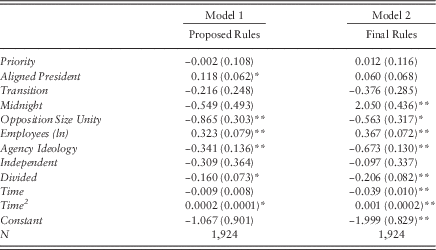
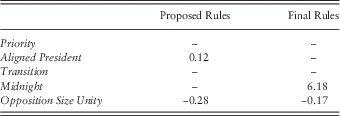
Table 1 presents the results for both Proposed Rules and Final Rules. Overall, the results provide strong support for the role of Congress and mixed support for the role of the president. First, consider our presidential support variables, Priority and Aligned President. Priority is not significant for either proposed rules (Model 1) or final rules (Model 2). The results for Aligned President, however, do provide some support for our theoretical proposition in Hypothesis 2 that agencies that share an ideological affiliation with the president are likely to capitalise on that support by increasing their rulemaking output – at least for proposed rules. Table 2 shows the substantive effect of these results.Footnote 23 Compared with a quarter where the agency is not aligned with the president, aligned agencies will propose 0.12 more rules, which implies that over the course of one presidential term aligned agencies will propose two additional significant rules. Meanwhile, although the effect is positive (as expected) for final rules, the coefficient does not achieve statistical significance.
Counts of Proposed Rules and Final Rules by quarter

Note: Table entries are maximum likelihood coefficients obtained from negative binomial models, with random effects at the agency level and standard errors clustered on the agency. The agency-quarter is the unit of analysis. One-tailed tests; *p<0.05, **p<0.01.
Predicted changes in Proposed and Final Rules volume
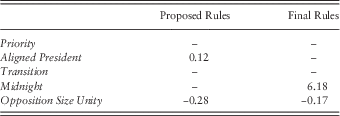
Note: Table entries are predicted changes in the number of rules produced per quarter for Proposed Rules (Model 1) and Final Rules (Model 2) for independent variables that are statistically significant in the predicted direction. Calculations assume a change from 0 to 1 for dichotomous variables and a change from 1 SD below the mean to 1 SD above the mean for continuous variables. All other variables held constant at their mean values.
Unexpectedly, the results suggest that agencies are less likely – and not more likely, as we predicted – to issue final rules during periods of transition from unified to divided government. We do, however, find the anticipated effect for Midnight, at least for final rules. Agencies are more likely to finalise midnight rules during the period before a president of a new party takes office, to the tune of 6.18 more final rules during midnight quarters than during nonmidnight quarters. The fact that Midnight is significant for final rules but not for proposed is unsurprising; agencies that are part of an outgoing administration seek to lock in policy with a final rule, rather than propose new policies, which they could not reasonably expect to finalise during the midnight period.
To assess the Congressional Opposition hypothesis (Hypothesis 4), we turn to the Opposition Size Unity variable, which we predict to be negative, indicating that agencies that face a larger and more cohesive congressional opposition are more likely to hold back on rulemaking activities. Here, we see that rulemaking is indeed decreasing in the strength of the agency’s congressional opposition. The results indicate that as the opposition party becomes stronger, agencies become more cautious and less likely to complete the rulemaking process. Substantively, this means that moving from 1 SD below the mean value to 1 SD above the mean produces a decrease of 0.28 proposed rules or 0.17 final rules in a given quarter. These results provide a measure of support for the theoretical argument regarding the effect of separation of powers on agency rulemaking activity.
Importantly, these factors matter even when we control for an agency’s characteristics, which also influence the level of rulemaking activity. To begin with, the positive and significant coefficient for Employees (ln) demonstrates that agency rulemaking is, at least in part, a function of the agency’s internal characteristics. Although the effect of Independent is not significant, Agency Ideology is significant and negative. Given that this variable is coded such that more conservative agencies take on higher values, the negative coefficients in Models 1 and 2 indicate that, all else equal, conservative agencies issue fewer rules (both proposed and final) than more liberal agencies. Taken together, these two results about agency size and ideology provide some affirmation for our argument about bureaucratic motivations. That is, as Teodoro (Reference Teodoro2011) argues, agencies that are larger (and govern more turf) may attract more ambitious leaders, which may in turn result in more rulemaking. In addition, there may be a selection effect regarding the type of people who choose to work in an agency of one ideological bent rather than another. Those that choose more conservative agencies may share conservative professional backgrounds (Adolph Reference Adolph2013) and choose to demonstrate their career bona fides in ways other than rulemaking, as regulation is often associated with more liberal policy goals.
Finally, consistent with Yackee and Yackee (Reference Yackee and Yackee2009), our results show that periods of divided government are associated with fewer rulemakings. Models 1 and 2 thus show the influence of both separation of powers factors and an agency’s type on an agency’s rule output. Specifically, agencies are more likely to increase their production of final rules and significant final rules when Congress is capable of taking action to sanction them, when they are in general ideological agreement with the president (for proposed rules), when it is a transition or a midnight period (for final rules), and when they have greater capacity (as measured by the number of employees).
In addition to the models presented here, we also conduct a number of robustness checks, which we explain in greater detail and present in the Online Appendix. To begin with, we reestimate Models 1 and 2 in several ways. First, we include rules that have a deadline (Table A4). Second, we aggregate data by year rather than by quarter (Table A5). Third, we use an alternative estimation technique, Poisson pseudo-maximum likelihood (Table A6), to demonstrate that our results are not dependent on a particular modelling approach. Next, we employ an alternative measure of our congressional opposition variable that takes into account the agenda-setting powers of the majority party (Table A7). We also consider the role of congressional committees in providing oversight (Table A8); and, lastly, we take a more nuanced approach to considering agency ideology (Table A9). None of these changes affect the substantive takeaways of the results presented above.
Our next set of checks extends the model’s theoretical reach. We start with a placebo test of sorts: we consider tests of separate sets of proposed and final rules that agencies deemed as “insignificant” in the Unified Agenda. Table A10 shows predominantly null results for our key theoretical variables, suggesting that political effects are targeted at significant rules and not insignificant ones. This finding is consistent with our expectations that political factors affect substantive issues, but that they matter little for the sorts of mundane rules that fly beneath the radar. Last, in Table A11 we consider the effect of a different institution – the courts – on agency rule production. Although we find little by way of a systematic influence of the judiciary on proposed or final rules, we do not view this as dispositive, a point to which we return in the conclusion.
Presidential influence in context
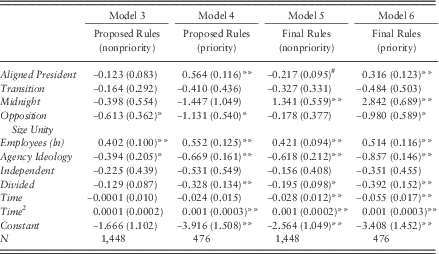
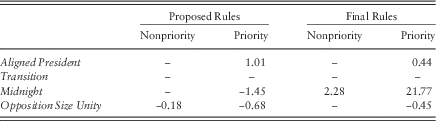
Although the results in Table 1 provide compelling evidence of agencies adjusting their rulemaking output in response to separation of powers oversight, the results for whether the president prioritises an agency are somewhat puzzling. In the literature, presidents are presumed to play a critical role in the rulemaking process. Yet our results indicate that Priority does not affect the production of either proposed or final rules. These results, however, assess only whether Priority has a direct effect on the production of rules, so we now check to see whether it has an indirect effect – that is, whether it modifies the effect of our other main variables. To do this, we separately consider the effects of each of our covariates for nonpriority agencies and for priority agencies.Footnote 24 Table 3 presents these results, using the same modelling approach as before, and Table 4 presents the changes in predicted values associated with each of the models.
Proposed Rules and Final Rules for priority and nonpriority agencies by quarter

Note: Table entries are maximum likelihood coefficients obtained from negative binomial models, with random effects at the agency-level and standard errors clustered on the agency. The agency-quarter is the unit of analysis. One-tailed tests; *p<0.05, **p<0.01. #indicates significance at the 0.05 level in the direction opposite from the prediction.
Predicted changes in volume of Proposed Rules and Final Rules, nonpriority and priority agencies

Note: Table entries are predicted changes in the number of rules produced per quarter for Proposed Rules (Models 3 and 4) and Final Rules (Models 5 and 6) for independent variables that are statistically significant in the predicted direction. Calculations assume a change from 0 to 1 for dichotomous variables and a change from 1 SD below the mean to 1 SD above the mean for continuous variables. All other variables held constant at their mean values.
Overall, the results provide support for the idea that presidential prioritisation of an agency magnifies the effects of other factors. We start by focusing on Aligned President, with the goal of discerning whether the ideological differences between a president and an agency matters for rulemaking both when the agency is a presidential priority and when it is not. As shown in Models 4 and 6, we find strong evidence that such alignment leads to a significant increase in both proposed and final rules when the agency is a presidential priority, but also that alignment does not produce an increase in rulemaking in agencies that are not presidential priorities (and indeed is significant in the opposite direction for final rules). More specifically, agencies increase the number of rules produced per quarter by 1.01 proposed rules (Model 4) and 0.44 final rules (Model 6) when they are a presidential priority and they share the president’s ideological orientation. Thus, we find that Priority has an indirect effect on rulemaking by modifying the effects of Aligned President.
Agency responses to presidential prioritisation are also evident with respect to midnight rulemaking, at least for Final Rules.Footnote 25 First, Midnight has a positive and statistically significant effect for final rules in both nonpriority and priority agencies. Second, as shown in Table 4, the size of the effect of Midnight on Final Rules is considerably magnified in priority agencies; while nonpriority agencies are predicted to produce an additional two final rules in a midnight quarter, priority agencies are predicted to issue 22 more final rules as compared with a nonmidnight quarter.Footnote 26
Finally, we find no moderating effect of Priority on either Transition or Opposition Size Unity. Transition is insignificant across all four models in Table 3, regardless of whether the agency is a priority. For Opposition Size Unity, we find that the effect of Congress is negative (as expected) in all of the models and significantly different from 0 in three of them. However, the differences between the relevant pairs of coefficients are statistically and substantively insignificant – that is, the coefficients for Opposition Size Unit in Model 3 (Nonpriority) and Model 4 (Priority) are statistically indistinguishable, as they are for Models 5 and 6. This finding suggests that Congress is unaffected by the president’s prioritisation of specific agencies.
Overall, we take these results on the moderating effect of Priority to speak to the comparative influence of Congress and the president. While other studies suggest that the president has a comparative advantage in influencing bureaucratic action (e.g., Clinton et al. Reference Clinton, Lewis and Selin2014), we find that the president’s influence is limited to those agencies that he has made a priority. More specifically, we observe stronger effects for Aligned President and Midnight if the president prioritises those agencies. Furthermore, Midnight also highlights a distinction between proposed rules (which it does not influence) and final rules (which it does). These results are also consistent with recent work by Bolton et al. (Reference Bolton, Potter and Thrower2016), which suggests the president’s influence in rulemaking is much weaker than scholars sometimes posit. Although those authors focus on how presidential influence is constrained by resources, we find that limits on presidential attention may also affect the president’s ability to influence agency rule production. Congress’s influence, however, is not conditional on the president. Hence, our results reinforce Kerwin and Furlong’s (Reference Kerwin and Furlong2011, 30) contention that “in the battle for influence over bureaucracy, congressional powers are at least as substantial as those of the president.”
Conclusion
Rulemaking is an extraordinarily important political activity, touching on many of the most prominent and controversial policies in American politics. Aside from a few pioneering studies (e.g., O’Connell Reference O’Connell2008, Reference O’Connell2011; Yackee and Yackee Reference Yackee and Yackee2009), political scientists have paid little systematic attention to its root causes. Our study adds to this growing literature in a number of significant ways. Most basically, our results indicate that agencies take other institutions into account when deciding whether to engage in rulemaking. This finding suggests that the volume of rules issued each quarter is not merely the product of administrative needs, agency capacity, or statutory demands, but rather is the result of a deliberate calculation on the agency’s part. In particular, we find that to the extent that agencies share ideological similarities with the president, they are more likely to engage in rulemaking. In addition, we find that agencies, recognising the myriad ways in which Congress can make their lives difficult, produce fewer rules when faced with strong opposition forces.
Our results also speak to the balance between Congress and the president in overseeing rulemaking, albeit in a limited way. We find that agencies are most able to realise benefits from presidential favour when presidents have explicitly prioritised them; meanwhile, Congress’s power to serve as a deterrent in rule production persists regardless of the president’s orientation of the agency. While these obviously are not apples-to-apples comparisons, we believe they suggest that scholars should continue to seriously consider the role that Congress plays in affecting agency rule production.
Although these are important findings, they also leave us with a number of questions. First, the count aspect of our data have forced us to combine two distinct types of rules in our analysis: rules that are regulatory and rules that are deregulatory. Analysing the content of the rules under study is of course beyond the scope of this analysis, but we think it is a worthy pursuit for future research. Second, we briefly considered the influence of the courts on agency rulemaking decisions without detecting any systematic effects. However, we recognise that the courts are important institutional actors and that agencies are likely to be sensitive to the predilections of judicial overseers (Shipan Reference Shipan2000; Canes-Wrone Reference Canes-Wrone2003; Hume Reference Hume2009). In light of this, we encourage future researchers to consider the nuanced relationship between agencies and courts, including how this relationship may be specific to particular policy areas and legal doctrines.
Even allowing for these questions, our study contributes to an evolving view of agencies as strategic actors in the rulemaking game. Although ideas and arguments that long have been central to the voluminous legal literature on rulemaking, such as on the proper scope of rulemaking, the legitimacy of legal foundations for rulemaking, and the consequences of rulemaking activity, will continue to be important, they should be considered in light of the findings that emerge here. In particular, patterns of agency rulemaking activity clearly demonstrate the influence of other political actors in the separation of powers system.
Acknowledgements
The authors would like to thank Larry Bartels, Jowei Chen, Jon Hanson, Will Howell, John Jackson, John Patty, Paul Poast, Bill MacMillan, Kevin Stange, Rocio Titiunik, Jason Webb Yackee, and Susan Webb Yackee for helpful discussions and comments. In addition, the authors would like to thank Robert McGrath and Anne Joseph O’Connell for sharing data with the authors.
Supplementary material
To view supplementary material for this article, please visit https://doi.org/10.1017/S0143814X17000216