Much research has focused on the negative sequelae of childhood abuse for victims' psychosocial functioning. Far less is known about the extent of, and mediators of, intergenerational continuities in the consequences of abuse. The present paper makes use of a prospective general population study of mothers and their children, The Avon Longitudinal Study of Parents and Children (ALSPAC), to study the effects of maternal childhood abuse on offspring adjustment trajectories over a 3-year period between ages 4 and 7 years. A previous report demonstrated a strong association between a maternal history of sexual abuse and offspring adjustment problems at age 4 years (Roberts, O'Connor, Dunn, Golding, & the ALSPAC Study Team, 2004). This study also highlighted the importance of maternal mental health, qualities of parenting, and family type as important mediators of this association. No study to date has examined the persistence of mental health problems in children of mothers with a history of abuse. We hypothesized that these children would show greater stability in adjustment problems to age 7 years compared to other children, even accounting for child, mother, and family characteristics at age 4 years. Furthermore, we anticipated an increased risk for a range of stressful life events, including family change, and possible trauma and abuse during the follow-up period for children of abused mothers, and that these might act as important mediators of group differences in adjustment prognosis.
Rates and Psychosocial Outcomes of Child Abuse
Child abuse is a serious and common risk affecting individual development in important ways. In the United Kingdom, 30,000 children were on the child protection register in the year up to March 31, 2002, a rate of approximately 2.5 per 1,000 children (National Society for the Prevention of Cruelty to Children, 2003). Prevalence estimates from general population surveys demonstrate that the rate of child abuse is far higher. For example, a recent study of young adults in the United Kingdom found that as many as 16% reported experiencing maltreatment during childhood (Cawson, Wattam, Brooker, & Kelly, 2000; May-Chahal & Cawson, 2005). Population prevalence estimates for specific types of abuse vary considerably depending on the manner in which abuse is defined. However, even with very stringent definitions, estimates demonstrate that child abuse is not a rare occurrence. Epidemiological studies point to rates of approximately 8% for serious forms of sexual abuse (May-Chahal & Cawson, 2005; see also Fergusson & Mullen, 1999), approximately 6% for frequent and severe emotional maltreatment (May-Chahal & Cawson, 2005) and around 7% for serious forms of physical abuse (May-Chahal & Cawson, 2005), with many children experiencing multiple forms of abuse.
Implications of child abuse for individual development are well known, with serious consequences of physical, sexual, and emotional abuse for neurobiological (Cicchetti, 2002), cognitive (Koenen, Moffitt, Caspi, Taylor, & Purcell, 2003), behavioral (Dodge, Pettit, & Bates, 1994), and psychiatric (Lansford et al., 2002) functioning. Effects of abuse persist into adulthood, with elevated risks for adult psychiatric disorders including depression, suicide, anxiety disorder, personality disorder, and substance abuse (Brown, Cohen, Johnson, & Smailes, 1999; Fergusson, Horwood, & Lynskey, 1996; Fergusson & Lynskey, 1997; Kendler et al., 2000; Schuck & Widom, 2001). Furthermore, effects of child abuse on individual development appear to be independent of correlated environmental and genetic risks (e.g., Brown et al., 1999; Kendler et al., 2000). Adults with experiences of childhood abuse are also more likely to have broader difficulties in their adult relationships. These include increased rates of interpersonal aggression, difficulties in intimate relationships, and an increased likelihood of divorce (Hill et al., 2001; Nelson et al., 2002; White & Widom, 2003). Childhood abuse is also associated with an increased exposure to traumatic adult life events, including revictimization experiences such as rape or being the victim of domestic violence (Coid et al., 2001). Furthermore, there is converging evidence that adult experiences of this kind mediate, at least in part, the association between child abuse and adult psychiatric disorder (Coid et al., 2003; Horwitz, Widom, McLaughlin, & White, 2001). Finally, child abuse has repercussions for victims' relationships with their own children (Banyard, 1997; Roberts et al., 2004). At the extreme, parents with experiences of abuse are more likely to be abusive toward their children, although this appears to only hold true for a minority of abused individuals (Egeland, Jacobvitz, & Sroufe, 1988; Pears & Capaldi, 2001).
Intergenerational Continuities in the Effects of Child Abuse
It is well established that most psychiatric disorders, as well as a range of broader social difficulties (e.g., poverty, divorce, criminality, poor health), often recur across generations of the same family. Understanding the reasons for such intergenerational continuities are as important as understanding the etiology of psychiatric disorder at the individual level (Serbin & Karp, 2004).
Despite the wide array of research on the consequences of abuse for abused individuals, less is known about the intergenerational effects of child abuse. As described above, abuse is associated with substantially increased risks for adult psychiatric disorder, impaired relationship functioning, family instability, and harsh or abusive parenting. Given that all of these may be expected to jeopardize offspring development, it is surprising that only a few studies have focused on the adjustment of the children of abused individuals. Those studies that have examined this issue suggest that parental experiences of childhood abuse do indeed result in elevated risks for mental illness and adjustment problems among children in the next generation, both in selected and community-based samples (Bifulco et al., 2002; Brent et al., 2004; Roberts et al., 2004).
No study to date has tracked the adjustment of children of abused mothers over time. It is hypothesized for a number of reasons that the longitudinal adjustment trajectories of these children would be poorer than for children of nonabused mothers. First, psychiatric disorder is usually more pernicious and persistent for abused than for nonabused psychiatrically ill persons (e.g., Brent et al., 2002; Buist & Janson, 2001). Second, as noted above, child abuse is strongly associated with high levels of adult psychosocial stress, including an elevated risk for the experience of traumatic life events, relationship discord, and family instability. Notwithstanding the possibility of resilience and recovery (Collishaw, Pickles, Messer, Rutter, Shearer, & Maughan, in press), it appears that difficulties often accumulate over time for individuals who experienced abuse. It is likely that children of abused mothers are exposed to a range of risk factors (parental mental illness, family instability, stressful life events) that continue to affect their development as they grow up. It may therefore be expected that the longitudinal prognosis of the offspring of abused mothers will be poorer than that of other children. Compared with other children with similarly high scores at Time 1, children of abused mothers are expected to show worse outcomes at future assessments. That is, our concern here is in assessing whether children of mothers who experienced abuse are at risk for maladapted developmental trajectories, rather than simply assessing their outcomes at any individual time point.
Mechanisms Underlying the Transmission of Risk Associated With Parental Childhood Abuse
An important goal in research on the intergenerational transfer of risk is the identification of mediating mechanisms (Rutter, 1998). Here it is useful to distinguish between specific continuities in risk across generations and nonspecific mediators of the association between maternal childhood abuse and offspring maladjustment. Findings from selected clinical samples indicate that associations between parental childhood abuse and offspring psychopathology are mediated in part by intergenerational continuities in offspring abuse (Brent et al., 2004). However, as noted above, only a minority of abused individuals go on to become abusive toward their own children. Wider psychosocial adversity (including parental discord and divorce, dysfunctional parent–child relationships, parental mental illness) may be more relevant for understanding the transmission of risk for psychopathology associated with parental childhood abuse. In a previous report on the ALSPAC sample, Roberts et al. (2004) showed that parental experiences of child sexual abuse were related to increased offspring adjustment problems at age 4 years. Maternal childhood abuse was related to adult mental health problems, family instability, and problems in parenting, and these factors, in part, mediated and moderated links between parental childhood abuse and offspring adjustment.
Nevertheless, important questions remain about the mechanisms involved in the transmission of risk for offspring of abused parents. Previous research has failed to fully explain the associations between parental childhood abuse and offspring maladjustment. In addition, because of the intercorrelation of a wide variety of psychosocial stress, it has been difficult to pinpoint specific mechanisms of risk transmission. The current study builds on the longitudinal assessments of adjustment and risk factors within the ALSPAC study; by focusing on intraindividual change in adjustment over time (between ages 4 and 7 years), we hope to provide a more precise estimate of the role of particular risk factors in the intergenerational continuity of psychosocial risk associated with parental childhood abuse.
It is well known that psychiatric problems during childhood and adolescence show considerable stability across time (Verhulst & Van der Ende, 1995). Nevertheless, problem behaviors also change considerably across time, with wide individual variation in trajectories of adjustment/maladjustment. It is likely that various factors influence change in psychopathology over time, including characteristics of the child and their family, as well as the influence of intervening events. Studies of specific predictors of within-individual change over time have a number of advantages (Rutter, Pickles, Murray, & Eaves, 2001): first, they are able to control more precisely for other measured and unmeasured causal variables captured by the baseline score. Second, although not fully cross-lagged, the present study is able to assess the impact of antecedent family-level risks on child behavior, while controlling for child effects on the environment. Third, studies such as this one can help disentangle cause and effect relationships between particular correlates and psychopathology by establishing the time-ordering of effects, for example, by demonstrating that the occurrence of some specific stressful event is associated with an increase in behavioral problems over time.
Aims and Hypotheses
To summarize, we argue that a study of within-individual change is important for clarifying the reasons for the association between maternal childhood abuse and offspring maladjustment. A critical question from the perspective of treatment for children with adjustment problems is whether a history of maternal childhood abuse constitutes an “active risk” affecting offspring development, or whether it is simply a distal and “static” risk that has already exerted its influences on maternal and child well-being early in life.
Our study had the following aims. First, we used a residuals scores method to examine differences in the longitudinal adjustment trajectories between ages 4 and 7 years for three groups of children: offspring of mothers reporting severe, moderate, or no abuse in their own childhoods. Second, we tested the extent to which the three groups differed in their exposure to a range of stressful life events occurring during the follow-up period. Third, we tested the extent to which group differences in children's adjustment trajectories were accounted for by variations in levels of antecedent and interim psychosocial adversity. The present study tested two main hypotheses. First, it was expected that maternal childhood abuse would be associated with an increased persistence in exposure to psychosocial adversity for the mother and her child. Second, we anticipated that this increased exposure to stressful events would result in poorer adjustment trajectories for children of abused parents.
Method
Sample
The ALSPAC is an ongoing study of mothers (and their families) who gave birth in the Avon Health District in the United Kingdom between April 1, 1991, and December 31, 1992 (Golding, Pembrey, Jones, & the ALSPAC study team, 2001). Around 80 to 90% of the eligible population participated. Of the mothers enrolled in the study, a total of 13,971 went on to give birth to a child that survived beyond infancy. Families in the study are reported to be broadly similar to those in the UK as a whole, although ethnic minority representation (at between 2 and 3%) is somewhat lower than the national rate of 7.6% (source 1991 UK census, see www.alspac.bris.ac.uk for further information). The present study focuses on measures collected from mothers toward the end of pregnancy (32 weeks' antenatal assessment), around the study child's fourth birthday (47 months' postnatal assessment), and around the study child's seventh birthday (81 months' postnatal assessment).
Measures
Maternal childhood abuse (retrospective, antenatal reports)
Maternal childhood experiences of sexual, physical, and emotional abuse were assessed retrospectively as part of the 32-week antenatal assessment. Mothers completed a life events questionnaire, in which they were asked whether a parent had been physically or emotionally cruel to them prior to age 17 years. Respondents provided answers on 5-point scales (1 = yes, affected me a lot; 2 = yes, moderately affected; 3 = yes, mildly affected; 4 = yes, but did not affect me; 5 = no, did not happen). Physical and emotional cruelty were recoded into 3-point scales according to rated impact (1 = no abuse; 2 = abuse occurred; 3 = abuse occurred, large impact). To support the validity of these ratings of abuse, we assessed associations with other relevant measures of parenting reported by mothers. Mean scores on the maternal care subscale of the Parental Bonding Instrument (Parker, 1989), administered separately to mothers at an earlier assessment, were between 1.2 and 1.6 SD lower for those reporting emotional or physical cruelty than for the population as a whole. There were strong associations between reports of emotional and physical cruelty and reported sexual abuse (see also Roberts et al., 2004). Finally, 95% of those reporting either moderate or severe emotional or physical cruelty also reported another form of abuse, or reported abuse at multiple time points, or indicated some other difficulty in their relationships with their parents (Parent Bonding Instrument care score ≤ −1 SD, violence between parents, or marked unpredictability of a parent; details available from authors on request).
Childhood sexual abuse was rated according to answers provided to a detailed seven-page questionnaire covering a range of sexual experiences (including noncontact exposure, fondling, oral sex, and sexual intercourse) involving boy/girl friends, parents, other relatives, family friends, and strangers. Further information was also given relating to age at first experience, whether the experience was wanted or unwanted, and whether the experience had happened repeatedly. Previous research highlights the importance of taking into account these different factors when distinguishing between sexual abuse of varying degrees of severity (e.g., Bifulco, Brown, & Harris, 1994). Here, sexual abuse was defined on a 3-point severity scale. Experiences involving physical sexual contact with an individual other than a boy/girl friend prior to age 16 were defined as sexual abuse. Single incidents of abuse that involved fondling, but not genital contact, and that only occurred in the teenage years (13–15 years) were rated as “minor abuse.” Other forms of abuse were rated as “moderate abuse,” except for intercourse/oral sex that occurred prior to age 13 or intercourse/oral sex that involved a family member prior to age 16. Such experiences were coded as “severe abuse.” The study used a 3-point scale of sexual abuse: 0 = none or minor, 1 = moderate, 2 = severe. Finally, a composite measure of all three types of abuse was created: 0 = no abuse, 1 = abuse of moderate severity/impact only, 2 = severe abuse.
Maternal mental health (antenatal)
Affective symptomatology was assessed at the 32-week antenatal assessment using the Crown-Crisp Experiential Index (CCEI; Crown & Crisp, 1979). The CCEI assesses symptoms of depression, anxiety, and somatic complaints. It has been validated against clinical assessments of present and past psychiatric illness and symptom severity (Birtchnell, Evans, & Kennard, 1988), and has good internal consistency (α = 0.80).
Parent–child relationship (4 years)
An eight-item questionnaire concerning the relationship between mother and child was used to derive a positivity subscale and a negativity subscale (see Dunn, Deater-Deckard, Pickering, & O'Connor, 1998, for details). The four positivity items were “I really love this child,” “This child makes me happy,” “This child is very affectionate to me,” “I feel very close to this child.” The four negativity items were “I often get very irritated with this child,” “I dislike the mess and noise that surrounds this child,” “I have frequent battles of will with this child,” “This child gets on my nerves.” Items were rated as yes or no by the mother. A low-care/high negativity scale was created by subtracting the positivity score from the negativity score. Scale reliability for this combined scale was comparable (α = 0.61) with the internal consistency of the two separate subscales (α = 0.60–0.64).
Family type (4 years)
Family type was categorized as follows: biological (two-parent families in which all children within the household are the biological children of both parents), single mother (families headed by mother alone, with no live-in partner), or stepfamily (some or all children living within or visiting the household are the step-children of one or both parents).
Early family life events (2.5–4 years)
Mothers completed a negative life events questionnaire when the study child was 4 years old. The questionnaire comprised 43 items regarding potentially stressful life events occurring over the previous 18 months. The questionnaire included items relating to family illnesses and deaths, family changes (births, pregnancies, separations, new partnerships), family discord and violence, and other stressors affecting the family (e.g., problems with the law, arguments with friends, being burgled, moving house). A count of the number of life events endorsed by mothers was used as an index of early family stress.
Interim child life events (5–7 years)
Mothers completed a further negative life events questionnaire when the study child was 7 years old. This questionnaire differed from the age 4 questionnaire in that it focused specifically on stressful life events experienced by the study child. In particular, the questionnaire comprised 18 items regarding potentially stressful life events occurring since the study child's fifth birthday. Items were subdivided on conceptual grounds into those relating to potentially traumatic and abusive experiences (“child had a shock or fright,” “child physically hurt by someone”), items relating to changes in the family (“child separated from mother,” “child separated from father,” “child separated from someone else she/he was close to,” “child changed caretaker, i.e., the person mostly looking after her,” “somebody in the family died,” “child acquired a new mother or father,” “child had a new brother or sister”), and items relating to other potentially stressful events (“child moved home,” “child was admitted to hospital,” “child started school,” “child started a new school,” “child lost her best friend,” or “something else”). Three items were not considered in this study: “death of a pet,” and items relating to sexual abuse and the child being taken into care (these two were not completed by sufficient numbers of study members to allow robust between-group comparisons, n < 10). In addition to scores on each subscale, the total number of stressful life events was also considered.
Offspring adjustment (4 and 7 years)
The study children's adjustment was assessed at 4 and 7 years using the parent completed Strengths and Difficulties Questionnaire (SDQ; Goodman, 1997). In addition, teacher-rated SDQs were available from age 7 years. The SDQ comprises five scales of five items each, assessing conduct problems, hyperactivity, emotional symptoms, peer relationship problems, and prosocial behavior. Each item is rated on a 3-point scale (e.g., “many worries, often seems worried”; 0 = not true, 1 = somewhat true, 2 = certainly true). Analyses focused on the total SDQ score, derived by adding scores from the conduct, hyperactivity, emotional, and peer problem scales. Scores could range from 0 to 40. Evidence of the reliability and validity of the SDQ is presented by Goodman (2001). To compare effect sizes associated with abuse across informants, age- and informant-standardized z scores were derived. To assess the clinical significance of the findings, parent SDQ scores ranging from 17 to 40 and teacher SDQ scores ranging from 16 to 40 were described as falling in the “abnormal range.” Goodman (2001) reported 15-fold increased odds of independently diagnosed psychiatric disorders for children and adolescents with scores in this range. Additional information about the SDQ, including norms by age, gender, country, and informant, is available at www.sdqinfo.com. The definition of our measure of children's adjustment trajectories, derived from parent SDQ scores at 4 and 7 years, is described below.
Statistical analysis
Response rates and attrition
Of the 13,971 mothers enrolled into the study (and whose child survived beyond infancy), 12,426 responded to the antenatal assessment (89%). Of these, 10,437 (84%) completed the questions relating to physical, emotional, and sexual abuse, and provided information relevant to predicting nonresponse at subsequent follow-ups. This study focused on the subsample of 5,619 mothers (54% of those with data antenatally), who completed the measures of child adjustment at 4 and 7 years, and also provided complete information on other measures of interest. To assess the representativeness of this subsample we compared the characteristics of responders and nonresponders. As shown in Appendix A, there were a number of systematic biases associated with attrition. A multivariate logistic regression analysis found that response rates were higher among individuals with higher educational qualifications (p < .001), with a higher income (p < .001), for those describing their ethnic group as White (p < .001), and for mothers with lower depression scores (p < .001). In addition, there were marginally lower response rates for mothers whose own parents had separated or divorced (p = .06), and for the small number of mothers with no partner at the antenatal assessment (p = .07). Reports of childhood abuse did not independently predict response (p = .14). Predictors of response on the whole did not vary according to abuse status; only the interaction between maternal qualifications and abuse status was statistically significant (p = .05), indicating that response variations according to educational level were less marked among mothers who reported abuse. To minimize biases associated with nonresponse, weights were estimated using predicted values from the logistic regression model of significant and marginally significant predictors of response. The top 1% of weights was trimmed back to the next highest value to reduce the impact of extreme outliers. As Appendix A shows, the weights adequately corrected known biases associated with nonresponse.
Teacher-completed SDQs at age 7 years were available for 4,761 of the children with data about maternal childhood abuse (45.6%). Nonresponse weights for analyses of the age 7 teacher data were derived separately. Predictors of nonresponse were broadly similar to those outlined above, and the “teacher weights” were similarly effective in correcting known nonresponse biases.
Analyses
Adjustment prognosis over time was assessed in this study using standardized residual scores saved from a linear regression of age 7 age-standardized parent total SDQ score on age 4 age-standardized parent total SDQ score. This method of assessing change in adjustment over time has two important advantages. First, age-standardized measures of adjustment covary out the general decrease in rated SDQ score over the follow-up period (see Table 2). Second, the use of residual scores is preferable to using change scores because account is taken of regression toward the mean that operates in longitudinal investigations of symptom scores such as this. Regression toward the mean refers to the fact that the predicted score of any particular individual will be closer to the population mean at Time 2 than was their actual score at Time 1. Analyses of residual scores are therefore particularly well suited for comparing the behavior trajectories of children with different levels of problems at the outset. Residual outcome scores were used to measure the extent to which age 7 scores were higher or lower than expected on the basis of children's age 4 SDQ scores.
The analyses were structured as follows. We first describe the incidence of maternal childhood abuse reported in ALSPAC and then compare parent- and teacher-rated offspring SDQ scores at ages 4 and 7 years for groups of nonabused mothers, mothers reporting moderate abuse, and mothers reporting severe abuse. We then compare children's parent-rated adjustment trajectories for the different maternal abuse groups using the residual outcome scores. Next we examine possible contributory factors that might explain variations in trajectories between the maternal abuse groups. We test the extent to which children of abused and nonabused mothers were differentially exposed to a variety of stressful life events in the period between the two behavioral assessments. In addition, we provide brief information on variation in three childhood factors assessed prior to or at age 4 years (maternal depression, maternal hostility toward the study child, family type). Finally, we present a series of multivariate regression analyses that assessed the effect of controlling for these factors on the association between maternal abuse and offspring adjustment trajectories.
Analyses were conducted in STATA (StataCorp, 2003). Nonresponse weights were included throughout, with analyses making use of weighted likelihood estimation and the robust or sandwich parameter covariance matrix estimator of Huber (1967). Maternal abuse groupings were entered as three-level factors into analyses with the nonabused group used as the baseline for statistical comparisons. Tests for dichotomous outcomes used logistic regression analyses, and those for continuous outcomes used linear regression. Standardized effect sizes (β) or odds ratios (OR) with 95% confidence intervals (95% CI), together with associated significance levels (p) are reported. For comparisons of unadjusted and adjusted models of differences in adjustment prognosis by maternal abuse status, the percentage of reduction in beta is reported. Quoted significance levels are indicative only; no corrections have been made for multiple testing or nonindependence among tests.
Results
Incidence of maternal childhood abuse
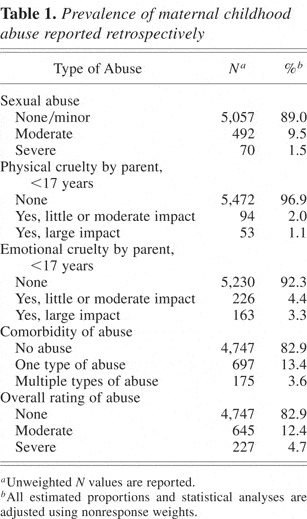
Rates of abuse in the ALSPAC subsample studied here are summarized in Table 1. A total of 17.1% of mothers reported childhood abuse, 3.1% reported physical cruelty by a parent, 7.7% reported emotional cruelty, and 11% reported moderate or severe sexual abuse in childhood.
Prevalence of maternal childhood abuse reported retrospectively

Maternal childhood abuse and offspring adjustment at ages 4 and 7 years
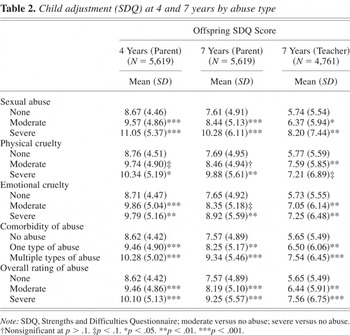
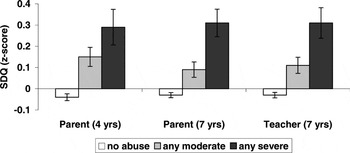
Table 2 summarizes mean parent-rated SDQ scores for children at the 4- and 7-year follow-ups, separately for the different maternal childhood abuse groups. Teacher-rated SDQ scores at age 7 are also shown. The following points are worth noting. First, all forms of abuse were associated with increased offspring adjustment problems both at 4 and 7 years of age. Second, in most instances child adjustment problems increased with the rated severity or impact of abuse. Third, comorbidity between different types of abuse was associated with increased offspring adjustment problems at both time points. Fourth and finally, associations of maternal childhood abuse with offspring adjustment were apparent for both parent and teacher ratings of child adjustment. In fact, as shown in Figure 1, the mean effect sizes were closely comparable for both informants and for both time points.
Child adjustment (SDQ) at 4 and 7 years by abuse type


A comparison of the associations between maternal childhood abuse (overall rating) and offspring adjustment by child age and informant. The vertical lines are standard error bars.
To assess the likely clinical significance of the associations between maternal childhood abuse and offspring adjustment, additional analyses compared rates of children scoring in the abnormal ranges of the parent and teacher SDQs. Results showed significantly higher rates of parent-rated problems at age 4, no abuse: 5.4%; moderate abuse: 8.3%, OR = 1.6 (1.1–2.2), p < .01; severe abuse: 12.2%, OR = 2.4 (1.6–3.8), p < .001; and at age 7 years, no abuse: 5.5%; moderate abuse: 8.3%, OR = 1.5 (1.1–2.2), p < .05; severe abuse: 10.4%, OR = 2.0 (1.2–3.1), p < .01. Similarly, high teacher SDQ scores were more common among children of mothers reporting severe abuse, no abuse: 6.9%; moderate abuse: 8.8%, OR = 1.3 (0.9–1.8), p = .11; severe abuse: 13.4%, OR = 2.1 (1.4–3.2), p = .001.
Abuse and adjustment trajectories between ages 4 and 7 years
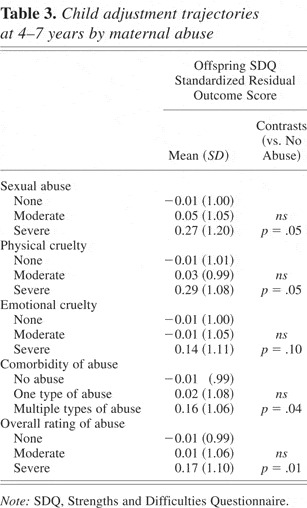
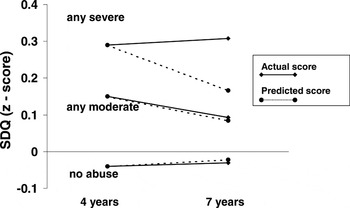
As shown in Table 3, children of mothers reporting severe childhood abuse showed significantly poorer adjustment trajectories between ages 4 and 7 years, with residual outcome scores between .15 and .30 SD higher than among children of mothers reporting no abuse. The offspring of mothers reporting moderate childhood abuse did not differ from the children of mothers reporting no childhood abuse in terms of residual outcome scores (p > .2 in all cases). The large discrepancy for children of severely abused mothers between actual adjustment at age 7, and that predicted on the basis of SDQ scores at age 4, is further illustrated in Figure 2.
Child adjustment trajectories at 4–7 years by maternal abuse


A comparison of actual and predicted scores for the overall rating of maternal childhood abuse and offspring adjustment trajectories from 4 to 7 years.
Associations between maternal childhood abuse and possible mediating factors
Early childhood factors
The overall rating of maternal childhood abuse was strongly associated with maternal antenatal affective symptomatology, with group differences of up to two-thirds of an SD (moderate abuse, β = .43, p < .001; any severe abuse, β = .66, p < .001). Maternal childhood abuse was also associated with maternal hostility toward the study child (moderate abuse, β = .15, p = .001; severe abuse, β = .32, p < .001), living in a single-parent or step family at age 4 years, no abuse, 20.3%; moderate abuse, 29.7%; severe abuse, 37.3%; moderate versus no abuse: OR = 1.66 (1.4–2.0), p < .001; severe versus no abuse: OR = 2.34 (1.7–3.1), p < .001; and with a greater number of early family stressors (moderate abuse, β = .33, p < .001; severe abuse, β = .57, p < .001).
Interim life events
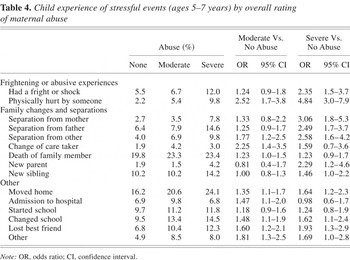
Table 4 describes rates of a range of stressful life events experienced by children between the ages of 5 and 7 years. As shown, children of abused mothers had increased odds of experiencing a range of adversity, with risks increasing markedly with the severity of the reported abuse. Although rare in the population as a whole, 5% of children of moderately abused mothers (OR = 2.52) and 10% of children of severely abused mothers (OR = 4.84) were reported by mothers to have been physically hurt by someone. Other frightening or shocking experiences were also more common among children of severely abused mothers (OR = 2.35). Most family changes (separations from parents, acquiring a new parent or sibling, although not deaths in the family) were significantly more common for children of mothers who reported severe abuse in their own childhoods (with ORs ranging from 1.46 to 3.06). Finally, some other stressful events (moving house, changing school, losing a friend) were also significantly more common among the children of mothers with severe childhood abuse.
Child experience of stressful events (ages 5–7 years) by overall rating of maternal abuse

Overall, 13.0% of children of nonabused mothers experienced three or more of the events listed in Table 4, compared with 20.5% of children of mothers reporting moderately severe abuse, OR = 1.72 (1.4–2.1), p < .001, and 27.4% of children of severely abused mothers, OR = 2.52 (1.8–3.5), p < .001. A further analysis indicated that there were significant differences in the mean number of life events according to maternal abuse group (moderate abuse, β = .15, p = .003; severe abuse, β = .31, p < .001) after controlling for maternal mental health (β = .03, p = .06), age 4 years family type (β = .12, p = .001), age 4 parent–child hostility (β = .04, p = .005), and number of family life events reported at age 4 for the previous 18 month period (β = .22, p < .001).
Explaining the association between maternal childhood abuse and offspring adjustment trajectories: Unadjusted/adjusted models of group differences in residual outcome scores
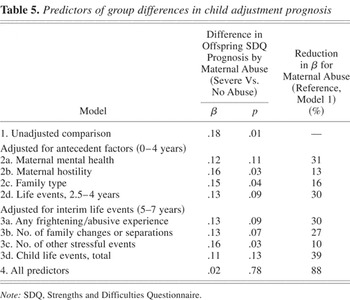
A series of multiple regression models tested the extent to which the group difference (severe abuse vs. no abuse) in residual outcome scores was accounted for by early childhood factors, and by children's increased exposure to interim stressful life events. These analyses are summarized in Table 5. A base model showed an unadjusted group difference in residual outcome scores of β = 0.18 and p = .01. Models 2a–d added controls for (a) antenatal maternal mental health, (b) age 4 maternal hostility, (c) age 4 family type, or (d) number of family life events between ages 2.5 and 4 years. The coefficient for maternal abuse status was reduced by around a third and to marginal significance by controlling for maternal mental health (see Model 2a) or early life events (Model 2d). Controls for age 4 years maternal hostility (see Model 2b) or age 4 family type (see Model 2c) accounted for smaller portions of the effect of maternal abuse status.
Predictors of group differences in child adjustment prognosis

Models 3a–c accounted for interim stressful events (possible trauma/abuse, family change, other events, respectively). Together (see Model 3d), the increased susceptibility of children of abused mothers to experience such events accounted for 39% of the group difference in residual outcome scores. Finally, a combined model included all the above predictors (see Model 4). All covariates were significant or marginal predictors of children's residual outcome scores (maternal mental health, β = .05, p = .002; maternal hostility, β = .07, p < .001; age 4 family type, β = .07, p = 0.08; total number of early family life events, ages 2.5–4 years, β = .05, p = .002; total number of interim child life events, ages 5–7 years, β = .08, p < .001), whereas differences by maternal abuse status were no longer statistically significant (β = .02, p > 0.7). The coefficient for severe maternal abuse was reduced by 88% relative to the unadjusted model, indicating that together the added covariates accounted almost entirely for the poorer adjustment trajectories of children of abused mothers.
Discussion
Previous research has suggested that experiences of parental abuse in childhood have immediate and substantial effects on victims' social, cognitive, and emotional development, with several studies showing the persistence of these effects into adulthood. This study sought to extend these life-course findings by elucidating how the risks associated with parental childhood abuse are transmitted to the next generation. A previous report on the ALSPAC sample demonstrated an intergenerational link between maternal childhood sexual abuse and offspring maladjustment at 4 years of age (Roberts et al., 2004). The present study capitalized on the repeated assessments of child adjustment within ALSPAC to test the importance of specific environmental stressors as predictors of individual change in children's adjustment from age 4 to age 7 years.
Main findings
Maternal childhood abuse and offspring adjustment
Cross-sectional analyses demonstrated that maternal experiences of sexual, physical, and emotional abuse in childhood were associated with adjustment problems in offspring at ages 4 and 7 years. There were dose–response relationships demonstrating that the more severe or the greater the rated impact of abuse on mothers, the worse the adjustment problems of their offspring. Furthermore, the occurrence of multiple types of maternal abuse was associated with more severe offspring problems than maternal exposure to just one type of abuse. Standardized group differences were as large at age 7 as at age 4, and they were comparable for teacher and parent ratings of child adjustment.
How did children of abused mothers progress over time?
The first main aim of the study was to test the hypothesis that children of abused mothers would not only show poorer adjustment at any given point in time, but also a worse prognosis over time, when initial behavior is accounted for. Longitudinal analyses examined children's adjustment trajectories between 4 and 7 years of age. Children in the cohort as a whole had lower mean parent SDQ scores at age 7 than at age 4. Results also showed that children whose mothers reported severe abuse had a greater persistence of adjustment problems than did other children. In particular, residual scores analyses showed markedly poorer adjustment at age 7 years than predicted on the basis of their age 4 scores. These results are important as they suggest that the intergenerational continuity in psychosocial risk that underlies the association between maternal abuse and offspring adjustment may have a cumulative impact on children as they grow older.
Mediators of the poorer adjustment trajectories of children of abused mothers
An important aim of the study was to use the longitudinal design and the availability of ratings of adjustment at two points to test the importance of specific mediators of the association between maternal abuse and offspring adjustment. The examination of predictors of within-individual change/continuity in maladjustment made it possible to directly test the role of specific interim life events. The design also allowed a consideration of longer term associations with earlier assessed risk factors. Although not fully cross-lagged, analyses of maternal mental health, parental hostility, and family type in early childhood were adjusted for initial levels of child maladjustment.
Previous research has shown that childhood abuse predicts a broad range of intercorrelated psychosocial difficulties. Roberts et al. (2004) in a previous report on the ALSPAC sample demonstrated associations between maternal childhood abuse and maternal adult affective symptoms, dysfunctional parenting (e.g., lower maternal confidence, increased hostility), and family type at age 4 years. The present study demonstrates that exposure to psychosocial adversity in families of abused mothers tended to accumulate over time. Rates of a range of stressful life events were elevated for children of abused mothers followed up to age 7 years, even accounting for earlier assessed adversity. In particular, children of abused mothers were more likely to experience frightening and shocking events and physical assaults. They were also more likely to experience changes to their family units, including separations from parents and caretakers, and the acquisition of new parent figures. Finally, the offspring of abused mothers were also exposed to a broader spectrum of stressful life experiences (e.g., moving house, changing school, losing touch with friends). Exposure to stressors between ages 5 and 7 years did not simply reflect continuity in terms of early or ongoing life stress. Instead, there were significant group differences in number of stressful life events even when controlling for earlier adversity.
Tests of mediation addressed the reasons for the poorer longitudinal adjustment trajectories for the children of abused mothers, focusing on several specific hypothesized mediators. First, measured interim life events accounted for 39% of the group difference in residual outcome scores between the two groups. This suggests that family-level selection effects associated with maternal childhood abuse play a significant role (i.e., the tendency of children of at-risk mothers to be exposed to greater psychosocial risk). Of the measured life events, child exposure to frightening or abusive events, together with changes to the family unit were the most important mediators. Second, antecedent factors (maternal affective symptomatology, maternal hostility to the child, family type at age 4 years, earlier family stressful events) were also significant and independent predictors of trajectories in children's adjustment over time. Together, the measures of antecedent psychosocial risk and interim stressful events fully accounted for the poorer adjustment trajectories of the offspring of abused children.
Limitations
There are a number of potential limitations that should be considered. First, experiences of abuse were reported retrospectively in adulthood. Prospective studies show that even though most documented instances of abuse are reported to interviewers, 30% of cases are not (Hardt & Rutter, 2004). In addition, there is very little evidence about the likely rate of false positive cases, that is, how often childhood abuse is reported when it did not occur. Of particular concern is the possibility that distressed individuals may be more likely to report abuse than nondistressed individuals. Although we have no direct way of assessing the likely impact for our findings, previous research does suggest that despite uncertainty regarding estimated rates of retrospectively reported abuse, associations of reported abuse with adult psychopathology do appear on the whole to be robust and valid (Brewin, Andrews, & Gotlib, 1993; Fergusson, Horwood, & Woodward, 2000).
Second, another limitation concerns the measures of emotional and physical cruelty. One potential problem is that concerns about the reliability of retrospective recall of abuse are exacerbated by the nonspecific nature of these questions. More detailed assessments, such as those used for assessing maternal childhood sexual abuse, would have been preferable. Nonetheless, as set out in the Method section, these questions did relate strongly to other assessments of abusive/deficient parenting experienced by mothers in their childhood.
Third, the reliance on a single reporter for many of the measures of interest in the study meant that it is possible that shared method variance led to inflated associations between risk factors and outcomes of interest. However, the longitudinal nature of the study is likely to have reduced problems of this kind. In particular, maternal childhood abuse and offspring adjustment were assessed on separate occasions over a period of several years. Furthermore, as already noted, the teacher SDQ data at age 7 provided strong independent support for an association between maternal childhood abuse and offspring maladjustment, with effect sizes closely comparable to those found for maternal SDQs. This finding suggests that there was not a general negativity bias affecting the ratings of mothers reporting childhood abuse, and it therefore also provides support for the validity of the longitudinal analyses of child adjustment based on the maternal reports.
Fourth, tests of statistical mediation should ideally be based on datasets in which longitudinally ordered predictors, mediators, and outcomes are assessed sequentially. Although one of the main advantages of the present study was the use of a prospectively followed birth cohort with multiple assessment points, it is also important to acknowledge that maternal childhood abuse was assessed contemporaneously with maternal depression, and that child adjustment at age 7 was assessed at the same time as children's interim life events.
Fifth, a final limitation concerns sample attrition, which was relatively high as a result of combining data across several different assessment points. We used information on a range of factors available for the full sample to distinguish those with complete data from those who were excluded from our study as a result of missing data. Predictors of attrition were then used to construct weights that accounted for selective nonresponse. As shown in Appendix A, these weights worked well in addressing known biases associated with sample attrition.
Conclusions and Implications
This study has demonstrated that maternal childhood abuse is associated with significant intergenerational continuity in psychosocial risk that affects the adjustment of children in the next generation. In particular, children of mothers who reported abuse were more likely to have experienced a family breakup by age 4 years, and were exposed to further changes in parent figures between ages 5 and 7 years. Maternal childhood abuse was associated with maternal depression and anxiety, and with hostile parenting at age 4. In addition, children of abused mothers were more likely to experience physical assaults and other possibly traumatic events between 5 and 7 years of age. As already noted, stressors appeared to cumulate over time for children of abused mothers. This is the first study to show that these children tend to show a poorer prognosis in terms of their mental health when assessed longitudinally over time. Finally, the study showed that the various assessments of psychosocial adversity to which children were exposed both in the preschool period and in between the two assessments of adjustment together fully explained their poorer adjustment prognosis.
The study has several implications for intervention and prevention. The study highlights the importance of focusing not solely on the psychosocial well-being of victims of abuse, but also on preventing the intergenerational transmission of risks associated with abuse. Past research has often focused on direct intergenerational continuities, that is, the risk of victims of child abuse themselves becoming abusive as parents. The current study, however, suggests that indirect mediational pathways also play an important role, with more general elevations in levels of psychosocial stress underpinning the associations between maternal childhood abuse and offspring maladjustment. The present study identifies two important targets for intervention and prevention: (a) mental health problems among mothers reporting abuse, which in this study showed enduring consequences for children's adjustment trajectories, and (b) the tendency of abused mothers and their families to experience a greater number of stressful life events. Interventions aimed at reducing levels of stress, together with interventions aimed at helping mothers “buffer” their children against the effects of stress are both likely to be valuable. Further trials are needed to test if specific interventions aimed at reducing the extent and impact of psychosocial stressors among mothers who experienced early adversity (e.g., Olds et al., 2004) benefit not only the mother but also her children, and thereby help interrupt the tendency of such risk to be transmitted intergenerationally.
Appendix A