Introduction
Dairy cows are usually deprived of the ability to lie down and feed while they are waiting for routine veterinary inspections, such as for pregnancy diagnosis or tuberculin testing, for foot trimming, and also during milking and the holding period prior to milking. Previously we have shown that during deprivation of lying, cows increased the time spent feeding and more frequently exhibited leg stamping, weight shifting, body repositioning and butting; behaviours that suggest discomfort (a negative subjective feeling in response to an unpleasant stimuli that is sufficient in intensity for the animal to initiate a response, e.g. a change in posture, which exists until the stimuli is reduced and at the extreme would consist of pain and distress) (Cooper et al., Reference Cooper, Arney and Phillips2007). After deprivation, cows recovered some but not all of their lying time by reducing feeding and standing. However, feeding deprivation is often concomitant with lying deprivation when cows are withheld for veterinary treatment or reproductive techniques, and it is unclear as to whether this magnifies the impact on behaviour.
Dairy cows are highly motivated to feed and rest, potentially leading to a motivational conflict in cows with limited time available for both activities (Metz, Reference Metz1985; Fregonesi and Leaver, Reference Fregonesi and Leaver2001), exacerbated by the fact that their feed intake capacity has not increased to the same extent as their milk production (Kamphues, Reference Kamphues1998). Depriving lactating dairy cows of opportunities for both feeding and lying will help to determine their priorities for these two behaviours. Bolinger et al. (Reference Bolinger, Albright, MorrowTesch, Kenyon and Cunningham1997) found that although post-deprivation feeding frequency was reduced after 4 h deprivation of lying and feeding when cows were placed in restraint yokes, feed intake and milk yield were not affected. Plasma cortisol, neutrophil-to-mononuclear cells ratio and somatic cell count (SCC) were not affected by restraint, but grooming and agonistic behaviours were increased and there was increased lying post restraint. During restraint, cows appeared to increase time spent ruminating, and spent less time ruminating afterwards. Bolinger et al. (Reference Bolinger, Albright, MorrowTesch, Kenyon and Cunningham1997) suspected that restrained cattle shifted their weight from one leg to another, and recommended that this be further studied.
We investigated the impact on behaviour and production of depriving cows of the ability to lie down and to feed for 2 or 4 h on a single occasion, and the impact of an additional stressful procedure – foot trimming – during 4 h of deprivation.
Material and methods
Experiment 1
An experiment was conducted over 18 consecutive days, commencing 28 June and ending 15 July, using 18 cows from the Holstein-Friesian dairy herd of Moulton College, Northampton, UK. Cows were fed a total mixed ration containing fresh weight proportions as follows: second-cut grass silage (53.5%), maize silage (30.6%), wet maize gluten (15.3%) and minerals (0.6%). Other aspects of the management of the herd were described previously (Cooper et al., Reference Cooper, Arney and Phillips2007).
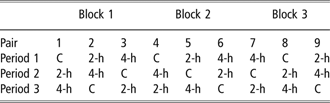
The cows were in late lactation (mean ± s.e. lactation duration 273 ± 5.1 days), with a mean ± s.e. initial milk yield of 21.8 ± 1.12 kg/day, mean ± s.e. body condition score of 3.00 ± 0.05 and a mean ± s.e. time to parturition of 80.2 ± 1.9 days. Cows were allocated to nine pairs at random, and each pair was randomly assigned to one of three blocks of a replicated Latin-square design (no. 63 of Patterson and Lucas, 1962; Table 1). This design had three periods, three blocks and three treatments: control (no lying/feeding deprivation), 2 h of lying plus feeding deprivation (treatment 2-h) and 4 h of lying plus feeding deprivation (treatment 4-h).
Latin-square design showing order of treatments for each pair of cows in each block for each period
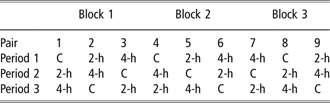
C = control treatment; 2-h = 2 h deprivation treatment; 4-h = 4 h deprivation treatment.
Each pair was allocated to one of three adjacent, identical pens, as described in Cooper et al. (Reference Cooper, Arney and Phillips2007), at random, where the necessary treatments were applied. Pens provided ad libitum access to drinking water and the same total mixed ration as the rest of the herd, which was delivered at the same time. During periods of darkness, artificial lighting was provided overhead by six strip lights to facilitate video-recording. Cows spent 48 h in the experimental pens and were returned back to the herd towards the end of morning milking when the next group of six cows was collected. Each group of six cows underwent the experimental procedure three times, with each pair in the group subject to a different treatment on each occasion. The experimental cows were allowed approximately 2 h to become accustomed to the pens and each other before any behavioural observations took place. Lying deprivation was achieved by securing the cows in the deprivation area using a non-electrified spring gate, which prevented the cows having access to the bedded area. Feeding deprivation was achieved by withdrawing feed from the barrier. The 4- and 2-h deprivation periods commenced at 1020 and 1220 h, respectively, and at 1420 h the spring gates were removed and the cows gained access to the bedded area. Following the application of treatments, the cows remained in their pairs for a further 41 h, after which they were returned to the herd.
Behavioural observations
Deprivation period
Cows were observed in the same order each time by one of three trained observers. Behaviours previously thought to be associated with discomfort, frustration or fatigue (see Cooper et al., Reference Cooper, Arney and Phillips2007) were recorded continuously as frequencies. These were leg stamping, repositioning, butting, head swinging and weight shifting. The frequency of nosing (touching with the nose) and sniffing the ground, self-licking and walking (moving all four legs slowly forward one at a time in a synchronised manner covering greater than one body length in distance) were also recorded in this way. Behaviours recorded by duration included rubbing of the head against the housing, drinking (drinking from water trough/bowl) and sleeping (lying down with neck relaxed and eyes closed). All the above behaviours not defined here have previously been defined by Cooper et al. (Reference Cooper, Arney and Phillips2007) – however leg stamping was previously recorded as leg stomping, and licking was termed grooming. Bouts were separated by the cow showing at least 1 s of another behaviour. Behaviours recorded by scan sampling at 5 min intervals included feeding, ruminating (chewing partially digested food that has been regurgitated) while lying or standing, and standing or lying but not ruminating, with a total of 144 measurements per cow and 2592 in total.
Post deprivation
Continuous time-lapse video-recordings (a Sanyo 3372 camera fitted with a varifocal (3.5 to 8 mm) lens (Sanyo, Watford, UK) and a HS-1024EB video-recorder (VHS Mitsubishi, Hatfield, UK) played at 2.6 mm/s) commenced immediately after the deprivation period for the subsequent 41 h when the cows remained in the pen, during which time it was expected that residual or compensatory behavioural effects of treatment may be displayed (Metz, Reference Metz1985). Recordings of lying, standing and feeding behaviour were made every 5 min, except when the cows were being milked, with a total of 1476 measurements per cow and 26 568 measurements in total. Feeding was defined as the cow having food in the mouth and/or chews (Munksgaard et al., Reference Munksgaard, Ingvartsen, Pedersen and Nielsen1999). Lying was defined as the body resting on the floor (Munksgaard et al., Reference Munksgaard, Ingvartsen, Pedersen and Nielsen1999). For each individual cow, the total time spent in each activity was estimated by assuming it had been performing the behaviour for the remainder of the 5 min period and multiplying the number of recordings of each behaviour by the number of scans in the 41-h period. The duration of the first meal post-deprivation was determined from the start and cessation of this activity.
Milk production
Milk yield was recorded on four consecutive occasions for each cow after entering the experiment – afternoon milking on day 1 (the deprivation day), morning and afternoon milking on day 2 and morning milking on day 3, prior to the cows being returned to the herd. Morning and afternoon milking took place between 0700 and 0830 h, and between 1500 and 1720 h, respectively.
Statistical analyses
The mean value of each pair of cows was used as the replicate. Most behaviours were not normally distributed across pairs as defined by the Anderson–Darling test (P < 0.05), so all behaviours were analysed by Friedman’s non-parametric test with pair and treatment as factors. Spearman’s rank order correlation coefficients were determined between behavioural variables. The number of vocalisations and the time spent sleeping were both too few to analyse by hour, and were only analysed for all 4 h together. For the post-deprivation behaviour data, graphical representation of mean time spent in each behaviour for each treatment revealed that blocks of 8-h periods were most appropriate for analysis. Standard errors for individual hours were calculated to facilitate identification of differences between treatment means. Milk production data were also not normally distributed and therefore Friedman’s test was used as for behaviours, as well as the duration of the first post-derivation feeding and lying bouts. Correlation coefficients were additionally determined for production characteristics and behaviours using the same method as that used for correlations between behaviours. Because of the large number of potential correlations, a statistical probability of 0.01 was used to indicate significance, unless the correlation was considered particularly relevant to the discussion.
Experiment 2
Because it is difficult to distinguish the effects of potentially stressful events, such as foot trimming of a herd, from unrelated but concurrent events, such as changes in diet or the weather, a trimming programme that affected a small number of cows at regular intervals was selected for this purpose. Fifteen cows with overgrown front hooves were selected from the University of Cambridge dairy herd of Holstein-Friesian cows to be trimmed by veterinary students, who had no prior experience of the procedures. The cows were removed from the herd at morning milking (0700 h) in five groups of three at weekly intervals. They waited in a 4 × 4 m pen with a concrete floor and no bedding, with access to water but no food, until the students arrived at 0900 h to lead them to individual trimming crushes, where they were treated in the standing position. Here the cows were subjected to supervised trimming of the front feet for 120 min by the five-step Dutch method (Greenough, Reference Greenough1997). Trimming ended 4 h after initial restraint, and the cows were then returned to the herd in a straw yard with ad libitum access to a total mixed ration.
To assess the effect of trimming on the cow’s walking behaviour, their speed and step rate were recorded by an observer with a stopwatch over a 30 m distance as they voluntarily walked back along a passageway to their straw yard accommodation following afternoon milking 2 days before the day of trimming and on the day of trimming. Each cow’s front foot was used as a reference point. Milk yield was recorded automatically in the rapid exit parlour for each cow 5 days before and 5 days after trimming.
Results
Experiment 1
Deprivation period
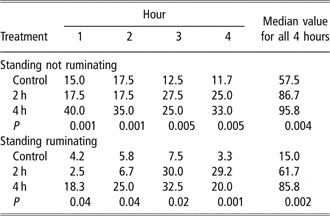
Cows in treatments C and 2-h both spent a median 15 min/h feeding during the 4 and 2 h, respectively, when food was available, with no differences between treatments (P = 0.62). There was no difference between treatments C and 2-h in the median time spent lying without ruminating (range 0 to 5 min/h for both treatments, P > 0.25) and lying ruminating (range 8 to 16 min/h for both treatments, P > 0.25) during the first 2 h (treatment 2-h cows were deprived of lying during the subsequent 2-h period). No cow from either of the deprivation groups attempted to lie down during deprivation. Time spent standing, not ruminating, was greater when the cows were undergoing deprivation (Table 2) and tended to be greater for treatment 4-h cows in hours 1 and 2, compared with those in hours 3 and 4. Standing ruminating time was also greater when the cows were undergoing deprivation, and particularly in treatment 2-h cows and treatment 4-h cows in hours 3. The total time spent standing, not ruminating, and standing and ruminating over the 4-h period both increased between treatments with length of deprivation.
The median duration (min/h) of standing with and without ruminating recorded instantaneously every 5 min for hours 1 to 4 of the deprivation period, and the median per hour for all 4 hours, for cows in control, 2-h and 4-h treatments

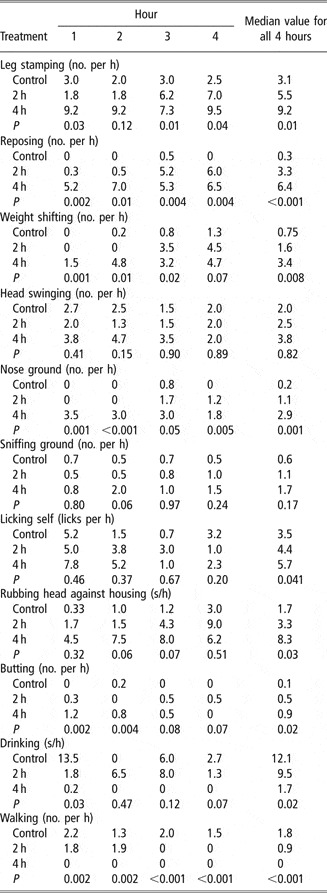
In the deprived cows, the frequency of leg stamping during hours 3 and 4 was approximately double that of the control group and this behaviour increased overall with duration of deprivation (Table 3). Repositioning was not observed, nor weight shifting to any major extent, for the cows in treatment C or treatment 2-h when not deprived, but both behaviours were performed more frequently during deprivation, especially repositioning. These behaviours increased overall with duration of deprivation. Head swinging, sniffing the ground and self-licking were not significantly affected by treatment. Nosing the ground was only observed in treatment C cows in hours 3, but occurred in treatment 4-h cows and, to a lesser extent, in treatment 2-h cows during deprivation. The frequency of cows rubbing their heads against the housing increased overall between treatments with length of deprivation. Butting was rare outside deprivation, and was increased more overall for cows in treatment 4-h than in 2-h. Time spent drinking and the number of times cows were observed walking were both reduced by deprivation, particularly for cows in treatment 4-h. The number of vocalisations was increased by deprivation, particularly for cows in treatment 4-h (median: 0, 0.1 and 0.5 vocalisations per 4 h for cows in treatments C, 2-h and 4-h, respectively, P = 0.004). The time spent sleeping was reduced by deprivation (median: 3.5, 2.5 and 0 s per 4 h for cows in treatments C, 2-h and 4-h, respectively, P = 0.008).
The median frequency or duration of each behaviour recorded continuously in hours 1 to 4 of the deprivation period, and for the 4 h, for cows in control, 2-h and 4-h treatments

Leg stamping was correlated (P < 0.05) with head swinging in treatments C (CC, correlation coefficient, +0.92) and 2-h (CC +0.79). Sniffing the ground was correlated (P < 0.05) with leg stamping and repositioning in treatments 2-h (CC +0.59) and 4-h (CC +0.59) and rubbing head against housing in treatment 2-h (CC +0.61).
Post deprivation
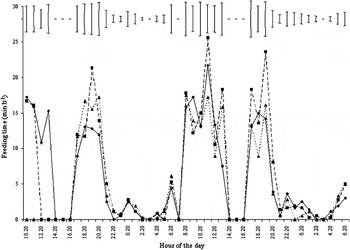
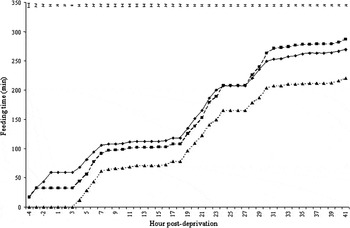
The first meal post-treatment was longest for treatment 4-h cows (median 27 min) compared with cows in treatments C (median 20 min) and 2-h (median 19 min) (P < 0.001). The first lying bout was longer for cows in treatment 4-h (median 79 min), and, to a lesser extent, for cows in treatment 2-h (median 61 min), compared with cows in treatment C (median 51 min) (P = 0.003). The feeding time in the first 8-h post deprivation was longest for cows in treatment 4-h (median 115 min) and, to a lesser extent, for cows in treatment 2-h (median 98 min) compared with cows in treatment C (median 73 min). The main feeding bout during this first 8-h period occurred between 1620 and 2220 h (Figure 1). The cumulative feeding time was restored for cows in treatment 2-h by 24 h post deprivation (Figure 2). Cows in treatment 4-h did not compensate for lost feeding time during deprivation over the 41-h post-deprivation period (Figure 2).
The mean time (min/h) spent feeding for all the experimental animals in the control (⧫), 2-h deprivation (▪) and 4-h deprivation (▴) treatments for the 4-h deprivation period (1020–1420 h) and 40-h post-deprivation period (I = 1 s.e.d.).

The accumulated feeding time (min) for cows in the control (⧫), 2-h deprivation (▪) and 4-h deprivation (▴) treatments for the 4-h deprivation period (h – 4 to – 1) and post-deprivation period (hours 1 to 40), (I = 1 s.e.d. between two means) in experiment 1.

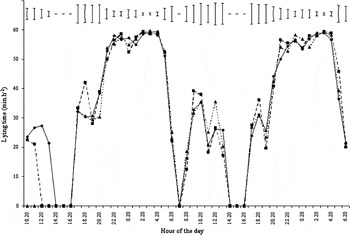
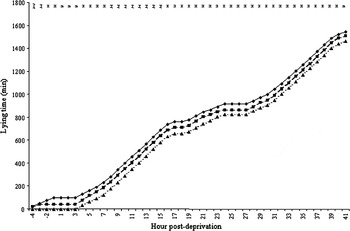
Neither standing nor lying time were significantly affected by treatment in any of the 8-h periods post-deprivation (P > 0.05), but there was one recording (at 1820 h), soon after the end of deprivation, when the cows in treatment 4-h tended to increase their lying time (Figure 3). The absence of restoration of lying at other times of the day meant that the cumulative lying curves were parallel for the three treatments (Figure 4).
The mean time (min/h) spent lying for all the experimental animals in the control (⧫), 2-h deprivation (▪) and 4-h deprivation (▴) treatments for the 4-h deprivation period (1020–1420 h) and 40 h post-deprivation period (I = 1 s.e.d.).

The accumulated lying time (min) for cows in the control (⧫), 2-h deprivation (▪) and 4-h deprivation (▴) treatments (I = 1 s.e.d.) for the 4-h deprivation period (hours –4 to –1) and post-deprivation period (hours 1 to 40), (I = 1 s.e.d. between two means) in experiment 1.

Milk production
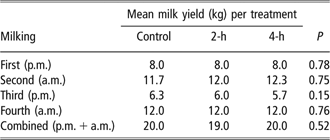
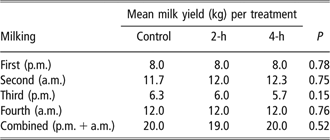
There were no significant effects on milk yield at any of the four milkings post treatment (Table 4). However, there were positive correlations (P < 0.05) between milk yield and the incidence of leg stamping (CC +0.60) and weight shifting (CC +0.70). For cows in treatments C and 2-h, there were negative correlations between milk yield and time spent lying (CC −0.50 and −0.49, respectively, P < 0.05), and there were tendencies for positive correlations with the incidence of head swinging (CC +0.45 and +0.41, respectively, P < 0.10).
Mean post-deprivation milk yields (kg) for cows in the control, 2-h and 4-h treatments in experiment 1
Experiment 2
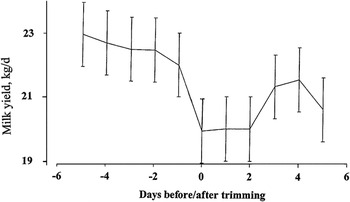
Mean milk yields were 22.6 kg/day for the 5 days before trimming and 20.8 kg/day for the 5 days after trimming. Milk yield was reduced by about 2 l/day for 2 days after foot trimming, and on the day of trimming (Figure 5). Subsequently, there was a recovery for 2 days after which milk yield appeared to resume to its normal pattern of decline. There was no difference in the mean ± s.e. walking rate before and after trimming (before: 0.82 ± 0.096; after: 0.82 ± 0.136 m/s) or in the stepping rate of cows before and after trimming (before: 1.44 ± 0.063; after: 1.40 ± 0.043 steps per min).
Milk yield before and after trimming.

Discussion
Deprivation period
In experiment 1, cows in the control treatment lay and fed for 100 and 59 min, respectively, over the 4 h, which was therefore likely to be similar to the actual amount of lying and feeding that treatment 4-h cows were deprived of. Similarly, treatment 2-h cows would have been deprived of 45 and 26 min lying and feeding, respectively. Both treatment 2-h and 4-h cows replaced lying and feeding almost equally with standing not ruminating and standing ruminating during the deprivation period. Munksgaard and Simonsen (Reference Munksgaard and Simonsen1996) reported that cows spent the majority of their time standing ruminating when deprived of lying. Overall, the proportion of time spent ruminating was similar for the cows in treatments C, 2-h and 4-h (41%, 45% and 42%, respectively), which contrasts with the results of a similar, previous experiment (Cooper et al., Reference Cooper, Arney and Phillips2007), in which the time spent ruminating by cows when deprived of only lying decreased with increasing deprivation time. In this previous experiment, the cows had access to feed during lying deprivation, and primarily replaced lying with feeding.
Cows responded to the deprivation of lying and feeding in this experiment by leg stamping, repositioning and weight shifting, which has been observed previously as a response to lying deprivation (Ruckebusch, Reference Ruckebusch1974; Hopster et al., 2002). The frequency of these behaviours remained approximately constant over the course of the deprivation period for both treatments, suggesting that either any discomfort caused did not increase over time, or that they were not effective coping mechanisms. Butting, although rarely observed, was more frequently performed by cows in treatments 2-h and 4-h. Behaviours such as leg stamping, repositioning and weight shifting may enable the cow to cope with forced standing by alleviating strain on the legs and hoofs. Butting is more likely to be a behavioural expression of frustration, representing an attempt to cope with a negative situation (Sandem et al., Reference Sandem, Braastad and Boe2002). Butting has been previously observed in response to food deprivation in cows (Sandem et al., Reference Sandem, Braastad and Boe2002). The ability of the deprived cows to see other cows eating may have increased the frustration, and may not necessarily occur if cows were isolated for treatment. In addition, the increased butting activity may have partly been due to being confined during deprivation.
Deprived cows were observed to nose the ground at the place where food was usually presented, suggesting that they may have been searching for food. In Cooper et al. (Reference Cooper, Arney and Phillips2007) we reported that lying-deprived cows sniffed the ground more, but this was interpreted as intentional lying behaviour. Nosing the ground was not observed when cows were deprived of lying only (Cooper et al., Reference Cooper, Arney and Phillips2007), as food was available. Nosing the ground in cows may be the equivalent of beak-wiping in chickens, which is performed when they are prevented from feeding (Preston, Reference Preston1987). It seems likely that the motivation to feed was constant throughout the deprivation period, as the frequency of this behaviour did not differ between hours. The increase in nosing the ground, leg stamping, repositioning, weight shifting and butting over time indicates increased activity with deprivation, which has also been observed in chickens (Webster, Reference Webster2000), turkeys (Hocking et al., Reference Hocking, Maxwell and Mitchell1999) and pigs (Day et al., Reference Day, Kyriazakis and Lawrence1995). Typical responses are increased pacing and non-nutritive pecking in fowl, and increased aggression and rooting behaviour in pigs. The increased activity, with the exception of nosing the floor, was probably related to frustration, rather than food seeking, since it was also observed when cows were deprived of lying only (Cooper et al., Reference Cooper, Arney and Phillips2007), and food restriction alone does not increase locomotion in pigs (Day et al., Reference Day, Kyriazakis and Lawrence1995).
Sniffing the ground was positively correlated with leg stamping and repositioning when cows were in treatment 2-h and 4-h, suggesting that the inability to lie down led to frustration. Over the entire deprivation period, the cows rubbed their heads against the housing more when they were deprived of lying and feeding for 4 h than for 2 h. Other research has found that cattle deprived of lying interacted with their surroundings more frequently, i.e. licking or chewing stall fixtures (Munksgaard and Simonsen, Reference Munksgaard and Simonsen1996; Munksgaard et al., Reference Munksgaard, Ingvartsen, Pedersen and Nielsen1999), reflecting a possible need to compensate for a lack of stimulation (Munksgaard and Simonsen, Reference Munksgaard and Simonsen1996).
Cows deprived of lying and feeding for 4 h slept and drank less. Reduced sleep is associated with stress in other species (Abou-Ismail et al., Reference Abou-Ismail, Burman, Nicol and Mendl2007) and drinking has also been observed in food-deprived chickens (Preston, Reference Preston1987), pigs (Day et al., Reference Day, Kyriazakis and Lawrence1995) and sheep (Cockram et al., Reference Cockram, Kent, Waran, McGilp, Jackson, Amory, Southall, O’Riordan, McConnell and Wilkins1999). Water is required while eating to prepare a bolus of the correct moisture content for swallowing and after feeding to clear the mouth of debris, but is also required to maintain a constant osmolarity of rumen contents. In treatment C, the cows spent the most time drinking in the first hour, which is also when they spent the most time feeding. There was no treatment effect on self-licking, in contrast to some studies in which this increased during lying deprivation (Munksgaard and Simonsen, Reference Munksgaard and Simonsen1996; Munksgaard et al., Reference Munksgaard, Ingvartsen, Pedersen and Nielsen1999), but not all (Cooper et al., Reference Cooper, Arney and Phillips2007). However, both Munksgaard and Simonsen (Reference Munksgaard and Simonsen1996) and Munksgaard et al. (Reference Munksgaard, Ingvartsen, Pedersen and Nielsen1999) deprived cows of lying for 14 h/day over several weeks, and the oral behaviours observed by Munksgaard et al. (Reference Munksgaard, Ingvartsen, Pedersen and Nielsen1999) did not increase until week 3. Munksgaard and Simonsen (Reference Munksgaard and Simonsen1996) recorded an associated increased concentration of ACTH in the first hour of deprivation, but others have suggested that these orally centred body-care activities are induced by oxytocin (Van Erp et al., Reference Van Erp, Kruk and De Kloet1993), which remains high for several minutes after cessation of milking (Mayer et al., Reference Mayer, Schams, Prokopp and Worstoff1984). The increased rumination in deprived cows may have decreased the motivation for grooming.
Post deprivation
During the first 8-h post deprivation, compared with treatment C, cows in treatments 2-h and 4-h increased their feeding time and not the time spent standing or lying, indicating that the motivation to feed was greater than to lie down after being deprived of both. This is in agreement with Ruckebusch (Reference Ruckebusch1974), who also found that cattle chose to feed immediately after being deprived of lying and feeding for 14 and 22 h/day. Munksgaard et al. (Reference Munksgaard, Jensen, Pedersen, Hansen and Matthews2005) found that cattle experienced less of a proportional reduction in feeding than lying time during deprivation for 12 h/day for 18 days, and that a reduction in feeding time can be ameliorated by an increase in feed intake rate. There was limited evidence that the more time-restricted cows learnt to prioritise feeding during the early stages of this experiment.
The prevention of feeding by cows in treatments 2-h and 4-h resulted in the greatest increase in feeding time, compared to treatment C, during the first 8 h post deprivation, in comparison to any other 8-h period. During this time the cows in treatments 2-h and 4-h compensated for about 94% (31 min) and 47% (28 min), respectively, of their lost feeding time. This rebound indicates that the motivation to feed builds up significantly after only a few hours of deprivation, but the extent of feeding may be limited by the gastrointestinal capacity, since cows deprived for 4 h did not feed for significantly longer time than those deprived for 2 h, and cows and pigs deprived for longer periods (14 and 20 h, respectively) have also been observed to only increase feeding time by 2 to 3 h immediately post deprivation (Ruckebusch, Reference Ruckebusch1974; Beattie et al., Reference Beattie, Burrows, Moss and Weathercup2002). Besides gastrointestinal capacity, there is the possibility that biting rate or bite mass was increased, as previously observed in cows (Patterson et al., Reference Patterson, McGilloway, Cushnahan, Mayne and Laidlaw1998), sheep (Iason et al., Reference Iason, Mantecon, Sim, Gonzalez, Foreman, Bermudez and Elston1999) and pigs (Day et al., Reference Day, Kyriazakis and Lawrence1995) after fasting.
Milk production
In experiment 1, the absence of any effect on milk yields suggests that the increase in feeding time post-treatment was successful in maintaining feed intakes to sustain milk production. Any reduction in milk yield following lying deprivation is small and short-lived (Munksgaard and Løvendahl, Reference Munksgaard and Løvendahl1993; Verkerk et al., Reference Verkerk, Fisher, Morrow and Mathews1999; Cooper et al, Reference Cooper, Arney and Phillips2007). In experiment 2, the major reduction in milk yield suggests that the foot trimming caused stress, but of lesser magnitude than relocation stress, which was observed to cause a 10 kg/day yield reduction for 3 days (Varner et al., Reference Varner, Johnson, McDaniel and Mochrie1983). More minor stressors cause less effect – tuberculin testing has been observed to reduce milk yield by 1 kg/day (King, Reference King1976) and visitor disturbances resulted in reduced yield by 0.5 kg/day (King, Reference King1978), both of these for about 2 days. Other researchers have found that a single hoof trimming either improved milk production in late lactation (Tanaka et al., Reference Tanaka, Onashi, Tanida and Yoshimoto1994) or it did not significantly adversely affect the milk yield of a small sample of cows with healthy hooves (Nishimori et al., Reference Nishimori, Okada and Ikuta2006). The benefits of improved hoof health and frictional properties following trimming (Phillips et al., Reference Phillips, Coe, Colgan, Duffus, Ingoldby, Pond and Postlethwaite1998) may provide long-term improvements in the ability of cows to feed, whereas the short-term impact may be a reduction in milk yield as a result of stress.
Conclusions
Depriving lactating dairy cows of the ability to lie and feed for 2 to 4 h increases the time ruminating, but they will also spend an approximately equal amount of time to ruminating just standing. Behaviours indicative of discomfort, frustration and tiredness: leg stamping, butting, repositioning themselves and weight shifting – quickly develop, and are at a greater frequency in a 4 h deprivation than in a 2 h one. Nosing the ground may develop as a lying intention and rubbing the head against the housing was increasingly frequent as the length of deprivation increased. Following deprivation, cows deprived for just 2 h restored their feeding time but not lying time. Cows deprived for 4 h did not restore feeding or lying time. Milk yield was transiently affected by the deprivation, but only when a 4 h deprivation was accompanied by an event that is likely to be stressful, foot trimming, and lasted for 3 days. The well-being of dairy cows is therefore likely to be reduced by temporary deprivation of food and lying, and milk production is likely to be affected if deprivation is accompanied by a stressful procedure.
Acknowledgements
The authors acknowledge the provision of a postgraduate studentship for MDC and facilities for the experiment by Moulton College, a Universities Federation for Animal Welfare research grant and formal supervision for MDC by Dr L Sinclair, Harper Adams University College.