Hardly any aspect of Roman life was unaffected by the new order established by the young Octavian/Augustus.Footnote 1 This paper considers how it affected provincial coinages. The material and iconographic changes to provincial coinages can provide further insights into the transformations that were taking place, from the point of view of those civic élites of the Empire who were responsible for their production. The changes were, at least in part, adumbrated under Caesar and Mark Antony, and they continued and developed throughout the reigns of the Julio-Claudian emperors, but the real turning point can be seen to be the reign of Augustus.
The initial sections of this article provide an overview of the coinages (i) and the extent to which imperial interventions were made during the late first century b.c. and first century a.d., especially under Augustus (ii). Subsequent sections discuss the way that Augustus and his successors were identified on the coinages, both in words (iii) and in images (iv), before looking at other ways in which the designs used on the coinages were transformed (v). Section vi analyses the extent to which the coin denominations changed from local to Roman ones. A final section (vii) draws these themes together.
I OVERVIEW OF THE MATERIAL
The coins considered here are almost all low-value bronze coins, made by many hundreds of cities in the Roman Empire:Footnote 2 some 420 (240 in the East) in the Julio-Claudian period and 200 in the Flavian period.Footnote 3 In many ways these imperial coins were just a continuation of the great mass of coinage, especially of bronze (most civic silver had come to an end in the course of the first century b.c.), that had been produced throughout the Roman world in the Hellenistic period, both pre- and post-Roman conquest. Hellenistic coins mostly bear designs that refer to the cults of the cities that produced them, such as Zeus and Asclepius at Pergamum — typically a head of a deity on one side and a standing figure on the other. The transition from royal to Roman rule is generally impossible to detect, as the coins rarely bear any visible reference to the change in political circumstances. Scholars must use other chronological arguments like style or the dating evidence provided by hoards to determine on which side of the conquest any particular issue lies.Footnote 4
Some changes started to take place during the short reigns of Caesar and (in the East) of Mark Antony. But it was only with the reign of Augustus, in particular, and those of his immediate successors, that changes started to take place on a substantial scale, and give the ‘Roman provincial coinage’ a character and development that is lacking in its Hellenistic and Republican period predecessors. The coins, again mostly of bronze, continued to be produced in small quantities and at irregular intervals. By contrast the mint of Rome produced massive quantities of gold, silver and bronze on a fairly regular basis. Provincial coins were not of any great individual economic or monetary significance, although they did in aggregate provide much of the small change of the Empire, especially in the East. A very few issues were, however, produced on a sufficiently large scale to justify the view that their origin lay with the Roman provincial authorities rather than the local civic élites.Footnote 5 In Gaul and other northern parts of the Roman world, the coins were made by tribal communities,Footnote 6 but in the Mediterranean lands of the Empire they were produced in cities, of various statuses, including colonies and municipia. Coins of colonies and municipia normally used Latin, and other cities Greek, but there are some very rare exceptions; neo-Punic is also found at some cities in the Roman province of Africa.Footnote 7 There are also many puzzles, such as the question of why the coinage of Antioch in Syria used Greek on silver, but (normally) Latin on bronze.
Provincial coinage typically, but not always, featured a portrait of the emperor or an empress on the obverse side and an image, often religious, on the reverse side that referred to the issuing city in some way. As for the inscriptions, we usually have the name of the ruler on the obverse, and on the reverse the name of the issuing city, and sometimes a local official or person.
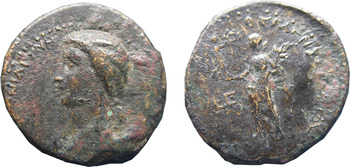
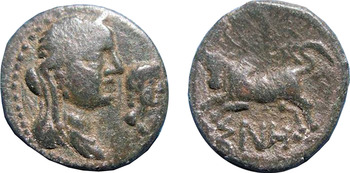
A flavour of the character and diversity of the coinage can be given by taking four different examples, using the particular to characterize the general (with the over-simplification implied).
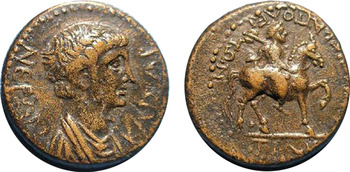
Bronze, 18 mm.Footnote 8
Obverse: ΝΕΡΩΝ ΚΑΙΣΑΡ; draped bust of Nero to right.
Reverse: ΤΙ ΔΙΟΝYΣΙΟΣ ΙΕΡΑΠΟΛΙΤΩΝ; Apollo on horseback to right, with double axe over shoulder.
The obverse is self explanatory: a youthful portrait of the emperor with some drapery, and a short inscription in Greek for the Latin form Nero Caesar.
On the reverse we have the depiction of a male figure on horseback, holding a double axe over his shoulder. We know that this is a depiction of Apollo, who was the principal deity of Hierapolis, and who appears in different ways on the coinage.Footnote 9
On this coin, we also have a personal Greek name, with two elements, Ti(berios) Dionysios, and the name of the people of the city, in the genitive plural as had always been normal on Greek coins. We know nothing about Dionysios other than his name. At Hierapolis we have seven personal names on coins of Nero's reign, continuing the tradition of Hellenistic and earlier imperial coins of the city, on which one finds many personal names. One of the other Neronian examples describes himself as ΓΡ for γραμματεύς, and the same civic magistracy appears on Hierapolitan coins of Augustus (in one case ΓΡΑΜΜΑΤΕYΣ ΔΗΜΟY) and of Claudius. So it may be that all the names represent members of a board of Secretaries under a senior People's Secretary, but we cannot be sure. Nor do we know why in each case the names of these men (and occasionally women) appear on the civic coins of the provinces: were they the civic officials responsible for the production of the coins? Did they donate the cost of the coinage? Or do they just appear as eponymous magistrates? Are they a wider mixture of people drawn from the city élites?Footnote 10 In some cases, e.g. Hierapolis, we can make informed guesses, but more often we just do not know.
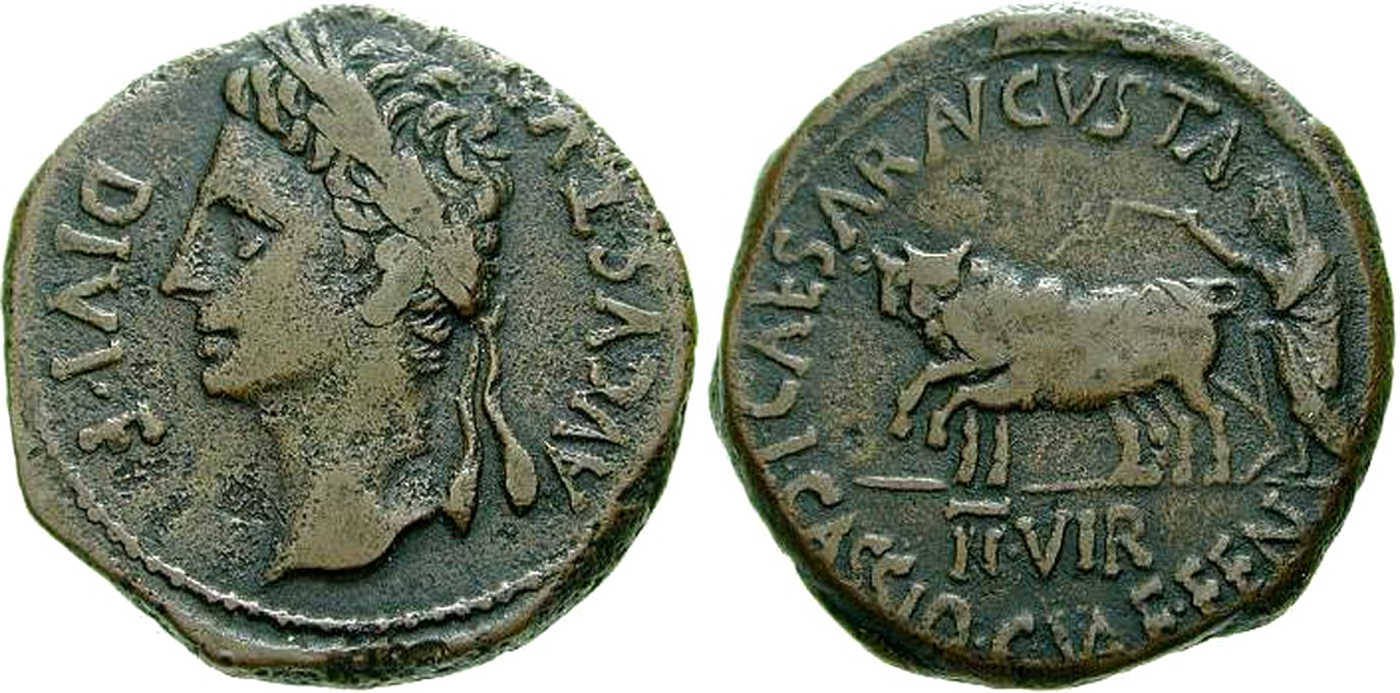
Bronze, 28 mm.Footnote 11
Obverse: AVGVSTVS DIVI F; laureate bust of Augustus to left.
Reverse: CAESARAVGVSTA; L CASSIO C VALE FEN II VIR; priest ploughing left.
The obverse has the laureate portrait of the emperor with the Latin inscription, Augustus divi f (‘Augustus, son of the divine’).
On the reverse we have the ploughing scene that occurs on the coinage of many colonies. It depicts the sacred laying out of the colony's territory by the commissioner who ploughed the sulcus primigenius, the first furrow.Footnote 12 The commissioner has his toga drawn up over his head, in the religious manner of a Roman priest.
The inscription on the reverse refers to the name of the colony, Caesaraugusta, and also includes two personal Latin names, of L. Cassius and C. Valerius Fene(stella?). They are described as IIVIR, the duoviri who would have been the principal magistrates of the colony. The names of duoviri often appear on coins of colonies, but again it is not clear whether they are named because they are the officials responsible for the production of the coins, or if they appear just as eponymous magistrates.
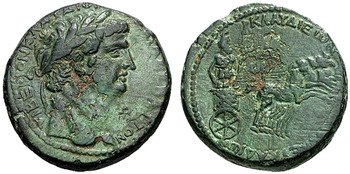
Bronze, 22 mm.Footnote 13
Obverse: ΤΙΒΕΡΙΟΝ ΚΛΑYΔΙΟΝ ΚΑΙΣΑΡΑ ΣΕΒΑΣΤΟΝ; laureate head of Claudius to right.
Reverse: ΚΛΑYΔΙΕΩΝ ΤΩΝ ΚΑΙ ΛΕYΚΑΔΙΩΝ; chariot to right, with god wearing tiara; above, letter A.
The Syrian city of Balanea was refounded as Claudia Leucas by the emperor Claudius (a.d. 41–54)Footnote 14 who is depicted here, with the inscription (in the accusative caseFootnote 15) identifying the portrait — the Greek form of Tiberius Claudius Caesar Augustus. The inscription on the reverse gives the city's new name, while the letter A is the numeral 1 and refers to the first year of the refounded city, perhaps a.d. 48. The identity of the god in the chariot is not certain, but his regular appearance on the city's coinage suggests that he was its principal deity.
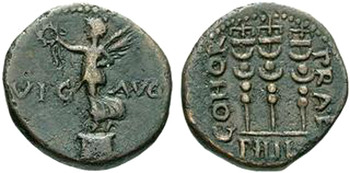
Bronze, 18 mm.Footnote 16
Obverse: VIC AVG; figure of Victory to left.
Reverse: COHOR PRAE PHIL; three military standards.
The inscriptions and designs refer to the Battle of Actium as the VIC(toria) AVG(usti) and the settlement of veterans from the Praetorian Cohort (COHOR PRAET) at Philippi (PHIL).
Coins such as this, which lack either a portrait of the emperor or of a member of his family are generally, and unhelpfully, referred to as ‘pseudo-autonomous’. This term misleadingly implies that they have a significance for civic status, and perhaps a term like ‘coins lacking imperial portrait’ would be better as it is more neutral.Footnote 17 It is true that some free cities, like Athens, Tyre or Rhodes, made coins that mostly have no imperial portrait, so there is some sense in which the phenomenon does reflect status. But it is not a strong correlation.Footnote 18 Some cities that were not free, such as Emporion in Spain, produced only coins without any portrait, whereas others that were free, such as Aphrodisias, produced coins with portraits. Many cities did, however, produce such coins with no portrait as a means of distinguishing between denominations, and one often finds small denominations that lack a portrait (such as the case with the coin of Philippi). But there are also instances where larger denominations may lack a portrait, for example at Aegeae in Cilicia. There the largest denomination lacks a portrait,Footnote 19 though it does appear on smaller denominations.
These four examples serve to give an idea of the coins produced by the cities throughout the Empire, but one should not assume that coinage was produced in a uniform way across the Empire. There were areas where little city coinage was produced, but where the existing coinage of local non-urban communities continued to circulate and be produced. These ‘Celtic’ or ‘late Iron Age’ coinages, already mentioned, were produced in many areas in the north of the Empire: in Gaul, in the northern Balkans and in Britain after the conquest of a.d. 43. With the exception of some of the coins made in Britain, probably just before the conquest, they did not, however, bear the imperial portrait, and they are very hard to date and distinguish from earlier coins.Footnote 20 They are not generally included in books on imperial or provincial coinage since they conform to a different pattern.
Even within the Mediterranean areas of the Empire where coinage such as the examples above (Figs 1–4) was produced, there were many regional differences. Personal names are rare outside the province of Asia, and the incidence of coins with family portraits, often produced, like the portrait-less coinage, as a denominational marker, is very low in an area such as the whole province of Syria.Footnote 21 Even within a geographical area one may find many variations; for example, although coins without portraits are common in Asia, none were made at Ephesus, its capital. An area such as the Jewish ‘client’ kingdom of Agrippa I, though situated in the middle of Syria, nevertheless produced coins with portraits of family members as well as coins which were close copies of other coins minted in Rome (Fig. 5). Even within the category of dependent kingdoms, there was a wide variation of the visual acknowledgement of the Roman emperors.Footnote 22
From the city of Hierapolis in Phrygia, in the Roman province of Asia (modern Pamukkale, in western Turkey).

From the colony of Caesaraugusta in the Roman province of Hispania Tarraconensis (modern Zaragoza, in Spain).

From the city of Claudia Leucas in the Roman province of Syria (modern Baniyas in Syria).

From the colony of Philippi, Macedonia (modern Filippoi, Greece).

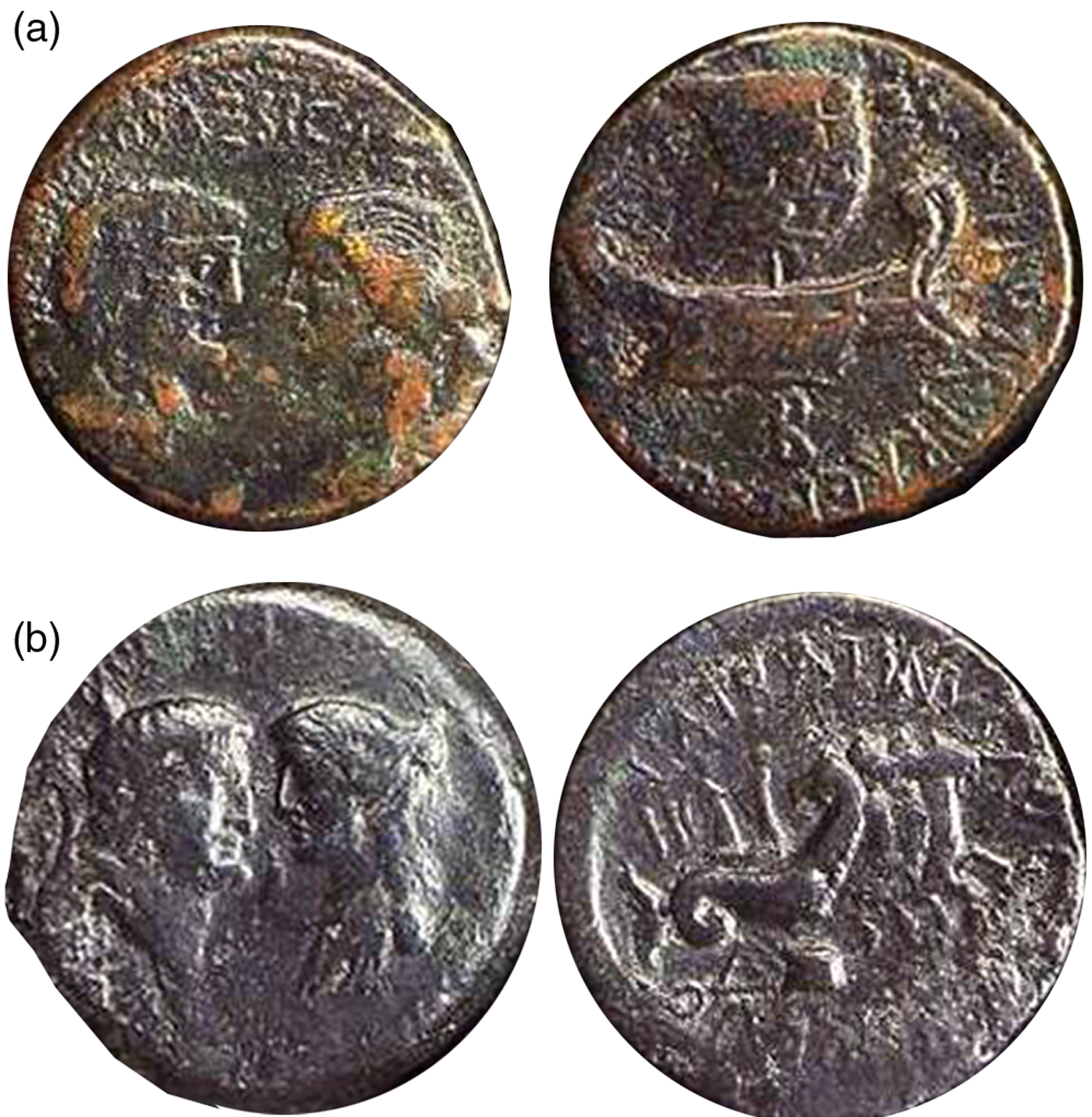
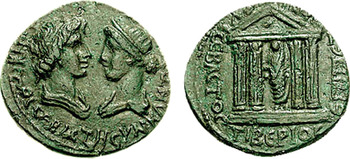
Caesonia and Drusilla, the wife and daughter of Gaius (a.d. 37–41), on a coin of Agrippa I, King of Judaea (RPC 1, 4977).

In contrast, slightly to the north, in Phoenicia, the adoption of the imperial portrait was very slow and patchy, and strange coins might be produced such as the coins of Aradus which show a small portrait of the emperor overshadowed by an enormous one of the city goddess (Fig. 6).
Tyche and Augustus on a coin of Tyre, Phoenicia (RPC 1, 4483).

These examples give a flavour of the diversity of the coinage. They all stand for patterns of greater or lesser applicability, but it remains difficult to generalize about the provincial coinage, since there are always many exceptions.
We have no direct evidence about how the system worked. Inferences have to be drawn from the surviving coins themselves. As discussed further below, their pattern shows that there was no exact ‘imperial system’ as such. Even when it comes to the diameters and weights of the coins, the two indicators which would have been most helpful for differentiating between the coins and for indicating their value, there are different patterns in different parts of the Empire. Sometimes we find patterns over a large geographical area,Footnote 23 but often, even within a single province, we may find several different patterns. This is a clear sign of local rather than central or imperial control. In our modern world of coins and coin use, we are not used to such a fluid system. To our modern way of thinking, something much more standard and controlled is the norm. The occasional references on provincial coins to seeking permission from the emperor or, occasionally, the proconsul,Footnote 24 have sometimes been used to create a similar picture of close central control. But, inasmuch as there was any such system requiring such permissions, the degree of control was clearly very limited. This is an important point, which will be developed later when we look in more detail at the inscriptions the coins bear. It also has implications for our understanding of the portraits on the coins.
II INTERVENTIONS IN THE PROVINCIAL COINAGE
The Romans were more than capable of intervening in the coinage and imposing a pattern if they wished, and every now and then there is some evidence of such interventions, though they are unusual. The demonetization of Carthaginian coinage in Italy at the end of the third century b.c., can be seen as a moral response to the devastating effect of Hannibal's invasion.Footnote 25 The lingering sense of outrage against Carthage saw, after 146 b.c., not only the destruction of the city but also of its coinage, and its substitution in the circulation of North Africa by Roman Republican denarii. Social War denarii, the coins made by Rome's ‘allies’ at the beginning of the first century b.c., rapidly disappeared from the monetary circulation of Italy.Footnote 26 Similarly, Vespasian's revocation of the ‘freedom of Greece’ proclaimed by Nero led to a cessation of civic coinage in Achaea. It was resumed only in the reign of Domitian when the coinage of Corinth proclaims that it was made PERM(issu) IMP(eratoris),Footnote 27 ‘with the permission of the emperor’, while Patras at the same time produced coins dedicated INDVLGENTIAE AVG MONETA INPETRATA,Footnote 28 ‘to the gracious favour of the emperor, for the concession of coinage’.
Similar, though less substantial interventions can be found under Mark Antony and also early in Augustus' reign. In Mark Antony's sphere of control in the eastern Mediterranean we seem to find a tentative attempt to impose a single pattern of coinage. This consists of the so-called ‘fleet coinage’, so-called because it was once thought to have been produced on board Antony's fleet (Fig. 7). In the early 30s b.c., coins were issued by three of his lieutenants:

Fleet coinage of Oppius and Atratinus (2-as and 4-as coins).
The coins were minted at three separate mints, but on approximately the same weight standards. They were produced in six denominations with the same designs in use at all three mints. Exactly where those mints were located is not certain, and until fairly recently there was no evidence. However, we now have a number of provenances which suggest that Atratinus and Capito minted at two separate locations in Greece, while Bibulus worked further east, in Cyprus or Syria.Footnote 29
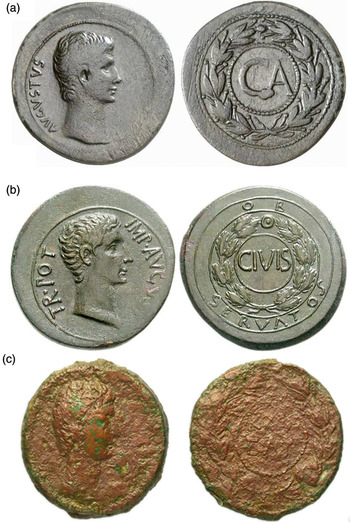
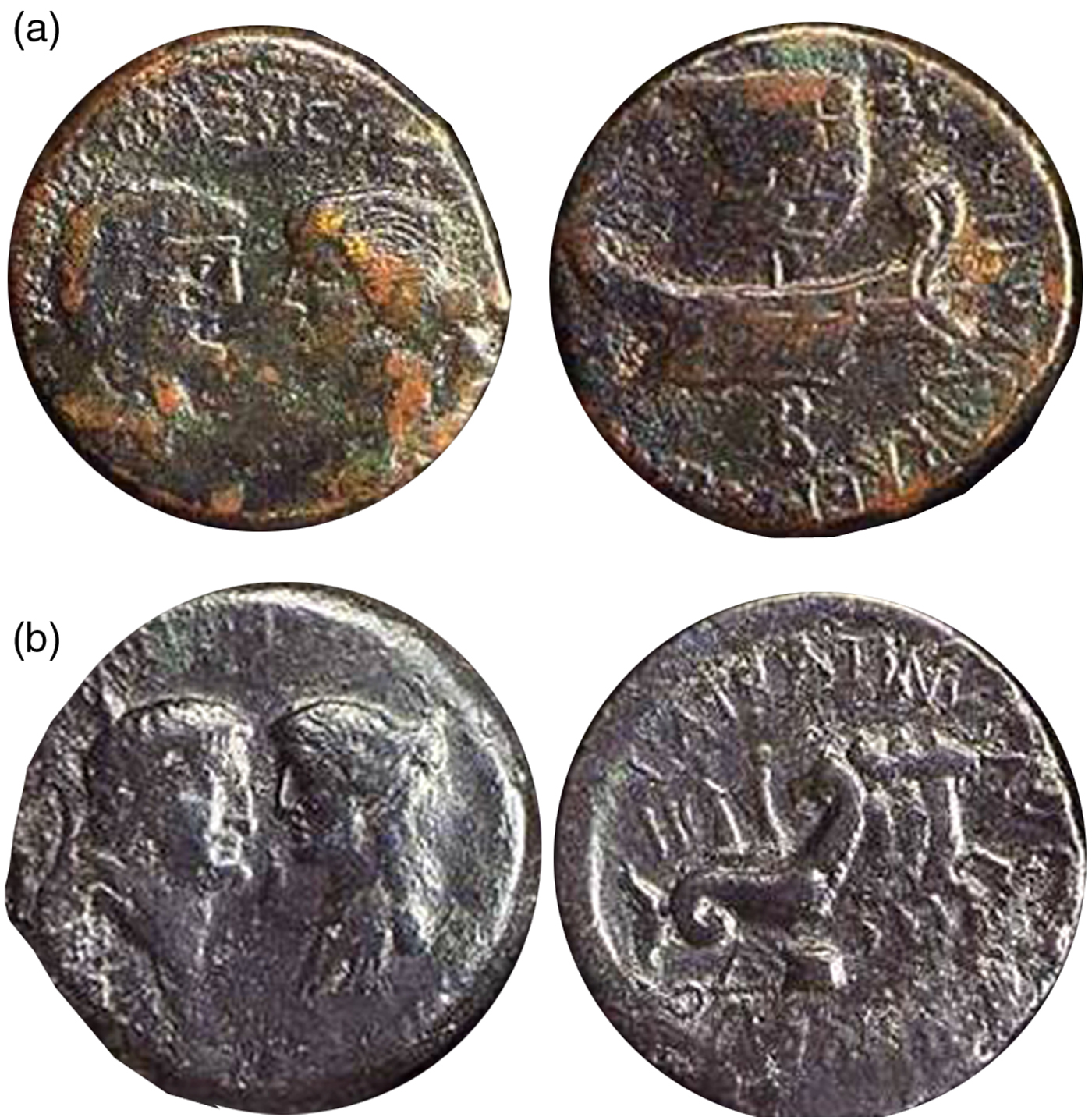
In this case we find the same pattern in very different locations — clear evidence of centralized control (even though other coinages from the same areas seem to have been allowed to co-exist with these issues). Something similar also occured at the beginning of the reign of Augustus, where we find an attempt to introduce large bronze or brass coins produced in a number of different locations. All are about 30 mm in diameter, much larger than any previous Hellenistic bronze coins, and they are normally called ‘sestertii’ today.Footnote 30 Coins of this type were minted in the following locations, including a new discovery for Egypt:
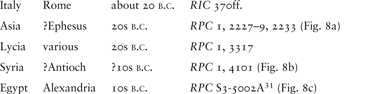
All these coins lack the name of an issuing city, and the unusual size, exactly like the newly introduced brass sestertiusFootnote 32 from Rome, suggests an experiment to introduce ‘Rome’-pattern bronze sestertii in the East. The new coin (Fig. 8c) suggests the experiment extended beyond Asia and Syria, to Egypt.
Sestertius-sized coins of Augustus from Asia (a), Syria (b) and Egypt (c).

Senate and Livia, with reverse showing Tiberius in a temple, from Smyrna (RPC 1, 2469; 22 mm).

Although both these cases, under Antony and Augustus, were short-lived and were not repeated, they do show an attempt to impose a new pattern of currency across a wide extent of the Empire. The absence of any city names on the coinsFootnote 33 is a good indication that the idea did not come from the cities, and the only other possibility is the ‘Roman authorities’, which must mean something centralized since the experiment extends over several provinces. Central intervention can also be seen several decades later, when the various silver coinages of the Empire were changed and co-ordinated as part of the Neronian coinage reform;Footnote 34 or again, as we have seen, in Achaea, at the end of Nero's reign, when all the city coinages were brought to a halt until Domitian's reign.
The main change of the Julio-Claudian period was the ending of provincial coinage in the West — in Africa, Spain, Gaul and Italy. The last city coins in Italy and Africa were made in the reign of Tiberius; in the former, the last, and almost only, city coinage was produced by Paestum. In Spain, a few cities made coins in the reign of Gaius, and the last issue was made by the community of the island of Ebusus (Ibiza) in the reign of Claudius. In Gaul, the production of coinage by tribal communities and leaders seems to have ended in the reign of Augustus.Footnote 35 There has been much discussion of the phenomenon.Footnote 36 But as it was a gradual cessation rather than a sudden end, it cannot be explained in terms of direct Roman intervention (as seems to have happened in Achaea after Nero's reign, as described above). The suggestion that it was somehow caused by the impoverishment of the provincial cities can also be discounted, since the provincial coinage was mainly of low-value coins whose aggregate value would never have been very substantial, and the evidence we have for impoverishment applies equally to the East as the West.Footnote 37
Elsewhere, it has been suggested that the change was a cultural phenomenon, the result of the wish of the provincial élites in the West to become as Roman as possible, an aspect of which would have been to use the same coins.Footnote 38 The last provincial coins in the West had already become very Romanized, in the sense of looking like coins made at Rome (both in terms of shape and size, and also of design). After the end of the provincial coinage, many copies of coins of Claudius were made in the West: in Spain, Gaul, Britain and perhaps Africa.Footnote 39 It is not clear whether they were produced privately or by city authorities to meet a shortage of small change; but either way, the choice for imitation of models from the mint of Rome, rather than coins with local designs, implies a shift in iconographic consciousness.
These exceptional cases of intervention and the process of cessation of coinage in the West help us understand the system — or rather the lack of one — that applied to the provincial coinages of the early Empire. There were only rare attempts by the Romans to intervene in civic coinages.Footnote 40 As a result, there was no empire- or even province-wide system. The conclusion must be that the inspiration for the coinages came from within the cities, no doubt from the local aristocracies that dominated them, even though they did, of course, reflect local and regional fashions. So, in the absence of anything imposed from above, we should seek to understand the words and images that we find on the provincial coins as responses by the cities to what was going on in the Empire. The diversity of approach which is described below shows that they were the choice of those in the city who controlled them, even though, as mentioned above, we are not clear exactly who those people were.
III NAMES AND TITULATURE
With this background, let us now look at first the words, and later the images, that occur on the coins and use them to investigate the way that the cities defined the identity of their rulers. The same lack of central control explains the diversity of these coinages, and we are mostly considering the identity given to the emperors by the cities, rather than that given to the cities by the emperors. The first method of investigation is simply to look at the names that the cities gave the different emperors, in Latin and in Greek.Footnote 41 These coins provide the only systematic source of evidence for the names that were typically used by the inhabitants of the Roman Empire to describe their rulers.
Augustus
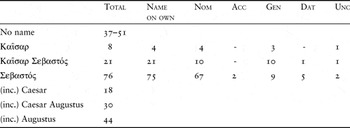
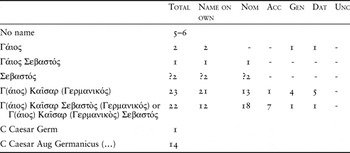
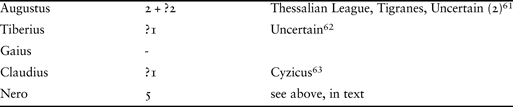
Common inscriptions on provincial coins of Augustus. The numbers represent the number of cities that used each form. (The total is sometimes smaller than the sum of the sub-totals, as sometimes the same city used more than one case.) (inc.) means that other names or titles may be included before, in or after the words given here. See caption to Table 2 for the explanation of ‘37–51’

Several things can be seen from this table. First, that quite often the emperor's portrait was accompanied by no name. This is perhaps what we might expect from the Hellenistic antecedents. The emperor's portrait (to be discussed in the next section) was adopted in place of the head of a deity, the normal pattern for the reverses of Hellenistic coins. Heads of gods were never accompanied by names on Hellenistic coins, so it is perhaps not too surprising that so many cities produced coins with no imperial name. Given that, it is, if anything, more surprising that the cities felt the need to start adding the emperor's name.
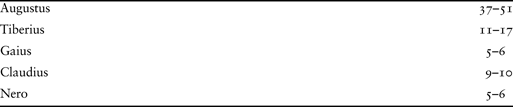
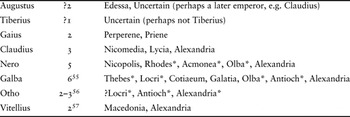
The lack of name is a chronological phenomenon. Many of the anonymous Augustus coin portraits seem to date from early in his reign.Footnote 42 Moreover, anonymous imperial portraits become progressively rarer for later emperors (Table 2).
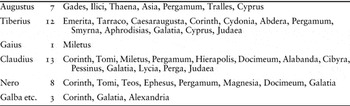
Imperial portraits on provincial coins with no accompanying names. The numbers represent the number of cities that have a portrait with no name. The uncertainties (e.g. for Augustus the figure is between 37 and 51) reflect the difficulty of identifying the head. Especially in the case of Augustus, there are several Spanish coins with a bare head that might not even be an emperor (e.g. Laelia, Irippo, Osset, Celsa); much the same is true of south-east Asia (Attalea, Sillyum, Aspendus, Mallus: also for Tiberius)
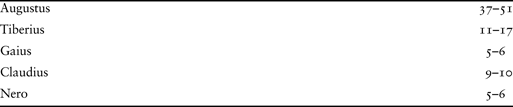
The way that anonymous portraits become rare is itself an important shift, and illustrates that, after Augustus, having a name associated with the portrait was a necessary part of imperial identity. This fits well with the tendency described by Woolf, whereby names were inscribed more with the expansion of Roman society.Footnote 43
When we look at the names, we find that Latin and Greek are really quite consistent, in that the most common way of referring to Augustus was as Augustus or Σεβαστός; Caesar Augustus and Καῖσαρ Σεβαστός were also common, but the simple Caesar or Καῖσαρ were much less usual. There is no reason to think that there is any chronological significance to these different choices, since nearly all these occurrences are after 27 b.c., when the name Augustus/ Σεβαστός was adopted. It is not obvious that there is any chronological pattern between 27 b.c. and a.d. 14, though we need to acknowledge that it would be very difficult to detect any such pattern.
One should not, however, exaggerate the similarities between Latin and Greek. Although the forms are essentially the same, as we have seen, there are also differences. Two are particularly clear. First, the Greek inscriptions on the coins nearly always consist of whole words, as set out in the table, but nothing else. In contrast, the words in the Latin inscriptions are often abbreviated and also accompanied by other titles etc.: thus, e.g., Imp Augus (Calagurris), Aug (Sicca, Dyme, Macedonia, Parium, Berytus), Augustus divi f (many instances), or the more challenging Imp C d f A p m p p (Carthage, Lepti).Footnote 44 Abbreviation was, of course, a feature of Latin names, but rare in Greek; the addition of titles to coin inscriptions is also a feature of Roman practice, as one can see from denarii of the triumviral period. Hellenistic royal coins kept things simpler and fuller: ΒΑΣΙΛΕΩΣ ΛYΣΙΜΑΧΟY.
Secondly, the use of the genitive case for Hellenistic royal coin inscriptions contrasts with what we find for Roman emperors, including Augustus.Footnote 45 From Table 1, we can see that, while we do find all cases for names of Augustus in Greek, the genitive is only a little more used than the accusative or dative, and the nominative is overwhelmingly the most common. For Latin coin inscriptions we find only the nominative, as again had been normal practice on early denarii of the late Republic. So the adoption of the nominative case for Greek inscriptions naming Roman rulers derives from Latin models.Footnote 46
A third difference is implicit in a small piece of iconography.Footnote 47 Apart from the portrait and a name, the only other thing that regularly appears on the coin obverses is a lituus. Although it does sometimes appear for later emperors, its use does seem very much to concentrate on Augustus.Footnote 48 There are no less than about thirty cities that use the lituus in conjunction with Augustus' portrait. This seems to need some explanation in itself — why is this religious symbol chosen rather than the simpulum, symbol of the priesthood and an obvious choice, particularly after Augustus became pontifex maximus in 12 b.c.? The explanation seems to lie in the association of the lituus with the augurate, and the word-play between augur and Augustus. It is surprising to find this association in the Greek-speaking world, where he was, as we have seen, nearly always called Σεβαστός,Footnote 49 and since there is not really a Greek word for augur or indeed lituus: in both cases the Latin is just transliterated αὔγουρ and lituus becomes λίτυον.Footnote 50 The frequency of its use on the provincial coinage suggests that the link augur-Augustus played a much greater rôle than is usually thought in his public image;Footnote 51 and here the significance is that this word-play could be used in Greek-speaking contexts where presumably the expectation of the coin designers was that it would not be difficult to understand.Footnote 52
Tiberius
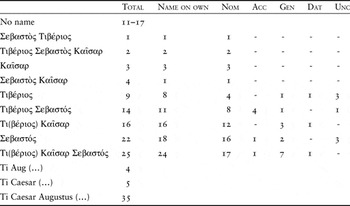
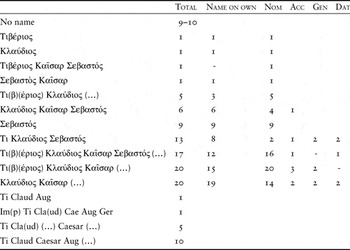
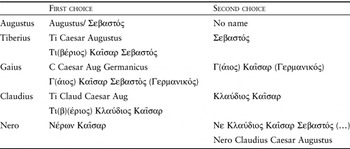
After his adoption by Augustus and during Augustus' lifetime, Tiberius is always called Τιβέριος Καῖσαρ (two cities) or Τι Καῖσαρ (ten cities) on coins.Footnote 53 After a.d. 14 we find a greater variety of forms (Table 3).
Common inscriptions on provincial coins of Tiberius. The numbers represent the number of cities that used each form. (The total is sometimes smaller than the sum of the sub-totals, as sometimes the same city used more than one case.) (…) means other titles or names are sometimes added. Letters in brackets are sometimes included, sometimes not

Latin is fairly consistent. Abbreviation and extra names or titles are used in a similar way as they were for Augustus, but it is clear that he was usually known as Ti Caesar Augustus. The use of Ti is not surprising, as a way of differentiating him from Augustus, but the common use of Caesar is perhaps less expected. If Augustus was usually known as Augustus, then one might have expected Ti Augustus to have been the most common for his successor.
When we look at the Greek forms, the pattern is much more diverse. The common use of Τιβέριος Σεβαστός, Τι(βέριος) Καῖσαρ and Τι(βέριος) Καῖσαρ Σεβαστός parallels the commonest Latin forms, but the frequent use of the simple Σεβαστός is surprising. Obviously it is just carried over from Augustus (as indeed was the portrait, as we shall see later), and so it seems that many cities were content to refer to Tiberius with the same name as his predecessor. The other points are the large number of alternatives, and the uncertainties about word order. This clearly was not a matter of concern for the coin engravers. The elements of the imperial name were more important than their sequence.
We can conclude from this that there was uncertainty about what to call Tiberius, and that, although the majority of Greek cities followed Latin forms, a very substantial minority departed from Latin practice and just transferred Augustus' title to his successor. Finally, we should note that we find the Latinate abbreviation Τι in Greek inscriptions at five cities.
Gaius
Gaius appears only twice under Tiberius (at Carthago Nova and Caesaraugusta) and on both occasions his portrait is named C Caesar (or something longer).Footnote 54 He does not appear on Greek coins during this period. From a.d. 37 we find the forms in Table 4 below.
Common inscriptions on provincial coins of Gaius. The numbers represent the number of cities that used each form. (The total is sometimes smaller than the sum of the sub-totals, as sometimes the same city used more than one case.) (…) means other titles or names are sometimes added. Letters in brackets are sometimes included, sometimes not

The table shows that Gaius was consistently called C Caesar Aug Germanicus by Latin-speaking communities. As with Tiberius, the situation is less clear with Greek communities, although, apart from the inclusion or non-inclusion of the word Σεβαστός, the inscriptions usually follow the Latin form. But they are less certain of the word order: hence Γ(άιος) Καῖσαρ (Γερμανικὸς) Σεβαστός. Σεβαστός on its own, so common under Tiberius, does not certainly occur. More interesting is the relatively frequent use of the abbreviation Γ for his praenomen Γάιος, which occurs at as many as eight cities (nine if we add the slightly longer form Γαι at Eresus). This is more than the abbreviated Τι found for Tiberius, and shows that Greek-speaking communities were now systematically using a Latin-style abbreviation for the emperor's praenomen.
There are also two instances of the inclusion of the title word Αὐτοκράτωρ as part of the inscription, at Perperene and Priene. This seems a relatively high number, given the rarity of coins for this emperor. Imperator had been used as a praenomen by Augustus but then not again by an emperor until Nero, towards the end of his reign. The incidence of αὐτοκράτωρ on provincial coins is shown in Table 5.
The incidence of Αὐτοκράτωρ on provincial coins. The numbers represent the number of cities that have a portrait with no name (*= as praenomen)

From this table, we can conclude that the title is probably not used on provincial coins before the reign of Gaius, and is only occasionally used for Claudius and Nero. Although Nero's adoption of the title as his praenomen in a.d. 66 might have been expected to have some greater impact, this was not the case, perhaps because the adoption took place late in his reign. However, it is very commonly used for all of Galba, Otho and Vitellius.
Claudius
Common inscriptions on provincial coins of Claudius. The numbers represent the number of cities that used each form. (The total is sometimes smaller than the sum of the sub-totals, as sometimes the same city used more than one case.) (…) means other titles or names are sometimes added; in the case of Claudius this is usually some form of Germanicus or Γερμανικός. Letters in brackets are sometimes included, sometimes not

The pattern for Claudius is similar to that for Gaius. In Latin he was most commonly called Ti Claud Caesar Aug, and this was also a common form in Greek, although the shorter form, without Σεβαστός, was slightly more common (the same tendency not to include Σεβαστός that we noted for Gaius). As previously, there is uncertainty about the word order.
The large number of occurrences of Κλαύδιος Καῖσαρ is very striking, and continues the form Γάιος Καῖσαρ from the previous reign. Σεβαστός on its own is quite common, though relatively less so than, say, under Tiberius. The use of abbreviated praenomen in Greek continues: T (1)Footnote 58, particularly Τι (30) and Τιβ (5) all occur, alongside the fuller Τιβέριος.
Nero
Towards the end of the reign of Claudius, the young Nero appears on coins of several cities. In Latin (three cities) he is always Ne(ro) Cla(ud) Caes (…); the Greek equivalent Νέρων Κλαύδιος Καῖσαρ (…) also occurs at three cities, Νέρων on its own at one, and Νέρων Καῖσαρ (…) is the most common, occurring at six.Footnote 59
From a.d. 54, we find the forms in Table 7 below.
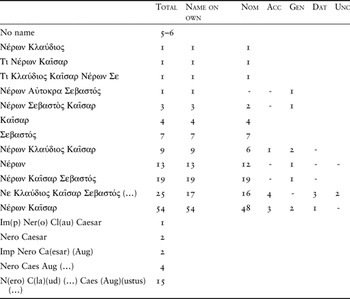
Common inscriptions on provincial coins of Nero. The numbers represent the number of cities that used each form. (The total is sometimes smaller than the sum of the sub-totals, as sometimes the same city used more than one case.) (…) means other titles or names are sometimes added. Letters in brackets are sometimes included, sometimes not

Although there are many variants of abbreviation and inclusion of extra words like Germanicus and Imp, the pattern for Latin inscriptions for Nero is fairly consistent, and indicates that he was generally referred to as Nero Claudius Caesar Augustus. The instances with the imperatorial praenomen presumably date to the end of his reign but they otherwise retain the same general form of name.
In Greek, as previously, there is greater variety, though Νέρων, Νέρων Καῖσαρ Σεβαστός and Νε Κλαύδιος Καῖσαρ Σεβαστός are common, and all derive more or less from the principal Latin form. The exception is Νέρων Καῖσαρ, which is the most frequent, as it had been when Nero appeared in Claudius' reign, and it is much more dominant than the similar form Κλαύδιος Καῖσαρ found for his predecessor. One hesitates to think that we should make any association of this emphasis on a Greek form with Nero's philhellenism. Σεβαστός, though it continues to occur, is relatively less common than it had been for Claudius.
There are five instances of Nero being described as a god: at Sicyon (as Zεύς Ἐλευθέριος), Nicopolis (Νέρων Ἀπόλλων), Cyme (θέος), Laodicea (θέος), and Synaus (θέος).Footnote 60 A divine title had possibly been used for some of the earlier emperors but the evidence is uncertain (Table 8).
The ascription of divinity to the emperor during his lifetime on provincial coins. The numbers represent the number of cities
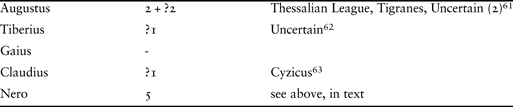
Even including Nero, there are very few examples of emperors being likened to a god on provincial coins, in marked contrast to female members of the imperial house, who are regularly described as θεά or such like (e.g. Livia appears as Ἣρα at three cities and as θεά at another three; Agrippina II is θεά at eight cities).Footnote 64
Summary and Trends
The most commonly used name for each emperor is shown in Table 9.
The names most commonly used for each emperor on provincial coins

The detailed examination of the inscriptions used in the Julio-Claudian period points to the following trends:
1. At first, the emperor's portrait was often unnamed, but this became rarer.
2. Latin inscriptions were more consistent than Greek, but they tended to have more abbreviations and extra titles and names.
3. Under Augustus, both Latin and Greek inscriptions tended to be very simple, most commonly with only one element. Greek ones followed much the same formula as Latin ones, although the legends tended to include more names and titles.
4. From Tiberius onwards, names tended to get longer, in both languages (but less so in Greek: see 5), often having three elements.
5. From Tiberius onwards, Greek names tended to be of two main sorts. As under Augustus, we find a Greek version of the Latin formula, i.e. often with three or sometimes four elements; but we also find (usually more commonly) a simpler inscription, with one or two elements, in the form either Σεβαστός or xxxx Καῖσαρ.
6. The Greek version of the Latin formula was most common for Tiberius, Gaius and Claudius; but for Nero, the simpler version prevailed (Νέρων Καῖσαρ).
7. Latin habits like abbreviation and the addition of other names became more common in Greek inscriptions, particularly after the reign of Tiberius.
8. The word order of Greek versions of Latin formulae was quite often confused.
9. Titles like αὐτοκράτωρ and θέος are very rare, in contrast with the relatively frequent use of titles like θεά for empresses.
The great variety of forms and the variety of trends that can be observed, show clearly that there was no ‘central’ attempt to impose a particular form of the emperor's name on the provincial cities. Yet it is important to remember that these coins were public, not private, artefacts: the designs were chosen by members of each city's élite for the city's official coinage. They are not equivalent to some casual set of graffiti that show ordinary people might refer to emperors however they wished. Rather, there was, it seems, no difficulty in civic élites choosing differing and inconsistent forms for their official coinage.
IV IMPERIAL PORTRAITURE
The other main element of imperial identity is the portrait; here only the main points will be discussed.
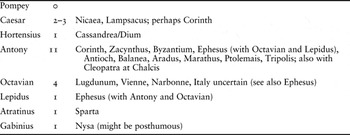
The first, and in a sense obvious, point is that most provincial coins have an imperial portrait. But the adoption of the emperor's portrait represents, in fact, a revolution in the history of ancient coin design. Hellenistic kings had indeed often placed their portraits on the royal gold and silver coins they issued themselves. By contrast, the cities in their kingdoms, which also produced large amounts of coinage, mostly bronze but also silver, only rarely produced issues bearing the king's portrait. There are some exceptions such as the municipal coinage of Antiochus IV of Syria,Footnote 65 but normally the city coinage shows no sign of the king. The same holds true for the Roman world before Augustus; the vast amounts of silver denarii made in Rome or low-value bronze coinage made in, for example, Roman Achaea or Roman Asia during the Republican period refer to no individuals. Even from the era of Caesar, when portraits of Roman leaders started to appear on aurei and denarii, they are still in the minority of designs. The cities controlled by Roman leaders produced some silver and many bronze coins, but again only exceptionally with their portrait. For Caesar, in his lifetime, we find only two or three instances; for Octavian four; Antony has a few more.Footnote 66
Portraits of Roman rulers on provincial coins before Actium

So portraits did occur, but they were very exceptional. There is a complete change under Augustus. The adoption of his portrait becomes standard, and appears at over 200 cities. In the words of Fergus Millar (referring to the provincial coinage):
we should not minimize the colossal change which had come over the symbolic character of the coinage … What we have is … a set of visible and uncontrovertible examples of how people construed the world in which they lived.Footnote 67
Unfortunately, we do not know exactly when Augustus' portrait came into widespread use, and we have no direct evidence about the mechanism which brought about the change. First, the date. It is very hard to date the individual coin issues. In a few cases we can see that portraits were made soon after Actium, but generally speaking, there are only five to ten cases that can be dated securely before about 20 b.c. However, we should remember that civic coinages were minted intermittently rather than continuously. On the basis of the data amassed in RPC 1 it seems that, with one regional exception,Footnote 68 the portrait of Augustus was generally adopted on coinage as soon after the early 20s b.c. as coinage was produced.Footnote 69
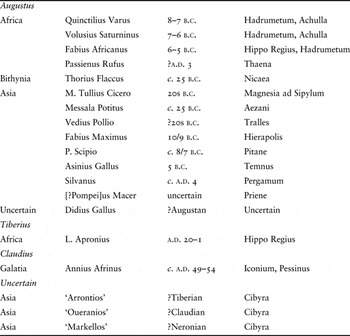
At the beginning of the Empire there are also a very few non-imperial portraits on the provincial coinage (Table 11).Footnote 70
Non-imperial portraits on provincial coins (see RPC 1, Index 2.3). There are also a very few posthumous portraits of founders, like Pompey at Soli or Gabinius at Nysa. It is not clear whether the three portraits at Cibyra are of Roman governors or other people

Most of these non-imperial portraits were made in the first half of Augustus' reign. Their decline and disappearance can be linked to other trends, such as the disappearance of moneyers' names from the coinage minted at Rome in the later part of Augustus' reign, or indeed the disappearance of triumphs held by generals other than the emperor.Footnote 71 All are part of the pattern of the narrowing of focus on to the person of the emperor, at the expense of according any prominence to other individuals.
When one looks at the details of imperial portraiture on provincial coins, however, one can say disappointingly little. It is well known that Augustan sculptural portraits were produced in three or four main types,Footnote 72 and to some extent one can follow these types on the gold and silver coins made at mints like Rome or Lugdunum. But the provincial coin portraits do not fall into such exact categories: one can sometimes generalize about ‘early’, ‘middle’ and ‘late’, but it is not easy to put everything into such neat and easy categories. The taxonomy of provincial coin portraits is even more difficult; they can be quite crude and, as we will see, not always easy to identify. One can try, like Bosch, to track the presence of early, middle and late portraits, but the approach works only to a very limited extent, since many of the portraits do not easily lend themselves to such a classification.Footnote 73 And even then the approach is of limited use, since ‘early’ portraits were sometimes made late in the reign, as we know from the dated coins of Sinope or Antioch.Footnote 74
As already mentioned, it is often very hard even to identify the right emperor, in the absence of a date or name on a coin. In a sense this is no surprise, since Augustus' successors modelled their portraits on his as a guarantee of continuity. The later Julio-Claudians became more individualized, and, in the case of Claudius, characteristics such as his long neck can sometimes be seen, but on other occasions his portrait may be indistinguishable from that of his predecessors. The existence of local stylistic groups, such as that we find in use at as many as sixteen cities in western Asia centred on Laodicea, makes the point: very similar portraits occur throughout the Julio-Claudian period on most (but not all!) coins of a number of cities nearby.Footnote 75 Many of them are simply labelled ΣΕΒΑΣΤΟΣ, and it is very hard to know which emperor is intended, even though it is clear that the portraits cover the whole Julio-Claudian period.Footnote 76
Only with Nero are there more individualized portraits.Footnote 77 At first he is shown as a young boy, but this representation is not confined in the provinces to the reign of Claudius — we find a number of examples from the beginning of his own reign, after a.d. 54, often in conjunction with Agrippina.Footnote 78 Later, he is shown in a more mature fashion; and then finally, after a.d. 63, with the ‘steps’ portrait.Footnote 79 This sort of portrait is widely used, but not exclusively — for example, it occurs only irregularly at the prolific mint of Alexandria, where we can be sure of the chronology as the coins are well dated by the regnal years they bear.
It may perhaps only be coincidence that Nero's reign combines a more realistic form of portraiture with a departure from the Latin form of his name in favour of the simple Νέρων Καῖσαρ. On the other hand both are departures from what had preceded, showing that the dominance of an Augustan portraiture and name formula had, forty years after his death, at last been replaced by a stronger sense of individual identity.
Once again there is a contrast with women. Female members of the Julio-Claudian house tended to have more individualized portraits, particularly as regards their hairstyles. As with inscriptions, perhaps, it mattered less for women to follow a standard set by Augustus, as they were never trying to draw legitimacy from him.
V REVERSE DESIGNS AND TEMPLES
The designs on the reverse of Hellenistic bronze coins were fairly static and referred to the issuing city, usually by depicting the deity of one of its principal cults. By the second century a.d. a new typology had developed, with an intense interest in the real and mythological history of the city. The designs, as well as focusing on civic cults, sometimes depicted temples or other structures, and sometimes gave extended, almost narrative, accounts of local myths. Between the simpler approach of the Hellenistic period and the antiquarian tendencies of the second century, the first century stands as a period of change.Footnote 80
The most significant change is the increasing diversity of designs, even though the majority of these still continue to refer to the city rather than to the emperor. Individual cities often produced coins with several different reverse designs for a single emperor, giving the provincial coinage a diversity that stands in contrast to its Hellenistic predecessors. The most likely explanation for this growth in choice and selection is the influence of Roman coins themselves: in the Republican period, the coinage had been remarkable, indeed unique among ancient coinages, for its multiplicity of design, and the designs more often referred to the personal histories of the moneyers than the Roman state itself. The coinage of the provincial cities is not dissimilar, if we think of individual cities rather than the individual moneyers: both serve to memorialize either their individual family or public civic identities.
One of the most interesting of the innovations is the depiction of structures, such as temples, arches, bridges or gateways.Footnote 81 The presence of structures is a good route to test the changing nature of ‘cultural identity’ in coin design, since the implicit emphasis on civic space is a Roman characteristic and contrasts with the Greek predilection for images drawn from the natural world. Buildings appear on Roman coins but not Greek, while animals or plants predominate as motifs in Greek art, whether on coins, jewellery, or in poetry. Temples start to appear from the reign of Augustus, and then become a standard design in the Julio-Claudian period (Table 12).
Temples on provincial coins

These are often, but by no means exclusively, temples associated with the imperial cult, and it may be the case that the invention of this new sort of temple is what prompted the choice of temple designs in general. Temples had never appeared on coinage previously, apart from the coins of Roman Republican moneyers, who used them alongside many other designs as a natural part of the visual language they employed to memorialize the achievements of their families.Footnote 82 In this way, some of the provincial coins were ‘Romanized’ in the sense of becoming more like coins minted at Rome. But, although some coins depict provincial cult temples, or on other occasions a Capricorn as a reference to Augustus,Footnote 83 nevertheless the character of the majority of the reverse designs remained strongly local.
VI CHANGING SHAPES AND ROMAN DENOMINATIONS
Μήτε δὲ νομίσματα ἢ καὶ σταθμὰ ἢ μέτρα ἰδίᾳ τις αὐτῶν ἐχέτω, ἀλλὰ τοῖς ἡμετέροις καὶ ἐκεῖνοι πάντες χρήσθωσαν·
None of the cities should be allowed to have its own separate coinage or system of weights and measures; they should all be required to use ours.Footnote 84
In Section ii the problem of denominations was mentioned, and the partial efforts of Antony and Octavian/Augustus to standardize the denominations in use throughout their territories were discussed. These attempts were not followed through, although, as the examples given in Section ii show, and as Maecenas's supposed remarks imply, they could have been. Instead, the existing situation was allowed to continue. Yet substantial changes did take place during the course of the first century a.d., in relation both to the system of denominations and to the physical shape of the coins. Neither of these changes can be understood in any detail, but some generalizations can be made.
To understand them there is a need to look at what had happened before. First, the system of denominations.Footnote 85 There is a contrast between the denominations in use by the Romans, who tariffed their coins in terms of denarii, sestertii and asses (1:4:16) and those used in the Greek and Hellenistic world, where we find a system, or systems, of drachmae and obols (1:6), with the obol divided up into a varying number of chalkoi. Secondly, the coins themselves were made of gold, silver and bronze (usually containing a quantity of lead: more correctly known as ‘leaded tin bronze’); some, from the first century b.c., were also made of the new shiny and gold-looking metal the Romans called orichalcum and we call brass (an alloy of copper and zinc). While we can identify the denominations of the precious metal coinage with some confidence, little can be stated with any certainty about the bronze coins, whose physical properties (diameter, weight and alloy) vary considerably.
The first change to take place — though its chronology is very uncertain — is the adoption of Roman denominations across the Empire. This adoption was never complete, and well into the third century a.d. we still find Greek denominations in use. In the West Roman denominations were clearly well understood and used, perhaps exclusively: Roman Republican asses circulated widely in Spain and Gaul as well as Italy, and some of the local coinages of Gaul and Italy bear Roman denominational marks; in Africa we find Roman denominations marked on the Augustan coinage of Lepti Minus, perhaps as early as the 20s b.c.Footnote 86 East of the Adriatic we find some Roman denominational marks in Achaea, though often in more ‘Roman’ contexts such as the coinage of the colony at Corinth. Thessalian tax inscriptions attest a change from drachmae to denarii under Augustus, but continue to use non-Roman smaller denominations. The Caesarian colony at Lampsacus perhaps uses them, and some rare silver coins of the Neronian coinage of Caesarea in Cappadocia bear the value marks ΑϹ ΙΤ ΚΔ or ΑϹ ΙΤ ΙΒ, standing for twenty-four Italian asses and twelve Italian asses. Similar marks are found on the coinage of the Black Sea kings from the reign of Tiberius. For Syria, non-Roman denominations are attested at Antioch and Sidon, but the Roman quadrans is used as a countermark on Neronian coins of Caesarea and, at Palmyra, a letter of a.d. 18–19 from Germanicus to ‘Statilius’ stipulated that taxes should be reckoned πρὸς ἀσσάριον Ἰτα[λικόν], ‘in Italian asses’.Footnote 87 From this limited amount of evidence, it is clear that there is a shift from non-Roman to Roman denominations but a shift whose extent is hard to judge and whose chronology is currently vague. We do not know how widespread was the use of Roman denominations, although their use in the res gestae divi Augusti implies at least that they would have been understood everywhere. For the province of Asia, we have enough evidence to see that a compromise was made to allow the two systems to co-exist.Footnote 88 The best evidence comes from the Salutaris inscriptions of a.d. 104 from EphesusFootnote 89 or the (unfortunately undatable) coinage of Chios.Footnote 90 From these it can be seen that a drachm (there consisting of six obols, each of twelve chalkoi) was equated with three-quarters of a denarius and we find the following sets of equivalences:

One cannot be sure when this system came in, but it seems to have been current in the Julio-Claudian period, and may possibly have been introduced as early as the 40s b.c.Footnote 91
There was no dramatic shift throughout the Empire from non-Roman to Roman denominations, but a gradual tendency towards such a change can be observed. Because of the uncertainties in the evidence it is difficult to judge its stages. It seems likely to have begun in the West in the Republican period, and started to develop more in the East under Antony and especially Augustus. But the process went on during the rest of the Julio-Claudian period, and indeed continued until the third century.
The second aspect is the physical appearance of the bronze coins. At Rome, Augustus had introduced a reform of the bronze coinage, introducing the new metals of brass and copper to replace the earlier bronze:

Apart from the experimental and short-lived coins made in Asia, Syria and Egypt described above, there is little trace of such coin sizes or metals in the provinces. The only exceptions are Spain and Bithynia. In Spain, an approximately similar system of brass and copper was adopted from the reign of Tiberius by a number of cities, but by no means all.Footnote 92 In Bithynia, from the reign of Claudius, there was a widespread, though not universal, system of coins made of brass, with the largest emulating the sestertius of Rome in diameter (though of lighter weightFootnote 93). In other areas of the Empire, especially the East, base-metal coinage continued to be made mostly in bronze (the exceptional use of brass perhaps only continues the earlier Hellenistic practice) and in a bewildering variety of mostly small sizes and low weights. These vary from city to city and make modern generalizations very hard to make.Footnote 94 They might seem also to have implied that everyday monetary life would have been very difficult for the inhabitants of the Empire (how would they have known what any coin was worth?), until we recall that the circulation of bronze coins was essentially localized, and it may even have been the case that some cities at least recognized only their own or a restricted set of civic bronzes as ‘legal tender’, thereby making the currency more comprehensible to use.Footnote 95
Among this mass of mostly small coins of varying shapes and sizes, there is, however, a clear trend during the first century a.d. for some larger coins to be made. Although they were not as heavy as the sestertius made at Rome or made of the same metal (they are mostly bronze rather than brass), nevertheless they seem influenced by the sestertius of Rome, and some at least may even perhaps also be 4-as or sestertius coins by denomination. Mention has already been made of the sestertius-like coins of Bithynia from the reign of Claudius, and similar coins also began to be made in Egypt from the reign of Nero. Normally (and rightly) described as a ‘drachm’, their physical shape too seems influenced by the Roman sestertius and they were in some senses sestertii.Footnote 96
There are similarly large coins from a few cities in the province of Asia, although it is not certain what denomination they represent.Footnote 97 By reign:

In the Flavian period, this phenomenon continued in Bithynia, Egypt and Asia, but also spread to other parts of the Empire, such as Achaea (Corinth and Patras) and Syria, although in the latter, very conservative, area it was rare, appearing in only two, strongly Romanizing contexts (the coinage of the colony of Caesarea and of the ‘client-king’ Agrippa II).Footnote 98
The pattern that emerges is, once again, one of local choice without any centralizing control. But, once again, local choice produces new models, based on the emulation of the ‘Roman’, in the sense of the coins made at the mint of Rome. Some of the changes were partially initiated by Antony and Augustus but although the changes taking place under them were significant, they were perhaps only important spurs to a much longer process of change.
VII CONCLUSIONS
Several generalizations have already been set out in the discussions of the separate sections above. They can be drawn together in a simple way.
First, all the changes taking place to the provincial coinage (the words and images used to describe the emperors; the reverse designs; the shapes and sizes of the coins; and the cessation of the Western coinage) embody civic responses to their situation, and do not reflect a pattern that was centrally imposed and controlled. Others had already introduced some experiments which foreshadowed the changes that took place under Augustus. The provincial portrait had appeared for Caesar and (especially) Mark Antony, while the latter had also made an attempt to standardize, at least partially, denominations. But it was the reign of Augustus that was the turning point for the civic coinages of the ancient world. The central components of these changes were the replacement of images of city deities by the image of the emperor; the widespread adoption of the need to identify it with a name; and an increasingly diversified repertoire of designs, such as the temple.
Under Tiberius, Gaius and Claudius, the identity of the emperor looked to the precedent of Augustus and Latin forms of the imperial name, often incorporating abbreviations into the Greek; the ending of coinage in the West under Gaius and Claudius can also be seen as part of the tendency to adopt Roman models. As time passed, the name generally contained more elements and more abbreviations. Both reflect features of Latin usage and coinage produced at Rome.Footnote 99 Again, the diversity of the reverse designs increased with time. Under Nero, we find a new approach to portraiture and a departure from Roman forms of the name. In this sense it was only in Nero's reign that the cities generally tried to portray an individual identity. This tendency was quickly ended by the Flavians, under whom we see a return to the pattern of inscriptions influenced by Latin forms and portraits derived from Republican models.
These remarks inevitably involve some simplification. But the trends described here show that any model of strict and centralized control over the coinage was very loose indeed, if it ever existed at all. Even in a situation where there was no attempt to impose any rules, it would not have been difficult to find out what was the emperor's preferred style of name or what the official canon of imperial image ‘allowed’. But this was not a concern for the provincial coin engravers; they knew the emperor's name (they rarely made any mistakesFootnote 100), but they chose to refer to it in different ways, and they were content to represent him with a generalized image, an image whose identity was often indicated by the accompanying inscription. Even then it was sometimes labelled only ‘emperor’, as the continuing use of the simple Σεβαστός shows.
This analysis leads one to consider how it may affect our understanding of the ways in which people referred to the emperors in other media. There is nothing else which is anything like such a systematic source for the names that were used for them. There are indeed many inscriptions, and Hotje has made a collection of the inscriptions on statue bases.Footnote 101 However, such inscriptions generally spell out the name in full, so do not have the advantage of the shortening of coin inscriptions to show how people made up their minds when choices were to be made. More interesting implications arise when we consider the images. Mention has already been made of the frequency of the lituus, and the question has already been raised as to whether this means that we should consider the possibility that many of the statues of Augustus that show him as a priest capite velato are in fact intended to depict him as an augur rather than a pontifex. But what of the more general question of the control of imperial imagery? There is little direct evidence about the way in which images of the emperor were controlled and disseminated; a later, third-century inscription from Termessus in Asia Minor refers to a show held in the amphitheatre ‘on the day that the sacred image of our lord Valerian, the new emperor, was brought’,Footnote 102 but that does not take us very far, and is little help for the first century.Footnote 103 As a result, a picture has been built up, notably by the German school of art historians and most fully documented in the wonderful series of volumes Das römische Herrscherbild, of a model of very strict control. This picture arises from the very detailed stylistic analysis,Footnote 104 as a result of which a picture is built up of an exact and standard model (e.g. the hairstyle), from which some deviation is allowed, but not much. The stylistic approach is a triumph of connoisseurship, but it raises a problem of interpretation, since it assumes the very thing that it then proves — namely that the portraits were very tightly controlled and hence that anything that does not strictly conform to the criteria must be someone else, whether a prince of the Julio-Claudian house or a private individual whose representation was (not surprisingly) influenced by that of the emperor. Coin evidence suggests a very different picture, and, unless one is to assume that there were different rules for different media, the possibility that there is less difference, and that our picture of Augustan and Julio-Claudian imperial sculpture is misconceived, should at least be investigated: one should consider the possibility that many imperial portraits have not been recognized as such.Footnote 105
The freedom of provincial élites to produce coinage as they wished was, of course, constrained by their wish to adopt iconographies and forms (shapes, sizes, denomination systems) that responded to their new world order. In the ways described above, the provincial coinage was Romanized ‘indirectly’ rather than ‘directly’,Footnote 106 in the sense of becoming more and more like the coinage produced in Rome. It also became ‘imperialized’ principally through the adoption of the imperial portrait, even though it never lost its local identity. Though events and the emperor's person appeared more frequently on the coinage later rather than earlier, the mass of reverse designs was still dominated by local themes. The combination neatly encapsulates the new order of the Augustan world.