Autism spectrum disorder (ASD) is characterised by a spectrum of impairments in social-communication skills and the presence of repetitive, restricted, and/or sensory interests and behaviours (American Psychiatric Association [APA], 2013). The challenges faced by children with ASD often create barriers to their education, leading to further social and educational disadvantage. In fact, the most recent national survey of Australian children with ASD (Australian Bureau of Statistics [ABS], 2014) indicated that 95% of children attending school experienced educational restrictions, primarily due to social, communication, and learning difficulties. Thirty-six percent of children with ASD required a counsellor or disability support person to assist in their education, and 39% required special tuition. Together, the findings demonstrate the need for further concerted effort among teachers, clinicians, and caregivers to improve educational supports and outcomes for children with ASD.
Reading is arguably one of the most important skills children learn at school (National Early Literacy Panel, 2008). Although reading is sometimes highlighted as an area of relative strength for children with ASD (e.g., see review of academic skills by Keen, Webster, & Ridley, Reference Keen, Webster and Ridley2016), many children with ASD, even those with intelligence in the average range, show difficulties acquiring reading skills (Nation, Clarke, Wright, & Williams, Reference Nation, Clarke, Wright and Williams2006). For those who learn to read, up to 60% may show below average performance in reading comprehension (Ricketts, Reference Ricketts2011; Ricketts, Jones, Happé, & Charman, Reference Ricketts, Jones, Happé and Charman2013). It is, therefore, important to acknowledge the literacy needs of children with ASD along with their social-communication needs. The focus of this article is on providing an overview of reading profiles in children with ASD and the implications for assessment. Our aim is to provide key information for school psychologists and counsellors to assist them to support children with ASD in this important area of academic achievement.
Learning to Read
The ultimate aim of learning to read is to read with understanding. According to the ‘simple view of reading’, reading comprehension is the product of word recognition (decoding) and oral language comprehension (Gough & Tunmer, Reference Gough and Tunmer1986). In other words, to understand written text, the reader does not only need to recognise the printed words on a page, but also needs to understand the meaning of those words, sentences, and paragraphs.
Learning to read begins in the preschool years, through the development of so-called emergent literacy skills that form the foundation for accurate and fluent reading with comprehension (Whitehurst & Lonigan, Reference Whitehurst and Lonigan1998). Code-related emergent literacy skills include letter knowledge, print concepts, and early developing phonological awareness, which are predictive of word recognition. Meaning-related skills (related to oral language comprehension) include vocabulary, morpho-syntactic skills, and story retelling and comprehension (see Westerveld, Trembath, Shellshear, & Paynter, Reference Westerveld, Trembath, Shellshear and Paynter2016, for a detailed review).
The unique contributions of word recognition and oral language comprehension to reading comprehension change over time (Catts, Hogan, & Adlof, Reference Catts, Hogan, Adlof, Catts and Kamhi2005). During the initial stages of learning to read, reading comprehension relies heavily on word recognition (Catts et al., Reference Catts, Hogan, Adlof, Catts and Kamhi2005). Once word recognition becomes automatic and fluent, typically around their fourth year of schooling, children's reading comprehension skills are heavily influenced by their oral language comprehension ability (Catts et al., Reference Catts, Hogan, Adlof, Catts and Kamhi2005). Although not explicitly captured in the simple view of reading, reading fluency is an important element of reading and difficulties with reading fluency may indicate underlying word recognition difficulties as well as difficulties in a child's ability to process language for meaning (Barth, Catts, & Anthony, Reference Barth, Catts and Anthony2009). Thus, while the simple view of reading by name may imply a relatively straightforward, predictable, and transparent process by which children learn to read, the reality is that it is a complex and dynamic system with multiple points of vulnerability for children with ASD and other developmental disabilities.
Reading in ASD
There is a lack of strong epidemiological data regarding the proportion of children with ASD who experience reading difficulties, with the best current estimates of between 30–60% based on existing data (e.g., Jones et al., Reference Jones, Happe, Golden, Marsden, Tregay, Simonoff and Charman2009; Nation et al., Reference Nation, Clarke, Wright and Williams2006; Ricketts et al., Reference Ricketts, Jones, Happé and Charman2013). The estimated high proportion of children with ASD presenting with reading difficulties is not surprising, given that communication impairments affecting oral language and pragmatics are characteristic of ASD, with approximately 25–35% of children with ASD minimally verbal (i.e., little or no verbal communication) at school entry (e.g., Anderson et al., Reference Anderson, Lord, Risi, Shulman, Welch, DiLavore and Pickles2007; Rose, Trembath, Keen, & Paynter, Reference Rose, Trembath, Keen and Paynter2016). Drawing from the simple view of reading, impairments in oral language clearly put children with ASD at risk of later reading challenges. In addition, rates of intellectual disability (approximately 30%) are elevated in ASD (Centers for Disease Control and Prevention, 2014), and the difficulties children with intellectual disability experience in skills — including reasoning, planning, and problem-solving — are likely to translate to difficulties across educational activities, including learning to read. Although the majority of children with ASD who show reading difficulties experience challenges in reading comprehension skills, with relative strengths in word recognition (Jones et al., Reference Jones, Happe, Golden, Marsden, Tregay, Simonoff and Charman2009; Nation et al., Reference Nation, Clarke, Wright and Williams2006; Ricketts et al., Reference Ricketts, Jones, Happé and Charman2013; Troyb et al., Reference Troyb, Orinstein, Tyson, Helt, Eigsti, Stevens and Fein2014), it is important to acknowledge the considerable individual differences in reading ability (Norbury & Nation, Reference Norbury and Nation2011).
Reading Ability and Profiles
Two extremes of ability may come to mind when thinking of literacy in children with ASD. First, there are hyperlexic readers, who show word recognition skills that are far better than their reading comprehension skills (Catts, Hogan, & Fey, Reference Catts, Hogan and Fey2003; Newman et al., Reference Newman, Macomber, Naples, Babitz, Volkmar and Grigorenko2007). Despite the fact that only a small percentage of children with ASD show a hyperlexic profile, considerable attention has been given to hyperlexia in children with ASD in the research literature (Newman et al., Reference Newman, Macomber, Naples, Babitz, Volkmar and Grigorenko2007; Turkeltaub et al., Reference Turkeltaub, Flowers, Verbalis, Miranda, Gareau and Eden2004). On the surface, these children appear to have an advantage to becoming proficient readers due to their strong word recognition skills, but they may be disadvantaged in other ways. For instance, children's reading aptitude may be dismissed as a ‘splinter skill’ that serves no real purpose (Mirenda, 2013). Alternatively, children who present with hyperlexia may be assumed to have adequate reading comprehension skills, and thus be overlooked for more in-depth assessment
The second extreme that may come to mind when thinking of literacy in children with ASD is children with intellectual impairments or other significant impairments may be assumed to be too ‘low functioning’ or not ready for literacy (Mirenda, Reference Mirenda2003). Thus, in practice, the literacy needs of children with ASD may not receive adequate attention due to the extent of other needs such as challenging behaviour or severe communication impairments. Professionals may assume children with severe disabilities cannot master prerequisite skills, and thus, not attempt to teach literacy (Kliewer & Biklen, Reference Kliewer and Biklen2001), or in inclusive programs exclude children with ASD from the full literacy curriculum, focusing instead on sight word instruction (Spector, Reference Spector2011). Such practices limit children's opportunities for learning and may not only lead to difficulties accessing the school curriculum, but also restrict their participation in activities in the community more broadly through reduced opportunities for literacy development. The positive findings of research studies into literacy instruction for children with severe intellectual disability (e.g., Bock & Erickson, Reference Bock and Erickson2015; Koppenhaver & Erickson, Reference Koppenhaver and Erickson2003) attest to the fact that literacy level is amenable to change through intervention, and should be conceptualised as a continuum along which all children have the potential to move.
In reality, the majority of children with ASD show skills somewhere in between these extremes of ability; all require appropriate educational support (Keen et al., Reference Keen, Webster and Ridley2016), and there is no single ‘autism profile’ for reading (e.g., Nation et al., Reference Nation, Clarke, Wright and Williams2006; Ricketts et al., Reference Ricketts, Jones, Happé and Charman2013). Based on the simple view of reading (Gough & Tunmer, Reference Gough and Tunmer1986), children with reading comprehension difficulties may be classified into three groups: (a) children who show difficulties in word recognition alone (i.e., dyslexia); (b) children who show adequate word recognition skills but impaired oral comprehension skills (i.e., specific comprehension impairment); and (c) children who show difficulties in both (i.e., mixed reading disability). Understanding the profile of each child with ASD is vital for informing appropriate support and intervention, and starts with a detailed assessment of his or her strengths and weaknesses in both oral language and reading-related skills.
Reading Assessment
An important role of school psychologists and school counsellors is the conduct of assessments (Oakland, Faulkner, & Annan, Reference Oakland, Faulkner, Annan, Frisby and Reynolds2005). Keen et al. (Reference Keen, Webster and Ridley2016) recently highlighted the need ‘to identify individual strengths and weaknesses across all academic skill areas. Individualised assessment that leads to profiling the relative strengths and weaknesses of individuals with ASD, irrespective of age and IQ, can inform educational programming and provide a baseline for measuring achievement over time’ (p. 16). Thus, assessment of reading in children with ASD should seek to understand the specific reading profile for an individual child. Consideration of the child's characteristics of ASD (i.e., social-communication skills and behaviour) should inform the assessment process in terms of test selection, preparation, administration, and interpretation (see Paynter, Reference Paynter2015). For example, in terms of test selection, verbal ability level and mental versus chronological age should be considered in informing choice of an appropriate measure. In terms of preparation, the use of social stories (see Collet-Klingenberg & Franzone, Reference Collet-Klingenberg and Franzone2008) and/or visual schedules (see Hume, Reference Hume2008, for an overview of visual supports) may assist in understanding the social context of the assessment. With regards to administration, managing off-task and challenging behaviour, as well as adapting the physical environment may assist in obtaining a valid assessment. Finally, in terms of interpretation, consideration of associated cognitive strengths and weaknesses in ASD such as potential biases towards local processing (i.e., details over ‘big picture’) and difficulties with executive functioning (e.g., keeping and using information), and/or perspective-taking, should be considered when interpreting results.
Consistent with good practice guidelines in ASD (see Prior, Roberts, Rodger, Williams, & Sutherland, Reference Prior, Roberts, Rodger, Williams and Sutherland2011), reading assessment requires a multidisciplinary approach comprising speech pathologists, educators, and other literacy education specialists (e.g., educational psychologist). In many cases, relevant assessment results, such as intellectual assessments, oral language assessments, and/or reading/literacy assessments may be readily available from speech pathologists or educators. In any case, literacy assessment should be tailored to the child's level of reading ability and take the child's general developmental level into account.
Emergent Readers
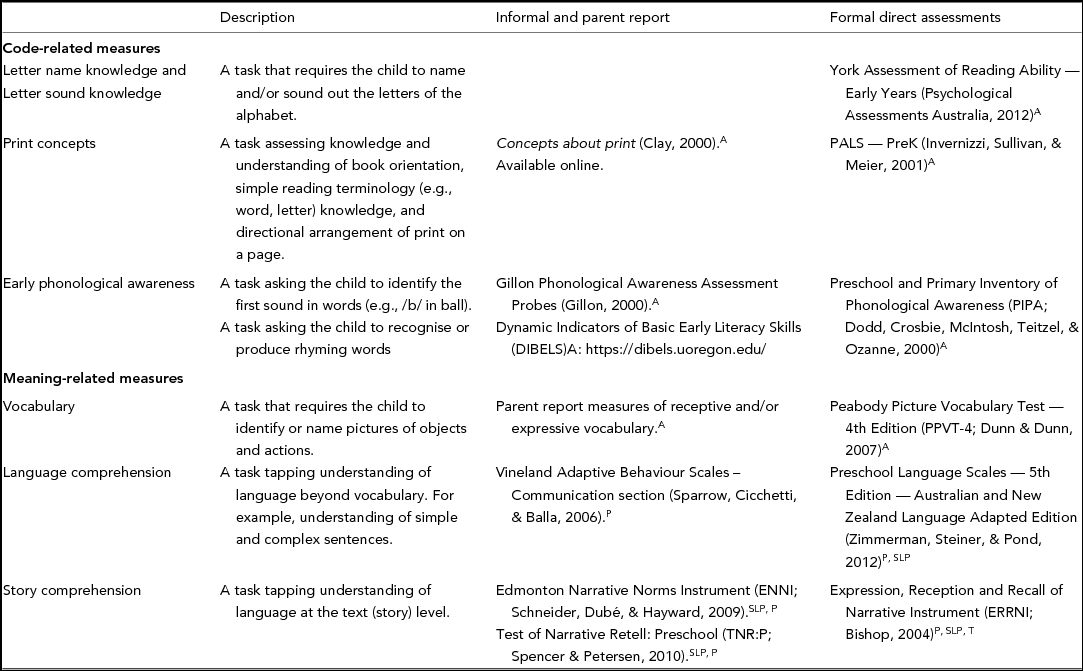
Children who are not yet able to read novel words or sentences (i.e., preliterate) may be considered to be in the emergent literacy stage, and their emergent literacy skills should be assessed across code-related (e.g., letter knowledge, print concepts, and early writing) and meaning-related (e.g., vocabulary, story retell, and comprehension) skills. For children who are unable to complete standardised assessments, emergent literacy skills may be assessed using informal measures to determine a baseline level of performance. Table 1 provides examples of assessment tasks that may be administered by members of a multidisciplinary team (e.g., speech pathologists, psychologists, and teachers) during the emergent literacy stage. Moreover, parents and caregivers can play a key role in the assessment process (Arciuli, Stevens, Trembath, & Simpson, Reference Arciuli, Stevens, Trembath and Simpson2013). For example, parents may be asked to describe the home literacy environment using existing questionnaires (e.g., Boudreau, Reference Boudreau2005), or asked to rate their children's emergent literacy skills using the Pre-Literacy Rating Scale from the Clinical Evaluation of Language Fundamentals Preschool – Second Edition, Australian and New Zealand Standardised Edition (Wiig, Secord, & Semel, Reference Wiig, Secord and Semel2006).
Brief Descriptions and Examples of Emergent Literacy Tasks*

Note: *Superscripts indicate who may complete each assessment: GGuidance Officer; PPsychologist; SLPSpeech Language Pathologist; TTeacher; AAll of these.
Early and Skilled Readers
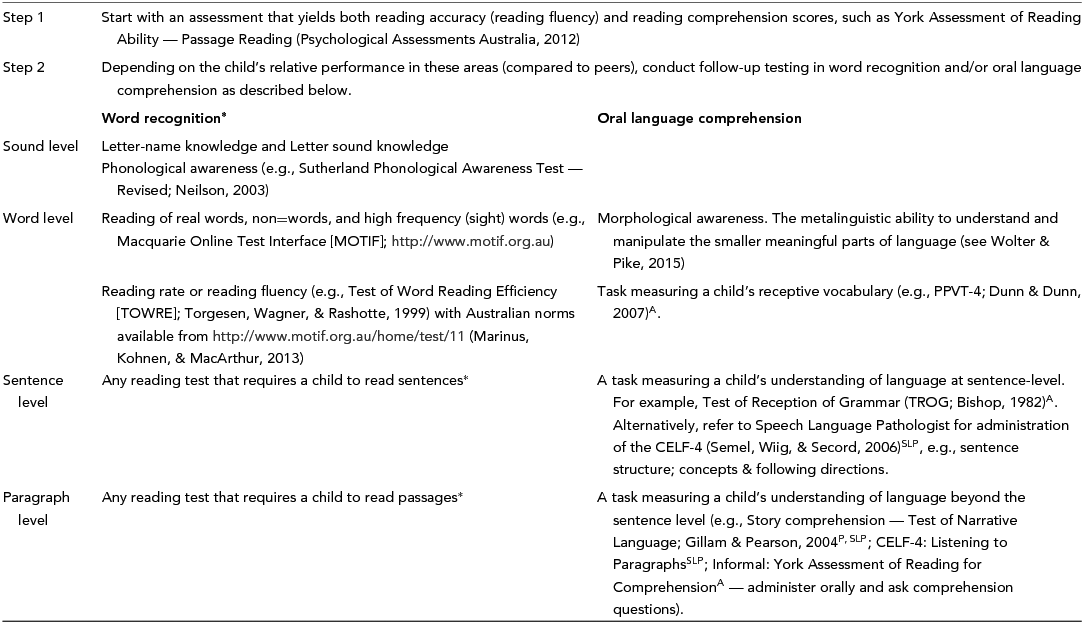
For those children who are able to read simple sentences or short passages, a reading assessment should be administered that yields measures of word recognition (at word, sentence, and paragraph levels) and reading comprehension (see Westerveld, Reference Westerveld2009, for a review of reading comprehension tasks, and see Table 2 for examples), as well as a measure of reading fluency. Depending on the child's performance (i.e., whether they show needs or strengths) in either of these areas, practitioners are encouraged to conduct follow-up testing to further identify strengths and weaknesses in word recognition and/or oral language comprehension (see Roberts & Scott, Reference Roberts and Scott2006, for an excellent discussion of assessment of these areas in terms of the simple view of reading). Table 2 provides examples of assessment tasks that may be used. For a comprehensive discussion of formal and informal reading assessments see Farrall (Reference Farrall2012).
Assessment Process (and Examples of Tasks) in the Early and Established Reading Stages*

Note: *For an excellent overview of reading assessments tapping different levels of word recognition, see Farrall (Reference Farrall2012, Chapter 11); superscripts indicate who may complete each assessment: GGuidance Officer, PPsychologist, SLPSpeech Language Pathologist, TTeacher, AAll of these.
Conclusions
While the social, communicative, and behavioural needs of children with ASD are widely acknowledged, academic and learning needs — particularly literacy — have received comparably less attention. Literacy is a core area of academic learning and should receive attention for all children, including children with ASD who may be especially vulnerable to difficulties in this area, given common challenges in oral language and the frequency of comorbid intellectual impairment. Some attention has been drawn to both children who show above average word recognition (hyperlexia) skills, as well as those who show significant impairments in reading. However, as per the dyad of impairments in ASD (APA, 2013), a spectrum is observed, and the range of strengths and needs in word recognition and reading comprehension are observed across individual children with ASD.
Educational and school psychologists have an important role to play in ensuring that children with ASD have access to appropriate assessment and educational support services. They are in an ideal position to evaluate children's individual strengths and needs within educational settings and to inform and contribute to the design, implementation, and evaluation of appropriate interventions (see El Zein, Solis, Vaughn, & McCulley, Reference El Zein, Solis, Vaughn and McCulley2014, for a review) where indicated as part of a multidisciplinary team, in conjunction with speech pathologists, teachers, and guidance personnel. Educational and school psychologists are pivotally placed to influence the views, attitudes, and practices of teachers and other educational staff, including the need for individualised reading assessment and instruction for all children, including those with ASD. Routine attention to the strengths and challenges in reading ability in children with ASD will help tailor educational supports for children with ASD, and should ultimately provide them with better opportunities to engage in education, the workforce, and society.