INTRODUCTION
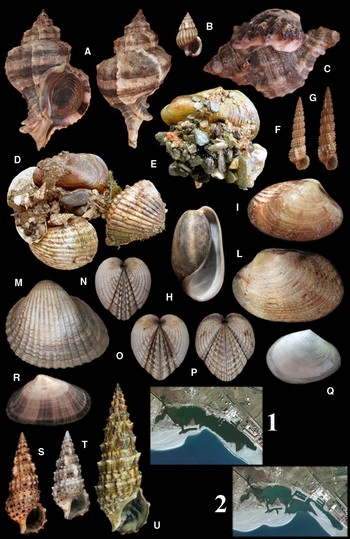
Gizzeria harbour (Catanzaro, Italy) (38°56′03.58″N–16°12′23.09″E) is a small artificial basin located inside a cove along the Calabrian Tyrrhenian shores. It extends nearly parallel to the coastline for about 1 km and up to 400 m in the longest distance. It is the only lagoonal basin located in the whole area. A small river, connected to some freshwater coastal lagoons used for eel farming, runs into the harbour, and an artificial opening of the sandbar separating the site from the sea is periodically excavated crosswise the coastline. Two maps of the area, from Google Earth™, are here reported (Figure 1, 1–2): the first shows the harbour with the tidal sandbar and the second one without it. Even in the summer, the opening is so shallow that only small crafts and fishing boats can enter.
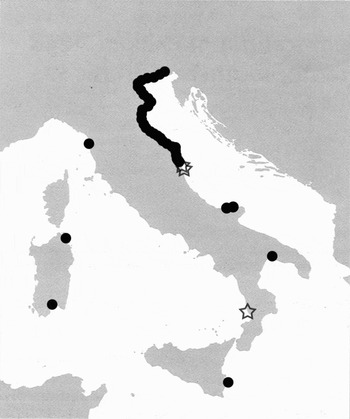
The known distribution of Musculista senhousia (Benson in Cantor, 1842) in Italy. Stars constitute the new sites of presence reported in this paper.

Although the basin is clearly polluted, local people commonly use it to fish Sparidae (mainly Sparus aurata and Diplodus vulgatus) with fishing rods and edible bivalves (mainly Ruditapes decussatus and Cerastoderma glaucum) with hand clam rakes.
MATERIALS AND METHODS
Specimens studied were collected from January 2008 to August 2009 by analysing fishing scraps of hand clam rakes. In fact, edible molluscs are readily transferred into buckets full of seawater, whereas shellfish scraps are left on the foreshore and taken back into the sea by waves. Local fishermen use a 5 mm mesh, but further collections were made by hand to the sea level and using a small trawl with a 2 mm mesh. This allowed us to pick up small molluscs living in situ, but, except Nassarius pygmaeus, most comprised juveniles or sub-adult specimens of already sampled species.
RESULTS, DISCUSSION AND CONCLUSIONS
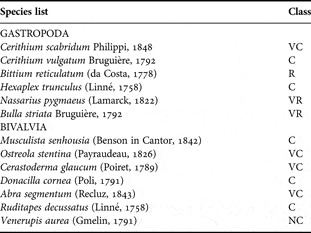
Our results constitute the first qualitative and semi-quantitative data of the marine species living in the area. A total of 13 living molluscs were found, listed together with their classes in Table 1 and shown in Figure 1. In addition, only empty shells of Nassarius mutabilis (Linné, 1758) and Bolinus brandaris (Linné, 1758) were found, together with a single big valve of Mytilus galloprovincialis Lamarck, 1819. We believe that the first two species lived in Gizzeria harbour, even if their presence is considered accidental, whereas the finding of the valve was owing to an anthropogenic contribution because no mussel banks are present in this or the neighbouring areas. Among the autochthonous species the following deserve biogeographical attention: Ostreola stentina (Payraudeau, 1826), Cerastoderma glaucum (Poiret, 1789) and Abra segmentum (Recluz, 1843), not included in the living molluscan fauna of the lower Tyrrhenian Sea (Schiaparelli, Reference Schiaparelli and Relini2009). Moreover, our findings clearly show the high heterogeneity of the marine environment of Gizzeria harbour. Together with generalist species, such as Hexaplex trunculus and Cerithium vulgatum, we found both typical sandy infralittoral species such as Donacilla cornea and Nassarius pygmaeus, living mainly in the investigated site near the opening, and lagoon species such as Ruditapes decussatus, A. segmentum and C. glaucum, common near the tributary of freshwater. The maximum density of O. stentina, finally, was reached next to the moorings of boats.
Living molluscan species recorded from Gizzeria harbour (Catanzaro). Classes: VC, very common, always found in a high number of specimens; C, common, always found; NC, uncommon, rarely found; R, rare, occasionally found; VR, very rare, fewer than 5 specimens found.

On the contrary, the presence of the two alien species in the same site was surprising. In fact, they lived in different niches: Cerithium scabridum was found alive in numerous stations of Gizzeria harbour to the sea level up to 50 cm depth, mainly on sandy, gravel or sandy–gravel bottoms, whereas Musculista senhousia was found on muddy or gravel–muddy bottoms up to 2 m of depth in association with A. segmentum and C. glaucum. Together with eighteen living specimens, loose valves up to 37 mm were also found. This pointed to a distant arrival in the site of the latter alien species. Moreover, C. scabridum and M. senhousia were recorded in the same area only along the Israeli (Zenetos et al., Reference Zenetos, Gofas, Russo, Templado and Briand2004), Tunisian (Ben Souissi et al., Reference Ben Souissi, Trigui El Menif, Mahjoub, Mejri, Quignard, Capapé and Zaouali2005) and Italian shores near Syracuse (Brancato & Reitano, Reference Brancato and Reitano2009; Crocetta et al., Reference Crocetta, Renda and Vazzana2009). As in Gizzeria harbour only small crafts are present we rule out a concurrent arrival through ballast water and speculate about different origins and times. Recent discussions about the distribution of C. scabridum in Italian seas have been led by Crocetta et al. Reference Crocetta, Renda and Colamonaco(2008, Reference Crocetta, Renda and Vazzana2009). Besides, this species is probably forming new populations following the pattern of secondary spread of already established species, taking into account recent records in the vicinity or inside touristic harbours (Crocetta et al., Reference Crocetta, Renda and Vazzana2009). Several problems, on the contrary, relate to M. senhousia. To our best knowledge, stable populations were recorded in the Adriatic Sea from the Natissa River mouth (Grado-Marano Lagoon) to Marina di Altidona (Ascoli Piceno) (Bucci, Reference Bucci1994; Lazzari & Rinaldi, Reference Lazzari and Rinaldi1994; Turolla, Reference Turolla1999; Mizzan, Reference Mizzan2002; Mistri, Reference Mistri2003; Solustri et al., Reference Solustri, Morello and Froglia2003; Dondi et al., Reference Dondi, Marchini and Sconfietti2004; Mistri et al., Reference Mistri, Rossi and Fano2004; Poggiani et al., Reference Poggiani, Mattioli and Micali2004), even if we report here specimens in F. Crocetta's private collection up to Roseto degli Abruzzi (Teramo). Moreover, the species is also known from Lesina and Varano Lagoons (Apulia) (Florio et al., Reference Florio, Breber, Scirocco, Specchiulli, Cilenti and Lumare2008). Outside the Adriatic Sea, this species has been reported from Gulf of Taranto (Mastrototaro et al., Reference Mastrototaro, Matarrese and D'Onghia2003, Reference Mastrototaro, Petrocelli, Cecere and Matarrese2004a, Reference Mastrototaro, Matarrese and D'Onghiab), Livorno Harbour (Campani et al., Reference Campani, Coppini, Cuneo and Margelli2004; Campani, Reference Campani2006) and Syracuse Harbour (Brancato & Reitano, Reference Brancato and Reitano2009). Finally, two spotty sites are known in northern (Savarino & Turolla, Reference Savarino and Turolla2000) and southern (Delongueville & Scaillet, Reference Delongueville and Scaillet2006) Sardinia (Figure 2). Previous M. senhousia findings were always justified as accidental introduction through ballast water or the anthropogenic introduction of mussels/Philippine clams. However, ships or vessels could not enter in Gizzeria harbour, and no mussel farming or mussel natural banks are present in or close to the harbour area. From the analysis of living specimens and empty shells found, we can also exclude either the actual or previous presence of Ruditapes philippinarum (Adams & Reeve, 1850) in the basin. Therefore, the arrival of M. senhousia could be because of secondary spread, such as C. scabridum, or together with mussels used as bait by local fishermen. A further hypothesis could be connected with alevin introduction from the fish farm located close to Gizzeria harbour. We are conscious that, in the absence of clear proof, these are only speculations, but the recent finding opens up new horizons concerning the spread of M. senhousia. Further analyses are to be undertaken in the neighbouring freshwater basins to verify its absence. The diffusion of both alien species in Italian seas should be strongly monitored because they can interfere with autochthonous communities: C. scabridum is characterized by a broader ecological niche than native small Mediterranean Cerithidae (Lavie & Nevo, Reference Lavie and Nevo1986) and could replace them, whereas M. senhousia should be able to build important colonies and produce dense mats, covering the mobile bottom and excluding other infaunal species (Zenetos et al., Reference Zenetos, Gofas, Russo, Templado and Briand2004).
Gizzeria harbour from Google Earth™ and living molluscan species recorded (not to scale): (1) Gizzeria harbour with tidal sandbar; (2) Gizzeria harbour during summertime. (A) Hexaplex trunculus, 67 × 38 mm; (B) Nassarius pygmaeus, 9 × 5 mm; (C) Ostreola stentina, 21 × 18 mm; (D, E) Musculista senhousia; (D) 25 × 15 mm; (E) 24 × 15 mm; (F, G) Bittium reticulatum; (F) 13 × 4 mm; (G) 15 × 4 mm; (H) Bulla striata, 26 × 14 mm; (I) Venerupis aurea, 16 × 23 mm; (L) Ruditapes decussatus, 21 × 31 mm; (M–P) Cerastoderma glaucum; (M) 31 × 36 mm; (N) 27 × 25 mm; (O) 30 × 26 mm; (P) 30 × 27 mm; (Q) Abra segmentum, 13 × 18 mm; (R) Donacilla cornea, 13 × 22 mm; (S, T) Cerithium scabridum; (S) 19 × 7 mm; (T )16 × 6 mm; (U) Cerithium vulgatum, 43 × 15 mm.

Moreover, another interesting observation can be made on Gizzeria harbour molluscan species, mainly C. glaucum shells. As it can be seen in Figure 1 (N, O, P), their valves often show an interruption of calcification in growth patterns, probably connected to critical physiological conditions. Therefore, the chances of survival of the two alien species in the studied basin are strongly connected with their possibility of surviving these conditions. A recent survey (August 2009), however, revealed that both alien species lived through the 2009 summer period. Further studies are finally needed to understand the variety of the molluscan assemblage in the area during the seasons and with respect to the anthropogenic opening of the sandbar.
ACKNOWLEDGEMENTS
The authors thank Enzo Campani, Paolo Pompei and Francesco Toscano for their helpful advice.