Relativization is often chosen as the target of instruction in SLA research. The acquisition of relative clauses (RCs) by second language (L2) learners has been investigated to determine the difficulty order of different types of RCs (e.g., Gass, 1979; Hamilton, 1994, 1995; Hansen-Strain & Strain, 1989; Hyltenstam, 1984; Izumi, 2003; Pavesi, 1986; Sadighi, 1994; Tarallo & Myhill, 1983) as well as to examine the effects of L2 instruction on the target item (e.g., Aarts & Schils, 1995; Ammar & Lightbown, 2004; Croteau, 1995; Doughty, 1991; Eckman, Bell, & Nelson, 1988; Gass, 1982; Izumi & Izumi, 2004; Tanaka, 1996). In relativization research, different types of RCs are considered to represent different levels of difficulty, and such difficulty levels have also been discussed in relation to the developmental sequences through which L2 learners appear to pass. Pedagogical concerns have evolved around the questions of which types of L2 relativization should be taught, and how, in order to effectively facilitate the learning of RCs.
For L2 learners who are at the later stages of the beginners' level, relativization is regarded as a hurdle to overcome because it involves applying complex grammatical rules. Research shows that the frequency of the use of RCs by nonnative speakers is extremely low in comparison to native speakers (e.g., Masuda, 2000). Because L2 learners can carry out basic communication without RCs, they tend to avoid using them (e.g., Schachter, 1974). Relativization, however, becomes an important grammatical subsystem for L2 learners when they wish to describe situations or express themselves in depth using complex, multiple-clause sentences as opposed to simple, single-clause sentences.
This study explores the differential effects of three types of instructional treatment on the learning of RCs by Japanese as a foreign language (JFL) students at the end of the introductory level in a university language program. The study also investigates participants' ability to generalize instruction that reflects a particular position on a typological markedness hierarchy proposed in the relativization literature. The objectives of this study are to investigate ways to facilitate the comprehension and production of Japanese RCs by L2 learners and to inform effective syllabus development for adult JFL and, potentially, other L2 classes.
EXPLICITNESS OF FORMAL INSTRUCTION
One of the major pedagogical choices in L2 grammar teaching is how explicit instruction should be. This includes the question of whether to directly teach explicit grammar rules or to indirectly let L2 learners abstract rules by themselves through language activities. DeKeyser (1995) defined an explicit instructional treatment as one that includes rule explanation or rule-searching opportunities by attending to forms, and he defined an implicit treatment as one that involves neither rule presentation nor directions to focus on particular forms. SLA research has explored the effect of explicitness of instruction on specific target items. The facilitative role of explicit instruction has been supported by a substantial body of research in a variety of L2 contexts (e.g., Allen, 2000; de Graaff, 1997; DeKeyser; Ellis, 1993; Robinson, 1996, 1997), whereas a number of studies have suggested that explicit rule presentation does not necessarily promote L2 learning (e.g., Sanz & Morgan-Short, 2004; VanPatten & Oikkenon, 1996).
Norris and Ortega's (2000) meta-analysis is among the most comprehensive and influential reviews of the relative effectiveness of L2 instruction. This meta-analysis summarized and compared the findings of 49 L2 instructional studies published between 1980 and 1998. One of the conclusions of this study reported an advantage for explicit types of instructional treatment over implicit ones. Generalization of those findings is difficult, however, for several reasons. For instance, as Norris and Ortega acknowledged (and as discussed further by DeKeyser, 2003), the actual number of experimental studies that have made a direct comparison between otherwise identical explicit and implicit instructional treatments in L2 classroom settings is extremely low. Most of this research is laboratory-based. Research that takes place in a classroom context often employs a combination of different instructional types in an effort to determine the point in the continuum of explicitness of formal instruction that is most effective for a specific target item. Furthermore, replication studies that test the effects of different types of instruction are few in number. Therefore, it is difficult to determine the advantage of certain treatment types over others based on research results. As a result, Norris and Ortega cautiously concluded that “L2 instruction can be characterized as effective in its own right, at least as operationalized and measured within the domain” (p. 480).
In a discussion of the Norris and Ortega (2000) meta-analysis, Doughty (2003, 2004) revisited two main issues concerning the design and methodology of research on the relative effectiveness of different instructional treatments on L2 learning. First, Doughty pointed out that among the L2 instructional studies that compared two or more types of instructional treatment with a control group or an exposure-only group, there was an overt tendency to use explicit, metalinguistic approaches. She argued that some of the approaches might merely accumulate L2 learners' metalinguistic knowledge about the given language. This is also true in the case of L2 research on the instruction of RCs. Most previous studies employed explicit types of instructional treatment (i.e., metalinguistic explanations and grammar tasks) and reported their effectiveness, but very few compared the effects of rule-oriented and meaning-oriented types of instruction on relativization (e.g., Doughty, 1991). Therefore, the possible effects of implicit instruction on L2 relativization are largely unknown. Doughty (2003) posited that the operationalization of L2 instructional treatments is “considered best analyzed psycholinguistically in terms of input-processing enhancements that facilitate L2 learners' extracting forms and mapping them to meaning and function” (p. 265), rather than treating the operationalization at the level of a mere method. Thus, there is a need to examine the effects of both explicit and implicit types of instruction as well as their possible advantages and disadvantages in the light of the development of such form-meaning connections. Second, Doughty (2003, 2004) expressed concerns as to how the relative effectiveness of explicit and implicit types of instruction was measured in L2 instructional studies. She argued that there is a general bias, in that the measurement instruments employed in those studies are typically of explicit types, thus creating a better match between the explicit instructional types and explicit treatment groups. Norris and Ortega (2000) also acknowledged that explicit tests of L2 knowledge were used in most studies and that, as a result, more benefits for explicit instruction were observed with this type of testing. Among the measurement types identified by Norris and Ortega—(a) constrained, constructed response, (b) metalinguistic judgment, (c) selected response, and (d) free constructed response—the results of their meta-analysis indicated that most of the outcome measures used in L2 instructional research required explicit, declarative knowledge and that free response types of measurement were uncommon. The measurement instruments typically used in research on the instruction of L2 relativization, again, are also of the first three response types. One must recognize and acknowledge such a measurement bias when interpreting the test results of L2 instructional studies.
L2 INSTRUCTION AND DEVELOPMENTAL SEQUENCES
In comparison to the number of SLA studies that have investigated the differential effects of contrasting types of formal instruction on the learning of various linguistic features, less research has dealt with the question of the order in which certain grammatical structures should be taught. In L2 and foreign language (FL) classrooms, grammar items are usually introduced in the order of basic to more complex, according to notions of difficulty of acquisition that often derive from individual language teachers' intuitive assumptions. Shirai (1997) posited that when language teachers introduce a new grammar item, starting with a basic and prototypical use of the item is “one of the basic premises in L2 teaching—so basic that not much has been said about it” (p. 6). Ellis (2002) pointed out that writers of grammar practice books also tend to “present and practice grammatical structures in accordance with notions of difficulty that have been passed down from one generation of writers to another” (p. 163).
Among the few studies that investigated the effects of instruction in relation to the order of acquisition of particular grammatical structures, Pienemann (1984, 1985, 1989) proposed that certain developmental sequences govern the learning of grammar. He argued that because of psycholinguistic constraints, certain grammatical rules cannot be acquired if L2 learners have not reached a stage in the developmental sequence that enables them to process the target grammar feature. Within the framework of processability theory, Pienemann (1998) proposed the teachability hypothesis, which predicts that instruction is beneficial only when L2 learners are exposed to a language structure that represents the next level of a developmental sequence and that learners cannot skip such developmental stages.
Pienemann and his colleagues (Pienemann & Johnston, 1987; Pienemann, Johnston, & Brindley, 1988) investigated developmental sequences in English, including stages of question formation. Based on part of the developmental stages of question formation identified by Pienemann and his colleagues, Mackey and Philp (1998) examined the effects of conversational interaction (i.e., recasts) on the acquisition of English question forms by adult English as a second language (ESL) learners. Mackey and Philp predicted that “the learnability of a structure is dependent on the readiness of the learner to acquire it,” and therefore the structure is “supposedly unlearnable, unteachable, and untreatable” (p. 340) if the learner is not at the right developmental level. Mackey and Philp claimed that the results of their study supported the teachability hypothesis because recasts did not help learners acquire structures that they were not developmentally ready for, and that only their so-called ready group made substantial progress in acquiring higher level structures.
Spada and Lightbown (1999), on the other hand, conducted an experimental study whose results were not consistent with the teachability hypothesis. The study investigated school-age francophone children's acquisition of English question forms. Using Pienemann et al.'s (1988) framework, the study examined whether instruction that focused on the next level of the learners' developmental sequence was more beneficial than that focused on a more advanced level and whether such instruction could sufficiently lead learners to move on to more advanced levels. The results on the oral tests in the study revealed that L2 learners who were at stage 3 in their question formation before instruction did not make greater progress than learners who were at stage 2. These findings indicate that learners were not constrained by the developmental sequences proposed by Pienemann (1984, 1985, 1989). In interpreting their findings, Spada and Lightbown also pointed out that Pienemann did not address the potential role of instructional types in relation to the teachability hypothesis; Pienemann's main concern was whether instruction was focused on the appropriate level of the sequences rather than which type of instruction is more effective than others in the teaching of particular grammar features. In her discussion of timing in providing formal instruction, Lightbown (1998) further suggested that different linguistic features (e.g., question forms, RCs, and possessive determiners) could entail different kinds of acquisition sequence.
In relation to the markedness and learnability of L2 grammar, Zobl (1983, 1985) proposed “a projection model of markedness” (1983, p. 293): the hypothesis that the acquisition of marked, more difficult linguistic items leads to the learning of unmarked items; that is, for certain grammatical features, if L2 learners are provided with instruction that is focused on more marked types, the instructional effect will project to the acquisition of less marked types. This hypothesis was supported by his research on the development of English possessive determiners by adult francophone ESL learners. Zobl (1985) reported that learners who were exposed only to input that contained third person singular possessives of human entities (marked data: e.g., his mother) were able to improve their knowledge of gender marking with possessives of nonhuman entities (unmarked data: e.g., his car), but the reverse was not possible: Learners who were exposed only to unmarked data did not improve their knowledge on marked data. Zobl's hypothesis indicated that if the target grammar item is of a projectional nature, it is more effective to introduce marked types and let L2 learners generalize rules to unmarked types.
Such observations challenge the general tendency of language teachers and grammar books to gradually increase the complexity of target structures in their instruction. Shirai (1997) suggested that for projectional grammar items, more marked ones should be taught in addition to unmarked ones, “even though this goes against the intuition of most teachers, who normally introduce basic, unmarked items first” (p. 7). Lightbown (1998) claimed that “we should question the efficacy of step-by-step teaching of specific features of the second language,” or of “having features presented one at a time, in an order determined either by hypothetical ‘linguistic simplicity’ or by observed ‘developmental sequences’” (p. 181). Lightbown also pointed out that the developmental stages identified in the SLA literature cover only a small portion of the grammatical features of English and German. Further research is needed to determine how to treat developmental sequences of specific linguistic features in relation to types and timing of L2 instruction. This also has to be investigated in various L2 and FL contexts.
NOUN PHRASE ACCESSIBILITY HIERARCHY
Common to many of the SLA studies investigating the effects of L2 instruction on relativization and the question of which types of RCs should be taught, the notion of typological markedness has been discussed in relation to the learnability of different types of relativization. The literature that has examined such relationships often supports the hypothesis that there is a strong correlation between markedness and learnability. This hypothesis derives from a typological markedness hierarchy suggested in the relativization literature.
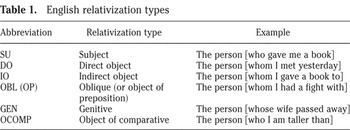
Based on a typological investigation of more than 50 languages, Keenan and Comrie (1977) proposed the noun phrase accessibility hierarchy (NPAH), suggesting that there is a particular markedness order of different RC types that applies to all of the languages of the world. In English, there are six types of relativization, distinguished by the function of the head noun inside the RC. These are illustrated in Table 1.
English relativization types

According to Keenan and Comrie, the order of relativization types in the NPAH is as follows: subject (SU) > direct object (DO) > indirect object (IO) > oblique (OBL) > genitive (GEN) > object of comparative (OCOMP), in which > means “more accessible than.” In this hierarchy, the relativization types located to the left are considered to be less marked, whereas those to the right are regarded as more marked. If one of the relativization types is present in a language, it implies the presence of all types to the left but not to the right in the hierarchy. For instance, any language that has DO also has SU. In a language that has OBL, one can also find IO, DO, and SU but not necessarily GEN or OCOMP.
This hierarchy has been used to predict the difficulty order that L2 learners would face in the acquisition of RCs. Keenan and Comrie (1977) explained that such an order largely depends on the “psychological ease of comprehension” (p. 88). Research in SLA has led to the general claim that marked items are more difficult to acquire than unmarked items. Pedagogical discussion revolves around the questions of which types of RCs should be taught and in what order they should be introduced in the L2 classroom. For instance, if there is a hierarchical difficulty order among different types of RCs, should easier types be taught first, followed by more difficult ones, as Pienemann's (1998) teachability hypothesis suggests? Or is it more effective to introduce more difficult types first and let the learners generalize the rest, as indicated by Zobl (1983, 1985)?
SLA RESEARCH ON INSTRUCTION AND THE NPAH
Gass (1982) was among the earlier experimental studies that investigated the acquisition of English RCs in light of the difficulty order predicted by the NPAH and learners' potential ability to generalize instruction focused on a particular position in the hierarchy to other types of RCs. In her study, an experimental group was instructed only on object of preposition (OP) relativization, whereas a control group was taught RCs following a standard grammar text. The results of a sentence-combining test and a grammaticality judgment test showed that participants in the experimental group were able to generalize what they had been taught to other types of RCs (except for GEN) and that they outperformed the control group both in the sentence-combining test and the grammaticality judgment test. Eckman et al. (1988) replicated and extended the study by Gass. Instruction on one of the three types of RC structures (i.e., SU, DO, or OP) was given to each of the three experimental groups. The results of their sentence-combining tests showed that all groups did best on the structure on which they were instructed and that L2 learners who manifested evidence of recognizing or using one RC type benefited from instruction that targeted more marked RCs.
In her experimental study on the acquisition of English relativization, Doughty (1991) investigated (a) whether L2 instruction makes a difference in the rate of acquisition of relativization by L2 learners, (b) whether different types of instructional procedures differently affect the acquisition of relativization, and (c) whether L2 instruction that utilizes marked types of RCs facilitates the acquisition of other RC types. Based on the findings of previous studies on relativization, Doughty used the NPAH as a reasonable predictor of difficulty in RC acquisition and chose OP RCs as the target form. A pretest and a posttest were conducted with two experimental groups and one control group. Two types of treatment using computer-based instruction—namely rule-oriented and meaning-oriented treatments—were given to the experimental groups during reading sessions in which learners were instructed to read and comprehend several given passages that included OP RC sentences. The results of the study suggested that (a) L2 instruction positively affected the rate of relativization acquisition, (b) although both instructed groups gained in relativization ability, the meaning-oriented treatment group outperformed the other groups in comprehension of the texts, and (c) markedness theory has an important role in instructed L2 relativization development.
Among recent studies, Ammar and Lightbown (2004) examined both the effectiveness of instruction and the directionality of generalizations of relativization. Three groups of Arabic speakers learning English as a FL were taught RC types with different levels of markedness (DO only, OP only, and SU + DO + OP), and their posttest results were compared with the results of a control group. The findings revealed that the experimental groups outperformed the control group in the learning of relativization and that participants who were taught marked RCs were able to generalize to less marked ones. Moreover, participants also generalized to some RC types that were more marked and thus not implicated by the ones they were taught. Based on their findings, Ammar and Lightbown emphasized that teaching only one marked RC type can be as beneficial as teaching many RC types starting with the less marked types.
Common to all of the aforementioned relativization research is that L2 instruction positively affects the rate of relativization acquisition and that the teaching of more marked types of RCs leads to the generalization of rules on less marked types, thus supporting Zobl's (1983, 1985) projection hypothesis.
Fewer studies have addressed the NPAH in the learning of L2s or FLs other than English; researchers have thus far examined RCs in French (e.g., Hawkins, 1989; Mitchell, 2001), Irish (e.g., Scott, 2003), Italian (e.g., Croteau, 1995), Korean (e.g., O'Grady, Lee, & Choo, 2003), Swedish (e.g., Hyltenstam, 1984) and have undertaken a comparison of Chinese, Japanese, Persian, German, and Portuguese (Tarallo & Myhill, 1983). Among these studies, few have investigated the effect of classroom instruction on the learning of RCs. Furthermore, whereas the studies on European languages tend to agree with the difficulty order among different types of RCs suggested by the NPAH (except in the results reported by Hawkins and Mitchell as well as the case of GEN in Gass, 1982), studies on the NPAH in Japanese have yielded mixed results.
RELATIVIZATION IN JAPANESE
Typologically, the Japanese language shares many of the morphosyntactic features of subject-object-verb (SOV) languages (Clancy, 1985). Japanese is an agglutinative language that makes use of both postpositional morphemes (case markers or particles) and word order for case marking. Japanese case-marking particles are postpositional instead of prepositional, and modifiers such as adjectives, subordinate clauses, and RCs appear before head nouns. Thus, the relativization system of Japanese differs substantially from the systems of postnominal languages such as English.1
Matsumoto (1988, 1997), for instance, used the term noun-modifying construction to describe the characteristics of Japanese relativization that make it different from European languages. In recent publications, Comrie (1998, 2002) distinguished it as the attributive clause construction. According to these authors, the Japanese language has a single construction that covers both relative clauses and sentential complements with a nominal head. They argue that there are no grammatical constraints on the Japanese attributive construction, although there may be pragmatic constraints instead.
- They are prenominal: RCs precede head nouns.
- No relative pronouns are used.
- Postpositional case-marking particles in RCs tend to be deleted.
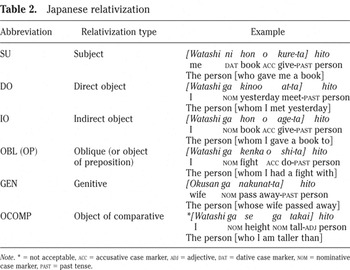
Different types of Japanese relativization are illustrated in Table 2, based on the English examples given in Table 1. According to Inoue (1976), the last type, OCOMP relativization, is considered unacceptable2
It should be pointed out, however, that the illustration of OCOMP in Table 2 does not reflect the English equivalent “the person [who I am taller than].” To express a comparative meaning in the original sentence, an additional phrase no hoo (“the side of”) has to be placed in between watashi and ga. Watashi no hoo ga se ga takai “I am taller than (he is)” then becomes an appropriate sentence. Further discussion on this point is not within the scope of this study, but the interested reader should refer to Kuno (1973) and Inoue (1976).
Japanese relativization

RESEARCH ON THE NPAH IN L2 JAPANESE
In comparison to the SLA studies investigating the NPAH in the learning of postnominal languages, the number of studies on the NPAH in Japanese is low. Moreover, whereas the NPAH has been considered as a significant hypothesis that predicts the difficulty order of different RC types in postnominal languages, the results of studies on the acquisition of Japanese RCs are less conclusive.
Sakamoto and Kubota (2000), for instance, carried out two studies on the acquisition of Japanese RCs by Japanese as a second language (JSL) learners. The first study examined the frequency of different types of RCs found in the participating JSL learners' diaries. The second study surveyed sentence-combining tasks given to the JSL learners. The results of the first study supported the NPAH, showing that the SU-type RCs were used most frequently, followed by DO, IO, and others. The second study, however, had mixed results: The difficulty order of the relativization types differed among the learners of different first languages (L1s) in the results of the sentence-combining tasks. Kanno (2001) conducted an experimental study on the processing of different types of RCs by English-speaking learners of Japanese. Her results showed that SU RCs were more easily understood by the learners than DO RCs, thus supporting the predictions of the NPAH. Tarallo and Myhill (1983), on the other hand, examined the acquisition of RCs in Chinese, Japanese, Persian, German, and Portuguese by L1 English learners. The results of their grammaticality judgment test on Japanese (and Chinese) indicated that DO relativization was found to be easier than SU relativization for the participating JFL learners—a finding inconsistent with the predictions of the NPAH. Recently, Ozeki (2005) investigated the production of RCs by JSL learners with various L1s, using different datasets collected in interviews, a natural setting, and classroom settings. Her results suggested that the difficulty that JSL learners had producing RCs was not affected by the grammatical function of modifying clauses and head nouns. Ozeki concluded that the acquisition of Japanese relativization is different from that of English, which has often been reported to follow the predictions of the NPAH. To examine the differential effects of teaching different types of Japanese RCs, Roberts (2000) employed an experimental design, using a pretest and a posttest that consisted of a production (sentence-combining) task and a comprehension task. Each of the three experimental groups of JFL learners received explicit instructional treatments that focused exclusively on one of the DO, IO, or OP (OBL) relativization types. As for the difficulty order of different types of RCs, the results of the production task suggested that SU was easier than DO for the learners, thus supporting the predictions of the NPAH. The comprehension task results, however, contradicted the predictions of the NPAH: They indicated that the meanings of SU RCs were the most difficult for the learners to understand. Results for the pretest and posttest were also analyzed to examine whether participating learners were able to generalize the rules for other types of relativization. Roberts' findings indicated that there were many instances in which the participants generalized their knowledge beyond the levels that were the focus of instruction (i.e., DO, IO, or OP) and that there were also many participants who failed to generalize their learning up to those levels. Roberts further suggested that after L2 learners acquire a less marked item, a new level of achievement will be added incrementally to the previous levels; in other words, as learners progress, more marked types will be acquired in the order predicted by the NPAH.
FURTHER ISSUES
The NPAH focuses only on the RC itself regardless of its structural or functional relationship with the main clause, but research suggests that the difficulty order of different relativization types could depend on a number of other variables. For instance, some studies have indicated that the difficulty of relativization might also be determined by the location and the function of the RC in the main sentence (e.g., Hamilton, 1994; Izumi, 2003). On the basis of the results of research on the processing of L1 relativization, Ozeki (2003) also pointed out that the use of animate and inanimate nouns in the clause might influence L2 learners' difficulty in understanding the meaning of the whole sentence. In recent research, Ozeki (2005) as well as Ozeki and Shirai (this issue) further confirmed the effect of animacy on the acquisition of L2 Japanese relativization. Therefore, the test assessment materials used in research on L2 relativization need to be carefully controlled so that elicitation sentences include similar conditions across different RC types as much as possible.
Although studies on the NPAH in postnominal languages have explored the question of which relativization types should be introduced to L2 learners in order to facilitate the acquisition of RCs, little is known with regard to the teaching of Japanese RCs. Furthermore, whereas a number of L2 studies have examined the effect of classroom instruction on the learning of relativization in English, no reported studies have explored the effects of different types of instruction on Japanese RCs (Saito, 2002). Thus, a carefully designed study on the acquisition of Japanese RCs should make a significant contribution not only in the JFL context but also in our understanding of relativization in SLA in general.
RESEARCH QUESTIONS
On the basis of theory and practice presented in the literature on formal instruction and relativization in SLA, the current study investigates the potential effects of different formal treatments on the acquisition of Japanese RCs as well as JFL learners' ability to generalize instruction that is focused on a marked position beyond the learners' developmental level. The research questions that guide this study are the following:
- Do three types of formal treatments—namely form-based, meaning-based, and form- plus meaning-based—during the practice and production procedures in the teaching of RCs differently affect the participants' acquisition of Japanese relativization?
- Are the findings of the present study consistent with the predictions of the NPAH? If so, does formal instruction that utilizes marked RCs facilitate the acquisition of other RC types?
METHOD
Target of Instruction
Japanese relativization was the target of instruction in this study. The OBL relativization type, which is located at the second lowest position among the five in the NPAH in Japanese, was chosen as the focus of instruction. The OBL type was selected for three reasons. First, a low position in the hierarchy was necessary in order to investigate how far learners would generalize the rules up the hierarchy. Second, the GEN type, at the lowest position, was not chosen, in an attempt to determine whether generalization of rules could still be observed in GEN relativization, which is supposed to be more marked than OBL relativization in the NPAH. Third, the OBL (OP) type had been chosen as the target item in two of the major instruction studies on the NPAH: Doughty (1991) and Gass (1982). Examples of Japanese OBL RCs are presented in (1)–(3)3
Abbreviations: com = comitative case marker, dir = directional case marker, loc = locative case marker, nom = nominative case marker, past = past tense, prog = progressive, top = topic marker.

The postpositional case markers ni, e, and to, which roughly represent “in,” “to,” and “with,” respectively, in the original sentences, cannot occur on the head nouns in the RCs.
Research Design
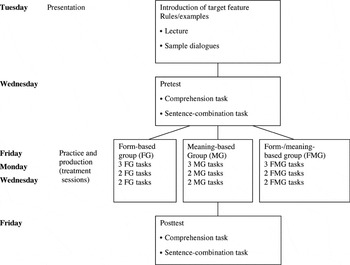
A quasi-experimental design was used in this research. The study took place in a major university in the greater Toronto area, involving three classes in a first-year (introductory-level) Japanese course. Each weekly syllabus of the program followed the presentation, practice, and production (PPP) teaching sequence (Byrne, 1976) for particular grammatical items.4
Although I am aware of the drawbacks of the PPP procedure (e.g., Harmer, 2001), this is the course format in place for the Japanese language course that I teach.

Overall research design.
Participants
A total of 60 young adult learners of JFL enrolled in three classes in the first-year university Japanese course participated in the study.5
The way in which students had enrolled in each class was arbitrary: Students had chosen their classes based on their course schedules for the year. Several time slots were made available for all students. Therefore, there is no reason to believe that there were major differences between the three groups.
A number of major studies on the acquisition of ESL RCs involved participants with a variety of L1 backgrounds. Doughty (1991) and Gass (1982) randomly assigned their participants to two experimental groups and one control group, which resulted in an unequal proportion of L1s in each group. Eckman et al. (1988), on the other hand, controlled the ratio of L1 backgrounds in each of the three experimental groups and one control group.
The exact number of participants who answered that their most fluent language was English was 15 for the FG, 14 for the MG, and 17 for the FMG. Other languages that participants claimed to be fluent at were the following: FG (Mandarin = 5, Cantonese = 2, Korean = 2, Indonesian = 1, French = 1, Arabic = 1); MG (Mandarin = 5, Cantonese = 3, Korean = 4, Hakka = 1, Russian = 1, Romanian = 1); FMG (Mandarin = 3, Cantonese = 3, Korean = 4, Fujianese = 1, Vietnamese = 1, Russian = 1, German = 1).
Procedures
Presentation Session.
The presentation procedure in the study consisted of two parts: a lecture in which grammatical explanations and examples of Japanese relativization were presented, and dialogues that included utterances with RCs.8
Although the target form focused on in the present study was OBL relativization, the example expressions and sample dialogues in the presentation session included other types of RCs (i.e., SU and DO). These are part of the instructional materials used in the present language course, and I was not able to control this for ethical reasons. It is not possible for me to claim that this had no impact on the data in the present study.
Practice and Production Sessions.
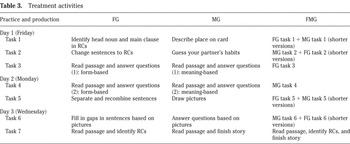
These sessions were aimed at promoting and enhancing the L2 learners' comprehension and production of the target feature. Each of the three groups was provided with one of the three different formal treatments during the practice and production sessions of the study: (a) an explicit form-based instructional approach with deductive characteristics, (b) a communicative meaning-based approach with inductive characteristics, and (c) a combination of the two. The three groups were labeled as the form-based treatment group (FG), meaning-based treatment group (MG), and form- plus meaning-based treatment group (FMG), respectively. There were three treatment sessions, using three 50-min class periods scheduled on separate dates. All key sentences used in the elicitation activities in these sessions were controlled to include only OBL-type RCs and were also controlled to include the same number of occurrences of the form across the three treatment groups. Participants were engaged in the activities both in pairs and in groups. A summary of the activities is presented in Table 3.
Treatment activities

Tasks created for the FG evolved around identifying the details of or discovering the grammatical functions of RCs. For instance, in FG task 1, participants were given instructions on how to identify the head noun and the modifying clause in some sample expressions of Japanese OBL RCs. Participants were then given more expressions of OBL RCs and were asked to identify and mark the head noun and the modifying clause for each expression by distinguishing them using pink and yellow markers that were provided. In FG task 5, using slips of paper with a RC sentence written on each of them (e.g., Ken-san wa watashi ga deta daigaku e ikimashita. “Ken went to the university that I graduated from.”), participants were instructed to identify the head noun and modifying clause in each sentence using different colored markers and then to divide the main clause and RC into two simple sentences by duplicating the head noun. They were told to write those two sentences on a separate blank sheet of paper; while the participants were engaged in this task, the original slips were collected so they could no longer see the original sentence. Participants were then instructed to recombine the two simple sentences into the original complex sentence that included a main clause and a RC and, finally, to compare their answers with their peers' responses. Other FG tasks involved reading a passage and performing highly form-oriented tasks, such as underlining and analysis of the structure of sentences that included RCs.
Tasks for the MG mainly involved understanding the meaning of or producing expressions that contained RCs. In MG task 1, for instance, the instructor first displayed a picture of a place (e.g., a library) and asked what it was and what one would do there. Both the instructor's questions and participants' answers included OBL RCs (e.g., Toshokan wa hon o yomu tokoro desu. “A library is a place where you read books.”). This activity was followed by a round of practice that used similar questions and answers based on a picture of another place (e.g., a café). Each participant was then provided with some picture cards of various places (e.g., a park, restaurant, kitchen, bank) and was asked to describe the place on his or her card and let the other group members guess what sort of place was printed on the card. If participants guessed correctly, the card was theirs, and they were challenged to collect as many cards as possible. MG task 5 used the same sentences as FG task 5, but the MG task involved participants drawing pictures to illustrate the sentences. For this task, each participant was given four slips of paper, one at a time, as well as a separate blank sheet of paper and a glossary with sample sketches of people, things, and actions (e.g., “me,” “university,” and “to go”). Participants were instructed to illustrate each sentence by drawing a picture (with the help of the sample sketches on the glossary sheet) and then to compare their pictures with their partner's drawings. During the picture comparison, all of the slips were collected from the participants, who were then instructed to describe their pictures in Japanese to their partners. Other MG tasks included similar exercises that focused on meaning: For the activities that involved reading a passage, for instance, participants were given questions to answer about the content of the passage.
Most of the tasks for the FMG were designed mainly as a combination of shorter versions of FG and MG activities. For each task, participants were provided with a form-based activity to learn about the structure and function of RCs as well as a meaning-based activity to demonstrate the understanding and use of expressions with RCs.
How to treat participants' errors during the treatment sessions was another issue in the experiment. Corrective feedback was limited to form-related errors for the FG and meaning-related errors for the MG, whereas both types of errors were corrected for the FMG. All of the classroom sessions were tape-recorded in order to examine whether the three types of instruction were carried out as originally planned and to determine whether all of the key sentences were covered in each group.
Test Materials and Scoring
A pretest and a posttest that involved two tasks—a comprehension task and a sentence-combining task—were conducted to measure the progress of the learners in each group. For each task, participants received a total of 18 questions (6 questions for OBL-type RCs and 3 questions each for SU, DO, IO, and GEN). To examine the participants' morphosyntactic knowledge separately from their orthographic knowledge of Japanese, only romanization (the English alphabet) was used for the tests. Participants were also allowed to answer the questions in romanization. For the purpose of minimizing the effects of participants' limited vocabulary on their task performance, only the basic vocabulary covered in the course was used in the stimulus sentences. Participants also reviewed a list of vocabulary used in the sentences before receiving the tests, and they were allowed to access this vocabulary list during the tests. Each test was conducted so that participants had sufficient time to answer all questions: They were given 20 min for the comprehension test and 30 min for the sentence-combination test.
In the test materials, the number of free morphemes (i.e., content words and function words) was controlled so that each set of sentences among the five different relativization types would have approximately the same number of such morphemes. As in the examples of SU relativization given in (4), (5), and (6), all of the RCs in the comprehension test and the desired answers to the sentence-combination test were embedded at the beginning of the main sentences. The function of the RC in the main clause of each sentence was also controlled so that each type of RC appeared as SU, DO, and IO.

To avoid a possible influence of the use of animate and inanimate nouns, all head nouns were controlled to be animate (i.e., people) in the 12 sentences that did not have OBL-type RCs. Of the six sentences with OBL-type RCs, three sentences included inanimate head nouns; this was to examine how much progress the participants made in the comprehension and production of the target item (OBL RCs) through the treatment activities, which included both animate and inanimate head nouns. Efforts were also made to include different types of OBL RCs as much as possible for the sentences used in the tests. In each of the actual tests, 18 sentences were randomly ordered.
Comprehension Test.
The comprehension test employed multiple-choice questions. For each of the 18 Japanese sentences that included RCs, participants were given four statements in English and were asked to choose the one that most accurately reflected the given Japanese sentence. As in the example in (7), the four choices consisted of (a) the correct answer, (b) two statements that include RCs but do not correspond to the given sentence, and (c) a distracter that does not include a RC.

To choose the correct answer, a participant was required to understand both the main clause and the subordinate clause in the Japanese sentence. For each question, participants were given either one point for a correct answer or zero points for an incorrect answer.
Sentence-Combination Test.
Participants were given 18 pairs of simple sentences and were instructed to combine each pair to make a complex sentence. This was done by converting one of the sentences into a RC. Sample questions and intended responses are given in (8a) and (8b).

To have one possible correct answer for each question, the two simple sentences for each item were devised in such a way that only one of them could be converted into a RC. For instance, only the first sentence in (8a) (“Mari introduced a teacher to Ms. Suzuki”) and only the second sentence in (8b) (“Mr. Kawano invited the student”) can be converted into RCs, whereas the other sentences cannot be transformed into RCs because one is an interrogative (“Who is the teacher?”) and the other is a polite request form (“Please send a mail to the student”).9
In the sentence-combining tasks used in many previous relativization studies, participants were directed to start with the first sentence in order to obtain one possible answer for each question. I did not employ this method because I intended for participants to refrain from mechanically constructing each sentence without closely attending to its meaning. However, a small number of participants still produced prohibited sentences by converting an interrogative or request form into a RC. For such answers, I provided partial points based on the scoring scheme created for the test.
For the sentence-combination task, multiple errors were found in participants' answers. A scoring scheme, accompanied by a flowchart and sample errors to refer to, was established based on the types of errors. For instance, transposition of the main clause and subordinate clause, placement of the modifying clause before a wrong head noun, and use of a wrong case marker both in the main clause and the subordinate clause were treated as errors. The total score for each sentence was calculated based on these errors. Each combined sentence was given a 10-point value, and points were then deducted for each type of error (e.g., −5 for the wrong choice of head noun, −2.5 for an incorrect use of case marking that affected the meaning of the sentence). To obtain interrater reliability on the scores, a second rater (a Japanese language instructor at the same institution) scored 20% of the pretests and posttests, randomly taken from a sample of 24 participants. The correlation coefficient as calculated by SPSS reliability analysis was .99.
On the Validity of the Measurement.
The two outcome measures used in this study, especially the sentence-combination test, were highly form-oriented and therefore mainly tested explicit knowledge of L2 relativization. As discussed previously, there is a general bias in L2 instructional studies in that their measurement instruments tend to be of explicit types, and this study was no exception in this regard. One reason for this was that grammatical accuracy (e.g., word order and the use of case markers) is essential for the comprehension and production of Japanese RCs, and it was my primary concern to test this. Because I intended to investigate the effect of instruction among different types of relativization, there was also a need to morphosyntactically control all test items, which might have concomitantly created decontextualized testing conditions. Moreover, there were practical and logistical constraints on the study (e.g., a large number of participants and limited time allocated). For these reasons, it was not possible to create spontaneous and meaning-oriented conditions for individual participants (e.g., the oral elicitation of relativization knowledge using pictures, as used in the pretests of Doughty, 1991). Therefore, the intended construct of the tests in this study was limited to the measurement of the grammatical accuracy of Japanese relativization.
RESULTS10 The
reliability coefficients (Cronbach's α) for the comprehension
pretest, comprehension posttest, sentence-combination pretest, and
sentence-combination posttest were .84, .83, .97, and .98, respectively.
In order to examine the normality of the variables, I checked the means,
standard deviations, skewness, and kurtosis of each variable. The skewness
and kurtosis of each variable fell within a range of ± 2,
indicating acceptable normality.
The reliability coefficients (Cronbach's α) for the comprehension pretest, comprehension posttest, sentence-combination pretest, and sentence-combination posttest were .84, .83, .97, and .98, respectively. In order to examine the normality of the variables, I checked the means, standard deviations, skewness, and kurtosis of each variable. The skewness and kurtosis of each variable fell within a range of ± 2, indicating acceptable normality.
Effects of Instructional Treatments
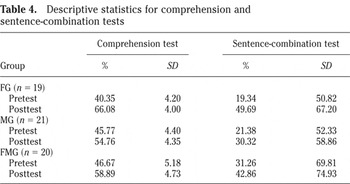
Table 4 shows the mean scores of the comprehension and sentence-combination tests for the three treatment groups. All three groups increased their scores on both tests.
Descriptive statistics for comprehension and sentence-combination tests

For the comprehension test, group mean gain scores for the FG, the MG, and the FMG were 25.73%, 8.99%, and 12.22%, respectively; the FG made the most improvement, followed by the FMG and the MG. The group mean gain scores for the sentence-combination test were 30.35% for the FG, 8.94% for the MG, and 11.6% for the FMG, resulting in a pattern of mean gain scores similar to that observed for the comprehension test. In both of the tests, the mean gain scores of the FG were more than double the mean gain scores observed for the FMG and almost three times the scores of the MG. The pretest mean scores of the three groups were considerably different from one another11
The FMG group's pretest mean score on the sentence-combination test, in particular, was higher than those of the other two groups; the reason for this is not clear.
I divided the entire sample into two groups, putting participants with Chinese (SVO language) and Korean (SOV language) backgrounds into one group. However, Kanno (this issue) suggested that even though Chinese RCs are prenominal, there is a difference in the processing of Japanese relativization between Chinese-speaking learners and speakers of SOV languages. Due to the small sample size, I was not able to investigate the possible effects of the participants' language backgrounds for each language group in the study.
The results were also recalculated using the data of those participants who claimed that their most fluent language was English: There were 15, 14, and 17 such participants in the FG, MG, and FMG, respectively. The results showed a pattern similar to that of the entire sample: The FG made the most progress, followed by the FMG and MG, on both the comprehension and sentence-combination tests.
Difficulty Order and the Generalization of Rules
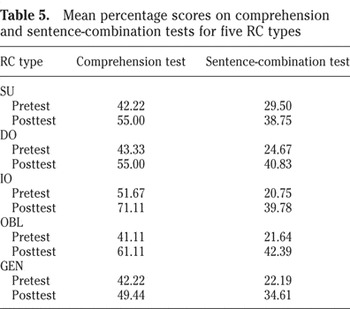
Table 5 presents the mean pretest and posttest scores for the five relativization types for all participants. In the set of analyses that compared the five relativization types, the results of the three items of the OBL type that included inanimate head nouns were excluded so that the elicitation sentences shared similar conditions in animacy across all of the relativization types. Three items of each type appeared on the pretest and the posttest. Overall, participants improved their scores for all five relativization types on both the comprehension and the sentence-combination tests.
Mean percentage scores on comprehension and sentence-combination tests for five RC types

With regard to the NPAH, the results of the comprehension test are not conclusive. Based on the pretest mean scores, it appears that the difficulty order of the five relativization types for the participants before the treatments did not follow the predictions of the NPAH. The results of the sentence-combination pretest, on the other hand, suggest that for the participants in this study, the SU type of RC was the easiest (29.50%), followed by the DO type (24.67%), which somewhat reflects the predictions of the NPAH. These results for both the comprehension and sentence-combination pretests are partially consistent with results reported by Roberts (2000), whose participants got high scores for IO and DO RCs on a comprehension task but did best with SU and DO RCs on a production (sentence-combining) task.
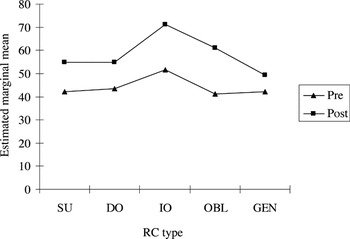
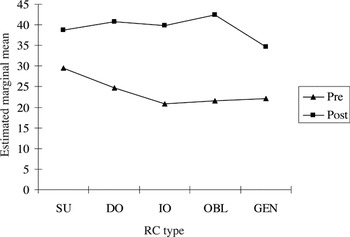
Results of the comprehension and sentence-combination posttests indicate that participants made progress on all relativization types, although they were instructed only on the OBL type. The fact that there was a considerable period of time between the pretest and posttest (10 days) suggests that participants were not affected by a practice effect but, instead, that they demonstrated a projection effect in their performance. Among the five RC types, a trend was observed for more improvement on relativization of the OBL type as well as the IO type. The average gain scores for the comprehension test were 20% for the OBL type and 19.44% for the IO type, whereas the average gain scores for the other types were lower (12.78% for SU and 11.67% for DO), with the GEN type showing the least improvement, at 7.22%. As for the sentence-combination test, the average gain scores were 20.75% for OBL and 19.03% for IO, followed by DO (16.17%), GEN (12.42%), and SU (9.25%). For both the comprehension and sentence-combination tests, participants made the most progress on the type of relativization that was the focus of the instructional treatments (i.e., the OBL type). This finding is consistent with previous L2 relativization studies (e.g., Ammar & Lightbown, 2004; Eckman et al., 1988; Roberts, 2000). SLA studies that investigated the generalization of rules in other contexts of relativization (e.g., Croteau, 1995; Doughty, 1991; Eckman et al.; Gass, 1982) reported a trend for more improvement on relativization at and above the marked type that was their focus of instruction. In this study, participants made the most improvement on the OBL type, followed by IO, the position immediately above OBL on the NPAH. The improvement rate was relatively low for SU and GEN, however. (See Figures 2 and 3.)

Means of comprehension pretest and posttest for five RC types.

Means of sentence-combination pretest and posttest for five RC types.
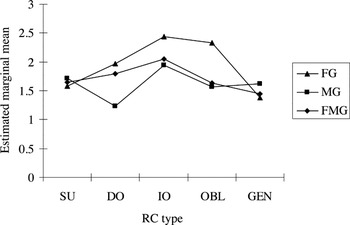
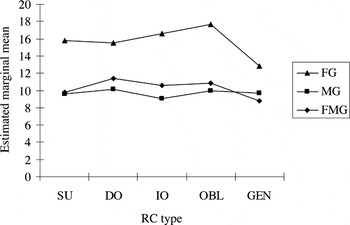
Another important goal of this study was to determine the effects of the different instructional treatments on the five different relativization types (after controlling for initial differences). For this analysis, a MANCOVA was used, holding the pretests as covariates. The MANCOVA results from all participants in all groups for the comprehension tests showed that there were no statistically significant differences among the five types of relativization. As for the sentence-combination tests, the MANCOVA results indicated marginally significant differences among the relativization types (p < .042, η2 = .168). The results of the tests of within-subjects contrasts showed that OBL and GEN were significantly different from the overall mean of the relativization types (p < .011 and p < .006, respectively). A further inspection of the contrasts suggested that GEN was statistically significantly different from IO and OBL (p < .038 and p < .002, respectively). In sum, the results of the MANCOVA showed that although significant group differences were observed across all relativization types, there was no statistical difference among the relativization types on the comprehension and sentence-combination tests, except for GEN and IO/OBL. This indicates that even though participants were trained only on OBL RCs, gains were found for all relativization types; however, IO and OBL showed significantly more gains than GEN on the sentence-combination tests. As for the treatment effects, the FG outperformed the other groups on both tests, especially for OBL-type RCs. Figures 4 and 5 illustrate these results.

Comparison of group means of five RC types on the comprehension posttest.

Comparison of group means of five RC types on the sentence-combination posttest.
DISCUSSION
Types of Instruction
The first research question asks whether three instructional types—namely form-based, meaning-based, and form- plus meaning-based instruction—affect participants' acquisition of Japanese RCs. According to the degrees of explicitness in instructional approaches presented by Rutherford and Sharwood Smith (1988), it can be said that during the practice and production sessions, the FG was provided with instruction in which participants were led to “explicitly call attention to a grammatical feature” and “articulate an informal pedagogical ‘rule’ as an instructional aid,” whereas the MG activities were designed to “implicitly call attention to a grammatical feature through calculated exposure of the learner to crucial pre-selected data” (p. 277). The FMG, on the other hand, was given a combination of explicit and implicit approaches during the treatment sessions. The test results show that whereas all three groups increased their scores from pretest to posttest, the FG made the most improvement, followed by the FMG, and then the MG, for both comprehension and sentence-combination tests.
The instructional treatment provided to the FG was of a highly explicit type. During the treatment sessions, participants were taught how to identify head nouns and modifying clauses and were asked to pay close attention to the structure and function of the RC in the sentence. As in Ammar and Lightbown (2004), Doughty (1991), and Roberts (2000), participants in this group were provided with the rules and steps necessary to combine two simple sentences into one complex sentence using a RC. The instructor's corrective feedback to participants was focused on form-related errors as well.14
For example, there were instances during the FG activities when participants marked a wrong noun as a head noun, and they noticed their errors when comparing the answers to their peers' responses. I provided these participants with explicit metalinguistic feedback.
The better performance of the FG participants might also be attributable to the fact that the sentence-combination test was similar to task 5 provided to the FG during the treatment sessions. However, the FG participants also did best on the comprehension posttest, which tested their ability to understand the meaning of each sentence as a whole.
The MG participants, on the other hand, were given the same amount of exposure to expressions of Japanese RCs as the FG participants, using sentences similar to those given to the FG. They were provided with activities that would lead to the understanding of the meaning and use of RC structures, using visual aids instead of detailed explanation of the rules of relativization. All of the MG tasks were designed to be meaning-oriented, and the instructor's feedback to participants was also restricted to meaning-focused feedback.16
A few participants in the MG were still concerned about the grammaticality of their utterances and asked me whether their sentences were grammatically correct. For such questions, I responded with “Well, what do you think?” and participants usually answered “I think it is okay,” and carried on with their task.
Participants in the FMG also increased their scores on both tests. The test results showed that the FMG improved more than the MG but did not improve as much as the FG. It is possible that because the FG activities were more effective than the MG activities, the FMG—a hybrid of the FG and MG—sits in the middle of the two groups. Although combinations of different types of instructional techniques are argued to be more useful and effective than one individual type (e.g., Ellis, 1993), it appears that the more form-based activities the participants had, the more improvement they made on the tests in this study. Another possible explanation for the performance of the FMG could be that because participants were asked to engage in different types of tasks over a limited period of time, their attention might have been dispersed. They might not have been able to take time to focus on one activity before going on to the next. The results of this study indicate that a mere combination of FG and MG treatments does not necessarily provide students with an optimal opportunity for learning.
The NPAH and the Projection Effect
The second research question explores the universality of the NPAH and participants' generalization of rules to their knowledge of different relativization types in Japanese. This study suggests (a) both inconsistency and partial consistency with the NPAH in the results of comprehension tests and sentence-combination tests and (b) similar patterns of projection effect in the types of RCs across the two tests.
In regard to the universality of the NPAH, the findings of this study were not conclusive. As reported earlier, the results of the sentence-combination pretest showed that the SU-type RC was the easiest, followed by the DO type, which is consistent with part of the NPAH. This result is similar to the production (sentence-combining) test results of JFL learners in Roberts (2000). The results of the comprehension pretest, however, did not follow the NPAH: The IO and DO types were found to be easier than the SU-type RC.17
Tarallo and Myhill (1983) was the only study that reported the difficulty order of DO > SU in Japanese L2 relativization, based on their grammaticality judgment test. They paid attention to the distance of the head noun from its extraction site in a RC and argued that this distance determines the difficulty order of relativization types (i.e., SU > DO for right-branching languages and DO > SU for left-branching languages). Participants in the current study might also have been affected by the typological differences between Japanese and their L1 when they were tested on SU-type relativization. However, O'Grady et al. (2003), who investigated the comprehension of L2 relativization by English learners of Korean, a left-branching language, claimed that it is not linear distance but structural factors that determine the difficulty order.
Such differences between the results of two task types were also reported by Izumi (2003). In his study on the acquisition of L2 English relativization, the NPAH was supported in the production test, whereas the comprehension test had mixed results.
Regarding the effect of projection, participants in the current study improved in their knowledge of relativization and their ability to comprehend and produce all of the relativization types. However, compared with the improvement observed for OBL and IO relativization,19
The fact that the improvement was greater for OBL and IO relativization types leads to a question of to what extent IO and OBL RCs are distinct in Japanese. Comrie (1998) argued in his attributive clause hypothesis that in both Japanese and Korean, the same construction is used when the interpretation is made on the relativization of an indirect object or recipient or of instrument. If the IO and OBL relativization types are not distinct in Japanese, there would be no need for generalization from OBL to IO.
To summarize, this study indicated only a partial consistency with the NPAH; participants demonstrated the ability to generalize rules to other relativization types when instructed only on OBL relativization, but the improvement rate was lower for SU and GEN. However, for the teaching of Japanese relativization in postsecondary JFL contexts, the introduction of RCs appears to follow the hierarchy indicated by the NPAH, in the order of unmarked to marked types. Many of the popular JFL textbooks used at the college level, for instance, introduce the SU type first and provide exercises on other types, mainly DO and, occasionally, IO or OBL. An examination of several popular JFL textbooks reveals that the GEN type is not generally introduced in the lessons on RCs.20
These observations are based on an examination of five popular JFL textbooks, including Genki: An integrated course in elementary Japanese by Banno, Ohno, Sakane, Shinagawa, and Tokashiki (1999; Japan Times) and Yookoso!: An invitation to contemporary Japanese by Tosaku (2006; McGraw-Hill).
Limitations of the Study
The limitations of the present study mainly derive from the fact that intact Japanese classes were used as the three groups in the experiment. Although all other factors of participants' background (e.g., gender, age, and language background) were similar across the three groups, it was not possible to control for initial differences in the pretest scores among the groups. Conducting the study in the dual role of researcher and teacher might have been another limitation. It is not possible to claim that this had absolutely no impact on the present study, although I made every effort to keep an objective eye as a researcher throughout the study. Another limitation is that only the immediate effects of instruction were investigated, due to the fact that the study took place at the end of a first-year university course before a long summer break and only a handful of students proceeded to the second-year course in the following academic year. It was not possible to administer a delayed posttest, although this would have provided important information about the long-term effects of instruction.
Other limitations are related to the measurement instruments of the study. The outcome measures were highly analysis-oriented, and this might have favored the form-based group in their performance. Although the intended construct of the two tests in this study was to measure the grammatical accuracy of participants' knowledge about Japanese RCs, the results obtained in this study need to be interpreted with the explicit nature of the tests in mind. Finally, the test materials in this study included only a small number of items (i.e., 18 items for each of the comprehension and sentence-combination tests, with 3 items for each relativization type). Given the time expected for participants to complete the two tests as well as the nature of the tests, the participants were faced with quite a daunting task. To balance the conditions of time constraints and participant motivation, a small number of carefully designed sentences were chosen to test the participants' knowledge of and ability in relativization. The findings of statistical significance in this study should, therefore, be interpreted with caution.
CONCLUSION
Two main conclusions can be drawn from the findings of the current study. First, the study indicates that the type of instruction plays an important role in the acquisition of L2 RCs, at least in the short term and with the measurements employed. In the context of the teaching and learning of Japanese relativization outlined previously, L2 learners' attention to detailed analysis of grammar structures facilitated the comprehension and production of RCs. Whereas all three groups received different types of formal instruction and appeared to have improved their knowledge of the target structure, results suggest that explicit form-oriented instruction in this context might be more beneficial for helping L2 learners move on to advanced levels of proficiency. Second, participants in this study were able to generalize rules to other contexts of relativization when instructed on a marked type. As the results of previous relativization studies also demonstrated, the teaching of marked types of Japanese RCs might be beneficial to L2 learners. However, the acquisition of Japanese relativization in this study appears to be a nonlinear and complex process when compared to the predictions of the NPAH. The universality of the NPAH as well as the issue of complexity in the acquisition of RCs might have to be revisited in various L2 contexts and with a wider variety of languages, including more Asian languages.
APPENDIX
EXCERPT FROM LECTURE NOTES AND A SAMPLE DIALOGUE
Excerpt from Lecture Notes
Characteristics of Japanese relative clauses
- No relative pronouns.
- Relative clause precedes head noun.
- Subject is marked by GA or NO.
- Some particles disappear.
Sample Dialogue
Dialogue G: Kuruma no naka de
Satoo: Konban tomaru hoteru wa doko desu ka.
Katoo: Naiagara-on-za-reeku ni aru Purinsu-obu-Ueeruzu to iu hoteru ni tomatte mimashoo.
Satoo: Soko wa yuumee-na hoteru desu ka.
Katoo: Ee, Igirisu no Ueeruzu-kootaishi ga tomatta tokoro na node, yuumee desu. Naiagara no taki o mita ato de sono hoteru ni ikimasu. (from Lecture 19, Ota, 2006)
Dialogue G: “In the car” English translation
Satoo: Where is the hotel that we are staying at tonight?
Katoo: Let's try the hotel called Prince of Wales that is in Niagara-on-the-Lake.
Satoo: Is that a famous hotel?
Katoo: Yes, it is, because that is the place that England's Prince of Wales once stayed at. We will go to the hotel after we look at Niagara Falls.