Introduction
The recurrent nature of depressive illness has been one of the most extensively replicated finding in the psychopathological literature (for reviews, see Burcusa & Iacono, Reference Burcusa and Iacono2007; Hardeveld et al. Reference Hardeveld, Spijker, De Graaf, Nolen and Beekman2010). For example, within 5 years of having recovered from an episode of (usually) major depression, up to 85% of clinically referred adults had another depression episode (Mueller et al. Reference Mueller, Leon, Keller, Solomon, Endicott, Coryell, Warshaw and Maser1999; Solomon et al. Reference Solomon, Keller, Leon, Mueller, Lavori, Shea, Coryell, Warshaw, Turvey, Maser and Endicott2000). High rates of recurrence characterize clinically depressed youths as well (for a review, see Rao & Chen, Reference Rao and Chen2009). Although major depression may be somewhat less recurrent in samples outside of specialized mental health care settings (e.g. Hardeveld et al. Reference Hardeveld, Spijker, De Graaf, Nolen and Beekman2013), prevention of recurrence is critical for reducing the overall burden of depression on society.
One approach to recurrence prevention is to identify and then ameliorate contributory factors (e.g. Farb et al. Reference Farb, Irving, Anderson and Segal2015). However, reliable predictors of depression recurrence, such as number of prior episodes or stressful life events (e.g. Hardeveld et al. Reference Hardeveld, Spijker, De Graaf, Nolen and Beekman2013; Harkness et al. Reference Harkness, Theriault, Stewart and Bagby2014), which were consistently identified in earlier studies, have had limited implications for prevention efforts. Thus, the research emphasis has been shifting to the study of risk factors that are malleable, especially those that might link behavioral and physiological aspects of vulnerability (Marchetti et al. Reference Marchetti, Koster, Sonuga-Barke and De Raedt2012; Cuthbert & Insel, Reference Cuthbert and Insel2013; Farb et al. Reference Farb, Irving, Anderson and Segal2015).
One important area of individual differences relevant to depression risk is the ability to appropriately self-regulate sadness and dysphoria (mood repair), which is impaired in the context of major psychopathology (Aldao et al. Reference Aldao, Nolen-Hoeksema and Schweizer2010; Gross, Reference Gross2013). Consistent with the typical characterization of depressive disorders (American Psychiatric Association, 2000), clinically depressed individuals usually report finding it difficult (or impossible) to attenuate their sad mood. More importantly, mood repair problems persist after recovery from depression and usually involve excessive use of responses, such as rumination, that exacerbate or prolong rather than attenuate dysphoria (Ehring et al. Reference Ehring, Fischer, Schnulle, Bosterling and Tuschen-Caffier2008; Kovacs et al. Reference Kovacs, Rottenberg and George2009; Kanske et al. Reference Kanske, Heissler, Schonfelder and Wessa2012). The persistence of problematic mood repair may increase the risk of depression recurrence by exacerbating and prolonging normally occurring sad affect, which then can lead to a cascade of further depression symptoms.
There is considerable evidence that problematic mood repair prospectively predicts depression symptoms. In their classic study, Nolen-Hoeksema & Morrow (Reference Nolen-Hoeksema and Morrow1991) found that individuals’ pre-existing ruminative style of coping with sadness predicted severity and duration of depression symptoms after experiencing a natural disaster. We found that, controlling for depression levels, the habitual use of maladaptive mood repair (MMR) responses predicted depression symptoms about 1 year later among adults who varied in depression risk (Kovacs et al. Reference Kovacs, Rottenberg and George2009). Conversely, competent emotion regulation in a community sample of adults predicted lower levels of depression symptoms 5 years later (Berking et al. Reference Berking, Wirtz, Svaldi and Hofmann2014). While less information is available on the predictive value of mood repair problems in younger cohorts, rumination, which is a specific maladaptive response, has been well studied. According to a meta-analysis, when baseline depression symptoms are controlled, the tendency to ruminate in response to sadness is a modest prospective predictor of depression among youths (Rood et al. Reference Rood, Roelofs, Bögels, Nolen-Hoeksema and Schouten2009).
However, little is known about whether mood repair can predict course features of a depressive disorder such as recovery from or recurrence of an episode. Among 21 depressed and 19 recovered adults, only one response to sadness, the use of reflection (a presumably adaptive response), predicted recovery from depression 6 months later (Arditte & Joormann, Reference Arditte and Joormann2011). Among young adults with remitted depression (n = 99), habitual use of MMR (but not adaptive mood repair; AMR) responses predicted a recurrent depression episode across a 3-year follow-up, on average, beyond the prediction offered by prior clinical variables (Kovacs et al. Reference Kovacs, Rottenberg and George2009). Thus, the effects of mood repair on the course of a depressive disorder represent an emerging area of research, the scope of which has not yet been extended to juveniles.
Physiological functioning is another domain of individual differences relevant to depression risk. Within this area, the parasympathetic nervous system (PNS) has received particular attention, given its role in emotion experience (e.g. Kreibig, Reference Kreibig2010; Levenson, Reference Levenson2014). Respiratory sinus arrhythmia (RSA), the magnitude of heart rate variability (HRV) linked to the respiration cycle, is the most common index of PNS functioning; it reflects the extent of parasympathetic inhibitory input to the heart's pacemaker via the vagal nerve (Thayer et al. Reference Thayer, Åhs, Fredrikson, Sollers and Wager2012). Resting RSA provides information about the ability to adjust physiological arousal to changing internal and external demands and has been regarded as a proxy for overall ‘self-regulatory strength’ (Geisler et al. Reference Geisler, Vennewald, Kubiak and Weber2010): higher values reflect stronger health maintenance capacity. RSA reactivity to challenges usually involves decreased vagal input (vagal withdrawal) which allows increased heart rate, but it also can entail stronger vagal input (vagal augmentation) resulting in decreased heart rate (Berntson et al. Reference Berntson, Bigger, Eckberg, Grossman, Kaufmann, Malik, Nagaraja, Porges, Saul, Stone and van der Molen1997). Vagal withdrawal in response to experimental stimuli has been associated with adaptive functioning (Graziano & Derefinko, Reference Graziano and Derefinko2013), and context-appropriate RSA reactivity is believed to mirror physiological flexibility.
According to several reviews (Rottenberg, Reference Rottenberg2007; Kemp et al. Reference Kemp, Quintana, Gray, Felmingham, Brown and Gatt2010), depressed (but otherwise healthy) adults generally exhibit lower resting HRV than do controls; this conclusion has been confirmed by some recent studies as well (Brunoni et al. Reference Brunoni, Kemp, Dantas, Goulart, Nunes, Boggio, Mill, Lotufo, Fregni and Benseñor2013; Liang et al. Reference Liang, Lee, Chen and Chang2015). According to three separate reports, lower resting RSA levels also characterize diagnosed depressed adolescents as compared with control peers (Tonhajzerova et al. Reference Tonhajzerova, Ondrejka, Javorka, Adamik, Turianikova, Kerna, Javorka and Calkovska2009, Reference Tonhajzerova, Ondrejka, Javorka, Turianikova, Farsky and Javorka2010; Blom et al. Reference Blom, Olsson, Serlachius, Ericson and Ingvar2010), although these studies included only girls. In another sample of adolescents, the null results concerning resting RSA may reflect that the study's definition of recovery probably misclassified some remitted cases as ‘currently’ depressed (Byrne et al. Reference Byrne, Sheeber, Simmons, Davis, Shortt, Katz and Allen2010).
Recent work suggests that RSA may be a prospective predictor of depression symptoms in both adults and youths. Among healthy young adults, resting RSA predicted depression symptoms 1 year later, even after controlling for confounds (Yaptangco et al. Reference Yaptangco, Crowell, Baucom, Bride and Hansen2015). In two partially overlapping samples of young offspring, normative RSA patterns, as well as higher vagal withdrawal in response to an affect trigger, prospectively predicted lower depression symptoms and depression symptom trajectories (Gentzler et al. Reference Gentzler, Santucci, Kovacs and Fox2009; Yaroslavsky et al. Reference Yaroslavsky, Rottenberg and Kovacs2014). However, little is known about whether RSA can predict the clinical course of depressive disorders. In the sole study addressing this issue in adults, vagal withdrawal in response to a sad film predicted recovery from diagnosed depression 6 months later (Rottenberg et al. Reference Rottenberg, Salomon, Gross and Gotlib2005). Thus, while there is increasing evidence of cross-sectional and prospective associations between RSA and depression symptoms, very little is known about the extent to which RSA can inform about the course of depressive disorders across the age span, including adolescence.
Finally, work, which addressed both RSA and mood regulation, suggests that mood repair also may serve as a link between physiological processes and psychological adjustment. For example, among young women at variable risk for depression, normative RSA patterns signaled a reduced likelihood that MMR will lead to depression symptoms (Yaroslavsky et al. Reference Yaroslavsky, Bylsma, Rottenberg and Kovacs2013a ). Emotion regulation also served as a conduit between HRV and various areas of affective functioning (Geisler et al. Reference Geisler, Vennewald, Kubiak and Weber2010). However, no study has addressed mood repair as a possible mediator of the relations of RSA and depression recurrence in depression-prone samples.
It is important to examine pathways by which RSA, mood repair and major depressive episode (MDE) recurrence are related in adolescents because clinical depressions that onset very early in the lifespan prognosticate worse functional outcomes across the years than do adult-onset depressions (Lewinsohn et al. Reference Lewinsohn, Clarke, Seeley and Rohde1994; Zisook et al. Reference Zisook, Lesser, Stewart, Wisniewski, Balasubramani, Fava, Gilmer, Dresselhaus, Thase, Nierenberg, Trivedi and Rush2007). Possibly, if recurrent depression early in life can be prevented or forestalled, its long-term negative sequelae may be attenuated. In this regard, it is particularly appropriate to study mood repair and/or RSA as risk factors because these two processes are malleable (e.g. Bhatnagar et al. Reference Bhatnagar, Phelps, Rietz, Juergens, Russell, Miller and Ahearn2013; Krygier et al. Reference Krygier, Heathers, Shahrestani, Abbott, Gross and Kemp2013) and therefore can serve as targets in depression prevention.
In light of the above, we tested three hypotheses in our sample of adolescents with prior depression. First, we hypothesized that MMR (but not AMR) predicts recurrent MDEs. Second, we expected that atypical RSA profiles likewise predict recurrent MDEs. And finally, we hypothesized that MMR will mediate the association of atypical RSA profiles and MDE recurrence. To facilitate stringent tests of our hypotheses, mood repair was modeled as a latent construct based on the reports of multiple informants. While our hypotheses build on prior work with adults (Kovacs et al. Reference Kovacs, Rottenberg and George2009; Geisler et al. Reference Geisler, Vennewald, Kubiak and Weber2010; Yaroslavsky et al. Reference Yaroslavsky, Bylsma, Rottenberg and Kovacs2013a , Reference Yaroslavsky, Rottenberg and Kovacs b , Reference Yaroslavsky, Rottenberg and Kovacs2014; Yaptangco et al. Reference Yaptangco, Crowell, Baucom, Bride and Hansen2015), to the best of our knowledge, the current study is the first to model the relations of RSA, mood repair and recurrent major depression in a sample of previously clinically referred adolescents.
Method
Subjects
We report on 178 adolescent probands (mean age = 17.14, s.d. = 1.38 years), whose histories of MDEs had already been established in a prior genetic investigation in Hungary (e.g. Tamás et al. Reference Tamás, Kovacs, Gentzler, Tepper, Gádoros, Kiss, Kapornai and Vetró2007), but were in remission at the time of their assessment for the present study (time 1; T1). This sample was comprised mostly of males (63%) and was ethnically representative of the Hungarian population (Caucasian 96% and 3% multi-ethnic, Roma, or other ethnic category). Probands were 9.01 (s.d. = 1.76) years old, on average, at onset of their first MDE, and 3% (n = 5) had had depression episodes in the context of bipolar mood disorder.
Recruitment and diagnostic procedures have been detailed elsewhere (Tamás et al. Reference Tamás, Kovacs, Gentzler, Tepper, Gádoros, Kiss, Kapornai and Vetró2007; Kovacs et al. Reference Kovacs, Yaroslavsky, Rottenberg, George, Baji, Benák, Dochnal, Halas, Kiss, Vetró and Kapornai2015). Briefly, probands were identified for the prior genetic study across 23 child mental health facilities in Hungary, based on diagnosis [depressive disorder by Diagnostic and Statistical Manual of Mental Disorders, fourth edition (DSM-IV); American Psychiatric Association, 2000], age (7–14 years old at initial screen), medical and cognitive status (free of major systemic medical disorder and intellectual disability), and availability of at least one biological parent and a full biological sibling to participate. Due to funding constraints, only a subset of probands participated in the present study.
Procedures
T1 visits in the present study included a psychiatric/psychosocial evaluation and completion of self- and parent-rated questionnaires. As also noted elsewhere (Kovacs et al. Reference Kovacs, Yaroslavsky, Rottenberg, George, Baji, Benák, Dochnal, Halas, Kiss, Vetró and Kapornai2015), youths also participated in a 1 h-long psychophysiological protocol that probed reactions to various stimuli (presented in counterbalanced order). RSA was continuously monitored via an electrocardiogram (ECG). The stimuli included a 164-s segment from the film ‘Champ’ (dubbed in Hungarian). This film clip has been extensively used to induce sadness (e.g. Gross & Levenson, Reference Gross and Levenson1995; Rottenberg et al. Reference Rottenberg, Gross, Wilhelm, Najmi and Gotlib2002) and was also pilot tested with Hungarian youths (see Kovacs et al. Reference Kovacs, Yaroslavsky, Rottenberg, George, Baji, Benák, Dochnal, Halas, Kiss, Vetró and Kapornai2015). We focused on probands’ physiological reactions to depictions of sadness because this affect is central to clinical depression. Time 2 (T2) visits involved only a psychiatric/psychosocial evaluation and took place over the subsequent 2 (s.d. = 0.49) years. While the rate of follow-up visits ranged from one to three, 81% of the youths had two visits. MDE recurrence was based on all information derived across T2 visits.
Determination of depression remission, recurrence and related variables
Parents and offspring separately completed a DSM-IV-based, semi-structured, psychiatric interview about the adolescent (Interview Schedule for Children and Adolescents: Diagnostic version; ISCA-D) with trained clinicians. The ISCA-D has documented reliability (Kiss et al. Reference Kiss, Gentzler, George, Kapornai, Tamás, Kovacs and Vetró2007; Baji et al. Reference Baji, Lopez-Duran, Kovacs, George, Mayer, Kapornai, Kiss, Gadoros and Vetro2009): final diagnoses were assigned by consensus among clinicians and were then further verified by pairs of senior diagnosticians. Recovery from an episode of depression was defined as having no more than one clinical symptom and maintaining that essentially asymptomatic state continuously for at least 2 months (Kovacs et al. Reference Kovacs, Feinberg, Crouse-Novak, Paulauskas and Finkelstein1984b ). Recurrence was defined as meeting DSM-IV criteria for an episode of MDE after having been essentially symptom free for 2 or more months (Kovacs et al. Reference Kovacs, Feinberg, Crouse-Novak, Paulauskas, Pollock and Finkelstein1984a ).
Parents also provided information about psychotropic medication prescribed for the offspring: those data were coded by type, dose, and start- and end-dates. Severity of adolescents’ depression symptoms in the prior 2 weeks was quantified via the self-rated Children's Depression Inventory – 2nd edition (CDI; Kovacs & MHS Staff, Reference Kovacs2011).
Mood repair and latent mood repair
Parents and offspring independently completed the Feelings and My Child, and Feelings and Me (FAM) questionnaires, respectively (Tamás et al. Reference Tamás, Kovacs, Gentzler, Tepper, Gádoros, Kiss, Kapornai and Vetró2007; Gentzler et al. Reference Gentzler, Santucci, Kovacs and Fox2009; Bylsma et al. Reference Bylsma, Yaroslavsky, Rottenberg, Kiss, Kapornai, Halas, Dochnal, Lefkovics, Baji, Vetró and Kovacs2016). These questionnaires contain 54 content-wise identical items that quantify the usual extent to which the target youth deploys various AMR and MMR responses to sadness in daily life (e.g. ‘when I am sad, I look for a teacher or other adult to talk to’; ‘when I am sad, I throw, kick, or hit things’, respectively). Responses to items are summed: higher scores reflect greater utilization of adaptive or maladaptive responses. FAM scores have good psychometric properties, including internal consistency, test–retest reliability, and construct, concurrent and predictive validity (Tamás et al. Reference Tamás, Kovacs, Gentzler, Tepper, Gádoros, Kiss, Kapornai and Vetró2007; Kovacs et al. Reference Kovacs, Rottenberg and George2009; Bylsma et al. 2015). The maladaptive total score also has been shown to predict depression (Kovacs et al. Reference Kovacs, Rottenberg and George2009; Bylsma et al. Reference Bylsma, Yaroslavsky, Rottenberg, Kiss, Kapornai, Halas, Dochnal, Lefkovics, Baji, Vetró and Kovacs2016).
Because we modeled mood repair as a latent construct, we first examined whether latent AMR and MMR factors explain the covariance among parents’ and youths’ FAM scores. Factor loadings for parents’ and youths’ FAM scores were made parallel for indicators of the adaptive and maladaptive factor, respectively. Youths’ self-reports were free to covary in all models to accommodate shared method variance (see Eid, Reference Eid2000). The resultant model displayed excellent fit to the data, and was retained for analysis [χ2 (2) = 1.07, p = 0.59, comparative fit index (CFI) = 1.00, root mean square error of approximation (RMSEA) = 0.00; λ's = 0.43–0.54, r method effect = 0.26, p < 0.01]. Mirroring prior findings (e.g. Yaroslavsky et al. Reference Yaroslavsky, Bylsma, Rottenberg and Kovacs2013a ), the relationship between the AMR and MMR factors was orthogonal (r AMR,MMR = −0.02).
Assessment of RSA
During the T1 protocol, ECG signals were acquired according to accepted guidelines (Berntson et al. Reference Berntson, Bigger, Eckberg, Grossman, Kaufmann, Malik, Nagaraja, Porges, Saul, Stone and van der Molen1997) using Ag/AgCl electrodes that were placed in a modified lead II configuration on the subject's chest. Heart values were sampled online at 1000 Hz using the Mindware Bionex system (MindWare Technologies, Ltd, USA). RSA was calculated using MindWare HRV 3.0.21 software (MindWare Technologies, Ltd, USA). R-wave markers in the ECG signal were processed with the MAD/MED artifact detection algorithm; signals were visually inspected and suspected artifacts were corrected (Berntson et al. Reference Berntson, Bigger, Eckberg, Grossman, Kaufmann, Malik, Nagaraja, Porges, Saul, Stone and van der Molen1997). The inter-beat interval (IBI) series was resampled, linearly detrended, and tapered using a Hanning window. HRV was calculated using Fast Fourier transformation analysis of the IBI series, with spectral power values determined in ms2/Hz (Berntson et al. Reference Berntson, Bigger, Eckberg, Grossman, Kaufmann, Malik, Nagaraja, Porges, Saul, Stone and van der Molen1997). Our index of RSA was the log-transformed high-frequency (HF) power band of HRV (0.15–0.40 Hz range; see Berntson et al. Reference Berntson, Bigger, Eckberg, Grossman, Kaufmann, Malik, Nagaraja, Porges, Saul, Stone and van der Molen1997). Hereafter we refer to HF-HRV as RSA, since HF-HRV is the power band of HRV that occurs in the typical range of respiration.
We report herein on RSA during a baseline period of paced breathing (180 s), which involved a rising and fading tone to guide subjects’ respiration at 12 breaths per min (resting RSA), and during sad mood induction (while watching the film clip described earlier). RSA reactivity was calculated as the difference between resting RSA and RSA during the sad film clip. Thus, positive RSA reactivity values represent vagal withdrawal (decreased RSA during the sad film) while negative values represent vagal augmentation (increased RSA during the sad film). We defined a ‘normative RSA profile’ as entailing relatively high resting RSA (i.e. at or above the sample's mean) in interaction with RSA withdrawal in response to the sad film clip. This definition is supported by our prior findings (Yaroslavsky et al. Reference Yaroslavsky, Rottenberg and Kovacs2013b ) and the literature on normative characteristics of resting RSA and RSA reactivity to negative affect probes (e.g. Frazier et al. Reference Frazier, Strauss and Steinhauer2004). All other combinations of resting and reactive RSA levels were considered to represent ‘atypical’ profiles.
Statistical analyses
Descriptive analyses were conducted via SAS version 9.3 software (SAS Institute, Inc., 2013). The latent variable survival analysis used Mplus version 7.11 software (Muthén & Muthén, Reference Muthén and Muthén1998–2012). Latent variable models involved a two-step approach (Anderson & Gerbing, Reference Anderson and Gerbing1988). First, measurement models were fitted to estimate latent AMR and MMR factors from parent- and offspring-reported FAM scores. Then, structural equation models were fitted to estimate MDE recurrence as a function of latent mood repair and RSA patterns.
Robust full information maximum likelihood was used to adjust parameter estimates for missing values (less than 2% of the sample). Following Hu & Bentler (Reference Hu and Bentler1999), non-significant model χ2, along with CFI values of 0.95 or greater, and RMSEA of 0.06 or lower, indicated excellent fit for the measurement model. Fit indices were unavailable for structural models, given that the absence of major depressive disorder recurrence at follow-up assessment was treated as a right-censured variable. Thus, Wald χ2 tests were used to examine improvement in model fit among nested models.
In all structural models, subject's sex and current psychotropic medication use were co-varied (Barutcu et al. Reference Barutcu, Esen, Kaya, Turkmen, Karakaya, Melek, Esen and Basaran2005; Rottenberg, Reference Rottenberg2007; Licht et al. Reference Licht, de Geus, Zitman, Hoogendijk, van Dyck and Penninx2008). To account for the fact that subjects were in remission for varying durations at T1, this variable also was statistically controlled in structural models. Finally, T1 depression symptoms also were statistically controlled, given their probable effects on the risk of MDE recurrence.
Results
At T1, 41% of the youths already had a history of two or more prior MDEs and 37% had a lifetime history of psychiatric hospitalization. At the T1 assessment, mean time in remission from the last depression episode was about 5 (s.d. = 2.42) years, while 4.5% of the youths still had ongoing anxiety disorders. Consistent with a remitted clinical status, the sample's mean CDI score was in the subclinical range (mean = 9.26; s.d. = 6.36; range 0 to 29) and only 2% of the youths were taking prescribed psychotropic medication. Likewise, both self- and parent-rated FAM scores were consistent with remitted depression as the primary clinical status (maladaptive FAMself-rated mean = 9.57, s.d. = 6.41; maladaptive FAMparent-rated mean = 9.79, s.d. = 7.30; adaptive FAMself-rated mean = 19.38, s.d. = 8.41; adaptive FAMparent-rated mean = 17.41, s.d. = 8.33).
Mean baseline resting RSA was 7.24 (s.d. = 1.16), relative to which the sad film clip typically elicited vagal withdrawal (meanΔRSA = 0.73, s.d. = 0.82, t 177 = 11.88, p < 0.001, Cohen's d = 0.90). Only 19% (n = 34) of the youths evidenced vagal augmentation during the sad film clip. The ‘normative RSA profile’, which characterized 44% of the sample, consisted of the combination of high baseline RSA (i.e. at or above the mean) and RSA withdrawal during sad film viewing. Rates of ‘atypical profiles’ ranged from 6% (high resting RSA and RSA augmentation during the sad film) to 37% (low resting RSA and RSA withdrawal during the sad film).
During the follow-up (mean = 2.08, s.d. = 0.49 years), 17% (n = 30) of the youths had an MDE recurrence, with no significant difference in rates between males and females (18.6 and 13.9%, respectively; p > 0.41). Altogether 15.7% of the sample had interim mental health treatment, including in-patient hospitalization (2%) and psychotropic medication (6%). Mental health treatment during the follow-up was significantly more likely among youths with a depression recurrence (43%), compared with youths who remained in remission (10%) (Fisher's exact test p < 0.001).
Does mood repair predict a recurrent MDE among adolescents?
In a structural model, time to the first MDE, with the date of T1 as the start point, was regressed on the two latent mood repair factors, with subject's sex, current psychotropic medication use and duration of remission at T1 as covariatesFootnote 1 , Footnote 2 Footnote † . In support of hypothesis 1, T1 MMR predicted the risk of recurrent depression [b = 1.34, p < 0.01, hazard ratio = 3.80, 95% confidence interval (CI) 1.39–10.40]. In contrast, T1 AMR was unrelated to MDE recurrence, suggesting that habitual use of AMR responses does not protect against recurrent depression. Results were unchanged when T1 depression symptoms (CDI scores) were covaried in the model. Thus, reports of MMR at T1 predicted recurrent depression, independent of T1 depression levels.
Do RSA patterns predict a recurrent MDE among adolescents?
To test hypothesis 2, we modeled MDE recurrence using baseline RSA and RSA reactivity (main effects) and their interactions (patterns), while controlling for the previously mentioned covariates. Contrary to expectations, neither the main effect of RSA nor the interaction of the two RSA indices predicted depression episode recurrence (b RSA = 0.29, p = 0. 25; b ΔRSA = −0.13, p = 0.65; b RSA × ΔRSA = −0.55, p = 0.15).
Is mood repair a mediator between RSA patterns and recurrent MDE among adolescents?
Failure to find a direct association between a predictor (e.g. RSA patterns) and an outcome (e.g. MDE recurrence) has historically been viewed as a contraindication to test for mediation effects. However, according to current perspectives, the aforementioned approach has significant limitations (MacKinnon et al. Reference MacKinnon, Lockwood, Hoffman, West and Sheets2002; Shrout & Bolger, Reference Shrout and Bolger2002; Hayes, Reference Hayes2009; Zhao et al. Reference Zhao, Lynch and Chen2010). Given our hypotheses and previous findings, we therefore examined a mediational model of the relations of RSA patterns, depression recurrence and mood repair. The models included the aforementioned covariates, main and interactive effects of RSA on the two mood repair factors, and the indirect effects of RSA patterns via mood repair on risk of MDE recurrenceFootnote 3 .
While resting RSA and RSA reactivity (each alone) did not predict the mood repair factors, their interaction (second-order effects) significantly predicted MMR (β = −0.14, p < 0.05, ΔR 2 = 0.03) and significantly improved model fit [χ2 (1) = 3.99, p < 0.05]. Simple slopes analyses of the interaction revealed that atypical RSA patterns (high resting RSA + augmentation, low resting RSA + withdrawal to the sad film) predicted higher rates of MMR responses (β = 0.21), whereas normative RSA patterns (high resting RSA + withdrawal to the sad film) predicted lower rates of maladaptive strategy use (β = −0.05). The model is depicted in Fig. 1.
Standardized first- and second-order structural equation models of latent mood repair mediating the effects of respiratory sinus arrhythmia (RSA) patterns on major depressive episode (MDE) recurrence. Effects of categorical predictors are standardized with respect to the outcome variable. Effects of maladaptive mood repair (MMR) factor on time to episode recurrence are unstandardized. Parameters within parentheses are from the first-order effects models. Parameters outside parentheses are from the second-order effects models. Parameters in bold face are significant (p < 0.05). P, Parent report; Y, youth self-report; RSA, RSA during paced breathing; ΔRSA, change from paced breathing RSA to RSA during the sad film; RSA × ΔRSA, second-order (interaction) effects of RSA indices; AMR, adaptive mood repair factor; Rx, prescribed medication use; Sex, high value represents males; YrRem, years in remission at time 1; t-MDE, time-to-episode recurrence by time 2.

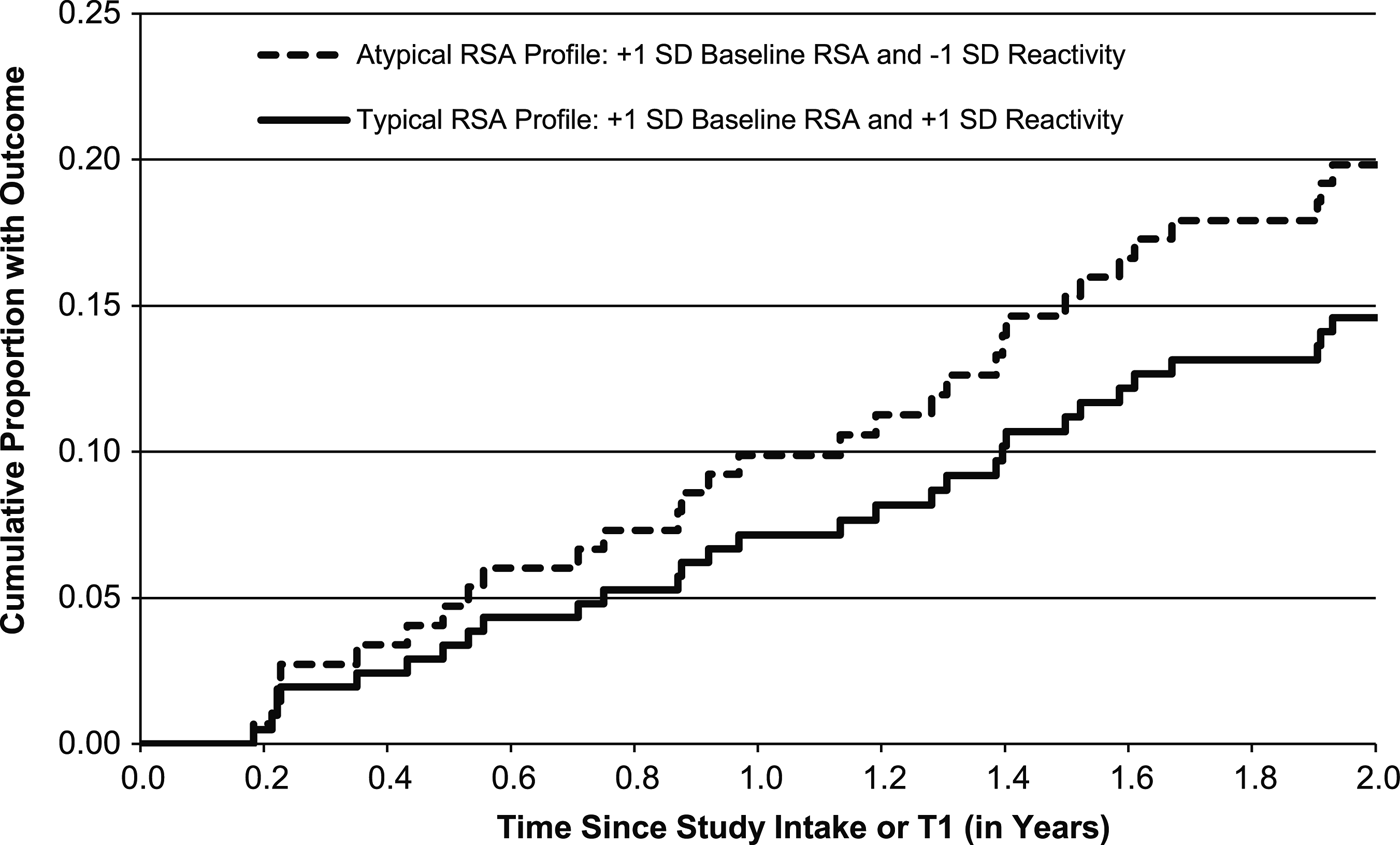
To determine whether MMR mediates a potential association between RSA patterns and depression recurrence, regression weights and their respective standard errors (Fig. 1, paths A and B) were submitted to the PRODCLIN program (MacKinnon et al. Reference MacKinnon, Fritz, Williams and Lockwood2007). Consistent with hypothesis 3, RSA patterns were linked to MDE recurrence via MMR (bMMR, RSA × ΔRSA = −0.17, 95% CI −0.13 to −1.12). Adolescents with atypical T1 RSA patterns had more extensive MMR repertoires that, in turn, increased their risk for a recurrent depression episode later on (hazard ratio = 1.19), relative to peers with normative T1 RSA patterns, who displayed less extensive MMR response repertoires (hazard ratio = 0.90). Fig. 2 portrays these results: recurrent MDE risk is modeled since T1, controlling for length of remission at T1.
Estimated effects of atypical and typical (normative) respiratory sinus arrhythmia (RSA) profiles via maladaptive mood repair on the cumulative probability of a recurrent major depression episode in remitted adolescent probands. SD, Standard deviation; T1, time 1.

Discussion
In the first study to model the relations of RSA, mood repair and recurrent major depression, we found that MMR response use among previously clinically referred adolescents was a prospective predictor of MDE recurrence over a 2-year period and also served as a conduit through which atypical PNS functioning (RSA patterns) contributed to depression recurrence. Importantly, the predictive value of MMR was above and beyond the prospective prediction offered by prior depression levels (or prior MDEs). In other words, youths who reported habitually responding to sadness in ways that maintained or exacerbated (rather than attenuated) that affect were the ones most likely to have a recurrent depression episode. Notably, even large repertoires of AMR responses did not lower the risk of recurrent depression and thus failed to serve as a protective factor. These results extend to a juvenile cohort our previous finding that MMR is a prognosticator of the clinical course of depressive illness in adults (Kovacs et al. Reference Kovacs, Rottenberg and George2009).
Atypical RSA patterns and MMR were significantly associated. And, although we failed to confirm a direct link between RSA and recurrent MDE, the findings supported our third hypothesis that MMR is the conduit through which atypical PNS functioning contributes to depression recurrence. It is of note that combining multiple indexes of PNS functioning (rather than relying on a single index) revealed the contribution of RSA to depression recurrence, a finding also consistent with work on adults (Yaroslavsky et al. Reference Yaroslavsky, Rottenberg and Kovacs2013b ). Because RSA entails a complex and dynamic physiological process, it is logical that taking into account both its tonic (resting) and phasic (reactivity) levels can provide stronger predictive power than can a single index. And yet, even RSA profiles tend to account only for a small proportion of the variance in behavioral outcomes, suggesting that our study was not sufficiently powered to detect its direct association to a relatively low frequency outcome (MDE recurrence).
What is the mechanism whereby mood repair and RSA jointly contribute to recurrent depression? RSA is widely regarded as an index of inhibitory processes that facilitate optimal (flexible) use of physiological resources and response selection, and, hence, a proxy for self-regulatory abilities (Thayer & Lane, Reference Thayer and Lane2000; Porges, Reference Porges2007). Self-regulatory systems, in turn, have been linked both to attention deployment and affect regulation (Porges, Reference Porges, Campbell, Hayne and Richardson1992; Thayer & Lane, Reference Thayer and Lane2009). For example, the flexible use of attention is one of the key features of AMR (Kovacs & Yaroslavsky, Reference Kovacs and Yaroslavsky2014), as also documented by laboratory studies of depression-prone adults and adolescents (Joormann et al; Reference Joormann, Siemer and Gotlib2007; Kovacs et al. Reference Kovacs, Yaroslavsky, Rottenberg, George, Baji, Benák, Dochnal, Halas, Kiss, Vetró and Kapornai2015). Because mood repair involves multiple response systems, including the PNS, it is likely to be influenced by the adverse effects of suboptimal vagal control on attention deployment. Indeed, the relationship between RSA and attention is well documented (e.g. Park et al. Reference Park, Van Bavel, Vasey and Thayer2012, Reference Park, Vasey, Van Bavel and Thayer2013) and dysfunctional attention processes have been implicated in depression (e.g. Joormann, Reference Joormann2004). Problematic RSA is likely to undermine the flexible use of attention and thereby facilitate maladaptive responses to sadness, which render that affect more enduring or more intense. Such dysphoric affect experiences can become the prelude to an array of related depression symptoms and culminate in an episode of clinical depression.
The present investigation extends the literature on risk factors for recurrent depression by having documented that individual differences in the behavioral–psychological and physiological domains are intertwined as prospective predictors of clinical course. Additionally, to our knowledge, this is the first study to show that a combination of such individual difference variables predicts a recurrent MDE in adolescents. Importantly, the variables we examined are malleable. Improving mood repair, or changing the way a person responds to sad affect, has been identified as the central psychotherapeutic target for depressed adults (Berking et al. Reference Berking, Wupperman, Reichardt, Pejic, Dippel and Znoj2008) and children and adolescents (Kovacs & Lopez-Duran, Reference Kovacs and Lopez-Duran2012), and cognitive approaches to dealing with sadness have long been featured in cognitive–behavior therapy for depression (Beck et al. Reference Beck, Rush, Shaw and Emery1979). Thus, a variety of behavioral, cognitive or interpersonal regulatory strategies could be adapted for use in depression prevention programs. There also are indications that RSA can be modified through meditation (e.g. Nesvold et al. Reference Nesvold, Fagerland, Davanger, Ellingsen, Solberg, Holen, Sevre and Atar2011; Bhatnagar et al. Reference Bhatnagar, Phelps, Rietz, Juergens, Russell, Miller and Ahearn2013; Krygier et al. Reference Krygier, Heathers, Shahrestani, Abbott, Gross and Kemp2013), which therefore also could have a role in programs to prevent or forestall recurrent depression in youths.
Results of our study should be viewed in the context of several limitations. We acknowledge that our effect sizes have been no larger than medium in magnitude and sometimes were small. However, the risk of a new depression episode, which is an important clinical outcome, is influenced by a large number of factors that include but are not limited to mood repair and RSA, none of which alone would be expected to have a large influence. Indeed, one challenge for future research is to identify combinations of risk factors that provide the best prospective prediction of depression for any given person. Another limitation is that we did not control for respiration in our computation of RSA during sad mood induction, which can influence estimates of PNS activity (e.g. Grossman & Kollai, Reference Grossman and Kollai1993). Further, youths were in remission from depression for variable durations at T1, for which we only could control statistically. Therefore, survival time before a recurrent depression was modeled from study entry, which truncated the true time to recurrence. Finally, the results may not generalize to populations with adult-onset depressive disorders, partly because those groups consist mostly of females. All in all, however, the strengths of the present study outweigh its limitations and point to useful directions in the search to reduce the rate of recurrent depression episodes in youths.
Acknowledgements
This study was supported by National Institutes of Health grant MH084938 and by Hungarian Scientific Research Fund grant NN85285.
Declaration of Interest
M.K. receives royalties from Multi-Health Systems Inc. The other authors have no conflicts to declare.