INTRODUCTION
Rice (Oryza sativa L.) is one of the most important cereal crops globally and is a staple food for more than half of the world's population (Han et al. Reference Han, Xu, Liu, Yan, Korban, Chen and Gu2004). High yield and good quality are two key priorities for rice improvement. In recent decades, rice yield has dramatically improved as a result of the introduction of semi-dwarf varieties and the utilization of heterosis. However, improvement in the quality of rice grain still has a long way to go. As living conditions improve, human demand for high quality rice continually increases, especially in terms of cooking and eating quality. To meet this demand, more and more studies on the genetic basis of rice grain quality have been reported over recent years (Bao et al. Reference Bao, He, Xia, Chen and Zhu1999, Reference Bao, Corke and Sun2006; Tian et al. Reference Tian, Qian, Liu, Yan, Liu, Yan, Liu, Gao, Tang, Zeng, Wang, Yu, Gu and Li2009; Yan et al. Reference Yan, Fang, Li, Peng, Liu, Tang and Gu2010; Luo et al. Reference Luo, Jobling, Millar, Morell and Li2015).
In rice, cooking and sensory properties are the major determinants in consumers’ choice of rice variety. However, a clear understanding of sensory properties has not yet been achieved due to its complexity. Instead, amylose content (AC), gel consistency (GC) and gelatinization temperature (GT) of rice flour have been widely used as indicators of quality for rice varietal development and genetic analysis (Little et al. Reference Little, Hilder and Dawson1958; Cagampang et al. Reference Cagampang, Perez and Juliano1973; McKenzie & Rutger Reference McKenzie and Rutger1983). Of these, AC is an essential index for evaluating rice grain quality and plays an important role in determining starch internal quality (Wang et al. Reference Wang, Zheng, Shen, Gao, Snustad, Li, Zhang and Hong1995), and GC is known to be negatively correlated with AC. Recently, starch viscosity and thermodynamic properties have also become important indexes for evaluating rice grain quality (Han et al. Reference Han, Xu, Liu, Yan, Korban, Chen and Gu2004; Yan et al. Reference Yan, Tian, Fang, Yang, Li, Zeng, Gu, Xu, Tang and Gu2011; Chun et al. Reference Chun, Lee, Hamaker and Janaswamy2015; Luo et al. Reference Luo, Jobling, Millar, Morell and Li2015). Since starch comprises >0·90 of milled rice, it is widely considered that starch determines to some extent the rice grain cooking and eating quality (Juliano Reference Juliano and Juliano1985).
Starch biosynthesis is a complicated process and at least five classes of enzymes are involved, including adenosine diphosphate-glucose pyrophosphorylase (AGPase), granule-binding starch synthase (GBSS), soluble starch synthase (SSS), starch branching enzyme (SBE) and debranching enzyme (DBE) (Myers et al. Reference Myers, Morell, James and Ball2000; Nakamura Reference Nakamura2002). Of these, GBSS participates in amylose biosynthesis, while amylopectin is synthesized by the concerted actions of several isoforms of SSS, SBE and DBE (Butardo et al. Reference Butardo, Fitzgerald, Bird, Gidley, Flanagan, Larroque, Resurreccion, Laidlaw, Jobling, Morell and Rahman2011). Each enzyme has a few variant isoforms encoded by independent genes. In the rice genome, there are six AGPase genes, ten SSS genes, three SBE genes and two DBE genes (Jeon et al. Reference Jeon, Ryoo, Hahn, Walia and Nakamura2010). Each gene has a variable number of alleles existing in japonica and indica rice germplasm (Tian et al. Reference Tian, Qian, Liu, Yan, Liu, Yan, Liu, Gao, Tang, Zeng, Wang, Yu, Gu and Li2009).
There are two major subspecies, indica and japonica in Asian cultivated rice (O. sativa L.). The diversity of starch properties between indica and japonica has been widely investigated, and the genetic regulation mechanism has been intensively explored through a number of approaches (Gao et al. Reference Gao, Zeng, Cui, Zhou, Yan, Huang, Li and Qian2003; Han et al. Reference Han, Xu, Liu, Yan, Korban, Chen and Gu2004; Tian et al. Reference Tian, Qian, Liu, Yan, Liu, Yan, Liu, Gao, Tang, Zeng, Wang, Yu, Gu and Li2009; Yan et al. Reference Yan, Fang, Li, Peng, Liu, Tang and Gu2010, Reference Yan, Tian, Fang, Yang, Li, Zeng, Gu, Xu, Tang and Gu2011). Starch synthesis-related genes (SSRGs) exhibit allelic variations which lead to diversity in rice grain quality traits (Tian et al. Reference Tian, Qian, Liu, Yan, Liu, Yan, Liu, Gao, Tang, Zeng, Wang, Yu, Gu and Li2009, Reference Tian, Yan, Qian, Yan, Xie, Wang, Xu, Liu, Wang, Liu, Tang, Li and Gu2010; Yan et al. Reference Yan, Fang, Li, Peng, Liu, Tang and Gu2010). Hence, the functional investigation of these alleles appears to be particularly important for rice grain quality improvement.
In order to identify the major genes controlling grain quality, Tian et al. (Reference Tian, Qian, Liu, Yan, Liu, Yan, Liu, Gao, Tang, Zeng, Wang, Yu, Gu and Li2009) sequenced all SSRGs in more than 70 typical indica and japonica cultivars through a candidate gene association analysis approach, and found that SSRGs coordinate with each other to form a fine regulating network that controls the eating and cooking quality and defines the correlation among AC, GT and GC properties. Of these, the Wx (GBSSI) gene plays an essential role in determining AC and GC, and starch synthase II-3 (SSII-3) is mainly responsible for GT variation, strongly suggesting the functional allele variations occur particularly on the Wx, SSII-3 locus, as well as some other genes that contribute minor effects. Also, genetic analysis has been carried out to draw a genetic network controlling glutinous rice grain quality through a candidate gene association analysis (Yan et al. Reference Yan, Tian, Fang, Yang, Li, Zeng, Gu, Xu, Tang and Gu2011). Furthermore, in order to understand the combination effects of SSRG alleles on starch structure and properties, Luo et al. (Reference Luo, Jobling, Millar, Morell and Li2015) selected six SSRGs (Wx, SSI, SSIIa, SBEI, SBEIIa and SBEIIb) and evaluated their allelic effects in a rice recombinant inbred line (RIL) population. It was found that rice Wxi and SSIIaj alleles play major roles, while SSIi, SBEIi, SBEIIai and SBEIIbj have minor contributions in the determination of starch properties between indica and japonica rice through starch structure modification.
However, nearly all the above studies were carried out in a segregated population with complex genetic backgrounds, where the genetic background noise makes it difficult to accurately evaluate the genetic effects of SSRGs. Improving grain quality is an important goal in breeding new elite rice varieties, requiring accurate evaluation of the effects of quality trait-related genes or quantitative trait locus (QTLs).
In previous studies, the functions of SSRGs have been obtained mainly through characterization of mutants or via transgenic approaches. The natural variations of SSRGs have been poorly investigated except for Wx, Sbe1, Sbe3 and SSIIa genes (Han et al. Reference Han, Xu, Liu, Yan, Korban, Chen and Gu2004; Nakamura et al. Reference Nakamura, Francisco, Hosaka, Sato, Sawada, Kubo and Fujita2005; Bao et al. Reference Bao, Corke and Sun2006; Mikami et al. Reference Mikami, Uwatoko, Ikeda, Yamaguchi, Hirano, Suzuki and Sano2008; Luo et al. Reference Luo, Jobling, Millar, Morell and Li2015). Previous studies have shown that the sequence diversity on SSII-1, SSII-2 and SSII-3 loci occur during rice evolution and form two typical alleles in each locus (Tian et al. Reference Tian, Qian, Liu, Yan, Liu, Yan, Liu, Gao, Tang, Zeng, Wang, Yu, Gu and Li2009, Reference Tian, Yan, Qian, Yan, Xie, Wang, Xu, Liu, Wang, Liu, Tang, Li and Gu2010), but their genetic effects on grain quality and starch properties have not so far been comprehensively investigated. In the present study, three japonica alleles (SSII-1j, SSII-2j and SSII-3j ) from japonica rice were independently selected to develop a set of near-isogenic lines (NILs) with an indica genetic background, and the genetic effects on eating and cooking quality of rice and its starch properties were investigated, in order to clarify the contribution of each gene to grain quality and to provide clues for the breeding of new rice varieties with desirable palatability.
MATERIALS AND METHODS
Plant materials
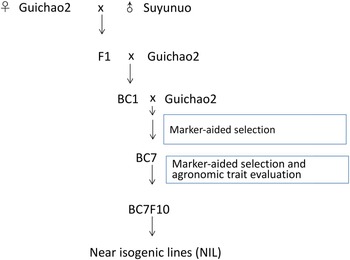
Based on the genomic sequence diversities on the SSII gene family, two alleles (indica vs japonica) for each gene locus were identified among Asian rice germplasm (Tian et al. Reference Tian, Yan, Qian, Yan, Xie, Wang, Xu, Liu, Wang, Liu, Tang, Li and Gu2010). In order to evaluate the genetic effects of SSII genes, a set of NILs for three soluble starch synthase II genes (SSII-1, SSII-2 and SSII-3) was constructed by crossing an indica cultivar Guichao2 to a japonica cultivar Suyunuo. This was then successively backcrossed with Guichao2 for seven generations, followed by selfing for ten generations (Fig. 1). Each NIL in each generation was selected via investigation of agronomic traits and molecular marker detection. The genotypes at SSII-1, SSII-2 and SSII-3 loci of NILs were confirmed using three gene-tagged markers: SSII-1M1, SSII-2M1, SSII-3M2 (Tian et al. Reference Tian, Yan, Qian, Yan, Xie, Wang, Xu, Liu, Wang, Liu, Tang, Li and Gu2010). The genetic backgrounds of NILs were evaluated with 76 simple sequence repeat (SSR) markers covering the entire genome and 17 gene-tagged markers (Tian et al. Reference Tian, Yan, Qian, Yan, Xie, Wang, Xu, Liu, Wang, Liu, Tang, Li and Gu2010) specific to SSRGs (AGPlar, AGPiso, AGPsma, Wx, GBSSII, SSI, SSII-1, SSII-2, SSII-3, SSIII-1, SSIII-2, SSIV-1, SSIV-2, SBE1, SBE3, ISA and PULL). The NILs and parents used in the present study were planted at the experimental farm of Yangzhou University (119°26′E, 32°24′N; 7 m a.s.l.) and Hainan (110°02′E, 18°30′N; 11 m a.s.l.) in the rice growing season. At maturity, the seeds from each NIL were harvested to assess the quality of the grain for eating and cooking and measurement of starch properties.
Diagram of near-isogenic line (NIL) construction.

Isolation of starches
Starches were isolated from mature grains according to the method of Zhu et al. (Reference Zhu, Liu, Sang, Gu and Shi2010) with minor modifications. Ten grams of polished rice grains were soaked in about 30 ml water overnight. The supernatant was discarded and 20 ml 0·001 m sodium hydroxide (NaOH) added. The soaked grains were ground in a Waring blender (IKA-T RCT-Basic, Germany) at medium speed for 3 min and then 20 ml 0·001 m NaOH was added to the slurry. The slurry was adjusted to pH 9·5 with 1 m NaOH by using a pH controller. Next, 0·05 of protease was added and mixed in a magnetic stirring bar for 18 h at 42 °C. After that, the slurry was filtered with 100-, 200- and 300-mesh sieves and centrifuged at 3000 g for 20 min. The yellow gel-like layer on top of the packed white starch granule pellet was carefully scraped off and discarded. The process of centrifugation separation was repeated several times until no yellow material existed. A 45-ml chloroform/methyl alcohol mixture (1 : 1 v/v) was added for 30 min at 45 °C in a water bath prior to centrifugation at 3000 g for 20 min. The precipitated starch was further washed with methyl alcohol/acetone mixture (1 : 1 v/v) and anhydrous ethanol three times, respectively, dried at 40 °C for 2 days, ground into powder and passed through a 200-mesh sieve.
Amylose content measurement
The AC of NILs was measured following Tan et al. (Reference Tan, Li, Yu, Xing, Xu and Zhang1999). The experiments were performed in triplicate.
Pasting property measurement
The starch pasting properties were evaluated with a Rapid visco analyser (RVA) (RVA-3D, Newport Scientific, Narrabeen, Australia), according to the AACC Standard Methods 61–01 (amylograph method for milled rice) and Method 61–02 (determination of the pasting properties of rice with RVA) from the American Association of Cereal Chemists (2000). A programmed heating and cooling cycle was used, where the samples were held at 50 °C for 1 min, heated to 95 °C in 3·75 min and then held at 95 °C for 2·5 min, cooled to 50 °C in 3·75 min and held at 50 °C for 1·5 min. The following starch viscosity characteristics were determined: peak viscosity (PKV), hot paste viscosity (HPV) and cool paste viscosity (CPV). Three secondary parameters, including breakdown (BDV), setback (SBV) and consistency (CSV) were calculated from the original data: BDV = PKV – HPV, SBV = CPV – PKV and CSV = CPV – HPV. In addition, pasting temperature (temperature of the initial viscosity increase, PaT) and pasting time (time of the initial viscosity increase, PeT) were also recorded. Each analysis was performed at least twice.
Thermal property determination
The starch thermal properties were measured using differential scanning calorimetry (DSC) (200-F3, NETZSCH, Germany) as described previously by Wei et al. (Reference Wei, Qin, Zhou, Xu, Chen, Chen, Wang, Gu and Liu2011) with some modifications. Polished rice flour (~5 mg) was precisely weighed and mixed with double the weight of deionized–distilled water. The mixture was sealed in an aluminium pan overnight at 4 °C. After equilibrating for 1 h at room temperature, the sample was then heated from 20 to 110 °C at a rate of 10 °C/min. The experiments were performed in triplicate.
Morphology observation of starch
The starch granules were suspended in anhydrous ethanol. One drop of the starch–ethanol suspension was applied to an aluminium stub using double-sided adhesive tape, and the starch was coated with gold before viewing with an environmental scanning electron microscope (SEM) (Philips XL-30).
Starch granule size distribution
The particle size of the starch was analysed by a laser diffraction particle size analyser (Mastersizer 2000, Malvern, UK). Instrument accuracy was verified with Malvern standard glass particles. The instrument operates based on the principle of laser light scattering and can measure sizes between 0·1 and 2000 µm. The dispersal phase was anhydrous ethanol. The size distribution was expressed in terms of the volume of equivalent spheres. The average granule size was defined as the volume weighted mean. The experiments were performed in triplicate.
Crystal structure analysis of starch
Crystal structure of starch was analysed by X-ray diffraction (XRD) (D8, Bruker, Germany). The XRD analysis and relative crystalline degree (%) of the starches were carried out following the method described by Wei et al. (Reference Wei, Qin, Zhou, Yu, Xu, Chen, Zhu, Wang, Gu and Liu2010a ). Before measurements, all the specimens were stored in a desiccator where a saturated solution of sodium chloride (NaCl) maintained a constant humidity atmosphere for 1 week. The relative crystallinity was quantitatively determined three times.
Attenuated total reflectance-Fourier transform infrared measurement
Ordered structure of starch external region was analysed on a Varian 7000 Fourier transform infrared (FTIR) spectrometer with a deuterated triglycine sulphate detector equipped with a attenuated total reflectance (ATR) single reflectance cell containing a germanium crystal (45° incidence angle) (PIKE Technologies, USA) as previously described by Wei et al. (Reference Wei, Xu, Qin, Yu, Chen, Meng, Zhu, Wang, Gu and Liu2010b ). Spectra were corrected by a baseline wave number (i.e., the spatial frequency of a wave in cycles per unit distance) in the region from 1200 to 800 cm−1 before de-convolution was applied using Resolutions Pro. The assumed line shape was Lorentzian with a half-width of 19 cm−1 and a resolution enhancement factor of 1·9. The experiments were performed twice.
Gel Permeation Chromatography analysis of starch
The starch samples were extracted and de-branched following Tran et al. (Reference Tran, Shelat, Tang, Li, Gilbert and Hasjim2011) and Li et al. (Reference Li, Hasjim, Dhital, Godwin and Gilbert2011). The de-branched starch was frozen in liquid nitrogen followed by freeze-drying overnight (Wang et al. Reference Wang, Hasjim, Wu, Henry and Gilbert2014). Dried samples were stored in a desiccator before size exclusion chromatography analysis. The size distribution of de-branched starches were analysed following Cai et al. (Reference Cai, Shi, Rong and Hsiao2010) with some modifications: each dried starch sample (4 mg) was mixed with 1·3 ml of dimethyl sulphoxide (DMSO) solution and sodium nitrate (NaNO3) (0·5 mm), and heated in the thermomixer at 80 °C and 350 rpm overnight. Then it was centrifuged at 4000 g for 10 min and the mixture transferred to gel permeation chromatography (GPC) vials for analysis. The analysis was carried out in a PL-GPC 220 system (Agilent Technologies, Inc., Amherst, MA, USA) equipped with a differential refractive index detector. A series of columns (pl1117-6800, polargel-m 7·5 300, pl110-6300, pl1110-6100) were used in this analysis. The flow rate was 0·8 ml/min, while the oven temperature was 80 °C. A series of standard dextrans (American Polymer Standards Co., Mentor, OH, USA) with different molecular weights were used for calibration.
Statistical analysis
The data reported in all the tables were mean values and standard deviations. Multiple comparisons by the least significant difference test (P < 0·05) were conducted with SPSS statistical software Version 16·0 to determine the presence of significant differences among NILs.
RESULTS
Development of near-isogenic lines
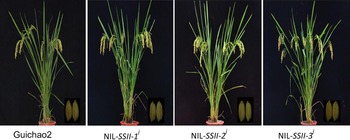
During the process of NIL development, molecular markers were always used to genotype the progeny of backcrossing populations. The result of target genes analysis showed that the target genes were successfully transferred into the Guichao2 genetic background (Fig. 2), and the genetic background of each NIL was very similar to its recurrent parent. The genomic similarity determined by SSR marker was >0·95 for each NIL, ensuring that the genetic effects of the target alleles could be accurately evaluated without the interference of other SSRGs. With regard to the agronomic traits, all NILs exhibited similar phenotypes to their recurrent parent, Guichao2, including growth duration, plant height, tiller number, panicle length, primary branch number, secondary branch number and thousand grain weight (data not shown). Also, the plant architecture and grain shape of NILs were approximately the same (Fig. 3).
Identification of different target genes in near-isogenic lines (NILs) with the gene-tagged marker. M, molecular marker; 1, Guichao2; 2, Suyunuo; 3, NIL-SSII-1j ; 4, NIL-SSII-2j ; 5, NIL-SSII-3j .

Phenotypes of near-isogenic lines (NILs). The whole plant at grain filling stage and grain shape of each NIL, as well as their recurrent parent Guichao2 was shown. (colour online)

Amylose content
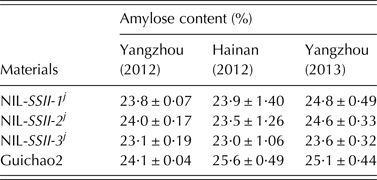
Table 1 shows the AC of each NIL and the recurrent parent harvested in Yangzhou and Hainan, China, in 2012 and 2013, respectively. Compared with that of the recurrent parent, Guichao2, the AC of NIL-SSII-3 was significantly (P < 0·05) reduced in each season. However, the ACs of NIL-SSII-1 and NIL-SSII-2 showed no significant differences compared with Guichao2. Instead, significant differences (P < 0·05) were repeatedly detected between NIL-SSII-3j and NIL-SSII-3i (Guichao2) across three growth seasons, with a slightly reduced AC in NIL-SSII-3j (~1%).
Amylose content of near-isogenic lines (NILs) in the 2012 and 2013 crop years (mean ± s.d., d.f. = 3)

Starch pasting properties
The pasting properties of starches isolated from NILs and their recurrent parent were measured by RVA (Table 2). The results clearly showed that the basic parameters of RVA profile (PKV and HPV) of NIL-SSII-3j increased significantly (P < 0·05), and the secondary parameters (SBV and CSV) decreased significantly (P < 0·05), when compared with those of NIL-SSII-3i (Guichao2). Although NIL-SSII-1j decreased significantly (P < 0·05) in BDV, the parameter varied in different environments (data not shown). As for the NIL-SSII-2j , no significant difference was found in RVA parameters when compared with those of Guichao2.
Comparison of Rapid Visco Analyser profile parameters between the near-isogenic lines (NILs) and their recurrent parent (mean ± s.d., d.f. = 3)

Starch thermodynamic properties
Thermal property analysis of starches extracted from the NILs and their recurrent parent harvested in Yangzhou in 2013 are summarized in Table 3. The peak temperature (TP), onset temperature (TO) and conclusion temperature (TC) of NIL-SSII-3j increased significantly (P < 0·05) when compared with those of NIL-SSII-3i (Guichao2). The TO of NIL-SSII-1j increased significantly (P < 0·05) while the enthalpy of gelatinization (ΔH) decreased significantly (P < 0·05). As for the NIL-SSII-2j , no significant difference was found in DSC parameters when compared with those of Guichao2.
Differential scanning calorimetry parameters of near-isogenic lines (NILs) (mean ± s.d., d.f. = 3)

Morphology and size distribution of starch granules
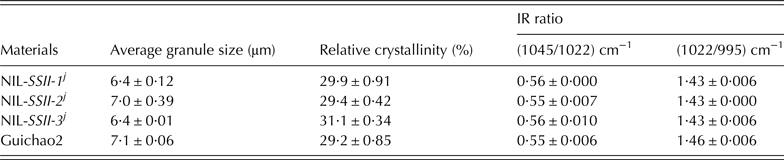
Scanning electron microscopy images of starch granules isolated from mature grains harvested in 2013 are shown in Fig. 4. Morphologically, the starch granules from the NILs were all similar. The shapes of starch granules appeared to be polygonal granules with sharp angles and edges, and the surfaces of them were smooth when viewed by SEM. In the present study, laser light-scattering analysis was used to determine starch granule size distribution. The average granule size was shown in Table 4. It was found that the average granule size of NIL-SSII-1j and NIL-SSII-3j decreased significantly (P < 0·05) when compared with those of Guichao2.
Scanning electron micrographs of starch granules in the 2013 crop year. (a) Guichao 2; (b) NIL-SSII-1j ; (c) NIL-SSII-2j ; (d) NIL-SSII-3j . Scale bar = 5μm.

Average granule size, relative crystallinity and infrared (IR) ratio of starches (mean ± s.d., d.f. = 3)

X-ray diffraction and attenuated total reflectance–Fourier transform infrared spectra of starch
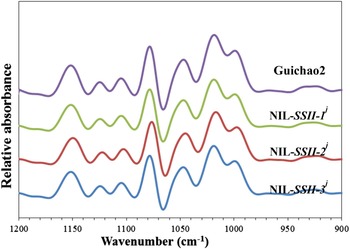
The XRD spectra of starches from NILs and their recurrent parent harvested in Yangzhou in 2013 were assayed, and the relative crystallinity data are listed in Table 4. The results indicated that starches isolated from NILs all displayed an A-type crystalline pattern which was characterized by peaks at 15°, 17°, 18° and 23° 2θ. In addition, the relative crystallinity of NIL-SSII-3j was found to be significantly (P < 0·05) increased, while the relative crystallinity of NIL-SSII-1j and NIL-SSII-2j showed no significant differences compared with their recurrent parent, Guichao2. The de-convoluted ATR-FTIR spectra in the region 1200–900 cm−1 of starches from NILs and their recurrent parent harvested in Yangzhou in 2013 are presented in Fig. 5. The ratios of 1045/1022 and 1022/995 cm−1 of starches are shown in Table 4, which serves as a convenient index of FTIR data in comparison with other measures of starch conformation (Sevenou et al. Reference Sevenou, Hill, Farhat and Mitchell2002; Warren et al. Reference Warren, Royall, Gaisford, Butterworth and Ellis2011). In the present work, no significant differences were found between these NILs. Based on both the spectra and calculated data, starches isolated from the set of NILs showed no significant difference in the structure of starch external region.
The de-convoluted attenuated total reflectance – Fourier transform infrared (ATR-FTIR) spectra of starch in near-isogenic lines (NILs). (colour online)

Molecular weight distribution of starch
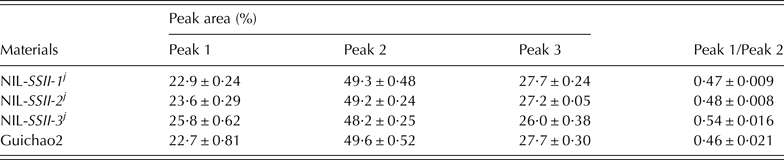
In the present study, GPC was used to study the effects of these three amylopectin synthesis alleles on starch fine structure. A trimodal distribution of low, middle and high molecular weight peaks, designated Peak 1, Peak 2 and Peak 3, respectively, was observed. Peak 1 and 2 consisted of short (A and B chains) and long (B chains) branch chains of amylopectin, respectively. Peak 3 included amylose (Song & Jane Reference Song and Jane2000). The results showed that the value of Peak 1 and the area ratio of Peak 1–2 in NIL-SSII-3j increased significantly (P < 0·05) when compared with those of NIL-SSII-3i (Guichao2). Furthermore, the value of Peak 2 and Peak 3 in NIL-SSII-3j decreased, with the value of Peak 3 reaching a significant level at P < 0·05. As for the NIL-SSII-1j and NIL-SSII-2j , no significant difference was found in GPC parameters when compared with those of Guichao2 (Table 5). The results of AC (Table 1) and GPC (Table 5) analysis all showed that NIL-SSII-3j had the lower AC, whereas NIL-SSII-1j and NIL-SSII-2j had no significant differences compared with their recurrent parent; this finding coincided with the AC result.
Gel permeation chromatography parameters of isoamylase-debranched starches from near-isogenic lines (NILs) in the 2013 crop year (mean ± s.d., d.f. = 3)

DISCUSSION
In the present work, three starch synthesis genes, SSII-1, SSII-2 and SSII-3, belonging to the SSII gene family, were subjected to evaluation of their genetic effects on grain quality and starch structure through a series of NILs. Near-isogenic lines are widely considered as the ideal material for accurate evaluation of the effects of SSRGs on rice grain quality due to the similarity of the genetic backgrounds (Han et al. Reference Han, Xu, Liu, Yan, Korban, Chen and Gu2004; Zhang et al. Reference Zhang, Li, Fang, Liu, Lu, Meng, Peng, Yi, Gu and Yan2012). Three sets of NILs conferring SSII-1, SSII-2 and SSII-3 genes were developed through successive backcrossing with molecular marker-aided selection. The results of molecular marker detection and investigation of agronomic traits confirmed that the NILs were generated successfully and suitable for evaluating the genetic effects of different alleles (Fig. 3).
Amylose content is an essential index for evaluating rice grain quality and plays an important role in determining starch intrinsic quality (Wang et al. Reference Wang, Zheng, Shen, Gao, Snustad, Li, Zhang and Hong1995). The present results from multi-site plantations for several years strongly suggested that amylopectin synthesis-related genes are also involved in the regulation of the AC: SSII-3 had a stable genetic effect on AC and the japonica SSII-3 allele in indica genetic background led to slightly reduced AC. The accumulated knowledge showed that the Wx gene is the major gene in control of AC, functioning together with the SSII-3 gene (Larkin et al. Reference Larkin, McClung, Ayres and Park2003; Tian et al. Reference Tian, Qian, Liu, Yan, Liu, Yan, Liu, Gao, Tang, Zeng, Wang, Yu, Gu and Li2009). In previous studies, the genetic mechanism underlying the AC was usually dissected through the QTL mapping method. Due to the close localization with the major gene Wx on chromosome 6, the SSII-3 gene was difficult to detect. On the other hand, the genetic noise in the RIL, doubled haploid line or F2 population may be another important factor leading to the failure of detection of SSII-3 locus. In fact, NIL has an advantage in identifying genes with minor effects. In the present study, the NIL-SSII-3j , having relatively lower AC (decreased by only 1%) was identified successfully. Hence, for grain quality improvement, SSII-3 should be considered, along with Wx gene in the regulation of AC.
The paste viscosity profile is considered as a very important predictor of the eating and cooking quality characteristics of common indica/japonica rice (Juliano Reference Juliano and Juliano1985), Thus, understanding the genes affecting paste viscosity parameters will facilitate efforts to improve rice grain quality, although the relationship between paste viscosity profile and eating and cooking quality in non-glutinous rice remains unclear. Previous research results indicated that the SSII-3 gene was another important factor in controlling of RVA profile in addition to the Wx gene (Bao et al. Reference Bao, He, Xia, Chen and Zhu1999; Wu et al. Reference Wu, Liang, Gu, Shan, Wang, Han and Gu2006). The present results clearly indicate that the japonica SSII-3 allele in the indica genetic background had a stable genetic effect on RVA profile, resulting in an increase of PKV and HPV, and a decrease of SBV and CSV. Pasting properties are mainly affected by AC and the branch chain length distribution of amylopectin (Jane et al. Reference Jane, Chen, Lee, McPherson, Wong, Radosavljevic and Kasemsuwan1999; Park et al. Reference Park, Ibanez, Zhong and Shoemaker2007). A previous report showed that AC is negatively correlated with HPV and PKV, but positively correlated with BDV and SBV (Chun et al. Reference Chun, Lee, Hamaker and Janaswamy2015). In the present study, the relationship between AC and the pasting properties was confirmed. In NIL-SSII-3, NIL-SSII-3j exhibited lower AC, but higher HPV and PKV, and low BDV and SBV when compared with NIL-SSII-3i (Guichao2). This trend is consistent with the findings of Chun et al. (Reference Chun, Lee, Hamaker and Janaswamy2015), suggesting that the SSII-3j allele could be utilized in indica grain quality improvement to reduce the AC slightly and consequently increase the stickiness of cooked rice.
Due to the tight correlations between GT and the transition temperatures (TO, TP and TC) of starch thermodynamic properties, TO, TP and TC measured by DSC have recently been used to represent the GT. Previous studies showed that SSII-3 was a dominant factor controlling GT variation, especially in varieties with similar AC (Waters et al. Reference Waters, Henry, Reinke and Fitzgerald2006; Tian et al. Reference Tian, Qian, Liu, Yan, Liu, Yan, Liu, Gao, Tang, Zeng, Wang, Yu, Gu and Li2009; Yu et al. Reference Yu, Olsen and Schaal2011). In the present study, TO, TP and TC of NIL-SSII-3 all significantly increased in the NIL-SSII-3j by ~1 °C, when compared with those of NIL-SSII-3i (Guichao2). However, no difference was detected between the NIL-SSII-2j and NIL-SSII-2i (Guichao2) with regards to thermodynamic properties. The present results confirm that the japonica SSII-3 allele in an indica genetic background would increase the transition temperatures of gelatinization and decrease enthalpies of gelatinization. In fact, the SSII-3 (SSIIa) gene is well known as the dominant factor controlling starch GT through regulating the fine structure of amylopectin (Gao et al. Reference Gao, Zeng, Cui, Zhou, Yan, Huang, Li and Qian2003; Nakamura et al. Reference Nakamura, Francisco, Hosaka, Sato, Sawada, Kubo and Fujita2005; Bao et al. Reference Bao, Corke and Sun2006; Tian et al. Reference Tian, Qian, Liu, Yan, Liu, Yan, Liu, Gao, Tang, Zeng, Wang, Yu, Gu and Li2009). Also, cultivars carrying the japonica SSII-3 allele usually have higher GT, suggesting that higher temperature and longer cooking time will be needed for cultivars with the SSII-3j/SSII-3j genotype instead of SSII-3i/SSII-3i . The fact that the replacement of SSII-2i with its counterpart did not significantly change the thermodynamic properties indicated that no functional differentiation existed at this locus, at least for GT variation. Of course, another explanation could be that SSII-2 may not function in rice grain starch synthesis or this may be due to different expression profiles (Jiang et al. Reference Jiang, Dian, Liu and Wu2004; Ohdan et al. Reference Ohdan, Francisco, Sawada, Hirose, Terao, Satoh and Nakamura2005).
The surface features of starch granules from NILs were morphologically similar. Previous studies indicated that the shape and size of starch granules was associated with gelatinization, with smaller granule size making this more difficult (Ramesh et al. Reference Ramesh, Zakiuddin Ali and Bhattacharya1999; Takeda et al. Reference Takeda, Hizukuri and Juliano1989). The present results are consistent with previous findings that NIL-SSII-1j and NIL-SSII-3j have higher GT and smaller starch particle size compared with Guichao2. The results indicated that the introgression of japonica allele on SSII-1 and SSII-3 loci into an indica rice genetic background could decrease average granule size, consequently affecting the starch thermodynamic properties.
The diversity of the physicochemical properties of starch is related to specific structural properties (Vandeputte & Delcour Reference Vandeputte and Delcour2004). In order to understand why the japonica alleles on SSII-3 and SSII-1 have an effect on AC, starch pasting and thermodynamic properties, the fine structure of starch of NILs were investigated through XRD, ATR-FTIR and GPC assay. The results suggested that the fine structure of starches in NIL-SSII-1 and NIL-SSII-3 have altered, especially in NIL-SSII-3. These results explained why the physicochemical properties of NILs in the present work differed from those in previous studies (Wang et al. Reference Wang, White, Pollack and Jane1993; Cheetham & Tao Reference Cheetham and Tao1998; Hoover & Ratnayake Reference Hoover and Ratnayake2002; Sevenou et al. Reference Sevenou, Hill, Farhat and Mitchell2002; Umemoto et al. Reference Umemoto, Yano, Satoh, Shomura and Nakamura2002; Nakamura et al. Reference Nakamura, Francisco, Hosaka, Sato, Sawada, Kubo and Fujita2005; Warren et al. Reference Warren, Royall, Gaisford, Butterworth and Ellis2011).
It could be assumed that the different alleles (indica or japonica) at each locus involved in starch synthesis shapes the starch structure, which in turn affects physicochemical properties, such as AC, GC and GT. For instance, the length of the amylopectin side chain has been reported to determine the GT of starch granules (Gidley & Bulpin Reference Gidley and Bulpin1987; Moates et al. Reference Moates, Noel, Parker and Ring1997; Noda et al. Reference Noda, Takahata, Sato, Suda, Morishita, Ishiguro and Yamakawa1998).
Gao et al. (Reference Gao, Zeng, Cui, Zhou, Yan, Huang, Li and Qian2003) cloned the SSIIa (SSII-3) gene (designated as ALK in their investigation), which can elongate short chains (A and B1) to form longer B2 and B3 chains in the developing rice endosperm. Furthermore, compared with indica rice, SSII-3 activity in japonica rice was reduced due to either enzyme amount or functional capacity, which leads to the difference in amylopectin structure between japonica-type and indica-type rice varieties (Umemoto et al. Reference Umemoto, Yano, Satoh, Shomura and Nakamura2002; Nakamura et al. Reference Nakamura, Francisco, Hosaka, Sato, Sawada, Kubo and Fujita2005). In the present study, NIL-SSII-3j showed a significantly higher proportion of amylopectin short chains (Peak 3) and lower long B chains (Peak 2) compared with NIL-SSII-3i (Guichao2), which was possibly caused by the decreased activity of SSII-3, leading to a decreased proportion of elongated short chains and, consequently, a decreased proportion of long B chains. This result further confirmed that SSII-3 had an effect on the synthesis of amylopectin chains and that the SSII-3j allele was less active than SSII-3i . The area ratio of Peak 1–2 might be used as an index of the extent of branching of amylopectin; the higher the ratio, the higher the degree of branching (Wang et al. Reference Wang, White, Pollack and Jane1993). In the present study, the branching degree of amylopectin of NIL-SSII-3j showed a significant increase when compared with that of Guichao2. Thus, it is concluded that SSII-3 has an effect on rice endosperm starch structure and the japonica SSII-3 allele in an indica genetic background will increase the proportion of short chains and the branching degree of amylopectin.
In addition, it should be noted that the genetic effect of SSII-2 on grain quality and starch properties was not detected through characterization of a pair of NIL, which may be due to its distinctive expression profile. Previous studies have shown that the SSII-2 gene is expressed mainly in the vegetative organs, especially in the leaves (Jiang et al. Reference Jiang, Dian, Liu and Wu2004; Ohdan et al. Reference Ohdan, Francisco, Sawada, Hirose, Terao, Satoh and Nakamura2005), instead of in the rice endosperm. Thus, although the sequence variation on the SSII-2 locus occurred between indica and japonica sub-species, resulting in the generation of two typical alleles, it was reasonable to assume that it did not affect the grain quality and starch properties in the endosperm. Therefore, rice quality improvement programmes can disregard the genetic effect on SSII-2.
In the present work, only individual SSRG was transferred into the indica genetic background in order to evaluate its genetic effect on rice grain quality. In fact, the SSRGs function cooperatively to regulate starch biosynthesis (Nakamura Reference Nakamura2002; Tian et al. Reference Tian, Qian, Liu, Yan, Liu, Yan, Liu, Gao, Tang, Zeng, Wang, Yu, Gu and Li2009), so the gene family may work together with for example SSII gene family. Thus, more effort is needed to simultaneously transfer all the members in one gene family to study the coordinated function in detail.
CONCLUSIONS
The functional differentiations on SSII-1 and SSII-3 loci between the japonica and indica germplasm were detected except for SSII-2 through the characterization of sets of NILs. In particular, SSII-3 showed a clear and stable genetic effect on rice grain quality and starch properties. The japonica SSII-3 allele in an indica genetic background can significantly decrease the AC and the average granule size as well as increase the GT, degree of crystallinity, proportion of amylopectin short chains and degree of branching of amylopectin. The results shed light on the functions of SSII gene family in determining the grain quality and starch properties of rice. This finding provides a useful clue for developing new cultivars with desirable grain quality.
This study was financially supported by the National Natural Science Foundation (31371233), the Natural Science Foundation of Jiangsu Province (BK2012684, 14KJA210002), the project of Six Talent Peaks in Jiangsu Province (2012-NY-027) and a project funded by the Priority Academic Program Development of Jiangsu Higher Education Institutions.