


Introduction
Pragmatic trials are designed to assess the effectiveness of an intervention in real-world settings. This requires a broad patient population and creative methods to enroll participants and collect data in real-time [Reference Treweek and Zwarenstein1,Reference Macpherson2]. One such method is the use of patient-reported outcome measures (PROMs) completed on the participants’ own technological devices, or decentralized data collection. Potential advantages to this approach include reduced costs for the study, potential decreased study team burden, and reduced burden to participants since they complete surveys on their own time using their own devices [Reference Coons, Eremenco, Lundy, O’Donohoe, O’Gorman and Malizia3]. Potential disadvantages of decentralized enrollment and data collection include low conversion of eligible to enrolled participants and lower rates of retention [Reference Eysenbach4,Reference Danaher and Seeley5]. Participants may be lost to follow-up or have difficulty with survey completion [6–Reference Hardouin, Conroy and Sébille8]. Furthermore, adults over the age of 65 are less adept with technology, leading to participation barriers [Reference Faverio9]. These challenges can result in incomplete data capture.
Incomplete data sets lead to bias, underpowered studies, and uninterpretable results, representing a waste of valuable money and resources [6,Reference Bell and Fairclough7,Reference Rombach, Jenkinson, Gray, Murray and Rivero-Arias10]. Several methods have been implemented to improve PROM completion in pragmatic trials, including mailings and phone calls by research staff, automated reminders, and monetary incentives [Reference Cheville, Patil and Boyd11–Reference Miyata, Tafuto and Jose16]. However, evidence directly examining how different communication approaches influence enrollment and retention in decentralized pragmatic trials remains limited.
The challenges of enrollment, retention, and data completeness in decentralized pragmatic trials are well illustrated by the Fibromyalgia TENS in Physical Therapy (PT) Study (FM-TIPS) (NCT01888640), a phase III pragmatic trial testing the effectiveness of transcutaneous electrical nerve stimulation (TENS) for individuals with fibromyalgia (FM) when implemented in a PT setting. The primary objective of FM-TIPS was to determine if the addition of TENS to routine PT improves movement-evoked pain in individuals with FM [Reference Post, Dailey and Bayman17]. Patients were enrolled directly through a study-trained physical therapist and completed PROMs on their own personal electronic devices over six months, providing an opportunity to observe how different communication strategies taken by the study team affected enrollment, PROM completion, and participant retention.
The purpose of this study is to review how different communication strategies, ranging from automated reminders to personalized contact from study staff, impacted enrollment, baseline data completion, and participant retention in the FM-TIPS pragmatic trial.
Methods
Physical therapy clinics and clinicians
FM-TIPS (NCT 04683042) was a cluster randomized pragmatic trial that included more than 150 physical therapists in 28 enrolling PT clinics within 6 health care systems across 7 states. A full protocol has been published [Reference Post, Dailey and Bayman17]. All clinics within the 6 health care systems (HCS) were cluster randomized to either PT + TENS (n = 13) or PT-Only (n = 15) and stratified by clinic size (large: >3 physical therapists or small: ≤3 physical therapists). Study-trained physical therapists were instructed on screening and enrollment procedures for patients presenting with FM to their clinic and patients’ participation requirements. The physical therapists provided instructions to participants about the intervention on PT visit-2, and although they engaged with participants that posed questions about the study, their main focus after that was to provide the physical therapy intervention.
Study team
The study team included university-based pain researchers, physical therapists who were both clinical and research trained, a rheumatologist who served as the medical lead, and the Clinical Trials Statistical and Data Management Center (CTSDMC) at the University of Iowa, which served as the data coordinating center. The CTSDMC generated weekly reports to monitor study progress. The study team held weekly meetings to review reports and determine if changes to study procedures were warranted.
Eligibility
Due to the pragmatic nature of the study, inclusion/exclusion criteria were minimal. Eligible participants were adults beginning an episode of land-based physical therapy for chronic musculoskeletal pain with a diagnosis of FM. Participants were included if they had been previously told by a clinician that they have FM. Exclusion criteria were contraindications to TENS, current enrollment in another pain study, and use of TENS in the last 30 days.
Enrollment and onboarding procedures
Participants completed eligibility screening at their first PT visit on a study iPad using the patient-facing portal in REDCap (Figure 1). Screening required phone and email contact information. If eligible, participants were directed to the electronic informed consent (eConsent) document via their personal survey queue in REDCap on the iPad or through a link to their survey queue sent by email and text message to be accessed from a personal device with no login required. Study staff received an email after consent was signed by the participant and then electronically signed all eConsent documents before participants were informed of their enrollment status and next steps by email and text from REDCap.
Signing of eConsent by the study staff triggered an email notification to the coordinating PT clinic of the patient’s confirmed enrollment in FM-TIPS. Simultaneous with the clinic notification, an email and text message were generated informing enrolled participants that study material dissemination would occur at PT visit-2. If patients had not signed the eConsent by PT visit-2, they were excluded from the study. After PT visit-2, participants were instructed to complete home-based PROMs termed “research homework” (Figure 1). Completion of research homework Day 1 entered the participant in the modified intention to treat (mITT) population. Study-trained PT clinicians confirmed completion of research homework Day 1 at PT visit-3; if not, participants were excluded from the study.
Onboarding timeline, procedures, and outcomes. A. Flow from study onboarding to baseline research homework completion B. enrollment and baseline research homework completion rates under different communication strategies; HW = research homework; mITT = modified intention to treat; PT = physical therapy.

Study design
All participants completed routine PT as determined by their physical therapist. The study was divided into two phases, a randomized phase (Day 1–Day 60) and an extension phase (Day 61–Day 180). The randomized phase determined efficacy between groups for primary and secondary outcomes at Day 60. In the extension phase, the PT + TENS group continued using TENS for 6 months while the PT-Only group used TENS for the next 4 months after receiving TENS units and telehealth TENS training from the study team. Outcome measures, i.e., research homework, were collected at home by the participant at Days 1 (baseline), 30, 60 (primary endpoint), 90, and 180 (end of study) (Figure 2) for both groups. Research homework was available for 11 days, −5 days to + 5 days, for Days 30, 60, 90, and 180 (Figure 2). Day 1 had an open window and was completed between PT visit-2 and PT visit-3. Participants were alerted to survey availability by automated email and text message from REDCap. Over the course of the study, automated procedures via REDCap messages and surveys and personal communication from the study staff to participants by phone, email, and text were developed and modified.
Retention data completion timeline and outcomes. A. Timeline of participant homework B. Timeline of reminders within homework window. C. Participant retention under different reminder protocols. HW = research homework; PR = patient reminders.

TENS units and Quell application
TENS units were designed in coordination with and manufactured by Quell (Quell Wearable Pain Relief Technology, Woburn, MA, USA). The units were multifunctional as they could be controlled by a single, multi-function button on the back of the unit or by an app downloaded to the participant’s smartphone. Participant accounts on the Quell app were created using a unique username consisting of codes unique to the enrolling PT clinic and the participant’s study ID number. Each participant had two color-coded units, one for use on the upper back and one for the lower back. Supplies for TENS units, including electrodes and wires, were provided by the study and replenished as needed for the duration of the study.
Data collection and monitoring
Data were entered directly into REDCap by participants who received an email and text link to their survey queue. Regular reports were generated in REDCap and by the data management team to monitor completion of enrollment, consent, and research homework.
Data completeness reports tracked study performance in aggregate and were reviewed at weekly group meetings. A separate system was developed to track individual participants’ progress. A study onboarding spreadsheet was maintained for tracking consent and completion of research homework Day 1. A participant retention spreadsheet contained windows for completion of research homework and participant contact based on the date of research homework Day 1 baseline data completion. The spreadsheet was updated multiple times per week based on research homework completeness reports generated by REDCap.
A communication log was kept, where each instance of contact between participants and study team members was recorded. Participant study ID number, enrolling clinic, date of interaction, study staff involved, initiator of contact (study staff, participant, or clinician), method of communication, timepoint, problem, and text description of the problem were noted. In addition to discreet steps of the study (screening, consent, and research homework windows), “timepoint” could also include post consent (consent signed but not yet ready for research homework Day 1), TENS use, TENS education, and N/A for communication outside of research homework windows.
Data analysis
Enrollment, research homework completion, retention, and communication log data were analyzed descriptively. Enrollment and completion rates were examined in relation to communication strategies implemented during the study. Because communication strategies were introduced sequentially as operational modifications rather than randomized study interventions, no formal statistical comparisons were performed to evaluate the effects of the communication strategies. Exploratory analyses were conducted to examine whether participant demographic and clinical characteristics were associated with the total number of participant contacts. Pearson or Spearman correlation coefficients were used based on variable types and distribution. Group comparisons were performed using analysis of variance.
Study phone and email accounts
To help with accessing and navigating the surveys and to answer general questions regarding the research homework throughout the study, a study-specific email address and phone number were provided to all participants and clinicians. In addition, the study-trained physical therapists at the different HCSs were assigned a study team member to serve as a point of contact for each clinic. Contact initiated by a study-trained clinician regarding a participant was included in the communication log and filed under the participant’s study ID. Though phone and email were utilized throughout the study, text messaging was added 8 months into the study for onboarding and 31 months into the study for research homework reminders.
Results
FM-TIPS was an embedded pragmatic trial set in PT outpatient clinics; study-trained clinicians (physical therapists), screened participants, and provided the interventions. This came with challenges for recruitment, consent, and completion of baseline assessments which constituted our mITT population. The majority of study clinicians identifying and recruiting patients for the study had no previous experience with clinical trials of this complexity [Reference Van Gorp, Vance and Pedelty18]. Though clinicians were trained in study procedures by study staff, we found that multiple training sessions were often needed. Additionally, onboarding potential participants during PT evaluation (PT visit-1) and early PT follow-up visits (PT visit-2 and PT visit-3) created a change to the clinicians’ standard workflow necessitating increased reminders for clinicians. A total of 503 subjects were eligible after screening, 459 of those signed informed consent, 384 completed research homework Day 1 (mITT), and 234 completed research homework Day 180.
Study onboarding
When the study began in February 2021, minimal contact between study staff and participants was planned. Clinicians were trained and expected to onboard participants through screening, consent, and baseline assessments (research homework Day 1). After onboarding, automated study invitations were sent when subsequent research homework windows opened, beginning five days prior to each assessment window. No formal reminder strategy was initially implemented, though ad hoc communication occurred if technical or other issues arose for an individual participant. However, early screening and enrollment data revealed challenges with this low-contact approach. Although the enrollment rate (signed consent) was 83%, only 67% of enrolled participants completed research homework Day 1 (Figure 1B).
To address this, a reactive communication strategy was implemented in which study staff contacted participants if the consent document was not signed within one week of eligibility screening and again if research homework Day 1 was not completed within one week of enrollment (Table 1). Following implementation of the reactive communication strategy, enrollment increased to 92% (from 83%), and completion of research homework Day 1 increased to 81% (from 67%) of enrolled participants (Figure 1B).
Patient reminder protocols implemented in FM-TIPS study. HW = research homework

Table 1. Long description
A table comparing patient reminder protocols in a study. The table has four columns and two rows. The columns are labeled ‘No plan’, ‘Protocol 1’, ‘Protocol 2’, and ‘Protocol 3’. The rows are labeled ‘HW Day 30 and HW Day 90’ and ‘HW Day 6 and HW Day 180’. Row 1: No plan: No official strategy for personal reminders. Protocol 1: Automatic reminder emails from REDCap. Protocol 2: No change. Protocol 3: Personal phone calls, emails, texts if HW not completed. Row 2: No plan: No official strategy for personal reminders. Protocol 1: Personal phone calls, emails, and texts if HW not completed. Protocol 2: Automatic reminder emails from REDCap. Personal call on Day 140 to give HW-Day 180 date. Protocol 3: No change.
In attempts to further increase the rate of participants that completed research homework Day 1, our mITT population, a more proactive approach to communicating with participants was implemented. All eligible participants were called within two days of passing screening to welcome them to the study and answer questions. During the call, study staff reviewed study procedures, including completion of research homework Day 1, timing of future assessments, study notifications, and overall study flow. Participants were given the opportunity to ask questions regarding the consent document, study requirements, TENS use, and study supplies. Study staff also assessed participants’ access to internet-enabled devices, discussed device compatibility and preferences for survey completion, and addressed technology-related concerns that could interfere with participation. Enrollment remained stable at 90%, and completion of research homework Day 1 increased to 89% (Figure 1B).
Across the entire study, the average time to complete consent after passing screening was 1.7 ± 3.8 days (range: 0 – 29). The majority of participants read and signed the consent document on the same day. The average time to complete research homework Day 1 after enrolling was 9.1 ± 8.4 days (range: 0 – 70).
In total, 1205 contacts were initiated during onboarding. Of these, 46 were related to the eligibility screen, 299 to eConsent, 345 occurred after consent but before research homework Day 1 and 515 were related to research homework Day 1 completion. Communications were primarily initiated from the study staff because participants had not yet completed the required activities. Contacts related to eConsent and after consent were more frequent later in the study. This increase corresponded with the implementation of proactive onboarding procedures; 84% of all contacts occurred after implementing onboarding procedures.
Participant Retention
From the initiation of FM-TIPS, no official reminder strategy was implemented to ensure research homework completion and participant retention (Table 1, No Plan). Completion rates decreased between the primary and secondary endpoints, with 89% completing research homework at Day 60 and 69% completing research homework at Day 180 (Figure 2C). Therefore, Protocol 1 was implemented, where automatic email reminders were sent through REDCap every 4 days throughout the 11-day window for research homework completion at all time points. Additionally, if research homework Day 60 or research homework Day 180 had not been completed within four days before the window closed, study staff made personal reminder contact via phone call or email to participants (Table 1, Protocol 1). Following implementation of Protocol 1, research homework Day 180 completion rate increased to 84% (Figure 2C). Protocol 2 was implemented to further bolster research homework Day 180 completion with the addition of a phone call by study staff approximately 6 weeks before the research homework Day 180 timepoint (Table 1, Protocol 2). This addition did not lead to an increase in research homework Day 180 completion (Figure 2C). Given the observed benefit of personalized reminders within the last four days of the research homework window, we implemented that strategy for research homework Day 30 and research homework Day 90 (Table 1, Protocol 3). Following this change, completion rates increased from approximately 80% to 94% for research homework Day 30 and from 71% to 92% for research homework Day 90 (Figure 2C).
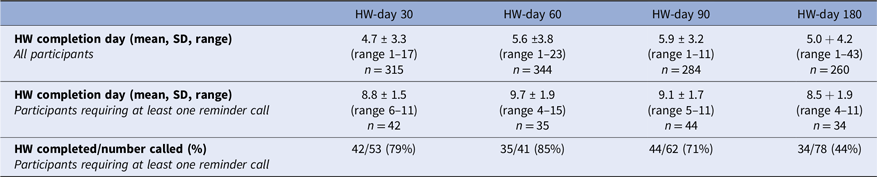
On average, research homework was completed in the middle of the 11-day window between four and seven days (Table 2). The study staff contacted participants at each timepoint who had not completed research homework by day 4 of the window. Among those that required at least one reminder call after day 4 of the window, 80% completed research homework Day 30, 85% completed research homework Day 60, 71% completed research homework Day 90 and 43% completed research homework Day 180 (Table 2).
Research homework (HW) completion rates

Table 2. Long description
The table presents data on research homework (HW) completion rates at four different time points: HW-day 30, HW-day 60, HW-day 90, and HW-day 180. It includes information on the mean, standard deviation (SD), and range of HW completion days for all participants and those requiring at least one reminder call. The table also shows the percentage of participants who completed the homework after being called. The table has four columns representing the different time points and five rows detailing the completion statistics. Row 1: HW completion day (mean, SD, range) for all participants. Row 2: HW completion day (mean, SD, range) for participants requiring at least one reminder call. Row 3: HW completed/number called (percent) for participants requiring at least one reminder call. Row 4: Number of participants (n) for all participants. Row 5: Number of participants (n) for participants requiring at least one reminder call. Notable trends include the variation in completion rates and the number of participants requiring reminder calls across different time points.
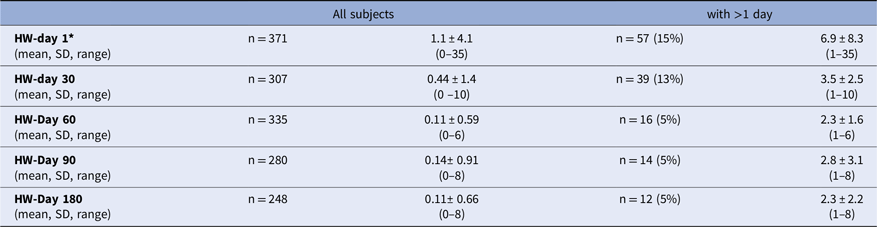
The majority of participants completed research homework in one sitting as intended, resulting in an average time to completion of a day or less. However, some participants (5–15%) stopped partway through the surveys (Table 3). Phone calls to those participants were made to encourage completion. For research homework Day 30 through Day 180 the average time to completion was 2–3 days with the maximum time being 10 days (Table 3).
Time to research homework (HW) completion by Day

Table 3. Long description
A table comparing the time to research homework completion across different days. The table has 5 rows and 6 columns. Column headers are: All subjects, HW-day 1, HW-day 30, HW-day 60, HW-day 90, HW-day 180. Row labels are: n, mean, SD, range, with>1 day, n, mean, SD, range. Row 1: All subjects, n=371, HW-day 1, n=57 (15 percent), HW-day 30, n=39 (13 percent), HW-day 60, n=16 (5 percent), HW-day 90, n=14 (5 percent), HW-day 180, n=12 (5 percent). Row 2: All subjects, mean=1.1, HW-day 1, mean=6.9, HW-day 30, mean=3.5, HW-day 60, mean=2.3, HW-day 90, mean=2.8, HW-day 180, mean=2.3. Row 3: All subjects, SD=4.1, HW-day 1, SD=8.3, HW-day 30, SD=2.5, HW-day 60, SD=1.6, HW-day 90, SD=3.1, HW-day 180, SD=2.2. Row 4: All subjects, range=0-35, HW-day 1, range=1-35, HW-day 30, range=1-10, HW-day 60, range=1-6, HW-day 90, range=1-8, HW-day 180, range=1-8.
*For HW-Day 1 the maximum time between start and stop of surveys was 35 days as this was not a prescribed window but rather the deadline was before PT-visit 3.
Additional communication needs for the study
In addition to facilitating the completion of required study documents and surveys, an initial welcome call served the purpose of establishing a line of communication between study staff and participants that remained open throughout the study. The study team received calls and emails throughout the course of the study unrelated to onboarding and research homework. In total, study staff communicated with participants over 2000 times over 4 years and 1 month of study activity. While most of these contacts were initiated by study team, participants reached out to the study staff 613 times (Figure 3A). FM-TIPS-trained clinicians contacted the study team regarding participant concerns at least 113 times. A vast majority of those were by phone call, though email and text messaging were also used (Figure 3B). Most study team-initiated contacts were phone calls for personal reminders for onboarding and completion of research homework. Contacts outside of the research homework windows were related exclusively to TENS use. Many of the calls by the study team were unanswered by the participants (there were 1041 references to voicemail in the communication log).
Characteristics of communication events between participants, clinicians, and study staff. A. Study staff initiated most communication with participants. B. A variety of communication methods were used, and the majority included phone contact.

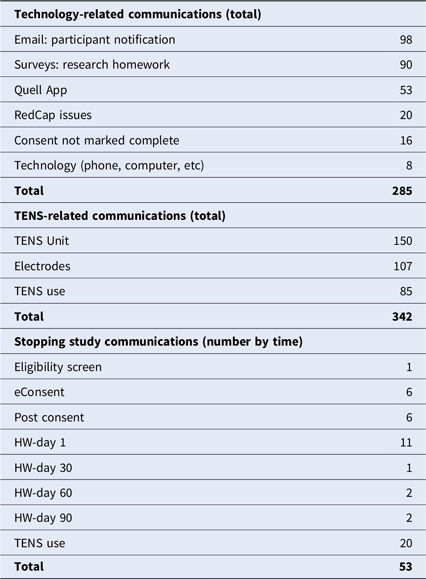
Phone calls outside of the research homework windows were primarily related to technology and TENS-related issues. Participants needed help with locating or resending emails, survey links, and managing their personal devices and accounts (Table 4). Some participants had difficulty with the TENS units used in the study. Almost 400 contacts were recorded as TENS-related, with the greatest number of these contacts related to the function of the TENS units (Table 4). There were also communications from participants related to the need for more electrodes (107), how and when to use TENS (85), and the use of the Quell app (54). Communications related to stopping the study were recorded 53 times for 43 participants at all time points of the study for a variety of reasons (Table 4). Study staff encouraged continued use of TENS particularly through research homework Day 60 (primary endpoint) and continued participation in the study.
Communications from participants to the study team. HW = research homework; TENS = transcutaneous electrical nerve stimulation

Table 4. Long description
A table summarizing participant communications with the study team. The table is divided into three sections: Technology-related communications, TENS-related communications, and Stopping study communications. Each section lists specific categories and the number of communications for each. Technology-related communications include Email: participant notification (98), Surveys: research homework (90), Quell App (53), RedCap issues (20), Consent not marked complete (16), and Technology (phone, computer, etc) (8), totaling 285. TENS-related communications include TENS Unit (150), Electrodes (107), and TENS use (85), totaling 342. Stopping study communications are listed by time, including Eligibility screen (1), eConsent (6), Post consent (6), HW-day 1 (11), HW-day 30 (1), HW-day 60 (2), HW-day 90 (2), and TENS use (20), totaling 53.
Communication patterns across participant characteristics
The number of study contacts per participant was examined to explore whether communication needs differed across participant characteristics. Participants had a mean of 6.7 ± 3.3 total contacts (IQR 4–9; range, 1–17). Participants randomized to the TENS intervention had more contacts than participants in the no-TENS group (mean 7.6 ± 3.6 vs. 5.9 ± 2.9; F(1, 381) = 26.37, p < 0.001; η 2 = 0.065). Participants residing in rural areas had slightly fewer contacts than urban participants (mean 6.3 ± 3.3 vs. 7.1 ± 3.4; F(1, 381) = 6.15, p = 0.014); however, the effect size was small (η 2 = 0.016). No other baseline demographic or clinical characteristics were associated with communication frequency.
Discussion
We report the results of evaluating and adjusting the communication plan to improve patient enrollment, study retention, and data capture. FM-TIPS was designed as a decentralized pragmatic trial where participants completed data entry at home after enrollment from their study-trained physical therapist at one of the HCSs PT clinics. Our findings suggest that frequent and targeted communications may be important components in decentralized trials, where consent and data are obtained remotely by the participants [Reference Jean-Louis and Seixas19]. Initially, the study used automated reminders but quickly moved to a reactive communication approach by contacting subjects when they failed to complete consent and assessments. However, when we changed to a proactive communication approach which sent regular reminders and emails prior to the completion deadline, we observed a greater conversion of participants to the mITT population and increased completion rates of research homework. While the proactive communication approach was more successful, it required significant efforts by the study team.
Pragmatic and decentralized trials rely on activities to occur in participants’ homes and/or local community provider clinics instead of research sites [Reference Califf and Sugarman20]. As with other decentralized and pragmatic trials, we relied on electronic devices for participants to be able to screen, consent, and complete assessments in their coordinating PT clinic and at home. While FM-TIPS utilized monetary incentives to motivate completion, these were not sufficient for maximal retention. Decentralized trials have limited opportunities to build relationships between participants and researchers [Reference de Jong, van Rijssel and Zuidgeest21]. Prior studies suggest that individuals participate in research if it has a personal benefit, opportunities for new treatments, and trust [Reference Sheridan, Martin-Kerry, Hudson, Parker, Bower and Knapp22] in healthcare providers and the study team. The proactive approach of welcoming participants to FM-TIPS initiated a relationship between the study team and participants. Further, personalized messaging and regular communication with the study team can keep participants motivated throughout a trial, particularly for long-term studies [Reference Steinhubl, Wolff-Hughes, Nilsen, Iturriaga and Califf23,Reference Coyle, Rogers, Copland, De Paoli, MacDonald and Mackenzie24]. Our experience with FM-TIPS is consistent with this notion. Indeed, personalized and regular communication was associated with improved completion of both consent and assessments through 6 months in FM-TIPS.
Participant engagement generally involves recruitment, enrollment, and retention in pragmatic trials [Reference Marquis-Gravel, Faulkner and Merritt25]. In parallel, community engagement methods facilitated awareness of the study to potential participants [Reference Vance, Pedelty and Van Gorp26]. In the current study, after passing an electronic screening on their initial PT visit, potential participants were sent an eConsent. While a great number of participants signed consent on the day of screening, some participants did not. Thus, we implemented a personalized welcome call to all participants after passing screening, which was associated with higher rates of completion of consent and baseline assessments done after the second PT visit. A prior study showed that a reminder call prior to sending surveys facilitated completion rates [Reference MacLennan, McDonald, McPherson, Treweek and Avenell12] by 6 –10%, particularly if done within a short time period. Another study showed that a multi-modal retention strategy using multiple forms of communication, along with monetary incentives, can enhance completion rates [Reference Watson, Mull, Heffner, McClure and Bricker13]. In agreement, we show >10% increased completion rates when reminder phone calls, text, and emails were sent within the data collection windows for each assessment.
It is generally assumed that frequent, personalized communication strategies in clinical trials improve participant retention and adherence. Yet, data comparing communication strategies in clinical trials is scarce with respect to enrollment and data completion by participants. One study showed that implementing an orientation session results in higher intervention adherence and assessments [Reference Mayhew, Leo, Vollmer, DeBar and Kiernan27]. Another study showed that reminder calls improved completion of assessments [Reference MacLennan, McDonald, McPherson, Treweek and Avenell12]. Similarly, our initial onboarding session enhanced the conversion of potential participants who passed screening into enrolled participants who completed baseline assessments. In addition, completion rates at later time points were higher following implementation of regular reminder calls, emails, and texts. Another advantage to regular communication in a pragmatic, decentralized trial is the improved ability to identify and troubleshoot issues related to assessments or intervention completion. Thus, in addition to improving completion rates, regular communication provided added benefits that enhanced the use of the intervention.
Participants report that they prefer participating in a clinical trial using mobile technology rather than a traditional trial where the data collection is completed in clinics, as using mobile technology offers greater convenience and ability to complete data capture at home [Reference Macpherson2,28,Reference Harris Paul and Cheng Alex29]. Pragmatic trials and decentralized trials regularly use mobile technology for data capture, which allows recruitment of a broader population, particularly from underrepresented populations, including rural communities. In FM-TIPS nearly 50% of clinics were located in rural communities, and the majority of clinics recruited rural participants, which resulted in 50% of participants enrolled in FM-TIPS being from a rural community. This wide recruitment from a broad spectrum of the population will allow the results to have broader application to the population tested [Reference Harris Paul and Cheng Alex29]. Mobile technology such as text, email, and video utilized by the study team for communication likely increased adherence to the intervention and completion of the assessments as it allowed troubleshooting of the TENS intervention, completion of TENS training for the PT-only group by telehealth, and completion of assessments by participants at home. Additionally, technology allowed the study team to regularly meet with clinicians for training sessions and problem-solving study-related questions.
An important observation from FM-TIPS is that decentralized trial procedures did not eliminate the need for study personnel involvement. Although participants completed consent, assessments, and the intervention outside of traditional research settings, study staff time and effort was required for onboarding, assessment completion, troubleshooting of technology and TENS-related issues, and participant retention. Thus, rather than eliminating study burden, decentralized approaches may shift personnel effort from in-person research activities to participant support and engagement activities. However, the workload associated with these activities was manageable because only a subset of participants required active outreach at any given time. Communications were incorporated into routine study operations by part-time study staff, with many contacts consisting of brief voicemail messages, personalized emails, or short follow-up conversations. Our experience suggests that staffing needs may be driven less by total study enrollment and more by the number of participants simultaneously undergoing onboarding or approaching assessment deadlines.
Limitations
This study has several limitations. Communication strategies were implemented sequentially as operational improvements during the course of the trial and were not randomized; therefore, observed improvements in enrollment, completion, and retention cannot be attributed solely to any individual communication strategy. In addition, multiple communication approaches were sometimes introduced concurrently, making it difficult to determine the independent contribution of specific interventions. The communication log was maintained separately from participant demographic data collected in REDCap, preventing analyses of whether communication needs differed across participant characteristics. Finally, the duration of participant contacts was not systematically recorded, limiting our ability to quantify the personnel effort and resources required to implement these communication strategies. Future studies should prospectively evaluate communication strategies in decentralized trials to identify the most effective approaches for different participant populations. Quantifying personnel effort and integrating communication records with participant-level characteristics may further inform efficient and scalable retention strategies.
Conclusion
The use of automated technology to send survey invitations and reminders has provided a breakthrough in clinical research, allowing participants to engage in study activities outside of a medical setting. This decentralized, pragmatic approach allows for a real-time, real-world assessment of participant health and well-being. In FM-TIPS, however, we found supplementing automated technology with personal communications fostered an integral relationship between the participant and the study team. This communication included a variety of time points and topics: a welcome to the study, study engagement, survey reminders, and discussions of technology issues and equipment functionality. Direct involvement of the study team was associated with increased enrollment and retention within the study. Though “no touch” clinical trials are possible, we found that a personal touch is more effective.
Author contributions
Elizabeth M. Johnson: Conceptualization, Data curation, Formal analysis, Methodology, Writing – original draft, Writing – review & editing; Dana L. Dailey: Conceptualization, Methodology, Project administration, Supervision, Writing – review & editing; Carol G.T. Vance: Methodology, Writing– review & editing; Barbara J. Van Gorp: Methodology, Writing - review & editing; Andrew A. Post: Methodology, Writing – review & editing; Ruth L. Chimenti: Methodology, Supervision, Writing – review & editing; Kari G. Vance: Methodology, Writing – review & editing; David-Erick Lafontant: Data curation, Writing – review & editing; Dixie Ecklund: Supervision, Writing – review & editing; Kristin R. Archer: Conceptualization, Methodology, Writing – review & editing; Bridget M. Zimmerman: Data curation, Writing – review & editing; Emine Bayman: Data curation, Supervision, Writing – review & editing; Kathleen A. Sluka: Conceptualization, Data curation, Formal analysis, Funding acquisition, Methodology, Project administration, Supervision, Visualization, Writing – original draft, Writing – review & editing; Leslie J. Crofford: Conceptualization, Formal analysis, Funding acquisition, Methodology, Project administration, Supervision, Writing – original draft, Writing – review & editing.
Funding statement
This work was supported by the National Institutes of Health (NIH) Pragmatic Trials Collaboratory through the NIH HEAL Initiative (KAS, LJC, grant number UG3/UH3 AR076387), administered by the National Institute of Arthritis and Musculoskeletal and Skin Diseases (NIAMS); the National Center for Advancing Translational Sciences of the National Institutes of Health (grant number UM1TR004403); and logistical and technical support from the PRISM Resource Coordinating Center through the NIH HEAL Initiative (grant number U24 AT010961), and from the NIH Pragmatic Trials Collaboratory Coordinating Center funded by the National Center for Complementary and Integrative Health (NCCIH), the National Cancer Institute (NCI), the National Heart, Lung, and Blood Institute (NHLBI), the National Institute of Allergy and Infectious Diseases (NIAID), NIAMS, the National Institute of Minority Health and Health Disparities (NIMHD), the National Institute of Neurological Disorders and Stroke (NINDS), the National Institute of Nursing Research (NINR), the National Institute on Aging (NIA), the NIH Office of Behavioral and Social Sciences Research (OBSSR), and the NIH Office of Disease Prevention (ODP) (grant number U24 AT009676). The content is solely the responsibility of the authors and does not necessarily represent the official views of the NIH or its HEAL Initiative, or of NCCIH, NCI, NIA, NIAMS, NHLBI, NIAID, NIMHD, NINDS, NINR, OBSSR, or ODP.
Competing interests
None.





 Open access

