More than half of nursing home residents receive at least 1 course of antibiotics each year, many are unnecessary or inappropriate.Reference Nicolle, Bentley, Garibaldi, Neuhaus and Smith 1 Improving antibiotic use in nursing homes is a national priority and a Centers for Medicare and Medicaid Services condition of participation. 2 The Centers for Disease Control and Prevention Core Elements of Antibiotic Stewardship for Nursing Homes provide a framework for implementing antibiotic stewardship programs (ASPs). 3 A key component of an ASP is measuring antibiotic use to identify and track quality improvement targets. 3 – Reference McElligott, Welham, Pop-Vicas, Taylor and Crnich 5 Multiple antibiotic tracking methods exist; antibiotic days of therapy (DOT) is a reliable method of measuring the antibiotic use burden and the effect of antibiotic stewardship interventions.Reference Jump, Gaur and Katz 4 , Reference McElligott, Welham, Pop-Vicas, Taylor and Crnich 5 Tracking antibiotic DOT in nursing homes is challenging because of lack of readily available data from electronic medication administration records and limited expertise in generating antibiotic data summaries. We evaluated whether a regular weekly point-prevalence survey of antibiotic use can accurately estimate DOT and identify targets for improving antibiotic use.
Methods
This analysis includes 4 nursing homes in Monroe County, New York, participating in a 5-year quality-improvement project to implement antibiotic stewardship practices. The median nursing home size was 134 beds. Two of these nursing homes have dedicated ventilator units (8% and 14% of beds), and 3 have a post-acute care unit (range, 15%–21% of beds). Also, 2 of these nursing homes have an in-house dispensing pharmacy.
We obtained 6 months of antibiotic dispensing data (October 1, 2016, through March 31, 2017) from nursing home pharmacies because medication administration records data were not available. Data included a resident identifier, antibiotic name, and directions for use (ie, indication, dose and duration). We assumed that dispensed antibiotics were taken as prescribed. Using the start date and treatment duration, we identified all antibiotics dispensed for a specific date and day of the week. We chose Wednesday to conduct a 1-day point-prevalence survey of antibiotic use because there is little variation in daily antibiotic use within a single week and nursing home medical staffing is generally more consistent during the week. Also, other point-prevalence estimates have used midweek sampling.Reference Thompson, Edwards and Bamberg 6
Statistical analysis
The point-prevalence antibiotic use data for each Wednesday in a month were summed then divided by the average daily census for the number of Wednesdays in the month to generate an estimate of the monthly antibiotic DOT per 1,000 resident days. Denominator data were obtained from publically available nursing home occupancy data. The overall estimated DOT rate was compared to the measured DOT rate for each month. The DOT rate by drug class and for 3 common indications in nursing homes (urinary tract infections [UTIs], skin and soft-tissue infections [SSTI], and pneumonia)Reference Thompson, LaPlace and Epstein 7 were also compared. The distribution of the DOT for antibiotics used to treat the 3 most common indications were also evaluated. The Wilcoxon rank-sum test was used to compare the distribution of monthly measured and estimated DOT rates. A P value <0.05 was considered statistically significant, and all tests were 2-sided.
Calculation for estimated monthly DOT per 1,000 resident days for each nursing home:
 ${{\sum {\rm{ }}Wednesday{\rm{ }}Point{\rm{ }}Prevalence{\rm{ }}AU} \over {(Average{\rm{ }}Daily{\rm{ }}Census{\rm{ }}{\mkern 1mu} *{\rm{ }}Number{\rm{ }}of{\rm{ }}Wednesdays{\rm{ }}in{\rm{ }}Month)}}*1,000$
Results
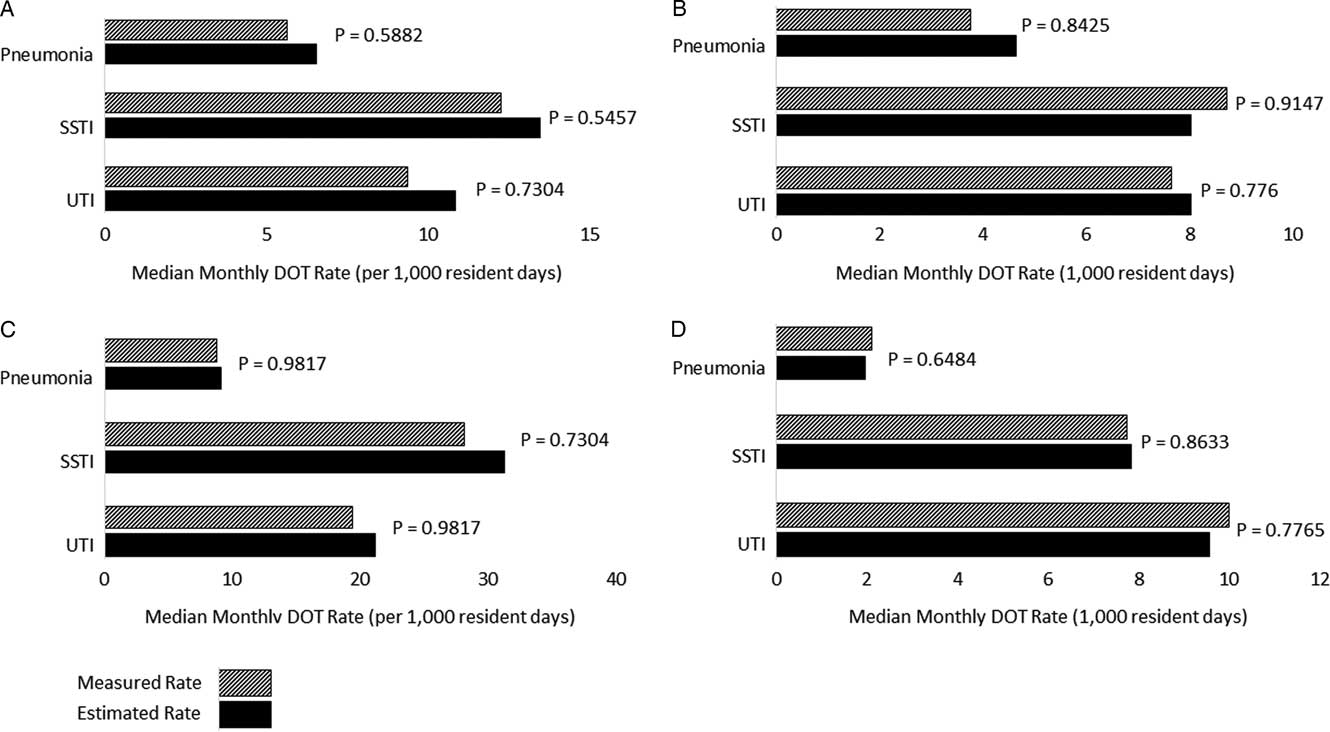
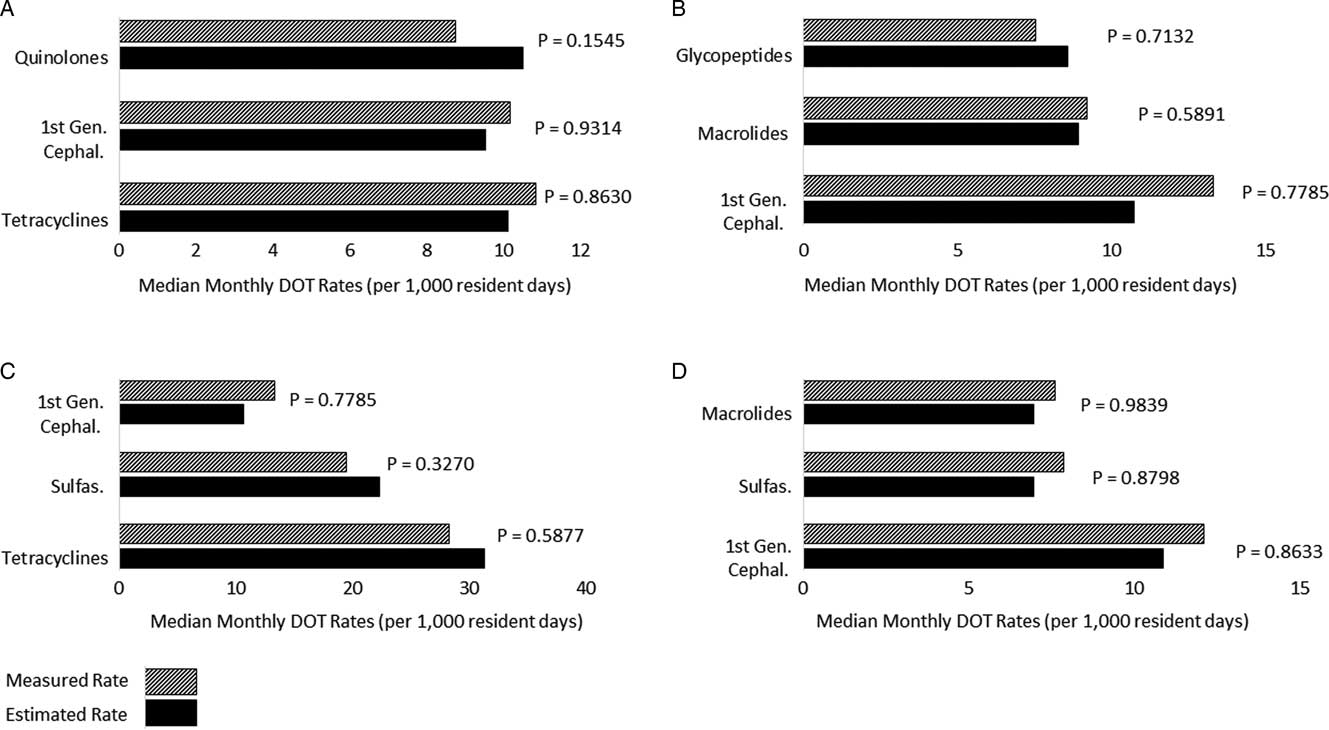
In the 4 nursing homes, the median 1-day prevalence for antibiotic use was 6.7% (25%–75% interquartile range [IQR], 5.0%–8.6%). The measured monthly antibiotic DOT rate varied between the nursing homes (median, 68.9; IQR, 54.4–100.6 per 1,000 resident days). The median monthly antibiotic DOT rate per 1,000 resident days ranged from 7.6 to 16.4 for UTI, 6.8 to 23.8 for SSTI, and 3.7 to 7.9 for pneumonia (Fig. 1). The drug classes also varied by nursing home: the most common antibiotic class in 2 nursing homes was tetracyclines (median monthly DOT rates, 28.3 and 10.8 per 1,000 resident days), whereas first-generation cephalosporins (median monthly DOT rates, 16.2 and 12.1 per 1,000 resident days) were most common in the other 2 nursing homes. Quinolone use was generally low in all 4 nursing homes due to their involvement in an intervention to reduce quinolone use. The distribution of antibiotic DOT for the 3 common infections varied by nursing home. For UTI and SSTI, cephalosporins were the most common class prescribed in 3 of the nursing homes. For pneumonia, only 1 nursing home commonly prescribed quinolones; in another, doxycycline was the preferred agent (Supplemental Fig. 3).
Measured and estimated median monthly days of therapy (DOT) rates (per 1,000 resident days) for pneumonia, skin and soft-tissues infections (SSTI) and urinary tract infections (UTI) for the 4 nursing homes.

The measured and estimated overall monthly DOT rates did not differ significantly (P range, 0.4227–0.7131). In addition, the monthly antibiotic DOT rate by indication (UTI, SSTI, pneumonia) (Fig. 1) and by antibiotic drug class (Fig. 2) were not statistically different (P ranges, 0.5457–0.9817 and 0.1545–1.0000, respectively) for the 4 nursing homes. The measured and estimated distribution of DOT of antibiotics used for UTI, SSTI, and pneumonia were also similar (Supplemental Fig. 3).
Measured and estimated median monthly days of therapy (DOT) rates (per 1,000 resident days) for the 3 most common antibiotic classes in each nursing home. *1st Gen Cephal: first-generation cephalosporins.

Discussion
We found that a weekly, 1-day point-prevalence survey of antibiotic use accurately estimates a nursing home’s total antibiotic burden, measured as DOT per 1,000 resident days. This measure is important because nursing homes with high antibiotic use have increased antibiotic-related adverse events.Reference Daneman, Bronskill and Gruneir 8 The 1-day point-prevalence survey can also accurately estimate the DOT for common indications and classes of antibiotics. These data can be used to identify targets for intervention and to measure progress over time.Reference Mylotte 9 , Reference Crnich, Jump, Trautner, Sloane and Mody 10 For instance, in one nursing home, quinolone use was common for pneumonia highlighting an antibiotic stewardship need. Notably, DOT can be inflated by prolonged treatment durations and long-term prophylaxis (eg, UTI, pemphigoid), and this is one of the reasons for the observed high DOT rate for doxycycline and SSTI in some nursing homes.
Our point-prevalence method is valuable for nursing homes without electronic medication administration records or with a dispensing pharmacy that is unable to provide data summaries or capture antibiotic indications. We accurately estimated overall DOT as well as DOT by indication and antibiotic class. Other manual antibiotic use measurements include collection of antibiotic starts as part of infection surveillance activities and performing an intermittent point-prevalence survey of antibiotic use.Reference McElligott, Welham, Pop-Vicas, Taylor and Crnich 5 , Reference Mylotte 9 , Reference Crnich, Jump, Trautner, Sloane and Mody 10 Although antibiotic starts rates are correlated with DOT rates,Reference Mylotte 9 this measure cannot assess the impact of an intervention that focuses on reducing antibiotic duration;Reference Crnich, Jump, Trautner, Sloane and Mody 10 one alternative to address this gap is focusing on antibiotic courses of >7 days duration. Intermittent point prevalence measurements can provide an estimate of the proportion of residents on antibiotics including antibiotics initiated by the hospital and the most common reasons for antibiotic use, but if done infrequently, it cannot assess the total antibiotic burden. 3 Our manual weekly count of antibiotic use and aggregating antibiotic use point-prevalence data at regular intervals can provide an estimate similar to the total antibiotic DOT without the labor of daily manual data collection.
This analysis has several limitations. First, we included a small number of nursing homes. Also, we were unable to differentiate between antibiotics initiated by the hospital or the nursing home, and we used dispensing data for which we could not confirm that a prescribed drug was administered. Additionally, antibiotic courses of<7 days may have been missed; however, no significant difference in the estimated and measured antibiotic DOT rate was found. Finally, we did not validate that nursing home staff could accurately replicate this antibiotic use measure using manual data collection. Future research is needed to determine whether this methodology can be replicated in other nursing homes.
Our findings suggest that a weekly, 1-day point-prevalence survey of antibiotic use is an accurate proxy of measured antibiotic DOT. Identification of simple antibiotic use measurement methods that reduce staff burden can facilitate the participation of nursing homes in antibiotic use tracking as part of an antibiotic stewardship program.
Acknowledgments
We thank Elizabeth Dodds-Ashley, PharmD, for her guidance on the antibiotic measurement; Nicola Thompson, PhD, and Sarah Kabbani, MD, MSc, for their critical review of this manuscript.
Financial support
This work was supported by a grant for New York State Department of Health.
Conflicts of interest
All authors report no conflicts of interest relevant to this article.
Supplementary material
To view supplementary material for this article, please visit https://doi.org/10.1017/ice.2018.309