Introduction
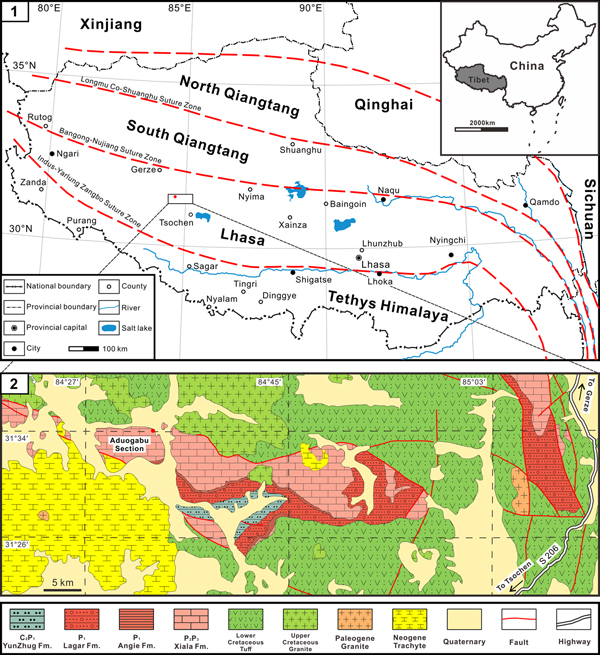
It has been widely acknowledged that the formation of the Qinghai-Tibet Plateau is closely bound with the tectonic evolution of a series of peri-Gondwanan blocks (Yin and Harrison, Reference Yin and Harrison2000; Metcalfe, Reference Metcalfe2013; Zhang et al., Reference Zhang, Shi and Shen2013). Notably, most of these blocks (i.e., Cimmerian blocks; Sengör, Reference Sengör1979) rifted away from the northern Gondwanan margin and drifted northward rapidly during the late Paleozoic and early Mesozoic. The Lhasa Block is bounded by the South Qiangtang Block in the north and the Tethys Himalaya in the south (Fig. 1.1). However, its rifting time and paleogeographic evolution remains controversial. Some researchers suggested that the Lhasa Block rifted away from the peri-Gondwanan region during the late Cisuralian (e.g., Shen et al., Reference Shen, Shi and Archbold2003a, Reference Shen, Sun and Shic, Reference Shen, Zhang, Shi, Li, Xie, Mu and Fan2013; Ran et al., Reference Ran, Wang, Zhao, Li, He, Zhu and Coe2012; Angiolini et al., Reference Angiolini, Crippa, Muttoni and Pignatti2013; Zhang et al., Reference Zhang, Shi and Shen2013; Yuan et al., Reference Yuan, Zhang, Shen, Henderson, Zhang, Zhu, An and Feng2016) and was gradually incorporated into the warm-water regime during the Guadalupian and Lopingian based on faunal changes (Shi et al., Reference Shi, Archbold and Zhan1995; Shen and Shi, Reference Shen and Shi2004; Muttoni et al., Reference Muttoni, Gaetani, Kent, Sciunnach, Angiolini, Berra, Garzanti, Mattei and Zanchi2009; Shen et al., Reference Shen, Xie, Zhang and Shi2009; Angiolini et al., Reference Angiolini, Crippa, Muttoni and Pignatti2013, Reference Angiolini, Zanchi, Zanchetta, Nicora, Vuolo, Berra, Henderson, Malaspina, Rettori and Vachard2015). On the other hand, other colleagues suggested that the Lhasa Block had not rifted from Gondwana until the Late Triassic based on the paleomagnetic constraints and some petrological evidence (e.g., Metcalfe, Reference Metcalfe2013; Zhu et al., Reference Zhu, Zhao, Niu, Dilek, Hou and Mo2013; Li et al., Reference Li, Ding, Lippert, Song, Yue and van Hinsbergen2016). As have been widely perceived by many previous studies (e.g., Mannion et al., Reference Mannion, Upchurch, Benson and Goswami2014), invertebrate faunas and their paleobiogeographic affinities continually changed with the paleolatitude-related thermal gradients of the tectonic blocks in Tibet and adjacent areas (Shi and Archbold, Reference Shi, Archbold, Hall and Holloway1998). Therefore, studies on marine faunas spanning from the early Permian to Late Triassic in the Lhasa Block will provide critical data to further clarify these hotly debated scientific issues (e.g., Ke et al., Reference Ke, Shen, Shi, Fan, Zhang, Qiao and Zeng2016). Recently, studies on the Guadalupian fusuline and nonfusuline foraminifers (e.g., Zhang et al., Reference Zhang, Cheng and Shen2010, Reference Zhang, Shen, Zhang, Zhu and An2016, Reference Zhang, Shen, Zhang, Zhu, An, Huang, Ye, Qiao and Xu2019) and the Cisuralian and Lopingian conodonts (Yuan et al., Reference Yuan, Zhang, Zhang, Zhu and Shen2014, Reference Yuan, Zhang, Shen, Henderson, Zhang, Zhu, An and Feng2016) provide important information to constrain the tectonic evolution of the Lhasa Block. However, studies of the major benthic fossil group—the brachiopods—were only carried out by Zhan and Wu (Reference Zhan and Wu1982) from the Xiala Formation and Zhan et al. (Reference Zhan, Yao, Ji and Wu2007) from the middle and upper parts of the Yunzhug and Anjie formations at the Xiala section. Documentation of Lopingian brachiopods is basically lacking in the Lhasa Block except for a few species that were listed without descriptions from the Lielonggou Formation near Lhasa City (Sun et al., Reference Sun, Hu and Chen1981). In this paper, we describe and illustrate a new brachiopod fauna from the Aduogabu section (84°33′07”E, 31°34′01″N), which is ~ 85 km northwest of Tsochen in the central part of the Lhasa Block (Fig. 1.2).
(1) General tectonic subdivision of the Qinghai-Tibet Plateau; (2) geologic sketch map of the studied area with the location of the Aduogabu section.

Stratigraphy
The Permian strata in the central Lhasa Block are commonly divided into five formations, i.e., the upper part of the Yunzhug Formation, and the Lagar, Anjie, Xiala, and Mujiucuo formations in ascending order (Zhang et al., Reference Zhang, Shi and Shen2013). The uppermost part of the Yunzhug Formation consists of thick clastic deposits with several layers of limestone yielding the brachiopod assemblages Cimmeriella mucronate-Taeniothaerus excellens of late Asselian to Sakmarian age and Trigonotreta magnifica-Bandoproductus intermedia of early Cisuralian age (Zhan et al., Reference Zhan, Yao, Ji and Wu2007). The Lagar Formation is characterized by marine diamictites, equivalent to the Poindo Group exposed in the Lhunzhub area in the eastern part of Lhasa Block, which contains the well-known brachiopod Bandoproductus fauna. The overlying Angie Formation is composed of limestone in the lower part and shale or mudstone interbedded with limestone lens in the upper part. The brachiopod assemblage Aulosteges ingens-Punctocyrtella nagmargensis (Zhan et al., Reference Zhan, Yao, Ji and Wu2007) and the conodont assemblage Mesogondolella idahoensis-Vjalovognathus shindyensis (Ji et al., Reference Ji, Yao and Wu2007; Zheng et al., Reference Zheng, Xu, Wang and Ma2007) were reported from this formation; both suggest an Artinskian to Kungurian age with relatively cool climatic conditions.
The succeeding Xiala Formation is marked by the appearance of distinct purplish bioclastic limestone that yields the brachiopod Costiferina-Stenoscisma gigantea Assemblage (Zhan and Wu, Reference Zhan and Wu1982), the nondissepimental solitary coral Lytvolasma-Ufimia Assemblage (Yin, Reference Yin1997; Wang et al., Reference Wang, Shen, Sugiyama and West2003), and the conodonts Mesogondolella Kozur, Reference Kozur1988 and Vjalovognathus Kozur, Reference Kozur1977 (Yuan et al., Reference Yuan, Zhang, Shen, Henderson, Zhang, Zhu, An and Feng2016). Abundant fusuline and nonfusuline foraminifers (e.g., Nankinella Lee, Reference Lee1934, Chusenella Hsü, Reference Hsü1942, Shanita Brönnimann, Whittaker, and Zaninetti, Reference Brönnimann, Whittaker and Zaninetti1978, and Hemigordiopsis Reichel, Reference Reichel1945; Zhang et al., Reference Zhang, Cheng and Shen2010, Reference Zhang, Shen, Zhang, Zhu and An2016, Reference Zhang, Shen, Zhang, Zhu, An, Huang, Ye, Qiao and Xu2019) are commonly found in the middle and upper parts of the Xiala Formation. The age of this formation can range to the Wuchiapingian in the Xainza area based on the recent discovery of the conodont Clarkina liangshanensis (Wang, Reference Wang1978) and the fusulinid Codonofusiella schubertelloides Sheng, Reference Sheng1956 (Yuan et al., Reference Yuan, Zhang, Zhang, Zhu and Shen2014; Zhang et al., Reference Zhang, Zhu, Yuan and Zhang2014) and to the Changhsingian in the Shiquanhe, Geji, and Tsochen areas based on the presence of the conodont Clarkina changxingensis (Wang and Wang, Reference Wang and Wang1981), the conodont Hindeodus–Isarcicella assemblage, and the foraminifer Colaniella fauna (Ji et al., Reference Ji, Yao and Wu2007; Wu et al., Reference Wu, Ji, Trotter, Yao and Zhou2014; Qiao et al., Reference Qiao, Xu and Zhangin press).
The Mujiucuo Formation, distributed in the Xainza and adjacent areas, is dominated by dolomite. It is noteworthy that the age of this formation is probably Changhsingian to Early Triassic rather than Wuchiapingian (Cheng et al., Reference Cheng, Wang, Li and Wu2002) according to presence of the conodont Clarkina liangshanensis from the topmost part of the underlying Xiala Formation in the Mujiucuo area (Yuan et al., Reference Yuan, Zhang, Zhang, Zhu and Shen2014) as well as Early Triassic conodonts (e.g., Ellisonia agordina Perri and Andraghetti, Reference Perri and Andraghettie1987, Hadrodontina anceps Staesche, Reference Staesche1964, Pachycladina obliqua Staesche, Reference Staesche1964) within this formation (Wu et al., Reference Wu, Ji, Yao, He, Sun, Shi, Li, Zhong, Liu, Guo, Hou, Li and Shen2017, Reference Wu, Ji, Sun, Shi, He, Li, Liu, Guo, Hou and Li2018).
Age of the brachiopod fauna
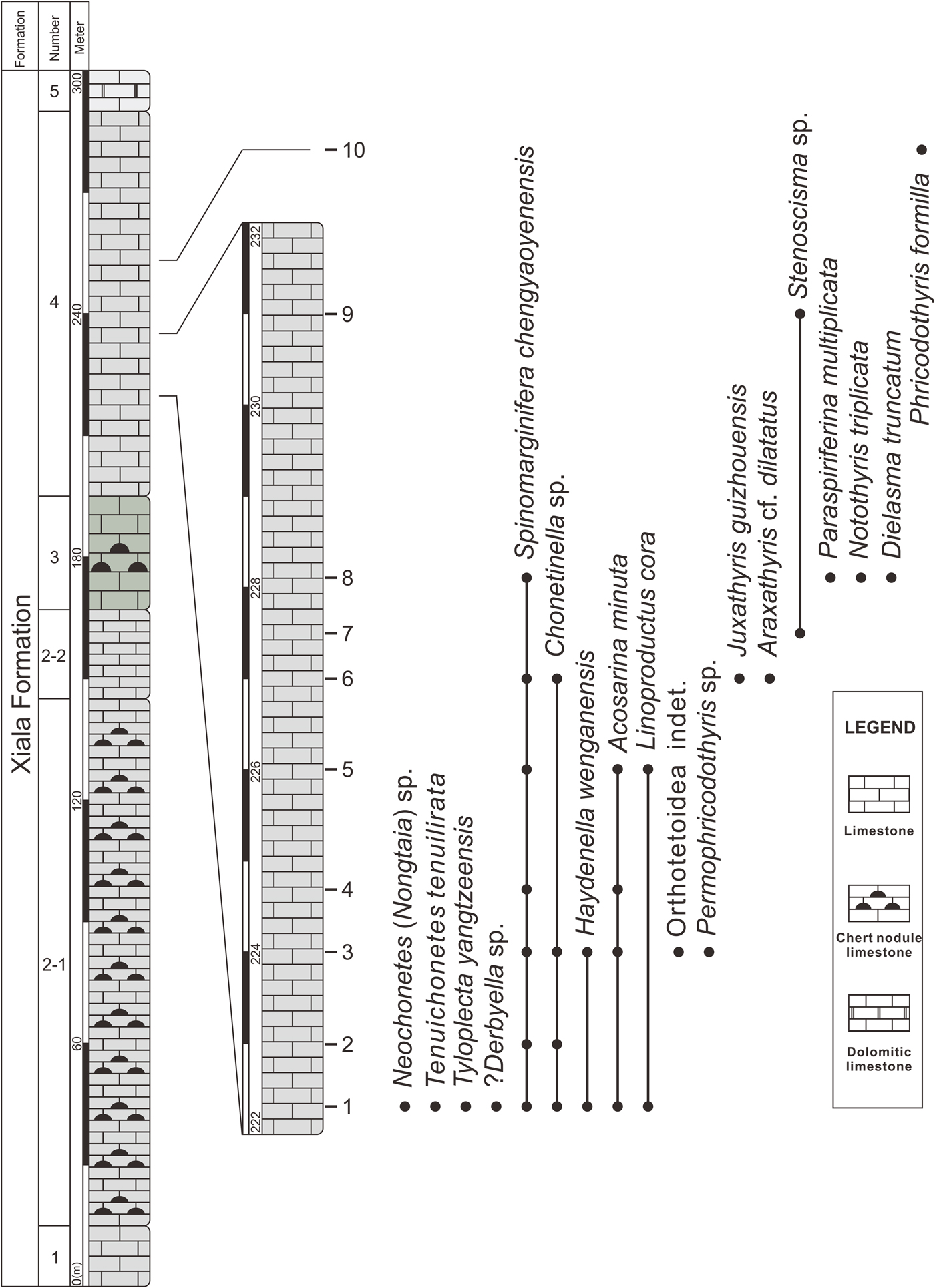
In total, 17 species belonging to 17 genera and one unidentifiable Orthotetoidea have been identified from the uppermost part of the Xiala Formation at the Aduogabu section. Most of the brachiopods generally indicate Changhsingain age. Spinomarginifera chengyaoyenensis Huang, Reference Huang1932 is the dominant species in this fauna (Fig. 2). It is very common in the Changhsing Formation in South China (Huang, Reference Huang1932; Liao, Reference Liao1980a, Reference Liaob, Reference Liao1987; Shen et al., Reference Shen, He, Zhu and Gu1992; Zeng et al., Reference Zeng, He and Zhu1995). It was also reported from the upper part of the Yenduyet Formation near Son La, northwestern Vietnam, with an early Changhsingian age (Shi and Shen, Reference Shi and Shen1998). Other relatively abundant species are Chonetinella sp., Haydenella wenganensis (Huang, Reference Huang1932), and Acosarina minuta (Abich, Reference Abich1878). Although Chonetinella spp. mainly range from the upper Carboniferous to the Cisuralian, some species also occur in the Guadalupian to Lopingian (e.g., Chonetinella cymatilis Grant, Reference Grant1976, C. transversa Tazawa, Reference Tazawa2008, and C. unisulcata Zhang in Zhang and Jin, Reference Zhang and Jin1976). The species in this study is probably referred to a new species of undetermined age. Haydenella wenganensis is very close to H. kiangsiensis (Kayser, Reference Kayser and von Richthofen1883); both are common elements throughout the entire Lopingian of South China. Haydenella wenganensis has been also recorded from the lower Takakurayama Formation of Wuchiapingian age at the Abukuma Mountains in northeastern Japan (Tazawa et al., Reference Tazawa, Kaneko, Suzuki and Hasegawa2015). Acosarina minuta is widely distributed in the Salt Range of Pakistan; western Texas, USA; Thailand; northern Iran; and Transcaucasia, with the age ranging from the upper Carboniferous to earliest Triassic (e.g., Waagen, Reference Waagen1884; Cooper and Grant, Reference Cooper and Grant1976b; Liao, Reference Liao1980a, Reference Liao1987; Ghaderi et al., Reference Ghaderi, Garbelli, Angiolini, Ashouri, Korn, Rettori and Gharaie2014); it is extremely common in South China during the Lopingian (e.g., Shen and Shi, Reference Shen and Shi2007; He et al., Reference He, Shi, Zhang, Yang, Zhang, Wu, Niu and Zhang2014). Araxathyris dilatatus Shen, He, and Zhu, Reference Shen, He, Zhu and Gu1992 has mainly been recorded from a number of formations of Changhsingian age in South China (e.g., Shen et al., Reference Shen, He, Zhu and Gu1992; Shen and Archbold, Reference Shen and Archbold2001; Shen and Zhang, Reference Shen and Zhang2008). Tyloplecta yangtzeensis (Chao, Reference Chao1927) is widely distributed and ranges from the late Capitanian to the Lopingian. Juxathyris guizhouensis (Liao, Reference Liao1980a) has been reported from the Douling Formation (earliest Wuchiapingian) at Hunan (Shen and Zhang, Reference Shen and Zhang2008); the Lungtan Formation (late Wuchiapingian) at Guizhou (Liao, Reference Liao1980a); the Changhsing Formation (Changhsingian) at Chongqing (Shen et al., Reference Shen, He, Zhu and Gu1992), and the Episkopi Formation (Wuchiapingian) of Hydra Island, Greece (Shen and Clapham, Reference Shen and Clapham2009). Phricodothyris formilla (Xu and Grant, Reference Xu and Grant1994) has only been reported by Xu and Grant (Reference Xu and Grant1994) from the Lungtan and Changhsing formations of South China and by Angiolini and Carabelli (Reference Angiolini and Carabelli2010) from the Nesen Formation (Changhsingian) of northern Iran. According to Shi et al. (Reference Shi, Chen and Han2002), the majority of Permophricodothyris spp. are restricted to the Lopingian and all became extinct near the Permian-Triassic boundary. Therefore, Permophricodothyris sp. in this section is probably of Lopingian age. Paraspiriferina multiplicata (Sowerby, Reference Sowerby1829) is not only present in the Changhsing Formation and its equivalent strata in South China, but also occurred in the topmost part of the Wargal and Chhidru formations in the Salt Range of Pakistan and the Episkopi Formation of Hydra Island, Greece. Notothyris triplicata Diener, Reference Diener1897 has been reported from several localities in the Qinghai-Tibet Plateau, e.g., the Gaqoi Limestone (Wordian) at Zhongba (Jin and Sun, Reference Jin and Sun1981); the Chitichun Limestone (Lopingian) at Purang, Tibet (Diener, Reference Diener1897); the Kaixinling Formation (late Wuchiapingian) at Golmud in Qinghai (Jin et al., Reference Jin, Ye, Xu and Sun1979), and the Changhsing Formation in Chongqing and Guizhou, South China (Shen et al., Reference Shen, He, Zhu and Gu1992; Shen and He, Reference Shen and He1994), and the Basleo beds (Capitanian or Wuchiapingian) of West Timor (Hamlet, Reference Hamlet1928).
Stratigraphic succession of the Aduogabu section with occurrences of the brachiopod fossils.

In addition to the Lopingian species mentioned above, this fauna also contains a few species that have been recorded in the Guadalupian or even Cisuralian. Tenuichonetes tenuilirata (Chao, Reference Chao1928) was recorded in a number of formations of Guadalupian age at Anhui, Fujian, Zhejiang, and Hong Kong, China. Linoproductus cora (d’Orbigny, Reference d'Orbigny1842) is mainly restricted to the lower Permian (Muir-Wood and Cooper, Reference Muir-Wood and Cooper1960), but is also occasionally reported from the upper Carboniferous to the upper Permian (e.g., Diener, Reference Diener1897; Chen and Shi, Reference Chen and Shi2001). Dielasma truncatum Waagen, Reference Waagen1882 has been recorded from the Schwagerina Limestone (Sakmarian) of the southern Urals, the lower Productus Limestone (Wordian) of the Salt Range of Pakistan, and the Basleo beds (Capitanian or Wuchiapingian) of West Timor.
In conclusion, 10 of 17 species generally suggest Lopingian age except for four indeterminate species. Notably, Spinomarginifera chengyaoyenensis with a Changhsingian age accounts for approximately half of the total quantity of brachiopods. Therefore, this fauna can be assigned to the Changhsingian age based on the brachiopods and their co-occurring foraminifers Colaniella parva (Colani, Reference Colani1924) and Reichelina pulchra Miklukho-Maklay, Reference Miklukho-Maklay1954.
Paleobiogeographical implications
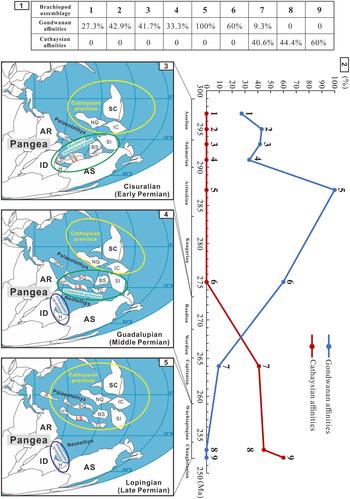
The brachiopod fauna from the uppermost part of the Xiala Formation at the Aduogabu section in the central Lhasa Block shows strong Cathaysian affinity. Twelve species have been reported from South China and other paleoequatorial areas, accounting for 70% of this fauna. The dominant species Spinomarginifera chengyaoyenensis has only been recorded from the South China and Indochina Block. Very similar species, e.g., Spinomarginifera spinosocostata (Abich, Reference Abich1878) and Spinomarginifera helica (Abich, Reference Abich1878), have been also reported from northwestern and central Iran (Angiolini and Carabelli, Reference Angiolini and Carabelli2010). Other species, e.g., Tenuichonetes tenuilirata, Haydenella wenganensis, Tyloplecta yangtzeensis, Acosarina minuta, Juxathyris guizhouensis, Araxathyris dilatatus, and Phricodothyris formilla, are very common in the Lopingian in South China. Apart from these typical Cathaysian elements, Paraspiriferina multiplicata and Notothyris triplicata are common species in the peri-Gondwanan region (e.g., from the Chitichun Limestone; the upper part of the Wargal and Chhidru formations in the Salt Range, Pakistan; and the Basleo beds of West Timor), but they also occur in South China (Shen et al., Reference Shen, He, Zhu and Gu1992). This fauna also contains some cosmopolitan genera (e.g., Linoproductus Chao, Reference Chao1927, Stenoscisma Conrad, Reference Conrad1839, and Dielasma King, Reference King1859. Therefore, the brachiopod fauna from the Aduogabu section belongs to the Cathaysian Province of the Tethyan Realm in paleobiogeography during the Changhsingian (Shen et al., Reference Shen, Archbold and Shi2001a; Ke et al., Reference Ke, Shen, Shi, Fan, Zhang, Qiao and Zeng2016). In contrast, the counterpart of the Selong Group or Qubuerga Formation at the Selong Xishan, Shengmi, Qubu, and Tulong in the Tethys Himalaya is dominated by typical Gondwanan cold-water taxa, e.g., Costiferina indica (Waagen, Reference Waagen1884), Retimarginifera xizangensis Shen et al., Reference Shen, Archbold, Shi and Chen2000, Biplatyconcha grandis (Waterhouse, Reference Waterhouse1975), Spiriferella qubuensis Zhang in Zhang and Jin, Reference Zhang and Jin1976, and Neospirifer (Quadrospina) tibetensis Ding, Reference Ding1962. The faunas in the Selong Group are very different from the fauna in the studied area in taxonomic composition (Shen et al., Reference Shen, Archbold, Shi and Chen2000, Reference Shen, Archbold and Shi2001b, Reference Shen, Archbold, Shi and Chenc, Reference Shen, Shi and Archbold2003b; Xu et al., Reference Xu, Cao, Yuan, Zhang and Shen2018). Through comparison of the brachiopod faunas in the Lhasa Block and Tethys Himalaya, it is clear that the Lhasa Block drifted into a relatively warm regime, far away from the cold, northern peri-Gondwanan margin, and thus was situated in a totally different paleogeographic position from the Tethys Himalaya during the Lopingian (Fig. 4.5).
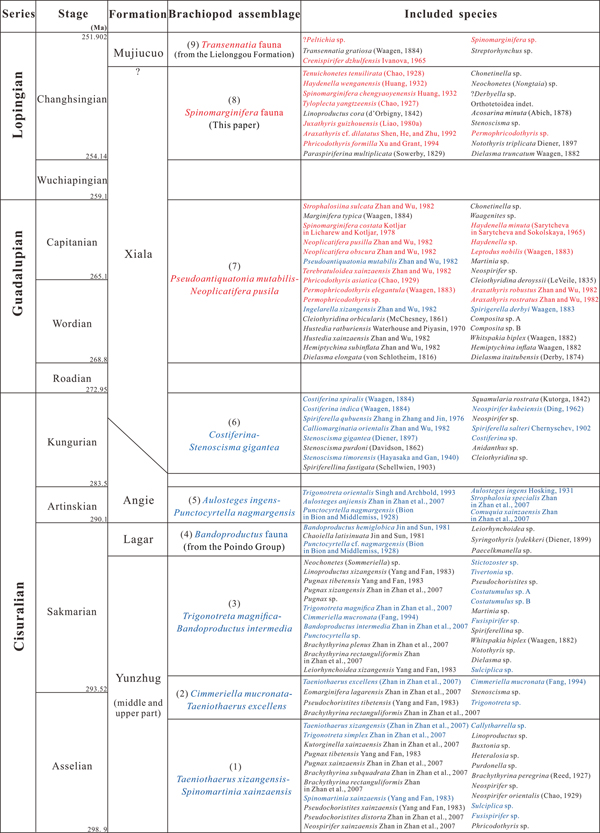
With the addition of the Lopingian brachiopods described herein, the paleobiogeographical evolution of the Lhasa Block based on brachiopod faunas suggests that significant changes occurred during the Permian (Figs. 3, 4). Three brachiopod assemblages were recognized by Zhan et al. (Reference Zhan, Yao, Ji and Wu2007) from the middle and upper parts of the Yunzhug Formation, namely the Taeniothaerus xizangensis-Spinomartinia xainzaensis, the Cimmeriella mucronata-Taeniothaerus excellens, and the Trigonotreta maginfica-Bandoproductus intermedia assemblages. Their age is assigned to the early to middle Cisuralian (Zhan et al., Reference Zhan, Yao, Ji and Wu2007; Shen, Reference Shen2018). Among these three assemblages, cold-water genera (e.g., Taeniothaerus Whitehouse, Reference Whitehouse1928, Spinomartinia Waterhouse, Reference Waterhouse1968, Fusispirifer Waterhouse, Reference Waterhouse1966, Cimmeriella Archbold and Hogeboom, Reference Archbold and Hogeboom2000, Trigonotreta Koenig, Reference Koenig1825, and Bandoproductus Jin and Sun, Reference Jin and Sun1981) are relatively prosperous, occupying 27 – 43% in these three assemblages, and no typical warm-water genera have been recorded so far, indicating a typical Gondwanan-type fauna. Another similar Gondwanan-type Bandoproductus fauna was reported from the Poindo Group (Jin and Sun, Reference Jin and Sun1981), which is comparable with that of the late Sakmarian Lagar Formation. The Aulosteges ingens-Punctocyrtella nagmargensis Assemblage from the lower part of the overlying Anjie Formation shows an Artinskian age. This assemblage is entirely composed of cold-water elements, showing much colder paleoclimatic conditions. The brachiopod fauna of the lowest part of the overlying Xiala Formation exhibits similar features with that of the Anjie Formation, with ~ 60% of genera with Gondwanan affinities. Costiferina spiralis (Waagen, Reference Waagen1884), Calliomarginatia orientalis Zhan and Wu, Reference Zhan and Wu1982, and Spiriferella salteri Chernyschev, Reference Chernyschev1902 of the Costiferina-Stenoscisma gigantea Assemblage (Zhan and Wu, Reference Zhan and Wu1982) are commonly recorded from the peri-Gondwanan region (e.g., the Salt Range of Pakistan, Tethys Himalaya, and West Timor). This assemblage belongs to the late Kungurian based on the abundant conodonts Mesogondolella idahoensis (Youngquist, Hawley, and Miller, Reference Youngquist, Hawley and Miller1951) and Vjalovognathus nicolli Yuan, Shen, and Henderson in Yuan et al., Reference Yuan, Zhang, Shen, Henderson, Zhang, Zhu, An and Feng2016 yielded from the equivalent interval (Yuan et al., Reference Yuan, Zhang, Shen, Henderson, Zhang, Zhu, An and Feng2016).
Stratigraphic distribution of brachiopods in the Lhasa Block during the Permian; the data of brachiopod assemblages 1, 2, 3, and 5 are from Zhan et al. (Reference Zhan, Yao, Ji and Wu2007), 4 from Jin and Sun (Reference Jin and Sun1981), 6 and 7 from Zhan and Wu (Reference Zhan and Wu1982), and 9 from Sun et al. (Reference Sun, Hu and Chen1981). The age of each stage is based on the 2018 International Chronostratigraphic Chart ver. 2018/8. Brachiopods with Gondwanan affinity are in blue font; those with Cathaysian affinity are in red font.

(1, 2) Paleobiogeographic evolution of the Lhasa Block through the entire Permian as demonstrated by the changes of the ratios of the brachiopods with Gondwanan affinity versus Cathaysian affinity; the numbers, ratios, and ages of the brachiopod assemblage refer to Figure 3; (3–5) Paleogeographic map of the Tethyan region showing the paleoposition of the Lhasa Block (in red font) from Cisuralian to Lopingian. AR = Arabian Plate; AS = Australia; BS = Baoshan Block; H = Tethys Himalaya; IC = Indochina; ID = Indian Plate; IR = Iran; LS = Lhasa Block; NQ = North Qiangtang Block; SC = South China; SI = Sibumasu Block; SP = South Pamir; SQ = South Qiangtang Block; TC = Tengchong Block. Base map courtesy of Christopher Scotese.

In contrast, the nature of brachiopod faunas changed dramatically around the Guadalupian (Figs. 3, 4.1, 4.2). A relatively abundant brachiopod fauna, the Pseudoantiquatonia mutabilis-Neoplicatifera pusilla fauna from the middle part of the Xiala Formation (Zhan and Wu, Reference Zhan and Wu1982), shows 40% of the genera with Cathaysian affinities and only 9% with Gondwanan affinities; genera with warm affinities were almost absent in the above-mentioned older faunas. The dominant elements of this fauna, e.g., Neoplicatifera pusilla Zhan and Wu, Reference Zhan and Wu1982, Leptodus nobilis (Waagen, Reference Waagen1883), Haydenella minuta (Sarytcheva in Sarytcheva and Sokolskaya, Reference Sarytcheva, Sokolskaya, Ruzhentsev and Sarytcheva1965), and Permophricodothyris elegantula (Waagen, Reference Waagen1883), are all common warm-water taxa, which are quite comparable with the brachiopod faunas from the Shazipo Formation of the Baoshan Block and the Maokou Formation (Wordian to Capitanian) of South China (Shi and Shen, Reference Shi and Shen2001).
By the Changhsingian, the brachiopod fauna from the uppermost part of the Xiala Formation, as documented by this study, was characteristic of the Cathaysian Province (Shen et al., Reference Shen, Archbold and Shi2001a; Ke et al., Reference Ke, Shen, Shi, Fan, Zhang, Qiao and Zeng2016). This is also consistent with a small Changhsingian brachiopod assemblage recorded from the Lielonggou Formation in the eastern part of the Lhasa Block (Sun et al., Reference Sun, Hu and Chen1981), which is mainly composed of common South China species, e.g., ?Peltichia sp., Spinomarginifera sp., and Crenispirifer dzhulfensis Ivanova, Reference Ivanova, Ruzhentsev and Sarytcheva1965.
To conclude, the paleobiogeographic evolution of brachiopods in the Lhasa Block shows that the fauna progressively changed from Gondwanan-type (Cisuralian) to mixed-type (Guadalupian), then to typical warm-water Cathaysian-type (Lopingian) (Fig. 4). This progressive faunal shift can be interpreted by two different causes or an interplay of both: (1) a paleoclimatic amelioration after the late Paleozoic Ice Age (e.g., Fielding et al., Reference Fielding, Frank, Isbell, Fielding, Frank and Isbell2008; Shi and Waterhouse, Reference Shi and Waterhouse2010) could take effect in this paleobiogeographic shift during the late Cisuralian and Guadalupian. This has been supported by a conodont δ18Oapatite study (Chen et al., Reference Chen, Joachimski, Shen, Lambert, Lai, Wang, Chen and Yuan2013) that suggests that a gradual shift from icehouse to greenhouse occurred during the Kungurian in South China. Alternatively, (2) the Lhasa Block experienced a significant northern drift during the Permian, that is, it attached to the northern margin of Gondwanaland during the early Cisuralian (Fig. 4.3), so the brachiopod faunas were dominated by cold-water elements. It might have drifted away from the peri-Gondwanan margin during the latest Cisuralian and Guadalupian, gradually moving northward into a relatively warm regime (Fig. 4.4), so a cold/warm mixed fauna began at that time, and finally drifting farther northward to a typical warm regime after the Guadalupian (Fig. 4.5), leading to most of the brachiopods being typical warm-water elements like the fauna described herein. In contrast to the Lhasa Block, the brachiopod faunas in the Tethys Himalaya remained cold-water elements through the Permian (Ke et al., Reference Ke, Shen, Shi, Fan, Zhang, Qiao and Zeng2016; Shen, Reference Shen2018; Xu et al., Reference Xu, Cao, Yuan, Zhang and Shen2018). Therefore, the paleogeographic evolution of the Lhasa Block probably played a more important role than the paleoclimatic changes, otherwise the faunas from both tectonic units would have changed similarly in the ratio of cold-water to warm-water elements through the Permian. This also suggests that the Neotethys Ocean would have opened around the Cisuralian-Guadalupian transition (e.g., Shi and Archbold, Reference Shi, Archbold, Hall and Holloway1998; Shen et al., Reference Shen, Shi and Archbold2003a, Reference Shen, Sun and Shic; Zhang et al., Reference Zhang, Shi and Shen2013; Haig et al., Reference Haig, Mory, McCartain, Backhouse, Håkansson, Ernst, Nicoll, Shi, Bevan, Davydov, Hunter, Keep, Martin, Peyrot, Kossavaya and Santos2017).
Materials and methods
Brachiopod samples were collected from 10 layers of Bed 4 of the uppermost part of the Xiala Formation at the Aduogabu section. These specimens were repaired using a pneumatic engraving and sharpening pen under a microscope, coated with smoked magnesium, and photographed under a Nikon KEYENCE D3X and KEYENCE VHC-600 microscope.
Repository and institutional abbreviation
The specimens described herein are housed in the Nanjing Institute of Geology and Palaeontology (NIGP), Chinese Academy of Sciences, Nanjing, China.
Systematic paleontology
The systematic study largely follows the classification proposed by Brunton et al. (Reference Brunton, Lazarev, Grant, Jin and Kaesler2000) for Productida, Williams et al. (Reference Williams, Brunton, Wright and Kaesler2000) for Orthotetida, \Williams and Harper (Reference Williams, Harper and Kaesler2000) for Orthida, Savage et al. (Reference Savage, Manceñido, Owen and Kaesler2002) for Rhynchonellida, Alvarez and Rong (Reference Alvarez, Rong and Kaesler2002) for Athyridida, Carter et al. (Reference Carter, Johnson, Gourvennec, Hou and Kaesler2006) for Spiriferida, Carter and Johnson (Reference Carter, Johnson and Kaesler2006) for Spiriferinida, and Lee et al. (Reference Lee, Mackinnon, Smirnova, Baker, Jin, Sun and Kaesler2006) for Terebratulida.
Order Productida Sarytcheva and Sokolskaya, Reference Sarytcheva and Sokolskaya1959
Family Rugosochonetidae Muri-Wood, Reference Muir-Wood1962
Genus Chonetinella Ramsbottom, Reference Ramsbottom1952
Type species
Chonetes flemingi Norwood and Pratten, Reference Norwood and Pratten1855 from the Pennsylvanian of Texas, USA.
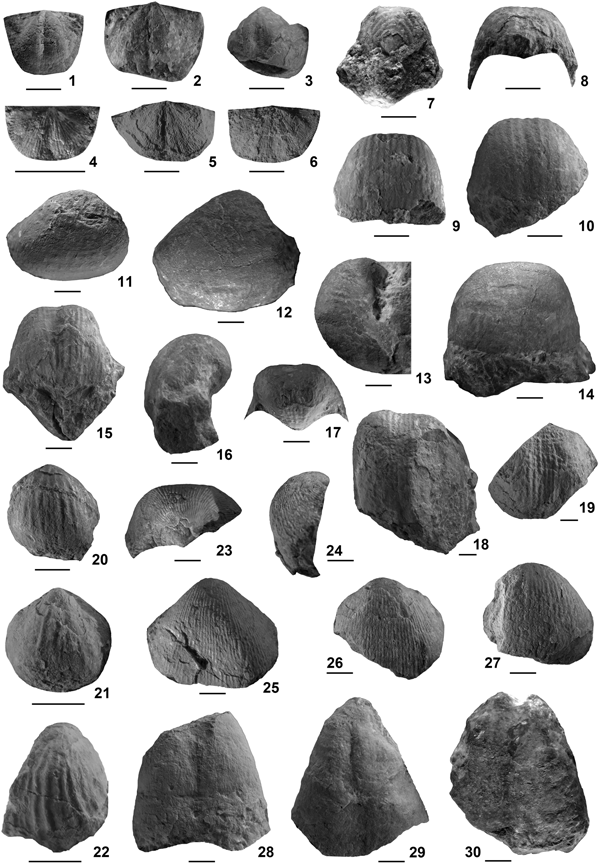
Chonetinella sp.
Figure 5.1–5.3
(1–3) Chonetinella sp., ventral views of ventral valves: (1) NIGP 169358; (2) NIGP 169359; (3) NIGP 169360. (4) Neochonetes (Nongtaia) sp., ventral view of a ventral valve, NIGP 169361. (5, 6) Tenuichonetes tenuilirata (Chao, Reference Chao1928), ventral views of ventral valves: (5) NIGP 169362; (6) NIGP 169363. (7–17) Spinomarginifera chengyaoyenensis Huang, Reference Huang1932, ventral valves: (7) posterior view, NIGP 169367; (8, 9) posterior (8) and anteroventral (9) views, NIGP 169368; (10) anteroventral view, NIGP 169369; (11) ventral view, NIGP 169370; (12–14) ventral (12), lateral (13), and anteroventral (14) views, NIGP 169371; (15–17) anteroventral (15), lateral (16), and posterior (17) views, NIGP 169372. (18, 19) Tyloplecta yangtzeensis (Chao, Reference Chao1927), anteroventral (18) and posteroventral (19) views of an incomplete ventral valve, NIGP 169373. (20–22) Haydenella wenganensis (Huang, Reference Huang1932), ventral views of ventral valves: (20) NIGP 169364; (21) NIGP 169365; (22) NIGP 169366. (23–27) Linoproductus cora (d’Orbigny, Reference d'Orbigny1842), ventral valves: (23–25) posterior (23), lateral (24), and ventral (25) views, NIGP 169374; (26) ventral view, NIGP 169375; (27) ventral view, NIGP 169376. (28–30) ?Derbyella sp., ventral views of incomplete ventral valves: (28) NIGP 169377; (29) NIGP 169378; (30) NIGP 169379. Scale bars = 5 mm.

Occurrence
Nos. 1 – 3 and 6 of Bed 4 of the Xiala Formation at Tsochen, central Tibet, China.
Description
Shell medium to large for genus, 11.5–14.2 mm wide, 9.3–11.5 mm long, subquadrate in outline, widest at hinge; cardinal extremities slightly obtuse. Ventral valve strongly convex; beak short, pointed; umbonal region swollen, slightly extended posterior to hinge; flank slopes relatively steep; visceral area triangular, very prominent; ears small; sulcus narrow, originating from beak, moderately deep, slightly widening near anterior margin; costellae very fine, delicate, ~ 20 per 5 mm at anterior margin; growth lines faint anteriorly.
Materials
Seven ventral valves. Registered specimens: three ventral valves (NIGP 169358 – 169360).
Remarks
These specimens are assigned to Chonetinella because of their bilobate sculpture with a deep median sulcus and costellate ornamentation. They differ from C. shuiquangouensis Fan and He, Reference Fan and He1999 (p. 109, pl. 8, figs. 30–33) only by their much larger size; from C. ciboloensis Cooper and Grant, Reference Cooper and Grant1975 (p. 1272, pl. 500, figs. 41–49) by their larger size and less extended umbonal region; and from C. cymatilis (see Grant, Reference Grant1976, p. 77, pl. 16, figs. 1–58) by their less transverse outline and narrower sulcus. To conclude, these specimens are best referred to a new species of this genus based on the diagnostic features of medium to large size, highly convex ventral valves, and deep linear sulcus if the dorsal valve and internal features are available. However, more materials are necessary to designate this species.
Genus Neochonetes Muri-Wood, Reference Muir-Wood1962
Subgenus Nongtaia Archbold, Reference Archbold1999
Type species
Neochonetes (Nongtaia) taoni Archbold, Reference Archbold1999 from the Guadalupian of Thailand.
Remarks
This subgenus is very close to subgenus Huangichonetes Shen and Archbold, Reference Shen and Archbold2001 in its small size and distinct sulcus but differs in its relatively coarse, less numerous costellae that normally bifurcate at the anterior margin (Archbold, Reference Archbold1999; Verna et al., Reference Verna, Angiolini, Baud, Crasquin and Nicora2011; Crippa and Angiolini, Reference Crippa and Angiolini2012).
Neochonetes (Nongtaia) sp.
Figure 5.4
Occurrence
No. 1 of Bed 4 of the Xiala Formation at Tsochen. central Tibet, China.
Description
Shell small, 4.7 mm long, 6.5 mm wide, subquadrate in outline, widest at hinge; cardinal extremities subquadrate; ears distinct, flat, well demarcated from visceral disc. Ventral valve moderately convex in lateral profile; sulcus originating near umbo, widening and deepening anteriorly; costellae coarse, increasing in number by bifurcation anteriorly; growth line faintly preserved at left part of anterior margin; spines not observed.
Materials
A ventral valve (NIGP 169361).
Remarks
This species mainly differs from Neochonetes (Nongtaia) arabicus (Hudson and Sudbury, Reference Hudson and Sudbury1959, p. 26, pl. 3, figs. 6 – 16, pl. 6, figs. 14 – 18) and Neochonetes (Nongtaia) asseretoi Fantini Sestini, Reference Fantini Sestini1964 (p. 899, figs. 1, 2) by its less convex ventral valve and relatively coarser costellae. The present specimen closely approaches Neochonetes (Nongtaia) taoni (see Archbold, Reference Archbold1999, p. 76, fig. 3A–O) in its narrow, deep sulcus and coarse costellae, but it is difficult to refer it to the latter species owing to the lack of a dorsal valve and internal features of the ventral valve.
Genus Tenuichonetes Jin and Hu, Reference Jin and Hu1978
Type species
Chonetes tenuilirata Chao, Reference Chao1928 from the Guadalupian of South China.
Remarks
Tenuichonetes shares a similar outline with Mesolobus Dunbar and Condra, Reference Dunbar and Condra1932, but differs in its much weaker or absent median fold on the ventral sulcus and its longer ventral median septum. Neochonetes (Neochonetes) resembles the present genus in size, outline, and fine costellae, but is distinguished by the low convexity of the ventral valve, low or absent sulcus, and shorter ventral median septum (Angiolini, Reference Angiolini1995).
Tenuichonetes tenuilirata (Chao, Reference Chao1928)
Figure 5.5, 5.6
- Reference Chao1928
Chonetes tenuilirata Chao, p. 26, pl. 3, figs. 1–5.
- Reference Jin and Hu1978
Tenuichonetes tenuilirata; Jin and Hu, p. 110, pl. 1, figs. 23–27.
- Reference Wang, Liu, Jin, Hu, Liang and Liao1982
Tenuichonetes tenuilirata; Wang et al., p. 199, pl. 86, figs. 5–8, pl. 90, figs. 11, 12.
- Reference Zhu1990
Tenuichonetes tenuilirata; Zhu, p. 65, pl. 10, figs. 2, 4–7.
- Reference Liang1990
Neochonetes latisinuata millecostata Liang, p. 137, pl. 16, figs. 1–5.
- Reference Liao, Li, He, Li, Chen and He1997
Tenuichonetes tenuilirata; Liao et al., p. 73, pl. 2, figs. 10–19, 23, 24.
Type material
NIGP 1151/709 and 1152/712 (Chonetes tenuilirata, syntypes) from the Lyttonia shale, Guichi, Anhui, China (Chao, Reference Chao1928, pl. 3, figs. 1, 2).
Occurrence
No.1 of Bed 4 of the Xiala Formation at Tsochen, central Tibet, China; and a number of formations of Guadalupian age at Anhui, Fujian, Zhejiang, and Hong Kong, China.
Description
Shell 7.6–8.6 mm long, 12.5–12.7 mm wide, reverse trapezoidal in outline, widest at hinge; cardinal extremities slightly acute; ears flat, well demarcated from visceral disc. Ventral valve moderately and evenly convex in profile; beak low, broad; sulcus arising from umbo, normally narrow, distinct; costellae delicate, fine, increasing by bifurcation and intercalation, 9 or 10 per 2 mm, > 40 near anterior margin; some spine-apertures arranged near anterior margin; cardinal spines not observed.
Materials
Two ventral valves (NIGP 169362, 169363).
Remarks
The present specimens are probably conspecific with Tenuichonetes tenuilirata based on size, outline, and external ornamentation of very fine costellae, no plication in the sulcus, and spine-apertures anteriorly. Although the diagnostic characters of Tenuichonetes (e.g., typically long ventral medium septum) were not observed, its fine costellation characterizes this species very well. In addition, there are very few chonetid species comparable with this species in view of its fine costellation during the Changhsingian. Tenuichonetes tenuilirata mainly differs from Tenuichonetes plicatiformis (Li in Zhan and Li, Reference Zhan and Li1962) in its smaller size and no median fold in the ventral sulcus (Jin and Hu, Reference Jin and Hu1978).
Family Productellidae Schuchert, Reference Schuchert and Pompeckj1929
Genus Haydenella Reed, Reference Reed1944
Type species
Productus kiangsiensis Kayser, Reference Kayser and von Richthofen1883 from the Lopingian of South China.
Remarks
Haydenella is close to Ogbinia Sarytcheva in Sarytcheva and Sokolskaya, Reference Sarytcheva, Sokolskaya, Ruzhentsev and Sarytcheva1965 based on size, low and coarse costae, and rugae on the ears, but differs in its normally less elongate outline and trifid cardinal process, whereas Ogbinia has a unified cardinal process.
Haydenella wenganensis (Huang, Reference Huang1932)
Figure 5.20–5.22
- Reference Huang1932
Linoproductus kiangsiensis var. wenganensis Huang, p. 49, pl. 3, figs. 16–18.
- Reference Zhan, Hou, Zhan and Chen1979
Haydenella kiangsiensis wenganensis; Zhan, p. 81, pl. 5, figs. 1, 2.
- Reference Liao1980a
Haydenella wenganensis; Liao, pl. 6, figs. 32, 33.
- Reference Zeng, He and Zhu1995
Haydenella wenganensis; Zeng et al., pl. 5, fig. 5.
- Reference Tazawa2008
Haydenella sp.; Tazawa, p. 24, fig. 3.20.
- Reference Tazawa, Kaneko, Suzuki and Hasegawa2015
Haydenella wenganensis; Tazawa et al., p. 39, fig. 5.3, 5.4.
Holotype
NIGP 4564 (Linoproductus kiangsiensis var. wenganensis) from Wengan, Guizhou, China (Huang, Reference Huang1932, pl. 3, fig. 16).
Occurrence
Nos. 1 and 3 of Bed 4 of the Xiala Formation at Tsochen, central Tibet, China; Changhsing Formation of Guizhou, Sichuan, and Guangdong, China; and lower Takakurayama Formation (Wuchiapingian) at Abukuma Mountains, northeastern Japan.
Description
Shell small for genus, 10.5–13.6 mm long, 9.2–13 mm wide, subelliptical in outline; greatest width at hinge; ears small, not well preserved. Ventral valve moderately and evenly convex in lateral profile, maximum convexity posterior to shell midlength; slightly geniculated with short trail; beak narrow, pointed, scarcely projecting over hinge; umbonal region slightly inflated; umbonal and lateral slopes inclined steeply; sulcus absent; costae low, rather coarse, round, separated by tolerably deep grooves, 5 or 6 per 5 mm, but insignificant on umbonal region; concentric rugae distinct on ears, nearly parallel to hinge.
Materials
Three ventral valves (NIGP 169364 – 169366).
Remarks
Haydenella wenganensis was once regarded as a synonym of H. kiangsiensis because these two species were commonly discovered from the Lopingian in South China and the former is probably defined based on some immature specimens (Shen and Clapham, Reference Shen and Clapham2009). However, this species can differ from H. kiangsiensis in its more distinct and stronger costae and less convex ventral valve in addition to its relatively smaller size. This species is similar to H. minuta in shell surface ornamentation but is larger and has a relatively inflated umbonal region.
Genus Spinomarginifera Huang, Reference Huang1932
Type species
Spinomarginifera kueichowensis Huang, Reference Huang1932 from the Changhsingian of South China.
Remarks
Spinomarginifera is similar to Marginifera Waagen, Reference Waagen1884 in its subquadrate outline, numerous spines on the ventral valve, wide and low costae on the trail, and a prominent marginal ridge, but the former has weak costae and irregular rugae on the umbo, whereas the latter has stronger costae and reticulated ornamentation (He et al., Reference He, Shi, Bu and Niu2008). This genus is distinguished from Costispinifera Muri-Wood and Cooper, Reference Muir-Wood and Cooper1960 in its distinct marginal ridge and coarser costae on the trail (Liao, Reference Liao1980a).
Spinomarginifera chengyaoyenensis Huang, Reference Huang1932
Figure 5.7 – 5.17
- Reference Huang1932
Spinomarginifera chengyaoyenensis Huang, p. 63, pl. 5, figs. 18, 19.
- Reference Wang, Jin and Fang1964
Spinomarginifera chengyaoyenensis; Wang et al., p. 314, pl. 50, figs. 12, 13.
- Reference Zhan, Hou, Zhan and Chen1979
Spinomarginifera chengyaoyenensis; Zhan, p. 81, pl. 13, fig. 12.
- Reference Liao1980a
Spinomarginifera chengyaoyenensis; Liao, pl. 5, figs. 27–32.
- Reference Liao1980b
Spinomarginifera chengyaoyenensis; Liao, pl. 2, figs. 12, 13.
- Reference Liao1987
Spinomarginifera chengyaoyenensis; Liao, pl. 5, figs. 3, 4.
- Reference Xu, Yang, Yin, Wu, Yang, Ding and Xu1987
Rugosomarginifera chengyaoyenensis; Xu, p. 224, pl. 11, figs. 9, 17, 18, pl. 13, figs. 1–4.
- Reference Shi and Shen1998
Spinomarginifera chengyaoyenensis; Shi and Shen, p. 509, fig. 4.8–4.10.
- Reference Liao and Xu2002
Spinomarginifera cf. chengyaoyenensis; Liao and Xu, pl. 1, fig. 25.
- Reference Chen, Kaiho, George and Tong2006
Spinomarginifera chengyaoyenensis; Chen et al., p. 315, fig. 8f–h.
Holotype
NIGP 4594 (Spinomarginifera chengyaoyenensis) from the Permian coal beds, Dading, Guizhou, China (Huang, Reference Huang1932, pl. 5, fig. 18).
Occurrence
Nos. 1–5 and 8 of Bed 4 of the Xiala Formation at Tsochen, central Tibet, China; Changhsing Formation of Guizhou, Guangxi, Sichuan, and Guangdong, China; lowest Feixianguan Formation (earliest Griesbachian) of Chongqing, China; and Yenduyet Formation of Son La, northwestern Vietnam.
Description
Shell small to medium sized; 12–23.8 mm long, 14–26 mm wide, oval in outline, concavoconvex in lateral profile, widest at hinge. Ventral valve strongly and evenly inflated, geniculate anteriorly; beak strongly enrolled, obviously over hinge line; umbonal region prominent, highly raised above hinge line; flanks steep; ears flattened; median sulcus almost absent or very narrow and shallow; prominent concentric rugae on umbonal region; costae low, wide on trail, ~ 5 per 5 mm; numerous elongate spines arranged in rows.
Materials
Thirty-four ventral valves. Registered specimens: six ventral valves (NIGP 169367 – 169372).
Remarks
The present specimens match well with the type materials described by Huang (Reference Huang1932) except for their relatively coarser costae. The present species most closely resembles Spinomarginifera lopingensis (Kayser, Reference Kayser and von Richthofen1883) from the Loping Series of Jiangxi Province, southeastern China, but the latter is larger, and has a wide umbo and stronger costation on the trail (Shi and Shen, Reference Shi and Shen1998). It is distinguished from Spinomarginifera pseudosintanensis Huang, Reference Huang1932 by its more strongly inflated ventral valve and finer costae; from Spinomarginifera kueichowensis by its smaller size, more strongly convex ventral valve, and stronger rugae covering the posterior region. In addition, some specimens of this species were once assigned to Rugosomarginifera Xu, Reference Xu, Yang, Yin, Wu, Yang, Ding and Xu1987, which features distinct concentric wrinkles, concentrically scattered spines, and a gently concavoconvex profile. However, all of these characters were thought to be specific variations within Spinomarginifera by Chen et al. (Reference Chen, Kaiho, George and Tong2006).
Family Productidae Gray, Reference Gray1840
Genus Tyloplecta Muri-Wood and Cooper, Reference Muir-Wood and Cooper1960
Type species
Productus scabriculus mut. nankingensis Frech, Reference Frech and von Richthofen1911 from the Cisuralian of China.
Remarks
Both Liraplecta Jin and Sun, Reference Jin and Sun1981 and Stereochia Grant, Reference Grant1976 are close to Tyloplecta in size, outline, and reticulate ornament. However, Tyloplecta sculpture includes much more distinct nodes on the intersections between rugae and costae and less delicate reticulation (Shen et al., Reference Shen, Jin, Zhang, Weldon, Rong, Jin, Shen and Zhan2017). Tyloplecta also differs from Costiferina Muir-Wood and Cooper, Reference Muir-Wood and Cooper1960 by its more regular and finer costae.
Tyloplecta yangtzeensis (Chao, Reference Chao1927)
Figure 5.18, 5.19
Holotype
NIGP 983 (Productus yangtzeensis) from the Lyttonia bed, Fengcheng, Jiangxi, China (Chao, Reference Chao1927, pl. 5, figs. 1, 2).
Occurrence
No. 1 of Bed 4 of the Xiala Formation at Tsochen, central Tibet, China; Guadalupian to Lopingian, South China; Transcaucasia, southeastern Europe; Thailand; Mongolia; western Serbia; northern Iran; and Salt Range, Pakistan.
Description
Shell medium sized, > 38 mm long, 31.5 mm wide, subquadrate in outline. Ventral valve strongly convex; flanks steep; beak not observed owing to poor preservation but umbonal region relatively flat; sulcus generally weak but clear on posterior portion, slightly shallowing on trail; costae relatively coarse, well developed, 3 or 4 per 5 mm, crossed by concentric rugae posterior to midvalve, forming clear reticulate ornaments on visceral region; spines with elongated bases, numerous on costae posteriorly; nodes obvious at the intersections between rugae and some elongated spine bases.
Materials
An incomplete ventral valve (NIGP 169373).
Remarks
This species can be safely assigned to Tyloplecta by the elongate spine bases posteriorly and distinct rugae posterolaterally. According to Crippa and Angiolini (Reference Crippa and Angiolini2012), diagnostic characters to distinguish Tyloplecta yangtzeensis from other species of Tyloplecta are mainly the length/width ratio, the shape of the umbo, and the ornamentation. Although this specimen is not completely preserved, we can judge that the length is greater than width based on the transverse curvature at the midvalve, which is the main difference from Tyloplecta persica Fantini Sestini and Glaus, Reference Fantini Sestini and Glaus1966 (length/width ratio < 1). Tyloplecta yangtzeensis differs from Tyloplecta nankingensis (Frech, Reference Frech and von Richthofen1911) from the Chishia Formation (Kungurian) in its less coarse costae and weak sulcus, which is almost absent in the latter species.
The synonymy of the present species is omitted because it is a commonly described species.
Family Linoproductidae Stehli, Reference Stehli1954
Genus Linoproductus Chao, Reference Chao1927
Type species
Productus cora d'Orbigny, Reference d'Orbigny1842 from the Cisuralian of Bolivia.
Linoproductus cora (d’Orbigny, Reference d'Orbigny1842)
Figure 5.23 – 5.27
Holotype
Specimen (Productus cora, registration number not available) from Patapatani, one of the islands in Lake Titicaca, Bolivia (d’Orbigny, Reference d'Orbigny1842, pl. 5, figs. 8 – 10).
Occurrence
Nos. 1 and 5 of the Bed 4 of the Xiala Formation at Tsochen, central Tibet, China; mainly restricted to the lower Permian globally, occasionally reported from the late Carboniferous to late Permian.
Description
Shell 22.3–24.7 mm wide, > 20 mm long, triangular in outline; ears scarcely preserved. Ventral valve moderately convex; beak pointed, slightly incurved over hinge line; sulcus absent or very shallow, broad anterior to umbonal region, forming weak pit near midvalve; costellae delicate, fine, increasing by bifurcation and intercalation, 8 or 9 per 5 mm; spines sparsely scattered on ventral valve.
Materials
Three ventral valves (NIGP 169374–169376).
Remarks
As a well-known species, the specific definition of Linoproductus cora has been broadened many times. The species was described and figured by d'Orbigny in Reference d'Orbigny1842, and Wang and Yang (Reference Wang and Yang1998) concluded that this species can be divided into two types according to the redescription by Kozlowski (Reference Kozlowski1914). One type of this species is characterized by a moderately sized shell, moderately convex ventral valve, wider anterior portion, slightly concave at shell midlength, and especially quincunxially arranged strong spines, which is almost consistent with the present specimens. The other type is larger, with a strongly convex ventral valve and much smaller spine bases. Linoproductus lineatus (Waagen, Reference Waagen1884) is comparable with the present species, but is normally represented by larger, more elongate shells, with more irregular costellae (Chen and Shi, Reference Chen and Shi2001).
The synonymy of the present species is omitted because it is a commonly described species.
Family Scacchinellidae Licharew, Reference Licharew1928
Genus Derbyella Grabau, Reference Grabau1931
Type species
Derbyella burei Grabau, Reference Grabau1931 from the lower Permian of Mongolia.
?Derbyella sp.
Figure 5.28 – 5.30
Occurrence
No. 1 of the Bed 4 of the Xiala Formation at Tsochen, central Tibet, China.
Materials
Three incomplete ventral valves (NIGP 169377–169379).
Remarks
These specimens could be assignable to Derbyella based on size, subconical ventral valves, a deep and narrow median sulcus separating the flanks, and the relatively high ventral interarea. However, the narrow pseudodeltidium on the interarea and the surface ornamentation (e.g., regular costellae, numerous growth lines, and spines) are not observed owing to the poor preservation. Thus, the generic attribution of this species remains questionable.
Occurrence
No. 3 of Bed 4 of the Xiala Formation at Tsochen, central Tibet, China.
(1–10) Dielasma truncatum Waagen, Reference Waagen1882, conjoined shells: (1–4) ventral (1), dorsal (2), lateral (3), and anterior (4) views, NIGP 169397; (5–7) ventral (5), dorsal (6), and lateral (7) views, NIGP 169398; (8–10) ventral (8), dorsal (9), and lateral (10) views, NIGP 169399. (11–15) Acosarina minuta (Abich, Reference Abich1878), ventral views of ventral valves: (11) NIGP 169382; (12) NIGP 169383; (13) NIGP 169384; (14) NIGP 169385; (15) NIGP 169386. (16–19) Araxathyris cf. dilatatus Shen, He, and Zhu, Reference Shen, He, Zhu and Gu1992, ventral (16), dorsal (17), lateral (18), and posterior (19) views of a conjoined shell, NIGP 169391. (20) Phricodothyris formilla (Xu and Grant, Reference Xu and Grant1994), dorsal view of a dorsal valve, NIGP 169392. (21–23) Stenoscisma sp.: (21) ventral view of a ventral valve, NIGP 169387; (22) dorsal view of a dorsal valve, NIGP 169388; (23) dorsal view of a dorsal valve, NIGP 169389. (24) Notothyris triplicata Diener, Reference Diener1897, dorsal view of a conjoined shell with the ventral valve mostly lost, NIGP 169396. (25, 26) Permophricodothyris sp., ventral views of ventral valves: (25) NIGP 169393; (26) NIGP 169394. (27–31) Paraspiriferina multiplicata (Sowerby, Reference Sowerby1829), lateral (27), ventral (28), dorsal (29), posterior (30), and anterior (31) views of a conjoined shell, NIGP 169395. (32, 33) Orthotetoidea indet., dorsal view of a dorsal valve (32) and ventral view of its external mold (33), NIGP 169381. (34) Juxathyris guizhouensis (Liao, Reference Liao1980a), ventral view of a ventral valve, NIGP 169390. Scale bars = 5 mm.

Description
Shell ~ 54 mm wide, 36 mm long, transversely rectangular in outline; hinge line straight, nearly equal to or slightly shorter than greatest width at approximate shell midlength; cardinal extremities nearly at right angles; sulcus absent. Dorsal valve gently convex in lateral profile, maximum convexity in umbonal and middle region; umbo swollen, broad, with gentle slopes to lateral margins; costellae very fine, rounded, worn at umbonal region, 16 or 17 per 10 mm at approximate shell midlength; concentric lines fine, regular, with interspaces of ~ 1.5 mm width; growth lamellae developed at shell margin.
Materials
A dorsal valve and its external mold (NIGP 169380, 169381).
Remarks
The described specimen can be assigned to the superfamily Orthotetoidea based on its large size, clear and dense costellae, and concentric wrinkles, but it is difficult to assign it to a family or genus owing to the lack of a ventral valve. This specimen is close to Derbyia in size, outline, and delicate and dense costellae, but interiors are not available.
Order Orthida Schuchert and Cooper, Reference Schuchert and Cooper1931
Family Schizophoriidae Schuchert and LeVene, Reference Schuchert and LeVene1929
Genus Acosarina Cooper and Grant, Reference Cooper and Grant1969
Type species
Acosarina dorsisulcata Cooper and Grant, Reference Cooper and Grant1969, p. 2, pl. 5, figs. 19–23 = Acosarina minuta (Abich, Reference Abich1878), from the Guadalupian (middle Permian) of western Texas, USA.
Remarks
Acosarina is distinguished from Schizophoria King, Reference King1850 and Orthotichia Hall and Clarke, Reference Hall and Clarke1892 by its long, low ventral median septum and its rectimarginate to sulcate commissure. Kotlaia Grant, Reference Grant1993 was considered a junior synonym of Acosarina by Shen and Shi (Reference Shen and Shi2007) based on similar tubular costellae and a very long median septum.
Acosarina minuta (Abich, Reference Abich1878)
Figure 6.11 – 6.15
Holotype
Specimen (Streptorhynchus peregrinus var. minutus, registration number not available) from Transcaucasus (Abich, Reference Abich1878, pl. 10, fig. 1a).
Occurrence
Nos. 1, 3, 4, and 5 of Bed 4 of the Xiala Formation at Tsochen, central Tibet, China; upper Carboniferous to lowest Triassic from China; Pakistan; western Texas, USA; Thailand; northern Iran; and Transcaucasia.
Description
Shell small to medium sized, subcircular in outline, subequally biconvex in profile; width slightly greater than length; maximum width at shell midlength; anterior margin gently rounded. Ventral valve gently convex in profile; beak small, suberect; umbonal region moderately inflated with median region flattened; lateral slopes gently inclined; surface ornamented with very fine, delicate costellae; costellae somewhat tubular, 3 or 4 per 1 mm; long median septum clearly impressed in ventral valve, nearly reaching anterior margin.
Materials
Five ventral valves (NIGP 169382–169386).
Remarks
According to Shen and Shi (Reference Shen and Shi2007), Acosarina minuta is a widely distributed species in the Permian and has great variation in external features including a subquadrate to subcircular outline and the dorsal sulcus absent to evident. Therefore, Orthis indica Waagen, Reference Waagen1884 and Acosarina dorisulcata, as well as some specimens of Acosarina dorashamensis (Sokolskaya, Reference Sokolskaya, Ruzhentsev and Sarytcheva1965), were reassigned to this species based on similar intraspecific features. Our ventral valves are comparable with Acosarina minuta in size, ventral external features, and its long ventral median septum, but the dorsal sulcus is not available for comparison.
The synonymy of the present species is omitted because it is a commonly described species.
Order Rhynchonellida Kuhn, Reference Kuhn1949
Family Stenoscismatidae Oehlert, Reference Oehlert and Fischer1887 (1883)
Genus Stenoscisma Conrad, Reference Conrad1839
Type species
Terebratula schlottheimi von Buch, Reference Buch1835 from the late Permian of Germany.
Stenoscisma sp.
Figure 6.21–6.23
Occurrence
Nos. 7 and 9 of Bed 4 of the Xiala Formation at Tsochen, central Tibet, China.
Materials
A ventral valve and two dorsal valves (NIGP 169387–169389).
Remarks
The described specimens are probably assigned to Stenoscisma based on their medium to large size, subtrigonal outline, more strongly convex dorsal valve, and distinct costae on both valves, although the stolidium and internal structures (e.g., spondylium and median septum) are not available. The specimens most resemble Stenoscisma camurum Cooper and Grant, Reference Cooper and Grant1976a in outline, size, strong convexity of the dorsal valve, and strong, simple costae, but differ in lacking the strongly hooked ventral beak that presses against the dorsal umbo.
Order Athyridida Boucot, Johnson, and Staton, Reference Boucot, Johnson and Staton1964
Family Athyrididae Davidson, Reference Davidson1881
Genus Juxathyris Liang, Reference Liang1990
Type species
Juxathyris apionucula Liang, Reference Liang1990 from the Cunhouling Member of the Lengwu Formation (Capitanian), Tonglu, Zhejiang Province, South China.
Remarks
Juxathyris was once regarded as a synonym of Spirigerella Waagen, Reference Waagen1883, but the latter can be readily distinguished by its strong cardinal flanges and the dental plates deeply buried in secondary shell material, whereas the former has inner socket ridges superseded by large, high coronal processes (Alvarez and Rong, Reference Alvarez, Rong and Kaesler2002). In addition, some species of Juxathyris in the upper Permian of South China were previously assigned to Araxathyris Grunt, Reference Grunt, Ruzhencev and Sarycheva1965. Xu and Grant (Reference Xu and Grant1994) emphasized that species of Araxathyris always have an obvious median groove on the fold of the dorsal valve; Liang (Reference Liang1990) suggested that the median groove is normally developed on the dorsal valve without a fold in Juxathyris. Moreover, dental plates of Juxathyris converge at an angle of > 90°, whereas those of Araxathyris converge at an acute angle (Shen et al., Reference Shen, Grunt and Jin2004).
Juxathyris guizhouensis (Liao, Reference Liao1980a)
Figure 6.34
- Reference Liao1980a
Araxathyris guizhouensis Liao, p. 268, pl. 9, figs. 1–4.
- Reference Liao1980b
Janiceps janiceps (Stache, Reference Stache1883); Liao, pl. 9, figs. 10–13.
- Reference Shen and Shi2004
Juxathyris guizhouensis; Shen et al., p. 896, figs. 8.11–8.23, 13.
- Reference Shen and Zhang2008
Juxathyris guizhouensis; Shen and Zhang, fig. 6.9–6.14.
- Reference Shen and Clapham2009
Juxathyris guizhouensis; Shen and Clapham, p. 725, pl. 4, figs. 1–7.
Holotype
NIGP 43785 (Araxathyris guizhouensis) from the Lungtan Formation, Anshun, Guizhou, China (Liao, Reference Liao1980a, pl. 9, figs. 1–4).
Occurrence
No. 6 of Bed 4 of the Xiala Formation at Tsochen, central Tibet, China; a number of formations of Wuchiapingian or Changhsingian age at western Guizhou, southern Hunan, China; and Episkopi Formation of Hydra Island, Greece.
Description
Shell 13.2 mm wide, 15.4 mm long, subpentagonal in outline, moderately subequally biconvex in lateral profile; greatest width anterior to shell midlength; anterior commissure parasulcate. Ventral valve moderately convex; posterolateral sides nearly straight, convergent posteriorly at ~ 80°; beak strongly incurved; umbonal region slightly inflated; greatest convexity anterior to umbonal region; sulcus relatively shallow, developed on anterior part, anteriorly forming tongue-like edge toward dorsal valve; shell surface smooth.
Materials
A ventral valve (NIGP 169390).
Remarks
As discussed above, Juxathyris is mainly distinguished from Araxathyris by a more widely rounded spondylium (Shen et al., Reference Shen, Grunt and Jin2004). Therefore, it is difficult to determine generic assignment according to the external characters of this ventral valve. However, the ventral valve is consistent with J. guizhouensis especially in its elongate outline, parasulcate anterior commissure, and ventral sulcus developing anteriorly. Other species, e.g., Araxathyris sinensis (Shen, Grunt, and Yin, Reference Shen, Grunt and Jin2004) and J. zhijinensis (Liao, Reference Liao1980a), are also similar to this specimen, but Araxathyris sinensis differs in its sulcus originating from the beak and J. zhijinensis is distinguished by its larger size and less convexity. Overall, this specimen is probably assigned to J. guizhouensis although its dorsal valve and internal features are unknown.
Genus Araxathyris Grunt, Reference Grunt, Ruzhencev and Sarycheva1965
Type species
Spirigera protea Abich, Reference Abich1878 from the Lopingian of Transcaucasia.
Araxathyris cf. dilatatus Shen, He, and Zhu, Reference Shen, He, Zhu and Gu1992
Figure 6.16–6.19
Occurrence
No. 6 of Bed 4 of the Xiala Formation at Tsochen, central Tibet, China; Changhsing Formation (Changhsingian), South China.
Description
Shell 17 mm long, 13 mm wide, 13.5 mm thick; outline subcircular; strongly biconvex and spherical in lateral profile; greatest width at approximate shell midlength; apical angle ~ 90°; anterior commissure not observed owing to poor preservation. Ventral valve very strongly convex; beak blunt, strongly incurved, not completely preserved; sulcus very shallow, beginning anterior to umbonal region, width and depth almost remaining unchanged anteriorly. Dorsal valve not well preserved, less strongly convex than ventral valve; beak broad, blunt, moderately incurved; fold weakly developed or absent, median groove not observed. Surface smooth on both valves except for faint growth lines near anterior margin on ventral valve. Internal features not available.
Materials
A conjoined shell (NIGP 169391).
Remarks
The present specimen is almost identical with Araxathyris dilatatus in its size, outline, umbonal angle, nature of beaks, and especially its spherical profile. However, the characteristic parasulcate anterior commissure is not preserved in the present specimen. Moreover, the nature of the sulcus and fold slightly differs from those of Araxathyris dilatatus, which has the sulcus widening and deepening anteriorly and the fold bounded by two shallow troughs with a median groove.
Order Spiriferida Waagen, Reference Waagen1883
Family Elythidae Frederiks, Reference Fredericks1924
Genus Phricodothyris George, Reference George1932
Type species
Phricodothyris lucerna George, Reference George1932 from the lower Carboniferous of Britain.
Remarks
Phricodothyris most closely resembles Squamularia Gemmellaro, Reference Gemmellaro1899 and Permophricodothyris Pavlova, Reference Pavlova1965 in outline and external ornamentation. However, it mainly differs from Squamularia in its normally smaller size, relatively elliptical outline, less distinct growth lamellae, and the presence of a delthyrial ridge (Shi et al., Reference Shi, Chen and Han2002); from Permophricodothyris it differs mainly in the direction of the spiralia (Carter et al., Reference Carter, Johnson, Gourvennec, Hou and Kaesler2006).
Phricodothyris formilla (Xu and Grant, Reference Xu and Grant1994)
Figure 6.20
- Reference Xu and Grant1994
Squamularia formilla Xu and Grant, Reference Xu and Grant1994, p. 58, fig. 48.1–48.24, 48.26, 48.27.
- Reference Angiolini and Carabelli2010
Squamularia formilla; Angiolini and Carabelli, p. 81, pl. 5, figs. 20–23
Type material
USNM 456191–456195 (Squamularia formilla, syntypes) from the Lungtan Formation and Changhsing formations of South China (Xu and Grant, Reference Xu and Grant1994, fig. 48.1–48.24, 48.26, 48.27).
Occurrence
No. 11 of Bed 4 of the Xiala Formation at Tsochen, central Tibet, China; Lungtan and Changhsing formations of South China; and Nesen Formation (Wuchiapingian–Changhsingian) at the Abrendan section in Iran.
Description
Shell small for genus, subcircular in outline; greatest width slightly posterior to shell midlength. Dorsal valve 13.3 mm long, 15.4 mm wide, moderately and evenly convex; umbo suberect, very short, broad; growth lamellae well developed, regularly arranged but relatively weak, > 10 per 5 mm; biramous spines not observed.
Materials
A dorsal valve (NIGP 169392).
Remarks
This specimen is almost identical with Squamularia formilla described by Xu and Grant (Reference Xu and Grant1994) and Angiolini and Carabelli (Reference Angiolini and Carabelli2010) from the Lopingian of South China and Iran in size, outline, and dense growth lamellae. Therefore, it is assigned to this species although only a dorsal valve is available. Notably, the present specimen and those assigned to Squamularia formilla previously by Xu and Grant (Reference Xu and Grant1994) are better re-assigned to the genus Phricodothyris based on their small size, relatively rounded outline, and less distinct concentric ornaments. However, the characters of spiralia in the specimens described by Xu and Grant (Reference Xu and Grant1994) are unknown so far. Thus, its generic assignment remains open.
Genus Permophricodothyris Pavlova, Reference Pavlova1965
Type species
Permophricodothyris ovata Pavlova, Reference Pavlova1965 from the Lopingian of Caucasus.
Remarks
Permophricodothyris as named by Pavlova (Reference Pavlova1965) differs from other genera of reticularioid brachiopods by its posterolaterally directed spiralia with numerous whorls, double spine bases, long and lyrate crura, and the absence of dental plates, adminicular, and septum. Shi et al. (Reference Shi, Chen and Han2002) supplemented other morphological features for the genus, including a knoblike cardinal process, strong socket ridges, and developed muscle scars, according to abundant Guadalupian and Lopingian materials from South China. Moreover, the majority of species in this genus are restricted to the Lopingian and finally became extinct near the Permian-Triassic boundary according to Shi et al. (Reference Shi, Chen and Han2002).
Permophricodothyris sp.
Figure 6.25, 6.26
- Reference Zhan and Wu1982
Phricodothyris sp.; Zhan and Wu, pl. 4, fig. 24.
Occurrence
No. 3 of Bed 4 of the Xiala Formation at Tsochen and the Xiala Formation (Capitanian) at Xainza, central Tibet, China.
Materials
Two ventral valves (NIGP 169393, 169394).
Remarks
This species is referred to Permophricodothyris according to its relatively large size, elongate outline that probably indicates the presence of posterolaterally directed spiralia, and prominent concentric lamellose ornamentation. A ventral valve of Phricodothyris sp. (Zhan and Wu, Reference Zhan and Wu1982, pl. 4, fig. 24) reported from the Xiala Formation at Xainza is probably assignable to the present species. The present specimens are closely similar to Permophricodothyris squamularioides (Huang, Reference Huang1933), but differs in the absence of a ventral sulcus and having much sparser growth lamellae.
Order Spiriferinida Ivanova, Reference Ivanova1972
Family Paraspiriferinidae Cooper and Grant, Reference Cooper and Grant1976b
Genus Paraspiriferina Reed, Reference Reed1944
Type species
Spiriferina (Paraspiriferina) ghundiensis Reed, Reference Reed1944 from the Kalabagh Member of the Wargal Formation, Ghundi, Salt Range of Pakistan.
Remarks
Paraspiriferina most closely resembles Punctospirifer North, Reference North1920 especially in the pattern of plications, with the rather large fastigium and numerous smaller lateral plications, but differs in its somewhat smaller size, greater convexity, rounded cardinal extremities, and small triangular interarea. Spiriferellina Fredericks, Reference Fredericks1924 is distinguished from Paraspiriferina by its fewer and more angular plications, higher and shallower fastigium with a flattened crest, deeper sulcus with a flattened floor, and more transverse outline. Crenispirifer Stehli, Reference Stehli1954 is also similar to the present genus except for its fewer and high-angular plications.
Paraspiriferina multiplicata (Sowerby, Reference Sowerby1829)
Figure 6.27 – 6.31
- Reference Sowerby1829
Spirifer multiplicatus Sowerby, p. 119.
- Reference Sedgwick1829
Spirifer multiplicatus; Sedgwick, p. 119.
- Reference Davidson1862
Spiriferina octoplicata (Sowerby, Reference Sowerby1829); Davidson, pl. 1, fig. 11 (non figs. 12–14).
- Reference Waagen1883
Spiriferina multiplicata; Waagen, p. 502, pl. 49, figs. 8, 9.
- Reference Gemmellaro1899
Spiriferina margaritae; Gemmellaro, p. 154, pl. 30, figs. 9–23.
- Reference Reed1925
Spiriferina multiplicata; Reed, p. 94, pl. 6, fig. 12.
- Reference Huang1933
Spiriferina multiplicata; Huang, p. 57, pl. 9, figs. 4, 5.
- Reference Liao1980a
Punctospirifer multiplicatus; Liao, pl. 3, fig. 19.
- Reference Liao1987
Punctospirifer multiplicatus; Liao, pl. 6, figs. 1, 2.
- Reference Shen, He, Zhu and Gu1992
Paraspiriferina multiplicata; Shen et al., pl. 4, figs. 33–36.
- Reference Shen and Zhang2008
Paraspiriferina multiplicata; Shen and Zhang, fig. 6.3.
- Reference Shen and Clapham2009
Paraspiriferina multiplicata; Shen and Clapham, p. 735, pl. 6, figs. 22–25, pl. 7, figs. 1–4.
Holotype
Specimen (Spirifer multiplicatus, registration number and plate not available) from the Compact Limestone, Midderidge, Humbleton and Tunstal Hill, Britain (Sedgwick, Reference Sedgwick1829, p. 119; Sowerby, Reference Sowerby1829, p. 119).
Occurrence
No. 8 of Bed 4 of the Xiala Formation at Tsochen in central Tibet, China; Changhsing Formation at Dapaichong, Hunan Province, China; lower part of the Heshan Formation at Heshan, Guangxi Province, China; upper Permian in Hechuan, Sichuan Province, South China; topmost part of the Wargal Formation and Chhidru Formation (Wuchiapingian to Changhsingian) at Salt Range, Pakistan; and Episkopi Formation (Wuchiapingian) at Episkopi, Hydra Island, Greece.
Description
Shell 14 mm wide, 12 mm long, 11 mm thick; outline transversely subelliptical; strongly biconvex in lateral profile; widest at hinge; cardinal extremities obtusely rounded. Ventral valve strongly convex; beak not well preserved, narrow, probably incurved; interarea concave, triangular; sulcus beginning at beak, rapidly deepening and widening anteriorly, with broadly V-shaped floor; plications simple, relatively low, with blunt crests; width of plications narrowing laterally; each flank with five plications and very low plication developed in middle of sulcus. Dorsal valve also strongly convex; beak pointed, slightly incurved; interarea low; fastigium obviously elevated; feature of plications similar to that on ventral valves, each flank with four plications and a weak plication on fastigium.
Materials
A conjoined shell (NIGP 169395).
Remarks
The present specimen can be compared well with those from the Hydra Island of Greece (Shen and Clapham, Reference Shen and Clapham2009) in size, lateral profile, and especially the presence of a low plication developed on the flattened floor of the sulcus. Our specimen differs slightly from common specimens of this species in its less transverse outline, fewer plications on each flank, and the relatively lower fastigium on the dorsal valve.
Order Terebratulida Waagen, Reference Waagen1883
Family Notothyrididae Licharew, Reference Licharew and Sarycheva1960
Genus Notothyris Waagen, Reference Waagen1882
Type species
Terebratula subvesicularis Davidson, Reference Davidson1862 from the upper Productus Limestone of Salt Range, Pakistan.
Remarks
This genus is close to Hemiptychina Waagen, Reference Waagen1882 in size, outline, convexity, and other external features except for the normally stronger convexity of the ventral valve and its longer and stronger plication. These two genera each lack dental plates in the ventral valve, but differ in the dorsal interior (Liao, Reference Liao1987), especially in the nature of the hinge plates and loop. In Notothyris, the hinge plates are apically perforate and the loop is nearly rounded, whereas in Hemiptychina, the hinge plates are posteriorly conjunct and the loop features a transverse band that is gently bent to V-shaped.
Notothyris triplicata Diener, Reference Diener1897
Figure 6.24
- Reference Diener1897
Notothyris triplicata Diener, p. 78, pl. 13, figs. 1, 2.
- Reference Diener1903
Notothyris triplicata; Diener, p. 37, pl. 2, figs. 11, 12.
- Reference Hamlet1928
Notothyris triplicata; Hamlet, p. 70, pl. 10, fig. 22.
- Reference Jin, Ye, Xu and Sun1979
Hemiptychina triplicata; Jin et al., p. 125, pl. 35, figs. 1–4.
- Reference Jin and Sun1981
Hemiptychina triplicata; Jin and Sun, pl. 12, figs. 5–8.
Type material
Specimens (Notothyris triplicata, registration numbers not available) from the Chitichun Limestone, Purang, Tibet, China (Diener, Reference Diener1897, pl. 13, figs. 1, 2).
Occurrence
No. 8 of Bed 4 of the Xiala Formation at Tsochen, central Tibet, China; Gaqoi Limestone (Wordian) at Zhongba, Tibet, China; Chitichun Limestone (Wuchiapingian) in Tibet; Kaixinling Formation (late Wuchiapingian) at Germu, Qinghai, China; Changhsingian Formation in Chongqing and Guizhou, China; and Basleo beds (Capitanian or Wuchiapingian) of West Timor.
Description
Shell 17.2 mm long, 11.4 mm wide, elongate in outline; lateral sides well rounded; anterior commissure rectimarginate. Ventral valve strongly convex; beak relatively thick, wide, slightly incurved; small foramen below apex; two strong lateral plicae developed; other features not available. Dorsal valve rather flat to slightly inflated; beak low, broad; anterior margin slightly truncated; four relatively strong plicae developed at anterior part, at approximately one-quarter of shell length; two outer plicae rather strong, separating anterior portion from the lateral parts; two indistinct plicae present on lateral sides.
Materials
Conjoined shell with ventral valve mostly lost (NIGP 169396).
Remarks
Notothyris triplicata was once re-assigned to the genus Hemiptychina by Jin et al. (Reference Jin, Ye, Xu and Sun1979) probably because of the posteriorly conjunct hinge plates in the dorsal interior according to their description, but without relevant illustrations. However, judging from the section of Notothyris triplicata (see Diener, Reference Diener1903, pl. 2, fig. 12), it is clear that the loop of this species is nearly rounded without the typical transverse band of Hemiptychina. Therefore, this species is undoubtedly allied to Notothyris. Diener (Reference Diener1897) remarked that this species can be easily distinguished from all other congeneric elements by its triplicate sculpture on the ventral valve. In addition, the quadruplicate pattern on the dorsal valve is unique in this genus through detailed comparison. Therefore, the present specimen can be safely assigned to Notothyris triplicata although the triplicate ornamentation on the ventral valve is not observable.
Family Dielasmatidae Schuchert, Reference Schuchert and von Zittel1913
Genus Dielasma King, Reference King1859
Type species
Terebratulites elongatus von Schlotheim, Reference Schlotheim1816 from the upper Permian, Pössneck, Thuringia, Germany.
Dielasma truncatum Waagen, Reference Waagen1882
Figure 6.1–6.10
- Reference Waagen1882
Dielasma truncatum Waagen, p. 345, pl. 25, figs. 11, 13.
- Reference Chernyschev1902
Dielasma truncatum; Chernyschev, p. 456, pl. 1, fig. 1.
- Reference Hamlet1928
Dielasma truncatum; Hamlet, p. 65, pl. 10, fig. 9.
Type material
Specimens (Dielasma truncatum, registration numbers not available) from the lower member of Productus Limestone, Salt Range, Pakistan (Waagen, Reference Waagen1882, pl. 25, figs. 11, 13).
Occurrence
No. 8 of Bed 4 of the Xiala Formation at Tsochen, central Tibet, China; Schwagerina Limestone (Sakmarian) of the southern Urals; lower member of the Productus Limestone (Wordian) of Salt Range, Pakistan; and Basleo beds (Capitanian or Wuchiapingian) of West Timor.
Description
Shell small for genus, 6.5–10.6 mm long, 6.5–6.9 mm wide, 3.5–5 mm thick, elongate to subpentagonal in outline, biconvex in profile, but uneven longitudinally; greatest convexity at umbonal region; maximum width anterior to shell midlength; anterior commissure rectimarginate. Ventral valve more strongly convex than dorsal valve; ventral beak moderately bent over; foramen very distinct. Dorsal valve slightly convex; beak suberect. Shell surface very smooth probably owing to silicification; sulcus and fold absent.
Materials
Three conjoined shells (NIGP 169397–169399).
Remarks
The present specimens are generally consistent with the juvenile type of Dielasma truncatum in size, outline, and the greatly inflated beak. These specimens can be also compared with Dielasma minor Waagen, Reference Waagen1882 in size, but differ in their longer, narrower form and smaller apical angle. Dielasma elongata shares a similar outline with this species but can be distinguished by its much larger size and a shallow sulcus on the ventral valve.
Acknowledgments
We thank two anonymous reviewers and journal editors J.S. Jin and R.B. Zhan for providing very helpful comments to improve the manuscript; J.J. Tang for photographing. This work was supported by the Second Tibetan Plateau Scientific Expedition and Research (2019QZKK0706), Strategic Priority Research Program (B) of the Chinese Academy of Sciences (XDB26000000, XDB18000000), National Science Foundation of China (91855205, 41472009), and Youth Innovation Promotion Association CAS for ZYC (2016282).