Introduction
Rabbit semen has been successfully stored in liquid state only for short periods of time without serious loss of its fertilizing ability (Roca et al., Reference Roca, Martínez, Vázquez, Lucas, Parrilla and Martínez2000; Mocé & Vicente, Reference Mocé and Vicente2009). On the other hand, freezing arrests the metabolic process of the spermatozoa, allowing indefinite storage without a devastating loss of fertilizing ability. However, during cryopreservation, sperm cells are exposed to stress which decreases the sperm quality and is responsible for a diminished fertility when frozen semen is used for artificial insemination (AI) (Mocé & Vicente, Reference Mocé and Vicente2009; Mocé et al., Reference Mocé, Lavara and Vicente2010). There are different variables that influence successful semen freezing such as the medium, the cryoprotective agent (CPA) used and its concentration, the packaging system or the freezing and thawing system. Among the various factors, the choice of the CPA plays a role of primary importance. CPAs minimize the physical and chemical stress of cooling, freezing, and thawing of sperm cells. Although glycerol remains as the optimum permeable CPA for sperm from most other species, it is not the CPA of choice for rabbit sperm (Mocé & Vicente, Reference Mocé and Vicente2009). Unlike sperm from other species, rabbit sperm plasma membrane presents a high cholesterol:phospholipid ratio. This ratio is of some importance in determining the nature and degree of packing in the spermatozoa membrane (Darin-Bennett & White, Reference Darin-Bennett and White1997). Hence, the rabbit spermatozoa plasma membrane has a relatively low water permeability and a high activation energy (Curry et al., Reference Curry, Redding and Watson1995). A low water permeability value is consistent with the need to use a penetrating CPA of lower molecular weight and higher permeability (such as dimethylsulfoxide (DMSO) or amides) for rabbit sperm cryopreservation (Curry et al., Reference Curry, Redding and Watson1995). Also, only few minutes of equilibration seem insufficient for complete equilibrium to be reached between the CPA and water in the rabbit sperm (Iaffaldano et al., Reference Iaffaldano, Iorio and Rosato2012). Nowadays, most extenders developed for rabbit sperm cryopreservation include a permeable CPA, along with non-permeable CPA to stabilize the sperm membrane during the cryopreservation process (Mocé & Vicente, Reference Mocé and Vicente2009). Non-permeable cryoprotective substances such as disaccharides, acting mainly as osmoprotectants, can mitigate the cryodamage caused by permeating CPAs. At similar concentrations, these substances are less toxic than permeable CPAs, inhibit ice growth and help the sperm to stabilize internal solute concentrations under osmotic stress (Swain & Smith, Reference Swain, Smith, Chian and Quinn2010; Rosato & Iaffaldano, Reference Rosato and Iaffaldano2013). Several researchers have also focused their attention on the cryoprotective effects of non-permeable compounds with a larger molecular weight than disaccharides and trisaccharides for spermatozoa and embryo cryopreservation (Dalimata & Graham, Reference Dalimata and Graham1997; Shaw et al., Reference Shaw, Kuleshowa, MacFarlane and Trounson1997; Kuleshowa et al., Reference Kuleshowa, Shaw and Trounson2001). In this study we hypothesized that the addition of Ficoll 70 into the cryopreservation media might elevate the viscosity of the solution and, therefore, better preserve the rabbit sperm from cryoinjury. Ficoll is a highly soluble and relatively inert polymer (Suarez et al., Reference Suarez, Katz, Owen, Andrew and Powel1991), which acts as a non-permeable CPA as it affects the viscosity of vitrification solution and preserve the cells by reducing mechanical stress, coating the cells, protecting the cell membrane and also prevent crystallization during freezing/thawing (Dumoulin et al., Reference Dumoulin, Janssen, Pieters, Enginsu, Geraedt and Evers1994; Shaw et al., Reference Shaw, Kuleshowa, MacFarlane and Trounson1997; Kuleshowa et al., Reference Kuleshowa, Shaw and Trounson2001). The cryoprotective action of Ficoll was studied in mouse frozen/thawed sperm (An et al., Reference An, Iwakiri, Edashige, Sakurai and Kasai2000), however, these authors found it marginally effective. Conversely, Ficoll 70 has been used successfully for cryopreservation of rabbit morula and blastocyst stage embryos (Kasai et al., Reference Kasai, Hamaguchi, Zhu, Miyake, Sakurai and Machida1992; Papis et al., Reference Papis, Sypecka, Korwin-Kossakowski, Wenta-Muchalska and Bilska2005; Makarevich et al., Reference Makarevich, Chrenek, Olexikova, Popelkova, Turanova, Ostro and Pivko2008a). To our knowledge, studies on the cryoprotective effect of Ficoll 70 on the quality of frozen rabbit sperm have not been previously reported. The goal of this study, therefore, was to investigate if the addition of Ficoll 70 as a second non-permeable CPA into standard freezing medium containing sucrose as a non-permeable CPA and DMSO as a permeable CPA can improve the quality of frozen/thawed rabbit semen.
Materials and methods
Animals
Clinically healthy New Zealand White (NZW) breed rabbits were used in this experiment. Animals were housed individually, fed with a commercial diet (KV; TEKRO Nitra, s.r.o., Slovakia) and watered ad libitum. The photoperiod used was a ratio of 14 h light:10 h dark. The temperature and humidity in the area were kept at 17–20°C and 60–65%, respectively.
Semen collection
Semen was collected from four sexually mature male rabbits with a pre-heated artificial vagina once a week over 3 months. The semen was transported to the laboratory in a water bath at 37°C. Only ejaculates that exhibited a white colour were used in the experiment. Samples containing urine and cell debris were discarded, whereas gel plugs were removed. The samples were pooled to avoid the effects of individual differences among males.
Freezing of the semen
Semen samples (average concentration 0.8 × 10⁹/ml) were cooled down to 5°C for 90 min in a fridge to minimize cold-shock damage. After cooling, an aliquot of rabbit semen was diluted: (i) in a freezing medium (5°C) consisting of a commercial diluent (DMRS; Minitube, Germany) dissolved in a Milli-Q water (Millipore; Lambda Life a.s., Slovakia) mixed with 16% DMSO (Sigma-Aldrich, Germany) and 2% sucrose (Sigma-Aldrich, Germany) to a ratio 1:1 (v:v), to give a final concentration of 8% DMSO and 1% sucrose (control); or (ii) in the control medium enriched with 4% Ficoll 70 (Sigma-Aldrich, Germany) to give a final concentration of 8% DMSO, 1% sucrose and 2% Ficoll 70 (Ficoll). Each sample of the ejaculate used was subdivided and cryopreserved using both the control and the Ficoll protocol. After dilution, the semen was packaged in 0.25 ml plastic straws and equilibrated at 5°C for 45 min. The straws were suspended horizontally in liquid nitrogen vapours (LNV) 5 cm above the liquid nitrogen (LN2) level for 10 min (–125 to –130°C) before being plunged into the liquid phase (–196°C) for storage. Following 2–3 days of storage in LN2, the straws were thawed in a water bath at 50°C for 10–13 s.
Motility analysis
An aliquot taken from each pool of fresh rabbit semen was used for motility analysis immediately after collection and following 30, 60, 120, 180 and 240 min incubation at 37°C. The rest of the pool was frozen as described above. The fresh or frozen/thawed semen was diluted in a saline solution (0.9% NaCl; Braun, Germany) to a concentration of 125 × 106/ml, immediately placed into Standard Count Analysis Chamber Leja (depth of 20 microns) (MiniTube, Tiefenbach, Germany) and evaluated under a Zeiss Axio Scope A1 microscope using the Computer Assisted Semen Analysis (CASA) system (Sperm Vision™; MiniTube, Tiefenbach, Germany). The rest of the semen from each straw was equilibrated at 37°C for 30, 60 or 120 min before the dilution and motility analysis. For each sample, seven microscopic view fields were analyzed for percentage of totally motile (motility > 5 μm/s) and progressively moving spermatozoa (motility > 20 μm/s).
Analysis of plasma membrane integrity
Fluorescence assays were performed as described previously by Makarevich et al. (Reference Makarevich, Spalekova, Olexikova, Lukac, Kubovicova and Hegedusova2011). The evaluation of plasma membrane damage was accomplished using a fluorescein-labelled lectin (Alexa Fluor®) from peanut agglutinin (Arachis hypogea; PNA). The staining solution contained 20 μmol.l−1 of PNA Alexa Fluor® (Molecular Probes, Lucerne, Switzerland) in saline (0.9% NaCl; Braun, Germany) enriched with 1% fecal calf serum (FCS) (Sigma-Aldrich, Germany). Fresh and frozen/thawed semen samples were washed and centrifugated two times in saline enriched with 1% FCS at 600 g for 7 min. The supernatant was discarded and the semen pellet was resuspended. The semen suspension (20 μl) was mixed with 50 μl of staining solution and incubated for 20 min at room temperature in the dark. Afterwards, the samples were washed in saline and centrifugated at 600 g for 6 min. Subsequently, the supernatant was discarded and 3 μl of the stained sample were placed on a microslide into 3 μl of the Vectashield anti-fade medium containing 4′,6-diamidino-2-phenylindole (DAPI) fluorescent dye (H-1200, Vector Laboratories Inc., Burlingame, CA, USA). The staining with PNA Alexa Fluor® and DAPI was checked under the Leica fluorescence microscope (Leica Microsystem, Germany) at×400 magnification using 488 nm and 460 nm wave-length filters, respectively. The fluorochrome DAPI is a DNA-specific probe that forms a fluorescent complex by attaching in the minor grove of A–T rich sequences of DNA, emitting blue fluorescence (Kapucinski, Reference Kapucinski1995). This fluorochrome binds to the DNA of both intact and damaged cells, and hence, the DAPI-positive cells were counted as the total number of cells. PNA binding is limited to the acrosomal cap of the spermatozoa and confined to the outer acrosomal membrane (Cheng et al., Reference Cheng, Fazeli, Voorhout, Marks, Bevers and Colenbrander1996). The samples were not fixed, allowing PNA Alexa Fluor® green labelling only in the spermatozoa with damaged plasma membranes and exposed acrosome, whilst the sperm cells with intact plasma membranes remained unstained.
Sperm membrane architecture and early destabilization was detected with fluorescently stained annexin V (annexin-V-FLOUS staining kit, Roche Diagnostics, Germany). Semen samples were washed in a binding buffer (supplied with a kit) and following centrifugation (600 g × 7 min) the supernatant was discarded and the semen pellet was resuspended. The semen suspension (20 μl) was mixed with 100 μL of working solution of annexin-V-FLOUS (4 μl of annexin-V in a 200 μl of binding buffer) and incubated for 20 min at room temperature in the dark. Following staining, the sperm cells were washed in the binding buffer and centrifuged at 600 g for 6 min. Subsequently, the supernatant was discarded and 3 μl of the stained sample were placed on a microslide into 3 μl of the Vectashield anti-fade medium containing DAPI fluorescent dye. The staining was immediately checked under the Leica fluorescence microscope using 488 nm wave-length filter and ×400 magnification. Fluorescence-labelled annexin-V binds to the plasma membrane phospholipid phosphatidylserine (PS). The transition of the inner cell membrane PS to its outer parts is a primary feature of plasma membrane destabilization (Martin et al., Reference Martin, Reutelingsperger, McGahon, Rader, van Schie, LaFace and Green1995). The spermatozoa with disordered PS asymmetry exhibited green fluorescence whilst intact spermatozoa remained unstained (Chrenek et al., Reference Chrenek, Makarevich and Simon2010).
In each semen sample at least six view fields were analysed so that at least 200 sperm cells per one experiment were counted. Experiments were performed in three replicates. Totally, more than 600 cells per each group and fluorochrome (PNA Alexa Fluor®; annexin-V-FLOUS) were analyzed.
Ultrastructure analysis
The fresh and frozen/thawed semen samples were prepared according to the protocol described by Pivko et al. (Reference Pivko, Makarevich, Kubovicova, Riha, Sirotkin and Matejasakova2009). The sperm cells were washed in a 0.15 M cacodylate buffer (sodium cacodylate in distilled water; pH 7.1–7.3) and embedded into 4% agar (DIFCO 214 010, Becton Dickinson, USA) at the bottom of an eppendorf tube to form pellets for electron microscopy. Agar pellets of rabbit semen were fixed in a mixture of aldehydes (2.5% glutaraldehyde and 2% paraformaldehyde in 0.15 M cacodylate buffer) for 1 h on a watch glass and then washed in a cacodylate buffer. Afterwards samples were post-fixed in 1% osmium tetroxide in 0.15 M cacodylate buffer and washed in distilled water four times for 15 min. Washed pellets were gradually dehydrated in 50, 70, 95 and 100% of acetone for 2, 10, 30 and 60 min, respectively. Finally, pellets were embedded into Durcupan ACM (Fluka Analytical Sigma-Aldrich; Switzerland). The blocks of semen were cut into semithin sections (1–2 μm) using a UC 6 Leica ultramicrotome (Leica Microsystems, MIKRO spol. s.r.o., Bratislava, Slovakia) and subsequently stained with 1% toluidine blue. Ultrathin sections (70–90 nm) were collected on copper grids, contrasted with 5% uranyl acetate and 3% lead citrate, and examined on a transmission electron microscope (JEM 100 CX-II, Jeol, Japan) operating at 80 kV accelerating voltage. Sperm heads were classified into four grades according to the extent of morphological changes in the sperm head membranes and the acrosome: grade I – sperm with intact plasma membrane of the head and intact acrosome; grade II – sperm with waved plasma membrane; grade III – sperm with swollen or damaged acrosome; and grade IV – sperm with pseudo-acrosomal reaction formed by vesicles and with loss of acrosomal content (Pivko et al., Reference Pivko, Makarevich, Kubovicova, Riha, Sirotkin and Matejasakova2009).
Fertility analysis
In total, 86 multiparous rabbit does were used for AI from June to October 2013. All the does had red and softened vulva during the insemination time. Fresh and frozen/thawed semen (Ficoll group) was diluted in a commercial diluent (DMRS; Minitube, Germany) up to a concentration of 25 and 40 × 106 spermatozoa per 0.5 ml, respectively in accordance with Iaffaldano et al. (Reference Iaffaldano, Iorio and Rosato2012). The does were treated with 25 IU pregnant mare's serum gonadotropin (PMSG; Sergon, Bioveta, Czech Republic) 48 h before insemination. Artificial insemination was performed either with fresh, or frozen–thawed semen sample (0.5 ml per doe), applied with an insemination plastic pipette simultaneously with i.m. treatment with 100 μl of synthetic gonadotropin-releasing hormone (GnRH; Supergestran 36, Ferring Pharmaceuticals, Czech Republic) to trigger ovulation. Pregnancy diagnosis (conception rate) was determined by abdominal palpation on day 15 after AI. The kindling rates were recorded 30–32 days after AI.
Statistical analysis
The statistical analysis was performed using one-way analysis of variance (ANOVA; Dunn's Method) for comparison of mean values (motility and membrane integrity analysis) using SigmaPlot software (Systat Software Inc., Germany) and with chi-squared test for comparison of percentages (ultrastructure and fertilization ability analysis) using an MS Excel® software. P-values < 0.05 were considered as statistically significant.
Results
Semen analysis
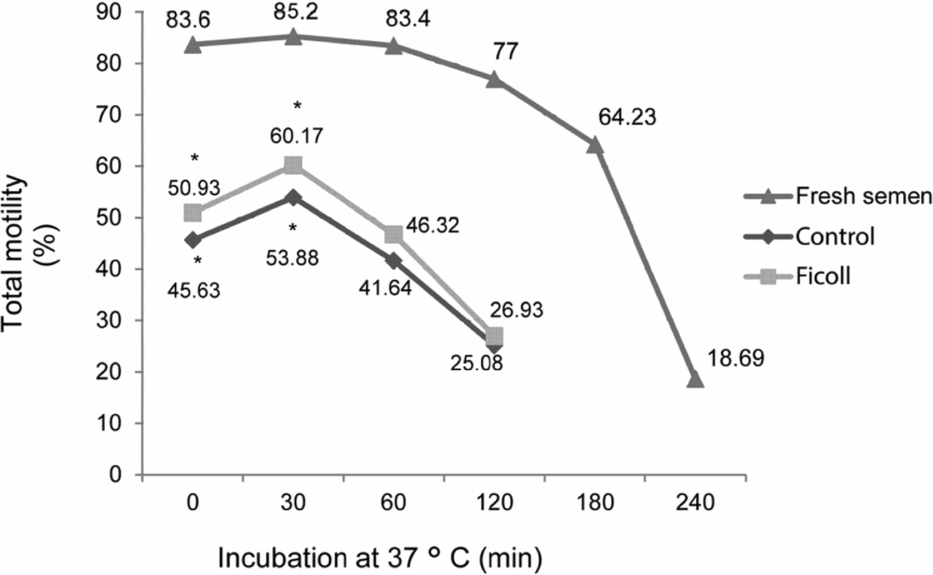
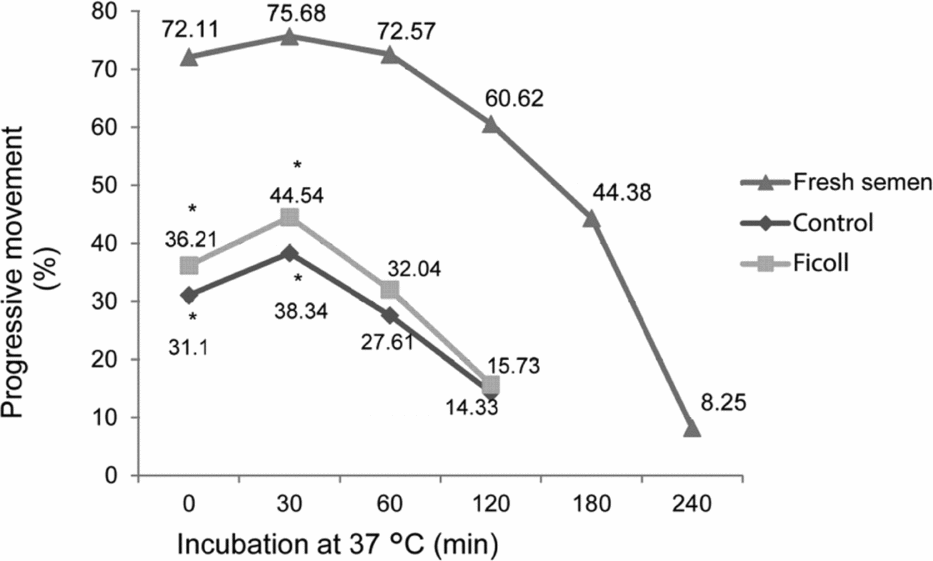
Figures 1 and 2 show the percentage of motile and progressively moving spermatozoa of fresh (n = 43) and frozen/thawed (n = 86) semen samples at different time points after thawing. Immediately after thawing and following 30 min of incubation at 37°C, higher numbers (P < 0.05) of motile and progressively moving spermatozoa were noted in the semen frozen in Ficoll medium when compared with the control group.
Total motility of the fresh and frozen/thawed semen immediately after thawing and after different incubation times at 37°C.
*Control and Ficoll groups within the same time interval are statistically different (P < 0.05).

Progressive movement of the fresh and frozen/thawed semen immediately after thawing and after different times of incubation at 37°C.
*Control and Ficoll groups within the same time interval are statistically different (P < 0.05).
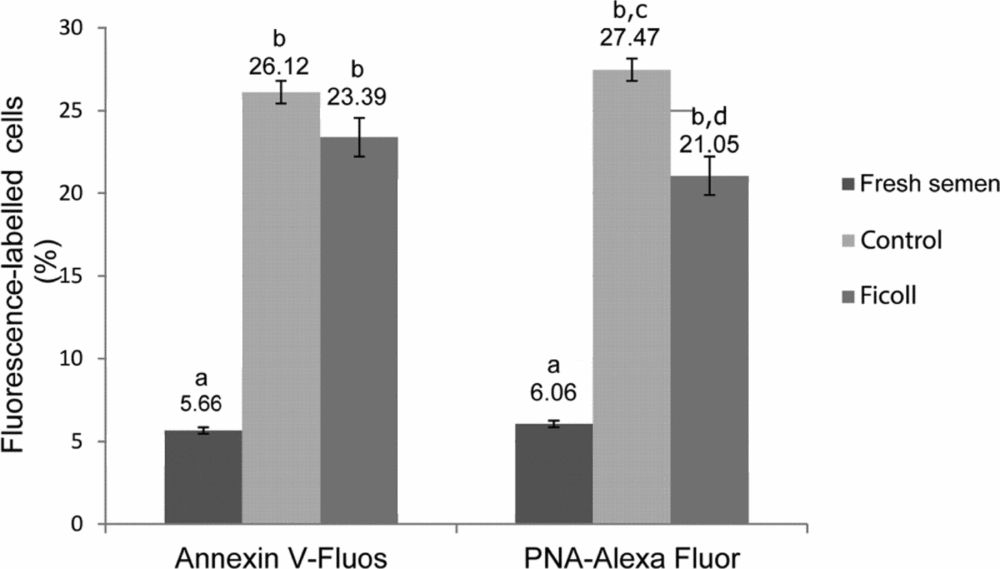
A higher (P < 0.05) proportion of cells with damaged plasma membrane and exposed acrosome was found in the control when compared with the Ficoll group (27.47 ± 8.660 versus 21.05 ± 6.49). Also, a slight but not significant difference in the proportion of sperm with destabilized membranes (annexin-V labelling) between the control and Ficoll group was revealed (Fig. 3).
Percentage of annexin-V-labelled cells (destabilized membrane) and PNA Alexa Fluor®-labelled cells (damaged plasma membrane) in fresh and frozen/thawed semen samples. Different superscripts within the same fluorochrome are statistically different a versusb = (P < 0.01); c versusd = (P < 0.05).
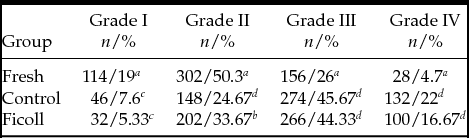
For a more comprehensive overview of changes in the plasma membrane and acrosomal part of sperm caused by freezing, the electron microscopy assay of sperm samples was performed. Sperm heads were classified into four grades according to the extent of morphological changes in the sperm head membranes and the acrosome (Fig. 4). The results obtained on ultrastructural categorisation of rabbit sperm heads (Table 1) show that 69.5% of fresh spermatozoa could be classified to grades I and II and only 30.5% of sperm had alterations in sperm head, thus corresponding to grades III and IV. In the frozen/thawed semen we found an increase in the ratio of sperm belonging to categories III and IV (control: 67.6%; Ficoll: 61.1%) and a decrease in the percentage of sperm in categories I and II (control: 32.4%; Ficoll: 38.9), when compared with the fresh semen. Slightly better results were found in the samples frozen in Ficoll medium compared with those frozen in control medium. Based on the findings of in vitro analysis in this experiment, the best freezing protocol, which contained Ficoll 70, was used for the insemination trial.
Ultrastructure characterization of the fresh and frozen/thawed rabbit sperm heads according to the membrane status
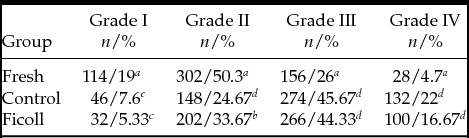
n = number of spermatozoa.
Different superscripts within the same column are statistically different;a versusb = (P < 0.05); a versus c = (P < 0.01); a versus d = (P < 0.001).
Rabbit sperm heads classified into four grades according to the state of the membranes and acrosome. (A) Grade I: sperm with intact plasma membrane of the head and intact acrosome (×10,000 magnification). (B) Grade II: sperm with waved plasma membrane (×10,000 magnification). (C) Grade III: sperm with swollen or damaged acrosome (×7200 magnification). (D) Grade IV: Sperm with pseudo-acrosomal reaction formed by vesicles and with loss of acrosomal content (×7200 magnification).
Fertility analysis
No statistically significant difference was found in the fertilization ability between fresh and frozen/thawed rabbit semen (Table 2). However, slightly lower conception rate and kindling rate was found for the group of does inseminated with frozen semen. Differences in conception and kindling rates per group may be affected by possible diagnostic inaccuracy.
Fertility traits for the fresh and frozen/thawed rabbit semen

n = number of does. SD, standard deviation.
Discussion
Cryopreservation of rabbit semen drastically affects the number of viable spermatozoa (Mocé & Vicente, Reference Mocé and Vicente2009) and hence reduces the fertilizing ability of surviving spermatozoa. This can be attributed to the ineffectiveness of many cryopreservation protocols for maintenance of semen quality (Siqueira et al., Reference Siqueira, Wallgren, Hossain, Johannisson, Sanz, Calvete and Rodríguez-Martínez2011). Therefore, we tried to improve the spermatozoa characteristics after thawing by adding Ficoll 70 as a second non-permeable CPA to the freezing medium in accordance with our preliminary results, when different concentrations of Ficoll 70 in the freezing medium were tested. In the present study, motility results obtained using the CASA system immediately after thawing and after 30 min of incubation at 37°C showed that Ficoll 70 in combination with sucrose and DMSO maintained better progressive movement and total motility of spermatozoa during cryopreservation when compared with the semen frozen with sucrose and DMSO only. The higher percentage of progressively moving sperm might be important when semen is used for AI. For example, in dogs, these sperm are likely to be the source of the fertilizing population because of high resistance to in vitro incubation in capacitating conditions and to osmotic stress (Peña et al., Reference Peña, Barrio, Becerra, Quintela and Herradón2012). Furthermore, Del Olmo et al. (Reference Del Olmo, Bisbal, Maroto-Morales, García-Alvarez, Ramon, Jimenez-Rabadan, Martínez-Pastor, Soler, Garde and Fernandez-Santes2013) demonstrated a relationship between some motility parameters assessed by CASA and fertility of cryopreserved ram sperm. Such relationship was found also by Hirano et al. (Reference Hirano, Shibahara, Obara, Suzuki, Takamizawa, Jamaguchi, Tsunoda and Sato2001) for the human sperm. In the case of rabbits, Mocé et al. (Reference Mocé, Vicente and Lavara2003b) observed that the equilibration of straws at –30°C before LN2 storage, maintained better total motility, however, fertility and prolificacy was higher in the straws frozen in LNV. Nevertheless, no published data are available confirming directly the correlation between the frozen/thawed progressively moving rabbit sperm and fertilization rate. Conversely, in fresh rabbit semen, Hagen et al. (Reference Hagen, Gilkey and Foote2003) obtained correlation between the motile spermatozoa and fertility measured as a percentage of fertilized oocytes 42 h after AI. The correlation was also obtained between the kindling rate and the percentage of total motile fresh rabbit sperm (Lavara et al., Reference Lavara, Mocé, Lavara, de Castro and Vicente2005).
In rabbits, the storage of fresh semen at 15–20°C preserved fertility for more than 24 h (Roca et al., Reference Roca, Martínez, Vázquez, Lucas, Parrilla and Martínez2000; López-Gatius et al., Reference López-Gatius, Sances, Sancho, Yániz, Santolaria, Gutiérrez, Núñez, Núñez and Soler2005). In contrast, incubation at 37 to 39°C caused faster depletion in sperm viability, resulting in lower motility with increasing preservation time (Rigau et al., Reference Rigau, Farré, Balleste, Mogas, Peña and Rodríguez-Gil2001). It is also known that the decrease in the sperm motility is faster after freezing/thawing, compared with semen stored in the cold (Peña et al., Reference Peña, Núñez-Martínez and Morán2006). These statements agree with our finding that motility of fresh semen incubated for 4 h at 37°C decreased from 80 to 20%. When frozen/thawed semen was incubated at 37°C, we noted a drastic reduction in progressive movement and total motility in both experimental groups already after 2 h. Thus, frozen/thawed semen should be used for AI as quickly as possible. It was also assumed, that due to the fact that frozen sperm are partially capacitated and present lowered longevity, fertility rate might be improved after an asynchrony between the ovulation and AI (Parrish & Foote, Reference Parrish and Foote1986). However, when frozen rabbit semen is used, effects of asynchronies are variable between works. In the study of Parrish & Foote (Reference Parrish and Foote1986), fertility rate was improved after 5 h of asynchrony but Chen et al. (Reference Chen, Li, Simkin, Yang and Foote1989), did not observe differences between females induced to ovulate 5 h before or at the same time of AI. Moreover, in the study by Mocé et al. (Reference Mocé, Lavara and Vicente2003a) the induction of an 8 h asynchrony between ovulation and insemination, either with fresh and frozen/thawed rabbit semen, decreased the fertility and kindling rate.
Membrane changes, including sperm capacitation or rapid acrosomal reaction, are some of the main forms of damage brought out by cryopreservation (Martin et al., Reference Martin, Sabido, Durand and Levy2004). Damage of plasma/acrosomal membranes has been indicated as a major cause of functional loss, due to leakage of cellular components and inactivation of crucial proteins (Valcárcel et al., Reference Valcárcel, De las Heras, Pérez, Moses and Baldassarre1997). The negative effect of freezing procedure and CPA on sperm acrosomes could be minimized if disaccharides such as sucrose are included in the extenders (Vicente & Viudes de Castro, Reference Vicente and Viudes de Castro1996). Ficoll 70 is a non-ionic synthetic polymere and it could also be classified as a polysaccharide. It is known to have a higher solubility than other compounds with high molecular weight (Kasai et al., Reference Kasai, Hamaguchi, Zhu, Miyake, Sakurai and Machida1992). Some protocols use Ficoll 70 as a macromolecule additive to cryopreservation media used for freezing of preimplantation embryos including rabbit morula and blastocyst stage embryos (Kasai et al., Reference Kasai, Hamaguchi, Zhu, Miyake, Sakurai and Machida1992; Papis et al., Reference Papis, Sypecka, Korwin-Kossakowski, Wenta-Muchalska and Bilska2005; Makarevich et al., Reference Makarevich, Chrenek, Olexikova, Popelkova, Turanova, Ostro and Pivko2008a). Kasai et al. (Reference Kasai, Hamaguchi, Zhu, Miyake, Sakurai and Machida1992) found that when a rabbit morula was suspended in EFS solution [ethylene glycol, Ficoll and sucrose dissolved in modified phosphate-buffered saline (PBS)], not only blastomeres but also the zona pellucida and the mucin coat shrank. After thawing, no over-swelling of blastomeres was observed, whereas the two investments regained their original volume. Authors suggested that Ficoll dehydrates the zona and mucin coat, and hence it might promotes vitrification of the investments. Its addition to cryopreservation media reduced zona pellucida cracking (Swain & Smith, Reference Swain, Smith, Chian and Quinn2010). Moreover, Kuleshowa et al. (Reference Kuleshowa, Shaw and Trounson2001) studied the toxicity of different polymeres added into media for embryo freezing and observed that Ficoll was not toxic under any of the conditions tested. Conversely, in the field of sperm freezing, An et al. (Reference An, Iwakiri, Edashige, Sakurai and Kasai2000) examined the protective action of compounds with a molecular weight larger than the disaccharides and trisaccharides, including Ficoll, on mouse spermatozoa survival post-thawing. However, they have found Ficoll to be marginally effective in the survival rate of mouse frozen/thawed spermatozoa. Nevertheless, no published data are available with Ficoll 70 included into the protocol for rabbit sperm freezing.
In our study we have used detection reagents targeting the acrosomal region of the sperm head (PNA Alexa Fluor®) and annexin V-staining in accordance with Peña et al. (Reference Peña, Johannisson, Wallgren and Rodríguez-Martínez2003) and Makarevich et al. (Reference Makarevich, Parkanyi, Ondruska, Kubovicova, Flak, Slezakova, Pivko and Rafay2008b), who showed that the annexin-V labelling technique is a very sensitive method to detect changes in the sperm membrane. In numerous reports, annexin-V binding has been considered as an indicator of apoptotic changes in sperm (Peña et al., Reference Peña, Johannisson, Wallgren and Rodríguez-Martínez2003; Martin et al., Reference Martin, Sabido, Durand and Levy2004; Makarevich et al., Reference Makarevich, Parkanyi, Ondruska, Kubovicova, Flak, Slezakova, Pivko and Rafay2008b; Chrenek et al., Reference Chrenek, Makarevich and Simon2010; Lukac et al., Reference Lukac, Bardos, Stawarz, Roychoudhury, Makarevich and Chrenek2011). However, there is a finding that the annexin-V test may indicate capacitation-like, rather than apoptotic, membrane changes in sperm cells (Gadella & Harrison, Reference Gadella and Harrison2002).
Our study confirmed a significantly higher incidence of membrane-altered cells after cryopreservation. The addition of Ficoll 70 as a second non-permeable CPA into freezing extender improved the post/thaw quality of rabbit semen. A significant difference in the proportion of sperm with damaged plasma membrane and exposed acrosome was found between the control and Ficoll group. Thus, freezing medium enriched with Ficoll 70 seemed to reduced the damage to the plasma membrane brought on by freezing and thawing. We postulate that the effectiveness of Ficoll 70 to protect sperm cells during cryopreservation process may probably be attributed to affected viscosity of the freezing solution ensuring a greater stability of the sperm membrane, reducing mechanical strain and ice crystals formation, therefore, increasing the ability to survive cryopreservation. Our suggestion is in agreement with positive results of other authors with the use of polymers in the cryopreservation media (Dumoulin et al., Reference Dumoulin, Janssen, Pieters, Enginsu, Geraedt and Evers1994; Dalimata & Graham, Reference Dalimata and Graham1997; Shaw et al., Reference Shaw, Kuleshowa, MacFarlane and Trounson1997; Kuleshowa et al., Reference Kuleshowa, Shaw and Trounson2001).
The use of frozen/thawed semen in AI trials showed that there were no differences in the conception rate, kindling rate, total number of pups and liveborn pups between fresh and frozen/thawed semen. These results are similar to observations by Iaffaldano et al. (Reference Iaffaldano, Iorio and Rosato2012), who proposed DMSO as a permeable CPA and sucrose as the non-permeable CPA of choice for freezing semen from rabbit bucks. However, for rabbit semen freezing, besides the type of CPA also sample size, semen processing methodologies applied, the different evaluation criteria and the differences among breeds and lines should be taken into account (Castellini et al., Reference Castellini, Battaglini and Lattaioli1992; Chen & Foote, Reference Chen and Foote1994; Mocé et al., Reference Mocé, Vicente and Lavara2003b; Polgár et al., Reference Polgár, Virag, Baranyai, Bodó, Kovács and Gócza2004; Saffa et al., Reference Saffa, Vicente, Lavara and Viudes de Castro2008).
In conclusion, our study demonstrates a positive effect of Ficoll 70 as a non-permeable CPA on several characteristics of rabbit spermatozoa evaluated in vitro following freezing/thawing. Furthermore, the fertility potential of the semen samples frozen in our study is similar to that of fresh semen. The use of a suitable freezing protocol will enable the establishment of a gene bank from national or endangered rabbit breeds as a gene resource.
Acknowledgements
Authors would like to thank to Mr Matušica and Mr Pecho for technical assistance.
Financial support
This work was supported by grant APVV-0556–011 coordinated by the Slovak Research and Development Agency (APVV) and by the Ministry of Education (Slovak Republic) under the contract VEGA No. 1/0415/12. This research was also funded by the European Community under project no. 26220220180: Building Research Centre ‘AgroBioTech’.
Ethical standards
The authors assert that all procedures contributing to this work comply with the ethical standards of the relevant national and institutional guidelines on the care and use of laboratory animals. The treatment of the animals was approved by the Ministry of Agriculture and Rural Development of the Slovak Republic, no. SK P 28004 and Ro. 1488/06–221/3a.
Conflicts of interest
None.