Introduction
Haplorchis taichui is a heterophyid fluke that is pathogenic to humans, infecting the small intestine. This parasite is widely distributed in Asia, but has a particularly high prevalence in Indochina, especially in Lao PDR, Thailand and Vietnam (Chai et al., Reference Chai, Darwin and Lymbery2005a). Infection can occur when undercooked fish contaminated with H. taichui metacercariae is eaten (Van et al., Reference Van, Ersbøll, Dung and Dalsgaard2011). The parasite is reported to be a possible aetiological agent of an irritable-bowel-like syndrome (Watthanakulpanich et al., Reference Watthanakulpanich, Waikagul, Maipanich, Nuamtanong, Sanguankiat, Pubampen, Praevanit, Mongkhonmu and Nawa2010).
In the Mekong Basin, H. taichui is frequently found in humans as a co-infection with Opisthorchis viverrini (Chai et al., Reference Chai, Park, Han, Guk, Shin, Lin, Kim, Sohn, Yong, Eom, Min, Hwang, Phommmasack, Insisiengmay and Rim2005b). The geographic distributions of populations of these two parasites frequently overlap (Sato et al., Reference Sato, Pongvongsa, Sanguankiat, Yoonuan, Dekumyoy, Kalambaheti, Keomoungkhoun, Phimmayoi, Boupha, Moji and Waikagul2010; Sripa et al., Reference Sripa, Bethony, Sithithaworn, Kaewkes, Mairiang, Loukas, Mulvenna, Laha, Hotez and Brindley2011; Wongsawad et al., Reference Wongsawad, Phalee, Noikong, Chuboon and Nithikathkul2012). The life cycles of these two parasites are similar. Freshwater snails and freshwater fish are the first and second intermediate hosts, respectively. Fish-eating mammals and humans are both definitive hosts, but H. taichui can also infect fish-eating birds (Chai et al., Reference Chai, Shin, Lee and Rim2009). These two parasites have differences in longevity, with O. viverrini in humans having a life span of over 10 years (Harinasuta & Harinasuta, Reference Harinasuta and Harinasuta1984) while there is little information on the longevity of H. taichui in humans. However, the life span of H. taichui in chicks is only 54 days following infection (Kumchoo et al., Reference Kumchoo, Wongsawad, Chai, Vanittanakom and Rojanapaibul2003).
In a population genetic study of O. viverrini based on the mitochondrial nad1 gene, gene flow was the major factor acting on genetic variation of O. viverrini populations in the lower Mekong Basin, including in Thailand, Laos PDR and Cambodia (Thaenkham et al., Reference Thaenkham, Nuamtanong, Sa-nguankiat, Yoonuan, Touch, Manivong, Vonghachack, Sato and Waikagul2010). In contrast, analysis of the mitochondrial cytochrome c oxidase subunit 1 gene (COX1) of H. taichui, collected from different geographic regions in northern and central Vietnam, indicated limited gene flow. Genetic differentiation among those populations across geographic areas was apparent because they were isolated by the regional topography and the lack of interconnectedness between the river basins (Dung et al., Reference Dung, Hop, Thaenkham and Waikagul2013).
The limited gene flow among the Vietnamese H. taichui populations was mainly attributed to the lack of interconnected river basins (Dung et al., Reference Dung, Hop, Thaenkham and Waikagul2013). However, the genetic differentiation of the H. taichui populations distributed in regions of overlap with the O. viverrini populations in the Mekong Basin, and other areas connected to it by rivers, should be determined to estimate the levels of gene flow. Genetic differentiation within and/or between populations can be used to clarify the population structure and the gene flow that occurs by dispersal of organisms, which is an important evolutionary factor, increasing the genetic variation and therefore the fitness of a population (Avise, Reference Avise2000; Criscione et al., Reference Criscione, Poulin and Blouin2005). Among the DNA markers used to study intraspecific variation, mitochondrial DNA genes are particularly appropriate for determining genetic differentiation within and/or between populations, because the rapid rate of sequence divergence allows discrimination of recently diverged lineages (Harrison, Reference Harrison1989; Ballard & Kreitman, Reference Ballard and Kreitman1995).
The population structures of trematodes such as Schistosoma japonicum (Zhao et al., Reference Zhao, Mo, Zou, Li, Weng, Lin, Xia and Zhu2009), Fasciola hepatica (Weng et al., Reference Weng, Elsheikha and Zhao2011), O. viverrini (Thaenkham et al., Reference Thaenkham, Nuamtanong, Sa-nguankiat, Yoonuan, Touch, Manivong, Vonghachack, Sato and Waikagul2010) and Opisthorchis felineus (Brusentsov et al., Reference Brusentsov, Katokhin, Brusentsova, Shekhovtsov, Borovikov, Goncharenko, Lider, Romashov, Rusinek, Shibitov, Suleymanov, Yevtushenko and Mordvinov2013) have all been determined using mitochondrial (mt) genes. Among the mtDNA genes, COX1 was used as the genetic marker to study the population structure of the Vietnamese H. taichui (Dung et al., Reference Dung, Hop, Thaenkham and Waikagul2013).
Based on the assumption that gene flow should be limited by a lack of river basin interconnectivity, which should affect the population structure of the Vietnamese H. taichui as discussed above, we hypothesize that geographic barriers are important in subdividing H. taichui populations, and that interconnectedness of rivers is a major factor encouraging gene flow. To test this hypothesis, seven populations of H. taichui from Laos and Thailand were collected from the lower Mekong Basin to evaluate the levels of gene flow among them. The genetic differentiation of these H. taichui populations was estimated, together with those of the three Vietnamese populations investigated in our previous study (Dung et al., Reference Dung, Hop, Thaenkham and Waikagul2013), to establish the population structure of H. taichui in Indochina. A population of H. taichui from the Philippines was used as the outgroup population. A fragment of COX1 was used as the genetic marker.
Materials and methods
Collection and examination of metacercariae and adult worms
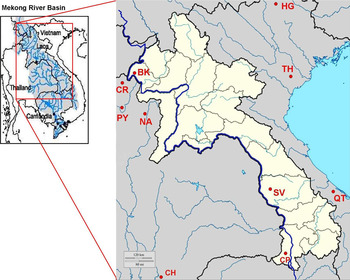
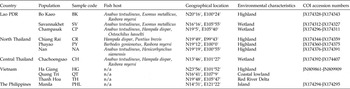
Haplorchis taichui metacercariae were collected from freshwater fishes in seven different geographic localities in Lao PDR (three populations) and Thailand (four populations) (fig. 1). Information about each locality and species of fish intermediate hosts is given in table 1. The metacercariae were separated from the fishes with a pepsin digestion technique (World Health Organization, 1995). Among the pooled metacercariae collected from each locality, about 100 were selected randomly and identified under a light microscope according to morphological criteria (Pearson, Reference Pearson1964). One thousand metacercariae were then administered orally to golden hamsters (Mesocricetus auratus). Adult worms were obtained from the hamster small intestine approximately 3 days after infection and then identified under a light microscope according to morphological criteria (Pearson, Reference Pearson1964) and preserved in 70% ethanol at –20°C until analysis. Two representative adult worms were randomly selected from the pooled H. taichui samples from the voucher specimen collection held by Dr Belizario, University of the Philippines, Manila, the Philippines, to compare them genetically with the populations from Indochina. The COX1 sequences of three Vietnamese populations (Dung et al., 2009) were obtained from the GenBank DNA database (table 1).
Haplorchis taichui populations from ten different geographic locations in Indochina; four populations of Thai strains were collected from Chaing Rai (CR), Nan (NA), Phayao (PY) and Chachoengsao (CH) provinces and three Lao strains were collected from Bo Kaeo (BK), Savannakhet (SV) and Champasak (CP). Three Vietnamese strains were also included from Ha Giang (HG), Thanh Hoa (TH) and Quang Tri (QT) (Dung et al., Reference Dung, Hop, Thaenkham and Waikagul2013).

Geographical location of sample collection sites of Haplorchis taichui from wetland and highland habitats in Lao PDR and north and central Thailand.

Molecular and phylogenetic analyses
Genomic DNA was extracted from each adult worm using the Tissue Genomic DNA Mini Kit (Geneaid Biotech Ltd, Taipei, Taiwan), according to the manufacturer's instructions. The partial mitochondrial COX1 gene (375 bp) from each worm was amplified by polymerase chain reaction (PCR), using the primers and conditions described by Dung et al. (Reference Dung, Hop, Thaenkham and Waikagul2013). The PCR products were purified with the Gel/PCR DNA Fragments Extraction Kit (Geneaid) and sequenced with the BigDye™ Terminator v3.1 Cycle Sequencing Kit on an Applied Biosystems 3730XL DNA Sequencer (Macrogen, Seoul, Korea). The PCR primers were used as sequencing primers and the amplicons were sequenced in both directions. The DNA sequences were checked manually with electropherogram comparisons using BioEdit version 7 (Hall, Reference Hall1999) and then aligned with the available H. taichui COX1 sequences from GenBank with the BLAST program (McGinnis & Madden, Reference McGinnis and Madden2004).
A 375-bp fragment of the H. taichui COX1 gene from 163 organisms isolated from ten Indochinese populations and two sequences representative of H. taichui from the Philippines were aligned (table 1). The haplotype diversity (Hd) and nucleotide diversity (π) at the segregating sites within the populations were calculated, using DnaSP version 5.0 (Librado & Rozas, Reference Librado and Rozas2009). The population pairwise Fst values were used to estimate the gene flow between the populations. The last two tests were performed with Arlequin version 3.1 (Excoffier et al., Reference Excoffier, Laval and Schneider2007). Values of Fst between 0.0 and 0.05 imply small genetic differences between populations (and therefore some gene flow). Values of Fst between 0.05 and 0.15 imply moderate genetic differences, and values higher than 0.15 suggest considerable genetic differentiation and low (or no) gene flow. The number of breeding adults migrating between populations was calculated using N e m = (1/Fst – 1)/4 (Slatkin, Reference Slatkin1987).
Using the Akaike information criterion in jModelTest (Posada, Reference Posada2008), the best-fitting model of nucleotide substitution was determined to be the Hasegawa–Kishino–Yano model + invariant sites (HKY + I). Using this model, a phylogenetic tree was constructed with the maximum likelihood method in MEGA v5.05 (Tamura et al., Reference Tamura, Peterson, Peterson, Stecher, Nei and Kumar2011). To estimate the support for different groupings on the tree, the data were resampled (bootstrapped) 1000 times and a tree constructed from each pseudoreplicate. The genetic distances among the clusters were then estimated with the same substitution model, using the bootstrap method to generate 1000 pseudosamples, with the MEGA 5.05 software (Tamura et al., Reference Tamura, Peterson, Peterson, Stecher, Nei and Kumar2011). All H. taichui haplotypes studied were summarized by the nucleotide variation and haplotype frequency for each population, using BioEdit (Hall, Reference Hall1999).
Results
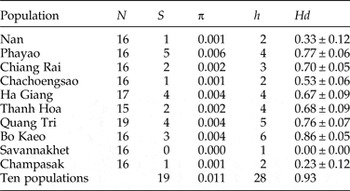
The amount of DNA polymorphism (S) was estimated for the 163 aligned 375-bp COX1 sequences of H. taichui, from ten populations in Indochina. The results showed very few segregating sites (hence very low nucleotide diversity) within each population (0–5). Among all the H. taichui populations studied, the BK population had the highest haplotype diversity (Hd = 0.86), whereas the SV population had no haplotype diversity (Hd = 0; only one haplotype was present) (table 2).
DNA polymorphism of ten populations of Haplorchis taichui in Indochina; N = number of samples, S = number of segregating sites, π = nucleotide substitution, h = number of haplotypes, Hd = haplotype diversity.

Genetic differentiation and gene flow between populations
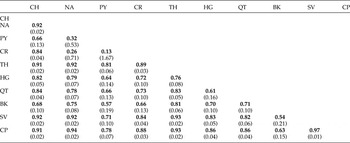
The pairwise Fst values of the ten Indochinese populations were calculated. Almost all the pairwise Fst values were high, implying high genetic differentiation between the H. taichui populations and very low gene flow. Only the CR and PY populations of northern Thailand showed moderate genetic differentiation (Fst < 0.15) and quite high gene flow (N e m = 1.67) (table 3).
Genetic differentiation and number of migrants per generation between Haplorchis taichui populations in Indochina. Values of fixation index (Fst), a measure of population differentiation, are in bold, while the numbers of migrants per generation (N e m) are the values in parentheses. All Fst values are significant at P < 0.05; see table 1 for abbreviations of populations.

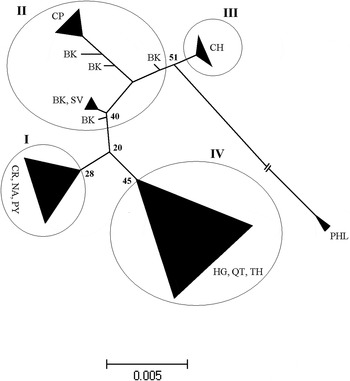
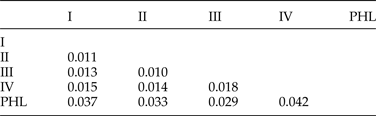
A maximum likelihood tree was constructed from the 165 H. taichui partial COX1 gene sequences shown in table 1. The phylogenetic analysis divided the Indochinese H. taichui populations into four clusters: cluster I of the CR, NA and PY populations; cluster II of the BK, SV and CP populations; cluster III of the CH population; and cluster IV of the HG, QT and TH populations (fig. 2). However, the internal nodes between the clusters were poorly supported, with low bootstrap values. The genetic distances were then estimated, to confirm that the genetic differentiation between the clusters was about 0.014 (table 4). The genetic distances within clusters I and II were about 0.005, whereas the genetic distance within cluster IV was about 0.014, as high as the genetic distance between clusters.
Maximum likelihood tree of ten Haplorchis taichui populations from Indochina, using the PHL (Philippines) strain as the outgroup. Four clusters are shown, with cluster I from northern Thailand (CR, PY and NA), II from Laos PDR (BK, SV and CP), III from central Thailand (CH) and IV from Vietnam (HG, TH and QT); numbers on the internal nodes are bootstrap proportions (see table 1 for abbreviations of populations).

Pairwise genetic distance between four clusters of Haplorchis taichui populations Indochina and the PHL population as the outgroup population, estimated using the HKY + I substitution model; see fig. 2 for abbreviations of clusters.

Discussion
Ten populations of Indochinese H. taichui collected from Laos, Thailand and Vietnam (data for the latter available from GenBank) (table 1) were clearly separated into four clusters, representing populations from northern Thailand, central Thailand, Laos and Vietnam. The Lao, Thai and Vietnamese populations of H. taichui were genetically distant from one another. Dung et al. (Reference Dung, Hop, Thaenkham and Waikagul2013) tentatively attributed the low gene flow among the three Vietnamese populations used in this study (TH, HG and QT populations) to topographic features that isolated them geographically, including mountainous and wetland areas (Dung et al., Reference Dung, Hop, Thaenkham and Waikagul2013). In the present study, H. taichui from sites within the lower Mekong Basin in Thailand and Laos were compared with those from the Vietnamese sites to explore the population structure of H. taichui across Indochina. Many of the sites investigated in Thailand and Laos are not separated by obvious geographic features and may be affected by the same widespread floods, and such flooding events are likely to wash hosts, snails and fish, and parasites between drainage basins, including between the CR and BK populations. These two populations were collected from sites geographically close to each other but on opposite sides of the Mekong River. However, surprisingly, there were still strong genetic differences among these populations.
The genetic distances between the populations within the same clusters indicated that the populations were highly genetically differentiated, with low gene flow between them. High gene flow was only suggested between the CR and PY populations from northern Thailand. These two populations are relatively close to one another geographically and occur in waters that drain into the Mekong from the west. Each population studied displayed quite high genetic variation (haplotype diversity), except NA from northern Thailand, and SV and CP from Laos. Low genetic variation within populations is probably attributable to parasite sampling. A previous study found that the clones of cercariae infecting several kinds of fish have similar immune systems, which limits the genetic variation in the adult worms (Keeney et al., Reference Keeney, Waters and Poulin2006). The SV and CP populations from Laos showed very low gene flow, despite the flooding conditions and river connections in the wetlands of the Mekong Basin.
The results of this study indicate that the population structure of H. taichui differs from the population structures of O. viverrini and O. felineus, which were studied with different mitochondrial DNA markers (nad1 for O. viverrini and COX1 and COX3 for O. felineus; Thaenkham et al., Reference Thaenkham, Nuamtanong, Sa-nguankiat, Yoonuan, Touch, Manivong, Vonghachack, Sato and Waikagul2010; Brusentsov et al., Reference Brusentsov, Katokhin, Brusentsova, Shekhovtsov, Borovikov, Goncharenko, Lider, Romashov, Rusinek, Shibitov, Suleymanov, Yevtushenko and Mordvinov2013). Gene flow is a major evolutionary factor, reducing the genetic differentiation between populations but increasing the genetic variation within populations of opisthorchiid liver flukes (Thaenkham et al., Reference Thaenkham, Nuamtanong, Sa-nguankiat, Yoonuan, Touch, Manivong, Vonghachack, Sato and Waikagul2010; Kiatsopit et al., Reference Kiatsopit, Sithithaworn, Saijuntha, Pitaksakulrat, Petney, Webster and Andrews2014). Although the life cycle of H. taichui and Opisthorchis spp. are quite similar, they are different in life expectancy. The life span of O. viverrini has been reported to be more than 10 years, while the longevity of H. taichui is known to be about 2 months in their definitive hosts (Harinasuta & Harinasuta, Reference Harinasuta and Harinasuta1984; Kumchoo et al., Reference Kumchoo, Wongsawad, Chai, Vanittanakom and Rojanapaibul2003). Helminthic parasite longevity is known to have a significant influence on population structure. Those parasites with short life spans, particularly those with a semi-aquatic life cycle (e.g. requiring freshwater snails and fish as the intermediate host and terrestrial mammals as the definitive host), may be at risk of experiencing a population bottleneck during dry seasons because of low/no infection in snails. The small population size of the parasites can cause low within-population genetic variation and high genetic differentiation between populations (Vazquez-Prieto et al., Reference Vazquez-Prieto, Vilas, Paniagua and Ubeira2015). The short life span of H. taichui may therefore be a contributing factor in limiting gene flow between populations.
Low rates of H. taichui infection (0.29%) have been reported in the freshwater snail Melanoides tuberculata, a common species in Thailand. Although these snails are distributed uniformly throughout their range, their infection by H. taichui is discontinuous (Krailas et al., Reference Krailas, Namchote, Koonchornboon, Dechruksa and Boonmekam2014). This suggests that the presence of a snail host may not correlate with parasite density. Vazquez-Prieto et al. (Reference Vazquez-Prieto, Vilas, Paniagua and Ubeira2015) suggested that those species with semi-aquatic transmission and a terrestrial definitive host (e.g. Schistosoma mansoni and Fasciola hepatica) may be at risk that their eggs will be deposited in an unsuitable habitat for transmission. This could then lead to relatively low levels of genetic variability and relatively high population genetic structure (Theron et al., Reference Theron, Sire, Rognon, Prugnolle and Durand2004; Vilas et al., Reference Vilas, Vazquez-Prieto and Paniagua2012; Vazquez-Prieto et al., Reference Vazquez-Prieto, Vilas, Paniagua and Ubeira2015). Aemero et al. (Reference Aemero, Boissier, Climent, Mone, Mouahid, Berhe and Erko2015) studied the genetic structure of S. mansoni populations in Ethiopia and found that it was not associated with isolation by distance, and that restricted gene flow between populations was seen because of localized adaptations and variation in environmental conditions along the river (Aemero et al., Reference Aemero, Boissier, Climent, Mone, Mouahid, Berhe and Erko2015).
In examining the various factors limiting gene flow, we suggest that short parasite life span, patchy distribution of the intermediate snail host and seasonal infective dynamics (between drought and wetter conditions) may all be contributing factors explaining the low within-population genetic variation and high genetic differentiation between H. taichui populations in Indochina. Therefore, the hypothesis that river interconnectedness should result in the greater likelihood of genetic exchange between H. taichui populations must be rejected. This study suggests that geographical barriers are not the single most important factor in isolating H. taichui populations (e.g. genetic differentiation of Vietnamese H. taichui) (Dung et al., Reference Dung, Hop, Thaenkham and Waikagul2013), but that other factors, as mentioned above, contribute as well. Because of the limitations of gene flow, the H. taichui populations seem to be divided by national barriers along the Mekong River, which clearly indicates that the great genetic differences between BK and CR are attributable to the Thai–Laos border.
However, this study was limited in the numbers of samples analysed and the number of areas in which the parasites were collected. In a future study, more samples of H. taichui from different geographic localities, particularly from populations along the Mekong River between Thailand and Laos, are required to clarify the genetic differentiation that occurs along this national border. Another genetic marker, such as microsatellite loci, should also be applied to reveal the population dynamics of the parasite and its intermediate hosts between different seasons. Human activity and the mobility of other reservoir hosts (e.g. fish-eating birds and mammals) that can affect H. taichui population structure should also be investigated. If the distribution of H. taichui populations is limited and incidentally associated with national borders, the treatment programmes in one country might have little effect in the border regions with another country.
Acknowledgements
We thank our colleagues at the Department of Helminthology, Faculty of Tropical Medicine, Mahidol University, Thailand, for their technical support, particularly Mr Nirundorn Homsuwan. We express our thanks to Professor David Blair, College of Marine and Environmental Science, James Cook University, Australia, for his valuable comments on this manuscript.
Financial support
This research was supported by the Thailand Research Fund (TRF), Thailand (grant number BRG5180005) and the Faculty of Tropical Medicine, Mahidol University, Thailand.
Conflict of interest
None.
Ethical standards
The experimental animal care and use were performed following the ethical protocol, which was approved by the Animal Ethics Committee of Faculty of Tropical Medicine, Mahidol University, Thailand under the ethical clearance number FTM-ACUC003/2009.