INTRODUCTION
Two of the major questions in usage-based accounts of language acquisition are (a) How do children extract information from the input they receive? and (b) Why does children's early language differ from that of adults? (Lieven, Reference Lieven2014). The current study touches upon both issues by examining how the experience that older learners have with language, and their knowledge about its structure, impact the units they attend to. We examine how existing knowledge impacts the information children extract from their input by looking at the effect of emergent literacy skills on children's sensitivity to word units in speech. Specifically, we ask how emergent literacy impacts segmentation of multiword units, an investigation that also aims to add to the relatively scarce literature on the effect of multiword frequency on children (Arnon & Clark, Reference Arnon and Clark2011; Bannard & Matthews, Reference Bannard and Matthews2008; Matthews & Bannard, Reference Matthews and Bannard2010).
There is recent theoretical interest and empirical support for the idea that multiword units play an important role in language (Abbot-Smoth & Tomasello, Reference Abbot-Smith and Tomasello2006; Arnon, Reference Arnon2010, Reference Arnon2015; Bannard & Lieven, Reference Bannard and Lieven2009; Biber, Reference Biber2009; Meunier, Reference Meunier2012; Peters, Reference Peters1983; Siegelman & Arnon, Reference Siegelman and Arnon2015). We use the term as used in the psycholinguistic literature to refer to multiword sequences produced by speakers (unlike the way the term is used in the formulaic language literature, we do not propose they are stored holistically; Arnon & Snider, Reference Arnon and Snider2010). Psycholinguistic findings show that children and adults are sensitive to multiword information in processing (Arnon & Cohen Priva, Reference Arnon and Cohen Priva2013; Arnon & Snider, Reference Arnon and Snider2010; Bannard & Matthews, Reference Bannard and Matthews2008; Reali & Christiansen, Reference Reali and Christiansen2007; Siyanova-Chanturia, Conklin, & van Heuven, Reference Siyanova-Chanturia, Conklin and van Heuven2011; Tremblay & Baayen, Reference Tremblay, Baayen and Wood2010). Data from language acquisition further suggests that children use multiword units in early production and draw on them during learning (Arnon & Clark, Reference Arnon and Clark2011; Bannard, Lieven, & Tomasello, Reference Bannard, Lieven and Tomasello2009; Lieven, Behrens, Speares, & Tomasello, Reference Lieven, Behrens, Speares and Tomasello2003; Lieven, Salomo, & Tomasello, Reference Lieven, Salomo and Tomasello2009). However, while both children and adults are sensitive to the properties of multiword units, their role in learning may differ: it has been proposed that children rely more on multiword units during language learning than adult L2 learners, a tendency which impacts learning outcomes (Arnon, Reference Arnon2010; Arnon & Christiansen, Reference Arnon, Christiansen, Brooks and Kempe2014; Arnon & Havron, unpublished observations; Arnon & Ramscar, Reference Arnon and Ramscar2012; Siegelman & Arnon, Reference Siegelman and Arnon2015). In this respect, adults' lesser reliance on multiword units may be partially caused by their familiarity with written language where word boundaries are visually salient.
In this paper, we ask if, and how, emergent literacy skills impact the units used during language processing. In particular, we examine if literacy acquisition increases the prominence of single words compared to multiword units. Unlike in spoken language, written language (in many scripts) provides clear information about word boundaries by marking them with spaces. While preliterate children are clearly able to segment utterances into words (Aslin, Saffran, & Newport, Reference Aslin, Saffran and Newport1998; Christophe, Dupoux, Bertonici, & Mehler, Reference Christophe, Dupoux, Bertonici and Mehler1994), learning to read may nevertheless lead language users to rely more on word units compared to preliterate language users. Such a pattern is consistent with models of language that consider both words and larger units to be building blocks for language (e.g., Bod, Reference Bod2006; Elman, Reference Elman2009; McClelland, Reference McClelland2010).
Indeed, studies have shown that literacy increases lexical segmentation: the ability to segment utterances into words (Gombert, Reference Gombert1994; Havron & Arnon, Reference Havron and Arnon2016; Kurvers & Uri, Reference Kurvers and Uri2006; Olson, Reference Olson1996; Roberts, Reference Roberts1992; Veldhuis & Kurvers, Reference Veldhuis and Kurvers2012). Literate adults and children are more likely to segment sentences into word units compared to illiterate adults or pre-literate children in various tasks, such as counting words in a sentence (Bialystok, Reference Bialystok1986), and tapping with chips (Holden & MacGinitie, Reference Holden and MacGinitie1972). However, it is somewhat difficult to separate the effect of age and cognitive and linguistic variables from that of literacy in these studies. Since literate children are typically older than preliterate children, it is possible that the differences in performance are driven by age and the increased linguistic experience that comes with it, rather than by literacy. In line with this interpretation, Karmiloff-Smith and colleagues (Karmiloff-Smith, Grant, Sims, Jones, & Cuckle, Reference Karmiloff-Smith, Grant, Sims, Jones and Cuckle1996) found that five-year-old preliterate children segmented sentences into words more than four-year-old preliterate children, suggesting that age affects segmentation independently of literacy. In contrast, Kurvers, Vallen, and Hout (Reference Kurvers, Vallen and Hout2006) used a similar task with children in the Netherlands and Norway but did not find an effect of age independent of literacy.
THE CURRENT STUDY
The existing findings leave several open questions. First, the mixed pattern of results on the effect of age highlights the difficulty of separating the effect of age from that of literacy without using longitudinal designs. Second, there is a need to control for other cognitive and linguistic variables which may affect performance on these tasks. Children who can read may differ from their age-matched preliterate peers on additional variables other than literacy: they may have higher cognitive abilities - such as intelligence or short-term memory – and they may have more linguistic knowledge and experience (Evans, Shaw, & Bell, Reference Evans, Shaw and Bell2000; Gathercole, Tiffany, Briscoe, & Thorn, Reference Gathercole, Tiffany, Briscoe and Thorn2005).
In the current study, we aim to address these questions by examining the effect of emergent literacy on lexical segmentation in preliterate and literate children longitudinally. We will attempt to disentangle the role of literacy and age by using a before-after design, and by measuring and statistically controlling for possible confounding factors: age itself, but also non-verbal intelligence, short-term memory, and vocabulary. We will test Hebrew-speaking first-graders twice: before and after they learn to read. This will allow us to separate the effect of literacy from that of other factors in enhancing lexical segmentation. We test two hypotheses: in the first session, we hypothesize that children's literacy skills will predict segmentation abilities over and above the effects of age and cognitive and linguistic measures. In the second session, we hypothesize that improvement in reading ability will predict improvement in segmentation. If learning to read enhances lexical segmentation, then greater changes in literacy should correspond to larger improvement in segmentation. Importantly, this prediction focuses on changes in literacy between the start and end of the year: we expect the greatest change in segmentation in those children who learned to read during the year (and less so in those who could also read when the year started, as well as those who did not improve and remained poor readers). Note that we do not hypothesize emergent literacy levels at the beginning of the year to predict improvement in segmentation. Such analysis would disregard the fact that children might also improve to a different degree in their literacy skills between the two sessions.
Hebrew is a Semitic language with a rich synthetic morphology. The writing system is an abjad (Daniels & Bright, Reference Daniels and Bright1996), i.e., consonants are represented graphically, but vowels are not, for the most part. As such, reading is dependent on knowledge of the morphological elements making up the word – roots, patterns, and the distinction between root consonants and ones that are also used to indicate grammatical morphemes or function affixes (Ravid, Reference Ravid2012). Literacy acquisition in Hebrew and the impact of literacy acquisition on metalinguistic awareness has been studied extensively (see, for example, Bar-On & Ravid, Reference Bar-On and Ravid2011; Berman & Ravid, Reference Berman and Ravid2000; Ravid, Reference Ravid, Joshi and Aaron2005). Research has focused primarily on the impact of emergent literacy on phonological and morphological awareness (e.g., Levin, Ravid, Rapaport, & Nunes, Reference Levin, Ravid, Rapaport and Nunes1999; Ravid & Malenky, Reference Ravid and Malenky2001), yet no work to date has explored lexical segmentation in Hebrew. Despite differences between Hebrew and other languages which have been studied in the context of lexical segmentation (Dutch: Kurvers, van Hout, & Vallen, Reference Kurvers, van Hout and Vallen2009; Onderdelinden, Craats, & Kurvers, Reference Onderdelinden, Craats and Kurvers2009; French: Gombert, Reference Gombert1994; Portuguese: Morais, Bertelson, Cary, & Alegrıa, Reference Morais, Bertelson, Cary and Alegrıa1986), they share one important feature – they mark word boundaries with spaces. In logographic scripts, such as Chinese Hanzi and Japanese Kanji, there are no conventions for determining word boundaries, and indeed logographic literacy does not seem to aid lexical segmentation (Bassetti, Reference Bassetti2007). We thus predict that emergent Hebrew literacy skills will enhance lexical segmentation.
An additional goal of the current study is to add to the sparse literature on multiword processing in children (Arnon & Clark, Reference Arnon and Clark2011; Bannard & Matthews, Reference Bannard and Matthews2008; Matthews & Bannard, Reference Matthews and Bannard2010). This literature has focused, to date, on the processing of multiword sequences in English. We add to the existing research by asking whether Hebrew-speaking children have a harder time segmenting high-frequency two-word sequences compared to lower-frequency ones. This frequency manipulation will also allow us to validate our task and make sure it is measuring language processing, by replicating frequency effects previously found with adults (e.g., Arnon & Snider, Reference Arnon and Snider2010; Bybee, Reference Bybee2002; Havron & Arnon, Reference Havron and Arnon2016; Siyanova-Chanturia, Conklin, & van Heuven, Reference Siyanova-Chanturia, Conklin and van Heuven2011). We predict that frequently used two-word sequences will be harder for children to segment, regardless of literacy level.
METHOD
Participants
Thirty-nine children (24 girls and 15 boys) between the ages of five and seven (mean 6;6, range 5;9–7;5) participated in this study. They were recruited from middle- to high-socioeconomic status schools in Israel. Written parental consent was obtained for all children.
Materials
Lexical segmentation tasks
Word order reversal task
In this task, based on a study conducted by Huttenlocher (Reference Huttenlocher1964), participants heard two-word sequences and were asked to reverse their order (e.g., hear “little boy”, produce “boy little”). The modified task has been used in a study of adult illiterates learning to read in their L2 (Havron & Arnon, Reference Havron and Arnon2016). That study showed that task performance was affected by emergent literacy and by the frequency of the two-word sequences, indicating its ability to tap into linguistic processing and not only metalinguistic awareness. All the stimuli were grammatical two-word sequences, used in everyday speech, which differed in the frequency of the two-word sequences but were matched on single-word frequency (e.g., high-frequency ʔaba ʃeli ‘my dad’, low-frequency tzeva tari ‘fresh paint’). The units included a mixture of more and less fixed expression encompassing a range of grammatical and syntactic relations. The reversed pairs resulted in a mix of grammatical and ungrammatical sequences, as in Huttenlocher's original study (despite the freer word order of Hebrew). We used the MILA Tapuz People Forum Corpus of Israeli online forums (Itai & Wintner, Reference Itai and Wintner2008) to calculate the frequencies of the single words and of the two-word sequences. This is a collection of around 1·4 million words taken from Israeli online forums in Hebrew. We used this corpus because (a) there is at the moment no large enough corpus of spoken Hebrew, including child-directed speech (e.g., the Hebrew section of CHILDES contains only about 400,000 tokens) and (b) it is closer to spoken Hebrew that other available written corpora.
We constructed two lists of forty two-word sequences, one for each session. Each list contained an equal number of frequent and infrequent two-word sequences (see ‘Appendix 1’ for all items). All the two-word sequences were prerecorded by a native speaker of Hebrew unaware of the study goals.Footnote 1 The order of presentation was randomized for each participant.
Sentence dictation task
In this task children heard recorded sentences and were asked to say these sentences back to the experimenter “part by part” so that she could write them down. This task is an adaptation of two previously used tasks (Gombert, Reference Gombert1994; Veldhuis & Kurvers, Reference Veldhuis and Kurvers2012). We controlled for sentence plausibility (as assessed by ratings of native speakers), and the number of words and syllables in the sentences (see ‘Appendix 2’ for item details). Responses were coded for unit types (word, multiword, and part-word) by two RAs blind to the children's literacy level. Units were defined on the basis of the pauses the child made in her dictation. We define as ‘word’ a unit that would have been separated by spaces in writing (‘teva’). Thus, if the child said: “ima shela [pause] halxa [pause] la@makolet”, this is one multiword sequence (ima-shela), and two word units (halxa and la@makolet). We calculated agreement between raters on the number of single words dictated in each sentence, and found reliability to be high (weighted Kappa = ·89, z = 23, p < ·001).
Cognitive and vocabulary measures
Non-verbal intelligence
This was assessed using the child version of the block design subset of the WISC-III (Kaufman, Reference Kaufman1994).
Short-term memory
This was evaluated using the digit span task (only forward section; Kaufman, Reference Kaufman1994). We used only the digits one to five, to prevent arithmetic ability from affecting performance.
Vocabulary measure
We used the Kavé (Kavé, Reference Kavé2006) Hebrew naming test for productive vocabulary, a validated tool suitable for use with children and adults.
Literacy assessment
This was performed using a rated paragraph reading task. The paragraph was at a level suitable for readers at the end of the first grade. The responses were recorded and later rated by a native speaker who had not met the participants. We used a scale developed for assessing literacy in illiterate populations (Tarone, Biglew, & Hansen, Reference Tarone, Bigelow, Hansen and Faux2007; Havron & Arnon, Reference Havron and Arnon2016). The original scale rates both reading and writing, to create a full literacy scale. Here, however, we focus on reading, since it provides children with a visual representation of word boundaries (they are less likely to write full sentences and texts at this stage than read them). Reading was rated for fluency (0–3) and confidence (0–3) by an RA who had not met the children. The scores were aggregated to create a single score (see ‘Appendix 3’ for paragraphs and rating instructions). Twenty percent of children's paragraph readings were coded by a second coder. Inter-rater reliability was high (weighted Kappa = ·9, z = 2·49, p = ·01).
Current instructions from the ministry of education in Israel determine that children who start first grade should be expected to know the letters and have awareness of the basic speech sounds (phonemic awareness). Children are not expected to be able to read words or sentences. Despite this, many children start school while already being able to read familiar or unfamiliar words, and even short stories. This may be the result of more extensive schooling in a specific kindergarten, or of the children's or their parents' efforts or abilities. For our participants, this resulted in a range of emergent literacy levels, as expanded on in the ‘Results’ section.
Procedure
Participants were tested twice: once at the start of the school year (October–November), and once after spring break (May), when most children were estimated by the teacher to be able to read aloud a short paragraph without diacritical signs (niqqud). Children were tested in a quiet room using a laptop computer. We used the experimental software E-Prime to run the tasks and record responses. In the first session, participants completed the tasks in the following order: (1) vocabulary, (2) word-order reversal task, (3) block design, (4) sentence dictation task, (5) digit span, and (6) literacy assessment. In the second session the children completed the (1) word-order reversal task, (2) dictation task, and (3) literacy assessment. At the end of each session, the child was given stickers and a certificate of participation.
RESULTS
We excluded participants who completed less than 50% of the trials in the reversal task during the first session, since this was taken to indicate that they did not understand the task. This led to the exclusion of four out of the thirty-nine children who participated in the study.
First session
Literacy, cognitive, and linguistic measures
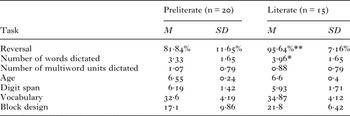
At the beginning of the first grade, less than half of the children could already read (15 out of 35 children scored 4 and above on the literacy scale). There were no significant differences between the two literacy groups in terms of age, short-term memory, vocabulary, and non-verbal intelligence. As expected, there was a significant difference between the two literacy groups in the reversal task scores, and in the number of word units dictated, with literate children showing more segmentation (see Table 1).
Differences between preliterate and literate children at the beginning of the year

notes: * p < ·05; ** p < ·01.
Reversal task
Overall, across both groups, performance ranged between 56·76% and 100%, with a mean of 86·06% (SD = 11%). Cronbach's alpha scores were high (first session, α = ·87; second session, α = ·79), demonstrating the task's internal reliability. Incorrect responses included repetition of the two-word sequences, content errors (e.g., hearing ‘my name’, producing Yoav), and reversing meaning (e.g., hearing ‘little boy’, producing ‘big girl’). Such errors – which show limited evidence of lexical segmentation – accounted for 73% of errors. Other incorrect responses seem to exhibit some level of segmentation. These included repetition of only one of the words (e.g., hearing ‘little boy’, producing ‘little boy boy’), changing one of the words (e.g., hearing ‘little boy’, producing ‘small boy’), or adding function words (e.g., hearing ‘new friend’, producing ‘friend the new’). Such responses accounted for 27% of the errors.
Hypotheses testing: reversal task
We hypothesized that emergent literacy skills will predict performance after controlling for age, cognitive abilities, and vocabulary. We also hypothesized that more frequent two-word sequences would be harder to segment. To test these predictions, we ran a mixed-effect logistic regression model with trial accuracy as our dependent variable, using the glmer function in R software (Bates, Maechler, Bolker, & Walker, Reference Bates, Maechler, Bolker and Walker2015). Since the model predicts the result of each trial we have 1,400 observations in the model from our 35 participants (see Baayen, Davidson, & Bates, Reference Baayen, Davidson and Bates2008; Jaeger, Reference Jaeger2008). The dependent variable was accuracy on each trial (as a binary variable). We had logged frequency of two-word sequences and literacy (in z-scores) as our variables of interest. We had age (in days), short-term memory, non-verbal intelligence scores, and productive vocabulary scores (all in z-scores) as fixed effects. The model included random intercepts for participant and item (the maximal effect structure that allowed it to converge; Barr, Levy, Scheepers, & Tily, Reference Barr, Levy, Scheepers and Tily2013), and had low colinearity (all VIF values < 1·8).
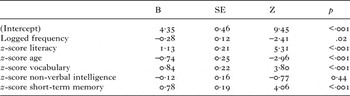
As predicted, the effect of the frequency of two-word sequences on performance was significant: more frequent two-word sequences were harder to reverse (β = –0·28, SE = 0·12, p = ·02, model comparison p = ·02). Importantly, the effect of literacy was also significant: participants who were better readers showed better lexical segmentation (β = 1·13, SE = 0·21, p < ·001, model comparison p < ·001). Surprisingly, age had a negative effect on performance: older children were less likely to produce correct responses after controlling for the other measures (β = 0·74, SE = 0·25, p = ·003, model comparison p = 0·002). Vocabulary size predicted performance, with participants with larger vocabularies performing better (β = 0·84, SE = 0·22, p < ·001, model comparison p < ·001). The effect of short-term memory was also significant: better short-term memory was associated with better performance (β = 0·78, SE = 0·19, p < ·001, model comparison p < ·001). The effect of non-verbal intelligence was not significant (see Table 2).
Mixed-effects logistic regression for segmentation task performance: session 1

We suspected that the negative effect of age was driven by the youngest children. For children born between September and December, parents in Israel can choose whether the child will start first grade or remain in kindergarten. It is possible that children whose parents decided to send them to the first grade had characteristics that were correlated both with early literacy and with performance on our task. Put differently, these children may have cognitive or environmental advantages over their older peers. In line with this hypothesis, removing these children (n = 7) eliminated the effect of age (β = –0·41, SE = 0·27, p < ·13) while not impacting the significance of the other factors.
To summarize, as hypothesized, the word order reversal task revealed a significant effect of emergent literacy on lexical segmentation among children of the same age, suggesting that literacy has an independent effect on segmentation abilities. The results also show that children are sensitive to the frequency of two-word sequences and find it harder to segment more frequent two-word sequences.
Dictation task
We looked at the same 35 participants as in the previous analysis. The 330 sentences the participants dictated included 1,191 single words (e.g., ima ‘mother’), 326 multiword units (e.g., ima-shela ‘her-mother’), and 37 part words (e.g., im ‘mothe’). We ran a mixed-effects linear model to predict the number of word units dictated in each sentence (which had a significant and strong negative correlation with the number of multiword units (r(31) = –0·93, p < ·001). We had literacy as our variable of interest, as well as age (in days), short-term memory, non-verbal intelligence scores, and productive vocabulary scores (all in z-scores) as fixed effects. The model included random intercepts for participant and item, and had low colinearity (all VIF values < 1·2).
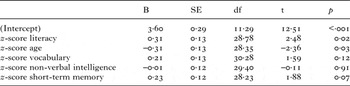
As predicted, the effect of literacy was significant: participants who were better readers dictated more word units (β = 0·31, SE = 0·13, p = ·02, model comparison p = ·01). Again, age had a significant negative effect on performance: older children were less likely to dictate along word boundaries (β = –0·31, SE = 0·13, p = ·03, model comparison p = ·01). Here again, when we removed children born before December, the effect of age disappeared (β = 0·33, SE = 0·21, p = ·13). Short-term memory had a marginally significant effect (β = 0·23, SE = 0·12, p = ·07, model comparison p = ·05). None of the other factors were significant (see Table 3).
Mixed-effects linear model for number of word units in dictation: session 1

To summarize, as hypothesized, the dictation task also revealed a significant effect of literacy. This task provides convergent evidence to the word order reversal task, showing that emergent literacy, rather than age, is associated with enhanced lexical segmentation.
Second session
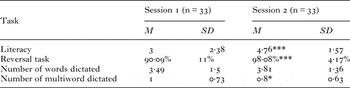
Two participants were not tested again at the end of the year; one had left the school and another was unable to complete the word order reversal task for technical reasons. Performance in the word order reversal task ranged between 82·5% and 100%, with a mean of 98·08% (SD = 4·17%). There was a significant improvement in reading between the first and second session, as well as in the word order reversal task, and significantly fewer multiword units dictated in the second session (but no significant change in the number of word units; see Table 4).
Differences in measures between sessions

notes: * p < ·05; *** p < ·001.
Hypotheses testing: reversal task
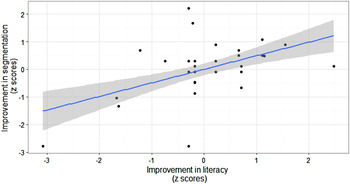
We hypothesized that improvement in literacy would predict improvement in segmentation. To test this prediction, we conducted the following analysis: we first created two improvement scores by regressing first-session literacy scores from second-session literacy scores, and first-session segmentation scores from second-session segmentation scores. We do not use simple improvement scores, but rather, residualized scores, because they are a better estimate for improvement – as they provide scores which are relative to the rest of the group and show whether improvement was above or below expected. Raw improvement scores, in contrast, equate a child who improved from 5 to 6 (as expected) with a child who improved from 0 to 1 (much less than expected). After creating these improvement scores, we conducted a linear regression, predicting segmentation improvement score (in z-scores) from literacy improvement scores (in z-scores). As expected, we find that literacy acquisition is significantly correlated with segmentation enhancement (R = ·02, t(31) = 3·15, p < ·004). Improvement in literacy also explained a significant proportion of variance in segmentation improvement scores (corrected R 2 = ·22) (see Figure 1). Since participants who were already reading fluently in the first session and had very high segmentation accuracy could not have improved much in either task, their performance may support our hypothesis for psychometric and not substantial reasons (they had little room for improvement on either task). Thus, to show that our effect is not driven solely by these participants, we conducted a second analysis, in which we removed all participants who were at the top quartile of scores on lexical segmentation in the first session, and who could also read at level 6. Even though removing these children left us with a smaller sample (n = 18) the findings remain the same: improvement in literacy is significantly correlated with improvement in segmentation (R = ·02, t(16) = 2·98, p < ·01). Moreover, improvement in literacy explained a larger proportion of variance in segmentation improvement scores than in the analyses that included all children (corrected R 2 = ·32). To conclude, the more a child improved in her literacy skills, the greater improvement she showed in the reversal task.
Improvement in segmentation by improvement in literacy.

Dictation task
We hypothesized that improvement in literacy would predict an increase in the number of word units dictated (which will serve as evidence for segmentation into word units). To test this prediction, we conducted the same analysis as we performed for the reversal task: we first created two improvement scores by regressing first-session literacy scores from second-session literacy scores, and the mean number of words the child dictated per sentence in the first session from the mean number of words the child dictated per sentence in the second session. After creating these improvement scores, we conducted a linear regression, predicting increase in number of words dictated per sentence (in z-scores) from improvement score in literacy (in z-scores). We find that literacy acquisition marginally significantly predicts the increase in the number of word units (R = ·34, t(31) = 1·85, p = ·07). As with the reversal task, we ran an additional regression after removing participants who were already reading at level 6 at the first session (here there is no potential of a ceiling effect in the dictation task). The analysis now yields a significant effect (R = ·35, t(23) = 2·31, p = ·03). Improvement in literacy explains a small proportion of variance in segmentation improvement scores (corrected R 2 = ·16).
To summarize, both tasks show evidence that acquisition of literacy is correlated with improvement in segmentation.
DISCUSSION
The present study had two major goals: to examine the effect of emergent literacy skills on lexical segmentation, and to add to the literature on child processing of multiword sequences. Regarding the first goal, we found strong evidence that emergent literacy skills affect lexical segmentation after controlling for cognitive and linguistic abilities. Somewhat surprisingly, we found a negative correlation between age and segmentation after controlling for literacy. We believe this finding resulted from factors confounded with early literacy skills that were not directly tested in the current study. In particular, children who can read before first grade may differ from preliterate children of the same age in many respects. While we controlled for some cognitive and linguistic variables, we did not examine other potentially confounding factors such as possible differences in parental education and socioeconomic status, literacy readiness training in kindergarten, phonological awareness, etc., all of which may impact both emergent literacy skills and language processing (de Jong & van der Leij, Reference de Jong and van der Leij1999). Indeed, removing the children who could have stayed in kindergarten an extra year eliminated the effect. Our control of various factors related to language processing and experience (age, vocabulary, short-term memory, non-verbal intelligence), and the fact that the size of improvement in the segmentation tasks was related to the size of improvement in literacy, are a strong indication that emergent literacy plays a causal role in the development of lexical segmentation. While it is possible that both improvement in segmentation and improvement in literacy are the result of a third, confounding, factor, the combined findings from the two sessions provide evidence that literacy indeed enhances segmentation. This joins the large number of studies which point to the role of literacy in enhancing segmentation (e.g., Gombert, Reference Gombert1994; Kurvers & Uri, Reference Kurvers and Uri2006; Roberts, Reference Roberts1992; Veldhuis & Kurvers, Reference Veldhuis and Kurvers2012), while adding the control of age, cognitive abilities, and the use of a more online task. However, one limitation of the study is that, though less metalinguistic than previously used tasks, and although they do replicate findings from the online psycholinguistic literature (multiword frequency effects), our tasks are still quite offline.
Regarding our second goal, we found that frequency had a negative effect on performance in the word order reversal task at the beginning of the year. The more frequent the two-word sequence, the harder it was for children to reverse, mirroring adult studies on multiword frequency effects (e.g., Arnon & Snider, Reference Arnon and Snider2010; Bybee, Reference Bybee2002; Havron & Arnon, Reference Havron and Arnon2016; Reali & Christiansen, Reference Reali and Christiansen2007; Tremblay & Baayen, Reference Tremblay, Baayen and Wood2010). We suggest that the children found it hard to override frequency-induced word-order preferences for high-frequency two-word sequences (e.g., Siyanova-Chanturia et al., Reference Siyanova-Chanturia, Conklin and van Heuven2011). We do not find it likely that this effect was driven by the fact that children do not know that the two-word sequences consist of two separate words. At least in the overwhelming majority of cases, we believe that children did know that the bigrams consist of two different words, given their age and the nature of the stimuli, which included high-frequency and familiar words (e.g., ‘good night’, or ‘each one’). Our study joins the few studies conducted on children which show that children display the same multiword frequency effects as adults (Arnon & Clark, Reference Arnon and Clark2011; Bannard & Matthews, Reference Bannard and Matthews2008; Matthews & Bannard, Reference Matthews and Bannard2010). It is also the first study to show such effects in Hebrew-speaking children.
Our findings may have consequence for models of language learning. Multiword units are seen as important building blocks for first language learning in usage-based approaches (e.g., Abbot-Smith & Tomasello, Reference Abbot-Smith and Tomasello2006; Arnon & Christiansen, Reference Arnon, Christiansen, Brooks and Kempe2014; Bod, Reference Bod2006). It has also been suggested that some aspects of grammar are better learned from multiword units than from single words (Arnon, Reference Arnon2010; McCauely & Christiansen, Reference McCauley, Christiansen, Carlson, Hölscher and Shipley2011, Reference McCauley and Christiansen2014; Wray, Reference Wray2000). Empirical support for these suggestions comes from artificial language learning experiments, which found that learning from utterances was more beneficial for learning grammatical relations between words, compared to learning from smaller units (Arnon, Reference Arnon2010; Arnon & Ramscar, Reference Arnon and Ramscar2012; Siegelman & Arnon, Reference Siegelman and Arnon2015; Valian & Levit, Reference Valian and Levitt1996). If emergent literacy skills also impact the units of learning, and lead to reduced focus on multiword units, then preliterate children may show an advantage over literate children in learning these relations. In fact, we have recently completed an artificial language study with preliterate and literate children, which found evidence that emergent literacy skills also affect language learning (Havron & Arnon, unpublished observations).
To conclude, we showed that emergent literacy skills affect lexical segmentation, even when controlling for age, cognitive and linguistic variability, and using a relatively online task. We also showed an improvement in lexical segmentation after literacy acquisition, with the amount of improvement in literacy predicting enhancement in segmentation abilities, suggesting that it is literacy, rather than age, which leads to enhanced segmentation. We add to the growing literature on the role of multiword units in language processing in children, and expand pervious research to lexical segmentation in Hebrew.
Appendix 1: stimuli for word pair reversal task

Appendix 2: stimuli for dictation task

Appendix 3: reading scale
Session 1:
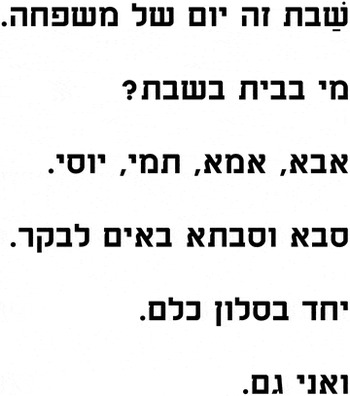
English translation: Saturday is a day for families. Who is home on Saturday? Dad, Mom, Tami, Yossi. Grandpa, and grandma come to visit. Everyone is in the living room together. So am I.
Session 2:

English translation: Once there was a pine tree. The tree wanted a friend. The sun came, the cloud came, the dove came, and the tree could not find a friend. Danny came, and planted a small tree next to the pine. The tree had a friend, the tree was not alone.
Coding instructions
Fluency

Confidence