Nursing home (NH) residents are at a particularly high risk of developing healthcare-associated infections owing to frail health, sharing of closed common environments, and frequent hospitalizations.Reference Strausbaugh, Sukumar and Joseph 1 , Reference Richards 2 Among the common causes of these healthcare-associated infections are multidrug-resistant organisms (MDROs)Reference Smith, Bennett and Bradley 3 , Reference Richards and Steele 4 such as methicillin-resistant Staphylococcus aureus (MRSA)Reference Bradley 5 , Reference Raghavendran, Mylotte and Scannapieco 6 or extended-spectrumβ-lactamase (ESBL) producers.Reference Rooney, O’Leary and Loughrey 7 Clostridium difficile is also increasingly common,Reference Magill, Edwards and Bamberg 8 , Reference Pawar, Tsay and Nelson 9 often owing to the overuse of antibiotics.Reference Stevens, Dumyati, Fine, Fisher and van Wijngaarden 10
The Centers for Medicare and Medicaid Services (CMS) requires all Medicare/Medicaid-certified NHs to have active infection control and prevention programs 11 but offers no specific practice standards. The only existing national guidelines for NHs, published by the Society for Healthcare Epidemiology of America and the Association for Professionals in Infection Control and Epidemiology,Reference Smith, Bennett and Bradley 3 are largely adapted from acute care settings.Reference Siegel, Rhinehart, Jackson and Chiarello 12 , Reference Siegel, Rhinehart, Jackson and Chiarello 13 These recommendations are broad, allowing for modifications based upon the residents’ clinical situations and facility resources, and defer to guidance developed by a handful of states. 14 – 16
Currently, little is known about actual infection control policies and practices that NHs adopt. Existing studiesReference Murphy, Eells and Quan 17 – Reference Mody, Langa, Saint and Bradley 19 are based on a small number of NHs and largely pre-date the most recent 2009 CMS infection control requirements for certified NHs, which have mandated more robust infection control programs and revisions to internal policies and practices. 11
In this study we examined the prevalence of healthcare-associated pathogens and infection control policies and practices in a national sample of NHs. We focused on the extent to which facilities follow existing national guidelinesReference Smith, Bennett and Bradley 3 with regard to dedicated time spent on infection control duties, admission and screening policies, isolation and contact precautions, decolonization, and room cleaning practices, as they relate to MRSA, ESBL producers, and C. difficile.
METHODS
In 2012 we conducted a national survey of Medicare/Medicaid-certified facilities. A random sample of 6,700 US NHs was identified using the CMS Nursing Home Compare website. Surveys were addressed to directors of nursing, asking for the survey to be completed by the person most knowledgeable about infection control and prevention in the facility. Two follow-up mailings were sent to nonrespondents 4 and 8 weeks after the initial mailing.
We adapted a previously validated NH infection control survey.Reference Murphy, Eells and Quan 17 The survey (Online Appendix 1) was composed of 56 mostly closed-ended questions about residents who are colonized or infected, admission policies for such residents, policies for routine screening on admission and for contact precautions, residents’ activity restrictions, decolonization practices, and the environmental cleaning practices for rooms of residents on contact precautions. Respondents were also asked about their title and the amount of time dedicated to infection control. The study was approved by the University of Rochester’s Institutional Review Board.
Secondary data—the 2012 CMS Nursing Home Compare report; the CMS Online Survey, Certification and Reporting data set; and the Long-Term Care Focus website 20 —were also employed to provide information on NH characteristics and infection control deficiency citations. The Rural-Urban Commuting Area Codes file (ZIP code level) was used to determine NHs’ rural-urban location. The primary and secondary databases were linked at the facility level, using a unique provider identification number.
To investigate the generalizability and the potential response bias, we compared facility characteristics between responding and nonresponding NHs using the Wilcoxon rank sum test for continuous variables and the χ2 test for categorical variables.
RESULTS
We mailed 6,700 questionnaires; completed questionnaires were received from 1,002 NHs for an adjusted response rate of 15.0%.
NH Characteristics
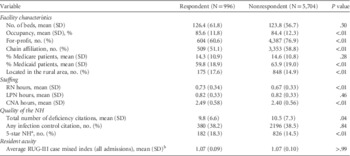
We did not observe statistically significant differences between responding and nonresponding NHs with regard to number of beds, percent of Medicare residents, staffing of licensed practical nurses, infection control citations, and facility case-mix index (Table 1). However, responding facilities had higher occupancy rates, higher staffing levels of registered nurses and certified nursing assistants, lower percent of Medicaid residents, and fewer total deficiency citations. Respondents were more likely to be 5-star facilities, and less likely to be for-profit and chain-affiliated.
Comparison of Nursing Home (NH) Characteristics: Responding Versus Nonresponding Facilities

NOTE. CNA, certified nursing assistants; LPN, licensed practical or vocational nurse; RN, registered nurse; RUG, Resource Utilization Group.
a This indicator shows whether an NH is a 5-star facility, an overall measure for NH quality based on the CMS Nursing Home Compare 5-star quality rating system that takes into account performance on state health inspections, quality measures, and nurse staffing levels. NHs assigned 5 stars are considered to have above-average quality compared with other facilities in that state.
b This index measures the resident acuity of a facility and is calculated by averaging the scores for all residents admitted to the facility based on the RUG-III classification system used by CMS for Medicare payment adjustment.
Prevalence of Healthcare-Associated Pathogens
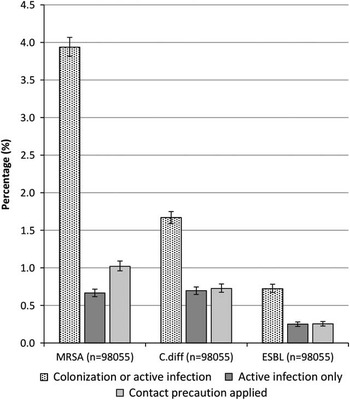
Overall, NHs reported 3.9% of residents as MRSA-positive (95% CI, 3.8%–4.1%). Of these, 16.9% had active infections and were receiving antibiotic therapy, and 25.9% were on contact precautions. For C. difficile, the reported prevalence rate was 1.7% (95% CI, 1.6%–1.8%); 41.7% had active infections and 43.5% were on contact precautions. Less than 1% of residents were reported harboring ESBL producers (0.7%; 95% CI, 0.7%–0.8%), among them 34.7% with active infections and 35.3% on contact precautions (Figure 1).
Overall prevalence rate of healthcare-associated pathogens in nursing homes for methicillin-resistant Staphylococcus aureus (MRSA), Clostridium difficile (C.diff), or extended-spectrum β-lactamase (ESBL) producers. Error bars indicate 95% CIs. n=total number of residents.

Resources and Staffing for Infection Control Activities
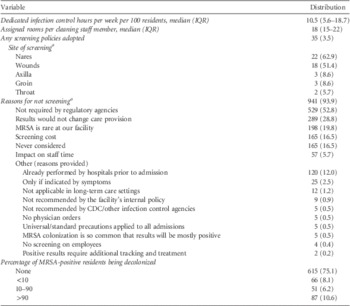
In most facilities, the individuals most knowledgeable about infection control and prevention practices were the directors of nursing (n=520 [51.9%]), followed by dedicated infection preventionists (IPs) (n=245 [24.5%]). NHs devoted a median of 10.5 hours per week per 100 residents to infection control and prevention activities (Table 2). Approximately 6.5% of the NHs reported more than 40 hours per week per 100 residents. NHs assigned a median of 18 rooms to each cleaning staff member (Table 2).
Staffing for Infection Control Activities, Screening Policies for MRSA on Admission, and Decolonization Policies for MRSA-Positive Residents (N=1,0002 facilities)

NOTE. Data are number (%) of nursing homes unless otherwise indicated. CDC, Centers for Disease Control and Prevention; IQR, interquartile range; MRSA, methicillin- resistant Staphylococcus aureus.
a Respondents could select more than one option.
Policies and Practices for Infection Control and Prevention
In this section, we compare infection control policies and practices reported by the NHs with the currently available recommendations and guidelines (in italics).
-
1) Denial of admissions solely on the basis of colonization or infection with MDROs is not appropriate. Reference Smith, Bennett and Bradley 3 , Reference Siegel, Rhinehart, Jackson and Chiarello 12 , Reference Aureden, Burdsall, Harris and Rosenbaum 21
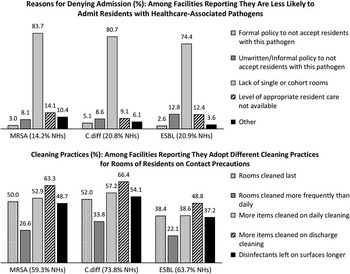
This practice was not very common (14.2%–20.9%) (Figure 2) and was mostly attributed to a lack of single or cohort rooms (74.4%–83.7%). Few NHs (2.6%–5.1%) reported having formal denial policies for MDROs or C. difficile, but 8.1% to 12.8% reported informal denial policies.
-
2) There are currently no recommendations for routine screening for MRSA on NH admission.
Very few NHs (3.6%) performed routine screening for MRSA on admission (Table 2). When screening occurred, nares and wounds were the 2 most common sites. More than half of NHs stated that they do not screen because it is not required by regulatory agencies. Thirty percent reported that screening would not affect care provision and 12.8% stated that screening was performed in hospitals before NH transfer. They also identified cost (17.5%) and limited staff resources (6.1%) as reasons for not screening.
-
3) Isolation precautions and restrictions on activities for residents harboring MRSA
-
∙ Apply contact precautions for residents with draining wounds, including single room, gloves and gowns for all resident contact and upon room entry, and dedicated care equipment. Reference Siegel, Rhinehart, Jackson and Chiarello 12 , Reference Siegel, Rhinehart, Jackson and Chiarello 13 , Reference Aureden, Burdsall, Harris and Rosenbaum 21
-
∙ Use mask in addition to contact precautions when near residents with respiratory symptoms or performing splash-generating procedures, Reference Siegel, Rhinehart, Jackson and Chiarello 12 , Reference Siegel, Rhinehart, Jackson and Chiarello 13 , Reference Aureden, Burdsall, Harris and Rosenbaum 21 but not routinely to prevent transmission from patient to health care workers. Reference Siegel, Rhinehart, Jackson and Chiarello 12
-
∙ Limit the movement or transport of residents with draining wounds from the room for essential purposes only. Reference Aureden, Burdsall, Harris and Rosenbaum 21 Allow colonized or infected residents whose site of colonization or infection can be appropriately contained, and who can observe good hand hygiene practices, to enter common areas and participate in group activities. Reference Siegel, Rhinehart, Jackson and Chiarello 12 , Reference Aureden, Burdsall, Harris and Rosenbaum 21
For MRSA-infected residents with draining wounds 76.9% of NHs report using full contact precautions (private rooms, glove and gown use, dedicated equipment); another 21.4% implemented less than complete contact precautions, primarily owing to lack of dedicated equipment (62.2%) and private rooms (32.7%). More than half reported using precautions for infections not involving draining wounds. Although contact precautions for MRSA carriers were less frequent, 50.5% reported using gloves when caring for these residents. Masks were used in 81.8% of NHs when near infected residents with respiratory symptoms, and 15.4% used masks regardless of respiratory symptoms while 2.4% used them for asymptomatic carriers (Figure 3). Similar patterns were observed vis-à-vis activity restrictions (Figure 3). More than two-thirds of NHs reported using restrictions on activities of infected residents with uncontained wounds; fewer (14.0%–15.2%) reported use for those without draining wounds. Restrictions for MRSA carriers were rarely adopted (<2%).
-
-
4) Decolonization for MRSA-positive residents is not recommended routinely but should be used as a component of intensified MRSA control program for a limited period of time on a case-by-case basis.Reference Siegel, Rhinehart, Jackson and Chiarello 12 , Reference Aureden, Burdsall, Harris and Rosenbaum 21
Most NHs (75.1%) reported they do not decolonize residents harboring MRSA, and another 8.1% reported decolonizing less than 10% (Table 2). However, 10.6% reported they decolonize at least 90% of such residents.
-
5) Prioritize room cleaning of residents on contact precautions; Reference Siegel, Rhinehart, Jackson and Chiarello 12 , Reference Aureden, Burdsall, Harris and Rosenbaum 21 however, no guidance exists as to how such rooms should be cleaned.
For environmental cleaning, approximately two-thirds of NHs reported adopting different cleaning practices for rooms of residents on contact precautions (Figure 2). For example, on discharge more items were cleaned in rooms previously occupied by residents on contact precautions for MRSA (63.3%), C. difficile (66.4%), and ESBL producers (48.8%). In addition, 37.2%–54.1% of NHs reported leaving disinfectants on surfaces longer in these rooms. The least common approach was to increase the frequency of cleaning (26.6% for MRSA; 33.8% for C. difficile, and 22.1% for ESBL producers).
Admission denial policies and cleaning practices for nursing home (NH) residents harboring healthcare-associated pathogens: methicillin-resistant Staphylococcus aureus (MRSA), Clostridium difficile (C.diff), or extended-spectrumβ-lactamase (ESBL) producers.

Isolation precaution and activity restriction policies for residents harboring methicillin-resistant Staphylococcus aureus (MRSA).

DISCUSSION
In the past 2 decades, an increasing number of state and regional guidelines or recommendations have been issued for NH surveillance and infection control activities. More recently CMS has issued national requirements for NHs to implement more robust infection prevention and control programs. Yet, little is known about the NHs’ response to these largely voluntary infection control approaches. This national study is one of the first to shed light on NHs’ practices in this regard.
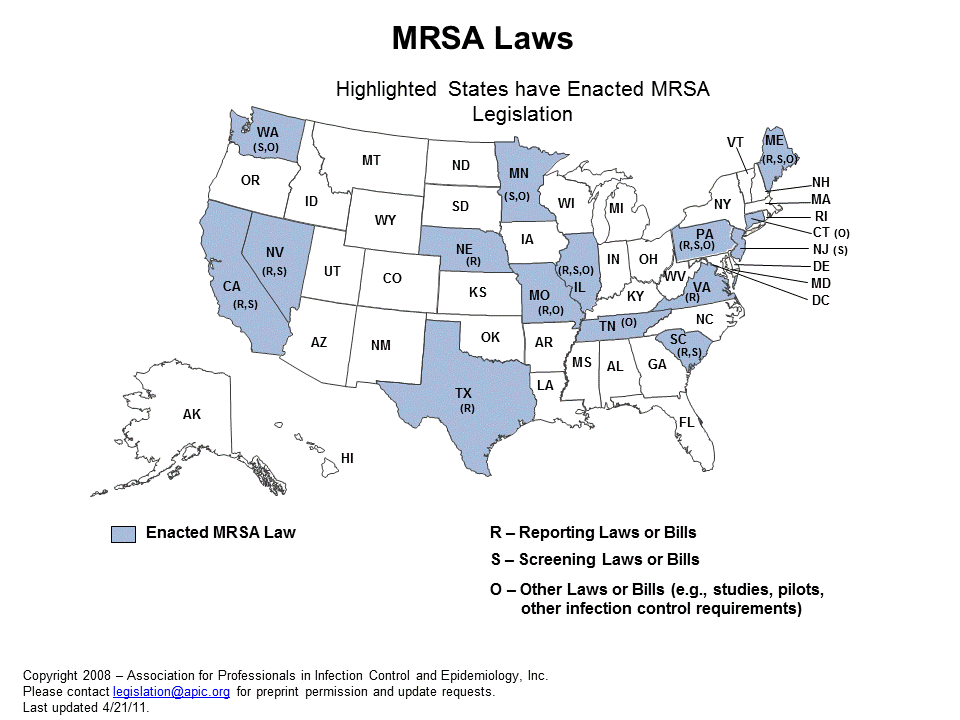
Consistent with the current lack of recommendations for MDRO screening, the majority of NHs reported no routine screening activities. Aside from the absence of regulatory mandates, many NHs identified lack of actionable response to screening (positive results would not change care provision) and lack of resources (impact on staffing, cost of screening) as reasons for not screening. Some NHs also reported relying on hospital screening to detect colonization on admission. Nine states have enacted laws requiring active surveillance cultures at hospital admissions. 22
In the absence of routine screening, it is not surprising that MDRO prevalence reported by the survey respondents (eg, 3.9% for MRSA) is considerably lower than prevalence based on screening cultures (24%–58%).Reference Murphy, Eells and Quan 17 , Reference Furuno, Hebden and Standiford 23 , Reference Mody, Kauffman, Donabedian, Zervos and Bradley 24 A recent study using the Minimum Data Set to assess prevalence reported results similar to ours.Reference Kahvecioglu, Ramiah and McMaughan 25 Unlike surveillance testing, both the Minimum Data Set and surveys rely on staff knowledge about residents’ disease status, 26 and thus are unlikely to reflect true carriage burden or risk of transmission.
Infection control programs in NHs are supposed to be spearheaded by IPs,Reference Smith, Bennett and Bradley 3 but this practice is far from universally adopted. Dedicated IPs were found in only one-quarter of NHs and full-time IPs were rarely available. Although empirical data justifying a fulltime IP in NHs are still lacking, a ratio of 1 IP to 250 beds has been suggested as optimal.Reference Smith, Bennett and Bradley 3 , Reference Morrison 27 By this standard, the NHs in our study are nearly 40% below the expected IP staff levelsReference Smith, Bennett and Bradley 3 , Reference Morrison 27 and 60% below that for small rural hospitals.Reference Stevenson, Murphy and Samore 28
The disparity in infection control resources between hospitals and NHs is worrisome, especially in an era when patient transfers between the 2 care settings are more and more frequent, potentially contributing to the spread of healthcare-associated pathogens.Reference Huang, Avery and Song 29 A recent study found that an outbreak in a single NH influences MRSA prevalence in multiple hospitals with which that NH shares patients.Reference Lee, Bartsch and Wong 30
Current guidelines do not recommend denying NH admission solely on the basis of colonization or infection with MDROs,Reference Smith, Bennett and Bradley 3 , Reference Siegel, Rhinehart, Jackson and Chiarello 12 , Reference Aureden, Burdsall, Harris and Rosenbaum 21 and indeed our results suggest that formal NH policies do not support such practice. However, a substantive number of NHs report they are less likely to admit such patients. Shortage of single rooms and inability to provide an appropriate level of care are cited as reasons for denying admission, as previously reported in other studies.Reference Kreman, Hu, Pottinger and Herwaldt 18 , Reference Reynolds, Kim and Kaplan 31
Following concerns about delivering care that is consistent with a “home-like” environment,Reference Mody, Bradley and Huang 32 most NHs impose only limited restriction on activities of residents whose site of colonization or infection can be contained. This practice is consistent with a prior study showing that compared with universal glove use for all residents, contact isolation precautions did not decrease the frequency of MRSA acquisition but did result in 40% higher costs and 21% lower rates of hand hygiene.Reference Trick, Weinstein and DeMarais 33 Importantly, our study found that gloves were more commonly used than any other approach, indicating that NHs may be more aware and supportive of this barrier precaution, particularly compared with more expensive approaches such as the use of single rooms.
Owing to concerns with resistance to decolonizing agents and risks of recolonization, current guidelines for NHs do not recommend routine decolonization, except in conditions of increased transmission.Reference Siegel, Rhinehart, Jackson and Chiarello 12 , Reference Aureden, Burdsall, Harris and Rosenbaum 21 We found that most NHs did not decolonize MRSA carriers. A prior study suggested several factors that might temper NHs’ decision to decolonize—such as time and cost, lack of support from physicians, need for a dedicated decolonization team, and risks of recolonization due to frequent patient transfers to and from hospitals.Reference McClean, Tunney, Parsons, Gilpin, Baldwin and Hughes 34
Environmental contamination also plays a key role in the transmission of MDROs and C. difficile. Centers for Disease Control and Prevention guidelines recommend that NHs prioritize room cleaning of residents on contact precautions and focus on frequently touched itemsReference Siegel, Rhinehart, Jackson and Chiarello 12 ; however, there are no specific instruction about cleaning practices. Despite this lack of clarity, we found that many NHs adopt a variety of enhanced cleaning practices for rooms of residents on contact precautions. These practices may be particularly important in NHs as they do not disrupt social and care activities, but directly intervene on the path of person-to-person transmission.
When infection control practice recommendations are available, most NHs appear to follow them. Recommendations for changes in practice that do not require substantial resource investment—for example, the use of gloves, masks, and room cleaning—have substantially better chances of being adopted. However, when additional dedicated staff (eg, IPs) or single rooms specifically designated for infected patients may be indicated, NHs are reluctant or unable to comply. Although regulatory mandates may be more effective than recommendations in assuring compliance, to be successful such tactics must be accompanied by adequate financial and educational supports, given the already financially constrained circumstances of most facilities.
Perhaps a meaningful starting point is to promote working partnerships between NHs and hospitals sharing significant numbers of patients with a potential for high infection transmission risk. Care transitions between hospitals and NHs are often fragmented and poorly informed, and rarely coordinated.Reference Naylor, Kurtzman and Pauly 35 If MRSA screening results were accurately and promptly shared with NHs during transfers, NHs may be able to more effectively use this information to treat or contain transmissions, potentially reducing rehospitalizations of infected residents. Today, however, the lack of information and the lack of communication between hospital and NH staff have been cited as barriers to effective infection control and prevention in NHs.Reference Wolf, Lewis, Cochran and Richards 36
The principal study limitation is the low response rate, which may limit the generalizability of our findings. It is interesting to note that this response rate might also indicate lack of interest or perceived lack of importance of this topic in NHs. A prior study has shown that only 59% of NH staff perceived MRSA to be a risk to residents’ safety.Reference Wolf, Lewis, Cochran and Richards 36 Lack of managerial interest in and emphasis on residents’ safety culture has also been identified as a barrier to infection control and prevention in NHs.Reference McClean, Tunney, Parsons, Gilpin, Baldwin and Hughes 34 Overall, our survey’s response is similar to that of an earlier national survey of C. difficile prevalence and control practices in US hospitals (response rate, 12.5%), suggesting that expecting higher response rates may not be realistic.Reference Jarvis, Schlosser, Jarvis and Chinn 37
Our study suggests that NHs are quite compliant in following infection control guidelines as long as such recommendations do not require substantial financial investments. Additional research to better understand which infection control practices are effective, while maintaining a home-like environment for all residents, is critical to ensure increased NH compliance.
Acknowledgments
Financial support. National Institute of Nursing Research (R01 NR010727).
Potential conflicts of interest. All authors report no conflicts of interest relevant to this article.
Supplementary material
To view supplementary material for this article, please visit http://dx.doi.org/10.1017/ice.2015.59